Shared posts

14 Aug 03:17

Scripting News: Can the EFF rep the people re NSA?

I did a few searches, and looked around the EFF site to get an idea of where their money comes from. I did not find the information, except in a general sense, that a percentage comes from foundations, some from companies, and some from individuals.

I'm sure they try to represent all of us, and they have done a great job, except now, when it comes to the NSA revelations, it seems to me that they, like a lot of the pundits in tech, have a conflict, unless little or none of their funding comes from the tech industry.

As Bruce Schneier observes, the tech industry is now clearly subordinate to the US government. How long this has been going on is in dispute. Schneier believes it's recent. I think it's deeply ingrained in the structure of the tech industry. There's a revolving door between government and the industry, as with every other industry. Tech is younger so it's less developed, but it's catching up quickly.

Foundations like the EFF may be conflicted as well. Until we know where their money comes from, we won't have a good picture of whether or how conflicted they are.

There has been some discussion. Bruce Sterling wrote a piece that was critical of the EFF without naming them, criticism that I thought was fair. There was a response from Cory Doctorow on Boing Boing and one by Danny O'Brien who currently works at EFF.

Doctorow is a former staffer at EFF and a current EFF fellow.

The discussion so far has been superficial and some of it disappointingly personal. It would be better to get an overall sense of who we're dealing with. Is EFF repping Google, Apple, Amazon, etc? Or the users of the Internet? Can't really represent both now, because the interests are in conflict, imho. And if EFF doesn't represent the people, who does?

Update

  • John Perry Barlow, co-founder of EFF, offers in a tweet: "Please give us a sense of how you'd like #EFF's income stream to be broken down and we'll do it."
    • @davewiner Please give us a sense of how you'd like #EFF's income stream to be broken down and we'll do it. We've nothing to hide.

      -- John Perry Barlow (@JPBarlow) August 13, 2013
  • Thanks, that would be great. Any way that answers this question -- how much of EFF's funding comes from the tech industry. And to be complete, how much comes from governments, although I'm pretty sure that's close to nil. ;-)
13 Aug 18:47

Editorial: International Space Station’s viability beyond 2020 doubtful

by Lee Hutchinson

There's a flagpole atop the roof of Building 30 at the Johnson Space Center in Houston, proudly streaming Old Glory in the sultry Texas summer wind. On the very first closed-door tour I got of the restored Apollo Mission Operations Control room more than a decade ago, my tour guide pointed out the flag as we entered the building's lobby. "That flag," he said, smiling, "flies whenever there is an American in space. Thanks to the International Space Station (ISS), NASA has had a flag up there continuously since 1998. I hope it'll be up there forever."

Forever is a long time, but it seemed possible—after so many fits and starts, construction on the ISS was barreling forward. Columbia was still a member of the orbiter fleet. It felt like NASA had actual for-real momentum—a big project with a goal to work toward. We were building the world's highest-flying laboratory, and it was going to teach us everything we needed to know to send humans elsewhere in the solar system.

It's 2013, and the international partnership that helped fund the ISS is starting to crumble. NASA's manned space program, the only program ever to put human beings on another world, now lacks even a single rocket that can get people off of the Earth's surface. The six-person crew of the ISS rides up into low Earth orbit courtesy of Russia, while in America the government allocates an increasingly smaller percentage of the overall federal budget to NASA.

Read 14 remaining paragraphs | Comments


13 Aug 18:03

Krang

Krang’s ultimate goal is to take over the Earth; it probably only became his objective after he was exiled on the Earth, but this point is never made clear.

Link (Thanks, Sarah)

13 Aug 17:50

diy: Become a Block Builder.

13 Aug 17:49

Shadow Triforce shirt idea by Cory Schmitz The inverted Triforce...

by ericisawesome


Shadow Triforce shirt idea by Cory Schmitz

The inverted Triforce tee complements his excellent Wisdom, Courage, Power shirt at Attract Mode (bottom image). If you missed the news last week, The Legend of Zelda: A Link Between Worlds will introduce the Shadow Triforce.

I always love Cory’s shirts because they’re rarely gimmicks or mash-ups, just awesome and thoughtful designs.

PREORDER The Legend of Zelda: A Link Between Worlds, upcoming games
13 Aug 17:49

Chinese doctor builds illegal rock villa atop Beijing apartment tower

by George Dvorsky

Chinese doctor builds illegal rock villa atop Beijing apartment tower

Eccentric Beijing resident Zhang Biqing has just spent the last six years constructing this $24 million faux-mountaintop villa on top a 26-story hi-rise — just in time for the Chinese authorities to finally declare it illegal. The 10,000 square foot complex is now slated for demolition.

Read more...


13 Aug 17:49

That Dragon, Cancer tackles Ouya in 2014

by Jessica Conditt
That Dragon, Cancer tackles Ouya first, exclusively in 2014

That Dragon, Cancer will debut on Ouya in 2014, showcasing an intense, emotional game on the big screen, in living rooms and just as developers Ryan Green and Josh Larson intended.

That Dragon, Cancer tells a raw story of Green's real life - his 4-year-old son, Joel, has cancer and is fighting his eighth tumor, and the game chronicles his family's struggles, mimicking events and emotions that Green is experiencing himself. It's a breathtaking, interactive poem disguised as a low-poly point-and-click adventure.

"Part of the reason we're creating this game is to create a safe space to talk about hard things," Green told Joystiq. "We want people to share their own experiences about life and death and hope and grace with each other .... It's an experience that we're designing for players that have an hour or two to spend with us. And while it's certainly a personal experience, my hope is that it will be a shared experience."

Green and Larson will self-publish That Dragon, Cancer through their studios, Media Greenhouse and God at Play, with an investment from Ouya. Kellee Santiago, head of developer relations at Ouya, said that investment was "enough so Ryan and Josh and their team [could] make this game a reality without the added burden of struggling financially to do so."

After crafting the ideal living room experience, the developers will "eventually" bring the game to other platforms.

Continue reading That Dragon, Cancer tackles Ouya in 2014

JoystiqThat Dragon, Cancer tackles Ouya in 2014 originally appeared on Joystiq on Tue, 13 Aug 2013 09:00:00 EST. Please see our terms for use of feeds.

Permalink | Email this | Comments
13 Aug 17:48

storm-indicator: A unity indicator for connecting to your...


storm-indicator:

A unity indicator for connecting to your SSH hosts easily.

13 Aug 17:47

theatlantic: You Can Do Anything: Must Every Kids’ Film...


theatlantic:

You Can Do Anything: Must Every Kids’ Film Reinforce the Cult of Self-Esteem?

Encouraging kids is fine, but films like Planes and Turbo take their messages to an extreme. Parents should turn to 1969’s A Boy Named Charlie Brown for a reality check.

Read more. [Image: Disney; Dreamworks; Cinema Center Films]

Interesting take on this…

13 Aug 17:47

US Moves to Ground Big Air Merger - Wall Street Journal


Wall Street Journal

US Moves to Ground Big Air Merger
Wall Street Journal
The Justice Department unexpectedly moved to block the merger of American Airlines parent AMR Corp. and US Airways Group Inc., threatening to upend what was viewed as the final step in the consolidation that has helped return U.S. airlines to profit after ...
US, Filing Suit, Moves to Block Airline MergerNew York Times
Government blocks US Airways, AA dealCBS News
Feds Board Wrong Plane in Blocking US Airways–American DealTIME
MiamiHerald.com -Bloomberg -Dallas Morning News
all 524 news articles »
13 Aug 17:47

New profile of Snowden’s trusted ally illustrates importance of opsec

by Cyrus Farivar

Edward Snowden first bonded with Laura Poitras—the filmmaker and one of the two journalists who first exposed his leaks from the National Security Agency (NSA)—when Snowden “discovered Laura was more suspicious of me than I was of her, and I’m famously paranoid.” That revelation comes from a new profile of Poitras in the New York Times Magazine published on Tuesday.

In a rare interview mediated by Poitras, the Times also spoke with former NSA contractor Edward Snowden to gain insight into the veteran filmmaker.

“The combination of her experience and her exacting focus on detail and process gave her a natural talent for security, and that’s a refreshing trait to discover in someone who is likely to come under intense scrutiny in the future, as normally one would have to work very hard to get them to take the risks seriously,” Snowden said.

Read 5 remaining paragraphs | Comments


13 Aug 17:46

I'm 13 and None of My Friends Use Facebook

by hodad

I decided to get a Facebook just to see what it was all about. I soon discovered that Facebook is useless without friends. My only friend is, like, my grandma.

Original Source

13 Aug 17:45

Microsoft Stares Down Their Last Xbox One Hurdle, $499 - Forbes

by gguillotte
Kinect helped drive the price of the Xbox One up to $499 as a mandatory piece of hardware for the system to operate. Now that it’s optional, shouldn’t there be a Kinect-free version for I don’t know, the PS4 price of $399?
13 Aug 17:43

Second Skin


miguelvallinas.com


miguelvallinas.com


miguelvallinas.com

Second Skin

13 Aug 17:42

Here Here

13 Aug 17:42

SDCC: Designer Olly Moss Talks Movie Posters, Comics & "The Simpsons"

firehose

Olly Moss beat

Acclaimed designer Olly Moss discussed creating much-sought-after movie posters for Mondo, his love of comic books and why his "An American Werewolf in London" poster is his favorite.
13 Aug 17:41

VIDEO: Dad calls Chechen son killed by FBI an innocent victim - FTC Publications


San Francisco Chronicle

VIDEO: Dad calls Chechen son killed by FBI an innocent victim
FTC Publications
The father of a Chechen man who was fatally shot while being questioned by an FBI agent about his ties to one of the Boston bombing suspects said that his son was a conscientious, responsible individual who became an innocent victim. Thanks for checking ...
Father speaks about Chechen's fatal shootingWWMT-TV

all 49 news articles »
13 Aug 15:30

Fashion It So | Starship Mine - 6.18

by OnlyMrGodKnowsWhy

The episode starts with Picard being accosted by EVERYONE on the ship, starting with Data:
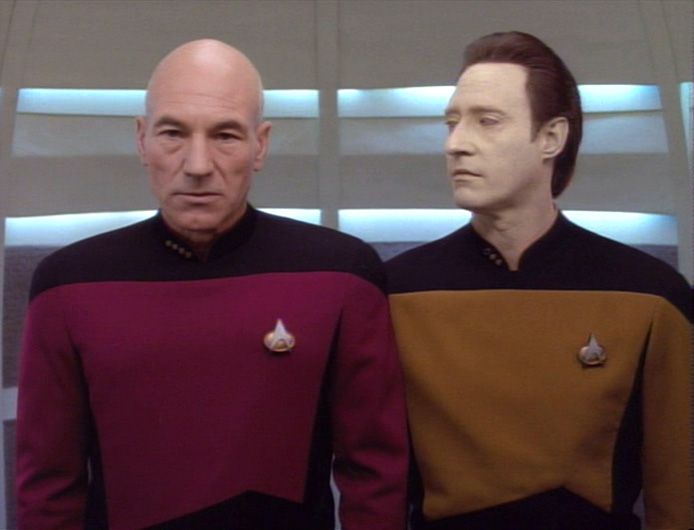
image

Are you uncomfortable yet? How about now? Now? What about now?

Data is attempting to learn about small talk, which confuses and irritates Picard: 

image

I say…are you malfunctioning, old chap?

He walks through the whole ship, being pestered at every turn by crew members (wearing only uniforms and thus not pictured). It’s like the opening sequence of a rom-com about an uptight businesswoman who learns to love, except the uptight businesswoman is a dashing older gentleman.

Eventually we learn that two things are happening:

  • The whole crew is leaving so the ship can undergo a baryon sweep (which will kill organic matter)
  • There is a reception going on for a commander that no one likes because he loves to talk about nothing

So everyone leaves the ship. But before they do, Picard sees these guys getting ON the ship:

image

Those jumpsuits are suspiciously un-standard…and suspiciously ugly

Is that Tuvok in the middle? …sort of. We’ll get back to him later. For now, I will just say: those boots are atrocious.

Down at the reception, Bev’s hair is looking right:

image

I KNOW IT’S A WIG AND I DON’T EVEN CARE

It’s just so luxuriant.

Meanwhile, Data is watching the annoying commander for tips on small talk, leading to a series of great faces:


image

image

image

Give the man a goddamn Emmy

Everyone is trying to figure out a way to get out of this boring-ass reception, and Picard actually manages it, by saying he wants to go get his saddle and ride the horses, which is totally what I ALWAYS use as an excuse, except when I say it, it means something else. You use your imagination on that one.

image

Look, over there - it’s, uh…something else

Mostly I included this because I want to know what that shit is on the table and what art department person was responsible for it. “Hey, can we get a giant polka-dot wine goblet and an abstract Axe Body Wash bottle to go behind it? Great.”

But now we are finally to the part of the episode we’ve all been waiting for. Picard’s Riding Outfit. You can never truly be prepared for this, but try. Try.

image

DAAAAAAMN

There is just so much to love about this outfit. First of all, yes, Rochelle, carrying a saddle is hot. Why? Who knows. Let’s not question it. Shhh. Shh.

Next, this color and texture combo. We’ve got a merlot velvet blazer over a dusty green possibly silk shirt, and what appear to be velour treggings (that’s trouser-leggings for those not in the know), but will later prove to be corduroy treggings:

image

A wale-formed butt

It also turns out that the top is not just dusty green, but some sort of herringbone pattern for EXTRA SASS:

image

Petulant Teen Picard will play his music as loud as he likes

Seriously, though, check out this beautiful draping: 
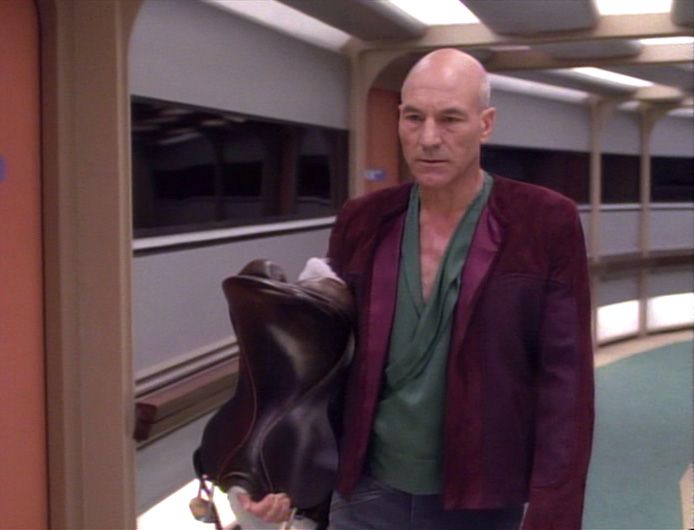
image

Deep V 

As Picard strolls along, he runs into this guy:

image

Tuvok! Your ears!!!

j/k, that’s not Tuvok. It’s just the actor that plays Tuvok, in a role as Terrorist in a Terrible Jumpsuit. You guys. This jumpsuit is terrible. Why so many seams in places that do no favors to the human form? Why the muted color palette? This makes me think of what the people in The Giver might wear because it evokes sexlessness and lack of passion. I know there are colors on this jumpsuit, but they are so boring and dusty that they read like grey.

Picard is like “waaaaaaait aaaaaa miiiiiiiinute” and fights the guy, because he’s not supposed to be there:

image

Howwww diiiiid youuuuu GET. HERE. Nobody’s s’pos’ta BE. HERE.

Picard’s riding boots are classic and hot, and not-Tuvok’s jumpsuit is just as terrible from the back. 
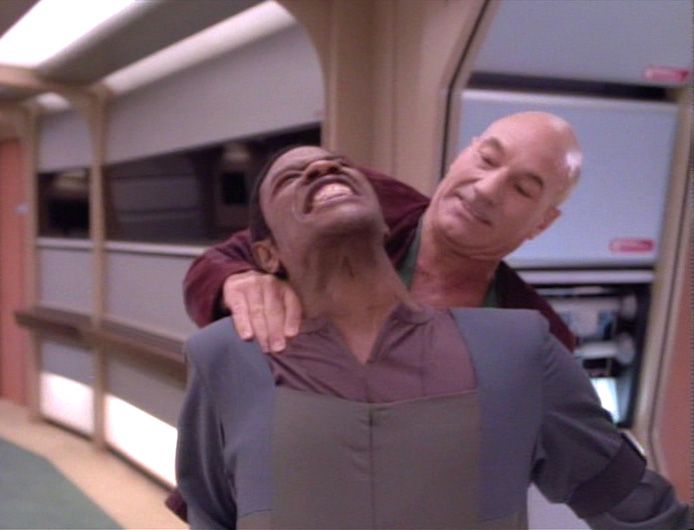
image

Vulcan neck pinch? Is that…irony? 

Picard takes not-Tuvok out for the moment and begins his descent (ascent?) into Die Hard: Enterprise Edition.

Meanwhile, Data is boring this guy with his newly-acquired small talk skills:

image

The stripes on my top mirror the bars on the prison of this conversation

It turns out, however, that this whole reception is some sort of secret attack on the base they’re at and the people “hosting” it are also bad guys? Honestly, though, look at this guy. He’s clearly a villain:

image

Benedict Cumberbatch looks terrible

They took 1 part Vincent D’Onofrio, 1 part Oliver Platt, added some ridges and a touch of bitchy resting face, and ended up with this fellow in a leftover Tron outfit. The hair, however, is inexplicable.

image

An updo can make any outfit feel fancy, even a mock turtleneck

What is even happening here? A cross between a mohawk and your grandmother’s church hair, which means we may see it on Miley Cyrus before long.

This guy and his friend start shooting and take everyone at the reception hostage:

image

Also possibly a Miley Cyrus hairdo

The stripes on this top are so weirdly wide. He looks like a greyscale clown.

Meanwhile, Picard is fully playing out his Die Hard fantasies on the Enterprise. It really is pretty much just like Die Hard, except there are no hostages and Alan Rickman is tragically absent. 

image

The role of Alan Rickman will be played by a 1940s lounge singer

That hair, right? For a terrorist, she sure has a great updo. Check out the back!

image

A sensible Modified Back Princess Leia is all the rage with terrorists this season

So what’s happening is that some terrorists - all wearing the same bad jumpsuit we saw earlier on not-Tuvok - have used the baryon scan to sneak onto the ship for nefarious purposes. In addition to Lady Alan Rickman, who’s the leader, we’ve got Molly Ringwald Ridge Face Terrorist:

image

Pretty in Purple (and Blue and Boring, Boring Grey)

Another member of the team, Hobbit Jared Harris:

image

Actually Jared Harris would be a great addition to Middle Earth 

And their compatriot, Adrien Brody Plays a Coral Reef:

image

We would also have accepted “Jonathan Pryce: Ocarina Edition”

What do they want? I don’t know, some explosive stuff from the engine. That part is not important. This is important:
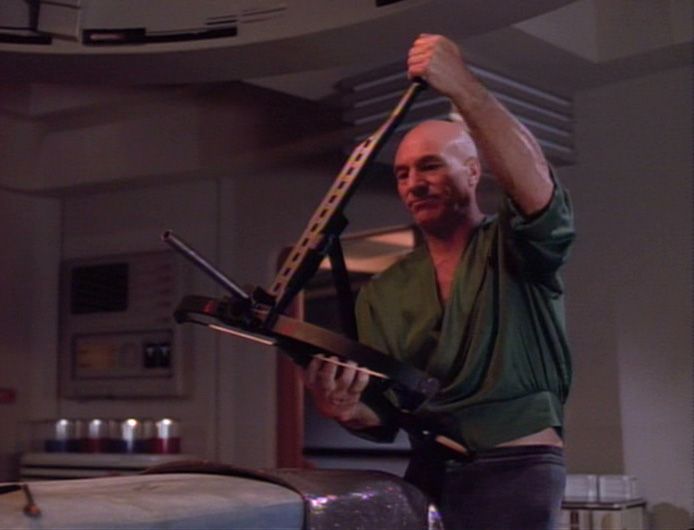
image

CROSSFIRE! YOU’LL GET CAUGHT UP IN THE

Yes, that’s a crossbow. On the Enterprise. SEEMS LEGIT. Also, that green top is even more ladylike than I previously imagined. Look at that banded bottom! 

Just like John McClane, Picard must improvise, since command functions and power are all off. This leads to:

image

That can’t be safe

Most of the episode is a game of cat-and-mouse, both up on the Enterprise and down on the base, and eventually the crew of the Enterprise wins, obviously. You should watch this one, it’s great. There is a moment where Picard is trying to avoid the baryon sweep and ends up in this hidey-hole in Ten-Forward that is just a very enjoyable shot:

image

Peek

And of course at the end, Picard is concerned about his saddle, which he hasn’t seen since he used it to fight not-Tuvok. Worf finds it in a maintenance locker and returns it to a beaming Picard:
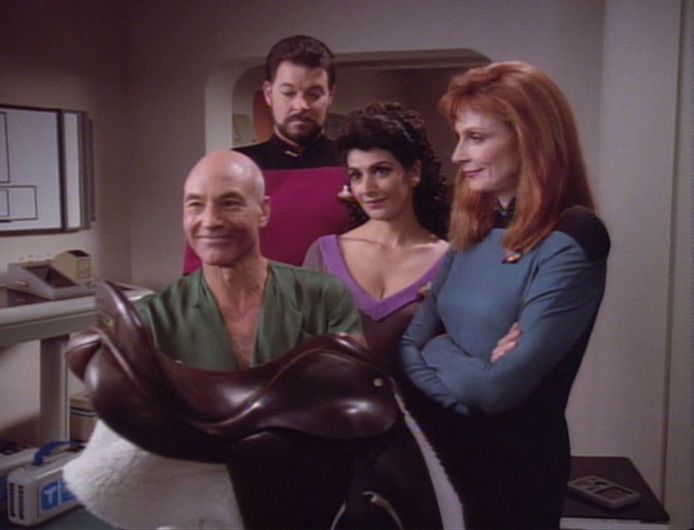
image

Just horsin’ around

This looks like a promo shot for a sitcom about a goofy bald guy who loves horse riding, his redheaded sister/caretaker, and their neighbors, a sensual brunette woman and her stern husband. What japes will they get into next?

Original Source

13 Aug 15:21

chasing-yesterdays: Thomas Jefferson’s recipe for vanilla ice...


chasing-yesterdays:

Thomas Jefferson’s recipe for vanilla ice cream, written in his own hand, ca. 1780s. It may be the first recipe for ice cream recorded in America (Jefferson most likely got it from a French source).

Here is a transcription of the recipe if you’re feeling bold enough to try it at home: Ice cream.


Source: Library of Congress

Hmm…

13 Aug 15:20

Drunk and chic: meet Lapka BAM, a breathalyzer for design nerds

by Ellis Hamburger
firehose

"Lapka for iPhone and Android increases its font size as you drink more, and even scraps its gestural interface and displays virtual buttons if you’re drunk enough. If you blow a .20, the app might even buzz your phone the next morning to make sure you’re okay."

What would a breathalyzer look like if it were designed in the iPhone era? It probably wouldn’t look like the BACtrack Select S80 Professional Edition, a heap of plastic with a '90s-era digital readout, which is Amazon’s top-selling breathalyzer.

Russian designer Vadik Marmeladov wanted to build a breathalyzer that looked like something James Bond would use if he had one too many Vodka martinis — the kind of tool he wouldn’t be embarrassed to pull out of his pocket at a club. He built the Lapka Breath Alcohol Monitor, a handsome ceramic cylinder that monitors your blood alcohol content and sends it to your smartphone using sound waves whenever you blow into it. It’s up for pre-order starting today.


Marmeladov and his small team of designers and engineers didn’t exactly start from scratch. They previously built the Lapka Environment Monitor, a bundle of sensors for measuring the temperature, humidity, radiation, and organic content of your surroundings. Marmeladov anticipated skepticism from consumers, but when Urban Outfitters picked up Lapka and sold out its stock twice in a row, he knew they were onto something. "We will never sell a million units," says Marmeladov, "but for a radiation sensor, it’s very very good." The Lapka Environmental Monitor’s success indicated that there might be a market for beautiful and modern scientific devices and tools outside of sci-fi movies.

"We will never sell a million units."

The next step was to build something that would be more useful on a daily basis than a pocket Geiger counter. Marmeladov arrived at the breathalyzer, which to him is a vastly undervalued personal measurement tool that has gone largely unchanged in the last few decades. To the Lapka team, a breathalyzer is not just a means of gauging your level of inebriation, but a way to measure your blood chemistry and get to know your body. It’s not so different from a Jawbone Up or Nike Fuelband, they say — two devices that help quantify your existence and provide more transparency about your personal health. (Of course, if you’re tracking drunkenness over time the same way you track fitness, a serious look at your lifestyle might be in order).

The Lapka BAM looks like something Jony Ive could have crafted, a pristine, buttonless cylinder made of the same diamond-ground ceramics used in Panerai watches. Inside the device is a police-grade electrochemical fuel cell sensor which estimates your blood alcohol content (BAC). To activate the BAM you simply cup one hand around it and blow. Your breath activates a switch that turns on the device, almost as if you were playing a woodwind instrument. The BAM then emits an inaudible sound wave carrying your BAC, which your phone intercepts and displays on-screen in the Lapka app. Marmeladov chose sound over Bluetooth since it provided much better battery life, and it somehow still works even in loud clubs. "Speech, yelling, or music at any volume will be around 100-5kHz, and Lapka operates around 18kHz," says Marmeladov.

Lapka_frequencies

The app can keep track of your BAC levels and provide funny quips like "Go mingle" when you’re at .06, but there’s another twist. "If you’re drunk, you shouldn’t see the same app," says Marmeladov. Lapka for iPhone and Android increases its font size as you drink more, and even scraps its gestural interface and displays virtual buttons if you’re drunk enough. If you blow a .20, the app might even buzz your phone the next morning to make sure you’re okay. It’s all a bit cute for a breathalyzer, but the Lapka team has succeeded in elevating the device above its cultural stereotype and using it objectively, as a data-gathering tool. Perhaps someday, the Lapka BAM will hook into your own personal API the way you'd expect other quantified self gadgets to do.

Marmeladov has made recording your BAC fun, which could make him an enemy of moms everywhere

It’s also far less uncomfortable to use in public, since it’s smaller than your hand. "We wanted to create a beautiful device that disappears," says Marmeladov. "The device is your hand, and now you have a new gesture — a new behavior to measure something." He has also eliminated the replaceable mouthpiece that makes most breathalyzers awkward to share with friends, which you now might do, since the Lapka app has a "party mode" that lets you compare BAC scores with friends. Marmeladov has made recording your BAC fun, which could make him an enemy of moms everywhere.

The Lapka BAM launches in October and is priced at $199.99, which is surprisingly competitive with other breathalyzers on the market that sync with a smartphone. Looking forward, Marmeladov hopes to build a consumer healthcare brand that makes the technology behind its products invisible, yet accessible to anyone. "People are going to give us really intimate moments in their lives," says Marmeladov, "So they shouldn’t think about the product." He re-emphasizes that he’s not judging your behavior — he’s only quantifying it. "We don’t want you to stop drinking," he says. "This is a ritual and you have to make it right. Lapka will guide you."

13 Aug 15:19

GenCon Bound: Safety and Inclusivity

by Kira Scott
The convention season is well under way now. We’re looking forward to going to GenCon Indianapolis from August 15-19. GenCon is a tabletop game focused event, though it’s got a bit of everything. Attendance has risen to 40,000 or more people and it’s in a city that embraces the geekdom that washes over it one week a year. Nearby restaurants put “Welcome GenCon!” signs in their windows, play fantasy and adventure movies on their big-screen TVs and some even make over their menu with fandom-named items. It’s a great space that we enjoy. Both of us are long-term attendees. We’ve played rpgs, board games, video games, and larps there, walked, talked and boothed the exhibit hall, and attended many official events like book-signings, concerts, movies and auctions.

So, what about inclusivity? How safe will it be from an anti-harassment point of view?

To help do our part to highlight these issues, we thought we’d focus some attention on what is going on at GenCon, and take a few steps ourselves to help make it a safe space.

Panels/Events

The following panels are going on during GenCon that support making it a diverse, inclusive & safe space. Clink the links below for times. The location is online and will be listed in the program. If you know of more events, mention them in the comments. We’ll add them to the list here:

Backup!

Also, we’re working with Tracey Barnett to have Backup ribbons to hand out. These ribbons come from the Open Source Women Back Eachother Up and Men’s Auxiliary Project. This is an (as it says) Open Source, do it yourself campaign to encourage people to be aware of harassment that goes on around them, and to do something rather than assuming it will just go away. We’ll have ribbons from the Backup Ribbon Project, and our intent for it is to be as they say, “No judgement, no exceptions. We’ve got your back.”

We’ll have these ribbons on hand at both our panels (Geeky Women Unite and Anti-Harassment Policy) and just walking around the convention center too. They’ll also be available at the Indie Press Revolution, Pelgrane Press and the Indie Game Designer Network booths!

A Few Games

Both of us will also be running only games designed and edited by women and queer identified designers! You can find us at Indie Games on Demand, level 2 room 237. Featuring Kagematsu (and KaGaymatsu an Italian hack), Heroine, Psi*Run, Monsterhearts, The Long Orbit (a Monsterhearts hack), The Quiet Year, and a few others we’ve got in our bags.

We’re looking to see everyone who will be there! It’s great to see these strides being made at conventions to be more inclusive.

(GenCon Bound: Safety and Inclusivity originally posted on Gaming As Women.)

Related posts:

  1. Indie Games on Demand – PAX East, Origins, GenCon Let me tell you about this cool project I’ve been...
  2. Great News! GenCon to Take a Serious Stand Against Convention Harassment Several weeks ago, I wrote a post over on Go...
  3. GenCon 2012: Panel Preview Hello everyone!  I know it’s taken me some time to...
13 Aug 15:19

IAB Urges People To Stop "Mozilla From Hijacking the Internet"

by timothy
firehose

rofl

hypnosec writes "In its latest attempt to stop Mozilla from going ahead with its proposed default blocking of third-party cookies in Firefox, the IAB took out a full page ad urging users to stop 'Mozilla from hijacking the Internet.' Through the advert, IAB has claimed that the Firefox maker wants to be the 'judge and jury' when it comes to business models on the web. According to the IAB, Mozilla wants to eliminate the cookies which enable online advertisers to reach the right audience. IAB notes that 'If cookies are eliminated, it is clear to us that consumers will get a less relevant and diverse Internet experience.'"

Share on Google+

Read more of this story at Slashdot.


13 Aug 15:18

Spain’s new approach to banking: once-a-month and on a bus

by Papa Kwaku Osei
firehose

exciting new crime ideas

Bankia bank bus

Bankia, Spain’s fourth-largest bank, lost €19.2 billion ($25.5 billion) last year and received a bailout carrying the condition that it lay off workers and shut down branches.

Having closed outlets earlier this year, Bankia is now dispatching buses equipped with tellers to provide services to customers with no local means of withdrawing or depositing money. The initial plan was to have these buses show up several times a month (link in Spanish), though at least in the towns of Maderuelo, Castile, and León, the bus comes only once a month.

Bankia had originally planned to close 1,100 offices and lay off 4,500 workers over three years. But the Spanish lender accelerated the process in hopes of completing it within a year. Over the last four years, bank closings have become common in Europe: 20,000 branches have been closed. Spain has more branches per person than any other country in Europe, but its number of branches fell 17% in 2012.

Below are pictures of Spain’s bank-on-wheels.

For residents in the village of Maderuelo, this is what a trip to the bank looks like. Reuters/Sergio Perez.
Banking in the village of Corral de Ayllon, which has about 60 residents.  Reuters/Sergio Perez.
Inside it looks much like any other small branch except for elastic bands that keep the furniture in place when it’s on the move. Reuters/Sergio Perez.
Without the bank-on-wheels, customers in remote areas such as Maderuelo would have to travel up to 150km (95 miles) to complete their bank transactions. Reuters/Sergio Perez.

13 Aug 15:17

Your meat addiction is destroying the planet

by Laura June
firehose

sorry everybody

“Jesus,” Molly said, her own plate empty, “gimme that. You know what this costs?” She took his plate. “They gotta raise a whole animal for years and then they kill it. This isn’t vat stuff.” She forked a mouthful up and chewed.” – William Gibson, Neuromancer (1984)

On Monday, August 6th, 2013, at a television studio in London in front of around 100 people, Dr. Mark Post of Maastricht University in the Netherlands unveiled the culmination of five years of research: a lab-grown “test tube” beef burger, cooked in a pan and served to two members of the public. Though a handful of tiny pieces of such meat had previously been displayed, the burger in that pan was the first fully cooked specimen tasted and admired by everyday citizens. “A few cells that we take from a cow,” Post says, can be turned into “10 tons of meat.” What Hanni Rützler, an Austrian researcher, and Josh Schonwald, a Chicago-based food writer — the “tasters” — were eating was 100 percent perfect beef. It had never been slaughtered, had never been properly “alive,” and most importantly, had never been a living, breathing animal. The meat, which contained no fat, was pronounced to have “quite a bit of flavor” by Rützler, and the consistency was said to be “perfect.” “Some people think this is science fiction,” Sergey Brin, founder of Google and the single donor who provided funding (nearly $1 million thus far) for Post’s research, said, but he sees it as an achievable goal.

Sticky TOC engaged! Do not remove this!

For Brin, a billionaire who wears Google Glass in the promo video for the Cultured Beef project, maybe that’s true: he’s already living in a future where man can augment himself and surpass any obstacle. For the rest of us, meat — actual beef — which has never been an animal, undercuts one of our basic assumptions about it. For us to eat meat, something must die. The research Brin is funding is, according to its leader, Post, about 20 to 25 years away from producing a commercially available product, but they’re clearly working at a breakneck pace to reach their goals.

If they succeed, they would be part of a long and concerted effort to change the way that we, the human race, eat every single day. It would broadly affect our health, our well-being, our environment, and our sense of who we are and the creatures we share the planet with.

A growing consensus among scientists, doctors, environmentalists, and animal rights activists suggest that our current system of food — specifically meat — production is not sustainable. By 2050, the global demand for meat will double as our population continues to rapidly grow. The effects of all this farming on our environment are currently devastating, and getting worse. Simply put, we are destroying the planet, and meat production and consumption is arguably the most to blame.

This is why people like Post and his team are not the only ones working on solutions: there is a small but growing community who — with financial backing and vocal support from some of the most powerful technologists and VCs in Silicon Valley — hope to apply scientific innovations to the course of human history and change the way we live. This lofty desire to apply our brains to complicated, seemingly overwhelming problems, in fact, is the story of human history. And really, in a way, it all comes down to meat.

And yes, that sounds like science fiction, Sergey.

The Hunters

The hunters

"It’s fair to say that meat eating is critical to our history," Joseph Ferraro, an anthropologist at Baylor University says, "and without the consumption of meat, we would not have large brains, and wouldn’t be where we are today." When humans really got started on earth, there weren’t very many of us, and we weren’t very smart. Man was outnumbered by "orders of magnitude" for millennia by animals. "Two million years ago, if you were just plopped down into a random point on the inhabited earth," Ferraro says, "you probably wouldn’t have seen another person for days or even weeks." The population, he says, was "probably close to 10,000." "What you would have seen," Ferraro explains, "is a vast number of animals."

Men and animals evolved together on the planet over the course of thousands of years, with a supportive relationship crucial to our evolution. A paper Ferraro co-authored this past April suggests that early humans began to hunt — or at least to scavenge and butcher — animals for food around 2 million years ago. And at "just about that time, we see big shifts in the human fossil record of the increase in brain size, increase in body size, and hominins leaving Africa for Eurasia," he says.

Before that, humans were predominantly plant eaters. "Meat is rarely a majority of the diet of any human, even today," Ferraro says, "our diets and those of hunter gatherers were still primarily vegetative, fruit, with that extra meat component." Once our innovations and technological advances meant that we could start hunting, however, the animal food seems to have enabled some of our most critical early evolutionary processes. "The key thing about meat," he says, however, wasn’t intrinsically the meat itself: "it was a lot of calories, a lot of nutrients and vitamins and minerals in these packages … meat was the only possible source at the time and place" in man’s evolution.

The history of man and animal is more complicated than a simple hunting relationship, of course: humans began to domesticate the gray wolf (the origin animal of all currently domesticated dogs) around 33,000 years ago (some estimates and evidence exist for a much, much earlier relationship), giving us a source of fur, security, beasts of burden, and eventually, the companionship which dogs are predominantly known for today.

Around 10,000 years ago, humans began practicing agriculture in earnest, and with it the process of bringing other animals into the domestic circle. All of this has meant that for most of our history, men and animals have had a complex and emotional, give-and-take relationship.

For a very high percentage of the 7 billion people living on earth, what to eat is not a decision that is made so much as it is passed on to us from our parents. Most people have historically eaten similarly to their families — if you’re Hindu, for example, you might not eat cows, and if you’re Jewish, you (sometimes) avoid pork or seafood. There are also regional differences in what we eat, informed by a host of evolutionary, geographic, cultural, and religious practices.

For most of human history, we ate what was local

For most of human history, we ate what was local, because there were no airplanes, steamships, or refrigerated trucks to bring us "exotic" or non-local foods. Plants that were found to be poisonous were added to the arsenal of "things we don’t eat." Over time, however, culture took over, and man began to form customs for what food — mostly animals — was for eating, and what was not. Generally, all bets are off in times of starvation, but our ideas about food are deeply ingrained in our communities, and we haven’t bothered to examine them very closely.

"We figured out how to hunt," Ferarro says, and that "enabled so much of our development." Eventually, it allowed the population to explode. This presented us with a new challenge: how to scale the hunt.

The Factory

The factory

"Those are chickens," said Crake. "Chicken parts. Just the breasts, on this one. They’ve got ones that specialize in drumsticks too, twelve to a growth unit." "But there aren’t any heads…" That’s the head in the middle," said the woman. "There’s a mouth opening at the top, they dump nutrients in there. No eyes or beak or anything, they don’t need those." – Margaret Atwood, Oryx and Crake (2003)

We teach children that "Old MacDonald had a farm," and that on that farm, he had a cow (moo moo), a goat (baa baa), a chicken (cluck cluck), and a pig (oink oink). The reality, most of us know, is that Old MacDonald was largely replaced long ago by massive operations run by multinational corporations that often don’t even bear the name "farm." Family farms were responsible for 90 percent of the United States’ chicken production until around the 1960s. Today, roughly 99 percent of the animals raised for slaughter in the US live on factory farms.

Throughout the 19th and early 20th centuries, families increasingly grew and produced less of their own food on small farms, and those operations were consolidated into the growing food industry, which began to apply manufacturing techniques to the raising of livestock so that the growing millions, then billions, could be fed fast and cheap. By the middle of the 20th century, factory farms were so ubiquitous that the "Old MacDonald" farms of our childhood imaginations were quickly becoming an endangered species.

In US law, factory farms are called concentrated animal feeding operations (CAFOs for short). In practice, factory farms are very large — four farms in the United States produce 80 percent of the cattle raised for slaughter and half of the chickens. They’re operations that raise livestock in highly confined, high-density conditions with more than 125,000 animals under one roof. The largest factory farm in the United States is Tyson Foods, which reported a revenue of $32 billion in 2011. Tyson employs 115,000 people and has 400 operation centers in the United States. In 2010, Tyson "processed" (slaughtered) an average of 42.3 million chickens, 143,000 cows, and nearly 390,000 pigs per week. The company makes its profit by raising animals efficiently and brutally. For example, in 1925, the average Tyson chicken lived approximately 112 days, weighed around 2.5 pounds at the time of slaughter, and had consumed about 11.75 pounds of grain. In 2010, the same chicken lived just 45 days, was slaughtered at an average weight of 5.63 pounds, and consumed just 10.8 pounds of grain. Simply put, the animals live less than half as long, eat half as much and are more than double the size they were 100 years ago.

The efficiency of these operations has enabled them to produce an ever-increasing amount of animals for ballooning profits. The first few decades of the 20th century saw the introduction of vitamin supplements. Combined with artificial lighting, it allowed animals to be raised indoors (chickens will even lay eggs year round, now), and at increasing body weights. The advent of refrigeration meant that animal meat could be kept much longer, and transported farther distances, before going bad. A growing understanding of genetics led to the selective breeding of the strongest, healthiest birds. In the 1950s livestock vaccination became standard. Around the same time, the largest and most often-cited technological advance in factory farming came with the introduction of low-grade antibiotics into the chickens’ feed and water supply. Farmers were raising animals in such large quantities that disease could quickly and easily wipe out huge numbers of them; the application of antibiotics, it was thought, would lessen some of that risk. It also meant they could be raised in far less sterile conditions. But there was also an unforeseen consequence: the animals quickly grew fatter. Antibiotics, it turns out, kill off the bacterium — known as the microbiome — that naturally occurs in the guts of all animals and helps digest carbohydrates. Unable to process the microbiome, the animal puts on weight, and fast. The cause of such rapid weight gain wasn’t understood until early 2013, but it became a standard method of fattening livestock in the 1950s. Today around 80 percent of all antibiotics produced in the US are used for livestock.

Old MacDonald was largely replaced by factory farms long ago

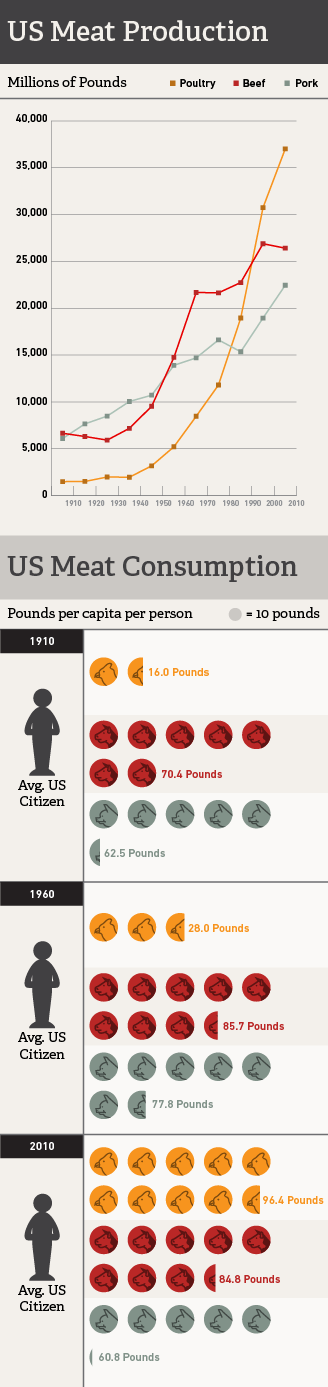
These are just a few of the ways in which factory farms are able to meet the ever-increasing demand for animal-based food. The availability of large quantities of cheap meat has unsurprisingly increased demand steeply. The average person in the US now eats about 270 pounds of meat a year. Beef consumption has gone down, but overall consumption — of fish, meat, poultry, and eggs — has continued to rise steadily. Over the past 100 years meat consumption has steadily grown in proportion to the rest of our diets, now composing roughly 15 percent of the calories in the average US citizen’s diet. Thanks to population growth and demand in developing nations, meat consumption globally is predicted to double by the year 2050. All of this comes at a very high cost, a cost which many experts say will be devastating.

A planet in danger

A planet in danger

Meat_updated_final

Source: USDA Food Availability (Per Capita) Data System, USDA Livestock & Meat Domestic Data

"Here is the truth: The earth is round; Saddam Hussein did not attack us on 9/11; Elvis is dead; Obama was born in the United States; and the climate crisis is real." – Al Gore

To produce 1 pound of beef, the friendly neighborhood farmer (or Tyson foods) will need 13 pounds of grain and 2,500 gallons of water. If a 1,000-pound cow yields 600 pounds of beef, that cow consumed 1.5 million gallons of water and 7,800 pounds of grain. So, on a basic level, farming at this scale is pretty inefficient, when you could effectively feed thousands of people with just the grain and water it takes to produce that one cow. It’s not that inefficient if you’re one farmer with a few cows and chickens (though it’s more expensive to raise animals that actually graze) and just your family to feed. But even when you’re as good as Tyson Foods is at maximizing profits, it’s a mathematically unsustainable equation.

Today, up to a third of earth’s landmass is used for grazing and growing crops. In the US, 70 percent of our grain goes to feeding livestock. This has led to a critical situation where demand is expected to far outweigh supply in the next 50 years. But inefficiency isn’t nearly the only problem.

Man-made climate change, or global warming, is primarily caused by an increased concentration of greenhouse gasses (GHG) — water vapor, carbon dioxide, methane, ozone — in the atmosphere. Activities such as deforestation, burning fossil fuels, and yes, raising livestock emit greenhouses gasses, and all have been on a steep rise since large-scale manufacturing processes were applied to various industries, including farming. The levels of greenhouse gas emissions have seriously increased since the Industrial Revolution, and most scientists agree that we’re facing a devastating climate situation. The year 2013 will go down as the hottest on record, and livestock is partially to blame.

A 2006 report by the Food and Agriculture Organization (FAO) for the UN estimated that around 18 percent of worldwide human-caused GHG emissions were the result of livestock. This study has been widely cited but is also disputed: experts believe that the 18 percent figure vastly undercounts GHGs caused by raising animals. Robert Goodland, who was the lead environmental adviser to the World Bank Group for 23 years, co-authored an influential 2009 study for the World Watch Institute with Jeffrey Anhang (also of the World Bank). It estimated the figure was actually closer to 50 percent, once undercounted emissions from respiration, land use, and methane were taken into consideration. Goodland, who is now retired, notes that the Kyoto Protocol "originally focused primarily on efforts to reduce fossil fuels or come up with renewable energy alternatives." But if the emissions from livestock are close to 50 percent of the rising GHG levels, it follows that the only "pragmatic solution," at this point, as Goodland says, "is likely to be increasing plant-based diets" and drastically reduced animal consumption. It’s a behavior, he says, that can be changed "overnight." Having a positive impact on the environment by moving to a plant-based diet, Goodland and Anhang argue, would be the most effective way to immediately and significantly reduce our man-made GHG emissions. In fact, some estimate that if we globally reduced our animal consumption by 25 percent, we could reach our GHG emission goals as set forth by the United Nations.

There are other devastating effects on the environment too: the EPA estimates that runoff (which it regulates) from factory farms into waterways is the largest single pollutant in the US. Livestock also drink about half of the country’s potable water each year, and they produce more excrement than humans, waste which is usually just spread on the ground, further contaminating the water (and remember, there’s a decent amount of antibiotics in that waste, too).

Up to one third of earth's landmass is used for livestock

This is what people mean when they tell you, as Ashley Byrne of PETA told me, that "factory farming is unsustainable." The population explosion means more mouths to feed, and meat consumption overall has been on the rise proportionally to the rest of our diets; this increases pressure to raise more animals, and more food to feed them, which in turn gravely stresses our environment. The huge number of animals produces waste and polluting byproducts, and eventually, we’re going to not only simply lack the livestock to meet demand, but will face the high environmental costs to boot. Most experts believe that our effect on climate change is reversible, but only if we act immediately.

"We have three options moving forward," says Sergey Brin in the Cultured Beef promo. As he tells it, we can all become vegetarians, we can continue to destroy the planet, or we can "try something new."

Vegetarianism is on the rise — by some estimates it’s at an all-time high of 10 percent in the United States — but it also feels fair to agree with Brin when he dismisses it as the most likely way to address our problems, even as some meat eaters reduce their consumption. "People know that how they eat affects their health," Dr. Donald Smith of Mount Sinai Hospital in New York City says, and that affects their behavior. Beef consumption has been on a slight decline in the US in recent decades, partially because people have recognized it’s better for their hearts — a 2001 study found that people who avoided meat were "far healthier, especially in terms of coronary heart disease" and "40 percent less likely to develop cancer compared to meat eaters."

Initiatives like Meatless Monday — which encourages families to replace meat in just one weekly meal — have proven quite popular. But, for most people, when you cut out meat, you need to replace it with something. Americans aren’t going to go for a plant-based diet that easily, right? And that’s where a handful of new, Silicon Valley-funded companies swoop in.

Meat eaters know the feeling: you’re at a barbecue with friends or around the table at a family holiday, and the one, lone vegetarian drops a pale tofu dog on the fire or pulls a basketball-shaped Tofurkey out of the oven. Maybe they don’t know they’re missing out, maybe they do. Either way, what they’re eating doesn’t look that great, does it? Does it taste like meat? Does it even matter?

To the vegetarian, it usually really doesn’t. Meatless meats have been around for a long time: big names in the market include Boca Burger (owned by Kraft Foods), Morningstar Farms and Gardenburger (both owned by Kellogg’s) and Lightlife (ConAgra). But the new companies trying to create meat alternatives, or meat replacements, aren’t really trying to go after vegetarians. "We already have them," says Ethan Brown, CEO of Los Angeles-based Beyond Meat, "and we know that." His company, founded in 2009, was privately funded by Kleiner Perkins and The Obvious Corporation. (Obvious is a web incubator that was founded in 2006 by Evan Williams and Biz Stone and has gone on to also create and launch products like Medium). "The goal is to get everyone else on board."

For Beyond Meat, and a handful of other companies such as Hampton Creek Foods, a San Francisco-based startup that makes egg replacement products, the model is pretty straightforward. They work in concert with world-class food scientists to come up with meat alternatives — let’s call them Tofurkey 2.0 — for consumer products that aren’t only better-tasting than their ancestors, but they’re healthier, and often cheaper, and marketed in a way that meat eaters won’t be turned off of.

"There is a growing market of educated consumers," Brown says. They shop at places like Whole Foods — incidentally the first place Beyond Meat sold its products to. These consumers, Brown says — some of whom are vegetarians but many who are not — are health conscious, and they care about the environment. Beyond Meat started, in June of 2012, by selling a chicken-like product to Whole Foods, which used it in prepared foods such as "chicken" salad. In April of 2013, their consumer packaged Chicken-less Strips were put on Whole Foods shelves nationwide. The products are vegan, and made from a combination of soy and vegetable proteins. "What we envision," Brown says, "are supermarket aisles where in the future, you’ll have two choices: meat or meat-free protein, sold side-by-side. You won’t need to go to a special vegetarian section in most supermarkets," he says, because most people will eat a combination of both. Beyond Meat’s products are attractively packaged: the food itself looks a lot more like meat than its meatless 1.0 predecessors. "I tasted Beyond Meat’s chicken alternative," Microsoft founder Bill Gates wrote this past March, "and honestly couldn’t tell it from real chicken."

Hampton Creek Foods takes a similar approach, but it’s trying to convince people to replace eggs. An easier sell, if you consider that many doctors regularly suggest people limit their egg consumption anyway: with 184 mg of cholesterol, egg yolks contain one of the highest concentrations per serving of any food. But it’s also true that eggs are the "most consumed animal protein in the world," says Josh Tetrick, CEO of Hampton Creek Foods. People have been using (egg-based) egg replacements for years, but a lot of those products aren’t good for baking or using in recipes, or they aren’t that much cheaper than eggs themselves. The goal of Beyond Eggs, Hampton Creek’s egg product, is to function just like an egg, regardless of how it’s being used, and still be cheaper than eggs. Their powdered egg alternative is made from peas and sorghum, among other things. It’s totally plant-based. Hampton Creek Foods is funded by Khosla Ventures, which routinely supports technology-based, environmentally disruptive businesses, and also by Gates himself, through Khosla.

The goal is to put the burger before the cow

For both of these companies, selling to consumers is only part of the equation. Selling wholesale to other, much larger food companies is also a big piece of their business. "If we can convince a General Mills that our product will be cheaper, and taste just as good," Tetrick says, "that’s how we succeed." And he’s probably correct: if General Mills can use a cheaper egg substitute that tastes identical in its processed foods or baked goods, who will know or care? "I started out wanting to create a world-changing business," Tetrick says. He doesn’t bother using the word "vegan" on his products, though they are, in fact, animal-free. In many ways, Tetrick is angling to change the world’s egg consumption the way that margarine changed the world’s butter consumption: by being much cheaper, while still behaving a lot like the original.

There’s a lot of money to be made in these startups: they’re nascent markets, ready for growth. Astute money men — people like Khosla or Gates — are often best at seeing the future, and in this case, they see "tremendous market potential" in the words of Gates. They’re small companies which apply scientific methods and develop their products in labs and at universities. And they have the environment in mind. Ethan Brown sees reducing meat consumption by 25 percent as a "reasonable goal," and one which "would have a very, very positive impact" on the environment, according to experts like Robert Goodland, whom he cites.

But what about your hardliner? The person who, regardless of health, food safety, environmental, or ethical concerns, just wants a great burger, made of real beef, at his weekend brunch? He hasn’t been forgotten either. In fact, he’s getting arguably the biggest chunk of money and scientific research in food technology.

Because in this case, the goal is nothing less than putting the egg before the chicken. Or more properly, the chicken breast before the chicken… or even: the burger before the cow.

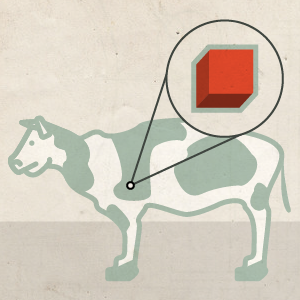
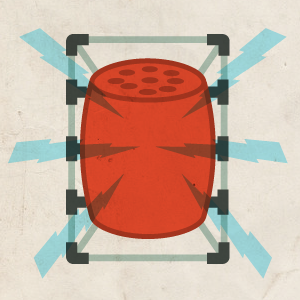
How to grow beef in a lab

Meat_steps_001

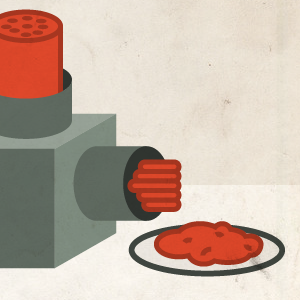
Extract tissue from a living animal via biopsy


Meat_steps_005

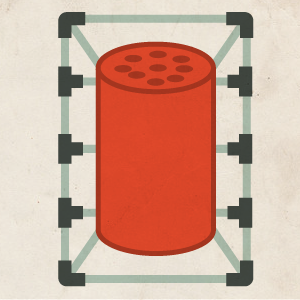
Exercise to boost protein levels


Meat_steps_002

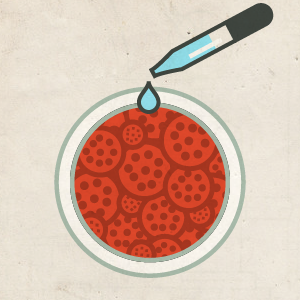
Extract myosatellite stem cells from the tissue


Meat_steps_006

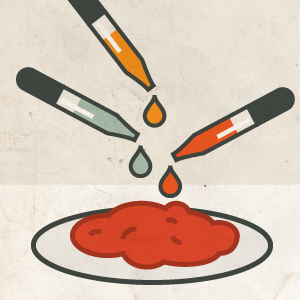
Grind up muscle strips


Meat_steps_003

Add growth serum to multiply cells


Meat_steps_007

Add flavor, iron, and vitamins if necessary


Meat_steps_004

Grow cells on scaffolding to form muscle


Meat_steps_008

Dinner time


Science Fiction

Science fiction

"Fifty years hence, we shall escape the absurdity of growing a whole chicken in order to eat the breast or the wing, by growing these parts separately in a suitable medium." – Winston Churchill, (1936)

Since the 1990s, the possibility of growing animal cells in a lab by using stem cells has become a viable prospect. NASA spent the early 2000s working with turkey stem cells, and the first edible specimen — cultured goldfish cells — were successfully produced in 2002. In the United States, the effort to grow meat in a lab has been most vocally supported by Jason Matheny, who in 2005 authored an influential paper in the journal Tissue Engineering, a paper responsible for renewed interest in the topic of growing meat in a lab in the US. In 2009 he told the University of Chicago Magazine that cultured meat "will be the purest meat ever," lacking the additives, antibiotics, and growth hormones given to most livestock today. In 2004 he founded New Harvest, a non-profit dedicated to raising awareness of in vitro meat, also called test tube meat, or cultured meat. In 2008, Mark Post began investigating culturing meat in a lab with $4 million in funding from the Dutch government. When that funding ended, Matheny worked to broker a deal for Brin to begin funding Post’s work, though it was done anonymously until last week.

Around 30 labs in the world are working to create cultured meat

Nicholas Genovese of the University of Missouri estimates that "around 30" labs — most of them at universities, often with some private funding — are working on creating cultured meats. It’s nearly identical in some ways to research being done in tissue engineering and organ creation work, both using stem cells. Geneovese’s own work has been funded by PETA for the past two years. In 2008 PETA announced a $1 million prize for the first lab to successfully grow test tube chicken. "We want to focus on chicken," Ashley Byrne of PETA says, "because chickens are the most widely abused animals in the world."

"Most scientists are focusing on one particular part of the problem," says Genovese. For example, he’s working on creating the best medium in which to grow the cells. The process of creating meat in a lab is a complex one. In the simplest of terms, the most common procedure begins with extracting stem cells from a live, adult animal. A growth serum (animal-free) is then added to the cells, which are grown on a scaffolding (like a skeleton) to form a muscular structure. This muscle is often exercised to create a richer, tastier flesh.

At Mark Post’s London tasting, both Hanni Rützler and Josh Schonwald noted the same thing was missing from the meat: fat. Post calls it a "technical bottleneck," and it’s one of the next phases of research. "What we love about meat is the fat, that’s what makes it taste good," says Ethan Brown, "but it’s also the least healthy part of the meat." For people developing cultured meat, however, the goal is to get it as close to the "real" thing as possible, fat and all. "They’re going to get there," Isha Datar, director of New Harvest says, "it’s just a question of when."

Post estimates that within 20 to 25 years, we could have a commercial product: lab-grown beef which is indistinguishable from that which comes from an animal, grown in a lab. Theoretically, one crop of stem cells could create a huge amount of meat, with no animals harmed, no grazing land needed, grown in a sterile environment. "This product would address all of the major concerns of large-scale farming today," Datar says: environmental, health, and ethical. PETA thinks their chicken challenge is likely to bring a product to market in far less time, though. "I do think we’ll make the goal within the next few years," Byrne says.

There are, of course, serious challenges to getting a product to market, and at the scale which would be required. There’s still no fat in the meat, and for a product to be marketable, it’s going to need to be nearly identical to real meat, or it will simply be an "expensive Gardenburger," as one environmental scientist with doubts about the project called it. It’s also insanely expensive right now: calling Post’s tester the $325,000 burger (as the media has, over and over) is generous: Post’s research has cost, conservatively, in the realm of $5 million so far. But theoretically, there’s no reason this product couldn’t be much cheaper than meat from an animal in the future: that’s how it worked in Neuromancer, and it makes sense, mathematically.

The final challenge, however, is whether people will buy it. Can we get over our sense of how "weird" cultured meat is? "To me," Ethan Brown says, "that will all be a question of how it’s marketed." Once we stop talking and thinking about it as the "Frankenburger," we’ll go a long way towards realizing just how world-changing such a product could be.

Of course, there are those who say we don’t have 20 to 25 years left to address the environmental issues. For them, the in vitro meat project, even if successful, is just too far off, and they believe that people need to reduce their meat consumption now to impact the environment positively.

But that’s not going to stop us from trying. And it’s not going to stop people like Sergey Brin, who see business opportunities in addition to the ability to address ethical and environmental concerns, from pouring money into projects that the rest of us still think of as science fiction. Two million years ago, there were probably naysayers too, laughing at the guy with the DIY spear running after a bear. And there were also probably plenty of people who disagreed when it was first suggested that you could raise massive quantities of animals, and that meat could be something which even poor people could afford to eat on a daily basis. At every turn, man’s innovative nature has answered the call to solve critical problems. Why should this time be any different?

13 Aug 15:14

Photo


13 Aug 15:14

The Big Lebowski Condensed Into a One Minute Animated Speedrun

by Justin Page

For their ongoing series, 1A4 Studio condensed The Coen Brothers’ 1998 cult-classic film The Big Lebowski into a one minute animated speedrun.

submitted via Laughing Squid Tips

13 Aug 15:11

The Ridiculous High-Concept Inflatable Bike Helmet Is Finally Buyable

by djempirical
firehose

championship GIF

If you're sick of your bike helmet and you'd rather have something that looks like a giant baseball mitt to protect your cranium, you're in luck. After seven whole years of development, the Hövding invisible helmet is finally available for purchase.

Original Source

13 Aug 15:10

Robert Gray (sea captain) - Wikipedia, the free encyclopedia

by gguillotte
firehose

it's too bad Gray was a "this fucking guy" (he shot up tribes to steal their otter pelts) because otherwise he was doing the whole Lewis and Clark thing years before Lewis and Clark while also being a tremendous dick to the British

Gray did not publish his geographic discoveries on the Columbia River, nor those elsewhere along the Pacific coast. Captain Vancouver did publish Gray's discoveries in England, along with his own explorations, and gave Gray credit. At the time these discoveries by Gray did not gain him any renown nor were thought important. However, the trading opportunities Gray pioneered (in regard to Americans) were soon followed up by other New England merchants, with the result that the Indians of the Northwest Coast came to call Americans "Boston men".
13 Aug 15:09

Who is CA Amber Alert suspect Jim DiMaggio? | HLNtv.com

by gguillotte
firehose

fucking great

Those who know Jim DiMaggio call him a "loner" and a "non-materialistic" man who is more interested in video games than anything else. DiMaggio is also a tech savvy guy who had recently been laid off from his IT job.
13 Aug 14:54

Except for All the Details, Elon Musk's Hyperloop Sounds Awesome

by Alexis Madrigal
firehose

via saucie
otters: "for instance, you have to go to LA"

"Musk's proposal, because of who Musk is, could serve as a poison dart for California's high-speed rail, and then nothing comes of it, leaving the state with an outdated passenger rail network and no Hyperloop to make up for it."

He already has spaceship and electric vehicle companies, and he'd like to fly to Mars, but Elon Musk has another idea to bring us closer to the comic-book future. The Hyperloop is a pod-based transport system that Musk's been toying with, and he revealed more details Monday.

He gave the most information to BusinessWeek's Ashlee Vance, sketching out the design and answering questions about the physics of the Hyperloop.

He describes the design as looking like a shotgun with the tubes running side by side for most of the journey and closing the loop at either end. These tubes would be mounted on columns 50 to 100 yards apart, and the pods inside would travel up to 800 miles per hour.

Musk also posted a 57-page PDF proposal called "Hyperloop Alpha," calling it an "open source transportation project."

Among the details contained therein, we find the route that he proposes, which would be more accurately described as Los Angeles to Hayward (not San Francisco). Heyward is a heck of a long way from the Mission (but not too far from Musk's Tesla factory). At the speed Musk is proposing, that would take 38 minutes.
hyperloopmap.jpg

So, two thoughts on the Hyperloop, which I find to be in tension. First, like anyone who has ever read a sci-fi novel or made the sound "pew-pew" with a raygun made from thumb and forefinger, I think is fantastically cool and wonderful. A pod system that shoots you to LA! Amazing! Even the drawings evoke that '50s can-do futurism. There's none of that dark '60s/'70s technoanxiety in this proposal. None.

Which brings me to thought two: I worry that more fully baked transportation projects might be put on hold in hopes that Musk's still-fictional idea works out. Musk's proposal, because of who Musk is, could serve as a poison dart for California's high-speed rail, and then nothing comes of it, leaving the state with an outdated passenger rail network and no Hyperloop to make up for it.

Musk says he could build a Hyperloop system to transport people for $6 billion or one capable of transporting people and cars for $10 billion.

California's long-suffering high-speed rail project has been projected to cost $68 billion. In part because they have to acquire 1,100 different pieces of land. Just Fresno to Bakersfield, a little over 100 miles, is supposed to cost $7 billion for high-speed rail.

hyperloop3.jpg

It's not that there couldn't be cheaper ways of doing things. I'm sure there are. But in comparing Musk's plan with the California HSR proposal, we're looking at two very different levels of detail. Musk's is a sketch. The HSR proposal has been worked over by so many parties for years, and many more costs have been discovered lurking in the details of putting in a major transportation system in the second decade of the 21st century.

California's high-speed rail system may be a boondoggle. But Musk's estimate would be an unfair way to make that point.

totalcosthyperloop.jpg

Take the $1 billion allotted for "land and permits" in Musk's plan. Assume that along the 700-miles of the Hyperloop, they can manage to buy just a skinny strip of land 500 feet wide. That'd still be 42,424 acres of land the Hyperloop would need to acquire right down the heart of California. Is that going to be possible? Is it reasonable? Sounds like a lot of lawyer's fees and contract work. But who knows?

This post originally appeared on The Atlantic.