firehose
Shared posts
How One Inventor Secretly Built A Pneumatic Subway Under NYC
Why You Should Drink
Sawbuck Gamer: Black Lodge 2600
firehose"Players control Agent Dale Cooper, the show’s hero, as he wanders around the red-curtained dreamworld of The Black Lodge. It’s an evil realm filled with soul-sucking doppelgängers of Twin Peaks’ residents, including the deceased Laura Palmer, her perpetually distraught father Leland, and even Agent Cooper himself. Just getting out of the first room left me as confused as a non-liberal arts major watching Eraserhead."
Whitey Bulger Verdict Interrupted By Ben Affleck Shouting Commands From Director’s Chair In Balcony
Latest Snowden quote
Snowden: "Any unencrypted message sent over the Internet is being delivered to every intelligence service in the world."
somebody’s getting crabs tonight - Dynamite Cop (Sega -...


somebody’s getting crabs tonight -
Dynamite Cop (Sega - Dreamcast - 1999)
Film: Great Job, Internet!: The White House made a Mean Girls joke on Twitter

The White House is pretty pop culture savvy today. First came news that Michelle Obama is curating a hip-hop record, and now comes a tweet from the official White House Twitter account that both features a picture of Bo, the First Dog, and quotes Mean Girls. A screencap is below, but suffice it to say that this is the most important news of the day.
Bonus snaps go to Entertainment Weekly for its Tumblr response: “Oh my God, Karen, you can’t just ask dogs why they’re black and white.”

Ages of Revolution: How Old Were They on July 4, 1776? - Journal of the American Revolution
- Andrew Jackson, 9
- Thomas Young, 12
- Deborah Sampson, 15
- James Armistead, 15
- Joseph Plumb Martin, 15
- Peter Salem, 16*
- Peggy Shippen, 16
- Marquis de Lafayette, 18
- James Monroe, 18
- Henry Lee III, 20
- Gilbert Stuart, 20
- John Trumbull, 20
- Aaron Burr, 20
- John Marshall, 20
- Nathan Hale, 21
- Banastre Tarleton, 21
- Alexander Hamilton, 21*
- Benjamin Tallmadge, 22
- Robert Townsend, 22
- George Rodgers Clark, 23
- David Humphreys, 23
- Gouveneur Morris, 24
- Betsy Ross, 24
- William Washington, 24
- James Madison, 25
- Henry Knox, 25
- John Andre, 26
- Edward Rutledge, 26
- Abraham Woodhull, 26
- Isaiah Thomas, 27
- John Paul Jones, 28
- Bernardo de Galvez, 29
- Robert R. Livingston, 29
- Benjamin Rush, 30
- Tadeusz Kosciuszko, 30
- John Jay, 30
- Abigail Adams, 31
- John Barry, 31
- Casimir Pulaski, 31
- Anthony Wayne, 31
- Nathanael Greene, 33
- Thomas Jefferson, 33
- Joseph Brant, 33
- Benedict Arnold, 35
- Thomas Knowlton, 35
- Hercules Mulligan, 36
- Andrew Pickens, 36
- Haym Solomon, 36
- John Sullivan, 36
- Charles Cornwallis, 37
- King George III, 38
- Ethan Allen, 38
- Thomas Paine, 39
- John Hancock, 39
- Daniel Morgan, 39
- Patrick Henry, 40
- Enoch Poor, 40
- John Adams, 40
- Daniel Boone, 41
- John Lamb, 41*
- Paul Revere, 41
- Thomas Sumter, 41
- Robert Morris, 42
- Thomas McKean, 42
- John Dickinson, 43
- John Glover, 43
- Benjamin Edes, 43
- Francis Marion, 44
- Charles Lee, 44
- Lord North, 44
- George Washington, 44
- Friedrich von Steuben, 45
- Martha Washington, 45
- Joseph Galloway, 45
- William Howe, 46
- Henry Clinton, 46
- John Stark, 47
- Mercy Otis Warren, 47
- Horatio Gates, 48
- Artemas Ward, 48
- Lord Stirling, 50
- Guy Carleton, 51
- Comte de Rochambeau, 51
- James Rivington, 52*
- Samuel Adams, 53
- Comte de Grasse, 53
- John Burgoyne, 54
- Johann de Kalb, 55
- Thomas Gage, 56
- Israel Putnam, 58
- Comte de Vergennes, 58
- Lewis Nicola, 59*
- George Germain, 60
- Stephen Hopkins, 69
- Benjamin Franklin, 70
- Samuel Whittemore, 81
New Orleans and U.S. in Standoff on Detentions - NYTimes.com
firehose!!!!!!!!!!!
NEW ORLEANS — The Orleans Parish sheriff will no longer honor many requests from the federal immigration authorities to detain people who are suspected of being here illegally, making New Orleans one of a growing number of jurisdictions to adopt such a policy and the first to do so in the Deep South.
The policy, articulated in filings that accompanied a legal settlement in federal court, is similar to others that have been instituted since 2011 by Chicago, New York and Washington, several counties and the State of Connecticut.
But in some respects, the policy in New Orleans goes farther than some others, refusing cooperation with federal immigration enforcement at a number of different points. It comes as New Orleans has been wrestling with the Department of Justice as part of a large-scale overhaul of the city’s criminal justice system.
urbanination: Le Corbusier’s plan 1925 for Paris, France.
firehosecontinued/autoshare


time-for-maps: From the 1954 book Engineers’ Dreams.Africa’s...

From the 1954 book Engineers’ Dreams.
Africa’s Central Lake planned by german architect Herman Sörgel in 1935. Basically the plan was to totally reconfigure the interior of Africa by creating a series of huge inland seas. His plan was to dam the Congo River where it passes through a string of deep, narrow gorges after it merges with one of its tributaries, the Kwa River. It would create a lake 350,000 square miles in area - larger than the areas of California, Nevada and Oregon combined.
Once the lake filled, it would be forced to overflow from another one of its tributaries, the Ubangi, into the Shari River which is one of the feeders for the present day Lake Chad. Lake Chad would swell to the dimensions it was thought to have had over 10,000 years ago, spreading across the Ahaggar plateau. A river would then be created that would lead through Algeria, turn east into Tunisia and then eventually empty into the Mediterranean Sea at the Gulf of Gabes. This river could made navigable allowing ships to directly access the interior of Africa. (source 1 2)
Expats Are Doing The Math And Renouncing Their American Citizenship
firehoseattn: Snorkmaiden
Google Maps Has An Incredible Doctor Who Easter Egg

Hey, you know how it is. One minute you're walking down a London street, minding your own business, when you accidentally step into a police call box and all of a sudden you're inside the TARDIS and the Doctor has enlisted your help fighting aliens. I hate when that happens.

    
|
Visiting Sweden? Awesome! Look Out for Testicle-Eating Fish.
Oh, and South America, too! Because apparently both places now have the "pacu" fish—a relative of the piranha who delights in feasting on men's testicles. From the hilariously hyperbolic Telegraph:
The freshwater fish, which can grow up to 90 centimetres and weigh up to 25 kilogrammes, has been nicknamed the "ball cutter" for its attacks on the male genitalia.
In areas where pacus proliferate, fishermen have reportedly bled to death after losing their testicles to the fish's crushing jaws.
So why exactly do pacus go for the male testicles? Danish museum fish expert Henrik Carl explains:
"They bite because they're hungry, and testicles sit nicely in their mouth."
HAHAHAHAHAAAA!! OH YES THEY DO. Waitasecond... there's more and... WHAT?!? You're just NOW mentioning this?!?
Found in most rivers in the Amazon and Orinoco basins in South America, they have also been spotted in Papua New Guinea, where it is believed they have been introduced to boost fish stocks. Discoveries have also been reported in several US states; in 2006, officials at one Texas lake reportedly put a $100 bounty on the pacu caught there.
Way to bury the lede, Telegraph! And this is EXACTLY why I wear THIS every time I go swimming. Bon appétit, a-hole fish!

Google Blindness
firehoseI agree with most of both sides of this debate
I hate jailed iOS and I hate Google Android
somehow the entire debate got framed as though those are the only two options, _even within those two mobile operating systems_, and that's why everybody's losing out
Paul Stamatiou’s “Android Is Better” is generating a lot of discussion and inflammatory headlines, and many readers have sent it to me (partly because I get name-checked in it — I’ll get to that in a bit).
Paul’s headline is his thesis, conclusion, and call to action: Android is better, and everyone should try it and will likely convert like he did. But after reading the article, I’m more convinced than ever that the best mobile platform for me is currently iOS.
That sentence contains two huge qualifiers: the best mobile platform for me is currently iOS. I’ve learned to write and think with a broader view, since it’s less insular and more accurately reflects reality. (The world is a big place.)
While reading Paul’s article, I was often struck by how differently he and I use the same technology.
His article exudes a narrow tech-world view by having no such qualifiers. I don’t know Paul, but if his audience is similarly narrow, this might be a safe assumption in the context of writing on his personal site. I don’t qualify my posts here with “…well, if you have a computer,” because I can assume that most people reading my site are included in that group. But I bet Paul’s audience isn’t as narrow as he thinks.
Despite using a Mac and formerly using an iPhone and iPad, Paul says he doesn’t use any major iCloud services and doesn’t use iTunes (or maintain a music library at all), then concludes:
The list of Apple products I use daily largely amounts to OS X and Apple hardware. People identify themselves as Mac users and Windows users… zoom out a bit and you’ll find another Venn diagram where Google almost entirely encompasses all of these users.
Rather than using Apple’s services, he uses a wide variety of Google’s: (emphasis his)
Google+ Auto Backup … I use Chrome … My calendars are hosted by Google … I made do by exporting from the OS X Contacts app and importing to GMail Contacts. … Most services I rely on daily are owned by Google. My world revolves around GMail and Google search. …
One key component to this experience is that my identity follows me around. Given that the majority of the services I rely on are Google products, I’m already logged in or just need to select an account. This is a significant convenience that also extends to apps using Google for sign-in. …
However, Google Now is what genuinely makes this experience magical. … So how do you use Google Now? Well, you don’t. You just go about your life and when it’s appropriate, Google Now will send you a notification to something relevant.
To me, that sounds like a nightmare.
I object to a huge, creepy advertising company having that much access to me and my data, I think it’s unwise to use many proprietary, hard-to-replace services in such important roles, and I think it’s downright foolish to tie that much of your data and functionality into proprietary services run by one company in one account that sometimes gets disabled permanently with no warning, no recourse, and no support.
But people love Google’s services, especially geeks and power users. I get it — there’s a lot to love. They’re just not for me. I use search and maps, but little else.
If you give Google an inch, they take a foot. I stay logged out of my Google account most of the time, despite their incessant badgering. I try to keep some distance from them, which means I’m always defending my technology use from further Google intrusion.1
If Apple somehow irrevocably locks out my Apple ID, which I’ve never heard of happening, it would be inconvenient. My contacts and calendar would temporarily stop syncing during the 20 minutes it would take to create a new account and point my devices to it. The biggest problem would be losing my app and media purchases, although I wouldn’t lose any local copies of anything, and there’s a phone number I can call to convince a human to give me a transfer or credit. But that’s it. My standard IMAP email, and almost everything else I do on my computers and phone, will be fine.
It’s important to maintain diversity of services.
No tech giant wants you to maintain any diversity, though. Apple pushes you to choose Apple hardware for every profitable device category, then buy software and media from Apple storefronts (and a lot of that media still has DRM). Google tries as hard as it can to railroad you into using Google’s services for everything you do online. Facebook’s even worse, more shameless, and more proprietary by trying to replace staples like email and calendars with completely proprietary implementations and zero interoperability (which Google can’t wait to copy). Twitter is trying very hard to achieve Facebook levels of creepiness, intrusion, and lock-in as quickly as possible, and Microsoft wishes they could still do it like they did in the ’90s.
If you buy into Apple’s ecosystem too much, Android will be limited, annoying, and incomplete to you — especially if you try to keep Google away from most of your data. Alternately, if you buy mostly into Google’s ecosystem and avoid most of Apple’s services, like Paul says he does, iOS’ downsides and limits may feel unjustified and Android will feel more integrated.
It’s foolish for people on either side to ignore the other or the middle, because despite what it sometimes looks like to geeks like us, we’re not everyone. Not even close. Even within our world, we can’t agree on much.
What Paul’s article really says is that Android “is better”… for him, his usage, and his priorities. That’s fine, but it really doesn’t generalize well.2
As for my name-check:
The Android community lacks a champion. An evangelist that doesn’t obsess over hardware specs and has a broader appeal. Someone that vividly illustrates how Android can fit into the ebb and flow of your daily life as it has mine. And sure, even someone to encourage budding developers to take their next idea to Android. Where is the Marco Arment or John Gruber of Android? We’ll get there.
I’m honored by the suggestion that I’m somehow helping iOS, but in reality, I’m not that important. iOS helps itself, especially in developers’ eyes, by delighting its customers so they keep coming back, being a pleasure to develop for (compared to most platforms), and attracting a healthy ecosystem of better users to develop most apps for.
Developers aren’t fools. We aren’t swayed by charismatic figureheads who try to convince us to develop for their platforms. The formula is quite simple. We’ll develop for a platform if:
- We use it.
- A lot of other people use it.
- We can make a living developing for it.
If your platform nails all three, we’ll develop for it. Nobody will even need to ask us. We’ll break the door down.
A weakness in any of those three can only be made up for by both others being very strong. Even then, you often don’t get great apps. iOS nails all three, so that’s where most developers focus their attention. While Android has closed a lot of the gap since I wrote that in 2010, it still significantly lags behind iOS in criteria 1 and 3, despite kicking ass at 2.
As for “an evangelist that doesn’t obsess over hardware specs and has a broader appeal”: John Grubers don’t just fall from the sky and get allocated to random hardware platforms. (John also doesn’t really “belong” to iOS or Apple the way many Windows and Android fans suggest.) Android isn’t just sitting around waiting for its turn to get one. Time won’t fix this.
The better question the Android community should be asking itself is why it hasn’t attracted or developed great writers and evangelists as well as Apple has. They’re probably there, but in smaller numbers and far less visible. What is it about Android and its community that’s preventing such people from shining through?
-
As one example, I use Safari for most browsing, but use Chrome anytime I need to run Flash or log into Google, Facebook, or Twitter for something. (With the ubiquity of their embeds and their cross-site tracking practices, I’m too skeptical to log into any of them from my primary browser, even though I’m sure they’re tracking my Safari browsing through inference anyway.)
Every time I visit a site in Chrome with a Keychain-saved login from Safari, Chrome barrages me with Keychain prompts to access it. If I say no, it just keeps asking. (And no, deleting all of Safari’s Keychain entries is not a helpful “fix”.) Clearly, there aren’t a lot of people at Google testing cases such as “current or former Safari users” or “people who don’t allow Google to access everything all the time”. ↩
-
While reading his article, after scrolling past the halfway point, a balloon popped up that prompted me to post a link to it on Twitter and follow Paul.
I’d never implement something like that on my site, and relatively few of my readers would ever accept such an invitation on any site. (I sure wouldn’t.) But Paul’s different, and his audience is probably different.
Again: different worlds. ↩
The Rose Garden Is Now the Moda Center
firehoseuggggggggh
uggo ugger uggest

Goodbye, Rose Garden. Hello, Moda Center.
Wait. What the heck's a Moda Center?
Moda Center is named after Moda Health, which signed a 10-year naming rights agreement with the Portland Trail Blazers. And they are wasting no time: The Rose Quarter website has already been updated with the new venue name.
The Columbian reports:
Physical transformation of the renamed arena and Rose Quarter will begin immediately, with new signage and other visual elements being added gradually. New graphics for the home court surface of the Trail Blazers will debut in time for the team’s 2013-14 regular season home opener on November 2 versus the defending Western Conference Champion San Antonio Spurs.While the Moda name might take a little getting used to, there are some good things about the name change. Moda Health (formerly known as ODS) is a locally based company with 1,400 employees. It's a health company, not a fast-food slinger or a big box store. And it rhymes with "Yoda," which can only be a good thing.
“Straight Male Gamer” told to ‘get over it’ by BioWare
firehosehigh five
"…The person who says that the only way to please them is to restrict options for others is, if you ask me, the one who deserves it least."

corgis-everywhere: corgiaddict: gatsbyadventures: I made a...
firehoseno satan only corg


I made a corgi shirt yesterday.
Czarina is flaunting her corgi addiction. Matching bandannas to t-shirts. Brava!
i love this fabric!! :-)
tumblr_mnsnciZO6u1qdlh1io1_400.gif (GIF Image, 400 × 362 pixels)
firehosehug the police

American Voices: Millennials Choosing Not To Own Cars
firehose“They’re probably just waiting to see which car the Lumineers endorse.”
TV: TV Club: MythBusters - “Breaking Bad Special”
firehose'The great thing about putting the MythBusters crew on jobs like these is that they’re not the kind of Debbie Downers who will be satisfied throwing down however much fulminated mercury Walt said he threw down on the floor and then saying, “Shucks, the windows didn’t blow out. That Vince Gilligan is a lying motherfucker.” '

MythBusters is often a fun show, and it always gains a little something when it ties itself in with popular culture. Science is awesome and all, and it’s good to know that there are people out there using it to improve cancer medications and address the dangers of climate change. Meanwhile, the rest of us have been wondering for five years now, what the hell did Walt throw on the floor when he was in Tuco’s hideout that blew out all the windows and allowed him to walk out unscathed? And is it legally obtainable? And does it work at high school reunions? Thanks to Jamie and Adam, the world is now better enlightened on this pressing issue. Checking in on from time to time are Aaron Paul and a man with a deep, Southern twang to his voice who I first thought was Marc Maron after a ...
Read moreGNUstep Kickstarter Campaign Launched
firehose"API compatibility with Mac OS X 10.6's Cocoa"!


Read more of this story at Slashdot.

All those people with cheap Android smartphones have finally started buying apps
firehoseWHAT'S THAT
IF YOU MAKE SHIT AND CHARGE MONEY FOR IT
PEOPLE WILL BUY IT???????????
OH NOESSSSSSSS

It’s great having a huge user base to show off. Less great is not having much to show for it. We have been writing for months about how Android’s large market share hasn’t translated into actual phone usage or, more importantly, app-store sales. Android users consume less data than owners of Apple’s iOS devices, prefer to use Wi-Fi rather than 3G for data connections, and spend less on apps.
That appears to be changing. A report out this week from Distimo, an app analytics firm, estimates that revenue generated by the Google Play Store, from which many Android users get their apps, has grown 67% over the past half-year. By contrast, Apple’s App Store revenue grew 15%, according to Distimo estimates, which cover the top 18 countries. That sounds less impressive if you consider that the App Store brought in twice as much revenue in absolute terms. But the numbers are shifting fast. In February, the App Store was generating three times as much revenue, and last November it out-earned Google Play by a factor of four. Google is gaining.
Much of this growth comes from three countries: the US, Japan and Korea. The US is the world’s second largest smartphone market after China. Japan has enthusiastically embraced Android. And Korea is the home of Samsung, the leader in Android handsets. That these three countries should be the first Android user bases to mature ought not be surprising.
It seems clear too that this is just the beginning. Where the top five free apps on the Apple App Store in July were all games, number one on Google Play was Facebook, followed by WhatsApp. Facebook Messenger comes in at number five. These are apps people download when they first get their phones, not ones they come back for.
What does this all mean? Android has long been considered the poor man’s smartphone with users who are reluctant to spend money. That is true, to a degree. But Distimo’s numbers show it can, over time, be a profitable platform. Indeed, an earlier report (pdf) from Distimo found that WhatsApp—which is free for the first year on Android—made more money from Google Play than the App Store in three western European countries in April. The long-term game may pay off in the rest of the world too.


A Limit on Consumer Costs Is Delayed in Health Care Law - New York Times
firehosefucking fantastic
U.S. News & World Report |
A Limit on Consumer Costs Is Delayed in Health Care Law New York Times WASHINGTON — In another setback for President Obama's health care initiative, the administration has delayed until 2015 a significant consumer protection in the law that limits how much people may have to spend on their own health care. National Twitter ... Another Obamacare delay shows the benefit of friends in high placesDaily Caller Another Key Provision of 'Obamacare' Suffers DelayU.S. News & World Report Obamacare Critical Consumer Protection Rule Delayed Until 2015Connecticut Watchdog AllGov -Specialty Fabrics Review magazine -Atlanta Journal Constitution (blog) all 214 news articles » |
Dash Board was a popular interface enhancement for Newton OS...
firehosenever die or change, Newton

Dash Board was a popular interface enhancement for Newton OS 2.1 in the late 1990s.
An absolutely essential one, if you ask me—Dash Board is, roughly speaking, the Newton equivalent of Alfred or Quicksilver—and it’s now free and open source.
(Even if you don’t have a Newton click through for the README, an epic tale of developer Mason Mark’s efforts to resurrect the project.)
Meet me in Portland: The Fullbright Company's journey home
firehosemeanwhile, in Portland
By Mike Mahardy on August 13, 2013 at 12:00p
How serendipity, restlessness and trust formed an independent game studio.There's this house in Northeast Portland. A green Cape Cod, with moss on the roof and a hammock in the backyard. The kind of place where you want to raise a family, maybe retire to, if the Pacific Northwest is your thing.
If you're attentive, you'll see the cats, Delicious and Adventurous, peering through a window as a guy with dreadlocks, held in place by a folded bandana, leaves on his bike. Later, you might see the rest of the residents returning from the local Hollywood Theater, famous for its atmosphere, pizza and beer.
Some know this as the Fullbright House. The residents call themselves The Fullbright Company.
Steve Gaynor, Karla Zimonja, Johnnemann Nordhagen and Kate Craig are no strangers to game development. As individuals, they've worked on titles such as BioShock 2, BioShock Infinite and The Bureau: XCOM Declassified. One of them even has experience making social games.
They're making a new house. One not made of Sheetrock and timber, but code and polygons. This is Gone Home, a game devoid of violence or superpowers, in which you explore a house, searching for your lost family members in a personal story without much context beyond that. If all goes well, this title will put The Fullbright Company, and the Portland game scene, on the map.
But in the end, that really doesn't matter. The four have poured so much of themselves into Gone Home, and received so much in return, that the trip has become more important than the destination. And somewhere along the way, they all became a family.
The company ladder
The company ladder

Top to bottom: Steve Gaynor, Johnnemann
Nordhagen, Karla Zimonja, Kate Craig
To look at him today, at the helm of his own independent game studio, you wouldn't know that Steve Gaynor was once the quintessential wandering college student, going through the motions, taking a bit longer to progress toward graduation than some of his Portland State professors might have preferred.
"I really didn't know what I was aiming towards," Gaynor says. "And I sort of had this realization like, 'Clearly what I'm thinking about the most [is] games, over any other form of expression or entertainment.' Even though I was drawing comics, studying sculpture and learning about the fine art world."
Gaynor found that level design was a great way to break into game development, because of easy access to design tools. His first levels, made entirely in his free time, were for F.E.A.R., the first-person shooter.
Gaynor moved to San Francisco in 2006, and worked as a tester for Sony. Soon, though, his knowledge of the F.E.A.R. level editor landed him a job at TimeGate Studios, the Houston-based developer in charge of the F.E.A.R. expansion Perseus Mandate.
"It was a great experience," he says. "It was a very old-school experience. It was a small number of guys ordering Chinese food in every night. It was very low pressure and I got to learn a lot without being super scared, which is a good starting point as a professional."
A year later, at the 2008 Game Developers Conference, Gaynor followed a friend to an appointment with 2K Marin. There he met Jordan Thomas, the creative director of BioShock 2. The encounter encouraged Gaynor to apply for a job, despite his apprehension.
"It's a mistake I think a lot of people make," he says. "Don't assume other people won't be interested. If you don't apply, no one can get back to you in the first place."
Gone was the indecisive, unsure Gaynor, replaced by someone more confident. He took a leap, hoping to reach the opposite ledge. 2K Marin did get back to Gaynor. The job was his.
And, as luck would have it, he would soon meet Karla Zimonja and Johnnemann Nordhagen.
"Don't assume other people won't be interested. If you don't apply, no one can get back to you in the first place."
Bonding agents
Bonding agents
Back at the Fullbright House, the day is drawing to a close. The charcoals on the grill are smoldering. Kate Craig, Fullbright's 3D artist, who works remotely from Vancouver, is in town for the weekend, and the rest of the team is enjoying her company. Tonight, they'll hang out around the fire pit, drink beers and head over to the swing set at the nearby park.
You would think they'd get sick of one another. Or at least want more time apart. But The Fullbright Company members can't seem to hang out enough. They recently visited Enchanted Forest, a nearby amusement park. They watch Star Trek and My So-Called Life together. Chances are, if you see one of them, another is close by.

"We were at GDC, and I compared it to being in a band," Craig says. "It's closer-knit than the other studios I've worked at. If you don't have much money, you have to do things like share hotel rooms, share flights and sleep in their basement, with cats lying on you."
Gaynor, Zimonja and Nordhagen have seen the other side of the fence, the side with large teams and international studios, where you're consigned to a role for the duration of a project. Craig's experiences with social games are similar.
But that's not why they all left. Despite the horror stories that so often accompany game development experiences, Gaynor and his team weren't pushed away, but pulled. They were attracted to the artistic liberty and self-management of a small game studio. They have the freedom to ride their bikes when work becomes too much, to have not only a co-worker beside them, but a friend as well.
"This has been an amazing thing," Nordhagen says. "I can't imagine living my life any other way now. Which is why I hope this game does well, so I don't have to go get another job."
"Maybe it's foolhardy of me, but I was never worried about living with them," Zimonja says. "I forget to go outside sometimes, and not sit in front of the computer all day. So it's good to have someone to say, 'Let's go do this.' And it's been working well for the entire development process. We've become this weird little family."
To hear Gaynor talk about his team now, more than a year after it formed, you'd be forgiven for assuming he was never afraid. His confidence belies the fact that it could have fallen apart at any time. Their funds, and personal cash flow, could have vanished. They could have collapsed under the weight of their new responsibilities. They could have hated each other.
"I'm really glad we get along well enough to live together, without driving each other super crazy," Gaynor says. "It's great to have this ambient ability just to hang out with people, and enjoy them ... to have this group of people you can rely on."
Trust me, I have a plan
Trust me, I have a plan
"My favorite game developers would seriously piss off the Sorting Hat [in Harry Potter]," says Jordan Thomas, five years after his chance meeting with Gaynor at GDC, "and these three embody that. They have a deep hunger to diversify ... to draw, code, write something unsolicited in the margins of their job description that reminds you, 'Yeah, so, I can do more?' They just can't help it.
"They each defy classification in a way that pleasantly surprises you, over and over again."
At this point, Thomas has worked with the trio on BioShock 2 and its single-player expansion, Minerva's Den, on which Gaynor was the lead designer in 2010. Just beneath Gaynor was Zimonja — his story partner, and the team's 2D artist.
After getting her foot in the door as a researcher at 2K, Zimonja was able to branch out. Take on more responsibility. Her proven mettle landed her a position on the development team for Minerva's Den, where she fell in love with the small-team atmosphere Gaynor grew so fond of in Houston.
Zimonja is no leader. She'll be the first to tell you that. But she functions well as a right hand, supplementing someone else's talents with her own expertise.
"I'm a better editor than I am a writer," she says. "I work better when there's something to work with. I always see different things than Steve does, so it's good for us both to be there. It's a good collaboration."
When Gaynor left TimeGate in 2011 to join Irrational Games, the team making BioShock Infinite, Zimonja remained behind. She began work on The Bureau: XCOM Declassified.
Gaynor and Zimonja knew they wanted to work together again, but how they would do that was easier said than done. Gaynor and his wife, Rachel Jacks, lived in Boston; Zimonja was still in San Francisco. After a while, as they so often can, things stopped clicking.
"My wife and I just realized that being somewhere strictly for a job, and being on a really big, high-profile project, were not really what we were interested in when we got there," Gaynor says.
"I had been doing the exact same thing, every day, for too long, even now, I miss everyone at 2K. It was just time to do something else."
Jacks' family was from Oregon, so she knew the Portland area well. It was also Gaynor's "adopted home," as he calls it, after his college love affair with the city. The choice was, in a lot of ways, simple.
"We had both wanted to move back to Portland for a long time, even when we lived in San Francisco," Jacks says. "We were both giddy about moving back here when we decided to go for it."
Gaynor wanted to make a personal game, one with an intimate narrative, but also within the means of a small team. One they could make with the money from their own pockets, and one they could make well.
The seeds of The Fullbright Company had been planted. Now, all Gaynor needed was help to make them grow. After a few emails and phone calls, Zimonja was all but packing her bags.
"I had been doing the exact same thing, every day, for too long," she says. "Even now, I miss everyone at 2K. It was just time to do something else. I was at a point where I was like, 'Sure, I can move a whole bunch of states away.' It was a good time for a change."
But neither Zimonja nor Gaynor knew how to program very well. They needed someone versatile, someone who could take on the workload of several programmers. They wanted someone familiar.
Enter: Nordhagen. The one with the dreadlocks.
"One day, I was thinking about what I wanted to do after Irrational," Gaynor says. "And I saw a tweet from Johnnemann. It was just sort of existentially introspective. I read it and I was like, 'Johnnemann might be considering the possibility of what else he could be doing.'"
Nordhagen's constant smile finally becomes a laugh.
"I remember that," he says. "A categorical imperative. Basically, if you're ever doing anything merely as a means to an end, you're doing a disservice to yourself.
"Working in triple-A development had kind of turned into a means to an end — getting a paycheck and feeding myself, instead of something that inspired me purely for its own sake. Working on an indie title, that's all there is. The game. And that's an end in and of itself, which is great."
So, Gaynor began chatting with Nordhagen about the possibility of coming to Portland, along with Zimonja, to form The Fullbright Company.
A whole new world
A whole new world
Jacks is managing her Etsy account. She sells jewelry, clothing and pillows with designs inspired by the stars. On the other side of the basement wall, her husband, Zimonja and Nordhagen are hard at work on Gone Home.
"I'm constantly listening to talk about the game," Jacks says. "I have a kind of weird inside-but-outside perspective on the whole thing."
Every once in a while, Gaynor or Zimonja will ask Jacks' opinion on a product or logo. ("Protex," the tampon brand you may or may not stumble across in Gone Home — that name was Jacks' idea.)
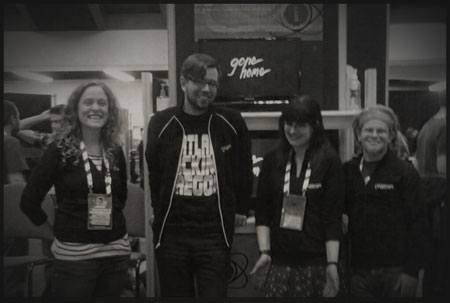
"When he worked on BioShock 2, Steven went off to the office all day, and I didn't really know what exactly went on there," Jacks says. "I now have a much better idea of how a game is made, and I'm really impressed by all the work that goes into it."
Jacks isn't the only one learning new things. Gaynor knew from the beginning that every member of the team would need to branch out and take on more responsibility, as the specialization inherent to a bigger studio with hundreds of members wouldn't work here.
"We needed people that had a broad skill set," Gaynor says. "In an indie studio that's small, everyone's going to be doing a lot of jobs. We all knew that we could work together, because of Minerva's Den, and we all had similar desires, as far as the kind of game we wanted to make."
On prior projects, Gaynor was a level designer. Now, he's in charge of music licensing, writing, recording sound, even publicity and marketing.
Zimonja helps direct voice acting in Gone Home, researches the title's 1990s setting and handles the 2D art.
Nordhagen is in charge of programming throughout the entire project, a far cry from the specialization of BioShock 2.
And as far as 3D art goes, well, no one had any clue where they'd get that at first.
They had enough of a budget to hire contractors for the 3D work, or even buy samples online, and edit them as they saw fit. For whatever reason, they avoided this route. The decision paid off.
One of Gaynor's favorite comic and video game fan artists, Emily Carroll, was in Portland one weekend in May 2012. The two decided to grab lunch, and Carroll's wife Kate Craig happened to be there.
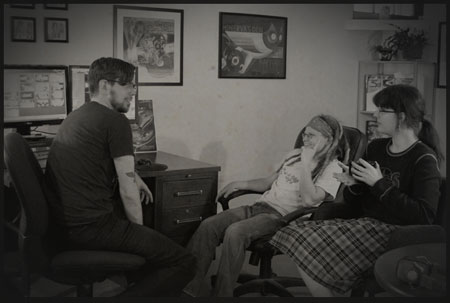
"We got to talking about what she did, and Kate said, 'Oh, I make 3D art for video games,'" Gaynor says.
At this point, Gaynor doesn't even seem fazed at the turn of events. The entirety of development on Gone Home has been one fortunate event after another.
"It's sort of intimidating when you've never met Steve Gaynor before," Craig says. "When they first talked to me, I was like, 'Oh my gosh, these BioShock dudes are talking to me?' They've worked on Minerva's Den and impressive stuff, and I haven't done any of that just yet. I feel really lucky to work with these dudes."
After working part time with Craig for a few weeks, while she continued working on the social game Margaritaville, Gaynor offered her a full-time gig.
"She's been insanely important, and it was super serendipitous," Gaynor says. "Kate was just the perfect match for what we needed. She's right on the exact wavelength of artistic outlook that fits with Gone Home."
With that, The Fullbright Company was complete. The four adapted to their new roles in a small team. For 15 months, they leaned on one another, supported one another. They learned how to work together and, more importantly, how to live together.
"I am merely a curious explorer, who has become entwined in this family tale ... These people matter and deserve to be remembered."
Ad infinitum
Ad infinitum
Just as he did when he applied to 2K Marin, Gaynor took a leap of faith with The Fullbright Company and Gone Home. There was no guarantee of success, and he couldn't promise Zimonja, Nordhagen or Craig that it wouldn't be a disaster.
But maybe that's why they all cherish the payoff even more. For The Fullbright Company, Gone Home is more than a game. It's 15 months worth of poise and daring, of the team members' faith in one another.
"I am ... merely a curious explorer, who has become entwined in this family tale ... These people matter and deserve to be remembered."
This excerpt, from writer Michael Gakuran's blog series, describes the thrill of Haikyo. Literally translated, this Japanese word means "ruins." It's also a term for urban exploration, the act of investigating abandoned buildings and houses.
The blog series, detailing the exploration of the forgotten Royal House in Japan, inspired Gaynor to create a title based around the idea — finding a story through voyeurism and exploration. In Gone Home, you explore the house on Arbor Hill, trying to discern the whereabouts of your family, all the while getting to know them on a personal level through diaries and bedside notes.
If The Fullbright Company vanished today, without explanation, you could still get to know the team. You could read their emails, grocery lists, birthday cards and journals. It would take some digging, but eventually you would find it.
You'd find a story that matters and — like that of the Royal House in Japan or the house on Arbor Hill — a story that deserves to be remembered. 
Images: The Fullbright Company
Editing: Matt Leone, Russ Pitts
Design / Layout: Warren Schultheis, Matthew Sullivan

'Archie: Betty Or Veronica' Invites You To Rebuild Riverdale By Breaking At Least One Teenager's Heart
firehose"Send Jughead home to eat a five pound ham."
my motherfucking hero

A few weeks back, we covered the announcement of Archie: Betty or Veronica, a new mobile game for iOS in which everyone’s favorite crosshatch-haired teen was tasked with rebuilding his hometown, piece by piece and tap by tap. Last week, the game was finally released, and now, I’ve had some time to play around with it.
The verdict? It’s definitely one of those mobile games where you send people off to do tasks for hours on end and then come back later when it’s done unless you want to pay to speed things up… but it’s also one that does a pretty great job of capturing what’s great about Archie Comics.
The premise of the game — told in comic book form by actual Archie creative teams, as are most of the game’s cutscenes — is that while the Archies were off playing a gig, the corrupt Mayor of Riverdale ransacked the town and made off with the entire treasury. Personally, I would question the wisdom of keeping the wealth of an entire town — particularly one with at least one bona-fide millionaire Captain of Industry like Hiram Lodge — in some kind of form that could be easily stuffed into two briefcases and hauled off by one person, but that’s Riverdale for you. Now, the town is in dire straits, and it’s up to Archie and the gang to fix it up.

The mechanic that’s hinted at in the title of the game comes into play every time you level up, when you have to make a choice between helping Betty or helping Veronica with the tasks they want you to do. Usually, Betty wants you to help other people while Veronica is a bit more self-interested. You end up doing all the tasks, of course, but deciding what to do first (and which characters to pair up for long, lonely hours fixing broken windows down at Pop Tate’s) determines how the relationships progress, and what benefits you get down the line.
Like a lot of games like this, there’s a way to speed up the process of “send Archie to the post office for five hours,” and this time, it’s kisses. You get around 15 of them to start and playing consistently for a few days gives you the chance to spin a slot machine mini-game for more, but naturally, the easiest way to get a bunch of them is to spend real money on them. It’s a little frustrating if you’re trying to keep from spending a ton of money on extras like new characters..

…but it’s hard to really grouse about it when that’s the model that makes these games profitable.
Regardless, the real selling point here is the tone.Betty or Veronica does one thing that I wish more comic book-inspired games would do, and includes a ton of comics for you to read. Accessing the Comic Book Store gives you the chance to read all the “cutscene” strips, as well as the first appearances of the major characters like Archie, Betty, Veronica and Moose right off the bat, and progressing through the game unlocks other full comics as you go.
Plus, there’s a mission in here that cracked me up:

It’s definitely a time waster, but if you’re as much of an Archie obsessive as I am, it’s definitely worth checking out.