firehose
Shared posts
The Rise Of Roller Derby
Stories from MI5
This essay is filled historical MI5 stories -- often bizarre, sometimes amusing. My favorite:
It was recently revealed that back in the 1970s -- at the height of the obsession with traitors -- MI5 trained a specially bred group of Gerbils to detect spies. Gerbils have a very acute sense of smell and they were used in interrogations to tell whether the suspects were releasing adrenaline -- because that would show they were under stress and lying.Then they tried the Gerbils to see if they could detect terrorists who were about to carry a bomb onto a plane. But the gerbils got confused because they couldn't tell the difference between the terrorists and ordinary people who were frightened of flying who were also pumping out adrenaline in their sweat.
So the gerbils failed as well.
Jay Cutler Hoping To Prove Doubters Whatever In Contract Year
2014 Olympics To Be Held In 19th Century
Father Teaches Son How To Fly Into Rage Over Completely Inconsequential Bullshit
Google: Gmail Users Shouldn't Expect Email Privacy
firehoseR.
O.
F.
L.
Meet Breaking Bad's Newest Drug Lord: Jack McBrayer?!?
In this clip from Conan, Breaking Bad's Walter White (as Heisenberg) meets up with a new and dangerous drug lord: 30 Rock's Kenneth (AKA Jack McBrayer). And as drug lords go... he's not too bad! That is, if you like your drug lords weak, ineffectual, and absolutely ADORABLE! Watch.
Submission - Unofficial Map: Portland, Oregon Rail Network by...

Submission - Unofficial Map: Portland, Oregon Rail Network by Taylor Gibson
When Taylor sent through his aerial photo map of Portland the other day, he also submitted this very interesting isometric map of the city’s rail network (MAX, WES and streetcar). Tyler is a self-proclaimed “total newbie at making transit maps”, but this is definitely a pretty solid effort.
Highly reminiscent of this isometric map of Stuttgart (Oct 2011, 5 stars), the 30-degree-angled route lines allow station labels to be set horizontally without clashing with each other, even in the congested downtown area. The only real problem area is the almost unavoidable mess created by the four separate “Pioneer Square” stations right in the middle of the map. I’ve noticed that these have been consolidated into one “mega-station” on TriMet’s new in-car maps, and that’s definitely a cleaner, more sensible approach to the problem in my eyes.
I also see a little influence from my own map of Portland’s rail system: both in the layout of the legend, and the fact that Taylor has decided to show the new MAX line to Milwaulkie as an extension of the Yellow Line, rather than the commonly expected “Orange Line”.
I do have a few minor criticisms: text in general is a little small and hard to read, although I can see how larger text would cause layout problems (perhaps a condensed typeface could solve this), and there are a couple of confusing label clashes: the parking symbol for Gateway TC is right on top of the station marker for Parkrose/Sumner TC, for example. It’s also a little sad to see the streetcar relegated to thin unlabelled lines, but the space limitations of the map almost demand this treatment.
Still, for a “newbie”, this is pretty darn awesome. Great work, Taylor!

Your garden may be a pesticide-tainted death-trap for bees

As bee populations plummet in the US and Europe, people have been urged to plant bee-friendly gardens to create safe havens for the endangered little pollinators. But a first-of-its-kind study released today found that flowers and vegetables bought from American nurseries are contaminated with the same agricultural pesticides linked to the mass die-off of honey bees that pollinate a third of the food on your dinner plate.
An analysis of supposedly bee-safe backyard plants like daisies, tomatoes and salvia purchased from Home Depot, Lowe’s and other big-box US retailers discovered they were contaminated with neonicotinoids. That class of pesticide has been implicated in Colony Collapse Disorder, an affliction that has wiped out 10 million beehives over the past six years in the US. In April, European regulators banned the pesticide manufactured by Bayer CropScience and Syngenta for two years in response to crashing bee populations in France and elsewhere.
“Gardeners may be unwittingly purchasing toxic seedlings and plants attractive to pollinators for bee-friendly gardens, only to poison them in the process,” states the report from the Pesticide Research Institute and the environmental group Friends of the Earth. “Unfortunately, pollinator friendly nursery plants sold to unsuspecting consumers carry neither a list of pesticides used, nor do they carry a warning that these pesticides could harm pollinators.”
And while most apian visitors to your garden are likely to be bumblebees, they are not the only ones in danger. “Neonicotinoid-treated garden plants could also be a source of exposure for domesticated honey bees, solitary ground bees, and other vital pollinators,” Timothy Brown, an associate scientist at the Pesticide Research Institute and an author of the report, told Quartz in an email.
Researchers bought plants at nurseries in the San Francisco Bay Area, Washington, DC and in Minneapolis and St. Paul, Minnesota. An analysis of the stems, leaves and flowers conducted by scientists at the Pesticide Research Institute determined that 54% of the plants contained neonicotinoids at concentrations as much as 220 times higher than those found in agricultural crops.
Some nursery plants become contaminated with neonicotinoids either because their seeds were pre-treated with pesticide or the potting soil they were planted in contained it.
Dennis vanEngelsdorp, a research scientist at the University of Maryland and lead author of a groundbreaking study on bees and pesticides, said the new report raises important issues. “If insects on a plants pose no food or health risk why should we control them?” he wrote in an email. “Ensuring pollinators have access to at least some toxin-free food is almost certainly part of the solution.”
The study comes with some caveats, however. Scientists tested only 26 plants and did not analyze pollen, so it’s unknown just how much of the neonicotinoids bees might ingest. It’s also not known to what extent the pesticides would persist as plants grow.
“We treated the scope of this pilot study as a starting point since no similar studies were available for comparison,” Brown says. “A key point in our conclusions is that further studies with larger sample sizes are needed to fully evaluate the extent of contamination in common nursery plants.”
Brown also says it’s unclear whether pesticide-contaminated nursery plants are a widespread phenomenon or limited to mass retailers like Home Depot.
So what’s a bee-loving gardener to do? The best bet is to buy only organic, bee-friendly flowers and vegetables from nurseries that sell pesticide-free plants, the report advises.

Adorable Cat Donuts Inspired by Donut-Shaped Anime Cats

These adorable cat donuts were inspired by one Nya hup, an anime series which features adorable donut-shaped cats (video). They are available starting August 15th but only in Japan and only for a very limited time.


image 1 via donyatsu_anime, images 2, 3 via ITmedia
meanwhilestudios: Powerpuff Girls #1 is coming out in September...

Powerpuff Girls #1 is coming out in September from IDW! I hope you’re all looking forward to seeing the girls back in action!!
HOORAY FOR THE POWERPUFF GIRLS!!!
Pan Planets, Realistic Planet Photos Created With a Frying Pan

Italian artists Giuliano Antonio Lo Re and Matteo Gallinelli used an ordinary frying pan to create surprisingly convincing planet photos for their series “Pan Planets.” The series includes images of several planets of the solar system, as well as the sun and moon. The artists created the images through clever use of water, oils, paints, and other colorings.


Mark Wahlberg Wants a Shot at Marvel's "Iron Man" Franchise

TSA to Ruin Train Travel Now, Too - Reason.com
firehosea reminder more than anything. don't bother clicking through, it's content-free, no-new-news whinging
Who Cares if They Call it the Moda Center
firehoseI don't care that it's corporate
I care that it's a fucking uggggggggh bad downgrade from the Rose Garden
which is still a part of the fucking city and community
even--especially--when it's not hosting Blazers losses
Yeah, whine a bunch about the new "corporate" name of the venue while you chug $12 Bud Lights and wear the official NBA-licensed apparel of a major league sports team owned by a billionaire corporatist.
The Blazers aren't yours and neither are the Timbers, the Winterhawks, the Hops or any other big name sports team.
Worse yet, when you're not following your favorite sports corporation, you're prattling on about the "indie ethic" and "DIY culture". If you practiced what you preached, you'd be enthusiastically watching pick-up games at the park, not pseudo-post-ironcally pining for a Blazers championship that happened a full half decade before you were born.
The Space Invaders: In Search of Lost Time, A Film About the Rise and Fall of the Arcade
The Space Invaders: In Search of Lost Time is a feature-length documentary film directed by Jeff Von Ward about the rise and fall of arcade and the dedicated collectors who restore old games and create their own personal arcades. The film is available to watch on Amazon Instant Video.

image via The Space Invaders
American Athlete in Moscow Dedicates His Silver Medal to His Gay Friends
A top American distance runner dedicated the silver medal he won at the track and field World Championships in Moscow to his gay and lesbian friends, becoming the first athlete to openly defy Russia’s new anti-gay law that outlaws “homosexual propaganda.” Nick Symmonds won the silver medal in the 800-meters Tuesday, then broke a previous pledge to not speak out against the law while at the championships by telling a Russian news outlet that he had no choice but to say something.
“As much as I can speak out about it, I believe that all humans deserve equality as however God made them,” Symmonds told Russia’s R-Sport. “Whether you’re gay, straight, black, white, we all deserve the same rights. If there’s anything I can do to champion the cause and further it, I will, shy of getting arrested.”
“I respect Russians’ ability to govern their people,” he added. “I disagree with their laws. I do have respect for this nation. I disagree with their rules.”
Symmonds’ statement is the first major test of the Russian law by an international athlete and could possibly land him in trouble with Russian authorities, who have already deported foreign activists who have protested the law, including four Dutch filmmakers recording a documentary about the activism against it.
Here's hoping the athletes heading to Sochi follow Symmonds' lead. John over at Americablog rounds up all the Russia news in his daily "Russian Gay Olympic Implosion Update" here. I wanted to draw attention to this interview with Alistair Stewart, Assistant Director The Kaleidoscope Trust, "a UK based charity working to uphold the human rights of lesbian, gay, bisexual and trans people internationally." Stewart discusses the legal situation in Russia, what the IOC should do, why there won't be a boycott of the Olympics itself, and the vodka boycott:
What is your view on the vodka boycott?
We are supportive of the vodka boycott. I completely agree that by itself it won’t change the Russian laws and consumer boycotts have a problematic history at best. You also have to be careful when you’re trying to target companies that may ostensibly appear to be Russian but are actually transnational and operate in a number of different territories. Where the boycott has been incredibly successful is in raising the profile of the issue. If it hadn’t been called for it would be unlikely that we would be discussing the problems and unlikely that it would be appearing in national newspapers or that Obama would be talking about it on late night television.
The boycott is working.
The Minecraft stage in Super Smash Bros. looks rad ⊟ Shout outs...
firehose"I have a nephew who thinks Fallout is a Minecraft texture. That’s what’s going on with video games now."


The Minecraft stage in Super Smash Bros. looks rad ⊟
Shout outs to BonkinHead. Yes, it seems silly that someone would confuse Pilotwings with Minecraft, but that’s how kids are these days — a lot of them view everything through the lens of Minecraft. I have a nephew who thinks Fallout is a Minecraft texture. That’s what’s going on with video games now.
Anyway, who doesn’t love fighting on a plane? It was dope in Gunstar Heroes (well, that was a helicopter, but you know what I mean), and it will probably be dope in Super Smash Bros.
PREORDER Super Smash Bros for Wii U/3DS, upcoming releases
Darumeshi Sports Store is weird and awesome ⊟ You might have...
firehose"You can buy extra minigames for ¥400 yen each ($4), but you can also talk the shopkeeper’s price down by doing him favors, like giving him eggs or letting him use your nose hair trimmers"
sometimes I love Nintendo the most


Darumeshi Sports Store is weird and awesome ⊟
You might have missed this if you didn’t catch the Direct presentation for Japan last week, but this is one of Nintendo’s most interesting eShop titles, even if it looks like a straightforward baseball minigame collection.
StreetsAhead provides this description for the free-to-play game released in Japan last week:
"The game starts by entering Darumeshi Sports Store run by Inuji Darumeshi, a 10 year-old dog (56 in human years) and former professional baseball player. … Inuji is in a bad place — his wife has left him and his store is failing. Children no longer want to play his beloved sport of baseball, instead choosing to play inside.
But Inuji had an idea — he went to Hontendo (the game specifically differentiates it from Nintendo) to get a ‘4DS’ and some baseball games to sell. Gosh darn it, if the kids aren’t going to play baseball outside, they damn well will on their 4DS. For listening to his story his gives you a 4DS and a demo of one of the baseball games.”
You can buy extra minigames for ¥400 yen each ($4), but you can also talk the shopkeeper’s price down by doing him favors, like giving him eggs or letting him use your nose hair trimmers — you get these by completing challenges in the game.
As you can see in the official trailer and NintenDaan’s first look, it’s a very silly, WarioWare-esque game — check out the pitching machines in suits!
BUY Nintendo 3DS and 3DS XL consoles, upcoming releases
Cracking suicide: hackers try to engineer a cure for depression
firehose'Although the hacker community can be supportive and loving, it’s also rife with egos and immaturity; "go kill yourself" is actually not an uncommon insult. There was some debate over whether a talk about suicide belonged at Def Con; one attendee told Baldet he’d rather commit suicide than go see it. On Saturday night at Def Con, I mentioned to a 24-year-old defense contractor that I had attended a panel on how to prevent suicide. "Is it just, ‘Don’t be a pussy’?" he asked. When I asked him to elaborate, he said that suicide is the "cheater’s way out" and a resort of "14-year-old girls." He’d been depressed before and simply pulled himself out of it, he claimed.
Pulling yourself out of a depressive slump turns out to be really, really hard, said Baldet, who decided to become an expert at intervention after going through two suicides in her family. Hackers operate so far outside the mainstream that they can feel lost even with professional help. "I remember going to my therapist a couple years ago and telling her some story where nobody had real names," Baldet said. "They were all handles. I’m like, ‘No, his name is KillFace,’ or whatever, and she was just like, ‘oookay.’" '
What’s in a hacker?
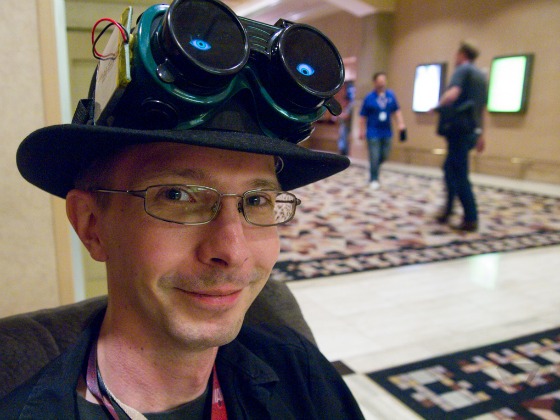
Renderman, aka Brad Haines.
There have been at least five hacker suicides in the last decade that made the news. In November 2011, Ilya Zhitomirsky, a gifted programmer who was working on a high-profile project billed as a Facebook killer, inhaled a lethal dose of helium. He was 22. In July 2011, cryptographer and security researcher Len Sassaman, 31, hanged himself while getting his PhD in Belgium. Jonathan James, who became the first juvenile to get a federal jail sentence for hacking after he broke into NASA and the Pentagon as a teenager, died by suicide in May 2008 at age 24. In 2002, the 25-year-old programmer Gene Kan, who was widely hailed as a genius, updated his resume to read: "Summary: Sad example of a human being. Specializing in failure," and shot himself in the head.
In January, the well-known programmer and activist Aaron Swartz became the latest hacker to die by his own hand when he hanged himself in his Brooklyn apartment at the age of 26. Suddenly, every geek was talking about depression: who had it, what caused it, and what could be done about it. Being analytical thinkers, they began to ask themselves: does being a hacker lead to depression?
The term "hacker" has been stretched to encompass welders and robot-makers along with internet entrepreneurs of the post-Facebook goldrush. For the purpose of this piece, it refers to a group that includes malicious "black hat" coders, who hack for fun and profit; well-intentioned "white-hat" programmers, who help companies find security holes; and those who play with computer systems out of innate curiosity without bothering to label themselves. These hackers are more likely to introduce themselves by the handles they use in IRC chat rooms and HackBB forums than by their given names. They form a tight-knit community online, where there’s always someone who is awake. A few times a year, they gather in real life at conferences like Def Con and Hackers on Planet Earth.
The typical hacker lifestyle doesn’t exactly sound like a breeding ground for good mental health. Erratic sleep patterns and prolonged isolation in front of a computer monitor are common. Prosecution by law enforcement is a constant threat, if not a reality. (Swartz spent the two years before his death under prosecution for downloading more than a million journal articles en masse from the Massachusetts Institute of Technology. His family believes that the threat of imprisonment contributed to his death.)
It’s tempting to infer that the hacker world attracts introverted outcasts, subjects them to pressure from law enforcement or the soul-sucking technology industry, and finally sequesters them behind a screen until they give up hope. That scenario is pretty far from the truth, however, based on the few studies that have been done on the elusive cohort.
Bernadette Schell, vice-provost at Laurentian University, studied hackers for more than a decade. She worked her way into the hacker community in 2000 by earning the trust of Bernie S, also known as Ed Cummings, a twice-imprisoned "phreaker" or phone hacker. She and two colleagues built profiles on more than 200 hackers, based on a lengthy questionnaire passed out at hacker conferences. She wanted to know whether hackers matched their portrayal in the media, which at the time considered them maladjusted cyber-psychopaths.
Suddenly, every geek was talking about depression: who had it, what caused it, and what could be done about it
"I kept looking for everything that would support these myths," she said. "What I found was that the hacker community was a very well-adjusted group of individuals."
At the time, the perception was that hackers were computer addicted, high-strung type A personalities. But the hackers in Schell’s study turned out to be emotionally balanced, "self-healing" type B personalities. They were a bit more introverted than the average population, but still socially connected. Most were employed and made more than the median income level. Incidence of depression was not higher than in the general population. (In fact, some studies have shown that engineers, a group that has a lot of overlap with hackers, have one of the lowest depression rates compared to other occupations.) The hackers were so resilient that even being sent to jail or charged for hacking crimes did not affect their reported stress levels long term.
In 2012, Schell investigated the incidence of Asperger’s, an autism disorder characterized by difficulty with social interaction; she found it was on par with the general population. Hackers, it seems, are just like the rest of us. "They were quite like the mainstream," she said.
Just fix it

Aaron Swartz. Photo: Quinn Norton (Flickr)
Where hackers stumble, it seems, is in trying to process depression as an engineering problem. When Ilya Zhitomirsky died, Bram Cohen, the creator of the popular file-sharing protocol BitTorrent, listed out the seven hackers he knew who had killed themselves, looking for patterns. "I’m past pain and working on triage," he wrote on Facebook. The prominent hacker Meredith L. Patterson lost both a husband, Len Sassaman, and a friend, Eric Tiedemann, to suicide. When Swartz died, she started looking for numbers. "Do we have statistically significant surveys of engineers as a population?" she asked on Twitter. "If not, let's make that happen."
The roboticist, hacker, and Discovery Channel personality Zoz, also known as Andrew Brooks, served as a student mentor while getting his PhD in electrical engineering and computer science at MIT. He ended up counseling a lot of depressed undergrads who tried to reverse-engineer a solution rather than seek help. Many hackers even refer to their strategies for dealing with depression as "hacks."
Many hackers even refer to their strategies for dealing with depression as "hacks"
"There were a lot of attempts to break it down into an engineering problem," Zoz said, recalling one former MIT student who wrote an engineering-style paper called "A Beginner’s Guide to Depression" after a spate of depression-related incidents on campus. From the abstract: "I put forth a few ways of modeling the problem, and offer some techniques for coping with depression."
Of course, depression can be difficult to synthesize into a math problem. The cause is usually a combination of cascading factors that are often difficult to trace. The solution can be even harder to pin down.
"It can be incredibly frustrating to be sitting there, looking at your own brain, and going, ‘right, I entirely understand that something is not quite right with the way that my neurotransmitters are communicating with the receptors in my brain,’" Patterson said. "‘I recognize that I can tinker with this balance and otherwise engage in manipulations of my own mental state to try to resolve this situation. I understand all of this, and why is it not working?’"
Patterson’s husband, Sassaman, was a widely respected computer scientist, co-founder of the CodeCon conference, and a PhD candidate at the Katholieke Universiteit Leuven in Belgium. He and Patterson were hailed as a geek power couple. But he had chronic health problems, some of them undiagnosed, and was under a lot of pressure at work in 2010. He began to withdraw from his colleagues and started working from home. Patterson would make two cups of coffee in the morning and leave one for Sassaman before she went to work. When she returned in the evening, she’d find the coffee cold on the counter and her husband still in bed.
Things seemed to be improving in the summer of 2011, and Patterson went back to the US for a few weeks. While she was home, Sassaman stopped answering IMs. A friend flew to Belgium to check up on Sassaman and found him hanging in the closet. Sassaman had been afraid that talking about depression would damage his credibility. All but his closest friends were shocked. "We had no idea," they told his wife.
Patterson decided to talk about Sassaman’s suicide publicly almost immediately, but she was too shaken to compose more than 140 characters at a time. So, she started tweeting about it. "We have to talk about it," she told me. "When people are afraid to talk about it, they die."
Hacking toward solutions

Amber Baldet.
The artist, digital rights advocate, and investment banking software programmer Amber Baldet presented a talk at Def Con this year that stood out among the panels about pen-testing and IPV6 attacks: "Suicide Risk Assessment and Intervention Tactics."
Although the hacker community can be supportive and loving, it’s also rife with egos and immaturity; "go kill yourself" is actually not an uncommon insult. There was some debate over whether a talk about suicide belonged at Def Con; one attendee told Baldet he’d rather commit suicide than go see it. On Saturday night at Def Con, I mentioned to a 24-year-old defense contractor that I had attended a panel on how to prevent suicide. "Is it just, ‘Don’t be a pussy’?" he asked. When I asked him to elaborate, he said that suicide is the "cheater’s way out" and a resort of "14-year-old girls." He’d been depressed before and simply pulled himself out of it, he claimed.
Pulling yourself out of a depressive slump turns out to be really, really hard, said Baldet, who decided to become an expert at intervention after going through two suicides in her family. Hackers operate so far outside the mainstream that they can feel lost even with professional help. "I remember going to my therapist a couple years ago and telling her some story where nobody had real names," Baldet said. "They were all handles. I’m like, ‘No, his name is KillFace,’ or whatever, and she was just like, ‘oookay.’"
Although the hacker community can be supportive and loving, it’s also rife with egos and immaturity
The popular impression that hackers have a high suicide rate could be because many of the hackers who killed themselves were at the top of their fields, and the highly gifted are statistically more likely to suffer from depression. The community’s facility for dissecting, analyzing, and communicating on the internet — a medium that naturally amplifies its message — has also contributed to the perception that there is a hacker suicide crisis
In reality, the situation is getting better. While there are still some negative associations with mental health issues among hackers, that’s true of most cultures. Like the broader public, awareness of mental health issues is growing, and resources like BlueHackers.org, which has information about depression geared to hackers, and IMAlive, an instant message version of a suicide hotline, have helped countless hackers through their issues. Hackers are also eager to help each other; the line for Baldet’s talk started forming 20 minutes before it was set to start, and she was mobbed by questioners afterward.
Six months after Sassaman died, Patterson appeared on a panel called "Geeks and Depression" at the 2011 Chaos Communication Congress (CCC), an international hacker conference. A year later, Patterson was relaxing with friends when she got an email from a stranger: "I just watched the video of the panel you were on and I’ve realized it’s time that I admitted to somebody that I need help." As Patterson sprang into support mode, everyone around her jumped to support her, offering to deliver Kleenex, beer, Adderall, whatever she needed to get through the night. Patterson messaged with the stranger for the next seven hours. She still doesn’t know his name. "All I know about him is the country he lives in," she said. And one more thing. "He is still my friend, and he is still alive."

The Red Tents
Film: Tolerability Index: This week we're barely putting up with the Hunger Games-inspired summer camp
firehose"The only thing that could properly host The Oscars is a stopwatch."
http://media.animevice.com/uploads/0/6742/531684-vlcsnap_2012_04_16_16h14m44s100.png

Pushing pixels with Paul Robertson, the artist behind 'Mercenary Kings' and 'Scott Pilgrim: The Game'
firehosePaul Robertson autoshare
"We worked on it for about a year, with the first half at Ubisoft Montreal where we were very poorly managed, with a mostly unqualified team and inappropriate tools for what we were trying to do. The game got postponed for a while and then cancelled and then revived and finished in China at Ubisoft's Chengdu studio. I went back home and did the rest of my work remotely. It's pretty surprising it came out as good as it did."
You might not know Paul Robertson's name, but there's a good chance you've seen his pixels. Robertson made his first big splash with the animated short Pirate Baby's Cabana Battle Street Fight 2006, a 12-minute-long black-and-white movie depicting an amazing, though sadly fictional, side-scrolling action game. Since then he's gone on to produce art and animation for a number of terrific games, including Scott Pilgrim vs. The World: The Game and Wizorb.
More recently, he teamed up with Tribute Games for the Metal Slug-style shooter Mercenary Kings, which just launched through Steam's Early Access program and will be coming to the PlayStation 4 later on. We took a few minutes to talk to Robertson about pixel art, the new game, and whether Pirate Baby will ever be something we can actually play.
What attracted you to pixel art in the first place? When and why did you first get into it?
When I was young I always liked drawing and cartoons, and one time my friend gave me a DOS animation program and I just started messing around with it, and making little films, and it grew from there. I didn't really think of it as "pixel art" at the time. It just had a low resolution and limited palette so it just turned out that way.
What classic game inspired you the most and why?
I'm not sure if any one game is my inspiration. Growing up I played a lot of Taito games like Bubble Bobble, Rainbow Islands, Liquid Kids, etc. They had really colorful, bright palettes and lots of cute characters so I was pretty into that. As I got a bit older I started getting into SNK and Capcom games. In the mid to late '90s they really started pushing pixel art to the limit so games like Metal Slug, The King of Fighters, Street Fighter III, etc. were pretty huge for me, too.
"You really don't need any fancy high-end tech to make pixel art."
What's your process like and how has it evolved or changed with new technology and such?
Actually it hasn't changed that much, it's just become more refined and I think I have a better sensibility as an artist. But I still use old programs and classic pixel techniques. I'm just faster and more efficient with them. You really don't need any fancy high-end tech to make pixel art.
Not many pixel artists are known by name. What do you think it is about your style that makes it stand out?
I don't think I have a particularly special style, there are loads of pixel artists more skilled than me. My stuff is largely inspired by video games and pop culture so there's already a big crossover audience that can relate to it.

There are some themes that are common through a number of your pieces, like really sexualized females, disturbing monsters, and vomiting. What is it about this imagery that makes you keep going back to it?
Whenever I make a piece I always try to make something that I'd want to look at. I just like ridiculous and extreme things, so that's what I try to create. I always try to push my art as far as it can go. Even if it's a stupid idea, something awesome and ridiculous can still be made out of it.
What was it like working on Scott Pilgrim? Were you a fan of the books already?
It was actually a pretty stressful experience. We worked on it for about a year, with the first half at Ubisoft Montreal where we were very poorly managed, with a mostly unqualified team and inappropriate tools for what we were trying to do. The game got postponed for a while and then cancelled and then revived and finished in China at Ubisoft's Chengdu studio. I went back home and did the rest of my work remotely. It's pretty surprising it came out as good as it did.

How did you get involved with Tribute Games? What was it about them that made you want to work with them?
Tribute games is made up of ex-Ubisoft guys that I met while working on Scott Pilgrim. We had a similar taste in games and had talked about making stuff together so it was just a natural progression from there.
What are your plans now that Mercenary Kings is out? Will you be working on more games in the future?
Not sure yet. I'd like to keep working with the Tribute guys on whatever they do next, but we'll see what happens.
What are the chances of Pirate Baby ever becoming a real game?
I'd say there's approximately zero percent chance. I want to do something new, and zombies are way too played out these days anyway.
- Related Items interview pixel art mercenary kings tribute games paul robertson pirate baby
EXCLUSIVE: Mark Millar's "CLiNT" Magazine Ends Run
firehosethis fucking guy

Music: Newswire: Chris Brown is being sued for that parking lot fight with Frank Ocean

Making it ever more difficult for Chris Brown to get over that "nonstop negativity," the cousin of Frank Ocean’s cousin is suing Brown over assault and battery, after allegedly taking a beating during that January scuffle between Ocean and Brown. Sha-keir Duarte claims he was punched and kicked by a member of Brown’s entourage, identified only as “Hood” in the suit, during the parking lot rumble, which happened Jan. 27 at Hollywood’s Westlake Recording Studios. Duarte says he suffered a concussion, humiliation, and mental anguish from the incident, and is seeking unspecified damages.
Brown’s lawyer, Mark Geragos, says that Brown is planning to countersue and ask that the suit be dropped. Geragos tells the Associated Press that “garbage like this” is what “gives lawyers and lawsuits a bad name.”
The fight reportedly started over a parking spot, and Ocean, who injured his finger in the fight ...
Read moreFamily-Friendly Policies - The Graduate School of Arts and Sciences
 OnlyMrGodKnowsWhy
Harvard finally gets it laughably, minimally together for its grad students…
Paid Time Off for Childbirth and Adoption
- Female and male students in PhD programs in GSAS are eligible for a Paid Time Off period of six weeks following the birth or adoption of a child.
- Students are expected to notify their advisor, their Director of Graduate Studies and the Dean for Student Affairs at GSAS in writing at least four months in advance of the birth or adoption, so that appropriate arrangements can be made to cover any teaching/research responsibilities.
- Normally the time off period commences within two weeks of the birth or adoption.
- During Paid Time Off, the student remains enrolled full-time. By remaining on full-time status, loan repayment schedules, eligibility for University housing, and student visa status, if applicable, will remain unchanged.
- Students will receive academic accommodation during the time off period - including relief from academic requirements, such as postponement of exams and course requirements.
- Students receiving financial support are entitled to continuation of the support during the time off period, as follows:
- Students receiving stipends from University funds are entitled to draw support for six weeks during the academic year.
- Students funded by government grants or other external sources are entitled to benefits as determined by the funding agency.
- Students who have TF appointments during the time off period will continue to be paid during this period
- Students who take advantage of Paid Time Off will have their departmental G clocks adjusted by one year.
RPG Review: The Quiet Year
firehosehey saucie, you were talking about worldbuilding games?
Leigh: Hi, Shut Up & Sit Down-ers (the Silenced & Seated?)! Thank you for having me back again as your ongoing indie RPG correspondent. Quinns, I think something might have gone off in your fridge, though. What is that?
Quinns: My flat has an Abundance of Rare Meats, but a Scarcity of Hygiene.
Leigh: A reference to the game mechanics, how clever!
So, The Quiet Year. I’m accustomed to roleplaying games that give me the chance to tell a story about a character, through interaction with other characters, but this game is different: Two to four players collaborate over a map to tell the story of a place, and the narrative that unspools itself is about the challenges a community faces following a long war, given one year to prepare for the advent of the mysterious Frost Shepherds.
What are the Frost Shepherds? Who knows! What is this place? Well, that’s what you play to discover. The designer, Joe Mcdaldno, calls it the world’s first cartography RPG.
sandandglass: Jessica Williams proposes applying New York’s...







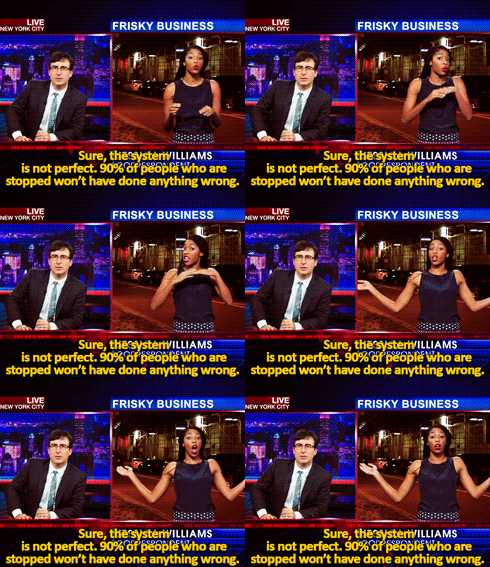


Jessica Williams proposes applying New York’s Stop and Frisk policy to Wall Street bankers.
Your Local Beer Isn't As Local As You Think
firehosevery Boston-centric; CBC beat, Pretty Things beat
'At the time (1996), Boston Beer contracted out production of the iconic Samuel Adams Boston Lager—named for the city’s beloved “brewer patriot”—to other commercial brewing facilities around the country: in Pittsburgh; Portland, Ore. ...'