Link
Former Double Dare host Marc Summers reveals that the channel's popular green goo (pioneered on his show) was named after the street name of heroin, Gak. Childhoods everywhere are now corrupted.


By Emily Gera on Aug 16, 2013 at 7:22a
The second adaptation of Steve Jackson's Sorcery! books, a nostalgic spin-off of the classic Fighting Fantasy series, is headed to iOS devices in late September/early October, developer inkle told Eurogamer.
Sorcery! Part 2 will feature twice as many words and nearly twice as many scenes and options as the previous installment that released in May. An Android version of Part 1 is slated to arrive sometime this year.
The sequel will also allow users who played the first part of the game to choose where they left off, meaning you won't risk losing your original save if you decide to replay Part 1.
Tap for more stories

I wondered what would happen if you made an app in a few hours, stuck it in the App Store and didn’t bother telling anyone? So I tried it out…
Fantastic look at actual numbers for a typical app and the alarming gap between paid and free downloads. (The paid sales average is actually very close to what I’m seeing with Bugshot now, which has fallen since my stats post to about $16 per day, and seems to be holding there.)
Then, in Part 2, see the effect of moving to in-app purchase.
(Via iOS Dev Weekly, the only email newsletter I’ve ever not regretted subscribing to.)
By John Walker on August 16th, 2013 at 1:45 pm.

Here’s some splendid news. Earlier this week I had a little grumblefest about the state of Spelunky’s PC port, with a lack of resolution options, and very poor windowed mode support. I also had a dig about the unskippable intro animations that were also a pain in the 360 version. Whether it was in response to my moaning, or something they were doing anyway, the really good news is that it’s all fixed! And as a result, Spelunky feels splendidly at home on the PC.
Loading the game, you’ll now see a skip intro option appear on the bottom left of the screen, which fantastically dumps you right into the main entrance to the game, everything else skipped. It’s a great change, and makes the game instantly accessible.

And even better, now you can run the game at native resolutions, or any mad combination you may prefer, either in or out of a window. It’s exactly as it should be, and we can all high five, fistbump, and hug until we fall asleep in a big happy pile on the floor.
Boston Globe |
Voice of Red Sox, Jerry Remy, is lost for words over son's arrest WLBZ-TV BOSTON, Massachusetts (NEWS CENTER/AP) - As sportscaster for the Red Sox, Jerry Remy usually has a lot to say, but with news of his son's arrest on a charge of murder, Remy says he's lost for words. He released a statement concerning Jared Remy's ... 'He went back and finished the job'Boston Globe Jared Remy's Father 'Heartbroken' Over Girlfriend's 'Senseless' KillingABC News Uncle of woman allegedly killed by son of Red Sox broadcaster Jerry Remy says ...New York Daily News Los Angeles Times -Boston.com -Fox News all 191 news articles » |
For the last few years, I’ve picked a couple of charities to help out for my birthday. This is the most needful one so far; it’s got a pretty large dollar amount, but I think it’s very important that kids in an area as poverty-stricken as this have access to books.
HOW CAN WE HELP MAKE THIS HAPPEN? All right, I’ll tell you.
Here is the deal (and it was Kathryn’s idea, blame her) . You donate to this cause. The amount is not important, but please try to be as generous as you can. You forward me your invoice at stuart_immonen@hotmail.com. Use “Kevin Church’s Birthday” as the subject line. At the end of the campaign, August 28, I will take all the donations, choose one at random and the winner gets a backing board-sized, black and white head sketch of the character of their choice. (please do not try to negotiate something else, please do not email me with other requests.Please do not make Kathryn regret making me do this.I will move on to the next person.) I will pay the shipping to you. One entry per person.
THAT RIGHT THERE IS THE DEAL. PLEASE REBLOG.
-Stuart
This workflow takes selected text in the Editorial editor and replaces it with HTML encoded character strings.
It's just a few actions:

The magic is in the bit of Python that uses the CGI module and should handle most non-english characters as well as special characters like emdash.
#coding: utf-8
import workflow
import cgi

action_in = workflow.get_input()

tempString = workflow.get_variable('origString')

encodeString = cgi.escape(tempString).encode('ascii', 'xmlcharrefreplace')

#TODO: Generate the output...
action_out = encodeString

workflow.set_output(action_out)
You can download the workflow
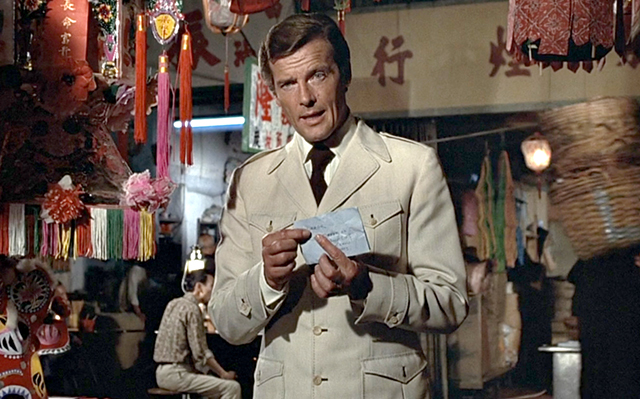
“The Safari Leisure Jacket” – Roger Moore in The Man with the Golden Gun (1974)
The Suites of James Bond is a blog by Briarcliff Manor, New York-based graphic designer Matt Spaiser cataloging the outfits worn by actors (James Bond and his numerous enemies) from the 007 films. Matt explains in fine detail everything we need to know about each article of featured apparel.
Here is an excerpt from Matt’s post about The Safari Leisure Jacket:
This outfit from ‘The Man with the Golden Gun’ may be the one most to blame for Roger Moore’s undeserved reputation for always wearing a leisure suit as James Bond. This safari jacket, made of cream-coloured silk or a linen and silk blend, is really the only one that’s a 100 percent product of the 1970s. Unlike Moore’s traditional safari shirts, this one is a structured jacket. It has natural—but structured—shoulders, set-in sleeves and a tailored waist. (read more)

“A Flamboyant Dinner Suit” – Sean Connery in Diamonds Are Forever (1971)

“Navy Linen Suit” – Daniel Craig in Casino Royale (2006)
images via The Suites of James Bond
via Boing Boing

    
|

New Sinbad 7 (ATW USA - arcade - 1982)

When you have what many consider to be the greatest television series of all time going into its final seven episodes, it’s amusing to look back and see what the critics were saying about the series before Breaking Bad gained its place in American television history. I mean, nobody knew obviously what Breaking Bad would become, and anyone that watches it (except for THIS guy) understands that it’s only gotten better over its five season. It’s understandable if critics, at the time, were somewhat hesitant about Breaking Bad: Recall, that it was only the second series on AMC (after Mad Men) and that it came out during the height of Weeds, which relies on a vaguely similar premise.
I know I’ve been watching it since it debuted (in the month of January, no less, which seems weird for a show so associated with the summer now), but I couldn’t tell you what I thought of it after the premiere. Thanks to the Internet, however, we can at least look back at some of the early reviews (including Alan Sepinwall’s) to see what critics thought of the show at the time. NONE of them knew what was to come.
A modest review from the New York Times, noting that it’s “a hard slog” and not as good as Mad Men. It also draws comparisons to Weeds:
It’s the pacing that makes “Breaking Bad” more of a hard slog than a cautionary joy ride. It has good acting, particularly by Bryan Cranston (“Malcolm in the Middle”), who blends Walt’s sad-sack passivity with glints of wry self-awareness. But the misadventures of Walt and his slacker sidekick, Jesse (Aaron Paul), are a picaresque comedy filmed at the speed of a tragic opera — jokes, visual and verbal, are slowed down from 78 r.p.m. to 33 1/3 by an underlying earnestness, as if it were a foreign art film set in the American Southwest.
“Breaking Bad,” created by Vince Gilligan, a writer and executive producer of “The X-Files,” couldn’t be more different from “Mad Men,” but it also lacks that series’s originality and sparkle. This crime story is in many ways a bleaker male version of “Weeds,” Showtime’s comedy about a widowed soccer mom who sells pot to keep up with the Joneses.
The rest of Tom Shales review over on the Washington Post is better than this blurb would suggest, but for historical purposes, these two paragraphs are the most interesting:
[A] “cult hit” still seems the most that the creators of “Breaking Bad” can hope for. A mondo-bizarro, dark-as-midnight, bitterly bleak tragicomedy, the series premieres tomorrow night at 10 on AMC and all but busts a gut straining to be edgy and grim.
Obviously a show that finds humor in the production and distribution of a deadly, addictive drug, a show whose hero learns in the first episode that he has terminal lung cancer, a show in which vigorous attempts to destroy a corpse in a bathtub full of acid end with the remains of the body, and the tub, crashing through the ceiling to the floor below — well, there you have a show that is definitely “not for everybody.”
I think it’s quant in 2013 to think that Breaking Bad wouldn’t exactly fit on AMC — a channel, at the time, known for classic movies — when just five years later, the channel is virtually defined by Breaking Bad, Mad Men, and The Walking Dead. This SFGate review also offers an amusing reminder that FX passed on the series.
Well, FX gave up on it. The network, which appears to have very few qualms about mangling the so-called envelope, loved the pilot of “Breaking Bad,” created by Vince Gilligan, a writer-director who was instrumental in making “The X-Files” a phenomenon. Still, FX apparently looked at Bryan Cranston (a long way from “Malcolm in the Middle”) cooking crystal meth in the New Mexico desert and said, “Uh, who’s going to advertise on this?” …
… It’s hard to watch. And you have to wonder whether people seeking out classic films on AMC who stumble on it are going to stay. It’s one thing to get intoxicated on the lush beauty of “Mad Men” and quite another to watch a desperate, dying man cook drugs in his underwear while wearing a gas mask.
Then again, let’s not worry about that. Once again AMC has put its money where its artistic ambition is, and “Breaking Bad” promises seven compelling and unique hours of drama – and who knows, it might get renewed – in a strike-damaged TV season.
I absolutely love that Alan Sepinwall, still writing for the New Jersey Star-Ledger at the time, wasn’t completely sold on the series yet, especially considering how much support he shows for it now.
“Breaking Bad” isn’t an out-of-the-box triumph like AMC’s previous drama series, “Mad Men.” “Mad Men” knew what it was from its opening shot, where the new show is still testing new compounds. Cranston’s performance alone is enough to keep me watching for a while, but I’d like to see something resembling a completed formula, and soon.
The Chicago Tribune compares it to a TNT show. Yikes.
My recommendation — and I do think the show is worth checking out — is not as hearty as I’d like it to be. “Breaking Bad” reminds me of TNT’s “Saving Grace,” another cable series that started strong then began to fizzle soon after its promising premiere. “Breaking Bad” likewise starts out strong then loses steam, especially in its unevenly paced third episode.
The Boston Herald, on the wrong side of history, was not a fan:
The opening shot confirms the worst. A pair of pants drop from the desert sky. A Winnebago careens crazily. A frantic Cranston yelps at the wheel, clad only in his underwear and a gas mask. Welcome to “Malcolm in the Meth Lab.” “Breaking Bad” is an uneven show about a man deep in crisis who chucks his moral compass and conversely finds his backbone once he is given a death sentence.
The other Boston paper, The Globe, wasn’t such a huge supporter, either:
You can feel creator Vince Gilligan (of “The X-Files”) straining to build an emblematic American fable and forgetting to fill in his story with particularities and believable motivations.
The most amusing of the bunch, however, comes from The AV Club, which loved the show:
After the towering achievement of Mad Men, third-rate movie channel AMC is suddenly a hot spot for serialized dramas. I hope that the basic cable equivalent of a sh*tload of viewers tuned in to the premiere of Breaking Bad on that basis alone. What they saw was nothing like the elegant social satire of Mad Men, but it certainly has promise, thanks to the mesmerizing presence of Bryan Cranston in the lead role and to the raw, keenly observed screenplay by writer/director Vince Gilligan. And really, if the sight of a doughy, middle-aged man clad only in worsted-weight socks, loafers, tighty-whiteys and a rubber apron doesn’t do it for you, I don’t know why you’re reading the TV Club …
but hated the title:
… Breaking Bad is a horrible, horrible name for a TV show. It’s not made any better by being included (and explained) in an actual line of dialogue from the show.
A woman attacked in the elevator of an apartment building last week was outside the Broadway T stop today when she spotted a familiar face - that of the man who attacked her, according to residents of the building.
The woman managed to snap his photo before calling police, but he got on a 9 bus that headed toward City Point before police arrived, residents say.
In the photo, the man appears to be glowering at the woman, as he wears ear buds - one wrapped around his ear, rather than in it.
firehoseman builds own wooden sailboat


It took 26 years and $200K, but Jeff Horley’s wooden sailboat — complete with Jacuzzi — is finally seaworthy
Jeff Horley talks like a sailor. Which is to say his voice sounds grizzled, worn by the waves, burnished by the sun and rife with salty sea yarns from all the places he has seen from the cockpit of his sailboat.
And yet, what he has seen, for the best part of the past three decades, is the inside of a rented warehouse and, lately, a custom geothermal heated shed on his rural property, not far from the yacht club in Sarnia, Ont., where he has spent 26 years landlocked, while building his 38-foot wooden sailboat. A dreamboat, really, complete with a Jacuzzi tub, stained-glass windows, room to sleep six and, finally, on this Sunday past, water beneath her Western Red Cedar, teak and African mahogany hull.
“She floats, so we got that much right,” says Mr. Horley, over a crackling cell phone, from a picnic table on the end of a dock not far from his prized possession.
“I didn’t get into this by accident. When I was 21 I determined that I wanted to build a new wooden boat. My old boat, the Craklin, was wood, and it was already getting pretty old and no one was really making wooden boats anymore and so I decided to make my own.” (Geoff Robins for National Post)
firehosetech companies are conservative no matter what they do or say beat
firehose"for many developers, money is motivation enough, and for just as many users, app availability – especially games – trumps the user experience."
Postulate: The greatest differentiator for iOS is the quality of its apps.
That’s the position taken by Benedict Evans in a must-read piece:
If total Android engagement moves decisively above iOS, the fact that iOS will remain big will be beside the point – it will move from first to first-equal and then perhaps second place on the roadmap. And given the sales trajectories, that could start to happen in 2014. If you have 5-6x the users and a quarter of the engagement, you’re still a more attractive market.
This is a major strategic threat for Apple. A key selling point for the iPhone (though not the only one) is that the best apps are on iPhone and are on iPhone first. If that does change then the virtuous circle of ‘best apps therefore best users therefore best apps’ will start to unwind and the wide array of Android devices at every price point will be much more likely to erode the iPhone base. Part of the reason for spending $600 on an iPhone instead of $300 on an Android is the apps – that cannot be allowed to change.
Still, Evans is careful to note that apps are “not the only [selling point]” for the iPhone. As well he should: there remains an elegance and refinement to iOS relative to the competition that a certain breed of user will simply not give up, even if Android had unique apps.
Still, that user is only a portion of iPhone buyers. I don’t have any hard numbers to support this (nor do I have them for any of the assertions in this post; however, I used to analyze the actual numbers behind a lot of this for a living), but I suspect the iPhone-buying population preference distribution looks like something like this:
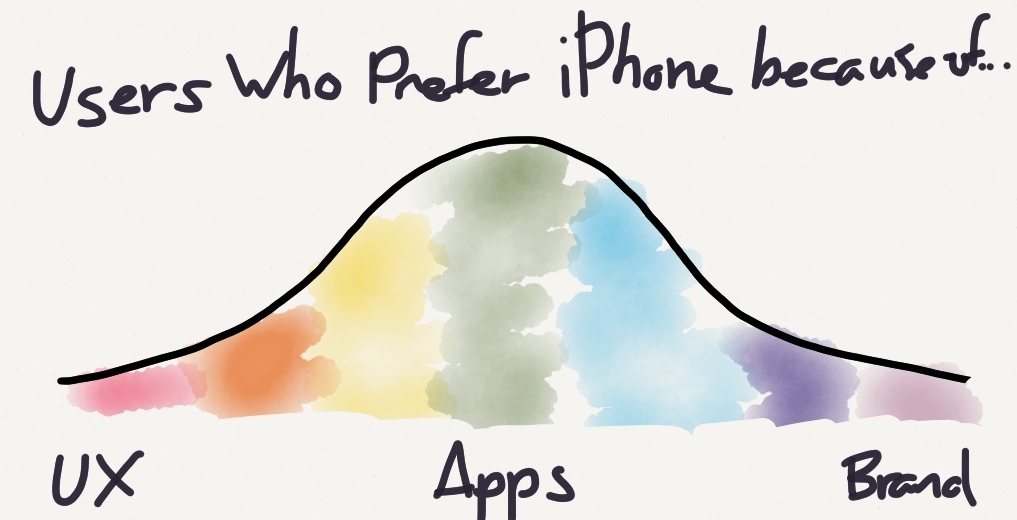
To the left are the folks I just referenced, who care above all else about the user experience. They would buy an iPhone even if Android had an app they desired.
In the middle are people who buy an iPhone for the apps, and on the right, for branding. Again, this is just the top-level preference; a user may prefer the iPhone’s UX, app selection, and branding, but by definition something is the most important.
Rene Ritchie wrote a great response to Evans’ piece about The Difference Between iOS and Android Developers:
The Mac, though its market share was never large, especially when compared to the well over 90% marketshare of Microsoft Windows-based PCs, had always attracted an incredibly talented, incredibly dedicated group of developers who cared deeply about things like design and user experience. OS X enjoyed not only the traditional Mac OS community, but the NeXT one as well. That talent share always felt disproportionate to the market share. Massively. And a lot of those developers, and new developers influenced by them, not only wanted iPhones and iPads, but wanted to create software for them…
People – developers – aren’t just numbers. They have tastes. They have biases. If they didn’t, then all the great iPhone apps of 2008 would have already been written for Symbian, PalmOS, BlackBerry (J2ME), and Windows Mobile years earlier. If they didn’t, then all the great Mac apps would have been migrated to Windows a decade ago.
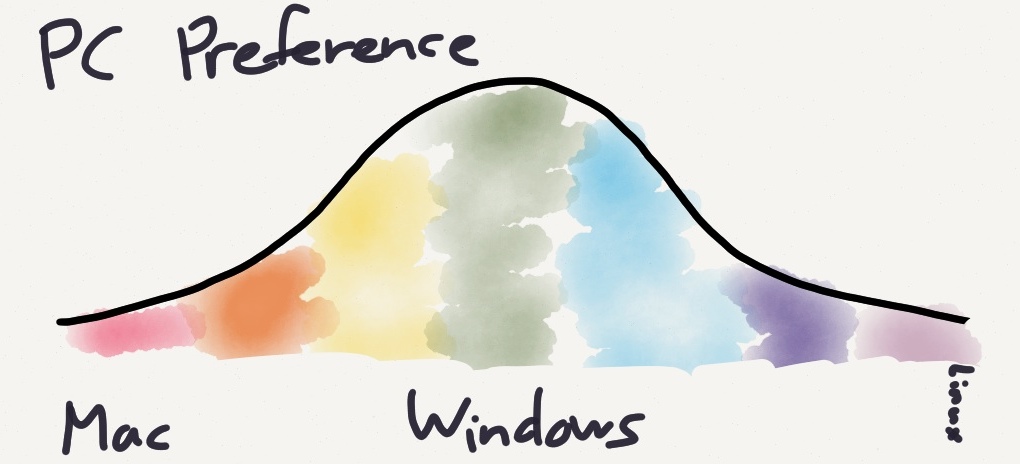
It’s interesting to consider the Mac in this context, particularly when it comes to developers. There’s no question Mac market share fit nicely into one tail of a bell curve:
Marco Arment, while not in direct response to Ritchie, made a similar argument about developers building software for platforms they themselves use:
Developers aren’t fools. We aren’t swayed by charismatic figureheads who try to convince us to develop for their platforms. The formula is quite simple. We’ll develop for a platform if:
We use it.
A lot of other people use it.
We can make a living developing for it.
If your platform nails all three, we’ll develop for it. Nobody will even need to ask us. We’ll break the door down.
Mapping developer motivation to the same bell curve, I’d imagine it looks something like this:
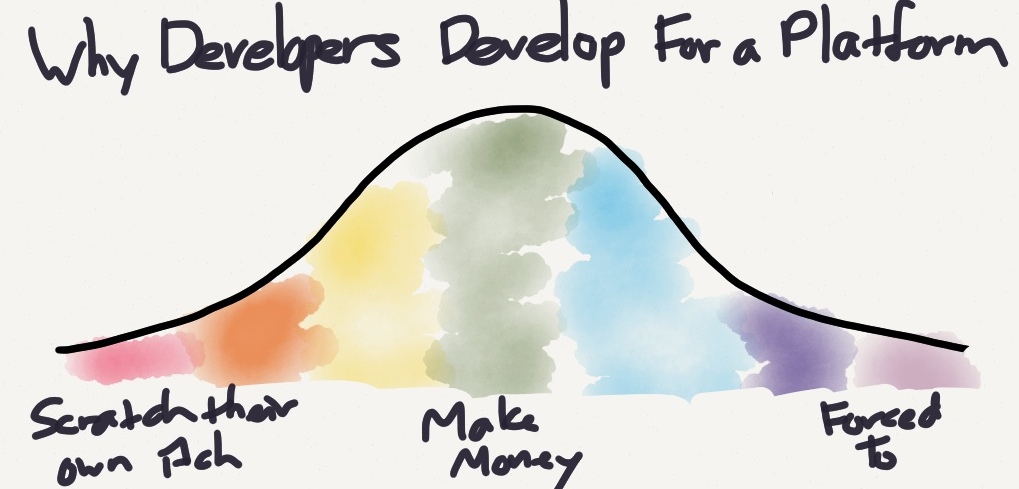
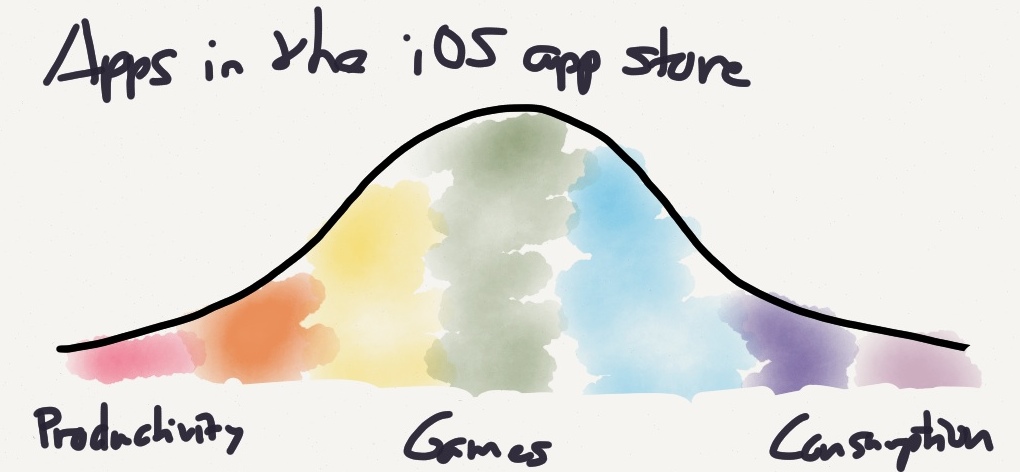
It’s interesting, also, to consider the types of apps that are in the app store. I think there are three broad categories:
Productivity Apps As I wrote previously, “If games are all about user input, with minimal app output, and consumption apps about app output, with minimal user input, productivity apps are about both. You put something into an app, and the app returns something back to you, better.”
Productivity apps are the most attuned to the underlying platform, particularly from a UI perspective, and thus have the highest incremental cost to supporting multiple platforms.
In terms of numbers of apps, the app store looks something like this:
By this point, you’re probably getting sick of the rainbow bell curve, so I’ll consolidate app quality, monetization models, and price:
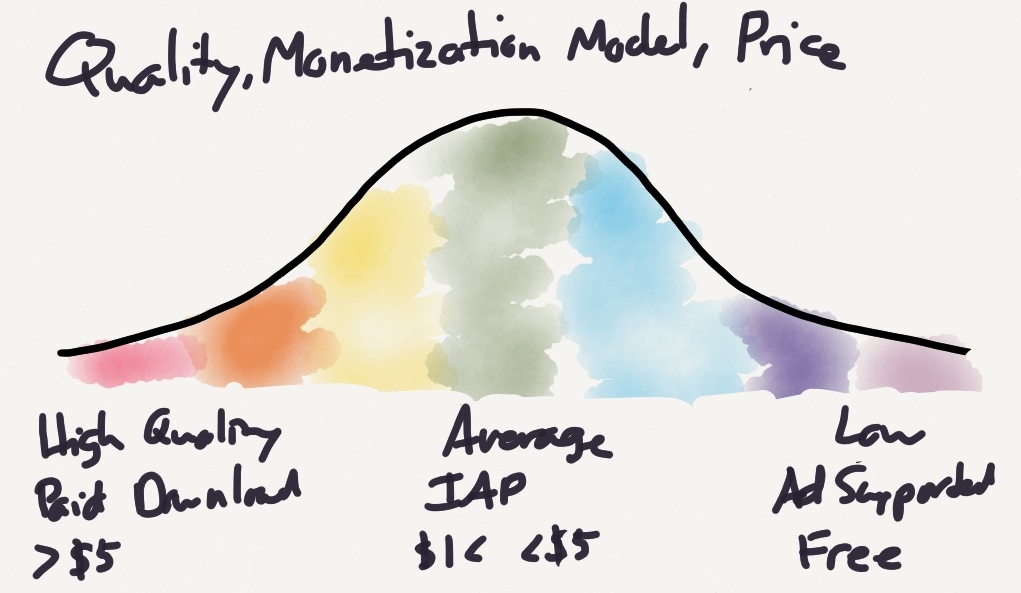
In fact, and this is the crucial point, I could have consolidated all of the bell curves, because I believe they are highly correlative.
Ultimately, though, neither tail is particularly interesting; it’s the massive middle that moves markets. While I had similar thoughts to Ritchie about the relative quality and associated motivation of a certain breed of iOS developers, most people aren’t buying iOS devices because of OmniFocus.
Rather, it’s apps like SuperCell’s Clash of Clans, the third-most grossing app in the App Store, or Instagram in the months before the Android version launched, that differentiate the iPhone. Apps like that fall solidly on the middle-to-right side of these bell curves: their developers are much more concerned with making money or maximizing their back-end investment than they are in scratching their own itch, and they will do the exact calculations Evans has suggested.
The average Android smartphone user is worth much less than the average iPhone user, but there are lots more of them.
Let’s be super clear: both Evans and myself are quite dismissive of the idea that iOS:Android::Mac:Windows. But one lesson that can be drawn is that for many developers, money is motivation enough, and for just as many users, app availability – especially games – trumps the user experience.
Evans is right: the lower-cost iPhone can’t arrive soon enough.
One final thing worth noting is geography. In the Valley, the iPhone reigns supreme. It’s genuinely surprising when folks don’t have an iPhone (although not as surprising as when they don’t have a Mac). In Asia, though, Android is far more popular, and it’s Asia where there is, by far, the most growth to be had for smartphone manufacturers. If Android-first development becomes a reality, it will happen here first.
The post The App Store Rainbow appeared first on stratēchery by Ben Thompson.
firehose"With the money he earns from the sale of the rights, Coolio hopes to expand his burgeoning series of cookbooks as well as his online cooking show, Cookin’ With Coolio."

Coolio is auctioning off the royalty rights to his entire catalog in an attempt to finance his culinary career. The rapper—real name Artis Leon Ivey, Jr.—will put all 123 of his songs on the auction block Aug. 28. The bidding starts at $140,000, but the catalog includes goofy cultural touchpoint hits like “Fantastic Voyage,” “1,2,3,4 (Sumpin’ New),” “C U When U Get There,” and “Gangsta’s Paradise.” Now when you get hit with a shoe at a random Val party, the version of “Rollin’ With My Homies” you sing can be one that you earn cash royalties on. Cha-ching!
With the money he earns from the sale of the rights, Coolio hopes to expand his burgeoning series of cookbooks as well as his online cooking show, Cookin’ With Coolio. He’s already published one bestselling cookbook, 2009’s Cookin’ With Coolio, and appeared on ...
Read morefirehose:|
Native American warrior Chief Thunder will return in the re-imagined Killer Instinct for Xbox One, which is not much of a surprise, after the blatant tease of the character's inclusion in a recent gameplay video. In a new video posted to IGN, developer Double Helix breaks down how the chief has changed over the past 20 years.
Chief Thunder will still carry his trademark dual tomahawks, but he's been transformed into a more aggressive grappler-style fighter in the new Killer Instinct. David Verfaillie, design director at Double Helix, calls Thunder a "superhuman, fantastical character" who should be considered a threat to rushdown fighters.
Thunder's signature special move, the Sammamish, will return and offer the fighter "complete project invulnerability." The rising attack has been complemented with a follow-up special, dubbed Sky Fall, which adds a stomp move. Chief Thunder's Triple Axe special will also return, helping him close the distance between himself and his opponent. He also has a move called the Ankle Slicer, which targets low. The modernized Chief Thunder's other moves are built around his grappling style, including his dash, which moves him further than other characters, provides invulnerability and can be canceled with a special move.
Chief Thunder joins Jago, Sabrewulf and Glacius in the list of confirmed characters coming to the Xbox One launch game.
For more on Chief Thunder as he appears in the free-to-play Killer Instinct, including details on his backstory and stage, check out the video at IGN.

In her 1998 essay “Fact And/Or/Plus Fiction,” Ursula K. Le Guin addressed what she saw as a reckless trend in non-fiction—not an erosion of standards overall, but an increase in what she calls the “theatricalizing” of written history and biography. In particular, she laments “writers of non-fiction narrative who ‘create’ facts, introduce inventions, for the sake of aesthetic convenience, wishful thinking, spiritual solace, psychic healing, vengeance, profit, or anything else”—and she goes so far as to say that non-fiction writers who take such liberties “aren’t using the imagination, but betraying it.”
It’s interesting that she speaks of the imagination as a power that can be used for either good or ill. Le Guin is foremost a fiction author, and she’s expressed her aversion to writing non-fiction several times (ironically in essay form)—and the fiction she writer is mostly science fiction and fantasy ...
Read more
 Audiosurf 2 rides the wave to Steam Early Access in September originally appeared on Joystiq on Fri, 16 Aug 2013 00:30:00 EST. Please see our terms for use of feeds.
firehosevia multitasksuicide
"The book is a seductive object to hold and smell and run your fingers through. I am drawn to books for many reasons"
fuck your books

 Andrew Hayes is a sculptor who makes beautiful pieces by pressing and deforming thick sheaves of book-pages between rigid hunks of steel. He calls the series "Altered Books."
The book is a seductive object to hold and smell and run your fingers through. I am drawn to books for many reasons; however, the content of the book does not enter my work. The pages allow me to achieve a form, surface, and texture that are appealing to me. The book as an object is full of fact and story. I take my sensory appreciation for the book as a material and employ the use of metal to create a new form, and hopefully a new story.
Andrew Hayes (via That Book Smell) 
|
|
firehosevia multitasksuicide
 I don't have much to say about the latest tempest in a teapot over the non-literal use of "literally." It started, as such things often do these days, on Reddit, where a participant in the /r/funny subreddit posted an imgur image showing Google's dictionary entry for "literally" that pops up when you search on the word. The second definition reads, "Used for emphasis or to express strong feeling while not being literally true." That was enough for the redditor to declare, "We did it guys, we finally killed English." As the news pinged around the blogosphere, we got such fire-breathing headlines as "Society Crumbles as Google Admits 'Literally' Now Means 'Figuratively'," "Google Sides With Traitors To The English Language Over Dictionary Definition Of 'Literally'," "I Could Literally Die Right Now," and "It’s Official: The Internet Has Broken the English Language."
The outrage was further heightened by the realization that (gasp!) pretty much every major dictionary from the OED on down now recognizes this sense of the word. So now we get vitriol directed toward the OED's lexicographers, who revised the entry for "literally" back in September 2011, coming from such sources as The Times, The Daily Mail, The Guardian, and The Telegraph. [Update: As Fiona McPherson points out on the OxfordWords blog, the usage was actually noted in the "literally" entry when it was first published in 1903. The 2011 revision reorganized the entry and expanded the historical record.]
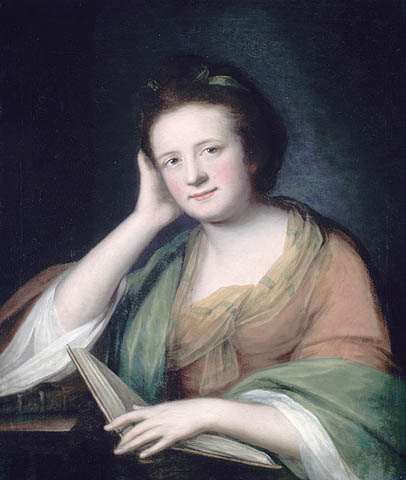
I've previously shared my thoughts on "literally" here on Language Log in a 2005 post discussing a piece on Slate by the OED's Jesse Sheidlower, as well as in a Word Routes column in 2008 ("Really! Truly! Literally!"). If I were pressed to find a silver lining in the latest round of hand-wringing, it would be this: many people are now learning about Frances Brooke, the novelist who is responsible for the earliest OED citation for the hyperbolic sense of "literally," from 1769. I first dug up the citation for the 2005 Language Log post, and it eventually worked its way into the OED's 2011 revision:
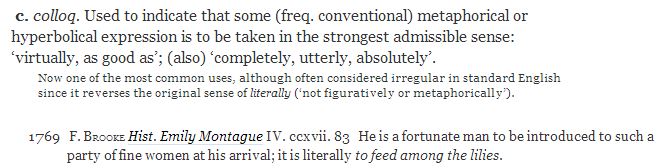
(You can read Brooke's History of Emily Montague, an epistolary novel, online here. As Wikipedia informs us, it holds the distinction of being the first novel written in Canada — she lived in Quebec from 1763 to 1768 before returning to England.)
The British press has duly noted that the maligned use of "literally" has been lingering since Brooke's time, but that hasn't stemmed the outrage: it's still wrong, they all say, even if it's been in continuous use for two and a half centuries. But it's a little inconvenient for the peevers, who would much rather blame Google or "the Internet" for the destruction of English. It doesn't make for as good a story to hold an 18th-century novelist responsible for "breaking the English language." Somehow, we've managed to soldier on since the linguistic horror perpetrated by the dastardly Mrs. Brooke.
firehosevia Russian Sledges: "#nevergo"