Official pics over at EW are giving us a new look at the X-Files revival episode “My Struggle” ; according to Comic Book Resources, the episode will feature Mulder and Scully investigating “a possible alien abductee (Annet Mahendru of The Americans) at the behest of the conservative talk-show host played by Joel McHale.”
This morning, on the 18th anniversary of her first Harry Potter publication, J.K. Rowling announced on Twitter that a new HP project is in the works! A play, titled Harry Potter and the Cursed Child, is set to hit London theaters next year. Rowling seems very excited about the project, although she’s trying to keep details secret.
It has been a huge pleasure to share with them (and soon, with you!) this untold part of Harry’s story. #CursedChild — J.K. Rowling (@jk_rowling) June 26, 2015
I don’t want to say too much more, because I don’t want to spoil what I know will be a real treat for fans. #CursedChild — J.K. Rowling (@jk_rowling) June 26, 2015
She has, however, revealed that it is not a prequel to the book series.
However, I can say that it is not a prequel! #CursedChild — J.K. Rowling (@jk_rowling) June 26, 2015
“But why a play?” you ask as you weep into your pillow because you’re not in London or even near London. Well, Rowling didn’t think the material suited a book.
To answer one inevitable (and reasonable!) question – why isn’t #CursedChild a new novel? – I am confident that when audiences see the play — J.K. Rowling (@jk_rowling) June 26, 2015
they will agree that it was the only proper medium for the story. #CursedChild
Rowling will be working with Sonia Friedman, writer Jack Thorne and director John Tiffany, which she calls her “dream team.” People are already asking who the stage actors will be. Daniel Radcliffe has plently of theater experience, as does much of the movie cast, so it would be great to see them return to their roles.
For those of us who can’t make it let’s make plans to watch A Very Potter Musical for the fifteenth time?
We only recently learned—and began rampantly speculating about—Punisher’s appearance in Daredevil season 2, but Nerdist has gotten wind that the new showrunner is referring to the upcoming season as “Daredevil vs. Punisher”! (Possible spoilers ahead!)
Certainly, the revamped logo and description of Punisher’s character had led us to believe he’d make a perfect foil to Daredevil by being a vigilante who crosses that much talked about “kill/don’t kill to achieve justice” line from season 1, so though this isn’t hard confirmation, we’d frankly be more surprised if it weren’t true. It all leads Nerdist to theorize about some other possible storylines for season 2, including the role of Elektra—whose appearance has been leaked—though it’d be really great if she could not be killed for motivation for one of the show’s male characters. We’ll just have to cross our fingers on that one.
So what do you think, gang? Excited to see Punisher as a villain, even if temporarily (if that is indeed the case)? Worried about what they have in store for Elektra? Hash it out in the comments!
All eyes are on Dylann Roof, Charleston and other Southern cities where the Confederate battle flag flies. But, as a landmark Supreme Court case proved this morning, the threat of bureaucratic, Northern-style racism is just as critical.
The geneology show's production has been halted after leaked Sony e-mails revealed that producers complied with Ben Affleck's request to hide his slave-owning relative.
You know that company that builds all your electronics? The one that makes your iPhone and your Xbox and your Kindle and has to install anti-suicide nets to deter miserable workers from ending their lives? It’s a company known to Americans as Foxconn, and it’s the 10th largest employer in the world.
The Internet Archive—including its Wayback Machine, which currently stores 485 billion snapshots of the world's web pages at different dates—is inaccessible for some users in Russia, as a post on the Global Voices site explains. This is the result of a blocking order from the country's Attorney General, under legislation originally designed to protect minors from pornography sites, sexual abuse sites, and sites that provide details about drug use and suicide, but later extended to cover sites advocating "extremist activities" too.
The Attorney General's order is to block a single page held by the Wayback Machine—one called "Solitary Jihad in Russia," which contains information about the "theory and practice of partisan resistance," as Global Voices reports. Since the Internet Archive site uses HTTPS by default for its connections, Russian ISPs are unable identify which page is being requested by their users, and thus whether it is the one subject to the new ban. Mindful of the consequences of ignoring the Attornery General's order, some have responded by blocking the entire archive.org domain. As more sites move to HTTPS by default, this problem may become more widespread in Russia, as well as in other countries that seek to block specific web pages.
The Internet Archive is not alone in encountering problems caused by Russia's increasingly restrictive Internet laws. Last month, the country's communications watchdog threatened to fine Facebook, Google and Twitter for failing to comply with a 2014 "blogger's law," which requires owners of accounts receiving more than 3,000 visitors a day to be registered with the Russian government. The US companies were also warned that they could face web blocks if they refused to delete from their sites “information containing calls to participate in mass rioting, extremist activities.”
This afternoon, Eric Saldarriaga, a private investigator from Astoria, New York, will be sentenced in federal court for his part in a conspiracy to hack into the e-mail accounts of more than 50 individuals as part of his investigations. (He has pled guilty.) Among his victims are two prominent critics of the Church of Scientology, both of whom were recently featured in the book and HBO documentary film Going Clear. Update: Saldarriaga received a sentence of three months imprisonment, three years of supervised probation, and a $1,000 fine—in addition to forfeiture of $5,000 he received in fees for hacking at least one account.
Who were Saldarriaga's clients? That remains unclear; court documents haven't revealed it, and the transcripts of his guilty plea are still held by the court awaiting redaction. But both Scientology critics are now convinced that it was the church which set Saldarriaga on them. "There can be no doubt that one of Mr. Saldarriaga’s clients is Scientology," Mike Rinder, a former Scientology official and one of the victims notified by the US Attorney's Office, said in a written statement sent to the court.
Ars attempted to get a comment from a church of Scientology spokesperson, but did not receive a response in time for publication. We will update this story if we receive comment.
On Monday, the Intercept published a new story from the Snowden documents:
The spy agencies have reverse engineered software products, sometimes under questionable legal authority, and monitored web and email traffic in order to discreetly thwart anti-virus software and obtain intelligence from companies about security software and users of such software. One security software maker repeatedly singled out in the documents is Moscow-based Kaspersky Lab, which has a holding registered in the U.K., claims more than 270,000 corporate clients, and says it protects more than 400 million people with its products.
British spies aimed to thwart Kaspersky software in part through a technique known as software reverse engineering, or SRE, according to a top-secret warrant renewal request. The NSA has also studied Kaspersky Lab's software for weaknesses, obtaining sensitive customer information by monitoring communications between the software and Kaspersky servers, according to a draft top-secret report. The U.S. spy agency also appears to have examined emails inbound to security software companies flagging new viruses and vulnerabilities.
The documents...don't describe actual computer breaches against the security firms, but instead depict a systematic campaign to reverse-engineer their software in order to uncover vulnerabilities that could help the spy agencies subvert it.
[...]
An NSA slide describing "Project CAMBERDADA" lists at least 23 antivirus and security firms that were in that spy agency's sights. They include the Finnish antivirus firm F-Secure, the Slovakian firm Eset, Avast software from the Czech Republic. and Bit-Defender from Romania. Notably missing from the list are the American anti-virus firms Symantec and McAfee as well as the UK-based firm Sophos.
But antivirus wasn't the only target of the two spy agencies. They also targeted their reverse-engineering skills against CheckPoint, an Israeli maker of firewall software, as well as commercial encryption programs and software underpinning the online bulletin boards of numerous companies. GCHQ, for example, reverse-engineered both the CrypticDisk program made by Exlade and the eDataSecurity system from Acer. The spy agency also targeted web forum systems like vBulletin and Invision Power Boardused by Sony Pictures, Electronic Arts, NBC Universal and othersas well as CPanel, a software used by GoDaddy for configuring its servers, and PostfixAdmin, for managing the Postfix email server software But that's not all. GCHQ reverse-engineered Cisco routers, too, which allowed the agency's spies to access "almost any user of the internet" inside Pakistan and "to re-route selective traffic" straight into the mouth of GCHQ's collection systems.
There's also this article from Ars Technica. Slashdot thread.
Kaspersky recently announced that it was the victim of Duqu 2.0, probably from Israel.
While some of the unit's activities are focused on the claimed areas, JTRIG also appears to be intimately involved in traditional law enforcement areas and U.K.-specific activity, as previously unpublished documents demonstrate. An August 2009 JTRIG memo entitled "Operational Highlights" boasts of "GCHQ's first serious crime effects operation" against a website that was identifying police informants and members of a witness protection program. Another operation investigated an Internet forum allegedly "used to facilitate and execute online fraud." The document also describes GCHQ advice provided :to assist the UK negotiating team on climate change."
Particularly revealing is a fascinating 42-page document from 2011 detailing JTRIG's activities. It provides the most comprehensive and sweeping insight to date into the scope of this unit's extreme methods. Entitled "Behavioral Science Support for JTRIG's Effects and Online HUMINT [Human Intelligence] Operations," it describes the types of targets on which the unit focuses, the psychological and behavioral research it commissions and exploits, and its future organizational aspirations. It is authored by a psychologist, Mandeep K. Dhami.
Among other things, the document lays out the tactics the agency uses to manipulate public opinion, its scientific and psychological research into how human thinking and behavior can be influenced, and the broad range of targets that are traditionally the province of law enforcement rather than intelligence agencies.
Federal Communications Commission member Michael O’Rielly yesterday argued that "Internet access is not a necessity or human right" and called this one of the most important "principles for regulators to consider as it relates to the Internet and our broadband economy."
O'Rielly, one of two Republicans on the Democratic-majority commission, outlined his views in a speech before the Internet Innovation Alliance, a coalition of businesses and nonprofits (see transcript).
O'Rielly described five "governing principles" that regulators should rely on, including his argument that Internet access should not be considered a necessity. Here's what he said:
In 2012, protesters descended on an unlikely target: Rothamstead, the oldest agricultural research center in the world and a nonprofit that focuses on sustainable food production. The protesters weren't simply upset with some of the work going on there; they announced in advance that they planned to destroy it. The reason? It involved genetically modified crops.
Researchers at Rothamstead had introduced a gene from peppermint into wheat, allowing the crop to produce a chemical that aphids use as an alarm signal. In lab tests, aphids had avoided wheat carrying the additional gene, suggesting that the GM wheat could limit the need for pesticide applications. The lab findings, however, needed to be validated through field trials. And anti-GMO activists decided that these trials posed an unacceptable risk to the public and farmers and needed to be stopped.
With heightened security, the trials went forward, and the results have now been published. It turns out that the summer the trials were run was cold and rainy, and aphids as a whole didn't do well—there were so few even the control plants were "well below the recommended [pesticide] spray thresholds for summer aphids in the UK." The aphids that were present, however, didn't seem to mind the presence of the alarm pheromone on the transgenic wheat.
This week the open source Atom text editor from Github had its official 1.0 release! Atom is a programmer’s text editor that’s built on web technology like HTML5 and JavaScript. This makes the editor easily portable to different platforms since it’s not tied to any particular native graphical interface. I’ve used Atom a bit in earlier releases and am excited to see how it works with the latest 1.0 release and its many performance improvements.
Also check out the blog post to learn about the history of Atom and some plans for the future now that the core functionality is in place with the 1.0 release. Be sure to watch the hilarious retro promotional video that looks like it was pulled out of a time capsule from the 50’s and 60’s. There’s an awesome Atom ‘computer’ with lots of knobs, buttons, blinky lights, and even an UNTZtrument!
Samsung has promised to stop disabling Windows Update on hardware using its SW Update software.
The behavior came to light earlier this week after debugger and reverse engineer Patrick Barker documented an investigation by members of the Sysnative forum into why Windows Update kept getting disabled—checking for updates but never downloading or installing them—on a misbehaving machine. The forum troubleshooters discovered that Samsung's SW Update was downloading a program called Disable_Windowsupdate.exe which, true to its name, was disabling Windows Update each time the system started.
Samsung's statement today says that the company will soon stop doing it. The company said that "Samsung has a commitment to security and we continue to value our partnership with Microsoft. We will be issuing a patch through the Samsung Software Update notification process to revert back to the recommended automatic Windows Update settings within a few days. Samsung remains committed to providing a trustworthy user experience and we encourage customers with product questions or concerns to contact us directly at 1-800-SAMSUNG."
Next week, a new item will join Disney theme parks' list of items that can't be taken in by patrons: selfie sticks. The rule will expand upon the parks' previous restrictions on selfie stick use.
An apparent leaked internal e-mail, sent to Disney theme park employees on Friday, clarified that the ban would go into effect on June 30 for all American Disney theme parks; Disney's Paris and Hong Kong parks will follow suit on July 1. The instructions included rules for both door bag screeners and general staff to make patrons check any discovered sticks at a "guest relations" station.
Song recordings created before 1972 don't have federal copyright, but many states did grant such copyrights. The varying rules on older songs have been a huge headache for satellite radio provider Sirius XM, and may yet be a boondoggle for streaming services like Pandora.
After experiencing some adverse rulings, Sirius is moving to put its biggest legal conflict over royalties behind it. Documents filed this morning with the Securities and Exchange Commission indicate that the company has agreed to pay the major record labels $210 million to end their dispute over whether they should be paying royalties for pre-1972 songs.
The song doesn't end litigation by the '60s band The Turtles, who still have a class-action lawsuit proceeding against Sirius. But the major labels have the rights to about 80 percent of the pre-1972 music that Sirius plays.
“I’ve been talking a lot with Bobby Jindal, who is our governor. Bobby is a good friend of ours. He and his wife are good friends of Korie and [mine]. He has been on our television show. Anybody that comes down and has been on an episode of ‘Duck Dynasty,’ obviously is the frontrunner in my book,” Willie Robertson told FOX411 in May. (Permalink)
Thomas wrote that there is no "dignity" clause in the US Constitution — and that, even if there was, the government could not bestow it upon a person or take it away.
To make his point, he invoked the examples of slavery and internment camps. From his dissent:
The corollary of that principle is that human dignity cannot be taken away by the government. Slaves did not lose their dignity (any more than they lost their humanity) because the government allowed them to be enslaved. Those held in internment camps did not lose their dignity because the government confined them. And those denied governmental benefits certainly do not lose their dignity because the government denies them those benefits. The government cannot bestow dignity, and it cannot take it away.
Thomas went on to write that one's liberty and dignity should be shielded from the government — not provided by it.
"Today’s decision casts that truth aside. In its haste to reach a desired result, the majority misapplies a clause focused on 'due process' to afford substantive rights, disregards the most plausible understanding of the 'liberty' protected by that clause, and distorts the principles on which this Nation was founded. Its decision will have inestimable consequences for our Constitution and our society," Thomas wrote in conclusion. (Permalink)
Here’s another sign that wage growth is finally coming to the US.
If the very solid jobs numbers from June 5 are any indication, things are getting better in the American job market and paychecks will likely start fattening up. Today’s survey data for May 2015 from the NFIB shows that the small businesses it tracks support that view. Having shaken off a rough winter, they reported an increasingly hopeful outlook; The small business optimism index rose slightly in May (to 98.3) after sinking significantly in March (having fallen to 95.2).
Meanwhile, a greater proportion of small businesses said they are expanding their payrolls.
Along with increased hiring, small business said they are raising pay, too.
The Obama administration’s decision to effectively forgive the student debts of tens of thousands of students who attended schools run by the now-bankrupt for-profit education company Corinthian Colleges may be the first step to admitting that America’s experiment with for-profit higher education is a giant mess.
For taxpayers this is a painful lesson. Students attending schools operated by Corinthian Colleges took out some $3.6 billion in Federal student loans. So theoretically taxpayers could be forced to eat all that debt as a loss. (Though its unlikely every last loan will qualify for relief.) And the costs could climb, as the Department of Education has opened the door to offer further forgiveness for students of other schools who claim they were misled into taking out excessive debt to attend for-profit schools.
Still, let’s hope a lasting realization sinks in with the sting. There are terrible incentives inherent to a for-profit education system kept afloat on an endless river of government loans. For anyone who paid attention to the financial crisis, the situation seems reminiscent of run-up to the housing bust, in which shady mortgage brokers encouraged people to load up on debt to buy houses. When those loans ultimately went bad, the US taxpayer had to step in to keep the financial system and the economy from collapsing. Might the bankruptcy of Corinthian be a turning point similar to the bankruptcy of Lehman Brothers during the crisis?
At any rate, the problems are not strictly confined to the Corinthian Colleges catastrophe. Here are a smattering of troubling findings surrounding the for-profit education sector as a whole.
“Students in for-profit colleges, especially the 2-year colleges, borrow approximately four times as much as they would have at a 2-year public college.” (Research in Higher Education)
“While enrolling nearly 10% of all students in accredited higher education institutions, it [for-profit education] secures some 24% of all Pell Grants—the main federal grant-in-aid for low-income students.” (European Journal of Education)
Students at for-profit institutions have significantly higher default rates on Federal student loans than in other sections of higher education. (Journal of Economic Perspectives)
Six years after entering for-profit programs, students have higher unemployment rates and lower earnings than comparable students from other schools. (Journal of Economic Perspectives)
A 2010 report based on an undercover tests of 15 for-profit colleges found that four colleges encouraged fraudulent practices and that all 15 made deceptive or otherwise questionable statements to GAO’s undercover applicants. (GAO)
So the question is, if these schools are such a rotten deal, why do people go? The answer seems to be a combination of aggressive marketing and program flexibility.
Many of the students who attend the for-profit schools have jobs and families that make it nigh-on impossible to attend a conventional higher education institutions, which have rigid class schedules and other requirements.
This is important. While as a whole the for profit-sector has been a rotten deal for students and taxpayers, the existence of the sector shows a real demand for flexible, tertiary education for populations who are traditionally under-represented at US colleges and universities.
In other words, the solution isn’t to turn away from public funding for higher education. Rather, taxpayers should take some of the money they’ve been inefficiently sending to the for-profit sector, and channel it toward America’s underfunded public higher education system. There, the emphasis should be on emulating some of the flexibility of the for-profit sector while offering the quality of non-profit schools. That should boost graduation rates and employment prospects, and result in taxpayers getting stiffed a lot less in the future.
some random old shit on there too. Those Who Hunt Elves?
In a continuing trend in China of banning “objectionable,” foreign online content after a crackdown that started earlier this year (both Agent Carter and fan/slash fic were early casualties), the Chinese government has now banned thirty-eight popular anime and manga titles from all forms of distribution in the country.
Terror in Resonance Blood-C Highschool of the Dead Ergo Proxy Parasyte The Skull Man Another Inferno Cop Afro Samurai Tokyo Ghoul √A Sword Art Online II Tokyo ESP Tokyo Ravens Devil May Cry RIN – Daughters of Mnemosyne The Testament of Sister New Devil Attack on Titan Corpse Party Strike the Blood Death Note Deadman Wonderland Date A Live II Psycho-Pass Devilman Lady School Days Those Who Hunt Elves Elfen Lied High School DxD Samurai Bride So, I Can’t Play H! Girls Bravo: Second Season Kanokon Aesthetica of a Rogue Hero Sakura Diaries Black Butler Claymore Dance in the Vampire Bund
Most of these titles feature graphic violence, murder, and other dark themes. Several, like Death Note and Attack on Titan, also feature subversive plots about fighting against authority. The ban seems really random, though, considering that other violent, subversive titles like Kill la Kill didn’t make the list. However, Chinese Ministry of Culture official Liu Qiang remarked that titles will continually be added.
China has been specifically targeting sites that stream Japanese animation lately, and warned twenty-nine websites, including Baidu, about the ban. Now, if a site wants to stream content online, they have to seek government approval first. Between bans on content and bans on feminism, things aren’t looking great for artists and activists in China. They’re not looking good for business owners either, as after the ban eight companies so far have gone under.
When will governments learn that banning forms of expression outright only hurts, but rarely helps?
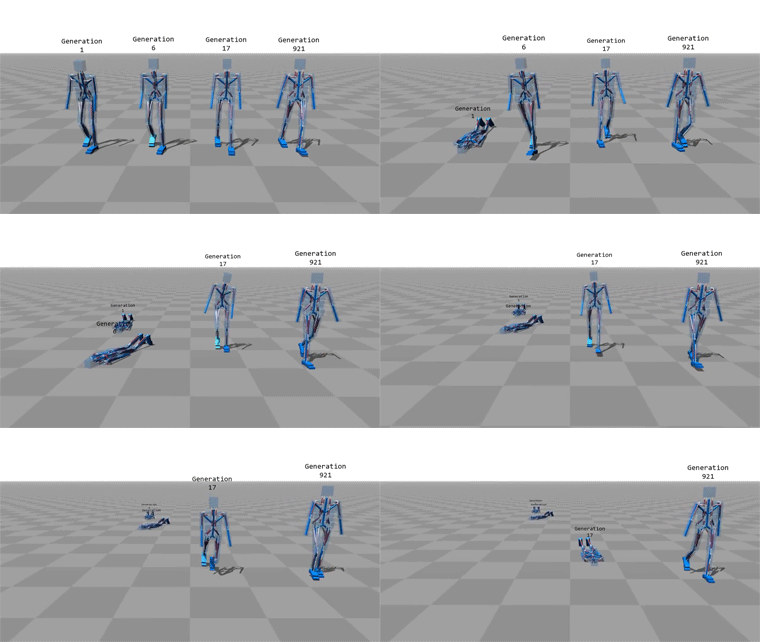
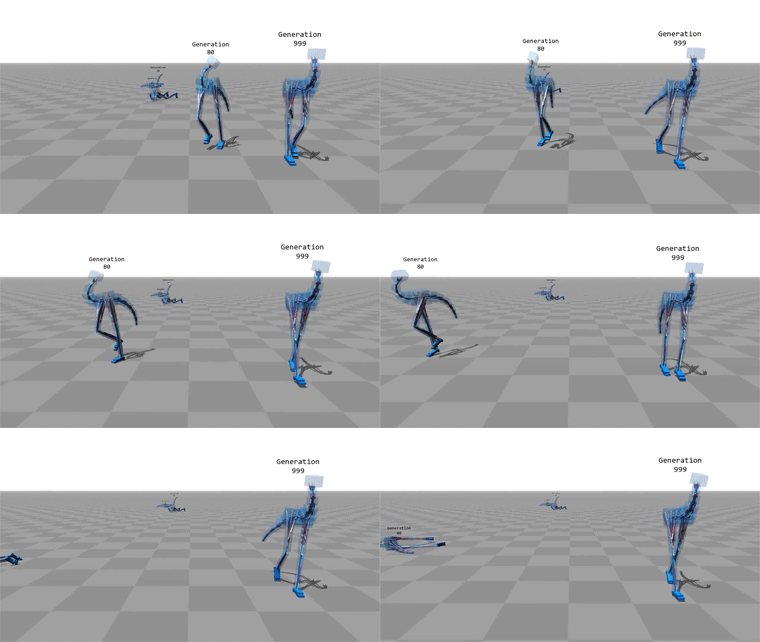
Computer simulations that teach themselves to walk.
Please cite the papers this is from, this is no better than posting stolen, unsourced art. This is someone’s results from their research: their PhD dissertation, ACM TOG, and SIGGRAPH/Eurographics.

 Super Opinionated.





















![[link]](http://i.imgur.com/TuJCfiO.png)