


Read more of this story at Slashdot.

Read more of this story at Slashdot.
The back pages of newspapers are littered with perfectly focused snapshots of star sportsmen frozen in a moment of graceful athletic ballet. These images are so commonplace and their quality so high that we rarely stop to think about just how much effort, patience, and endurance goes into the process of obtaining them. Never mind the five-figure cost of all the gear involved.
No autofocus? No problem
Pro photographer Kyle Grantham has this week given us a peek behind the lens when working to get that perfect action shot. Assigned to cover Sunday's blizzard-stricken NFL game between the Philadelphia Eagles and Detroit Lions, Grantham describes the experience as both the hardest and the most fun task he's ever had to do. His main challenge to overcome was the lack of autofocus, which was essentially disabled by the snow flurries — "imagine trying to photograph someone standing behind a waterfall."
While others opted to use wider lenses during the snowstorm, Grantham stuck with his 400mm glass and tried his best to focus each shot manually. With all the player motion and dancing snowflakes, that was no trifling proposition, but the photographer has come away feeling as satisfied as he's ever been with his work. And appreciating that AF button on his modern camera so much more as a result.


Angad Daryani built his first robot at age eight. By 13, he was building his own versions of the open source RepRap 3D printer. Now 15, he’s working on “SharkBot,” a modified version of the RepRap which he’ll sell to other “makers” in India, making it India’s first home-grown 3D printer. With teenage bravado, he told DNA India that it will be “the fastest and most robust desktop 3D printer that can print any material except metal.” One of his prototype 3D printers is being used at the Indian Institute of Technology in Mumbai.
Naturally, Daryani doesn’t have time for school. In an age when he was able to teach himself how to build a remote-controlled hovercraft by watching YouTube videos, what’s the point of formal instruction? From one of his online bios, here’s Daryani, who is technically home-schooled, says about education:
I am a school student, but i admit , 90% of my learning happens outside the classroom. My second school is the internet! I gained soo much knowledge from the internet and that has helped to reach this stage of being a maker, in my life!
Daryani has also created an e-book reader for blind people, the Virtual Brailer, which converts written text to brail as it scans across a text.
Daryani open-sources all of his designs so that others can copy and build on them. His TED talk isn’t online yet, but you can read more about him at the home of TED’s Mumbai meeting or on his blog, where he declares that “Computer Programming should be compulsorily incorporated into primary education just as literature is!”


by simonbitdiddle
We have released over a million images onto Flickr Commons for anyone to use, remix and repurpose. These images were taken from the pages of 17th, 18th and 19th century books and concern a startling mix of subjects. There are maps, geological diagrams, beautiful illustrations, comical satire, illuminated and decorative letters, colourful illustrations, landscapes, wall-paintings and so much more that even we are not aware of.
Which brings me to the point of this release. We are looking for new, inventive ways to navigate, find and display these 'unseen illustrations'. The images were plucked from the pages as part of the 'Mechanical Curator', a creation of the British Library Labs project. Each image is individually addressible, online, and Flickr provies an API to access it and the image's associated description.
We may know which book, volume and page an image was drawn from, but we know nothing about a given image. Consider the image below. The title of the work may suggest the thematic subject matter of any illustrations in the book, but it doesn't suggest how colourful and arresting these images are.
(Aside from any educated guesses we might make based on the subject matter of the book of course.)
See more from this book: "Historia de las Indias de Nueva-España y islas de Tierra Firme..." (1867)
We plan to launch a crowdsourcing application at the beginning of next year, to help describe what the images portray. Our intention is to use this data to train automated classifiers that will run against the whole of the content. The data from this will be as openly licensed as is sensible (given the nature of crowdsourcing) and the code, as always, will be under an open licence.
The manifests of images, with descriptions of the works that they were taken from, are available on github and are also released under a public-domain 'licence'. This set of metadata being on github should indicate that we fully intend people to work with it, to adapt it, and to push back improvements that should help others work with this release.
There are very few datasets of this nature free for any use and by putting it online we hope to stimulate and support research concerning printed illustrations, maps and other material not currently studied. Given that the images are derived from just 65,000 volumes and that the library holds many millions of items.
If you need help or would like to collaborate with us, please contact us on email, or twitter (or me personally, on any technical aspects)
The images have been tagged to aid browsing and to provide new views on the works themselves. They are tagged by publication year (eg 1764, 1864, 1884), by book (eg 003927270, 000149253), by author (eg Charles Dickens) and by other means.
This structure is helpful but we can do better! We want to collaborate with researchers and anyone else with a good idea for how to markup, classify and explore this set with an aim to improve the data and to improve and add to the tagging. We are looking to crowdsource information about what is depicted in the images themselves, as well as using analytical methods to interpret them as a whole.
We are very interested to hear what ideas and projects people use these images for and we would ideally like to collaborate with those who have been inspired to explore them.
Finally, while they have been released into the public domain, we would like to direct you to a post by Dan Cohen titled "CC0 (+BY)" There is no obligation for you to attribute anything to us, but we'd appreciate it. The dataset will develop over time, and will improve after all!
"The Coming of Father Christmas" by MANNING, Eliza F.
Posted by Ben O'Steen at 12:50 PM
i wont rest until ive complained about everything
I’ve decided to start a series of short tutorials on creating video game GIFs for Tumblr, and it seems like this is the best place to start. The Super Nintendo is known for being one of the first home consoles capable of extraordinary 2D animation and beautiful pixel art. Plus its game library is enormous, and easy to emulate. SNES ROMS are available all over the place, and there are plenty of emulators to choose from.
So why emulate the SNES instead of just playing games directly from the console? There are various ways to capture video from an actual SNES, but I don’t have any experience with them. What I can tell you is that emulation makes it much easier to record certain moments in a game through the use of save states. These allow you to rapidly try a certain action over and over until you get it exactly how you want it. Of course this also helps you get through the game faster, which is important since a lot of these old games can be really tough! The other main benefit of emulation is that you get a very fine-grain control over the screen size, image quality and even content of what’s being displayed. I won’t go into the moral ethics of emulation, other than to say that most people think it’s somewhat OK as long as you own the original cartridge, or you’ve bought a digital release of it somewhere such as PSN or the Nintendo Virtual Console. Unfortunately this still doesn’t make it legal.
My emulator of choice is ZSNES, a free Windows-based emulator which I’ve been using faithfully since the mid-90s. It has a ridiculous-looking DOS-like interface, with no real “window” around it. The older versions even had your mouse cursor as a knife that dripped blood. They haven’t updated this thing since 2007 (version 1.51), but it works great on my Windows 7 machine. I don’t know if there are better emulators, and I don’t really care – this one gets the job done almost every time. They support LINUX as well, and there is an unofficial Mac version here (thanks to codeman38 for pointing this out). A lot of the principles carry over to emulators, so it’s worth reading this even if you intend to use something else.
Configuration
With using any emulator for GIFs, it is crucial that you configure the settings first before doing anything else. There are a ton of settings in ZSNES, but these are the ones you really need to pay attention to:
Input— If you don’t have a gamepad, seriously go out and buy one before even trying to make a game GIF. It is absolutely essential. I highly recommend the Xbox 360 wired (NOT wireless) controller. Select “KEYBOARD/GAMEPAD” under “DEVICE”. Then click the “SET” button, and use the controller to indicate the correct button/joystick movement for each of the keys. Everybody hates the Xbox 360 d-pad, but the left analog stick works great for movement, so use that instead. After you’re done, it should look something like this:
Video — This is EXTREMELY important. When emulating any game system with the intention of creating GIFs, you want to run at the native resolution in order to avoid artifacts. Artifacts are garbage pixels which will make your GIFs blurry and distorted. However it is perfectly OK to run at any resolution that’s a multiple of two of the native resolution (x2, x4, x8, etc.). The native resolution for the SNES is 512 x 448 (though Wikipedia says there are others as well), so you’ll want to use “512x448 R W” which will maintain the correct aspect ratio and run it in a window that you can video capture. When you’re done it should look like this: 
The great thing about the 512 width is that Tumblr’s standard GIF resolution is a 500 pixel width, so it’s easy to crop off 12 pixels without losing much. This is why I don’t recommend running at the 2x multiple (1024x896) for SNES games – you can crop down to 500 pixels, but I don’t think you can scale it down without creating distortion. ZSNES doesn’t have anti-aliasing, bilinear filtering or scan lines in the video settings like many emulators. These are great for playing old games, but they are terrible for making clean-looking GIFs (especially pixel art GIFs). Avoid these at all costs. Most emulators which have anti-aliasing or bilinear filtering will have it turned on by default, so you really need to look out for this.
Saves — This may be unique to ZSNES, but here you’ll find a bunch of options for controlling how save states work in the game. As I mentioned before, save states and game controllers are both your best friend when it comes to gif-making productivity. And linking these together can turn you into an unstoppable juggernaut. 
As you can see in the photo, I am mapping gamepad buttons (specifically the triggers) directly to “save state” and “load state”. So I can save and load whenever I want, and my hands never even have to leave the controller! Most emulators don’t have these menu options, but you can usually get around it using a third-party tool such as the free AutoHotKey or the not-free (but more user-friendly) Xpadder.
Dealing with ROMs
As far as where to obtain SNES ROMs, I’ll leave that up to you. Since the games are so small, there are a ton of sites that have them. It’s a pretty simple Google search to find pretty much any game you’re looking for. Again, none of this is legal, even if you own the game. In fact I don’t think there are any legal SNES ROMs available anywhere outside of homebrew games and demos. So beware of anybody trying to charge money for ROMs, because it’s probably a scam.
SNES ROM files will usually have a SFC or SMC extension, but they will most likely arrive to you in a compressed format (ZIP, 7z, RAR, etc.) that will hide this. Open up the file, using a tool like WinRAR, and make sure there’s only one file in it, and that it’s in SFC or SMC format. If there is more than one file inside, or if the compression format is anything besides ZIP, you will need to extract it and (optionally) re-compress the ROM you want as a ZIP. If the extension is anything besides SFC or SMC, you can give it a try, but it may not work.
Once you have the ROM in the correct format it’s all pretty straightforward – in ZSNES you just select “Game” and “Load”. A dialog will pop up where you can navigate to the ROM you want to play. No, you can’t drag and drop – I’m not sure that even existed back when they first wrote this thing. It doesn’t matter. Just keep all your ROMs in one folder, and the emulator will remember the last place you loaded from.
Running the Game
From here on out, it’s pretty much like playing a SNES connected to a TV set, but with the added convenience of save states. ZSNES even lets you have multiple states – just go into the Game menu, and it’s under “PICK STATE”. The save/load buttons you mapped earlier onto your game pad will now use whatever state number you choose as your current state.
There are a lot of cool optional things you can do while running ZSNES. One of my favorites is the sprite and background layer display control. By default ZSNES maps these to the 1 through 6 keys. 1 through 4 are the background layers, 5 is the sprite layer and 6 resets all layers back to “ON”. This can come in handy when you’re trying to isolate a certain part of the image for your GIFs, so it’s worth playing around with just to see what your options are.
One minor note when running games: I’ve noticed some weird resizing that happens if you go back-and-forth between full-screen and windowed in ZSNES. Try to stay windowed the whole time, but if you accidentally go full-screen, be sure to shut down ZSNES and restart it completely.
I’ll go over how I capture video from games in my next installment. Spoiler alert: I use HyperCam.
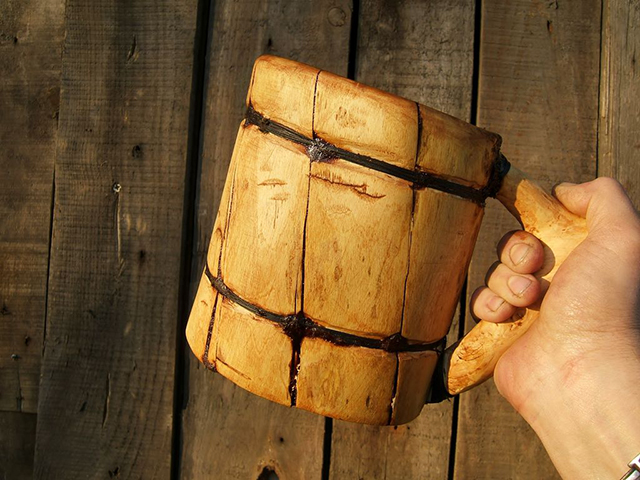
Flanders, Belgium designer bricobart of Yak-Proof demonstrates how to make a Viking-style beer mug out of wood in his step-by-step Instructables article. There are no crazy power tools required. All you need is a hatchet, a knife, polyester rope, some Propolis bio-resin for a leak-proof seal, and multiple layers of walnut oil. Then pour your favorite alcoholic beverage and join us in drinking to the mighty gods and goddesses of Norse mythology!


images via bricobart
If you're looking for a new tablet but missed out on some of the great Black Friday sales last month, you're in luck: Office Depot is currently selling the 2013 Nexus 7 for just $179.99. That's $50 off the regular price for the 16GB version of the Android tablet. (If you had your heart set on the new white version, you'll still have to pay the regular price through Google Play.) The deal is available both online and in store, and you have quite a bit of time to grab one for yourself — the sale runs through to December 21st, just in time for last minute gift ideas.

 Officially licensed Mega Man board game blasts Kickstarter for mega bucks originally appeared on Joystiq on Fri, 13 Dec 2013 11:00:00 EST. Please see our terms for use of feeds.
 |
submitted by shannonpreble [link] [6 comments] |
firehose14 songs, 17 videos, including their infant daughter's first credit
firehosevia Snorkmaiden

Mirror Universe Mr. Rogers doesn’t think you’re special, hates that you’re his neighbor and loves our Krampus Sweater. He does still wear tennis shoes because they’re so darn comfortable.
firehose'In Casino Royale, Bond knocked back nearly 20 drinks before going on a high-speed car chase, getting in a wreck and then spending two weeks in the hospital. "We hope that this was a salutary lesson," the authors wrote dryly.'
firehosePHILIP RIVERS IS A JOKE LOL
4,000+ yards in 5 of last 6 seasons
30 TDs, 9 INTs, 1 fumble, 70% comp, 8.5 ypa
but w/e he a joke lol

Peyton Manning was kept off the field in a game the Chargers controlled offensively to keep their season alive.
The big question entering Thursday Night Football was whether the San Diego Chargers would have an answer for Peyton Manning, but the focus should have been if the Denver Broncos could stop a choking, ball control Chargers offense. San Diego limited Manning's time on the field by holding the ball for 38:49 in a 27-20 Chargers win.
A rusty first quarter was quickly forgotten when Philip Rivers and Keenan Allen connected on two first half touchdowns to give the Chargers the lead entering the break. The pair opened the scoring on a crossing route that left the Broncos defense bewildered, and hooked up again shortly before the close to the half on an end zone throw that saw Allen elevate over defenders and extend the lead.
Ryan Mathews extended the lead early in the third quarter and Denver quickly found itself on the wrong end of a 14 point deficit. San Diego's running game was effective throughout the night, with Mathews and Danny Woodhead combining for 171 all-purpose yards, opening up the passing game for Rivers.
Clock control was Denver's biggest enemy. San Diego wasn't moving the ball through the air on big plays, but continually ground out first downs that took large chunks off the clock. Long passing plays never materialized for the Chargers, but it didn't matter.
San Diego's offensive success would be for naught if not for stellar defense play that turned largely Manning into a non-factor. Denver's passing game was threatening, but lacked punch without Wes Welker in the slot. This was compounded by the return of second-year linebacker Melvin Ingram, who made an impact in his second game of the season after being activated off the PUP list.
Denver still control their fate entering the 2013 playoffs. New England is positioned to make a late push for home field advantage, while the Chargers wait to see how chips fall in the AFC.
Mathews had an excellent night running for the Chargers, finishing with 128 yards and a touchdown.
Manning played well, but didn't make his customary impact from a fantasy perspective -- throwing for 289 yards, two touchdowns and an interception.
Players left the field for both teams, but nobody was lost for the game. The Broncos and Chargers escaped Thursday night without any serious injuries.
The Denver Broncos were 10-point favorites, according to OddsShark. Their outright loss means they failed to cover.
12/22: San Diego Chargers vs. Oakland Raiders
12/22: Denver Broncos vs. Houston Texans
• Expert picks for Week 15 | NFL Power Rankings: Broncos back on top
• Breaking Madden: Tony Gonzalez, cranky old man of destruction
• Russell Wilson can't stop getting drafted by pro sports teams
• Ex-NFL defensive end Stephen White on Vereen, Volunteers and more

Rooster ripping up the Nashua Market Basket!
 |
submitted by rroach [link] [63 comments] |
From the essay:
In late 2012, after I had finished most of the This Town manuscript, I was interviewing Sen. Joseph Lieberman, the Connecticut Democrat, for a brief Q and A that would appear in the front of The New York Times Magazine. Feeling a bit jaded — maybe more than usual after three years’ immersion in the Washington political class — my sarcasm flowed: “You’re retiring after serving 24 years in the Senate,” I asked Lieberman. “What lobbying firm are you going to join now?
“I’m not going to lobby,” Lieberman told me. “For sure.” “Chris Dodd said the same thing two years ago,” I said. (Dodd, Lieberman’s longtime fellow senator from Connecticut, had left the senate in 2011 and since went on to become head of the Motion Pictures Association of America, one of the most powerful lobbies in Washington.)
“Yeah, I know,” Lieberman said. “Watch me.”
We did, and it’s no surprise how this story ends. Politico’s Byron Tau reported before Thanksgiving that Lieberman had in fact signed on to represent a Libyan businessman who might run for president of his native land. Lieberman’s firm, Kasowitz Benson Torres & Friedman, would include “government relations services, communication of information to the principal and as well as [communication of] information about the principal to interested persons in the public sector,” according to public documents. Such communication will include “meetings with members of Congress, executive branch officials and others.” Not lobbying per se — he would not formally register! — but certainly lobbying-ish activities.
firehose'Twitter originally explained that the new system was intended to stop "retaliation" from users who discovered that they had been blocked, and the company stood by that assertion in a blog post about reverting the changes.
"Some users worry just as much about post-blocking retaliation as they do about pre-blocking abuse," wrote Twitter VP Michael Sippey. "Moving forward, we will continue to explore features designed to protect users from abuse and prevent retaliation." '
never go

Twitter prompted an outcry and backlash from some of its more vocal users this evening when it changed the way that its "block" feature worked. Previously, blocked users would no longer be able to see the blocker's Tweets in their timelines or follow the account that had blocked them, and a blocked user's replies and mentions would not show up in the blocker's "mentions" tab. The changes made it possible for blocked users to continue to follow, view, reply to, and retweet the Tweets of blockers. Because the changes would allow blocked users to easily reply to and retweet accounts that had blocked them, they drew criticism from users who claimed they put too much power in the hands of harassers (TechCrunch's Matthew Panzarino breaks down the changes and the criticism thereof pretty well).
The complaints were obviously heard—Reuters reports that the changes were reversed just a few hours later following a rare late-night meeting of Twitter executives. This meeting followed several hours of complaints from Twitter users and from various publications. Twitter originally explained that the new system was intended to stop "retaliation" from users who discovered that they had been blocked, and the company stood by that assertion in a blog post about reverting the changes.
"Some users worry just as much about post-blocking retaliation as they do about pre-blocking abuse," wrote Twitter VP Michael Sippey. "Moving forward, we will continue to explore features designed to protect users from abuse and prevent retaliation."
Read 1 remaining paragraphs | Comments

    
|
![[link]](http://i.imgur.com/M6g6UUK.jpg)