
firehose
Shared posts
21 Jan 19:29

This wooden arcade box packs all the gaming power you need in a vintage package
by Valentina Palladino
firehosesex
No one said gaming PCs have to be ugly — Love Hulten's R-Kaid Revelation is a prime example of an "all-in-one" gaming system that can be both functional and beautiful. The Swedish designer and craftsman made this gorgeous arcade box made out of walnut and copper, which features two wireless joysticks and a transparent, backlit LCD screen that shows the innards of the machine when in sleep mode.
Its walnut body is just as beautiful as it is functional
The R-Kaid Revelation doesn't just look nice — it's actually a powerful computer, too. It's got a custom interface devoted to over 12,000 pre-installed games, and it can boot into Windows for more demanding titles. It runs on an Intel i5 CPU, 8GB of RAM, and a GTX 670 GPU with 2GB of memory — it's not the most high-end system out there, but it should be capable of playing most modern games. The classic game titles are all controlled by the joypads, which are concealed in the machine's body in drawer-like compartments. Also concealed in the main chassis are a wooden Bluetooth keyboard and retro mouse for regular use. For a device to look so beautiful on the outside, it's amazing to see how well things can be stored on its inside, giving it extra function and utility that doesn't compromise aesthetics.

This isn't the first modern technology item Hulten has recreated in vintage wood style. He's made a MAME machine with wireless joysticks and trackball pad as well as a built-in projector and sound system. He's also dabbled in non-gaming related creations, like his beautiful cylindrical water cooled concept computer dubbed "The Shrine," and many more objects in his distinct style. You can see all of these and more of Hulten's distinctive projects at his website.
- Via Boing Boing
- Source Love Hulten
- Related Items love hulten arcade box pc gaming wood r-kaid revelation
firehose likes this
21 Jan 19:29
 Sword & Sworcery EP from developers Superbrothers, Capybara, and musician Jim Guthrie is Steam's featured "Daily Deal," slashing the indie darling's price down 80 percent to $1.59. The promotion will conclude on Wednesday, January 22 at 10am ...
Steam Daily Deal: Sword & Sworcery for less than a cup of coffee
by Xav de Matos
Sword & Sworcery EP from developers Superbrothers, Capybara, and musician Jim Guthrie is Steam's featured "Daily Deal," slashing the indie darling's price down 80 percent to $1.59. The promotion will conclude on Wednesday, January 22 at 10am ...
21 Jan 19:26
AMC Theaters Allegedly Calls FBI to Interrogate a Google Glass Wearer
by Unknown Lamer
firehosedystopian device + dystopian future + today = TAL
An anonymous reader writes "A Google Glass user was interrogated without legal counsel for a couple of hours under suspicion that he may have been recording a film in the AMC movie theater. Although the matter could have been cleared in minutes, federal agents insisted on interrogating the user for hours. So long for our constitutional freedoms." Hours of being detained that could have been avoided if they had just searched his devices (which he repeatedly suggested they do): "Eventually, after a long time somebody came with a laptop and an USB cable at which point he told me it was my last chance to come clean. I repeated for the hundredth time there is nothing to come clean about and this is a big misunderstanding so the FBI guy finally connected my Glass to the computer, downloaded all my personal photos and started going though them one by one (although they are dated and it was obvious there was nothing on my Glass that was from the time period they accused me of recording). Then they went through my phone, and 5 minutes later they concluded I had done nothing wrong." Update: 01/21 21:41 GMT by U L : The Columbus Dispatch confirmed the story with the Department of Homeland Security. The ICE and not the FBI detained the Glass wearer, and there happened to be an MPAA task force at the theater that night, who then escalated the incident. 


Read more of this story at Slashdot.
ken.elwell, firehose likes this
21 Jan 19:26
Didga the Cat Pulls Off Some Sick Tricks While Riding on a Remote-Controlled Skateboard Named Ollie
by Lori Dorn
firehosemore about the Fuck The Police skateboard cat
Didga the cat pulls off some sick tricks while riding around the streets Coolangatta, Australia on “Ollie”, a remote-controlled skateboard.
The Action starts when Ollie, a skateboard, takes his friend Didga, a CAT, for a ride around a beautiful beach town. On the way Didga “shows off” by jumping on, off, up and even over obstacles. One of those obstacles happens to be a large Rottweiler dog.

video & photo via CATMANTOO
21 Jan 19:25
FASA Games KS Update #6: A Word From L. Ross Babcock III
by RPGnet News
firehose'BattleTech and Shadowrun and our other properties have changed hands a couple of times and FASA is no longer involved with those properties. I wish I could bring them back under the FASA name, but they are currently owned and controlled by others.'
at least Ross understands
ugh, Weisman
Hello, this is Ross Babcock. I am a co-founder of FASA Corporation and have been involved in one form or another since we started the company in late 1980. Thank you all for your support for the Earthdawn 4th Edition Kickstarter campaign. I continue to be surprised and gratified to see such enthusiasm for FASA and its products. Here are some answers to the questions and comments posed by you, the backers of this project.
In 2001 FASA Corporation ended active operations. Our major intellectual properties were sold to Wizkids and Microsoft. Since then BattleTech and Shadowrun and our other properties have changed hands a couple of times and FASA is no longer involved with those properties. I wish I could bring them back under the FASA name, but they are currently owned and controlled by others.
The major exception to this is Earthdawn. It was never transferred. Since 2001 FASA Corporation has licensed the property first to Living Room Games and then to Redbrick. In 2012 Redbrick and I decided to bring back the FASA name and FASA Games, Inc. was created. Several talented people were brought into the new company to continue the work Redbrick had started and to create new games. Demonworld, Fading Suns and the new line 1879 are all being worked on with new releases planned throughout the year.
Earthdawn is our flagship line. With the decision to create the 4th Edition of this game, we wanted to modernize the core rules and once again start telling the story of Earthdawn. Josh Harrison and his team are doing a great job. The final draft of both the Players Guide and Gamemasters Guide are due to be complete in late March or early April. We will have more than enough time to finish production and printing of these books in time for our planned release at Gencon.
The continued success of this Kickstarter campaign means that the books will have all new artwork and as many additional extras as we can manage. We want to use the proceeds of this campaign to make the whole Earthdawn line as good as possible and to release new products in a timely fashion. With the overfunding of this campaign we do not want to invest it all in a single product, we want to invest in the whole Earthdawn line. This has shaped our rewards and stretch goals. Please remember that this is Earthdawns 21st year. This wildly successful campaign means that we can produce the products that will insure that Earthdawn is around for many, many years to come.
Once again I want to thank you all for your tremendous support and to continue to look here for more information and updates to the campaign and to Earthdawn. Please check out www.fasagames.com for blog updates, news articles, forum discussions and product information. Thank you.
(Original RSS Post)
In 2001 FASA Corporation ended active operations. Our major intellectual properties were sold to Wizkids and Microsoft. Since then BattleTech and Shadowrun and our other properties have changed hands a couple of times and FASA is no longer involved with those properties. I wish I could bring them back under the FASA name, but they are currently owned and controlled by others.
The major exception to this is Earthdawn. It was never transferred. Since 2001 FASA Corporation has licensed the property first to Living Room Games and then to Redbrick. In 2012 Redbrick and I decided to bring back the FASA name and FASA Games, Inc. was created. Several talented people were brought into the new company to continue the work Redbrick had started and to create new games. Demonworld, Fading Suns and the new line 1879 are all being worked on with new releases planned throughout the year.
Earthdawn is our flagship line. With the decision to create the 4th Edition of this game, we wanted to modernize the core rules and once again start telling the story of Earthdawn. Josh Harrison and his team are doing a great job. The final draft of both the Players Guide and Gamemasters Guide are due to be complete in late March or early April. We will have more than enough time to finish production and printing of these books in time for our planned release at Gencon.
The continued success of this Kickstarter campaign means that the books will have all new artwork and as many additional extras as we can manage. We want to use the proceeds of this campaign to make the whole Earthdawn line as good as possible and to release new products in a timely fashion. With the overfunding of this campaign we do not want to invest it all in a single product, we want to invest in the whole Earthdawn line. This has shaped our rewards and stretch goals. Please remember that this is Earthdawns 21st year. This wildly successful campaign means that we can produce the products that will insure that Earthdawn is around for many, many years to come.
Once again I want to thank you all for your tremendous support and to continue to look here for more information and updates to the campaign and to Earthdawn. Please check out www.fasagames.com for blog updates, news articles, forum discussions and product information. Thank you.
(Original RSS Post)
21 Jan 19:23

ē Battle of the Box
by Ben Thompson
firehose"For consumers, collaboration is an edge case"
Wow, really? Would love to hear more about that nugget. The only reasons I still have a Dropbox account (or created a new, sandboxed Google account) are for collaboration and sharing.
The problem with the old thin client model was the assumption that processing power was scarce. In fact, Moore’s Law and the rise of ARM has made the exact opposite the case – processing is abundant.
Data, on the other hand, is scarce – indeed, it is the scarcest resource in technology.
To be precise, I’m referring to personal data – my data, if you will – the opposite of “big data.” Were I to no longer have access to my various documents, pictures, emails, etc., I couldn’t simply walk into the store and pick up some more, and you couldn’t loan me yours. It’s precious, and it’s worthless, all at the same time.
Thus, over the last few years as the number of fat clients has multiplied – phones, tablets, along with traditional computers – the idea of a thin client with processing on the server seems positively quaint; however, in the context of our data, that is the exact model more and more of us are using: centralized data easily accessible to multiple “fat” devices distinguished by their user experience:
From “The (Alleged) 13-inch iPad and the Triumph of This Devices”. Click for the original article.
This is the niche Dropbox, which just raised $250 million at a $10 billion valuation, seeks to fill. In The Dropbox Opportunity, I argued that Dropbox’s business model gave them a key advantage vis–à–vis device/platform vendors like Apple:
Dropbox’s approach to my most important data is much more in line with the value I ascribe to that data: it’s available everywhere.
Not so for iCloud: data is available only on Apple devices, and it’s not exactly clear how to get it out…The only coherent strategy for Apple is a walled-garden of sorts that protects their vertical business model. A services-centric company like Dropbox, on the other hand, ought to pursue a horizontal strategy predicated on maximizing the number of interconnects with the layers above and below.
Today, though, I’m not so sure; Dropbox’s model makes sense theoretically, but it ignores the messy reality of actually making money. After all, notably absent from my piece on Business Models for 2014 was consumer software-as-a-service. I’m increasingly convinced that, outside of in-app game purchases, consumers are unwilling to spend money on intangible software. That is likely why Dropbox has spent much of the last year pivoting away from consumers to the enterprise.
There are multiple reasons why the latter is a more attractive target for all software-as-a-service companies, especially those focused on data:
-
Consumers need to be convinced of the value of their data – Despite the fact that data is precious and unique to each consumer, the vast majority of consumers don’t know or don’t care. Backblaze, the online storage company, found that only 10 percent of people backup regularly; I would imagine anyone reading this who has tried to convince friends and family to buy a $70 drive for Time Machine or similar is nodding wearily. While backup is not the primary use case for Dropbox, the broader point remains: before Dropbox can get a consumer to pay for their data service, said consumer needs to value data in the first place.
The situation is the exact opposite in the enterprise; data is what ties the entire operation together, and it’s difficult to imagine any company anywhere that is not intently concerned with its data even before you consider the various regulations around data safekeeping. It is much easier to sell something to someone who already knows they need what you have on offer.
-
Consumers have multiple free options – As I noted above, Dropbox’s horizontal orientation aligns their incentives with my need to have my data available anywhere. Most consumers, though, are much less likely to consider such intricacies when deciding where to put their data. Instead, convenience usually wins, and it’s more convenient to use iCloud, SkyDrive, or Google Drive on Apple devices, Microsoft devices, and Google devices respectively.
Enterprises, on the other hand, will never choose one of the free services offered by platform providers: the licensing terms are usually unacceptable, there is no guarantee of uptime, security is a significant concern, there is no top-down control, and there is no customization. Thus, while there may be competition on price within the enterprise space, that price will not be zero. It should be obvious that this makes monetization easier.
-
Consumers are hard to market to – Reaching the sort of scale to profit from consumers requires converting millions; if you consider how few consumers even know their data is important, and the fewer still that are willing to pay, that means the top of your consumer marketing funnel must be exponentially larger. This then requires a huge amount of money for advertising as well as an advertising message that is sufficiently broad and non-specific to appeal to your addressable market.
This is another stark difference with the enterprise, where most marketing is still done to a small group of individuals in the senior leadership of the company, particularly the CIO. Influencing just one person can result in many thousands of users; more importantly, the ability to actually sit down and have a conversation lets you more effectively tailor your message and sell your product.
-
For consumers, collaboration is an edge case – Most of the data that matters to consumers is for use by them alone; that’s part of what makes the data so valuable on an individual basis, but it also means collaboration and general sharing of files is only necessary every now and then. This reduces the perceived utility of Dropbox, making it even more difficult to monetize (particularly with the freemium option sufficing for any collaboration needs that do come up).
In contrast, what is an enterprise if not a collection of people and the data they jointly create and consume? Data belongs to the corporation, and by definition requires collaboration. Collaboration features, then, are a necessity, and the quality and ease-of-use of them is of primary importance. Any service that excels in this area is meeting a real need (and, as I just noted, the direct contact entailed with enterprise sales lets you explain these features clearly).
-
Building a platform for consumers is incredibly difficult – The natural evolution of a service like Dropbox – and one that justifies such a high valuation – is to be a platform on which other apps and services depend. The trouble with building consumer platforms is twofold:
- The vast number of consumers necessitates a broad-based general-use platform, even as different consumers have specific use cases. The only way to overcome this is with massive developer support and mindshare
- Many potential partners are not incentivized to support your platform. For example, the device makers may have a competing service; other partners, like say Gmail (for contacts), have different business models; still other partners may have your business-model but view the consumers dollar as a zero sum game given their general unwillingness to pay anything at all
While building platforms for the enterprise is no walk in the park, both of these challenges are reduced:
- Because you are making specific sells to specific customers, you have more latitude to build custom solutions that directly meet consumer needs, which may only entail a few specific partners for a payoff of many thousands of licenses
- Potential partners are, just like your competitors, paid offerings as well. This better aligns incentives. This is particular the case of other SaaS companies, which often still see a benefit in promoting SaaS in general, leading to win-win offerings that expand the pie for all. For example, Salesforce has made cloud promotion a central part of their pitch; this makes them more amenable to partnering with a storage cloud solution (as opposed to, say Gmail contacts)
Again, platforms are hard, but the incentives and obstacles in the enterprise are reduced; thus, the likelihood of seizing the potential upside is increased.
This is what is driving Dropbox’s pivot. Well, this plus the reality that Dropbox, according to the WSJ, only had revenues of ~$200 million last year, hardly enough to justify their 2011 Series B valuation of $4 billion, much less this weekend’s Series C valuation of $10 billion. To wit, over the last several months Dropbox has:
- Poached execs from Salesforce, VMWare, and Google to lead enterprise sales
- Hired an enterprise sales team en masse (take a look at Dropbox’s LinkedIn profiles; it’s hard to find a sales exec with tenure greater than six months)
- Relaunched Dropbox for Teams, which offered basic group management options, as Dropbox for Business which allowed dual business and personal accounts and slightly more fine-grained administrator control
Waiting in the wings, though, is the company most often compared to Dropbox: Box. Aaron Levie figured out a full seven years ago that enterprise was a far more attractive market than consumer. From a profile in the MIT Technology Review:1
By 2007, Box’s user base had doubled 20 times over and annual revenue was around $1 million. But Levie felt uneasy. The price of hard disks was falling 50 percent every 12 to 18 months. As online storage became a commodity, what would stop Apple, Google, or Microsoft from giving it to customers free? He noticed that the customers who stuck around longest weren’t storing MP3s or JPEGs but Word, Excel, and PDF files. In other words, business customers. Moreover, their colleagues would follow their lead, generating a steady stream of new sign-ups. Levie decided to ditch the fickle consumer market and focus on serving enterprises, companies with thousands of employees, which would be willing to pay for a storage service tailored to their needs. He set about adding the capabilities required by large businesses: search, security, and the ability to create and delete accounts, manage file access, and grant permission to view, edit, or delete.
In other words, what we have here is one of the more interesting business experiments we’ve ever seen: is it better to have established a firm foundation in the top-down enterprise market that actually matters – i.e. Box – or to have built tremendous goodwill and customer loyalty with actual users – i.e. Dropbox?
Looking back at the five factors I identified above:
- Box has focused on enterprises – who value data – a full six years longer than Dropbox. This means they have a much more full-fledged offering when it comes to features like user permissions, centralized control, etc.
- Box has long been focused on paid accounts, not freemium
- Box has an experienced sales team that has been an integral part of the company for years; Dropbox is catching up in sheer numbers, but not in cultural or product competency
- Box has only ever been concerned with competing with paid options; Dropbox has a legacy freemium business to be concerned with
- Box has spent years building up its platform capabilities; Dropbox has a nice hold on small scale developers but little else
On the other hand, Dropbox has a significant lead in registered users: 200 million (at last report) versus 20 million for Box, and many of those users are intensely loyal.
Box itself raised a new round of financing late last year – $100 million at a $2 billion valuation. The question, then, is if I had $10 million, would I prefer to invest in Dropbox or Box?
The decision is a close one:
- At the most recent valuations, $10 million will get me 0.1% of DropBox, or 0.5% of Box.
- Dropbox has a lot of retrofitting to do; in the consumer space, security and downtime concerns are of relatively less importance. You may lose customers, but they’re not very valuable on an individual basis. In enterprise, though, your uptime is usually guaranteed contractually, and data integrity is a precondition. I am very curious what this means for Dropbox’s reliance on Amazon S3 and shared files
- I’ve previously argued that The Consumerization of IT is Overstated; consumer and enterprise products are increasingly similar, but business models aren’t – and business models matter
Thus, if I had the $10 million, I’d invest in Box. Unfortunately, I don’t, which gives me the luxury of sitting back and observing which matters more: consumer headway in a market where enterprise pays, or enterprise capability – and business model – with a smaller base.
May the battle begin.
- Interesting ad, no?
The post Battle of the Box appeared first on stratēchery by Ben Thompson.
21 Jan 19:21

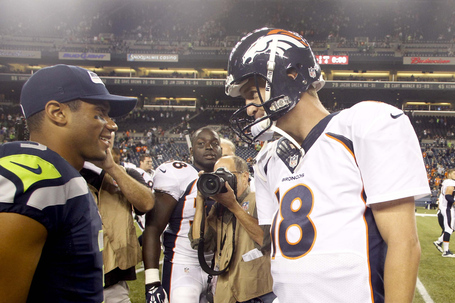 Be sure to bookmark SB Nation's complete coverage of Super Bowl XLVIII. Everything from the build up, to live coverage and reactions after the big game, all in one beautiful package.
Roger Goodell, NFL considering eliminating extra points
by Mark Sandritter
firehosegood
but fuck Goodell, wasn't his idea anyway
A NFL without extra points? It could happen.

The NFL and the competition committee make small changes to the rules every year, but this year, one of the potential changes would eliminate extra points entirely. NFL Commissioner Roger Goodell said there are proposals to eliminate extra points and the league could instead adopt a new scoring system.
"The extra point is almost automatic," Goodell said, via NFL.com. "I believe we had five missed extra points this year out of 1,200 some odd. So it's a very small fraction of the play, and you want to add excitement with every play."
Super Bowl XLVIII: Seahawks vs. Broncos
Be sure to bookmark SB Nation's complete coverage of Super Bowl XLVIII. Everything from the build up, to live coverage and reactions after the big game, all in one beautiful package.
Under one proposal, a team would be rewarded an automatic seventh point on a touchdown, if they choose to accept it. Score a touchdown, take the extra point and that's that, seven points. Teams, however, could instead opt to to forgo the automatic extra point and instead go for two. The two-point try would be the same as it is currently. If converted the team would receive eight points with a failed try netting six total points.
Goodell said there are still some issues to work through with the proposals, including the question of whether or not a team would be less likely to go for two. That doesn't seems to be a significant issue as extra points are close to automatic as is. According to NFL.com, 99.1 percent of extra points have been converted since 2004. Teams would still have the option of going for two when they need to late in games, which is when the majority of conversion attempts in the NFL happen.
While the change would be a significant one if it happens, it would likely have a minimal impact on the game itself and could help shorten the length of the television broadcast.
More from SB Nation NFL
• SB Nation's complete coverage of Super Bowl XLVIII
• Why are you mad at Richard Sherman? | Sherman explains interview
• Van Bibber: Peyton's Super Bowl cruise | Chilton: A Sunday for the ages
• Brady’s facepalm says it all | "Fat Man!" is the new "Omaha!" | #Lookit
firehose likes this
21 Jan 19:19

NEWS: I’m going to be drawing pages for X-MEN #25, guys....
by skinnygirlscomic
firehoseYAY
Bendis can't even remember Max's name in the quote
"There's this dude -- I can't remember his name off the top of my head, but there's a guy on Tumblr that does these Jean Grey stories that he writes and draws. And they're hilarious, and we got him. He's gonna do a piece, and it's his Marvel debut."
NEWS: I’m going to be drawing pages for X-MEN #25, guys. PROOF HERE
Additionally, I’ve been getting a lot of requests for certain things to show up in my work, so I’ve decided to….
*~*~*OPEN COMMISSIONS~*~**~
Ta-da? Okay, so, this is for ORIGINAL ART. Email me at m@maxwittert.com for requests. A pricing sheet is below, but if you have special requests, let me know.
——————————————————
-One-page comic (black and white): $125
-Multi-page comic (black and white): $100/page
-Colored character art: $80 for a single character (add another character $40)
——————————————————
**Please note that any work I generate for these commissions cannot be reproduced, posted, or displayed publicly without my explicit consent.
Uh… Okay. I guess that’s it. Let me know if I missed something.
-Max
firehose likes this
21 Jan 19:16


parker + donut sometimes i connect with Parker on a spiritual...
firehoseMeanwhile, in Portland
parker + donut
sometimes i connect with Parker on a spiritual level
21 Jan 19:15


Japan’s ruling party may have dropped a pledge to “never wage war again”—and that isn’t even the worst of it
by Lily Kuo
Chinese commentators have been in a frenzy this week over reports that Japan’s ruling party, the Liberal Democratic Party (LDP), has removed a promise to “never to wage war again” from the party’s campaign platform. The LDP, which voted Jan. 19 on the platform, has not confirmed the reports, but a final draft reviewed in early January eliminated the phrase.
Any changes wouldn’t immediately change Japan’s pacifist constitution, in place since the end of World War II, but prime minister Shinzo Abe has called for taking a broad interpretation of the document’s relevant passage, article 9, which states:
Aspiring sincerely to an international peace based on justice and order,the Japanese people forever renounce war as a sovereign right of the nation and the threat or use of force as means of settling international disputes.
Last year, Abe called for Japan to employ “active pacifism” that would enable it to use its “self defense forces” to help an ally under attack. Abe said this month he is pushing for amending the constitution itself before 2020. Japan, whose navy is already four times larger than Britain’s, was one of the world’s top five military spenders in 2012 and has long had the technology to build nuclear weapons. A new nuclear-fuel reprocessing plant for civil use in northern Japan is capable of producing nine tons (8.16 tonnes) of plutonium or enough to produce up to 2,000 bombs a year (paywall).
Despite the furore over the “no war” clause in the party platform, there are even broader changes afoot in the LDP’s platform that could have a chilling effect on Japanese society.
What would change if the constitution is revised, according to critics, is the the protection of Japanese civil rights, specifically free speech. The LDP’s draft proposal for the constitution, published in 2012, includes measures that censure protected rights like freedom of expression and assembly. To article 12 of the current constitution—which says: “Freedom of assembly and association as well as speech, press and all other forms of expression are guaranteed”—the LDP proposes adding, “Notwithstanding the foregoing, engaging in activities with the purpose of damaging the public interest or public order, or associating with others for such purposes, shall not be recognized.” (Here’s an abbreviated version in English and a complete draft in Japanese.)
Already, late last year, Japan unveiled a law granting the government sweeping powers over what it can deem a state secret and who can be convicted for leaks—a measure that could damage press freedom and whistle-blowing. Other revisions proposed by the LDP include giving parliament authority to declare a state of emergency across the country and replacing fundamental human rights with those that “reflect the history, culture and tradition of Japan.”
A strong strain of anti-militarism among the public has been an important brake for Japan’s more aggressive officials. An erosion of the Japanese public’s voice may be the true danger to peace in the region.
21 Jan 19:13


Verizon just hinted that a full blown price war in wireless might soon be upon us
by John McDuling
“The competitive environment has changed again here in the fourth quarter, and you can expect us to respond accordingly.”
Those fighting words from Verizon chief financial officer Fran Shammo on an earnings call this morning have spooked investors. Shares in the behemoth US wireless carrier are currently down about 3%, wiping about $4 billion off its market value, despite a solid set of quarterly results.
Why? There has been a lot of talk about a nascent price war in the industry, driven largely by a resurgent T-Mobile. Price wars are great for consumers, but terrible for investors, because they can obliterate profits across an entire industry. The comments suggest Verizon might be preparing to respond to T-Mobile’s recent aggression.
As we’ve recently discussed, T-Mobile, led by the flamboyant John Legere, has been winning customers at an unprecedented rate in recent quarters, after introducing simplified plans that, among other things, separate the cost of a device from the cost of calls, texts and data. They also include free international roaming (albeit at limited speeds).
Verizon seems not to be much worried by these plans: Shammo said he doesn’t think they are that much cheaper overall, just that costs of a device and wireless access are being shifted around. ”Really when you do the math, there really isn’t much of a price decrease here. It’s just a shift of how it’s marketed into the consumer market.”
But T-Mobile’s recent move to pay customers’ early termination fees of up to $350 (and a further $300 for a traded-in device) if they switch over from another carrier is a different matter entirely.
AT&T has already blinked. It’s offering T-Mobile customers $200 in credits if they switch to join AT&T’s service. Maybe that’s because most of T-Mobile’s recent customer wins have come at AT&T’s expense. The chart below from Macquarie Equities shows how many customers Verizon, AT&T and Sprint have each lost to T-mobile (TMUS):

So far, Verizon, the industry’s biggest player, hasn’t followed AT&T’s example. While it has more customers than anyone else (and hence more to lose), it has shed the fewest to T-Mobile.
But that was before T-Mobile introduced its latest offer to pay termination fees. Verizon’s whole strategy has been built on having the best network, and charging the most for it. Shammo’s words about a change in the “competitive environment” on this morning’s call might signal a shift in its strategy, which would alter the telecom landscape dramatically. Consumers are likely to benefit—but not anyone owning telecom stocks.
firehose likes this
21 Jan 19:00
Onion Poll: Do You Believe In Global Warming?
firehose'That’s neither here nor there. Two people in the parking lot saw you leave your dog inside the vehicle. Come with me.'
The Onion – America's Finest News Source


|
21 Jan 19:00
Sports Poll: Is Richard Sherman The NFL’s Best Corner?
firehose"Can’t form opinion until Richard Sherman finally speaks up on subject"
"Fuck you" - notably, only California
"[Unintelligible screaming]" - notably, only Washington
The Onion – America's Finest News Source


|
|
21 Jan 18:58
Ex-student calls teacher over alleged sex abuse, posts talk on YouTube - CNN
firehose'A woman who says a female teacher from middle school sexually abused her for years decided to confront the teacher -- and post video of the exchange on YouTube.
Within hours, the educator resigned from her job at another school in California. Police launched an investigation. And the former student, who once felt powerless, now says she feels vindicated knowing the ex-teacher is no longer working with children.'
ABC News |
Ex-student calls teacher over alleged sex abuse, posts talk on YouTube CNN (CNN) -- A woman who says a female teacher from middle school sexually abused her for years decided to confront the teacher -- and post video of the exchange on YouTube. Within hours, the educator resigned from her job at another school in California. California teacher that abused student exposed on YouTubeNew York Daily News Calif. woman confronts teacher she says molested her; posts video onlineWashington Times VIDEO: Woman confronts teacher who sexually abused her, uploads result to ...Philly.com (blog) Examiner.com -BuzzFeed all 76 news articles » |

21 Jan 18:56
 Be sure to bookmark SB Nation's complete coverage of Super Bowl XLVIII. Everything from the build up, to live coverage and reactions after the big game, all in one beautiful package.
Super Bowl XLVIII national anthem will be performed by Renee Fleming
by Jon Benne
firehosehuh
The acclaimed opera singer will be performing the national anthem at the Super Bowl this year.
The NFL has confirmed that opera singer Renee Fleming will perform the national anthem for the 2014 Super Bowl in New Jersey. The national anthem performance will be televised on FOX as part of the pregame festivities.
Super Bowl XLVIII: Seahawks vs. Broncos
Be sure to bookmark SB Nation's complete coverage of Super Bowl XLVIII. Everything from the build up, to live coverage and reactions after the big game, all in one beautiful package.
Nicknamed "The People's Diva," Fleming has received acclaim for her soprano voice. She's a four-time Grammy winner, recently winning the 2013 award for Best Classical Solo Vocal. She performed at numerous major events around the world, including the Diamond Jubilee for Queen Elizabeth II, the Nobel Peace Prize ceremony and the 2008 Beijing Olympics. Last July, President Barack Obama awarded her the National Medal of Arts, America's highest honor for an individual artist.
Fleming's selection breaks a long streak of contemporary pop artists performing the anthem. The previous singers included Alicia Keys, Kelly Clarkson, Christina Aguilera, Carrie Underwood and Jennifer Hudson. Bruno Mars has been chosen to perform the halftime show, with the Red Hot Chili Peppers opening for him.
More from SB Nation NFL
• SB Nation's complete coverage of Super Bowl XLVIII
• Sherman's deflection: The Xs and Os behind the big story
• The sordid end of David Meggett: From All-Pro to prison
• Why are you mad at Richard Sherman? | Sherman explains interview


21 Jan 18:41

Long before Russell T. Davies revived Doctor Who he wrote Dark...
firehose"The reflection in the centre of the screen is a 15 year old Kate Winslet"
Long before Russell T. Davies revived Doctor Who he wrote Dark Season, a 1991 children’s sci-fi drama about an evil mind controlling computer. The screen shot shows some of the kids breaking into the system telepathically in episode 2.
Some ARM assembler being listed to the screen, perhaps it’s something to do with font kerning? The reflection in the centre of the screen is a 15 year old Kate Winslet.
jgc says: “Given the date of release of Dark Season, this is very likely to be an Acorn Archimedes showing part of the code of RISC OS.”
firehose and -1 others like this
21 Jan 18:39

thalassarche: vortexanomaly: swan disguise yes hello fellow...
swan disguise
yes hello fellow waterfowl I am not paparazzi I am here to do swan things
(…And all the other waterfowl are down at the other end of the pond whispering to each other: WORST. SWAN. EVAR.)
firehose and -1 others like this
21 Jan 18:39
ComiXology reveals 51% of its users are outside U.S.
by Kevin Melrose

21 Jan 18:20
carmem: 1cara-bonito: vacilam: tb queria saber tb queria...
firehosegboy/ifabom

firehose and -1 others like this
21 Jan 18:19

Get your Detroit Lions 'Conference Participants' T-shirt
by Rodger Sherman
firehoselove the kitten logo
The Detroit Lions haven't won the NFC North since 1993, but now you can get a shirt signifying that they tried.
It has been 20 seasons since the Detroit Lions won the NFC North -- so long the division was the NFC Central then. Twenty long, long seasons. One of those seasons, they didn't win any football games. Some of them, like this past season, they nearly won enough to win the division, although they nosedived by losing their last four games. Some of those seasons, they actually made the playoffs, but they've lost every time during the playoff drought.
It's the second-longest division drought in the NFL, behind only the Cleveland Browns, who haven't actually existed as a franchise for the entirety of their drought. Therefore, Detroit fans have been unable to buy any celebratory merchandise whatsoever relating to their team.
Thanks to Detroit-based funny T-shirt company Alternative Hero, that problem has been solved.
Love the guys @AlternativeHero, who made a Detroit Lions “Conference Participants” T Shirt pic.twitter.com/OlfLZ5wbtq
— darren rovell (@darrenrovell) January 21, 2014
That's right, Lions fans, you can get yourself a Detroit Lions "Conference Participants" T-shirt! (Well, not actually the Detroit Lions, since this shirt isn't NFL-licensed, but a shirt with a more kitten-like lion rampant.) Can't you feel the excitement emanating from those models who didn't know they were modeling this shirt? They earned this by playing in 16 football games. A lot of people couldn't do that!
No, it's not a division championship T-shirt like the ones the Packers can get or a conference champions T-shirt like the one the Seahawks can get. But, um, it's still a shirt! And do you really like your chances to be able to purchase one of those other shirts in the near future?
firehose and -1 others like this
21 Jan 18:19
A firefighter from North Carolina is writing apps for Google Glass to make his job safer
by Nathan Ingraham
firehoseyay, a useful use of this damn thing
Google Glass is still a technology very much in its infancy, looking for the specific utilities and features that'll make it useful to a broader market than the developers and enthusiasts who are currently experimenting with the device. One of those developers is Patrick Jackson of Rocky Mount, North Carolina — the Glassware apps he's building aren't going to be the ones to make Glass a widely-accepted consumer device, but despite that, he's building out a specific, potentially life-saving use case for Google's wearable.
Custom Glassware for fighting fires
While Jackson may code and build apps during his downtime, his day job sees him battling fires as part of Rocky Mount's fire department — and he's building apps designed to save firefighters time and make their work a little bit faster, something that'll hopefully save lives. Right now, Jackson's incident notifications app routes incoming emergency calls to his Glass — it provides an address, map, and notes from the 911 emergency center, with an option to use turn-by-turn navigation to get to the scene. He's also built a "find a hydrant" app, which shows the closest fire hydrants to wherever that emergency call is.
Those two apps are working now, but he's also building out two more that are a bit more intriguing. One of them would provide building blueprints, floor plans, emergency exits, and other such vital information to firefighters before they even enter the building. A second, similar app would pull up schematics for a vehicle that shows exactly where to enter when using tools like the jaws of life to rescue people trapped inside.
Both of these apps are still works-in-progress, as Jackson needs more data to really flesh out the apps, but it's still a rather progressive approach for the tradition-heavy firefighting industry that still relies on books and binders of building schematics. For Jackson, though, Glass always felt like a natural fit for the work he does — it was clear from his submission in the #IfIHadGlass competition (copied below) that he had a very specific use case in mind for Google's headset:
As a career Firefighter, and a software engineer, I would use it to make firefighter's job safer and more effective. Mission critical information could be viewed quickly while never taking eyes off of the incident. Pictures and video could be recorded to add in fire investigation and incident critics. Personnel could stream realtime video to hangouts for an overview of the incident — view multiple sides from one location. Occupancy hazards could be in your view instantly instead of flipping through notebooks. Increased situational awareness!
Even if Jackson didn't get picked in the #IfIHadGlass competition, his apps might have gotten into the wild — he was writing them using the Glass Mirror API before he even picked up the headset. However, now that the has the headset and the full Glass Developer Kit is starting to make its way out to coders, he's been able to do a lot more. It's definitely a work in progress, but it's a good example of what Google hopes developers will think of when building Glassware — and it's the type of features that might help the world at large get used to Glass.

21 Jan 18:09
In my opinion, one of last year's most anticipated titles was Pathfinder: Adventure Card Game. And, after a friend told me about how much he enjoyed it, I decided to try it out.
In Pathfinder, you take control of a (wimpy) character, and you go on adventures (hence the name). Your specific adventures will be to go around to various locations, hunt down an evil villain (while thwarting his henchmen), and bring him to justice. Along the way, you may get loot! (Let's not ask questions like "where is this loot coming from?" or "is my adventurer really a hero if he smashes everything in his path and steals whatever he finds?" Asking these questions ruin lots of fun games.) Essentially, the gameplay is very straightforward - each turn you can optionally move, and then you can "encounter" a card at a location. This location might be a monster, item, weapon, armor, spell, or blessing. Whatever the card is, you will either have to defeat it, or (if it is some form of loot) you will have an opportunity to add it to your hand. Either of these things requires you to pass a skill check. Skill checks are based on rolling a die (which die depends on your character's abilities), and then getting bonuses and additional dice if cards are played. After rolling all of your dice, if the total value that you rolled equals or exceeds the difficulty of the check, then the check is passed (monster defeated or loot acquired). While going around to the locations, you are ultimately trying to defeat all of the henchmen (which allows you to "close" locations), and once all of the locations but one are closed, you defeat the villain in order to win. (Note: I've used the term "loot" here as a generic term to mean "sweet stuff that you might acquire", though there is an official card type in the game called "Loot" (which is something cool that you can acquire). Perhaps I should have used "booty" instead, but the phrase is "loot and pillage", not "booty and pillage.")
My first pro for Pathfinder is the looting. I love looting things. (In games! Not in real life. Sheesh…) The first time that I was able to get my wife (girlfriend at the time) to play video games was in Gauntlet: Dark Legacy. What appealed to her about it? It was very straightforward - kill the bad guys, and collect cool rewards while doing it. That is the formula for the Pathfinder card game, and it works fairly well. What's more, through the deck allowances (or whatever they're called), the game does a good job of letting you loot while still keeping your character true to their nature. For example, if I am a wizard, then I can keep a lot of spells in my deck - I can gain weapons and such, and I won't (always) just throw them in the trash while we are adventuring, but at the end of each scenario I will have to adjust my deck back to something that is legal for my character. This is a great balance.
My second pro for Pathfinder is the customization that you perform while playing the game. You start with a wimpy character and very basic cards. However, as you play through different scenarios, you will get both loot and character rewards. The loot allows you to customize (improve) what is in your deck. If you like to play the "Hulk Smash" character, then you can add all of the gigantic weapons that you find, and replace the smaller daggers and short swords. If you like to play as the dryad/animal adept character, then you can switch out which animal allies you have to work well with your style of gameplay. However, in addition to customizing your deck, you also get other rewards as you play the game. Some scenarios (or adventure paths (which is a set of scenarios)) will give you character bonuses - such as your character getting a permanent +1 bonus to a skill, being able to hold additional cards of a certain type, or getting special abilities. However, the bonuses that you get are infrequent enough that you probably won't get to upgrade everything (at least not for quite a while). So, you must pick how you want to play your character.
The two pros that I just mentioned really both blend together for the key pro for the game - Pathfinder ("Adventure Card Game") is very engaging. You become attached to your character as you play. You see them improve, and you want to keep playing so that you can try to add more stats to them, and to improve their stash of cards. I found myself generally wanting to play "just one more" scenario as I was playing the game. (As a note - you can actually play the game as just a single scenario instead of taking a character through the various adventure paths, but that doesn't really have any appeal to me at all.) However, if you truly play the game by the rules, then if your character "dies" (runs out of their deck of cards during a scenario), then you are supposed to completely start over with a different character, thereby losing all of your customizations. I haven't had my character die quite yet, but I'm not convinced that I'm going to do that instead of just restarting the scenario.
However, as great as the pros are, there are some equally strong cons. The first con is that there are massive rules ambiguities and places where the game is unclear. Even some of the things that are covered (such as evading) are covered so briefly that it is almost impossible to find the rule that you're unsure about in the rulebook. Pros and cons are often hard to quantify, but take this into consideration: according to my colleague from Board Game Quest, BoardGameGeek had 600 rules questions within the first two months of the game's release. Ouch!
The next con for me is that all of the adventures are the same. Honestly, I'm going to give them the benefit of the doubt for now, and assume that this will only be true in the base game. However, in all eight of the scenarios included in the base game, you are playing with the same formula - setup locations, close all of the locations and then defeat the villain. Whereas this works, variety is important for ensuring that the game has lasting appeal. (And, based on the fact that they are already planning five more expansions, I would say that they are banking on the game having lasting appeal.) The game that Pathfinder is most often compared with is Lord of the Rings LCG. But, one big difference is that Lord of the Rings has used it's formula of going through objective cards in a variety of very different ways - even in the base set. So far, Pathfinder does not have that diversity - and unless it starts to have some diversity in the upcoming expansions, I do not think that it will have the longevity of Lord of the Rings.
My final con for Pathfinder deals with quality of components. Before I even started playing the game, I had some cards that were marked, and others where the printing simply wasn't clean. This is very disappointing as Paizo is generally a very high quality publisher.
Overall, I give Pathfinder an 8.0/10. I love the looting and customization of the game, but, as with Risk: Legacy, I find myself enjoying these meta-game elements more than the game itself. (Though to a much lesser degree than with Risk: Legacy.)
If Pathfinder: Adventure Card Game sounds interesting, you might also check out Dungeon Command, Mice and Mystics, and Dungeon Lords.
Pathfinder: Adventure Card Game Review
by Josh Edwards
firehoseanother "it's great 8/10" review of the Pathfinder CCG with more cons than pros
"BoardGameGeek had 600 rules questions within the first two months of the game's release"
In my opinion, one of last year's most anticipated titles was Pathfinder: Adventure Card Game. And, after a friend told me about how much he enjoyed it, I decided to try it out.
In Pathfinder, you take control of a (wimpy) character, and you go on adventures (hence the name). Your specific adventures will be to go around to various locations, hunt down an evil villain (while thwarting his henchmen), and bring him to justice. Along the way, you may get loot! (Let's not ask questions like "where is this loot coming from?" or "is my adventurer really a hero if he smashes everything in his path and steals whatever he finds?" Asking these questions ruin lots of fun games.) Essentially, the gameplay is very straightforward - each turn you can optionally move, and then you can "encounter" a card at a location. This location might be a monster, item, weapon, armor, spell, or blessing. Whatever the card is, you will either have to defeat it, or (if it is some form of loot) you will have an opportunity to add it to your hand. Either of these things requires you to pass a skill check. Skill checks are based on rolling a die (which die depends on your character's abilities), and then getting bonuses and additional dice if cards are played. After rolling all of your dice, if the total value that you rolled equals or exceeds the difficulty of the check, then the check is passed (monster defeated or loot acquired). While going around to the locations, you are ultimately trying to defeat all of the henchmen (which allows you to "close" locations), and once all of the locations but one are closed, you defeat the villain in order to win. (Note: I've used the term "loot" here as a generic term to mean "sweet stuff that you might acquire", though there is an official card type in the game called "Loot" (which is something cool that you can acquire). Perhaps I should have used "booty" instead, but the phrase is "loot and pillage", not "booty and pillage.")
My first pro for Pathfinder is the looting. I love looting things. (In games! Not in real life. Sheesh…) The first time that I was able to get my wife (girlfriend at the time) to play video games was in Gauntlet: Dark Legacy. What appealed to her about it? It was very straightforward - kill the bad guys, and collect cool rewards while doing it. That is the formula for the Pathfinder card game, and it works fairly well. What's more, through the deck allowances (or whatever they're called), the game does a good job of letting you loot while still keeping your character true to their nature. For example, if I am a wizard, then I can keep a lot of spells in my deck - I can gain weapons and such, and I won't (always) just throw them in the trash while we are adventuring, but at the end of each scenario I will have to adjust my deck back to something that is legal for my character. This is a great balance.
My second pro for Pathfinder is the customization that you perform while playing the game. You start with a wimpy character and very basic cards. However, as you play through different scenarios, you will get both loot and character rewards. The loot allows you to customize (improve) what is in your deck. If you like to play the "Hulk Smash" character, then you can add all of the gigantic weapons that you find, and replace the smaller daggers and short swords. If you like to play as the dryad/animal adept character, then you can switch out which animal allies you have to work well with your style of gameplay. However, in addition to customizing your deck, you also get other rewards as you play the game. Some scenarios (or adventure paths (which is a set of scenarios)) will give you character bonuses - such as your character getting a permanent +1 bonus to a skill, being able to hold additional cards of a certain type, or getting special abilities. However, the bonuses that you get are infrequent enough that you probably won't get to upgrade everything (at least not for quite a while). So, you must pick how you want to play your character.
 |
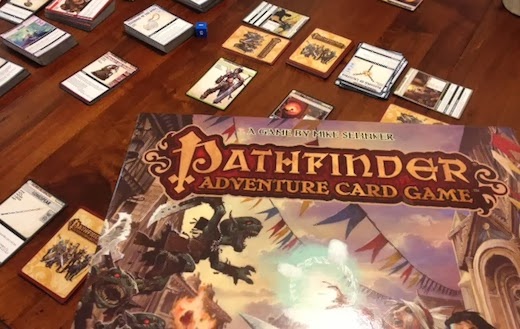
| Cards and piles everywhere! |
However, as great as the pros are, there are some equally strong cons. The first con is that there are massive rules ambiguities and places where the game is unclear. Even some of the things that are covered (such as evading) are covered so briefly that it is almost impossible to find the rule that you're unsure about in the rulebook. Pros and cons are often hard to quantify, but take this into consideration: according to my colleague from Board Game Quest, BoardGameGeek had 600 rules questions within the first two months of the game's release. Ouch!
The next con for me is that all of the adventures are the same. Honestly, I'm going to give them the benefit of the doubt for now, and assume that this will only be true in the base game. However, in all eight of the scenarios included in the base game, you are playing with the same formula - setup locations, close all of the locations and then defeat the villain. Whereas this works, variety is important for ensuring that the game has lasting appeal. (And, based on the fact that they are already planning five more expansions, I would say that they are banking on the game having lasting appeal.) The game that Pathfinder is most often compared with is Lord of the Rings LCG. But, one big difference is that Lord of the Rings has used it's formula of going through objective cards in a variety of very different ways - even in the base set. So far, Pathfinder does not have that diversity - and unless it starts to have some diversity in the upcoming expansions, I do not think that it will have the longevity of Lord of the Rings.
My final con for Pathfinder deals with quality of components. Before I even started playing the game, I had some cards that were marked, and others where the printing simply wasn't clean. This is very disappointing as Paizo is generally a very high quality publisher.
Overall, I give Pathfinder an 8.0/10. I love the looting and customization of the game, but, as with Risk: Legacy, I find myself enjoying these meta-game elements more than the game itself. (Though to a much lesser degree than with Risk: Legacy.)
If Pathfinder: Adventure Card Game sounds interesting, you might also check out Dungeon Command, Mice and Mystics, and Dungeon Lords.
21 Jan 18:09



starsaremymuse: sagansense: An orrery is a mechanical model of...
An orrery is a mechanical model of the heliocentric solar system illustrating the relative positions and motions of the planets and moons. This one (above), produced by Ken Condal. View it in real-time to watch this beauty in motion, HERE. Love to zerostatereflex for sharing.
I’ve always wanted one of those
21 Jan 18:08
PDF Wizardry [Link]
by Gabe
Here's a thoughtful series on working with PDFs from Chris Robert:
Maybe it's my academic years, but I'm a sucker for long posts with a conclusion. It's kind of like the classy version of TL;DR.
firehose likes this
21 Jan 18:01
Report: Wendy Davis' life story more complicated than compelling narrative - CNN (blog)
firehosegreat
tl;dr: Like every overambitious politician ever, she simplified the wrinkles out of her story to make herself more marketable
fortunately Texans have the Dallas Morning News to dismantle her in excruciating detail, with a heavy emphasis on the role her husbands have had on financially supporting her
(spoiler alert: the DMN editorial board consistently endorses center-right, including Romney, except for its rampant cheerleading for Ted Cruz)
Report: Wendy Davis' life story more complicated than compelling narrative CNN (blog) (CNN) - Texas gubernatorial candidate Wendy Davis admitted in an interview with the Dallas Morning News that she hasn't been totally accurate about her life's story, a compelling narrative she has used to appeal to voters in Texas and bolster her national ... and more » |