firehose
Shared posts
21 Jan 21:15
‘Scratch9′ teams with Bo Obama for FCBD issue
by Kevin Melrose
21 Jan 21:13

Facebook and Google won't sell ads for legal weed
by Kwame Opam
Marijuana is currently legal for recreational use in the states of Washington and Colorado, with Colorado having just opened its first cannabis shops this month. However, weed businesses won't be able to advertise their wares on social media for the time being. Google and Facebook don't plan on changing their policies barring the promotion of weed use, even in places where it's legal.
The risk is too high, no pun intended
According to GigaOm, the National Cannabis Industry Association, a trade group that lobbies for weed-related businesses in Washington, claims that it attempted to pay Facebook to promote stories covering marijuana but the site refused since it's policy doesn't allow it. Facebook told The Verge that, while it is willing to place ads that promote marijuana advocacy or legalization, the risk in running ads that promote the sale and use of the drug itself is "too high (no pun intended) for us to consider at this time." A Facebook representative did say that the company is always reviewing its policy decisions, but doesn't anticipate this matter being addressed in "the next few months."
Google's own AdWords policy disallows the promotion of drugs and drug paraphernalia (even if it does allow products that reference them). However, like Facebook, it did state via email that it is always reviewing its policies, though they haven't recently changed.
It should be noted that Facebook and Google can geo-target ads for specific demographics, but, given that — unlike alcohol — marijuana is still illegal on the federal level, they may be exercising some caution before they change their policies.
21 Jan 21:11


Newswire: Scott Aukerman, David Wain, Jim James, and Lil Bub recorded a new "Super Bowl Shuffle" for charity
firehose'Man Man’s Honus Honus'
Jim James, Lil Bub, Scott Aukerman, David Wain and more have teamed up and recorded a version of hit 1985 single “The Super Bowl Shuffle” for charity. The updated take on the Chicago Bears’ classic also features contributions from Tom Scharpling, Les Savy Fav’s Tim Harrington, Kyle Kinane, Dave Hill, Man Man’s Honus Honus, The Long Winters’ John Roderick, and wrestler Colt Cabana. The wacky track was put together by Sean Cannon, a staffer at Louisville radio station WFPK, and proceeds from the sales of both digital downloads and a limited edition 7-inch will benefit literacy charity Reading Is Fundamental. The track is available to stream for free below—but kick Cannon and company at least a buck or something. It’s for the kids, man.

21 Jan 21:01

For Our Consideration: It’s Elementary, Sherlock: How the CBS procedural surpassed the BBC drama
firehoseSpoilers in the full read, but good points all.
'Everything in Sherlock revolves around Sherlock. He is the series’ sole reason for existing, and the dynamic remains frozen in amber. Sherlock will do something outrageous, everyone will gasp, but then he’ll solve a crime or offer a token gesture of commiseration, and everyone will move on. It gets old, because the show simultaneously wants its audience to be shocked by Sherlock’s behavior, and charmed by his roguish self-regard and evident brilliance, without much variation. Elementary takes a broader view. As Sherlock, Miller is often standoffish and arrogant, but he exists in a world that refuses to let him off the hook for his mistakes or his behavior; better still, he recognizes his failings, and is clearly working toward addressing them. This doesn’t mean the series is about “fixing” Holmes, or even that the character is inherently broken, but it allows for the possibility of growth and change. On Sherlock, Holmes is constantly bemoaning that he’s surrounded by idiots, and it’s hard to argue his point. On Elementary, Holmes is engaged in the slow, painful process of accepting that those “idiots” might have something to teach him. The former has its moments, but the latter makes for better television and more rewarding art.'
also, best comment:
'Yeah! Sherlock is so progressive, making consistent and omnipresent jokes about "lol what if we were gay" and engaging in the most outrageous queerbaiting on television today. Wow, how horrible Elementary is by making a white man into a woman of color and having canonically queer characters as opposed to Sherlock, where queerness is always either a punch line or something that can be "fixed" a la Irene Adler, a lesbian who still manages to fall madly in love with Sherlock. Basically, anyone who thinks that creating a purely platonic dynamic with significant gender and racial diversity between a man and a woman is LESS of an edgy choice than yet another "no homo" white guy bromance is clearly part of a vastly different area of pop culture than me.'
The announcement that CBS would air a modern adaptation of Sir Arthur Conan Doyle’s most famous character was met with a certain amount of skepticism. This was understandable. The world was not exactly hurting for new versions of Sherlock Holmes, and any attempt to tell more stories about the influential icon smacked less of creative inspiration than of a desire to attract audiences with something almost, but not exactly, the same as something they already liked. Even more damningly, there was already a modern adaptation of Sherlock Holmes on the air: BBC One’s Sherlock, starring Benedict Cumberbatch as the World’s Greatest Detective, alongside Martin Freeman as His Guy Watson. Debuting in 2010, two years before Elementary’s premiere, the series created by Steven Moffat and Mark Gatiss arguably filled any conceivable Holmes-shaped hole in viewers’ lives. Surely another take on the iconic character from creator Robert Doherty would ...
firehose likes this




21 Jan 20:52


After 2,000 years, Ptolemy’s war elephants are revealed | Science News
by OnlyMrGodKnowsWhy
Carthaginians used war elephants against the Romans in the Battle of Zoma in 202 B.C., as seen in this 1890 painting by Henri-Paul Motte. A new genetic study sheds light on world’s only known battle between Asian and African war elephants in 217 B.C.
Painting by Henri-Paul Motte, reprinted in Das Wissen des 20. Jahrhunderts (1930)/Wikimedia Commons
-
Read Later
 Read Later
-
Twitter
 Twitter
-
Facebook
 Facebook
-
Reddit
 Reddit
-
Google+
 Google+
Sponsor Message
If you think back to history class, you might remember the tale of Hannibal’s crossing of the Alps in 218 B.C. to sneak up on Rome during the Punic Wars. It was notable not just because he brought an entire army from Carthage to Rome the long way around, but because that army included elephants.
The use of war elephants dates back at least to the fourth century B.C., when Indian kings took Asian elephants into battle. The practice soon spread west to the Persian Empire and then northern Africa, where African elephants were put to military use. There’s only one known case, though, of an African elephant-Asian elephant matchup, at the Battle of Raphia near Gaza on June 22, 217 B.C. The battle, over the sovereignty of Syria, matched the forces of Ptolemy IV, pharaoh of Egypt, against those of Antiochus III, a Greek king whose reign stretched into western Asia.
Ptolemy won the battle — but not because his elephants were any help, at least according to Greek historian Polybius, who described the encounter in his work The Histories:
A few only of Ptolemy's elephants ventured to close with those of the enemy, and now the men in the towers on the back of these beasts made a gallant fight of it, striking with their pikes at close quarters and wounding each other, while the elephants themselves fought still better, putting forth their whole strength and meeting forehead to forehead. The way in which these animals fight is as follows. With their tusks firmly interlocked they shove with all their might, each trying to force the other to give ground, until the one who proves strongest pushes aside the other's trunk, and then, when he has once made him turn and has him in the flank, he gores him with his tusks as a bull does with his horns. Most of Ptolemy's elephants, however, declined the combat, as is the habit of African elephants; for unable to stand the smell and the trumpeting of the Indian elephants, and terrified, I suppose, also by their great size and strength, they at once turn tail and take to flight before they get near them.
This account stumped later historians and naturalists. African elephants tend to be larger than Asian elephants, so what was up with Ptolemy’s elephant soldiers?
One possibility is that Ptolemy’s elephants belonged to an extinct subspecies. Another, proposed by classical scholar Sir William Gowers in 1948, holds that Ptolemy fought with smaller forest elephants (African elephants are actually two species — forest and savanna). That idea has persisted for decades.
The answer, however, lies in where Ptolemy was sourcing his war elephants.
The natural range for African elephants does not stretch into present-day Egypt. To get elephants, Ptolemy’s army looked to what is now Eritrea. Today, elephants in Eritrea are rare, numbering only 100 to 120. The population lives near the border with Ethiopia, sometimes migrating into that country. When Adam Brandt of the University of Illinois Urbana-Champaign and colleagues conducted a genetic study of those elephants — by sequencing DNA in elephant poo — they found that Eritrea’s elephants are not forest elephants; they’re savanna elephants (Loxodonta africana) with no genetic ties to either the forest or Asian species.
“Most likely, the Greek historian who wrote about the battle added in his own interpretation as to the relative size of the elephants,” study coauthor Alfred Roca of the University of Illinois Urbana-Champaign, wrote in an email. “There were semi-mythological accounts in the ancient world that attributed great size to the elephants of India, and these were probably known to Polybius, and were likely the source of his belief that Indian elephants were the largest of all.”
The Eritrean elephant population shows signs of inbreeding and isolation, the researchers report in the January-February Journal of Heredity. That’s not surprising because the population is small, and its nearest elephant neighbors are more than 400 kilometers away.
Being a small, isolated population is generally not good for survival, but Eritrea’s elephants are getting a helping hand from that nation’s agriculture ministry. The ministry is trying to minimize conflict between humans and elephants, and they’ve seen some success: The range and size of the population appears to be increasing. If these elephants need a bit of a genetic boost, though, the researchers note that their study has identified Eastern Africa savanna elephants as the population with the closest genetic affinity to the Eritrean population and best suited for any future breeding or transplantation projects.
firehose likes this
21 Jan 20:52
Apple granted temporary removal of its hated ebooks monitor
by Jacob Kastrenakes
firehoselol great
Apple is being temporarily relieved of the court-appointed antitrust-compliance monitor that it had instated after being found guilty in an ebook price-fixing trial last year. According to Reuters, the monitor is being removed at least until a federal court can hear Apple's motion to have the monitor fully removed during its appeal of the decision. The government did not oppose Apple's request for this temporary stay on the monitor, and it will reportedly have until January 24th to oppose its motion to remove the monitor throughout the appeal.
The stay is a small victory for Apple, but a victory nonetheless. Apple has been criticizing the monitor, Michael Bromwich, for several months now, complaining that Bromwich has been charging it exorbitant fees and acting too intrusively. Apple could see a full reprieve from the court-appointed monitor soon, though the monitor's ultimate presence rests on whether Apple succeeds in appealing last year's decision.
- Source Reuters
- Related Items apple ebooks antitrust compliance monitor monitor stay stay pending appeal court
21 Jan 20:52
Study says black Airbnb hosts earn less than their white counterparts
by Adrianne Jeffries
Two professors at Harvard Business School have found evidence of racial discrimination on Airbnb, the site that lets people rent their extra space to guests for short term stays. The study, which was based on 3,500 listings in New York City, concludes that black hosts are earning 12 percent less than white hosts for similar properties. The authors say that suggests that white hosts are able to charge more simply because they're white.
Airbnb puts an emphasis on the people behind the properties in order to build trust, including large profile pictures, biographical information, and connections from Facebook and Twitter. A thumbnail of the host’s photo shows up next to the main photo of the property in the search results page. The study’s authors believe that emphasis exacerbates the problem of racial discrimination in online marketplaces.
Discriminatory effects have been found in online marketplaces including Craigslist, where names commonly used by black people resulted in lower response rates, and the dating site OKCupid, where the site’s statistician writes that "although race shouldn’t matter in messaging, it does. A lot."
"Although race shouldn’t matter in messaging, it does. A lot."
Michael Luca and Benjamin Edelman decided to look at race dynamics on Airbnb out of a broader interest in discovering the best way to design online marketplaces. eBay and Amazon do not focus on the pictures of the sellers, for example, while staffing sites like TaskRabbit do.
"We became interested in this issue when we noticed that online marketplaces are becoming more and more social, with extensive seller and buyer profiles and pictures alongside more standard information about products and services," Michael Luca, one of the study’s authors, tells The Verge in an email. "We understand the benefits of this, but are uncomfortable with the notion that more pictures/profiles/information are unambiguously better."
Airbnb declined to provide the professors with data for the study, which had to rely on data harvested from public listings. The company also denies that it has a discrimination problem, saying the study is flawed.
Airbnb says the study is flawed
"We are committed to making Airbnb the most open, trusted, diverse, transparent community in the world and our Terms of Service prohibit content that discriminates," the company says in a statement. "The data in this report is nearly two years old and is from only one of the more than 35,000 cities where Airbnb hosts welcome guests into their homes. Additionally, the authors made a number of subjective or inaccurate determinations when compiling their findings."
Airbnb says the study, which is still under review for publication, did not control for factors such as how often a property is booked and the number of reviews a host has. The company declined to offer its own data that would counter the study’s conclusions, however.
The idea that profile pictures lead to discrimination shouldn’t surprise anybody. It’s a tricky problem, but not a new one. Discrimination based on race, gender, and other factors is alive in the real world; when orchestras began holding "blind" auditions in which a candidate played from behind a curtain, the number of women hired went from 5 percent to 25 percent.
The rise of the "sharing economy" in which people buy and sell their extra time, skills, and property directly to one another depends on the ability of the internet to facilitate trust. Everything from ride-sharing services to sites like Kickstarter try to highlight the people on the other side of the app, and that’s actually one of the reasons some users prefer to dip into the sharing economy rather than give their dollars to some corporate conglomerate: it feels more personal. It’s hailed as a progressive revolution in the country’s economy.
It’s a tricky problem, but not a new one
Airbnb has no legal obligation to change its interface in order to de-emphasize profiles and personal photos, even if the site’s design is inadvertently encouraging discrimination. But while profile pictures may lead some users to feel better about trusting strangers on the internet, it’s not in Airbnb or anyone’s interest to inadvertently penalize a group of its users. That’s the opposite of progress.
New York City has strict fair housing laws — although bias there usually goes the opposite way, with landlords excluding non-white tenants — and there is a streamlined legal process for those who feel they’ve been discriminated against. Airbnb and similar marketplaces are so new that in the process of disrupting the traditional economy they sometimes can also lose established consumer protections.
"Our point is that when deciding what information to prominently display, online market designers should think both about how to build trust and facilitate transactions but also how to minimize unintended consequences," Dr. Luca says.
- Related Items craigslist airbnb taskrabbit sharing economy peer to peer marketplaces
21 Jan 20:51
Novick: "Going Richard Sherman on the Oregonian"
by Denis C. Theriault
firehoseR.O.F.L
Add trash-talk to Commissioner Steve Novick's famed repertoire of rhetorical talents.
Novick, never shy with a jab or a quip, is seizing on some recent sporting news to fire back at an Oregonian editorial board that's made hay in recent weeks by aiming some public cheap shots at the Portland City Council. Novick, a member of the council, has naturally taken some umbrage and seems to have decided it's not worth trying to please an editorial board that any savvy reader can see has taken a hard right turn toward the suburbs.
It's here, but we'll post the whole thing for your convenience. Is he speaking for the council? It's not clear. But no one else's name appears on this, so probably not.
The Oregonian has spent the past couple of weeks trash-talking the city council. They've written things like: "you have to wonder sometimes whether the Portland City Council actively pursues mediocrity..." They've had a "live chat" on "Does Portland deserve a better city council?" They've repeatedly crossed the line between criticism and contempt.
And so far, the members of the City Council have kept a dignified silence. But after watching Richard Sherman's post-NFC championship game explosion the other day, I've decided, the hell with that. Let’s have some fun. If the Oregonian wants to trash-talk, let's trash-talk. Let's give the fans something to talk about. Because we can do it better than they can. We can out-trash-talk the Oregonian on the field, off the field, or in an alley.
You want to talk about mediocre? A paper that only delivers four times a week, now that's mediocre. You want to question our commitment to jobs? Seriously? The paper that specializes in firing people - good people like Ryan White and Scott Learn - wants to talk about jobs?
We're the best City Council in the league. And we're not going to be bullied by some sorry Orange County right-wing publisher. We'll be here after you're gone, Mr. N. Christian Anderson III - after the Newhouse family wakes up and realizes that it's economic idiocy to try to foist a Fox News paper on a progressive readership.
And don't think for a minute that anything you write will have any influence on us at all. Lions don't concern themselves with the opinions of sheep.
COB!
(No, I also have no idea what COB means. And based on urbandictionary.com's findings, I don't think I want to know.)
Update 3 PM: Novick has written another blog post, this time taking pains to say he doesn't think editorial page editor Erik Lukens is a terrible human being—and that he's absolutely not holding up the paper's reporters for opprobrium.
Lukens, for the record, called me back when I rang him for comment. He didn't seem outraged. He said he saw the whole thing as "Steve being Steve."
Novick's new post mentions Richard Nixon and includes his picture. I laughed at that.
He also asks and answers a compelling question, emphasis mine:
And yes, I guess I could have caveated my post with the same things I’m saying here… but that wouldn’t have made it a very good trash-talk.
firehose likes this
21 Jan 20:50
Egg Rugg, A Hand-Crocheted Rug That Looks Like a Fried Egg
by Kimber Streams

Wisconsin-based artist and schoolteacher Carly Dellger has created the Egg Rugg, a hand-crocheted rug that looks like a fried egg made “in the spirit of surrealism and a good friend’s love for eggs.” It’s available to purchase online at UncommonGoods.
Poached, scrambled, fried, or hard boiled, a perfectly cooked egg is the cornerstone of any balanced breakfast, late night snack, or the ever-so-special occasion—breakfast for dinner. Celebrate the versatile foodstuff and add a quirky crack of décor with this handmade rug. Hand-crocheting each yolk with upcycled materials, Carly Dellger uses a freeform technique so each sunny side up silhouette is different from the next. Handmade in Wisconsin.

images via UncommonGoods
firehose likes this
21 Jan 20:50
Judi Dench Stars In Our Favorite Bonkers Star Wars Rumor
firehose'Dame Judi Dench is being considered to play rebel leader Mon Mothma in Episode VII'
'In addition to the sequel trilogy there will be standalone films about individual characters'
'if the rumors are true (Lawrence) Kasdan plans to make the Boba Fett from the original trilogy someone who killed prequel-Boba and took his armor and name'
and most importantly
'The Latino Review puts out rumors all the damn time, and most of them turn out to be unfounded'

21 Jan 20:47
An Empassioned Fan’s Plea: Make Fifteen Jaws Movies to Maintain Back to the Future‘s Accuracy
firehoseburied lede: we're one year away from Marty McFly's future destination year, with hoverboards and shit

21 Jan 20:47
Sleepy Hollow Recap: Season Finale
firehose"zombie George Washington"
he's coming, he's coming, he's coming

21 Jan 20:45
This Game of Thrones In Feudal Japan Art Is All I Want In Life
firehosethe fact that it kind of did happen in medieval japan notwithstanding, still
Direct link: http://imgur.com/a/wuLsm

Nylonthread, Adam Victor Brandizzi and -1 others like this
21 Jan 20:44


The most productive thing I’m doing this year—no business trips
by Commentary
firehose'For seven months I got up and went to sleep in my own bed, next to my wife Amy with our dog Brooks at the foot of our bed. I didn’t experience the stale smell of an airplane a single time. I didn’t have any delayed or missed flights. A TSA person didn’t feel me in any inappropriate places. I didn’t have grab an imitation candy bar, disguised as an energy bar, a single time.'
it devolves v. quickly from there into a sort of superprivileged insanity ("We installed a high end Mezzanine system ... I’m surrounded by monitors") but seriously, there are very few reasons why many people who travel for business _need_ to travel for business--including a lot of people who don't need to spend tens of thousands out-of-pocket for high-end videoconferencing systems.
This originally appeared at LinkedIn. You can follow Brad here.
For the past 20 years I’ve traveled 75% of the time during the week. The companies I’ve invested in are distributed around the US, in Boston, New York, Chicago, Seattle, San Francisco, Los Angeles, Austin, Kansas City, and a few other places. And I live in Boulder, Colorado. So I became very familiar with the drive to and from Denver International Airport.
Last June I quit. Cold turkey. No more travel. I simply cancelled all of my upcoming trips and declared myself a no-fly zone through the end of 2013.
It was a bold experiment in self-preservation. I struggled with a deep depressive episode in the first half of 2013. I was functional, and got my work done, but I was in a continuous state of joylessness. I simply didn’t want to do anything. And when I did something, it was devoid of any satisfaction. Something had to change.
For seven months I got up and went to sleep in my own bed, next to my wife Amy with our dog Brooks at the foot of our bed. I didn’t experience the stale smell of an airplane a single time. I didn’t have any delayed or missed flights. A TSA person didn’t feel me in any inappropriate places. I didn’t have grab an imitation candy bar, disguised as an energy bar, a single time.
Instead, I mastered videoconferencing. I have always used some version of it on occasion, most recently Skype and Google Hangouts. But I never put real effort into setting up the appropriate infrastructure, which includes hardware, software, audio, and connectivity.
We installed a high end Mezzanine system from Oblong in our office. In two other rooms, we installed very large TVs with Mac Mini’s and optimized audio systems tuned to Skype and Google Hangouts. We made it simple to set up, turn on, and be in a conference. At Techstars, we installed a Lifesize system in every office. Suddenly, we had high end access points in virtually every city I regularly did business in.
Most importantly, I shifted my interaction modality to video-conference. Sure, I still end up on some audio conference calls. But they feel to me like sending letters through the mail instead of using email. Old school. Tired. Something my parents do, except for my parents always call me with video now.
I’ve continued to optimize my computers at home and the office for video conferencing. I’m surrounded by monitors ranging in size from 13” (my laptop) to 90”, with a bunch in the 27” and 65” range. I’ve learned how to have a separate audio channel. I’ve figured out how to deal with the least-common denominator effect, when someone shows up with a crummy connection. I’ve figured out how to use BlueJeans Network to merge my Oblong system with someone using Skype, while allowing someone on a mobile phone to dial in via audio.
And I stopped traveling. Completely. I decided not to travel for business in 2014. When I look at my schedule, I have a trip each month for pleasure—Miami in January to get warm, Memphis in February for a weekend with my dad, Cabo in March for spring break, and Boston in April to run a marathon. But more importantly, I have no business trips. And that makes me happy.
This post is part of a series in which LinkedIn Influencers share their secrets to being more productive. See all their #productivityhacks here.
firehose likes this
21 Jan 20:43
elmatpe submitted: I just saw this post and I decided to do something about it. This was the...
firehosewow, that how-to page, wow
elmatpe submitted:
I just saw this post and I decided to do something about it.
This was the original ‘turning a good gal into bad gal’ that Mr. Hart recommended:
So if you want to be a super-villain all you have to do is dye your hair (and skin??), wear heels and revealing clothes? (and going nuts?)
NOPE! I don’t think so! Here is my redesign (from scratch):
If you want to be a supervillain you are definitely going to end up picking up fights more often than not, either you are fighting superheros or your everyday police officers or soldiers. This lady has decided to work out and increase her physical prowress (Because, gasp!!, ladies can also be muscular) as well as wearing some decent protection.


Oh man, muscular women make my heart skip a beat. Don’t worry, though, I’m okay now. I don’t even need to go to the doctor’s. This time.
Your outfit makes for a much better progression than that crazy blue lady. No offense, crazy blue ladies.
-Staci
21 Jan 20:29



Nest CEO makes more promises about keeping Nest away from Google databases
by Casey Johnston
firehose"promises"
Nest CEO Tony Fadell onstage with CNNMoney correspondent Laurie Segall, defending Nest's privacy integrity under Google ownership.
During an interview at the DLD Conference in Munich on Monday, Nest CEO Tony Fadell said that the company will make all future privacy policy changes under Google opt-in and that it will be transparent about those changes. Fadell's statement follows Google’s acquisition of Nest, a smart home products company, for $3.2 billion, which has raised some questions about how Google might put the company—and its data—to use.
“The data we collect is all about our products and improving them,” Fadell said, reiterating a statement he issued about the company's smart thermostat and smart smoke detector following the announcement of the acquisition. “If there were ever any changes whatsoever, we will be sure to be transparent about it, number one, and number two, for you to opt in to it.”
The “number one” promise is consistent with Google’s approach to changing privacy policies, particularly in the last couple of years. When Google unified the privacy policies of all its products so that it could share data between services (for instance, Gmail and Google Calendar), it placed a notification bar on its homepage.
Read 9 remaining paragraphs | Comments
firehose likes this
21 Jan 20:18

Newswire: Trent Reznor will score David Fincher's Gone Girl
Trent Reznor is getting back to work with his old pal David Fincher again. The Nine Inch Nails frontman and his soundtrack partner Atticus Ross have signed on to score Fincher’s upcoming adaptation of Gone Girl. The movie isn’t out until this October, so that should give Reznor and Ross plenty of time to create the bleak and eerie tones suggested by Gillian Flynn’s original text.
Reznor, Ross, and Fincher have previously worked together on The Social Network and The Girl With The Dragon Tattoo, both of which earned Academy Award nominations for Best Score. The Social Network went on to win the Oscar.

Lblock likes this
21 Jan 20:18


Why Illy will never sell fair trade coffee
by Siraj Datoo
firehosetl;dr: because economic liberals are wishy-washy and it doesn't taste better
Illycaffè says its coffee doesn’t mix with fair trade.
Andrea Illy, the company’s chairman and CEO, told Quartz that while he endorses higher wages for growers, you won’t be seeing any “Fairtrade certified” Illy coffee. At the opening of the first Illy café in London yesterday, he offered two reasons why:
1. Fair trade products are interchangeable
People buy fair trade products as a way of showing “solidarity” with coffee bean farmers, Illy said—”to pay more for a product than it is worth on the market for the sake of fighting against poverty.”
Illy says that’s unsustainable: “They drink fair trade products occasionally for the sake of feeling right, not necessarily regularly.” And even if people continue to buy fair trade products, he said, they’re more apt to switch brands.
2. Fair trade doesn’t improve quality
“Once upon a time, we were buying one [coffee] lot out of ten,” Illy said. “Now we buy six out of ten.” The company has been able to improve the quality of its selection thanks to its own sustainability efforts, which he described as “beyond fair trade.”
In Illycaffè’s early days, the company would simply pay more for good coffee. But when it returned the following year, the farmers weren’t capable of producing the same coffee. They were “struggling in being consistent,” Illy said.
Illy said that the coffee growers and the company “select each other based on cultural affinities.” Once they’re partners, Illycaffè starts a process of “transferring knowledge”, taking time to understanding the needs and problems of the farmers. Many growers are even sent to the company’s Brazil-based University of Coffee for free training.
The idea is “full sustainability,” according to Illy. With the training, the growers produce better coffee more consistently and can scale their business by planting extra hectares. Illy adds that farmers can also “transfer this knowledge from father to son across generations,” no doubt a reference to Illycaffè’s own family history. (Andrea’s grandfather Francesco founded the company; Andrea’s father,Ernesto took over after World War II.)
The final step in Illycaffè’s process is buying the coffee directly. The company pays a premium for better coffee, ensuring growers receive a “good profit,” regardless of the market cycle. In Illy’s eyes, that’s better than fair trade.
21 Jan 20:17

 You can see the full price list to the right.


Think your Internet blows? Try $300 for 3Mbps DSL and a data cap
by Jon Brodkin
firehoseWelcome to Amercia
People in Winthrop, Iowa and several nearby towns are mad about the price of their Internet service, and we can't blame them.
The East Buchanan Telephone Cooperative (EBTC) offers DSL Internet at sub-broadband download speeds for up to $300 a month, and it imposes data caps with overages of $5 per gigabyte. As detailed on the company's website, service starts at $24.95 for 5GB per month and moves up to $44.95 per month for 10GB, $179.95 for 50GB, and $299.95 for 100GB. Regardless of which plan you choose, going over your cap brings a charge of $5 more per gigabyte.
EBTC
Read 24 remaining paragraphs | Comments
21 Jan 20:17
Oregonian Gets Smaller; Tries Desperately to Convince You Its Not Smaller
by Wm.™ Steven Humphrey
firehose'IN A RELATED STORY: The Mercury responded to the O's news by changing their size to a broadsheet, and publishing a completely worthless "Food Day" to throw at your front porch'
The Oregonian announced today that on April 2, they will be switching from their regular broadsheet size to a new "compact format," which will be 15 inches tall by 11 inches wide—HEY, WAIT A SECOND!! THAT'S THE EXACT SAME SIZE AS THE MERCURY! (I had no idea we were "compact.") From the O:
The compact format allows for full color on every page. “With color on every page and a streamlined design, the compact will be a richer experience for our readers,” said Anderson.
See? See how you're going to like this so much better? Hmmm. I think you need some more convincing.
"The traditional broadsheet format was due for an upgrade," said Peter Bhatia, Oregonian Media Group's vice president of content. "Today's readers want a more convenient and efficient way to consume the news that matters to them. With the new compact format, we're presenting the same quality journalism in a smarter package.”
Thanks for calling the Mercury's package smart. Now for some reason, the O buries the most important sentence in the sixth paragraph.
The type size will not change.
So breathe a sigh of relief, Oregonian's primary demographic! You probably won't have to use one of these things. And with fewer words, you won't have to waste so much of your time... you know... reading! IN A RELATED STORY: The Mercury responded to the O's news by changing their size to a broadsheet, and publishing a completely worthless "Food Day" to throw at your front porch.
firehose likes this
21 Jan 20:15
Watch Auburn's band as it watches the wildest ending in college football history
by Jason Kirk
firehosethat is the most on-point drum major
the fuckin' band director lost all of his shit and the drum major is like "OK FIGHT SONG 1 2 GO GO GO"
That happened. And then they played music.
21 Jan 20:13


Birdly Default by Foxiz ⊟ I don’t know why this exists, but I am...
by ericisawesome
firehoseattn: Rosalind (sorry, not real)
Birdly Default by Foxiz ⊟
I don’t know why this exists, but I am spinning around in my office chair screaming because it does. From Foxiz’ description (there’s a second page of birds on their Tumblr too!):
"BIRDLY DEFAULT, coming February 7th 2014, is Square-Enix’s latest and particularly unorthodox foray into the world of companion birds"
Nintendo should have just ditched that “jobs” trailer it uploaded for Bravely Default last week and sent this out. Actually, it should abandon Bravely Default altogether because the game can’t be as good as this. Sorry, Akihiko Yoshida.
BIRDS ARE TAKING OVER THE 3DS, y’all.
PREORDER Bravely Default, upcoming games
21 Jan 20:13
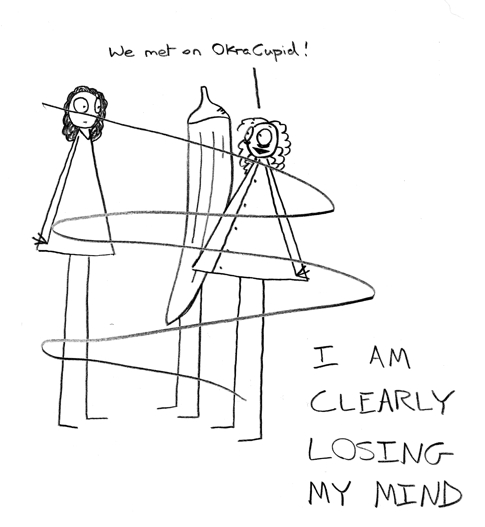
This comic was inspired by a recent stew. I like it a lot, but because today's a holiday no one will see it.
He's good for me
firehosevia Wojit
This comic was inspired by a recent stew. I like it a lot, but because today's a holiday no one will see it.
21 Jan 20:13


Bixi Files for Bankruptcy, But Bike-Share Goes On
by Sarah Goodyear
firehosevia saucie
By the time it happened, it seemed almost inevitable. On January 20, the Bixi bike-sharing company, based in Montréal, announced that it was filing for bankruptcy protection, citing debts totaling about $49 million, including a total of nearly $38 million from the city of Montréal.
Bixi, also known as Public Bike System, is based in Montréal, but its reach extends around the globe, with systems in place in more than a dozen cities in North America, Europe, and Australia, mostly operated by third parties. Mia Birk, vice president of Alta Bicycle Share, which operates eight Bixi-provided bike-share systems in the United States and Melbourne, Australia, said in an email shortly after the bankruptcy announcement that operations of those systems would be unaffected.
"Our systems across the country — in Washington, D.C., Boston, New York City, Chicago, the Bay Area, Columbus, OH, and Chattanooga, TN — are up and running and ABS will ensure that they continue to operate without interruption,” Birk wrote. “Given our plans to expand current systems and launch new systems this year, we're in constant communication with both PBSC as well as its suppliers to ensure we can do so successfully.”
Bixi has been trying, without success, to sell off its international operations.
Montréal’s new mayor, Denis Corderre, said in a statement that his city’s Bixi system, which is also operated by PBSC, will be up and running again this summer regardless of the bankruptcy filing. Whether it will go forward past 2014 is unclear. “If Bixi can be saved, it is through the Bankruptcy and Insolvency Act,” said the mayor. The system would require some kind of municipal subsidy to continue.
PBSC/Bixi came onto the international transportation scene with a bang when the first Bixi system launched in Montréal in 2009. Its robust bikes and solar-powered modular docking stations, developed under the city’s auspices, won design awards and attracted widespread interest at a time when bike-sharing was gaining traction among planners and elected officials.
Today, Bixi systems are in place in cities across the world, including London, New York, Minneapolis, and Chicago, where they are operated by third parties, including Alta. But Bixi has been unable to parlay that growth into a stable business model, and has been plagued by accusations of poor management and legal troubles, including a suit by the company that designed the system’s software. Many Canadian politicians have raised questions about whether government can or should be involved in this type of commercial enterprise.
In response to its multiple problems, Bixi has been restructuring and trying, without success, to sell off its international operations. The most recent potential sale fell through last December, reportedly when the unnamed potential buyer got a closer look at the company's books. If Bixi proves unable to sell the international division, Montréal taxpayers could be on the hook for as much as $38 million (you can find a comprehensive timeline of the company’s evolution and struggles here.)
In a statement on its Facebook page, Bixi blamed $5.6 million in outstanding payments from international clients for its financial woes. That’s an apparent reference to $3 million the company has claimed it's owed by Alta for delivery on New York City's bike-share system and $2.6 million owed for Chicago's*, payments withheld because of problems with delivery and implementation of their systems. (Alta’s Birk said that her company is up to date on all its payments to Bixi "with the exception of specific holdbacks related to PBSC software or hardware deficiencies.") Bixi says it will continue to restructure with bankruptcy protection from creditors, and that no jobs will be eliminated in the immediate future.
Bixi’s problems obviously run much deeper than a few outstanding payments from clients with fulfillment problems. Despite being owned by the city of Montréal, PBSC has a long history of failing to disclose its financial information in a timely fashion, and it has yet to release its 2012 statements. Montréal Mayor Coderre was blunt in his assessment to the Montréal Gazette, admitting that his city had "embarked on commercial operations that it should not have been involved in. ... It is not up to taxpayers to assume the financial risk involving a business plan."
For fans of bike-share in cities such as New York, the bankruptcy raises questions. The launch of the New York system, now encompassing approximately 5,000 bikes at 330 stations, was delayed months beyond its original date because of software problems. The long-awaited rollout of an additional 4,000 bikes at a total of 600 stations, which would substantially increase the Citi Bike coverage area and its usefulness to commuters, has yet to be scheduled.
New York City officials referred comment to Alta's Birk, who reiterated her assertion about the future of her company's systems in general. "ABS is committed to providing great service to our clients (cities) and all customers of bike share. All our bike share systems are up and running and ABS will ensure that they continue to operate without interruption/smoothly."
In Chicago, officials said that the relatively new Divvy system would not be affected by PBSC’s problems. “Chicago’s bike share system continues to operate as normal, and current operations will not be impacted by the announcement that Public Bike System (PBSC) has filed for bankruptcy,” wrote Peter Scales of the Chicago Department of Transportation in an email.
For riders who depend on the bikes for commuting or occasional recreational use, the Bixi systems they use will look the same as ever for now. But the pressure on Alta and other management entities to come up with long-term alternatives to an unreliable PBSC is only going to increase. And the question of how to craft an effective business model for a bike-share system such as Bixi's remains up in the air.
*Correction: This piece has been updated to clarify that outstanding payments Bixi has said it is owed from New York and Chicago are payments Bixi would like to collect from Alta, the operator of the bike-share systems in those cities, not from the city governments themselves.
Top image: a katz /Shutterstock.com
    
|
21 Jan 20:10
This May Be The Most Ridiculous Google Glass Sex App Yet
firehoseGoogle Glass's demographic is chronic narcissists
Sex With Glass lets two humping Glass-wearers view their sexual trysts in real-time from either partner’s perspective.

