Shared posts

08 Apr 18:13

Maryland will be the latest state to decriminalize marijuana

by Rich McCormick

Maryland is set to become the 17th state to decriminalize marijuana. Democratic Governor Martin O'Malley released a statement on Monday, saying he intended to sign legislation that would mean those found in possession of small amounts of the drug would not face jail time. Governor O'Malley said that the decriminalization bill had majority support in the state, and that under current state laws, few defendants in marijuana cases go to prison as a matter of "judicial economy and prosecutorial discretion."

Violent crime is at its lowest in Maryland in 30 years, and the governor said the new law would allow law enforcement officials to keep their focus on more serious crimes. "I now think that decriminalizing possession of marijuana is an acknowledgement of the low priority that our courts, our prosecutors, our police, and the vast majority of citizens already attach to this transgression of public order and public health," he said in the statement. "Such an acknowledgment in law might even lead to a greater focus on far more serious threats to public safety and the lives of our citizens."


Governor O'Malley said he would sign the bill when it reached him

Marijuana is decriminalized in many US states, but the drug can only be bought and sold legally in Washington and Colorado. Under Maryland's proposed laws, people found in possession of small amounts of marijuana can still be fined, and those discovered to have large amounts, designed for sale or trafficking, can be arrested. Further legislation is likely: recent studies suggest that 75 percent of Americans believe marijuana will eventually be legalized across the country, and that 58 percent of the population support that change.

08 Apr 18:09

News Flash: Google removes pornography from Android app | The Jakarta Post

News Flash: Google removes pornography from Android app | The Jakarta Post:

"The changes, which Google sent to developers via email, stretch its already strong stance against sexual content to encompass even “erotic” material, according to phandroid.com.

Starting very soon, Google Play Store will remove content such as animated wallpapers featuring women with excess bare skin.

Apps that contain or promote pornography are prohibited; this includes sexually explicit or erotic content, icons, titles or descriptions, according to Google’s official content policy page for Google Play.”

08 Apr 18:07

Blooey! "Even a molten ball of gas has its moments of...


Blooey!

"Even a molten ball of gas has its moments of elegance.

"Last week, NASA’s Solar Dynamics Observatory caught a solar flare on video, and the agency’s description of the sun’s swirling eruption as "graceful" isn’t hyperbole. Scientists will study this tape to gain insight on what leads to solar flares, a phenomenon not entirely understood."

"Graceful" doesn’t half say it.

08 Apr 18:05

China’s local governments are making a killing off of funerals

by Gwynn Guilford
An ancestral tomb, measuring 10 metres high and a surface area of 10 square metres, is seen on the construction site of a building in Taiyuan, Shanxi province, December 6, 2012. The grave, which is believed to have existed since 2004, has not been moved as the family of the deceased is waiting for an auspicious date to do so and a reason from the developer of choosing this site, according to the owner of tomb. The building is scheduled to be completed by April 2013. REUTERS/Stringer

The cost of living is soaring in China—but it may not be as bad as the cost of dying. A scarcity of cemetery plots drove prices in Beijing up 10-15% in the last year, to around 90,000  yuan per square meters ($1,342 per square foot), reports China National Radio (link in Chinese), with plum plots reaching more than twice that.

It’s a problem all over China—one that’s grown so bad that articles with the phrase “sibuqi” (“can’t afford dying”) frequently shows up in headlines (link in Chinese). Surging land prices and rapid aging are largely responsible for a grave shortage all over China—as are rising disposable incomes and a cultural preference for burial. But recent Chinese media reports highlight another factor: local government incentives.

Although the industry is supposed to be opening up to private commercial players, the government still dominates it. Fu Shou Yuan, a private provider that listed in Hong Kong in December 2013, is one of the rare exceptions. But even as one of the industry’s leading companies, its business volume makes up just 1% of the market, according to a Euromonitor study included in FSY’s prospectus (pdf, p.80).

Who’s running the rest? In large part, local public affairs ministries, which as Southern Weekend reports (link in Chinese), have a virtual monopoly on approving new companies and land parcel sales.

Unsurprisingly, government-affiliated companies are approved much more easily than private companies are, according to FSY’s prospectus. The state’s control of the funeral sector generally isn’t transparent, but the one exception—Guangzhou province—shows how critical the business can be. According to Southern Weekend, nearly 200 million yuan—about 90% of that provincial ministry’s 2014 budget—came from funeral management revenue.

There’s little incentive for local governments to cede control of the industry. The rapid clip at which China’s population is aging means more people are dying each year—9.7 million people kicked the bucket last year, compared with 9.1 million in 2007. By 2040, the annual death toll will be nearly twice what it is now, all else being equal.

​ Fu Shou Yuan International Group

At the same time, competition for land has contributed to the shortage of burial plots. Some local governments depend on the sale of land parcels to real estate developers for as much as half their revenue. Auctioning off centrally located land to be used for cemeteries is not as profitable as selling it to a developer of luxury villas.

Without more land—or a sudden embrace of cremation—big cities will soon run out of plots altogether. Within two decades, Shanghai will have none left, according to Southern Weekend’s calculations.

By then, even families who have purchased burial plots may find themselves out of luck. As it turns out, eternal rest comes with fine print. Because the government “transfers” land to the funeral company—and the Chinese government officially owns all the land—grave plots typically have an expiration date of anywhere from 20 to 70 years. This creates a quandary for the marketing of funeral services, as Wang Jisheng, general manager of Fu Shou Yuan, explains.

“So when we sell the land to customers, how long should it be for?” Wang told Southern Weekend. “If we sell it to a customer a year after it was transferred to us, should we sell them 49 years [of property use rights]? This is inherently problematic.”

08 Apr 18:04

athickgirlscloset: ghdos: Game. Set. Match. I normally dont...

Courtney shared this story from Super Opinionated.


athickgirlscloset:

ghdos:

Game. Set. Match.

I normally don’t reblog stuff like this. but he read dude’s whole life, a book, & the constitution with this response.

08 Apr 18:00

Photo


08 Apr 17:57

How straight women should interact with lesbians (as suggested in the late 80′s)

by Abraham

This half serious, half tongue-in-cheek handout from the Women’s Studies department of the University of Wisconsin circa 1988, which was recently re-found by a former student who was packing to move, reminds us that progress is a process (and a pretty fascinating and funny one, at that)…

When you meet a lesbian, circa 1988

(via Gawker)

08 Apr 17:57

A Game That Lets You Build — Or Destroy — Your Own Solar System

by Ria Misra

A Game That Lets You Build — Or Destroy — Your Own Solar System

If you've ever wondered just how skillful you might be at designing a solar system, here's your chance try your hand at it. A new game lets you build a solar system — and then see it action.

Read more...


08 Apr 17:57

Amazon claims it has surpassed Hulu to become third largest video site

by Jacob Kastrenakes

Amazon's been trying to turn Instant Video into a major player in the streaming space, and it looks like its dedication is starting to pay off: Amazon says that Prime video streams have nearly tripled year over year, and it cites video-delivery firm Qwilt to say that Instant Video is now the third largest video site overall, behind Netflix and YouTube. If correct, that would mean that Amazon has jumped ahead of Apple and Hulu to take the number three spot. Amazon likely only controls a small percent or so of the market even so, with Netflix retaining its position as one of the largest sources of internet traffic — not just video streams.


"We've invested hundreds of millions of dollars in great TV shows and movies."

With the launch of Fire TV last week, Amazon is certainly hoping that figure will continue to rise now that even more people will have a simple way to browse, rent, and buy movies and TV shows on Amazon. "We’ve invested hundreds of millions of dollars in great TV shows and movies for Prime members and it’s working," Bill Carr, an Amazon video and music executive, says in a statement.

Amazon's also continuing its push into original content, announcing its second slate of original shows last Monday. Though it's seen far less success than Netflix in this area, Amazon's programs have gotten more buzz than those from Hulu. Amazon doesn't say exactly which of these elements is responsible for drawing in so much new traffic, but it appears to be continuing its assault on all fronts — bringing viewers popular shows and movies, original content, and easy ways to watch — to make sure that it's positioned to keep growing.

08 Apr 15:48

Game Of Mobile Homes - YouTube

by hodad
firehose

"He's the Neil Patrick Harris of underground fighting."

08 Apr 15:32

Crowdfund Bookie, March 2014: The slide continues

by Mike Suszek
firehose

'Crowdfunding projects during (March) raised $991,113 collectively, the second-worst month of funding of the previous ten. March was also second to January in terms of the lowest number of backers in the last ten months, as just 28,460 people showed up to fund video game projects. The more telling figure is March's average pledge per person amount: $34.82, the lowest of any month since we began tracking crowdfunding data.'

The Crowdfund Bookie crunches data from select successful Kickstarter and Indiegogo campaigns that ended during the month and produces pretty charts for you to look at. In case there was any hope that the crowdfunded video game space was on the...
08 Apr 15:31

Bees in northern Europe are dying faster than they should be—and threatening billions in crops

by Gwynn Guilford
A bee is covered with pollen as it sits on a blade of grass on a lawn in Klosterneuburg April 29, 2013. The European Commission said on Monday it would go ahead and impose a temporary ban on three of the world's most widely used pesticides because of fears they harm bees, despite EU governments failing to agree on the issue. In a vote on Monday, EU officials could not decide whether to impose a two-year ban - with some exceptions - on a class of pesticides known as neonicotinoids, produced mainly by Germany's Bayer and Switzerland's Syngenta. The Commission proposed the ban in January after EU scientists said the chemicals posed an acute risk to honeybees, which pollinate many of the crops grown commercially in Europe. REUTERS/Heinz-Peter Bader

With the world set to have 9.5 billion people to feed by 2050, the name of the game is productivity. That’s why honeybees are so important—39 of the world’s 57 major crops yield more when bees pollinate them (pdf). And over the last half-century, those crops have assumed a bigger and bigger role in diets all over the world.

It’s also why the eerie die-off of American bees, which has put $30 billion of crops at risk, is so scary. Fortunately, things are better in many countries across the Atlantic, where new research by the European Commission shows “acceptable” mortality rates—meaning less than 10%—at nearly half of the European Union’s bee colonies, compared with 31% mortality rates during the same period in the US.

But not in all countries. At one-third of EU bee colonies, winter mortality rates exceeded the 10% level, according to the report (and bear in mind that 20% of EU colonies weren’t surveyed). Northern countries are taking the biggest hit. For instance, colony mortality was as high as 33.6% and 28.8% in Belgium and the UK, respectively.

​ Epilobee

As always, it’s hard to tell what’s killing the bees. The study, a pilot project investigating 32,000 colonies from 2012 to 2013, focused mainly on gathering data for future analysis.

One possible culprit is simply the unusually harsh winter of 2012-13 in Europe. On a positive note, the study established that foulbrood disease, a deadly bacterial outbreak that’s ravaged American colonies, isn’t an immediate threat. However, the report did note a worrying prevalence of Varroa destructor—a virulent parasite that likely contributed to colony collapse disorder in Canada and Hawaii—in bee colonies in Latvia, the UK and Poland.

​ Epilobee

But the report didn’t examine the impact of pesticides or biodiversity. Though the EU has among the strictest laws against the use of potentially harmful pesticides, research on bee die-offs to date reveals just how little we understand about the complex interplay of pesticides, fungicides and parasites and their impact on bee immune systems.

What we do know is that European farmers need bees more than ever. Despite rising numbers of EU colonies, pollination demand is accelerating at a brisker clip, growing 4.9 times faster than available stocks, according to a recent study in PLOS ONE. The UK, for example, has only one-quarter of the honeybees it needs.

A comparison of the supply density of honey bees (a, b), density of demand (c,d) and the resultant pollination service capacity (e,f) in 2005 (left panels) and 2010 (right panels). PLOS ONE

That’s happening thanks largely to a surge in biofuel feed crops like sunflowers and soybeans. An EU directive mandates that by 2020, 10% of transport fuel used by member countries must come from renewable sources, such as oil from seeds and beans.

So if bees are dying at scary rates in northern Europe, at the same time as biofuel production is expanding, how is anything getting pollinated? Wild bees are likely filling the gap. As the BBC reports, wild pollinators do work that would cost British farmers £1.8 billion ($3 billion) to do themselves.

However, as the European Commission’s report noted, current indicators of wild bee populations “show a worrying decline.” A recent bumblebee assessment found that nearly a quarter of Europe’s 68 bumblebee species are threatened with extinction, said the commission. As the BBC points out, that could be putting crops in the UK and other EU countries at more risk than farmers realize.

08 Apr 15:28

Great Job, Internet!: Full House Without Michelle’s new video takes sadness even further

by Kayla Reed

When The A.V. Club first saw “Full House Without Michelle,” the concept was amusing enough. It elicits the same type of laughs as Garfield Minus Garfield, but goes a bit more macabre by framing it with Danny Tanner inventing Michelle as a way of coping with his pregnant wife’s death (along the same vein as that dark Rugrats conspiracy). 

Now the darkness continues as Danny tries to potty train “Michelle” in the clip below. Without one of the Olsens in the shot, Danny is just a grown man playing with a tiny pink toilet and a baby doll. The sadness only expands with the rest of the Tanners’ pitied laughter at a man doing all he can to hold on to the rapidly waning memory of a lost love. Stephanie’s last line of the clip is also a bleakly funny bonus.


08 Apr 15:26

Verizon and "Relevant Mobile Advertising"

by Gabe
firehose

all carriers suck forever
'The only thing that surprises me about this is that they offer an opt-out.'

Verizon would like to monitor what you are doing with your mobile device and inject their advertising. You can opt out but it's a pain. I suggest every single customer call them. They'd love that.

Note: if you have a multi-line account, you must indicate your privacy choices with respect to each individual line.

And what are they collecting:

The information we use for this program includes the postal address we have for you and certain consumer information such as your device type and language preference, as well as demographic and interest categories obtained from other companies. This information might include your gender, age range, and interests (i.e. sports fan, frequent diner, or pet owner). In addition, we will use an anonymous, unique identifier we create when you register on our websites. This may allow an advertiser to use information they have about your visits to online websites to deliver marketing messages to mobile devices on our network. We do not share information that identifies you personally outside of Verizon as part of this program.

Cool. They don't identify you personally. Just your address, demographic info, interests and how you use the internet. Just meta data.

The only thing that surprises me about this is that they offer an opt-out. For whatever that's worth.

By way of @potatowire, the cutest sarcastic baby on the internet.

08 Apr 15:25

juggle ohs - Bishi Bashi Special (Konami - PSX - 2000) 


juggle ohs - Bishi Bashi Special (Konami - PSX - 2000) 

08 Apr 15:20

The NASA Z-2 Suit, The Newest Prototype Spacesuit Design

by Rollin Bishop
firehose

DUAL-WIELDING POWER TOOLS
360 NOSCOPE SXXXXREWDR!V3R

NASA Z-2 Suit

The Z-2 suit is the latest and greatest Z-series prototype spacesuit from NASA. The space agency has designed three distinct versions of the Z-2 suit, which is a non-flight phase prototype, and is currently holding an online public vote to see which of the three continues to be iterated upon.

The three designs — “Biomimicry”, “Technology”, and “Trends in Society” — differ aesthetically but function in a lot of the same ways. They all include pleats of some kind as well as electroluminescent wire, but their respective designs are influenced in different ways. More on the three suit designs, including 3D models for each, is available on NASA’s website. A Z-2 suit is expected to be completed by November 2014.

Biomimicry Z-2 Suit
“Biomimicry”

Technology Z-2 Suit
“Technology”

Trends in Society Z-2 Suit
“Trends in Society”

images via NASA

via Jesse Chan-Norris

08 Apr 15:06

Dyn discontinues free DynDNS service to clean up its DDNS network

by Lee Hutchinson
Dyn's service comparison chart no longer features a "free" column.

Dyn offers a whole passel of DNS-related products, but the company is most famous for its free DynDNS service: it lets users associate often dynamic IP addresses with hostnames, as long as those users "check in" once a month. It's a boon for people wanting to slap an easily remembered, fully qualified domain name onto their home ISP connections without dropping the money to actually register a domain—and it's vanishing on May 7, 2014.

Dyn CEO Jeremy Hitchcock posted a blog entry yesterday morning explaining the reasoning behind killing off DynDNS' free tier. The language is a little muddled and the post reads like it was run through a corporate communications department before posting, but Hitchcock explains that the move away from free accounts is due to increased abuse and diminishing value for Dyn.

Hitchcock notes that the change will allow Dyn to spend more time refining its paid service offerings and supporting paying customers. Dyn users who had previously donated money to the company in exchange for free lifetime service are exempted from the discontinuation.

Read 2 remaining paragraphs | Comments

08 Apr 15:05

Real life cats correctly predicted UConn as national champions

by Marc Normandin

Cats supporting dogs, all in the name of bracket glory.

It didn't take long for the majority of 2014's March Madness brackets to be ruined. The hope that early upsets would not be the start of a trend quickly faded in favor of rooting for chaos, as the unexpected continued to happen throughout the tournament.

Well, mostly unexpected. After all, we did have cats predict the University of Connecticut as the national champions, and that's just what ended up happening for the first-ever No. 7 seed to end March Madness as the victors.

Specifically, this cat, Winifred Burkle, predicted UConn to win it all:

20140317_201721

She was not alone, though, as UConn made it to the Final Four in the first place thanks to the prognostication of one Kitty Sanchez:

20140317_205715

While it's wonderful that these two teamed up to correctly identify March Madness's champion, we do have to admit that their bracket didn't go off entirely without issues, just like that of everyone else who participated this year. While they correctly identified a few upsets along the way, Kitty and Fred saw their bracket marred by the likes of Dayton and Mercer, as well as an overall ugly second round that nearly blew up their entire bracket.

In the first round, Kitty was right about Florida (1) over Albany (16), Pittsburgh (9) over Colorado (8), Syracuse (3) over Western Michigan (14), Stanford (10) over New Mexico (7), Virginia (1) over Coastal Carolina (16), Memphis (8) over George Washington (9), North Carolina (6) over Providence (11), UConn (7) over Saint Joseph's (10), and Villanova (2) over Milwaukee (15). That's nine out of 16 match-ups: not bad, but not great, either. When you adjust for cat and the chaotic year, we can probably deem it a success, though.

Sure, their feline Final Four wasn't pretty, but they at least picked the right winner.

Fred nailed Arizona (1), Gonzaga (9), San Diego State (4), Baylor (6), Wisconsin (2), Wichita (1), Kentucky (8), Saint Louis (5), Louisville (4), and Texas (7) on her side of the bracket, netting her 10 of 16 correct in the West and Midwest regions. That's 19 of 32 overall in the first round for Fred and Kitty.

In the second, things fell apart almost entirely for Kitty. The only correct pick she made from the first round to advance was UConn -- granted, that's the important one of the bunch, but it didn't look good at the time. That also meant they were the only possible correct pick she could make in the Elite Eight as well. Winifred fared a little better, with four of her eight match-ups coming out correctly thanks to Arizona, San Diego State, Baylor, and Louisville. Her Elite Eight didn't go any better than Kitty's, though, with only Arizona making it from her side of the bracket.

The only Final Four selection the two correctly predicted was UConn, but again, that was enough. They had UConn beating VCU and then Arizona to become national champion, and instead they went through Florida and Kentucky, but the end message -- UConn as tournament champ -- was at least on point. Now they can brag to all of their cat friends about the time they correctly picked an underdog national champion, and really, that's precisely why we fill out brackets in the first place, isn't it?

08 Apr 15:04

Detailed and interactive map of bike accidents in Portland

08 Apr 15:01

Harpocrates, Athanasius Kircher, Oedipus Aegyptiacus, 1652 


Harpocrates, Athanasius Kircher, Oedipus Aegyptiacus, 1652 

08 Apr 15:00

Stereotypes Of Appalachia Obscure A Diverse Picture : Code Switch : NPR

by hodad
77302ab1d83ab19dcc5841ff37e3cf2e
hodad

@arkbros

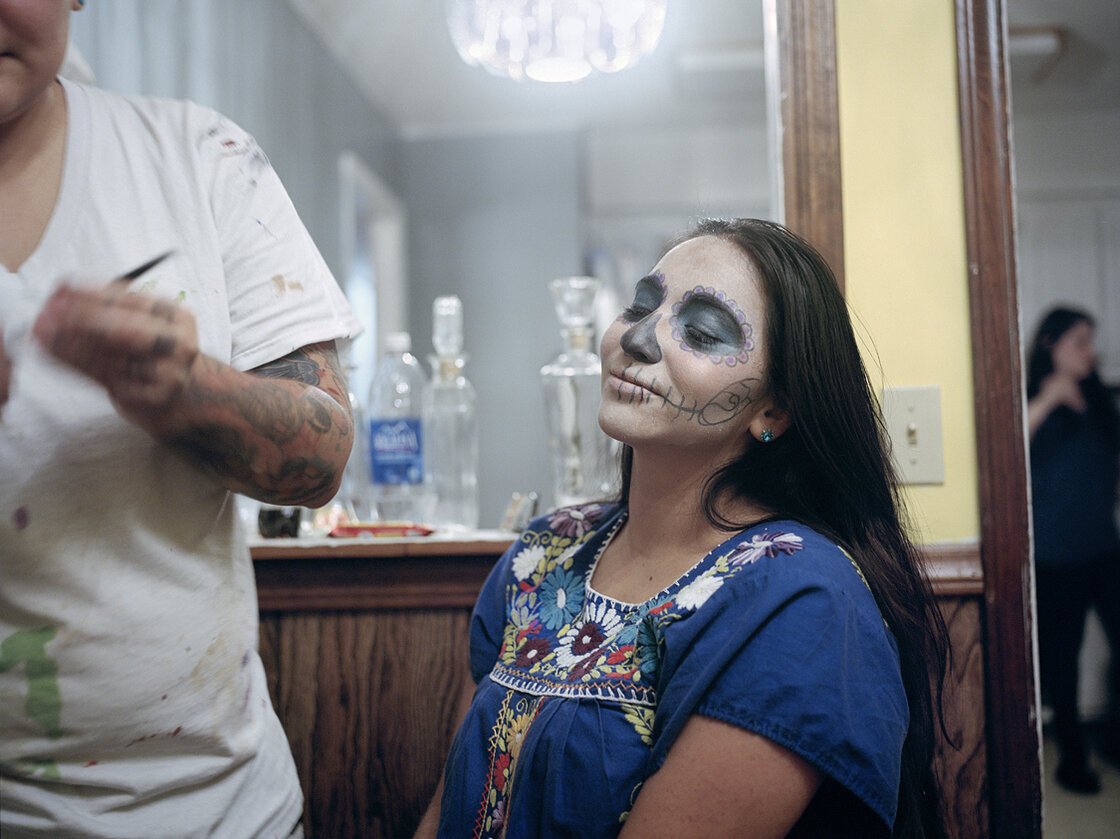
Anai Saucedo has her face painted with makeup in the Dia de los Muertos tradition in Erwin, Tenn.i i

hide captionAnai Saucedo has her face painted with makeup in the Dia de los Muertos tradition in Erwin, Tenn.

Courtesy of Megan King
Anai Saucedo has her face painted with makeup in the Dia de los Muertos tradition in Erwin, Tenn.

Anai Saucedo has her face painted with makeup in the Dia de los Muertos tradition in Erwin, Tenn.

Courtesy of Megan King

Children in sepia-toned clothes with dirt-smeared faces. Weathered, sunken-eyed women on trailer steps chain-smoking Camels. Teenagers clad in Carhartt and Mossy Oak loitering outside long-shuttered businesses.

When policymakers and news organizations need a snapshot of rural poverty in the United States, Appalachia — the area of land stretching from the mountains of southern New York through northern Alabama — is the default destination of choice. Poverty tours conducted by presidents from Lyndon Johnson to Richard Nixon, almost every member of the Kennedy clan, and religious leaders like Jesse Jackson have all painted the portrait of Appalachia the same way: poor, backward, and white.

Frank Cedillo fishes in a Greenville, Tenn., lake.i i

hide captionFrank Cedillo fishes in a Greenville, Tenn., lake.

Courtesy of Megan King
Frank Cedillo fishes in a Greenville, Tenn., lake.

Frank Cedillo fishes in a Greenville, Tenn., lake.

Courtesy of Megan King

While the economic despair and major health epidemics are an unsettling reality for the region, a glaring omission has been made from the "poverty porn" images fed to national audiences for generations: Appalachia's people of color.

"When we tell the truth about Appalachia, it's only then that we tell the real story about who we are," said Aaron Thompson, executive vice president and chief academic officer for the Kentucky Council on Postsecondary Education.

Growing up as an African-American outside Manchester, Ky. — a coal town home to the lowest per capita income in the state — Thompson has become one of the few outspoken role models for young people of color in his mountain home. "There's no one story of Appalachia, no one voice. It's time for everyone to feel like they can speak up, like their story is important."

The region's population growth is increasingly fueled by minorities, who have composed almost half of Appalachia's new residents (42 percent) over the past three decades and helped fuel awareness about the heterogeneous reality of mountain towns.

Appalachia's history as a mountainous melting pot dates to before the Revolutionary War, when the region's misty crags were an almost impenetrable Western frontier. Indian nations, including Cherokee and Shawnee, were the first to inhabit the area. A major wave of European settlers — primarily of Irish and Scottish descent — arrived via federal land grants in the early 18th century. African-Americans, both free and enslaved, arrived at this time as well. All these groups played key roles in shaping and molding the cultural traditions of the region.

African-Americans made up more than 10 percent of the region's population by 1860, with Appalachia's ethnic profile shifting dramatically as multiracial families boomed. (Later, those with blended Scots-Irish, Native American and African-American roots would come to be known as Melungeons.)

“ There's no one story of Appalachia, no one voice. It's time for everyone to feel like they can speak up, like their story is important.

- Aaron Thompson

In the years following the Civil War, former slaves migrated north to the region to escape the persecution of the Deep South. In Eastern Kentucky, Berea College opened its doors in 1867 to students of all races, with the first year's class totaling 187 students: 96 African-American and 91 white.

The coal crescendo during the early part of the 20th century brought in even greater diversity, with tens of thousands of Hungarian, Italian and Eastern European immigrants flocking to the mountains to cash in on booming mining towns. After the Great Depression, many of these immigrants — along with African-American families — moved to urban centers such as Cincinnati and Detroit in pursuit of more stable and less backbreaking work. These pioneers were some of the first to create "urban Appalachian" enclaves, spreading the traditions of an isolated region to metropolitan areas across the Midwest.

This fusion is most obvious in Appalachia's signature food and music. The African akonting was a precursor to the banjo — the instrument now synonymous with the region's plucky, twangy bluegrass sound. Spoonbread, chowchow and succotash all point to both African and Native American influences and are celebrated as culinary specialties of the area.

Despite a long history of ethnic diversity, racism continues to be a problem in the region, particularly as Hispanic communities grow larger. While African-Americans remain the region's largest minority (bucking a national trend) and make up about 9 percent of Appalachian residents, the region's Latino population has increased by more than 240 percent over the past 20 years, composing just over 4 percent of Appalachians in 2010. Still, the stigma associated with transient migrant workers remains.

but
if you think
makin‚'shine from corn
is as hard as Kentucky coal
imagine being
an Affrilachian
poet

— from "Affrilachia," by Kentucky poet laureate Frank X Walker

"Even though Hispanic families have been here for decades, they're definitely still unfairly targeted," said Megan King, a photographer whose work captures portraits of Latino families in and around Johnson City, Tenn. "When I was at the police station one day photographing a couple of [Hispanic] cops, a call came in and said that two Latino men were trying to steal a police car. It was the officers I was photographing — it was their police car."

From the beginning, the topography of Appalachia has proved to be a double-edged sword. The hard-to-maneuver hills and valleys have created a wholly unique, blended culture and communities with remarkable closeness, but also a level of outsider skepticism and self-imposed isolation that have plagued progress in many areas, from economic growth to health care.

"People in Appalachia are more concerned about kinship than skin color," said Thompson. "When my high school was integrated, it was a struggle the first couple of years. By senior year, I was class president and prom king. That initial fear of the unfamiliar — whether it's people of another race or any outsiders— looms large."

While there still is a way to go, a less whitewashed portrait of Appalachia seems to be gaining a foothold nationally, thanks in part to the efforts of scholars and grass-roots organizations. The term "Affrilachia" — a portmanteau of "African" and "Appalachian" coined by Kentucky poet laureate Frank X Walker — has brought together a loose collective of multiracial artists previously excluded from conversations about what it means to be an Appalachian. The word is now an entry in the Oxford American Dictionary, second edition. In 2005, Appalachian State University professor Fred Hay successfully petitioned the Library of Congress to change the definition of Appalachians from "Mountain Whites" to "Appalachians (People)."

That movement toward a more holistic regional picture may be a strong step toward tackling the larger societal ills. "In order to fix the issues of the region," said Thompson, "we first have to recognize we have a diverse bunch of people living there."

Original Source

08 Apr 14:59

Army: Fort Hood suspect had requested leave - Yahoo News

by gguillotte
A spokesman for Lopez's family said last week that Lopez was upset he was granted only a 24-hour leave to attend his mother's funeral in November. That leave was then extended to two days.
08 Apr 14:59

Meet The World's Coolest Character Creation System

firehose

Korean MMO Black Desert

The video on clickthrough is worth a view. The entire body can be adjusted with about the same granularity.

firehose shared this story from Kotaku.

I don't care if it's Skyrim or FIFA, The Sims or Mass Effect, this looks amazing.P

Meet The World's Coolest Character Creation System

08 Apr 14:58

Social Justice Design Jam: Co-creating images for the world we want to build, an event at Bento Miso

by gguillotte
firehose

Toronto

Our movements need more images! We have a wealthy visual vocabulary of protest and critique — raised fists, barbed wire, marchers holding placards — but we must also depict the world we are building, not just the forces we’re resisting. How can we communicate concepts we hold dear; concepts like interdependence, allyship, safety, and accountability? This workshop will bring together designers, artists, advocates, and community organizers to co-create images for the world we want to build. Working in small teams, we’ll brainstorm ideas both verbally and visually, and will collaborate on creating scalable, easy-to-use graphics for social justice movements. The resulting graphics will be shared in a free, open source library.
08 Apr 14:55

Philippine court upholds birth control law

firehose

via Arnvidr

Supreme Court strikes down legal challenge by church groups against law providing free contraception to poor Filipinos.
08 Apr 14:47

artbooksnat: Background art and architecture in sketched and...

firehose

via Russian Sledges


artbooksnat:

Background art and architecture in sketched and finished forms by Shichirou Kobayashi (小林七郎) for the film Revolutionary Girl Utena: Adolescence Apocalypse.

08 Apr 14:46

Arctic Death Spiral [Greg Laden's Blog]

by Greg Laden
firehose

via Ibstopher
speaking of good band names

The latest, updated, Arctic Death Spiral graphic from Andy Lee Robinson …

image

08 Apr 01:55

(via BkjiKNGIAAIoPZ5.jpg:large (JPEG Image, 547 × 410 pixels))

firehose

hi overbey

08 Apr 01:53

Critical crypto bug in OpenSSL opens two-thirds of the Web to eavesdropping

by Dan Goodin
firehose

WOKKA WOKKA

Aurich Lawson / Thinkstock

For a more detailed analysis of this catastrophic bug, see this update, which went live about 18 hours after Ars published this initial post.

Researchers have discovered an extremely critical defect in the cryptographic software library an estimated two-thirds of Web servers use to identify themselves to end users and prevent the eavesdropping of passwords, banking credentials, and other sensitive data.

The warning about the bug in OpenSSL coincided with the release of version 1.0.1g of the open-source program, which is the default cryptographic library used in the Apache and nginx Web server applications, as well as a wide variety of operating systems and e-mail and instant-messaging clients. The bug, which has resided in production versions of OpenSSL for more than two years, could make it possible for people to recover the private encryption key at the heart of the digital certificates used to authenticate Internet servers and to encrypt data traveling between them and end users. Attacks leave no traces in server logs, so there's no way of knowing if the bug has been actively exploited. Still, the risk is extraordinary, given the ability to disclose keys, passwords, and other credentials that could be used in future compromises.

Read 9 remaining paragraphs | Comments

08 Apr 01:41

Tilda Stardust 2.0 Leggings by Shivura on Etsy

by russiansledges
firehose

via Russian Sledges

The Tilda Stardust 2.0 design features a few added pictures of Bowie covering up a few of the more boring faces in the design. The new pattern is more colorful, vibrant, and a healthy chunk louder. The 2.0 leggings also feature a reinforced center seam.