Communications Physics, Published online: 26 February 2024; doi:10.1038/s42005-024-01561-5
Lyndsay Fletcher is a Professor of Astrophysics, specialising in solar physics, in the School of Physics and Astronomy, University of Glasgow and the Rosseland Centre for Solar Physics, University of Oslo.Shared posts
04 Sep 00:48
Embrace data anonymity, not ‘digital consent’
by Neil Seeman
Nature, Published online: 03 September 2019; doi:10.1038/d41586-019-02627-z
Embrace data anonymity, not ‘digital consent’
27 Sep 05:29
Dynamics and superconductivity in compressed lanthanum superhydride
by Hanyu Liu, Ivan I. Naumov, Zachary M. Geballe, Maddury Somayazulu, John S. Tse, and Russell J. Hemley
Author(s): Hanyu Liu, Ivan I. Naumov, Zachary M. Geballe, Maddury Somayazulu, John S. Tse, and Russell J. Hemley
Recent computational studies have predicted that rare-earth superhydrides are promising high-temperature superconductors. Of these phases having very high hydrogen content (XHn,n>6, where X is the rare-earth atom) a cubic phase of lanthanum hydride, recently synthesized at 170 GPa and identified ...
[Phys. Rev. B 98, 100102(R)] Published Wed Sep 26, 2018
Ouuing likes this
02 Aug 13:09

Author Correction: P53 and mTOR signalling determine fitness selection through cell competition during early mouse embryonic development
by Sarah Bowling
Author Correction: P53 and mTOR signalling determine fitness selection through cell competition during early mouse embryonic development
Author Correction: P53 and mTOR signalling determine fitness selection through cell competition during early mouse embryonic development, Published online: 02 August 2018; doi:10.1038/s41467-018-05718-z
Author Correction: P53 and mTOR signalling determine fitness selection through cell competition during early mouse embryonic development
26 Apr 20:51
High-pressure phase transitions of nitinol NiTi to a semiconductor with an unusual topological structure
by Guangtao Liu, Hanyu Liu, Xiaolei Feng, and Simon A. T. Redfern
Author(s): Guangtao Liu, Hanyu Liu, Xiaolei Feng, and Simon A. T. Redfern
Systematic ab initio structure simulations have been used to explore the high-pressure behavior of nitinol (NiTi) at zero temperature. Our crystal structure prediction and first-principles calculations reveal that the known B19 phase is dynamically unstable, and an orthorhombic structure (Pbcm) and ...
[Phys. Rev. B 97, 140104(R)] Published Thu Apr 26, 2018
Ouuing likes this
14 Nov 21:07

Origin of Negative Longitudinal Piezoelectric Effect
by Shi Liu and R. E. Cohen
Ouuingdata based finding.
Author(s): Shi Liu and R. E. Cohen
The negative longitudinal piezoelectric effect is predicted to be a general phenomenon caused by the strong ionic bonds, whose origin lies in small effective charges and rigid potential energy surfaces.

[Phys. Rev. Lett. 119, 207601] Published Tue Nov 14, 2017
Ouuing likes this
28 Jun 19:16
Scientists in limbo as US Supreme Court allows modified travel ban
by Sara Reardon
Scientists in limbo as US Supreme Court allows modified travel ban
Nature 546, 7660 (2017). http://www.nature.com/doifinder/10.1038/nature.2017.22190
Author: Sara Reardon
Justices overturn lower-court rulings on policy targeting people from six majority-Muslim countries.
09 Jan 17:46
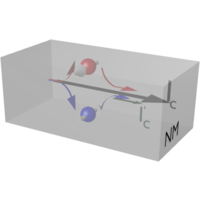
Hanle Magnetoresistance in Thin Metal Films with Strong Spin-Orbit Coupling
by Saül Vélez, Vitaly N. Golovach, Amilcar Bedoya-Pinto, Miren Isasa, Edurne Sagasta, Mikel Abadia, Celia Rogero, Luis E. Hueso, F. Sebastian Bergeret, and Fèlix Casanova
Author(s): Saül Vélez, Vitaly N. Golovach, Amilcar Bedoya-Pinto, Miren Isasa, Edurne Sagasta, Mikel Abadia, Celia Rogero, Luis E. Hueso, F. Sebastian Bergeret, and Fèlix Casanova
A new type of magnetoresistance is measured in thin nonmagnetic platinum films with strong spin-orbit coupling due to spin accumulation at the surface of the film.
[Phys. Rev. Lett. 116, 016603] Published Fri Jan 08, 2016
Sonny Rhim likes this
28 Mar 03:37
Metallization and superconductivity of BeH2 under high pressure
Pressure-induced metallization and potential superconductivity of BeH2 has been a topic of interest. In the present study, we extensively explored the crystal structures of BeH2 in a wide pressure range of 0–300 GPa using an unbiased structure searching method coupled with first-principles density functional calculations. A series of pressure-induced structural transformations are predicted for BeH2, as Ibam (α phase) → P-3m1 (phase II) → R-3m (phase III) → Cmcm (phase IV). Calculated pressures of phase transition are 25, 140, and 202 GPa, respectively. The phase II is isostructural to the well-known 1T structure of transition metal dichalcogenides, which is composed of covalent bonded BeH2 slabs stacked along the perpendicular direction by van der Waals forces. The phase III is constructed by the same BeH2 slabs, but differs from the phase II in the stacking sequence. The α phase, phase II, and phase III all have insulating electronic states while their band gaps decrease as pressure increases. We predicted that BeH2 reaches a metallic state by a III → IV phase transition, instead of a direct band gap closure in phase III. The phase IV has a three-dimensional extended Be-H network formed by edge-sharing BeH8 polyhedrons with delocalized electrons. Electron-phonon coupling calculations implemented using linear response theory on the metallic BeH2 predict a large electron-phonon coupling parameter of 0.63, leading to an estimation of superconducting transition temperature (T c ) of ∼38 K at 250 GPa.
No more posts. Check out what's trending.