Shared posts

08 Nov 16:12

The main loser from the MidTerms looks set to be “Big Pharma”

by Mike Smithson

One of the things we take for granted in the UK is the cost of our prescription medications. This is all part of the NHS and the majority of patients are too young/old or have chronic conditions which mean that they don’t pay.

Even those who don’t benefit from free prescriptions are not asked to pay the cost price of their medication but a fixed fee.

This means the NHS as almost a monopoly buyer is able to secure even the latest and most expensive medications at a pretty good prices.

How very different from the the US where public health programmes are barred by law from using their buying strength to negotiate big discounts for pharmaceuticals. This in one of the reasons why US health is so expensive.

To take an example. I an on a newish medication called Rivaroxaban which controls a genetic condition that causes me to have blood clots. The NHS pays about $2 per day for my pill which keeps me alive. The US price for exactly the same medication is just under $16 which many patients have to pay themselves.

Is it any wonder that the cost of pharmaceuticals is the biggest healthcare issue in US politics. The Democrats have promised to take action and Mr.Trump is also saying the same.

After Tuesday’s elections it clear that something will happen and big pharma is likely to be squeezed.

Mike Smithson

Follow @MSmithsonPB

Tweet

03 Jan 15:14

Senator Mitt Romney?

by Harry Enten

The 2018 midterms got a bit more exciting on Tuesday. The longest serving Republican senator in American history, Orrin Hatch of Utah, announced that he would not run for re-election. His retirement is unlikely to provide Democrats with much of an opportunity to win another Senate seat, but the door is now wide open for Trump nemesis and 2012 GOP presidential nominee Mitt Romney, who has reportedly told people he would enter the race if Hatch retired.

So, let’s break down Utah’s newly open Senate race …

1. Utah is really, really red.

Pretty much by any measure you look at, Utah comes out as one of the most Republican-leaning states in the country. The GOP holds a massive 4-to-1 advantage over Democrats in voter registrations. According to Gallup, only Wyoming gives Republicans a larger lead in party affiliation. Republicans have won 15 consecutive Senate elections in the state dating back to 1974. Democrats haven’t even won a governor’s race in Utah since 1980. And even though Trump won the state by a smaller margin than every Republican presidential nominee except one13 dating back to 1964, he still was able to win by 18 percentage points.

Though Hatch has been unpopular in the state, he would have been a favorite for re-election. A November survey gave him a 15-point lead over potential Democratic nominee Jenny Wilson. Democrats are desperate for another Senate seat to contest in 2018 — in addition to Nevada and Arizona — but Utah probably isn’t the best place for them to look.

2. But Trump is unusually unpopular for a Republican.

Trump managed to carry Utah handily in 2016, but that likely had more to do with his party affiliation than Trump himself. Trump won only 45 percent of the vote in a race that featured independent conservative Evan McMullin as well as Democrat Hillary Clinton. Trump won just 14 percent of the vote in Utah’s Republican caucus, which was far less than the 45 percent he won nationally during the nomination process. To boot, his net approval rating has been teetering around break even in the state. For a Republican president in Utah, that’s bad.

Will Utah’s dislike of Trump affect the 2018 Senate election? Well, maybe not. Utah is red enough that almost any Republican candidate will be a clear favorite there despite Trump’s poor numbers. That’s especially true if Romney — who is well-known and has a clear anti-Trump resume — wins the nomination. That said, if the GOP nominates a more Trumpian candidate, it’s possible to imagine him or her having some problems. After all, Trump won only a plurality (as opposed to a majority) of the Utah vote in 2016.

3. Anti-Trumpism has won in Utah already.

Last year, there was a trial run of sorts for anti-Trump Republicanism in Utah. Former Provo Mayor John Curtis ran in a special election to replace Rep. Jason Chaffetz in Utah’s 3rd Congressional District. During the primary, he admitted that he didn’t vote for Trump, and he won the primary against two candidates who did. That race was fairly close, however, with Curtis winning only 43 percent of the vote. Curtis then went on to win the general election by 32 percentage points, which was significantly greater than Trump’s 24-point margin in the district. Curtis’s win is particularly interesting given the large swing against Republicans in most 2017 special elections.

These numbers suggest that even if Romney decides not to run, a GOP candidate in his mold could win a primary and would be a favorite in the general.

4. Romney would be a heavy favorite

If Romney does enter the race, it’s hard to see him losing — the primary or the general. In a survey taken in November, Romney was rated among the most popular politician in the state. His net favorability among all voters was +47 percentage points — far higher than Trump’s. He also scored a +73 net favorability among Utah Republicans. (By contrast, Romney’s popularity among GOP voters nationally plummeted when he spoke out against Trump during the 2016 primaries.) The same poll found Romney with an astounding 51 percentage point lead against potential Democratic nominee Wilson.

In short: If Romney runs, he’d be as big a favorite as favorites get.

5. A candidate can take the argument directly to the voters.

One last logistical point: Republican candidates used to have to win or place second in a statewide convention to get on the primary ballot. That might have been a problem for a Romney-esque candidate. Longtime Sen. Bob Bennett was defeated in such a convention in 2010. But the state law was changed in 2014; now, candidates can get on the ballot via the convention or by gathering signatures.14 Curtis, for example, was beaten by the more conservative Chris Herrod in his district’s convention in 2017, but he got on the ballot for the primary and won anyway.

While it is unclear who will be strongest in a convention setting in 2018, widespread appeal is now more important for a candidate to win the nomination. If the polls are correct, Romney has the popularity necessary to win a nomination through a primary.

28 Feb 10:41

People With Eating Disorders Have The Best Chance of Recovery If They Can Access Early Treatment. Let's Ensure GPs Are Able To Provide It

by Tom Quinn
Yesterday, Beat, and other eating disorder and mental health charities across the UK, marked the start of Eating Disorders Awareness Week, an annual event that gives us a chance to highlight the struggles faced by those affected by these serious mental illnesses.

At least 725,000 people of all ages, genders and backgrounds in the UK have an eating disorder. They are extremely serious illnesses, and if left untreated for too long they potentially have long-term physical consequences and may even be deadly - anorexia has the highest mortality rate of any mental illness. Beat focuses on early intervention for eating disorders as a major part of its work, because we know that the sooner someone gets treatment, the better their chance of a full and sustained recovery.

Early intervention relies on a number of different factors. For someone with an eating disorder to access the treatment they need and deserve as quickly as possible, the people around them, such as their friends and family, must be able to spot the earliest symptoms. Their GP needs to know how to recognise an eating disorder when it first develops, so that they can immediately refer the patient for specialist assessment. And, of course, the funding needs to be in place to allow for the provision of effective treatment as soon as a diagnosis is made.

GPs are often the first port of call for people who are worried about themselves or someone they know, so for Eating Disorders Awareness Week, Beat's focus is the vital role that GPs play in diagnosis and treatment. To identify an eating disorder as soon as it develops, GPs must know what to look for. This doesn't simply mean the changes to physical appearance that might be expected, but behavioural and psychological signs that in most cases will emerge much earlier. With a standard GP appointment lasting only ten minutes, we know it's not always going to be easy for the GP to pick up on these signs and to talk with the patient about what they might mean, especially if, as can be the case, the patient themselves is struggling to realise that they're ill. So more needs to be done to make sure that GPs can provide the best care possible to patients suffering from these complex illnesses.

Yesterday morning, Beat released the results of a survey we carried out in December 2016, which focused on the experiences of sufferers of eating disorders with their GPs. We got responses from almost 1,700 people who had either had an eating disorder, supported someone with an eating disorder, or both. Of over 1,200 who had sought treatment for their own eating disorders from their GP, 30% didn't get a referral to specialist mental health services from the first GP they visited, and only 34% felt their GP knew how to help them. The results, as well as comments from respondents on the survey and in follow-up conversations, show that we need to do more to help GPs help their patients. To approach the GP about an eating disorder requires enormous courage on the part of the sufferers, and we must ensure that all GPs have enough understanding of eating disorders to be able to provide them with the best quality care.

The consequences of not receiving treatment at once can be serious. Some survey respondents who had visited their GP for their eating disorder were told that they wouldn't be able to access treatment unless they had a lower Body Mass Index. As one person said, in response to being told her BMI wasn't low enough for treatment: "My already warped thoughts went wild. [My GP] was right - there was nothing to worry about; my family were overreacting, I didn't have a problem until I lost more weight." Being turned away from treatment can cause people to believe that they're not really ill, or that they're not worthy of getting help.

We know that sometimes access to treatment is out of the hands of GPs. We also know that while there are instances of people being turned away, there are also many instances of GPs who have provided fantastic care for patients with eating disorders. We have heard from people who completed our survey that even - and perhaps especially - in cases where specialist treatment has been difficult to access, a GP who understands these illnesses and is able to provide support can make a real difference to the wellbeing of their patient. Not only do GPs play an essential role in identifying these illnesses and referring their patients, but a knowledgeable and compassionate GP can make a big contribution to recovery by coordinating their care and monitoring their health.

To make sure that GPs are able to provide the best possible care for people with eating disorders, Beat are calling for increased training on eating disorders for junior doctors specialising in general practice, as well as sufficient training in medical schools and appropriate examination. We're also launching new literature, including "First Steps" guidance to empower people with eating disorders to get the most out of their GP appointment and to answer any questions the GP may have and refer them to relevant medical guidelines.

Throughout the week, we'll be pressing for early intervention in a variety of ways, including through a public awareness campaign, a parliamentary event, and a petition calling for the necessary steps to be taken to ensure that all GPs are able to refer eating disorder sufferers to treatment without delay. Eating disorders are complex, widely misunderstood mental illnesses that can take over a sufferer's life and the lives of those around them, but with the right support, provided as early as possible, we know people can fully recover.

If you're worried you might have an eating disorder or concerned about someone you know, visit www.b-eat.co.uk, or call the Beat helpline on 0808 801 0677.

-- This feed and its contents are the property of The Huffington Post UK, and use is subject to our terms. It may be used for personal consumption, but may not be distributed on a website.

14 Aug 18:20

The Incredible Chemistry Set on Kickstarter

by Mark Frauenfelder

Cory James Marriott is Kickstarting a cool $600 chemistry set. The examples on the video of glowing liquids, colored flames, color changing liquids, and weird crystals are the kinds of things kids hope and expect when they are given a crappy modern-day chemistry set, only to be disappointed to find out it contains not much more than a baggie of salt, a plastic eyedropper, and a pair of safety goggles. Read the rest

09 Sep 07:43

Library of Things

by News Admin
James at The Old Library

James at The Old Library

Have you ever wanted to borrow something for a few days rather than buy? Then try West Norwood’s Library of Things.

Its free to borrow things for 7 or 10 days. To join you just have to donate something useful to the library – things like tools, kitchen mixers, tea urns, easels, sewing machines, protective clothing, camping stuff, suitcases , wellies, beach gear, BBQs, sports rackets, toys…

For the moment the Library of Things is based in The Old Library building at 14 Knights Hill SE27 on Wednesdays 6pm to 8pm and Saturdays 10am to 4pm.

To get in touch email : libraryoft@gmail.com or see: www.theopenworks.org/library-of-things


02 Jul 15:23

Julian Huppert MP writes.. A step towards humanist weddings

by Julian Huppert MP

Humanist Wedding Ceremony - 16One of the Liberal Democrats greatest achievements in Government has been the successful passage of the Marriage (Same Sex Couples) Act. On Saturday 29 March 2014 the first same-sex marriages took place, a date I am certain will go down in history.

Most of the positive speeches given during the debates in Westminster concentrated not around gay or straight but on the belief that everyone has a fundamental right to love who they want and demonstrate that love together in a manner of their choosing.

And yet still in England we ban many weddings. In particular, humanist ceremonies are not allowed. More and more people are having humanist funerals, and anyone who has attend one will acknowledge they are moving and well run.

In Scotland, humanist marriage ceremonies are fully legal – as in Australia, Canada, Iceland, Ireland, New Zealand, Norway and some parts of the US.

The UK has been slow to catch up and during the passage I and other colleagues in the Commons and the Lords pressed for humanist ceremonies to be legally recognised. We faced a barrage of rather bizarre obstacles – including a suggestion that humanism was similar to tiddlywinks – but after much effort it was agreed that it could happen, subject to a consultation. Simon Hughes has been pressing to make sure it happens, and at long last it has.

I find it hard to imagine who would be harmed by allowing those with humanist beliefs to celebrate a marriage in their own way. So I’d urge everyone who has a view on this issue to submit it to the consultation: we need to make it clear that equality means equality for everyone.


* Julian Huppert is Liberal Democrat MP for Cambridge.

27 May 08:04

UK thanks Russell Brand

THAT not-voting thing has worked out brilliantly, Britain has told Russell Brand.
21 Feb 10:38

Wales begs Scotland to stay

WALES has begged Scotland not to leave it trapped in the UK with those two other mad bastards.
03 Feb 08:50

The Mail on Sunday and Oral Contraceptives

by Unity

A couple of days ago the Director of the Hacked Off campaign group, Brian Cathcart, published an article on the Huffington Post containing a table of figures that the Press Complaints Commission would much prefer that the public didn't see, one which shows which newspapers attracted the most PCC complaints in 2013. The top five newspapers on that list runs as follows:

1. Daily Mail - 1,214 complaints 2. The Sun - 638 complaints 3. Daily Telegraph - 300 complaints 4. Daily Mirror - 242 complaints 5. Mail on Sunday - 168 complaints

The Mail on Sunday, of course, publishes only one edition per week compared to the six per week published by the four newspapers ahead of it in the PCC's chart of shame.  Its 168 complaints last year are the... Read more »

16 Aug 09:27

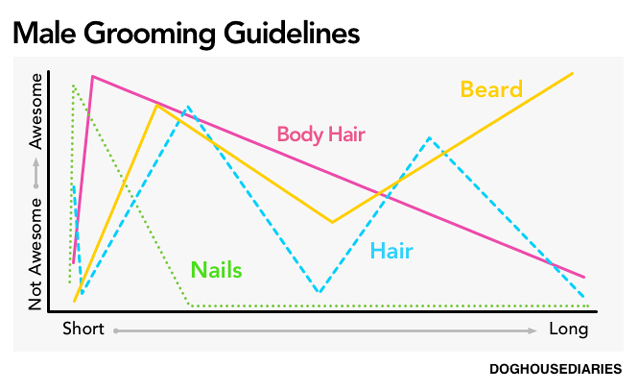
Male grooming guidelines

by Rob Beschizza

More controversy-baiting from the beard lobby! [Doghouse Diaries via Laughing Squid]


21 Jun 11:14

Segregated headstones reach over the cemetery wall

by Cory Doctorow
Parkertherocks

Beautiful.


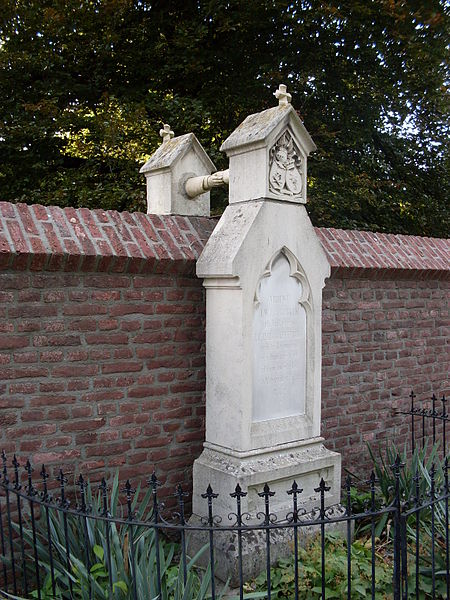
These grave markers -- pressed up against either side of an imposing wall, with a pair of clasped hands reaching over the wall's top -- date to a time in Dutch history when Catholic and Protestant graves were strictly segregated. A Catholic and a Protestant married couple, separated in death, arranged for this unique workaround in order to rejoin one another:

In 1842, a colonel in the Dutch cavalry, JWC van Gorkum, married a woman known as JCPH van Aefferden. The union was controversial — van Gorkum was Protestant and van Aefferden was Catholic. Despite the prevailing culture at the time, the two remained married for decades, only separating when van Gorkum died in 1880. He was buried in a cemetery near the Dutch town of Roermond called Begraafplaats Nabij de Kapel in ‘t Zand (“the cemetery near the chapel in ‘t Zand”). Pillarisation was taken very seriously — each community had its own schools, media, and graveyards — and Begraafplaats was no different. It took this segregation literally, with each religion having its own section. Van Gorkum was buried in the Protestant section, as would any other Protestant during that era.

But when van Aefferden passed away eight years later, she couldn’t be buried with her late husband; even in death, Catholics needed to stay with their own. While alive, she made her wishes clear — she did not want to be buried in her family tomb, and, instead, wished to be as close to her husband as possible. The solution, seen above, is her grave site. (Here’s a bigger version of her tombstone, and here’s his.) The two tombstones, separated by a wall and by religions, feature a pair of hands connecting over the brick divider.

Until Death Do Us Reunite [Now I Know]

(via Super Punch)


17 Jun 12:36

Join Britain in cringing at Alex Jones

by Rob Beschizza
Parkertherocks

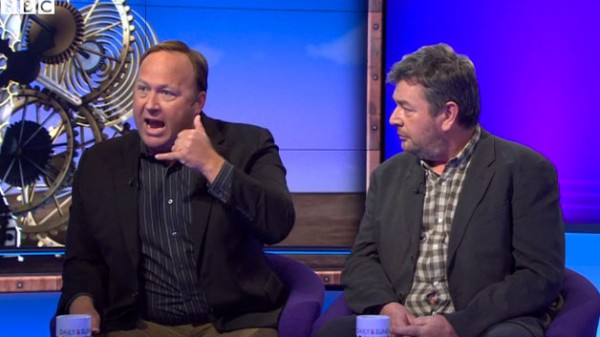
Ohhh emmm geee.

Alex Jones, American radio host and conspiracy theorist, was invited to the BBC's Sunday Politics. It is not to be missed.


30 May 11:28

Hemispherical Earth cake with crust, mantle and core

by Cory Doctorow
Parkertherocks

Geologist cake. Awesome.


This brilliant hemispherical cake depicting the Earth's surface and approximating its core was baked by Rhiannon of Baking Adventures in Melbourne, Australia. She baked a cake inside a cake, formed a crust of chocolate buttercream, and then applied the seas, continents and islands with marshmallow fondant.


When I started this cake I was determined for pin-point accuracy. I was going to make every country and every island so damn accurate a pilot could use it as their navigation system. But by the time I got to Europe, it was more like, "Yeah, that's the general shape." By the time I got to the Americas I was wondering if that continent was even necessary. I missed a whole heap of islands above Australia and settled instead for the main ones. Cutting out the countries wasn't that cake walk I'd imagined it to be.

I finally got to a finished look for the cake and let my sister take it off my hands. She brought me back a slice so I could share a picture of the inside with you all. The red layer is orange Madeira sponge, the yellow is lemon Madeira sponge and the white cake was a vanilla buttercake.

Commission: Earth Structural Layer Cake (via Geekologie)