Shared posts

30 Apr 00:41

'GIVE PEOPLE BACK THEIR GODDAMN FREEDOM': Elon Musk bashes US shelter-in-place orders as 'fascist,' says they're 'forcibly imprisoning' people in their homes (TSLA)

by Graham Rapier

Elon Musk

  • Elon Musk is unhappy with the United States' shutdown of most non-essential businesses. 
  • The billionaire on Wednesday said Tesla's shuttered car factories remain a "serious risk" to its business. 
  • "Give people back their goddamn freedom," he said on a conference call. 
  • Visit Business Insider's homepage for more stories.

In a short rant complete with expletives, Elon Musk doubled down on his stance against the shelter-in-place orders that have gripped the United States economy in recent weeks in an effort to stop the spread of the coronavirus.

The Tesla chief executive did not mince words on a Wednesday conference call following the company's surprise first-quarter profit when he warned that the factory shutdowns are a "serious risk" to the electric automaker's business.

"Frankly, I would call it forcible imprisoning of people in their homes against all of, their constitutional rights, in my opinion," he said. "It's breaking people's freedoms in ways that are horrible and wrong and not why they came to America or built this country. What the f--k. Excuse me. Outrage. Outrage."

The billionaire first said panic about the coronavirus "is dumb" on March 6, as the US first began reporting cases that have now topped 1 million. On Tuesday, he ratcheted up those complaints on Twitter, urging leaders to "FREE AMERICA NOW" and praising Texas' relaxation of rules starting Friday.

"It will cause great harm, not just to Tesla, but to many companies," Musk said on the call. "And while Tesla will weather the storm, there are many companies that will not. Everything people have worked for their whole life is being destroyed in real-time."

Musk even went so far as to call the government imposed shutdown of all-but-essential businesses undemocratic.

"If somebody wants to stay in their house, that's great and they should be able to," he said. "But to say they cannot leave their house and that they will be arrested if they do: that's fascist. That is not democratic; this is not freedom. Give people back their goddamn freedom."


Join the conversation about this story »

NOW WATCH: How waste is dealt with on the world's largest cruise ship

15 Jul 02:20

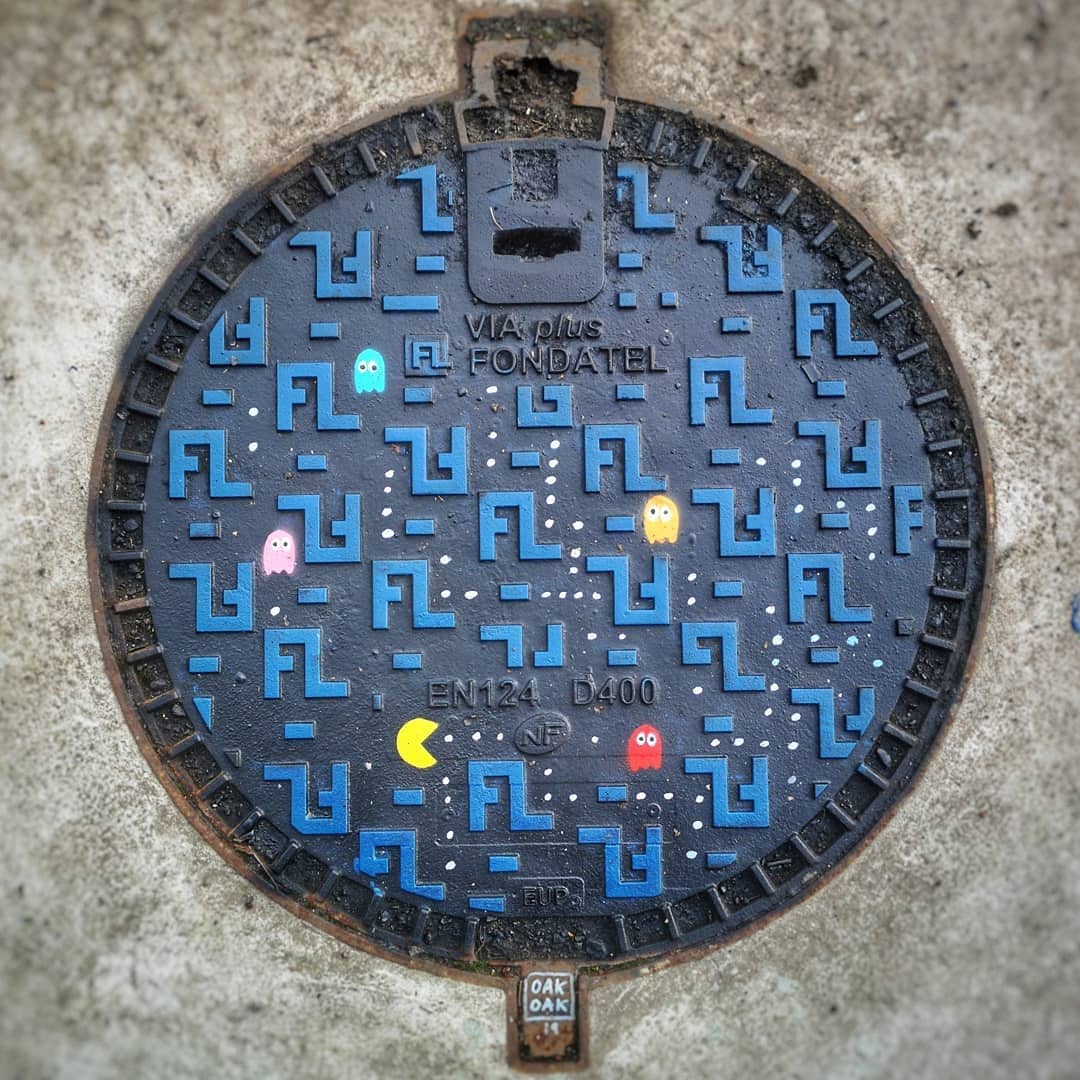
Sewer Cover Cleverly Transformed Into Pac-Man

by Lori Dorn

French street artist Oakoak (previously) very cleverly transformed a simple sewer cover in the town of Liévin, France into a level from Pac-Man. Other urban transformations by this artist incorporate his imaginative view of the roads, sidewalks, and signs in and around whatever town he is in.

His approach consists of diverting urban elements, playing with mundane flaws, like a crack on a wall. He adds his own vision, his own references that often stem from the geek culture. His art is a means to poeticize the urban environment.

Related Laughing Squid Posts

Follow Laughing Squid on Facebook, Twitter, Flipboard and Subscribe by Email.

The post Sewer Cover Cleverly Transformed Into Pac-Man first appeared on Laughing Squid.

13 Sep 23:12

Neil deGrasse Tyson Patiently, Joyously Explains to Paparazzi What Would Happen if You Smoked Weed in Space

by Jason Koebler

Consider all the decisions—conscious and unconscious—made by hundreds of millions of organisms and the chaotic entropy of trillions and trillions of atoms across space and time that led to this moment, in which a TMZ paparazzo asks theoretical physicist Neil deGrasse Tyson what would happen if one were to smonk a marijuana in space.

The Big Bang, stars and galaxies form, explode. Earth forms and is pelted by space detritus. The formation of carbon and The Great Oxygen event. The Cambrian explosion 500 million years ago, five great extinction events. The rise and fall of dinosaurs. The rise and fall of various hominid species. Early tool use. Agriculture. What is weed, anyway? New Amsterdam. The Revolutionary War. Celebrity culture. A young South African man emigrates to the United States with nothing but a dream to put plants on Mars, but gets sidetracked with conspiracy theories about hero divers. Twitter. Carl Sagan. Craigslist's domination of online classifieds leading to the downfall of traditional print media. Harvey Levin. The attention economy. The intellectual dark web. What beautiful chaos. What beautiful cosmos.

21 Aug 13:32

The 7 TV shows that have a 100% critic score on Rotten Tomatoes in 2018

by Travis Clark

cobra kai 2 youtube

Television continues to deliver one great show after another this year, but only a select few have come out on top with critics.

Seven shows this year — either returning with new seasons or brand new — have garnered the coveted 100% critic score on the review aggregator Rotten Tomatoes. And there are a few surprises.

Some excellent series failed to make the cut, like AMC's "Better Call Saul" season four and Netflix's "Glow" season two, both with 98%, and HBO's "Sharp Objects" with 93%.

Among the ones that did manage the perfect 100% range are a crime anthology and a long-running sci-fi, and three are available to stream on Netflix.

Below are seven TV shows with a 100% Rotten Tomatoes critic score in 2018:

SEE ALSO: The 6 movies that have a 100% critic score on Rotten Tomatoes in 2018

"The Bold Type" — season two

How to watch: Available at the Freeform website with an account and on Hulu

Description: "The Bold Type gives us a glimpse into the outrageous lives of the young women working at the nation's top women's magazine, 'Scarlet.' Jane, Kat, and Sutton are three best friends working at the magazine's headquarters in New York while also trying to navigate their careers, identities, and individual voices in a sea of intimidating leaders. This next generation of unapologetically fierce working women is primed to take on the world and smash the patriarchy — one selfie at a time."

What the critics said: "The Bold Type dramatizes the lives of its three leads without turning any of the women into caricatures. The newsroom and New York they inhabit aren't the world's most accurate depictions of life in digital media, but they're also far from fanciful. The show is still finding its footing, and so none of its main characters have become personality avatars, the way Sex and the City's Carrie, Samantha, Miranda, and Charlotte each came to stand for a particular kind of New York City woman. But the first episodes of Season 2 are promising." — Hannah Giorgis, The Atlantic


"Cobra Kai" — season one

How to watch: Available on YouTube Red

Description: "Thirty years after the events of the 1984 All Valley Karate Tournament, a down-and-out Johnny Lawrence (William Zabka) seeks redemption by reopening the infamous Cobra Kai karate dojo, reigniting his rivalry with a now successful Daniel LaRusso (Ralph Macchio), who has been struggling to maintain balance in his life without the guidance of his mentor, Mr. Miyagi."

What the critics said: "'Cobra Kai' is extremely entertaining, but even more so if you loved 'The Karate Kid' (and its sequels) growing up. Zabka and Macchio are all in with the reprisal of their iconic roles and that's really the hook. Some of the stuff will certainly go over your head if you weren't into the movie, but YouTube is hoping that the popularity of the movie over decades has enough passionate fans to launch this series (and YouTube) into the streaming zeitgeist." — Jason Guerrasio, Business Insider


"Dear White People" — season two

How to watch: Available on Netflix

Description: "Students of color navigate the daily slights and slippery politics of life at an Ivy League college."

What the critics said: "Weighing personal satisfaction with national priorities isn't easy, but 'Dear White People' blends them in such a way to illustrate how they're linked. Each part is powerful because each part is honest, even when what it builds toward is an uncertain future." — Ben Travers, Indiewire


See the rest of the story at Business Insider
06 Jun 11:45

Photos show how Microsoft took a big step forward in its crazy plan to power the internet from the sea (MSFT)

by Shona Ghosh

Microsoft Project Natick Scotland

Microsoft has put a data centre in the sea in an experimental effort to see if it can provide internet services faster to coastal cities using renewable energy.

As part of its bigger Project Natick "moonshot," Microsoft has put the data centre on the seafloor close to Scotland's Orkney Islands. 

The data centre is submerged 117 feet under the sea and is powered by a submarine cable running from Orkney. Microsoft picked the islands because it wants its data centres to run on renewable power, and Orkney is a major hub for renewable energy.

Scroll on to see to see photos of how the project unfolded.

SEE ALSO: This is Microsoft's plan to power the internet from under the sea

A Microsoft employee first came up with the idea of an underwater data centre in a whitepaper, and the company's artificial intelligence and research division took on the project in 2014. Data centres are the internet's backbone, storing huge amounts of information.


The wider goal with Project Natick is to deploy data centres at scale anywhere in the world within 90 days.

Most data centres can take anywhere from one to two years to deploy — but as more of the world comes online, it would be handy to speed this process up.


The company initially built a proof-of-concept vessel last year in the calm waters of California, which operated for 105 days. It was called Leona Philpot, after the character in Microsoft Xbox game "Halo."


See the rest of the story at Business Insider
04 May 17:52

DIGITAL HEALTH BRIEFING: Cerner earnings marred by VA delay — Suki launches medical voice assistant — Providers eye health tech incubators

by Laurie Beaver

Welcome to Digital Health Briefing, the newsletter providing the latest news, data, and insight on how digital technology is disrupting the healthcare ecosystem, produced by Business Insider Intelligence.

Sign up and receive Digital Health Briefing free to your inbox.

Have feedback? We'd like to hear from you. Write me at: lbeaver@businessinsider.com


CERNER REVENUE GROWTH MARRED BY VA DELAY: Electronic health records (EHR) giant Cerner reported muted revenue growth of 3% year-over-year (YoY) in Q1 2018. The company pulled in $1.3 billion for the quarter, compared with $1.26 billion in Q1 2017. The lower-than-expected growth was largely the effect of the delayed $10 billion deal with the US Department of Veterans Affairs (VA), Cerner President Zane Burke noted during the conference call Wednesday.

Meanwhile, bookings during Q1, which were up 12% YoY, marked a bright spot for the company, signaling strong growth potential for the healthcare IT market.

  • Demand for EHR solutions remains strong. Business Insider Intelligence forecasts that more than 80% of all doctors will work at a facility that uses an EHR system by 2019. By 2025, nearly all facilities in the US will use EHR, with only a small fraction of private offices still relying on physical records. And nearly 50% of the US provider market intends to switch EHR vendors within the next three years, according to Sage Growth Partners.
  • Spending will only increase as infrastructure improvements become necessary to cope with health systems' growing need for healthcare insights. As providers begin requiring increasingly complex IT-enabled services, such as big data analysis and automation — to support areas like precision health and population health — they'll need to overhaul their existing infrastructure. 

As competition in the EHR market heats up, vendors are pushing additional services to woo potential customers, driving partnerships between tech and healthcare. To differentiate from the competition and enhance value to providers, the big EHR players are partnering with a range of tech companies. For instance, Cerner partnered with Salesforce to offer cloud solutions for population health. And Epic integrated its EHR offering with AI-company Nuance’s virtual assistant.  

SUKI LAUNCHES HEALTH-FOCUSED VOICE ASSISTANT: Suki, an AI-powered voice assistant company, announced on Monday a $20 million funding round to launch its eponymous virtual assistant for doctors. The service aims to automate manual tasks such as recording medial notes and retrieving patient files, which can attribute to physician burnout. Suki currently has 12 active pilots across a range of medical areas and three separate EHR systems.

AI-based voice assistants are being increasingly used within the healthcare system, with more providers trialing the technology as a potential tool. Major hospitals and healthcare services in the US are using voice assistants to connect with patients and help physicians. For example, BIDMC is using Amazon's Alexa to enable inpatients to perform routine tasks, such as calling a nurse or ordering a meal. And EHR vendor eClinicalWorks launched Eva, an assistant that allows physicians to pull patient data and order prescriptions. Providers are clearly interested in leveraging the technology — 23% of US physicians are already using voice assistants in a professional capacity, according to a survey from Decision Resources

HEALTHCARE PROVIDERS SEE DIGITAL HEALTH INCUBATORS AS WORTHY INVESTMENT: Provider interest in digital health initiatives appears to be gaining traction, with two announcements this week focused on fostering and developing digital technology for healthcare:

  • The American Medical Association (AMA) strengthened its commitment to driving provider adoption and usage of digital health solutions — the organization committed $27 million to its partner incubator Health2047, according to MobiHealthNews. With the AMA’s funding, the incubator also gains access to the organization’s more than 230,000 physician and medical student members. This announcement is just the latest sign of the AMA’s enthusiasm for digital health following the group’s intentions to expand digital health as one of its top advocacy priorities of 2018.
  • Boston-based Beth Israel Deaconess Medical Center launched the Health Technology Exploration Center (HTEC), an incubator aimed at developing scalable digital health technologies. The initiative will focus on the development of blockchain, IoT, artificial intelligence, telemedicine, and machine learning technologies within the healthcare market.

The announcements are further indications that providers now consider fostering new digital health technologies crucial to the future of healthcare. Further, these partnerships and innovation hubs also mean that providers will have a greater hand in focusing the development of health tech in areas of need. With their existing patient data and physician expertise, hospital-led initiatives may be uniquely positioned to direct digital health improvements that streamline delivery of care.

NEW EMERGENCY-RESPONSE WEARABLE TARGETS ELDERLY POPULATION: San Francisco-based tech company iBeat announced $5.5 million in funding to support the launch of its HeartWatch — a personal emergency response system (PERS) smartwatch that monitors heart rates, blood flow, and oxygen levels, and alerts emergency care services when irregularities occur, MobiHealthNews reports. iBeat’s watch demonstrates the increased integration of PERS functionality into wearable devices. PERS devices, also known as medical alarms, are the most niche area of the telehealth industry and cater almost exclusively to elderly patients. And while the aging population means that demand for this technology will grow — the US has 42 million seniors, two-thirds of which are at risk of heart disease, the US Census Bureau estimates — the increasing capabilities of wearables, such as fitness trackers or smartwatches, means that the need for cumbersome, single-use devices such as medical alarms will fade. Further, by catering its product to this particular subset of the population, iBeat likely hopes to carve out a niche of the broader wearables market against the likes of Apple and Fitbit, which are increasingly taking on the healthcare market.bii us telehealth lumascape

IN OTHER NEWS:

  • A new study found that a computer algorithm was as accurate as doctors in assessing risk of breast cancer, eHealthNews reports. Researchers hope the system can alleviate the subjectivity and inconsistency across radiologists’ evaluations.
  • The Mayo Clinic is poised to roll out the first stage of the $1.5 billion EHR overhaul at its Minnesota headquarters on May 5, Healthcare IT News reports. The firm will use Epic’s EHR system to replace systems from Cerner and GE.

Business Insider Intelligence research associate Nicky Lineaweaver contributed to the briefing.

Join the conversation about this story »

09 Feb 14:29

Pinterest says there are 600M+ monthly visual searches across its products, up 140% YoY; ability to add Lens images to any text search coming to iOS next week (Khari Johnson/VentureBeat)

Khari Johnson / VentureBeat:
Pinterest says there are 600M+ monthly visual searches across its products, up 140% YoY; ability to add Lens images to any text search coming to iOS next week  —  Pinterest shared insights into its Lens visual search tool today, one year after the social media platform launched the tool in beta for its Android and iOS apps.

13 Nov 14:40

Researchers Employ Deep Mind Artificial Intelligence to Tackle the Difficult Task of Lip Reading

by Lori Dorn

A group of Deep Learn researchers at the University of Oxford have discovered a way to employ the artificial intelligence of Deep Mind neural technology to tackle the very difficult task of reading lips. Entitled LipNet, the technology continually learns in order to recognize new patterns of speech.

LipNet is doing lipreading using Machine Learning, aiming to help those who are hard of hearing and can revolutionise speech recognition. …LipNet is a neural network architecture for lipreading that maps variable-length sequences of video frames to text sequences, and is trained end-to-end …LipNet is the first lipreading model to operate at sentence-level, using a single end-to-end speaker-independent deep model to simultaneously learn spatiotemporal visual features and a sequence model. On the GRID corpus, LipNet achieves 93.4% accuracy, outperforming experienced human lipreaders and the previous 79.6% state-of-the-art accuracy.

via Prosthetic Knowledge

Related Laughing Squid Posts

10 May 21:39

Introducing PodRide, A Weatherproof Custom Quadcycle

by David Lumb

A Swedish engineer built his own bike-like vehicle to keep commuting to work through winter. Now he's selling schematics to other tinkerers.

Love biking but hate riding in subzero temperatures? Swedish mechanical engineer Mikael Kjellman built a bicycle-like custom four-wheel electric vehicle he calls the PodRide to keep him pedaling through the harsh Scandinavian winter, which can get down to -30 degrees Celsius. Now he's crowdfunding to make a step-by-step guide so anyone can build their own winter-friendly quadcycle.

Read Full Story

22 Mar 20:05

Andy Grove, tech legend and former Intel CEO, passes away

by Mariella Moon
Intel's former CEO and Chairman Andrew S. Grove has passed away today, March 21st. He was 79 years old. The company owes much of its success to Grove, who was the company founders' first hire. Back in the day, Intel used to manufacture memory chips (...
21 Feb 15:00

Remind Launches New Slack-Like App For Schools

by Jessica Hullinger

The new tool aims to replace antiquated robocalls and phone trees with something better.

When a bomb threat prompted officials to shut down all 900 schools in the L.A. Unified School District last December, chaos ensued. Confused parents got the news via robocall around 8 a.m. and scrambled to pick up their kids and find last-minute child care. Others didn't get the call at all. Communication between the district, principals, and teachers collapsed. The threat exposed the existing emergency system's weaknesses, but amid the mayhem, many educators turned to Remind, the four-year-old messaging tool for students and teachers.

Read Full Story


21 Feb 14:59

BuzzFeed's Global Domination Plan: The Techniker Has Been Informed

by Noah Robischon

BuzzFeed is expanding across the globe—and tackling one of advertising's greatest challenges.

"Don't let anybody ever talk to you about global advertising," says Greg Coleman, BuzzFeed's president and the person responsible for its advertising business. "Because it's there, but it's very limited." Global advertising, for a media brand, is a tough nut to crack: It requires massive global reach and the ability to attract the limited number of brands that want to advertise their wares all across the world. BuzzFeed is attempting to defy the odds by becoming a global cross-platform advertising powerhouse—and Coleman certainly has the background to pull it off.

Read Full Story


28 Jan 22:47

Apple Acquires Education Startup LearnSprout

by Connie Loizos
apple-learnsprout Apple has acquired education-technology startup LearnSprout, Bloomberg reported a bit ago and we have just confirmed. Terms of the deal were not disclosed. LearnSprout is a three-year-old, San Francisco-based software startup whose online data insights help K-12 educators track students’ performances. The company had raised $4.7 million from investors across two rounds, including… Read More
20 Jan 00:09

Physics Girl Combines Magnetic Ferrofluid & Glow Sticks for Some Strange, Beautiful Science

by Glen Tickle

Physics Girl host Dianna Cowern combines magnetic ferrofluid and glow sticks for some strange, beautiful science in a recent episode of her PBS Digital Studios series. While Cowern demonstrates the unique properties of her glowing fluid, she explains the science behind ferrofluid and what makes it so unique.

04 Jan 19:21

Tina Fey Plays a War Correspondent on Her First Trip Covering Afghanistan & Pakistan in Whiskey Tango Foxtrot

by Glen Tickle

Tina Fey stars as real life war correspondent Kim Barker on her first assignment covering Afghanistan and Pakistan in Whiskey Tango Foxtrot. The film shows Fey as Barker along with costars Margot Robbie, Martin Freeman, and Billy Bob Thornton.

Whiskey Tango Foxtrot is based on Barker’s book The Taliban Shuffle: Strange Days in Afghanistan and Pakistan and will be released in theaters on March 4, 2016.

Whiskey Tango Foxtrot Poster

image via Whiskey Tango Foxtrot

02 Sep 13:14

Google Unveils New Logo and Takes a Look Back at How They Have Evolved Over the Last 17 Years

by Scott Beale

Google Logo

Google takes a look at the evolution of the company over the last 17 years as they unveil their new logo.

Today we’re introducing a new logo and identity family that reflects this reality and shows you when the Google magic is working for you, even on the tiniest screens. As you’ll see, we’ve taken the Google logo and branding, which were originally built for a single desktop browser page, and updated them for a world of seamless computing across an endless number of devices and different kinds of inputs (such as tap, type and talk).

It doesn’t simply tell you that you’re using Google, but also shows you how Google is working for you. For example, new elements like a colorful Google mic help you identify and interact with Google whether you’re talking, tapping or typing. Meanwhile, we’re bidding adieu to the little blue “g” icon and replacing it with a four-color “G” that matches the logo.

Google Design talks about some of the design considerations that went into evolving the Google identity.

12 Aug 12:05

The Family: God’s Litmus Test of Applied Grace

by Tim Kimmel
Original

If you want to know the depth of one’s character, observe how they treat children and the elderly.

Folks on the extreme ends of life’s timeline usually have enormous needs and limited capabilities. These built-ins to their age bracket often place their daily success and ongoing dignity at the mercy of the people around them. Character is an outwardly focused nobility that is consistently offered — often at high personal cost — to people who can’t necessarily return the favor. It doesn’t really matter, therefore, what we say we are as a person.

When it comes to true character, the kindness, patience, and honor we show to children and the elderly tends to tell the more accurate story. And we could add to our character-test list widows and orphans (James 1:27), as well as the “least of these” type of people Jesus listed in Matthew 25:31-46.

God’s Grace As Your Family’s Default Mode

Which brings us to the subject at hand — God’s grace. It’s easy to give theoretical assent to the reality of God’s grace, but the ultimate litmus test as to whether or not we’ve truly allowed his grace to become our default mode is how we treat the people in our family. Home has a best-of-times-and-worst-of-times nature about it. As such, family can either be a watershed opportunity for us to move from walking in the flesh to living in the power of God’s Spirit, or it can be our Waterloo.

If grace doesn’t show up in the crucible of our demanding family dynamics, it doesn’t mean that the gospel is impotent, but it may mean that we’re kidding ourselves if we say we’ve truly embraced the transforming work of God’s grace deep down in our lives.

We can give lip-service to God’s grace all we want. But if our kids would prefer having their gums sanded over having to eat at the same table with us each day, and our spouse would rather wake up alone rather than next to us morning after morning, then most likely the grace we say we embrace is merely our lip-syncing to the real thing. I’ve just listed two worst-case scenarios to make everybody feel better, but the truth is there are all kinds of things we can do — short of making our family members wish we weren’t in the Christmas photo — that still speak to the minimal presence of God’s grace in our relationships.

Grace for Conversion and for Everyday

So how does this happen to well-intended Christ followers? For too many followers of Christ, the grace we embrace at the cross unwittingly gets confined to God’s work of redemption. We tend to limit God’s grace to his “saving” grace — the lost-found, blind-see experience that moves us from spiritual death to life. But then, for a lot of reasons (all lame), we proceed to stunt and blunt the work of God’s grace and move to a more performance arrangement with him. Kind of a “with all he’s done for me, I owe him so much, I’ve got to spend the rest of my life paying him back” type of nonsense. This mindset should have no place in the application of the gospel, but indeed often plops down on the Lazy-Boy positioned in the middle of our hearts and refuses to budge.

When this happens, it shouldn’t surprise us that the children we’re trying to impact with the gospel find our platitudes about God’s grace a hard sell for their hearts, and the spiritual performance we proceed to put them on to be a complete turn off as well. The generation being raised right now en masse operates under the presupposition, “If it works, then it’s true.” If our children don’t see God’s grace changing the way we deal with them — especially when they’re pushing all of our buttons — it’s hard for them to assume there’s much more to it than the cool song we all know the words to.

Confronting Fear-Based Parenting

If it’s not performance-based Christianity that blocks God’s grace from owning our hearts, then it’s one or a combination of other usual suspects. Probably the most prevalent is what I like to call “fear-based parenting.” We feel out-gunned, overwhelmed, and in over our heads when it comes to raising kids in the midst of such a contrary society. Fear should incline us to simply put our trust in God and not agonize about any of this, but when it’s our kids on the line, it tends to do just the opposite. Next thing you know, our fears have driven us to create man-made systems that have all the evangelical trappings of legitimacy, but are actually just accommodations to our fears that factor out the mighty power and presence of God sustaining us in the middle of it all. We’re talking things like: cloistering, sin management, spiritual image control, and evangelical behavioral modification. We substitute knowledge about God for the actual work of God in our kid’s lives. We shouldn’t be surprised, then, that they aren’t inclined towards a passionate relationship with Jesus.

It is the transforming work of God’s grace showing up as love, mercy, kindness, understanding, forgiveness, hope, freedom, and calm — when our kids are trafficking in their worst behavior — that indicates whether Jesus is driving our personal bus or merely just a passenger.

Joining God in the Miracle of Parenting

The grace in which God saved us is the very same grace he meant to wash over us, seep through us, and ultimately redefine us. That’s why the best advertisement for the gospel is a mother or father who are not only guided by God’s truth, but consistently tempered by his grace. That’s how God deals with us (John 1:14). Why not follow his example? In fact, that’s the bottom line of grace-based parenting — it’s simply treating your kids the way God treats you.

Parenting is our chance to take God’s hand and join him in a miracle. The transforming impact of God’s grace happens best in our children when it’s happened deeply in us first.

30 Jul 17:59

S, M, L, XL: Why Responsive Website Design is the Best Strategy for Different Size Screens

by Kivi Leroux Miller

In this post, one of our favorite graphic designers, Julia Reich, toots the horn for responsive design, explaining why she decided on responsive design for the new Stone Soup Creative website; why she and her team will endeavor to build it into sites they’ll be designing for their clients from here on in; and why she recommends you consider it for your site too.

Guest Post by Julia Reich of Stone Soup Creative

As you know from reading Kris’s post on the subject, responsive design is an approach to website design in which the site is engineered so the design and functionality is tailored to the capability of the visitor’s device – most importantly, screen size. So no matter what computerized gadget you use, the page fills the space on your screen and your website visit ends happily ever after.

Users interact with small devices in a fundamentally different way than with a laptop or desktop – the main control device changes from a mouse with corresponding arrow or hand icon to a fingertip. A finger is larger and obviously not nearly as accurate as a mouse, and it can’t trigger the same “hover over” action that partially defines the online desktop user experience. Instead, it’s a direct touch-screen interface, usually designed with large, fingertip-friendly buttons.

When I created the new Stone Soup Creative website, I knew from studying Google Analytics that a significant segment of my site’s traffic was originating from handheld devices. I wanted to meet the growing expectations of these mobile users, so that visitors with any device, and any screen size would be successful – not exasperated – when viewing the site.

Definitions

Since the distinctions can be subtle and confusing, here’s a glossary of strategies for viewing websites on different screen sizes

Mobile-friendly

A mobile-friendly website is an HTML-based website that is viewable on a smartphone. These sites never contain Flash, since Flash can’t be seen on mobile devices. Although they should be easy to use, the truth is they aren’t always.

Tim Halbach is Stone Soup Creative’s Technical Director. He points out that “if a site starts so that you have to scroll horizontally, or you have to zoom out to see it, then I wouldn’t consider it to be mobile-friendly at all.”

Mobile-optimized

A mobile-optimized website is separate from a “regular” site you’d view on a “regular” desktop computer. No scrolling or pinching or zooming is necessary, as the navigation has been structured specifically for smaller handheld displays with touch-screen interfaces. Pro: Images load quickly, and content is kept to a minimum. Con: Don’t mobile users want access to all of the information and functionality available to desktop users?

Halbach agrees: “The key problem is that ‘separate site’ is usually synonymous with ‘incomplete functionality’ – which is why I always find myself clicking on the ‘Go to Full Site’ link. Not a good user experience.”

Responsive design

This is a site that is engineered to re-format itself according to the screen size of a visitor’s device. This is the strategy I’m discussing here since, as an emerging technology, it holds the most promise for successful usability.

App

Apps don’t technically belong in this category, as they are applications that are downloaded and installed on your mobile device, rather than being called up from within a browser. A separate app needs to be developed for each iPhone, Droid, etc. device. An app usually has a very specific purpose – such as an interactive game. Think of it more as a small computer program than a website. Users commonly download apps via Apple’s ITunes and Android’s Play Store.

Keep in mind that strategies for viewing websites on different screen sizes can fall along a spectrum. For example, “mobile-optimized sites are not always separate sites, as they can be done as ‘partially-responsive’ design… meaning, rather than lots of design breakpoints for different browser sizes, it just has two – standard and mobile. That’s actually considered a best practice in today’s design world, if you’re not going full-blown responsive,” notes Halbach.

Examples of Organizations with Responsive Design Websites

Team PAWS Chicago

An attractive, easy-to-read, type-only design.


Archimedes: Ann Arbor Research Center for Medical Device Security

A fluid grid system ensures navigation and columns stack neatly as the screen gets progressively more narrow.

Jewish Social Justice Roundtable

The team at devcollaborative created this site in Drupal by customizing a theme that had a pre-built responsive grid. Using a ready-made responsive grid means that there are some design limitations, but that the decisions about how the content “responds” on narrower screen widths are already made. This lowers the cost of a responsive web design considerably.

Planning for the Responsive Design Website

Compared with a “regular” website, a responsive design site is oftentimes more costly to create.

Because responsive design allows you to build and maintain one site that adapts automatically for all browser sizes and displays, it requires the site’s design and development team to think about the breakpoints – the point at which your site’s content will respond to provide the user with the best possible layout to consume the information.

“This often requires more planning around information architecture,” says Erin Fogel of devcollaborative.com, a web development team that builds Drupal websites for nonprofits (including the Jewish Social Justice Roundtable example mentioned above).

Keep in mind that it also takes more time to build responsive design into an existing site than it does to integrate it into a new site as part of the original site structure. Fortunately there are many popular themes available for Drupal and especially WordPress platforms (which was my choice for Stone Soup Creative) – themes which are already styled and ready to be implemented out of the box.

Fogel’s advice for NPOs embarking on a site re-design that’s responsive? “Simplicity! Clean-looking, organized sites are not only trends in design, but will also make the build easier and more affordable.”

Julia Reich

Julia Reich

Resources

For readers interested in learning more about responsive design:

Julia Reich is the Principal at Stone Soup Creative. You can reach her:

Twitter: @juliareich
Facebook:www.facebook.com/StoneSoupCreative
LinkedIn: /www.linkedin.com/in/stonesoupcreative

For over 12 years, Julia has been helping nonprofit clients bring to life innovative branding, design & marketing projects at Stone Soup Creative (formerly Julia Reich Design). She blogs on her own site and guest blogs for NTEN, Nonprofit Marketing Guide, and Marketing Mentor.

Love the daily blogging? Great! If not so much, switch to Kivi’s weekly email newsletter with blog highlights and then unsubscribe from the blog’s emails.


17 Jul 02:59

Prone to Wander…from the Pickle Jar?

by Jonathan Adams

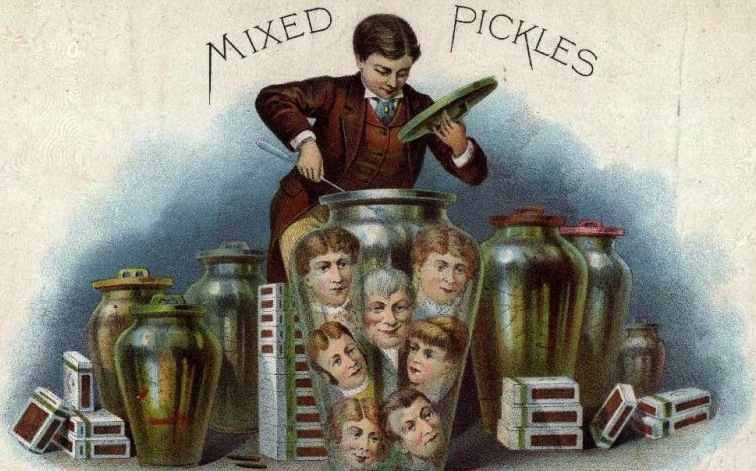
Mixed Pickles   VF 6    Vintage Cigar Box Advertising Label    #6445

A few Sundays ago, I preached a sermon on Galatians 1:11-24, and we had a rough landing. It was one of those Sundays where I felt the plane take off perfectly, maintaining altitude for most of the sermon, but somewhere along the descent we hit turbulence.

As I drove home that day I asked myself, “What made the last part of my sermon so rough?” Why did I struggle so much with the last five minutes? Well, I realized I was trying to deliver a truth that I wasn’t actually believing myself. During the final point of my sermon–“Who is the gospel for?”–I proclaimed it was for the sick, not the well, for undeserving, not deserving, sinners. Yet, in that very moment, I was hearing another voice, deep inside, proclaiming a different truth. Within this truth there lay a distinction between a sinner and a failure. I began to believe that the gospel was for sinners, but not for real sinners like me. In other words, I began to believe that, though the Gospel was for sinners, it is not for failures. It’s not that I don’t desperately want to believe the Gospel is for me; it’s just that I equally desperately begin searching for reasons as to why I’ve merited it.  Then begins the game of spiritual comparisons.

heinz picklesWe are prone to wonder (wander?) that Jesus-plus-something is the truer equation. My accuser tells me God only loves the eager rule-obeying, unwavering lions of faith, those foreign to detours. I begin to believe the Gospel is for the spiritual elite, not the sin-pickled heart I know so well. The good news comes for those who have learned from, or exceeded, the hindrances of sins; it is not for those engrossed in an illness.

But that directly opposes the message I was reading from Galatians. Paul was preaching against elitism, this Jesus-plus-something gospel that only leads to the weight of comparison. Paul calls it a false gospel–the mandate that we “examine our spiritual fruit” keeping us watchful of a bad harvest. It is terrifying. Where’s there good news in a life of terror? Everyone lives in terror…

Thank goodness that the Gospel that I often believe to be true is, in fact, false; and the Gospel that almost always appears ridiculously silly, is the true Gospel of Jesus. In Jesus I am declared innocent and righteous before God, not because of my wonderful, intentional, fruit-bearing crop of righteous living, but solely based on God’s work. He exchanged his perfect record for my hermetically-sealed, sin-pickled one. When God looks at me, or anybody, strange as it is, God sees a beloved child in whom he is well pleased.

Make no mistake, Paul’s message of Jesus-plus-nothing is a message from God himself. The grace that saves you is the grace that is keeping you, and there is nothing you can do or add to make God love you any more than He already does. Our only job is to repent and trust that the blood of Jesus covers everything…even our wandering hearts, which wander from this good news everyday.

O to grace how great a debtor
Daily I’m constrained to be!
Let Thy goodness, like a fetter,
Bind my wandering heart to Thee.
Prone to wander, Lord, I feel it,
Prone to leave the God I love;
Here’s my heart, O take and seal it,
Seal it for Thy courts above.

12 Jul 16:26

Report: Accelerating Entrepreneurship in Africa

by HASH

A couple months back Omidyar Network released a report (with an exhaustively long title, like all reports tend to have), “Accelerating Entrepreneurship in Africa: Understanding Africa’s Challenges to Creating Opportunity-driven Entrepreneurship.“. If you’re interested in this space at all, in even a minor way, it’s well worth a read.

Get the full 2.5Mb download of the report here: (ON Africa Report).

The gaps they see are familiar to many. We all know that part of the problem is the education system isn’t setup for problem solving, it’s about rote learning.

“Students are not afforded clear paths for cultivating competencies related to practical thinking and creative problem-solving—skills needed to successfully build and manage a business.”

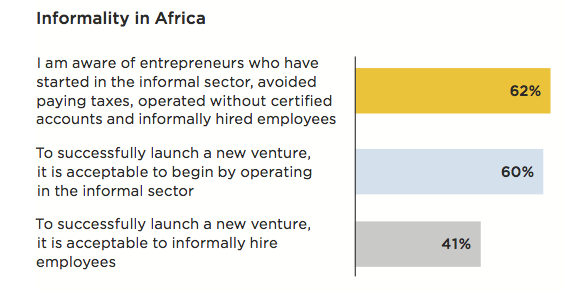
African entrepreneurs aren’t helped by government policies and regulations, in fact they’re better served by doing it informally first, as seen in the responses on this to the question:

African entrepreneurs prefer starting off informally

African entrepreneurs prefer starting off informally

Another great quote about the cultural pressure not to do a startup:

“Parents and guardians pressure their wards into studying more professional courses rather than entrepreneurial or creative ones, sometimes even tagging them as ‘crazy’ when students make the decision to work in start-up companies or develop their own businesses.”

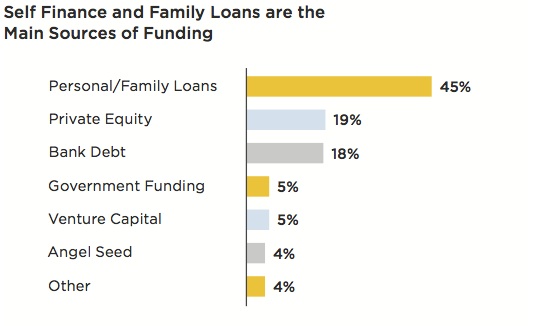
There’s also a gap in where companies find seed funding:
Africa-entrepreneurs-funding

The survey focused on four areas of the entrepreneurial environment:

  • Entrepreneurship assets: Financing, skills and talent, and infrastructure
  • Business support: Government programs and incubation.
  • Policy accelerators: Legislation and administrative burdens.
  • Motivations and mindset: Legitimacy, attitudes, and culture.

There are a lot of recommendations for each of these four areas that the report covers, enough for anyone running a tech hub, incubator, university and especially the government to think through.

04 Jul 02:01

21 Stupid Things You Can Stop Doing [Infographic and Recording]

by Kivi Leroux Miller

We had so much fun last week on our free webinar sharing stupid marketing tactics that we’ve decided to share that fun with everyone!

You can now watch 21 Stupid Things Nonprofit Marketers Can Stop Doing whenever you want.

During this 60-minute webinar, we talked about 21 stupid marketing tactics and strategies you are totally wasting your time on, as well as those you are needlessly holding on to. We also told you what to do instead that will help you save time, money and your sanity!

If you are already part of our Free Membership Program, you’ll find the recordings on your Free Membership Dashboard. Or you can get just this webinar recording without becoming a member.

We have also created this infographic so you can refer to it whenever you feel you might be heading to Stupid Town (or if you just need a good conversation starter in the office!):

StupidThingsNonprofitMarketersCanStop

Tomorrow, we’ll share the full poll results from the webinar to let you know which of these things nonprofits admit to doing the most. You can see if you are in good (or should that be bad?) company. We’ll also a share a more printable version of the list.

Remember, you can join the “stupid conversation” with us on Twitter with #npcommstupid.

Love the daily blogging? Great! If not so much, switch to Kivi’s weekly email newsletter with blog highlights and then unsubscribe from the blog’s emails.