 This fantastic salad can be served as a main course for dinner, with its sweet and savory flavors that are oh so satisfying.
V.w.verweij
Shared posts
20 Jun 11:12
This fantastic salad can be served as a main course for dinner, with its sweet and savory flavors that are oh so satisfying.
Pear and spinach salad with caramelized onions and blue cheese [Vegetarian]
by Kelly Rossiter, Jaymi Heimbuch
This fantastic salad can be served as a main course for dinner, with its sweet and savory flavors that are oh so satisfying.
Leahgates likes this
20 Jun 02:39
 Have you ever seen a cocoon quite like this?! Looking more like a net, or open-weave basket, this cocoon has an interesting reason for its surprising structure.
Nature Blows My Mind! 3D printing found in nature with this strange cocoon
by Jaymi Heimbuch
Have you ever seen a cocoon quite like this?! Looking more like a net, or open-weave basket, this cocoon has an interesting reason for its surprising structure.
20 Jun 02:36
 This hotel for insects was created to promote urban biodiversity.
Paris designers create "Insectopia" bug houses
by Margaret Badore
This hotel for insects was created to promote urban biodiversity.
19 Jun 11:43
Your Afternoon Animal Fix
by Prince Of Petworth
If you have any animal/pet photos you’d like to share please shoot me an email to princeofpetworth(at)gmail(dot)com with ‘Animal Fix’ in the title and say the name of your pet and your neighborhood. Your photos will go into the queue (usually 3-4 weeks wait) and will be posted in the order I receive them. If you’ve already entered your pet and would like to do so again – that’s no problem – just space the entries out a bit.

“Poppy and Grendel taking a nap in Shaw.”

“Clooney of 16th Street Heights, rescued from the streets of Adams Morgan as a starving kitten two summers ago.”

“Hayley from Kingman Park trying to be invisible after stealing a sandwich.”
19 Jun 11:43
Here's a video of a guy chewing on a tree on U Street
by Andrew W
V.w.verweijDon't do this
Well, there's something you don't see every day:
According to DCist, the video's uploader explained the situation thusly: the guy was visibly intoxicated, and "He approached the tree and proceeded to slap the it semi-sexually, like he was spanking it. Then he really got in there and chewed the bark off the tree for about five minutes. He didn't actually eat it, just chewed. Cops showed up, but they seemed just as confused as the rest of us. I think they told him to be on his way and that was that."
The plant-chewing occurred near the U Street Music Hall.
According to DCist, the video's uploader explained the situation thusly: the guy was visibly intoxicated, and "He approached the tree and proceeded to slap the it semi-sexually, like he was spanking it. Then he really got in there and chewed the bark off the tree for about five minutes. He didn't actually eat it, just chewed. Cops showed up, but they seemed just as confused as the rest of us. I think they told him to be on his way and that was that."
The plant-chewing occurred near the U Street Music Hall.
Commenters on DCist speculate that the drunk person might have thought he was being funny for passersby. That seems logical. Or maybe he just needed more fiber in his diet.
17 Jun 19:35
New Brunch Menu from Cause Philanthropub Features “Adult Cereals”
by Prince Of Petworth
V.w.verweijADULT CEREALS

1926 9th Street, NW
From Cause’s website:
We offer a special Brunch menu every Sunday, served from 12-4pm. It highlights a number of brunch specialities, bottomless mimosas and bloody marys, as well as the unique to Cause Adult Cereals. Bring family and friends and have a great time.
You can see the full brunch menu here.
17 Jun 16:04


Other Proposed Designs for the Lincoln Memorial
by Ghosts of DC
These are amazing. This is a series of images depicting alternate versions of the proposed Lincoln Memorial. These we all designed in 1912.
We dug these up at the National Archives.
Henry Bacon’s Competition Proposal for a Monument to Abraham Lincoln, 1912
John Russell Pope’s Competition Proposal for a Monument to Abraham Lincoln , 1912

John Russell Pope’s Competition Proposal for a Ziggurat Style Monument to Abraham Lincoln, 1912

John Russell Pope’s Competition Proposal for a Mayan Temple Style Monument to Abraham Lincoln, 1912

John Russell Pope’s Competition Proposal for a Circular Colonnade Style Monument to Abraham Lincoln, 1912

John Russell Pope’s Competition Proposal for a Circular Ziggurat Style Monument to Abraham Lincoln, 1912

John Russell Pope’s Competition Proposal for a Pyramid with Porticoes Style Monument to Abraham Lincoln, 1912
Check out the rest of them here.
The post Other Proposed Designs for the Lincoln Memorial appeared first on Ghosts of DC.
Jakest likes this
17 Jun 16:04


Lincoln Memorial Under Construction
by Ghosts of DC
I took a trip down to the Lincoln Memorial this past weekend for the first time in quite a while. So, I thought it was appropriate to dig up an old photograph from the days when it was being built.

Lincoln Memorial under construction
The post Lincoln Memorial Under Construction appeared first on Ghosts of DC.
Jakest likes this
17 Jun 15:42

givemeajobplease: This was a man, dressed as a plant, making...
by areshoekiddingme
This was a man, dressed as a plant, making pigeon noises at people walking by. I said hello, asked if it was okay to take his picture, and then asked why he was dressed as a plant. He said, “I’m just working through some stuff. Thank you for asking. No ones asked yet.”
it’s good to ask, I think, and it’s okay not to answer
16 Jun 23:23


Ten Reasons Not To Write Your Master’s Dissertation on Sexual Violence in War
by Guest Authors

A guest post, following on from some previous reflections on gender and teaching and the politics of pedagogy, from Marsha Henry. Marsha is Lecturer in Gender, Development and Globalisation at the LSE Gender Institute, where she teaches, amongst other things, a course on gender and militarism. Her most recent research is into sexual exploitation in peacekeeping missions and peacekeeper labour hierarchies, and she is also, with Paul Higate, author of Insecure Spaces: Peacekeeping, Power and Performance in Haiti, Kosovo and Liberia (Zed, 2009). With Pablo, she recently co-edited a special issue of International Feminist Journal of Politics on ‘Rethinking Masculinity and Practices of Violence’. This post is based on a presentation given in San Francisco at the International Studies Association in April 2013.
It’s the first day of Lent term and the students are nervously gathered in a small stuffy classroom. When I walk in and head towards the front of the room, the group falls silent. I introduce myself and we start a round of introductions and I ask students to speak briefly about their interest in the course. The first student tells me, and the class, that she’s in IR (International Relations), and is keen to take the course because she’s interested in studying sexual violence in war. Another student turns to her, incredulous because she too is interested in that exact subject, and that furthermore she has worked for 3 months in the Democratic Republic of Congo (DRC) and has ‘seen a lot’. A few more students echo similar interests and I’m trying hard not to stereotype these students. But it’s difficult. A mythical figure is beginning to crystallise in my head and I can’t stop it. This figure is young, female and possibly middle-class, sometimes Scandinavian. She’s studying IR, Human Rights or Gender Studies. A few male students also indicate an interest. Some indicate interest in other topics, but there is a numbers problem from the outset. I feel uncomfortable as this is the third year that I’ve taught this course, each time allotting only one lecture week to the subject of sexual violence in war, and subsuming it under the larger heading of ‘gender, sexualised violence and work in militarised contexts’. Each year students have asked for more time to be devoted to the subject, for the lecture week to be moved up, and for their to be less focus on diversity in the armed forces. When students come to me during office hours to discuss the scope of their dissertations on the subject I fidget. After a few conversations with colleagues, I decide I need to start compiling a list – of compelling reasons why students should not write on the subject of sexual violence in war. But what would I do with this list? Can it be shared? And what of my responsibility not to teach on the subject?
10: Writing About ‘It’ Narrows The Political Focus
As a committed feminist, I’m all for drawing significant attention to the ways in which women experience conflict in distinctive ways. But the concentration of interest on sexual violence in wartime often leads to a neglect of the ways in which women experience violence (labelled as sexual or not) in peacetime. This noticeable singular focus on the topic also narrows the possibility of dislodging categories and subject positions. It is often assumed in class conversations, essays and subsequently dissertations that women are the victims and men are the perpetrators of this form of violence. This assumption appears in written work in a way that both masks the possibility of other positionings within the perpetrator-victim continuum, as well as the structurally embedded way in which sexualised violence occurs and is experienced by individuals and communities. This failure to explain the pervasiveness of sexualised violence against women tends to reinforce the binaries and provides a rather fixed aperture for analysing sexual violence in war and its consequences.
9: Researching The Topic Inspires Voyeurism
I’m squirming in my seat as one of the students smiles widely while she explains her interest in working on the topic of sexual violence as a weapon of war. She could be nervous explaining herself in front of her peers and her professor. She could be feeling awkward about the subject matter. She could be conforming to gendered expectations of women in the classroom where female students who express themselves confidently or through feminist rhetoric are categorised as aggressive. If feminist critique is pleasurable, how do we ‘do’ our analysis of sexual violence in wartime, paying attention to experience, trauma, and moral responsibility? There is a tendency, in making visible the ‘horror’ of it all, that students sensationalise the subject by focussing on the minutiae, the details and the thick descriptions. Honing in on the bodily experience of rape, for example, can remove rape in war from the wider social, cultural, economic and political context in which it always takes place. It can be an abstraction of the total experience. The affective impact is that readers of these dissertations distance themselves from subjects in the studies. Those who are victims and/or survivors and end up consciously or unconsciously performing what Donna Haraway referred to as a god-trick.
8: Writing About ‘It’ Invokes Colonial Stereotypes & A Colonial Gaze
Students who are developing gender goggles in regard to militarisation and the effects of war on women tend not to recognise their critiques as potentially reinforcing colonial tropes. Sexual violence in war cannot be easily dislodged from its articulation within colonial narratives. The subject of sexual violence in war is multiplex, precisely because attached to the many narratives and discourses are ideas and metaphors of Africa as a place of barbarity, exceptionalism, alterity: the ‘Heart of Darkness’ (as Margot Wallstrom recently commented in a speech aimed at drawing attention to sexual violence in war). Along with this, African men feature as pathologically violent and therefore prone to participate in sexual violence as a war weapon. The Black Man as Rapist Myth has a long history in colonial and popular accounts, and haunts these dissertations. Add to this, stereotypes of subaltern, ‘Third World’ and African women as the penultimate victims living in what some have deemed the ‘worst place to be a woman’ (DRC), connote many problematic ideas about Africannness, gender and geopolitics.

7: There Will Be An Insufficient Account Of History and Geopolitics
The majority of dissertations focus on the subject of sexual violence in the conflict region of the Democratic Republic of Congo. In seminars and supervision sessions in my office, I felt unease with the abbreviation of the full name for the country to Congo. When using the term Congo, students revert the country back to its colonial history and place it at the centre of discussions about sexual violence in war. Few students are interested in studying older conflicts and thus empirical studies of Rwanda, Bosnia, Sierra Leone, and Kosovo have more or less dropped off of the list of case studies that concern students. These conflicts become archived, shelved into the past in a way that suggests each new and contemporary conflict is somehow more worthy of study. It is almost as if students feel that if the study is not located in the ‘heart’ of Africa, it is a lesser form of violence to document. As such, ‘random’ acts of sexual violence (read: everyday), become too mundane to feature. In addition, larger relations of global politics across geographic contexts are left unaddressed. What is the relationship between where sexual violence is used as a weapon of war and the body of academic knowledge being produced in order to expose it? Students do not always think about the power relations between those who are able to speak about sexual violence, to name the victims and the perpetrators, likely at a distance, and those who witness, but who may not want to testify, speak to truth or even to be given what Pupavac has termed ‘therapeutic governance’.
6: Ethical Dilemmas are Rarely Challenged or Resolved by Writing
How can I object to outrage and criticism of rape? And sexual violence as a weapon of war? To criticise someone else’s criticism of gender-based violence would be itself an ethical challenge. As such, writing on the subject of sexual violence as a weapon of war can create an ethical vacuum and a political seal around the discussion, making it morally reprehensible to challenge the way in which arguments are strung together, information is arranged and presented, and the geo-ontological space from where the student speaks about (or for) women who have experienced sexual violence during conflict. As such these dissertations and essays provide little opportunity for discussing the politics of representation, the ethics of humanitarian intervention, the imbalance of power produced by international global governance institutions, and the dilemmas of treating rape survivors as a means to a (feminist) end. Many of the dissertations end up treating sexual violence as a weapon of war as a grand anecdote, used instrumentally to critically comment on the state of sexism and militarism in the world order – a laudable goal and necessary critique – but what about the simultaneous responsibility to acknowledge academic privilege? Moral compasses need to be checked: student and myself.
5: Where Are You From?: Positionalities, Standpoints, and Situated Knowledges
In addition to the ethical dilemmas that are not considered sufficiently, there is the question of perspective. Which type of student is able to write about sexual violence as a weapon of war? And worse, what about the students that may have (recently) experienced war (Swati Parshar recently spoke about the methodological and ethical dilemmas of teaching about gender and war at ISA San Diego). How can sexual violence as a weapon of war be articulated? What are the registers available? And from which geopolitical position can the subject be approached? At least two types of students emerge in relation to this growing interest in the topic. White, middle-class, (sometimes-Scandinavian) female students have told me over the past two years, that they want to write about the subject. I try not to think of the growing problem of students just a few years back who developed a mass obsession with writing about the veil, but I’m experiencing intertextual anxt. The other student ‘figure’ emerging is the young, feminist-sensitive white, middle-class male – who is likely to be from Europe or the US. He is interested in meticulously mapping the issue, demonstrating some of the quantitative complexities of sexual violence. But I’m grossly generalising here. Mastery narratives are infused in many of the students’ desires. I’m trying not to jump to conclusions. Am I being too sensitive about positionality? Why does it matter where the student is standing, thinking and feeling? If all knowledge is situated then cannot this problem be resolved by a mere paragraph or two in the dissertation giving the usual declarations of privilege, reflexivity and western attachment? I’ve got my doubts.
4: Singularising Grammar
Recent work by Maria Eriksson-Baaz and Maria Stern, and Paul Kirby shows the dangers of not paying attention to grammar and narrative form when analysing the subject of sexual violence as a weapon of war. A tendency towards specific types of narratives, or a singularising grammar can have a number of problematic effects. Again, student dissertations and essays can adopt a colonial gaze, therefore unproblematically analysing the subject of gender-based violence without sufficient attention to a critical ‘race’ perspective on the subject. In addition, singularising grammars tend to reinforce and crystallise binaries and binary thinking. Only one sexed subject can be the victim and the opposite [sic] sexed subject remains perpetually the perpetrator. Students need to pay attention to the modes of writing they are engaged in. And, of course, not just for the subject of sexual violence as a weapon of war.
3: Encourages A Non-Feminist Standpoint
Sexual violence as a weapon of war is a subject that encourages a mastery complex in students. It becomes another subject to be managed, mapped, tallied and diagrammed. Some students over the years have continually crafted lengthy, worthwhile dissertations analysing issues of validity and reliability of statistics available, especially on the DRC. One student wrote a comprehensive analysis in a recent essay, without once making reference to the politics of sexual violence as a weapon of war. The dissertation outlined all of the arguments for and against taking numbers seriously, different variables that should or should not be included, causes including greed and grievance, and finally some of the ways in which practices vary from context to context, citing the infamous piece by Elizabeth Jean Wood which shows that sexual violence in war cannot be explained on simplistic biological arguments. But should dissertations on sexual violence in war pay adequate attention to the political perspectives of feminist scholars and activists? Is this attempt to say everything possible about sexual violence as a weapon of war a reterritorialising and silencing move? Is it an attempt to master the subject without paying attention to the ways in which sexual violence is embedded within social, political and cultural relations, and require all students of the subject to ask moral, ethical and political questions?
2: It Inspires Problematic Proximity and/or Remoteness
Dissertations and essays often take an intimate or proximate approach to the subject, or remove themselves from the messiness of experience altogether. For example, some dissertations spend a great deal of time illustrating the ‘horrors’ of sexual violence as a weapon of war, reiterating victims narratives from various primary (or not) sources. In an attempt to draw significant attention to the seriousness of sexual violence as a weapon of war, and the dismissal of it as a systematic practice, students spend considerable time illustrating the bodily affects of such war practices, sometimes describing in visceral terms the embodied details of violence through film clips, testimonies and journalist exposes. Vicarious trauma can be evidenced, in addition to forms of witnessing, and voyeurism. Many of the accounts are repetitively traumatic (oftentimes for the reader), with multiple essays and dissertations on the subject, following similar grammatical registers and rhetorical strategies as outlined above. At the same time as the proximity becomes vulgar, there is also a simultaneous distancing that occurs. The ‘inhumanity’, ‘exception’, and ‘bare life’, depicted in the students’ words creates a rupture in the reader’s ability to engage. It dehumanises the victims as it does the audience. This is sometimes reinforced through a ‘rational’ and ‘matter-of-fact’ tone. The rape narrative is elevated and becomes untouchable – and even unmarkable.
1: Replication and Reiteration Are No Good
Here’s another important reason not to write a dissertation on sexual violence as a weapon of war in the DRC. It’s been done already! Students continually ask me ‘can you suggest a couple of books on the subject?’. Where to start? There is so much to be said about gender and violence in militarised contexts more generally, but there has also been a great deal written about by a number of scholars. And it is precisely this body of knowledge that has sometimes been misanalysed by students. That is, although much of this writing has politically exposed the issue, students often read it as a holistic canon on the subject, interpreting the text as they wish. Dissertations often become regurgitated and simplistic snapshots of other work, reinforcing particular perspectives and portrayals and therefore contributing to the reification of the subject (missing a cogent assessment of narrative forms). A rhetorical stasis is created, where certain material and citations are circulated and re-circulated, with little new insight or critical perspective provided.
So these are my thoughts about writing on the subject of sexual violence as a weapon of war and a list of reasons why I think students should not write their dissertations on the subject. There are clearly many potential pitfalls. All of these reasons demand another set of analyses which is to do with how I should teach about sexual violence in war, although in many ways this, I think is a much harder task. In the meantime, can we have a moratorium on dissertations on sexual violence as a weapon of war?
14 Jun 18:35
Your Cheesemonger: Blue Cheese
by ARLnow.com
V.w.verweijMake sure to read the description of Stilton

Editor’s Note: This sponsored column is written by Katie Carter, cheesemonger at Arrowine (4508 Lee Highway)
The story of blue cheese is the story of the balance between great milk and the blue penicillium mold, our attempts to control the two, and the pleasure we experience when it’s done right. A happy accident led to the discovery of this special category of cheeses.
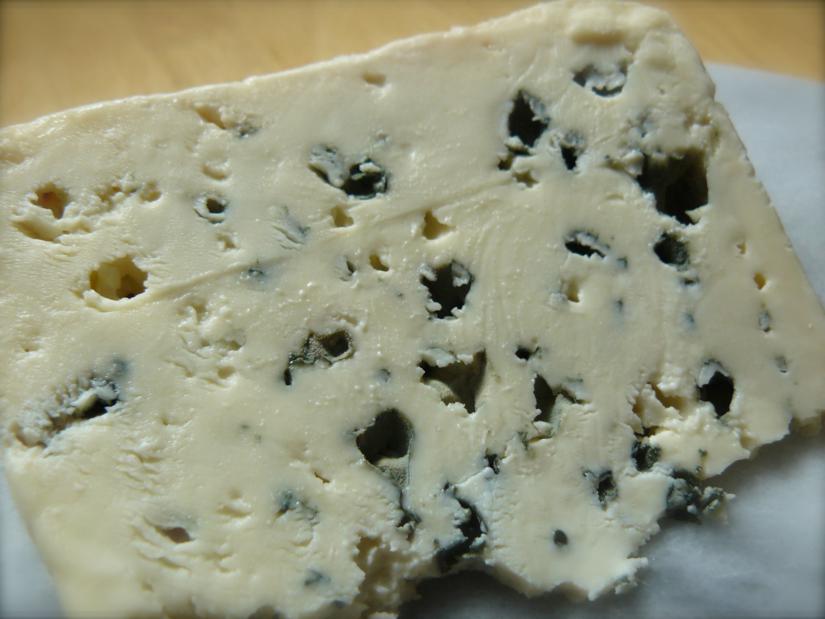 The tale goes that a young shepherd left his lunch of bread and cheese near the natural caves of Cambalou in the Roquefort-sur-Soulzon region of France. When he returned to fetch his food a few days later, he discovered his cheese had grown mold. Not wanting to waste his food, the shepherd ate the moldy cheese, which turned out to be delicious! By leaving his cheese to grow mold (penicillium roqueforti) native to that very particular cave, this shepherd inadvertently created the very first Roquefort cheese.
Today, almost all of the blue cheese produced around the world are made using the cultivated mold from these special caves. It is usually added to the milk in liquid form before coagulation but some cheesemakers still use a powdered version. The blue-green mold needs air to grow, so most blues are either pierced with needles or have a very open texture (air pockets) where the mold forms. Willi Schmid is the only producer I know of that creates an intentional pattern by splitting the cheese with a knife a few weeks after production.
The best blues are not overpowered by the flavor of the mold. The cheese and mold should harmonize and work together to create a unique, yet balanced, experience. Blues are naturally stronger in flavor than most other cheeses but not all blues are intense. They can range from very buttery with a slight spice to incredibly bold and acidic. Queso Cabrales is the strongest blue I have come across. Some people love it; I find it way too strong to eat on its own.
Stilton
 Dating back to the 18th century, Stilton is England’s most famous blue cheese. It was described in the early 1720’s by author Daniel Defoe as, “English Parmesan, and is brought to the table with the mites or maggots round it so thick that they bring a spoon with them for you to eat the mites with, as you do the cheese.” Fortunately, maggots are no longer present in the blue cheese and is enjoyed instead with a glass of port. Though it is a classic winter cheese, Stilton can be enjoyed throughout the year. Made today only with pasteurized cow’s milk, it is buttery and rich while the blue veining adds a pleasant acidity. Look for Stilton made by the Colston Bassett creamery, the best and oldest Stilton producer.
Roquefort
This very famous cheese was the first French cheese to gain AOC status and is only made by seven producers today. Made with raw sheep’s milk, this cheese can only be made in the region of Roquefort-sur-Soulzon in France and must be aged in the natural Cambalou caves. This semi soft cheese has a very white paste with an open texture that allows the greenish blue mold to grow within. The flavor is distinctly strong and powerful with a peppery bite and salty finish. This is the most elegant of all blue cheese and is best enjoyed with a sweet white wine, such as Sauternes.
 Buffalo Blue
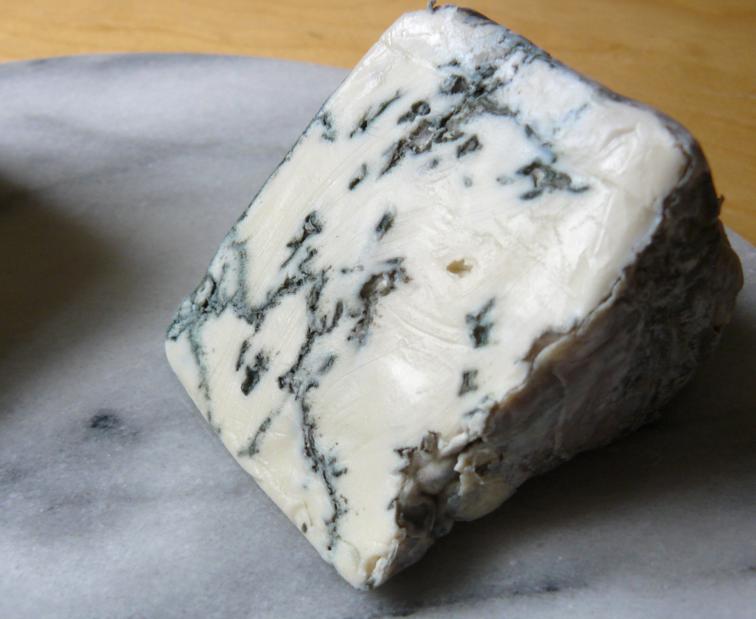
The milk of only four water buffalo is used to create this amazing Swiss blue. Though these huge beasts look fierce and rugged, their milk is rich, sweet, and gentle. It makes the perfect backdrop to the sharp blue mold that marbles the interior and acts as a rind. This very rare cheese is quite special, give it a try if you ever come across it.
Monte Enebro
This unique Spanish blue, made with pasteurized goat’s milk, has a dense and thick paste. It is neither pierced nor does it have an open texture so the penicillium roqueforti grows only on the exterior of the cheese. The cheese has fun and bright flavors and can often taste tropical. Always taste before you buy this cheese, its window of perfection is small.
Katie Carter is Arlington’s first and only ACS Certified Cheese Professional. She has worked in the cheese industry for ten years as a cheesemaker, cheesemonger, and educator. She can be found on Twitter @AfinaCheese. The views and opinions expressed in the column are those of the author and do not necessarily reflect the views of ARLnow.com.
14 Jun 16:59

Dance Edit: I’ve decided that the dress Great Warrior is...
Dance
Edit: I’ve decided that the dress Great Warrior is wearing was from her Quinceañera.
13 Jun 23:16
Your Afternoon Animal Fix
by Prince Of Petworth
If you have any animal/pet photos you’d like to share please shoot me an email to princeofpetworth(at)gmail(dot)com with ‘Animal Fix’ in the title and say the name of your pet and your neighborhood. Your photos will go into the queue (usually 3-4 weeks wait) and will be posted in the order I receive them. If you’ve already entered your pet and would like to do so again – that’s no problem – just space the entries out a bit.

“Hobbes lives in Columbia Heights and is ALWAYS wanting to play.”

“Duchess lives in the Atlas District. She loves H Street, especially Liberty Tree, Cusbah and The Pug for Happy Hours.”

“This is Oscar of Adams Morgan, sleeping comfortably. Such a rough life.”
13 Jun 23:09
what do women want? also where. and when. and how. and i guess why??
| archive - contact - sexy exciting merchandise - cute - search - about | |||
|
MY FACE IS UP HERE: dang a special-edition shirt available only for 7 days! :o dinosaur comics returns monday!
|
|||
| ← previous | June 13th, 2013 | next | |
|
June 13th, 2013: Yesterday night I went to a nice dinner party where I knocked a rack of sticky ribs into my lap and then for dessert knocked a nice piece of pie into my lap, in case you were wondering what it's like to be an internet cartoonist / all around cool guy One year ago today: did I build this whole comic around the last line? perhaps, perhaps – Ryan 
| |||

Snipergirl likes this
13 Jun 03:08
Columbia Heights Power Outage Closes Wonderland, Room 11, Arthur’s Grocery, and El Chucho
by Prince Of Petworth

Thanks to a reader for sending word and the photo above from Wonderland and the photo below from Red Rocks. Reader says power out from the south side of Park Rd, NW to at least Kenyon on 11th Street.
Update: On twitter another @Shipsa01 says:
“power outage in #BloomingdaleDC closed @RedHenDC”
And @KJinDC7 says Park View is also experiencing outage.
@capitaljeff says:
“#PEPCO map shows outages in Dupont, Logan, West End as well. So far no problem here n.border of 20037 in Dupont.”
and @AndrewLoeb says:
“Power outage extending east to GA Ave.”

13 Jun 02:03


Pet of the Week: Josie Mae
by ARLnow.com
Meet Josie Mae, a rescue pup with a heart of gold and this week’s Arlington Pet of the Week.
Here’s what her owners had to say about her:
Josie Mae–or Miss Mae, The Pups, Pup-Tart and Frankenpuppy, Poo Poo Potties, Baby GIrl, Freshie Freshington and Pretty Pie–as we affectionately call her, is a two and a half year old border collie-husky mix that hails from Lyons, GA where she was found in a high kill shelter. K-9 Lifesavers rescued her and brought her to the Reston Pet Fiesta Festival & Dog Adoption event the very next morning. She was a last minute transport and she literally arrived right off the truck, still somewhat dirty, scared and shy. We were there to see other dogs we had read about online that Mother’s Day weekend, but we fell in love with her. She instantly stole our hearts and together we formed a family.
It hasn’t been easy though; our four-legged, tail-wagging child is quite the handful. She went through two obedience trainers just to learn how to walk on a leash. She still hasn’t fully mastered it, and I think she thinks I’m a sled. She loves to shred paper products to teach us a lesson when we leave home without her. She likes to chase rabbits and squirrels and will nearly take your arm out of its socket in her pursuit. She likes to dig holes, particularly in freshly landscaped flower beds. We’ve made a lot of friends this way. She likes to put all things found on the ground into her mouth, and occasionally she likes to swallow these non-food items too. Oh, and she knows tons of tricks and commands, but conveniently forgets all of them, that is, until you present her with a food item. That’s our trick.
That being said, all of her positive attributes more than make up for her character, ahem, shortcomings–and even so, we find them endearing just the same. She is an amazing companion. Where you go, she will follow. She howls and “talks” on command (and cries when she wants attention). She is the best passenger in the car, happy just to ride along and she doesn’t complain about her dad’s driving–or my singing (though her dad does). She likes to share our food, any food (this is not always a good thing, but I take it as a compliment that she enjoys my cooking). She is an excellent swimmer and does not tire of retrieving sticks. Total beach dog. And she has a peculiar taste for sand. Still haven’t figured that one out. She knows the names of all her toys in her toy bin and loves to take them all out trying to entice you with one to play. Everyone, and I mean this sincerely, asks what breed she is and comments on her beauty. What can I say, she gets her good looks from her momma.
We still aren’t sure who rescued whom. But be careful because this little one can cast a spell on you. She has a talent for lowering her ears to seem sweet and innocent, and when she looks up at you with those loving blue eyes, you melt.
The Arlington Pet of the Week is sponsored by Dogma Bakery, which has locations at The Village at Shirlington (2772 S. Arlington Mill Drive) and the Lee Harrison Shopping Center (2445 N. Harrison Street).
Want your pet to be considered to be the Arlington Pet of the Week? Email steph@arlnow.com with a 2-3 paragraph bio and 3-4 photos of your pet. Each week’s winner receives a $25 Dogma gift card.
13 Jun 00:46
Photos from PoPville – Bones on the Mall
by Prince Of Petworth
V.w.verweijI saw this. It was weird, but it was pretty powerful.

Photo by PoPville flickr user number7cloud
number7cloud writes:
“a visible petition against ongoing genocide and mass atrocities. each bone represents a call to action, a story, and a voice. onemillionbones.org”
When becoming a member of the PoPville flickr pool please make sure your settings allow me to download your photos. Join the PoPville flickr pool here and follow PoPville on twitter here on facebook here.

Photo by PoPville flickr user J Sonder
13 Jun 00:41
Wed. Afternoon Rental Option – Columbia Heights
by Prince Of Petworth
V.w.verweijThis is easily the worst cover picture for an apartment ad.

This rental is located at 1030 Park Road, Northwest:

The listing says:
“Great Location. Great Basement Apartment! High ceilings. Exposed brick wall. Great Patio and yard in the back. Beautiful This house is almost on the corner of 11th and Park Road, only steps to Red Rocks Brick Oven gourmet pizza, & across the street from Meridian Pint, The Coupe 24 hour Diner, Maple, Room 11 Wine Bar. Also, steps to the 24 hour Giant Food, Target, Washington Sports Club, DSW, etc.”
This 1 bed/1 bath is going for $1,950/Mo.
13 Jun 00:40
Your Afternoon Animal Fix
by Prince Of Petworth
If you have any animal/pet photos you’d like to share please shoot me an email to princeofpetworth(at)gmail(dot)com with ‘Animal Fix’ in the title and say the name of your pet and your neighborhood. Your photos will go into the queue (usually 3-4 weeks wait) and will be posted in the order I receive them. If you’ve already entered your pet and would like to do so again – that’s no problem – just space the entries out a bit.

“This is Pele, from Mt. Vernon Triangle, enjoying a sunny day.”

“Margot relaxing in Columbia Heights.”

“Here’s my sweet newly adopted kitten, Juno. Enjoying her new home in Mount Pleasant!”

 facebook
  reddit
11 Jun 01:33
More Sweet City Rides – GMO Editions
by Prince Of Petworth


10 Jun 22:56
Your Afternoon Animal Fix
by Prince Of Petworth
If you have any animal/pet photos you’d like to share please shoot me an email to princeofpetworth(at)gmail(dot)com with ‘Animal Fix’ in the title and say the name of your pet and your neighborhood. Your photos will go into the queue (usually 3-4 weeks wait) and will be posted in the order I receive them. If you’ve already entered your pet and would like to do so again – that’s no problem – just space the entries out a bit.

“Auggie and Moon Pie in Columbia Heights.”

“Fergie is the mostly black guinea pig getting a nice bath in Cleveland Park.”

“Marlie is the sheltie mix enjoying a car ride in Cleveland Park.”

“Wiggles is the white guinea pig hamming it up for the camera in Cleveland Park.”
10 Jun 22:55
Lost Dog Found in Columbia Heights
by Prince Of Petworth

A reader writes:
“We found this dog wandering around Columbia Heights near Cardozo High School this morning. We contacted the Humane Society.”
If you recognize the dog please contact the humane society.
10 Jun 22:55
A Poem for Maurice
by areshoekiddingme
Today would have been Maurice Sendak’s 85th birthday. In one of his last interviews, he said,
“I’m writing a poem right now about a nose. I’ve always wanted to write a poem about a nose. But it’s a ludicrous subject. That’s why, when I was younger, I was afraid of [writing] something that didn’t make a lot of sense. But now I’m not. I have nothing to worry about.”
This makes a lot of sense to me, so to celebrate his birthday, I wrote a poem about a nose.
—————
I like to enter a room
Nose First
So that people can come to grips
With what they’re dealing with
The protuberance of a nose
Leading a face into a room
Says
“I am here to experience… something.
I am taking in this place
in a full, sensory
Olfactory way,
And if you had garlic pickles for lunch,
I am going to know about it.”
That kind of thing takes some getting used to.
But encountering a nose
is, in itself, an Unsettling Event.
You try to get to know someone,
and right there in the middle, between
“What’s your name?”
and
“Where are you from?”
is this presumptuous triangle
butting in with a story
about all the summer afternoons you didn’t listen to your mother
when she told you to put on sunscreen
and the time you lost at dodgeball in the fourth grade.
It’s a lot to put out there.
So I like to get it out of the way
first thing
So we can all move on.
Yes, that’s my nose.
Now, what’s for dinner?
10 Jun 03:02

Storymap is a charming Google Map that captures the personality of Dublin city through Ireland’s age-old tradition of storytelling, presenting a vision of Dublin as told through its stories and storytellers.
Storymap takes advantage of the Dubliners' love of telling a good tale by presenting the city through the stories of the local people. The map is a collection of videos in which Dubliners tell stories about locations around the city. The stories range from a deadly gunfight between students at Trinity College Dublin and a college porter to the strange tale of the first cat to fly across the Irish Sea.

Trulia has launched a few new visualisation options to their real-estate Google Maps. The new options allow users to view average rental prices in different neighborhoods and to view earthquake and flooding risks across cities.
To view the new map views visit Trulia Local and use the menu panel on the left-hand side of the map. The Rental Prices option allows the user to view a heat map of rental rates, showing the average cost-per-bedroom at the neighborhood level over the last year.

I've recently spotted a number of maps in the wild using hexagonal binning to visualise data. The Sacramento Bee map of Six Years of Sacramento County Homicides is the first time I've seen it being used with the Google Maps API.
The map shows homicides and assaults with a firearm, or shootings, reported to Sacramento police and sheriff's deputies from 2007 to 2012. Homicides on the map are represented as dots. The hexagons are used to display the number of shootings in defined regions on the map.
The Google Maps of the Week
by Keir Clarke
Storymap is a charming Google Map that captures the personality of Dublin city through Ireland’s age-old tradition of storytelling, presenting a vision of Dublin as told through its stories and storytellers.
Storymap takes advantage of the Dubliners' love of telling a good tale by presenting the city through the stories of the local people. The map is a collection of videos in which Dubliners tell stories about locations around the city. The stories range from a deadly gunfight between students at Trinity College Dublin and a college porter to the strange tale of the first cat to fly across the Irish Sea.
Trulia has launched a few new visualisation options to their real-estate Google Maps. The new options allow users to view average rental prices in different neighborhoods and to view earthquake and flooding risks across cities.
To view the new map views visit Trulia Local and use the menu panel on the left-hand side of the map. The Rental Prices option allows the user to view a heat map of rental rates, showing the average cost-per-bedroom at the neighborhood level over the last year.
I've recently spotted a number of maps in the wild using hexagonal binning to visualise data. The Sacramento Bee map of Six Years of Sacramento County Homicides is the first time I've seen it being used with the Google Maps API.
The map shows homicides and assaults with a firearm, or shootings, reported to Sacramento police and sheriff's deputies from 2007 to 2012. Homicides on the map are represented as dots. The hexagons are used to display the number of shootings in defined regions on the map.
09 Jun 13:22
 Check out these beautiful photos and learn more about this awesome, but often overlooked, littlest of penguin. There's even a direct link between them and Tux, the Linux mascot!
Meet the adorable Fairy Penguin, the smallest penguin species on Earth!
by Michael Graham Richard
Check out these beautiful photos and learn more about this awesome, but often overlooked, littlest of penguin. There's even a direct link between them and Tux, the Linux mascot!
09 Jun 13:20
 New research shows a connection between soil errosion and pollution from deforestation, and the decline of coral reefs.
How do we save coral reefs? By stopping deforestation on land.
by Jaymi Heimbuch
New research shows a connection between soil errosion and pollution from deforestation, and the decline of coral reefs.
09 Jun 02:56


Let's Bring Back the Debtors' Prison!
by The Awl

It was an oblong pile of barrack building, partitioned into squalid houses standing back to back, so that there were no back rooms; environed by a narrow paved yard, hemmed in by high walls duly spiked at top. Itself a close and confined prison for debtors, it contained within it a much closer and more confined jail for smugglers. Offenders against the revenue laws, and defaulters to excise or customs who had incurred fines which they were unable to pay, were supposed to be incarcerated behind an iron-plated door closing up a second prison, consisting of a strong cell or two, and a blind alley some yard and a half wide, which formed the mysterious termination of the very limited skittle-ground in which the Marshalsea debtors bowled down their troubles.—Charles Dickens, Little Dorrit
There doesn’t seem to be as much cultural nostalgia for debtors' prison as for other 19th century phenomena like absurd facial hair, backyard chickens, and churning your own artisanal butter. But allow me to defend a modest proposal: We should bring debtors' prison back.
Read the rest at The Billfold.
---
See more posts by The Awl
09 Jun 02:55


A Reminder To Those Of Us In Denial About The Death Of Google Reader: It's Dying
by Alex Balk
"Obviously Google had to have a good reason to shut Reader down. The company has reams of data on how we use its products, and would not shutter a product that was providing sufficient food to its info-hungry maw. While some users remained devoted, the usage numbers just didn’t add up. The announcement shouldn’t have been too unexpected. Google hadn’t iterated on the service for years. It even went down for a few days in February. But there’s another reason Google decided to put its RSS reader to death. According to Mountain View, most of us simply consume news differently now than when Reader was launched."
---
See more posts by Alex Balk
08 Jun 04:51
Your Afternoon Animal Fix
by Prince Of Petworth
If you have any animal/pet photos you’d like to share please shoot me an email to princeofpetworth(at)gmail(dot)com with ‘Animal Fix’ in the title and say the name of your pet and your neighborhood. Your photos will go into the queue (usually 3-4 weeks wait) and will be posted in the order I receive them. If you’ve already entered your pet and would like to do so again – that’s no problem – just space the entries out a bit.

“This is Penelope, pretending to be a discarded child’s toy in Eckington.”

“This is Ernie Banks of Glover Park”

“This is Bowser from Woodley Park! His pastimes include napping and eating cardboard.”