Shared posts

09 Dec 09:12

The Experience Revolution

by Brett Davidson

Turning Services Into Experiences

Financial planning, when it’s done right, is a pretty amazing experience. A prospective client comes to see you in the belief they’ve simply got a pension or investment problem, and ends up (a few weeks or months later) with a plan that’s changed their life and their relationship to money.

When it all goes well, it’s a process you could call transformative. But let’s be honest – not every interaction is like that.

The rise of the experience economy

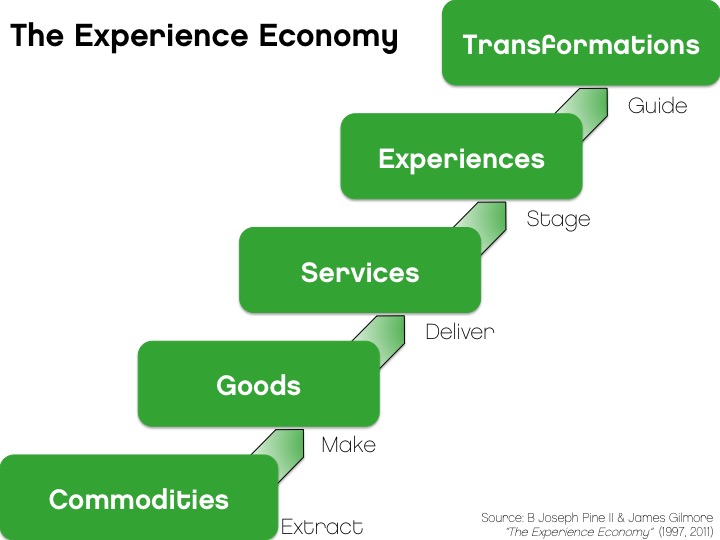
In their 1999 book The Experience Economy, Joseph Pine II and James Gilmore predicted a new age of consumer behaviour and consumption; a move away from goods and services towards experiences, ultimately towards those that are truly transformative.

Take a look at their diagram below:

FP Advance | Advise Better, Live Better

Think of some of the top ‘client experience’ brands, like Apple or Disney; or themed restaurants like the Hard Rock Cafe. They’ve taken a simple task or service (buying a computer or a meal), and turned it into a memorable experience. When you return home from a visit to the Hard Rock Cafe you don’t talk about the quality of your hamburger. You talk about the memorabilia, and the memories evoked by some of the guitars or the artists they were attached to. It’s powerful stuff.

Financial planning as an experience

You only need to look at our profession to see Pine and Gilmore’s ideas over the last century borne out in practice:

  • Money was originally a means of exchange (commodity)
  • The managed fund was developed (goods)
  • Advisers were introduced into the distribution chain (service)

The final two steps aren’t always achieved, but when financial planning is done well, it changes the process into an experience, and in some cases a transformative one.


“The experience revolution will help people be happier by nudging them to spend less time and money on having things, and more of their time and money doing things.”

James Wallman,
Stuffocation: Living More With Less


Once you understand how transformative financial planning can be for some clients, you can’t stop yourself from thinking about how you might institutionalise that type of experience. The truth is for most firms it isn’t always repeatable. But the great firms are thinking long and hard about how to make financial planning repeatedly transformative.

Recently, Abraham Okusanya shared with us his positive spin on the emergence of robo-advice. His point was that many of the repetitive tasks in the financial planning process could and should be done by robots (or computer systems), not people. I concur with his view.

However there is disruption on the way from technology. When the various parts of our value chain are broken down and stripped out as separate services, they will return to being merely a commodity, which will see them valued as such too; priced very cheaply, or free.

The real threat for financial planning businesses will be in failing to create a combined, complete and transformative client experience. If you allow clients to buy the component parts of what you do, then it’s a race to the bottom. If you instead focus on delivering lifestyle outcomes for clients (helping them to ‘live more’), then there is the opportunity to stay relevant, appreciated and profitable for the long term.

Pine and Gilmore argued in their book that businesses need to create memorable events for their customers, and that memory itself then becomes the product — the ‘experience’. They also believed that more advanced ‘experience’ businesses can begin charging for the value of the ‘transformation’ that their experience offers. In 2015, I believe this is financial planning.

Making it conscious

Most financial planning firms have progressed from commodity, to product, to service – which is great. The next level is creating that client experience – doing a good financial planning job while making the process fun and enjoyable for clients. I’ve worked with a few firms in recent years who have grappled with that issue.

The final and ultimate level is transformation, while nirvana is institutionalising that transformation so that it’s not something you do every month or so, but something you do consistently – being aware of what you are doing and doing it on purpose.

Price vs value

Personally, I’m hesitant to get on the price reduction train that seems to be gathering steam, and you should be too. The only way to avoid pricing pressure is to be deliberate in the experience you create for clients.

Think about things that financial planners have not typically considered before. What would help make your clients’ experience fun, fabulous and life changing? Many of the component parts are already in place (great questions, interactive technology), yet there are too many elements that have been designed by an unhealthy fear of compliance. These ruin the experience of many clients, so consider how you can effectively balance the client experience with compliance requirements.

Our greatest challenge as a profession is to create something memorable.

This is what the leaders are working on right now. Are you?


Tweet: Great firms are thinking long and hard about how to make financial planning repeatably transformative. <a href='http://www.adviserlounge.co.uk/members/brettdavidson/' rel='nofollow'>@brettdavidson</a> http://bit.ly/1LGUYgsThe great firms are thinking long and hard about how to make financial planning repeatedly transformative.


07 Dec 16:52

Tips for better engagement (don’t let the title put you off)

by Anthea Christie

Consumer, member, client engagement. Take your pick. My heart sinks a little when I hear these words. Not because they’re bad, but because they’ve become jargon. Fix engagement and we’ll close the savings gap, everyone will understand the value of advice and customers will buy our products. 

The problem with jargon is it becomes an abstract concept and everyone else’s problem.

‘Engagement’ is often used interchangeably with ‘communication’ and as synonymous with ‘getting in touch’. Because we all have language, we mistakenly think we’ve mastered the art of communication, but it’s more than words. Engaging communication must be meaningful to everyone involved. 

I’ve spent time with advisers who run successful businesses. They have different business models and reasons to engage their clients. For some, it’s establishing a relationship with clients inherited through a merger. For others, it’s keeping clients up to date with news. They invariably need help because their clients don’t do what they want them to do.

I also have plenty of experience of poor provider attempts to engage with customers.  Here are some common mistakes:

“My job is to write a letter, send an e-mail or write a brochure.”

No it’s not. That’s your end result. Your job is to help someone understand something better than they did before. Approach it as a letter writing exercise and you focus on the letter rather than the person who’s reading it.

“Compliance won’t sign that off.”

Compliance is important but should be secondary to audience needs.  Check out the FCA discussion paper Smarter Consumer Communications: “ we also signal our support and encouragement for firms that are writing for the consumer first and then ensuring communications are compliant, rather than the other way round”.  Be brave on behalf of your audience.

“We’re experts so my audience expect a certain standard.

The problem is, this professional standard often manifests itself in complexity. This insight from the Wall Street Journal shows exactly what investors (i.e. people with money who need our help) want – simple English.

Perhaps the biggest misconception is that engaging communication is simply words and creative style. It’s also about analysis, logic, structure and social science. If this seems daunting, then hire someone to take care of your communication. But failing that, here are some tips:

  1. Know who you’re speaking to. Mailing lists are not homogenous. The best results come from targeting specific people with relevant messages.
  2. Second guess questions and give the answers. Perform a critical analysis of your proposition.
  3. Back up statements with facts and examples – be plausible.
  4. Explain benefits and signpost action.
  5. Include opposing view points. Your audience will trust you more.
  6. Good writing comes on the rewrite – leave it, come back and take time to get it right.
  7. Your communication should have a planned architecture and take your audience on a journey.
  8. Make it simple, not simplistic. The Economist style guide is a fantastic reference document: “clarity of writing usually follows clarity of thought”.
  9. Develop your own voice.
  10. Edit by collaborating with others you trust to give an honest opinion. And read out loud – that can be very illuminating.

Perhaps I haven’t followed my own advice, but I hope it’s been useful all the same.

27 Oct 12:00

In pounds and pence: How picking the wrong income fund can cost savers thousands

by Kyle Caldwell
Scores of funds are labelled as 'income' but precious few can be relied upon to pay it, here we explain why


29 Sep 10:33

Osborne pitches welfare cuts to voters ahead of election

BIRMINGHAM, England (Reuters) - Chancellor George Osborne sought on Monday to deflect voter attention from a Conservative party split over Europe by pledging more spending cuts to help the government's finances back to surplus.
08 Apr 11:40

148. STANLEY KUBRICK answers a question

by Gav

comic-2014-04-02-stanleykubrick.jpg

RELATED COMICS: Roger Ebert On Kindness, John Lennon Produce Your Own Dream, Bill Watterson A Cartoonist’s Advice, Chris Hadfield An Astronaut’s Advice, The Dalai Lama answers a question.

Stanley Kubrick (1928-1999) was a filmmaker responsible for classic movies such as Dr. Strangelove, 2001: A Space Odyssey, A Clockwork Orange, The Shining and Full Metal Jacket.

Growing up in the Bronx in New York, Kubrick was terrible at school and often skipped class to go to the movie theatre. He soon developed an interest in photography, teaching himself how to use the camera his father gave him as a gift. Similarly, Kubrick didn’t have any formal education in directing and taught himself all aspects of filmmaking. Kubrick on making his first short film, Day of the Fight in 1951:

“I was cameraman, director, editor, assistant editor, sound effects man—you name it, I did it. It was invaluable experience, because being forced to do everything myself I gained a sound and comprehensive grasp of all the technical aspects of filmmaking.”

By the age of 31, Kubrick had already worked as a photojournalist at Look magazine for five years (check out some of his amazing photos) and directed four feature films. In 1960, he was hired to direct the most-expensive film ever made at the time, Spartacus. Kubrick butted heads with Kirk Douglas, the leading-man and producer, over the film’s direction and the bad experience made Kubrick vow that he would have complete creative control on all of his future films.

Kubrick is often described as an eccentric thanks to the stories about his obsessive attention to detail, treatment of actors, personality quirks and reclusiveness. But these anecdotes are overshadowed by his ground-breaking movies, technical expertise and the opinions of those close to him, who described him as a warm, loving and gregarious genius of a man.

The quote used in the comic is taken from a 1968 Playboy interview Kubrick did soon after the release of 2001: A Space Odyssey. You can read the context of the question in this Brain Pickings article.

- Watch this awesome 11-minute tribute video to Kubrick (NSFW).
- The recent documentary Room 237 claims that the visual effects Kubrick pioneered in 1968 for 2001: A Space Odyssey was just a dress rehearsal for his most ambitious ‘film’: the 1969 Apollo moon landing. The film argues that Kubrick was in cahoots with the United States Government and faked the moon landing. Kubrick was so guilt-ridden he left clues in his next movie, The Shining, which gave away his involvement. I don’t believe the claim, but it’s a fascinating documentary and it makes a pretty convincing argument.
- It’s recently been announced that Steven Spielberg will be turning Kubrick’s unrealised movie Napoleon, often referred to as ‘the best film never made’, into a TV miniseries.
- Spielberg and Scorsese on Kubrick.
- Thanks to Anthony and Max for submitting this quote.

26 Mar 12:10

Second

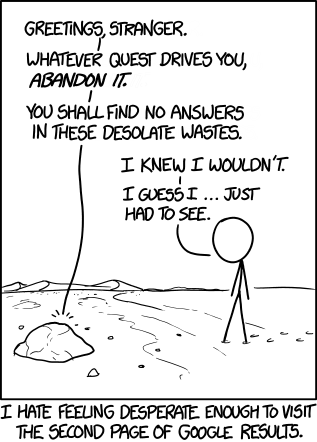
Let me just scroll down and check behind that rock. Annnnd ... nope, page copyright year starts with '19'. Oh God, is this a WEBRING?
01 Oct 12:08

Eversheds: opt-out rates could be double DWP estimates

Opt-out rates for auto-enrolment could be twice as high the Department for Work and Pensions figure of 9%, according to solicitors Eversheds.
18 Jul 10:24

Cap on care costs will help just 1 in 8 because most pensioners will die before reaching £72k limit

Cap on care costs will help just 1 in 8 because most pensioners will die before reaching £72,000 limit