Shared posts

11 Jun 14:47

Small towns are the same everywhere — all screwed up

by PZ Myers

Hank Munzer is one of those far-right nuts, a braggart and bully, and one of those people who was in Washington DC on January 6th, and who is proud of it, despite being arrested and facing a prison sentence. He’s also unfortunate because one of his fellow residents of Dillon, Montana has written an essay about how screwed up small-town conservatives have become, and uses Munzer as a specific, named example. That’s a brave act — I guarantee you that this essay is a hot topic at the Dillon cafe and in telephone gossip. I know, because his description of his county sounds a lot like mine.

A generation ago, one national politician described our state as “hyper rural.” You know the feeling? My county, larger than Connecticut, boasts about 9,000 residents and few traffic lights. Most Americans can’t imagine or understand or appreciate such a mode of life. Many pass through but few would choose to stay. In pockets like mine, it’s an unimaginable distance to D.C. or New York—other countries.

Stevens County, Minnesota is a bit smaller geographically, and we have 10,000 residents (optimistically), and two, count’em, two traffic lights. Similarly, both Morris and Dillon were named after late 19th century railroad executives. But we also have a university in town. I guess that makes us immensely more cosmopolitan than Beaverhead County, Montana, but we’re still in the same ballpark of rural, conservative counties, and the descriptions sound familiar.

Hank Munzer’s building also has analogs here.
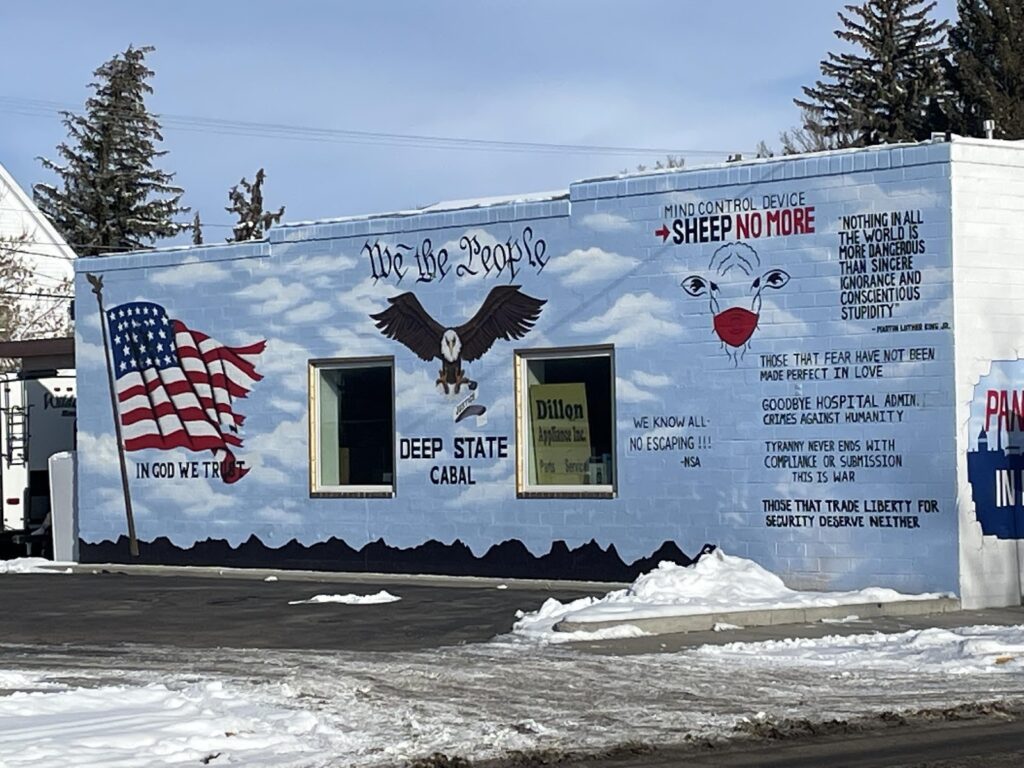
The paint job on Hank’s business building proves his lie as it is far more than an eyesore; as a calculated act of visual violence, it repels many of us and, according to one local realtor, dissuades occasional prospects who considered moving here. One friend told me she no longer drives on this main street; another said she chants “a–hole, a–hole, a–hole” every time she rides by. The city council does nothing because of Fred’s ostensible First Amendment protections.

My stomach used to cramp as I passed but in more recent seasons, I’ve grown numb, pretending to ignore this bizarre paint job. Most townspeople do their best to ignore it. I’ve never seen a building, graffitied or otherwise, like this one anywhere.

The essayist needs to get out more. I’ve seen similar in lots of places. Here in Morris, there’s a house on 7th Avenue with huge crudely painted signs saying “ALL LIVES MATTER,” with a thin blue line police flag and various other unsightly splatters on it — coincidentally, I also mutter “a–hole, a–hole, a–hole” when I drive by. In Glenwood, several miles away, there was a construction detour that forced us to swing through a residential zone with a house covered with gigantic Trump posters and signs — it was a major eyesore that had me saying even ruder things every time we had to drive by it.

I wish I could say it’s just one fringe lunatic in a small town in Montana, but they’re everywhere. And they’ve become bold and outspoken and swagger when they trumpet their idiotic conspiracy theories, and pretend they’re not on a downward spiral.

In his spot-on analysis of my state, “Fifty-Six Counties,” novelist Russell Rowland defines a fierce love of “the land or their families or their country” characteristic, I believe, of rural Americans: “They love until it makes them blind, until they feel the need to barricade themselves against anything that threatens that love.”

That circling-the-wagons mentality against ostensible outside threats, a species or xenophobia and denial, results in destructive conduct: “So we drink. We kill ourselves. We throw our sinking self-image out onto those around us, sometimes in violent, ugly ways, and we decide that our problems are everyone else’s fault, and that if they would go away, or act more like we do, or learn to think more like we think, then we would feel better.”

In such soil grows the Hankss of rural communities. After all, “they” are out to get us, right? And rural problems come from elsewhere, according to this self-delusion.

This toxic combination of ignorance, victimhood, naiveté, and auto-hypnosis, now commonplace, would remain minuscule but for alt-right media platforms.

That’s the thing: they’ve found self-reinforcing online communities where every stupid thing they say and believe gets echoed and praised by other people who also believe the same stupid thing, and they lose all sense of perspective and swell up with righteousness and think petty obsessions make them great and meaningful. So here’s where Hank Munzer stands now.

He was arrested about a week after the Capital riot and charged with one felony count and four misdemeanors, two of those disorderly or disruptive conduct. Among other things he was accused of recording videos inside the Capitol. Six days later he posted those on Facebook. That fact alone evidences his online dependency. Did he know or care about legality? He thinks he did nothing wrong and only exercised free speech.

He was arraigned then released on bail—he grins in his orange prison suit—and then he got to work on his business’ building in Dillon.

Hank was supposed to go to trial in August 2022 but now there’s been another half-year postponement. He’s wanted a change of venue but will be tried in Washington D.C. He prefers to represent himself rather than use a lawyer. That fact suggests the level of his self-righteous zealotry or his narcissistic personality disorder. Or both.

Meanwhile, he enjoys local notoreity. He even ran for city council and garnered dozens of votes. Whose sick joke is that? Exactly whom in rural America is he speaking for? One flavor of rural America consists of a range of deep resentments; above all, resentment of the federal government. Nothing new here, given the long history of agricultural subsidies and dependencies.

Same here, except that I’d add that many of those resentments are fostered by the corporate farms that have eaten up the small landowners. It’s just good policy to give the peons a far-away enemy to hate, lest they notice that greed is destroying their local community.

I agree, though, that small town problems have been getting enflamed by the pernicious poison of talk radio, Fox “News,” and Facebook.

15 May 15:28

1202: Cloud Commuting

http://www.giantitp.com/comics/oots1202.html
27 Oct 17:20

When’s the best time to get a flu shot? Right now.

by Julia Belluz
Though flu vaccine campaigns begin as early as August, several studies published in recent years show the flu vaccine’s effectiveness declines over time in the months after the shot is given. | Derek Davis/Portland Portland Press Herald via Getty Images

Research is mounting that shows the vaccine’s effectiveness declines over time. Late October may be your best bet.

We’re entering the season of coughing and bodily aches and pains. And if you haven’t been immunized yet, now might be the perfect time to get a flu shot.

Though flu vaccine campaigns begin as early as August, several studies published in recent years show the flu vaccine’s effectiveness actually declines over time in the months after the shot is given. So if you immunize too early, you might lose some — or all — immunity by the time flu season is peaking in January and February. (If you already got your flu shot, there’s not much you can do this season, but remember this advice next time flu rolls around.)

Getting vaccinated a little later — around the end of October — can protect you through the height of flu activity. To understand why, let’s take a look at recent studies of how vaccine protection changes during a flu season.

Why people who vaccinate too early may be more likely to get the flu

In one 2017 study, researchers from the Centers for Disease Control and Prevention looked at data from four recent US flu seasons to track whether and when the vaccine’s effectiveness starts to wane.

They found the shot was most effective just after vaccination, followed by a drop off that varied slightly by the type of flu virus. (There are four kinds of influenza viruses — A, B, C, and D — and seasonal flu is caused by influenza A and B. Every year, different strains of these pathogens circulate.) So for influenza A(H3N2) and influenza B, the vaccine’s effectiveness dropped 7 percent per month after vaccination. For influenza A(H1N1), it dropped 6 to 11 percent per month.

Overall, the researchers said, “We observed decreasing influenza vaccine protection with increasing time since vaccination across influenza types/subtypes.”

Another 2018 paper looked at even more flu seasons — seven — and found a similar pattern: “Across all seasons, every additional 28 days between vaccination and influenza testing was associated with, approximately, a 16 percent increase in the odds of testing positive for any influenza.” This finding was driven mostly by the waning of influenza A immunity, the authors — most of whom are at Kaiser Permanente — wrote.

Other recent papers have come to similar conclusions — such as a UK study of the 2011–2012 flu season, and a study from Spain that found a drop off in vaccine effectiveness to zero 119 days after vaccination.

“Though the root causes of intraseasonal waning immunity are up for debate ... the evidence towards its existence is becoming increasingly difficult to ignore,” wrote a pair of researchers in a 2018 journal Clinical Infectious Diseases editorial, cheekily titled “Early bird gets the flu.” They note that there’s a lot we still have to understand about this phenomenon — how it differs among age groups, or people with certain underlying diseases that affect the immune system, such as HIV.

But for now, the editorial authors wrote, “The prospect that a vaccine administered in August loses effectiveness in as little as 3 or 4 months is troubling.” That’s because “the millions of people who are vaccinated in August and September may be at risk by January or February, historically when influenza season peaks.”

So what does this mean for people who already got vaccinated? There’s not much you can do this year. CDC says there’s no benefit to vaccinating twice in a season, and the Advisory Committee on Immunization Practices, which sets vaccine policy in the US, hasn’t changed its guidance yet to reflect the new research. They currently recommend getting vaccinated by the end of October, and this year warned, “Vaccinating early — for example, in July or August — may lead to reduced protection against influenza later in the season, particularly among older adults.”

There are many good public health reasons to get vaccinated against flu

As we’ve reported before, flu vaccines carry very little risk — and the big potential benefit of avoiding serious illness for you and those around you. That’s because getting the vaccine isn’t only about protecting yourself; it’s about protecting others through herd immunity. When enough people are immunized, the virus is less likely to spread. So even if you think you can shrug off a bout of influenza, you could spread it to more vulnerable people who can’t.

Older people, young children, pregnant women, and people with compromised immune systems are particularly vulnerable to influenza. So herd immunity and the vaccine is especially important for these groups. During the 2017-2018 flu season, 80 percent of pediatric deaths occurred in unvaccinated children, according to the CDC.

As for treating flu, most people can just wait out their sickness at home, getting lots of rest and taking care not to infect others. But people in those high-risk groups — young children, pregnant women, people over age 65, those with other chronic diseases — may want to seek immediate medical attention and antivirals like Tamiflu.

In the meantime, there are other, even simpler things you can do to mitigate your risk of getting the flu or spreading the virus to others. They include good old-fashioned hand-washing, covering your mouth when you cough, and, again, staying home if you’re sick.

Further reading

27 Apr 13:42

Phil Plait does good

by PZ Myers

In one of his Crash Course Astronomy episodes, he made a joke that could easily be interpreted as transphobic (he didn’t intend that, but you know what everyone says about intent…). So he did something very smart.

He edited out the bad joke, re-uploaded the video, and then publicly admitted the error, and apologized. But of course that bizarre crowd of haters that populates youtube comments is irate that he did the right thing, and has started flinging a grievous insult at him: “Social Justice Warrior!” So he has replied to that, too.

And here’s the important bit: Apologizing and changing it does no harm, and in fact does some good; it helps a group of people see that we can be sensitive to their needs.

There are times when I think people are too sensitive, and times I think others aren’t sensitive enough. I tend to judge these on a case by case basis. But with a group that is historically marginalized and “othered”, well, a little (extra) empathy does a soul good.

And for the other bit, people derisively calling us “social justice warriors”? They may use it as a derogatory term, thinking of SJWs as shrill and overbearing, but to me it’s a term that refers to people willing to go to bat for others who don’t have as big a soapbox. I might prefer the term “ally”, but SJW fits fine, too. This world could use a lot more social justice. I’ll be happy to fight for it when I can.

Here’s the fixed video. It’s good science, too.