 Remarks by the President of the 2012 Medals of Arts and the Medals of Humanities (White House)
Shared posts
01 Aug 21:48
Remarks by the President of the 2012 Medals of Arts and the Medals of Humanities (White House)
July 12, 2013
by Sohmer
Remarks by the President of the 2012 Medals of Arts and the Medals of Humanities (White House)
Cary Renquist likes this
16 Jul 20:38
Kernel Dev Tells Linus Torvalds To Stop Using Abusive Language
by Unknown Lamer
darthcamaro writes "The Linux Kernel Development Mailing List can be a hostile place for anyone. Now Intel developer Sarah Sharp is taking a stand and she wants the LKML to become a more civil place. Quoting her first message: 'Seriously, guys? Is this what we need in order to get improve -stable? Linus Torvalds is advocating for physical intimidation and violence. Ingo Molnar and Linus are advocating for verbal abuse. ... Violence, whether it be physical intimidation, verbal threats or verbal abuse is not acceptable. Keep it professional on the mailing lists.'" The entire thread is worth a read, but Linus isn't buying it: "Because if you want me to 'act professional', I can tell you that I'm not interested. I'm sitting in my home office wearing a bathrobe. The same way I'm not going to start wearing ties, I'm *also* not going to buy into the fake politeness, the lying, the office politics and backstabbing, the passive aggressiveness, and the buzzwords. Because THAT is what 'acting professionally' results in: people resort to all kinds of really nasty things because they are forced to act out their normal urges in unnatural ways.' He also offered cookies in exchange for joining the dark side. An earlier reply by Linus further explains why he thinks it is OK to be mean: most of the time, he's only yelling at people who should know better (cultivating a crew of lead developers bound to him by Stockholm Syndrome?). 


Read more of this story at Slashdot.
Cary Renquist likes this


16 Jul 18:23

The Dream of the Fisherman’s Wife by Hokusai The Dream of the...
The Dream of the Fisherman’s Wife by Hokusai
The Dream of the Fisherman’s Wife is the most famous image in Kinoe no Komatsu, published in three volumes from 1814, during the Edo period. The book is a collection of shunga, a form of erotic art popularized by the ukiyo-e movement.
The image, Hokusai’s most famous shunga, depicts a woman, evidently an ama (a shell diver), enveloped in the arms of two octopuses. The larger of the two mollusks performs cunnilingus on her, while the smaller one, perhaps his son, assists on the left by fondling her mouth and nipple. In the text above the image the woman and the creatures express their mutual sexual pleasure from the encounter. The text reads:
LARGE OCTOPUS: My wish comes true at last, this day of days; finally I have you in my grasp! Your “bobo" is ripe and full, how wonderful! Superior to all others! To suck and suck and suck some more. After we do it masterfully, I’ll guide you to the Dragon Palace of the Sea God and envelop you. “Zuu sufu sufu chyu chyu chyu tsu zuu fufufuuu…"
MAIDEN: You hateful octopus! Your sucking at the mouth of my womb makes me gasp for breath! Aah! yes… it’s…there!!! With the sucker, the sucker!! Inside, squiggle, squiggle, oooh! Oooh, good, oooh good! There, there! Theeeeere! Goood! Whew! Aah! Good, good, aaaaaaaaaah! Not yet! Until now it was I that men called an octopus! An octopus! Ooh! Whew! How are you able…!? Ooh! “yoyoyooh, saa… hicha hicha gucha gucha, yuchyuu chyu guzu guzu suu suuu…."
LARGE OCTOPUS: All eight limbs to intertwine with!! How do you like it this way? Ah, look! The inside has swollen, moistened by the warm waters of lust. “Nura nura doku doku doku…"
MAIDEN: Yes, it tingles now; soon there will be no sensation at all left in my hips. Ooooooh! Boundaries and borders gone! I’ve vanished….!!!!!!
SMALL OCTOPUS: After daddy finishes, I too want to rub and rub my suckers at the ridge of your furry place until you disappear and then I’ll suck some more. “chyu chyu.."
(Wikipedia)
Cary Renquist likes this
16 Jul 08:17
"Your love for them compels you to let them die with dignity in their own time and not on our time...."
CaryI did this last week with a cat... I should have had her put to sleep when I brought her to the vet, but I ended up leaving her overnight to see what the bloodwork/x-ray/etc showed -- she died alone during the night.
“Your love for them compels you to let them die with dignity in their own time and not on our time. When their bodies fail them, they are telling you in their own way to let go. I have learned this lesson the hard way when I kept my dog alive (with numerous surgeries and excessive medications) way longer than I should have.”
-
-
A Dish reader reflects on the moral and emotional turmoil of pet mortality. Pair with John Updike’s heartbreaking poem “Another Dog’s Death" and Fiona Apple’s stirring handwritten letter about her dying dog, and Mark Twain’s little-known verses mourning the loss of his beloved canine companion.
Meanwhile, the Mortality Paradox looms over all of us.
(via explore-blog)


15 Jul 20:43


The animal handlers at the Oregon Zoo took Elephant around to meet some other animals. The sea lions were her favorite.
Cary Renquist, Sthevens and -1 others like this
15 Jul 19:51


Photo credit: David Handschuh/New York Daily News


Photo credit: David Handschuh/New York Daily News

Photo credit: David Handschuh/New York Daily News

Photo credit: David Handschuh/New York Daily News


via [Twisted Sifter, NY Daily News, Imgur]
Car Covered in Chalkboard Paint Invites People to Draw On It
by Pinar
Chalkboard paint is often used to turn a wall in an office or school into a chalkboard, but college student Philip Romano decided to cover his 2004 Hyundai Elantra in the black matte material to transform his vehicle into an art project on wheels. Equipping the car with a vanity plate that reads "DRAWONME," Romano makes sure to further entice passersby with plenty of chalk, inviting them to draw on the mobile blackboard, whenever he parks his car.
He has found great success in getting people to cover the car, from top to bottom, in colorful drawings and text (some saying "Thanks for this"). The 20-year-old has left his car in various neighborhoods throughout New York, but gained great recognition once he parked it out in from of MoMA, where the line to draw on it reportedly went around the block. Since then, Romano's own mother has taken photos of people participating in the ongoing project and uploaded them to Imgur.
If you like this story, check out the man who invited people to Sharpie his van.
Photo credit: David Handschuh/New York Daily News
Photo credit: David Handschuh/New York Daily News
Photo credit: David Handschuh/New York Daily News
Photo credit: David Handschuh/New York Daily News
Photo credit: David Handschuh/New York Daily News
via [Twisted Sifter, NY Daily News, Imgur]
Cary Renquist likes this
15 Jul 19:40
Ted Wilson Reviews the World #190
by Ted Wilson
CaryIn some ways Canada is like the attic of America. It’s cold and mostly empty and even though it’s right there, no one really ever thinks to go into it.
CANADA
★★★★★ (3 out of 5)
Hello, and welcome to my week-by-week review of everything in the world. Today I am reviewing Canada.
Most of the time I forget that Canada exists, but I was reminded of it this weekend when Glee star Cory Monteith passed away in Vancouver. He was a bright, charismatic, talented actor with great comedic timing, and his death is a tragic loss. If Canada never existed he might be with us today.
In some ways Canada is like the attic of America. It’s cold and mostly empty and even though it’s right there, no one really ever thinks to go into it. One major difference is that Canada doesn’t allow pornography, but most attics I’ve been in is where pornography is stored.
Since attics usually have ghosts in them, and Canadians are so friendly, Canada would be more like whatever attic Casper the Friendly Ghost lives in. And in that attic, Casper would have great health care and no guns. Although I suppose health care wouldn’t do him much good.
It’s a wonder anyone wants to leave Canada. When I see Canadian celebrities living it up in America, all I can think of is how they abandoned their country for fame. I’m never able to see the talents of people like Barry Pepper or Sarah McLachlan because I’m too blinded by their lack of patriotism.
Canada has produced a lot of celebrities, but most of it’s population isn’t famous at all. Have you ever heard of Dabisha Havenburgh? What about Neil Wallphomp? Neither have I. In fact, I can’t even verify that anyone with those names even exists. That’s how unfamous most Canadians are.
Even though Canada is a really big place, most of the citizens crowd together down near the U.S. border. I know it’s colder farther north, but it’s not like heaters and jackets don’t exist. Penguins have no problem living in the snow, so why not just make some jackets out of penguin skin? That stuff must be super warm.
It’s funny to me that more Canadians don’t try to sneak into America the way Mexicans do. I think it’s because of the walls we put up between us and Mexico. When you can’t have something it makes you want it more.
Canadian coins are so similar to American coins that they often wind up in my change. They are inferior to American coins in that vending machines will reject them. They are superior, however, in that they are magnetic. I think that’s caused by the North Pole or something.
Please join me next week when I’ll be reviewing toothpaste.
Related Posts:
- No related posts…
Bookgirl76, Cary Renquist likes this
15 Jul 05:46


Redesigning Death
by Allison Meier
The PoeTree urn by Margaux Ruyant (photograph by Margaux Ruyant, via Tuvie)
For the amount of time that people have been dying, which is quite long really, our designs for death haven’t changed as much as our designs for everything else. Sure, there has been the move to better preservation and much, much more expensive funerals, but compare, say, the stages from the the telegraph to the iPhone to the change of the urn guarding itself as a bulky, somber container.
Part of it is just that designing for death is depressing, but it’s going to happen, so why not go out in style? Perhaps starting with the “Metropolitan Museum Of Art’s Most Trusted Cremation Services Provider“? Here are a few options.
Turn Yourself into a Tree
Bios Urn (via urnabios.com)
Green burials are growing in popularity, skipping the expensive chemicals of embalming and pricey hardwood coffins for simple interments in degradable boxes or even with just a shroud. One of the more interesting designs, however, has centered around actually turning the remains of your physical presence into an actual tree. Human remains are heavy on the phosphorous which is a good fertilizer, but you can’t just dump ashes in the ground with some seeds you got at Home Depot and expect them to grow. Leading the movement is Bios Urns (whose logo is a human with its head as a recycling symbol), where your ashes are mixed with seeds of your choosing in a coconut shell-based container that will biodegrade when buried in the ground. You can imagine a cemetery as a forest instead of a field of tombs, where each tree represents a person. There’s also The Spirit Tree, another seed-containing urn that grows into a tree, and the PoeTree by Margaux Ruyant with the DSK International School of Design that “evolves over time as a companion through the stages of mourning” with ashes in an urn from which a tree grows, which can later be transfered to a park or garden, guarding the ceramic ring around its trunk with the name of the deceased.
Enclose Yourself in an Art Object
Tom Kundig, “The Final Turn” (2012) (via Olson Kundig Architects)
If you’d prefer to be kept around, or keep your loved ones with you, there are some designers creating beautiful objects for use as urns. (Although in theory, you could just buy any sculpture and put the cremated remains, or “cremains” as they say in the funeral business, inside.) For example, Tom Kundig’s “The Final Turn“ is a striking off kilter sphere, that seems to be playing off the visual of an opening tomb for the resurrection, or just with some creative unexpected imagery. The collaboration with Lundgren Monuments is made in steel or bronze and even has space inside for mementos. And speaking of Lundgren, which was started by artist Greg Lundgren as a way of making cemeteries more like personalized sculpture parks, they have a whole service of artistic tombstones, such as some sweet luminous glass gravestones that stand out from the somber stone monuments. There’s also the sleek Capsule urns, which you’d have to be sure not to mix up with a fancy kitchen appliance, that come in geometric shapes, including tiny cubic keepsake urns to keep close to you. You could also be more straightforward and have a memorial painted with ashes, an idea used by Zefrey Throwell in a recent exhibition at Gasser & Grunert Gallery that mixed ashes with methamphetamine to reflect on his late father’s death by meth.
Become an Underwater Scupture
Neptune Memorial Reef (photograph by Todd Murray/Flickr user)
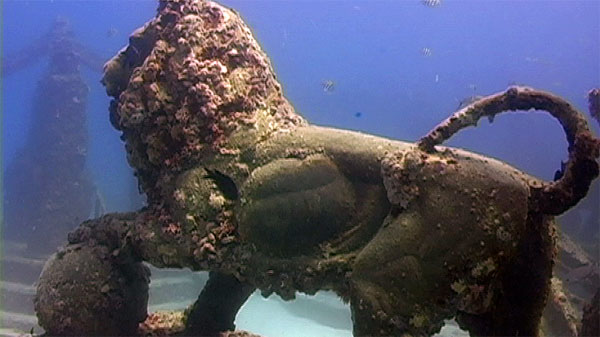
Yet short of shooting yourself into space, the most epic memorial may be in turning your ashes into an underwater sculpture that can be visited by your relatives by scuba diving. There’s Eternal Reefs or the Neptune Society Memorial Reef, which is located off the shore of Miami as the largest man-made reef. The 16 acres that were once barren ocean floor are now covered with sculptures like a lion and towering ornate monolithic architecture that seems right out of Atlantis.
Cary Renquist likes this
15 Jul 03:36

Tagged: lol, gif, tires, pedestrian, crosswalk, close call, not...
Tagged: lol, gif, tires, pedestrian, crosswalk, close call, not a single fuck was given, meanwhile in Russia, .
Cary Renquist likes this
15 Jul 01:42


Representative (and former teacher) Mark Takano Grades Republican Letter, Gives it an "F"
Cary Renquist likes this
14 Jul 18:44
Editor's note: This week we published our survey of the top 20 punk albums in history. In conjunction we asked our columnist Henry Rollins -- who's on the number two album on the list, Black Flag's Damaged -- to name his own top 20. They are below, preceded by a few of his notes.
Rollins: This list is in no particular order. Lists like these often get confusing because they beg the question, what is Punk? Could Wire, also be considered Post Punk? Where do you put bands like PIL, Joy Division, Television, Patti Smith, Suicide, and Killing Joke? What about Gang of Four, 999 and the Banshees?
Henry Rollins' 20 Favorite Punk Albums: Henry Rollins!
 |
Rollins: This list is in no particular order. Lists like these often get confusing because they beg the question, what is Punk? Could Wire, also be considered Post Punk? Where do you put bands like PIL, Joy Division, Television, Patti Smith, Suicide, and Killing Joke? What about Gang of Four, 999 and the Banshees?
For me, as a lean definition, I go by the classic UK 1977 graduating class, Pistols, Clash, etc., and go from there. Beyond that, there were a lot of great Punk Rock bands who never made full albums. The Machines, The Killjoys, Some Chicken, and countless others. So many great bands and great records in this genre and the surrounding/resulting genres. Best bet is just to get the music playing for as long as possible.
Cary Renquist likes this
14 Jul 18:35
Pic of the Day: Spectacular Split-Shot Taken in Antarctica
by alice

The upcoming book, The Masters of Nature Photography features ten amazing portfolios from ten of the world's top nature photographers. They are all past winners of the Wildlife Photographer of the Year competition which is run by the Natural History Museum and BBC Worldwide. The book showcases 120 incredible photos in all and includes everything from striking animal portraits to underwater photography.
One of the 10 celebrated photographers included in the book is award-winning David Doubilet who began shooting under the sea at a young age of 12. Often featured in National Geographic, he's photographed in waters all around the world including those surrounding New Zealand, Canada, Japan, Tasmania, and Scotland.
This photo, called Penguins, Ice and Light, is one of Doubilet's finest. Taken in Antarctica, it shows playful penguins and a large iceberg above and below the sea.
Here's how he describes it, ''I came late in life to the ice, but now ice is in my blood. I’ve been seduced by icebergs, and over the past few seasons, I’ve been working on them at every opportunity. I think of icebergs as a perfect metaphor for the sea – only a small percentage is visible to us. We were lucky to find this bergy bit with a small group of chinstrap and gentoo penguins squabbling on top of it. I made a few frames of the idyllic scene before they began to push each other off, and slide down one side, pop up on the other and start over again. I was excited when two gentoo penguins circled the ice under water, providing perspective. Look how much ice there is below water. One of the greatest joys of shooting half-and-half is that there’s always a surprise – especially the way the surface receives the light.''
This image and much more will be published in The Masters of Nature Photography book which will be released on September 10, 2013.
If you love these kinds of photos, taken above and below the sea, make sure to check out more, here.
via [Telegraph]
Cary Renquist and -1 others like this
14 Jul 18:00
Quote Pow!
Only in America can a dead black boy go on trial for his own murder.
-Syretta McFadden
Via "Son of Baldwin" blog
-Syretta McFadden
Via "Son of Baldwin" blog
Cary Renquist likes this
14 Jul 17:52


My take on the NSA Animation (credit SexualWeasel for idea)
Cary Renquist, Donkeyrock likes this


14 Jul 04:20


This Snake Has a Tail That Looks Like a Spider
by Ed Yong
Credit: Omid Mozaffari
Bryan Fry has been bitten by more venomous snakes than I’ve even seen. He studies their toxins for a living. He used to keep loads of them at his mountainside home, when his university ran out of space. Man knows his snakes. So, when Bryan Fry tells me that something is “easily the coolest snake ever”, I pay attention.
The creature he’s talking is new to science, having only been described in 2006. It’s the spider-tailed viper (Pseudocerastes urarachnoides) and it is aptly named.
The tail is bizarre. If you saw a close-up photo of it, you’d struggle to believe that there was a snake at the other end. There’s a large orange or grey bulb at the tip, and the scales just before that are bizarrely long and thin. Together, these features look a bit like the legs and abdomen of a spider or their close relatives, the solpugids or ‘camel spiders’.
The resemblance is even more striking when the snake moves. It keeps the rest of the tail still, while moving the tip in a disconcertingly jerky way. When studying animal behaviour, it’s important to remember that we’re watching with human eyes and to avoid biased interpretations. That said, just look at the video below!
The first spider-tailed viper was collected in the deserts of western Iran in 1968, and made its way to the Field Museum of Natural History in Chicago. Steven Anderson first inspected it in 1970 and at first, he thought there was a small camel spider clinging onto the animal. On closer inspection, he realised that the “spider” was actually part of the tail.
Was it a tumour, a growth caused by some parasite, a genetic deformity, or a natural part of the animal? With just one specimen, it was impossible to say. “Thus, the specimen languished, but was not forgotten, for nearly four decades,” wrote Anderson’s team.
Then in 2003, Iranian scientist Hamid Bostanchi found a second viper with exactly the same tail. That’s no tumour. It’s what the animal actually looks like. Another Iranian scientist Behzad Fathinia confirmed this by catching a live spider-tailed viper in 2008.
The viper’s scales are so rough and ridged that it looks like it’s encrusted with rock. That provides it with perfect camouflage among the rough gypsum sediments of its desert home. Local people, who knew about it long before scientists came on the scene, call it Mar-e-pardar (feathered snake) or Mar-e-gatch (gypsum snake). The viper’s texture gets even rougher when it’s alarmed. It hisses and inflates its body, which separates the rough scales and makes them stand out from each other. The effect is electric—the snake appears to bristle.
Credit: Barbod Safaei Mahroo
And then there’s the tail. It’s probably a lure, like a fisherman’s fly. By resembling a tasty morsel, it draws potential prey into the snake’s striking range. Fathinia tested this idea by putting a chick into the same enclosure as his captive viper, which duly undulated its tail.
“It was very attractive and looked exactly like a spider moving rapidly,” Fathinia wrote. “After approximately half an hour, the chick went toward the tail and pecked the knob-like structure. The viper pulled the tail structure toward itself, struck and bit the chick in less than 0.5 seconds. The chick died after 1 hour.” A sparrow met the same fate.
Many snakes use similar “caudal lures” like this, including death adders (see below), some boas, and many vipers. But usually, these lures are nothing fancier than a thin tail tip that wriggles like a worm. If that’s good enough to attract a lizard or frog, why has the spider-tailed viper evolved a tail that’s so much more elaborate?
Maybe it’s meant to lure a different type of prey, but what? We definitely know that the viper eats birds, since the first specimen had a bird inside its stomach and the live one had feathers in its faeces. But beyond that, the function and the origin of the spider-tailed viper’s spider tail is still a mystery.
More on snakes:
- The Gaboon Viper Has Ultra-Black Scales So You Can’t See It
- The snake that eats toads to steal their poison
- Immune snakes outrun toxic newts in evolutionary arms races
- Titanoboa – thirteen metres, one tonne, largest snake ever.
- ‘Wasabi protein’ responsible for the heat-seeking sixth sense of rattlesnakes
- How spitting cobras shoot for the eyes
- Kukrisnakes fight for turtle nests with dagger teeth, forked penises and false heads
- How coral snakes cause excruciating pain
- Meet the Agta, a tribe where a quarter of men have been attacked by giant snakes
- Snakes know when to stop squeezing because they sense the heartbeats of their prey
Cary Renquist likes this
12 Jul 21:14


NSA vs USA (All credit to Reddit user sqorck)
A. Kachmar, Sthevens and one other like this
12 Jul 21:00


Photo credit: Jared Ropelato
Stunning Shots of Fly Geyser, Nevada's Hidden Treasure
by alice
As you all know by now, we love finding extraordinary destinations off the beaten path like Lake Baikal in Siberia. Today, we bring you another one which can only be described as surreal or otherworldly. Fly Geyser (or Fly Ranch Geyser) is a a small geothermal geyser that is located approximately 20 miles north of Gerlach, in Washoe County, Nevada. Called "one of the most beautiful sights in Nevada," the geyser is a little-known tourist attraction even to Nevada residents.
Accidentally created in 1916 during well drilling, the geyser started spewing water in the 1960s when a geothermally heated pack of water found a weak spot in the wall and began escaping. Dissolved minerals rose and accumulated creating the mound on which the geyser sits. Water now continually spews into the air, reaching up to 5 feet, making it resemble a miniature volcano.
I like what the photographer Jared Ropelato says about it, "As you walk around Fly Geyser you notice that this thing has a bit of Beauty, and a bit of the Beast. A little Jeckyl and a little Hyde. The color however, is like a rainbow on all sides."
Photographer Christian Klepp described it this way, "This weird and unearthly landscape could have existed somewhere on Jupiter's volcanic moon Io....Such unearthly landscapes are rare on Earth, but they exist. Maybe this helps to imagine how Earth might have looked like at its very beginning. Heat and sulfur resistant bacteria feed on the boiling water of the geyser. Just like in the beginning of life on Earth."
Here are some of our favorite photos of one of the world's most amazing places.
Photo credit: Inge Johnsson
Photo credit: Jared Ropelato

Photo credit: Jared Ropelato

Photo credit: Michael Flick

Photo credit: Lenae Payne

Photo credit: Quang Le Hong

Photo credit: Quang Le Hong

Photo credit: Christian Klepp

Photo credit: Stephen Oachs

Photo credit: Frans Lanting

Photo credit: Dan Newton
If you'd like to visit this destination, heed this warning. Fly Geyser sits on private property. It is located behind a locked gate and is rarely open to the public.
12 Jul 20:55


How Much Is the US Government Spying On Americans?
by Washingtons Blog
Anyone Who Says the Government Only Spies On Potential Bad Guys Is WRONG
Even now – after all of the revelations by Edward Snowden and other whistleblowers – spying apologists say that the reports are “exaggerated” or “overblown”, and that the government only spies on potential bad guys.
In reality, the government is spying on everyone’s digital and old-fashioned communications.
For example, the government is photographing the outside information on every piece of snail mail.
The government is spying on you through your phone … and may even remotely turn on your camera and microphone when your phone is off.
As one example, the NSA has inserted its code into Android’s operating system … bugging three-quarters of the world’s smartphones. Google – or the NSA – can remotely turn on your phone’s camera and recorder at any time.
Cell towers track where your phone is at any moment, and the major cell carriers, including Verizon and AT&T, responded to at least 1.3 million law enforcement requests for cell phone locations and other data in 2011. (And – given that your smartphone routinely sends your location information back to Apple or Google – it would be child’s play for the government to track your location that way.) Your iPhone, or other brand of smartphone is spying on virtually everything you do (ProPublica notes: “That’s No Phone. That’s My Tracker“).
The government might be spying on you through your computer’s webcam or microphone. The government might also be spying on you through the “smart meter” on your own home.
The FBI wants a backdoor to all software. But leading European computer publication Heise said in 1999 that the NSA had already built a backdoor into all Windows software.
And Microsoft has long worked hand-in-hand with the NSA and FBI so that encryption doesn’t block the government’s ability to spy on users of Skype, Outlook, Hotmail and other Microsoft services.
(And leading security experts say that the NSA might have put a backdoor in all encryption standards years ago. … meaning that the NSA can easily hack into encrypted communications.)
“Black boxes” are currently installed in between 90% and 96% of all new cars. And starting in 2014, all new cars will include black boxes that can track your location.
License plate readers mounted on police cars allow police to gather millions of records on drivers … including photos of them in their cars.
A security expert and former NSA software developer says that hackers can access private surveillance cameras. Given that the NSA apparently already monitors public cameras using facial recognition software, and that the FBI is building a system which will track “public and private surveillance cameras around the country”, we can assume that government agencies might already be hacking into private surveillance cameras.
The CIA wants to spy on you through your dishwasher and other “smart” appliances. As Slate notes:
Watch out: the CIA may soon be spying on you—through your beloved, intelligent household appliances, according to Wired.
In early March, at a meeting for the CIA’s venture capital firm In-Q-Tel, CIA Director David Petraeus reportedly noted that “smart appliances” connected to the Internet could someday be used by the CIA to track individuals. If your grocery-list-generating refrigerator knows when you’re home, the CIA could, too, by using geo-location data from your wired appliances, according to SmartPlanet.
“The current ‘Internet of PCs’ will move, of course, toward an ‘Internet of Things’—of devices of all types—50 to 100 billion of which will be connected to the Internet by 2020,” Petraeus said in his speech. He continued:
Items of interest will be located, identified, monitored, and remotely controlled through technologies such as radio-frequency identification, sensor networks, tiny embedded servers, and energy harvesters—all connected to the next-generation Internet using abundant, low cost, and high-power computing—the latter now going to cloud computing, in many areas greater and greater supercomputing, and, ultimately, heading to quantum computing.
***
ITworld’s Kevin Fogarty thinks that J. Edgar Hoover, were he still with us, would “die of jealousy” upon hearing about the tools soon to be at Petraeus’ disposal.
And they’re probably bluffing and exaggerating, but the Department of Homeland Security claims they will soon be able to know your adrenaline level, what you ate for breakfast and what you’re thinking … from 164 feet away. (In addition, people will probably soon be swallowing tracking devices for medical purposes)
The government is allegedly scanning prisoners’ brains without their consent at Guantanamo. In the near future, brain scanners may be able to literally read our thoughts (and see this).
The government is currently testing systems for use in public spaces which can screen for “pre-crime”. As Nature reports:
Like a lie detector, FAST measures a variety of physiological indicators, ranging from heart rate to the steadiness of a person’s gaze, to judge a subject’s state of mind. But there are major differences from the polygraph. FAST relies on non-contact sensors, so it can measure indicators as someone walks through a corridor at an airport, and it does not depend on active questioning of the subject.
CBS News points out:
FAST is designed to track and monitor, among other inputs, body movements, voice pitch changes, prosody changes (alterations in the rhythm and intonation of speech), eye movements, body heat changes, and breathing patterns. Occupation and age are also considered. A government source told CNET that blink rate and pupil variation are measured too.
A field test of FAST has been conducted in at least one undisclosed location in the northeast. “It is not an airport, but it is a large venue that is a suitable substitute for an operational setting,” DHS spokesman John Verrico told Nature.com in May.
Although DHS has publicly suggested that FAST could be used at airport checkpoints–the Transportation Security Administration is part of the department, after all–the government appears to have grander ambitions. One internal DHS document (PDF) also obtained by EPIC through the Freedom of Information Act says a mobile version of FAST “could be used at security checkpoints such as border crossings or at large public events such as sporting events or conventions.”
The risk of false positives is very real. As Computer World notes:
Tom Ormerod, a psychologist in the Investigative Expertise Unit at Lancaster University, UK, told Nature, “Even having an iris scan or fingerprint read at immigration is enough to raise the heart rate of most legitimate travelers.” Other critics have been concerned about “false positives.” For example, some travelers might have some of the physical responses that are supposedly signs of mal-intent if they were about to be groped by TSA agents in airport security.
Various “pre-crime” sensing devices have already been deployed in public spaces in the U.S.
The government has also worked on artificial intelligence for “pre-crime” detection on the Web. And given that programs which can figure out your emotions are being developed using your webcam, every change in facial expression could be tracked.
According to the NSA’s former director of global digital data – William Binney – the NSA’s new data storage center in Utah will have so much storage capacity that:
“They would have plenty of space … to store at least something on the order of 100 years worth of the worldwide communications, phones and emails and stuff like that,” Binney asserts, “and then have plenty of space left over to do any kind of parallel processing to try to break codes.”
***
[But the NSA isn't stopping there.] Despite its capacity, the Utah center does not satisfy NSA’s data demands. Last month, the agency broke ground on its next data farm at its headquarters at Ft. Meade, Md. But that facility will be only two-thirds the size of the mega-complex in Utah.
The NSA is building next-generation quantum computers to process all of the data.
NBC News reports:
NBC News has learned that under the post-9/11 Patriot Act, the government has been collecting records on every phone call made in the U.S.
This includes metadata … which can tell the government a lot about you. And it also includes content.
The documents leaked by Edward Snowden to Glenn Greenwald show:
But what we’re really talking about here is a localized system that prevents any form of electronic communication from taking place without its being stored and monitored by the National Security Agency.
It doesn’t mean that they’re listening to every call, it means they’re storing every call and have the capability to listen to them at any time, and it does mean that they’re collecting millions upon millions upon millions of our phone and email records.
In addition, a government expert told the Washington Post that the government “quite literally can watch your ideas form as you type.” A top NSA executive confirmed to Washington’s Blog that the NSA is intercepting and storing virtually all digital communications on the Internet.
McClatchy notes:
FBI Director Robert Mueller told a Senate committee on March 30, 2011, that “technological improvements” now enable the bureau “to pull together past emails and future ones as they come in so that it does not require an individualized search.”
The administration is building a facility in a valley south of Salt Lake City that will have the capacity to store massive amounts of records – a facility that former agency whistleblowers say has no logical purpose if it’s not going to be a vault holding years of phone and Internet data.
***
Thomas Drake, a former NSA senior executive who challenged the data collection for several years, said the agency’s intent seems obvious.
“One hundred million phone records?” he asked in an interview. “Why would they want that each and every day? Of course they’re storing it.”
***
Lending credence to his worries, The Guardian’s latest report quoted a document in which Alexander purportedly remarked during a 2008 visit to an NSA intercept station in Britain: “Why can’t we collect all the signals all the time?”
***
One former U.S. security consultant, who spoke on condition of anonymity to protect his connections to government agencies, told McClatchy he has seen agency-installed switches across the country that draw data from the cables.
“Do I know they copied it? Yes,” said the consultant. “Do I know if they kept it? No.”
NSA whistleblower Russel Tice – a key source in the 2005 New York Times report that blew the lid off the Bush administration’s use of warrantless wiretapping – says that the content and metadata of all digital communications are being tapped by the NSA.
The NSA not only accesses data directly from the largest internet companies, it also sucks up huge amounts of data straight from undersea cables providing telephone and Internet service to the United States.
After all, the government has secretly interpreted the Patriot Act so that “everything” is deemed relevant … so the government can spy on everyone.
The NSA isn’t the only agency which is conducting massive spying.
The Wall Street Journal notes:
The rules now allow the little-known National Counterterrorism Center to … copy entire government databases—flight records, casino-employee lists, the names of Americans hosting foreign-exchange students and many others. The agency has new authority to keep data about innocent U.S. citizens for up to five years, and to analyze it for suspicious patterns of behavior. Previously, both were prohibited. Data about Americans “reasonably believed to constitute terrorism information” may be permanently retained.
The changes also allow databases of U.S. civilian information to be given to foreign governments for analysis of their own. In effect, U.S. and foreign governments would be using the information to look for clues that people might commit future crimes.
“It’s breathtaking” in its scope, said a former senior administration official familiar with the White House debate.
Reason notes:
Gazillions. That’s the number of times the federal government has spied on Americans since 9/11 through the use of drones, legal search warrants, illegal search warrants, federal agent-written search warrants and just plain government spying. This is according to Sen. Rand Paul, R-Ky., who, when he asked the government to tell him what it was doing to violate our privacy, was given a classified briefing. The senator — one of just a few in the U.S. Senate who believes that the Constitution means what it says — was required by federal law to agree not to reveal what spies and bureaucrats told him during the briefing.
Even if the US government weren’t recording all of that data, England’s GCHQ spy agency is … and is sharing it with the NSA.
Germany, Australia, Canada and New Zealand are also recording and sharing massive amounts of information with the NSA.
Private contractors can also view all of your data … and the government isn’t keeping track of which contractors see your data and which don’t. And because background checks regarding some contractors are falsified, it is hard to know the types of people that might have your information.
And top NSA and FBI experts say that the government can retroactively search all of the collected information on someone since 9/11 if they suspect someone of wrongdoing … or want to frame him.
The American government is in fact collecting and storing virtually every phone call, purchases, email, text message, internet searches, social media communications, health information, employment history, travel and student records, and virtually all other information of every American.
The Wall Street Journal reported that the NSA spies on Americans’ credit card transactions. Many other government agencies track your credit card purchases as well.
As Washington Monthly noted in 2004, Congress chopped off the head of the Total Information Awareness program … but the program returned as a many-headed hydra:
A program can survive even when the media, the public, and most of Congress wants it killed. It turns out that, while the language in the bill shutting down TIA was clear, a new line had been inserted during conference—no one knew by whom—allowing “certain processing, analysis, and collaboration tools” to continue.
….Thanks to the Central Intelligence Agency and the National Security Agency, which had lobbied for the provision, TIA didn’t die—it metastasized. As the AP reported in February [of 2004], the new language simply outsourced many TIA programs to other intelligence offices and buried them in the so-called “black budget.” What’s more, today, several agencies are pursuing data mining projects independent of TIA, including the Department of Homeland Security, the Justice Department, the CIA, the Transportation Security Administration, and NASA….Even with TIA ostensibly shut down, many of the private contractors who worked on the program can continue their research with few controls.
Senators Wyden and Udall – both on the Senate Intelligence Committee, with access to all of the top-secret information about the government’s spying programs – write:
Section 215 of the Patriot Act can be used to collect any type of records whatsoever … including information on credit card purchases, medical records, library records, firearm sales records, financial information and a range of other sensitive subjects.
In fact, all U.S. intelligence agencies – including the CIA and NSA – are going to spy on Americans’ finances. The IRS will be spying on Americans’ shopping records, travel, social interactions, health records and files from other government investigators.
The government is flying drones over the American homeland to spy on us. Indeed, the head of the FBI told Congress that drones are used for domestic surveillance … and that there are no rules in place governing spying on Americans with drones.
Senator Rand Paul correctly notes:
The domestic use of drones to spy on Americans clearly violates the Fourth Amendment and limits our rights to personal privacy.
Emptywheel notes in a post entitled “The OTHER Assault on the Fourth Amendment in the NDAA? Drones at Your Airport?”:
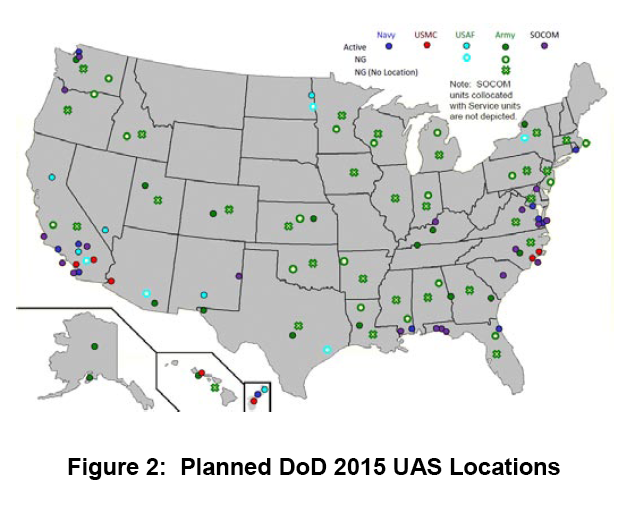
***
As the map above makes clear–taken from this 2010 report–DOD [the Department of Defense] plans to have drones all over the country by 2015.
Many police departments are also using drones to spy on us. As the Hill reported:
At least 13 state and local police agencies around the country have used drones in the field or in training, according to the Association for Unmanned Vehicle Systems International, an industry trade group. The Federal Aviation Administration has predicted that by the end of the decade, 30,000 commercial and government drones could be flying over U.S. skies.
***
“Drones should only be used if subject to a powerful framework that regulates their use in order to avoid abuse and invasions of privacy,” Chris Calabrese, a legislative counsel for the American Civil Liberties Union, said during a congressional forum in Texas last month.
He argued police should only fly drones over private property if they have a warrant, information collected with drones should be promptly destroyed when it’s no longer needed and domestic drones should not carry any weapons.
He argued that drones pose a more serious threat to privacy than helicopters because they are cheaper to use and can hover in the sky for longer periods of time.
A congressional report earlier this year predicted that drones could soon be equipped with technologies to identify faces or track people based on their height, age, gender and skin color.
The military is paying for the development of drones with facial recognition software which “remember” people’s faces … and read “malintent”.
Moreover, Wired reports:
Transit authorities in cities across the country are quietly installing microphone-enabled surveillance systems on public buses that would give them the ability to record and store private conversations….
The systems are being installed in San Francisco, Baltimore, and other cities with funding from the Department of Homeland Security in some cases ….
The IP audio-video systems can be accessed remotely via a built-in web server (.pdf), and can be combined with GPS data to track the movement of buses and passengers throughout the city.
***
The systems use cables or WiFi to pair audio conversations with camera images in order to produce synchronous recordings. Audio and video can be monitored in real-time, but are also stored onboard in blackbox-like devices, generally for 30 days, for later retrieval. Four to six cameras with mics are generally installed throughout a bus, including one near the driver and one on the exterior of the bus.
***
Privacy and security expert Ashkan Soltani told the Daily that the audio could easily be coupled with facial recognition systems or audio recognition technology to identify passengers caught on the recordings.
RT notes:
Street lights that can spy installed in some American cities
America welcomes a new brand of smart street lightning systems: energy-efficient, long-lasting, complete with LED screens to show ads. They can also spy on citizens in a way George Orwell would not have imagined in his worst nightmare.
With a price tag of $3,000+ apiece, according to an ABC report, the street lights are now being rolled out in Detroit, Chicago and Pittsburgh, and may soon mushroom all across the country.
Part of the Intellistreets systems made by the company Illuminating Concepts, they have a number of “homeland security applications” attached.
Each has a microprocessor “essentially similar to an iPhone,” capable of wireless communication. Each can capture images and count people for the police through a digital camera, record conversations of passers-by and even give voice commands thanks to a built-in speaker.
Ron Harwood, president and founder of Illuminating Concepts, says he eyed the creation of such a system after the 9/11 terrorist attacks and the Hurricane Katrina disaster. He is “working with Homeland Security” to deliver his dream of making people “more informed and safer.”
The TSA has moved way past airports, trains and sports stadiums, and is deploying mobile scanners to spy on people all over the place. This means that traveling within the United States is no longer a private affair.
You might also have seen the news this week that the Department of Homeland Security is going to continue to allow searches of laptops and phones based upon “hunches”.
What’s that about?
The ACLU published a map in 2006 showing that nearly two-thirds of the American public – 197.4 million people – live within a “constitution-free zone” within 100 miles of land and coastal borders:
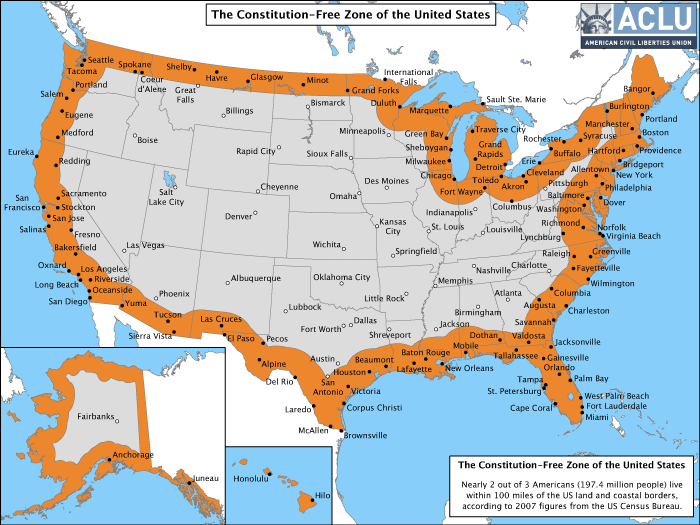
The ACLU explained:
- Normally under the Fourth Amendment of the U.S. Constitution, the American people are not generally subject to random and arbitrary stops and searches.
- The border, however, has always been an exception. There, the longstanding view is that the normal rules do not apply. For example the authorities do not need a warrant or probable cause to conduct a “routine search.”
- But what is “the border”? According to the government, it is a 100-mile wide strip that wraps around the “external boundary” of the United States.
- As a result of this claimed authority, individuals who are far away from the border, American citizens traveling from one place in America to another, are being stopped and harassed in ways that our Constitution does not permit.
- Border Patrol has been setting up checkpoints inland — on highways in states such as California, Texas and Arizona, and at ferry terminals in Washington State. Typically, the agents ask drivers and passengers about their citizenship. Unfortunately, our courts so far have permitted these kinds of checkpoints – legally speaking, they are “administrative” stops that are permitted only for the specific purpose of protecting the nation’s borders. They cannot become general drug-search or other law enforcement efforts.
- However, these stops by Border Patrol agents are not remaining confined to that border security purpose. On the roads of California and elsewhere in the nation – places far removed from the actual border – agents are stopping, interrogating, and searching Americans on an everyday basis with absolutely no suspicion of wrongdoing.
- The bottom line is that the extraordinary authorities that the government possesses at the border are spilling into regular American streets.
Computer World reports:
Border agents don’t need probable cause and they don’t need a stinking warrant since they don’t need to prove any reasonable suspicion first. Nor, sadly, do two out of three people have First Amendment protection; it is as if DHS has voided those Constitutional amendments and protections they provide to nearly 200 million Americans.
***
Don’t be silly by thinking this means only if you are physically trying to cross the international border. As we saw when discussing the DEA using license plate readers and data-mining to track Americans movements, the U.S. “border” stretches out 100 miles beyond the true border. Godfather Politics added:
But wait, it gets even better! If you live anywhere in Connecticut, Delaware, Florida, Hawaii, Maine, Massachusetts, Michigan, New Hampshire, New Jersey or Rhode Island, DHS says the search zones encompass the entire state.
Immigrations and Customs Enforcement (ICE) and Customs and Border Protection (CBP) have a “longstanding constitutional and statutory authority permitting suspicionless and warrantless searches of merchandise at the border and its functional equivalent.” This applies to electronic devices, according to the recent CLCR “Border Searches of Electronic Devices” executive summary [PDF]:
Fourth Amendment
The overall authority to conduct border searches without suspicion or warrant is clear and longstanding, and courts have not treated searches of electronic devices any differently than searches of other objects. We conclude that CBP’s and ICE’s current border search policies comply with the Fourth Amendment. We also conclude that imposing a requirement that officers have reasonable suspicion in order to conduct a border search of an electronic device would be operationally harmful without concomitant civil rights/civil liberties benefits. However, we do think that recording more information about why searches are performed would help managers and leadership supervise the use of border search authority, and this is what we recommended; CBP has agreed and has implemented this change beginning in FY2012.***
The ACLU said, Wait one darn minute! Hello, what happened to the Constitution? Where is the rest of CLCR report on the “policy of combing through and sometimes confiscating travelers’ laptops, cell phones, and other electronic devices—even when there is no suspicion of wrongdoing?” DHS maintains it is not violating our constitutional rights, so the ACLU said:
If it’s true that our rights are safe and that DHS is doing all the things it needs to do to safeguard them, then why won’t it show us the results of its assessment? And why would it be legitimate to keep a report about the impact of a policy on the public’s rights hidden from the very public being affected?
***
As Christian Post wrote, “Your constitutional rights have been repealed in ten states. No, this isn’t a joke. It is not exaggeration or hyperbole. If you are in ten states in the United States, your some of your rights guaranteed by the Bill of Rights have been made null and void.”
The ACLU filed a Freedom of Information Act request for the entire DHS report about suspicionless and warrantless “border” searches of electronic devices. ACLU attorney Catherine Crump said “We hope to establish that the Department of Homeland Security can’t simply assert that its practices are legitimate without showing us the evidence, and to make it clear that the government’s own analyses of how our fundamental rights apply to new technologies should be openly accessible to the public for review and debate.”
Meanwhile, the EFF has tips to protect yourself and your devices against border searches. If you think you know all about it, then you might try testing your knowledge with a defending privacy at the U.S. border quiz.
Wired pointed out in 2008 that the courts have routinely upheld such constitution-free zones:
Federal agents at the border do not need any reason to search through travelers’ laptops, cell phones or digital cameras for evidence of crimes, a federal appeals court ruled Monday, extending the government’s power to look through belongings like suitcases at the border to electronics.
***
The 9th U.S. Circuit Court of Appeals sided with the government, finding that the so-called border exception to the Fourth Amendment’s prohibition on unreasonable searches applied not just to suitcases and papers, but also to electronics.
***
Travelers should be aware that anything on their mobile devices can be searched by government agents, who may also seize the devices and keep them for weeks or months. When in doubt, think about whether online storage or encryption might be tools you should use to prevent the feds from rummaging through your journal, your company’s confidential business plans or naked pictures of you and your-of-age partner in adult fun.
Do you still believe that the government is only spying on bad guys in “targeted” searches?
Cary Renquist likes this
12 Jul 20:11


Happy Birthday, Buckminster Fuller: A Scientific Prayer
by Maria Popova
A secular definition of divinity as a curiosity-driven love of truth bent through the prism of our subjective experience.
 “Everyone who is seriously involved in the pursuit of science,” Einstein wrote to a little girl who asked him whether scientists pray, “becomes convinced that some spirit is manifest in the laws of the universe, one that is vastly superior to that of man.” “The notion that science and spirituality are somehow mutually exclusive,” Carl Sagan seconded, “does a disservice to both.” And yet the oppression of religious doctrine over scientific thought has persisted for centuries, from Galileo to some of today’s most celebrated minds.
In his 1981 classic Critical Path (public library), legendary architect, designer, inventor, theorist and futurist Buckminster Fuller (July 12, 1895–July 1, 1983) explores the subject with his singular blend of philosophical fringe-think, love of science, and cosmic poetics. He recalls being heavily influenced, at the impressionable age of ten, by the Russian Revolution and the Communist party’s demolition of all mystical thought, which was forcibly replaced with blind faith in “omniscientific technology” that manifested as institutionalized atheism. Three years later, Fuller wrote Einstein’s famous “Cosmic Religious Sense — the Nonanthropomorphic Concept of God,” which pointed out that legendary scientists like Galileo and Kepler had been excommunicated by the Roman Catholic Church as “heretics” for their resolute faith in the orderliness of the universe and the belief that it was driven by principles of nonathropomorphic nature — that is, no elderly gentleman with a big white beard. This, Fuller writes, shaped his thinking profoundly, so he created his own scientifically-inspired rendition of “the Lord’s Prayer,” a centerpiece of the Christian faith:
Since 1927, whenever I am going to sleep, I always concentrate my thinking on what I call “Ever Rethinking the Lord’s Prayer.”
He then goes on to write out his “prayer” — essentially a secular definition of divinity as a curiosity-driven love of truth bent through the prism of our subjective experience, something Philip Ball articulated a quarter century later in his eloquent distinction between curiosity and wonder — on his 84th birthday:
EVER RETHINKING THE LORD’S PRAYER
July 12, 1979To be satisfactory to science
all definitions
must be stated
in terms of experienceI define Universe as
all of humanity’s
in-all-known-time
consciously apprehended
and communicated (to self or others)
experiences.In using the word, God,
I am consciously employing
four clearly differentiated
from one another
experience-engendered thoughts.Firstly I mean: —
Those experience-engendered thoughts
which are predicted upon past successions
of unexpected, human discoveries
of mathematically incisive,
physically demonstrable answers
to what theretofore had been misassumed
to be forever unanswerable
cosmic magnitude questions
wherefore I now assume it to be
scientifically manifest,
and therefore experientially reasonable thatscientifically explainable answers
may and probably will
eventually be given
to all questions
as engendered in all human thoughts
by the sum total
of all human experiences;
wherefore my first meaning for God is: –all the experientially explained
or explainable answers
to all questions
of all time –Secondly I mean: –
The individual’s memory
of many surprising moments
of dawning comprehensions
of an interrelated significance
to be existent
amongst a number
of what had previously seemed to be
entirely uninterrelated experiences
all of which remembered experiences
engender the reasonable assumption
of the possible existence
of a total comprehension
of the integrated significance –
the meaning –
of all experiences.Thirdly, I mean:–
the only intellectually discoverable
a priori, intellectual integrity
indisputably manifest as
the only mathematically statable
family
of generalized principles –
cosmic laws–
thus far discovered and codified
and ever physically redemonstrable
by scientists
to be not only unfailingly operative
but to be in eternal
omni-interconsiderate,
omni-interaccommodative governance
of the complex
of everyday, naked-eye experiences
as well as of the multi-millions-fold greater range
of only instrumentally explored
infra- and ultra-tunable
micro and macro-Universe events.Fourthly, I mean: –
All the mystery inherent
in all human experience,
which as a lifetime ratioed to eternity,
is individually limited
to almost negligible
twixt sleepings, glimpses
of only a few local episodes
of one of the infinite myriads
of concurrently and overlappingly operative
sum-totally never-ending
cosmic scenario serialsWith these four meanings I now directly address God.
“Our God –
Since omni-experience is your identity
You have given us
overwhelming manifest: –
of Your complete knowledge
of Your complete comprehension
of Your complete concern
of Your complete coordination
of Your complete responsibility
of Your complete capability to cope
in absolute wisdom and effectiveness
with all problems and events
and of Your eternally unfailing reliability
so to doYours, Dear God,
is the only and complete glory.By Glory I mean
the synergetic totality
of all physical and metaphysical radiation
and of all physical and metaphysical gravity
of finite
but nonunitarily conceptual
scenario Universe
in whose synergetic totality
the a priori energy potential
of both radiation and gravity
are initially equal
but whose respective
behavioral patterns are such
that radiation’s entropic, redundant disintegratings
is always less effective
than gravity’s nonredundant
syntropic integratingRadiation is plural and differentiable,
radiation is focusable, beamable, and self-sinusing,
it is interceptible, separatist, and biasable –
ergo, has shadowed voids and vulnerabilities;Gravity is unit and undifferentiable
Gravity is comprehensive
inclusively embracing and permeative
is nonfocusable and shadowless,
and is omni-integrative
all of which characteristics of love.
Love is metaphysical gravity.You, Dear God,
are the totally loving intellect
ever designing
and ever daring to test
and thereby irrefutably proving
to the uncompromising satisfaction
of Your own comprehensive and incisive
knowledge of the absolute truth
that Your generalized principles
adequately accommodate any and all
special case developments,
involvements, and side effects;
wherefore Your absolutely courageousomnirigorous and ruthless self-testing
alone can and does absolutely guarantee
total conservation
of the integrity
of eternally regenerative UniverseYour eternally regenerative scenario Universe
is the minimum complex
of totally intercomplementary
totally intertransforming
nonsimultaneous, differently frequenced
and differently enduring
feedback closures
of a finite
but nonunitarily
nonsimultaneously conceptual system
in which naught is created
and naught is lost
and all occurs
in optimum efficiency.Total accountability and total feedback
constitute the minimum and only
perpetual motion system.
Universe is the one and only
eternally regenerative system.To accomplish Your regenerative integrity
You give Yourself the responsibility
of eternal, absolutely continuous,
tirelessly vigilant wisdom.Wherefore we have absolute faith and trust in You,
and we worship You
awe-inspiredly,
all-thankfully,
rejoicingly,
lovingly,
Amen.

He goes on to further explore the relationship between science and scripture:
In considering theology and science I think it is important to note their differences regarding familiar and not-so-familiar cosmic concepts.
It is the very essence of my thinking that, for a principle to qualify as generalizable in science, there must be no known exceptions to its reliability. Exceptionless means eternal. Principles can be only eternal.
He points to mathematics as an example of the eternal, for its principles are reliably demonstrable, and writes:
Acknowledging the mathematically elegant intellectual integrity of eternally regenerative Universe is one way of identifying God.
Stuart Firestein wrote in his indispensable Ignorance: How It Drives Science, one of the best science books of 2012, that “Real science is a revision in progress, always. It proceeds in fits and starts of ignorance.” So, too, Bucky reminds us that science is inextricably bound with the mysterious, its champion rather than its nemesis, as much of traditional religious doctrine would have us believe. He writes:
The synergetic integral of the totality of all principles is God, whose sum-total behavior in pure principle is beyond our comprehension and is utterly mysterious to us, because as humans — in pure principle — we do not and never will know all the principles.

Like Carl Sagan, who urged us to master the critical balance between skepticism and openness, Bucky reminds us that critical thinking is what separates the superstitious clinging to quasi-principles from the reliable recognition of pure principles:
Only minds have the capability to discover principles and put them to rigorous physical test before accepting them as principle. More often theologists and others discover principles but do not subject them to the rigorous physical-special-case testing before accepting and employing them as working-assumption principles.
Principles are eternal. Special case interactions of principles are temporal and brain-apprehensible because in pure principle we have time, which is simply the principle of potentially different relative frequencies and not of beginnings and endings.
Critical Path, as necessarily mind-bending from cover to cover, can’t be extolled enough. Complement it with Bucky on synergetics and the perils of specialization.
Donating = Loving
Bringing you (ad-free) Brain Pickings takes hundreds of hours each month. If you find any joy and stimulation here, please consider becoming a Supporting Member with a recurring monthly donation of your choosing, between a cup of tea and a good dinner:
| ♥ $7 / month♥ $3 / month♥ $10 / month♥ $25 / month |

You can also become a one-time patron with a single donation in any amount:
 Brain Pickings has a free weekly newsletter. It comes out on Sundays and offers the week’s best articles. Here’s what to expect. Like? Sign up.
Brain Pickings takes 450+ hours a month to curate and edit across the different platforms, and remains banner-free. If it brings you any joy and inspiration, please consider a modest donation – it lets me know I'm doing something right.

Ming A., Jennifer.earl and 2 others like this
12 Jul 20:09
Charlie Kaufman to Write Film Adaptation of Vonnegut’s Slaughterhouse-Five
by Paolo Yumol
Guillermo del Toro (director of Pan’s Labyrinth and the upcoming movie Pacific Rim) has recently announced that he has selected Charlie Kaufman as the writer of the screenplay for del Toro’s film adaptation of Kurt Vonnegut’s Slaughterhouse-Five.
Kaufman, famous for writing the screenplays behind such mind-bending and unsettlingly funny works as Being John Malkovich and Eternal Sunshine of the Spotless Mind, was described by del Toro as “perfect” and “very expensive.” Great choice, sir.
Related Posts:
Cary Renquist likes this
11 Jul 20:43
Tempers flare as Republicans boo Rep. Corrine Brown for shaming them over food stamp cuts
by David Edwards
Republicans in the House of Representatives on Thursday threatened to strike a Democratic representative’s words from the record and then booed her after she shamed them for cutting food stamp funding from the farm bill.
“The Bible says, to whom much is given, much is required,” Rep. Corrine Brown (D-FL) observed during debate over whether funding for the Supplemental Nutrition Assistance Program (SNAP) should be stripped from the farm bill. “And this is a sad day in the House of Representatives. Shame on the Republicans! Shame on the House of Representatives!”
After an objection from Rep. Rob Woodall (R-GA), Speaker pro tempore Kevin Yoder (R-KS) ordered Brown to “suspend” and “be seated.”
“Excuse me,” Brown replied, glaring at Yoder. “What did I say that was incorrect?”
In a point of parliamentary inquiry, Rep. Donna Edwards (D-MD) pointed out that Republican members of Congress had often called out President Barack Obama and even said, “Nancy Pelosi’s a train wreck.”
“And their words have not been taken down and they’ve not been seated,” Edwards insisted. “Is it not in order for the gentle lady to be recognized and to be able to speak on this issue, merely saying ‘Republicans’?”
Yoder then gaveled for Edwards to “suspend” and noted that Woodall had demanded that Brown’s words be taken down.
After about five minutes of discussion, Yoder returned to the podium to say that Woodall had decided to withdraw his objection and Brown was allowed to continue.
“This is a sad day in the House of Representatives, and to separate the farm bill from the elderly, from the children, this is a shame!” Brown exclaimed. “Mitt Romney was right. You all do not care about the 47 percent!”
Watch this video from C-SPAN, broadcast July 11, 2013.
Cary Renquist likes this
11 Jul 18:53


QUOTE: Few people know how to take a walk. The qualifications…
by Jason Fried
Few people know how to take a walk. The qualifications are endurance, plain clothes, old shoes, an eye for nature, good humor, vast curiosity, good speech, good silence and nothing too much.
—Ralph Waldo Emerson
Cary Renquist and -1 others like this
11 Jul 18:30
Taiwan evacuates more than 2,000 tourists as super-typhoon looms in the Pacific
by Agence France-Presse
CaryGreat... My niece just arrived in Okinawa yesterday.
Taiwan evacuated more than 2,000 tourists on Thursday as the island braced for super-typhoon Soulik while Japan’s Okinawa warned residents giant waves of up to 12 metres (40 feet) could hit the archipelago.
The typhoon, packing gusts of up to 227 kilometres (140 miles) per hour, was 790 kilometres east southeast of the island’s Yilan city in the northeast at 0900 GMT, Taiwan’s Central Weather Bureau said.
“That means trees could be uprooted and roofs ripped off” if the typhoon struck the island without losing strength, a weather forecaster told AFP.
Soulik is moving west-northwest towards Taiwan at about 22 kilometres per hour and could narrowly skip or make landfall in the north of the island sometime between late Friday and Saturday morning, the bureau said.
“The public must heighten their vigilance as the typhoon will certainly bring strong winds and heavy rains,” the weather forecaster said.
The Taipei-based TVBS news channel said the route evoked painful memories of 1996 when super-typhoon Herb lashed the island with powerful winds and heavy rains, leaving 51 dead and 22 missing.
Taiwan’s Central Weather Bureau is expected to issue a “land warning” at 1230 GMT, a further warning signal issued when the storm is thought to be 18 hours away from Taiwan.
Authorities evacuated 2,300 tourists from Green Island, off the southeastern city of Taitung, and issued a warning to ships sailing north and east off Taiwan to take special precaution.
The Okinawa weather bureau in Japan warned waves of up to 12 metres and gusts of winds up to 234 kilometres (145 miles) per hour may hit parts of the far southwest of the archipelago.
The westernmost inhabited island of Okinawa lies around 100 km from the east coast of Taiwan.
The local government said while no specific guidance had yet been issued, people should take the usual precautions.
“It is possible that strong winds will blow things around leading to broken windows and the risk of injury,” an official said.
“The local government may issue instructions and orders as the typhoon closes in,” he added.
The Hong Kong Observatory has classified Soulik as a “super typhoon” on its website, while Taiwan’s weather bureau listed it as a “strong typhoon”.
On the Chinese mainland, meteorological authorities maintained an orange alert — the second-highest level — for Soulik on Thursday, Beijing’s official Xinhua news agency reported.
After hitting or passing Taiwan on Saturday Soulik is expected to head towards the coastal provinces of Zhejiang and Fujian, bringing “extremely strong” winds, it cited the National Meteorological Center as saying.
In August 2009 Typhoon Morakot killed about 600 people in Taiwan, most of them buried in huge landslides in the south, in one of the worst natural disasters to lash the island in recent years.

11 Jul 00:20
gofwd: This comment from Ryan Tate at Hacker News perfectly...
CaryPerfect description of Google+


Cary Renquist and -1 others like this