


MARK A REYNOLDS - from the workbooks


How to read the square kufic from the mausoleum at Shah-i-Zinda, made in 1361. QR-codes can go to bed now.
More pics and info at kufic.info.
بسم الله الرحمن الرحيم
قل هو الله أحد
اللَه الصَمد
لمْ يلد ولم يولد
و لم يكن له كفوا أحد
Claus.dahlDet er sgu stærkt


|

"With our chart, you can quickly see that over 25% of all orders in "Large Stocks" are canceled in about 25ms (1/50th of a second): which is before they could be physically accessed by anyone west of the Mississippi."
(via Nanex ~ 15-Oct-2013 ~ SEC Market Structure Revelations)
This seems obscure. It is not.
Claus.dahlYou can never under estimate the taste of consumers
Apple is cutting its orders for the iPhone 5c ahead of the fourth quarter, a new report from the Wall Street Journal claims. Citing people familiar with the situation, the WSJ says that Apple asked its two iPhone assembly partners Pegatron and Hon Hai to reduce the volume of orders for it lower-cost smartphone going into the end of the year, by under 20 percent and around one-third respectively.
The iPhone 5c reduction also comes alongside an iPhone 5s production increase, however, according to two Hon Hai executives speaking to the WSJ. Apple saw much higher than anticipated demand for the new gold-colored version especially, the report says, leading to an uptick in volume output for those devices. Still, the cuts for iPhone 5c orders seem to also include a 50 percent decrease in parts from at least one supplier, indicating Apple is possibly preparing to reduce volumes even further.
The new information from the Wall Street Journal backs up claims made earlier this week from analyst firm Consumer Intelligence Research Partners, which said that the iPHone 5s was outselling the iPhone 5c by a ratio of two to one. That also lines up with the live data being tracked by mobile analytics firm Mixpanel, which sees iPhone 5s adoption at just over double that of the iPhone 5c, a little over a month after launch.
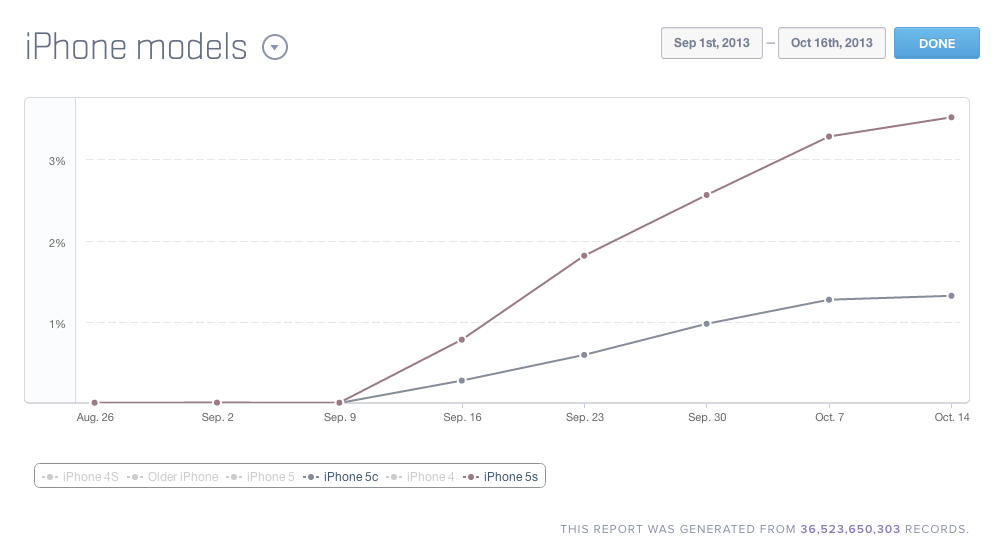
The above lines up with anecdotal reports we’ve heard from various Apple Store and carrier retail employees that the iPhone 5s is hard to keep in stock, while the iPhone 5c remains readily available. At first, it was unclear whether or not this might be attributable simply to an abundance of supply of the lower cost device, but increasingly, it seems demand plays a role, too.
Apple still managed to sell 9 million iPhones in total during its launch weekend, however, and the iPhone 5c isn’t designed as a marquee or flagship seller. What’s more likely is that interest in the iPhone 5c burns more slowly, but perhaps more consistently – its target shoppers aren’t the type to rush out to a launch day celebration, and are much more likely to be swayed by in-store specials and carrier/retailer discounts as time goes on and their contracts run out.
We’ve reached out to Apple for comment on the matter, and will update if we hear more.


Claus.dahlAlso, awesome band name
In game theory, grim trigger is a trigger strategy for a repeated game, such as an iterated prisoner’s dilemma.
Initially, a player using grim trigger will cooperate, but as soon as the opponent defects (thus satisfying the trigger condition), the player using grim trigger will defect for the remainder of the iterated game.
Since a single defect by the opponent triggers defection forever, grim trigger is the most strictly unforgiving of strategies in an iterated game.
(wikipedia)
Claus.dahlLiiige lang nok, men gode laffs her og der
I'm not sure that the bad lip reading of NFL players will ever be topped, but this dubbing of Game of Thrones with alternative dialogue is pretty great too.
(via devour)
Tags: Game of Thrones remix videoClaus.dahlTjotal respekt Yahya. Ikke mere offerpis af *nogen* art.
Claus.dahlwhoa - the net is degrading from rampant silofication. Some of the silos are our own.... the noisy chatty place we used to know is going to be a faint memory like The Well or something. We had a good run, though
Publishing analytics startup Parse.ly released its second quarterly “Authority Report” on Wednesday. The highlight: Dark search now accounts for the vast majority — over 87 percent — of referrals from Google’s search engine.
“Dark search” means search terms aren’t included in the data that a publisher gets when someone finds its site via Google. Publishers will know users came from Google, but that’s about the extent of it. Naturally, the practice has caused some headaches in the SEO world, but one has to assume people have become accustomed to the opacity by now.

Source: Parse.ly
Besides, one could argue that SEO is soon to be a relic as the field of intelligent search continues to advance. Google and others are betting that consumers care less about keywords than they do about context — that is, finding the content or information they want whether or not it happens to contain exact phrases. I’d bet they’re right.
Otherwise, the Parse.ly report is very similar to the one it put out in August: Facebook dominates social referrals, Feedly dominates RSS referrals and — whether it’s including search terms or not — Google dominates everything.

Related research and analysis from GigaOM Pro:
Subscriber content. Sign up for a free trial.
Claus.dahlPerfekt old-europe parodi
The first trailer for Wes Anderson's new movie. This looks great!
Tags: movies The Grand Budapest Hotel trailers Wes AndersonClaus.dahllink 2 - goog's docker. link 1: Prototyping er bare så nederen - det skal være easy build. I'm waiting for Macaw....
Claus.dahlbaddeste keyboard EVAH!

This toy keyboard is being used to play music on an NES. As you probably already know, the hardware inside those original controllers was dead simple. They’re just a parallel to serial shift register that reads from all of the keys. To get this keyboard up and running [heavyw8bit] simply mounted eight chips inside the gutted toy, connecting two of them to the keyboard keys, and the rest to the array of push buttons he added to the right.
So what’s the point of using this as a quadruple game controller? Are you expecting to see what a full speed-run of Contra looks like using this as the controls? That’s not the point at all. This becomes a musician-friendly frontend for the NES synthesizer ROM called NESK-1. [heavyw8bit] wrote the game/program in order to allow you to use the original console hardware to play all of the sounds you know and love. Our favorite is the arpeggio example heard at about 2:35 into the clip after the break.


Claus.dahlEt must
It was an unusually busy week, mostly because of the preparations for our Mobilize conference next week. In addition, there were many events to be attended. Not surprisingly, all that activity ate into my reading time. But still, I did get enough time to put together this list, though I wish I had even more topic variety.
And now a personal message: I am hosting GigaOM RoadMap, an experience design conference with Katie Fehrenbacher on November 5th and 6th in San Francisco. I would love for you to join the two of us and we’ll have experts like Jack Dorsey (of Square and Twitter) and Kevin Systrom along with many more speakers tell us the role of design in our increasingly digital society. For details, visit the conference website.


There's a story about NASA's incredibly expensive space pen and Russia's simpler solution that gets trotted out every time some large organization introduces some complex, bloated, over-engineered product or process. The story goes like this:
During the space race back in the 1960's, NASA was faced with a major problem. The astronaut needed a pen that would write in the vacuum of space. NASA went to work. At a cost of $1.5 million they developed the "Astronaut Pen". Some of you may remember. It enjoyed minor success on the commercial market.
The Russians were faced with the same dilemma.
They used a pencil.
Fantastic story, right? Except that's not what happened. NASA originally used pencils in space but pencils tend to give off things that float in zero-g (broken leads, graphite dust, shavings) and are flammable. So they looked for another solution. Independent of NASA, the Fisher Pen Company began development of a pen that could be used under extreme conditions:
Paul C. Fisher and his company, the Fisher Pen Company, reportedly invested $1 million to create what is now commonly known as the space pen. None of this investment money came from NASA's coffers -- the agency only became involved after the pen was dreamed into existence. In 1965 Fisher patented a pen that could write upside-down, in frigid or roasting conditions (down to minus 50 degrees Fahrenheit or up to 400 degrees F), and even underwater or in other liquids. If too hot, though, the ink turned green instead of its normal blue.
After testing, NASA ordered 400 Fisher pens for use on space missions at a cost of under $1000. Russia switched to using the pens a year later. Fisher still sells the original Space Pen and you can get it on Amazon for about $32.
Tags: NASAClaus.dahlThis would have been *awesome* if he didn't actually remind people that the drawing has the two ways of seeing

Remember that old drawing that, depending on your perspective, could be a young woman turning her head to look at a bright future or a haggard old lady with a tired gaze? Reading through Twitter’s prospectus, I half-expected to see that chestnut included there. Because it’s the perfect illustration of how this company’s outlook is portrayed in its own words.
Twitter’s S-1 document is full of financial data, as you would expect from any responsible company planning to list its shares on the public market. Yet what you take away from it seems to depend even more on how you interpret that information. Is this an undercooked startup trying to go public without earning a penny? Yes! Does its potential to scale up into massive global growth make it an alluring investment? Okay!
In a way, this isn’t surprising. When it comes to investing in tech IPOs, there have always been two primary schools of thought: Invest in proven profits, or invest in promised growth. One of these approaches is prudent but can shut you out of huge returns. The other is intoxicating but can end in tears when a stock plunges from manic highs.
Nathaniel Mott outlined several dualities that Twitter embodies. In the community of tech-stock investors, it is illuminating, and even exacerbating, one more: the age-old debate between fundamental investing and momentum investing. There is ample fuel in its prospectus to fire up arguments on both sides.
Skeptics need only point to the income statement to make their case. Since 2010, Twitter has brought in $705 million in revenue. To do that it’s had to spend more than a billion dollars in marketing, R&D and other expenses. In other words, Twitter has had to spend $1.50 for every dollar of revenue it’s seen in the past three and a half years.
What’s more, Twitter’s revenue in the first half of 2013 more than doubled from the same period a year earlier to $254 million. But expenses rose 89 percent in that same period to $316 billion. Compare that to 2011, when the revenue growth rate was 198 percent and the expense growth rate was 69 percent. Revenue appears to be decelerating while spending seems to be accelerating. Not a promising trend for a company going public to be caught in.
A Twitter bull would point to the reasons Twitter gives (on page 69 of the S-1) for that increased spending: Twitter is building out its data centers aggressively. And it’s hiring just as aggressively, while paying for new office space for a growing work force. In other words, Twitter is investing to scale up to the kind of growth that could bring in revenue, and eventually profits, for many years.
Further down (page 107), Twitter outlines that growth strategy: Grow users, expand geographically, enrich the platform – especially its mobile app. Three fourths of Twitter’s users accessed the service from mobile devices, and 65 percent of its ad revenue came from mobile. That would help Twitter reach out to more advertisers, many of which are still unsure about social network ads, let alone mobile ads. Twitter plans to improve ad targeting, build stronger partnerships with media companies and, again, reach out to overseas advertisers. The company says that 77 percent of its users last quarter came from outside the U.S., while only 25 percent of its ad revenue did.
There is just as much disagreement over the growth that Twitter is already seeing. On the one hand, revenue per user has increased to 60 cents last quarter from 50 cents a year earlier. On the other, it still lags the $1.60 revenue per user of Facebook and LinkedIn’s $1.90 figure. That could suggest Twitter lacks the revenue potential of two of its peers or that it’s still early in the monetization process.
Another example: Twitter’s monthly active users has grown to 218 million in the most recent quarter from 151 million a year earlier. But its user growth rate has slowed to 7 percent last quarter from 18 percent in early 2012. That could suggest Twitter growth is stagnating, or it could be the growth has slowed because the company is getting better at shutting down spam accounts.
On balance, the bullish case seems to be the more credible one, although that may not make the stock an attractive buy. That will depend more on how the deal is priced. If Twitter is valued at $12.8 billion, it could be worth 20 times its 2013 revenue. That’s four times Google’s price-to-sales ratio, but on par with Facebook’s and LinkedIn’s. But those two companies have a history of profits, and Twitter won’t be profitable this year, and many not even be profitable for another year or so.
The Twitter IPO is an important one because it comes right as the market for tech stocks stands at a crossroads between these two investment modes. Consumer Web stocks have been rallying ever since Facebook’s most recent financials showed it’s possible to monetize mobile ads in a way that grows profits.
The needle seemed to be moving toward momentum-driven investing based on promise rather than profits: Stocks like Yelp and Zillow are surging even though they’re not expected to be profitable in 2013. If investors embrace Twitter’s promising growth story, it could throw another log onto the fire burning under Web stocks.
If, however, it turns out Twitter can’t monetize its mobile platform as successfully as Facebook, the alluring young company that many investors are seeing inside the company may be unmasked as just another tired old business model. And that disappointment could dampen the broader rally in Web stocks.


|
|
From the Harvard Gazette, Walter Isaacson writes about Bill Gates' years at Harvard.
It may have been the most momentous purchase of a magazine in the history of the Out of Town News stand in Harvard Square. Paul Allen, a college dropout from Seattle, wandered into the cluttered kiosk one snowy day in December 1974 and saw that the new issue of Popular Electronics featured a home computer for hobbyists, called the Altair, that was just coming on the market. He was both exhilarated and dismayed. Although thrilled that the era of the "personal" computer seemed to have arrived, he was afraid that he was going to miss the party. Slapping down 75 cents, he grabbed the issue and trotted through the slush to the Currier House room of Bill Gates, a Harvard sophomore and fellow computer fanatic from Lakeside High School in Seattle, who had convinced Allen to drop out of college and move to Cambridge. "Hey, this thing is happening without us," Allen declared. Gates began to rock back and forth, as he often did during moments of intensity. When he finished the article, he realized that Allen was right. For the next eight weeks, the two of them embarked on a frenzy of code writing that would change the nature of the computer business.
What Gates and Allen set out to do, during the Christmas break of 1974 and the subsequent January reading period when Gates was supposed to be studying for exams, was to create the software for personal computers. "When Paul showed me that magazine, there was no such thing as a software industry," Gates recalled. "We had the insight that you could create one. And we did." Years later, reflecting on his innovations, he said, "That was the most important idea that I ever had."
And here perhaps is the worst idea Gates ever had:
Tags: Bill Gates Harvard Microsoft Walter IsaacsonClaus.dahlog gav helt ny mening til frasen "bringing your A. game"

He also invented a fantastic coffee machine.
Claus.dahlstill want
*More fallout from Maker Faire Rome.
Exploration Kit Series from littleBits on Vimeo.
Exploration Kit Series
from littleBits
“The littleBitsTM Base, Premium and Deluxe Exploration Series Kits will keep curious minds engaged for hours and include everything you need to kick-start your creativity, no soldering, programming or wiring required. Bits modules intuitively snap together with magnets, so you can never make a mistake while building. With the Exploration Series, anyone and everyone can use the modules to create circuits and explore the world of electronics. You can also add the modules to almost anything, including craft materials, household items or even toys, to “make something that does something,” like a nightlight, an electronic birthday card or a Morse code machine.
“Every Exploration Kit has a fantastic variety of modules grouped into four different categories and color coded to simplify the creation process for artists, makers, students, designers and budding engineers alike. Blue power modules are needed in every circuit and are the start of all your creations. Pink input modules accept input from you and the environment and send signals to the modules that follow. Green output modules DO something – light, buzz, move. Orange wire modules expand your reach and change direction – great for helping to incorporate littleBits into your projects.
“littleBits makes an expanding library of modular electronics that snap together with magnets. Bits modules are just the beginning. Combine them with craft materials, building sets, and other toys to electrify your life. Find out more at littleBits.com”

|
|
Avril Haines, The Least Likely Spy - Newsweek
Avril is the Deputy Director for the CIA. We weren’t close back in high school, but the nerd crew had quite some nights in that apartment full of books. I knew Avril to be brilliant and kind. And looking back, it turns out more of us than I’d imagined were dealing with illness in the home. Reading it reminded me of how dark it was to leave high school every day and go home to a hospital-ed up living room.
It was New York in the 80s, true, but it was Alpha Nerds, mostly. So there was little of what you imagine high school kids getting into, in that apartment full of books. Mostly. Mostly little of that.
Anyway: Deputy Director. It’s a wise choice, if character is a component, and it should be. I feel safer, and I don’t say that frequently.
—
Robot Monastery just asked what makes me feel safer. I feel safer knowing that the Deputy Director of the CIA has the upbringing I witnessed: thoughtfulness, kindness, humility, wisdom. Raised in the complexity of New York City in the 70s, and a household that demanded empathy, courage, and character. That’s not everything you need for the position, but in the past, we’ve started with a lot less than that.
Claus.dahlOK, considering Twitter completely squandered their original platform-capability these numbers are bleak

Twitter has just filed for its long-anticipated IPO. The company is looking to raise $1B in this initial offering, which is set to mint many millionaires among shareholders and founders like Ev Williams, Jack Dorsey and Biz Stone. Currently, the filing does not list a valuation, and sources are saying that’s because they have yet to determine one.
Twitter’s revenues have been revealed for the first time as well. Revenues for 2012 were $316.9 million, for a loss of $79.4M and in the first half of 2013 they’ve already earned $253.6M for a loss of $69.3M. That’s just above estimates from last year but well below tracking of over $600M for the year. Overall, Twitter has lost $418.6M since it began.
Twitter will be offering up 472,613,753 shares of stock in this initial release. Twitter says that it currently has 218.3M monthly active users and those users have created over 300 billion tweets. That MAU number is significantly lower than many had expected at this point as they announced that they had 200M MAUs in December. Twitter says that it delivers over 200B tweets per day.
Twitter says that 75% of its MAUs access the service from mobile devices (that’s 161.25M) and that 65$of all of its ad revenues come from mobile. This marks a big contrast to Facebook, which had no revenues in mobile at all when it filed for IPO.
Twitter says that in the second quarter of 2013 there were approximately 30 billion ‘online impressions’ of tweets off of its properties. The companies’ current estimates put spam accounts at under 5% of MAUs, but says that this may not be accurate.
On the employment front, Twitter says that it has gained over 900 employees in the year since June of 2012, an increase of 90%. It currently employs over 2,000 people.
Twitter’s IPO has been a hotly anticipated event for some months now, with news of Twitter’s ‘secret’ filing coming via a Tweet last month. The stealth filing was made possible by the JOBS (Jumpstart Our Business Startups) act which allows companies with under $1B in revenue to file for an IPO without exposing the details immediately.
Twitter lists a number of risk factors in the filing noting that the business could be harmed if “influential users, such as world leaders, government officials, celebrities, athletes, journalists, sports teams, media outlets and brands or certain age demographics” conclude that an alternative product or service is more relevant, they are unable to convince potential new users of the value and usefulness of our products and services or they are unable to combat spam or other hostile or inappropriate usage on the platform.
This story is developing…
Image Credit: Lisa Cee
Claus.dahlDet er en awesome forudsigelse

Netscape founder and venture capitalist Marc Andreessen thinks the world is going to see an explosion of new countries in the years ahead.
“I think there is going to be double, triple, quadruple countries in the coming years,” Andreessen told Sarah Lacy at Thursday night’s PandoMonthly in San Francisco.
The cofounder of venture firm Andreessen Horowitz noted that the borders of today’s countries are in some cases arbitrary, pointing to Iraq, Syria, and much of Africa as artificial constructs. In the last few decades, the world has seen the emergence of a litany of new companies, and he sees no reason why that splintering is going to slow down.
“You’re going to get a much larger number of countries,” he said, before noting that the proliferation of nations could be a positive force in the long term, measured by a span of 100 years or more.
“The transition is going to be very painful,” he said, “but I think ultimately it’s going to be very healthy.”
He envisions a world in which neighboring countries choose to ally with each other and collaborate, rather than foment conflict. And, he thinks, software will play an important role in that cross-border cooperation.
“Notwithstanding what Malcolm Gladwell says, it is these technologies that is going to make that possible,” Andreessen said, pointing to the likes of Twitter and Facebook, which he said have accelerated the rise of social protest in recent years.
The president of Turkey has said that Twitter is insidious evil, which is an indication of the medium’s levity. Andreessen noted the irony that in Silicon Valley the criticism of Twitter is that it enables teenagers to tweet about what their cats ate for breakfast.
“The underlying point is you give people communications tools,” he noted, adding that one of his favorite books is “Orwell’s Revenge,” which is essentially a rewrite of “1984.” A central premise of the book is that people are given two-way screens in their homes so that everyone can broadcast.
“When you give people the ability to learn and express themselves and organize, that is going to change a lot.”
[Marc Andreessen is an investor in PandoDaily]
[Photo by Yelena Sophia / Bloom Productions]


|
|
Claus.dahlAmazing talk by Maciej - long time fan; glad to see he's doing well with pinboard
Claus.dahlSeeeeeeeejt!

Take a piano. Strap a projector above it. Build a Guitar Hero-esque interface that shows upcoming notes, and project it down onto the Piano’s top surface and keys. What do you get?
The piano instructor of the freakin’ future. Or, at least, a piano instructor that won’t yell at you and make you wish you decided to stick with soccer after all.
Highlighted in a video by NewScientist this morning, the Projected Instrumented Augmentation System is a project built by a team out of Germany’s Ulm University. Combining the aforementioned projection setup with logic that detects what you’re playing, the system is able to illuminate mis-pressed keys, and can move the song’s notes along at your pace.
Yeah, yeah. This might not teach you to actually play the piano — at least, not without lugging a big ol’ projector with you everywhere or memorizing everything you want to play. It certainly won’t teach you how to read sheet music. But it would help you get more comfortable poundin’ away at the old ivories, and help you learn to contort your hands into the many crazy shapes that piano playing requires. Plus, it probably feels pretty awesome to play along with.
This certainly isn’t the first time we’ve seen piano playing gamified, with companies like Konami (with Keyboard Mania), Harmonix (with Rock Band 3) and to some extent Smule (with Magic Piano for iPad) having toyed with the concept in their own ways. But this is the first time I’ve seen it mashed up directly onto the piano — and man, does that look rad.
If you’ve got a MIDI keyboard and are looking for something sort of similar (albeit without the crazy projection setup), check out Synthesia.
Claus.dahlligner Milk-bordet
Stir, a company based in Pasadena, Calif., has created a connected, height adjustable desk that it bills as part of the quantified self movement. Founder and CEO JP Labrosse was very clear about his hope that people would accept this in the same category as their Jawbone Up bands or their Zeo sleep monitors.
But in looking at the beautiful, $4,000 (okay $3,890) piece of furniture all I saw was this generation of startups’ Aeron chair — that ubiquitous piece of office furniture in startups from the late 90s and early aughts. The chair was ergonomic, but at about $900 it was just pricey enough that you wanted your first round of funding before you splurged.
The potential health and productivity benefits for your valued employees was worth the cost. And like that chair, the Stir Kinetic Desk has a similar proposition, only updated for this decade’s health concerns and outfitted with today’s technology. The concern is sitting. As I type this standing at my own height adjustable desk (unconnected, $1,100 with tax and delivery), I’m currently proof of the ubiquity of this concern.

And I’m clearly not the only one. Employers are shelling out for sit/stand desks for employees as articles come out trumpeting the dangers of sitting. Labrosse even gave me the welcome news that if I stood for four hours a day I’d burn an estimated 4,000 more calories per month.
So, let’s talk about the desk itself. It’s a really attractive piece of furniture. Labrosse was a former product designer at Apple. My desk (pictured below) doesn’t have shielding between the lift mechanism in the legs and the cord management is two circles on top. To raise or lower the desk, I have to hold down one button while I toggle another up or down. There are no pre-set settings.

The Kinetic desk makes mine look like cinderblocks and plywood on hydraulics. It has a capacitive touch screen in the lower left hand corner that controls the lift mechanism and moves it to one of several pre-set locations. That same screen shows you how long you’ve been standing or sitting, while a thermal sensor underneath the desk tracks how long you are actually at your desk. There are charts and data to track your sitting and standing.
The screen is set in a thick piece of white varnished wood (it also comes in black) that contains an inset cord management system on each back corner of the desk. It has eight plugs and USB ports powered by one cord dangling down from the desk. Finally, you can order the desk with one of several shades that color the underside, inside the cord management inset and the desk’s single power cord.
 Labrosse says the desk has a learning algorithm (like the Nest!) that can remind you when you generally like to stand. If you put it in automatic mode it will move for you. If you put it active mode, where you control and then get really focused and stop moving, it will gently move up and down (“like a breath” says Labrosse) to remind you to take a break or to move the desk.
Labrosse also wants to connect people’s activity tracking devices eventually so if you go for a long run in the morning, the desk might change its prompts to give you a chance to recover. It would be awesome to connect this desk via If This Then That so the desk could act as a trigger. Like when the thermal sensors sense you’ve left, it turns your IM status to away. Or perhaps the desk could move up or down in response to an email form your boss.
I asked Labrosse if he might put a few LEDs inside the desk to give it more ambient information delivery capabilities, and he was just as excited as I was to talk about what you might want your desk to tell you versus a phone or another connected device. Labrosse’s pitch was very much like a mattress salesman’s … you spend a third of your life at your desk, shouldn’t it be good for you and beautiful.
And yet, for now, this is a desk for the 1 percent. It’s beautiful, pushes us closer to this idea of everything being connected, but it does it in an incredibly expensive way, with hand-crafted wood tops made in Brooklyn and a value add that will appeal only to the upper echelon of techies. And those who want it must wait until the first quarter of next year for delivery.
I can see executives and maybe engineers at companies with fat profit margins or VC funding, working at these, but it’s hard to envision someone like myself picking one up, even if I wanted to. But if I did pick up such a desk, I know exactly the chair I’d want to go with it.

Related research and analysis from GigaOM Pro:
Subscriber content. Sign up for a free trial.
Claus.dahlHmm, jeg burde lave sådan en her ud af mine Old Reader-shared
Her er de seneste bookmarks, jeg har gemt eller twittet om:
Se alle mine bookmarks på Pinboard.
The post Mine seneste bookmarks (03.09.13 – 24.09.13) appeared first on Morten Gade.
Claus.dahlIndeed - was an awesome post
Claus.dahlGoogle læsper! Systematisk
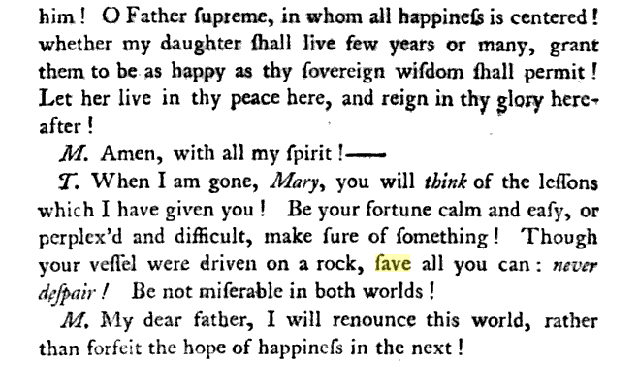
While researching the etymology of the word "fave", a noun that's in the process of being verbed1, I noticed that, according to Google's ngram viewer, the word was much more popular in the 1600-1700s than it is now.

A bit of investigation reveals that Google's book-scanning software is at fault; it can't recognize the long s commonly used in books prior to the 1800s. So each time it encounters "save" with a long s, it sees "fave":


[1] "Fave" (n., adj.) is slang for "favorite", a usage that started in the US in the 1920s, as in "Teddy Roosevelt was totally my fave President". Recently, "fave" (v.) has come to mean liking or marking an item as a favorite on social media services like Twitter, Flickr, Facebook, Tumblr, Stellar, etc. (IMPORTANT: It's "fave", not "fav". Let's get this one right, people.) ↩
Tags: Google Books language typography
