Shared posts

08 Nov 11:49

Back of a Philly cab warning against using payment systems other...

Claus.dahl

"The real world is full of toes to step on." - god linje


Back of a Philly cab warning against using payment systems other than the one provided in the cab, including white cubes attached to cellphones, whatever might arrive in such forms. The thing about the IoT, where the T includes taxis, is that it ain’t like the internet of Internets. The real world is full of toes to step on. Cc @capoglou

08 Nov 11:48

OK Go's I Won't Let You Down

Claus.dahl

Det tekniske nivo er højt, men blir også en smule overkill, tænker jeg

Segway chairs, drones, and umbrellas as an LED display  
08 Nov 11:46

"Nearly two dozen Western hostages held together in a...

Claus.dahl

Horribelt, men uafviseligt


"Nearly two dozen Western hostages held together in a 215-square-foot cell in Syria made a chess set from discarded pieces of paper." from the horrifying trigger-warning article in the NYT about the lives of ISIS hostages, which is the toughest read of any news in a dark and long news cycle.

(via The Horror Before the Beheadings - NYTimes.com)

08 Nov 11:41

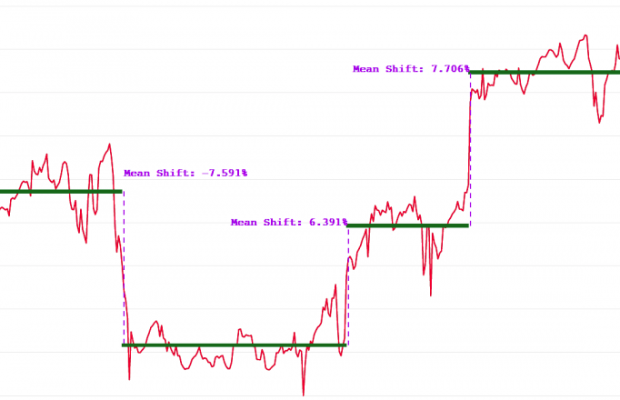
Breakout detection in R

by Nathan Yau
Claus.dahl

Regime change algoritm - bookmarked

Breakout detection

Say you have time series data and you want to detect significant changes, but there's also a lot of noise to sift through. Twitter released an open source R package, BreakoutDetection, to help with that.

Our main motivation behind creating the package has been to develop a technique to detect breakouts which are robust, from a statistical standpoint, in the presence of anomalies. The BreakoutDetection package can be used in wide variety of contexts. For example, detecting breakout in user engagement post an A/B test, detecting behavioral change, or for problems in econometrics, financial engineering, political and social sciences.

Was a quick installation and worked as expected for me. Twitter has released plenty of open source projects, but I think this is the first R package. Nice.

Tags: changes, time series, Twitter

08 Nov 11:09

We the Economy

by Jason Kottke
Claus.dahl

Knippelgod idé. Sidder netop og formulerer tanken om at bruge Bret Victors Tangle library til at lave et single serving site, der får forskellige basale økonomiske termer til at hænge sammen

We the Economy is a series of 20 short videos that attempt to explain important economic concepts. For instance, acclaimed director Ramin Bahrani did a video about regulatory capture starring Werner Herzog, Patton Oswalt, and the Sherman Antitrust Act of 1890.

Anchorman director Adam McKay directed an animated My Little Pony-esque video about wealth distribution and income inequality featuring the voice talents of Amy Poehler, Maya Rudolph, and Sarah Silverman.

Paul Allen and Morgan Spurlock are behind the effort, with Bob Balaban, Steve James, Catherine Hardwicke, and Mary Harron directing some of the other videos. (via mr)

Tags: Amy Poehler   economics   Maya Rudolph   Patton Oswalt   Ramin Bahrani   Sarah Silverman   video   Werner Herzog
08 Nov 11:03

Happy 45th Birthday, Internet!

by Matt Novak
Claus.dahl

Good good, I never thought about it that way, but I'm about two weeks younger than the Internet.

Happy 45th Birthday, Internet!

Happy birthday, Internet! You may be turning 45 today, but we swear you don't look a day over 30. And not to embarrass you, but we thought we'd celebrate by sharing some of your baby photos. Or, more accurately, perhaps some of your sonograms.

Read more...

08 Nov 11:01

James Cameron doesn’t think Oculus is a big deal

by Janko Roettgers
Claus.dahl

I'm annoyed that GigaOm has given up on RSS - we're down to Pando doing it right by now, basically - should probably just tune out Om, if they aren't actually publishing any more.

The tech world may be in love with the Oculus Rift and its mobile offspring, the Gear VR headset, but Avatar director James Cameron thinks it's all a big yawn.

James Cameron doesn’t think Oculus is a big deal originally published by Gigaom, © copyright 2014.

Continue reading…

08 Nov 11:00

Louis Menand, say what???

by davidw
Claus.dahl

Clearly we all need to reread Austins 'how to do things with words' in the context of technology - the notion of intent, the imperative aspect of language, is much more complicated now that language is more intensely mediated than ever before; so many speakers, so much intent, so *varied* intent.

Can someone help me understand how Louis Menand sets up his Oct. 20 piece on copyright in the New Yorker? Menand’s a great writer, and the piece has gone through the NYer’s famous editorial process, so I am confident that it’s my fault that I am stuck staring at a couple of paragraphs not understanding what he’s talking about. I expect to be slapping my forehead momentarily.

Let me tell you why this matters to me, beyond my high expectations for New Yorker writing. When the New Yorker takes the Internet as its subject, it tends to be in the Traditional Resistant camp — although I acknowledge that this may well be just my observer’s bias. Their writers acknowledge the importance of the Net and nod at the good it does, but then with some frequency focus on the negative side, or the over-inflated side. Of course that’s fine. They’ve got some great writers. And Menand is not taking that side in this article. But if Menand’s description of how the Web works is as wildly wrong as it seems to me to be, then it raises some special concerns. If the New Yorker can’t get these basics right, then we have further to go than I’d thought. (Keep in mind that I am not all confident in how I’m reading this passage in the Menand article.)

So, Menand begins by imagining that an anthology called “Most Thoughtful Essays” includes his essay without his permission. Then he asks us to…

…suppose that a Web site, awesomestuff.com, ran an item that said something like “This piece on copyright is a great read!” with a hyperlink on the word “piece” to my article’s page on The New Yorker’s Web site. You wouldn’t think this was banditry at all. You would find it unexceptionable.

Some courts have questioned the use of links that import content from another Web site without changing the URL, a practice known as “framing.” But it’s hard to see much difference. Either way, when you’re reading a linked page, you may still be “at” awesomestuff.com, as clicking the back button on your browser can instantly confirm. Effectively, awesomestuff.com has stolen content from newyorker.com, just as the compiler of “Most Thoughtful Essays” stole content from me. The folks at awesomestuff.com and their V. C. backers are attracting traffic to their Web site, with its many banner ads for awesome stuff, using material created by other people.

When he says “it’s hard to see much difference,” the two cases seem to be awesomestuff.com including a hyperlink “to my article’s page on the NYer’s Web site” and awesomestuff.com embedding the entire article at their site in an iframe. But in the first case (clicking on the normal link) you are taken to NewYorker.com and are not on awesomestuff.com.

Even more confusing, when you’re now at NewYorker.com, clicking the back button will confirm that you were in fact not at awesometuff.com, for the page will change from NewYorker.com to awesomestuff.com. And, if awesomestuff.com has embedded Menand’s article via an iframe, clicking on the back button will take you to whatever page you were at before awesomestuff, thus proving nothing.

Finally, since the point of all this is to show us how linking is equivalent to printing Menand’s article in a paper anthology without his permission, it’s weird that Menand leaves out what is by far the most common case that might be equivalent: when a page neither links to another page nor uses an iframe to embed its content, but simply copies and pastes from another site.

So, as far as I can tell, the most coherent way of taking the words that Menand has written — and he’s a precise writer — contradicts the most basic experience of the Web: clicking on a link and going to a new page.

So where am I going wrong in reading him???

By the way, the rest of the article provides a good general overview of the copyright question, and is sympathetic to the reformist sensibility, although it is surprisingly primer-like for a NYer article. IMO, natch.

08 Nov 10:52

"I am writing this letter to share with you what has been on my mind and heart for several years now...."

Claus.dahl

Hvorfor er min old reader pludselig Murder-themed?

“I am writing this letter to share with you what has been on my mind and heart for several years now. For the last few nights, I have stayed awake writing this letter in my head, and each time, I found myself mentally balling up the pages. I just couldn’t find the right words to convey how deeply remorseful I am for causing your death.”

-

The Apology (A Letter To The Man I Murdered) — Medium

Shaka Senghor, who I have come to know through the Media Lab. Like a few other people I’ve met there, he’s changed how I see the world. Thank you for that.

08 Nov 10:43

The Internet Arcade

Claus.dahl

Att: @kahrzdn

Jason Scott just dropped a bomb: 900 classic arcade games emulated in the browser  
08 Nov 10:36

Ex Machina

by Jason Kottke
Claus.dahl

Link dødt, trailer her: https://www.youtube.com/watch?v=b20dZiTWf1E - er det Scarlett Johansen igen som AI? Det har godt nok været meget techno i grønne omgivelser lately

The directorial debut of Alex Garland, screenwriter of Sunshine and 28 Days Later, looks interesting.

Ex Machina is an intense psychological thriller, played out in a love triangle between two men and a beautiful robot girl. It explores big ideas about the nature of consciousness, emotion, sexuality, truth and lies.

(via http://devour.com/)

Tags: Alex Garland   Ex Machina   movies   robots   trailers
08 Nov 10:34

By speaking for just herself, Rachel Sklar speaks for all women

by Sarah Lacy
Claus.dahl

Vi er nødt til at unfucke forbindelsen mellem arbejde og, you know, liv - og mellem kønnene

sklar

I guess it had to happen eventually.

Rachel Sklar and I have not always seen eye-to-eye on how to talk about the challenges facing women in tech, and beyond. Today, however, Sklar wrote something about women that I completely agree with. Like nodding-at-every-word agree with.

In an honest, thoughtful essay, posted today on Medium, Sklar shared with the world the news that she is single, 41, and pregnant. And — although Sklar doesn’t say it quite this aggressively– she essentially adds that if people, pregnancy books, or the establishment isn’t cool with that, that’s sort of their problem. They are the ones out of date, not her, she says.

Unlike Renee Zellweger’s bizarre “what are you talking about?” response to suddenly looking like Kristen Wiig, Sklar has responded to what could be a socially awkward situation by being incredibly honest about what happened. That hers was an unplanned pregnancy. That it was from a relationship she is no longer in. And that, she’s spent many a night before the last three-plus months, crying alone on her bed wondering if she would ever be able to have kids. What could seem like a curse to many women is a blessing to her.

This is such an important conversation, and I’m incredibly impressed by Sklar’s willingness to own it in such an authentic way. I’m not sure I would have had that level of courage– particularly in a city like New York where there seems to be more pressure for women to snag a man young or spend their life alone. As the glass ceiling breakers of a previous generation have enabled women to have more opportunities and society (and Sex and the City etc) has made it more socially acceptable to marry later, options for women have comparatively exploded– even if we don’t still make as much as a man with those options.

But one thing simply doesn’t change: Reproductive realities. The fact that we can put off so many life altering decisions so late but can’t push off possibly the biggest one– whether or not to spend the rest of our lives raising another life– is jarring. It’s like we’re stuck with a foot in each era, when all three life decisions of marriage, career, and family are hopelessly intertwined and historically have been dependent on one another.

Most of what I love about Sklar’s piece is this: She speaks for herself and, in doing so, she speaks for women broadly. It’s a massive pet peeve of mine when women look to other high profile women to define how they should arrange their careers, marriages, maternity leaves or anything else. Witness: The recent scandals about whether it’s a bad thing that companies like Apple and Facebook are covering egg freezing for employees. The gist of the argument is that offering the option is somehow forcing women to work longer and put off having families. But that view treats women as if we’re mindless drones willing to suddenly put of families we would have had because an employer suggests it.

Women are stronger than that, whether men get that or not. And the strongest ones define what “having it all” means for them, and no one else. My definition of “having it all” would likely seem like torture for another woman. But I feel nothing but blessed everyday.

A few months into her pregnancy, Sklar is already showing something many people miss: A pregnant woman is perhaps the most resilient thing in the world. Western culture treats pregnant women like they are disabled — let me carry that bag with a blouse in it for you!– but I found my true inner strength pregnant. I felt like a super hero in a comic book where suddenly my body knows how to do things I never knew it did– like swing from webs, or deflect bullets. I’m growing a fucking human, what are you doing with your day? 

The more women trust themselves and believe like Sklar that the rest of the world is the one with the problem, the more we grapple with the curse and infinite blessing of a finite biological clock.

Sarah Lacy

Sarah_Lacy_6x6
Sarah Lacy is the founder and editor-in-chief of PandoDaily. She is an award winning journalist and author of two critically acclaimed books, "Once You're Lucky, Twice You're Good: The Rebirth of Silicon Valley and the Rise of Web 2.0" (Gotham Books, May 2008) and "Brilliant, Crazy, Cocky: How the Top 1% of Entrepreneurs Profit from Global Chaos" (Wiley, February 2011). She has been covering technology news for over 15 years, most recently as a senior editor for TechCrunch.


08 Nov 10:32

Links for October 31st

by delicious
Claus.dahl

this is old - but very good; simpler and more playful than, say, knockout

07 Nov 22:24

My Grandma The Poisoner

Claus.dahl

Dafuk. Dette er det ANDET piece af en velskrivende med en morder i familien denne uge

"People were always dying around Grandma"  
07 Nov 22:23

Edward Snowden and the Justice League: A review of Citizenfour

by Eileen Jones
Claus.dahl

Skal læses

Screen Shot 2014-11-02 at 1.22.21 PM

We’re living in strange times, and we have the films to prove it. Today’s exhibit: Citizenfour, a movie about…well, I don’t know what. I’m baffled.

Citizenfour seems to present itself as a documentary that’s been awkwardly welded to a political thriller “starring” Edward Snowden as himself—a pale, nerdy political martyr urging film director and journalist Laura Poitras to spare others by “nailing me to the cross” and revealing to the public his leaked documentation of the NSA massive domestic and international surveillance programs. It co-stars Glenn Greenwald and Ewen MacAskill as, respectively, the obnoxious career-obsessed newshound who manipulates the naïve Snowden for his own purposes, and the old mensch journalist who tries to inject a note of common sense into the bizarre proceedings. The female lead is played by Poitras herself, a shadowy narrator figure behind the camera who shares an intense communion with Snowden and whose point of view defines Snowden for us. In a supporting role, William Binney, by far the most likable character, plays the tough old codger who’s already paid a heavy price for being an NSA whistleblower and is refreshingly practical and unself-pitying.

But it ends up turning into a ponderous thriller indeed, mostly filmed in a hotel room in Hong Kong, where Poitras was holed up with Snowden for eight days. There she records extended interviews in which he tells her, Greenwald, and MacAskill his story, discusses the journalists’ rollout of his NSA documents, frets, stares out the window, and awaits discovery.

It’s a strange interlude in that hotel room. It’s speciously informative as we hear Snowden tell the journalists who he is and, broadly, what he’s handing over to them, as well as conveying his own sense of himself as a man with a mission, sacrificing himself for a highly moral cause. Only the details of how Snowden went about leaking the information are new to anyone who’s been halfway paying attention, as many critics have observed. The film contains no major revelations about NSA and other government surveillance programs that haven’t already been widely reported.

But you can’t help asking a lot of awkward questions about “character motivation” while you’re stuck in that hotel room with Poitras and Snowden. For example, what possessed Snowden to allow this whole super-secret process to be filmed in the first place? Snowden is so worried about being “viewed” that he drapes a towel over his head and his laptop while typing a message, lest there be a hidden camera planted behind him in the headboard of his bed. Didn’t he worry about being “viewed” as the hero of a film?

And despite all the time we spend in that hotel room, watching Snowden, we never find out what triggered the key plot-turn of this thriller: Snowden’s decision to flee, rather than offer himself up to the authorities after he’s handed over the documents to Greenwald and Poitras, as originally planned. Did Greenwald persuade him to take a new course of action, at some point that remains off-screen? We certainly see Greenwald urge Snowden not to “do their work for them” by identifying himself to as the leaker and surrendering. But Snowden seems set on his “locked plan.” Greenwald then agrees with Snowden that, by surrendering, Snowden would send the message that “I’m not hiding for one second!”

No one in the room seems to see the humor of that message, coming from a man who’s sequestered himself in a hotel room for days, and who turns ashen and round-eyed at the sound of a hotel fire alarm test which might be a ruse designed to force him out of hiding.

At some undefined point in that room, Snowden decided to escape the authorities instead, and preparations are made to get him out of there and onto a plane bound, as the world now knows, for Russia. Mighty incompetent plans they are, too. Even as reporters are besieging the hotel, hot on Snowden’s trail, a human rights lawyer facilitating his escape says that Snowden could just walk out the door and take a taxi to the airport. Only problem is, taxis are hard to snag in crowded Hong Kong. Soooo, maybe hire a car?

You fucking amateurs, I fumed in the audience. Lucky for you the press corps lurking around hoping for a photo of Snowden was composed entirely of morons, apparently, because you managed to get away unseen somehow.

You’ve got a lot of time during this sequence to think thoughts like these. There’s not much else to do, unless you’re riveted by Snowden’s expressionless features for minutes at a time. Frankly, this section of the film seems designed to facilitate silent, worshipful staring at Snowden. Those interested in hagiography can spend the time wondering, “What is this divinity thinking at this moment of crisis, his personal Gethsemane?”

Only, confusingly, by that point Snowden’s not going to his crucifixion, he’s going to the airport. Whoever edited this hodgepodge of a film seems not to have allowed for the change of plan, because the through-line of Snowden’s intended self-sacrifice at the hands of the authorities is maintained in the film’s “story” and overall tone, while his change of plan is effaced. The focus remains on Snowden’s solemn preparations to leave the hotel room at last, looking waxy-pale and tremulously resolute, changing his appearance by combing his hair back, removing the glasses, and donning all-black clothes. The clothing-change has a big, doom-laden impact, because, as George Packer argues in his extensive New Yorker article on the making of Citizenfour, we’d been looking at white-on-white up to that point:

In shots of him sitting on his unmade bed—white sheets and covers, white headboard, white bathrobe, white skin—Snowden seems like a figure in some obscure ritual, being readied for sacrifice.

This brooding on Snowden in silence was part of Poitras’ filmmaking strategy, it seems. Supposedly due to her initial commitment to certain principles of cinema verite/direct cinema, she opted not to ask Snowden any probing questions, sticking mainly to the “fly on the wall” observational style. Though we catch a glimpse of Poitras in the mirror at one point, and hear her voice faintly when interacting with Snowden a few times—telling him how to better position himself for the camera, and consulted by him about whether or not he should shave his facial hair—she is silent and unseen throughout most of the sequence.

The hotel room footage is the source of most of the film’s fascination, as Godfrey Cheshire of the Roger Ebert film site raves:

Indeed, no film has ever been historic in quite the way this one is, since it tells a story in which the filmmaker and her work play a crucial part. It’s as if Daniel Ellsberg had a friend with a movie camera who filmed his disclosure of the Pentagon Papers every step of the way. Or if the Watergate burglars had taken along a filmmaker who shot their crimes and the cover-up that followed. Except that the issues “Citizenfour” deals with are, arguably, a thousand times more potent than Vietnam or Watergate.

That’s quite a “historic” claim, “…a thousand times more potent than Vietnam….” What do you get if you multiply Vietnam by a thousand—the asteroid that killed the dinosaurs?

And why, if your footage is so historic and extraordinary, and reflects a commitment to cinema verite, why would you doll it up with a standard genre film aesthetic?

Judging by its cinematography and soundtrack choices, Citizenfour seems to want most to be a film noir-inflected political thriller, complete with brooding long shots of stark cityscapes, sleek Lynchian traveling shots within dark urban tunnels lit only by intermittent slashes of overhead light, black screen shots with close-ups of cryptic communications appearing in white typeface tapped out onto computers, eerie thrumming electronic music, and slick editing by Mathilde Bonnefoy, who presumably got practice at this kind of thing while cutting Tom Tykwer’s 2009 political thriller The International starring Clive Owen and Naomi Watts.

This is a long way from Poitras’s claimed commitment to cinema verite.

Even critics determined to be fans of the film have wrestled with its schizoid quality. As A.O. Scott of the New York Times points out,

There are two ways to look at “Citizenfour”… The first and most obvious is as a piece of advocacy journalism, a goad to further argument about how security and transparency should be balanced in a democracy, and about how governments abuse technology, about how official secrets are kept and exposed. The second is as a movie, an elegant and intelligent contribution the flourishing genre of dystopian allegory.

This description is a bit confusing. After all, a documentary that’s a “piece of advocacy journalism” is also “a movie,” isn’t it? And if Citizenfour is an allegory, dystopian or otherwise, it’s an allegory of what, exactly?

Ultimately, A.O. Scott leans toward regarding Citizenfour as a terrific genre movie of some sort or other:

It’s a tense and frightening thriller that blends the brisk globe-trotting of the “Bourne” movies with the spooky, atmospheric effects of a Japanese horror film. And it is also a primal political fable for the digital age, a real-time tableau of the confrontation between the individual and the state.

Got all that? It’s a piece of advocacy journalism, a dystopian allegory, a thriller, a horror film, and a political fable.

I can put it more succinctly: for all the film’s superficial slickness, it’s a mess.

After the hotel room sequence, the awkward jumble of scenes that follow seem to be remnants from another aspect of Poitras’ earlier plans for the film, revealed in a Time magazine interview:

…[T]here are a lot of really talented national security reporters who can do great work on documents in the public interest. Doing this was what I wanted to do—making a longform film that looked at the story from many angles—asking what it says about journalism, whistleblowers, and the government coming down on both in the context of post-9/11 America….

But she changed course in post-production:

In the editing room, we realized a couple of things quickly. One was that I was part of the story and it needed to be told from a subjective point of view. I was the narrator. I was a participant as much as a documentarian. Then we tell a close story of the protagonists, Snowden, Glenn, [U.S. intelligence official-turned-whistleblower] William Binney…It’s a broader human story. Yes, it’s about the NSA, but it’s also about what would cause a person to risk everything.

As I was reading this interview, trying to get some sort of grip on Citizenfour, I got a dreadful sense of déjà vu and remembered I had read similar interviews about the making of the film Dirty Wars back in 2013.

Dirty Wars deals with Jeremy Scahill’s extensive reporting on the covert military operations involved in America’s “war on terror.” Like Citizenfour, it was initially conceived as documentary. Then at some point it morphed into a different type of film altogether, one with a streamlined and simplified “story” resembling conspiracy thriller genre movies, featuring Scahill himself as a protagonist whose traumatic personal experience is foregrounded.

I went back to my old review of Dirty Wars just to make sure I was remembering right:

The film’s creative team, including Scahill himself, director-cinematographer Richard Rowley, and co-writer David Riker (who normally writes fiction scripts), got a bright idea about how to approach “Dirty Wars” when it came to film style. They wanted to maximize attendance, so they took the most direct route toward their goal by imitating popular Hollywood blockbuster strategies.

And here we go again with Citizenfour, designed to be “a political thriller in three acts,” according to George Packer. Here’s the focus on the heroic “protagonist,” Snowden—just as in Dirty Wars with its focus on Jeremy Scahill’s starring role as a brave but suffering expert on America’s covert ops—featuring an ensemble cast of heroes around him, a kind of Justice League including Greenwald, Poitras, and Binney.

Snowden and Poitras’ e-mail exchanges, which from the beginning of the film we see typed out over black screen and hear intoned by Poitras in voice-over, have a distracting quality of self-dramatization from the get-go. As Packer notes,

From the beginning, the language of their correspondence was heightened. Snowden wrote to Poitras, “You asked why I chose you. I didn’t. You chose yourself.”

After that bit of dialogue, if you’ve seen The Matrix, you might expect Snowden to instruct Poitras to answer the mysterious knock on the door, “follow the white rabbit,” meet Trinity and Morpheus, and take either the red pill or the blue pill.

There seems to have been some pushback from Snowden against starring in this thriller about himself. At a certain point in Citizenfour, as Greenwald is actively planning how to present the Snowden story to the world, Snowden says on camera, “I don’t want to be the story.”

This seems odd when watching the film, because after all, we’re sitting in theaters drinking in Snowden’s every blink, twitch, and wan smile, because he took a filmmaker with him on the lam.

But there’s backstory on that oddity, too. According to Poitras, Snowden also told her he didn’t want to be the story when he first contacted her, but she overruled him, saying, “Like it or not, you’re going to be the story, so you might as well get your voice in.”

Presuming that Poitras means, “like it or not, the media and the general public are going to make you the story” (instead of, “like it or not, I’m going to make you the story, so get ready for your close-up, you little bastard”), does it necessarily follow that there was no way to offer up any resistance to this inevitability? Instead of focusing on Snowden’s personal story even more, putting “Snowden, the Man” on prolonged display before the movie-going public, wouldn’t it have been possible to resolutely return, no matter what the pressure, to the contents of the documents, the dissemination of the documents, the government’s accountability for what’s contained in the documents, the public action that should be taken based on the documents?

Why do we keep coming back to the world of hero-construction and fictional narrative styles?

Is the cinematic hero-worship of Snowden in Citizenfour likely to persuade anyone of anything about the serious issues at stake? I doubt it. These limited release documentaries that play in art-house theaters in major city centers are playing to a certain type of crowd. Just looking around the theater, you can see the demographics: highly educated urbanites age 30s and up, skewing left politically. No doubt many of them are already following the ever-expanding government surveillance news bulletins like bloodhounds, and they’re probably Snowden fans. Which is not to suggest that preaching to the choir is an unusual rhetorical strategy.

The film ends with an absurd scene in different hotel room, this time in Russia. Greenwald and Snowden seem to have learned directly from something William Binney said in the preceding scene–that the way for journalists to protect sources wanting to leak classified documents is to pull a “Deep Throat”: avoid all technological means of communication by talking in person at a secret location. (“Find an underground garage.”) So Snowden and Greenwald are scribbling notes to each other, in case the room is bugged.

But the camera’s still on them, of course, and presumably Poitras stands behind it.

The camera shows us close-ups of some of the notes Greenwald and Snowden are scrawling to each other, then coyly disguises others, which are displayed already crumpled or half-blurred. So we’re only getting glimpses of possibly inflammatory new stories yet to come. We can see a note with a series of boxes and arrows running up to the box at the top, marked “POTUS,” while cryptic comments by Greenwald indicate that drone strike orders come right out of the Oval Office. And another note has a number, 1.2 million, indicating how many people are now on “watch lists.”

Snowden’s responses to these revelations are huge, given the narrow range of expressions we saw in the earlier hotel sequence. Eyebrows shooting up, stopping in his tracks to stare pop-eyed at Greenwald as if something of tremendous significance had passed between them.

“This could raise the profile of this whole political situation with whistleblowing to a whole new level,” he exclaims.

Again, I got the familiar baffled feeling. Surely we knew Obama signed off on drone strikes? Wouldn’t it be a bigger story if drone strikes were happening that he didn’t authorize? And given the scope of the NSA surveillance program we’ve been hearing about all along, weren’t we meant to assume that huge watch lists were being compiled?

But of course, there are other notes, presumably the really big-deal ones, that we don’t see.

So why is this scene shot this way, revealing and disguising in equal measure, clearly attempting to ratchet up excitement in a “sneak preview” fashion? What are Poitras, Greenwald, and Snowden “previewing” here?

Oh, right. All the rest of the documents Snowden gave Greenwald and Poitras, along with any other whistleblower documents they get exclusive control over, that will be rolling out in a thousand separate headlines over many years in their online publication The Intercept.

And maybe those new revelations can be celebrated a sequel to Citizenfour! Maybe there’ll also be a sequel to Dirty Wars—because, after all, Jeremy Scahill’s also on board at The Intercept. And as more sequels emerge and create a winning franchise, they’ll start to trade and combine heroic characters and have new adventures together, which will all be written about in The Intercept—I’m thinking synergy here, kind of like the Marvel Comics movies—and at the end of each movie there’ll be a preview of the next movie. I can hardly wait to see what kind of superhero Glen Greenwald turns out to be!

Eileen Jones

Eileen Jones is author of the book Filmsuck, USA. She teaches at the University of California, Berkeley.


07 Nov 19:03

Four short links: 4 November 2014

by Nat Torkington
Claus.dahl

FB-problemlisten skal læses

  1. Cooper-Hewitt Shows How to Share 3D Scan Data Right (Makezine) — important as we move to a web of physical models, maps, and designs.
  2. Singapore Tests Autonomous Golfcarts (Robohub) — a reminder that the future may not necessarily look like someone used the clone tool to paint Silicon Valley over the world.
  3. Solar Hits Parity in 10 States, 47 by 2016 (Bloomberg) — The reason solar-power generation will increasingly dominate: it’s a technology, not a fuel. As such, efficiency increases and prices fall as time goes on. The price of Earth’s limited fossil fuels tends to go the other direction.
  4. Facebook’s Top Open Data Problems (Facebook Research) — even if you’re not interested in Facebook’s Very First World Problems, this is full of factoids like Facebook’s social graph store TAO, for example, provides access to tens of petabytes of data, but answers most queries by checking a single page in a single machine. (via Greg Linden)
07 Nov 18:53

Chappie and the computing rights movement

by Jason Kottke
Claus.dahl

Ah, sføli er det Blomkamp. En mere obvious 2er til D9 end Elysium, der ikke rigtig havde the goods - selvom jeg da så den med ok fornøjelse

Neill Blomkamp (District 9, Elysium) is coming out with a new film in the spring, Chappie. Chappie is a robot who learns how to feel and think for himself. According to Entertainment Weekly, two of the movie's leads are Ninja and Yo-Landi Vi$ of Die Antwoord, who play a pair of criminals who robotnap Chappie.

Discussions of AI are particularly hot right now (e.g. see Musk and Bostrom) and filmmakers are using the opportunity to explore AI in film, as in Her, Ex Machina, and now Chappie.

Blomkamp, with his South African roots, puts a discriminatory spin on AI in Chappie, which is consistent with his previous work. If robots can think and feel for themselves, what sorts of rights and freedoms are they due in our society? Because right now, they don't have any...computers and robots do humanity's bidding without any compensation or thought to their well-being. Because that's an absurd concept, right? Who cares how my Macbook Air feels about me using it to write this post? But imagine a future robot that can feel and think as well as (or, likely, much much faster than) a human...what might it think about that? What might it think about being called "it"? What might it decide to do about that? Perhaps superintelligent emotional robots won't have human feelings or motivations, but in some ways that's even scarier.

The whole thing can be scary to think about because so much is unknown. SETI and the hunt for habitable exoplanets are admirable scientific endeavors, but humans have already discovered alien life here on Earth: mechanical computers. Boole, Lovelace, Babbage, von Neumann, and many others contributed to the invention of computing and those machines are now evolving quickly, and hardware and software both are evolving so much faster than our human bodies (hardware) and culture (software) are evolving. Soon enough, perhaps not for 20-30 years still but soon, there will be machines among us that will be, essentially, incredibly advanced alien beings. What will they think of humans? And what will they do about it? Fun to think about now perhaps, but this issue will be increasingly important in the future.

Tags: Chappie   Die Antwoord   movies   Neill Blomkamp   robots   trailers   video
07 Nov 18:40

The Sixth Stage of Grief Is Retro-computing

Claus.dahl

Truly an awesome piece on loss and emotion in computing....

Paul Ford on emulation and the loss of a friend  
07 Nov 18:39

Four short links: 5 November 2014

by Nat Torkington
Claus.dahl

Jeg er selv gået Atom - den er rimelig god - men Brackets var jeg ret lun på undervejs også

  1. Swimming Robotic Microscallops (Nature) — blood, and indeed most of the internal fluids, is non-Newtonian, which works nicely with the simple reciprocating motion that basic robot actuators generate. Best headline and readable coverage in IEEE, and the best headline: Robotic Microscallops Can Swim Through Your Eyeballs.
  2. Eliminating Taps with Fluid Touch Gestures (Luke Wroblewski) — every tap powers Hitler’s war machine! Swipe and hold for Victory today!
  3. Adobe Brackets Reaches 1.0 — Brackets is Adobe’s open source code editor for the web, written in JavaScript, HTML, and CSS.
  4. Poppy — open source 3D-printed robot, built to encourage experimentation with robot morphologies (“bodies”). (via Robohub)
07 Nov 18:38

Fantastically Wrong: History’s Most Hilarious Misconceptions About the Elephant

by Matt Simon
Claus.dahl

Fantastisk

Fantastically Wrong: History’s Most Hilarious Misconceptions About the Elephant

Elephants aren't afraid of mice. Also, they have knees, and...just read on.

The post Fantastically Wrong: History’s Most Hilarious Misconceptions About the Elephant appeared first on WIRED.


07 Nov 18:28

Google just removed the biggest obstacle to its real-world surveillance system’s spread

by Nathaniel Mott
Claus.dahl

Hele Irland har lige fået Danfoss' konkurrent gratis som en loss leader. Åh Danfoss, I er probably fucked allerede, men hvis I ikke vil være fucked skal der VIRKELIG fuld skrald på innovationsmøllen MED DET SAMME

nest_moving

Nest plans to offer its smart thermostat to Irish consumers for free when they sign up for a two-year contract with Electric Ireland. Nest chief executive Tony Fadell said at the Web Summit in Dublin that the deal could put his company’s thermostats in up to 1.6 million homes, according to CNET, and claimed that similar deals would be announced for other countries in the future.

It makes sense for Nest to give away its thermostat. Most consumers are unlikely to spend $250 on an Internet-connected thermostat, but they might be willing to have one installed if one is offered for free whenever they sign a contract with a utilities company. (Though they might also do what Samsung’s customers did when it offered free smartwatches and try to resell them online.)

This is a familiar tactic. It’s probably how you purchased your smartphone: You signed on for a two-year contract with a wireless carrier, purchased a subsidized device, and paid it off as part of your inflated monthly payments. The only difference is that Nest is applying the model to something besides phones, and it’s giving the devices away for free instead of cutting the price.

All of which means that Google has now removed the biggest obstacle standing between its real-world surveillance system and the people from whom it so desperately wants to gather its data.

Google is infamous for its ability to offer consumers products which are paid for not by their users but by the ads those users see. Its products are among the best in their categories, and when it’s free to use them, there’s little reason for consumers to pay for another service. Now Google is just applying that same logic to the real world — and it will probably work out for it just as well.

Even I’ve grown sick of hearing this sentiment, but it’s more relevant now than ever: If you aren’t the one paying for a service, you are the product. That’s true if you’re buying a phone subsidized by carriers that use “perma-cookies” to track you across the Web, if you’re using a service like Google Maps, or if you’re receiving a smart thermostat from your utilities company.

Nathaniel Mott

nathaniel
Nathaniel Mott is a staff writer for PandoDaily, covering startups and technology from New York.


07 Nov 18:27

No, Taylor Swift doesn’t owe Spotify anything

by David Holmes
Claus.dahl

of course not - but probably a silly move

taylor-swift

In the three days since Taylor Swift pulled her entire catalog off of Spotify, there’s been no shortage of armchair analysis from journalists and musicians alike. My immediate take was that, as an artist who can sell massive numbers of albums (nearly 1.3 million and counting for her latest , 1989) and who still retains a great deal of control over how her music is distributed, Swift can afford to stay off streaming sites if she wants.

As for Spotify, the immediate blowback will be negligible — Hey, lots of artists aren’t on Spotify. The Beatles aren’t on Spotify! But in the long-term, Spotify should be wary of artists like Swift striking exclusive streaming deals with services that can offer much better terms — like whatever streaming platform Apple launches to replace Beats Music. With its huge warchest, not to mention its ability to sell digital downloads before “windowing” a record onto its streaming service, Apple could conceivably give Swift a considerably sweeter deal than Spotify.

One piece of analysis that makes no sense to me, however, is the idea that Spotify and its listeners are somehow entitled to Swift’s discography. It sounds ridiculous, I know. But that’s the basic thesis put forth by Tom Barnes in a Mic article published yesterday:

Streaming is the dominant form of musical consumption, and it’s only growing. It can one day be a viable model that compensates artists adequately — one that gives casual fans the chance to become real fans and then paying fans. But this can only happen if artists help develop the platform, working with streaming services rather than against them. Swift’s 1989 — with all the records it’s set to break — is going to look like a victory for the industry’s old model. But it’s really not. It’s only proof that the old model is unfeasible for anyone but music’s 1%.

Hold on a second. Since when is Taylor Swift responsible for figuring out Spotify’s business model for it? Or even the business model of music industry at large? Should she willingly give up her art at a price she doesn’t think is fair, just to help streaming become a “viable model”? And how can the model ever be “viable” if artists aren’t paid their fair share?

This isn’t to say that every artist should remove their work from Spotify. But if a musician can afford to abandon streaming services and still bring in as much or more money, why should we blame them? That speaks to a problem with the streaming business model, not with the artists who chose a more lucrative path. When so many artists lack control over their own destiny, sitting at the painful mercy of record executives, A&R teams, and technology companies, how dare we shame an artist for exerting whatever control she has?

Yes, I know that Swift is filthy rich with an estimated net worth of almost $200 million. She’s no martyr by any means. But I’ll never fault an artist for trying to get paid. They’re the ones who make all the songs those millions of Spotify users love.

And if Swift can pull it off, good. The system should reward artists who make business-savvy decisions, like retaining the rights to their releases, or turning down cash advances from labels that include onerous stipulations. And if by playing the one bargaining chip she has with labels — the fact that people love her songs — she’s able to make the new digital music economy just a little more artist-friendly, then more power to her.

[illustration by Brad Jonas]

David Holmes

Studio20profile
David Holmes is Pando's East Coast Editor. He is also the co-founder of Explainer Music, a production company specializing in journalistic music videos. His work has appeared at FastCompany.com, ProPublica, the Guardian, the Daily Dot, NewYorker.com, and Grist.
You can follow David on Twitter @holmesdm


07 Nov 18:20

Four short links: 6 November 2014

by Nat Torkington
Claus.dahl

collab filter link er nice - also 7 principles

  1. Karma — kick-ass open source Javascript test environment.
  2. The Dark Market for Personal Data (NYTimes) — can buy lists of victims of sexual assault, of impulse buyers, of people with sexually transmitted disease, etc. The cost of a false-positive when those lists are used for marketing is less than the cost of false-positive when banks use the lists to decide whether you’re a credit risk. The lists fall between the cracks in privacy legislation; essentially, the compilation and use of lists of people are unregulated territory.
  3. 7 Principles of Rich Web Applications — “rich web applications” sounds like 2007 wants its ideas back, but the content is modern and useful. Predict behaviour for negative latency.
  4. Collaborative Filtering at LinkedIn (PDF) — This paper presents LinkedIn’s horizontal collaborative filtering infrastructure, known as browsemaps. Great lessons learned, including context and presentation of browsemaps or any recommendation is paramount for a truly relevant user experience. That is, design and presentation represents the largest ROI, with data engineering being a second, and algorithms last. (via Greg Linden)
07 Nov 18:08

The Stewart

in which Matt Haughey commissions an oil painting of Stewart Butterfield from China  
07 Nov 18:04

The Great Bitcasa Purge

Claus.dahl

Dipshits - felt wrong from the getgo, though

just evil  
07 Nov 18:03

Oculus Rift 1980s arcade simulator

next step would be hooking it up to MAME, currently Game Boy Color only  
07 Nov 18:02

Too Many Cooks

Claus.dahl

Jo, det *er* godt

Tucked quietly into the 4am slot, Adult Swim occasionally broadcasts a segment listed simply as "Infomercials." Most of these have been parodies of late-night infomercials, but for the last week, they've aired something a little different.

Have you ever watched something, and knew as it unfolded that you were witnessing the birth of a cult classic?

Please allow me to introduce you to everyone's favorite late '80s sitcom, Too Many Cooks:

Finished? Good.

Some things you might have missed (spoilers):

  • The credits appearing over each character are their real names. The IMDB page is suitably nuts.
  • If you slow the end credits, nearly every character's last name is "Cook." Also spotted: Cooke, Van Cook, O'Cook, McCook, Bake, Broil, and B6-12.
  • The stalker, credited as "Bill" on IMDB and "Featuring William Tokarsky" in the credits, appears in the background many, many, many times before he's officially introduced. Watch it again.
  • Hardest to spot? The serial killer appears in a background oil painting.
  • Lars von Trier as "Pie," who has his own badge.
  • The dad, Ken DeLozier, is the patient infected with "Intronitis." His face is replaced by William Tokarsky's as soon as the final photo's taken.
  • Katelyn Nacon aka "Chloe Cook" is the teen daughter introduced third. She's introduced again around the dinner table, and looks bored to tears.
  • The magazine read by both grandmas is called "Magazine: The Magazine." The cover promises "Pages Inside" with words and paper.
  • The creator, Casper Kelly, also writes Your Pretty Face Is Going to Hell, a live-action workplace comedy set in Hell.
  • Vulture and EW both interviewed Kelly about the film, which was in post-production for over a year, and they did a Reddit AMA.

Like meta-TV intro credits humor? You may also enjoy this inferior One for the Road, a MadTV sketch with a similar starting premise, USB's Hart and Home, and Adam Scott's The Greatest Event in Television History series.

Rush Coil released a ridiculously great chiptune cover:

 
07 Nov 17:35

Echo, the First Useful Home Computer Intelligence?

by Sarah Petkus
Claus.dahl

Bedste kommentar var fra infosec-hajen Dan Kaminsky "remember when literally the Star Trek computer was just awesome and not OMGNSA" - https://twitter.com/dakami/status/530557740423589890 - for det er jo lige præcis hvad der er gået galt: Vi får teknologi nu, der pludselig gør alt det vi har set i sci-fi filmene; men det de ikke havde med i filmene var alle sideeffekterne af teknologien, som f.eks. at der pludselig er en mikrofon (mere) i ens hjem, og at en bug eller et national security letter eller begge dele i al hemmelighed betyder at nogen optager alt der bliver sag i dit hjem. Nutiden har fucket fremtiden, endda den vi har drømt om i 40-60 år.

echo

We’re familiar with features like Siri or Microsoft’s Cortana which grope at a familiar concept from science fiction, yet leave us doing silly things like standing in public yowling at our phones. Amazon took a new approach to the idea of an artificial steward by cutting the AI free from our peripherals and making it an independent unit that acts in the household like any other appliance. Instead of steering your starship however, it can integrate with your devices via bluetooth to aide in tasks like writing shopping lists, or simply help you remember how many quarts are in a liter. Whatever you ask for, Echo will oblige.

Screen Shot 2014-11-06 at 2.57.14 PMThe device is little more than the internet and a speaker stuffed into a minimal black cylinder the size of a vase, oh- and six far-field microphones aimed in each direction which listen to every word you say… always. As you’d expect, Echo only processes what you say after you call it to attention by speaking its given name. If you happen to be too far away for the directional microphones to hear, you can alternatively seek assistance from the Echo app on another device. Not bad for the freakishly low price Amazons asking, which is $100 for Prime subscribers. Even if you’re salivating over the idea of this chatting obelisk, or intrigued enough to buy one just to check it out (and pop its little seams), they’re only available to purchase through invite at the moment… the likes of which are said to go out in a few weeks.

The notion of the internet at large acting as an invisible ever-present swiss-army-knife of knowledge for the home is admittedly pretty sweet. It pulls on our wishful heartstrings for futuristic technology. The success of Echo as a first of its kind however relies on how seamlessly (and quickly) the artificial intelligence within it performs. If it can hold up, or prove to hold up in further iterations, it’s exciting to think what larger systems the technology could be integrated with in the near future… We might have our command center consciousness sooner than we thought.

With that said, inviting a little WiFi probe into your intimate living space to listen in on everything you do will take some getting over… your thoughts?


Filed under: internet hacks, news
07 Nov 17:25

Too Many Cooks

by Jason Kottke
Claus.dahl

Jeg har simpeltjen fulgt for dårligt med i Kottke de sidste par år

Adult Swim did something magical with this 11-minute 80s sitcom intro:

I didn't have high hopes for this when I started watching, but it's like the Terminator of 80s sitcoms: it just will not stop introducing people. Better quality here. (via waxy)

Tags: TV   video
07 Nov 17:23

Got an IP webcam? Here are 73,000 reasons to change from the default password

by Kevin C. Tofel
Claus.dahl

Herlige scener fra sci-fi film og thrillers reproduceret pga dovenskab

Using webcams to monitor your home or business isn't a bad idea. Using them with the default administrator password is, however, evidenced by a site that is showing video from more than 73,000 unsecured cameras around the world.

Got an IP webcam? Here are 73,000 reasons to change from the default password originally published by Gigaom, © copyright 2014.

Continue reading…