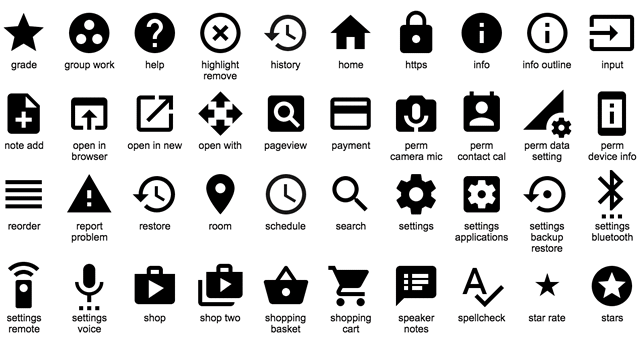
As part of their Material Design visual language, Google has open-sourced a package of 750 icons. More info here.
Tags: design Google
As part of their Material Design visual language, Google has open-sourced a package of 750 icons. More info here.
Tags: design GoogleFinally, the first review of my book #! is in. It’s from Zach Whalen. this is it, and to make it easier for you to copy, paste, and run it, here is the review that he banged out:
perl -e '{print$,=$"x($.+=.05),map{$_ x($.*.1)}qw(# !);redo}'
By the way, please come to my reading tomorrow at MIT (E15 atrium) at 6:30pm if you’re in the area. It will be fun!
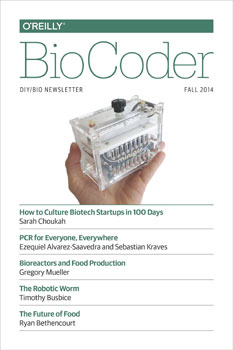 The fifth issue of BioCoder is here! We’ve made it into our second year: this revolution is in full swing.
Rather than talk about how great this issue is (though it is great), I’d like to ask a couple of questions. Post your answers in the comments; we won’t necessarily reply, but we will will read them and take them into account.
And yes, we do have a great issue, with articles about a low-cost MiniPCR, bioreactors and food production, and what happens when you model a worm’s brain on a computer and let it drive a robot. Plus, an interview with Kyle Taylor of the glowing plant project, the next installment in a series on lab safety, and much more.
Again, don’t hesitate to send your article ideas to BioCoder@oreilly.com. And, answering my own question: if you’re doing something you think we’d like to know about, tell us, even if you’re not able or willing to write the article. We might be able to do something about that…
Download the free issue of BioCoder Fall 2014 here.

Accelerators are so 2011, or so it now seems. Few, save for Y Combinator, have managed to generate true venture caliber returns for the limited partner backers. And there’s only a handful who have shown themselves capable of consistently recruiting and graduating successful and sustainable companies. So its no surprise that many would-be investors are looking for new models to find leverage in backing early stage startups.
Angel investing or raising a micro-VC fund are always options, but each lacks the hands on company-building thrill that many entrepreneurs turned investors crave. Thus, the new model du jour seems to be the technology studio. Part fund, part incubator, part technology platform, these company building shops are cropping up in markets across the country. New York has Betaworks, Los Angeles has Science, and the Valley has Giant Pixel and Kevin Rose’s N-O-R-T-H, among others.
The latest group to jump on the studio bandwagon is Santa Monica-based Zuma Ventures, an upstart founded by David Carter and Allen Hurff. Carter is best known as the co-founder and CEO of Vertical Technologies (acquired by Zebra), Thoughtstar (acquired by iManage) and S5 Wireless, and more recently as a co-founder of the Venice-based Amplify.LA accelerator. Hurff was the EVP of Engineering at MySpace and more recently an entrepreneur-in-residence at Science, with which Zuma will now be competing. Carter and Hurff will be joined by Apple, Adobe, and Disney veteran Richard Wolpert as a Venture Advisor and a handful of support staff.
Zuma is withholding details of its capitalization at this stage, but Carter tells Pando via email, “We are an operating company and do not have a fund element at this time. No, we do not receive management fees and structurally run like a traditional tech company.” The near-term plan, Carter adds, is to “build 3 companies internally and not fund external ventures during [Zuma’s] first phase.”
Under the studio model, Zuma will create companies “from ideation to eventual launch as an independent entity,” Carter says, adding, “Internally, Zuma looks, acts, and functions like a technology company although we work on several projects/companies simultaneously with the ultimate goal of creating stand-alone companies with independent management teams.”
But underlying this parallel entrepreneurship, the thing that differentiates studios from incubators is a shared foundation of technology and services that will support all the companies created. In Science’s case, this means a data and audience analytics platform, customer acquisition capabilities, and more recently mobile development frameworks and consumer intelligence. We have yet to see what Zuma will build to support its future startups, but given Hurff’s experience with Science and, before that, Myspace, it’s likely that the group has plenty of ideas in mind for areas where the parent organization can create leverage for its future portfolio companies.
There are a few big risks with the studio model of company building. The first is, what will Carter and Hurff do if one of the companies created under Zuma emerges as a breakout success? Will they choose to turn their full time attention to that project at the expense of any others? Given their pedigree, any outside LPs in Zuma might prefer this outcome. But as individual companies raise their own funding rounds, new investors will expect Zuma to continue providing support and resources to the companies they birthed. It’s a true Catch-22.
Similarly, given the considerable role that Zuma will play in conceptualizing and building these future companies at the early stages, there are questions as to how the studio will structure the equity ownership for future independent management teams. Incentivizing non-founder executives has proven to be a thorny challenge for studios in the past and Zuma has yet to articulate how it plans to address this issue. Carter tells Pando:
We are swinging for the fences in regards to recruiting a management team. In order to attract and properly incentivize a top team, we are planning on 20 to 30 percent equity for the CEO and an extra 15 percent for his or her team. We consider the CEO a co-founder and are interested in entrepreneurs with at least one successful exit and domain expertise.
Finally, while parallel entrepreneurship is certainly a fantasy of many founders who’ve tasted success previously, it’s a model that simply rarely works in practice. Throwing out Steve Jobs and Elon Musk, two outliers in every sense of the word, you’d be hard pressed to find an example of a founder building multiple companies simultaneously where one or more of the companies didn’t suffer as a result of this divided attention. Startups are just too hard, too intensive, and too binary to divide your focus.
And even with multiple “founders” in Carter, Hurff, and Wolpert, Zuma may risk making similar tradeoffs for its ambitious model. Sure the plan is to bring in outside management to lead each of Zuma’s subsequent startups, but in many ways that already erodes the value of having this type of experienced team involved at all. The more companies a studio like Zuma founds, and the more success each one finds, the less time Carter, Hurff, and Wolpert will be able to dedicate. It may fall into the good problems to have bucket, but it can be a problem nonetheless.
One thing that has changed dramatically in recent years is that the cost of starting companies has plummeted considerably. As such, it’s never been easy to slap together a few MVP (minimum viable product) versions of a new product ideas, launch them into the marketplace, and see what sticks. It’s also more desirable than ever to work in a startup (save for maybe a brief window in 1999), versus a more established company, making it easier to recruit talented teams than at many points in the past.
These two factors combine to make now an ideal time to launch a studio. And with LA continuing to prove itself as a legitimate startup ecosystem, the timing couldn’t be better for Zuma, founded by two local success stories, to plant its flag in the region. But assembling a few million bucks, renting an office, and throwing a couple ideas on the whiteboard is the easy part, at least relatively. Proving that you have the vision and the execution ability to turn those ideas into sustainable companies is another thing entirely. We have yet to see a $1 billion-plus company emerge from a technology studio. Carter and Hurff will be hoping that, even with its late start, Zuma can be the first.
[illustration by Brad Jonas for Pando]


I'm tired of being lied to. Tired of companies exploiting my childhood dreams of riding a hoverboard just like Back to the Future Part II. When Doc Brown let me down , I was ready to write off the whole idea. But this week, my dream finally came true.

Editor’s note: this post originally appeared in BioCoder Fall 2014; it is published here with permission. Download a free copy of the new issue here.
A few months ago, I singled out an article in BioCoder about the appearance of open source biology. In his white paper for the Bio-Commons, Rüdiger Trojok writes about a significantly more ambitious vision for open biology: a bio-commons that holds biological intellectual property in trust for the good of all. He also articulates the tragedy of the anticommons, the nightmarish opposite of a bio-commons in which progress is difficult or impossible because “ambiguous and competing intellectual property claims…deter sharing and weaken investment incentives.” Each individual piece of intellectual property is carefully groomed and preserved, but it’s impossible to combine the elements; it’s like a jigsaw puzzle, in which every piece is locked in a separate safe.
We’ve certainly seen the anticommons in computing. Patent trolls are a significant disincentive to innovation; regardless of how weak the patent claim may be, most start-ups just don’t have the money to defend. Could biotechnology head in this direction, too? In the U.S., the Supreme Court has ruled that human genes cannot be patented. But that ruling doesn’t apply to genes from other organisms, and arguably doesn’t apply to modifications of human genes. (I don’t know the status of genetic patents in other countries.) The patentability of biological “inventions” has the potential to make it more difficult to do cutting-edge research in areas like synthetic biology and pharmaceuticals (Trojok points specifically to antibiotics, where research is particularly stagnant).
The free-software and open source movements have done a lot to enable innovation in computing. We have a rich “commons” of software (Linux, Apache, MySQL, Hadoop, to say nothing of the many tools from the GNU project). This software commons forms the technological basis for just about every technology company in existence today, including Facebook, Google, Apple, and even Microsoft. Can the same ideas be equally productive for biology?
I believe so. But exactly how to apply those ideas isn’t clear. As tempting as the analogy is, biology isn’t computing. What does (or should) open source mean for biology? We don’t yet have an answer to that question. Yes, it’s reasonably easy to patent or copyright a long string of As, Ts, Cs, and Gs. And for similar reasons, we could apply any of the open source software licenses to that sequence. But is that sufficient? And what does that mean? I’d like to push on those questions a bit harder.
In computing, the notion of “open source” has a clarity that doesn’t necessarily extend to biology. We know what source code means: it’s a more-or-less complete expression of what a computer program does. The source code may be a couple of lines long, or millions, but when you run the code, the computer does what it’s told to do. We don’t yet have that kind of understanding in biology, and it’s possible we never will. It’s a truism to say that DNA is a programming language that we don’t understand. While we understand (to a limited extent) how DNA encodes proteins, we’re far from understanding the complexity of that mapping. One modification to DNA may have many interacting effects, some benign, some fatal. Our notion of “effects” and “side effects” confuses the issue; side effects are just the effects we don’t like. As far as the organism is concerned, though, there are only effects. And we are far from understanding all the effects of any modification on all but the simplest biological systems.
So, what does it mean to say that DNA sequences are a kind of genetic “source code” for living organisms? The process by which DNA is used to build proteins is extremely complex; the code is read in both directions; furthermore, there’s a logic to gene expression that we don’t completely understand. If the same genetic information is present in all cells, why are some cells muscle and others liver? Genes encode proteins, and (to use a programming analogy), they’re sort of like assignment statements. But you can’t build a program if you only have assignments. You need conditional logic and other control structures. We are far from understanding DNA’s control structures and how they work. So, while we can call DNA a “program,” open sourcing biology is qualitatively different from open sourcing a program written in Java or C. We really don’t yet understand what the biological program means. What is an open source gene? What is an open source protein? Those are important questions, and we don’t yet know the answers.
Software developers have one key advantage over biologists: software developers speak a common language. Well, more realistically, many common languages; but the differences between Python and FORTRAN are small enough that Python programmers and FORTRAN programmers can meaningfully communicate with each other. DNA may be a programming language, but that won’t help us communicate if we don’t understand its syntax.
As Trojok says in the white paper, “a future bio designer should be able to code the properties of a living system…by describing the desired features in a biological programming language.” That programming language could be DNA, properly understood; but a better analogy might be to see DNA as the machine language — the 1s and 0s, of biology. While the pioneers of computing dealt directly with 1s and 0s, we now describe a program’s “desired features” in high-level languages like Python; programming in binary only happens in a few special circumstances.
I doubt that we’ll end up with a single biological language; just as in computing, we will probably end up with dozens (if not hundreds or thousands). But whether there’s one or many, we need those languages to exist. And we need those languages to be part of the commons, not proprietary creations as they were in the “dark ages” of computing. Today, there are very few programming languages that don’t have an open source implementation, and it’s very difficult to imagine a new programming language that doesn’t start as an open source project (Swift being a significant exception). High-level languages for biology will be the same: to succeed, they must be part of an intellectual commons. Proprietary languages are no good for sharing ideas.
In the last few years, we’ve discovered that computing isn’t as clear-cut as we thought it was. In 1990, it was relatively easy to look at a program and say that we understood what it did. Now, when almost all significant applications run on complex distributed systems, tens to thousands of computers that are “in the cloud,” it’s much more difficult to reason about what a program can or can’t do. Look at the Shellshock bug in the Bash shell: that bug might have existed when Bash was first developed, but it would have been meaningless, unexploitable. In 1989, our computer networks were primitive. We didn’t have web servers, and distributed systems were exotic, experimental beasts. It was relatively simple to understand all (or almost all) of the situations in which a program could execute.
Modern computer systems are much more like biological systems than the computers of the 80s and early 90s. Both biologists and software developers have to deal with extremely complex systems, emergent behavior, and unintended consequences. Open source hasn’t been immune to the problems that arise when you place software in new contexts, and biologist have to be extremely careful about the consequences of introducing unforeseen changes into organisms, or releasing organisms into the wild.
The Bio-Commons has a bio-ethics subgroup (currently mostly empty) for discussing ethical issues. How do we manage systems that defy deterministic understanding? What do biological systems mean, and how can we use them? What responsibilities does a researcher have for his creations?
It’s interesting that the Bio-Ethics group lists “the definition of individuality” as one of its concerns. Identity and individuality are certainly an important concern in software, but those issues rarely appear in the context of open source software. You write software; you apply a license; you use software in accordance with that license. What stake does individuality have in the software you write or use? Perhaps open source software and the future bio-commons can learn from each other.
When Richard Stallman founded the Free Software Foundation, his goal was to preserve the freedom to share software. Sharing was fundamental to the culture of computing in the 1970s, but it was threatened by the shift that brought about the start-up booms of the 1980s: computing itself became a commodity, and software became monetizable. Developers stopped sharing their work (in many cases, were no longer allowed to share their work) because software was something you wrapped in a package and sold. Software faced the threat of the anticommons; the free-software and open source movements are a reaction to that threat. And indeed, the open source movement has won.
While “sharing knowledge” has always been a scientific ideal, many outside of the sciences would be surprised just how little knowledge is actually shared. Results are locked up in journals, which live behind carefully maintained (and extremely expensive) paywalls. Papers share results, but rarely share the actual data or the software used to analyze the data. Papers describe experiments, but rarely describe them accurately enough for their results to be duplicated reliably.
As we’re engaging in research, we need to share data, we need to share code, we need to share experimental designs. But we don’t yet have standard languages for sharing that information, or repositories in which to store it. Much of the data collection in the sciences is fairly haphazard. We’re limited by tools and methodologies that were developed when data was hard to get and data storage was expensive. Now that you can buy terabyte disk drives for a few dollars (this morning, I see a 3-terabyte external disk drive for $120 retail), and fill those disk drives using automated instruments controlled by an Arduino or Raspberry Pi, we have the ability to generate and store data in bulk. We have the ability to instrument and monitor every stage of an experiment in detail; but that’s not happening in biology, at least not on a regular basis.
This is an area where biologists can learn from software developers. Modern software systems throw off gigabytes of data, and we have built tools to monitor those systems, archive their data, and automate much of the analysis. There are free and commercial packages for logging and monitoring, and it continues to be a very active area of software development, as anyone who’s attended O’Reilly’s Velocity conference knows.
One critical goal of the Bio-Commons is to facilitate sharing. And I’m excited that they realize how little we know about sharing. We can talk about “open source” biology, but we don’t really know what we mean. Are we talking about some genetic code? Are we talking about proteins? Are we talking about experimental procedures (protocols)?
In addition to the Bio-Commons, we see start-ups like Synbiota working on cloud-based repositories for storing and sharing biological data, much as GitHub serves as a repository for source code.
I’ve often said that the revolution in biology depends on a revolution in tooling. That revolution is also under way; I’ve come across many start-ups working on tools for biologists, ranging from the extraordinarily ambitious to the humble, and looking at customers from huge industrial laboratories to small bio-hacking spaces.
Again, it’s important that the tooling biologists use be part of the biological commons. You can see it in software projects like Cytoscape and BioPython. You can also see the tooling revolution in the OpenPCR project, the low-cost homebrew PCR described in the new issue of BioCoder, and the open sourced laboratory robotics platforms from Modular Science and OpenTrons.
We’re making tremendous progress in our understanding of life; we’re clearly at the start of a revolution in biology. But for that revolution to get going in earnest, and to avoid settling into a dystopian anticommons, we need to improve our ability to share. The computer revolution arguably started in the 1960s, but it really didn’t get going until we understood the importance of shared code. The biological revolution will be similar, but with one big advantage: we can see what the open source movement has done. Many of the problems we face have already been solved, or are being solved.
We are building a biological commons. Whether that’s the Bio-Commons that Rüdiger Trojok and his collaborators are building, or something that hasn’t yet started to take shape, its time has come. It’s the fermentation vessel in which the revolution will grow.
Cropped image on article and category pages by Col Ford and Natasha de Vere on Flickr, used under a Creative Commons license.

I remember arriving in Berlin in 1992 for the first time, and how you could tell where the wall had been by the change in color temperature. The West German lights and the East German lights. There were, um, a few other cues as well. But that’s the one I recall most vividly.
Over the last week, I've been scraping every single #Gamergate tweet to do some network analysis. I ended up writing the whole thing up on Medium, I hope you like it.

One interesting bit: I discovered Newsweek made a major mistake reporting the sentiment analysis on their Gamergate feature, confirmed by the analytics company that collected it. I updated my post with the details.
Good artists copy; great artists steal.
-Picasso
 Happy Halloween! I haven’t cared for ages. But, now I have someone in my house like this. My 5 month old ladybug :)
I find myself at the nearest drugstore constantly buying diapers, and I can’t help notice the holiday on sale. Candy, makeup, masks. Especially the classic: Frankenstein.
Most of us don’t realize our use of Frankenstein’s name is wrong. Frankenstein was the name of the scientist, Victor Frankenstein. The monster didn’t have a name.
In the book, he’s called monster, creature, fiend, even devil. If anything, the monster’s name is Adam.
I am thy creature: I ought to be thy Adam, but I am rather the fallen angel, whom thou drivest from joy for no misdeed
-The “monster”
But the big thing most don’t realize is that the story of Frankenstein was written by François‐Félix Nogaret.
Wait that doesn’t sound right. Wasn’t Frankenstein written by Mary Shelley?
Julia V. Douthwaite, a professor at The University of Notre Dame, recently uncovered a story by French author François‐Félix Nogaret, written years before Mary Shelley was even born. The story is about an inventor named Frankenstein who creates an artificial man.
Mary Shelley stole the idea of Frankenstein.
Cars were supposed to be the solution to lost or stolen horses.
When I leave my machine at the door of a patient’s house I am sure to find it there on my return. Not always so with the horse: he may have skipped off as the result of a flying paper or the uncouth yell of a street gamin, and the expense of broken harness, wagon, and probably worse has to be met.
-An excited new automobile owner from 1901, found in the book Stealing Cars
Instead, cars have been the object of thieves attention since they were first invented. Motor vehicle theft, also more popularly known as grand theft auto (amongst police and video game playing teens), is an enormous problem and a multi-billion dollar industry for thieves.
By many counts, a car is stolen in the US every 30 seconds. Of those stolen, only about 12% are ever recovered. And the problem is all over the world. 1 in 6 cars on the road in the Czech Republic are stolen vehicles or contain stolen parts.
But today, with the advent of Vehicle Identification Numbers (VINs), a stolen car isn’t that valuable sold on its own. If you had a stolen car and changed its plates, its VIN is still etched or stamped onto 20 or more pieces of your car. The dashboard is the obvious place you see it. But it’s on the engine. The doors. Some cars even have the VIN etched onto all the windows.
And so, a stolen car is easy to identify. As a whole.
Professional car thieves know that as soon as you steal a car, your next immediate task is to get it to a chop shop. A chop shop is an illegally operating garage that specializes in taking a car and almost literally chopping it into pieces. In less than an hour, a stolen car is chopped. Seats, windshield, airbags – every individual item is removed. Things with VINs are dumped, destroyed, or melted down.
Now, thieves have extremely valuable parts on their hands. Wheels, entertainment systems, air bags – all can go for hundreds to thousands of dollars on their own. Even melted down. A catalytic converter contains platinum going for $1500 an ounce.
And in their sale, they can’t be traced back to the original owner or the crime.
Professional thieves have figured out that there isn’t much use to stealing and reselling an entire car. The value is in deconstructing the car, and utilizing the individual pieces.
Many people also don’t realize Mary Shelley’s Frankenstein is subtitled “The Modern Prometheus”, as the subtitle doesn’t appear on modern editions of the book.
Prometheus is a tale from Greek mythology, probably 3000 years old. Some versions of the myth have Prometheus as the architect of mankind, fashioned out of mud and fire. Shelley’s monster was created with flesh and lightning.
Shelley didn’t just steal from Nogaret. She stole pieces of work from a countless number of places. Like Greek mythology. Like Milton’s Paradise Lost, an alternative genesis story about Adam, God, and Satan.
Like Adam, I was created apparently united by no link to any other being in existence many times I considered Satan as the fitter emblem of my condition; for often, like him, when I viewed the bliss of my protectors, the bitter gall of envy rose within me.
-The “monster”
Like Coleridge’s The Rime of the Ancient Mariner. Mariner and Frankenstein both use a similar narrative technique of one character telling another character the story, and interrupting the narrative to make sure the reader is reminded of that fact.
She stole from Giovanni Aldini and Johann Konrad Dippel who were scientists in the late 1700s who were trying to sustain or create new life with electricity and chemicals.
Shelly even stole narrative and character ideas from her own mother’s novel, A Vindication of the Rights of Woman.
But you wouldn’t know these things unless you did a lot of research and could spot the elements. Nogaret and Shelley might have a main character with the same name creating an artificial man, but that’s largely where the similarities stop. The stories are completely different.
And that’s because Shelly did what these car thieves excel at: break things down, and find new value in the parts.
Amateurs tend to be poor at imitation. When they see an idea, they clone the whole thing and offer it as their own work. The pro knows to chop these things into pieces and find new uses for them.
One of my favorite books to recommend to developers who feel like they can’t design is Jarrod Drysdale’s Bootstrapping Design. He outlines a way novice web designers can do what Mary Shelley did:
I’ve made something called Draft, software to help people write better. The homepage has served me well in getting traffic and getting people to sign up:

But it’s actually a combination of things I’ve stolen. The font I stole from Field Notes, these beautifuly designed notebooks from Aaron Draplin and Coudal Partners. They introduced me to Futura, and I fell in love.
The layout was stolen from Google. Simple, centered, almost nothing on the page, just click the button and get started.
There’s a little animation to the headline that drops in – stolen from DuckDuckGo’s previous design, a great search engine built by Gabriel Weinberg. Their logo had a similar animation when the page loaded.
Even the blue button came from some place I can’t remember now. But I was on a site, saw the blue they were using, and decided it would make a great link and button color.
On and on, I’ve deconstructed these other sites into pieces and mixed them together into something new. Something original.
Now, I’ve recently taken over as the CEO of Highrise, and as we look at things to improve and redesign, I see us doing the exact same thing.
I hired the very talented designer, Wren Lanier, and the first thing she asked me was: send me all the sites and designs that inspire you.
And as you’ll see, when we launch our new homepage soon, it will come off as original, because it is. But lots of elements on those pages are because Wren or I liked a button here, a color there, a font somewhere else.
Here’s an illustration that you might see soon on the new Highrise homepage, describing Highrise as a “Secret Weapon.”

A beautiful original “shaken” from a designer and artist I hired, Brad Colbow, but you can spot where inspiration came from.
That quote “Good artists copy; great artists steal,” is often attributed to Picasso. But that’s not what he actually said. According to The Quote Investigator, that’s Steve Jobs’ version as he was trying to quote Picasso.
Picasso has also been quoted as saying:
Bad artists copy; great artists steal.
But a 1974 book, mentioned William Faulkner said:
Immature artists copy, great artists steal.
But it was T.S. Elliot who in 1920 wrote:
Immature poets imitate; mature poets steal.
And it was Alfred Tennyson in 1892 who wrote:
That great poets imitate and improve, whereas small ones steal and spoil.
All these great artists, Jobs, Picasso, T.S. Elliot, stole parts, added their own, and inspired the next – just like professional car thieves, clever enough to deconstruct the originals, and use the pieces to create something much more valuable.
If you don’t know Blast Theory then I am jealous that you’re about to learn about them for the first time.
I first heard about them in the late 90s through theater connections, then again from Jan Abrams who pointed out — this is maybe 14 years ago — that this was a theater group using GPS devices. Think about doing that 14 years ago. When we started Area/Code in 2004, they were our heroes, and that’s still true today.
I played their piece in Brighton a few years ago, “A Machine to See With,” and it changed how I thought about what’s possible, and that’s not true of many things. I hope for the same from their piece in progress now, “Karen,” which is kickstarted and which you SHOULD BACK WITH PREJUDICE.
I don’t say that frequently, or lightly. This is a group of writers, artists, and technologists who have led the way for a long time. If you’ve ever dreamed of how these news form of interaction will affect how you interact with the city, with theatre, with stories, with embedded but invisible personae, then you secretly owe some support to the geniuses who pioneered so much of that. So please support their next adventure into the weird and powerful unknown… the one that lives just next door to where we live right now.
Click the link below to back it … and please consider spreading the word, as there’s only 5 days left to the kickstarter.
Joyent gets $15M in funding and tries to jump on the container bandwagon originally published by Gigaom, © copyright 2014.

What Do You Do When You Think You Have a Murderer in the Family? | VICE | United Kingdom
I’m pretty sure this is the most fucked up thing I’ve read in quite a while. And for the truth of how fucked up the world can be, thus worthwhile.
Melissa Moore's dad was Keith Jesperson, aka The Happy Face Killer. In this piece, she talks about what it was like growing up with a serial killer as a dad. This is the most disturbing thing I've read this week.
It was during this meal that my dad said, "Not everything is what it appears to be, Missy." And I said, "What do you mean Dad?"
I watched him wrestling with something internally. Then he said: "You know, I have something to tell you, and it's really important." There was a long silence before I asked him what it was. "I can't tell you, sweetie. If I tell you, you will tell the police. I'm not what you think I am, Melissa."
I felt my stomach drop, like I was on a rollercoaster and had just hit the lowest part of the loop. I had to run to the bathroom. When I returned to the booth I felt calm again and I found to my relief that my dad was willing to just drop the conversation.
But I go back to that incident so often and I think: "If he had told me, what would have happened next? If he had told me about his seven murders -- it was very soon to be eight -- would I have gone to the police? Having revealed his secrets, would he have given me the chance?"
Could my father have killed me? That has been a huge question mark in my life.
(via digg)
Tags: crime Keith Jesperson Melissa Moore murderEgypt has criminalised sexual harassment for the first time, in a move that campaigners say is just the first step towards ending an endemic problem.
Egypt's outgoing president, Adly Mansour, issued a decree that categorised sexual harassment as a crime punishable by a minimum six-month jail term and a fine worth 3,000 Egyptian pounds with increased penalties for employers and repeat offenders.
Continue reading...Xanadu, which began development in 1960, now has a working release, OpenXanadu
When consumers have been promised powerful, life-changing new software, delays and postponed launches can be excruciating.
Mac OS X was first demonstrated under the code-name Rhapsody in 1997, yet version 1 release didn't arrive until a full four years later. Windows Vista was originally planned to ship in 2003, as a minor release between Windows XP and the true follow-up, but that release date slipped by three years.
Continue reading...Claus.dahlMosell agrees
Bad girls, big hair and Jason Priestley's beautifully brooding face share your happy memories of the Peach Pit below
Former Beverly Hills, 90210 star Jason Priestley has just published his autobiography. In it he has the following advice for young stars: "If youre lucky enough to be on a hit TV show, dont leave until they kill you off. You never know when, or if, the next ones coming." Wise words, Jason, and particularly true given that the original 90210 was the ultimate teen hit. Here are six reasons why:
Continue reading... One killed and three injured in shooting at Seattle Pacific
Police say student pepper-sprayed and subdued gunman
When a lone gunman armed with a shotgun at a small Seattle university stopped firing at students to reload, another student pepper-sprayed him and subdued him with the help of others and prevented more deaths, police said.
"There are a number of heroes in this," assistant police chief Paul McDonagh said. "The people around him [the gunman] stepped up."
Continue reading...
Over the last two years, Facebook has slowly begun cutting back on the organic reach of page posts, whittling it down from 16 percent in 2012 to around two percent now for pages with over 500,000 fans. Brands have found themselves paying money lately to get posts out to fans that they’d already paid money to acquire.
Needless to say, people have gotten a bit peevish about the whole thing.
The short, obvious explanation has always been, Facebook is a business and this is simply the inevitable money-making conclusion of its initial freemium advertising model.
Except, well, yesterday Facebook VP of Advertising Brian Boland took to the Facebook for Business blog and attempted to argue that this clamping down on organic reach is for the good of both brands and users. He unequivocally denies the company is trying to make more money by limiting the visibility of brand content.
Boland says rather that brands simply do better when Facebook plays God a little bit. “Our goal is always to provide the best experience for the people that use Facebook,” he writes.
Brands actually have better organic reach now than they would otherwise, Boland argues. His claim has merit, even if it is a little naive. On average there are 1,500 stories that could appear in a person’s News Feed at anyone time. If you’ve liked a ton of pages, this number could be as great as 15,000. The number of pages the average user likes rose by 50 percent last year. Facebook only shows a user 300 stories at any one point in time and weighs up “thousands” of factors, all personalized, to choose the most relevant posts for you amid all of this noise.
The real-time approach throws too much content at a users, according to Boland, meaning that we’ll inevitably miss the things that matter the most to us — be it baby photos or news blast from much loved company. (I can’t tell you how many times I’ve lamented missing a thinly veiled brand advertisement amid posts from my close friends and family.) There’s a strong chance, he argues, that without Facebook’s filtering, less than two percent of people would see a brand post anyway.
Boland has a point. Real time is flawed. Twitter built its brand on the real time approach and has just recently started to back off from it ever so slightly. His case – that Facebook needs to take some ownership of what we see to stop the site devolving into a confused mess sinking under the self-indulgent warblings of one billion people and companies – is not a bad one. It is worthy of contemplation.
But, at a time when Facebook’s ad machine is minting cash, and the company is under constant pressure to deliver quarterly growth to Wall Street, Boland’s outright denial that this consideration has anything to do with money is a bit laughable. The sensible option might be the more lucrative one here, but trying to argue that Facebook’s bottom line didn’t impact how aggressively it pursued this course is a bit of an insult to our collective intelligence.
Hunters hunt. Publicly traded companies use their assets to make money. There are worse things to admit.


In its TRO, the Court ordered the government to refrain from any further destruction of evidence pending final resolution of the parties’ dispute over the government’s evidence preservation obligations: “Accordingly, it is HEREBY ORDERED that Defendants, their officers, agents, servants, employees, and attorneys, and all those in active concert or participation with them are prohibited, enjoined, and restrained from destroying any potential evidence relevant to the claims at issue in this action, including but not limited to prohibiting the destruction of any telephone metadata or ‘call detail’ records, pending further order of the Court.” ECF No. 189 at 2 (emphasis added). In its Amended Minute Order, the Court reiterated that the TRO’s prohibition on any evidence destruction remains in effect until the Court has finally decided the evidence preservation dispute: “The Court extends the temporary restraining order issued on March 10, 2014 until a final order resolving the matter is issued.” ECF No. 206 at 1.Ridiculously, the DOJ claimed that it did not believe the original TRO covered internet content interceptions, and thus was still destroying such evidence. It just said it believed the court was still determining if the TRO applied to such evidence. It took very little time for the court to respond, telling the DOJ to file an immediate response and in the meantime to stop destroying the freaking evidence.
In communications with the government this week, plaintiffs learned to their surprise that the government is continuing to destroy evidence relating to the mass interception of Internet communications it is conducting under section 702 of the Foreign Intelligence Surveillance Act. This would include evidence relating to its use of “splitters” to conduct bulk interceptions of the content of Internet communications from the Internet “backbone” network of AT&T, as described in multiple FISC opinions and in the evidence of Mark Klein and J. Scott Marcus....
On June 5, 2014, the Court received an emergency filing from Plaintiffs in which they contend that the government may be in violation of the Court’s restraining order. Defendants shall file a response to Plaintiffs’ emergency filing by no later than 12:00 noon PST on Friday, June 6, 2014. At that time, the Court shall decide whether and when to have a hearing on this matter. In the interim, the restraining order remains in effect: Defendants are ordered not to destroy any documents that may be relevant to the claims at issue in this action, including the Section 702 materialsThis is pretty damn egregious. There is simply no way that the DOJ could properly read the original TRO to mean that it can continue to destroy this evidence. To pretend that's a possible reading, especially given all the clear notifications of both EFF's and the court's concerns, is clearly the DOJ and NSA just playing dumb for the sake of being able to destroy more evidence.
Undersigned counsel have been advised by the National Security Agency that compliance with the June 5, 2014 Order would cause severe operational consequences for the National Security Agency (NSA’s) national security mission, including the possible suspension of the Section 702 program and potential loss of access to lawfully collected signals intelligence information on foreign intelligence targets that is vital to NSA’s foreign intelligence mission.It also promises to file a more complete response today, which we'll try to add here once it's out. This response seems bizarre. It's unclear why an order to not destroy evidence would mean that the Section 702 program would need to be suspended entirely. Either way, EFF lawyers had to stay up late last night, rushing out their own reply to the DOJ's frantic freakout.
It is not credible that, as the government contends, simply refusing to destroy during the next 18 hours the communications it has intercepted will cause “the possible suspension of the Section 702 program.”... How can the preservation of these intercepted communications cause a “loss of access to lawfully collected signals intelligence information”? ... That information will remain accessible even though it is being preserved.I imagine there will be more very soon.
More fundamentally, the unspoken but unmistakable foundation of the government’s position is a contention that it never understood before this afternoon that the Court’s TRO required it to preserve evidence relating to its interception of Internet communications. This, too, lacks any credibility, especially in light of the extensive discussions between Court and counsel at the March 19, 2014 hearing on the evidence preservation dispute. The government’s disregard for the past three months of its obligations under the Court’s TRO should not be retroactively blessed by granting a stay that permits the government to continue destroying evidence.


It’s fair to say most computers are severely handicapped whenever they can’t access the Internet, but few are as totally incapacitated as Chromebooks, which rely on the Web to perform even the simplest of tasks. While the devices offer tools that allow people to edit documents or view their email archives without an Internet connection, almost everything else relies on some online service or other.
Google is trying to change that by introducing apps like the new Play Movies, which allows Chromebook users to save videos to their devices for offline viewing. But I have to wonder, should it bother with those applications, or should it instead embrace the Web even more?
The problem with Chromebooks isn’t that they rely on Web services to perform even the most basic functions, it’s that they aren’t always online. Google and other companies are starting to prove the claims that Web technologies can be just as useful as their native brethren, so using online applications to create documents, edit images, or stream videos no longer seems strange.
That fact extends across everything from Chromebooks to Windows laptops and MacBooks. There’s a reason why Apple announced a new feature in OS X Yosemite allowing Mac users to connect their laptops to their iPhones to share an Internet connection, and it’s not because it was easy: people expect constant connectivity, whether they’re using something as Internet-dependent as a Chromebook or devices that can technically function without access to any online services.
Google should be offering products that offer similar always-on connectivity, not developing apps that make the Chromebook’s most glaring flaws even more apparent. (Most of them have limited storage space, so they’ll never be free from the Internet, even with new applications.) It’s playing to its laptops’ weaknesses instead of improving the things that make them unique.
So while existing Chromebook users might appreciate the ability to watch a movie without an Internet connection — assuming they still buy movies instead of streaming them or acquiring them through, uh, other means — that’s hardly going to make a difference for consumers who were wary about buying into the Chromebook’s core principles. Google is playing catch-up instead of showing everyone that Chromebooks are just as capable as other computers.
Then again, perhaps it’s a good thing Google is tinkering with software instead of hardware. The last time it did something innovative with Chromebook hardware by releasing a charger that worked with both the HP Chromebook 11 and smartphones, things got a little… heated.


Ctm Workshop: Charles Cohen @ Schneidersladen from Andreas Schneider on Vimeo.
There’s an easel of sound, and American composer Charles Cohen is its gentle-voiced practitioner. What starts as primitive basic sounds magically becomes sophisticated, expressive, emotionally-charged musical painting. And Charles can show you how.
He did just that earlier this year at CTM Festival, at a workshop hosted by Schneidersladen, the storied Berlin synth shop whose fearless captain, Andreas Schneider, was one of the early champions of today’s modular, analog, and boutique maker revivals.
He walks through the process, with all the cool methodical pedagogy of Bob Ross himself. “You just pull the plug.” Complex sounds, simple controls. Clocks drive rhythms into the delay; each pattern living in voltage.

Below: an earlier film by Alex Tyson captures Cohen improvising on the vintage instrument. This isn’t just chin-scratching stuff, some sort of antisocial noise-making esoterica. Rather, it seems almost like a UFO control panel was wired directly into the brain, translating the buzz of neurons into dreamlike animals of sonic imagination. And it all seams to have the immediacy of picking up a brush – a good bar for anyone playing with sound, whether you get your hands on one of these strange beasts or not.
CHARLES COHEN AT THE BUCHLA MUSIC EASEL from Alex Tyson on Vimeo.
Charles doesn’t over-sell his work: “beepsandboops” is the name of his SoundCloud account. But what wonderful beepsandboops. You could easily be convinced you’ve just picked up the Smithsonian Folkways record of traditional music – from outer space.
Or, as Bob Ross would say, “You need an almighty easel while you’re doing this – an easel that’s strong.”
These words could mean painting or music making, too – whether you’re playing a mandolin, a Buchla modular, or a computer.
“These little son-of-a-guns hide in your brush and you just have to push them out. This is your world … your creation.
There’s no secret to this — anyone can paint. All you need is a dream in your heart, a little practice…”
More reading:
And speaking of space and how it is, indeed, the place, Charles Cohen joins other artists reflecting on Sun Ra:
SUN RA CHANGED MY LIFE: 13 ARTISTS REFLECT ON THE LEGACY AND INFLUENCE OF SUN RA [The Vinyl Factory]
Charles Cohen: Synthesis and context [Resident Advisor]
The post The Bob Ross of the Music Easel: Watch Charles Cohen at the Buchla appeared first on Create Digital Music.
Given that Apple is embracing the quantified-self movement with its new HealthKit platform and Health app for iOS 8, it may sound counterintuitive that health tracking apps are in trouble. After all, Health is going to aggregate all sorts of data from these apps, right? Not necessarily: Health can work directly with wearable devices to get at that data too.

I first noticed this possibility earlier this week after installing the iOS 8 beta software and looking at the Health app. All I could do was manually enter data such as my height and weight; Health can actually keep a history for dozens of information types ranging from nutrition and fitness to sleep and lab results. I also saw a section in the Health app that was actively looking for wireless devices.
Now that 9to5Mac has dug into the HealthKit API, what I saw makes sense: HealthKit supports direct wireless device connections over Bluetooth LE. That means the Fitbit I currently wear (see disclosure below) could speak directly to the Health app in addition to, or instead of, the Fitbit app I have on my iPhone.

Obviously, it will be up to wearable device makers to decide if they want to work with HealthKit directly over Bluetooth or feed their data to the Health app through their current software. I suspect many will do both in order to give users the option. Besides, it may be easier to simply feed the data directly into a single app that aggregates a person’s quantified-self data in one spot; that’s exactly the point of Apple’s Health app. And it could save time and effort for a device maker: Why create a full-blown app to capture data from your device when you just plug it in to Apple’s HealthKit platform?
I use quite a few self-quantified and health tracking apps today and my hope that they don’t simply “go away” because of Health’s ability to speak directly with devices. While the basic data is useful, I also get information that Health doesn’t currently provide, such as the mapped route I took when running, my splits per mile or my fastest race paces at certain distances.

There’s still opportunity here for third-party app makers for sure. I do wonder though: How many of them will see app sales negatively impacted by Apple’s direct connection for data between Health and wearable devices? For consumers that just want the basic data all in one place, a paid third-party app might not be worth the investment.
Disclosure: Fitbit is backed by True Ventures, a venture capital firm that is an investor in the parent company of Gigaom.

Related research and analysis from Gigaom Research:
Subscriber content. Sign up for a free trial.
Also Sprach Zarathustra reminds me of Anglesey. Because we went here:
and I made this:
Flickr, being flickr right now, this might not work, so, if you want to, go here.
From the editors of The American Scholar, the ten best sentences. Presumably in all of literature? Here's one of them, from James Joyce's A Portrait of the Artist as a Young Man:
I go to encounter for the millionth time the reality of experience and to forge in the smithy of my soul the uncreated conscience of my race.
Why are these the ten best sentences?
Tags: A Portrait of the Artist as a Young Man best of books James Joyce lists