
Claus.dahl
Shared posts
13 Feb 17:16
You Are Not A Content Creator
Claus.dahlYessør
Jonathan Mann rants on a term that's always bugged me
13 Feb 16:29
Stupid Tricks with Promoted Tweets
Claus.dahlSmart med nullcasting
I was surprised to learn about "nullcasted" tweets, a way to post semi-private messages on Twitter
13 Feb 16:24
The AI Revolution: The Road to Superintelligence
Claus.dahlhvis man aldrig har hørt om singulariteten så kan man læse op her
eminently readable discussion of artificial superintelligence [via]
13 Feb 16:19
Where and why men outnumber women
by Nathan Yau
Claus.dahlEt fucked up syn på kvinder på den arabiske halvø følges med at der simpelthen ingen kvinder er
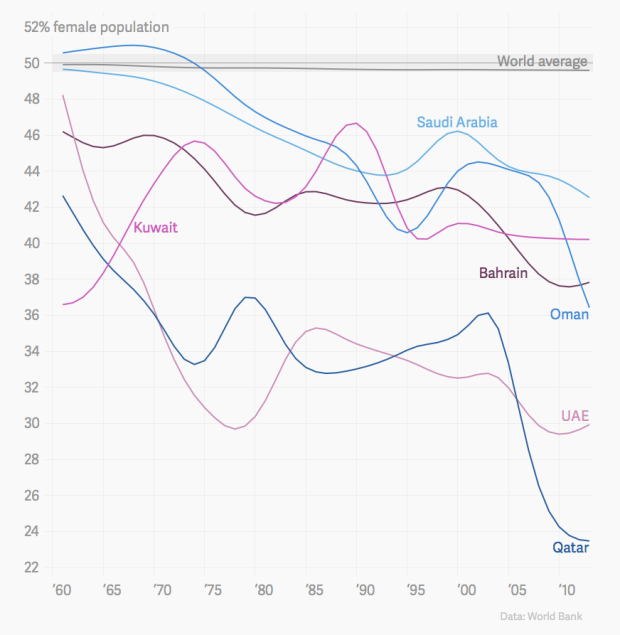
There are an estimated 60 million more men than women on this planet, based on data from World Bank. David Bauer takes a look at the places where the male majority is largest.
Although China and India are responsible for a significant portion of the disparity, there are several other countries of interest. The time series above shows the effect of migrant workers on the Arabian Peninsula.
The most gender imbalanced states in 2013 were all found on the Arabian Peninsula, Qatar being the most extreme. Less than one quarter of all people who lived in Qatar in 2013 were women. Those countries have attracted a lot of migrant workers for male-dominated industries, especially after oil prices started rising in the 1970s and the industry grew. Millions of men, mostly from South Asia, came to work on the Arabian Peninsula, but weren't allowed to bring their spouses and children with them, thus throwing gender ratios off balance.
Find out about other areas or compare countries yourself with the chart at the end of the article.
Sidenote: I've used World Bank data before, but it just occurred to me that they don't provide any values for margin of error on the site or in the downloads. Seems especially important in this case, when looking at such small percentage differences that account for millions of people.
Tags: gender, World Bank

13 Feb 15:49
 Nathaniel Mott is a staff writer for PandoDaily, covering startups and technology from New York.


Court says GCHQ-NSA surveillance programs violated human rights laws, but they’re all good now
by Nathaniel Mott
Claus.dahl"I den periode, hvor det ikke er en hemmelighed hvad vi har foretaget os, har vi brudt talrige love, der beskytter frihedsrettighederne, herunder naturligvis vore landes grundlove - men i tiden siden, som der endnu ikke er lækket nogle informationer om, har vi gjort et fantastisk stykke arbejde"

Britain’s intelligence agency watchdog has ruled that data-gathering by GCHQ and its counterpart in the United States, the National Security Agency, violated human rights laws.
The finding marks the first time the Investigatory Powers Tribunal, which previously defended the legality of mass surveillance programs, has rebuked intelligence agencies.
The New York Times reports that individuals will now be able to petition to learn what the agencies know about them if they believe they were surveilled before December 2014.
The IPT also ruled that GCHQ and the NSA have modified their practices to comply with human rights laws they previously violated.
The victory also comes as Prime Minister David Cameron fights to make it illegal for companies to offer secure communications tools without backdoors for the government. Furthermore, the prime minister’s office believes this ruling makes it clear that GCHQ won’t have to change its practices now that the public is aware of (some of) them. The Guardian reports:
The UK government issued a robust defence of GCHQ on Friday and said the judgment would not alter in any way the work of the monitoring agency. The prime minister’s spokeswoman said: ‘Overall, the judgment this morning is that the UK’s interception regime is fully lawful. That follows on from the courts clear rejection of accusations of mass surveillance in their December judgment and we welcome that.’
So even though the admittance that surveillance practices violated international laws — which is something the United Nations and advocacy groups have said for over a year — is a minor victory, it doesn’t seem like it will have much, if any, effect on the current programs.
Nathaniel Mott
13 Feb 15:17
Kashmir Hill's CAPS LOCK EXPERIMENT
Claus.dahlForbløffende godt - men der mangler noget om YAHYA HASSAN
HACK MAN, the SYSOP of my favorite BBS, used all-caps well into the mid-'90s
13 Feb 15:17
I'm an Anti-Braker
Claus.dahlKan ikke deles nok gange
I'm so sick of Big Automotive hiding the truth
Christal likes this
13 Feb 15:08
Job gains and losses over time
by Nathan Yau
Claus.dahlDen er fin
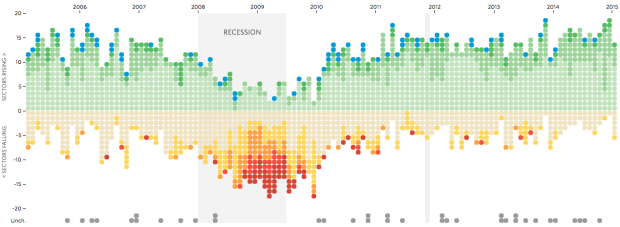
Andrew Van Dam and Renee Lightner for the Wall Street Journal provide a couple of useful linked views of unemployment and job gains and losses. The former comes as a grid where each cell represents the unemployment rate, and the standard time series is shown below that.
The second view is the more interesting part. It shows job gains and losses for various sectors (above), where each dot represents a sector and each column represents a year. Mouse over a sector to see how it did each year, and click on a year for a more detailed view like the breakdown below.
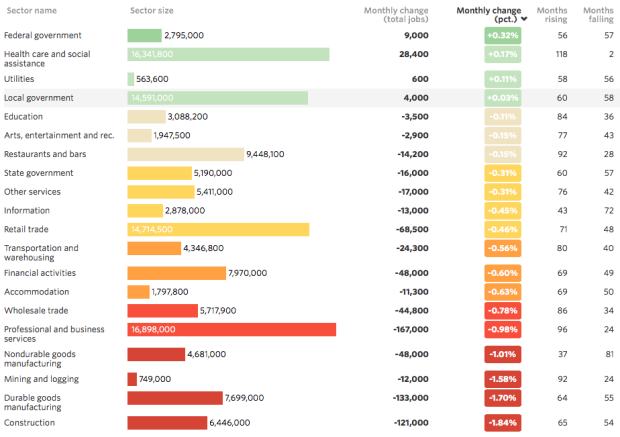
Or come at it from the other side and interact with the detailed view and see how it relates to the overview.
Easier to explore on your own than for me to describe.
Tags: jobs, Wall Street Journal
13 Feb 15:07
Nathaniel Mott is a staff writer for PandoDaily, covering startups and technology from New York. 


Sony hack prompts creation of new federal cyber-threat agency
by Nathaniel Mott
Claus.dahlDafuq

It looks like tasking the National Security Agency, the Department of Homeland Security, and the FBI with handling cyberattacks or digital threats isn’t enough for the White House.
President Obama’s assistant for homeland security and counterterrorism, Lisa Monaco, is expected to announce a new agency devoted to “sniff[ing] out threats in cyberspace” today.
According to the Washington Post, the Cyber Threat Intelligence Integration Center will be modeled on the National Counterterrorism Center, formed after the September 11 attack.
This new agency will report to the Office of the Director of National Intelligence and is expected to debut with a 50-person staff which will be supported by a $35 million budget.
CTIIC’s primary goal will be to corral the various intelligence agencies already working to combat what is seen as a growing threat from cyberattacks. The NSA, DOHS, and FBI will provide the information; this new agency will be expected to analyze and interpret it.
While some have called for something like this for a while, it was the November 2014 hack of Sony Pictures Entertainment that hastened its creation, according to the Post’s report:
President Obama wanted to know the details [of the Sony hack]. What was the impact? Who was behind it? Monaco called meetings of the key agencies involved in the investigation, including the FBI, the NSA and the CIA.
‘Okay, who do we think did this?’she asked, according to one participant. ‘She got back six views.’ All pointed to North Korea, but they differed in the degree of certainty. The key gap: No one was responsible for an analysis that integrated all the agency views.
Yet some fear CTIIC will simply add another level of bureaucracy through which potential threats must travel before the government can interpret, and perhaps respond, to them.
In the meantime, this $35 million can be added to the tally of unforeseen expenses caused by North Korea (allegedly) hacking a Japanese company because of a Seth Rogen movie.
[illustration by Brad Jonas]
Nathaniel Mott
13 Feb 15:06


What’s Up With That: Can Doctors Diagnose Autism With Video Footage?
by Nick Stockton
Claus.dahlWired, jeres nye RSS-feed er pis
Is it possible to diagnose somebody on the autism spectrum disorder based solely on their movements?
The post What’s Up With That: Can Doctors Diagnose Autism With Video Footage? appeared first on WIRED.
13 Feb 15:05
 Sarah Lacy is the founder and editor-in-chief of PandoDaily. She is an award winning journalist and author of two critically acclaimed books, "Once You're Lucky, Twice You're Good: The Rebirth of Silicon Valley and the Rise of Web 2.0" (Gotham Books, May 2008) and "Brilliant, Crazy, Cocky: How the Top 1% of Entrepreneurs Profit from Global Chaos" (Wiley, February 2011). She has been covering technology news for over 15 years, most recently as a senior editor for TechCrunch.


The $1 billion company that prefers 40 year old coders who only work 45 hours a week (Now that’s a unicorn)
by Sarah Lacy
Claus.dahlDer er håb, bare byg good shit

Here’s one thing you don’t hear everyday in the Valley: “We probably have more engineers over 40 than any other company, and of all the $1 billion companies, I suspect we probably work the fewest hours in a week. The office is pretty empty by 6:30.”
That’s right, at last week’s PandoMonthly Slack CEO Stewart Butterfield not only talked about his “arbitrary as fuck” $1 billion valuation just a year after product launch, but he bragged that the company has gotten there by following none of the normal Valley rules of staffing only balls-to-the-wall, 22-year-old kids who work 24/7, crushing code and Red Bull all night long.
It’s a surprising and welcome declaration, particularly for those of us who aren’t 22-years-old and simply can’t work 24 hours a day. It’s particularly welcome for working moms and dads, who I’d imagine will flood Slack with resumes after hearing this news. Also this: “There are no brogrammers… and we have maternity and paternity leaves that recognize the reality of being a parent.”
Slack may have sprinted into the Unicorn club, but Butterfield is sending every signal that he wants to build a company that’s sustainable for the long term. More of this please.
We’ll post the full Butterfield interview in another week. Check back! It’s worth watching in its entirety.
[photo by Geoffrey Ellis]
Sarah Lacy
13 Feb 15:04
Automating Tinder with Eigenfaces
Claus.dahlDet rigtige svar på the tedium og gamification, men mega creepy
"Admittedly, it worked too well and started to conflict with work."
13 Feb 15:00
Links for February 11th
by delicious
Claus.dahlIt's the one everybody finds - but yeah, it has good stuff
13 Feb 14:45
Daft Punk soundboard
by Jason Kottke
Claus.dahlSweet - flere som det

A keyboard-controlled soundboard for Daft Punk's Harder, Better, Faster, Stronger. See also the Beyonce Soundboardt. (via waxy)
Tags: Daft Punk music
M and -1 others like this
13 Feb 14:44


More than a currency, bitcoin is an enabling technology
by Jenn Webb
Claus.dahlSe Føhns! Alle har opdaget det
The promise of bitcoin and blockchain extends well beyond its potential disruption as a currency. In this Radar Podcast episode, Balaji Srinivasan, a general partner at Andreessen Horowitz, explains how bitcoin is an enabling technology and why it’s like the Internet, in that “bitcoin will do for value transfer what the Internet did for communication — make it programmable.” I met up with Srinivasan at our recent O’Reilly Radar Summit: Bitcoin & the Blockchain, where he was speaking — you can see his talk, and all the others from the event, in the complete video compilation now available.
The bigger picture of bitcoin
More than just a digital currency, bitcoin can serve as an instigator for new markets. Srinivasan explained the potential for everything to become a liquid market:
“Bitcoin is a platform for programmable money, programmable interchange, or anything of value. That’s very general. People have probably heard at this point about how you can use a blockchain to trade — in theory — stocks, or houses, or other kinds of things, but programmable value transfer is even bigger than just trading things which we know already exist.
“One analogy I would give is in 1988, it was not possible to find information on anything instantly. Today, most of the time it is. From your iPhone or your Android phone, you can google pretty much anything. In the same way, I think what bitcoin is going to mean, is markets in everything. That is, everything will have a price on it — everything will be a liquid market. You’ll be able to buy and sell almost anything. Where today the fixed costs of setting up such a market is too high for anything other than things that are fairly valuable, tomorrow it’ll be possible for even images or things you would not even think of normally buying and selling.”
13 Feb 14:44
How Peanuts got its first black character
by Jason Kottke
Claus.dahlEkstraordinær historie om hvordan der plusli kom sorte med i Radiserne
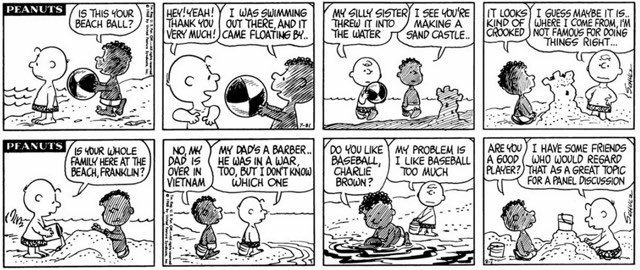
Franklin, the first black member of Charles Schulz's Peanuts gang, made his debut in July 1968. His presence came about through the efforts of Los Angeles schoolteacher Harriet Glickman, who wrote Schulz several letters in the wake of Martin Luther King Jr's assassination arguing that the inclusion of black characters in the most popular comic strip in America would be a positive thing. Here is her initial letter to Schulz:
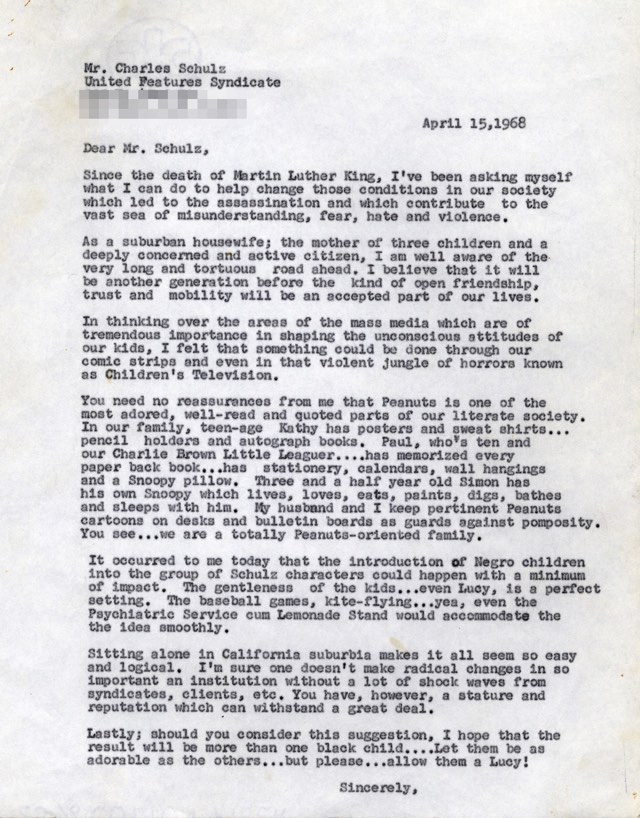
After some back and forth between Schulz and Glickman, Franklin made his first appearance in the strip.
Franklin's introduction was part of a five-day sequence featuring Sally tossing away Charlie Brown's beach ball and Franklin rescuing it. In some ways, this seems an aggressive bit of integration -- many American public beaches, while no longer legally segregated, were still de facto segregated at the time. In other ways, the strips suggest what might be seen today as an excess of caution; of the twenty panels of the series, Franklin is in ten panels and Sally is in eight, but never is Franklin in the same panel as the white girl. Franklin would not reappear for another two and a half months, when he came for a visit to Charlie Brown's neighborhood. He was somewhat lighter skinned here, which seems to be less a matter of trying to make him acceptable to the readers and more a matter of cutting back on shading lines which were overpowering his facial features. Franklin's job in this series was to react to the oddness of the neighborhood kids, and that was a precursor to what would be his primary role in the strip as a whole. Perhaps due to excessive caution, Franklin was never granted any of the sort of usual quirks that define a Peanuts character, the very sort of mistake that Glickman was warning about when she called for one of the black kids to be "a Lucy."
His inclusion made news nationally and upset many people, particularly in the South. Schulz had a conversation with the president of the comic's distribution company:
I remember telling Larry at the time about Franklin -- he wanted me to change it, and we talked about it for a long while on the phone, and I finally sighed and said, "Well, Larry, let's put it this way: Either you print it just the way I draw it or I quit. How's that?"
(via @essl)
Tags: Charles Schulz comics Harriet Glickman Peanuts racism
13 Feb 14:43


Why Europe’s Experimental Spaceship Is Shaped So Weirdly
by Marcus Woo
Claus.dahlDet havde jeg da ikke set i RumNyt
Yesterday, an unmanned experimental spacecraft from the European Space Agency took off from French Guiana and, 100 minutes later, splashed down into the Pacific Ocean just west of the Galapagos Islands. The spacecraft, called the Intermediate Experimental Vehicle, or IXV, didn’t look like your standard cone, though. It looked more—well, cinematic, for lack of a better word, kind of like a miniature space shuttle minus the wings and tail. And that odd shape might presage the future of space travel.
The post Why Europe’s Experimental Spaceship Is Shaped So Weirdly appeared first on WIRED.
09 Nov 15:01
Three cheers for Pig Pen Sedaris!
by Jason Kottke
Claus.dahlROFL

It makes for a charmingly local headline: Area Man Picks Up So Much Roadside Litter, District Council Names Garbage Truck After Him. Except in this case, the Area Man is the famous author and humorist, David Sedaris, whose fame is apparently (and even more charmingly) unknown by the district council and the paper covering the event.
Thrilled to have the vehicle named after him, David 'Pig Pen' Sedaris, said: "When I first moved to Horsham district three years ago I was struck by the area's outstanding natural beauty but I was also struck by all the rubbish that people leave lying around the roads.
"I'm angry at the people who throw these things out their car windows, but I'm just as angry at the people who walk by it every day. I say pick it up yourself. Do it enough and you might one day get a garbage truck named after you. It's an amazing feeling."
Don't know how I missed this story over the summer...a chapter of his next book just wrote itself. The paper followed up with a "holy shit, this dude is famous" piece the next day. (via sedaris' reddit ama)
Update: I had also missed reading Sedaris' piece about his Fitbit, in which he talks about his anti-litter efforts.
I've been cleaning the roads in my area of Sussex for three years now, but before the Fitbit I did it primarily on my bike, and with my bare hands. That was fairly effective, but I wound up missing a lot. On foot, nothing escapes my attention: a potato-chip bag stuffed into the hollow of a tree, an elderly mitten caught in the embrace of a blackberry bush, a mud-coated matchbook at the bottom of a ditch. Then, there's all the obvious stuff: the cans and bottles and great greasy sheets of paper that fish-and-chips comes wrapped in. You can tell where my territory ends and the rest of England begins. It's like going from the rose arbor in Sissinghurst to Fukushima after the tsunami. The difference is staggering.
(via @mmorowitz)
Tags: David Sedaris
09 Nov 14:22


Four short links: 17 October 2014
by Nat Torkington
Claus.dahlSkal da ha set på Naphta.
- Time to Enable Two-Factor Authentication on Everything (Gizmodo) — instructions for enabling 2fa on Google, Facebook, and other common consumer Internet services. (via BoingBoing)
- Project Naptha — automatically applies state-of-the-art computer vision algorithms on every image you see while browsing the web. The result is a seamless and intuitive experience, where you can highlight as well as copy and paste and even edit and translate the text formerly trapped within an image. Chrome extension. (via Anil Dash)
- Garbage Trucks and FedEx Vans (IEEE) — Foo alum, Ian Wright, found traction for his electric car biz by selling powertrains for garbage trucks and Fedex vans. Trucks have 20-30y lifetime, but powertrains are replaced several times; the trucks for fleets are custom; and “The average garbage truck in the U.S. spends $55,000 a year on fuel, and up to $30,000 a year on maintenance, mostly brake replacements.”
- Microsoft’s Quantum Mechanics (MIT TR) — the race for the “topological qubit”, involving newly-discovered fundamental particles and large technology companies racing to be the first to make something that works.
09 Nov 11:52
As Germany marks fall of the Berlin Wall, Gorbachev warns of new cold war
by Philip Oltermann in Berlin
Ex-Soviet leader backs Putin over Ukraine as Germany celebrates the 25th anniversary of a seminal moment in European history
Its hard to remember how scary it was ... extraordinary memories of the Berlin Wall
As Berliners watch 8,000 balloons being released into the night sky this evening, old divisions between east and west will symbolically vanish into thin air with them. Yet the runup to the festivities has already served up plenty of reminders that, 25 years after the fall of the wall that divided the city for three decades, the scars of history are hurting more than ever.
Speaking at a symposium near the Brandenburg Gate yesterday morning, former Soviet president Mikhail Gorbachev warned that the world was on the brink of a new cold war and strongly criticised the west for having sown the seeds of the current crisis by mishandling the fallout from the collapse of the iron curtain.
Continue reading...
09 Nov 11:51

“The Future of Reading Depends on the Future of Learning Difficult to Learn Things”
by cdixon
Socrates’ complaints about writing included “Writing removes the need to remember”. He meant that a prosthetic brace on a healthy limb will induce withering. On the other hand, if we think of new technologies as amplifiers that add or multiply to what we already have rather than replacing them—then we have the opportunity to use writing for its reach over time and space, its efficiencies, and its ability to hold forms of argument that don’t work in oral discourse. And we can still learn to remember all we’ve read! In other words, writing is not a good replacement for memories used in thinking—too inefficient—but is a great way to cover more ground, to cover different ground, and to have more to think about and with.
…[McLuhan said] that new media which are adopted at all first take their content from older and more familiar media. For example, it was important that the printed Gutenberg Bible be a Bible, and also look like a hand-made manuscript copy. Gradually, if the new medium has powers of its own, these will start to be found and used. The real message of printing was not to imitate hand-written Bibles, but 150 years later to argue in new ways about science and political governance. These are what forever changed Europe, and then America.
-Alan Kay, “The Future of Reading Depends on the Future of Learning Difficult to Learn Things” (via Chris Granger)
08 Nov 12:11
 Paul Carr is editorial director of Pando. Previously he was founder and editor in chief of NSFWCORP.


Embattled Whisper CEO suspends editorial staffers as investigation into privacy scandal continues
by Paul Carr
Claus.dahlNå, hov
se As the Guardian newspaper continues its investigation into Whisper’s use of user data, CEO Michael Heyward has suspended members of his editorial team, pending completion of a full inquiry into the allegations.
The suspensions, which sources say include Editor in Chief Neetzan Zimmerman, come as Senator Jay Rockefeller has asked for Whisper executives to attend a meeting with his powerful Senate Committee on Commerce, Science, and Transportation.
In a statement issued late Friday afternoon, Heyward appeared to confirm that Zimmerman was amongst those suspended:
As I have said, we strive to do right by all our users, and we continue to look into the unattributed quotes in the Guardian’s stories. We have placed members of the editorial team involved with the Guardian’s visit on leave, pending the results of our internal review.
Neetzan’s reaction to the Guardian’s allegations has taken away from the substance of the issue, which is that much of the Guardian’s reporting on this issue has been highly misleading or just plain wrong.
A Whisper spokesperson told Pando that they would not comment on specific suspensions but other sources close to the company have confirmed to Pando that Zimmerman is amongst those put on paid leave.
Last week, the Guardian reported Whisper’s alleged misuse of its users’ location data. Shortly afterwards, Zimmerman responded that the allegations were “a pack of lies” and threatened that the Guardian would “regret” publishing them.
We now know that, at best, Zimmerman had no idea whether the Guardian’s reporting was accurate when he made his threats against the newspaper. Today’s announcement that multiple staffers have been suspended suggests that Whisper has so far failed to identify the source of the specific claims made to reporters, or even whether the claims were made at all. That suggestion was also supported by sources close to the company.
Although the suspensions are a clear signal from Hayward that he is taking the Guardian’s allegations seriously, it remains unclear how Zimmerman — who Heyward has now publicly criticized and who certainly made false public statements about the scandal — can ever return to his post.
One possible reason for Heyward’s reluctance to fire Zimmerman is Whisper’s stated plan to build audience through partnerships with media sites. At Gawker, Zimmerman was jokingly referred to as a “traffic whore” for his ability to attract pageviews for apparently trivial stories. Still, Heyward may yet conclude that user trust is more important than short term traffic gains. As I wrote on Sunday:
While we wait for the results of Heyward’s investigation, one thing in now clear: Zimmerman accused the Guardian of fabricating its reporting and of creating sources from thin air before any kind of internal investigation had been completed… that fact alone makes Zimmerman’s position at the company absolutely untenable if users are ever to trust any future statement on user privacy from Whisper.
In addition to announcing the suspensions, Hayward’s statement — embedded below — included further factual rebuttals of the Guardian’s reporting. He also confirmed that he would be responding further to Senator Rockefeller’s questions about Whisper’s use of user data.
A request to Whisper to confirm that Zimmerman was amongst the suspensions was not immediately returned. I’ll update this post when I hear back.
Update: A Whisper spokesperson emails: “We’re not commenting beyond the post for now.”
Paul Carr
08 Nov 12:07


The biggest CIA-drug money scandal you never read
by Mark Ames
Claus.dahlJesus Christ - mens 'The War On Drugs' for alvor gik igang, boostede CIA faktisk kokaintrafikken ind i USA, fordi den finansierede contraerne i Honduras..

With the release of the new Gary Webb film “Kill The Messenger” and the sudden renewed interest in what goes on in that dark underbelly of the US Empire — drug running, money laundering, death squads, assassinations of lives and of reputations — I’m reminded of the incredible life and death of Nicholas Deak, the CIA’s Cold War banker hailed in Time magazine as “the James Bond of the world of money” until the mid-1980s, when his global finance empire was destroyed by Reagan Administration accusations of large-scale Latin American drug money laundering.
The Reagan Commission on Organized Crime spent much of 1984 attacking Deak’s global foreign exchange firm, Deak-Perera. By the end of the year, Deak was forced to appear before the commission in a testy public interrogation; his financial empire collapsed within days.
A year later, in 1985, Deak was assassinated in his Wall Street high-rise by a paranoid-schizophrenic bag lady from Seattle, who’d been hired for the job by Latin American mobsters, according to a private internal investigation led by former FBI detectives. The assassin, Lois Lang (pictured above), had previously spent several murky years in the underbelly of Silicon Valley, where she fell under the care of a famous Stanford Research Institute psychiatrist, Frederick Melges — an expert on dosing his subjects with drugs and hypnosis to induce “artificial” dissociative states. Perhaps not surprisingly, Dr. Melges was up to his eyeballs in secret CIA behavior modification programs that were going on at Stanford until they were exposed in Congressional hearings in 1977. [For more on this stranger-than-fiction story, read "James Bond and the Killer Bag Lady" co-authored with Alexander Zaitchik.]
Nicholas Deak’s end came fast. Exactly thirty years ago, in 1984, his global financial empire, Deak-Perera, was accused by the Reagan Administration of laundering hundreds of millions of dollars of Colombian drug cartel cash.
Nicholas Deak should’ve been the least likely target for a Reagan Administration takedown over cocaine money laundering, and not only because the same Reagan Administration was busy aiding and abetting the CIA’s mercenary army, the Contras, as they moved cocaine into the US, and illegal weapons into their Honduras bases. What made targeting Deak all the stranger was that one of Deak’s closest longtime friends, William Casey, was head of Reagan’s CIA at that time. And as Gary Webb’s reporting (and Robert Parry’s exposés before and after Webb) have shown, Casey’s CIA was at that very same time aiding and protecting the Contras’ cocaine-running operation.
Deak’s downfall was covered in the New York Times by a young greenhorn Ivy League grad named Nicholas Kristof, a budding serial dupe who, unsurprisingly, failed to connect the giant dots in front of his face about Deak’s deep ties to the CIA, and his close personal relationship with the Agency’s director, Bill Casey.
Kristof’s December 1984 article, “Collapse of Deak & Company,” begins:
In the world of foreign exchange and precious metals, no name glitters like Deak-Perera.
Founded in 1939 by a Hungarian immigrant, Nicholas L. Deak, the company grew into prominence by making markets in currencies no one else would touch and in later years, by aggressively promoting private investment in gold. Today, it is the largest nonbank foreign exchange and precious metals operation in the United States.
…At the heart of the collapse, according to the Deak family, are allegations in a report by the President’s Commission on Organized Crime about the laundering of money, so that drug traffickers could secretly repatriate profits to Latin America.
Kristof did enough of his archive searching to uncover Deak’s role in some spectacularly shady intelligence operations, but somehow managed to miss Deak’s own intelligence links — including Deak-Perera’s central role in the Lockheed Bribery Scandal, the “Watergate of Corporate America,” under which the CIA funneled millions of bribe dollars to a Japanese war criminal-turned-Yakuza don, who used the funds to influence Japan’s ruling party. Deak-Perera moved the CIA’s funds; Lockheed reps and a Spanish-born priest in Macao carried the cash. Here, however, Kristof leaves out the CIA’s role, so that it all appears, in Kristof’s limited grasp, to reflect “the peculiar world of high finance”:
[T]he report of the President’s Commission, and testimony before it, offer some glimpses into a peculiar world of high finance.
- From 1969 to 1975, Deak & Company was the conduit used by the Lockheed Corporation to transfer money intended by Lockheed to bribe Japanese officials. That bribery scandal resulted a year ago in the criminal conviction of a former Prime Minister, Kakuei Tanaka. In 15 deliveries, Deak & Company moved $8.3 million to Hong Kong, where a Spanish-born priest representing Lockheed took the cash and carried it to Japan in a flight bag or in cardboard boxes labeled ”oranges.” “Lockheed Corporation came in and asked us to make a payment,” Leslie Deak explained. “We made a payment. The fact that the money was used later for bribes is Lockheed’s shame, not ours.”
- The most serious charges involve the “laundering” of tens of millions of dollars garnered by cocaine traffikers. David Williams, an investigator for the commission, said in hearings in March that the “Grandma Mafia” – a well-known cocaine ring that involved many middle-aged or elderly women – deposited $7.6 million. The money was later transferred to Miami, Panama and Colombia, and Mr. Williams quoted a leader of the ring as doubting that her contact in the company could have been so naive as not to have known the origin or the money.
Had Kristof checked his own paper’s archives a little more thoroughly, he would’ve spotted a 1977 New York Times article on the powerful Veterans of the OSS organization — whose president through those years was Nicholas Deak, whom the Times photographed in a private room beside his colleague and friend, James Jesus Angleton, the paranoid founder of the CIA’s counterintelligence division.

Had Kristof dug a little deeper, he would’ve come across his former New York Times colleague Tad Sculz’s blockbuster exposé in the New Republic’s April 10, 1976 issue, reporting leaks from the Church Committee on Deak-Perera’s role as the CIA’s money mover:
Most of Lockheed Aircraft Corporation’s secret payments to agents in Japan and to Japanese government figures between 1969 and 1975 were transmitted by Deak & Co., a New York-based firm of international currency dealers that has for many years also served as a covert channel for worldwide financial operations of the Central Intelligence Agency.
Deak’s involvement with the CIA is a matter of guarded knowledge in Washington’s intelligence community.

Sculz was the anti-Kristof: one of the great investigative reports of the Cold War, he had been targeted by the CIA as “anti-agency” and “under suspicion as a hostile foreign agent” — used his Senate sources to shine light into Deak’s essential finance role in CIA covert operations:
Having built his company into one of the leading United States foreign-currency dealer firms, Deak is said to have performed various covert services for the CIA in the last 25 years.
…Deak is said, for example, to have handled CIA funds in 1953 when the agency overthrew Iran’s Premier Mohammed Mossadeq and restored the Shah to the throne. In that instance, the money went through Zurich and a Deak correspondent office in Beirut. During the Vietnam war, Deak & Co. allegedly moved CIA funds through its Hong Kong office for conversion into piastres in Saigon on the unofficial market. Deak officials in Hong Kong and Macao helped the CIA investigate Far East gold smuggling in the mid-1950s. It has also been suggested that Deak & Co.’s Hong Kong office may have ‘laundered,’ with the CIA’s knowledge, illegal contributions to the Nixon reelection campaign in 1972, although it is unknown whether Deak & Co. was aware of the precise nature of that operation.
The Lockheed Bribery Scandal, with Deak and the CIA at its center, led to the passage of the Foreign Corrupt Practices Act, the first ever law criminalizing bribery of foreign officials.
Around the same time that was going on, in 1975, Bill Casey gave a speech at a banquet honoring Deak. They’d bonded as spies in World War Two, and carried on throughout the Cold War, always keeping close to their intelligence comrades working inside the Agency. “It is a privilege to share this moment in the remarkable career of such an old and good friend and companion as Nick Deak,” Casey said:
Having had the privilege of seeing Nick Deak in action and being with him in some of his endeavors, I claim to speak about him with authority. During World War II, both of us served in the Office of Strategic Services under the Great and legendary ‘Wild Bill’ Donovan. We served in different parts of the world—I in Western Europe, Nick in Southern Europe and Southeast Asia—but I can attest to the high reputation for courage, boldness and reliability which he acquired in the OSS and for the esteem in which Bill Donovan held him.
Having from time to time counseled Nick Deak as lawyer and friend, I have had the opportunity to witness, and to some degree to understand, the remarkable way in which he developed the Deak-Perera Group.

Casey described how Deak, a Hungarian aristocrat from a prominent banking family, emigrated in 1939 to the US, rose up the elite wartime spy agency, and helped the US transition into a global empire with his unique grasp of global finance:
As soon as World War II began, he joined the U.S. Army. His knowledge of Europe and his linguistic abilities brought him quickly to the Office of Strategic Services. He was first assigned to our Middle East Headquarters at Cairo and was given responsibility in the Eastern Mediterranean with particular emphasis on the Turkish border, Cyprus and Crete. After the landings in North Africa, Sicily and Italy in the Western Mediterranean, our interests in the Eastern Mediterranean diminished, and Captain Deak was assigned to intelligence work in Burma, Thailand and Malaya.
In August, 1945, Nicholas L. Deak, in charge of an OSS unit, at the airport in Rangoon, Burma, accepted on behalf of the United States, the sword of surrender of the Commanding General of the Japanese forces in Burma. He wound up commanding an OSS unit in Indochina and was sent, at the end of his military duties, to Shanghai in China, being discharged with the rank of Major. For another year, he continued his intelligence and political duties in Asia and Washington with the Department of State.
Returning to New York in 1946, he resumed the foreign exchange business he had started in 1939. The Deak-Perera Group was on its way.
The tightly integrated, interdependent world economy which we know today was then just beginning to evolve. Businessmen were encountering obstacles and frustrations flowing from the foreign exchange restrictions which then prevailed. To function in foreign trade and investments, they needed sophisticated knowledgeable advice. Deak and Co., Inc. remedied that problem in America.
At the time of his speech honoring Deak, Bill Casey was serving as the head of the Export-Import Bank, having earlier served as chairman the SEC under Nixon. In 1984, as head of the CIA, Bill Casey was the dark face of Reagan’s Central America policies: The dirty wars in Nicaragua, Guatemala and El Salvador that left tens of thousands dead; the illegal mining of Nicaragua’s harbors; the illegal Iran-Contra covert operations to fund the Contra mercenary army by selling arms to Ayatollah Khomeini; and the darkest operation of all, the CIA’s involvement—passive or otherwise—in helping their Contra mercenaries run cocaine into America’s cities to finance their death squads, an operation that eventually put the Contra drug runners in business with “Freeway” Rick Ross, the crack cocaine kingpin of the 1980s.
And so in 1984, the Reagan Commission on Organized Crime spent most of the year trying to compel Nick Deak to testify before the committee, led by a federal prosecutor and West Point grad named Jim Harmon. Members on the commission included segregationist Dixiecrat Strom Thurmond, and the powerful first cousin of Vice President George Herbert Walker Bush — John M. Walker Jr., assistant secretary of the Treasury Department in charge of enforcement and financial crimes. (Vice President George H W Bush also led a number of powerful Reagan task forces — on terrorism, drugs, and drug money laundering in South Florida, among others.)
I interviewed Harmon in 2010 about his commission’s takedown of Deak. In our talk, he was very friendly and forthcoming, with no hint of malice, and no residual memory of hostility in the proceedings.
“Nicholas Deak was quite a guy—parachuting into Romania, accepting Japan’s surrender in Burma,” Harmon told me by phone. “Before our investigations, money laundering wasn’t illegal because there were no laws against it. We needed to learn the ins and outs first, and that’s why we called in Deak. We called others too—EF Hutton, Steve Wynn—it’s thanks to what we learned from them that we were able to devise the world’s first anti-money laundering.”
And yet in early 1984, after Deak publicly refused to testify in Washington alongside mob informant Jimmy “The Weasel” Fratianno, Harmon lashed out before reporters: “Mr. Deak will be asked to explain how over $100 million was laundered through his company and further into various criminal schemes.”
Finally, at the end of November 1984, the commission used a subpeona to force Deak to testify in Washington, appearing just before a hooded Colombian witness gave testimony about how he laundered drug funds through Deak.
The back-and-forth between Harmon and Deak, available on transcripts of the hearings, reveal a bristly and menacing Nicholas Deak, whose sardonic answers have an almost “you’ve got to be fucking kidding me” quality to them. Given everything a money man like Deak knew about the history of CIA covert operations, which invariably involved mixing with the underworld—as well as what Deak knew about his old friend Casey’s operations in Latin America, at the center of which were cocaine and arms shipments — Deak’s sarcasm comes off more like a condemned spy trying to remain dignified during his own kangaroo trial and impending execution:
- HARMON: Of the possibly billions of dollars [in Deak-Perera turnover], you recognize as you sit here today that there could be substantial amounts of money passing through your companies, put there by cocaine traffickers or heroin traffickers: is that right, sir?
- DEAK: I am not aware of it.
- HARMON: It could be though today?
- DEAK: Anything could be.
- HARMON: Well, you know, sir, as you sit here today that in the Orozco case to which you refer that one money launderer passed through $97 million through one account at Deak-Perera: isn’t that right, sir?
- DEAK: That is what I understand has happened, yes.
- HARMON: Well, what did you do, Mr. Deak, after you found out that one money launderer had put $97 million through Deak-Perera to make sure that that wouldn’t happen again?
- DEAK: I would recommend to the Government to be more alert when we are filing the reports.
* * * *
- HARMON: Are you aware in any way, Mr. Deak, of the serious consequences of the use of cocaine?
- DEAK: That is not my field. I’m sorry. I cannot answer that question.
- HARMON: If you knew, Mr. Deak, things that the Commission has heard here during the last couple of days that cocaine is addictive, and that cocaine wreaks havoc with people’s lives, do you think you might change Deak’s policy to …prevent narcotics traffickers from putting money through your companies?
- DEAK: Mr. Harmon, what policy do you refer to?
- HARMON: You have made no effort, have you, Mr. Deak, to examine past transactions by narcotics traffickers to see whether or not there should be a change in company policy; isn’t that what you’ve said, sir?
- DEAK: I think that we — you asked it repeatedly. The policy is that we accept deposits if we are authorized to accept deposits. The policy is that if the deposit is suspicious, that the teller has to report it, and it is up to the authorities then from that moment on to investigate.
- COMMISSIONER SKINNER: Is it your —
- DEAK: We are not an investigative body. That is you, gentlemen, that should do that.
And these exchanges, which read like something straight out of LeCarre, all the more so if you could hear Deak’s famous Transylvanian accent:
- COMMISSIONER SKINNER: Our concern is as being one of the major money processing firms in the world, is it not incumbent upon you, your company, as a matter of policy, to reject, summarily reject at the window, deposits of huge cash where suspicious factors are present which lead you to believe that the money being processed by your institution may result from illegal activities?
- DEAK: Mr. Chairman, first of all, you flatter me when you say that we are one of the major money processing institutions in the world. We are a fraction by size compared to the major banks, a fraction of a fraction.
* * * *
- SKINNER: [T]here are other major financial institutions, as a matter of policy, I should tell you, that have advised us that they do routinely reject account balances and clients from their institutions unless they verify certain circumstances, and I think the Commission is trying to understand why your organization does not take a similar policy.
- DEAK: I am not aware of that, but if that is, indeed, the case, and obviously it is the case because you, Mr. Chairman, say so, my guess is that there are very few major institutions following this policy, and if they do follow, well, more credit to them.
- SKINNER: Well, Mr. Harmon, any more questions?
- HARMON: Yes. I’d like to just point out one thing. Mr. Deak has referred in some ways to our interim report. I would point out finally, Mr. Chairman, that several banks used by Orozco literally threw him out on his ear once they suspected that he was using those banks for criminal purposes. Those include the Chase Manhattan Bank, Marine Midland, Irving Trust Company, and Credit Suisse. Do you have any explanation, following up on what the Chairman has asked you, why those several banks found it in their interest and in the interest to their community to throw Orozco out?
- DEAK: Mr. Harmon, I think that we were more useful than those banks which you suggest because those banks refused. We reported it to the Federal authorities. Isn’t that better? If we would have refused him also, you would have never learned about it.
But what Deak knew, and what Kristof and the rest of the press corps should’ve known, was that Commissioner Skinner wasn’t being “fair” — and that fairness never had anything to do with the business of covert empire management.
A year later, Deak was murdered, along with his receptionist, by the unlikeliest assassin imaginable — a homeless paranoid-schizophrenic from Seattle by way of Mountain View, Santa Clara Valley Medical Center, and the forgotten goings-on at the Stanford Research Institute.
Gary Webb was hardly the first journalist to pull up the floorboards and shine light onto the dark workings of empire. It’s not a pretty sight, and despite all the official Enlightenment cant about transparency and human improvement, there are a lot of people in this country who don’t want to know. Quite possibly a majority, even a supermajority — that was the lesson of the Reagan Revolution, it’s a lesson brilliantly retold in Rick Perlstein’s new book “Invisible Bridge,” and until someone can make a strong rational case — not a religious case based on liberal morality or Enlightenment cant — why all the non-journalists and non-liberal arts grads in this country’s lives are necessarily improved by learning every horrible shitty thing this country does — and that list is long, like reading all the names of the war dead — then we may as well admit that Gary Webb was driven to suicide so that one day, we might safely troll each other on Twitter, the perfect insta-medium to nurture our selective amnesia, without ever having to put much on the line.
[Note: The mug shot at the top of this story is that of Lois Lang, the contract assassin who killed Nicholas Deak and his receptionist Frances Lauder in November 1985. Lang is serving out her sentence in Bedford Hills prison in upstate New York. This is the last known photograph of Lang, a onetime college homecoming queen and UC Santa Barbara women's tennis team coach. More here.]
08 Nov 11:59
The sounds of NASA
by Jason Kottke
Claus.dahlSweet!
NASA has a new Soundcloud account with playlists like Rocket Engine Sounds, Solar System & Beyond Sounds, and Space Shuttle Mission Sounds. Here is the infamous Sputnik beep:
"Ok Houston, we've had a problem here":
And "one small step":
(via @brillhart)
Tags: audio NASA
Blindenmuth, M likes this
08 Nov 11:58
 Nathaniel Mott is a staff writer for PandoDaily, covering startups and technology from New York.


In an attempt to increase its influence over the media, Facebook makes publishers an offer they should refuse
by Nathaniel Mott
Claus.dahlAOL-ificeringen af Facebook. Uundgåeligt, og selvfølgelig vil nogen indie publishers slå til og benytte sig af muligheden for ikke selv at skulle have en infrastruktur - ligesom Amazons selfpublishers. Og nogen af dem vil blive rige af det, og etablerede publishers vil lide under at konkurrere med denne nye klasse af indies

Last week, I wrote that all the handwringing over Facebook’s influence on the media distracts from the amount of control Google holds over the world’s information, allowing the company to continue its efforts to manipulate the press and assert control over the media without protest.
Now that criticism of Facebook seems a little more appropriate. The New York Times reports that Facebook has approached publishers with a proposal to send stories directly to its service, allowing them to be saved to Facebook’s servers, shown next to Facebook’s ads, and read in Facebook’s applications.
Facebook’s power to drive traffic makes such partnerships seem like no-brainers. Consumers are already finding news through the service, reading it through its mobile application’s built-in browser, and helping the story reach others on the social network. Why not strengthen the relationship?
David Carr, the Times media writer who broke the news of these talks, might have an answer:
That kind of wholesale transfer of content sends a cold, dark chill down the collective spine of publishers, both traditional and digital insurgents alike. If Facebook’s mobile app hosted publishers’ pages, the relationship with customers, most of the data about what they did and the reading experience would all belong to the platform. Media companies would essentially be serfs in a kingdom that Facebook owns.
Such relationships would be even more worrisome than publishers’ attempts to chase Likes, or Google’s control over how information is found online. It’s one thing to trust a company to keep an index of Web pages; it’s another thing entirely to trust one with the content of those pages. (Besides, it’s not like publishers would even consider such an arrangement with, say, Google+.)
I concluded last week’s post with the following:
Facebook’s effect on the media is worth criticizing. But it shouldn’t be the only tech company mentioned whenever someone wants to complain about the media pandering to one algorithm or another — and it certainly shouldn’t be seen as more dangerous than Google, which has been actively manipulating the press to further its own goals instead of merely acting as a conduit through which people discover news articles. Facebook might be bad, but Google is even worse.
That last sentence will have to be revised if any publishers take Facebook up on its offer. Facebook as it exists now has a notable effect on the way news is discovered, read, and shared, but it pales in comparison to Google’s control over how so much information is found online. That will change if Facebook succeeds with this program, though, and not for the better.
I, for one, would prefer not to live in Facebook’s kingdom.
[illustration by Hallie Bateman]
Nathaniel Mott
08 Nov 11:52
SpaceX is prepping to reuse its rockets, and that’s going to make space travel much cheaper
by Signe Brewster
Claus.dahlSkrev lidt om de her ambitioner her: https://plus.google.com/106244705530319695063/posts/PdaCp1QrfUT
SpaceX may begin using a landing platform for its Falcon 9 rocket as soon as December. Musk estimated at a recent talk that it only has a 50 percent chance of succeeding on the first try.
SpaceX is prepping to reuse its rockets, and that’s going to make space travel much cheaper originally published by Gigaom, © copyright 2014.