Chaitanya Patel
Shared posts
Plastiblends India - Value Buy
The changing role of women in India
The three modernisations
The trajectory of a country is about three modernisations: social, political and economic. Social modernisation is about establishing freedom and rights of individuals. Political modernisation is about achieving democracy, where there is rule of law, where State power is dispersed and restricted, where elections generate contestability. Economic modernisation is about achieving a high growth modern market economy, about a government that gets away from expropriation and central planning to a government that is focused on solving market failures.
All three modernisations interact in complex ways and fuel each other. As an example, Milton Friedman's `Capitalism and Freedom' hypothesis is the idea that political modernisation fuels economic modernisation and vice versa. This is a well established idea in the discourse. I find it also interesting to think about the other two legs of the stool: the interlinkages between social modernisation and the other two kinds of modernisation.
The role of women
When we think of social modernisation and economic modernisation, the big thing that leaps out is the role of women. A society that does not respect women is under-utilising half its labour force. We would expect to see a causal impact of greater equality of women upon growth.
We in India are sometimes complacent about the role of women in India. India is famous for having women in leadership roles. In a dinner meeting by Larry Summers, I once said that India was world #1 on one measure of the role of women: the fraction of the top 100 financial firms that are headed by women. I once met Andre Beteille, and asked him: When compared with 1947, in what aspect have things in India worked out much different from what you expected. He said: The role of women in the elite. He said that for upper class women in India today, it's better than even Japan, which is otherwise a very advanced country. The daughters of the elite in India have no glass ceiling, which is better than what we see in most places.
On a population scale, however, things are vastly worse. Paramita Ghosh reports, in the Hindustan Times, on a crime victimisation survey of women with scary results. The India Today survey (link, link) shows us that 79.3% of men believe that marital rape is okay. We don't know how many men in India act out on this belief, but the report Why do some men use violence against women and how can we prevent it? by the United Nations, shows us scary facts from some Asian countries that have men who think similarly to what the Indian data is showing. The Supreme Court ruling of yesterday is a reminder of the distance that we have to go on achieving social modernisation.
Things are changing dramatically with the young
With human capital measures like literacy or graduating high school, a person tends to achieve them when young. If a person has not become literate or graduated high school by age 20, things are unlikely to change later on. Hence, the analysis of the cross section in the population is tantamount to looking at the history: what we see for (say) 50 year olds today is a description of what things were like, 30 years ago, for 20-year olds. Age-specific rates are like rings of a tree.
 |
| Literacy of the cohort aged 22.5 (Time-series reconstructed from age-specific rates visible in the cross section) |
The graph above shows the literacy of the cohort entering the labour force, which I approximate as being the cohort at age 22.5. The blue vertical line stands for today. This is constructed using the cross-section visible in March 2013 from CMIE Consumer Pyramids, a quarterly panel dataset with 150,000 households covering 700,000 individuals. With children, high literacy rates are found early on, and this yields projections for literacy of the age 22.5 cohort in the future.
We see that overall literacy of the cohort entering the workforce has gone up from roughly 70% in 1990, when India began opening the economy, to roughly 90% today and will go up to 100% in the coming 15 years. In addition, there was a big gender gap, which has been significantly reduced and will fully go away.
Let's turn to high school graduation.
 |
| High school graduates in the cohort aged 22.5 (Time-series reconstructed from age-specific rates in the cross section) |
It seems shocking to think that in 1990, roughly 7% of the cohort starting off into the labour force, at age 22.5, had passed 12th standard. This has gone up dramatically to 20%. Sharp growth is visible into the future when today's 15 year olds become age 22.5, and there is no gender gap with today's 15 year olds.
The third thing that I want to show from household survey data is the ownership of mobile phones.
 |
| Age-specific rates of mobile phone ownership |
All of us have been hearing about miraculous growth of mobile phones in India for a while, and have become a bit inured to the story. While a lot has happened, however, a lot remains to be done. The black line shows that with males, roughly 75% of the young and 80% of the old have mobile phones. The work is progress lies in taking this up to 100% for everyone. What's striking is the women. The upper red line, for March 2013, shows that 40% of girls have mobile phones, and this decays to 20% at age 45. On a related note, Avjit Ghosh, writing in the Times of India, talks about a paper by Yvonne MacPherson and Sara Chamberlain which finds that only 9% of adult women in Bihar have ever sent an SMS. There is a high rate of change with mobile telephony, in even the short timespan between the latest data (March 2013) and the first data from CMIE (June 2010) which is the lower red line.
Speculation
I feel that in the early decades after independence, we had a progressive elite, which was able to bring up daughters well and we made amazing strides at the top. But social modernisation took place only in the elite. For the bulk of the population, attitudes and indoctrination and levels of violence remained neanderthal.
M. N. Srinivas has emphasised the extent to which the rest of society aspires to catch up with the lifestyle and the values of the elite. In the early years, there was little catch up on the treatment of women: the elite and the proletariat coexisted like oil and water. Perhaps budget constraints came in the way of translating aspirations. Maybe poor households shortchanged daughters on nutrition and education and mobile phones and such like, thus encouraging subservience in daughters. In my opinion, the economic growth of the last 20 years is creating a new wave of households within which daughters are growing up differently. Daughters who have high school education and a mobile phone are going to engage with the world differently. As an example, they are less likely to accept sexual harassment and sexual assault. We may now be at the early stages of something very big.
Economic modernisation has created this phase of social modernisation. The rise of capable women who will not be pushed around will, in turn, fuel economic growth because we are then getting a superior labour force. There is an enormous distance to cover. In my opinion, it will be a story spread over two generations (50 years) starting from 2000, through which we will endup with something satisfactory on the role of women. Economic growth will create opportunities for women and for sensibly bringing up daughters, and the rise of capable women will fuel economic growth.
Too many unanswered questions
The Tatas’ about-turn on their banking application is inexplicable
The bland statement from the Reserve Bank of India on Wednesday did not say much. ‘Tata Sons Limited’, said the central bank, ‘has withdrawn its application made on July 1, 2013 for a new bank licence. The company has indicated that its current financial services operating model best supports the needs of the Tata Group’s domestic and overseas strategy, and provides adequate operating flexibility to its companies, while securing the interests of the Group’s diverse stakeholder base. The Reserve Bank has accepted withdrawal of the application.’
Unfortunately, as in most such cases, the statement leaves more questions unanswered than answered and inevitably leads to a great deal of speculation. What is the ‘real’ reason why the Tatas, one of the most respected corporate groups in the country, has chosen to withdraw its application? After all, nothing has changed since the final guidelines for issue of bank licences were announced by the RBI; and the final guidelines were announced after months if not years of debate.
The Tatas must have done a careful assessment of whether or not a bank was an appropriate ‘fit’ in the overall the group strategy before deciding to apply for a bank licence. So what explains their getting cold feet at the last minute, just weeks away from the deadline announced by the RBI governor, Raghuram Rajan, for issue of bank licences?
Could it be the high cost of compliance with regulatory obligations? These are far much more onerous for banks than for NBFCs (non-banking finance companies); even non-deposit taking NBFCs like Tata Capital. But all this was known in advance. It is also known that the RBI is seriously toying with regulatory convergence between banks and NBFCs, including non-deposit taking NBFCs, based on the recommendations of the Usha Thorat committee. So, regulatory arbitrage could not be a reason.
Could it be on account of the Non-Operating Financial Holding Company structure that, according to a reported statement by a Tata official could constrain the operations of the group? But the NOFHC structure had been mandated by the RBI well before applications were called for. So that, too, does not wash.
Could it be that the Tatas’ view of the banking sector has undergone a change in the few months since they submitted their application they no longer see banking as a sector that is worth the kind of investment in terms of money, time and manpower that the guidelines call for? If so, that is not a good omen for the sector.
Or could it be that the Tatas sensed their application might not find favour and hence preferred to withdraw? We will never know. But it is fair to surmise that when a respected corporate group withdraws from the race, the task of the RBI-appointed panel to choose the becomes much tougher.
How Europe Is Betraying Its Children
A few days ago, I participated in a debate organized by the Economist on whether the new generation has the skills it needs to succeed in tomorrow’s world. I thought I had the easy job of arguing that, especially in countries like Greece (where the event took place), there is a serious skill gap, with the educational and vocational training being dangerously out of date and misdirected.
The argument in favour of the motion, I reckoned, was straightforward. First, schools in many of the Old World countries, and certainly in the European South, still prioritize memorizing over critical thought; we obsess with teaching technical skills as opposed to fostering the ability to adapt, add and capture value in a shifting economic landscape. Universities, in many a European country, are neglecting the realities that graduates will face, producing degrees better suited to a generation ago.
Of course, all this is perfectly understandable. These school systems were built at a time when information was scarce and valuable, and obtaining vast amounts of it through memorization, was a useful skill. And Universities had evolved to serve the needs of a different polity and economy: skilled professionals destined to work in highly structured societies.
A degree was often the license to practice a privileged profession such as law or medicine, and humanities training was the tool to propel young graduates into the white collar workforce. Vocational training was, by and large, linked to the system of professions, themselves a descendant of the guild system. In other words, education was based on offering the brightest (or most fortunate) in society access to the land of privilege, bestowed by excluding most while anointing some.
This world no longer exists. Professions have lost their monopoly, guilds’ privileges are on their way out, sectors have unbundled, competition has become global, and value creation is the name of the game. With China making a massive push in its academic system, and as the Asian scores in aptitude tests reveal the shifting geography of the talent pool, the Old World cannot afford its old habits.
On the corporate level, as careers shorten and the nature of work evolves, the skills to succeed become ever more complex. Sadly, today’s youth is still kept behind by an antiquated educational system, and a reluctance of corporates to invest in developing their workforce. And on top of that, in Europe, most school and Universities’ lack of financial independence has hit hard in a time of fiscal austerity, depriving them of the resources and agility to react and adapt.
They also face tough governance problems, shown most acutely in places like Greece, where the Rector and the association of administrative employees can literally shut the biggest and oldest university down, as a protest on the mere prospect of having their own jobs redesigned. Dinosaurs die hard, and can wreak havoc on their way out.
It isn’t just the educational system that’s at fault. A recent BusinessRoundtable study of employers found that most complain that they can’t find the right people. Not because they can’t read, or lack computer or job-specific skills but because they lack critical thinking, critical problem solving and teamwork. Perhaps worse, they also lack professionalism, adaptability, and personal accountability for work. These are skills that the educational system isn’t geared to deliver but they precisely what the new generation must necessarily develop.
Given this context, I was mesmerized by the fact that 51% of the audience in the Economist debate voted for the view that the young generation does have the skills needed. Now, this could be the result of debating prowess of my opponent, Steve Bainbridge, who played up the need to believe in the younger generation, and of the value of hope, in an auditorium of a crisis-striken country.
But it just might be something deeper: a reflection of just how hard it is to recognize some uncomfortable truths, especially when we have no ready solution to offer. Yet, what could happen if we keep confusing wishful thinking with optimism? Most probably, a wasted generation and, for sure, further loss of competitiveness. And, on the personal level, the biggest drama for parents in plighted countries, who sacrifice all they have for the education of their children, is the realization that they may be making a bad investment. Unwavering faith in their offspring and their future may be detrimental for their ability to succeed.
Perhaps worst of all is the likelihood that this trend will make an uneven society even worse. Those who can attend the best universities, or go to the best business schools, will be able to cope effectively. But this will exacerbate societal imbalances, helping the 1% “in the know”, while leaving the majority behind. Our lack of courage in dealing with the skill gaps risks hurting the Old World and making it more uneven.
This isn’t an easy fight. It takes courage to accept the problem, and even more courage to address it, with entrenched interests as well as skill gaps in the educational system. But it’s an important fight, if we want to regain both prosperity and balance.
When common sense died…
no clue whom to thank …for this lovely forward that i got….
From an internet forward:
An Obituary printed in the London Times – Interesting and sadly rather true.
Today we mourn the passing of a beloved old friend, Common Sense, who has been with us for many years. No one knows for sure how old he was, since his birth records were long ago lost in bureaucratic red tape. He will be remembered as having cultivated such valuable lessons as:
- Knowing when to come in out of the rain;
- Why the early bird gets the worm;
- Life isn’t always fair;
- and maybe it was my fault.
Common Sense lived by simple, sound financial policies (don’t spend more than you can earn) and reliable strategies (adults, not children, are in charge).
His health began to deteriorate rapidly when well-intentioned but overbearing regulations were set in place. Reports of a 6-year-old boy charged with sexual harassment for kissing a classmate; teens suspended from school for using mouthwash after lunch; and a teacher fired for reprimanding an unruly student, only worsened his condition.
Common Sense lost ground when parents attacked teachers for doing the job that they themselves had failed to do in disciplining their unruly children.
It declined even further when schools were required to get parental consent to administer sun lotion or an aspirin to a student; but could not inform parents when a student became pregnant and wanted to have an abortion.
Common Sense lost the will to live as the churches became businesses; and criminals received better treatment than their victims.
Common Sense took a beating when you couldn’t defend yourself from a burglar in your own home and the burglar could sue you for assault.
Common Sense finally gave up the will to live, after a woman failed to realize that a steaming cup of coffee was hot. She spilled a little in her lap, and was promptly awarded a huge settlement.
Common Sense was preceded in death, by his parents, Truth and Trust, by his wife,Discretion, by his daughter, Responsibility, and by his son, Reason.
He is survived by his 4 stepbrothers;
I Know My Rights
I Want It Now
Someone Else Is To Blame
I’m A Victim
Not many attended his funeral because so few realized he was gone. If you still remember him, pass this on. If not, join the majority and do nothing
- See more at: http://www.subramoney.com/2012/12/an-obituary-to-common-sense/#sthash.hC7WlhGN.dpuf
Post Footer automatically generated by Add Post Footer Plugin for wordpress.
Education: UPA's slow poison
Issues like price-rise, corruption, law & order, internal - external security, energy and abuse of democratic institutions is the making of a corrupt, inefficient and notorious regime led by the Congress party. Another pressing issue that has spiraled into a national catastrophe of sorts is the administration and management of human resource development, particularly in the education sector.
As many as 46% of our teachers have not passed standard 12th and 25 % have not even passed 10th standard. Mr Sibal's ministry has not yet implemented even a 2012 Supreme Court order to ensure compulsory toilets in schools. More than 40% of the schools till date do not have a functional toilet. According to a Planning Commission report, India needs about 5 lakh secondary schools. By 2016-17, over 300 million young people will need employment.
The usual ranting of HRD ministry and planning commission that India does not have enough resources to provide quality meaningful education is hypocrisy of the worst kind. Kapil Sibal's ministry demanded Rs 40,000 crore for the year 2012-13 for implementing Sarva Siksha and RTE programmes. He finally got Rs 25,500 crore from the Union Budget. The money - which is actually 65% of the expenditure, with the state contributing the remaining 35% - has been virtually wasted. In a situation when needs and methods of every state and region are unique, the whole concept of Sarva Siksha and Right to Education needed region-wise implementation strategies. Surely someone is benefitting from creating artificial centre-state confusions and conflicts thereby allowing funds to remain in Delhi. On the ground little has changed despite so much of money. Is the Congress party really serious about getting Indians educated to compete with Americans & Chinese? It doesn't seem so.
One of the proposals Sam Pitroda's National Innovation Council received in December 2011 was the Indian education mega project and the Mumbai mega project. Without having to spend a single rupee, these projects would have created 30,000 new secondary schools and over a million jobs in various sectors within the economy and abroad as well. The proposal was also made available to Kapil Sibal. Despite all the merits and reputed brains behind designing the proposal, it was never considered with desired seriousness to be implemented. The proposal is merely gathering dust while the crisis in education sector remains grim. These fellows not only implement destructive policies but also prevent any meaningful and cost-effective people centric proposal from being implemented.
A panel, formed by the Ministry of Human Resource Development (MHRD) described the SSA and Midday Meal schemes as "fraudulent", plagued with "malpractices and corruption". Babus use expensive cars and ACs with the money meant for poor children, according to the panel. Around 17,282 habitations in India do not have a primary school within 1 km, 148,696 government schools still do not have a building, 165,742 have no drinking water, 455,561 schools have no toilets, and around 114,531 primary schools are single-teacher schools. Where does that leave the Right to Education, which has been notified by only 9 states 15 months on?
Such a state of affairs has been because of 10 years of systemic abuse by Arjun Singh , Kapil Sibal and an ineffective architecture of failures manned by professionals such as Montek Singh Ahluwalia , Sam Pitroda and babus of the concerned ministries. The Right to Education act is just another Congress excuse for causing such a heavy loss to the nation. In fact, such acts have become another tool for inaction and total failure. It is time for Congress party to stand accountable and pay for the destruction it has caused to the nation in this sector.
Investing in stocks:A much better alternative to starting one's own business - Part I
- Possibility to part own a business with small investment corpus: For a person coming from middle class, capital has always been a limitation in starting my own business. This is not to say that if there is a good idea, one will not find capital to fund the idea. However, many a times. this is the most challenging part of starting a business. So, if one wants to set up a chemical factory in Ahmedabad of reasonable scale, initial equity contribution required will be of the tune of 40-50 lakhs. This will mean investing one's savings for life in a venture, which may or may not work out. Alternatively, one can invest just a fraction of the proposed investment required for new chemical factory and part own the business of Vinati Organics, one of the largest manufacturer of speciality chemical IBB , a key ingredient for making ibuprofen. Say, if one would have invested 5,00,000 in Vinati Organics in 2009, would have more than tripled in 4 years resulting in annual CAGR of 32%! Even if one compares, return on equity, Vinati would have generate return in excess of 35%! Thus, even with a smaller ticket size, an investor can generate similar or better returns on capital employed as one would have generated by starting one's own chemical factory!
- Minimizing risk through diversification: Imagine, how many businesses one can start with 40-50 lakh? Most likely one, or may be two at the most! As on date, with the same quantum of money, I part own 12-13 different businesses across various industries. This diversification helps me mitigate the risk of losing capital entirely (which may very well happen if I own only one business for umpteen number of reasons including default on payment by one or two large customers!) as my capital is spread across various businesses and each business also has well established customer mix. Diversification also protects me from downside of generating sub-par returns due to headwinds in one or two businesses. Take example of unexpected depreciation in rupee in last one year. Had I been running one business where large portion of my raw material is imported while there is hardly any pricing power available with me. I have seen many small businesses going broke in last one year due to sheer depreciation in currency. On the other hand, current portfolio of businesses that I own consist of few businesses which are negatively impacted because of rupee depreciation (Cera/Astral) while the other set of export oriented businesses have benefited from rupee depreciation. Thus, in the end overall impact on earnings is minuscule. The moot point here is that many a times, if one has invested in a portfolio of carefully chosen quality business, tailwinds in few businesses will compensate for the headwinds in few other businesses thus, protecting investors from permanent loss of capital.
- Access to the best managers for running the business: When one invests in stock run by competent management, one is getting access to the best managers running a business he has put his money on! As an investor one can have an opportunity to side with and ride with people who have complimentary skills, which are unique to them, and has significant value. As an investor in the company, this skill is available to you at minuscule cost, but benefits derived from such skill can be enormous! If one was running his own business, access to people having such complimentary skills is prohibitively expensive and hence the odds of making extraordinary deals/returns are significantly lower. At the folly of repetition, let me give you example of investment in Piramal Enterprise. There was an opportunity with investors to side by one of the best deal maker and wealth creator Mr.Piramal at free of cost! Moreover, the ongoing businesses of PEL were available at throwaway price after he sold his formulation business to Abbott. Similarly take example of Mayur Uniquoter. Mr. Poddar, the founder of Mayur, is one of the oldest hats in the business and has uncanny understanding of the dynamics of business. As an investor in Mayur, I have access to the skill and competence of Mr.Poddar and his team in deploying and managing the capital I have invested in. This kind of access to people would be unthinkable for someone starting his own unit of manufacturing synthetic leather.
- Buying business ownership on your own terms: This is vital. It is important to choose which battles one fights and ideally one should choose the battles where odds of winning the battle are conspicuously in his favour. Though life doesn't give you an opportunity to choose your battle, but market surely does give you the flexibility of not only choosing the battle one wants to fight but also the option of choosing the battleground and timing as well! We, human beings, are not rational all the time, especially when it comes to matters related to money! Markets, which is confluence of human opinions and sentiments, is a perfect place to look for pockets of irrational behaviour. Fear and greed, both are found, in abundance in the market. This sets a perfect stage for getting great bargains which no owner, in his right mind, would ever offer. As a businessman, this is the best place to look for, if one wants to buy businesses at substantial discount or sell them at staggering premium! So, one can wait to invest in a business at significant discount to one's own perceived value of the business. In private transaction this would have never happened. Just imagine what would happen if you offer to buy a growing and profit making company at value less than cash sitting on the books? Most likely, you will be thrown out of the door! However, as an investor in the market one can get the opportunity to invest in cash bargains of some very respectable companies many times in one's lifetime!
- Flexibility to exit: Even if you are running a proprietary company, it takes while to complete all the formalities to close the business and down the shutter. The process is far more involved if it is a private limited company.One has to continue to meet compliance requirements till all the accounts are settled and money distributed to all stakeholders. If the business involves more than one partners,the matter gets further complicated, if some of the stakeholders want to continue the business while you want to exit. While one invests in stock,even though, you are a part owner of a business, you can exit the business, for whatever reasons, on a click of a mouse and get the proceeds deposited in your account in two days! This, again, is extremely useful, when in your judgement, the business is going down hill, management shows lack of competence or you just have a better business to invest in!
Temperament is more important than IQ

During a recent interview Warren Buffett and Charlie Munger had some interesting comments on how to outsmart people who are smarter than you.
Munger: We’ve learned how to outsmart people who are clearly smarter [than we are.]
Buffett: Temperament is more important than IQ. You need reasonable intelligence, but you absolutely have to have the right temperament. Otherwise, something will snap you.
Munger: The other big secret is that we’re good at lifelong learning. Warren is better in his 70s and 80s, in many ways, than he was when he was younger. If you keep learning all the time, you have a wonderful advantage.
Buffett: And we have a wonderful group of friends, from whom we can learn a lot.
— Brought to you by: The Suddes Group -- Changing the way nonprofits think, operate and fund.
Forget IQ – Have you ever thought about your Security Quotient (SQ) ?
Today, on Jagoinvestor, I will coin a new term – Security Quotient. Just as I.Q. (Intelligence Quotient) is a score that measures your overall intelligence, Security Quotient (S.Q.) measures how well you have managed the security of different areas of your financial life. By security I am taking about insurance against external factors.
Imagine a warrior – heading to battle and donning various pieces of armor to protect his body. He covers himself from top to bottom and ensures there are no chinks in his armor. A warrior can concentrate on fighting against the opponent only when he is assured that he is secured from all sides. If he leaves himself exposed, he risks getting severely injured every time he is attacked.

Now imagine yourself as a soldier too. You head out of your home everyday and brave the perils of your daily job to earn money. You strive to ensure you have enough funds to meet your financial goals and to have a good lifestyle including buying a home, car and other assets. But you are always exposed to various kinds of external risks in life. If you do not take measures to handle them, you can come under attack from them some day and your financial life may be severely crippled or may even collapse. It is therefore imperative that you protect yourself well from all sides and have the resilience to deal with any kind of risk. This should take the form of preemptive action, which ensures that should an adverse situation arise, you already have put things in place to eliminate or minimize the risk.
Now lets look at few areas, both big and small, and how you can take actions to protect yourself from risks in these areas.
1. Protection against Life Risk (35%)
What if you die before you expect to? A few days back I heard the news that 40 people had died in a mishap while travelling from Bangalore to Hyderabad in a Volvo bus. Do you think any of the passengers had expected such a situation to arise while boarding the bus the night before? Similarly, you have no way of predicting when the truck behind you on the road might lose its balance and run you over. So while you can control your actions, you have little to no control over the actions of others and the incidents arising from those actions.
So have you taken sufficient life insurance through a term plan or are you still deluding yourself by having those 3 or 4 traditional life insurance policies, which would not even feed your family for 2-3 years in the unfortunate event of your demise!
2. Protection against Hospitalization Risk (25%)
The wife of a relative of mine was suddenly hospitalized a few months back after having lived a healthy 55 years without any major illness. Her husband had felt that paying premiums for a product that ‘might’ not be needed was a waste of money. Unfortunately, as a result of the unexpected hospital bills, a good part of his retirement corpus is now eroded and he is making enquiries with me for a good health insurance policy. I had to inform him that it would be tough now to get a policy at a reasonable premium. The best time for him to take health insurance had long since passed.
How about you? Are you sitting on a pile of cash to the tune of 5-10 lakhs? You had better be ready with this money it if you are not planning to take good health insurance cover.
3. Protection against illness (5%)
Now what if you catch some major illness? Are you taking care of your health properly? Are you walking, exercising, biking and eating correctly? These are some steps you should be taking today to make sure you lower your risk of illness or disease. Admittedly, this was a non-finance tip, but also consider taking critical illness cover so that in the event you are diagnosed with some thing major, you get support from health insurance companies in form of money.
4. Protection against Theft at Home or Fire (5%)
I know the probability of these things occurring is miniscule – but there is still some risk you are exposed to. The more I watch Crime Patrol on Sony TV, the more I am convinced that world is not as safe as I assumed it to be! The courier boy might not be a courier boy – He might be a burglar!. A few years back, a relative’s house almost caught fire at Diwali time as a result of children carelessly bursting crackers inside the house.
Again, though chances of something like this happening are minimal, the risk will always be there. It is therefore your choice if you want to be prudent and get insured against home damage due to theft, fire or other natural disasters. The good thing is, it does not cost a lot of money. A Few hundred rupees are all you need to pay for reasonable coverage against these risks.
5. Protection against Frauds on Credit Card and Banking (5%)
The Internet is filled with millions of complaints against credit card frauds and banking related frauds yet at the same time it is also filled with credit card numbers, PAN card numbers, bank account numbers and so many important details.
The frightening thing is that smart people have lots of tricks to exploit the fragile systems to mine this information and loot investors. The ideal way to protect yourself is to know and apply the best practices to secure your information and also study the rules about banking and credit cards. You also have the option to take insurance cover against credit card theft and frauds, if that appeals to you.
6. Protection against Job loss (10%)
The shock of job loss is high because most people are immediately concerned about two things – “Will I get another job?” and “How will I handle my expenses for next few months?”
You can actually handle the second issue by maintaining an emergency fund that is sufficient to cover your expenses for a predefined number of months in the event of job loss. Say for example your expenses amount to Rs. 50,000 per month. You should be setting aside Rs. 3 lakhs only to be used if you lose your job. You could deposit the money in a F.D. and earn good interest on it – but it has to carry the mental label of ‘for emergency use only’! . You should read this article to learn how I created a job loss insurance product hypothetically
You also need to make sure you enhance your job skills and also build a strong position in your company. The ideal situation is when your employer needs your expertise more than you need that specific job! Achieving this outcome is purely in your control.
7. Protection against your Car Accident (10%)
I recently had to get a replacement for my car’s windshield. I was not worried about the expense because I had covered it already. A stone struck the windshield and shattered it. While this was a small incident, there are bigger problems lurking on Indian roads. What if your car were to be in a major accident and get badly damaged? What if it were to get stolen? What if you were to hit someone by accident and have to foot a bill of Rs. 35,000? Who will pay for all these expenses? (A similar analogy can be applied to 2-wheelers as well)
The way you can protect yourself against these risks is by taking auto insurance. Thank god it is almost mandatory in India and no one makes a fuss about getting it (like they do about term insurance).
8. Protection against loss of key documents (5%)
There was an instance when I was convinced that I had lost my Passport, original driving license and a few other key important documents (thankfully they were not lost – just misplaced). I panicked and was cursing myself for not keeping a scanned version of the documents with me, even though I had planned on doing so a lot of times.
After some frantic searching I managed to find the documents and the first thing I did was to create duplicates, keep one copy at my wife’s home and the other in my bank locker. I now make sure, that I am more careful about handling these critical pieces of paper. While I will do my best to ensure I never lose them, I always have a backup somewhere should I misplace the originals. The same goes for the keys to my home as well my important emails and digital documents!
So whats your Security Quotient between 0% – 100% ?
Just look at all the 8 points above. If you think you have secured yourself against that risk, give yourself a score from the number written next to each point. Tally up your total points and let me know how much you scored?
Resume Action Words That Will Get You That Job

Your resume plays a role of paramount importance in your job application process.
This serves as a foot in the door in order for you to land the job of your dreams.
As HR experts say, your resume is not just a piece of paper that summarizes your qualifications. Your resume inspires a potential employer’s first best guess on the value that you will bring to the company.
Take your pick from this list of resume action words. They will surely transform your resume to a powerful package that would make employers pick up the phone and ask for that much-awaited interview.
Read more »
How to Generate Stock Ideas
 In an interview with Warren Buffett in 1993, Adam Smith, author of Supermoney, asked how the small investor can find good investment ideas.
Warren Buffett: I’d tell him to do exactly what I did 40-odd years ago, which is to learn about every company in the United States that has publicly traded securities, and that bank of knowledge will do him or her terrific good over time.
Adam Smith: But there are 27,000 public companies.
Warren Buffett: Well, start with the A’s.
Everybody knows that Warren Buffett gets his investment ideas largely from annual reports.
Of course, now he has become so influential that companies call him to share their own ideas. But, fifty years ago, Buffett was not the go-to guy if you wanted to sell your company or raise capital for your failing bank.
He was a small investor who was clawing his way up the investing street by reading whatever annual report came his way, and then finding his investment ideas that worked wonders in the subsequent years.
You are probably at the same stage Buffett was fifty years ago. But there’s a big advantage you have over the early day Buffett.
That advantage is – technology.
With annual reports now available at the press of a few buttons (on company websites and BSE), you can look through hundreds of companies in lesser time than it took Buffett to access ten companies.
You may ask, “But how do I select companies whose annual reports I should read?”
Well, one quick suggestion is what Buffett told Adam Smith – “…start with the A’s.”
I would simplify this for you…
- Take, for instance, the BSE-200 list of companies
- Remove all companies that you “know” are outside your circle of competence (Don’t worry if you remove lot of companies…because the size of the circle is not important, knowing its boundary is)
- For companies that remain, start reading annual reports of companies whose names start with A, then B, and so on.

If you find this difficult to implement (and it is), here are a few other ways you can create a list of companies you would like to do a deeper research on to generate stock ideas…
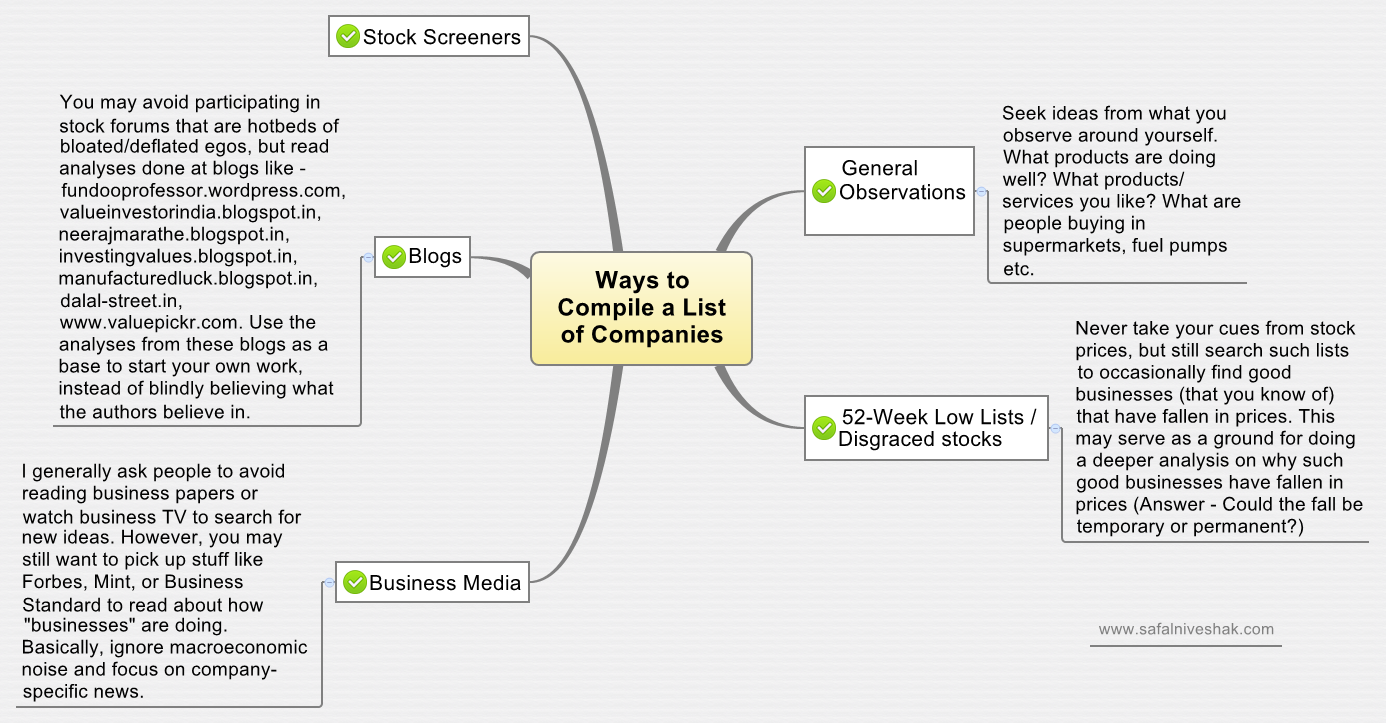
Remember, good ideas rarely come from…
- TV, newspaper analysis and breaking news
- Brokers and research analysts
- Friends, colleagues, and people you meet at social gatherings
…so you may rather do your own homework than relying on free tips, however enticing they may sound.
Screening Your Way to Stock-dom!
While I am not anymore a big fan of using readymade screeners to generate stock ideas – because you tend to substitute thinking with a lot of data – simple screeners still help me in doing the initial groundwork.
Also, while there are a few paid (and expensive) screeners available in the market – like Ace Equity, Prowess, Capital Line – I find a few free screeners to be very effective when it comes to the value I can derive from using them.
Here are three steps you can use while using three free screeners I use to do a basic analysis on companies…
Step 1: Use a Google Screener
Visit this Google Finance Stock Screener page and select “India” from the drop down list of countries, and then BSE or NSE from the stock exchange list.
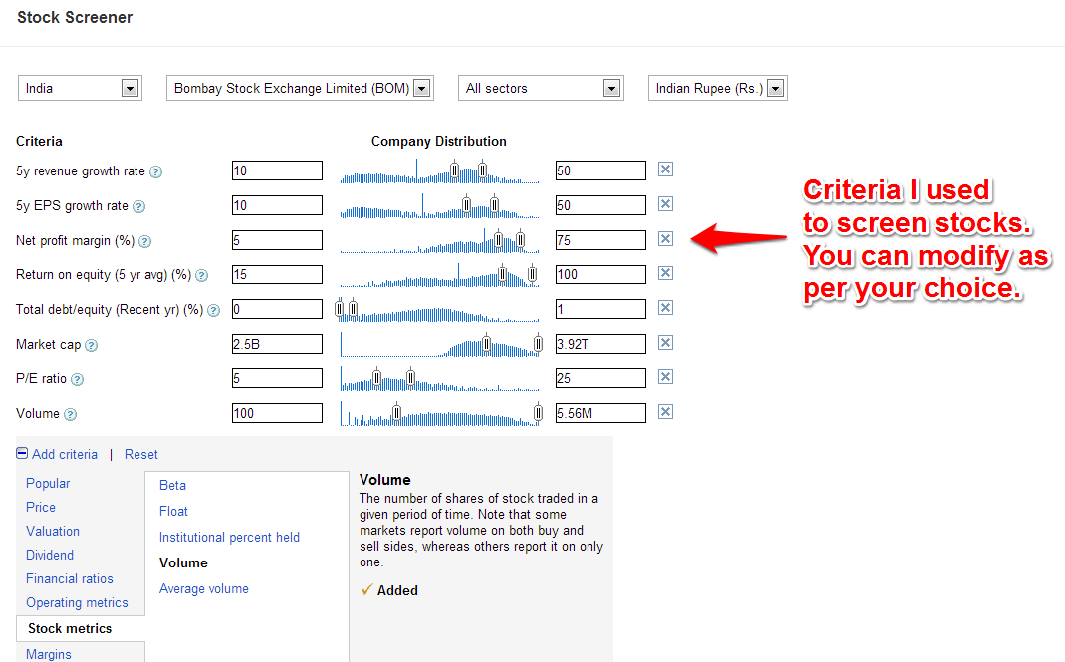
Remove all entries like “Market Cap”, “P/E Ratio” etc, so that you can set your own criteria for screening. Then, screen for companies using these key numbers (you may add more screening criteria from those available)…
- 5-year sales growth - Between 10% to 50% – Neither too low nor too high to avoid extremes or cases with sharp rise and sharp falls that may revert to the mean
- 5-year EPS growth – Between 10% and 50% – Neither too low nor too high to avoid extremes or cases with sharp rise and sharp falls that may revert to the mean
- Latest Net Profit Margin – Between 5% and 75%
- 5-year Avg. Return on Equity – Between 15% and 100%
- Latest Debt/Equity Ratio – Less than 100%
- Latest Market Capitalization – At least Rs 2.5 billion (Rs 250 crore) to exclude extremely small companies
- Latest P/E ratio – Between 5x and 25x
- Volume – At least 100 shares traded daily
Here is how the screening and its output look like…
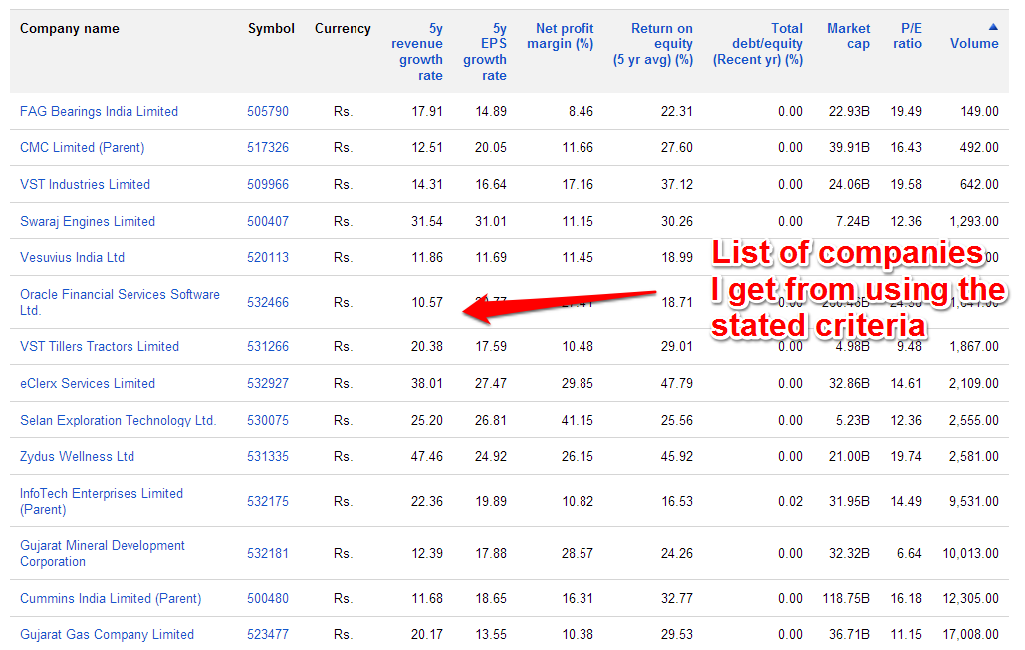
Note: Another good screener that a tribesmen has directed me to is from Financial Times – FT Equity Screener. It has greater number of criteria than Google’s screener, but does not display the results in INR. You must however try it out for sure.
Step 2: From the list of companies you get, exclude those outside your circle of competence – businesses you “know” you don’t understand (like I would exclude commodity businesses like metals and mining, or oil & gas businesses).
Step 3: Glance at the last 5/10 years’ financial performance on sites like Screener or Morningstar. Look for trends in:
- Sales growth – Check for rising and stable growth
- Net margin – Stable / rising margin. Be wary of margins that are falling
- Return on equity – Stable or rising. Be wary of falling ROE
- D/E – Nil or small debt is fine. Be wary of companies where D/E > 1x
- FCF change – Morningstar gives the free cash flow calculation, which instantly tells you if the company is generating cash or burning it. Look for businesses that have generated positive FCF over the past few years
- Apart from the ratios given, calculate ones like FCF yield – FCF per Share divided by Stock Price, which tells you if the stock is cheap or expensive. An FCF yield of 5% or more is a good number to look at.
The best part about these two screeners – Screener and Morningstar – is that you can download companies’s financial performance in excel and then do you own analyses.
Better Alternative to Step 3
While you may use Screener or Morningstar to study the past 5/10 years’s performance of companies that you get from Step 1 and Step 2 above, a far better way is to pick up the annual reports of the resultant companies and then read them one by one.
After having used readymade screens for the past few years, I have realized that you should not use numbers prepared by others, but rather generate them yourself. This way you get into the habit of actually reading annual reports and also get to learn what numbers you need to focus on.
Here are two videos that will tell you what you must focus on in an annual report…
If you can’t see the videos above, see here – Video 1 | Video 2
Ultimately, as you would realize, just a few numbers / facts / variables will help you understand what drives a given business.
I have seen analysts and investors trying to get perfect in their analysis by accumulating as many data points as possible.
But then, my experience suggests that trying to increase your confidence by gathering information that is supposedly unknown to most others really only makes you more comfortable with your investment decisions, not better at them, and is generally an unproductive use of your limited time.
Thus, I would suggest that after you arrive at your list of companies using any or a combination of methods suggested above, use a “Less is More Checklist” while reading the annual reports of the companies in your list.
Use the “Less is More” Checklist
Rather than obsessing with the bewildering fusion of news and noise, concentrate on a few key elements in stock selection, i.e., what are the 5-10 most important things you should know about any business you are about to invest in?
Of course, if I knew the exact answer I would have retired long ago!
Even if I could know all the facts about an investment, I would not necessarily profit. This is not to say that fundamental analysis is not useful. It certainly is.
But information generally follows the well-known 80/20 rule: the first 80% of the available information is gathered in the first 20% of the time spent.
So if I were to list down eight questions that, I believe, would help me do an 80% analysis of a business, they would be…
- Is the business simple to understand and run? (Complex businesses often face complexities difficult for its managers to get over)
- Has the company grown its sales and EPS consistently over the past 5-10 years? (Consistency is more important than speed of growth)
- Will the company be around and profitably better in 10 years? (Suggests continuity in demand for the company’s products/services)
- How has the company performed on Buffett’s earnings retention test? (Suggests how a company has used retained earnings in the past – a very important question to answer)
- Does the company have a sustainable competitive moat? (Pricing power, gross margins, lead over competitors, entry barriers for new players)
- How good is the management given the hand it has been dealt? (Capital allocation, return on equity, corporate governance, performance against competition)
- Does the company require consistent capex and working capital expenditure to grow its business? (Companies that have to spend continuously on such areas are like running on treadmills, which is not a good situation to have)
- Does the company generate more cash than it consumes? (Cash generators have a higher probability of surviving and prospering during bad economic situations)
These questions would help you answer whether the business you are looking into is great, good or gruesome as Warren Buffett has defined each one of them to be.
Ultimately, successful investing is all about doing your own research carefully and buying good businesses.
If you know a company well and you’ve done your homework, you can take advantage of situations when Mr. Market offers them on a platter, which he occasionally does.
Related posts:


Decisions under uncertainty

We make decisions every day.
For the sake of argument, let’s break them down into a few categories.
There are decisions where:
- Outcomes are known. This is the easiest way to make decisions. If I hold out my hand and drop a ball, it will fall to the ground.
- Outcomes are unknown, but probabilities are known. This is risk. Think of this as going to Vegas and gambling. Before you set foot at the table, all of the outcomes are known as are the probabilities of each. No outcome surprises an objective third party.
- Outcomes are unknown and probabilities are unknown. This is uncertainty.
We often think we’re making decisions in #2 but we’re really in #3.
Ignorance is a state of the world where some possible outcomes are unknown: when we’ve moved from #2 to #3.
One way to realize how ignorant we are is to look back, read some old newspapers, and see how often the world did something that wasn’t even imagined.
Some examples include the Arab Spring, the collapse of the Soviet Union, the financial meltdown.
We’re prepared for a world much like #2 — the world of risk, with known outcomes and probability that can be estimated, yet we live in a world with a closer resemblance to #3.
References: Ignorance: Lessons from the Laboratory of Literature (Joy and Zeckhauser).
— Brought to you by: The Suddes Group -- Changing the way nonprofits think, operate and fund.
Euro workers: no systemic risk
Martin Blessing from Commerzbank argues that "too much cheap credit could lead to future crises" and he concludes that he does not know "how too much cheap liquidity can solve a problem that was created by too much cheap liquidity." This argument has now been wrongly used for 5 years, I thought that by now we would have learned that this is the wrong analogy.
Fischen from Deutsche Bank complains that setting negative interest rates on deposits at the ECB would be like "penalizing banks". And this "will later be felt in a painful manner so that's what I've been warning about" (a threat?). This is the usual argument that banks are so important that you cannot do anything that annoys them. But what if negative interest rates are the right equilibrium value? In what way are we penalizing banks? Banks can go and invest their funds somewhere else if they find that this is not a competitive rate. In addition, it is not uncommon to have these CEOs arguing that what the Euro zone needs (in particular countries in the periphery) is a large reduction in wages. I guess this is fine. "Penalizing" workers is ok because they do not pose any systemic risk to the economy as a whole.
Antonio Fatás
Classic: Talking to Management, Part 5: Understanding Major Shifts
The following was published at RealMoney on April 20th, 2007:
The Changing Business Environment
What do you think is the most important change happening in the competitive environment at present?
This query can highlight emerging issues and demonstrate how the company is adjusting to the changes. Again, you need to compare the answers of various managers against each other; an odd answer could either be ahead of the pack or out of touch. If you think the answer makes sense, it can open up new questions that further enhance your understanding of the industry and the role that the company you are interviewing plays in it.
After Hurricane Katrina and other storms in 2005, ratings agencies toughened up their risk models, and catastrophe modeling companies increased their frequency and severity estimates. This created an even greater squeeze in the 2006 property reinsurance markets than what the losses of capital alone would have caused, as happened to the 2005 property reinsurance market from losses suffered in 2004. New entrants in the reinsuring property risk space found that they could write only half of the premium that their more seasoned competitors from the class of 2001 could. Further, property-centric writers found the capital required went up more for them than for their more diversified competitors.
There was less effective capital in property reinsurance at the end of 2005 than at the end of 2004, even though surplus levels were higher on net. Those who recognized the change in the rules of the game caught the rally in the stock prices as the price for reinsurance went up more rapidly than most expected for the 2006 renewal season.
What laws, regulations, or pseudo-regulations (such as debt ratings criteria) would you most like to see changed?
This is another attempt to understand what most constrains the growth of the enterprise (see Part 1 for a different angle on the question). The answer should be something that is reasonably probable, or else the management is just dreaming.
For an investment bank like Goldman Sachs (GS), an answer could be, “We want the ratings agencies to agree with our view of our risk management models, so that we can get a ratings upgrade and lower our funding costs.”
For a steel company in the early 2000s, the answer could have been, “The government needs to enforce the antidumping duties better.”
A media or branded goods company today might say, “Better efforts by the government to reduce piracy both here and abroad.”
For companies under cost pressure, such as General Motors (GM) and Ford (F), the answer could be, “A better labor agreement that includes changes in the union rules, so that we can improve productivity.”
What technological changes are most driving your business now?
Technology often benefits its users more than its creators. Prior to computers, it took a lot more people to run banks and insurance companies. Now financial companies are a lot more efficient and hire fewer people than they used to as a result of the change. You as the analyst want to know about the next technological change that will lower costs or create new products in order to forecast increases in growth of profitability.
There are other technological changes, but the biggest one recently in business terms is the Internet. The creation of the Internet has changed the way people search for information. World Book Encyclopedia was owned by Berkshire Hathaway (BRK.A), which thought it had a pretty good franchise until Microsoft (MSFT) and others came out with their own cheaper encyclopedias on a CD-ROM. Now even these are getting competed away by Wikipedia.
Who else is being harmed by the Internet? Newspapers are under threat from all sides. Classified ads have been marginalized by eBay (EBAY), Craigslist, Monster (MNST), etc. Regular advertising has been siphoned off by Google (GOOG), Yahoo! (YHOO) and others.
What cultural changes are most driving your business now?
Cultural changes affect demand for products. As more and more women entered the workforce, demand increased for prepared foods and dining out options. Demand decreased for Tupperware parties and things sold door-to-door.
Cultural changes can also lower the costs of an operation. Outsourcing has lowered costs and improved time coverage for call centers, computer programming and many other service functions. The willingness of nations to embrace the cultural change of capitalism creates new markets that previously did not exist.
One more example, again from insurance: Insurance became a growth product when extended family ties weakened and nuclear families became the standard. Now as nuclear families break down and are replaced by a greater proportion of singles without children, some insurance markets are weakening (life) and others are strengthening (annuities, personal lines, individual heath and disability).
What regulatory changes are most driving your business now?
Before you talk to management, you should know the answer to this one. But what matters here is that you know that they know, too, and more importantly, are building that into the plans for the business.
To get you started, consider the possible impacts of some changes on a few industries. For a pharmaceutical company such as Merck (MRK) or Pfizer (PFE), this could be a change in the way that drugs get approved. It might be a larger political change, such as the recent election of the Democrats, which is expected to produce a change in Medicare reimbursement rates.
Increases in environmental regulation can affect the profits of extraction businesses significantly, whether agriculture, mining, silviculture, energy exploration and production and more. If it becomes easier to unionize, that can affect wage rates and productivity even more as work rules bite into effectiveness and flexibility of work; both of these can lower profits in labor-intensive businesses.
Now, these are pretty obvious examples, and most examples here will be obvious, because most regulation is done openly. The answers that a management gives can be a test as to whether they themselves know what is going on.
Sometimes the answers get a little more subtle. In personal lines insurance, it took analysts a long time to catch up with the safety trends that were bringing down the frequency and severity of losses, particularly graduated licensing for young drivers. Internally, the companies had figured it out long before they told the analyst community. The analysts who asked why severity and frequency of loss were so good and got an answer that allowed them to “connect the dots” to the regulatory change realized that there was a secular, not cyclical, change going on. Thus they were able to make money buying personal auto insurers, because the trend was likely to extend to more states.
Mergers and Acquisitions
Without naming names, what types of business alliances do you think could be most valuable in the future?
This helps flesh out competitive strategy. Managements will be reluctant to part with details, but usually are willing to explain their approach to supplier agreements, joint ventures and so on.
The answer to this question can also highlight the “missing pieces” for the current business, and how the management team is trying to source them. It can also shine a light on new products and services that management is considering.
Is it cheaper at present to grow organically or through acquisitions?
The right answer is almost always organic growth. Acquirers usually overpay, particularly in acquiring scale. Intelligent acquisitions are usually small and often private firms, where the sale is negotiated and not an auction. The goal is to gain new core competencies or markets that can grow profits in concert with the capital and other resources that the company can add to their new acquisition.
If a company answers “through acquisitions,” there had better be a reason it has an advantage in acquiring companies that its competitors don’t, which is rare. If it’s the only public company rolling up a sector (again rare), there should be some logic as to what discipline the company exercises in not overpaying for acquisitions.
In the early phase of a roll-up, prices are typically reasonable for the small firms being purchased. As the roll-up proceeds, the acquisitions that are easy, logical and cheap get done first. In later phases, if there is a mania, the hard, illogical and more expensive acquisitions get done.
It’s rare to have a roll-up in which some party doesn’t start overpaying badly at the end. Sometimes that signals the end of the roll-up phase, with a decline in the share price of the overpayer, destroying the value of the currency that it is using to acquire small entities; namely, its stock price.
How important is scale when you consider acquisitions?
Again, acquirers usually overpay for scale. The right answer is usually that it is not important, unless it is a commodity business and the acquirer is the low-cost competitor, and will wrench expenses out of the target company to make the target as efficient as the acquirer.
Summary
The difference between my approach and the approach of most analysts is that I think about the business and its strategy rather than the next quarter or year’s earnings. My methods probably won’t help you make money in the short run but will help you make money in the long run as you identify intelligent management teams that understand how to compete for the long term, rather than those that can manage only next quarter’s GAAP earnings.
Two additional side benefits to doing it my way: First, the management teams will like talking with you. I can’t tell you how many times managers have said they appreciated my businesslike approach to analyzing their companies. Second, it will translate back into an improved understanding of the business you presently work in, as you think about strategic issues there.
Housing Finances…
I know this may sound sacrilegious, but the housing loan (mortgage) interest deduction is the most over-rated tax strategy in existence.
I constantly hear happy “homeowners“ boasting about how much money they “saved“ with their mortgage interest deduction.
Asking your boss to reduce your salary would perhaps have the same effect.
If you are in the 30% tax bracket each Rupee you pay interest on is only going to save you 30 paise. That means you are still spending 70 paise to save 30 paise.
My family believes that I choose to become a CA over IIT because I am weak in mathematics.
Even to my dumb head, this sounds like bad mathematics, correct?
This is actually the classic difference between a deduction and an expense write-off.
Can you convince a businessman that an expense is good, just because it can be claimed as deduction? I doubt it.
The other question that I ask in all my classes “Is a car an asset?“ Thanks to `Rich Dad Poor Dad`; many people having read that, say no.
Then I ask them “Is a house an asset?“ In spite of reading “Rich Dad Poor Dad“, people are still confused. And you`re so happy with this so-called tax break you aren`t thinking clearly about what is really happening.
In the first few years of a mortgage the majority of your payment goes toward paying your interest on the loan, not the principal. And homeowners think that`s fine; it means a bigger tax deduction. But if you can bring some logic to this you would realize you`re not building up any equity because of your payments.
You may be building up equity yes, but that is because real estate prices are going up. The question has to be asked, what happens if they ever start to go down. But let`s just look at why the mortgage companies really have you pay the majority of the interest up front.
First, the stats show that homeowners tend to buy a second house in six or seven years. So that means when you go to sell you`ve only paid interest on your mortgage; you haven`t really paid down any of your principal which means that the lender has been getting interest on almost all of the money they originally lent you which in the long run helps them make more money but at your expense.
At this stage the nice middle class homeowner go back to the lender, pay off the loan and take a fresh loan, and the interest payment cycle continues.
Thank God for my shareholding in India`s biggest mortgage company!
They surely got their maths correct, and so did I!
Let me come to my favorite topic of compound interest. Why do people feel happy about real estate? I think it is simple mental heuristics.
People do not understand the importance of the compounding formula (Future value = present value * (1+ r) ^ n). That is why they come up with “My father bought a house in Santa Cruz (an up market suburb of Mumbai) for Rs 30,000, now it is worth Rs 30,00,000.
We see it as a great 100 bagger! Great.“ However if you see that the purchase was made in the year 1964 and do an IRR it comes to “only“ 11% p.a.
If you factor in the interest cost, maintenance, and society charges, it does not sound too great, does it? This was over a period when inflation was hovering between 9 and 19% in India, and when for many years cost of funds was in excess of 12%.
Also this person was earning a princely sum of Rs 900 in 1964 – which meant he was paying 33 times his monthly salary for a house. However at a CTC of Rs 18L p.a. I am paying only 20 month`s salary. Thus the house, expressed in terms of inflation adjusted return may not be worth it.
Now while I know most people need a mortgage in order to purchase a home, there will come a time in your life when it will make sense to get rid of your mortgage. So I don`t want you to just keep paying a mortgage under the guise that it is your only tax write-off.
Very few seriously rich people have a mortgage. They simply write a cheque. Its simple guys, “its better to receive interest rather than pay interest“. Did you know that only since the Second World War the mass psychology changed from “use value“ to “ownership value“. Earlier, people like my Grand dad (decision circa 1919) was happy to rent 2 houses in Central Mumbai location and pay a rent for the rest of his life.
One more thing I cannot understand is how come we treat different assets differently?
Do you think you and your husband will do a 2nd job to support a Porshce, or a Mercedes? Sounds irrational, correct?
Do you say “Invested in a car?“ Well, I have not heard that ever.
How come you cannot invest in steel but can invest in steel and cement? It beats me, but thankfully the home loan interest deduction is gone after all!! (direct tax code!) -
Post Footer automatically generated by Add Post Footer Plugin for wordpress.
Do not buy an annuity!
There are many, many reasons to avoid buying an annuity, here are some prominent ones:
Let us start at the beginning. What is an annuity?
It is exactly a reverse of a loan. Or let us say it is a loan that you give to a fund house – and they repay it over a period of time. Let us say you give Rs. 1 crore to LIC and ask them to give you an annuity…then they are likely to give you, say, Rs. 6 L per annum for the rest of your life. Well it depends on your age. If you are say 68 you may get it for the rest of your life, but if you are 48 they may price it even more fine and reduce the amount.
Sounds so good on paper, why should you NOT BUY IT?
1. Simply because it comes with excessively high COST and huge discounting because of RISK.
After all all products have to be standalone profitable for the insurance / pension company so it is not priced well at all. The YTM on the 10 year G Sec is at 9.07% (22 Nov, 2013) – and you can surely buy a 10 year paper….so why should you suffer a 2% discount on your annuity?
2. Extremely inflexible product: Let us say you are now 58 years of age and will work for another 4 years…I would like an annuity product which will allow me to buy annuities at various ages. Let us say I have Rs. 4 crores in my annuity fund. I should be allowed to buy annuity worth Rs. 1 crore when I am 62, and another annuity when I am 69, and 2 more annuities when I am 75 and when I am 80. This gives me good pricing flexibility. Sadly, this is not possible. (the stupid govt NPS is worse)
3. It is not tax efficient at all in India (the 80C deductions are easy to get with elss, pf, nsc, ppf, school fees…and the amount is Rs. 100,000)
4. It takes a lot of money to get a reasonable corpus…so if you are investing Rs. 10,00,000 every year over a 20 year period you might end up with a sensible corpus…and we all know this is tough.
5. It is tax inefficient – when you withdraw from this fund is FULLY TAXABLE.
6. No more guarantees – read the clauses carefully. Or should i say no free lunches?
Post Footer automatically generated by Add Post Footer Plugin for wordpress.
Lower the Cap Rate, Not
Sometimes I think regulators are in over their heads. They aren’t talented enough to run a company, but they think they can control the excesses of financial companies. Then there’s the Fed. They think they can control an entire economy through the weak policy lever of affecting the views of people have for calculating what interest rates they should use to capitalize the values of assets.
Think of assets as a stream of future cash flows. But what are those cash flows worth today, to buy or sell them? The interest rate that makes the price and the cash flows equal is the capitalization rate, or, “cap rate.”
For years, at least in the Greenspan era, lowering the cap rate via Fed funds was the rule when times were weak. He was the anti-Martin, bringing back the punchbowl rapidly when the party was getting a little dull. Because of that, the economy grew more aggressively for a time, but at a price of growing unproductive debts.
The Problem
You can lower the interest rates as low as you want, but it doesn’t change the underlying productivity of the economy. You might push asset or goods prices higher — it depends whether saving or spending is more important. At present, actions of the Fed push asset prices higher, which doesn’t do much for the economy as a whole. Rising asset prices do not stimulate the economy much. Though it would be dishonest to do it, it would stimulate the economy more if Ben would rev up the “Helicopter of Happiness” and rain dollars from “Heaven.”
The Fed created the housing bubble with their policies 2001-2007. They did that to stimulate the economy. You can only use strong sectors of the economy to transmit monetary policy, because they can absorb more debt.
That’s true when not in a liquidity trap. We are in such a trap now, given the profligate prior Fed policy. They did not let recessions destroy bad debts leading to a reduction in the marginal productivity of capital. That value is so low now, that companies pay higher dividends and buy back shares. Relatively little goes into growth via new investment.
My point is that monetary policy has some potency if central bankers are willing to inflict pain in the bear phase of the credit cycle. With Greenspan and Bernanke, that was absent. As such, we suffer in a liquidity trap, and one that current Fed policy will not remedy. Far better to raise short-term interest rates and let some bad businesses fail, and grow from there.
You cannot Parody a Parody
I have never made it is a secret that I find Bollywood unbearable. But I have to confess that I have watched the 1975 blockbuster Sholay a dozen times at least. Why? Because one particular sequence in it cracked me up something wicked. It is a traditional joke — someone ostensibly speaking in favor of a person but actually doing everything possible to undermine that person’s case. As a rhetorical device, it is deliciously persuasive because the humor hammers home the underlying message more effectively than straightforward speech.
In that particular scene in the movie, Amitabh Bachchan’s character is pleading his friend’s case to the aunt of a girl that his friend is keen on. He slyly reveals that his friend is actually a worthless layabout and general debauch. The aunt is understandably disgusted and in the end she says that the last thing she would want is to throw her niece into the clutches of such a monster. End scene.
What brought to mind that sequence is that there’s a new parody of it on YouTube. In this version, the Bachchan character is canvassing the old lady to vote for the Congress/UPA government. Just give the government one more chance, he pleads. Let me not spoil it for you. Just watch it.
(Sorry to those who don’t follow Hindi. Perhaps someone will subtitle it in English soon.)
The old lady’s voice is clearly not that of the original actor’s but the man’s voice is unmistakably that of Amitabh Bachchan. I wonder how the makers of the parody got him to do it. Be that as it may, I am thrilled about it. The form of the message is funny but the content is devastatingly accurate. People who support the Congress/UPA government despite their terrible deeds are purposefully blind to the obvious. What they gain from this blindness will have to wait for another day but for now, just enjoy the little skit, which unfortunately for us, is not a parody. You cannot parody a government that is a parody itself.
Hired by the Data, Fired by the Data
And That's a Good Thing
They're Watching You At Work
The Atlantic
The term Big Data, admits writer Don Peck, "has quickly grown tiresome." But the power of analytics as a mechanism for making decisions about hiring and firing is still growing, and the "application of predictive analytics to people’s careers … is enormously challenging, not to mention ethically fraught." Indeed, the idea that stats may determine whether we'll flourish in careers or be temps forever is both promising and deeply concerning. Peck traces the history of hiring in America, noting that attempts at psychological testing based on "science" in the 1950s were largely abandoned in favor of ad hoc interviews. But we know that favoritism and bias are all too common in these situations. Now that science is making a comeback, Peck explores some of the new ways in which companies will be able to make some of their most important decisions.
One is a start-up called Knack, which uses video games to measure how people function neurologically when it comes to skills like problem solving; the game has been used by Royal Dutch Shell. In 2010, Xerox started using "an online evaluation that incorporates personality testing, cognitive-skill assessment, and multiple-choice questions about how the applicant would handle specific scenarios that he or she might encounter on the job." The color-coded rating (red, yellow, or green) generated by an algorithm helps guide the company in its hiring decisions. The attrition rate fell by 20% in the initial pilot period, and over time, the number of promotions rose. Then there's GILD, which uses data to search out software engineers who might have been missed by traditional forms of recruiting.
In the end, Peck surprises himself: He now believes "that we’re headed toward a labor market that’s fairer to people at every stage of their careers." That is, one that isn’t based on who you know or what kind of degree you have.
Can I Get a "Toot Toot"
Auto Correct
New Yorker
First, two sets of stats: Americans are in 10 million car accidents every year, and 9.5 million are their own fault. Second, the Google self-driving car has covered 500,000 miles without causing a single accident, and it can go 50,000 miles on a highway without experiencing a major error. So what's not to love about a car that you can get to work in while playing Candy Crush and not killing anyone? In this lengthy piece on the past, present, and future of the self-driving car, Burkhard Bilger reports on the broad stakeholder issues facing our driving future. One player is the famed Google X lab, where extensive research on two cars — a Prius for regular street use and a Lexus for highways — is aimed at radically changing how we drive.
The company wants to eliminate people’s need to own vehicles — most are used for merely an hour or two a day, and public transportation featuring self-driving cars akin to taxis could shake the entire car industry. "They want to make cars that make drivers better. We want to make cars that are better than drivers," says one Google engineer. "They" — car companies — are also developing self-driving cars, but view automation as a process that helps make driving easier and much safer while maintaining the inherent pleasure many feel in driving a car. Indeed, notes Bilger, "Mercedes builds cars for people who love to drive, and who pay a stiff premium for the privilege." But what about young people who learn to drive distracted, with phones and gadgets at their fingertips? And then there’s a host of moral issues, like whether or not the car should stop or swerve to avoid hitting someone's cat. The technology is getting there — Bilger describes the Google Lexus as behaving "like a dancer in a quadrille" when it meets traffic.
"Psssst. Your Waterproof Speaker Is Right Here."
The Amazon Whisperer
Fast Company
Fast Company editor Jason Feifer wanted a cheap, waterproof, Bluetooth-enabled, rechargeable speaker so that he could listen to podcasts in the shower (we've all been there). He typed his needs into Amazon, and one product popped up: something called Hipe (but was Hipe the brand or the model?). He bought it, and when he had questions, he sent an email, which produced a reply from a mystery man named "Sam." But what was this "Hipe" and who was behind it? The trail led Feifer to Chaim Pikarski, who essentially built a business around Amazon product reviews. Each of his “buyers,” as he calls them — the elusive Sam is one — "scours the web to learn all the features people wish a product had, and hire a manufacturer, often in China, to make the desired version." The buyer gets to name the product — hence the mysterious "Hipe." The company can then compete against speaker companies (or any other type of product manufacturer, for that matter) without needing to become one itself. Pikarski's company, C&A Marketing, is also pretty profitable: sales in nine figures and a 30% annual growth.
And, yes, Feifer eventually got to meet Sam.
Baby Steps
What to Expect When You're Expecting a Baby Boom
Wall Street Journal
China's revision of its one-child policy may be more illusion than reality, but its impact on the Chinese psyche and economy has apparently been significant. Makers of baby formula and diapers saw their shares jump. Same thing for companies that make pianos, because more babies means more little pianists. The Wall Street Journal says 48% of the 79 million Chinese women of childbearing age could be affected by the policy change; if just a quarter of them had second children, there would be 9.5 million additional babies in the next five years. Chinese bloggers have been joking about people’s pent-up desire for more children, saying that on the evening when the news broke, young couples went to bed early.
Despite the economic euphoria and the joshing, China still faces an accelerated demographic decline, Gordon G. Chang writes in Forbes. The one-child policy has led to a lopsided sex ratio, with more boys than girls, and the country's total fertility rate is low, well below what demographers call the "replacement" rate of 2.1 births per female. Many young women today are rejecting Chinese tradition and skipping marriage and motherhood altogether. The cautious, phased relaxation of the policy is seriously inadequate, Chang says; China's demographic trajectory is already set, with the number of young people declining and the elderly population ballooning. —Andy O'Connell
A Silicon Valley of One
Insights from an App-Developer Veteran: Think Simple, Low-Risk
VentureBeat
If you've been nursing a few app ideas and wonder what it takes to be a successful independent app developer, listen to self-taught programmer Rob Jonson, who has been releasing apps for a decade. When he looks at big-money app developers who are riding waves of hype and seeking venture capital or big tech buyouts, he wonders "why they didn't just build their app in the evenings, launch it, and see what happens. Most will disappear without a trace, but a good idea that fulfills a need will gradually find a market. And probably has as much chance of hitting it big as any other decent app, with a lot less risk." Jonson has never had employees and spends little on development, design, or launch. He finds that his most popular apps are those that he's developed for himself to satisfy his own needs. And he makes it a point to respond personally to users' emails. "People are surprised and pleased to get an email from the real developer," he says. —Andy O'Connell
BONUS BITS
Costs and Rewards
Just 90 Companies Caused Two-Thirds of Man-Made Global Warming Emissions (The Guardian)
How Snapchat Plans to Make Money (Business Insider)
What It's Like to Fail (Priceonomics)
Five Sources of Start-up Ideas
Does anyone dispute that 2013 has been the year of the tech company? LinkedIn has surged over 100%. Twitter and Zulily popped more than 70% and 80% respectively on the day of their recent IPOs. Even Facebook’s stock, once completely out of favor, has doubled in value over the past six months.
As prices of internet bellwethers reach stratospheric levels, more people are being enticed to start companies than ever before. Just one example: Roughly 16% of Stanford’s MBA Class of 2011 chose to start their own companies at graduation, eclipsing the previous high of 12% during the dot-com bubble.
That’s great for them. But as I’ve discovered recently, there are still countless more would-be entrepreneurs looking for a lightbulb moment before beginning their quest for fulfilling work, an independent agenda, and the potentially life-changing financial outcome that a start-up promises. In fact, when I interviewed my peers looking to become founders, the number one reason holding people back was the lack of a suitable idea. One remarked, “I have been working all my life, so funding isn’t a problem. I just don’t have any good ideas.” Said another: “I would start my own company tomorrow if I had an idea worth quitting my job for.”
To inspire the idealess, I’ve spent the past month investigating exactly where successful founders got their revelations. I surveyed 50 entrepreneurs at three different stages (pre-funding, growth, and acquired/gone public) and conducted detailed follow-up interviews with 15. Given that 90% of all ideas raised fit into one of the categories below, there’s a pretty good chance your next big thing will appear in the list.
Here are the top five sources of start-up ideas:
1. I experienced a pain point in my life and wanted to solve it. By far the most popular source of ideas among respondents was a frustration that the founder experienced in his or her personal life. Ever wonder how much your own problems might be worth? Ask Kent Plunkett, who founded Salary.com when hiring a secretary and finding himself unsure of what to pay. After building the world’s largest compensation information database, Kent eventually took the company public in 2007 at a valuation of $175M.
2. I met someone talented, and we started a company together. If you’re interested in starting a company, look at those around you, specifically at your workplace or school. Others have cautioned against starting companies with business school friends as a strategy for eventual success, but the data care to differ. Of the 39 companies started since 2003 and valued at over $1B by private or public market investors, almost half were started by founders who met at school. Close proximity of like-minded individuals seems to be a key catalyst for surfacing new ideas. Cofounders Corey Capasso, Andrew Fereneci, and Dan Reich first met at the University of Wisconsin, starting Spinback together many years later before the company was acquired by Buddy Media in 2011.
3. I have a special skill or passion, and I turned it into a business. Spend an hour conducting a written personal skills and passion inventory, and your next idea might be staring back at you. The founders in this category were intensely self-aware and looked for innovative ways to turn their work experience and hobbies into full-fledged businesses. Alexa von Tobel combined her passion for helping Millennials with her skill of articulating complex financial matters to start and raise more than $40M for LearnVest, an online financial planning company.
4. After working in an industry for a long time, I saw a customer need. Think your years slaving away at a corporate job will amount to nothing but a partially adequate 401(k)? If you use the experience to think hard about your customer’s unmet needs, you might be on the road to riches. The founders in this category worked in or around an industry for many years before starting a company directly related to that industry. Francois de Lame and Jennifer Fitzgerald amassed extensive experience in, and knowledge of, the personal insurance industry before starting KnowItOwl, an innovative online personal insurance navigator.
5. I researched many ideas and eventually narrowed it down to one. Savvy individuals are leveraging new sources of information, such as Quora and Hacker News, to conduct “top-down” research and use a data-driven process of elimination to arrive at a single business idea. Many were also very sophisticated in tracking proven business models and companies, with the goal of identifying breakout hits and applying them to new geographies. Founders Kimball Thomas and Davis Smith saw the value of taking the Diapers.com model to Brazil. Their latest goal? To hit $1B in revenue in the next few years.
So what does this mean for your inner “wantrepreneur” looking to hit it big? If you’re stuck pining to start, stop. Instead, extract start-up ideas from the fertile sources around you, and begin conducting small experiments to validate your hypotheses. Keep your head down and your momentum up, and with a little luck, you might just be onto the next big thing.
Budgeting has its advantages….
Whatever I do, my weight does not come down” and “Whatever I do I cannot reduce my expenses” – are commonly heard statements. If you are a doctor, a wealth guide, a financial planner, …you hear both of these statements.
Normally people do not write down diligently what they earn, spend and invest. Similarly for reducing weight you need to maintain a food diary which will tell you what you eat…and then you can analyse the same.
Let us see what makes a good budget?
In all the budget blunders exercises, the same few problems keep rearing their ugly heads. To avoid them, here are the important features of a successful budget.
1. Categories that fit your personal situation and your families’ spending habits.
2. Accurate income projections. Salaried individuals have it easy. In case of self-employed people – they tend to dramatically over/under estimate their incomes.
3. Enough categories to give you a meaningful picture of where your money goes and where you might be able to cut costs, but not so much detail that tracking is a chore that you’ll soon give up. Breaking up of your medical expenses into doctors’ fees, and medicines is fine. But if you try further breaking up medical expenses into generic and branded – you might give up the whole exercise.
4. Inclusion of expenses that don’t occur on a monthly basis, such as car maintenance, term life insurance premium, festival expenses, clothes buying, etc.
5. Regular review of categories to determine if you need more or fewer, review of expenses, and brainstorming about ways to reduce costs in each category.
6. Cash spending is a big leak in most budgets. Cash disappears quickly and if you don’t write down everything you spend it on, you will not have a clear picture of your spending.
7. A minimum saving amount – at least till you build your emergency fund.
8. Realistic written goals. Budgeting is about setting financial goals (saving for a down payment on a house, buying a new car, getting out of debt, saving for retirement, putting your kids through college, travelling, etc.) and finding ways to meet them.
9. Identification of spending patterns you may not have been aware of when you weren’t tracking your spending.
10. Most importantly, internal motivation and a positive attitude!
and ha! http://www.subramoney.com/2010/12/visualisation-power/
Post Footer automatically generated by Add Post Footer Plugin for wordpress.
Classic: Talking to Management, Part 4: Prices and Products
The following was published at RealMoney on April 19th, 2007:
Pricing and Products
Do you think you can pass through price increases in the next year?
Questions like this can highlight management’s competitive strategy and how much excess of demand over supply exists in the current environment. Answers that involve no price increases or price decreases should also explain the reason for that, e.g., technological change.
For example, if you asked this question of a disk-drive manufacturer, he’d probably blink and ask of you, “Where have you been? This business has been so cutthroat competitive that we have been forced to innovate in order to create drives that store more, retrieve faster and at lower cost for more than 20 years! We’ll never get price increases! This business is like Alice and the Red Queen. We have to run as hard as we can just to stay in the same place. Our only hope is volume growth, and thankfully, we have gotten that.”
Answers that boil down to “demand is eroding” or “competitors are irrational” should contain some idea of what management is doing to combat the problem. Sometimes giving up market share to an irrational competitor can be the brightest move; market share can only be rented, never owned.
I can give examples from many cyclical businesses. All mature businesses are inherently cyclical, and stock price performance follows the pricing cycle. At RealMoney, I have already written about this dynamic in insurance, steel and cement. To give one more example, consider the airlines. As so many of them slipped into bankruptcy early in the 2000s, most of the bankrupt carriers were forced to shed capacity. As they shed capacity, pricing got incrementally better and then a whole lot better, leading to the outperformance of airline shares.
What are your plans for dealing with emerging substitute products?
Sometimes a market comes under threat from a new competitor with a new business model. Usually threats like this begin with simple products with relatively low returns on equity.
For example, when the steel minimills came into existence, they provided only the lowest-quality steel products. Over time they expanded their products to capture more of the value chain in the steel business, and this placed increasing pressure on the integrated steel companies, many of which crumbled under competition from the minimills.
Had the competitive threat been met early, the integrated companies could have minimized the threat by adopting the tactics of the minimills.
Do you have any complementary products in the works that open up new markets for you?
Much of the time, growth happens through a willingness to explore offering products and services that are one step removed from existing offerings. This could be a new marketing channel, offering the product internationally, extending the brand, offering services that complement the product, etc. Often a move like this precedes growth in profitability; it means that executives are looking for low-risk ways to expand the franchise.
Going back to my favorite insurance company, Assurant (AIZ), it’s constantly looking for new ways to create new products and services that lever off an existing core competency. For example, it’s No. 1 by a large margin in force-placed homeowner’s insurance.
When a homeowner with a mortgage doesn’t make a payment on his or her homeowner’s insurance, the mortgage company is at risk if a disaster happens. After a grace period of two to three months expires, the mortgage company buys a homeowner’s policy from Assurant or another carrier and bills the homeowner at their next mortgage payment. The development of force-placed homeowner’s insurance led to new product lines in force-placed auto insurance and renter’s insurance.
The first business developed as a result of relationships with mortgage lenders that wanted their interests protected if property insurance slipped out of force (not a good sign for the creditworthiness of the loan). The same applies to auto lenders. It also applies to large multifamily unit management companies, which want the integrity of their apartments protected. Those who live in apartments are much more likely today to damage the units than in prior decades, and increasingly landlords require it.
Full Disclosure: still long AIZ
Confluence of Mutual Fund industry, 2013
Attended the Cafemutual Confluence – it is still going on – and I am posting from the venue.
The first round was the fund manager round which was chaired by Vivek Law and the speakers were Naren Sankaran, Prashant Jain and Anoop Bhaskar.
The problem with such an august panel is most people are intimidated to ask any questions. However Naren made a valid point – most distributors are scared of selling a scheme when it has recently taken a hit. Well he did not say it in so many words, but he said at the current interest yields (G sec very close to 2 digits!) the only reason that the IFAs are not selling debt funds is because of the July effect. Agreed Naren.
Also Prashant made a point that when all mutual funds are open ended funds why do IFAs not sell when the market is low?
Simply because Mr. Prashant Jain the IFA does not OWN the customer. The customer listens to Mr. Vivek Law, Mr. Dhirendra Kumar, on TV, reads many newspapers, magazines….and makes up his own mind. When things go right, he thinks it is his brain and when things go wrong he blames the IFA.
The second session was ‘how to increase the mutual fund pie’ – nice topic, but it spoke about mis-selling and the Moderator asked ‘since the world’s cheapest pension plan is the NPS, why do you distributors not sell the NPS’. Simply Mr. Gautam Chikermane the IFA has to make money to run his house, and NPS does not pay. If the distributor had an organisation backing him, pay him a Rs. 50 Lakh salary to do investor education, he would do that.
The other speakers were Lovaii Navlakhi, Neeraj Choksi, Rajiv Bajaj and Vishal Kapoor. I have heard of Lovaii and Rajiv, but I do not know the others. By the way the topic centered around mis-selling by the IFA….
Well I heard it…..
Wealth management for the non-urban non-elite households by Puneet Gupta was being moderated by Gautam Chikermane….
Post Footer automatically generated by Add Post Footer Plugin for wordpress.
How To Avoid Getting Sick
This time of year brings out more than just the holiday spirit. It’s cold and flu season and not a day goes by where I don’t see someone sniffling or coughing.
Here are 7 simple tips to keep in mind that will help prevent cold and flu.
1. Wash your hands.
This is something you should be doing a lot. Most of what we do every day, involves touch. Consider my local coffee shop, at least two—and often three—people touch that cup before it even gets to me. I’m not a germaphobe, yet if you’re only going to do one thing, do this.
2. Don’t pick your nose, rub your eyes, or otherwise touch your face.
My mom told me ‘this is the way germs get in’ and she was right. Even with relatively clean hands, odds are there are some germs. One of the easiest ways to transmit virus is through your nose, mouth, and eyes. Keep your hands away. Oh and don’t bite your nails.
3. Avoid sick people.
Sick people often have sick germs. Stay away from these people. If you’re sick don’t go to work. Every office has that person who shows up to ‘tough-it-out’ and everyone secretly hates that they are at work.
4. Avoid the social jet-lag (i.e., sleep).
Not getting enough sleep increases the risk of catching a cold. When you feel like you’re starting to get sick do the world a favour and take the day off to rest.
5. Drink plenty of water.
Not juice, water. If you want juice, eat an orange.
6. Pass on the booze.
If your body is fighting a cold or the flu, why would you ask it to do even more. That’s like taking the busiest person you know and saying, hey can you do this too? Skip the booze for a few days if you think you’re fighting something.
7. Fast
Skip a meal. When you’re sick your body does this naturally through lack of appetite. But when you’re fighting something, you can choose to do it. This is what animals do when they’re fighting an illness or serious infection. Don’t skip the water.
— Brought to you by: The Suddes Group -- Changing the way nonprofits think, operate and fund.
Oxfam Trailwalker, 2013, Pune area – A real long walk….
Last Friday and Saturday was spent walking on the roads of Lonavala…about 56km on Friday and 44 km on Saturday…totaling 100km.
This was part of the Oxfam Trailwalker, 2013 Charity walk.
Some lessons -
On the first day we thought we would average about 5km an hour and thus reach about 65km at 7pm (13 hours).
Well things did not go as planned. The first 10km was very difficult and we went much slower. Far more importantly we stopped every 10km and pampered ourselves with ice, change of clothes, filling up water in our water bags, eating (some necessarily some unnecessarily) ….and this reduced our walking time.
The arrangements made by the organisers were really good as were the doctors, physios, nurses etc. and this made our journey easier. Not that we used their services much – but must have helped those who needed it.
What was amazing was the organisers telling us that we should not eat oily food, but they served us very very oily food – which went straight from their containers to the bins. Sad, but they could have been more considerate.
We were lucky to be carrying our own food and hence it was not too much of a problem for us. I am not using any names of my companions – have not asked them.
On the second day we were scared (based on Friday experience) and thought we would finish by 9pm. We actually finished by 6pm. However on the second day we really enjoyed our trip – clicking snaps, taking dips in the flowing water, ….and generally having a ball.
So summarised learnings:
- Making projections (in this case of speed) without knowing the conditions (in this case the terrain) is STUPID. We did it, and went wrong.
- Making projections on day 2 based on experiences of day 1 was foolish (past performance is not a proof of future performance!)
- You should know why you are going (GOAL)…WE enjoyed our trip (awesome trip, repeat, awesome trip) and that was important. If that was the GOAL, why crib about speed and ranking? Habit, I guess.
Ha another stupid thing of trying to learn from every outing! Tch tch….why should I do it?
Post Footer automatically generated by Add Post Footer Plugin for wordpress.
Is it so near??
when mangoman says inflation pinches..you laugh...but when corporates fraud new joinees we keep mum...
Moily's diesel maths doesn't add up | Business Standard
This guy is telling he is gonna to deregulate diesel price in 6 months knowing fully aware in 6 months he will be jobless...he wants to sell IOC to unassuming public..so he openly lying..still no body questioning his intent...good country
Red flag over realty exposure of banks | Business Standard
When mangoman says the country's banking network is fullly gone due to real estate, you laugh and brand mangomen as party pooper...now what?
stilll may to come out...
Interestingly Maharastra government says they are not going to honour RTI applications about housing societies. Is there law exists in this banana republic?
Do Raghuram Rajan’s Five Pillars Stand Up?
I wrote this for Yahoo.
About two months after the entry of Raghuram Rajan as the new governor of the Reserve Bank of India, we have some kind of a scorecard to evaluate his performance - the five pillars…
Tehelka stings itself
The Tehelka molestation/sexual harassment (we yet don’t have details to finally call it one) case, where the publication’s founder and Editor-in-Chief Tarun Tejpal has been accused, is making waves. Tarun has decided to do “penance that lacerates” him for his “bad lapse of judgement” and has therefore “offered to recuse” himself from the editorship of the publication for the next six months.
But there are critical questions that come to mind and they cannot be brushed under the carpet. A crime, if it has been committed, cannot be wished away with a self imposed exile. It is a legal issue, apart from a huge social problem, and it is surprising that despite it now being common knowledge, and that the incident actually happened a fortnight ago, there is no police complaint. Who has pressured the victim from doing so?
More importantly, can a magazine that prides itself in exposing the wrong all around hide behind the façade of ‘internal matter’? Can sexual harassment or whatever it is finally proven to be, wished away by saying the accused has decided his own punishment and is apologetic?
The answer to all this is a resounding NO!
What makes the whole thing look even more murky, rather sad, is that the said incident happened (not once but twice) in Goa during the magazine organised literary event called Think. What’s more? One of the important discussion topic on Day 1 of the agenda was:-
THE BEAST IN OUR MIDST – Rape Survivors speak their stories.

Funnily enough, this debate was moderated by the magazine’s managing editor, who is now terming the incident as an internal matter and not something that she should be answerable to anyone outside. Fair enough? No!
The fact is that the media is undergoing tremendous strain currently, and it is not just to do with the march of technology. With the rapidly growing-in-clout social media keeping a hawk like eye on every move we make, the credibility is at stake too.
Far too often we are accused of jumping the gun and accusing, rather declaring someone a crook or a criminal way before even the charges are framed. Sure, some of the cases seem so open and shut that the delay in naming them criminals has more to do with the tardy system we have in place and the media would be failing in its duty if it didn’t do so quickly.
However, by that same yardstick, we ourselves must be open to open scrutiny too and be ready to take the blow on the chin. Not doing so amounts to plain double standards, which we are increasingly being accused of.
Just saying it was bad judgement etc is not enough. He must present himself for a full probe by the authorities. These harassment cases are not mere internal matter, but concern the society too, of which, we, the media are a watchdog. And a tainted watchdog can never be good for the society.
How Korea Can Avoid Japan’s Economic Mistakes
Chaitanya PatelGood article on Japan and Korea
Around 20 years ago, Japan’s middle-income class started to collapse. Up until the 1980s, Japan had boasted of its “100-million population, all middle-class society.” Afterwards, it was forced to admit that this had degenerated into a “society of disparity.” While 80% to 90% of the Japanese population considered themselves middle class in the 1980s, according to a Seoul University study, this plunged to less than 30% by 2007. The underlying causes of this collapse offer lessons for South Korea, which is now undergoing a transition similar to Japan’s at the start of the 1990s.
There were three major reasons for the profound change in Japan’s economic and social makeup:
During the “lost two decades” starting in 1990, Japan’s economy either shrank, or inched up by just 1% or 2%. Sluggish domestic demand, an aging demographic and a strong yen, and the undermining of the competitiveness of Japan’s exports, all took their toll on growth rates.
Political uncertainties and the absence of strong leadership contributed to social fragmentation. There have been as many as 16 prime ministers in Japan since 1990, while the average term of each prime minister has been just around one year. This instability meant that Japan was unable to iron out a national consensus on its reform plan, or implement reforms in the long run.
The persistent low growth meant many domestic companies struggled or went bankrupt. Massive layoffs ensued, and the labor market turned flexible far too rapidly, with many formerly middle-class workers losing permanent contracts and reliable salaries. Despite high unemployment rates and increasing numbers of irregular workers, the Japanese government failed to overhaul the country’s welfare system so that it would be better able to prevent the dismantlement of the middle class. The Japanese welfare system was poorly suited to the task because it was led largely by corporations. The government’s welfare spending was too small to dole out benefits to those who lost jobs during business restructurings. Even though the Japanese government dared to take deficit financing in order to boost the economy, it mostly injected money into building infrastructure, but didn’t expand spending on welfare much.
In this regard, it is reasonable to worry about the future of Korea, because much of what occurred during Japan’s lost 20 years is currently happening there.
Korea has just entered a low growth stage. The Korean economy is increasing at a rate of less than 3% for the third consecutive year in 2013 – far below its potential growth. The aging demographic is making its economy lose steam, while sluggish domestic demand has continued for over 10 years, since the 1997 Asian financial crisis. Korea differs from Japan, however, in that its exports have been buttressing its growth. But the outlook for the country’s exports isn’t bright due to the strong won, and the slower than expected recovery of the global economy.
Korea is also following Japan’s footsteps in increasing the use of irregular workers, while its lack of a welfare system is stoking social unease and eroding economic vitality.
Both countries’ uncertainties in political leadership are also alike. Conflicts between the ruling and opposition parties are intensifying. The conservatives and liberals are becoming extremely polarized. The president’s leadership is weakening, too. Society hasn’t reached consensus on reform. And even if consensus had been reached, it would be impossible to make consistent efforts to pursue reform due to the current situation of the country.
Given these similarities, how can Korea avoid repeating Japan’s economic mistakes and failures?
Reinstating political leadership is the most crucial factor. Social consensus can only be forged when there is a strong leadership that can broker a grand compromise between the ruling and opposition parties, conservatives and liberals, and employers and laborers. That leadership, at the same time, should be capable of sustaining the consensus and making consistent efforts to do so.
Second, Korea must find a way to pull out of its current low growth trend. Its most urgent task is to invigorate investment. The government needs to encourage businesses by easing regulations, restoring entrepreneurship, and pacifying anti-business sentiment.
Third, Japan’s case should remind Korea of the fact that the rapidly aging Korean society is a critical cause of its lackluster economic growth. The country should come up with long-term and multifaceted measures to raise its birth rate, which is currently the world’s lowest. In addition, Korea needs to revise its immigration policies.
Fourth, while Japan mainly invested in its social infrastructure to boost its economy, Korea needs to focus on its highly educated human capital.
Finally, it is right to increase welfare spending, but the focus should be on a productive welfare system centered on active labor market policies such as supporting training programs for those who change jobs.
If these measures are taken, Korea will still be able to avoid the specter of two lost decades.
Stagflation and Financial Repression
This post is an experiment. Don’t hold me to high standards here. I want to explore the area where governments extract value out of their citizens via inflation.
With stagflation, we have high inflation and high unemployment. Financial Repression has inflation higher than safe interest rates.
In the current situation, we have a lot of discouraged workers. We also have a government sucking value out of savers because short interest rates are so low.
The main thing to understand here is that the government is not here to help you, but to milk you. The government does not care about you. It cares about its survival. If it can’t get sufficient taxes out of the populace, it will use its financing arm, the central bank, to lend to it at preferential rates, while passing on losses to the populace via inflation. Also note that inflation tends to hit the poor more than the rich. Food and energy, two things that can’t be printed, have prices that rise more rapidly. Food and energy price rises affect the poor more than the rich. As such, the current Fed policy that tends to raise commodity and asset prices discriminates against the poor and in favor of the rich. From unelected bureaucrats, it’s hard to think of a more unaccountable policy.
Both policies, stagflation and financial repression, come about because the government and central bank are trying to force the economy to do more than it can do, leading to greater poverty on the low end of society, leaving aside the fine-sounding words of the liberals. You have to get this: there is no constituency for small business and poor people in Washington, DC. The policies align with big business and rich individuals. The purple party reigns, sucking in donations from both sides. Significant donations only come from big business and rich individuals. (Purple is significant of Monarchy, aside from being the mix of red and blue.)
My main point is this: it will be difficult for most developed country governments to fulfill all the promises they have made. The results of this may involve stagflation, financial repression, and/or defaults.
What a world we bequeath to our children and grandchildren.