Shared posts

21 Nov 06:26

Four Questions To Ask Yourself Before Opening Your Mouth

by Shane Parrish

Yoga

A friend passed along a copy of Yoga Wisdom at Work.

The book is a quick read. I took enough away from it to feel like it was time well spent.

One of the best parts of the book for me was on authentic conversations and the right speech.

Here are four questions to consider each time you speak.

1. Is it true?
2. Is it necessary?
3. Is it kind?
4. Does it improve upon the silence?

These can be incorporated into the acronym THINK: True, Helpful, Improves upon the silence, Necessary, and Kind.

Here is the discussion on the three elements of truth that followed:

It is no coincidence that the first question is about truth. That is the standard of satya, the second yama. We see truth as having three facets:

1. Telling the truth as you know it.
2. Being willing to hear another’s truth as they know it.
3. Understanding that many things can be true at the same time.

At work, the third point is an important and often over-looked facet of a truth-telling where version of “What happened here?” and “Who did what?” are numerous and have significant ramifications. When things get derailed or problems arise, trying to untangle “who said what to whom and when” can create an energy-sapping blame game. In addition, claiming that your experience is the only “truth” is the antithesis of learning. The lessons of discovery that spring from understanding multiple points of view, each of which is experienced as true for the individual, get lost in defensiveness and recrimination.

Acknowledging that many things can be true at the same time enhances your ability to truly hear others, be curious about their point of view, and find common understanding that serves the whole.

As Oscar Wilde said, “The truth is rarely pure and never simple.”

THINK before you speak.

(image via blue mountain fitness)

— Brought to you by: The Suddes Group -- Changing the way nonprofits think, operate and fund.

21 Nov 06:22

Saving glut or investment dearth?

by Antonio Fatas
Martin Wolf at the Financial Times argues that the future of the world economy, in particular that of advanced economies, looks sluggish because investment rates have displayed a downward trend over recent years, even before the financial crisis started. I made similar points in my blog post yesterday, let me add some evidence to that story.

It is a fact that since the mid 1990s interest rates in the world started a downward trend. This trend was explained by Ben Bernanke in his March 2005 speech

“To be more specific, I will argue that over the past decade a combination of diverse forces has created a significant increase in the global supply of saving--a global saving glut--which helps to explain the relatively low level of long-term real interest rates in the world today” 

This can easily be represented in a standard demand and supply chart for the global market for funds where the saving glut is simply a shift of the saving (supply) curve to the right.


What was interesting about the saving glut hypothesis is that it not only explained the decrease in interest rates but it was also able to account for the growth in global imbalances. One simple way to represent that is to separate the world in two blocks: those whose saving increased and the rest of the world. We can use again a simple demand and supply chart to represent this two group of countries: we represent the countries whose saving was increasing on the left hand side and the rest of the world on the right hand side to get the following picture:


This shows that we should expect the countries that increase their saving to display a growing current account surplus and the countries where the two curves are not shifting to display a growing current account deficit. This simple framework matches well the data during those years. Current account surplus in countries such as Germany, Japan, Oil producing countries, China and other emerging markets in Asia increased while deficits in countries such as the US and Greece, Spain, Portugal, Ireland, the UK increased as well. Here is the data (from the IMF World Economic Outlook):


But in this story there were some predictions that were never tested. In particular, as interest rates fell, investment should have increased globally. If you look at the saving and investment curves above, investment should have increased both in countries where the supply of saving was shifting as well as in the other countries. Unless we believe that investment rates do not depend on the interest rates we should have seen a generalized increased in investment around the world. Did we see that? No. In fact in advanced economies (including the US, as I showed yesterday) we have seen the opposite. Below is a chart that I have constructed using data from the IMF (World Economic Outlook database). I have calculated the aggregate investment rate (as % of GDP) for all advanced economies using the GDP share of each of these countries as weights [using PPP adjusted weights makes no difference for these countries].


There is a clear downward trend in the data. Even if we ignore the post-2008 data. the expansion in the 2000s was weaker that that of the 90s or the 80s. And remember that we expected exactly the opposite. The only way to make this last chart compatible with the saving glut story is to argue that at the same time that the saving curve was shifting to the right in some countries, the investment curve was also shifting (this time inwards) in other countries.


The shift of the investment curve would also help explain the lower interest rate during the decade. But in addition it would explain why growth rates (and labor market performance) remained weak during the expansion of the 2000s in some advanced economies. And given what we have seen so far during the current expansion it might be a source of additional pessimism about the coming years.

Antonio Fatás


20 Nov 03:11

Bubbles, interest rates and full employment.

by Antonio Fatas
The presentation of Larry Summers at a recent IMF conference has generated a good amount of comments. While some of what he said was not completely new, the way he put together some of these ideas to present a fairly pessimistic view of the state of the US economy has led to a debate around the possibility of secular stagnation (see Krugman). Secular stagnation refers to the fact that some of the output losses during the crisis become permanent, the economy does not ever return to the previous trend.

But there was something else that Larry Summers discussed that I also find interesting: he referred to the fact that in previous expansions the US economy barely managed to reach full employment despite the existence of strong bubbles and excesses. This also leads to a pessimistic view of the recent years and not so much because of what happened after 2008 but what happened before 2008.

Here is some data and a story to make you share that pessimism: it is a fact that global real interest rates during the last expansion (2001-2007) were very low by historical standards. The main candidate to explain low real interest rates is the saving glut that Ben Bernanke referred to in his 2005 speech to describe the increase in the pool of global saving coming from Asia, Germany, Japan and oil producing countries. As saving increase, the world interest rate fell. In other countries (such as the US and some European countries), this led to an increase in spending and borrowing that resulted in an increase in global imbalances. 

But if what we saw in these years was an increase in the pool of saving that drove down interest rates we should expect investment to increase (as supply shifts we move along a downward slopping demand curve to find the new equilibrium price). And if investment increases we should expect an increase in growth rates. But none of this happened. In fact, investment not only did not go up but it was lower than what it had been in previous expansions as shown in the chart below (data is for the US economy).


When we compare the last four expansions in the US economy we can see that while the real interest rate kept going down (especially in the 2001-2007 expansion), investment rates remained flat or even declined. I have included the current expansion in the chart although is not comparable to the others as it has not finished yet.

What happened to investment? Why didn't it go up as real interest rates fell and the pool of saving was increasing? I am not sure we have an answer to these questions but what the data suggests is that we are not just facing the negative consequences of a deep recession, we should also have some concerns about the strength of the recovery based on the weakness of investment in the previous expansion (once we take into account the low level of interest rates).

Antonio Fatás

P.S. Martin Wolf presents very similar arguments in today's FT.


18 Nov 03:07

Women and society

by subra

Should girls still be brought up as ‘Pati Parameshwar’  and he can do no wrong?

The kind of abuse parents ENCOURAGE their daughters to accept is almost unbelievable. In this educated 2013, why do parents of engineers, MBAs, doctors….accept the fact that ‘men are men..so they can HIT their wives’….is this not appalling?

What gets people into the mind set ‘what will others say’ and such  kinda shit?

This post is just meant to bring ‘normal’ people’s attention to a social malaise like domestic abuse. I also hear on the other side that all the laws are here to protect women – and so some smart women are misusing the law to trap decent middle class men into agonising, painful and financially expensive relationships. That of course is just as bad as the men illtreating their wives, but domestic abuse is terrible.

What in the world makes women teach their children (daughters) that it is all right to be hit by their husbands? I mean in a society where women have held such high posts including that of the Prime Minister – and now an all controlling UPA chariman’s post..why do MIDDLE CLASS women feel powerless? Though this is a greater problem in North India, it is not as though it does not happen in other parts of the country….

What can society do to reduce this? Simple – recruit a disproportionately high number of women in the police force – I mean really huge number of women should be recruited in the police force, armed forces, etc. A lot of this recruitment should happen from the smaller villages of UP, Bihar, Rajasthan, Haryana and Punjab. Exactly the states which do not treat their women well.

Suddenly and overnight the position of the woman will not change, but the women will (perhaps) understand the fellow women and thus be more willing to walk into a police station and lodge a complaint. It might also push other women to get educated hoping to get a ‘sarkari naukri’. Women with jobs in the police force will not be subject to harrasment (let us hope!). Similarly their sisters, friends, etc. will also get some kinda protection…

Post Footer automatically generated by Add Post Footer Plugin for wordpress.

17 Nov 03:24

Say No to credit!

by subra

Ok first the confessions. I am born in the 1960s and going by Google’s statistics old enough to be the parent of my average reader. So if I sound like a stuck record (ha a relic of the 1970s and 1980s – the Gramaphone record player!!) so be it.

I am anti borrowing – and believe that borrowing means living beyond one’s means, but love people who borrow. This is simply because these borrowers are the ones who have seen my Hdfc bank and Hdfc Ltd shares go through the roof. And repeat. Again.

So welcome to a post where I am going to tell you why borrowing makes no sense for YOU:

1. You pay interest: It is always better to RECEIVE interest instead of PAYING interest. Simple better a lender be, and not a borrower.

2. Opting for Consumer or bank credit for your purchase is MOSTLY a case of lack of self control. So learning to delay your gratification is a nice lesson to learn. Save / Invest in a SIP and when the amount accumulates to the level you need go and buy the product.

3. Interest rates on consumer credit, credit cards, and even bank loans is very, very high. It is almost impossible to earn about 30% p.a. on your investments – but you pay interest rates in that region if you borrow for your unplanned expenses.

4. Clearly you are shooting your budget or worse – you do not even have a budget. Get things organised, get a good budget FIRST.

5. Credit card interest rates hurt very badly when you are not able to pay off in full. Every additional purchase is charged FROM the date of purchase (no not from the due date)…and this is unknown to most people and it cuts viciously.

6. A poor credit score can hurt your job prospects, cost of your future borrowing – car, house, etc., reduce your chances of getting good houses on rent, etc. So if you borrow and do not repay on time , chances are you will NOT get loans or get them at more expensive rates!

7. Maybe a little far fetched but bad financial habits will impact your close personal relationships. Your parents, siblings, girl friend, spouse – all of them could have been at the receiving end at some time!

8. It can be addictive and chances are you realize that you are used to a level of ‘addictive spending’ and you feel entitled to that standard of living!

9. In a worst case, it can lead to bankruptcy: well not so fast, but you never know, right? vaat lagi…

10. Buying a product can give you some kinda orgasmic delight, but remember it may not last too long! So NOT borrowing can give you peace of mind. So go and get peace of mind instead of consumer debt…..

Post Footer automatically generated by Add Post Footer Plugin for wordpress.

16 Nov 04:17

You MUST use your credit card…but pay off in full….

by subra

For regular readers the original title of this post would have been a shocker…I had decided to call it ‘You must use your credit card’…!!

Well, even for once I am not saying that you should use the credit in your credit card, but use it like a charge card. What are the payments that you can make through your credit card?

Well you can pay for your groceries, air and train travel, purchases on websites, petrol, electricity bills, ….well almost all your expenses, is it not?

What are the advantages of using your credit card? Well, here are some of them:

1. You could get a sign up bonus points: If you have a good credit history with any of your lenders or housing loans most credit card providers will want to provide you with a nice bonus point gift! Take it.

2. It is free! Most credit cards are now free and are lifetime free. In case they do charge you for a renewal, just scream and scream loudly. The charges will vanish.

3. It is safer than taking cash especially if you are travelling. Enough safety guards can be built into it to avoid abuse.

4. You get bonus points based on usage: If you use it a lot you will earn a lot of bonus points – which you could use for buying things you need, or give it off as charity! Why not let www.akshayapatra.org benefit please?

5. You get 1-8% cash back offer: Many cards give you a cash back and this is useful. You anyway use a lot of fuel, why not get some extra money back? It is like getting 5% extra mileage on your car, is it not?

6. Grace period in which to make the payment: If you make a purchase today and today happens to be the first day of the payment cycle, you get about 45 days in which to settle the payment. NEVER exceed this, but use this to the fullest because your money is earning interest in the savings bank / money market mutual fund, remember?

7. Safety: Insurance is now built into the credit card purchase. If you can scream and prove that there has been a misuse of your card, the credit card company can stop further payment to the vendor,and protect you.

8. Accepted all over: Visa, Mastercard and our own Rupay cards are all well accepted all over India – brings us back to the question of convenience….

9. Not but not the least, you are building a nice credit history – solid payments always on time…will mean that the bank which has given you a card would love to fund your purchase of a house, car, jewellery…have fun, but be restrained!

10. No i have no 10th point….lol…


Post Footer automatically generated by Add Post Footer Plugin for wordpress.

15 Nov 13:25

The coming pensions crisis

by subra

On the one hand I see a lot of traction at the Policy level regarding Pensions, and on the other hand I meet people NOT AT ALL prepared for retirement!

One of my friends introduced me to his cousin….Well here is the stunning story…

Here is a guy EMPLOYED  in the pharma business and having a CXO position. Has a salary in 8 digits – well almost if you consider the perks! At his age of 57 you expect him to have a safety net, right?

Well, wrong.

He is HOPING that his company (almost family run) will keep him for 7-10 more years! Who will tell him that hope is NOT STRATEGY?

Well it is not as though he does not have anything, but really NOTHING CREATED by him except one house in which he is living! This is a house that belongs to his MOTHER and is in a good location in Mumbai. He has also been lucky to inherit a house in another metro – and the same has been kept locked FOR THE PAST 10 YEARS, because he is afraid to give it on rent.

Apart from these 2 houses he has also bought one flat in the outskirts of a 3rd metro – and will get delivery in the next 1-3 years.

So it is not as though he has nothing, but no where near enough for paying for the education of his 2 children, their marriage, wife’s illness (currently being paid for by the company with its liberal medical policy!).

If you work with people for their pensions, such a client/ friend is like a nightmare. There is  NO STARTING point. What do you tell a 58 year old? start early? do a small SIP? do not buy more real estate (it has worked for me, Subra, like equities worked for you!!). ….

The worst thing is he has no clue when his son/ daughter need big money for studying abroad (these days kids do not study in India, is it?)..will the real estate boom still be continuing to be going great.

God bless you!


Post Footer automatically generated by Add Post Footer Plugin for wordpress.

13 Nov 17:21

Why I Don’t Watch CNBC, and Why Even You Shouldn’t

by Vishal Khandelwal

“Hey why don’t you switch on CNBC?” asked a friend who was visiting me after several years.

“I don’t have CNBC as part of my channel package!” I replied.

“What? You don’t have CNBC? You are a stock market analyst and you don’t watch CNBC?”

“Apart from this stock analyst thing, give me one reason I should watch that channel,” I retorted.

“Boss, it helps you make money. As simple as that!” he replied with vengeance, as if he was paid to speak ‘for’ the channel.

“The goal of CNBC or any other business channel is not to make you money, dear friend, but to sell advertising,” I said.


Image Source: politicalhumor.about.com
The conversation ended there and then. But thankfully, our friendship has survived.

Why I don’t watch CNBC…or any other business channel?
See, I’m sure the guys at CNBC or any other business channel are committed to doing the best on their stories.

But the problem is with the way they structure their stories, the ultimate aim of which is to keep you on the edge of your seat, and depend on them for advice on what to do next.

When I say “on the edge of your seat”, I am speaking of something like this following video which, in essence, replicates the way most news is delivered on TV channels (business or non-business)…


If you don’t see the video above, see here.

So they would keep you hooked by their “well though out” analyses like…

  • “The US jobless numbers were higher than expected – what do you need to know to keep your portfolio safe?” says one sad-looking anchor as if he was fired from his job.
  • “India’s inflation has moved up by 0.02 percent over the previous week – can your portfolio withstand a higher inflationary environment?” asks another as if 0.02 percent is such a big deal.
  • “How should you get your portfolio positioned before the RBI meeting next week?” questions another.
  • And then, “Watch out for our super six stocks after the break!”

The biggest problem with business channels is that they have a ‘view’ (a reason) for every market move.

They want you to live in fear and react to every little hiccup in the market so that you are glued to their network in order to receive the investment advice…err…trading and speculation advice…which changes each business day.

But the truth is that if you are invested for the long haul, all the noise that business channels like CNBC make on a daily basis doesn’t really matter.

Instead, all you will end up doing by watching business channels is constantly churn your portfolio. And you don’t need to be an expert to know that the only person who benefits from that is your broker – whose analysts appear on these business channels to give you ‘free’ advice.

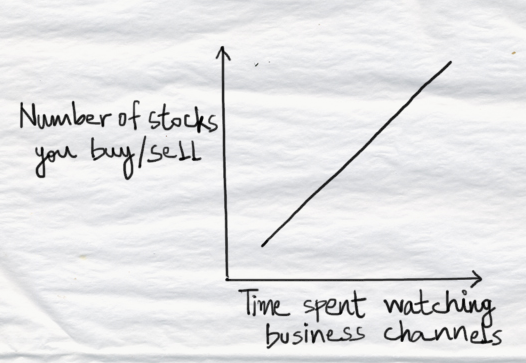
In fact, we can easily draw a correlation between the amount of time you spend watching business channels and the number of stocks you buy/sell every month or year, thereby making your broker rich.

And it looks something like this…


It’s my sincere request – Please don’t get terrorized by the business media into changing your well thought out investment plans. Their only goal is to sell advertising, and not to make you money. And you must know this for a fact.

I haven’t had CNBC on in my home in almost nine years. While my visitors think this is sadist, I believe it’s wonderful. :-)