Shared posts

12 Jun 15:21

Bristol Zoo Gardens Introduces Fred the Chameleon

by Andrew Bleiman

Fred the baby bearded pygmy chameleon at Bristol Zoo Gardens June 2018  credit Jenny Scully

Meet Fred, the smallest new addition to the reptile house at Bristol Zoo Gardens.

Only the size of a grape (15mm long) and just four weeks old, he is one of two Bearded Pygmy Chameleons that hatched in their enclosure from eggs the size of Tic-Tac mints.

A further eight tiny eggs are being incubated, behind the scenes, in the Zoo’s Reptile House and are expected to hatch in the coming weeks.

Bearded pygmy chameleon eggs at Bristol Zoo Gardens June 2018  credit Jenny ScullyPhoto Credits: Bristol Zoo Gardens

This is just the second time the Zoo has bred Bearded Pygmy Chameleons.

Curator of reptiles and amphibians, Tim Skelton, said, “Bearded Pygmy Chameleons are a very popular species; they are remarkably small and only grow to around 3 inches (8cm) when fully grown.”

“Although not endangered, we can learn a lot from breeding and caring for these animals which will help us in our breeding efforts for more endangered species in future.”

The Bearded Pygmy Chameleon (Rieppeleon brevicaudatus) is named after the beard-like scales below its mouth. Its native habitat is sub-montane and lowland forest and shrub in Eastern Tanzania and South-eastern Kenya. They eat a variety of small invertebrate food including small crickets and flies.

07 Jun 02:47

Two New Yak Calves for Hellabrunn Zoo

by Andrew Bleiman

1_Yaknachwuchs_Hellabrunn_2018_Dominik Greenwood (4)

Hellabrunn Zoo is proud to introduce their two male Domestic Yak calves.

Keepers opted for names indicative of the youngsters’ unique coloring. “Skunk” was born on May 18, and “Snowy” on May 25.

2_Yaknachwuchs_Hellabrunn_2018_Michael Thomas (1)

3_Yaknachwuchs_Hellabrunn_2018_Dominik Greenwood (1)

4_Yaknachwuchs_Hellabrunn_2018_Dominik Greenwood (3)Photo Credits: Hellabrunn Zoo /Dominik Greenwood (Images 1,3,4-5,8) / Michael Thomas (Images 2,6-7)

The Domestic Yak (Bos grunniens) is a longhaired domesticated bovid found throughout the Himalayan region of the Indian subcontinent, the Tibetan Plateau and as far north as Mongolia and Russia. It is descended from the Wild Yak (Bos mutus).

Contrary to popular belief, Yak have little to no detectable odor when maintained appropriately in pastures or paddocks. A Yak's wool is also naturally odor resistant.

Gestation lasts between 257 and 270 days and generally results in the birth of a single calf. The mother will find a secluded spot to give birth, and the calf is able to walk within about ten minutes of birth. Females of both the wild and domestic forms typically give birth only once every other year. Calves are weaned at about one-year-old and become independent shortly thereafter.

5_Yaknachwuchs_Hellabrunn_2018_Dominik Greenwood (2)

6_Yaknachwuchs_Hellabrunn_2018_Michael Thomas (2)

7_Yaknachwuchs_Hellabrunn_2018_Michael Thomas (3)

8_Yaknachwuchs_Hellabrunn_2018_Dominik Greenwood (6)

17 May 02:46

Twin Red Pandas Born at Virginia Zoo

by Andrew Bleiman

Virginia Zoo Photo 1

The Virginia Zoo welcomed two male Red Panda cubs in June. Born to two-year-old mom Masu and three-year-old dad Timur, the cubs were born at the Zoo’s Animal Wellness Campus. Red Panda cubs weigh approximately five ounces at birth, but each cub now weighs just over one pound.

Virginia Zoo Photo 3
Virginia Zoo Photo 3Photo Credit: Virginia Zoo

Red Panda cubs are particularly vulnerable during their first month of life, and zoo staff members intervene with the cubs as little as possible.

“We wanted to give Masu the best chance possible to successfully birth and raise healthy cubs,” said Dr. Colleen Clabbers, the Zoo’s Veterinarian. “We decided to move Masu to the Wellness Campus while she was still pregnant to give her the privacy and space she needed with as few disturbances and distractions as possible,” Dr. Clabbers added. Red Panda experts have found this species has better success when the mothers are able to give birth and provide the initial few months of care of their cubs off exhibit.

First-time mom Masu gave birth in an indoor, climate-controlled den where she has been nursing and bonding with her cubs in a quiet environment. The den is off view to the public and is monitored by staff. As Masu gets more comfortable allowing people to be near her cubs and the boys can safely navigate the trees and other exhibit features, the three will make their way to the original Red Panda exhibit off the main pathway.

The cubs have not yet been named.

“This is a significant birth for the species as there are less than 10,000 Red Pandas left in the wild,” said Greg Bockheim, Executive Director of the Virginia Zoo. “There has been a sharp decline in their population due to a loss of nesting trees and food resources in their native region, they are also hunted for their pelts. We are excited for the terrific care Masu has been providing for her cubs and look forward to having them on exhibit later this year,” Bockheim added.

Red Pandas are tree-dwelling mammals native to the eastern Himalayas and southwestern China. Slightly larger than a domestic Cat and with markings similar to Raccoons, Red Pandas have soft, dense reddish-brown and white fur. They feed mainly on bamboo, but also various plant shoots, leaves, fruit, and insects. Red Pandas are shy and solitary except when mating.

Red Pandas are listed as Endangered by the International Union for Conservation of Nature’s Red List of Threatened Species.

19 Apr 20:45

‘Big’ Little Elephant Surprises Keepers at Safari Park

by Chris Eastland

1_BabyGirlEle_001_LG

A female African Elephant calf was born to experienced mom, Umngani, on September 26 at the San Diego Zoo Safari Park.

The female weighed in at 281-pounds, making her the largest calf ever to be born at the Safari Park. A newborn elephant generally weights 200 to 268 pounds at birth, and the average gestation period for African Elephants is 649 days, or 22 months.

The yet-to-be-named, little pachyderm was introduced to the remainder of her herd on September 28. The Safari Park reported that the other elephants appeared very excited to meet the new baby: ‘rushing to her, and touching and smelling her with their trunks, all under the watchful eye of her protective mother’. The elephant herd includes three older siblings (one of which the new calf now shares a birthday with) and a male calf, named Umzuli-Zuli, who was born August 12 to mother, Ndula.

2_BabiesEle_001_LGPhoto Credits: Ken Bohn/ San Diego Zoo Safari Park

The Safari Park is now home to 14 African Elephants: 4 adults and 10 youngsters. The adults were rescued in 2003 from the Kingdom of Swaziland, where they faced being culled.

Guests can visit the new baby, her mom, and the rest of the herd at their home in Elephant Valley at the San Diego Zoo Safari Park, and they also may be seen on the Safari Park’s Elephant Cam, at: www.sdzsafaripark.org/elephant-cam .

04 Dec 22:46

What’s Trending? Trust in Institutions

by Evan Stewart

Social institutions are powerful on their own, but they still need buy-in to work. When people don’t feel like they can trust institutions, they are more likely to find ways to opt out of participating in them. Low voting rates, religious disaffiliation, and other kinds of civic disengagement make it harder for people to have a voice in the organizations that influence their lives.

And, wow, have we seen some good reasons not to trust institutions over the past few decades. The latest political news only tops a list running from Watergate to Whitewater, Bush v. Gore, the 2008 financial crisis, clergy abuse scandals, and more.

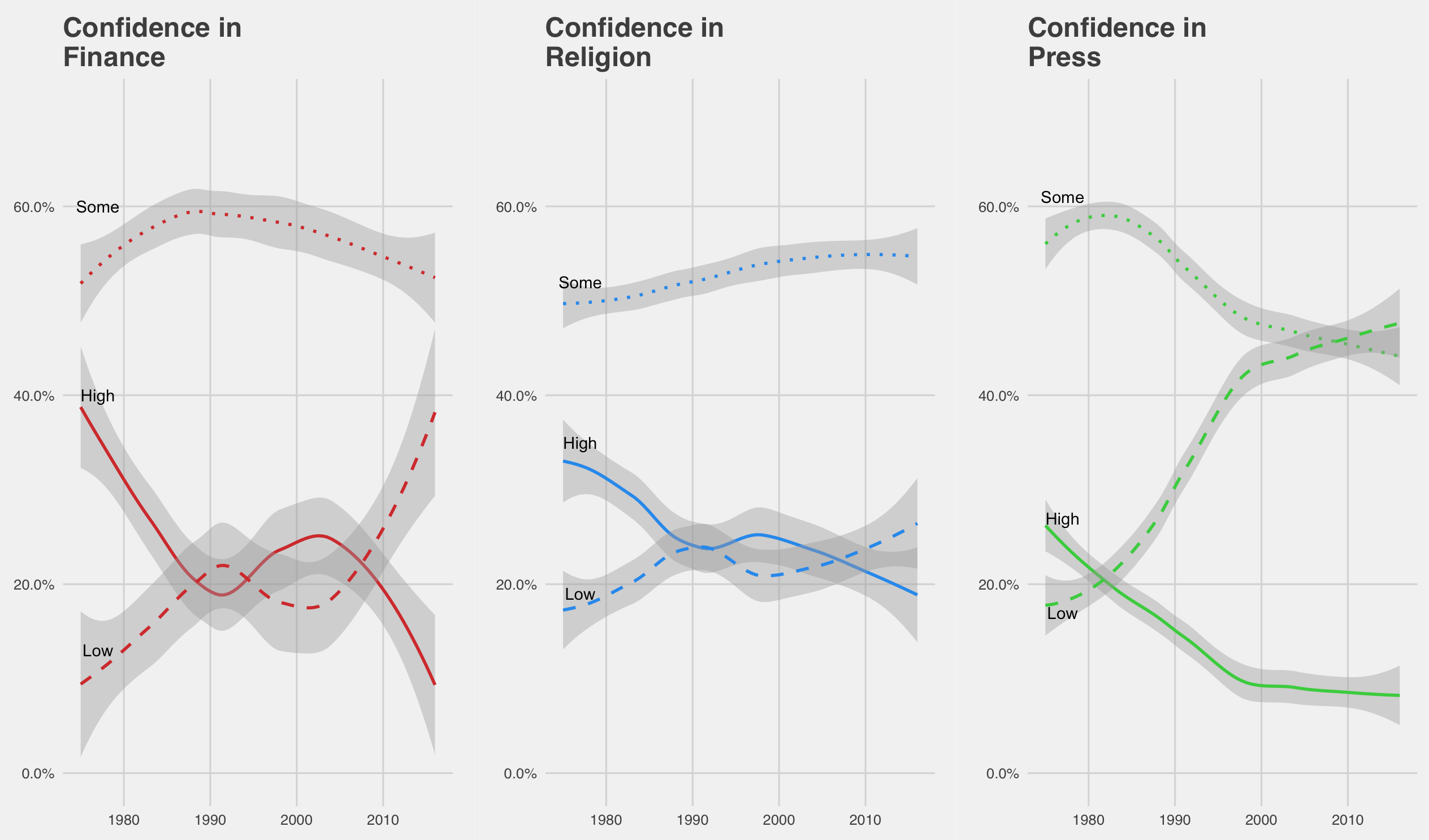
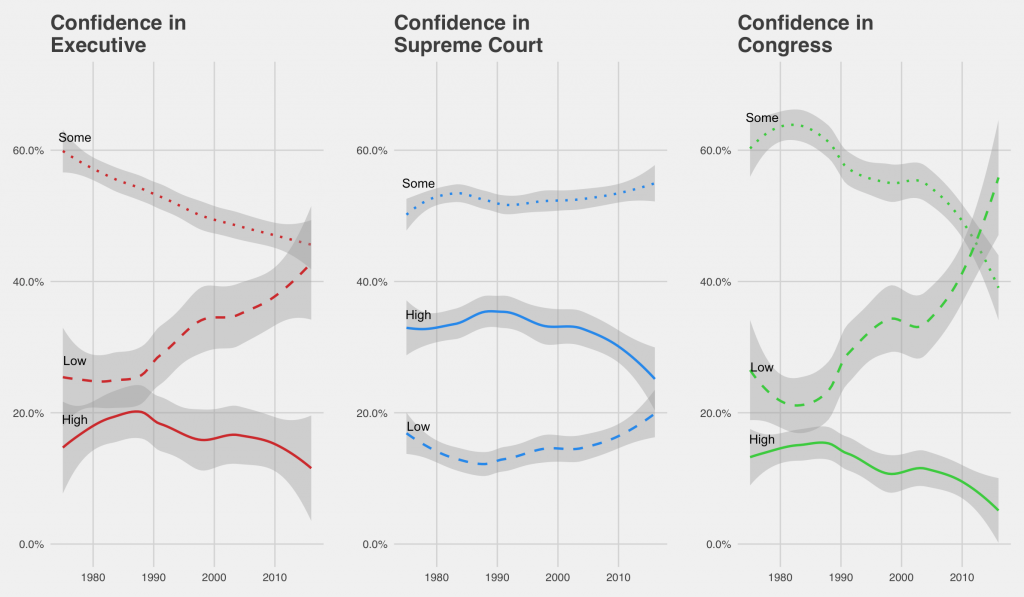
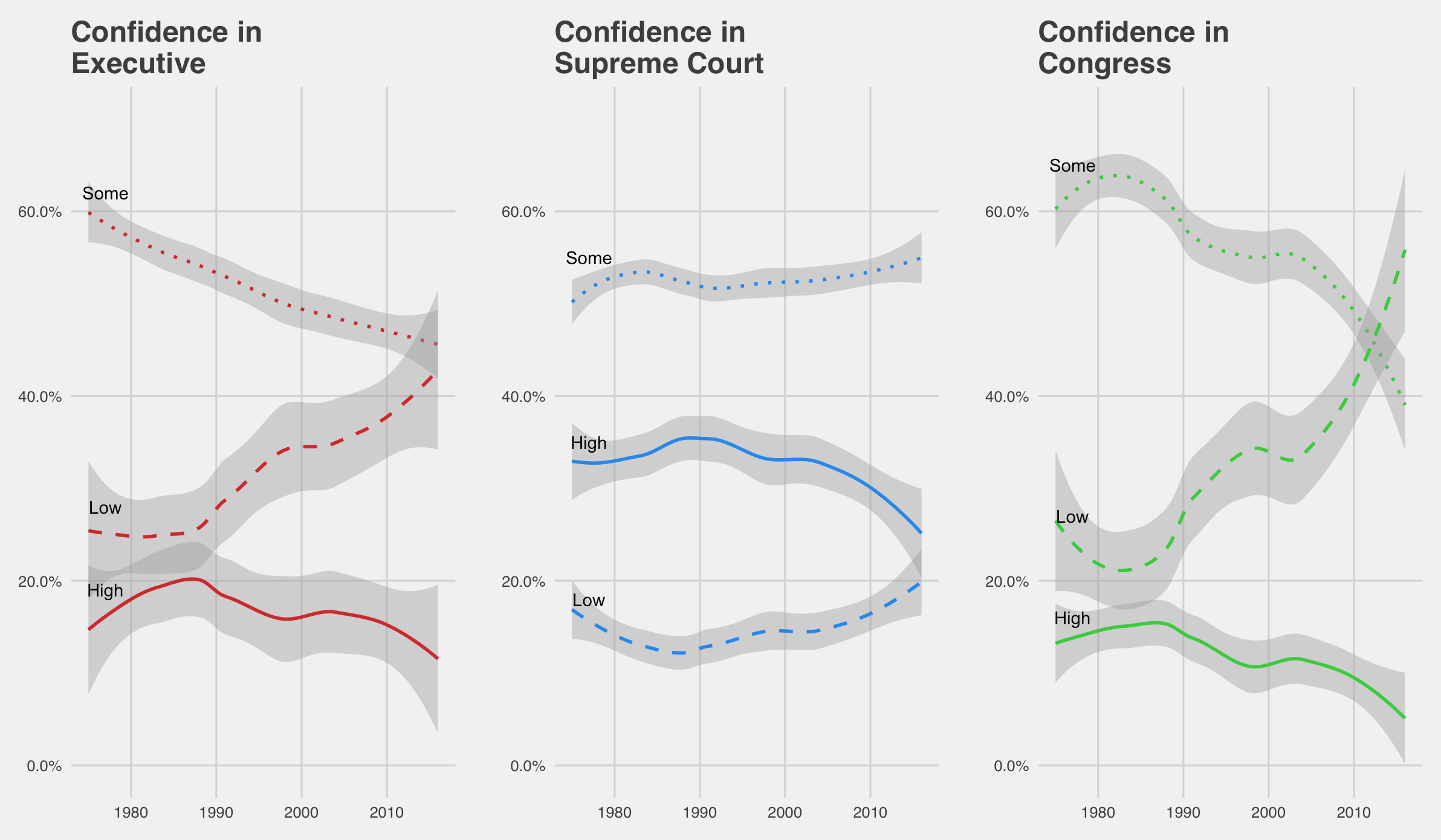
Using data from the General Social Survey, we can track how confidence in these institutions has changed over time. For example, recent controversy over the Kavanaugh confirmation is a blow to the Supreme Court’s image, but strong confidence in the Supreme Court has been on the decline since 2000. Now, attitudes about the Court are starting to look similar to the way Americans see the other branches of government.

(Click to Enlarge)
Source: General Social Survey Cumulative File
LOESS-Smoothed trend lines follow weighted proportion estimates for each response option.

Over time, you can see trust in the executive and legislative branches drop as the proportion of respondents who say they have a great deal of confidence in each declines. The Supreme Court has enjoyed higher confidence than the other two branches, but even this has started to look more uncertain.

For context, we can also compare these trends to other social institutions like the market, the media, and organized religion. Confidence in these groups has been changing as well.

(Click to Enlarge)
Source: General Social Survey Cumulative File

It is interesting to watch the high and low trend lines switch over time, but we should also pay attention to who sits on the fence by choosing some confidence on these items. More people are taking a side on the press, for example, but the middle is holding steady for organized religion and the Supreme Court.

These charts raise an important question about the nature of social change: are the people who lose trust in institutions moderate supporters who are driven away by extreme changes, or “true believers” who feel betrayed by scandals? When political parties argue about capturing the middle or motivating the base, or the church worries about recruiting new members, these kinds of trends are central to the conversation.

Inspired by demographic facts you should know cold, “What’s Trending?” is a post series at Sociological Images featuring quick looks at what’s up, what’s down, and what sociologists have to say about it.

Evan Stewart is a Ph.D. candidate in sociology at the University of Minnesota. You can follow him on Twitter.

(View original at https://thesocietypages.org/socimages)

20 Sep 01:55

Watch: How leaves tell each other about a bug attack

by Layne Cameron-Michigan State
Leahgates

belated birthday quality plant Content

New research reveals how plant communication systems respond to threats from hungry critters.

The results show that once wounded, plants use calcium signals to warn distant tissues of future attacks.

In one video, you can see a hungry caterpillar, first working around a leaf’s edges, approaching the base of the leaf and, with one last bite, severing it from the rest of the plant. Within seconds, a blaze of fluorescent light washes over the other leaves, a signal that they should prepare for impending attacks by the caterpillar or its kin.

A caterpillar eats a leaf as the plant sends its warning signal to other leaves. (Credit: Toyota/Gilroy)

That fluorescent light tracks calcium as it zips across the plant’s tissues, providing an electrical and chemical signal of a threat. The video is part of a study that shows how glutamate—an abundant neurotransmitter in animals—activates this wave of calcium when the plant is wounded.

“For decades, it’s been known that leaf damage, inflicted by mechanical wounding or caterpillar munching, rapidly activates defense responses in distant, undamaged leaves of the plant,” says Gregg Howe, a professor at the Michigan State University Foundation. “But what triggers this rapid response has largely remained a mystery.”

Danger, danger!

When a leaf is wounded, an electrical charge races across the plant to warn other tissues of possible danger. But, what triggered that electric charge, and how it moved throughout the plant, were unknown.

Calcium is one candidate. It’s ubiquitous in cells and often acts as a signal of a changing environment. And because calcium carries a charge, it can produce an electrical signal. But it is hard to track because its concentration levels spike and dip quickly.

The researchers created a method to see the calcium in real time. They developed plants that produce a protein that fluoresces around calcium, letting the researchers track its presence and concentration. Then came caterpillar bites, scissor cuts, and crushing wounds.

In response to each kind of damage, the plants light up as calcium flows from the site of damage to other leaves. The signal moved quickly, about one millimeter per second, reaching out to distant leaves in just a couple minutes.

A few minutes later, levels of the defense hormone, jasmonate, spiked in those distant leaves. They were preparing the plant for future threats by producing noxious chemicals that ward off predators.

Connecting many dots

Previous research by Swiss scientist Ted Farmer has demonstrated that defense-related electrical signals depended on receptors for glutamate, an amino acid and a major neurotransmitter that facilitates long-range information exchange within animals and plants. Farmer showed that mutant plants missing glutamate receptors lost their electrical responses to threats.

Following up on that research, the researchers tested mutants that knock out the glutamate receptors. The calcium barely showed up on the videos as marginal flashes of light.

The results suggest that glutamate exiting a plant wound leads to rapid propagation of a calcium wave, which in turn leads to production of jasmonate and defense responses.

The study connects decades of research that have revealed how plants have evolved clever defense strategies, in the absence of a central nervous system. The research provides the best look yet at these plant communication systems that are usually hidden from view.

“We often think of plants as being passive and at the mercy of their environment. My jaw literally dropped when I first saw these videos from the Gilroy lab—they beautifully illustrate how active and complex plants really are,” Howe says.

Masatsugu Toyota led the work as a postdoctoral researcher in the lab of Simon Gilroy at University of Wisconsin-Madison. Gilroy and Toyota collaborated with Howe and researchers from the Japan Science and Technology Agency and the University of Missouri.

The National Science Foundation, Department of Energy, NASA, and Japan Science Technology Agency PRESTO, KAKENHI, funded the study.

Source: Michigan State University

The post Watch: How leaves tell each other about a bug attack appeared first on Futurity.

20 Sep 01:54

How mice block out the sound of their own feet

by Karl Bates-Duke
Leahgates

mouse (sneaking)

A mouse’s brain has a built-in noise-cancelling circuit to ensure that the mouse hears the sounds of an approaching cat better than it hears the sounds of its own footsteps, according to new research.

It’s a direct connection from the motor cortex of the brain to the auditory cortex that says essentially, “we’re running now, pay no attention to the sound of my footsteps.”

“What’s special about this cancellation process is that the brain learns to turn off responses to predictable self-generated sounds,” says Richard Mooney, a professor of neurobiology at Duke University. “You can watch as these responses disappear as a function of time and experience.”

The findings, which appear in Nature, come from an array of difficult experiments, including a “mouse virtual reality” setup.

Cut the noise

This brain circuitry works differently than noise-cancelling headphones, but the results are similar. The headphones monitor ambient noise around the listener and then produce sounds that are mirror images of those soundwaves to cancel them out. Similarly, the brain’s auditory cortex receives a signal directly from the motor cortex that tells its inhibitory neurons to selectively cancel out the sounds it has learned will come from a particular motion.

For this system to work, it cannot depend solely on input from the ears, Mooney says, “because by the time the auditory signal from the ear is processed by the brain, it’s old news.”

In fact, the motor cortex sends the cancellation signal to the auditory cortex in parallel with commanding a movement, a process so fast that cancellation in the auditory cortex is actually predictive.

“The sound of the first footstep isn’t heard,” says David Schneider, a former Duke postdoctoral researcher in Mooney’s lab who is now an assistant professor at New York University’s Center for Neural Science.

“We would have a hard time operating in the natural world, if we couldn’t predict the sensory consequences of moving around in it,” says Mooney, who has also studied the connection between the auditory cortex and the motor cortex as birds learn to sing.

Digging deeper

To monitor the circuit, Schneider and graduate student Janani Sundararajan trained mice to associate an artificial tone with their foot-falls. As the mice walked or ran on a treadmill in this “virtual reality” experiment, the tone’s tempo matched each pitter-pat.

“We decided to make the sound as artificial as possible to push the mouse’s brain beyond what it was evolved to do,” Schneider says.

Schneider and Sundararajan watched the mouse’s brain as synapses that the motor cortex makes in the auditory cortex changed as it learned to cancel a predictable movement-related noise. They were able to identify the inhibitory neurons that responded to the artificial tone to cancel out its signal, “exactly like noise cancelling,” Schneider says.

To confirm what they were seeing, Sundararajan then did a series of behavioral experiments in which mice were taught to seek a reward after hearing two different tones. Then she trained them on the treadmill as before to associate one of those tones with walking.

After training, the mice detected the non-associated tone better than the “walking” tone when they were actually walking, even though they detected both tones equally well when they were standing still.

“The brain would rather be more sensitive to noises other than the ones we make,” Sundararajan says. For a mouse being stalked by a nearby cat, it would be a matter of survival.

What this means for humans

Being able to ignore the sounds of one’s own movements is likely important for humans as well. But the ability to anticipate the sounds of our actions is also important for more complex human behaviors such as speaking or playing music.

“When we learn to speak or to play music, we predict what sounds we’re going to hear—such as when we prepare to strike keys on a piano—and we compare this to what we actually hear,” explains Schneider. “We use mismatches between expectation and experience to change how we play—and we get better over time because our brain is trying to minimize these errors.”

Being unable to make predictions like this is also thought to be involved in a spectrum of afflictions.

“Overactive prediction circuits in the brain are thought to lead to the voice-like hallucinations associated with schizophrenia while an inability to learn the consequences of one’s actions could lead to debilitating social paralysis, as in autism,” explains Schneider.

“By figuring out how the brain normally makes predictions about self-generated sounds, we open the opportunity for understanding a fascinating ability—predicting the future—and for deepening our understanding of how the brain breaks during disease.”

The Howard Hughes Medical Institute, the Helen Hay Whitney Foundation, Burroughs Wellcome Fund, a Holland-Trice Graduate Fellowship in Brain Sciences, and the National Institutes of Health supported the research.

Source: Duke University, New York University

The post How mice block out the sound of their own feet appeared first on Futurity.
17 Sep 14:41

The Role of Replays

by Evan Stewart

Our lives are a team effort, often influenced by larger social forces outside of our control. At the same time, we love stories about singular heroes rising to the occasion. Sociologists often argue that focusing too much on individual merit teaches us not to see the rest of the social world at play.

Photo Credit: Vadu Amka, Flickr CC

One of my favorite recent examples of this is a case from Christopher A. Paul’s book, The Toxic Meritocracy of Video Games, about the popular team-based competitive shooter Overwatch. After the match is over and a winning team declared, one player is awarded “play of the game,” and everyone watches an automatically-generated replay. Paul writes that the replay…

… takes one moment out of context and then chooses to only celebrate one of twelve players when the efforts of the other members of the team often make the moment possible…a more dynamic, holistic system would likely be harder to judge and code, which is a problem at the heart of meritocracy. Actually judging skill or effort is ridiculously difficult to do…the algorithm built into selecting what is the play of the game and which statistics will be highlighted rewards only what it can count and judge, stripping out situation and context. (2018, Pp. 34-35)

It isn’t just the computer doing this; there is a whole genre of youtube videos devoted to top plays and personalized highlight reels from games like Overwatch, Paladins, and Counter Strike: Global Offensive.


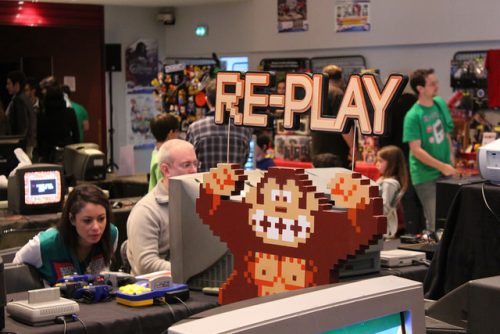
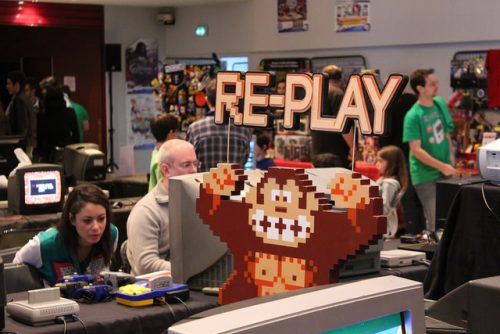
Paul’s point got me thinking about the structure and culture of replays in general. They aren’t always about a star player. Sometimes we see the execution of a brilliant team play. Other times, it’s all about the star’s slam dunk. But replays do highlight one of the weird structural features about modern competition. Many of the most popular video games in the massive esports industry are team based, but because these are often played in a first-person or limited third person view, replays and highlight reels from these games are often cast from the perspective of a single “star” player.

This is a great exercise for thinking sociologically in everyday life and in the classroom. Watch some replays from your favorite team sport. Are the highlights emphasizing teamwork or are they focusing on a single player’s achievements? Do you think different replays would have been possible without the efforts of the rest of the team? How does the structure of the shot—the composition and perspective—shape the viewer’s interpretation of what happened on the field?

Evan Stewart is a Ph.D. candidate in sociology at the University of Minnesota. You can follow him on Twitter.

(View original at https://thesocietypages.org/socimages)

17 Sep 14:40

Schools’ Selective Screening

by Jean Marie Maier

Originally Posted at TSP Discoveries

In a scene familiar to today’s teachers, several students in the classroom are glued to their screens: one is posting to social media, one is playing a computer game, and another is hacking their way past the school’s firewall with skills they perfected from years on the Internet. Are these students wasting class time or honing the skills that will make them a future tech millionaire?

Photo Credit: Ben+Sam, Flickr CC

Recent research in American Journal of Sociology from Matthew Rafalow finds that teachers answer that question differently based on the social class and race makeup of the school. Schools that serve primarily white, more privileged students see “digital play” such as video games, social media, and website or video production as building digital competencies that are central to success, while schools that serve larger Latino or Asian populations view digital play as irrelevant or a distraction from learning.

Based on observations of three technology-rich Bay Area middle schools, Rafalow examined whether the skills students develop through digital play are considered cultural capital — skills, habits, and dispositions that that can be traded for success in school and work. Although digital play can lead to skills like finding information online, communicating with others, and producing digital media, classed and raced stereotypes about educational needs and future work prospects affect whether teachers recognize those skills in their students. In other words, Rafalow examined whether teachers reward, ignore, or punish students for digital play in the classroom.

Rafalow found three distinct approaches across the schools. At the first school — a public middle school that largely serves middle-class Asian students — teachers viewed digital play as threatening to their traditional educational practices because it distracted students from “real” learning. Further, teachers believed students comfortable with digital skills could hack standardized tests that had been given electronically.

Photo Credit: US Department of Education, Flickr CC

At the second school — a public middle school that largely serves working-class Latino students — teachers discounted any skills that students brought into the classroom through their years of digital play. Instead, teachers thought introducing their students to website design and programming was a more important part of preparing them for 21st century working-class jobs.

In contrast, at the third school — a private, largely white middle school — teachers praised skills students developed through digital play as crucial to job success and built a curriculum that further encouraged expression and experimentation online.

The ways teachers in this study approached digital play provide a clear example of how raced and classed expectations for students’ futures determine the range of appropriate classroom behavior.

Jean Marie Maier is a graduate student in sociology at the University of Minnesota. She completed the Cultural Studies of Sport in Education MA program at the University of California, Berkeley, and looks forward to continuing research on the intersections of education, gender, and sport. Jean Marie has also worked as a Fulbright English Teaching Assistant in Gumi, South Korea and as a research intern at the American Association of University Women. She holds a BA in Political Science from Davidson College.

(View original at https://thesocietypages.org/socimages)

30 Aug 12:32

Who Feels Religious Freedom?

by Evan Stewart

Religious freedom and discrimination are back in the national spotlight, from this year’s Masterpiece Cakeshop case in the Supreme Court to Jeff Sessions’ new Religious Liberty Task Force. These cases are controversial because they raise questions about the limits of freedom—do people with sincere religious beliefs (often conservative Christians) have a right to opt out of providing goods and services they do not support? Or, is that just plain discrimination?

Michelle Bachmann at a rally for religious freedom (Photo Credit: A.L.L., Flickr CC)

Debates about religious freedom often jump to legal arguments, but there is also a sociological angle on these controversies: who experiences bias and who perceives bias? For example, my research at the American Mosaic Project found that Atheists and Muslims face the strongest animus in the US, at almost twice the rate of conservative Christians. Trends in hiring discrimination tend to follow a similar pattern. Yet many of these recent religious freedom cases focus on conservative Christians alleging discrimination. Does perceived bias run the other way?

Sociologist John W. Hawthorne recently shared some interesting research from the annual conference of the Association for the Sociology of Religion. His surveys of evangelical clergy found older clergy members tended to agree that society regularly discriminates against people with Christian beliefs, while younger clergy were more likely to disagree. I went back to data from the American Mosaic Project to see if a similar pattern shows up for members of these religious denominations.

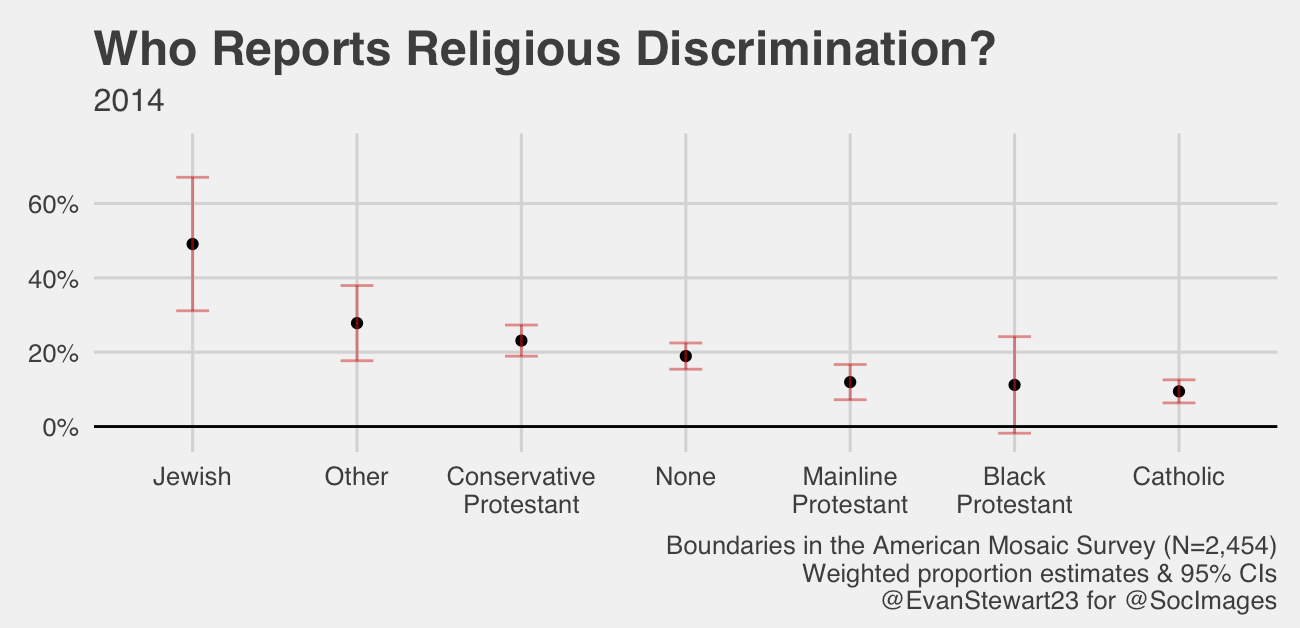
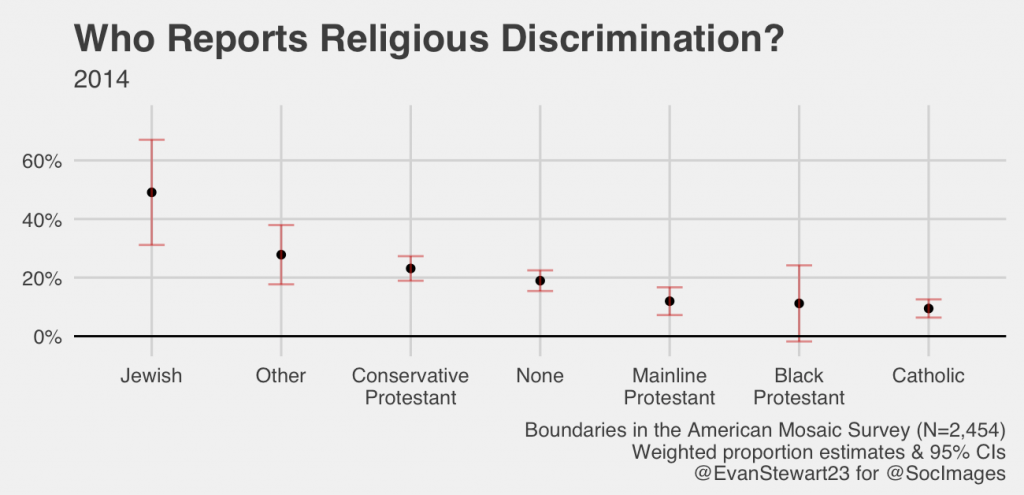
In this survey, respondents answered a simple yes or no question about whether they had ever experienced discrimination because of their religion. The chart below breaks down the percentage of responses who said they did by major denomination groups. It is important to remember that many minority religious groups in the US are actually quite small, so getting useful information requires putting many groups into a big “other” category and using confidence intervals to show uncertainty in our estimates.

(Click to Enlarge)

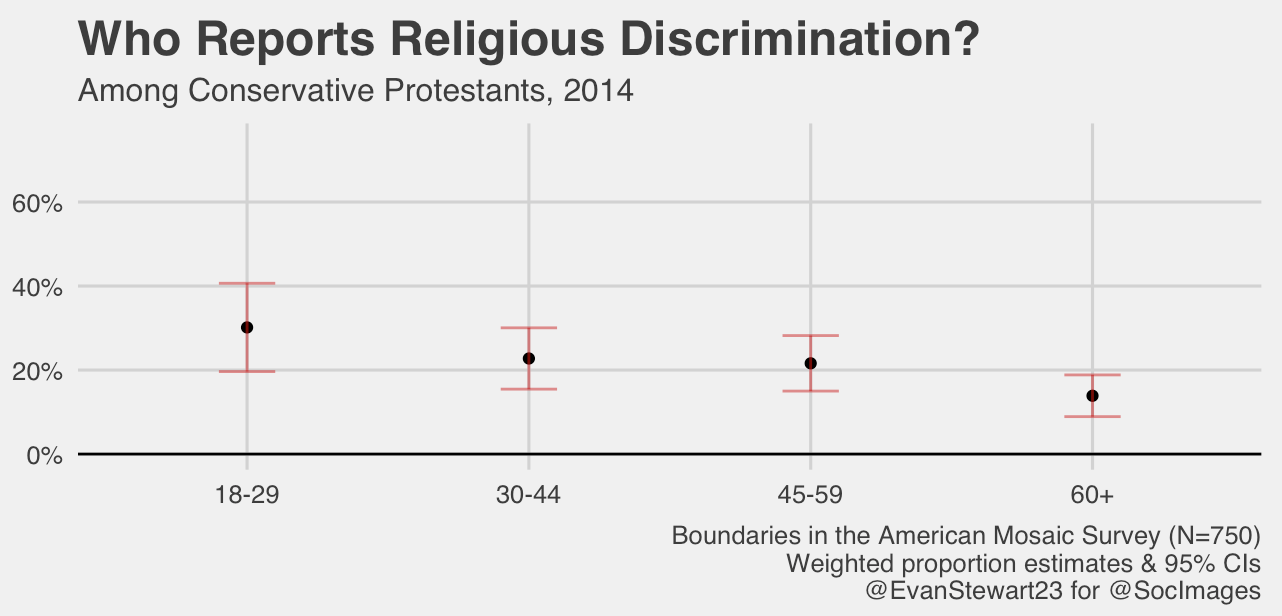
Conservative Protestants are different from other Protestant groups, with about 23%  reporting that they have experienced religious discrimination. This proportion is fairly high, third in line after respondents who are Jewish or belong to other religious minority groups. They even nudged out people with no religious affiliation. What about age brackets?

(Click to Enlarge)

This is different from John Hawthorne’s finding. Younger members of conservative Protestant groups reported experiencing discrimination at higher rates than older members. This is just a quick look, but we can speculate about an explanation. Younger conservative Protestants and evangelicals live in a very secular generation, and probably perceive tension and conflict outside the church. Younger clergy, on the other hand, probably have a different perspective on the changing role of churches in society.

The big sociological questions for the religious freedom debate are how these views persist and how they may skew our interpretation of trends in actual discriminatory behavior.

Evan Stewart is a Ph.D. candidate in sociology at the University of Minnesota. You can follow him on Twitter.

(View original at https://thesocietypages.org/socimages)

30 Aug 12:31

Creepy Videos Show Routines Running Wild

by Evan Stewart

People talk. Their interactions become habits, habits become routines, and routines become rules. Sociologists call this emergent behavior, and sometimes it happens so slowly we don’t even notice it until we look back and think “where did that come from?”  Emergent behavior can be quirky and fun (think of Taco Friday at the office or “on Wednesdays we wear pink“), but sometimes it can also be far more serious or more troubling.

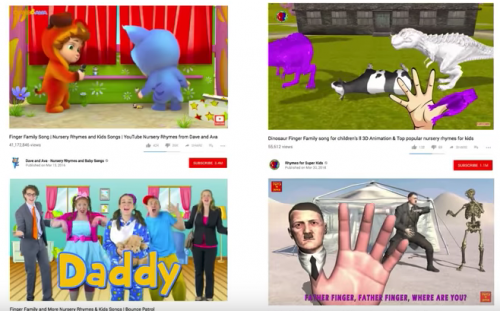
The challenge is that new technology makes these interactions happen much faster, on a much larger scale, and with less editing—often with odd results. Check out this TED talk—The Nightmare Videos of Children’s YouTube— for a good illustration of the dark side of emergent behavior when algorithms accelerate and exploit social interactions online.


Evan Stewart is a Ph.D. candidate in sociology at the University of Minnesota. You can follow him on Twitter.

(View original at https://thesocietypages.org/socimages)

28 Aug 23:18

Saying No To News

by Allison J. Steinke

Originally Posted at Social Studies Minnesota

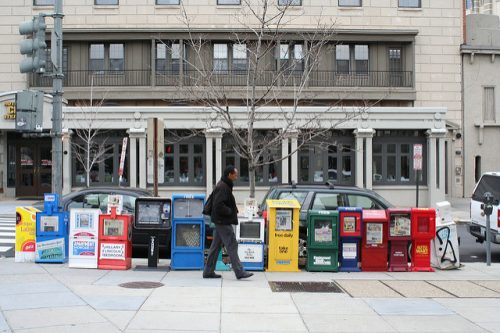
Photo Credit: Colby Cosh, Flickr CC

Everyone needs a break from the news now and then, but some people tune out all the time. Civic engagement is changing, and “fake news” is a growing concern, and so it is important to understand why some people stay away from important sources of information about society. As a journalism studies scholar with an interest in public opinion, Dr. Benjamin Toff recently published a study in Journal of Communication about “news avoiders”—people who seek out news less than once per month.

The study interviewed 43 people who said they use the news less than once per month. Interviewers found three folk theories that respondents used to explain how and why they avoid the news:

“News finds me.” Many avoiders, particularly those who were also social media users, described a feeling that news is “all around them.” Given the emergence of social and digital media in the past couple of decades, certain avoiders feel they don’t need to take an active effort to read the paper or watch the evening news because all the news they need can be found whenever they log on to Facebook or another social media network.

“The information is out there.” Some news avoiders deliberately keep themselves off social media but have confidence that, if they want to find news or information, that the information is “out there.” They describe the internet as vast and useful, and say that any information they might need is “only a Google search away.” These people feel like they can go get news anytime they want to.

“I don’t know what to believe.” A third folk theory came from avoiders who felt frustration about finding reliable sources and sorting through all of the information that’s out there. For example, while it’s possible to type a basic phrase into a Google search and see what comes up, these news avoiders talked about how difficult it would be to sort through the information they might find. The mere fact that information exists does not necessarily help people make sense of it or find the facts.

The study has three major implications. First, not all news avoiders are the same. We need to take these different concerns into account to better understand why people tune out. Second, improving media literacy requires helping people develop tools for evaluating the reliability of a range of media choices, not just encouraging a general skepticism of all news that many of these avoiders have already internalized. Finally, many avoiders are also politically disengaged, and they see little value to news in part because they have difficulty connecting it to the issues they see as most important in their own lives. This third concern may also reflect real deficiencies with the supply of news itself.

Allison J. Steinke is a Ph.D. student at the Hubbard School of Journalism and Mass Communication studying social and mobile media, journalism, and social justice with an emphasis on the anti-human trafficking movement. Follow her work on Academia or ResearchGate.

(View original at https://thesocietypages.org/socimages)

22 Aug 21:43

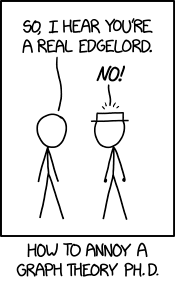
Edgelord

If you study graphs in which edges can link more than two nodes, you're more properly called a hyperedgelord.
21 Aug 14:25

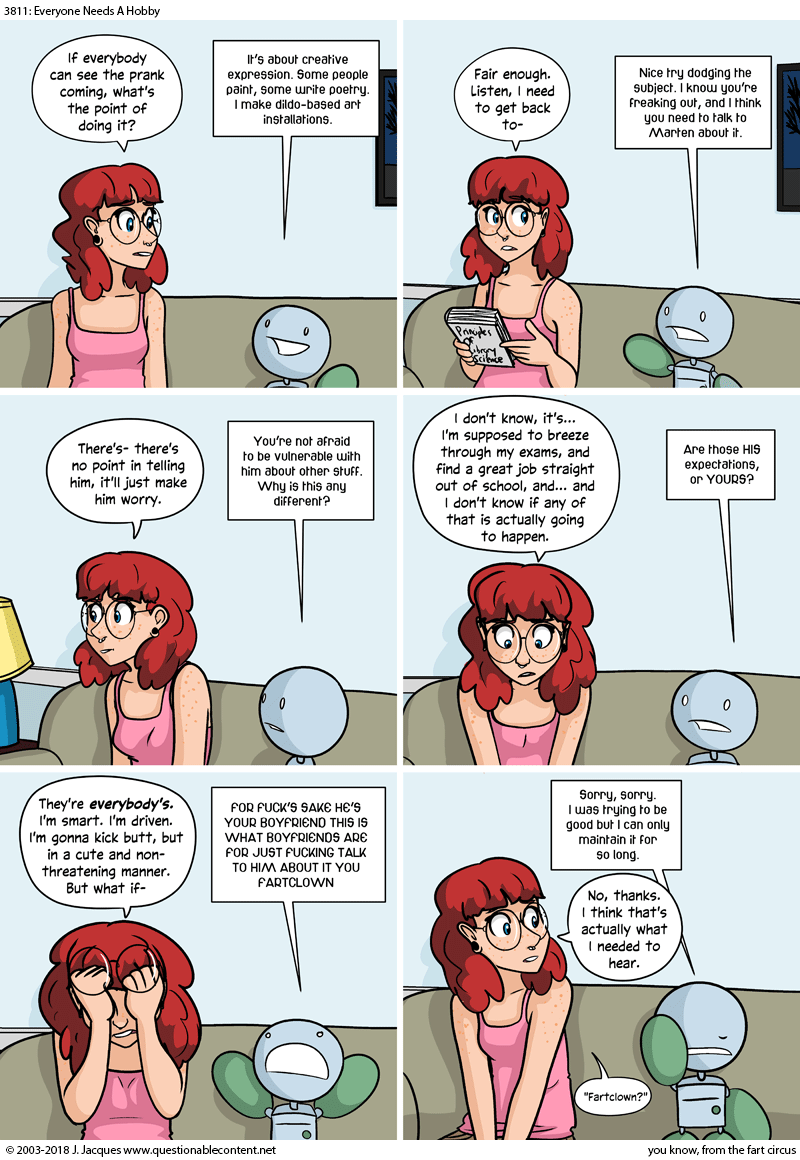
Everybody Needs A Hobby

Leahgates

I prefer "fartiste"

It's important to have a pastime

16 Aug 18:06

Union Says Metro Let White Supremacists 'Commandeer The System'

by Jordan Pascale, WAMU
Leahgates

Union: we see you tried to play us, and we are not having it

Union Says Metro Let White Supremacists 'Commandeer The System' They are holding a rally on Thursday to call for the firing of the general manager. [ more › ]
16 Aug 18:05

Unite The Right 2 Cost D.C. $2.6 Million, According To City Estimate

by Rachel Sadon
Leahgates

Imagine if we could spend this much on people who actually live here

Unite The Right 2 Cost D.C. $2.6 Million, According To City Estimate And that's not even the full total for the day. [ more › ]

01 Aug 21:17

Peer Review

Your manuscript "Don't Pay $25 to Access Any of the Articles in this Journal: A Review of Preprint Repositories and Author Willingness to Email PDF Copies for Free" has also been rejected, but nice try.
14 Jul 00:24

An Apple for a Dollar

I'd like 0.4608 apples, please.
09 Jul 14:19

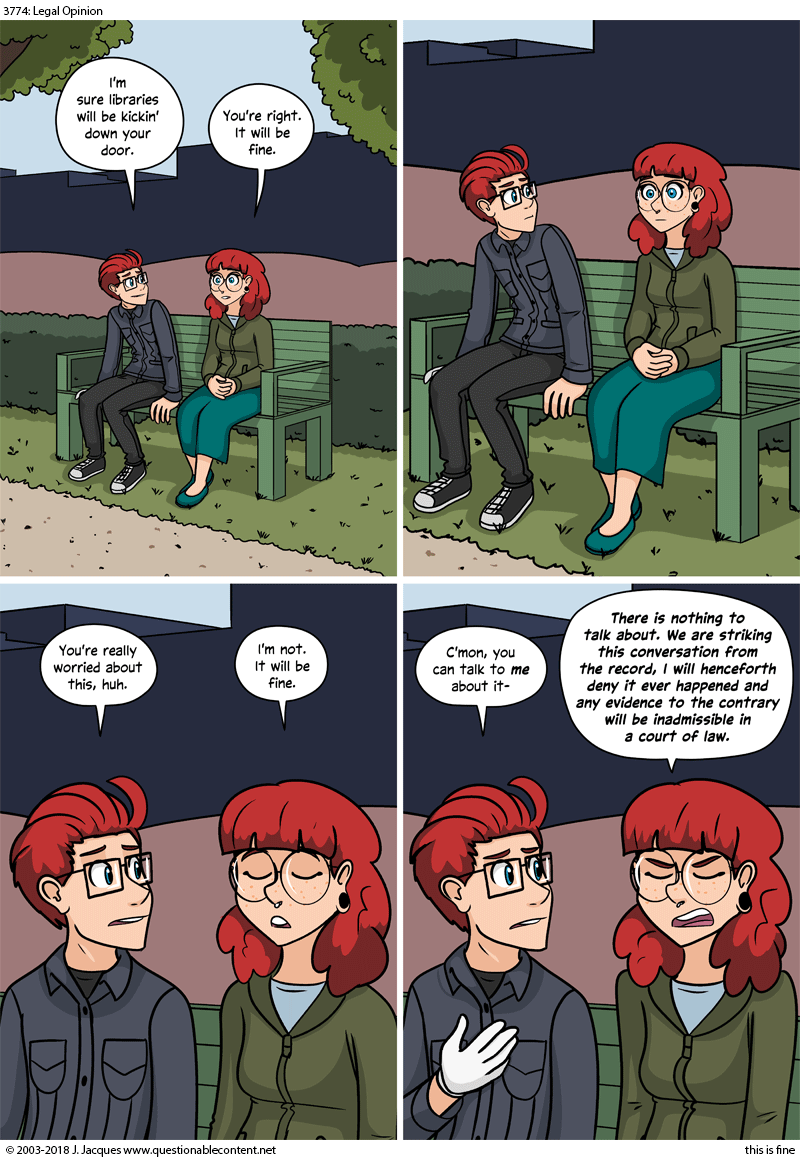
Legal Opinion

Leahgates

claire is me

also, fun fact, this week a job I was going to move for rescinded my offer the literal day my old job signed someone to replace me

so claire, just remember

the percentage of your anxieties that will actually come true is JUST high enough that you definitely need to be anxious about them forever

29 Jun 19:54

Thorough Analysis

Leahgates

same

The likely shape of the bells was determined through consultation with several bellringing experts at the Tower of London. Transcripts of those interviews are available in Appendix VII.
18 Jun 13:37

Anthony Bourdain, Gastrodiplomacy, and the Sociology of Food

by Alison Hope Alkon
Leahgates

oh no

“There is a real danger of taking food too seriously. Food needs to be part of a bigger picture”
-Anthony Bourdain

As someone who writes about food, about its ability to offer a window into the daily lives and circumstances of people around the globe, Anthony Bourdain’s passing hit me particularly hard. If you haven’t seen them, his widely-acclaimed shows such as No Reservations and Parts Unknown were a kind of personal narrative meets travelogue meets food TV. They trailed the chef as he immersed himself in the culture of a place, sometimes one heavily touristed, sometimes more removed from the lives of most food media consumers, and showed us what people ate, at home, in the streets and in local restaurants. While much of food TV focuses on high end cuisine, Bourdain’s art was to show the craftsmanship behind the everyday foods of a place. He lovingly described the food’s preparation, the labor involved, and the joy people felt in coming together to consume it in a way that was palpable, even (or especially) when the foods themselves were unusual.

At their best, these shows taught us about the history and culture of particular places, and of the ways places have suffered through the ills of global capitalism and imperialism. His visit to the Congo was particularly memorable; While eating tiger fish wrapped in banana leaves, spear-caught and prepared by local fishermen, he delved into the colonial history and present-day violence that continue to devastate this natural-resource rich country. After visiting Cambodia he railed against Henry Kissinger and the American bombing campaign that killed over 250,000 people and gave rise, in part, to the murderous regime of the Khmer Rouge. In Jerusalem, he showed his lighter side, exploring the Israeli-Palestinian conflict through debates over who invented falafel. But in the same episode, he shared maqluba, “upside down” chicken and rice, with a family of Palestinian farmers in Gaza, and showed the basic humanity and dignity of a people living under occupation.

Bourdain’s shows embodies the basic premise of the sociology of food. Food is deeply personal and cultural. Over twenty-five years ago Anthony Winson called it the “intimate commodity” because it provides a link between our bodies, our cultures and the global political economies and ecologies that shape how and by whom food is cultivated, distributed and consumed. Bourdain’s show focuses on what food studies scholars call gastrodiplomacy, the potential for food to bring people together, helping us to understand and sympathize with one another’s circumstances. As a theory, it embodies the old saying that “the best way to our hearts is through our stomachs.” This theory has been embraced by nations like Thailand, which has an official policy promoting the creation of Thai restaurants in order to drive tourism and boost the country’s prestige. And the foods of Mexico have been declared World Heritage Cuisines by UNESCO, the same arm of the United Nations that marks world heritage sites. Less officially, we’ve seen a wave of efforts to promote the cuisines of refugees and migrants through restaurants, supper clubs and incubators like San Francisco’s La Cocina that help immigrant chefs launch food businesses.

But food has often been and continues to be a site of violence as well. Since 1981 750,000 farms have gone out of business, resulting in widespread rural poverty and epidemic levels of suicide. Food system workers, from farms to processing plants to restaurants, are among the most poorly paid members of our society, and often rely on food assistance. The food industry is highly centralized. The few major players in each segment—think Wal-Mart for groceries or Tyson for chicken—exert tremendous power on suppliers, creating dire conditions for producers. Allegations of sexual assault pervade the food industry; there are numerous complaints against well-known chefs and a study from Human Rights Watch revealed that more than 80% of women farmworkers have experienced harassment or assault on the job, a situation so dire that these women refer to it as the “field of panties” because rape is so common. Racism is equally rampant, with people of color often confined to poorly-paid “back of the house” positions while whites make up the majority of high-end servers, sommeliers, and celebrity chefs.

More than any other celebrity chef, Bourdain understood that food is political, and used his platform to address current social issues. His outspoken support for immigrant workers throughout the food system, and for immigrants more generally, colored many of his recent columns. And as the former partner of Italian actress Asia Argento, one of the first women to publicly accuse Harvey Weinstein, Bourdain used his celebrity status to amplify the voice of the #metoo movement, a form of support that was beautifully incongruous with his hyper-masculine image. Here Bourdain embodied another of the fundamental ideas of the sociology of food, that understanding the food system is intricately interwoven with efforts to improve it.

Bourdain’s shows explored food in its social and political contexts, offering viewers a window into worlds that often seemed far removed. He encouraged us to eat one another’s cultural foods, and to understand the lives of those who prepared them. Through food, he urged us to develop our sociological imaginations, putting individual biographies in their social and historical contexts. And while he was never preachy, his legacy urges us to get involved in the confluence of food movements, ensuring that those who feed us are treated with dignity and fairness, and are protected from sexual harassment and assault.

The Black feminist poet Audre Lorde once wrote that “it is not our differences that divide us. It is our inability to recognize, accept, and celebrate those differences.” Bourdain showed us that by learning the stories of one another’s foods, we can learn the histories and develop the empathy necessary to work for a better world.

Rest in Peace.

Alison Hope Alkon is associate professor of sociology and food studies at University of the Pacific. Check out her Ted talk, Food as Radical Empathy

(View original at https://thesocietypages.org/socimages)

18 Jun 01:38

Anthony Bourdain, Honorary Sociologist

by Caty Taborda-Whitt

I was absolutely devastated to hear about Anthony Bourdain’s passing.

I always saw Bourdain as more than just a celebrity chef or TV host. I saw him as one of us, a sociologist of sorts, someone deeply invested in understanding and teaching about culture and community. He had a gift for teaching us about social worlds beyond our own, and making these worlds accessible. In many ways, his work accomplished what so often we as sociologists strive to do.

Photo Credit: Adam Kuban, Flickr CC

I first read Bourdain’s memoir, Kitchen Confidential, at the age of twenty. The gritty memoir is its own ethnography of sorts, detailing the stories, experiences, and personalities working behind the sweltering heat of the kitchen line. At the time I was struggling as a first-generation, blue-collar student suddenly immersed in one of the wealthiest college campuses in the United States. Between August and May of each academic year, I attended classes with the children of CEOs and world leaders, yet come June I returned to the kitchens of a country club in western New York, quite literally serving alumni of my college. I remember reading the book thinking – though I knew it wasn’t academic sociology – “wait, you can write about these things?” These social worlds? These stories we otherwise overlook and ignore? I walked into my advisor’s office soon after, convinced I too would write such in-depth narratives about food-related subcultures. “Well,” he agreed, “you could research something like food culture or alternative food movements.” Within six months of that conversation, I had successfully secured my first research fellowship and taken on my first sociology project.

Like his writing, Bourdain’s television shows taught his audience something new about our relationships to food. Each episode of A Cook’s Tour, No Reservations, and Parts Unknown, went beyond the scope of a typical celebrity chef show. He never featured the World’s Biggest Hamburger, nor did he ever critique foods as “bizarre” or “strange.” Instead, he focused on what food meant to people across the globe. Food, he taught us, and the pride attached to it, are universal.

Rather than projecting narratives or misappropriating words, he let people speak for themselves. He strived to show the way things really are and to treat people with the utmost dignity, yet was careful never to glamorize or romanticize poverty, struggle, or difference.  In one of my favorite episodes of No Reservations, Bourdain takes us through Peru, openly critiquing celebrities who have glorified the nation as a place to find peace and spiritual enlightenment:

Sting and all his buddies come down here, they’re going on and on and on and on about preserving traditional culture, right? Because that’s what we’re talking about here. But what we’re also talking about here is poverty. [It’s] backbreaking work. Isn’t it kind of patronizing to say ‘oh they’re happier, they live a simpler life closer to the soil.’ Maybe so, but it’s also a pretty hard, scrabbling, unglamorous life when you get down to it.

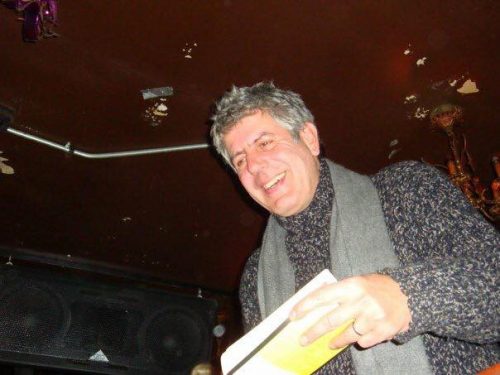
My parents and I met Anthony Bourdain in 2009 at a bar in Buffalo where he was filming an episode of No Reservations. My father was thrilled to tell Bourdain how much he loved the episode featuring his homeland of Colombia. It was perhaps one of the first times in my father’s 38-years in the United States that he felt like American television portrayed Colombia in a positive light, showing the beauty, resilience, and complex history of the nation rather than the images of drug wars and violence present elsewhere in depictions of the country. That night in that dive bar, Bourdain graciously spoke with my dad about how beautiful he found the country and its people. Both the episode and their conversation filled by father with immense pride, ultimately restoring some of the dignity that had been repeatedly stripped of him through years of indignant stereotypes about his home.

In the end, isn’t that what many of us sociologists are trying to do? Honor people’s stories without misusing, mistreating, or misrepresenting them?

In retrospect, maybe Bourdain influenced my path towards sociology. At the very least, he created a bridge between what I knew – food service – and what I wanted to know – the rest of the world. In our classrooms we strive to teach our students how to make these connections. Bourdain made them for us with ease, dignity, and humility.

Caty Taborda-Whitt is a Ford fellow and sociology PhD candidate at the University of Minnesota. Her research interests include embodiment, health, culture, and inequalities.

(View original at https://thesocietypages.org/socimages)

13 Jun 02:23

Presidential Succession

Leahgates

I'm sharing this for how 29 rounds is, in fact, exactly how many you would need, assuming full participation

Ties are broken by whoever was closest to the surface of Europa when they were born.
13 Jun 02:22

Just Tobi and Ria…and Baby Makes Three!

by Andrew Bleiman
Leahgates

why have I not previously noted how good the ears are

1_Tamandua baby (c) ZSL London Zoo 3

‘Tobi the Tamandua’ took-up residence at ZSL London Zoo, last October, as a potential companion for female, Ria. Zookeepers hoped to someday hear the pitter patter of tiny Tamandua toes. So, the Zoo was overjoyed when just five months later they spotted a tiny baby clinging to Ria’s back. When keepers did the math, they discovered that Ria must have fallen pregnant the same week of meeting her new mate, making newcomer Tobi a very fast mover!

ZSL keeper, Steve Goodwin, said, “Ria went into her nest box that morning, which isn’t unusual, as Tamanduas are nocturnal animals and often nap during the day. But at around 5pm, as the sun began to set, she amazed us all when she came outside for her evening explorations with a tiny newborn holding onto her fur.”

“We were confidant Ria was pregnant, as she’d just started to put on some weight, but we weren’t expecting to welcome a new member of the family quite so soon. They must have got together pretty much on their very first date – Tobi clearly pulled out all the stops!”

2_Tamandua baby (c) ZSL London Zoo 4

3_Tamandua baby (c) ZSL London Zoo 1

4_Tamandua baby (c) ZSL London Zoo 2Photo Credits: ZSL (Zoological Society of London)

The new baby, nicknamed ‘Poco’ by keepers, has remained close to Ria since the Easter Monday birth. Mum is sometimes seen tucking the youngster safely away in a hollow log.

Now, the two-month-old has started to tentatively venture away from mum to explore its “Rainforest Life” home, which the Zoo’s Tamanduas share with Two-toed Sloths (Marilyn, Leander and baby Lento), Emperor Tamarins, Red Titi Monkeys and Fruit Bats.

Steve added, “We set up a camera to keep a close eye on the pair, as they’re most active at night: we’ve been delighted to see the youngster peeking its head out of the tree stump at after dark, and now Ria is confident enough to carry her around the exhibit visitors will be able to spot the pair - especially at our Zoo Nights events this summer.”

The little one has also been spotted practicing sticking out its long tongue, which will grow up to 40cm in length and is used to extract tasty insects from inside branches and holes.

The Tamandua (Tamandua tetradactyla) is a nocturnal mammal. It is part of the anteater family and native to South America. They are also impressive climbers - holding on to mum enables the infant to build up the valuable muscles needed to climb easily through the treetop branches of London’s only living rainforest.

Juvenile Tamanduas spend the first three months clinging to their mother’s backs, sliding down to feed before pulling themselves back up to nestle into mum’s fur. They have fantastic camouflage as their distinguishable matching patterns align to create one continuous stripe, allowing the young pup to avoid the eyes of predators.

Keepers won’t know the youngster’s sex until it is scanned by vets, as the baby will remain close to mum until around six-months-old. Boy or girl, the newborn is a valuable addition to its species and once its sex is confirmed, its details will be added to the European Studbook (ESB), part of a coordinated breeding programme for Tamanduas.

The youngster’s public debut is just in time for the ZSL London’s Zoo Nights event. Every Friday, throughout June, visitors will be able to explore the Zoo after-hours, seeing its 19,000 animals in a completely different light.

See the Zoo come alive after dark at Zoo Nights. To book tickets or find out more, visit: www.zsl.org/ZSLZooNights

5_Tamandua baby night cam first image (c) ZSL London Zoo

09 Jun 21:09

Zoo Celebrates First Blue-billed Curassow Chick

by Andrew Bleiman
Leahgates

these birds are okay but I am sharing them so I can also tell you I did NOT share the toucan chicks in my feed, out of the goodness of my heart, because they were wet and pokey in all the pictures

1_42038154851_defee05f3b_o

Nashville Zoo’s avian staff welcomed their first Curassow chick on May 5.

After 30 days of incubation, Nashville Zoo keepers and veterinary staff assisted the chick in hatching. Keepers opted to assist the chick due to inactivity during the second day, after its initial pip in the shell membrane. Keepers noticed the shell membrane was dry instead of wet, and they decided intervention was necessary.

“This is a very valuable animal, and we need to do everything we can to help it survive,” said Shelley Norris, Nashville Zoo Avian Area Supervisor. “This egg hatching is significant because Curassows are critically endangered in the wild.”

2_42038154521_9c41791cd0_o

3_41137968615_27f751c4c9_o

4_41137968845_508862919c_oPhoto Credits: Kelsey White/Nashville Zoo

There are only 54 Blue-billed Curassows in zoos across the country and only about 750 in the wild. The population has been in decline due to habitat loss and fragmentation.

This is the first chick born from breeding pair, Albert (3) and Victoria (5), who both arrived in Nashville in 2015.

The Curassows at Nashville Zoo have laid eggs in the past. However, the eggs were either not viable or the female knocked the eggs out of the nest.

“She [Victoria] has no idea that she’s supposed to sit on the eggs,” Norris said. “We think it’s because she’s young and things haven’t kicked in yet."

Nashville Zoo's avian staff is currently working with Houston Zoo and the Species Survival Plan on where to best place this chick.

The Blue-billed Curassow (Crax alberti) is a species of bird in the family Cracidae, which includes the Chachalacas, Guans, and Curassows.

The bird is native to Colombia. Its natural habitat is subtropical or tropical moist lowland forest. The species is threatened by habitat loss and is currently classified as “Critically Endangered” by the IUCN.

Blue-billed Curassows are believed to live in the same areas in Colombia as Cotton-top Tamarins, a primate species that was recently introduced in the Nashville Zoo's new Expedition Peru exhibit. The Zoo is contributing to the conservation project “Proyecto Titi” that benefits sustaining the Cotton-top Tamarin population, which could potentially also benefit the Blue-billed Curassows with the installation of camera traps to monitor the species.

“We’re learning how best to care for them,” Norris said. “Right now, this species is just so critical, we basically are just keeping them alive in general until we can find a solution in the wild.”

09 Jun 17:22

English/Gibberish

by Evan Stewart
Leahgates

always reblog bobson dugnutt

One major part of introducing students to sociology is getting to the “this is water” lesson: the idea that our default experiences of social life are often strange and worthy of examining. This can be challenging, because the default is often boring or difficult to grasp, but asking the right questions is a good start (with some potentially hilarious results).

Take this one: what does English sound like to a non-native speaker? For students who grew up speaking it, this is almost like one of those Zen koans that you can’t quite wrap your head around. If you intuitively know what the language means, it is difficult to separate that meaning from the raw sounds.

That’s why I love this video from Italian pop singer Adriano Celentano. The whole thing is gibberish written to imitate how English slang sounds to people who don’t speak it.


Another example to get class going with a laugh is the 1990s video game Fighting Baseball for the SNES. Released in Japan, the game didn’t have the licensing to use real players’ names, so they used names that sounded close enough. A list of some of the names still bounces around the internet:

The popular idea of the Uncanny Valley in horror and science fiction works really well for languages, too. The funny (and sometimes unsettling) feelings we get when we watch imitations of our default assumptions fall short is a great way to get students thinking about how much work goes into our social world in the first place.

Evan Stewart is a Ph.D. candidate in sociology at the University of Minnesota. You can follow him on Twitter.

(View original at https://thesocietypages.org/socimages)

07 Jun 16:07

‘Sassy’ Mountain Goat Gives Birth to Sassy Kid

by Andrew Bleiman

1_SassyBaby

The Oregon Zoo announced the arrival of a new kid. Mountain Goat, Sassy, gave birth May 20.

Mom and kid can be seen amid the rocky crags of the Zoo’s “Cascade Crest” habitat, just past the zoo’s main entrance.

2_05-21-2018goat-121

3_05-21-2018goat-111

4_05-21-2018goat-351Photo Credits: Kathy Street / Oregon Zoo

While mothers of some species keep their newborns hidden away for several weeks, Mountain Goat kids are typically on their feet within minutes after birth, quickly learning to navigate their sparse and rocky alpine environment.

Sassy’s kid was no exception, according to Amy Cutting, who oversees the zoo’s Great Northwest area. “She gave birth between 8 and 8:20 Saturday evening, and her kid was already on its feet by 8:30,” Cutting said. “We saw it do a playful hop less than an hour after it was born. Mountain Goat kids are extremely precocious.”

Zookeepers had been aware that Sassy was pregnant and saw signs of labor early in the afternoon before the birth, so they had been keeping a close watch into the night.

Now that the new kid has arrived, keepers will continue to observe the pair to ensure all is going well. However, it appears Sassy doesn’t seem to need any help, according to Cutting.

“Although Sassy’s a first-time mom, she grew up in a herd and has seen other births before,” Cutting said. “So far, she’s been very attentive and is nursing her kid regularly. The two have been heard vocalizing to each other and they seem to be bonding well.”

Caregivers won’t know whether the new kid is male or female until its first veterinary check, probably in about a week.

Cutting also shared that the Zoo’s other adult Mountain Goats (male Honovi, who is the father, and female Montane) seem unconcerned about the new arrival, and have been giving Sassy and her kid some space to get acquainted.

Montane is also believed to be pregnant, and could give birth within a month.

“We’re excited that Sassy went first, so Montane has a chance to observe her and hopefully learn a few things,” Cutting said.

Montane has not experienced birth before. She arrived at the Oregon Zoo in 2009 and was an orphan, rescued by Idaho wildlife officials.

In the Pacific Northwest, wild Mountain Goats live on various peaks in the Washington Cascades and across Oregon ranges, like the Elkhorns and Wallowas. They also can be seen on the Olympic Peninsula, where they are non-native — introduced there by a hunting group in the 1920s — and have become a threat to local wildlife.

In March, the National Park Service announced plans to relocate 90 percent of the Olympic Mountain Goat population to its native range. The Oregon Zoo has contributed $5,000 toward transport enclosures to aid in the effort.

5_05-21-2018goat-204

07 Jun 16:06

Record Number of Feathertail Gliders Born at Taronga Zoo

by Andrew Bleiman
Leahgates

smol

Please credit photographer _ Sarah Lievore 6

Taronga Zoo, located in Sydney, Australia, is celebrating the breeding success of 13 Feathertail Glider babies, adding to 20 babies born only months ago. Born in March, the new joeys have just emerged from their mothers’ pouches.

Joeys usually emerge from their mother’s pouch when they are about 63 days old. At this point, the pouch, with up to four joeys inside, is so big that the mother’s feet cannot touch the ground.

Please credit photographer _ Sarah Lievore 3
Please credit photographer _ Sarah Lievore 3Photo Credit: Sarah Lievore

Feathertail Gliders are named after their long tail that is fringed with stiff hairs that resemble a feather. These tiny marsupials are only two to three inches long but can glide up to 90 feet from tree to tree. A flap of skin stretching from front to back legs acts like a parachute, while the tail serves as a rudder for steering. As adults they weigh .4 ounces – about the same as two US quarters.

Taronga Zoo Sydney is believed to be the first Zoo to ever successfully breed Feathertail Gliders, and in the last decade has seen the birth of up to 200 individuals.

With the help of fine skin ridges and tiny hairs on their feet, Feathertail Gliders are able to climb smooth surfaces, such as vertical panes of glass. Sweat helps the feet act like suction cups to aid in climbing.

Feathertail Gliders are probably common in much of eastern Australia, but few people see them due to their tiny size and nocturnal habits.

Not a lot is known about these tiny animals in the wild. While there appear to be no immediate major threats to this species in the short term, Feathertails may be locally threatened by habitat loss as well as predation by feral cats and foxes.  

See more photos of the Gliders below.

Please credit photographer _ Sarah Lievore

Related articles
04 Jun 02:59

“I Felt Like Destroying Something Beautiful”

by Sandra Loughrin
Leahgates

this is so interesting

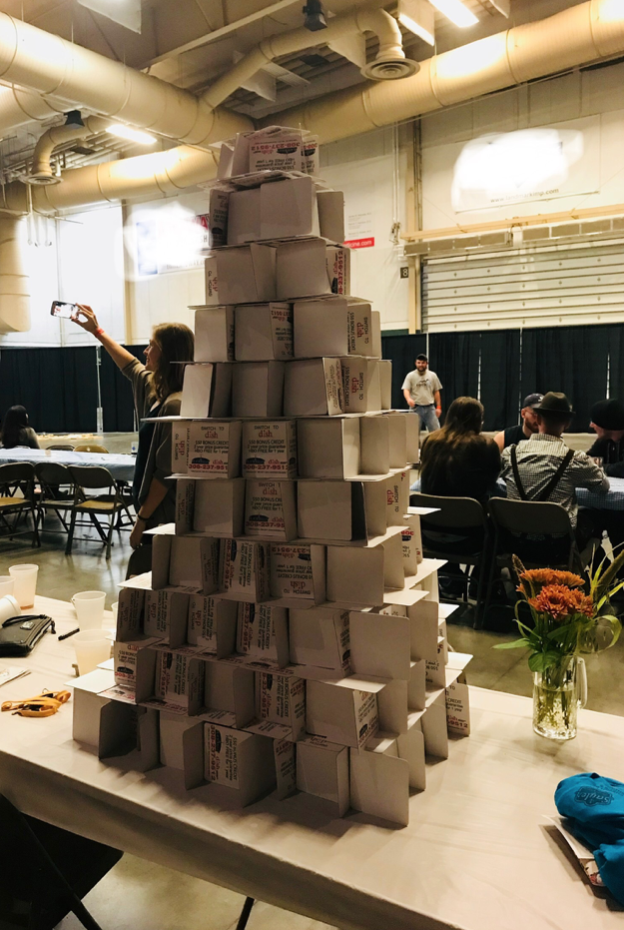
When I was eight, my brother and I built a card house. He was obsessed with collecting baseball cards and had amassed thousands, taking up nearly every available corner of his childhood bedroom. After watching a particularly gripping episode of The Brady Bunch, in which Marsha and Greg settled a dispute by building a card house, we decided to stack the cards in our favor and build. Forty-eight hours later a seven-foot monstrosity emerged…and it was glorious.

I told this story to a group of friends as I ran a stack of paper coasters through my fingers. We were attending Oktoberfest 2017 in a rural university town in the Midwest. They collectively decided I should flex my childhood skills and construct a coaster card house. Supplies were in abundance and time was no constraint. 

I began to construct. Four levels in, people around us began to take notice; a few snapped pictures. Six levels in, people began to stop, actively take pictures, and inquire as to my progress and motivation. Eight stories in, a small crowd emerged. Everyone remained cordial and polite. At this point it became clear that I was too short to continue building. In solidarity, one of my friends stood on a chair to encourage the build. We built the last three levels together, atop chairs, in the middle of the convention center. 

Where inquires had been friendly in the early stages of building, the mood soon turned. The moment chairs were used to facilitate the building process was the moment nearly everyone in attendance began to take notice. As the final tier went up, objects began flying at my head. Although women remained cordial throughout, a fraction of the men in the crowd began to become more and more aggressive. Whispers of  “I bet you $50 that you can’t knock it down” or “I’ll give you $20 if you go knock it down” were heard throughout.  A man chatted with my husband, criticizing the structural integrity of the house and offering insight as to how his house would be better…if he were the one building. Finally, a group of very aggressive men began circling like vultures. One man chucked empty plastic cups from a few tables away. The card house was complete for a total of 2-minutes before it fell. The life of the tower ended as such: 

Man: “Would you be mad if someone knocked it down?”

Me: “I’m the one who built it so I’m the one who gets to knock it down.”

Man: “What? You’re going to knock it down?”

The man proceeded to punch the right side of the structure; a quarter of the house fell. Before he could strike again, I stretched out my arms knocking down the remainder. A small curtsey followed, as if to say thank you for watching my performance. There was a mixture of cheers and boos. Cheers, I imagine from those who sat in nearby tables watching my progress throughout the night. Boos, I imagine, from those who were denied the pleasure of knocking down the structure themselves.

As an academic it is difficult to remove my everyday experiences from research analysis.  Likewise, as a gender scholar the aggression displayed by these men was particularly alarming. In an era of #metoo, we often speak of toxic masculinity as enacting masculine expectations through dominance, and even violence. We see men in power, typically white men, abuse this very power to justify sexual advances and sexual assault. We even see men justify mass shootings and attacks based on their perceived subordination and the denial of their patriarchal rights.

Yet toxic masculinity also exits on a smaller scale, in their everyday social worlds. Hegemonic masculinity is a more apt description for this destructive behavior, rather than outright violent behavior, as hegemonic masculinity describes a system of cultural meanings that gives men power — it is embedded in everything from religious doctrines, to wage structures, to mass media. As men learn hegemonic expectations by way of popular culture—from Humphrey Bogart to John Wayne—one cannot help but think of the famous line from the hyper-masculine Fight Club (1999), “I just wanted to destroy something beautiful.”

Power over women through hegemonic masculinity may best explain the actions of the men at Ocktoberfest. Alcohol consumption at the event allowed men greater freedom to justify their destructive behavior. Daring one another to physically remove a product of female labor, and their surprise at a woman’s choice to knock the tower down herself, are both in line with this type of power over women through the destruction of something “beautiful”.

Physical violence is not always a key feature of hegemonic masculinity (Connell 1987: 184). When we view toxic masculinity on a smaller scale, away from mass shootings and other high-profile tragedies, we find a form of masculinity that embraces aggression and destruction in our everyday social worlds, but is often excused as being innocent or unworthy of discussion.

Sandra Loughrin is an Assistant Professor at the University of Nebraska at Kearney. Her research areas include gender, sexuality, race, and age.

(View original at https://thesocietypages.org/socimages)

15 May 02:17

Prague Zoo’s New Aardvark on Exhibit with Mom

by Andrew Bleiman

1_32227184_1697232417027348_3781881839870803968_o

Prague Zoo announced that visitors might be able to catch a glimpse of the zoo’s new baby Aardvark. The cub was born on April 22 and will now be on-exhibit, with mom, for a few hours each day.

2_32266580_1697232320360691_5586968826722910208_o

3_32205949_1697232337027356_1651896077613268992_o

4_32191933_1697232347027355_7189550399081152512_oPhoto Credits: Prague Zoo

The Aardvark (Orycteropus afer) is a medium-sized, burrowing, nocturnal mammal that is native to Africa. Elephant Shrews, Hyraxes, and Elephants are among the closest living relatives of the Aardvark.

It has a long pig-like snout, which is used to sniff out food. It is a nocturnal feeder and subsists mainly on ants and termites, which it will dig out of their hills using its sharp claws and powerful legs.

The Aardvark also digs to create burrows in which to live and rear its young.

After a gestation of about seven months, females generally give birth to one cub. At around nine weeks of age, the youngster is able to leave the burrow to accompany mother in search of food.

Although they are not considered common anywhere in Africa, their large range allows them to maintain sufficient numbers. The IUCN currently classifies the Aardvark as “Least Concern”; however, they are a species in a precarious situation. Since they are so dependent on such a specific food source, if a problem arises with the population of termites, the species as a whole would be affected drastically.