Shared posts

25 Aug 08:49

Fullerenes: past, present and future

by Cesar Palmero

Special issue by Royal Society Publishing

Royal Society Publishing has recently published a special issue of Philosophical Transactions A entitled “Fullerenes: past, present and future, celebrating the 30th anniversary of Buckminsterfullerene“.

The discovery of C60 and the subsequent evolution of fullerene physics and chemistry can be seen as the culmination of a series of parallel research strands pursued by Harry Kroto through numerous collaborations with colleagues and co-workers.

This themed issue originates from the 2-day symposium held on 15–16 July 2015, organized by the Royal Society of Chemistry (RSC) and the Royal Society. The majority of the reviews and reports of original research were provided by scientists who gave presentations at the July 2015 meeting and the other contributions were produced by friends and co-workers of Harry.

This issue is free to access until the end of September:

Introduction:

Fullerenes: past, present and future, celebrating the 30th anniversary of Buckminsterfullerene
Anthony J. Stace, Paul O’Brien

Dedication:

Professor Sir Harry Kroto (1939–2016)
Dave Garner

Articles:

- Pathway to the identification of C60+ in diffuse interstellar clouds
John P. Maier, Ewen K. Campbell

- Fullerene ion chemistry: a journey of discovery and achievement
Diethard K. Böhme

- Super-atom molecular orbital excited states of fullerenes
J. Olof Johansson, Elvira Bohl, Eleanor E. B. Campbell

- Another big discovery—metallofullerenes
Hisanori Shinohara

- Fullerene and nanotube growth: new insights using first principles and molecular dynamics
Rodolfo Cruz-Silva, Takumi Araki, Takuya Hayashi, Humberto Terrones, Mauricio Terrones, Morinobu Endo

- Unconventional high-Tc superconductivity in fullerides
Yasuhiro Takabayashi, Kosmas Prassides

- The influence hydrogen atom addition has on charge switching during motion of the metal atom in endohedral Ca@C60H4 isomers
G. Raggi, E. Besley, A. J. Stace

Ab initio infrared vibrational modes for neutral and charged small fullerenes (C20, C24, C26, C28, C30 and C60)
Jean-Joseph Adjizian, Alexis Vlandas, Jeremy Rio, Jean-Christophe Charlier, Chris P. Ewels

- The Stone–Wales transformation: from fullerenes to graphite, from radiation damage to heat capacity
M. I. Heggie, G. L. Haffenden, C. D. Latham, T. Trevethan

- Two-dimensional inorganic analogues of graphene: transition metal dichalcogenides
Manoj K. Jana, C. N. R. Rao

We hope you enjoy reading this collection.

Digg This  Reddit This  Stumble Now!  Share on Facebook  Bookmark this on Delicious  Share on LinkedIn  Bookmark this on Technorati  Post on Twitter  Google Buzz (aka. Google Reader)  
22 Aug 10:53

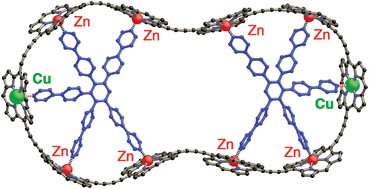
Nanorings with copper(II) and zinc(II) centers: forcing copper porphyrins to bind axial ligands in heterometallated oligomers

Chem. Sci., 2016, 7,6961-6968
DOI: 10.1039/C6SC01809B, Edge Article
Open Access Open Access
Creative Commons Licence&nbsp This article is licensed under a Creative Commons Attribution 3.0 Unported Licence.
Jonathan Cremers, Sabine Richert, Dmitry V. Kondratuk, Tim D. W. Claridge, Christiane R. Timmel, Harry L. Anderson
The stability of copper/zinc heterometallated porphyrin complex oligomers provides information on the strength of the copper porphyrin pyridine interaction. Heterometallated nanorings were prepared by template-directed synthesis.
The content of this RSS Feed (c) The Royal Society of Chemistry
16 Aug 10:53

A High-Energy Charge-Separated State of 1.70 eV from a High-Potential Donor–Acceptor Dyad: A Catalyst for Energy-Demanding Photochemical Reactions

by Gary N. Lim, Christopher O. Obondi, Francis D'Souza

Abstract

A high potential donor–acceptor dyad composed of zinc porphyrin bearing three meso-pentafluorophenyl substituents covalently linked to C60, as a novel dyad capable of generating charge-separated states of high energy (potential) has been developed. The calculated energy of the charge-separated state was found to be 1.70 eV, the highest reported for a covalently linked porphyrin–fullerene dyad. Intramolecular photoinduced electron transfer leading to charge-separated states of appreciable lifetimes in polar and nonpolar solvents has been established from studies involving femto- to nanosecond transient absorption techniques. The high energy stored in the form of charge-separated states along with its persistence of about 50–60 ns makes this dyad a potential electron-transporting catalyst to carry out energy-demanding photochemical reactions. This type of high-energy harvesting dyad is expected to open new research in the areas of artificial photosynthesis especially producing energy (potential) demanding light-to-fuel products.

Thumbnail image of graphical abstract

Keep 'em separated: A donor–acceptor dyad composed of a high oxidation potential zinc porphyrin covalently linked to C60 has been synthesized and shown to generate a high-energy charge-separated state on the order of 1.70 eV and a lifetime in the range of 50–60 ns during photoinduced electron transfer, which is sufficient to carry out many energy (potential) demanding photocatalytic reactions.

16 Aug 10:21

Helical Aromatic Foldamers Functioning as a Fluorescence Turn-on Probe for Anions

by Hae-Geun Jeon, Han Bit Jang, Philjae Kang, Ye Rin Choi, Junyoung Kim, Ji Hyun Lee, Moon-Gun Choi and Kyu-Sung Jeong

TOC Graphic

Organic Letters
DOI: 10.1021/acs.orglett.6b02156
08 Aug 11:48

Artemisinin—A Gift from Traditional Chinese Medicine to the World (Nobel Lecture)

by Youyou Tu
Thumbnail image of graphical abstract

Malaria has long been a devastating and life-threatening global epidemic disease in human history. Artemisinin, the active substance against malaria, was first isolated and tested in the 1970s in China. The important role played by traditional Chinese medicine in the discovery of artemisinin is described by Y. Tu in her Nobel Lecture.

04 Aug 07:35

Synthesis of C60-Fused Tetrahydrocarbazole/Dibenzothiophene/Benzothiophene and Dibenzofuran Derivatives via Metal-Free Oxidative Dehydrogenative Carboannulation

by Tong-Xin Liu, Jinliang Ma, Di Chao, Pengling Zhang, Nana Ma, Qingfeng Liu, Lei Shi, Zhiguo Zhang and Guisheng Zhang

TOC Graphic

Organic Letters
DOI: 10.1021/acs.orglett.6b01902
30 Jul 14:27

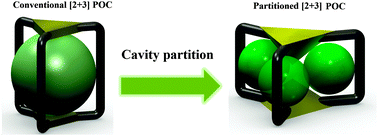
Cavity partition and functionalization of a [2+3] organic molecular cage by inserting polar P[double bond, length as m-dash]O bonds

Chem. Commun., 2016, 52,9267-9270
DOI: 10.1039/C6CC02801B, Communication
Genfeng Feng, Wei Liu, Yuxin Peng, Bo Zhao, Wei Huang, Yafei Dai
The cavity of a [2+3] organic molecular cage was partitioned and functionalized by inserting inner-directed P[double bond, length as m-dash]O bonds, which shows CO2 capture and CH4 exclusion due to the size-matching and polarity effects.
The content of this RSS Feed (c) The Royal Society of Chemistry
30 Jul 09:57

Converting disulfide bridges in native peptides to stable methylene thioacetals

Chem. Sci., 2016, 7,7007-7012
DOI: 10.1039/C6SC02285E, Edge Article
Open Access Open Access
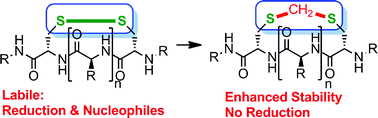
C. M. B. K. Kourra, N. Cramer
A mild and simple protocol converts the labile disulfide bond of unprotected native peptides into highly stable methylene thioacetals, annihilating reductive lability and increasing stability.
The content of this RSS Feed (c) The Royal Society of Chemistry
30 Jul 09:50

A Protocol for the Preparation of 2,5-Diaryl Fulleropyrrolidines: Thermal Reaction of [60]Fullerene with Aromatic Aldehydes and Arylmethanamines

by Ji-Long Shi, Xiao-Feng Zhang, Hui-Juan Wang, Fa-Bao Li, Xin-Xin Zhong, Chun-Xiang Liu, Li Liu, Chao-Yang Liu, Hai-Mei Qin and Yong-Shun Huang

TOC Graphic

The Journal of Organic Chemistry
DOI: 10.1021/acs.joc.6b01389
27 Jul 13:29

Achieving Optimal Self-Adaptivity for Dynamic Tuning of Organic Semiconductors through Resonance Engineering

by Ye Tao, Lijia Xu, Zhen Zhang, Runfeng Chen, Huanhuan Li, Hui Xu, Chao Zheng and Wei Huang

TOC Graphic

Journal of the American Chemical Society
DOI: 10.1021/jacs.6b05042
27 Jul 13:23

Azide Tripodal Dendrons from Behera’s Amine and Their Clicked Dendrimers

by Farhana Barmare, Marie-Caline Z. Abadjian, Erik C. Wiener and Douglas B. Grotjahn

TOC Graphic

The Journal of Organic Chemistry
DOI: 10.1021/acs.joc.6b00859
25 Jul 15:35

Methoxylation of Singly Bonded 1,4–1′,4′-BnC60–C60Bn Dimer: Preferential Formation of 1,4-C60 Adduct with Sterically Less Demanding Addends and Stability Difference between 1,2- and 1,4-OMe(Bn)C60

by Fa-Gui He, Zong-Jun Li and Xiang Gao

TOC Graphic

The Journal of Organic Chemistry
DOI: 10.1021/acs.joc.6b01171
25 Jul 15:33

Synthesis and Properties of Ladder-Type BN-Heteroacenes and Diazabenzoindoles Built on a Pyrrolopyrrole Scaffold

by Mariusz Tasior and Daniel T. Gryko

TOC Graphic

The Journal of Organic Chemistry
DOI: 10.1021/acs.joc.6b01209
25 Jul 15:25

Selective Nitrate Recognition by a Halogen Bonding Four Station [3]Rotaxane Molecular Shuttle

Selective Nitrate Recognition by a Halogen Bonding Four Station [3]Rotaxane Molecular Shuttle

Anion sandwich is a pincer cake: The synthesis of the first halogen bonding (XB) [3]rotaxane host system containing a four station axle is reported. Anion binding titration experiments reveal the rotaxane is selective for nitrate and operates through a dynamic pincer mechanism in which both macrocycles shuttle to the central XB anion recognition sites to form a 1:1 stoichiometric oxoanion–rotaxane sandwich complex.

[Communication]
Timothy A. Barendt, Andrew Docker, Igor Marques, Vítor Félix, Paul D. Beer
Angew. Chem. Int. Ed., July 20, 2016, DOI: 10.1002/anie.201604327. Read article

20 Jul 07:11

Face-to-Face Packing of 2,3,9,10-Tetrasubstituted Pentacene Derivatives Revealed through a Solid State [4 + 4] Thermal Cycloaddition and Molecular Dynamic Simulation

by Bikash Pal, Bo-Chao Lin, Mark Vincent Carreon dela Cerna, Chao-Ping Hsu and Chih-Hsiu Lin

TOC Graphic

The Journal of Organic Chemistry
DOI: 10.1021/acs.joc.6b00526
20 Jul 07:07

Tetranitro-oxacalix[4]crown-Based Host–Guest Recognition Motif and a Related [2]Rotaxane-Based Molecular Switch

by Hua Liu, Wen-Jing Hu, Yahu A. Liu, Jiu-Sheng Li, Biao Jiang and Ke Wen

TOC Graphic

The Journal of Organic Chemistry
DOI: 10.1021/acs.joc.6b01082
15 Jul 07:34

[Report] Aryl amination using ligand-free Ni(II) salts and photoredox catalysis

by Emily B. Corcoran
Over the past two decades, there have been major developments in transition metal–catalyzed aminations of aryl halides to form anilines, a common structure found in drug agents, natural product isolates, and fine chemicals. Many of these approaches have enabled highly efficient and selective coupling through the design of specialized ligands, which facilitate reductive elimination from a destabilized metal center. We postulated that a general and complementary method for carbon–nitrogen bond formation could be developed through the destabilization of a metal amido complex via photoredox catalysis, thus providing an alternative approach to the use of structurally complex ligand systems. Here, we report the development of a distinct mechanistic paradigm for aryl amination using ligand-free nickel(II) salts, in which facile reductive elimination from the nickel metal center is induced via a photoredox-catalyzed electron-transfer event. Authors: Emily B. Corcoran, Michael T. Pirnot, Shishi Lin, Spencer D. Dreher, Daniel A. DiRocco, Ian W. Davies, Stephen L. Buchwald, David W. C. MacMillan
15 Jul 07:20

Regioselective and Stepwise Syntheses of Functionalized BODIPY Dyes through Palladium-Catalyzed Cross-Coupling Reactions and Direct C–H Arylations

by Zeya Feng, Lijuan Jiao, Yuanmei Feng, Changjiang Yu, Na Chen, Yun Wei, Xiaolong Mu and Erhong Hao

TOC Graphic

The Journal of Organic Chemistry
DOI: 10.1021/acs.joc.6b00858
14 Jul 14:53

Self-Assembly of Concentric Hexagons and Hierarchical Self-Assembly of Supramolecular Metal–Organic Nanoribbons at the Solid/Liquid Interface

by Ming Wang, Kun Wang, Chao Wang, Mingjun Huang, Xin-Qi Hao, Ming-Zhan Shen, Guo-Qing Shi, Zhe Zhang, Bo Song, Alejandro Cisneros, Mao-Ping Song, Bingqian Xu and Xiaopeng Li

TOC Graphic

Journal of the American Chemical Society
DOI: 10.1021/jacs.6b04959
14 Jul 14:51

Synthesis of Stable Nanographenes with OBO-Doped Zigzag Edges Based on Tandem Demethylation-Electrophilic Borylation

by Xiao-Ye Wang, Akimitsu Narita, Wen Zhang, Xinliang Feng and Klaus Müllen

TOC Graphic

Journal of the American Chemical Society
DOI: 10.1021/jacs.6b04092
11 Jul 12:22

Light-melt adhesive based on dynamic carbon frameworks in a columnar liquid-crystal phase

by Shohei Saito

Article

Liquid crystals are used in many applications, such as removable adhesives, but this requires both good bonding strength, and its rapid disappearance under an external stimulus. Here, Saito and others report a dynamic liquid crystal material that loses is bonding strength under photo irradiation.

Nature Communications doi: 10.1038/ncomms12094

Authors: Shohei Saito, Shunpei Nobusue, Eri Tsuzaka, Chunxue Yuan, Chigusa Mori, Mitsuo Hara, Takahiro Seki, Cristopher Camacho, Stephan Irle, Shigehiro Yamaguchi

11 Jul 12:17

Selective catalytic two-step process for ethylene glycol from carbon monoxide

by Kaiwu Dong

Article

Conversion of one-carbon feedstocks to more complex structures is vital for the production of bulk chemicals. Here, the authors report a highly selective method for the conversion of carbon monoxide to ethylene glycol by means of an oxamide intermediate.

Nature Communications doi: 10.1038/ncomms12075

Authors: Kaiwu Dong, Saravanakumar Elangovan, Rui Sang, Anke Spannenberg, Ralf Jackstell, Kathrin Junge, Yuehui Li, Matthias Beller

10 Jul 09:20

[Report] Pore chemistry and size control in hybrid porous materials for acetylene capture from ethylene

by Xili Cui
The trade-off between physical adsorption capacity and selectivity of porous materials is a major barrier for efficient gas separation and purification through physisorption. We report control over pore chemistry and size in metal coordination networks with hexafluorosilicate and organic linkers for the purpose of preferential binding and orderly assembly of acetylene molecules through cooperative host-guest and/or guest-guest interactions. The specific binding sites for acetylene are validated by modeling and neutron powder diffraction studies. The energies associated with these binding interactions afford high adsorption capacity (2.1 millimoles per gram at 0.025 bar) and selectivity (39.7 to 44.8) for acetylene at ambient conditions. Their efficiency for the separation of acetylene/ethylene mixtures is demonstrated by experimental breakthrough curves (0.73 millimoles per gram from a 1/99 mixture). Authors: Xili Cui, Kaijie Chen, Huabin Xing, Qiwei Yang, Rajamani Krishna, Zongbi Bao, Hui Wu, Wei Zhou, Xinglong Dong, Yu Han, Bin Li, Qilong Ren, Michael J. Zaworotko, Banglin Chen
29 Jun 11:36

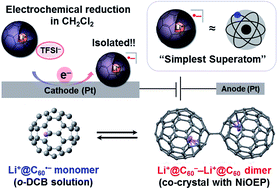
Electrochemical reduction of cationic Li+@C60 to neutral Li+@C60[radical dot]-: isolation and characterisation of endohedral [60]fulleride

Chem. Sci., 2016, 7,5770-5774
DOI: 10.1039/C6SC01209D, Edge Article
Open Access Open Access
Hiroshi Ueno, Shinobu Aoyagi, Yu Yamazaki, Kei Ohkubo, Naohiko Ikuma, Hiroshi Okada, Tatsuhisa Kato, Yutaka Matsuo, Shunichi Fukuzumi, Ken Kokubo
Li@C60 was synthesised by electrochemical reduction of ionic Li+@C60 salt. This is the first report of isolation and unambiguous characterisation of endohedral metallo[60]fullerene.
The content of this RSS Feed (c) The Royal Society of Chemistry
24 Jun 06:55

Highly Twisted N,N-Dialkylamines as a Design Strategy to Tune Simple Aromatic Hydrocarbons as Steric Environment-Sensitive Fluorophores

by Shunsuke Sasaki, Satoshi Suzuki, W. M. C. Sameera, Kazunobu Igawa, Keiji Morokuma and Gen-ichi Konishi

TOC Graphic

Journal of the American Chemical Society
DOI: 10.1021/jacs.6b03749
20 Jun 13:22

[Report] Covalently bonded single-molecule junctions with stable and reversible photoswitched conductivity

by Chuancheng Jia
Through molecular engineering, single diarylethenes were covalently sandwiched between graphene electrodes to form stable molecular conduction junctions. Our experimental and theoretical studies of these junctions consistently show and interpret reversible conductance photoswitching at room temperature and stochastic switching between different conductive states at low temperature at a single-molecule level. We demonstrate a fully reversible, two-mode, single-molecule electrical switch with unprecedented levels of accuracy (on/off ratio of ~100), stability (over a year), and reproducibility (46 devices with more than 100 cycles for photoswitching and ~105 to 106 cycles for stochastic switching). Authors: Chuancheng Jia, Agostino Migliore, Na Xin, Shaoyun Huang, Jinying Wang, Qi Yang, Shuopei Wang, Hongliang Chen, Duoming Wang, Boyong Feng, Zhirong Liu, Guangyu Zhang, Da-Hui Qu, He Tian, Mark A. Ratner, H. Q. Xu, Abraham Nitzan, Xuefeng Guo
20 Jun 13:04

Formation of Benzimidazoisoquinolinium and Benzimidazoisoindolinum Cyclic Systems by the Reaction of 2-(2-Alkynylphenyl)benzimidazoles with Iodine and Iodine–Iodine Interaction Including Halogen Bonding in Their Crystal Structures

by Shoji Matsumoto, Shu Kikuchi, Naoto Norita, Hyuma Masu and Motohiro Akazome

TOC Graphic

The Journal of Organic Chemistry
DOI: 10.1021/acs.joc.6b00607
15 Jun 07:04

One-Pot Synthesis of Substituted Benzo[b]furans and Indoles from Dichlorophenols/Dichloroanilines Using a Palladium–Dihydroxyterphenylphosphine Catalyst

by Miyuki Yamaguchi, Tomoyo Akiyama, Hirohisa Sasou, Haruka Katsumata and Kei Manabe

TOC Graphic

The Journal of Organic Chemistry
DOI: 10.1021/acs.joc.6b00824
15 Jun 07:03

A Shape-Persistent Cryptand for Capturing Polycyclic Aromatic Hydrocarbons

by Rui-Feng Zhang, Wen-Jing Hu, Yahu A. Liu, Xiao-Li Zhao, Jiu-Sheng Li, Biao Jiang and Ke Wen

TOC Graphic

The Journal of Organic Chemistry
DOI: 10.1021/acs.joc.6b01115
11 May 09:32

Electrophilic Activation of P-Alkynes in the Synthesis of P-Substituted and P-Centered Heterocycles

by Akhil Gupta and Bernard L. Flynn

TOC Graphic

The Journal of Organic Chemistry
DOI: 10.1021/acs.joc.6b00262