A junction between an n- and p-type semiconductor results in the creation of a depletion region whose properties are at the basis of nowadays electronics. If realized using topological insulators as constituent materials, p-n junctions are expected to manifest several unconventional effects with great potential for applications. Experimentally, all these fascinating properties remained unexplored so far, mainly because prototypical topological PNJs, which can be easily realized and investigated, were not readily available. Here, we report on the creation of topological PNJs which can be as narrow as few tenths of nm showing a built-in potential of 110meV. These junctions are intrinsically obtained by a thermodynamic control of the defects distribution across the crystal. Our results make Bi2Te3 a robust and reliable platform to explore the physics of topological p-n junction.
Dr.jens.brede
Shared posts
Experimental realization of a topological p-n junction by intrinsic defect-grading. (arXiv:1512.06554v1 [cond-mat.mes-hall])
Evidence for a diamondlike electronic band structure of Si multilayers on Ag(111)
Author(s): S. K. Mahatha, P. Moras, P. M. Sheverdyaeva, R. Flammini, K. Horn, and C. Carbone
Silicon multilayers on Ag(111) have been suggested to exhibit the structure of silicene, a material that has been heralded as a novel basis for microelectronic applications. However, our angle-resolved photoemission spectra (ARPES) from silicon multilayers on Ag(111) and of the silver-induced recons…
[Phys. Rev. B 92, 245127] Published Tue Dec 22, 2015
Direct observation of spin–orbit coupling in iron-based superconductors
Nature Physics. doi:10.1038/nphys3594
Authors: S. V. Borisenko, D. V. Evtushinsky, Z.-H. Liu, I. Morozov, R. Kappenberger, S. Wurmehl, B. Büchner, A. N. Yaresko, T. K. Kim, M. Hoesch, T. Wolf & N. D. Zhigadlo
Spin–orbit coupling is a fundamental interaction in solids that can induce a broad range of unusual physical properties, from topologically non-trivial insulating states to unconventional pairing in superconductors. In iron-based superconductors its role has, so far, not been considered of primary importance, with models based on spin- or orbital fluctuations pairing being used most widely. Using angle-resolved photoemission spectroscopy, we directly observe a sizeable spin–orbit splitting in all the main members of the iron-based superconductors. We demonstrate that its impact on the low-energy electronic structure and details of the Fermi surface topology is stronger than that of possible nematic ordering. The largest pairing gap is supported exactly by spin–orbit-coupling-induced Fermi surfaces, implying a direct relation between this interaction and the mechanism of high-temperature superconductivity.
Electrodeposition of gold nanoparticles on aryl diazonium monolayer functionalized HOPG surfaces

DOI: 10.1039/C5CP06415E, Paper
Gold nanoparticle electrodeposition on a modified HOPG surface with a monolayer organic film based on aryl diazonium chemistry has been studied.
The content of this RSS Feed (c) The Royal Society of Chemistry
Intrinsic spin torque without spin-orbit coupling
Author(s): Kyoung-Whan Kim, Kyung-Jin Lee, Hyun-Woo Lee, and M. D. Stiles
We derive an intrinsic contribution to the nonadiabatic spin torque for nonuniform magnetic textures. It differs from previously considered contributions in several ways and can be the dominant contribution in some models. It does not depend on the change in occupation of the electron states due to …
[Phys. Rev. B 92, 224426] Published Mon Dec 21, 2015
Synthesis of Pyrene-Fused Pyrazaacenes on Metal Surfaces: Toward One-Dimensional Conjugated Nanostructures

Majorana Zero Modes in Graphene
Author(s): P. San-Jose, J. L. Lado, R. Aguado, F. Guinea, and J. Fernández-Rossier
Majorana particles, which are their own antiparticles and whose recent detection in solid-state systems remains controversial, are expected to play an important role in future quantum computing. Now, scientists predict that graphene may host Majorana particles.
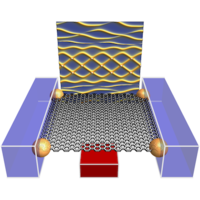
[Phys. Rev. X 5, 041042] Published Tue Dec 15, 2015
Unconventional Yu-Shiba-Rusinov states in hydrogenated graphene. (arXiv:1512.05267v2 [cond-mat.mes-hall] UPDATED)
Conventional in-gap Yu-Shiba-Rusinov states require two ingredients: magnetic atoms and a superconducting host that, in the normal phase, has a finite density of states at the Fermi energy. Here we show that hydrogenated graphene can host Yu-Shiba-Rusinov states without any of those two ingredients. Atomic hydrogen chemisorbed in graphene is known to act as paramagnetic center with a weakly localized magnetic moment. Our calculations for hydrogenated graphene in proximity to a superconductor show that individual adatoms induce in-gap Yu-Shiba-Rusinov states with an exotic spectrum whereas chains of adatoms result in a gapless Yu- Shiba-Rusinov band. Our predictions can be tested using state of the art techniques, combining recent progress of atomic manipulation of atomic hydrogen on graphene together with the well tested proximity effect in graphene.
Termination-dependent surface properties in the giant-Rashba semiconductors BiTeX (X=Cl, Br, I)
Author(s): Sebastian Fiedler, Thomas Bathon, Sergey V. Eremeev, Oleg E. Tereshchenko, Konstantin A. Kokh, Evgueni V. Chulkov, Paolo Sessi, Hendrik Bentmann, Matthias Bode, and Friedrich Reinert
The noncentrosymmetric semiconductors BiTeX(X=Cl,Br,I) show large Rashba-type spin-orbit splittings in their electronic structure making them candidate materials for spin-based electronics. However, BiTeI(0001) single-crystal surfaces usually consist of stacking-fault-induced domains of Te and I ter…
[Phys. Rev. B 92, 235430] Published Tue Dec 15, 2015
Dehydrogenative Homocoupling of Alkyl Chains on Cu(110)
Abstract
Through the interplay of high-resolution scanning tunneling microscopy imaging and density functional theory calculations, the stepwise dehydrogenative homocoupling of alkyl chains on Cu(110) is demonstrated, proceeding from the intact chain, via the dehydrogenative intermediates, to the formation of the divers final coupling products.

Chains linked: Through the interplay of high-resolution scanning tunneling microscopy imaging and density functional theory calculations, the stepwise homocoupling of alkyl chains on Cu(110) is demonstrated, proceeding from the intact chain, via the dehydrogenative intermediates, to the final coupling products.
On-Surface Engineering of a Magnetic Organometallic Nanowire

Ultra-narrow metallic armchair graphene nanoribbons
Article
Graphene nanoribbons have potential applications as nanoscale wires, though experimentally studied ribbons display wide bandgaps. Here, the authors synthesise the narrowest armchair graphene nanoribbon predicted to have metallic behaviour and show these ribbons—5 carbon atoms wide—indeed display almost metallic behaviour.
Nature Communications doi: 10.1038/ncomms10177
Authors: Amina Kimouche, Mikko M. Ervasti, Robert Drost, Simo Halonen, Ari Harju, Pekka M. Joensuu, Jani Sainio, Peter Liljeroth
Anatomy and Giant Enhancement of the Perpendicular Magnetic Anisotropy of Cobalt–Graphene Heterostructures

[Report] Evidence for two-dimensional Ising superconductivity in gated MoS2
Deposition and Self-Assembly of Large Magnetic Molecules

Intermolecular artifacts in probe microscope images of C_{60} assemblies
Author(s): Samuel Paul Jarvis, Mohammad Abdur Rashid, Adam Sweetman, Jeremy Leaf, Simon Taylor, Philip Moriarty, and Janette Dunn
Claims that dynamic force microscopy has the capability to resolve intermolecular bonds in real space continue to be vigorously debated. To date, studies have been restricted to planar molecular assemblies with small separations between neighboring molecules. Here we report the observation of interm…
[Phys. Rev. B 92, 241405(R)] Published Wed Dec 09, 2015
Nature of the quantum metal in a two-dimensional crystalline superconductor
Nature Physics. doi:10.1038/nphys3579
Authors: A. W. Tsen, B. Hunt, Y. D. Kim, Z. J. Yuan, S. Jia, R. J. Cava, J. Hone, P. Kim, C. R. Dean & A. N. Pasupathy
Two-dimensional (2D) materials are not expected to be metals at low temperature owing to electron localization. Consistent with this, pioneering studies on thin films reported only superconducting and insulating ground states, with a direct transition between the two as a function of disorder or magnetic field. However, more recent works have revealed the presence of an intermediate quantum metallic state occupying a substantial region of the phase diagram, whose nature is intensely debated. Here, we observe such a state in the disorder-free limit of a crystalline 2D superconductor, produced by mechanical co-lamination of NbSe2 in an inert atmosphere. Under a small perpendicular magnetic field, we induce a transition from superconductor to the quantum metal. We find a unique power-law scaling with field in this phase, which is consistent with the Bose-metal model where metallic behaviour arises from strong phase fluctuations caused by the magnetic field.
Specular interband Andreev reflections at van der Waals interfaces between graphene and NbSe2
Nature Physics. doi:10.1038/nphys3583
Authors: D. K. Efetov, L. Wang, C. Handschin, K. B. Efetov, J. Shuang, R. Cava, T. Taniguchi, K. Watanabe, J. Hone, C. R. Dean & P. Kim
Electrons incident from a normal metal onto a superconductor are reflected back as holes—a process called Andreev reflection. In a normal metal where the Fermi energy is much larger than a typical superconducting gap, the reflected hole retraces the path taken by the incident electron. In graphene with low disorder, however, the Fermi energy can be tuned to be smaller than the superconducting gap. In this unusual limit, the holes are expected to be reflected specularly at the superconductor–graphene interface owing to the onset of interband Andreev processes, where the effective mass of the reflected holes changes sign. Here we present measurements of gate-modulated Andreev reflections across the low-disorder van der Waals interface formed between graphene and the superconducting NbSe2. We find that the conductance across the graphene–superconductor interface exhibits a characteristic suppression when the Fermi energy is tuned to values smaller than the superconducting gap, a hallmark for the transition between intraband retro Andreev reflections and interband specular Andreev reflections.
Remotely Controlled Isomer Selective Molecular Switching

Molecular Electronic Effects on the Thermal Grafting of Aryl Iodides to TiO2 Surfaces

[Report] Evidence for a fractional fractal quantum Hall effect in graphene superlattices
Mapping the Electronic Structure of Each Ingredient Oxide Layer of High-T_{c} Cuprate Superconductor Bi_{2} Sr_{2} CaCu_{2} O_{8+δ}
Author(s): Yan-Feng Lv, Wen-Lin Wang, Jun-Ping Peng, Hao Ding, Yang Wang, Lili Wang, Ke He, Shuai-Hua Ji, Ruidan Zhong, John Schneeloch, Gen-Da Gu, Can-Li Song, Xu-Cun Ma, and Qi-Kun Xue
Understanding the mechanism of high transition temperature (Tc) superconductivity in cuprates has been hindered by the apparent complexity of their multilayered crystal structure. Using a cryogenic scanning tunneling microscopy (STM), we report on layer-by-layer probing of the electronic structures …
[Phys. Rev. Lett. 115, 237002] Published Wed Dec 02, 2015
Organic Covalent Patterning of Nanostructured Graphene with Selectivity at the Atomic Level

Measuring entanglement entropy in a quantum many-body system
Measuring entanglement entropy in a quantum many-body system
Nature 528, 7580 (2015). doi:10.1038/nature15750
Authors: Rajibul Islam, Ruichao Ma, Philipp M. Preiss, M. Eric Tai, Alexander Lukin, Matthew Rispoli & Markus Greiner
Entanglement is one of the most intriguing features of quantum mechanics. It describes non-local correlations between quantum objects, and is at the heart of quantum information sciences. Entanglement is now being studied in diverse fields ranging from condensed matter to quantum gravity. However, measuring entanglement
Origin of Perpendicular Magnetic Anisotropy and Large Orbital Moment in Fe Atoms on MgO
Author(s): S. Baumann, F. Donati, S. Stepanow, S. Rusponi, W. Paul, S. Gangopadhyay, I. G. Rau, G. E. Pacchioni, L. Gragnaniello, M. Pivetta, J. Dreiser, C. Piamonteze, C. P. Lutz, R. M. Macfarlane, B. A. Jones, P. Gambardella, A. J. Heinrich, and H. Brune
We report on the magnetic properties of individual Fe atoms deposited on MgO(100) thin films probed by x-ray magnetic circular dichroism and scanning tunneling spectroscopy. We show that the Fe atoms have strong perpendicular magnetic anisotropy with a zero-field splitting of 14.0±0.3 meV/atom. Thi…
[Phys. Rev. Lett. 115, 237202] Published Tue Dec 01, 2015
Submolecular Imaging by Noncontact Atomic Force Microscopy with an Oxygen Atom Rigidly Connected to a Metallic Probe

Exploring the phase diagram of the two-impurity Kondo problem
Article
Magnetic atoms on a surface possess diverse correlated phases under an applied magnetic field due to a balance of exchange interaction and carrier-mediated coupling. Here, the authors use scanning tunnel microscopy to explore the phase diagram of coupled Co atom pairs on the surface of Cu 2 N/Cu(100).
Nature Communications doi: 10.1038/ncomms10046
Authors: A. Spinelli, M. Gerrits, R. Toskovic, B. Bryant, M. Ternes, A. F. Otte
Topological spin waves in the atomic-scale magnetic skyrmion crystal. (arXiv:1511.08244v1 [cond-mat.mes-hall])
We study the spin waves of the triangular skyrmion crystal that emerges in a two dimensional spin lattice model as a result of the competition between Heisenberg exchange, Dzyalonshinkii-Moriya interactions, Zeeman coupling and uniaxial anisotropy. The calculated spin wave bands have a finite Berry curvature that, in some cases, leads to non-zero Chern numbers, making this system topologically distinct from conventional magnonic systems. We compute the edge spin-waves, expected from the bulk-boundary correspondence principle, and show that they are chiral, which makes them immune to elastic backscattering. Our results illustrate how topological phases can occur in self-generated emergent superlattices at the mesoscale.
Complex Magnetic Exchange Coupling between Co Nanostructures and Ni(111) across Epitaxial Graphene

Manganese coordination chemistry of bis(imino)phenoxide derived [2 + 2] Schiff-base macrocyclic ligands

DOI: 10.1039/C5DT03453A, Paper
Products resulting from the reaction of MnCl2 with [2 + 2] Schiff-base macrocycles have been structurally characterized, and were found to be poorly active for the ROP of ε-caprolactone.
The content of this RSS Feed (c) The Royal Society of Chemistry