
The Journal of Physical Chemistry C
DOI: 10.1021/acs.jpcc.5b08883
Article
The exchange coupling strength between magnetic adsorbates and a superconducting surface determines the nature of the system’s quantum ground state. Here, the authors use scanning tunnelling microscopy to explore the ground state and excited state properties of manganese phthalocyanine adsorbed on a Pb(111) surface.
Nature Communications doi: 10.1038/ncomms9988
Authors: Nino Hatter, Benjamin W. Heinrich, Michael Ruby, Jose I. Pascual, Katharina J. Franke
Author(s): Pourya Ayria, Ahmad R. T. Nugraha, Eddwi H. Hasdeo, Thomas R. Czank, Shin-ichiro Tanaka, and Riichiro Saito
The photon energy dependence of angle-resolved photoemission spectroscopy (ARPES) in graphene is investigated experimentally and theoretically. By applying light with energy of around 46eV, we found an unexpected increase in the ARPES relative intensity of graphene for the p branch (ARPES spectra br…
[Phys. Rev. B 92, 195148] Published Tue Nov 24, 2015


Nature Materials. doi:10.1038/nmat4477
Authors: Tianru Wu, Xuefu Zhang, Qinghong Yuan, Jiachen Xue, Guangyuan Lu, Zhihong Liu, Huishan Wang, Haomin Wang, Feng Ding, Qingkai Yu, Xiaoming Xie & Mianheng Jiang
Wafer-scale single-crystalline graphene monolayers are highly sought after as an ideal platform for electronic and other applications. At present, state-of-the-art growth methods based on chemical vapour deposition allow the synthesis of one-centimetre-sized single-crystalline graphene domains in ∼12 h, by suppressing nucleation events on the growth substrate. Here we demonstrate an efficient strategy for achieving large-area single-crystalline graphene by letting a single nucleus evolve into a monolayer at a fast rate. By locally feeding carbon precursors to a desired position of a substrate composed of an optimized Cu–Ni alloy, we synthesized an ∼1.5-inch-large graphene monolayer in 2.5 h. Localized feeding induces the formation of a single nucleus on the entire substrate, and the optimized alloy activates an isothermal segregation mechanism that greatly expedites the growth rate. This approach may also prove effective for the synthesis of wafer-scale single-crystalline monolayers of other two-dimensional materials.
Nature Physics. doi:10.1038/nphys3555
Authors: Yasuyuki Nakajima, Paul Syers, Xiangfeng Wang, Renxiong Wang & Johnpierre Paglione
Topological insulators, with metallic boundary states protected against time-reversal-invariant perturbations, are a promising avenue for realizing exotic quantum states of matter, including various excitations of collective modes predicted in particle physics, such as Majorana fermions and axions. According to theoretical predictions, a topological insulating state can emerge from not only a weakly interacting system with strong spin–orbit coupling, but also in insulators driven by strong electron correlations. The Kondo insulator compound SmB6 is an ideal candidate for realizing this exotic state of matter, with hybridization between itinerant conduction electrons and localized f-electrons driving an insulating gap and metallic surface states at low temperatures. Here we exploit the existence of surface ferromagnetism in SmB6 to investigate the topological nature of metallic surface states by studying magnetotransport properties at very low temperatures. We find evidence of one-dimensional surface transport with a quantized conductance value of e2/h originating from the chiral edge channels of ferromagnetic domain walls, providing strong evidence that topologically non-trivial surface states exist in SmB6.


Article
Magnetically doped topological insulators may exhibit exotic transport phenomena such as the quantum anomalous Hall effect, however the underlying mechanisms of ferromagnetic order are currently debated. Here, the authors reveal stabilized ferromagnetism in Cr-doped (Sb,Bi) 2 Te 3 mediated by Te and Sb p -hole carriers.
Nature Communications doi: 10.1038/ncomms9913
Authors: Mao Ye, Wei Li, Siyuan Zhu, Yukiharu Takeda, Yuji Saitoh, Jiajia Wang, Hong Pan, Munisa Nurmamat, Kazuki Sumida, Fuhao Ji, Zhen Liu, Haifeng Yang, Zhengtai Liu, Dawei Shen, Akio Kimura, Shan Qiao, Xiaoming Xie

Author(s): Yeping Jiang, Canli Song, Zhi Li, Mu Chen, Richard L. Greene, Ke He, Lili Wang, Xi Chen, Xucun Ma, and Qi-Kun Xue
We report on the mass acquisition of Dirac fermions by doping Cr into the topmost quintuple layer or into the bulk of Sb2Te3 topological insulator films. By careful investigation of the scanning tunneling microscopy/spectroscopy on the films, we find that the Landau level spectrum keeps a good quali…
[Phys. Rev. B 92, 195418] Published Wed Nov 18, 2015
Article
Single molecular layers of TiSe 2 are promising for advanced electronic applications, and it is therefore important to characterize their phases. Here, the authors use ARPES to detect a charge density wave transition without Fermi surface nesting and that takes place at a temperature higher than in bulk.
Nature Communications doi: 10.1038/ncomms9943
Authors: P Chen, Y. -H. Chan, X. -Y. Fang, Y Zhang, M Y Chou, S. -K. Mo, Z Hussain, A. -V. Fedorov, T. -C. Chiang
Author(s): B. Q. Lv, S. Muff, T. Qian, Z. D. Song, S. M. Nie, N. Xu, P. Richard, C. E. Matt, N. C. Plumb, L. X. Zhao, G. F. Chen, Z. Fang, X. Dai, J. H. Dil, J. Mesot, M. Shi, H. M. Weng, and H. Ding
We have investigated the spin texture of surface Fermi arcs in the recently discovered Weyl semimetal TaAs using spin- and angle-resolved photoemission spectroscopy. The experimental results demonstrate that the Fermi arcs are spin polarized. The measured spin texture fulfills the requirement of mir…
[Phys. Rev. Lett. 115, 217601] Published Mon Nov 16, 2015

Spin excitations in atomic-scale nanostructures have been investigated with inelastic scanning tunneling spectroscopy, sometimes with conflicting results. In this work we present a theoretical viewpoint on a recent experimental controversy regarding the spin excitations of Co adatoms on Pt(111). While one group [Balashov et al., Phys. Rev. Lett. \textbf{102}, 257203 (2009)] claims to have detected them, another group reported their observation only after the hydrogenation of the Co adatom [Dubout et al., Phys. Rev. Lett. \textbf{114}, 106807 (2015)]. Utilizing time-dependent density functional theory in combination with many-body perturbation theory we demonstrate that, although inelastic spin excitations are possible for Cr, Mn, Fe, and Co adatoms, their efficiency differs. While the excitation signature is less pronounced for Mn and Co adatoms, it is larger for Cr and Fe adatoms. We find that the tunneling matrix elements related to the nature and symmetry of the relevant electronic states are more favorable for triggering the spin excitations in Fe than in Co. An enhancement of the tunneling and of the inelastic spectra is possible by attaching hydrogen to the adatom at the appropriate position.
Article
Donor spin states in silicon are good quantum bit candidates due to their long coherence times. Here, the authors use radio frequency reflectometry to measure singlet and triplet states, and to determine the tunnel coupling between few-donor silicon double quantum dots and the electrical leads.
Nature Communications doi: 10.1038/ncomms9848
Authors: M. G. House, T. Kobayashi, B. Weber, S. J. Hile, T. F. Watson, J. van der Heijden, S. Rogge, M. Y. Simmons
Author(s): Rico Friedrich, Vasile Caciuc, Nicolae Atodiresei, and Stefan Blügel
Our first-principles study demonstrates for the first time that by increasing the molecule-surface binding strength, the interlayer magnetic coupling of a ferromagnetic metal can be drastically reduced with respect to that of a clean substrate. Importantly, for a weakly chemisorbed molecule the rehy…
[Phys. Rev. B 92, 195407] Published Fri Nov 06, 2015
Weyl semimetals may open a new era in condensed matter physics, materials science and nanotech after graphene and topological insulators. We report the first atomic scale view of the surface states of a Weyl semimetal (NbP) using scanning tunneling microscopy/spectroscopy. We observe coherent quantum interference patterns that arise from the scattering of quasiparticles near point defects on the surface. The measurements reveal the surface electronic structure both below and above the chemical potential in both real and reciprocal spaces. Moreover, the interference maps uncover the scattering processes of NbP's exotic surface states. Through comparison between experimental data and theoretical calculations, we further discover that the scattering channels are largely restricted by the orbital and/or spin texture of the surface band. The visualization of the scattering processes can help design novel transport effects and electronics on the topological surface of a Weyl semimetal.
We consider a superconductor proximity coupled to a two-dimensional ferromagnetic film with a skyrmion texture. Using the T-matrix calculations and numerical modeling we calculate the spin-polarized local density of states in the superconductor in the vicinity of the skyrmion. We predict the skyrmion bound states (SBS) that are induced in the superconductor, similar to the well-known Yu-Shiba-Rusinov (YSR) states. The SBS wavefunctions have spatial power law decay. Presence of the SBS suggests the mechanism by which superconductivity could facilitate an effective long-range interaction between skyrmions when their SBS wavefunctions overlap.
Author(s): M. Etzkorn, C. F. Hirjibehedin, A. Lehnert, S. Ouazi, S. Rusponi, S. Stepanow, P. Gambardella, C. Tieg, P. Thakur, A. I. Lichtenstein, A. B. Shick, S. Loth, A. J. Heinrich, and H. Brune
We report on the magnetic properties of Fe and Co adatoms on a Cu2N/Cu(100)−c(2×2) surface investigated by x-ray magnetic dichroism measurements and density functional theory (DFT) calculations including the local coulomb interaction. We compare these results with properties formerly deduced from ST…
[Phys. Rev. B 92, 184406] Published Thu Nov 05, 2015

Author(s): Michael Ruby, Falko Pientka, Yang Peng, Felix von Oppen, Benjamin W. Heinrich, and Katharina J. Franke
A recent experiment [Nadj-Perge et al., Science 346, 602 (2014)] provides evidence for Majorana zero modes in iron (Fe) chains on the superconducting Pb(110) surface. Here, we study this system by scanning tunneling microscopy using superconducting tips. This high-resolution technique resolves a ric…
[Phys. Rev. Lett. 115, 197204] Published Wed Nov 04, 2015
Author(s): Y. J. Yan, M. Q. Ren, H. C. Xu, B. P. Xie, R. Tao, H. Y. Choi, N. Lee, Y. J. Choi, T. Zhang, and D. L. Feng
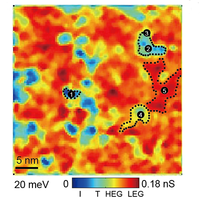
Superconducting cuprates are of great interest in condensed-matter physics, and now a new study shows that another transition-metal oxide, Sr2IrO4, may be analogous to cuprates in its high-temperature superconductivity.
[Phys. Rev. X 5, 041018] Published Wed Nov 04, 2015
Keplerates are molecules that contain metal polyhedra that describe both Platonic and Archimedean solids; new copper keplerates are reported, with physical studies indicating that even where very high molecular symmetry is found, the low-temperature physics does not necessarily reflect this symmetry.

New copper keplerates are reported, with physical studies indicating that even where very high molecular symmetry is found, the low-temperature physics does not necessarily reflect this symmetry
Nature Nanotechnology 10, 958 (2015). doi:10.1038/nnano.2015.193
Authors: A. A. Khajetoorians, M. Valentyuk, M. Steinbrecher, T. Schlenk, A. Shick, J. Kolorenc, A. I. Lichtenstein, T. O. Wehling, R. Wiesendanger & J. Wiebe
Nature Nanotechnology 10, 949 (2015). doi:10.1038/nnano.2015.188
Authors: Dillon Wong, Jairo Velasco, Long Ju, Juwon Lee, Salman Kahn, Hsin-Zon Tsai, Chad Germany, Takashi Taniguchi, Kenji Watanabe, Alex Zettl, Feng Wang & Michael F. Crommie
Defects play a key role in determining the properties and technological applications of nanoscale materials and, because they tend to be highly localized, characterizing them at the single-defect level is of particular importance. Scanning tunnelling microscopy has long been used to image the electronic structure of individual point defects in conductors, semiconductors and ultrathin films, but such single-defect electronic characterization remains an elusive goal for intrinsic bulk insulators. Here, we show that individual native defects in an intrinsic bulk hexagonal boron nitride insulator can be characterized and manipulated using a scanning tunnelling microscope. This would typically be impossible due to the lack of a conducting drain path for electrical current. We overcome this problem by using a graphene/boron nitride heterostructure, which exploits the atomically thin nature of graphene to allow the visualization of defect phenomena in the underlying bulk boron nitride. We observe three different defect structures that we attribute to defects within the bulk insulating boron nitride. Using scanning tunnelling spectroscopy we obtain charge and energy-level information for these boron nitride defect structures. We also show that it is possible to manipulate the defects through voltage pulses applied to the scanning tunnelling microscope tip.
Article
Inducing phase transitions in atomically thin films of layered materials requires efficient electrostatic doping techniques to reach high carrier densities. Here, the authors present a doping technique which induces superconductivity by reaching high n -doping density in few-layered MoS 2 on glass substrates.
Nature Communications doi: 10.1038/ncomms9826
Authors: Johan Biscaras, Zhesheng Chen, Andrea Paradisi, Abhay Shukla