31 Aug 17:32
by Ajaya K. Nayak
Magnetic antiskyrmions above room temperature in tetragonal Heusler materials
Nature 548, 7669 (2017). doi:10.1038/nature23466
Authors: Ajaya K. Nayak, Vivek Kumar, Tianping Ma, Peter Werner, Eckhard Pippel, Roshnee Sahoo, Franoise Damay, Ulrich K. Rößler, Claudia Felser & Stuart S. P. Parkin
Magnetic skyrmions are topologically stable, vortex-like objects surrounded by chiral boundaries that separate a region of reversed magnetization from the surrounding magnetized material. They are closely related to nanoscopic chiral magnetic domain walls, which could be used as memory and logic elements for conventional and neuromorphic computing applications that go beyond Moore’s law. Of particular interest is ‘racetrack memory’, which is composed of vertical magnetic nanowires, each accommodating of the order of 100 domain walls, and that shows promise as a solid state, non-volatile memory with exceptional capacity and performance. Its performance is derived from the very high speeds (up to one kilometre per second) at which chiral domain walls can be moved with nanosecond current pulses in synthetic antiferromagnet racetracks. Because skyrmions are essentially composed of a pair of chiral domain walls closed in on themselves, but are, in principle, more stable to perturbations than the component domain walls themselves, they are attractive for use in spintronic applications, notably racetrack memory. Stabilization of skyrmions has generally been achieved in systems with broken inversion symmetry, in which the asymmetric Dzyaloshinskii–Moriya interaction modifies the uniform magnetic state to a swirling state. Depending on the crystal symmetry, two distinct types of skyrmions have been observed experimentally, namely, Bloch and Néel skyrmions. Here we present the experimental manifestation of another type of skyrmion—the magnetic antiskyrmion—in acentric tetragonal Heusler compounds with D2d crystal symmetry. Antiskyrmions are characterized by boundary walls that have alternating Bloch and Néel type as one traces around the boundary. A spiral magnetic ground-state, which propagates in the tetragonal basal plane, is transformed into an antiskyrmion lattice state under magnetic fields applied along the tetragonal axis over a wide range of temperatures. Direct imaging by Lorentz transmission electron microscopy shows field-stabilized antiskyrmion lattices and isolated antiskyrmions from 100 kelvin to well beyond room temperature, and zero-field metastable antiskyrmions at low temperatures. These results enlarge the family of magnetic skyrmions and pave the way to the engineering of complex bespoke designed skyrmionic structures.
31 Aug 17:24
by Nils M. Freitag, Tobias Reisch, Larisa A. Chizhova, Peter Nemes-Incze, Christian Holl, Colin R. Woods, Roman V. Gorbachev, Yang Cao, Andre K. Geim, Kostya S. Novoselov, Joachim Burgdörfer, Florian Libisch, Markus Morgenstern
Coherent manipulation of binary degrees of freedom is at the heart of modern
quantum technologies. Graphene offers two binary degrees: the electron spin and
the valley. Efficient spin control has been demonstrated in many solid state
systems, while exploitation of the valley has only recently been started, yet
without control on the single electron level. Here, we show that van-der Waals
stacking of graphene onto hexagonal boron nitride offers a natural platform for
valley control. We use a graphene quantum dot induced by the tip of a scanning
tunneling microscope and demonstrate valley splitting that is tunable from -5
to +10 meV (including valley inversion) by sub-10-nm displacements of the
quantum dot position. This boosts the range of controlled valley splitting by
about one order of magnitude. The tunable inversion of spin and valley states
should enable coherent superposition of these degrees of freedom as a first
step towards graphene-based qubits.
30 Aug 15:55
Phys. Chem. Chem. Phys., 2017, 19,24605-24612
DOI: 10.1039/C7CP01341H, Paper

Open Access
Laerte L. Patera, Zhiyu Zou, Carlo Dri, Cristina Africh, Jascha Repp, Giovanni Comelli
Direct observation of hierarchical expression of supramolecular chirality, by means of noncontact atomic force microscopy and high-speed scanning tunnelling microscopy.
The content of this RSS Feed (c) The Royal Society of Chemistry

29 Aug 10:28
by Lars Smykalla, Carola Mende, Michael Fronk, Pablo F. Siles, Michael Hietschold, Georgeta Salvan, Dietrich R. T. Zahn, Oliver G. Schmidt, Tobias Rüffer and Heinrich Lang
Abstract
The bottom-up approach to replace existing devices by molecular-based systems is a subject that attracts permanently increasing interest. Molecular-based devices offer not only to miniaturize the device further, but also to benefit from advanced functionalities of deposited molecules. Furthermore, the molecules itself can be tailored to allow via their self-assembly the potential fabrication of devices with an application potential, which is still unforeseeable at this time. Herein, we review efforts to use discrete (metallo)porphyrins for the formation of (sub)monolayers by surface-confined polymerization, of monolayers formed by supramolecular recognition and of thin films formed by sublimation techniques. Selected physical properties of these systems are reported as well. The application potential of those ensembles of (metallo)porphyrins in materials science is discussed.
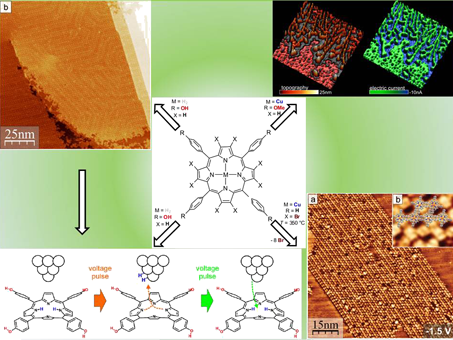
Beilstein J. Nanotechnol. 2017, 8, 1786–1800. doi:10.3762/bjnano.8.180
24 Aug 16:50
by J. Aulbach, S. C. Erwin, J. Kemmer, M. Bode, J. Schäfer, and R. Claessen
Author(s): J. Aulbach, S. C. Erwin, J. Kemmer, M. Bode, J. Schäfer, and R. Claessen
In one-dimensional electron systems, cooperative effects are expected to cause very specific electronic instabilities. Atomic nanowires, formed via self-organized growth on semiconductor surfaces, represent viable physical realizations for the study of such fascinating one-dimensional quantum states. The system in the focus of this work, Si(553)-Au, is created by Au adsorption on a stepped silicon substrate. It features two different chain types, interspersed with each other: Au chains on the terraces, and Si step edges that are subject to the formation of spin chains. By combining high-resolution scanning tunneling microscopy and local tunneling spectroscopy, the authors reveal the complex interplay between the two distinct wire architectures. The interaction is effectively “one-way” in that the Si step edges respond to the Au chains, but not vice versa. As a consequence, the symmetry of the system is lowered as the parity of the Si chains is broken. This fundamental effect creates two different configurations of chains with opposite directionality.
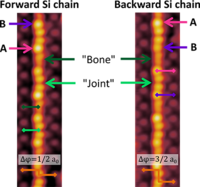
[Phys. Rev. B 96, 081406(R)] Published Tue Aug 22, 2017
24 Aug 16:46
by Conrad A. P. Goodwin
Molecular magnetic hysteresis at 60 kelvin in dysprosocenium
Nature 548, 7668 (2017). doi:10.1038/nature23447
Authors: Conrad A. P. Goodwin, Fabrizio Ortu, Daniel Reta, Nicholas F. Chilton & David P. Mills
Lanthanides have been investigated extensively for potential applications in quantum information processing and high-density data storage at the molecular and atomic scale. Experimental achievements include reading and manipulating single nuclear spins, exploiting atomic clock transitions for robust qubits and, most recently, magnetic data storage in single atoms. Single-molecule magnets exhibit magnetic hysteresis of molecular origin—a magnetic memory effect and a prerequisite of data storage—and so far lanthanide examples have exhibited this phenomenon at the highest temperatures. However, in the nearly 25 years since the discovery of single-molecule magnets, hysteresis temperatures have increased from 4 kelvin to only about 14 kelvin using a consistent magnetic field sweep rate of about 20 oersted per second, although higher temperatures have been achieved by using very fast sweep rates (for example, 30 kelvin with 200 oersted per second). Here we report a hexa-tert-butyldysprosocenium complex—[Dy(Cpttt)2][B(C6F5)4], with Cpttt = {C5H2tBu3-1,2,4} and tBu = C(CH3)3—which exhibits magnetic hysteresis at temperatures of up to 60 kelvin at a sweep rate of 22 oersted per second. We observe a clear change in the relaxation dynamics at this temperature, which persists in magnetically diluted samples, suggesting that the origin of the hysteresis is the localized metal–ligand vibrational modes that are unique to dysprosocenium. Ab initio calculations of spin dynamics demonstrate that magnetic relaxation at high temperatures is due to local molecular vibrations. These results indicate that, with judicious molecular design, magnetic data storage in single molecules at temperatures above liquid nitrogen should be possible.
22 Aug 21:09
by Ting Cao, Fangzhou Zhao, and Steven G. Louie
Author(s): Ting Cao, Fangzhou Zhao, and Steven G. Louie
We show that semiconducting graphene nanoribbons (GNRs) of different width, edge, and end termination (synthesizable from molecular precursors with atomic precision) belong to different electronic topological classes. The topological phase of GNRs is protected by spatial symmetries and dictated by t...
[Phys. Rev. Lett. 119, 076401] Published Wed Aug 16, 2017
21 Aug 21:12
by David Balle, Hilmar Adler, Peter Grüninger, Reimer Karstens, Ruslan Ovsyannikov, Erika Giangrisostomi, Thomas Chassé and Heiko Peisert

The Journal of Physical Chemistry C
DOI: 10.1021/acs.jpcc.7b04494

18 Aug 19:19
by Sun, X., Velez, S., Atxabal, A., Bedoya-Pinto, A., Parui, S., Zhu, X., Llopis, R., Casanova, F., Hueso, L. E.
We fabricated a C60 fullerene–based molecular spin-photovoltaic device that integrates a photovoltaic response with the spin transport across the molecular layer. The photovoltaic response can be modified under the application of a small magnetic field, with a magnetophotovoltage of up to 5% at room temperature. Device functionalities include a magnetic current inverter and the presence of diverging magnetocurrent at certain illumination levels that could be useful for sensing. Completely spin-polarized currents can be created by balancing the external partially spin-polarized injection with the photogenerated carriers.
18 Aug 19:15
by Christopher Bronner, Tomas Marangoni, Daniel J. Rizzo, Rebecca A. Durr, Jakob Holm Jørgensen, Felix R. Fischer and Michael F. Crommie

The Journal of Physical Chemistry C
DOI: 10.1021/acs.jpcc.7b02896

18 Aug 19:13
by Xiong Zhou, Fabian Bebensee, Mingmei Yang, Regine Bebensee, Fang Cheng, Yang He, Qian Shen, Jian Shang, Zhirong Liu, Flemming Besenbacher, Trolle R. Linderoth and Kai Wu

ACS Nano
DOI: 10.1021/acsnano.7b04900

16 Aug 14:39
by Ryoichi Hiraoka, Chun-Liang Lin, Kotaro Nakamura, Ryo Nagao, Maki Kawai, Ryuichi Arafune and Noriaki Takagi
Abstract
We present the transport characteristics of individual silicene nanoribbons (SiNRs) grown on Ag(110). By lifting up a single SiNR with a low-temperature scanning tunneling microscope tip, a nanojunction consisting of tip, SiNR and Ag is fabricated. In the differential conductance spectra of the nanojunctions fabricated by this methodology, a peak appears at the Fermi level which is not observed in the spectra measured either for the SiNRs before being lifted up or the clean Ag substrate. We discuss the origin of the peak as it relates to the SiNR.
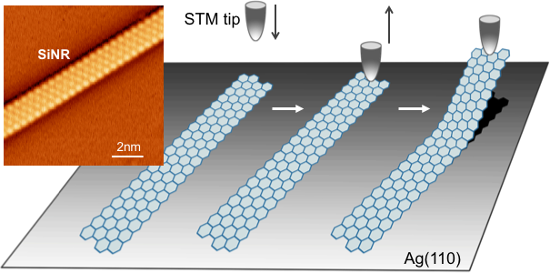
Beilstein J. Nanotechnol. 2017, 8, 1699–1704. doi:10.3762/bjnano.8.170
15 Aug 19:32
by Puneet Mishra, Zhi Kun Qi, Hirofumi Oka, Kohji Nakamura and Tadahiro Komeda

Nano Letters
DOI: 10.1021/acs.nanolett.7b03114

11 Aug 20:19
by Amandine Bellec, Yves Garreau, Jérôme Creuze, Alina Vlad, Frederic Picca, Michèle Sauvage-Simkin, and Alessandro Coati
Author(s): Amandine Bellec, Yves Garreau, Jérôme Creuze, Alina Vlad, Frederic Picca, Michèle Sauvage-Simkin, and Alessandro Coati
Using vicinal surfaces as a template for heteroepitaxial growth offers a unique possibility to control the orientation and the crystallinity of the grown layer. The study presented here focuses on the growth of Ag on a carefully chosen Ni(11 9 9) substrate. Ag adopts a Stranski-Krastanov growth mode...
[Phys. Rev. B 96, 085414] Published Wed Aug 09, 2017
11 Aug 20:11
by M. H. Seaberg, B. Holladay, J. C. T. Lee, M. Sikorski, A. H. Reid, S. A. Montoya, G. L. Dakovski, J. D. Koralek, G. Coslovich, S. Moeller, W. F. Schlotter, R. Streubel, S. D. Kevan, P. Fischer, E. E. Fullerton, J. L. Turner, F.-J. Decker, S. K. Sinha, S. Roy, and J. J. Turner
Author(s): M. H. Seaberg, B. Holladay, J. C. T. Lee, M. Sikorski, A. H. Reid, S. A. Montoya, G. L. Dakovski, J. D. Koralek, G. Coslovich, S. Moeller, W. F. Schlotter, R. Streubel, S. D. Kevan, P. Fischer, E. E. Fullerton, J. L. Turner, F.-J. Decker, S. K. Sinha, S. Roy, and J. J. Turner
A new x-ray spectroscopy technique can measure magnetic fluctuations in vortex-like structures called Skyrmions with nanosecond resolution.

[Phys. Rev. Lett. 119, 067403] Published Wed Aug 09, 2017
08 Aug 22:25
by Huimin Zhang
Origin of charge transfer and enhanced electron–phonon coupling in single unit-cell FeSe films on SrTiO3
Nature Communications, Published online: 9 August 2017; doi:10.1038/s41467-017-00281-5
The origin of interface charge transfer and electron-phonon coupling in single unit-cell FeSe on SrTiO3 remains elusive. Here, Zhang et al. report strengthened Ti-O bond and band bending at the FeSe/SrTiO3 interface, which leads to several important processes.

07 Aug 11:12
by Keiichi Katoh, Yu Aizawa, Takaumi Morita, Brian K Breedlove, Masahiro Yamashita
Abstract
When applying single-molecule magnets (SMMs) to spintronic devices, control of the quantum tunneling of the magnetization (QTM) as well as a spin-lattice interactions are important. Attempts have been made to use not only coordination geometry but also magnetic interactions between SMMs as an exchange bias. In this manuscript, dinuclear dysprosium(III) (DyIII) SMMs with the same octacoordination geometry undergo dual magnetic relaxation processes at low temperature. In the dinuclear DyIII phthalocyaninato (Pc2−) triple-decker type complex [(Pc)Dy(ooPc)Dy(Pc)] (1) (ooPc2−=2,3,9,10,16,17,23,24-octakis(octyloxy)phthalocyaninato) with a square-antiprismatic (SAP) geometry, the ground state is divided by the Zeeman effect, and level intersection occurs when a magnetic field is applied. Due to the ground state properties of 1, since the Zeeman diagram where the levels intersect in an Hdc of 2500 Oe, two kinds of QTM and direct processes occur. However, dinuclear DyIII-Pc systems with C4 geometry, which have a twist angle (ϕ) of less than 45° do not undergo dual magnetic relaxation processes. From magnetic field and temperature dependences, the dual magnetic relaxation processes were clarified.

Spin relaxation phenomena: For the dinuclear DyIII phthalocyaninato (Pc2−) triple-decker type complex [(Pc)Dy(Pc)Dy(Pc)] (1) with a square-antiprismatic (D4d) geometry, two kinds of magnetic relaxation processes are observed. However, dinuclear DyIII-Pc systems with C4 geometry, which have a twist angle (ϕ) of less than 45ο, do not undergo dual relaxation processes.
07 Aug 07:49
by Carmen Rubio-Verdú, Ane Sarasola, Deung-Jang Choi, Zsolt Majzik, René Ebeling, M. Reyes Calvo, Miguel M. Ugeda, Aran Garcia-Lekue, Daniel Sánchez-Portal, José Ignacio Pascual
Scattering of electrons by localized spins is the ultimate process enabling
electrical detection and control of the magnetic state of a spin-doped
material. At the molecular scale, this scattering is mediated by the electronic
orbitals hosting the spin. Here we report the selective excitation of a
molecular spin by electrons tunneling through different molecular orbitals.
Spatially-resolved tunneling spectra on iron porphyrins on Au(111) reveal that
the inelastic spin excitation extends beyond the iron site. The inelastic
features also change shape and symmetry along the molecule. Combining DFT
simulations with a phenomenological scattering model, we show that the
extension and lineshape variations of the inelastic signal are due to
excitation pathways assisted by different frontier orbitals, each of them with
a different degree of hybridization with the surface. By selecting the
intramolecular site for electron injection, the relative weight of iron and
pyrrole orbitals in the tunneling process is modified. In this way, the spin
excitation mechanism, reflected by its spectral lineshape, changes depending on
the degree of localization and energy alignment of the chosen molecular
orbital.
04 Aug 21:46
by B. J. Powell, J. Merino, A. L. Khosla, A. C. Jacko
Motivated by recent synthetic and theoretical progress we consider magnetism
in crystals of multi-nuclear organometallic complexes. We calculate the
Heisenberg symmetric exchange and the Dzyaloshinskii-Moriya antisymmetric
exchange. We show how, in the absence of spin-orbit coupling, the interplay of
electronic correlations and quantum interference leads to a quasi-one
dimensional effective spin model in a typical tri-nuclear complex,
Mo$_3$S$_7$(dmit)$_3$, despite its underlying three dimensional band structure.
We show that both intra- and inter-molecular spin-orbit coupling can cause an
effective Dzyaloshinskii-Moriya interaction. Furthermore, we show that, even
for an isolated pair of molecules the relative orientation of the molecules
controls the nature of the Dzyaloshinskii-Moriya coupling. We show that
interference effects also play a crucial role in determining the
Dzyaloshinskii-Moriya interaction. Thus, we argue, that multi-nuclear
organometallic complexes represent an ideal platform to investigate the effects
of Dzyaloshinskii-Moriya interactions on quantum magnets.
04 Aug 17:47
by Yi Pan, Kiyoshi Kanisawa, Naoto Ishikawa and Stefan Fölsch
A scanning tunnelling microscope (STM) operated at 5 K was used to study dysprosium biphthalocyanine
(DyPc 2 ) molecules adsorbed on the inert III–V semiconductor surface InAs(1 1 1)A. Orbital imaging
and scanning tunnelling spectroscopy measurements reveal that the molecular electronic structure
remains largely unperturbed, indicating a weak molecule-surface binding. The molecule adsorbs at the
In vacancy site of the (2 × 2)-reconstructed surface and is highly sensitive to current-induced
excitations leading to random rotational fluctuations. Owing to the weak surface binding, individual
molecules can be precisely repositioned and arranged by the STM tip via attractive tip-molecule
interaction. In this way, DyPc 2 dimers of well-defined internal structure can be assembled which
exist in two conformations of equivalent appearance. A binary switching between these two conformers
can be induced by injecting electrons into one of the two molecules. The conforma...
04 Aug 17:45
by Rémy Pawlak, Tobias Meier, Nicolas Renaud, Marcin Kisiel, Antoine Hinaut, Thilo Glatzel, Delphine Sordes, Corentin Durand, We-Hyo Soe, Alexis Baratoff, Christian Joachim, Catherine E. Housecroft, Edwin C. Constable and Ernst Meyer

ACS Nano
DOI: 10.1021/acsnano.7b03955

04 Aug 07:24
by Xiaoping Chen
Nature Nanotechnology 12, 797 (2017).
doi:10.1038/nnano.2017.110
Authors: Xiaoping Chen, Max Roemer, Li Yuan, Wei Du, Damien Thompson, Enrique del Barco & Christian A. Nijhuis
03 Aug 14:05
by Justus Krüger, Fátima García, Frank Eisenhut, Dmitry Skidin, José M Alonso, Enrique Guitián, Dolores Pérez, Gianaurelio Cuniberti, Francesca Moresco, Diego Peña
Abstract
Acenes are intriguing molecules with unique electronic properties. The difficulties in their preparation owing to low stability under ambient conditions are apparent because successful syntheses of long unsubstituted acenes are still scarce, in spite of the great attention they have attracted. Only unsubstituted acenes up to heptacene have been isolated in bulk, with nonacene being the largest acene detected to date. Herein we use on-surface assisted reduction of tetraepoxy decacene precursors on Au(111) as the key step to generate unprecedented decacene which is visualized and its electronic resonances studied by scanning tunneling microscopy (STM) and spectroscopy (STS).

Decathletes: Combined efforts of organic synthesis and on-surface chemistry have led to the preparation of decacene for the first time. An iterative sequence of aryne cycloadditions was used to synthesize stable tetraepoxy precursors which were reduced on Au(111) to obtain unprecedented decacene as visualized by scanning tunneling microscopy (STM).
02 Aug 22:16
by Rico Friedrich, Vasile Caciuc, Bernd Zimmermann, Gustav Bihlmayer, Nicolae Atodiresei, and Stefan Blügel
Author(s): Rico Friedrich, Vasile Caciuc, Bernd Zimmermann, Gustav Bihlmayer, Nicolae Atodiresei, and Stefan Blügel
In this ab initio study we demonstrate that molecular adsorption on a surface Rashba system can be used to modulate the surface electronic structure in different momentum space directions, i.e., to create anisotropic spin splittings in k space. This effect is rooted in the asymmetric adsorption of t...
[Phys. Rev. B 96, 085403] Published Wed Aug 02, 2017
02 Aug 22:12
by T. Hensgens
Quantum simulation of a Fermi–Hubbard model using a semiconductor quantum dot array
Nature 548, 7665 (2017). doi:10.1038/nature23022
Authors: T. Hensgens, T. Fujita, L. Janssen, Xiao Li, C. J. Van Diepen, C. Reichl, W. Wegscheider, S. Das Sarma & L. M. K. Vandersypen
Interacting fermions on a lattice can develop strong quantum correlations, which are the cause of the classical intractability of many exotic phases of matter. Current efforts are directed towards the control of artificial quantum systems that can be made to emulate the underlying Fermi–Hubbard models. Electrostatically confined conduction-band electrons define interacting quantum coherent spin and charge degrees of freedom that allow all-electrical initialization of low-entropy states and readily adhere to the Fermi–Hubbard Hamiltonian. Until now, however, the substantial electrostatic disorder of the solid state has meant that only a few attempts at emulating Fermi–Hubbard physics on solid-state platforms have been made. Here we show that for gate-defined quantum dots this disorder can be suppressed in a controlled manner. Using a semi-automated and scalable set of experimental tools, we homogeneously and independently set up the electron filling and nearest-neighbour tunnel coupling in a semiconductor quantum dot array so as to simulate a Fermi–Hubbard system. With this set-up, we realize a detailed characterization of the collective Coulomb blockade transition, which is the finite-size analogue of the interaction-driven Mott metal-to-insulator transition. As automation and device fabrication of semiconductor quantum dots continue to improve, the ideas presented here will enable the investigation of the physics of ever more complex many-body states using quantum dots.
02 Aug 13:27
by Junto Tsurumi
Nature Physics.
doi:10.1038/nphys4217
Authors: Junto Tsurumi, Hiroyuki Matsui, Takayoshi Kubo, Roger Häusermann, Chikahiko Mitsui, Toshihiro Okamoto, Shun Watanabe & Jun Takeya
01 Aug 19:57
by Ping Yu, Nemanja Kocić, Jascha Repp, Benjamin Siegert, and Andrea Donarini
Author(s): Ping Yu, Nemanja Kocić, Jascha Repp, Benjamin Siegert, and Andrea Donarini
The frontier orbital sequence of individual dicyanovinyl-substituted oligothiophene molecules is studied by means of scanning tunneling microscopy. On NaCl/Cu(111), the molecules are neutral, and the two lowest unoccupied molecular states are observed in the expected order of increasing energy. On N...
[Phys. Rev. Lett. 119, 056801] Published Tue Aug 01, 2017
01 Aug 15:16
by Marcus Liebmann, Jan Raphael Bindel, Mike Pezzotta, Stefan Becker, Florian Muckel, Tjorven Johnsen, Christian Saunus, Christian R. Ast, Markus Morgenstern
We present the design and calibration measurements of a scanning tunneling
microscope setup in a 3He ultrahigh-vacuum cryostat operating at 400 mK with a
hold time of 10 days. With 2.70 m in height and 4.70 m free space needed for
assembly, the cryostat fits in a one-story lab building. The microscope
features optical access, an xy table, in situ tip and sample exchange, and
enough contacts to facilitate atomic force microscopy in tuning fork operation
and simultaneous magneto-transport measurements on the sample. Hence, it
enables scanning tunneling spectroscopy on microstructured samples which are
tuned into preselected transport regimes. A superconducting magnet provides a
perpendicular field of up to 14 T. The vertical noise of the scanning tunneling
microscope amounts to 1 pmrms within a 700 Hz bandwidth. Tunneling spectroscopy
using one superconducting electrode revealed an energy resolution of 120 mueV.
Data on tip-sample Josephson contacts yield an even smaller feature size of 60
mueV, implying that the system operates close to the physical noise limit.
01 Aug 09:38
by Kamila Łępicka, Piotr Pieta, Aleksander Shkurenko, Paweł Borowicz, Marta Majewska, Marco Rosenkranz, Stanislav Avdoshenko, Alexey A. Popov and Wlodzimierz Kutnera

The Journal of Physical Chemistry C
DOI: 10.1021/acs.jpcc.7b04700

31 Jul 16:52
by V. Schendel, C. Barreteau, M. Brandbyge, B. Borca, I. Pentegov, U. Schlickum, M. Ternes, P. Wahl, and K. Kern
Author(s): V. Schendel, C. Barreteau, M. Brandbyge, B. Borca, I. Pentegov, U. Schlickum, M. Ternes, P. Wahl, and K. Kern
Among all transition metals, palladium (Pd) has the highest density of states at the Fermi energy at low temperatures yet does not fulfill the Stoner criterion for ferromagnetism. However, close proximity to magnetism renders it a nearly ferromagnetic metal, which hosts paramagnons, strongly damped ...
[Phys. Rev. B 96, 035155] Published Mon Jul 31, 2017