
Nano Letters
DOI: 10.1021/acs.nanolett.7b01963

Author(s): M. A. Broome, T. F. Watson, D. Keith, S. K. Gorman, M. G. House, J. G. Keizer, S. J. Hile, W. Baker, and M. Y. Simmons
In this work we perform direct single-shot readout of the singlet-triplet states in exchange coupled electrons confined to precision-placed donor atoms in silicon. Our method takes advantage of the large energy splitting given by the Pauli-spin blockaded (2,0) triplet states, from which we can achie...
[Phys. Rev. Lett. 119, 046802] Published Tue Jul 25, 2017

Quantum spin Hall materials hold the promise of revolutionary devices with dissipationless spin currents but have required cryogenic temperatures owing to small energy gaps. Here we show theoretically that a room-temperature regime with a large energy gap may be achievable within a paradigm that exploits the atomic spin-orbit coupling. The concept is based on a substrate-supported monolayer of a high–atomic number element and is experimentally realized as a bismuth honeycomb lattice on top of the insulating silicon carbide substrate SiC(0001). Using scanning tunneling spectroscopy, we detect a gap of ~0.8 electron volt and conductive edge states consistent with theory. Our combined theoretical and experimental results demonstrate a concept for a quantum spin Hall wide-gap scenario, where the chemical potential resides in the global system gap, ensuring robust edge conductance.
Majorana fermion is a hypothetical particle that is its own antiparticle. We report transport measurements that suggest the existence of one-dimensional chiral Majorana fermion modes in the hybrid system of a quantum anomalous Hall insulator thin film coupled with a superconductor. As the external magnetic field is swept, half-integer quantized conductance plateaus are observed at the locations of magnetization reversals, giving a distinct signature of the Majorana fermion modes. This transport signature is reproducible over many magnetic field sweeps and appears at different temperatures. This finding may open up an avenue to control Majorana fermions for implementing robust topological quantum computing.
The past decade's apparent success in predicting and experimentally discovering distinct classes of topological insulators (TIs) and semimetals masks a fundamental shortcoming: out of 200,000 stoichiometric compounds extant in material databases, only several hundred of them are topologically nontrivial. Are TIs that esoteric, or does this reflect a fundamental problem with the current piecemeal approach to finding them? To address this, we propose a new and complete electronic band theory that highlights the link between topology and local chemical bonding, and combines this with the conventional band theory of electrons. Topological Quantum Chemistry is a description of the universal global properties of all possible band structures and materials, comprised of a graph theoretical description of momentum space and a dual group theoretical description in real space. We classify the possible band structures for all 230 crystal symmetry groups that arise from local atomic orbitals, and show which are topologically nontrivial. We show how our topological band theory sheds new light on known TIs, and demonstrate the power of our method to predict a plethora of new TIs.
Imaging of super-fast dynamics and flow instabilities of superconducting vortices
Nature Communications, Published online: 20 July 2017; doi:10.1038/s41467-017-00089-3
Ultrafast vortex dynamics driven by strong currents define eletromagnetic properties of superconductors, but it remains unexplored. Here, Embon et al. use a unique scanning microscopy technique to image steady-state penetration of super-fast vortices into a superconducting Pb film at rates of tens of GHz and velocities up to tens of km/s.
Topological quantum chemistry
Nature 547, 7663 (2017). doi:10.1038/nature23268
Authors: Barry Bradlyn, L. Elcoro, Jennifer Cano, M. G. Vergniory, Zhijun Wang, C. Felser, M. I. Aroyo & B. Andrei Bernevig
Since the discovery of topological insulators and semimetals, there has been much research into predicting and experimentally discovering distinct classes of these materials, in which the topology of electronic states leads to robust surface states and electromagnetic responses. This apparent success, however, masks a fundamental
Author(s): Yun Wu, Yongbin Lee, Tai Kong, Daixiang Mou, Rui Jiang, Lunan Huang, S. L. Bud'ko, P. C. Canfield, and Adam Kaminski
We use high-resolution angle-resolved photoemission spectroscopy (ARPES) and electronic structure calculations to study the electronic properties of rare-earth monoantimonides RSb (R = Y, Ce, Gd, Dy, Ho, Tm, Lu). The experimentally measured Fermi surface (FS) of RSb consists of at least two concentr...
[Phys. Rev. B 96, 035134] Published Wed Jul 19, 2017
Author(s): Masashi Nantoh, Kengo Takashima, Takahiro Yamamoto, and Koji Ishibashi
A two-dimensional electron gas interacting with an external periodic potential attracts attention as a designable artificial material to explore topological phases. Here, to introduce a periodic potential into a Shockley state, superstructures of CO molecules have been fabricated on a Cu(111) surfac...
[Phys. Rev. B 96, 035424] Published Wed Jul 19, 2017
Nature Materials. doi:10.1038/nmat4934
Authors: Anjan Soumyanarayanan, M. Raju, A. L. Gonzalez Oyarce, Anthony K. C. Tan, Mi-Young Im, A. P. Petrović, Pin Ho, K. H. Khoo, M. Tran, C. K. Gan, F. Ernult & C. Panagopoulos

Author(s): Aurore Finco, Levente Rózsa, Pin-Jui Hsu, André Kubetzka, Elena Vedmedenko, Kirsten von Bergmann, and Roland Wiesendanger
Spin-polarized scanning tunneling microscopy investigations reveal a significant increase of the magnetic period of spin spirals in three-atomic-layer-thick Fe films on Ir(111), from about 4 nm at 8 K to about 65 nm at room temperature. We attribute this considerable influence of temperature on the ...
[Phys. Rev. Lett. 119, 037202] Published Tue Jul 18, 2017
Transmission of low-energetic electrons through two-dimensional materials leads to unique scattering resonances. These resonances contribute to photoemission from occupied bands where they appear as strongly dispersive features of suppressed photoelectron intensity. Using angle-resolved photoemission we have systematically studied scattering resonances in epitaxial graphene grown on the chemically differing substrates Ir(111), Bi/Ir, Ni(111) as well as in graphene/Ir(111) nanopatterned with a superlattice of uniform Ir quantum dots. While the strength of the chemical interaction with the substrate has almost no effect on the dispersion of the scattering resonances, their energy can be controlled by the magnitude of charge transfer from/to graphene. At the same time, a superlattice of small quantum dots deposited on graphene eliminates the resonances completely. We ascribe this effect to a nanodot-induced buckling of graphene and its local rehybridization from sp$^{2}$ to sp$^{3}$ towards a three-dimensional structure. Our results suggest nanopatterning as a prospective tool for tuning optoelectronic properties of two-dimensional materials with graphene-like structure.
Single magnetic atoms or molecules with large single-ion magnetic anisotropy are highly desired for future applications in high-density data storage and quantum computation. Here we have synthesized an Fe-porphyrin complex on Au(111) substrate in a controlled way, and revealed large magnetic anisotropy energy of more than 15 meV by low-temperature scanning tunneling microscopy and spectroscopy. Two magnetic states with opposite spin directions are discriminated by inelastic electron tunneling spectroscopy in varied magnetic field, and are found to have long spin lifetimes. First-principle calculations reveal that the weak ligand filed in this complex keeps the Fe atom in a high-spin state and preserves its large orbital angular momentum, which gives rise to an easy-axis perpendicular to the molecular plane and large magnetic anisotropy energy by spin-orbit coupling.
Nature Physics. doi:10.1038/nphys4186
Authors: Wei Li, Yan Zhang, Peng Deng, Zhilin Xu, S.-K. Mo, Ming Yi, Hao Ding, M. Hashimoto, R. G. Moore, D.-H. Lu, Xi Chen, Z.-X. Shen & Qi-Kun Xue
A single monolayer of iron selenide grown on strontium titanate shows an impressive enhancement of superconductivity compared with the bulk, as well as a novel Fermi surface topology, extreme two-dimensionality, and the possibility of phonon-enhanced electron pairing. For films thicker than one unit cell, however, the electronic structure is markedly different, with a drastically suppressed superconductivity and strong nematicity appearing. The physics driving this extraordinary dichotomy of superconducting behaviour is far from clear. Here, we use low-temperature scanning tunnelling microscopy to study multilayers of iron selenide grown by molecular beam epitaxy, and find a stripe-type charge ordering instability that develops beneath the nematic state. The charge ordering is visible and pinned in the vicinity of impurities. And as it emerges in the strong limit of nematicity, it suggests that a magnetic fluctuation with a rather small wavevector may be competing with the ordinary collinear antiferromagnetic ordering in multilayer films. The existence of stripes in iron-based superconductors, which resemble the stripe order in cuprates, not only suggests that electronic anisotropy and correlation are playing an important role, but also provides a platform for probing the complex interactions between nematicity, charge ordering, magnetism and superconductivity in high-temperature superconductors.


Author(s): Edgar Fernandes, Fabio Donati, François Patthey, Srdjan Stavrić, Željko Šljivančanin, and Harald Brune
We use Ca doping during growth of one- and two-monolayer-thick MgO films on Ag(100) to identify the adsorption sites of individual adatoms with scanning tunneling microscopy. For this we combine atomic resolution images of the bare MgO layer with images of the adsorbates and the substitutional Ca at...
[Phys. Rev. B 96, 045419] Published Mon Jul 17, 2017
The orbital magnetic moment is usually associated with the relativistic spin-orbit interaction, but recently it has been shown that noncollinear magnetic structures can also be its driving force. This is important not only for magnetic skyrmions, but also for other noncollinear structures, either bulk-like or at the nanoscale, with consequences regarding their experimental detection. In this work we present a minimal model that contains the effects of both the relativistic spin-orbit interaction and of magnetic noncollinearity on the orbital magnetism. A hierarchy of models is discussed in a step-by-step fashion, highlighting the role of time-reversal symmetry breaking for translational and spin and orbital angular motions. Couplings of spin-orbit and orbit-orbit type are identified as arising from the magnetic noncollinearity. We recover the atomic contribution to the orbital magnetic moment, and a nonlocal one due to the presence of circulating bound currents, exploring different balances between the kinetic energy, the spin exchange interaction, and the relativistic spin-orbit interaction. The connection to the scalar spin chirality is examined. The orbital magnetism driven by magnetic noncollinearity is mostly unexplored, and the presented model contributes to laying its groundwork.

Scanning tunnelling microscopy and low energy electron diffraction show a dimerization-like reconstruction in the one-dimensional atomic chains on Bi(114) at low temperatures. While one-dimensional systems are generally unstable against such a distortion, its observation is not expected for this particular surface, since there are several factors that should prevent it: One is the particular spin texture of the Fermi surface, which resembles a one-dimensional topological state, and spin protection should hence prevent the formation of the reconstruction. The second is the very short nesting vector $2 k_F$, which is inconsistent with the observed lattice distortion. A nesting-driven mechanism of the reconstruction is indeed excluded by the absence of any changes in the electronic structure near the Fermi surface, as observed by angle-resolved photoemission spectroscopy. However, distinct changes in the electronic structure at higher binding energies are found to accompany the structural phase transition. This, as well as the observed short correlation length of the pairing distortion, suggest that the transition is of the strong coupling type and driven by phonon entropy rather than electronic entropy.
Author(s): Julen Ibañez-Azpiroz, Manuel dos Santos Dias, Benedikt Schweflinghaus, Stefan Blügel, and Samir Lounis
Theory and simulations show that strongly renormalized spin-flip interactions of nonmagnetic atoms can be measured by inelastic scanning tunneling spectroscopy.

[Phys. Rev. Lett. 119, 017203] Published Fri Jul 07, 2017
Three-dimensional integration of nanotechnologies for computing and data storage on a single chip
Nature 547, 7661 (2017). doi:10.1038/nature22994
Authors: Max M. Shulaker, Gage Hills, Rebecca S. Park, Roger T. Howe, Krishna Saraswat, H.-S. Philip Wong & Subhasish Mitra
The computing demands of future data-intensive applications will greatly exceed the capabilities of current electronics, and are unlikely to be met by isolated improvements in transistors, data storage technologies or integrated circuit architectures alone. Instead, transformative nanosystems, which use new nanotechnologies to simultaneously realize improved devices and new integrated circuit architectures, are required. Here we present a prototype of such a transformative nanosystem. It consists of more than one million resistive random-access memory cells and more than two million carbon-nanotube field-effect transistors—promising new nanotechnologies for use in energy-efficient digital logic circuits and for dense data storage—fabricated on vertically stacked layers in a single chip. Unlike conventional integrated circuit architectures, the layered fabrication realizes a three-dimensional integrated circuit architecture with fine-grained and dense vertical connectivity between layers of computing, data storage, and input and output (in this instance, sensing). As a result, our nanosystem can capture massive amounts of data every second, store it directly on-chip, perform in situ processing of the captured data, and produce ‘highly processed’ information. As a working prototype, our nanosystem senses and classifies ambient gases. Furthermore, because the layers are fabricated on top of silicon logic circuitry, our nanosystem is compatible with existing infrastructure for silicon-based technologies. Such complex nano-electronic systems will be essential for future high-performance and highly energy-efficient electronic systems.
The superconductor iron selenide (FeSe) is of intense interest owing to its unusual nonmagnetic nematic state and potential for high-temperature superconductivity. But its Cooper pairing mechanism has not been determined. We used Bogoliubov quasiparticle interference imaging to determine the Fermi surface geometry of the electronic bands surrounding the = (0, 0) and X = (/aFe, 0) points of FeSe and to measure the corresponding superconducting energy gaps. We show that both gaps are extremely anisotropic but nodeless and that they exhibit gap maxima oriented orthogonally in momentum space. Moreover, by implementing a novel technique, we demonstrate that these gaps have opposite sign with respect to each other. This complex gap configuration reveals the existence of orbital-selective Cooper pairing that, in FeSe, is based preferentially on electrons from the dyz orbitals of the iron atoms.
The interactions that lead to the emergence of superconductivity in iron-based materials remain a subject of debate. It has been suggested that electron-electron correlations enhance electron-phonon coupling in iron selenide (FeSe) and related pnictides, but direct experimental verification has been lacking. Here we show that the electron-phonon coupling strength in FeSe can be quantified by combining two time-domain experiments into a "coherent lock-in" measurement in the terahertz regime. X-ray diffraction tracks the light-induced femtosecond coherent lattice motion at a single phonon frequency, and photoemission monitors the subsequent coherent changes in the electronic band structure. Comparison with theory reveals a strong enhancement of the coupling strength in FeSe owing to correlation effects. Given that the electron-phonon coupling affects superconductivity exponentially, this enhancement highlights the importance of the cooperative interplay between electron-electron and electron-phonon interactions.
Abstract
With the increasing use of thin dielectric decoupling layers to study the electronic properties of organic molecules on metal surfaces, comparative studies are needed in order to generalize findings and formulate practical rules. In this paper we study the adsorption and electronic properties of pentacene deposited onto h-BN/Rh(111) and compare them with those of pentacene deposited onto KCl on various metal surfaces. When deposited onto KCl, the HOMO and LUMO energies of the pentacene molecules scale with the work functions of the combined KCl/metal surface. The magnitude of the variation between the respective KCl/metal systems indicates the degree of interaction of the frontier orbitals with the underlying metal. The results confirm that the so-called IDIS model developed by Willenbockel et al. applies not only to molecular layers on bare metal surfaces, but also to individual molecules on thin electronically decoupling layers. Depositing pentacene onto h-BN/Rh(111) results in significantly different adsorption characteristics, due to the topographic corrugation of the surface as well as the lateral electric fields it presents. These properties are reflected in the divergence from the aforementioned trend for the orbital energies of pentacene deposited onto h-BN/Rh(111), as well as in the different adsorption geometry. Thus, the highly desirable capacity of h-BN to trap molecules comes at the price of enhanced metal–molecule interaction, which decreases the HOMO–LUMO gap of the molecules. In spite of the enhanced interaction, the molecular orbitals are evident in scanning tunnelling spectroscopy (STS) and their shapes can be resolved by spectroscopic mapping.
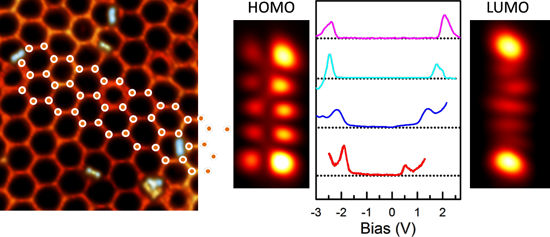
Beilstein J. Nanotechnol. 2017, 8, 1388–1395. doi:10.3762/bjnano.8.140
Nature Physics. doi:10.1038/nphys4202
Author: Jeff Byers
Physicists are accustomed to dealing with large datasets, yet they are fortunate in that the quality of their experimental data is very good. The onset of big data has led to an explosion of datasets with a far more complex structure — a development that requires new tools and a different mindset.
