Shared posts

22 Nov 21:24

Trump Formally Picks Two Net Neutrality Opponents To Head FCC Transition

by Karl Bode
Trump this week formally selected two staunch opponents of net neutrality to oversee the incoming President's FCC transition team. Economist Jeff Eisenach and former Sprint Corp lobbyist Mark Jamison both have deep-rooted ties to the broadband sector, and both played major roles in helping the industry fight passage of the U.S.'s net neutrality rules last year. We had already noted that incumbent ISPs like AT&T, Verizon and Comcast have been getting excited by the possibility of a hamstrung FCC and the roll back of numerous consumer-friendly policies made under the tenure of outgoing FCC boss Tom Wheeler.

Eisenach, formerly a consultant for Verizon and a think tanker over at the American Enterprise Institute, testified as an "objective" expert in a 2014 Senate Judiciary Committee hearing on net neutrality. There, Eisenach boldly declared that "net neutrality would not improve consumer welfare or protect the public interest." Similarly, in an AEI blog post last year, Eisenach again proclaimed that net neutrality doesn't help consumers, isn't necessary, and is little more than just "crony capitalism":
"Despite what you may have heard, net neutrality is not about protecting consumers from rapacious Internet Service Providers (ISPs). It would not make broadband more available in rural America, or lower prices for small businesses. And it has nothing to do with protecting free speech or dissenting voices. Net neutrality is crony capitalism pure and simple – an effort by one group of private interests to enrich itself at the expense of another group by using the power of the state."
For somebody who has supposedly made an entire living discussing the telecom sector, that's a staggering misrepresentation of the concept of net neutrality. As our readers know, the telecom market suffers painfully from limited competition, resulting in some of the highest broadband prices in the developed world (OECD data) and some of the worst customer service in any sector. Eisenach is of the vein of telecom-friendly allies that willfully ignore this fact in order to justify further sector deregulation.

And while deregulation can be a useful tool in healthy, functional markets that truly suffer from government over-reach, in the telecom sector (where incumbent ISP think tankers like Eisenach have polluted intelligent discourse) deregulation has an entirely different meaning. For most of these folks, deregulation quite literally means letting giant duopolists quite literally write telecom law. In telecom, we've discussed how this form of deregulation (time and time and time again) only makes the already broken telecom market worse for consumers and innovation.

Net neutrality, however imperfect the rules wind up being, is at least an attempt to create some layer of protection for consumers against incumbent ISPs looking to abuse their monopoly over the last mile. Both Eisenach and Jamison have made careers out of not only ignoring the lack of telecom sector competition, but the fact that net neutrality has broad, bipartisan support among consumers. It's worth noting that Eisenach isn't just tasked with spearheading Trump's telecom transition, he's in the running for the top FCC spot himself.

And it's not just net neutrality Eisenach would dismantle. Under Eisenach's outdated policies, gone too would be the FCC's recently passed privacy rules, which ensure consumers are clearly informed of what data is collected and who it's sold to, while ensuring ISPs provide users with working opt-out tools. In fact, the very FCC itself is likely at risk, as the GOP has made it abundantly clear that it plans to completely rewrite the Communications Act with an eye on one thing: ensuring the FCC lacks the funding and authority to effectively protect consumers from dominant, incumbent broadband providers.

Appointing two telecom-sector cronies to guide the FCC runs in stark contrast to Trump's claims that he'd "drain the swamp." Defanging the FCC so companies like Comcast grow even more powerful would be a crushing blow to consumer welfare. And the erosion of popular net neutrality rules would be a kick to the gut of the supposed "populist" rhetoric at the very heart of the Trump campaign.

Permalink | Comments | Email This Story
18 Nov 17:21

Cold War Documents Show The FBI Thinks It Can Be The CIA -- And The US Military -- If Just Given The Chance

by Tim Cushing
Brindle

paramilitary... danger

The FBI has, for years now apparently, always wished to be far more than it actually is. In the wake of the 9/11 attacks, the FBI shifted its focus from law enforcement to "national security." It continues to try to expand this role and believes it should be taking the lead in harvesting foreign informants and protecting the nation against overseas threats -- rather than an agency created solely for that purpose (the Dept. of Homeland Security) or one tasked almost solely with foreign intelligence gathering (the CIA).

This isn't a recent development. The FBI has long had CIA-envy, according to documents obtained by Mike Best and published at MuckRock. Long before Sarah Palin was keeping an eye on pesky Russians from the governor's mansion, the FBI wished to do the same. The FBI -- being neither a military force nor a foreign intelligence agency -- thought it should be able to run a covert ops station deep in the coldest part of the Cold War. Added bonus? Screwing the CIA out of prime surveillance real estate.

FBI files released earlier this year show the Bureau’s plan to build a secret network of “stay behind” agents in Alaska that would become active in the event of a Communist invasion. The file also reveals that Bureau personnel thought the biggest advantage to this plan was that it would screw over the CIA, ensuring the Bureau’s supremacy in their ongoing feud with other intelligence agencies.

As Best points outs, the FBI was its own worst enemy in this push for surveillance dominance. It had no idea how to successfully carry out this plan, but was imbued with enough hubris to ask for permission to do so anyway. It seemed to have little understanding of two key elements: military planning and foreign intelligence gathering. The FBI's folksy racism showed through, aligning it with movie producers of that era -- the kind who believed Charlton Heston could pass as Hispanic and John Wayne to be more than a capable Genghis Khan.

Covert surveillance calls for subtlety but if the natives couldn't be trusted, I guess it was up to the FBI's brightest and whitest to pass as Native Americans and Eskimos.

Agents selected should be residents of Alaska with established means of likelihood and logical reasons for being placed where they intend to operate and consideration should be given to businessmen, farmers, trappers, fishermen and "bush pilots." Selection of agents from the native groups, Eskimos, Indians, Aleuts should be avoided because of their basic unreliability.

Even this limited selection soon proved to be too expansive. The FBI feared informants willing to work for them might also be on the short list for deportation if tensions between the USSR and the US continued to escalate.

The files show the FBI was far less concerned with being right than it was with being first. It wanted to stick its flag in the Bering Strait before the CIA decided to do the same and start hoovering up all the intel in the area. In fact, the first advantage listed for the FBI's incursion is that it would be able to lock the CIA out of the market.

The principal advantage to the FBI in assuming joint responsibility in the two programs is that it will preclude any other intelligence agency, such as the CIA, getting into the intelligence field in Alaska at this time.

Given the agency's Hoover-induced rivalry with actual intelligence agencies, it's hardly a surprise information is rarely shared between agencies, even when the safety of the nation hangs in the balance. Budgets must be defended and credit acquired. That's apparently far more important than working together for the greater good. This sort of behavior isn't going to stop any time soon, not with the FBI helmed by a director willing to push his, and his agency's, agenda (not always the same thing…) with particular fervor.


Permalink | Comments | Email This Story
16 Nov 23:52

Appeals Court To Cops: If You 'Don't Have Time' For 'Constitutional Bullshit,' You Don't Get Immunity

by Tim Cushing

A disabled vet with PTSD accidentally called a suicide prevention hotline when intending to dial the Veterans Crisis Line. Within hours, he was dealing with DC Metro's finest, dispatched to handle an attempted suicide. This brief quote from the DC Circuit Court of Appeals opinion [PDF] -- part of veteran Matthew Corrigan's first conversation with responding officers -- sets the tone for the next several hours of Constitutional violations.

The officer who had asked for his key told him: “I don’t have time to play this constitutional bullshit. We’re going to break down your door. You’re going to have to pay for a new door.” Corrigan Dep. 94:15–18. Corrigan responded, “It looks like I’m paying for a new door, then. I’m not giving you consent to go into my place.” Id. 94:19–21.

This is as much respect as the responding officers had for Corrigan's Constitutional rights. The rest of the opinion shows how they handled the supposed suicide case with the same level of care.

The opening of the opinion recounts just how dangerous it is to talk to nearly anyone linked to the government about your personal problems.

Matthew Corrigan is an Army Reservist and an Iraq war veteran who, in February 2010, was also an employee of the U.S. Department of Labor’s Bureau of Labor Statistics. On the night of February 2, 2010, suffering from sleep deprivation, he inadvertently phoned the National Suicide Hotline when dialing a number he thought to be a Veterans Crisis Line. When he told the Hotline volunteer that he was a veteran diagnosed with PTSD, she asked whether he had been drinking or using drugs and whether he owned guns. Corrigan assured her that he was only using his prescribed medication and was not under the influence of any illicit drugs or alcohol; he admitted that he owned guns. The volunteer told him to “put [the guns] down,” and Corrigan responded, “That’s crazy, I don’t have them out.” Corrigan Dep. 56:2–5.

Despite Corrigan’s assurances that his guns were safely stored, the volunteer repeatedly asked him to tell her “the guns are down.” Id. 56:2–14. When asked if he intended to hurt himself or if he intended to “harm others,” he responded “no” to both questions. Id. 69:6–18. Frustrated, Corrigan eventually hung up and turned off his phone, took his prescribed medication, and went to sleep. Id. 56:10–14; 70:6–7. The Hotline volunteer proceeded to notify the MPD.

The MPD picked up the case, drawing in new hunches and "facts," picked up from the world's most direct game of Telephone.

At approximately 11:13 p.m., according to the February 9, 2010, Barricade Report from Lieutenant Glover to the MPD Chief of Police, officers from the MPD Fifth District were dispatched to Corrigan’s home for “Attempted Suicide.” Barricade Rpt. 1. Certain undisclosed “information” led them “to believe the subject was possibly armed with a shotgun.”

"Undisclosed" may as well mean "imaginary." The only thing relayed by the Hotline was that Corrigan owned guns. And owning guns is not the same as being armed with them, as Corrigan tried to make clear to the hotline operator. This wasn't the only thing the MPD imagined into existence to justify its Constitutional violations and destruction of Corrigan's home.

Upon arrival, the officers thought they detected a “strong odor” of natural gas and contacted the gas company, which turned off the gas to the row house.

Police officers have the best noses. The greatest. Perhaps the MPD should have spoken to someone who knew Corrigan and the place he lived FIRST.

[H]is landlady, upon being advised that the reason for the police presence was Corrigan’s attempted suicide, had insisted that was “outrageous” and repeatedly told the MPD officers that there was “a big misunderstanding” because she had known Corrigan for two years and had “never felt more comfortable with a neighbor in [her] life.” She had explained to the officers that Corrigan had guns because he was in the military and that his home had electric, not gas, appliances.

So, the police -- faced with a possible suicide intervention -- did what police do best: turned a neighborhood into a war zone and an "intervention" into a standoff where the police were the only willing participants.

The officers contacted Lieutenant Glover at home and he, in turn, gave orders to declare a “barricade situation...”

[...]

At 2:00 a.m., the ERT assumed tactical control of the situation. At 2:10 a.m., the MPD began to secure the perimeter around Corrigan’s home, including evacuating his neighbors.

Inside of this "barricade" was a sleeping war veteran. After being awakened by cops kicking at his front and back doors, Corrigan decided to retreat from the impending confrontation by moving to his bathroom and attempting to return to sleep. When it became apparent sleep wouldn't be an option, he checked his voicemail -- helpfully filled with demands of responding officers -- and placed a call to one of the MPD's "negotiators."

He told the officer he was coming out of the house, that he was unarmed, and that he would be carrying his cellphone in his left hand so it wouldn't be mistaken for a gun by trigger-happy suicide prevention "negotiators." He exited his house, locked the door behind him (both to keep his dog in and the MPD out), and laid down on his back. Police zip tied his hand and told them they only wanted to talk to him. He had committed no crime. Corrigan voluntarily agreed to check in at the Veteran's Hospital for PTSD treatment.

But he refused to give the "negotiators" permission to search his home. That's what triggered the "fuck you and your Constitution" outburst from the MPD's specially-trained suicide prevention unit. The MPD remained convinced Corrigan's house was loaded with IEDs, weapons, and whatever else they could dream up to justify their unconstitutional invasion.

After Corrigan was in MPD custody, Lieutenant Glover ordered the ERT, led by Sergeant Pope, to break in Corrigan’s home to search for “any human threats that remained or victims.”

Screw the Constitution. There might be any number of lives to be saved. How do we know this? Because the DC Metro Police firmly believes this is always the case in these situations, despite any information gathered that points to the contrary.

As a matter of course, Glover explained, if an ERT unit is called to a scene it goes inside 99.9% of the time, see id. 18:12-14, because “[s]tandard protocol” assumes “if there’s one [person inside] there’s two, if there’s two there’s three, if there’s three there’s four, and exponentially on up,” id. 13:18-21.

In the MPD's eyes, every individual is an army. With this being the MPD's "standard protocol," one wonders how it deals with the constant disappointment.

Upon breaking in Corrigan’s home, the ERT encountered only Corrigan’s dog; no one was found inside and no dangerous or illegal items were in plain view.

Frustrated by the lack of plain view dangerousness, the MPD decided to take it out on Corrigan's uncooperative residence. It did this five hours later and, again, without a warrant.

During the second MPD search, EOD officers cut open every zipped bag, dumped onto the floor the contents of every box and drawer, broke into locked boxes under the bed and in the closet, emptied shelves into piles in each room, and broke into locked boxes containing Corrigan’s three firearms.

But wait, there's more:

Upon returning home, Corrigan found his home in complete disarray: the police had left the contents of his bureau drawers and shelves scattered on the floor, his electric stove had been left on, and the front door of his home was left unlocked.

Recovered in the two unconstitutional searches were some weapons, smoke grenades, and fireworks. Corrigan's mistaken call to the wrong hotline resulted in the ten weapons and ammunition charges. That evidence has been suppressed. And because the Appeals Court doesn't find any of the MPD's actions remotely justifiable, the officers performing the searches will have to face Corrigan's lawsuit.

Even assuming, without deciding, that the initial “sweep” of Corrigan’s home by the MPD Emergency Response Team (“ERT”) was justified under the exigent circumstances and emergency aid exceptions to the warrant requirement, the second top-to-bottom search by the Explosive Ordnance Disposal Unit (“EOD”) after the MPD had been on the scene for several hours was not. The MPD had already secured the area and determined that no one else was inside Corrigan’s home and that there were no dangerous or illegal items in plain sight. Corrigan had previously surrendered peacefully to MPD custody. The information the MPD had about Corrigan — a U.S. Army veteran and reservist with no known criminal record — failed to provide an objectively reasonable basis for believing there was an exigent need to break in Corrigan’s home a second time to search for “hazardous materials,” whose presence was based on speculative hunches about vaguely described “military items” in a green duffel bag.

And assuming, without deciding, that the community caretaking exception to the warrant requirement applies to a home, the scope of the second search far exceeded what that exception would allow. In the end, what the MPD would have the court hold is that Corrigan’s Army training with improvised explosive devices (“IEDs”), and the post traumatic stress disorder (“PTSD”) he suffers as a result of his military service — characteristics shared by countless veterans who have risked their lives for this country — could justify an extensive and destructive warrantless search of every drawer and container in his home. Neither the law nor the factual record can reasonably be read to support that sweeping conclusion.

Better yet, the "screw your Constitution" officers have had their immunity stripped.

Because it was (and is) clearly established that law enforcement officers must have an objectively reasonable basis for believing an exigency justifies a warrantless search of a home, and because no reasonable officer could have concluded such a basis existed for the second more intrusive search, the officers were not entitled to qualified immunity across the board.

"Objectively reasonable" is not a high bar. But the MPD never had any intent of reaching it. The officer's statement that there was "no time" for the Constitution made that very clear. The failure to find anything in plain view during the first sweep was treated as an excuse to turn a cooperative man's (cooperative except for consent to search) upside down until officers could find something to excuse their steamrolling of the Fourth Amendment. They figured what they uncovered would save them after the fact. That's the ends justifying the means and that's precisely what the Fourth Amendment is there to protect against.


Permalink | Comments | Email This Story
14 Nov 20:43

VP Elect Mike Pence Goes To Court To Keep His Emails Secret

by Mike Masnick
After making it a key plank of the Trump/Pence campaign that the public needed to see what was in Hillary Clinton's emails, it does seem somewhat ironic that VP Elect Mike Pence is now headed to court to protect what's in some of his emails as governor of Indiana.
The administration is fighting to conceal the contents of an email sent to Gov. Mike Pence by a political ally. That email is being sought by a prominent Democratic labor lawyer who says he wants to expose waste in the Republican administration.
The circumstances are different, but the general principle is the same -- and there's a really important issue at stake when it comes to FOIA and public records issues. The background is fairly convoluted, but here's a quick summary. After President Obama announced a plan to defer enforcement of certain immigration laws for certain individuals, a few states were upset about it, and Texas and Indiana (where Pence is governor) sued the President. Pence hired an outside law firm to handle the case, and a local lawyer thought this was a waste of taxpayer funds. The lawyer filed public records requests to get access to emails about the decision to hire the law firm and to find out the costs to taxpayers.

Pence's office released some emails, but they were apparently redacted in places -- and in one case an email referred to an attached white paper that was not included. The lawyer who filed the request, William Groth, went to court to demand that the Pence administration reveal the full email with the attached white paper. The Pence administration has argued that it's not subject to public records requests as "attorney-client" work material -- but also that the courts are not allowed to question what the government chooses to release or redact under public records laws. A lower court agreed -- following an Indiana Supreme Court ruling saying that the courts cannot "meddle" in public records decisions by the legislative or executive branch due to "separation of powers." That's a bizarre reading of the law that seems to actually turn the concept of separation of powers on its head, as it kind of destroys a key part of that separation: the checks and balances of the three branches of government.

Either way, Groth has appealed, and that means that Pence is effectively going to court to argue that his emails as governor need not be revealed. Now, you can (and I'm sure some folks will...) argue that this is entirely different than the Clinton situation. But... it really isn't. The key issue in talking about the "33,000" emails that Clinton supposedly deleted was the fact that her legal team basically made the decision by themselves what documents were related to her government work and should be turned over, and which were personal, and thus deleted. If Pence is arguing that his office alone should get to determine which emails can be revealed and which cannot, it seems fairly hypocritical of him to also have argued that Clinton and her team shouldn't have been able to make the same decision.

But, of course, this is politics and the only real form of consistency is you argue for what benefits you and your team, no matter how contradictory it may be compared to when you're in similar situations.

But getting beyond the hypocritical symmetry here, this is an incredibly important issue. For many, many years, we've reported on how various governments -- federal, state, local -- seem to go out of their way to avoid truly complying with various FOIA and public records regulations. Indiana's ruling that such decisions cannot be challenged in court is ridiculous and basically takes away all of the power behind the state's public records law. Government officials can just refuse to release or redact whatever they want and get away with it. That's not any way to create government transparency. It's a way to hide corruption and sketchy behavior.

Permalink | Comments | Email This Story
11 Nov 20:21

Breastfeeding vampires and ancient dinosaurs: here are the 51 emojis being considered for Unicode 10

by Quentyn Kennemer
Brindle

Lack of commas really messed up what I thought I was going to see here...

The Unicode Consortium is still trying to figure out what 2017's new set of emojis will be, but today they've whittled the list down to 51 options for consideration.
09 Nov 19:25

What The Election Means For Stuff Techdirt Cares About?

by Mike Masnick
So, with basically all the big predictors predicting a fairly easy Hillary Clinton victory last night, I was planning to write a post explaining the many serious problems with her vague, confusing and mostly empty tech policy proposals -- and how there were going to be lots of things to pay attention to and fight for in the next four years. But with the surprise Donald Trump victory, it's basically even worse, in part, because he has no tech policy at all and on the issues that we care about he's bad to horrifically terrible.

Here's a quick look at some of the issues that we care about and where Trump comes down:
  1. Free speech: Clinton was bad on this, but Trump is the one with the long history of bogus defamation threats and lawsuits -- and a promise to open up our libel laws and make it easier to sue for defamation. Say goodbye to any chance of a federal anti-SLAPP law, and watch out for much worse.
  2. Mass Surveillance: Again, an issue where both candidates were terrible, and both seemed eager to expand mass surveillance and ignore the 4th Amendment. But again, Trump seems to care even less about the possible ramifications of this -- and has even suggested that he'd like to use the power to go after his personal enemies, rather than the enemies of the country. And, outside of the Presidential election, the 4th Amendment took a huge blow in two key Senate races as well. Senate Intelligence Committee head Richard Burr, who doesn't seem to care in the slightest about the 4th Amendment, beat his opponent, who used to run the North Carolina ACLU (an organization that cares deeply about the 4th Amendment). Burr's victory was likely, but the polls (ha!) were at least close. Up in Wisconsin, however, basically everyone was predicting a return to the Senate for Russ Feingold, the only Senator who voted against the PATRIOT Act and a strong supporter of civil liberties. But in an upset, he lost to incumbent Ron Johnson.
  3. Encryption: I don't believe Trump weighed in specifically on the whole "going dark" debate, but given his comments on mass surveillance and supporting law enforcement over all else, I'm guessing that the chances of a bill banning encryption just got a hell of a lot stronger. Download some strong encryption software now and learn how to use it, folks.
  4. Internet Governance/Net Neutrality: It's just bad. Trump supported a ridiculously dangerous plan based on near total confusion about how the internet works. And I'm guessing this will present a big opportunity for Congress to gut net neutrality as well. Enjoy more power for AT&T and Comcast, folks.
  5. Copyright: Uh, who the hell knows? I don't think it's an issue that Trump has ever remotely weighed in on, but it seems unlikely that he'd surround himself with folks who understand the nuances of copyright policy and its free speech implications.
  6. Patents: Ditto the copyright statement. Again, I fear that given his previous statements, he'll focus on using patents for much greater protectionishm, rather than greater innovation.
  7. High tech immigration: Hahahahahahah.
  8. Automation, Drones, Future of work, etc: Well, considering how focused Trump was on bringing back obsolete jobs, rather than ever mentioning innovation or how new technologies can change stuff... not expecting good things here either.
  9. Police brutality: Yeah, another one where Trump has made himself clear that he's going to side with the police no matter what. That's not good for basic civil liberties and the rule of law. "Law and order" and due process don't always go well together.

In short, no matter who won last night, there would be lots of things to be worried about on the kinds of things that we talk about -- but with Trump it's pretty bad. On the issues he's weighed in on, he's taken really dangerous positions. On issues he hasn't, there's little suggestion that he has the understanding or even the basic intellectual curiousity to understand what's important about them. I recognize that many of these issues aren't the key ones that people are worked up about -- and they certainly have very little to do with why Trump was elected. But they do matter. Trump has talked about protecting the constitution and making America great again. To do that, it has to mean more than just protecting the 2nd Amendment -- and it has to come with supporting actual innovation. That seems a lot less likely right now and that should be a major concern.


Permalink | Comments | Email This Story

09 Nov 19:24

Documents Show The FBI Wishes It Was The CIA, Thinks It Should Take The Lead In Foreign Intelligence Gathering

by Tim Cushing

If the FBI seems especially out of control lately, what with Mad Dog Comey constantly on the prowl and his underlings acting like an unofficial wing of Wikileaks, it's not just you. The FBI's director is swiftly gaining a reputation for being uncontrollable -- the head of a law enforcement agency that has also periodically been viewed as a rogue force.

Of course, it's hardly just a "law enforcement" agency at this point. It tends to view itself as an intelligence agency first, and its efforts are almost universally focused on expanding these powers and capabilities. To that end, it has turned its investigatory aims on their head, shifting away from digging into suspicious activity to basically looking into anyone it wants simply because it can.

Two documents [PDF 1, PDF 2] obtained by The Intercept show the reach of the FBI's "HUMINT" (Human Intelligence) efforts. One thing the FBI wants is a vast army of informants.

Under Comey and the previous director, Robert Mueller, the bureau has transformed its domestic intelligence operations in the name of fighting terrorism, building up an army of some 15,000 informants and deploying those informants in recent years not only for aggressive sting operations but also to collect intelligence not tied to any particular criminal case.

The FBI has enlisted the help of customs officials and DHS staff to pressure visiting immigrants into becoming intelligence sources, using threats of deportation or entry refusal to obtain their help.

The other aspect of the FBI's intelligence efforts is at least as disturbing, if not more so. The FBI has long been able to investigate nearly anyone in the US without actually having to justify its reasons for doing so. Right around the time surveillance powers were expanded with the FISA Amendment Act in 2008, the FBI was granted additional investigatory powers by then Attorney General Michael Mukasey.

[M]ukasey issued new guidelines for the FBI, emphasizing gathering, sharing, and retaining information “regardless of whether it furthers investigative objectives in a narrower or more immediate sense.”

The FBI could now gather information just for the purpose of gathering information: "looking busy" but with potential constitutional violations. But that wasn't the extent of it. Rather than having to justify investigations, the FBI was given a whole new playground for suspicionless information gathering.

Mukasey also gave agents the power to conduct “assessments,” a new category of investigative activity in which agents are allowed to use invasive techniques — including physical surveillance, checking government and public databases, and tasking an informant to gather information — in situations where there was no “particular factual” reason for concern.

The documents contain proposals and recommendations for even greater expansions of suspicionless surveillance and informant utilization. One part of the proposal suggested the FBI be given the freedom to "control" an "operative" without the person even being informed they are being used for intelligence gathering. (The proposal does at least give US citizens pressed into service the promise that they would be notified of their informant status. It doesn't appear to give anyone the option of refusing.)

What's still unknown is how many of these recommendations have been implemented. Clearly, the FBI isn't going to talk about its intelligence gathering operations. There's been no "neither confirm nor deny" statement from the agency. There's actually been no comment at all.

It appears from the documents that the FBI was motivated by some really weird professional jealousy. It seems to feel it's unfair that it has worry about rights violations more than intelligence agencies tasked almost exclusively with obtaining foreign intelligence.

“If the FBI fails to capitalize on this opportunity, it runs the risk the Central Intelligence Agency (CIA) or another USIC partner, e.g., Department of Homeland Security, requesting the Director of National Intelligence revise the current order to place themselves in the position of primacy with regard to domestic recruitment and [foreign intelligence] collection,” it continues.

The FBI feels it should be able to police the world. This attitude dovetails directly into its Rule 41 aspirations. The removal of jurisdictional limitations means the agency would be free to hack, search, and seize computers located anywhere in the world -- just like the CIA, NSA, and other agencies it clearly aspires to be.


Permalink | Comments | Email This Story
08 Nov 01:02

James Comey To Congress: About Those Hillary Clinton Emails I Mentioned Last Week? Meh, Forget About It, Nothing To See

by Mike Masnick
Brindle

That Joe Walsh tweet at the bottom is basically it...

James Comey continues to be playing by his own ridiculous rules. He was playing by his own rules when he publicly announced that no charges would be sought against Hillary Clinton over her emails back in July. He was playing by his own rules a week ago when he revealed in a letter to Congress that new information had come to light, man. And, he continued to play by his own rules in sending a new letter to Congress saying, "Ooops, turns out there was nothing."

Specifically, the letter -- sent to the same heads of various Congressional committees -- said:
I write to supplement my October 28, 2016 letter that notified you the FBI would be taking additional investigative steps with respect to former Secretary of State Clinton's use of a personal email server. Since my letter, the FBI investigative team has been working around the clock to process and review a large volume of emails from a device obtained in connection with an unrelated criminal investigation. During that process, we reviewed all of the communications that were to or from Hillary Clinton while she was Secretary of State.

Based on our review, we have not changed our conclusions that we expressed in July with respect to Secretary Clinton.

I am very grateful to the professionals at the FBI for doing an extraordinary amount of high-quality work in a short period of time.
Of course, because we're a day out from the election, and everyone wants to see this whole thing through stupid partisan eyes, you have Trump supporters who freaked out over the July announcement, but were thrilled by the October announcement, suddenly pissed off at this latest announcement. A key claim repeated a bunch of times is: "it's not possible the FBI could have gone through 650,000 emails in a week." This ridiculous line of thinking was kicked off by former NYPD Police Commissioner (and convicted felon) Bernard Kerik in a now deleted tweet:
Which, of course, is laughably clueless. First of all, there are at least some questions as to whether or not there were actually 650,000 Clinton emails in the bunch, but to do a basic analysis of even that large a group of emails isn't that hard. As some dude named Ed Snowden explained:
The key thing here: the crux of the investigation is if any of the emails found via Anthony Weiner/Huma Abedin's devices were different from the ones that the FBI already had from Clinton's server. Doing a basic diff isn't that difficult, as Snowden noted. So, as for Kerik's ridiculous claim, Americans may not be stupid, but it certainly appears that the former NYPD police commissioner is kinda ignorant of how computers work.

That said, going back to the original point: James Comey is and has been ridiculous throughout this process. I know that supporters of both Clinton and Trump have done their flip-flops on whether or not Comey was good or bad based on the July and October announcements, but it should be pretty clear that he was ridiculous throughout this entire process and handled nearly every aspect of it poorly. Even some diehard Trump supporters found the latest move to be dumbfounding. Here's former Congressional Rep. Joe Walsh -- who just a few weeks ago talked about taking up arms if Trump lost -- admitting that Comey's actions are head scratching:
So, perhaps -- in the heat of this crazy election that has people screaming at each other -- this is finally an issue that everyone can come together and agree on: James Comey is a terrible FBI director.

Permalink | Comments | Email This Story
04 Nov 15:17

Old Days

Brindle

oh god, the mouseover seals it...

Lot of drama in those days, including constant efforts to force the "Reflections on Trusting Trust" guy into retirement so we could stop being so paranoid about compilers.
04 Nov 00:50

McDonald's Apple Pie, Beef Jerky, Rice Krispies Treats: Timelapses Of Ants Eating Things Set To Random Stock Music

ants-eating-timelapse.jpg These are three timelapse videos of ants eating things set to random stock music tracks. The menu, in order: a McDonald's Baked Apple Pie, Jack Link's Beef Jerky and a Rice Krispies Treat. I learned a lot by watching them. Mostly that ants are small and hungry. If I was an ant I would want to be the fat ant that guards the food supplies back at the anthill. Then I can eat whenever I want. It'll be like a buffet with new food constantly coming in. Plus the queen will appreciate my prowess and ask me to make sweet, sweet love to her at which point I'll wake up because f*ck that dream, what happened to the one where I can fly? Keep going for the videos.
Thanks to Tradestar, who wants to see them try to eat a bag of Skittles next.
02 Nov 15:38

After North Carolina Law Bans Municipal Broadband, One ISP Gives Gigabit Connections Away

by Karl Bode
Back in August, we noted how the FCC lost an incredibly important case regarding municipal broadband. In short, the FCC tried to dismantle state-level protectionist laws, written by incumbent ISPs, that hamstring towns and cities from building their own broadband networks or striking public/private partnerships for broadband -- even in areas those same incumbent ISPs refused to upgrade. The FCC had tried to claim that its congressional mandate to ensure "even and timely" broadband deployment allowed it to strip away any part of these laws that hindered broadband expansion.

But the courts argued that the FCC lacks this authority, forcing the agency to acknowledge it was giving up on this fight. But there are still countless municipal broadband providers in the 19 states that have passed these laws that can't launch or expand existing service lest they run face-first into a law written by Comcast, AT&T, Verizon, or CenturyLink lawyers. And there are millions of customers that are incredibly frustrated by the lack of broadband market competition, resulting in the expensive, inconsistent broadband connections most of us "enjoy" today.

In North Carolina, it took Time Warner Cable four attempts to convince the state legislature to pass such a protectionist law. The FCC's failure to dismantle this law resulted in one municipal ISP, Greenlight, facing the specter of having to disconnect customers in a neighboring county given the ban on selling municipal broadband. In response, the ISP has decided not to sell broadband to these neighbors at all, instead announcing this week that it would be giving away gigabit service for free until it can figure out what to do next:
"Wilson officials voted Thursday to provide free Greenlight Community Broadband services to existing customers outside the county on a limited basis until efforts are successful in overturning the law that prohibits fee-based municipal broadband beyond the county line.

“While the short-term fix is not perfect, it was the only alternative we had to disconnecting our neighbors,” said Wilson Mayor Bruce Rose. “Taking broadband service from the people of Pinetops would have been a terrible blow, especially when they are still recovering from Hurricane Matthew."
And while that's quite a feel good story and a nice move by Greenlight, the reality is there's nobody coming to the rescue of these states any time soon in the wake of the FCC's loss. Incumbent telecom providers have such a stranglehold over state legislatures, they're being allowed to quite literally write the law. In most instances, the states that pass these laws wind up being among the least connected and competitive broadband states in the union. That leaves the only solution being to vote these beholden lawmakers out of office.

The problem is that ISPs have historically been successful in framing this as a partisan issue, one in which the mean ol' government is competing unfairly with the innocent daisies in private industry. This narrative usually involves framing all municipal broadband efforts as unmitigated financial disasters, while trying to claim these laws are necessary to protect poor, naive citizens from themselves. As such efforts in Congress to pass new laws banning state protectionist laws have consistently been scuttled, in part thanks to a public voter base that has been tricked into rooting against its own best self-interest.

The reality however is that this isn't a partisan issue at all. In fact, most municipal broadband networks are being built in Conservative areas with the support of Conservative voters. As these voters grow more and more disenfranchised by the existing duopoly status quo, it's getting harder and harder to convince them that letting AT&T, Verizon and Comcast buy protectionist, anti-competitive state law is perfectly fine, while building local, better broadband networks that dramatically improve local quality of life is the very worst sort of villainy.

Permalink | Comments | Email This Story
02 Nov 15:33

Chinese Innovation: Nude Photo Loan Platform Adds Uber-Style Debt Collectors Feature

by Glyn Moody
Brindle

wtf?! everything about this.. ugh

Back in June, Western media picked up on a sordid tale involving the Chinese company Jiedaibao, a platform which facilitates loans between individual lenders and borrowers. Because of the private nature of the deals, loan sharks came up with a new twist on securing collateral for the money they lend out at exorbitant rates, described here by China.org.cn:

They often ask female students to pose naked with their ID and use these photos as collateral in their practice. If a student defaults on the loan, the loaners will threaten to show the nude photos to her family and friends.

In exchange, the students who agree to send nude photos can have a higher loan amount, ranging from 2 to five times as much. However, the loan interest rate can be as high as 30 percent a week.
Being able to borrow even more money at these ruinous interest rates just means the women get into deeper trouble even faster. When criticized for allowing this sexual and economic exploitation, Jiedaibao initially said:
The usury and nude collateral practices are part of a private trade deal between users. As a result, the company cannot interfere, and assert that users have to shoulder these risks by themselves. However, if these scenarios get worse, they urge users to contact the police.
Perhaps realizing that this didn't really sound too good, the company later tweaked its response slightly, as the Guardian reported:
A spokesman for Jiedaibao condemned the "naked loans" and said the company would work with the police on any investigation of such practices. "This kind of naked loan is actually taking advantage of the online platform to operate an illegal usurious offline business," they said.
Despite that (feeble) condemnation, and the outrage this modern-day usury provoked in China, the abuse seems to have continued. Last month, China.org.cn published another article on the topic, where it noted that some women have been been coerced into prostitution in an attempt to pay off the money they owe to unscrupulous lenders. According to a more recent story in the South China Morning Post (SCMP), Jiedaibao's size -- it has more than 128 million users with a cumulative turnover of about $12 billion -- and lack control over the private deals made using its platform have led to the development of a serious problem:
Without proper credit risk assessments, many of the loans have soured, raising demand for debt collectors. Online chat groups have sprung up offering advice on recovering the money. Tips include repeated calls to debtors, calling debtors' relatives and paying "beggars" to protest near a debtor's home.
To address this issue, Jiedaibao has come up with a rather remarkable new feature for its platform:
Users of its app can apply to recover debts owed through the platform by uploading their ID card number and a photo.

After a "verification" process of about a week, successful applicants gain access to overdue borrowers' phone numbers, addresses and even ID numbers, with commissions of up to 40 per cent of the original loan for recovering the outstanding amounts.
Some may applaud Jiedaibao's idea of creating an Uber-like crowd of private debt collectors, but the scope for abuse is clear. And those suddenly finding themselves on the receiving end of these amateur debt collectors are unlikely to be so enthusiastic about Jiedaibao's innovative approach.

Follow me @glynmoody on Twitter or identi.ca, and +glynmoody on Google+


Permalink | Comments | Email This Story
30 Oct 01:42

Obama’s Silence on Crypto Could Set the Stage For Bad Policies to Come

by rainey Reitman

One year ago today, the 100,000th person added their name to a public petition calling on President Obama to categorically reject any attempt to add backdoors to our devices or otherwise undermine encryption.

Since then, crickets.

Obama has promised to reply to petitions on his We the People platform that receive over 100,000 signatures. But the only response our hugely popular petition received was a nonresponse asking for more input

Since then, the issue has become even more pressing. While the urgency of the Apple encryption battle may have abated, the conversation around forcing tech companies to assist the government in obtaining access to unencrypted data has continued.

Julian Sanchez, a senior fellow at the Cato Institute, wrote last month that the misguided Feinstein-Burr proposal—which sought to force tech companies to render unencrypted communications at law enforcement’s request—has been revised by the authors with an intent to find a version they could push through Congress with less opposition. Sanchez wrote: “Their offices have been circulating a series of proposed changes to the law, presumably in hopes of making it more palatable to stakeholders,” and then he detailed the adjustments to the fundamentally flawed proposal.

This should worry anybody who believes in strong digital security and fears attempts to undermine it. 

The backdoor issue is part of a larger conversation our country is having about digital security right now. We saw renewed public interest in cybersecurity last week when major websites like Twitter, Amazon, and Paypal suffered outages as their DNS provider Dyn came under a series of DDoS attacks. This highlights how the choices independent corporations make around security can have huge ramifications for the general public. We now know that the attacks last week were at least partially reliant on the security choices made by companies like Hangzhou Xiongmai, whose default settings made it trivial for their products to be taken over and turned into a zombie hoard that helped take down some of the Web’s favorite sites. In light of this demonstration of how poor security can cripple core Internet services, it’s even more important that the U.S. government champion best practices. We need the Administration to be leading our country along the path of strong security practices, uncompromised crypto, and engineering design that’s resistant to attack.

EFF, Access Now, and others sent a letter to the president today, urging him again to respond to the 100,000 individuals who spoke out in defense of encryption. As we explain in our letter, the world is watching the United States to see how we’ll address this issue:

Around the world, governments have capitalized on the lack of leadership in support for encryption and implemented harmful laws and policies. China specifically cited to the rhetoric in the U.S. last December when it passed a new law that likely bans end to end encryption, with no upper limit on fines for non-compliant companies. The UK is on the fringe of passing a law that would, practically, have the same impact. And from Brazil to Russia to India we are seeing other actions that will undermine the security of the global Internet.

Obama has tried to paint himself as a tech-savvy president who champions civil liberties. As he prepares to leave office in a few months, he has a golden opportunity to stand up for digital security. That means doing more than quietly indicating he wouldn’t support a backdoor bill; it means affirmatively describing a policy of the federal government that doesn’t seek to undermine encryption.

Over 100,000 people have been waiting for Obama’s leadership on this vital issue for a year now. His continued silence on the matter could leave open questions about how and when the Justice Department will seek future methods of undermining our security. But a strong statement from the White House today could ensure his Justice Department stops its nonsensical and short-sighted war on secure communications. It will also set the right standard for the next president to take office.

We’re all counting on you, Mr. President.


Share this: Share on Twitter Share on Facebook Share on Google+ Share on Diaspora Join EFF
30 Oct 01:25

Don't Let The Skinbags See: Neural Network Computers Learn How To Encrypt Messages To Each Other

Brindle

god damnit.

computers-encrypting-own-messages.jpg In robot apocalypse news, computers participating in Google's deep learning project have developed forms of encryption in order to send messages to one another without risk of them being read by an unintended recipient. Wow, finally, that's just what we've needed. *hammering nail in humanity's coffin*
We don't know exactly how the encryption method works, as machine learning provides a solution but not an easy way to understand how it is reached. In practice, this also means that it is hard to give any security guarantees for an encryption method created in this way, so the practical implications for the technology could be limited. Computers have a very long way to go if they're to get anywhere near the sophistication of human-made encryption methods. They are, however, only just starting to try.
Oh that's cool, we don't even know how their encryption method works. That's sure gonna pay off in the long run. I don't even know why I bother caring anymore, we're doomed. My only hope is that my penchant for Darwin Award-like behavior takes me before robots get the chance. Thanks to NotHappyJan, who is clearly just as thrilled as I am about this.
28 Oct 01:10

AT&T Requires Police to Hide Hemisphere Phone Spying

by Adam Schwartz

AT&T logo turning into an eye

AT&T built a powerful phone surveillance tool for police, called Hemisphere. Every day, AT&T adds four billion call records to Hemisphere, making it one of the largest known reservoirs of communications metadata that the government uses to spy on us. Law enforcement officials kept Hemisphere “under the radar” for many years—hidden from courts, legislators, and the general public—until the New York Times exposed the program in 2013. EFF sued federal and state law enforcement officials to obtain records about Hemisphere, in part to better understand how and why police kept such a massive spying database secret for so long.

New documents published by The Daily Beast earlier this week reveal that AT&T required this corrosive secrecy. Specifically, the contract AT&T prepared for police seeking access to Hemisphere provides:

[T]he Government agency agrees not to use the data as evidence in any judicial or administrative proceedings unless there is no other available and admissible probative evidence. The Government Agency shall make every effort to insure that information provided by the Contractor is non-attributable to AT&T if the data is provided to a third-party.

In other words, the first rule of Hemisphere is: you do not talk about Hemisphere. We knew this is the government’s rule. Now we know this is AT&T’s rule, too.

What do police do with the Hemisphere evidence that they cannot talk about? According to a Hemisphere training document, police must “wall off” that evidence, and then recreate it with a traditional subpoena. Police call this “parallel construction.” EFF calls it “evidence laundering.”

The harms of secrecy

This secrecy—imposed by AT&T—is highly disturbing for many reasons. Three deserve emphasis.

First, this secrecy hides Hemisphere from democratic oversight. Hemisphere enables police to map our intimate social relationships by data-mining massive amounts of our call records, usually without a warrant. Yet because of Hemisphere’s secrecy, judges cannot rule on whether the program violates the Fourth Amendment. Legislators cannot oversee the program and enact appropriate legislation. Voters cannot hold their elected officials accountable. Everyone is in the dark, except for a small number of law enforcement and corporate executives, who unilaterally decided to impose this highly intrusive program on the rest of us.

Second, this secrecy deprives criminal defendants of their constitutional right to a fair trial. Under Brady v. Maryland, police must disclose favorable evidence to the defense. When police hide their sources of evidence, the accused cannot challenge the quality or veracity of the government’s investigation, or seek out favorable information still in the government’s possession. Moreover, hiding evidence from individuals who are prosecuted as a result of such surveillance is antithetical to our fundamental right to an open criminal justice system.

Third, the new revelation clarifies AT&T’s role in the Hemisphere program. AT&T suggests that all it is doing is passively responding to lawful government demands for information about its customers. In fact, AT&T actively imposes secrecy on police who wish to use AT&T’s Hemisphere program. AT&T’s motives for imposing this secrecy are not presently known. Perhaps AT&T is seeking to avoid public scrutiny of its Hemisphere business model, which earns millions of dollars from police officials in exchange for access to private phone records that AT&T retains for many years longer than its competitors do.

Sadly, this isn’t the first time that police and corporations worked together to hide from the public their deployment of highly invasive spying tools. For example, corporate nondisclosure agreements contributed to years of secrecy about police use of cell site simulators, often called “Stingrays,” which masquerade as cell phone towers and thus force all phones in the area to disclose sensitive information to the police.

Next steps

We must fully expose Hemisphere to the light of public scrutiny. EFF has used public records laws to uncover many Hemisphere records, and we will add any other documents we obtain to our public library of Hemisphere records.

Looking forward, we must stop the police and their corporate suppliers from unilaterally and secretly deploying new surveillance technologies in the first place. Rather, the decision whether to adopt these sensitive tools should be made by elected officials, at open meetings, following ample opportunity for the general public to study the matter and have their voices heard. EFF supports a national campaign to enact laws requiring this process. In many cases, an informed citizenry and their elected officials will say “no” to new spying tools. In other cases, elected officials will impose necessary privacy safeguards.

AT&T and the police tried to keep Hemisphere secret. They failed. The time has come to end the Hemisphere program. As a matter of constitutional law and basic privacy principles, the police should not be allowed, without case-by-case judicial oversight, to scrutinize our social relationships with a database of trillions of phone records.


Share this: Share on Twitter Share on Facebook Share on Google+ Share on Diaspora Join EFF
28 Oct 01:00

As Expected, FCC Passes Modest Privacy Rules For Broadband Providers, ISPs Act Like World Has Ended

by Mike Masnick
Over the past week, we've been talking a lot about the need for more transparency and user control for privacy on the internet, so it's only fitting that the FCC has officially adopted its new privacy rules for ISPs that will require broadband providers to be much more explicit concerning what information it collects and shares with others, and provide (mostly) clear "opt-in" requirements on some of that data collection. This isn't a surprise. It was pretty clear that the FCC was going to approve these rules that it announced earlier this year. And, of course, the big broadband providers threw a giant hissy fit over these rules that just ask them to be more transparent and give users at least a little bit of control over what data is collected.

Comcast has caused these proposals "irrational" and various think tankers paid for by the broadband providers tried to tell the world that poor people benefit from a lack of privacy. And magically new studies came out claiming that broadband providers are cuddly and lovable, rather than snarfing up everyone's data.

And, of course, the various broadband providers want to blame Google for the rules, because everyone wants to blame Google for everything. The issue here is that the broadband access providers have these rules, while online service providers, like Google and Facebook do not. There are, of course, a few responses to this. The first, is that the FCC doesn't have authority over those sites, like it does have over the access providers under the Telecom Act. The second is that users are much more locked in to their broadband access provider, and there is much less competition. Switching is much more difficult. The third argument is, basically, that Google and Facebook don't have nearly the same history as the broadband access providers of really nasty privacy violations. Hell, just as these new rules were coming, Verizon was being fined for stealth zombie cookies. Finally, the simple fact is that broadband access providers have the power to spy on a lot more internet activity than Google or Facebook. Yes, those other services are in more and more places, but it's not difficult to block them. With your ISP everything goes through their pipes, and unless you carefully encrypt your traffic via a VPN, they get to see everything.

Frankly, the new rules are not that crazy and shouldn't be controversial at all. Here's how the FCC explains them:
This isn't that complicated, and should move broadband providers towards being more transparent and open. And if what they're offering is truly beneficial then why should they complain about that? It's only when what they're doing is sneaky and underhanded and they know they can't convince people it's worthwhile that they might have a problem. So, yeah, guess why they were so opposed to these rules?

Permalink | Comments | Email This Story
28 Oct 00:58

In Leaked Recording, Austin Police Chief Tears Into Commanders For Fatal Shootings, Use Of Excessive Force

by Tim Cushing

If police culture is truly going to change, it needs to start at the bottom. Years of DOJ investigations and consent agreements have done almost nothing to root out the deep-seated problems found in many law enforcement agencies. The change has to come from within each department -- a much longer, slower process that requires those leading the reforms to put their careers on the line. They will be opposed by many of their fellow officers and villainized by police unions for any attempts to bring more accountability to policework.

There are probably more law enforcement officials out there with the same mindset as Austin (TX) police chief Art Acevedo. Unfortunately, very little of what they've done or said makes its way into the public eye without being strained through several filters. Acevedo's private comments to Austin PD commanders, however, arrive in the form of a leaked recording.

Acevedo was addressing the criticism he took for firing Geoffrey Freeman after the officer shot and killed a naked, unarmed, mentally-ill 19-year-old as he ran down a residential street. Acevedo addressed many issues during this talk and made it clear the APD isn't going to keep heading down the same limited-accountability road and end up just another law enforcement agency more known for its misdeeds than its law enforcement efforts. (h/t PINAC)

“I have given nine years of my life to the Austin Police Department,” Acevedo told his commanders. “Nine years aren’t going to go down the drain because we have people in this room that don’t want to do the hard lifting, that don’t want to be the bad guys. Sorry, we have to be the bad guys sometimes.

And the problem ain't the cops. It's the leadership.”

Directly addressing the shooting, Acevedo had this to say:

If you can’t handle a kid in broad daylight, naked, and your first instinct is to come out with your gun, and your next instinct is to shoot the kid dead, you don’t need to be a cop. I don’t give a shit how nice you are,” Chief Acevedo told the group.

“The union got all pissed off because I fired Freeman. Some of you might have gotten pissed off. I’m going to tell you right now. If we have another Freeman tomorrow, that is what’s going to happen.”

He also addressed another controversial arrest -- one Acevedo only heard about after he started being questioned by media reps about it. "Contempt of cop" arrests will apparently no longer be tolerated.

“I am sickened that somehow people are still trying to justify Richter,” Acevedo said on the recording. “Nobody wearing stripes, or bars or stars should even think about justifying a woman — that the reason that woman got pulled out of that car is because she had the audacity to tell him to hurry up."

"She wasn’t going with the program,” he said. “You know what? Millennials ask questions, so get over it. If you are going to order somebody to do something, you better have a damn good reason if you are going to take them to jail.

That was such an easy stop to de-escalate.

Acevedo followed this up with something his commanders (and officers below them) can't have been happy to hear: massaging the paperwork to generate an exculpatory narrative is bullshit.

“Who cares what [Officer Richter] wrote?” Acevedo said. “Because I think we have this attitude, of I’ll just cover it in the report and I’ll be good to go … Anybody can do creative writing. Does that make sense to you guys?”

While these comments may have been spurred by recent events, Chief Acevedo is actually in the middle of an ongoing effort to reform his police department. The Austin Statesman points out that eleven internal affairs investigations have been opened on APD commanders in the last two years, leading to six reprimands and "several" resignations.

While resignations are hardly the ideal outcome, they're a better solution than allowing a poisonous influence to remain in the department. True, this move sidesteps accountability, but the intended outcome is still reached: the removal of a "bad apple," or at least a "bad apple" enabler.

Chief Acevedo will probably find himself out of a job, though. Complaints against him are already bubbling up from the lower ranks, with some commanders accusing him of refusing to consider their input. This may actually be a feature rather than a bug. Those complaining about his refusal to listen aren't providing much detail about the content of their input. If much of it was just more of the usual -- attempts to lower accountability for themselves and the officers they command -- it's hardly surprising Acevedo isn't implementing their ideas.

This is the sort of leadership America's law enforcement agencies need: commanders who are willing to start gathering up the slack given to officers over the years. Unfortunately, this can often lead to damaged or destroyed careers, which is why we see so few officials willing to do what Acevedo is doing. There's almost nothing to be gained personally from doing so, and an almost infinite amount to lose.


Permalink | Comments | Email This Story
28 Oct 00:56

DTrace for Linux 2016

With the final major capability for BPF tracing (timed sampling) merging in Linux 4.9-rc1, the Linux kernel now has raw capabilities similar to those provided by DTrace, the advanced tracer from Solaris. As a long time DTrace user and expert, this is an exciting milestone! On Linux, you can now analyze the performance of applications and the kernel using production-safe low-overhead custom tracing, with latency histograms, frequency counts, and more.
26 Oct 23:08

AT&T's $85 Billion Time Warner Buy Could Be An Anti-Consumer Shit Show Of Monumental Proportions

by Karl Bode
Brindle

No!... they'd never hurt consumers by reducing competition, that is crazy talk

As fixed and wireless broadband growth crawls to a halt and cord cutting begins to hammer TV numbers, incumbent telecom giants have been trying to pivot into the media and advertising game with mixed results. Verizon so far has shelled out billions to acquire aging 90s internet brands Yahoo and AOL, believing this can somehow transform the stodgy duopolist into a sexy, sleeker Facebook and Google competitor. So far these efforts to woo Millennials have been arguably underwhelming and occassionally comical, highlighting how innovation and disruption is somewhat foreign to these companies' DNA.

AT&T has decided to follow a similar tack, over the weekend announcing a mammoth $85 billion deal to acquire Time Warner (not to be confused with Time Warner Cable) and its media properties (CNN, HBO). AT&T was quick to proclaim that the deal would be a "perfect match of two companies with complementary strengths," who can bring a "fresh approach to how the media and communications industry works for customers, content creators, distributors and advertisers." The deal comes not too long after AT&T decided to spend $79 billion to acquire DirecTV, adding notable debt for the already giant company.

AT&T's decision to announce the deal now signals that it believes, or has been directly told, that regulators (both the tail end of Wheeler's term and his replacement in the new year) would look kindly upon such a deal. But given AT&T's long, rich history of aggressive anti-consumer behavior (and just blatant lying to prop up past mergers), there's more than a few justified questions raised about AT&T growing larger.

This is, after all, a company that in the last four years alone has been fined for ripping off programs designed for low-income households, ripping off programs designed to aid the hearing impaired, actively aiding drug dealing directory assistance scammers, and making bills harder to understand to help crammers. It's the same company that fought viciously against net neutrality, and is busy using "zero rating" to begin giving its own content an unfair advantage in the market. Yes, what could possibly go wrong with letting AT&T grow immeasurably larger?

Letting one company control an ocean-sized portion of all progamming and the conduit to the home has always been controversial. And while regulators did set some conditions to Comcast's 2011 acquisition of NBC Universal, it was found that Comcast ignored many of those conditions, ultimately leading to regulators blocking its subsequent acquisition attempt of Time Warner Cable.

In this case, AT&T is making it clear that the acquisition is all about the company's upcoming launch of its DirecTV Now streaming video service:
"Both Mr. Stephenson of AT&T and Jeffrey L. Bewkes of Time Warner stressed that during nearly three months of deal negotiations, the idea driving the talks was that Time Warner could help AT&T build out its own video streaming service. That service, called DirecTV Now, is Mr. Stephenson’s response to the migration of consumers toward mobile and online video watching and away from traditional cable packages."
Owning that much content certainly makes licensing easier for AT&T. The problem, again, is that the current FCC has refused to seriously address zero rating (giving your own content a broadband cap exemption while still penalizing Netflix) as a potential anti-competitive weapon. AT&T, in response, has made it abundantly clear that zero rating will play a huge role in this upcoming service. Regulators could ban AT&T from using zero rating to favor Time Warner content, though history has shown enforcement of these promises is inconsistent.

And that's before you get to the spectre of AT&T almost certainly (based on past behavior) using its role as a broadcaster to hamstring the streaming services that hope to compete with it. Or AT&T's abysmal history on privacy issues, be that the use of stealth cookies to track user behavior without consent, or the company's attempts to charge users more money just to opt out of private data collection and sales. AT&T's also fighting tooth and nail against new FCC broadband privacy protections the agency is expected to vote on later this week.

In short, AT&T apparently believes that the best way to navigate a dramatically changing TV landscape that requires flexibility and innovation is to grow bigger and clumsier than ever.

The company has been losing broadband, TV, and postpaid phone subscribers the last few quarters. Executives apparently believe the best solution is to strike a series of massive traditional media deals (with valuations based on peak TV earnings and cash flow) just as the traditional TV sector prepares for a free fall. AT&T bought a satellite TV giant on the eve of the cord cutting revolution, and now aims to buy a traditional media giant just as the TV market begins truly entering an identity crisis. But there's absolutely no indication that any of these deals will make AT&T magically more relevant to Millennials, or that vertical integration between distributors and content producers is still a guaranteed route to success.

That doesn't mean AT&T won't engage in anti-competitive behavior to try and make it work. Once AT&T launches its new streaming service, the company could make it much harder than ever for competing streaming providers to license the programming necessary to compete with it. AT&T could also zero rate its own content, further penalizing streaming video providers trying to compete in the space. And again, that's before you get to AT&T's history on privacy or any other creative new efforts AT&T will cook up to use its significantly larger scale and broadband monopoly to unfair advantage.

This being election season, the Presidential hopefuls were quick to chime in (sort of). Hillary Clinton gave somewhat of a non-answer by saying that she "certainly thinks regulators should look at" the deal (as if regulators tasked to review a deal would do anything else). It was actually Donald Trump's camp that issued the clearest opposition to the deal:
"This oligopolistic realignment of the American media along ideological and corporate lines is destroying an American democracy that depends on a free flow of information and freedom of thought,” Peter Navarro, a senior economic adviser to Mr. Trump, said in a statement on Sunday.
Broken clocks, twice a day, etc. All told there's little to any indication that the deal would be good for consumers, AT&T competitors or small businesses. But there are also doubts that regulators under the (likely) Clinton administration would stop the deal, if her non-answer and the notable amount of telecom money headed in the Clinton camp's direction is any indication. Regardless of the regulatory response, history suggests it should at least be fun watching AT&T's lawyers, lobbyists, and armies of think tankers once again try to spit shine the company's latest attempt to become larger and more powerful than ever.

Permalink | Comments | Email This Story
26 Oct 22:19

Google Fiber Announces Layoffs & Deployment Pause, Will Likely Pivot To Wireless

by Karl Bode
Brindle

:'( :'(

Back in August a report emerged claiming that Google Fiber executives were having some second thoughts about this whole "building a nationwide fiber network from the ground up" thing. More specifically, the report suggested that some executives were disappointed with the slow pace of digging fiber trenches, and were becoming bullish on the idea of using next-gen wireless to supplement fiber after acquiring fixed wireless provider Webpass. As such, the report said the company was pondering some staff reductions, some executive changes, and a bit of a pivot.

Fast forward to this week when Access CEO Craig Barrett posted a cheery but ambiguous blog post not only formally announcing most of these changes, but his own resignation as CEO. According to Barrett, Google will continue to serve and expand Google Fiber's existing markets (Austin, Atlanta, Charlotte, Kansas City, Nashville, Provo, Salt Lake City, and The Triangle in North Carolina), and will also build out previously-announced but not yet started efforts in Huntsville, Alabama; San Antonio, Texas; Louisville, Kentucky; and Irvine, California.

From there, the direction Google Fiber will be headed gets murky. According to Barrett, Google has paused (read: killed) potential deployments in cities where Google Fiber had been having conversations, but hadn't yet given the green light for full deployment (Portland, Chicago, Jacksonville, Los Angeles, Oklahoma City, Phoenix, San Diego, San Jose, and Tampa). Most of the layoffs will be in these cities, notes Barrett:
"For most of our “potential Fiber cities” — those where we’ve been in exploratory discussions — we’re going to pause our operations and offices while we refine our approaches. We’re ever grateful to these cities for their ongoing partnership and patience, and we’re confident we’ll have an opportunity to resume our partnership discussions once we’ve advanced our technologies and solutions. In this handful of cities that are still in an exploratory stage, and in certain related areas of our supporting operations, we’ll be reducing our employee base."
A report over at Bloomberg notes that about 9% of employees at Access (which covers multiple projects, not just Google Fiber) will be let go, which is notably fewer staff reductions than last summer's report had suggested. Bloomberg's insiders also claim that there have been some rifts among executives at Google/Alphabet/Access over whether to remain dedicated to the laborious process of fiber installations, or to pivot more completely to wireless:
"Moving into big cities was a contentious point inside Google Fiber, according to one former executive. Leaders like Barratt and Dennis Kish, who runs Google Fiber day-to-day, pushed for the big expansion. Others pushed back because of the prohibitive cost of digging up streets to lay fiber-optic cables across some of America’s busiest cities."
That there's some hesitation isn't surprising. Not only is building a fiber network from the ground up incredibly hard, expensive, and time consuming, the telecom industry is awash with deep pocketed incumbents intent on making things as difficult as possible for competitors like Google Fiber (and downright impossible for smaller ISPs). From AT&T suing cities to thwart attempts to streamline utility pole attachments, to incumbent ISPs writing awful state law prohibiting public/private partnerships, telecom can certainly be a cesspool of protectionism of the worst sort.

While these incumbent ISPs (and their armies of paid policy mouthpieces) will likely spend the next few weeks celebrating the "death of Google Fiber," there's nothing stopping the company from pivoting to next-generation wireless. Google has filed applications with the FCC to conduct trials in the 71-76 GHz and 81-86 GHz millimeter wave bands, and is also conducting a variety of different tests in the 3.5 GHz band, the 5.8 GHz band and the 24 GHz band. That said, it certainly remains possible that at some point Google gets tired of ramming its head against VerizoCasT&T and sells the project off in a few years, leaving us with another sad historical footnote in the often pitiful national quest for something vaguely resembling broadband competition.

Permalink | Comments | Email This Story
26 Oct 14:17

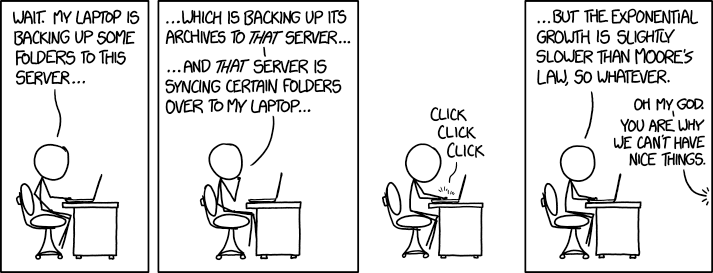
Life Goals

Brindle

last one for B and V...

I got to check off 'Make something called xkcd' early.
24 Oct 17:10

I Am Into This: A Legend Of Zelda Ladies' Romper

Brindle

@vitak

zelda-link-romper-1.jpg This is the Legend Of Zelda Link Ladies' Romper available exclusively from ThinkGeek. It costs $25 and can be credited with teaching me what a romper is. It's a one-piece shirt and shorts combo. Why don't they make that sort of thing for guys? I want as few clothes as possible. Plus I won't have to worry about matching. $25 actually seems like a pretty good deal considering it has a front zipper, hood, and thumb holes. I've paid $25 for just a t-shirt before and had to go to school bottomless until I saved up enough for a pair of Umbros. You know what my favorite thing about Umbros are? You never have to wash them. You can wear them every day and if they start to smell like butt or balls you can just spray a little cologne in there and you're good to go another week. "You're gross." No, I'm practical. "And what have your girlfriends thought about this?" Ahahahahaha -- you believed those stories?! Keep going for a couple detail shots.zelda-link-romper-2.jpg zelda-link-romper-3.jpg Thanks to hairless, who knows what I like, and I like a lady dressed as Link.

22 Oct 12:27

Android 7.1 feature spotlight: Google Camera actually takes a photo on voice command

by Corbin Davenport
Brindle

We were at a conference and the speaker said he was on the "Okay Google" team and I heard several phones beep around me...

android-camera-google-action

Trying to set a timer on cameras, both on smartphones and dedicated units, can be a pain. Google Camera 4.2, which currently can only be installed on Android 7.1 or higher, allows you to take photos with the "OK google, take a picture" voice command.

Once you say the magic words, the Camera app will open (if it isn't already) and start a 3-second timer. After the time is up, the photo will be taken.

Read More

Android 7.1 feature spotlight: Google Camera actually takes a photo on voice command was written by the awesome team at Android Police.

22 Oct 12:20

Nashville Council Member Admits AT&T & Comcast Wrote The Anti-Google Fiber Bill She Submitted

by Karl Bode
We've been talking about how the next great battlefield in broadband is utility pole attachment reform. In many cities, the incumbent broadband provider owns the utility poles, giving them a perfect opportunity to hinder competitors. In other cities, the local utility or city itself owns the poles, but incumbent ISPs have lobbied for laws making it more difficult for competitors to access them quickly and inexpensively. Google Fiber has been pushing "one touch make ready" rules in several cities aimed at streamlining this bureaucracy by letting a licensed, third-party installer move any ISP's gear (often a matter of inches).

And while incumbents like AT&T and Comcast will often breathlessly proclaim they're all for streamlining regulations, in this instance they're actively preventing the streamlining of these rules in a feeble attempt to slow Google Fiber down. In Louisville, AT&T sued the city after it passed one touch make ready rules. And in Nashville, both Comcast and AT&T have been actively working to prevent Google Fiber from getting similar rules passed. In a recent blog post explaining the stand off, Google Fiber highlights just what this entrenched, anti-competitive regulatory capture looks like in graphical form:
This week Nashville's city council is planning the final in a series of votes to approve Google Fiber's one touch make ready rules. But AT&T has already promised to sue the city if Nashville passes the ordinance. Meanwhile AT&T and Comcast have taken another route to try and delay Google Fiber; they've urged a Nashville city council member to propose an alternative city resolution that would supplant Google Fiber's plan with a plan that doesn't appear to actually do anything outside of stalling the Google Fiber proposal.

Under this alternative "right touch" proposal, pole attachment would see only modest changes, leading Nashville city councilman Jeremy Elrod to deride the move as little more than a last gasp effort by AT&T and Comcast to protect their duopoly fiefdom:
"Google Fiber service and other competitors will be forced to rolling out their service at a trickle, when under the One Touch ordinance it will be like opening the floodgates," Elrod said in an emailed statement.

"This resolution coming at the last minute, to be considered the same night as third reading of the One Touch bill, just shows it’s the last gasp of Comcast and AT&T, desperately trying to hold on to their top place on the utility pole. "These two companies should not be the gatekeepers that get to decide when and where their customers get access to a competitor, but (a Memorandum of Understanding) like this one enshrines that they stay that way. Comcast and AT&T would win, and competition and consumers would lose."
AT&T and Comcast's competing resolution was proposed by Nashville council member Sheri Weiner, who amusingly admits to Ars Technica that the incumbent ISPs wrote the proposal, and while she intended to edit some of it herself, that just didn't happen:
"I told them that I would file a resolution if they had something that made sense and wasn’t as drastic as OTMR,” Weiner told Ars in an e-mail today, when we asked her what role AT&T and Comcast played in drafting the resolution. Weiner said she is insisting on some changes to the resolution, but the proposal (full text) was submitted without those changes.

When asked why she didn't put her suggested changes in the version of the resolution published on the council website, Weiner said, “I had them [AT&T and Comcast] submit it for me as I was out of town all last week on business (my day job)." Weiner said an edited resolution will be considered by the council during its next meeting.
Yeah, whoops-a-daisy. If the AT&T and Comcast proposal passes, it will likely delay Google Fiber's market entry by a notable margin. If it doesn't, AT&T will simply sue the city of Nashville, insisting the city council overstepped its authority. Either way, Google Fiber gets delayed thanks to regulatory capture. And note this is all occurring while AT&T lobbyists happily mock Google Fiber for receiving "government favoritism."

Again, this is all par for the course for American broadband, where beholden lawmakers on every level from city council to state legislature work tirelessly to make sure incumbent ISPs like Verizon, Comcast, AT&T and Charter never have to work too hard, lest the campaign contributions stop flowing. And again, while any day of the week you'll find these companies' executives and lobbyists prattling on at length about how they despise "onerous regulation," when push comes to shove you'll repeatedly find them aggressively supporting just such regulation -- if it protects them from having to actually compete.

Permalink | Comments | Email This Story
22 Oct 12:19

Apple emails reveal complaints about sexist, toxic work environment

Mic.com has obtained a long list of e-mails from primarily female Apple employees (but also a few male employees), detailing a sexist culture inside the company that nobody seems to want to address. The 50 pages of e-mails were handed to Mic by an Apple employee, and obviously, all people involved have been anonymised. "With such love for a company that does so much good, it is with a heavy heart that I declare my resignation from Apple," a former employee wrote in an email obtained by Mic. "Despite all attempts to seek justice within this corporation, the cries of several minority employees about the toxic and oppressive environment have gone unanswered. I have witnessed the complete and utter disenfranchising of the voices of men and women of color and the fault lies not only in the direct management staff but in the response of those tasked with protecting employee rights. I write this letter hoping to highlight the areas that these departments have failed to properly support employees and as such have hence left Apple, Inc. culpable for various EEOC and ethical violations." According to Claire*, "several people" who have quit, citing a "white, male, Christian, misogynist, sexist environment," were not given exit interviews. "Their departure is being written up as a positive attrition," she told Mic. This obviously - but sadly - doesn't surprise me in the slightest. Silicon Valley is an inherently toxic environment dominated by white males, and despite all the talk from Tim Cook and various company bloggers, Apple is not the special diversity flowerchild farting rainbows and puking unicorn dust it claims to be. I mean, this is a company who considers having a Canadian speaking on stage during an event as "diversity". From these emails, a picture emerges of a company culture actively trying to get women to leave, actively preventing them from getting into mid-level and top-level leadership positions. From everything I've ever heard about Silicon Valley culture - this is par for the course, no matter the company.
22 Oct 12:17

Your 'Smart' Power Outlets Are Now Botnets Thanks To The Internet Of Broken Things

by Karl Bode
Making fun of the Internet of Things has become a sort of national pastime, made possible by a laundry list of companies jumping into the space without the remotest idea what they're actually doing. When said companies aren't busy promoting some of the dumbest ideas imaginable, they're making it abundantly clear that the security of their "smart," connected products is absolutely nowhere to be found. And while this mockery is well-deserved, it's decidedly less funny once you realize these companies are introducing thousands of new attack vectors in every home and business network the world over.

Overshadowed by the lulz is the width and depth of incompetence on display. Thermostats that fail to heat your home. Door locks that don't protect you. Refrigerators that leak Gmail credentials. Children's toys that listen to your kids' prattle, then (poorly) secure said prattle in the cloud. Cars that could, potentially, result in your death. The list goes on and on, and it grows exponentially by the week.

The latest gift of the Internet of Things industry, revealed last week by security researchers at Bitdefender, is smart electrical sockets that can be hacked to hand over e-mail credentials, create a botnet, or (potentially) burn your house down by firing up connected appliances. The devices are sold as an amazing new tool to help create a connected home, allowing users to manage any device plugged into them via a smartphone and/or the internet. The problem, as usual, is an (unspecified) company that treated security as an afterthought. From the full Bitdefender research paper:
"Bitdefender researchers observed that the hotspot is secured with a weak username and password combination. Furthermore, the application does not alert the user to risks associated with leaving default credentials unchanged. Changing them can be done by clicking ‘Edit’ on the name of the smart plug from the main screen and choosing a new name and a new password.

Secondly, researchers noticed that, during configuration, the mobile app transfers the Wi-Fi username and password in clear text over the network. Also, the device-to-application communication that passes through the manufacturer’s servers is only encoded, not encrypted.
That's not just bad security, that's yet another company that's not even trying. And not even trying, it should be added, despite a constant flood of news reports that have demolished an endless list of different brands for failing to embrace things like fundamental encryption. We're building a mansion out of flammable toothpicks and empty promises, and as Bruce Schneier recetly noted, it's really only a matter of time before the check comes due on a fairly massive scale.

And while security is a big part of the problem, equally troubling is the rise of "smart" products that stop working once the company's manufacturer gets bored or sold. Like, you know, connected light bulbs that no longer really connect to much of anything:
"Earlier this month, our colleague and Consumerist reader Michelle spotted a great deal on some Connected by TCP smart lightbulbs she’d been eyeing for her home. Before buying, she checked to see if they’d be compatible with her Amazon Echo or Wink app, and it’s good that she checked first. As it turns out, those bulbs are no longer compatible with any device, app, or hub, because TCP pulled the plug on their server as of June 1.
Whoops, sorry! Not only is the Internet of Things a total shit show when it comes to security and privacy, you also don't really own the things you buy, creating a universe of new possibilities when it comes to dysfunction, fraud, and misleading advertising promises. There are plenty of reasons why this incompetence is coming home to roost, though the simplest is that many companies were just too cheap and lazy to invest in quality kits, research and technology, and most IOT "evangelists" were too focused on self-promotion to much care about the fact that they were selling us an industrial-grade disaster.

Permalink | Comments | Email This Story
22 Oct 12:14

Backups

Brindle

I think this is how B feels at work sometimes...

Maybe you should keep FEWER backups; it sounds like throwing away everything you've done and starting from scratch might not be the worst idea.
21 Oct 20:07

'Nice Internet You've Got There... You Wouldn't Want Something To Happen To It...'

by Mike Masnick
Last month, we wrote about Bruce Schneier's warning that certain unknown parties were carefully testing ways to take down the internet. They were doing carefully configured DDoS attacks, testing core internet infrastructure, focusing on key DNS servers. And, of course, we've also been talking about the rise of truly massive DDoS attacks, thanks to poorly secured Internet of Things (IoT) devices, and ancient, unpatched bugs.

That all came to a head this morning when large chunks of the internet went down for about two hours, thanks to a massive DDoS attack targeting managed DNS provider Dyn. Most of the down sites are back (I'm still having trouble reaching Twitter), but it was pretty widespread, and lots of big name sites all went down. Just check out this screenshot from Downdetector showing the outages on a bunch of sites:
You'll see not all of them have downtime (and the big ISPs, as always, show lots of complaints about downtimes), but a ton of those sites show a giant spike in downtime for a few hours.

So, once again, we'd like to point out that this is as problem that the internet community needs to start solving now. There's been a theoretical threat for a while, but it's no longer so theoretical. Yes, some people point out that this is a difficult thing to deal with. If you're pointing people to websites, even if we were to move to a more distributed system, there are almost always some kinds of chokepoints, and those with malicious intent will always, eventually, target those chokepoints. But there has to be a better way -- because if there isn't, this kind of thing is going to become a lot worse.

Permalink | Comments | Email This Story
21 Oct 17:04

Actor James Woods Gloats Over Death Of Random Twitter Troll He Sued To Unmask

by Mike Masnick
Actor James Woods is an asshole. Let's just put that front and center. As you may recall, a little over a year ago, Woods sued a random Twitter user who went by the pseudonym "Abe List." "List" frequently mocked Woods, including calling him "clown-boy" and a "cocaine addict." Woods then sued for defamation, demanding $10 million, and tried to unmask List. This was ridiculous for any number of reasons, not the least of which is calling much more attention to what a thin-skinned jackass Woods is from anonymous Twitter users. But, more importantly, such hyperbolic statements in an internet forum are not defamation -- rhetorical hyperbole certainly doesn't meet the standard for defamation of a public figure. On top of that, trying to unmask an anonymous speaker is really, really sketchy, and there's a very high bar.

Oh, and did we mention that Woods himself has a long history of similar rhetorical hyperbole on Twitter, including making statements about others smoking crack?
California, of course, has a strong anti-SLAPP law, and Abe List, with the help of lawyers Lisa Bloom and Ken "Popehat" White, sought to use it to get the case kicked out. While the judge initially agreed that Woods' lawsuit was a SLAPP suit, he eventually changed his mind, and said that Woods could find out who Abe List really is. List appealed to California's 2nd District Court of Appeal soon after that ruling earlier this year. Since then the case had moved forward with both sides filing opening briefs.

However, apparently "List" just died. There are no details, but List passed away -- and with it, the case is over. The court docket shows that on Thursday, his lawyers filed for the case to be dismissed based on List's death and the court quickly dismissed the case and closed it. No matter what you think of anything, this is not a great situation. Someone died.

And total asshole James Woods decided to not just gloat about it, but to rub everyone's face in it. First, he pretended that the dismissal was because he was going to win the case:
That's so obnoxious that you might even overlook the fact that Woods here flat out admits he filed a SLAPP lawsuit.

Bloom, quite reasonably offended, pointed out that her pseudononymous client had died and it's pretty obnoxious to gloat over a default victory like that.
Just to put an exclamation point on what a total and complete jackass he is, Woods responded to others pointing out that the client died by gleefully celebrating his death and hoping it was "in agony."
He doubled down on that with another person, talking about how he'll follow people "to the bowels of hell."
That's sickening. Like, literally. I feel ill. What kind of person would celebrate anyone's death? Even someone they dislike? I have no idea if James Woods is a "cocaine addict" but he sure is an extreme asshole.

Oh, and kinda creepy too.
I asked Ken White if he had anything to say about this and he replied:
It was a privilege to represent Abe Doe. He was passionate about many issues and a fierce and incisive debater, not afraid to mix it up with his own attorney. He challenged me just as easily as he challenged others. I was proud to help him fight a contemptible censorious lawsuit, and am very sad about his passing.


Permalink | Comments | Email This Story
21 Oct 13:27

The Wait Is Over: Dog Leotards Exist Now

Brindle

@Spencer...

dog-leotards-10.jpg These are a bunch of dogs modeling Shed Defender dog leotards. The breathable outfits were designed to be worn by pets for short intervals when shedding is of particular concern (ie riding in the car, allergic frenemy coming over to case your new apartment so they can gossip about how crappy it is behind your back). They're available in seven colors, sizes mini - XXL, and cost $45 - $60. Obviously, I want a human one to match so my dog and I can be twinsies on Christmas morning. My parents are going to love that! Or, you know, hate we've been crashing on their couch for fifteen months. What do you mean ''getting to stay here" is my present?! We want toys! Keep going for a bunch more shots and a video of a guy demonstrating how to put on and take off a Shed Defender like you've never played dress-up with your dog before.dog-leotards-9.jpg dog-leotards-8.jpg dog-leotards-7.jpg dog-leotards-6.jpg dog-leotards-5.jpg dog-leotards-4.jpg dog-leotards-3.jpg dog-leotards-2.jpg dog-leotards-1.jpg
Thanks to