Shared posts

30 Oct 16:47

The Nanny State Didn't Show Up, You Hired It

by thelastpsychiatrist


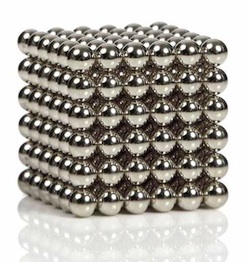
buckyballsboo.jpg

FLY, YOU FOOLS


The Consumer Products Safety Commission wants to ban Buckyballs, the magnetic office toy for "adults with Asperger's", because kids swallow them.  

("Hey, stupid, isn't the Buckyballs story two months old?"  I'm writing a book of pornography, it's taking up a lot of my time.  "Of?")

This is the kind of story that gets the public to unanimously cry, "We're a bunch of coddled babies!" and if you cried that, please recall my useful heuristic:  if you ever find yourself in complete agreement with the public, especially when "public" includes people you wanted to murder in the last election, then your position is not only wrong, it's not even yours.  You have been trained to have this thought, so the money is in understanding why.

Here is the mistake the conventional wisdom makes: it forgets it lives in the West.   It is free to compare risks because it believes all risks have been considered, by someone else.  This isn't a social problem, it is a philosophical one: we are taught to think like this. This is why an otherwise intelligent person still thought to say, "are you saying we should ban electrical sockets?  They kill more people than Buckyballs!"  That person is confused, but it isn't his fault.

Here's how it plays out.

Nine year old kid: Mom, I swallowed a Buckyball.
You: Oh my god, you are an idiot, I am so embarrassed. I want an abortion.

What would you do?  The balls are non-toxic and they can't rip out all your blood iron like Magneto.  So you do what every parent does, you call a psychiatrist and wait for your kid to poop it out.

Of course the problem is the balls clump together while in different parts of the intestine, pinching through the intestinal wall, kinking or twisting it-- and as he's dying you're saying, "well that serves you right for taking after your father."

Now that I just told you this it seems obvious, but would you have known this before I told you? Would you have known to take the belly pain of your child that seriously? That's the issue: that the toy is "conventional wisdom" safe, the precautions taken are the same as for regular ball bearings.

If you doubt this, please admit to yourself that you will be more careful with them around your children simply because you heard about the ban.   It is that warning that needs to be communicated by the product manufacturer.   "Well, it says it on the box."   As they point out in the complaint, however, the warnings so far have failed, kids are still swallowing them.  "They're stupid."  I agree entirely, however you've misunderstood me: the warnings have failed on the parents.  Note that "parents" here isn't your usual signifier for stupid parents (non-Asian minorities, Central Time moms, Christians, etc).  Buckyballs are sold at Brookstone with proof of subscription to Wired, that's the demo.

It's probably necessary for me to announce loudly that I am AGAINST THE BUCKYBALLS BAN, but the point here is why in 20XX such a ban is not only possible but expected. 


II.

Have you ever seen a bus and had the fantasy that if you got hit, you could sue the city for $5M?  While it's probably means you're a follower not a leader  (e.g. "I hate frivolous lawsuits, but if everyone else gets to do it...") I want you to focus carefully on the implication of this fantasy:  in the secret studio of your mind, even a bus accident is safe.

"Yes, we know, humans miscalculate risk."  No, they are very good at calculating it-- for other people.  No one ever thinks, "It would be awesome if my wife got hit by a bus and we sued for $5M."

"!HA! You're wrong, I think that every night!!!"  You're a tool.  And a cuckold.   It's not that you are more willing to take the "risk"-- you are not altruistic-- you're just 100% certain she would die if a natural gas powered leviathan hit her in the tits and 100% certain you would live.   (Sorry.  It's the porn book.)

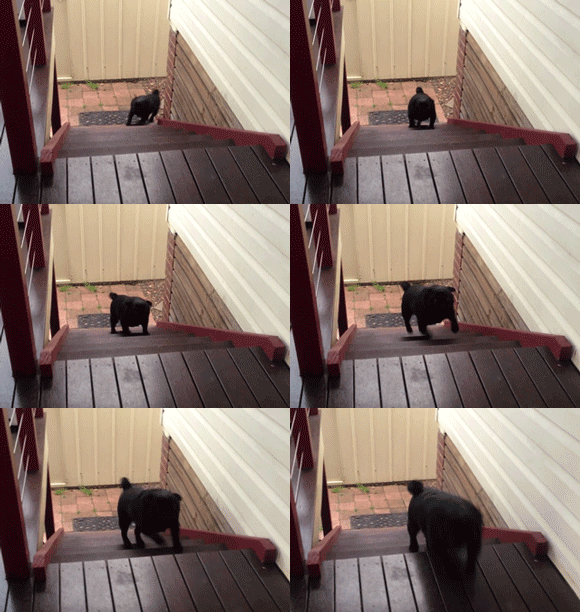
It is this kind of example that trips up the "public" when judging things like Buckyballs because we don't think in large numbers and apply to one (statistics), we think in terms of ourselves and multiply by 6 billion (narcissism).   Here's a piece from an extraordinary video I am ashamed to admit I found on Metafilter.   Watch this dummy try to climb 8 stairs (spacebar to play):


She got up this time, but let's pretend she smashed her face in. What would happen next?  Lawyer crawls out from under a Horn And Hardart's and they sue the city for $5M in future earnings because she says Revlon now won't return her calls.  That story gets picked up by the internet and you, the public, have something to yell at.

You will no doubt observe she is overweight, which about 80% of you will consider of central  importance, and you'd be right for the wrong reason: it's not relevant to her fall, it's relevant to your hate.  Of course you know I picked her on purpose; but what you will forget to know is that Dateline and HuffPo and the others will have looked for her- or a black woman or a guy with his nose in a Bible- to be in their story about tripping and suing, to ensure you'd spit your soda all over the screen. "#frivolouslawsuits!"  The system wins. 

But now watch the director's cut:


From JimmyJames on Metafilter, who has a remarkable insight into the relationship between personal responsibility and what permits it:


On its own, when you see one person slip, you automatically assume that person slipped, was clumsy or not playing attention. But when you look at the aggregate, you realize that the failure isn't on the individual at all, rather the structures that cause certain people to fail with almost no fault of their own. And yet, without this data, they will very quickly ascribe the mistake to themselves.

It difficult to explain to someone that the reason they live their life the way they do because of the structures built to help them live that way. But imagine, instead of a stupid mislaid step, the faulty structure is a punitive late policy on a credit card, or a bank that has a minimum balance fee and very quickly the maintenance of the status-quo is laid bare.


This is a very smart insight, and no surprise this is one of the most favorited comments on Metafilter.  But it is still wrong, and wrong in a very specific way, the only way that matters: pro-status quo.  Wrong, to ensure that things do not change.

JimmyJames has it backwards.  The issue isn't the faulty step, it is all of the correctly laid steps.  That seems abstractly unrealistic to you, so I'll simplify with JimmyJames's own  examples: the problem isn't the minimum balance fee, it is the bank; it isn't the punitive late policy, it is the credit card.  

She didn't trip because the step was high, she didn't trip because she should have been more careful; she tripped because the city taught her not to be careful, in the same way you taught your daughter not to be careful when she crosses the street.  "Huh? I taught her to look both ways!"  Slow down, Hawthorne:


DAD:

Look both ways, stupid!

GIRL:

Um, isn't that your job?

DAD:

But I'm not going to be holding your hand all the time, you have to learn to do this yourself.

GIRL:

So let me understand you.  Your thesis is I am so mentally defective that unless you teach me to look both ways even when you're with me, I will not remember to look both ways when you're not with me.  Isn't it more likely that the omnipotence I attribute to your symbolic identity as Father is what causes me to be more dependent when I know you're with me?

DAD:

How dare you talk to me like that.  You should respect your elders.

GIRL:

I do respect my elders, that's the whole problem.  You have taught me that there is always an appeal to a higher authority.  Meanwhile, your cynicism has split my loyalties, you've made me highly suspicious of individuals in authority, yet simultaneously reflexively obedient to symbols of authority as long as there is no defined individual attached to it.    And when I get old enough to see you're just Willy Loman, I'll start looking for a more abstract, omnipotent, father, and his name will be "Someone Else's Ideology." 


DAD:

That sounds insane.


GIRL:

Don't blame me, man, I just lease the space.  I think we would both respond more reliably to this kind of dependency branded as self-reliance if it was reinforced through the medium of a car commercial.  Something that promises complete freedom of the road and superb handling responsive to my every wish, but knows when to deploy safety features.  That way I'll be able to text with both hands.

DAD:


Maybe I should let you make some mistakes, maybe get a little hurt, to teach you self-reliance?


GIRL:

Ha!  You won't even let me play outside by myself.  You're afraid someone like you will try and eat me. Or that if I ever got hurt, the lesson I'd learn is that you are an unreliable Dad, and there's nothing worse than an unreliable Dad, except---


III.


On the one hand, we live in a society that values free choice and personal responsibility, but we are told that it is safe to value those things only because people expect a certain amount of absence of choice and freedom from responsibility.  You assume you would not be allowed to make a truly dangerous choice. 

What you don't understand consciously is that your judgment of risk is based on the fact that you believe in God, and this is even more true if you think you don't believe in God.  I can sense your resistance to this idea because you think you don't believe in God, but sadly for your immortal soul, you do.

The reason you think "personal responsibility" is the answer to the Buckyballs problem is that Buckyballs already exist, and if they already exist they must be safe-- or "some other omnipotent entity" would not have permitted them to come to existence.  That is the problem of the West, and you cannot change it.  All of the metaphors of the West imply this omnipotent entity, from "free market" to "inalienable rights" to "peace in our time."

Imagine if when Buckyballs were first invented, the manufacturer decided not to bring them to market because they were too dangerous. What would you have been furious then?  You'd have thought: "meh."   That is because your brain is broken, and your brain is broken because the system broke it.  Again, it's not your fault.  The true danger of the "Nanny State" isn't that it limits your freedoms but that it causes you to want less freedom.

Note again and again that the instinctive reflex among the public is to blame the individual and protect the corporation, the system.  You'd think we'd be happy if the system caught an after-market danger, but clearly we aren't, it enrages us.  The rage isn't because the government intrudes into our lives-- it always has-- it's because it's evidence that the system wasn't-- and therefore isn't-- omniscient.   When a product isn't brought to market because it's dangerous it confirms that Dad is reliable, but when it's only discovered later it suggests Dad can be unreliable, and there's nothing worse than an unreliable Dad, unless it's an unreliable God.  Hence Buddhism.  

IV.

I get that this kind of theoretical model doesn't seem practically applicable to every day life, but you'll see the "some other omnipotent entity" everywhere if you look for its three characteristics: it is omnipotent; it opposes the existing (dis)order; its sole job is to protect you from yourself.  Not from the world: from your bad decisions.

Here's an easy example: other than me, Rana Foroohar is the only person still reading Time, and since she has a degree in English Literature and I do not, they gave her the job of Assistant Editor In Charge Of Economics.  Here she is with other assistant editors being in charge of economics.


rana foroohar.jpg


As you can tell, economics is hilarious.  She also somehow writes a column called-- take a drink--  "The Curious Capitalist."  I'll assume she means all of those words ironically.  Here's a sentence she wrote without any irony at all: 

In order to keep things afloat until politicians get their act together, the Fed needs new strategies.

Holy mother of Buddha.  Leave aside policy controversies, what should make your eyes bleed here is how easily, naturally, she went over the government, to a higher authority-- how easily she was able to find "some other omnipotent entity" to save us from ourselves.

This doesn't mean the Fed is always that other omnipotent entity, it means that Foroohar will always locate such an entity because she cannot live without it; her allegiances will shift but she will never permit herself to live only in the abyss-mal world of her actions. She is always on the side of "who can fix this," she is never on the side of "I helped cause this."  This isn't a political problem, it is a psychic problem: this is how all of us think.

And if that entity one day fails to save you, you'll feel the kind of rage you hear described on psychiatry blogs.  Which is what happened when Chief Justice Of The Supreme Court Of The United States Of America John Roberts seemingly turned his back on the conservatives and upheld Obamacare.  A lengthy legal explanation was of no importance, what drove people bananas was not simply his ruling, but that he didn't at least pretend to omnipotence, "I can rule however I want!"   Instead, he said out loud the unsayable, the terrible awful truth about himself:  "It is not our job to protect the people from the consequences of their political choices."  You traitorous, black robed son of a bitch, how dare you reveal there is no God.


V. 


Try it the other way.

NYC Mayor Bloomberg's proposal is to ban soda sold larger than 16 oz.   Is it a government intrusion into our private lives?  Shouldn't we be allowed to make our own free choices about what to do with our own bodies?

The answer to both is a resounding yes, but nevertheless that's the trick.  The question that you should have asked, that you did not ask because you were hypnotized into asking the above questions, is: to what extent am I free to make the decision TO drink soda?

Soda was tested, refined and improved so that you would probably like it; but it was packaged and marketed so that you would like it regardless of whether you liked it, and "you" means you now, in this time, in this place.  Do you believe 10th century Viking marauders who previously described rejecting pop music would drink 3 sodas a day?  I saw Valhalla Rising

valhalla rising.jpg

The answer is no.

I just heard you say, "yes, they would.  Yes, they'd take a few sips and find it delicious and yes, they'd drink 3 bottles a day."  WRONG. 

If you believe that they would, then you are saying that marketing is unnecessary, all that money is a waste, the soda is delicious enough to hook anyone.  That the terms "market penetration" and "early adopters" and "branding" are meaningless.  But if this symbol


pepsi_logo.jpg


not the brown liquid, but that image-- which cost millions of dollars to create and promote-- if that strategy was necessary to making Pepsi a huge seller, more than the minor difference in taste from generic brand cola which no one drinks and thus no one needs protection from-- then you cannot say that your choice to drink soda is a free one. And it doesn't matter if the risk of diabetes with the liquid in the bottle labeled generic cola and the liquid in the bottle labeled Pepsi is the same, because product= object + branding: Pepsi is more dangerous than cola.

The vast majority of the people complaining about the Big Soda ban don't buy big sodas, and those most enraged about the Buckyballs ban either already have them or would never want them.  So the reaction has nothing to do with the products themselves, the rage is on a theoretical level, "I don't want government intruding in my private choices."  But they already do this in a gazillion different ways, bigger, more important intrusions.  The difference is that those are invisible.  You know you can't value the risks in airplane safety or radiation leaks so you trust them to do it, but you think you can value the risks of a soda and hate that they try to do it for you.  

I know you are thinking, "but I can resist soda; I understand the risks"-- never mind you don't even know the ingredients of soda, the point here is you are starting from you and multiplying by 6 billion.  

When you say, "personal responsibility!" you are really saying "this is safe enough for it to be a question of personal responsibility."   But you must ask yourself the question: how do you know Buckyballs and soda are safe enough for them to be about personal responsibility?  Because "some other omnipotent entity" allowed them to exist.  How do you know that Entity can be trusted?  Because it even tries to ban silly things like Buckyballs and soda.  The system is sound.

What is the final common pathway of all of this?  If the system is sound, there's no reason to obstruct the pressures of marketing.  That's what's at stake, not your safety or your personal freedoms.  The point of consumer protection is not protecting the consumer from the market, but protecting the consumer for the market.

The ban has the simple purpose of taking something deemed too dangerous away; but the purpose of the ban is to convey the impression of a watchful eye, so that when you say, "we live in a nanny state!" you are simultaneously saying, "and thank God!"  Hence your desire to get hit by a bus.

You're like a teenager who is perfectly happy-- strike that-- indignantly self-righteously deserving--  to live in his parents' house, eat their food, drive their car, "but for Buddha's sake, Dad, don't ever show your face if I'm hanging with my friends-- I can't have them thinking I have parents!!!"   No worry that their entire existence proves active parental involvement, but tell the kid he can't have get an Xbox or wear a miniskirt and it's an identity catastrophe, "how dare you try to control me!"  Dummy, they already control you in every way, so totally and efficiently that you believe that the miniskirt or the Xbox is a legitimate sign of independence.  The trick isn't that you have no freedom, the trick is that you think that is freedom.  All your fighting is for... consumer products.  "When I turn 18, I am so getting the hell out of this oppressive death hole!"  Where will you go?  "A four year undergraduate college!"

But the analogy goes a step further: all the other teens already know you have parents, they have parents, too-- but all must act collectively like they don't.  No discussion needed, all silently know to pretend that there is not the obvious 1 to 2 omnipotent adults you can immediately appeal to if things go sideways; that there isn't a huge infrastructure, plainly visible to everyone else, propping up your very material existence.  "Live free or die!"  Why specify a choice?  For you, they are exactly the same thing.


---


http://twitter.com/thelastpsych


30 Oct 16:23

nevver: Dr. Seuss

30 Oct 11:24

Memento Mori: Art to Help You Meditate on Death and Become a Better Man

by Brett & Kate McKay

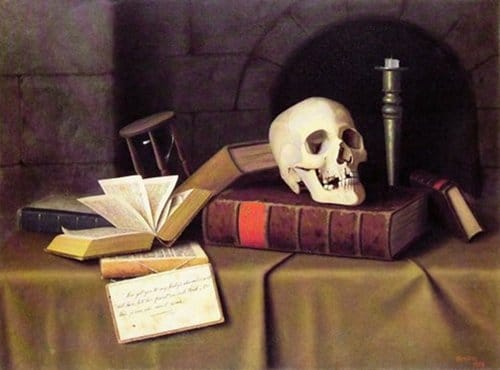
To This Favour by William Michael Harnett, 1879

In case you’ve forgotten, Halloween is this Wednesday. With all the ghosts and goblins decorating homes these days, I figured it’s a great time to talk about one of my favorite genres of art: memento mori.

Memento mori is Latin for “Remember death.” The phrase is believed to originate from an ancient Roman tradition in which a servant would be tasked with standing behind a victorious general as he paraded though town. As the general basked in the glory of the cheering crowds, the servant would whisper in the general’s ear: “Respice post te! Hominem te esse memento! Memento mori!” = “Look behind you! Remember that you are but a man! Remember that you will die!”

Memento mori. Remember that you will die.

Us moderns don’t like to think too much about death. It’s a bit too depressing and morbid for our think-positive sensibilities. Our culture is devoted to perpetuating the lie that you can stay young forever and your life will go on and on.

But for men living in antiquity all the way up until the beginning of the 20th century, rather than being a downer, death was seen as a motivator to live a good, meaningful, and virtuous life. To help men remember death, artists created paintings, sculptures, and mosaics depicting skulls, skeletons, and other symbols of death. Churches would display memento mori art to compel viewers to meditate on death, reflect on their lives, and re-dedicate themselves to preparing to meet God. Devout Christians would often ask that their tomb or grave marker have some sort of skeleton motif on it to remind their visiting family members to get right with God before they too bit the dust.

Below, I’ve put together a collection of famous memento mori artwork. Not only would these paintings of skulls and skeletons look badass hanging in your home, they can also help remind you that you’re dying daily, encourage you to quit wasting your life away on stupid stuff, and motivate you to start living the life you want NOW.

Self Portrait by Thomas Smith, 1680
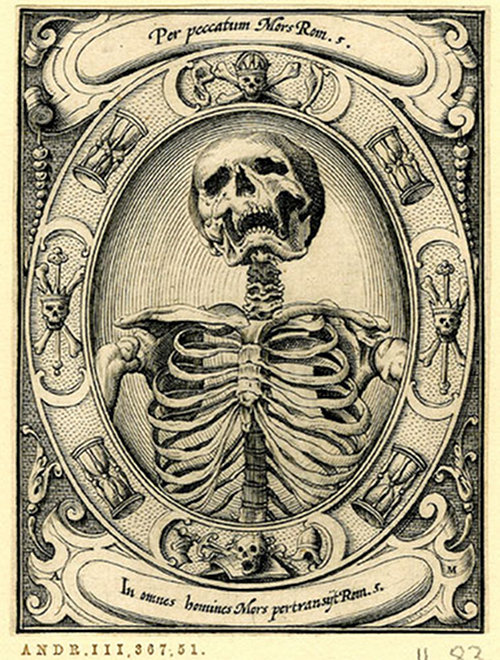
Memento mori woodcut by Alexander Mair, 1605

In ictu oculi by Juan de Valdés Leal, 1672
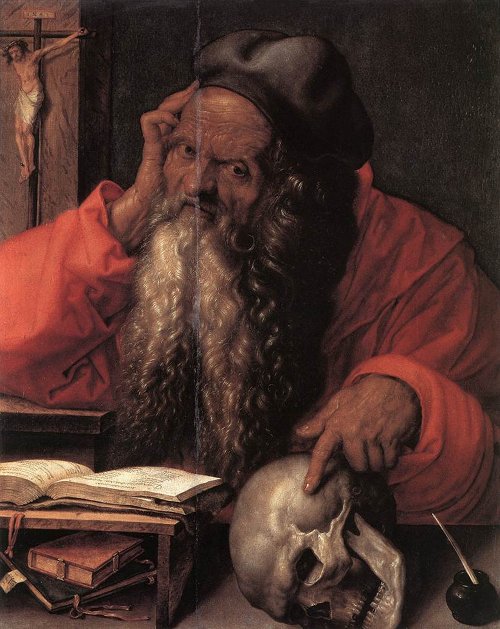
Saint Jerome by Albrecht Dürer, 1521
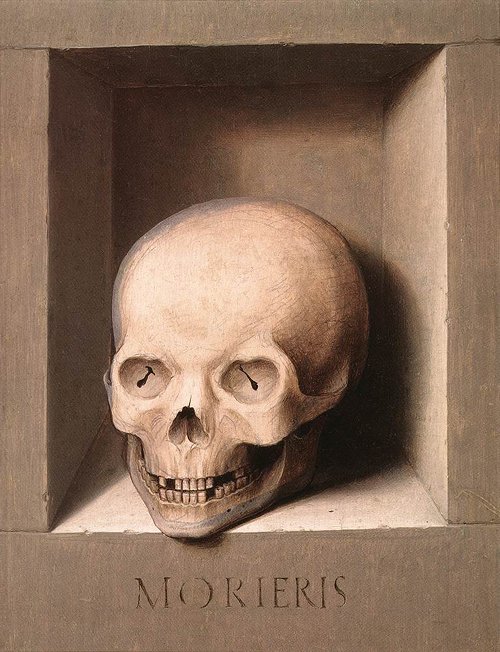
Morieris by Hans Memling, 1483
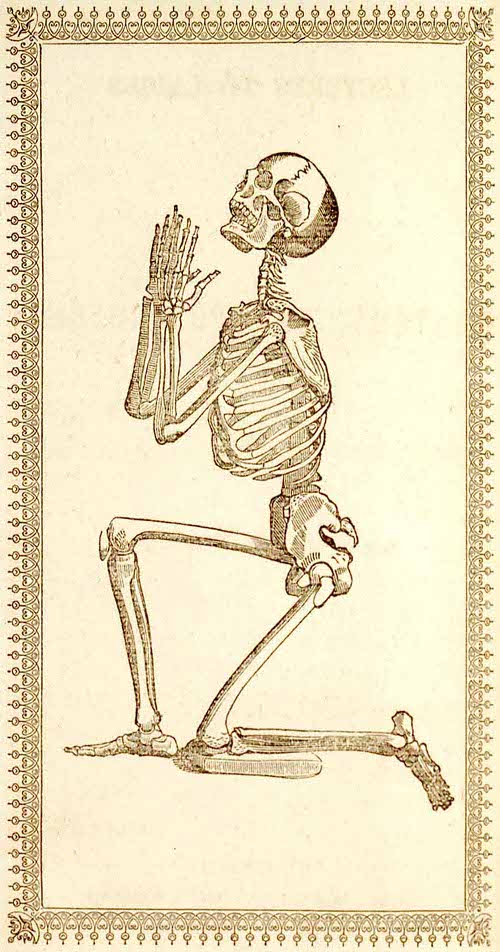
Unnamed illustration by Mary S. Gove, 1842
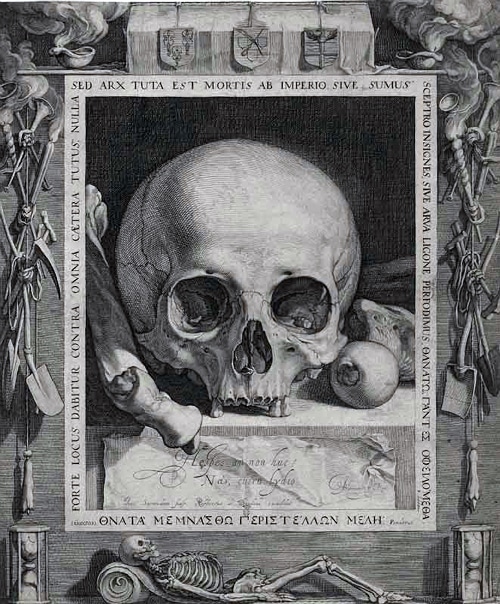
Memento Mori by Jan Saenredam, late 16th century
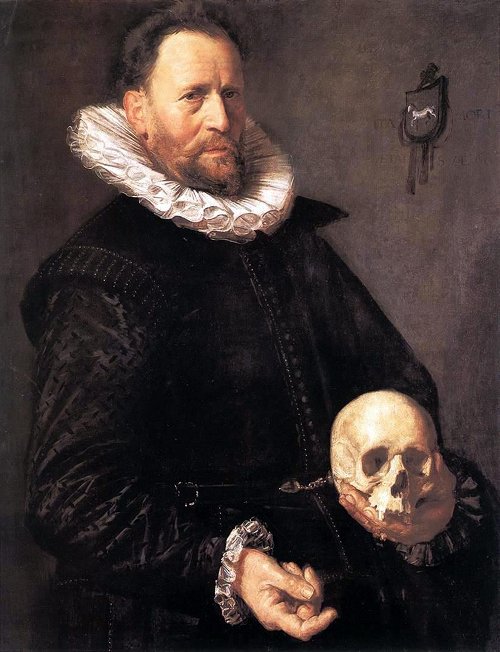
Portrait of a Man Holding a Skull by Frans Hals, 1615
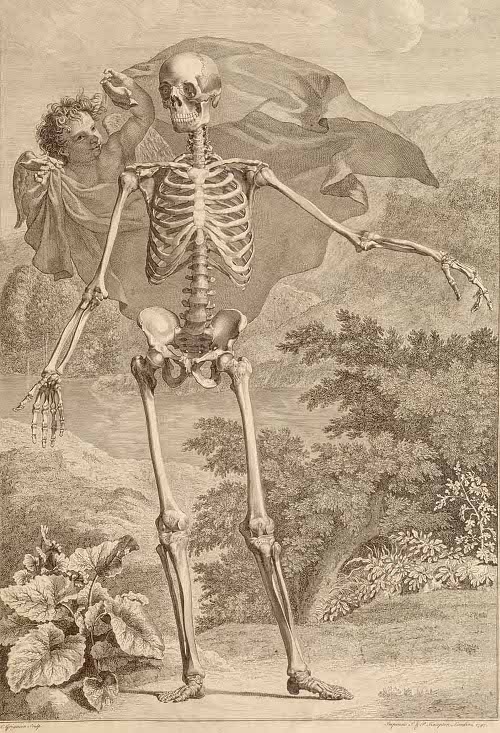
sceleti et musculorum corporis humani by Bernhard Siegfried Albinus, 1749. Albinus was an anatomist who would often depict human skeletons in traditional memento mori motifs.

Young Man Holding a Skull by Frans Hals, 1626.
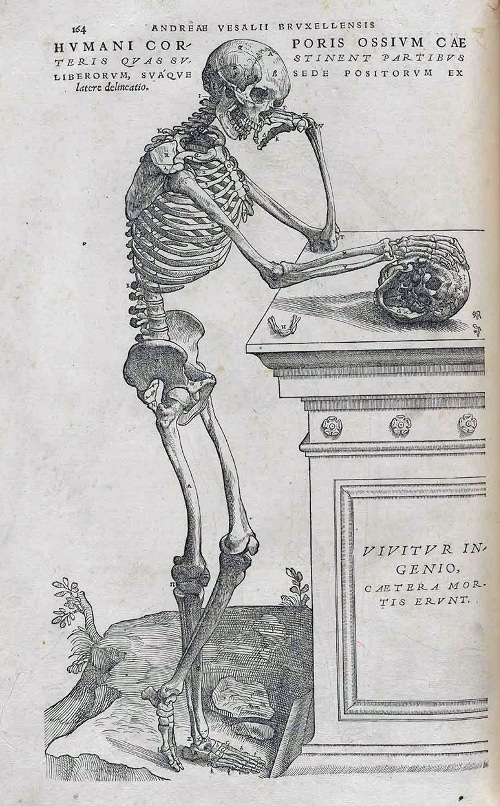
Unnamed illustration by Andreas Vesalius, 1543. Vesalius is considered the founder of modern anatomy and published the first comprehensive anatomy book of the modern era: “De humani corporis fabrica.” This illustration is an obvious play on memento mori motifs. It’s actually kind of meta. Death mediating on death.

Danse Macabre, or Dance of Death
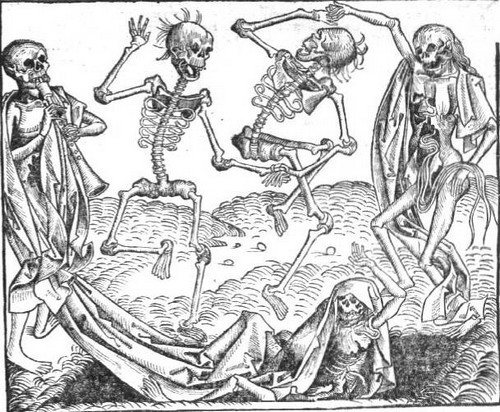
The Dance of Death by Michael Wolgemut, 1493

A sub-genre of memento mori art is Danse Macabre, or Dance of Death. This genre of art has its origins in late medieval times but became popular during the Renaissance.  Dance of Death paintings typically portray a skeleton (signifying Death or the Grim Reaper) walking, dancing, or playing music. To convey the universality of death, people from all walks of life — kings, popes, peasants, and children — are invited by jovial skeletons to follow them in a dance to the grave. Dance of Death art (and it also took the form of plays and poems), grew out of the grim horrors of the 14th century: famine, the Hundred Years War, and, most of all, the Black Death. The latter starkly demonstrated the way in which death united all, felling the population without the faintest regard for age or rank.

Some Dance of Death paintings are rather morbid, graphic, and downright creepy. Whether or not it gives you the heebee jeebees, there’s no denying its powerful reminder that we’ll all have to pay the fiddler once our mortal hoedown is through.

Dance of Death by Emmanuel Büchel, 1773
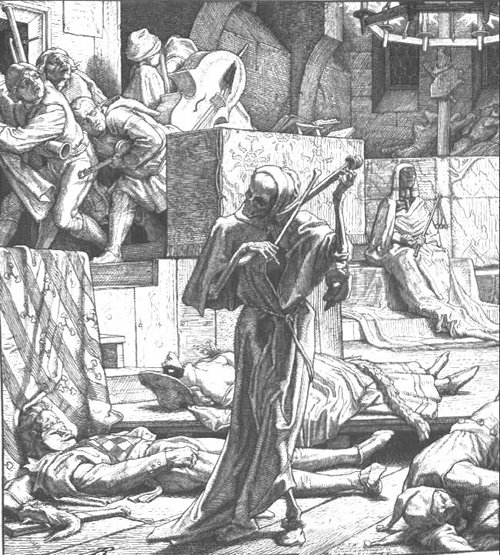
Death as a cutthroat by Alfred Rethel, 1851. Rethel was inspired by an account of how an outbreak of cholera ravaged a masquerade during the Carnival of Paris in 1832.
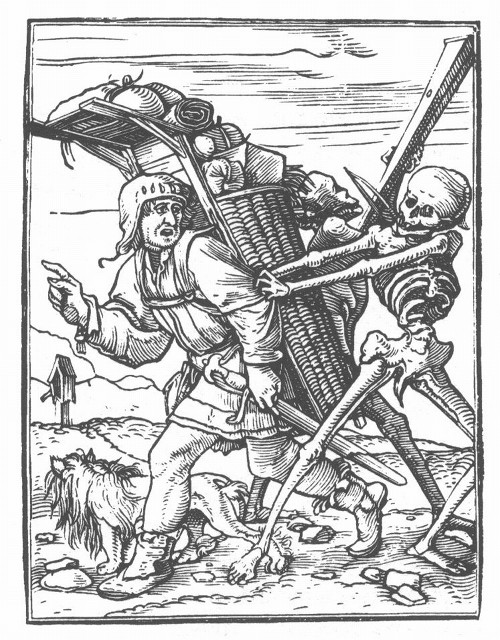
Dance of Death. Hans Holbein the Younger, 1523-1526. This woodcut is part of a series Holbein did on the Dance of Death theme.
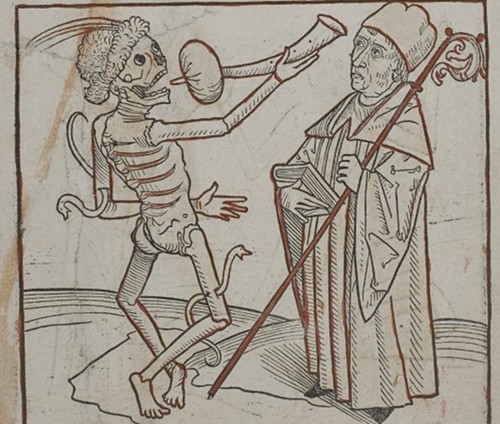
Unnamed illustration by unknown author, 1488. This image (and the 3 below) comes from a series of late 15th century woodcuts based on the Dance of Death theme. The book that contained these woodcut images was entitled Heidelberger Totentanz. Scholars believe it was the first collection of art dedicated solely to  the Dance of Death theme.

This appears to be a king accompanied by a trombone-playing skeleton.
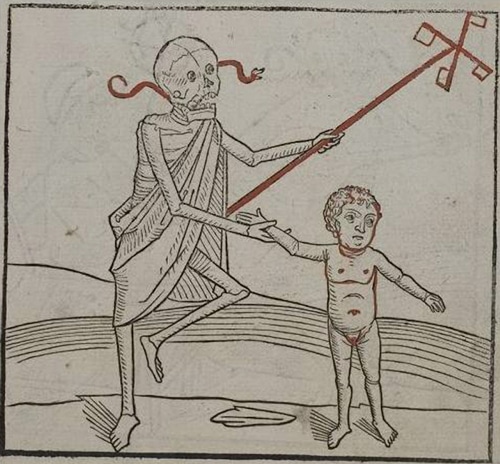
Sadly, as people in antiquity knew all too well, even children sometimes can’t escape the dance with death.
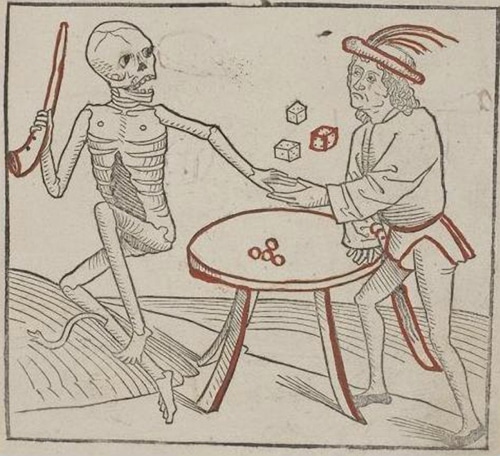
Life is often a game of chance. Fortunes come and fortunes go. But we all have to cash out and head to the big casino in the sky.
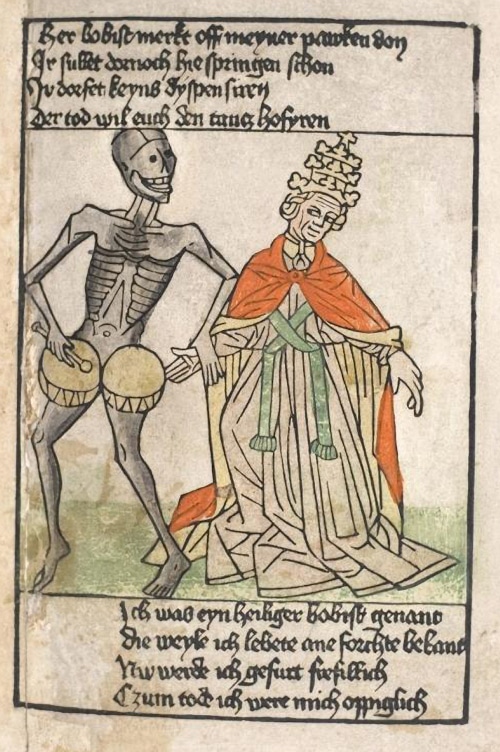
Heidelberger Bilderkatechismus, 1455. This is possibly one of the earliest depictions of the Dance of Death. That king kind of looks happy to be hanging out with Death. But I guess if the Grim Reaper had to come, at least he came playing the drums.
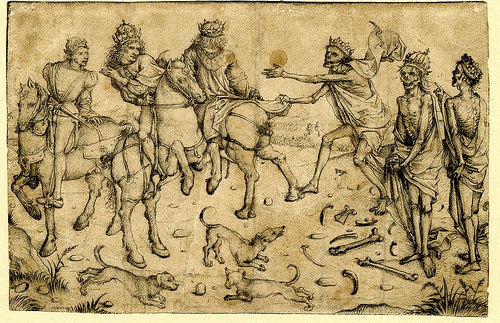
The 13th century legend of the Three Living and the Three Dead was a popular theme of murals and frescoes. In the legend, three gentlemen or kings meet the cadavers of their ancestors, who warn them: “Quod fuimus, estis; quod sumus, vos eritis” (What we were, you are; what we are, you will be!).

Vanitas Vanitatum Omnia Vanitas
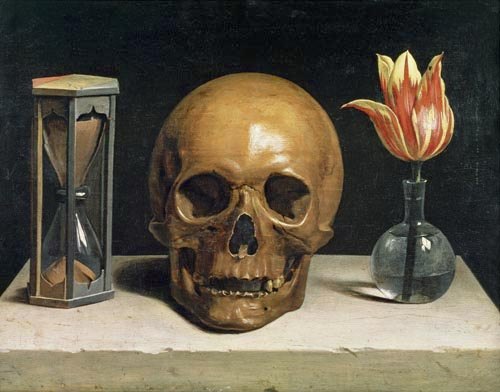
Still Life with a Skull by Philippe de Champaigne, 1671. The three essentials of existence: life, death, and time.

Another sub-genre of memento mori art is called vanitas.  This artistic motif was particularly popular among Dutch Golden Age artists of the 16th and 17th centuries. The famous passage from chapter 1 of Ecclesiastes on the fleeting and impermanent nature of our mortal life is cited as the inspiration for this morbid art.

2 Vanity of vanities, saith the Preacher, vanity of vanities; all is vanity.

3 What profit hath a man of all his labour which he taketh under the sun?

4 One generation passeth away, and another generation cometh: but the earth abideth for ever.

5 The sun also ariseth, and the sun goeth down, and hasteth to his place where he arose.

6 The wind goeth toward the south, and turneth about unto the north; it whirleth about continually, and the wind returneth again according to his circuits.

7 All the rivers run into the sea; yet the sea is not full; unto the place from whence the rivers come, thither they return again.

8 All things are full of labour; man cannot utter it: the eye is not satisfied with seeing, nor the ear filled with hearing.

9 The thing that hath been, it is that which shall be; and that which is done is that which shall be done: and there is no new thing under the sun.

10 Is there any thing whereof it may be said, See, this is new? it hath been already of old time, which was before us.

11 There is no remembrance of former things; neither shall there be any remembrance of things that are to come with those that shall come after.

In vanitas art, the certainty of death and our mortality are still the main themes, but there’s an added emphasis on the fleetingness and insignificance of earthly glory and pleasures. Common symbols in vanitas art include the skull (representing the certainty of death); bubbles (representing the brevity and fragility of life and earthly glory); smoke, hourglasses, and watches (every minute that passes brings you closer to death); rotting fruit and flowers (representing the fragility and decay of earthly things); musical instruments and music sheets (representing the ephemeral nature of life); torn or loose books (representing earthly knowledge); and dice and playing cards (representing the role that chance and fortune play in life).

The purpose of vanitas art is moral instruction. It’s to remind the viewer that life is precious, so they better not waste it on frivolous and meaningless things.

Self-Portrait with Vanitas Symbols by David Bailly, 1651. Notice the bubbles.
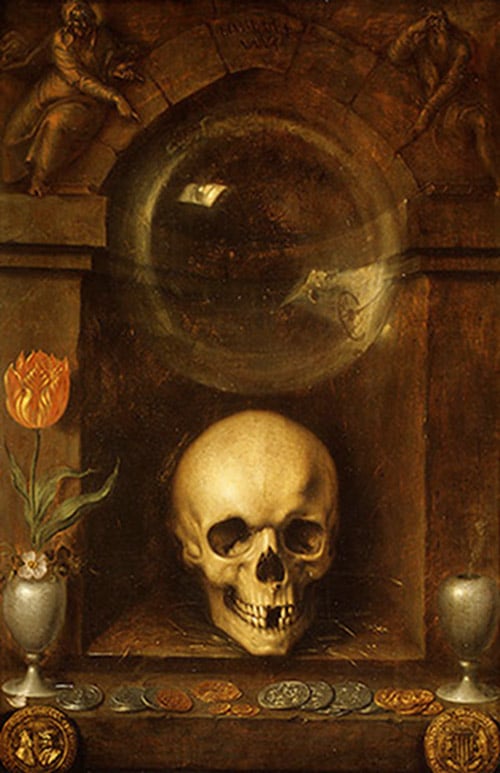
Vanitas Still Life by Jacques de Gheyn the Elder, 1603. Notice all the vanitas symbols: skull, bubble, smoke, and flower. Money seems to be another symbol in this painting. It likely represents the foolishness of “laying up your treasures where moth and dust doth corrupt.”

Vanitas Still Life by Jan Davidsz de Heem, 17th century
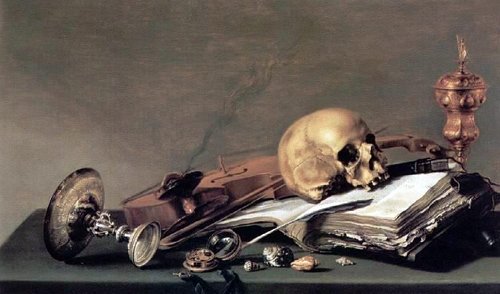
Vanitas Still Life by Jan Davidsz de Heem, 17th century.
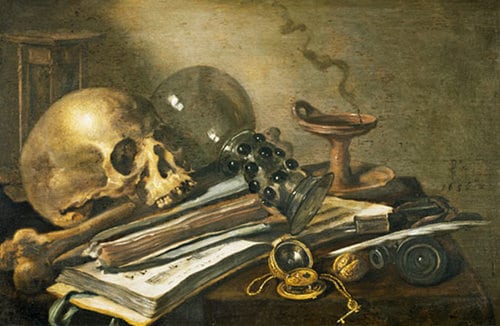
Vanitas Quiet Life by Pieter Claesz, early 17th century. Which vanitas symbols can you see?
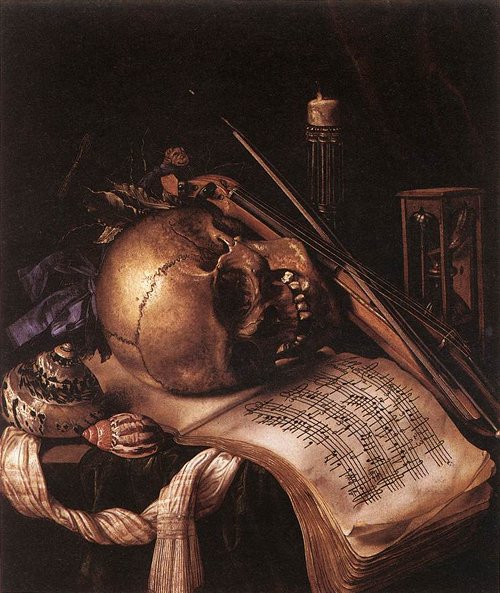
Vanitas Still Life by Simon Renard de Saint-André, middle of the 17th century.
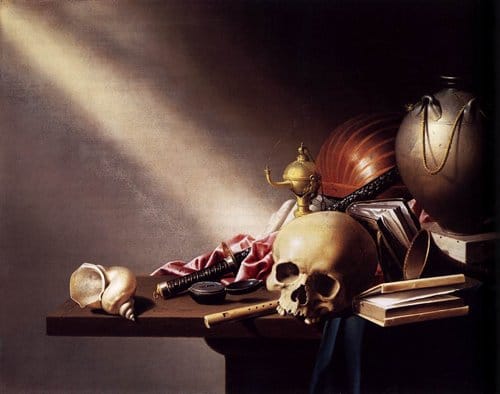
Still Life, An Allegory of the Vanities of Human Life by Harmen Steenwijck, 1640.
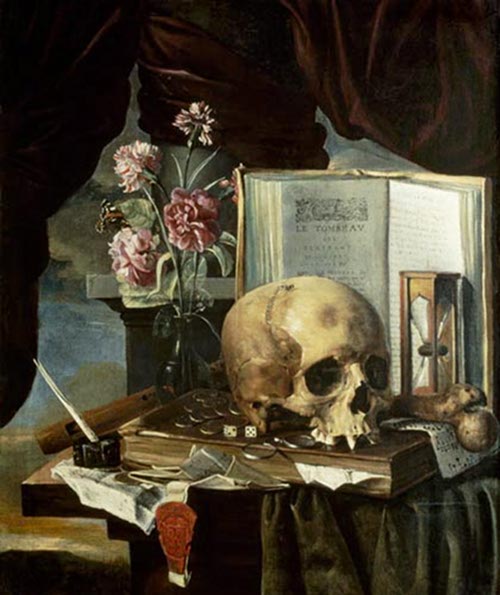
Vanitas Still Life by Simon Renard de Saint-André, middle of the 17th century. Notice the hourglass, pair of dice, and sheet of music.
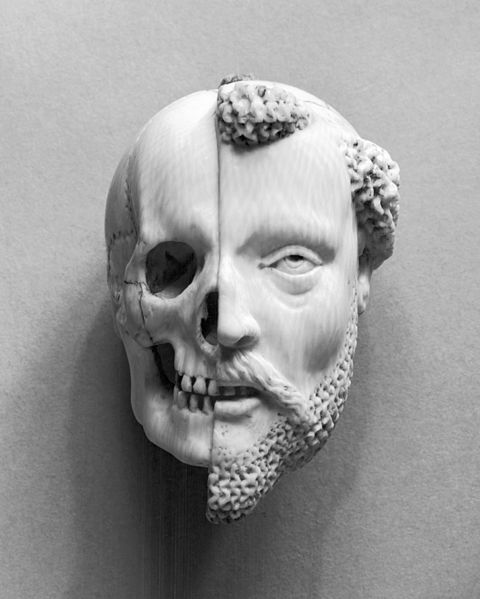
Memento mori themes were common in mediums beyond paintings as well, such as this 16th/17th century ivory pendant: Monk and Death. I like this one, because Kate often says to me, “Whoa, you have a skeleton under there.” Whoa indeed.

I know death isn’t the most pleasant thing to think about, but today I challenge you to pick out one of the memento moris above and really study it. Think about the symbols and what they mean. As you do so, ask yourself: Am I dedicating my life primarily to activities and things that will simply fade away like smoke and bubbles? Or I am making the most of my life by creating a legacy that will live beyond the grave?

Memento mori, gentlemen.


Related posts:

  1. Manvotional: Allan Quatermain on Death
  2. 16 Manly Last Words
  3. Losing Dad: How a Man Responds to the Death of His Father
  4. A Timeless Tradition: A Man’s Treasure Box
  5. The Menaissance: The Death of the Metrosexual and the Rise of the Retrosexual


30 Oct 11:16

Meus folhetos de cordel

by Marco Haurélio
Adam Victor Brandizzi

Loja de cordel na Internet? Lá se vão alguns centavos meus...


Recebo muitos e-mails solicitando títulos de minha autoria para compra. Os livros são encontráveis nas principais livrarias. Mas os folhetos e livretos de cordel, à venda em bancas de jornal ou de folhetos tradicionais, não são encontrados com a mesma facilidade. Um site, pelo menos, tem quase todos os meus títulos tradicionais à venda. É o Magazine Gibi, coordenado por Wanderson Nicoló. Nele, o leitor encontrará uma ampla gama de folhetos e livros, de autores clássicos e contemporâneos. Vale uma visita.

LIVRO AS BABUCHAS DE ABU KASEM

LIVRO AS BABUCHAS DE ABU KASEM 
AUTOR: MARCO HAURÉLIO - ANO: 2010 - EDITORA: CONHECIMENTO 

R$ 15,00
LITERATURA DE CORDEL - GALOPANDO O CAVALO PENSAMENTO

LITERATURA DE CORDEL - GALOPANDO O CAVALO PENSAMENTO
AUTOR: MARCO HAURÉLIO - ANO: 2007 - EDITORA: TUPYNANQUIM

R$ 3,00
LITERATURA DE CORDEL - PRESEPADAS DE CHICÓ E ASTÚCIAS DE JOÃO GRILO

LITERATURA DE CORDEL - PRESEPADAS DE CHICÓ E ASTÚCIAS DE JOÃO GRILO 
AUTOR: MARCO HAURÉLIO - ANO: 2007 - EDITORA: LUZEIRO 

R$ 5,00
LITERATURA DE CORDEL - SERRA DO RAMALHO UM BRASIL QUE O BRASIL PRECISA CONHECER

LITERATURA DE CORDEL - SERRA DO RAMALHO UM BRASIL QUE O BRASIL PRECISA CONHECER 
AUTOR: MARCO HAURÉLIO - ANO: 2005 - EDITORA: LUZEIRO 

R$ 3,00
LITERATURA DE CORDEL - O ROMANCE DO PRÍNCIPE DO REINO DO LIMO VERDE

LITERATURA DE CORDEL - O ROMANCE DO PRÍNCIPE DO REINO DO LIMO VERDE
AUTOR: MARCO HAURÉLIO - ANO: 2005 - EDITORA: LUZEIRO

R$ 3,00
LITERATURA DE CORDEL - OS APUROS DE CHICÓ E A ASTÚCIA DE JOÃO GRILO

LITERATURA DE CORDEL - OS APUROS DE CHICÓ E A ASTÚCIA DE JOÃO GRILO 
AUTOR: MARCO HAURÉLIO - ANO 2005 - EDITORA: LUZEIRO 

R$ 3,00
LITERATURA DE CORDEL - NORDESTE TERRA DE BRAVOS

LITERATURA DE CORDEL - NORDESTE TERRA DE BRAVOS
AUTOR: MARCO HAURÉLIO - ANO: 2005 - EDITORA: LUZEIRO

R$ 3,00
LITERATURA DE CORDEL - HISTÓRIA DA MOURA TORTA

LITERATURA DE CORDEL - HISTÓRIA DA MOURA TORTA 
AUTOR: MARCO HAURÉLIO - ANO: 2006 - EDITORA: LUZEIRO 

R$ 3,00
LITERATURA DE CORDEL - A BRIGA DO MAJOR RAMIRO COM O DIABO

LITERATURA DE CORDEL - A BRIGA DO MAJOR RAMIRO COM O DIABO 
AUTOR: MARCO HAURÉLIO - ANO: 2008 - EDITORA: LUZEIRO 

R$ 3,00
LITERATURA DE CORDEL - AS TRÊS FOLHAS DA SERPENTE

LITERATURA DE CORDEL - AS TRÊS FOLHAS DA SERPENTE 
AUTOR: MARCO HAURÉLIO - ANO: 2005 - EDITORA: LUZEIRO 

R$ 3,00
LITERATURA DE CORDEL - A IDADE DO DIABO

LITERATURA DE CORDEL - A IDADE DO DIABO 
AUTOR: MARCO HAURÉLIO - ANO: 2008 - EDITORA: LUZEIRO 

R$ 3,00
LITERATURA DE CORDEL - O CORDEL SUA HISTÓRIA, SEUS VALORES

LITERATURA DE CORDEL - O CORDEL SUA HISTÓRIA, SEUS VALORES
AUTOR: MARCO HAURÉLIO E JOÃO GOMES DE SÁ - ANO:2011 - EDITORA: LUZEIRO

R$ 5,00
LITERATURA DE CORDEL - O HERÓI DA MONTANHA NEGRA

LITERATURA DE CORDEL - O HERÓI DA MONTANHA NEGRA
AUTOR: MARCO HAURÉLIO - ANO: 2009 - EDITORA: LUZEIRO

R$ 5,00
LITERATURA DE CORDEL - OS 3 CONSELHOS SAGRADOS

LITERATURA DE CORDEL - OS 3 CONSELHOS SAGRADOS
AUTOR: MARCO HAURÉLIO - ANO: 2006 - EDITORA: LUZEIRO

R$ 5,00
LITERATURA DE CORDEL - HISTÓRIA DE BELISFRONTE O FILHO DO PESCADOR

LITERATURA DE CORDEL - HISTÓRIA DE BELISFRONTE O FILHO DO PESCADOR
AUTOR: MARCO HAURÉLIO - EDITORA: LUZEIRO - ANO: 2010

R$ 5,00
LITERATURA DE CORDEL - TRAQUINAGENS DE JOÃO GRILO

LITERATURA DE CORDEL - TRAQUINAGENS DE JOÃO GRILO
AUTOR - MARCO HAURÉLIO

R$ 3,00


30 Oct 09:56

A New Outlook

by Greg Ross

A correspondent of the Manchester Sporting Chronicle, thinking that his horse was short-sighted, had his eyes examined by an oculist, who certified that the horse had a No. 7 eye and required concave glasses. These were obtained and fitted on to the horse's head. At first the horse was a little surprised, but rapidly showed signs of the keenest pleasure, and he now stands all the morning looking over the half-door of his stable with his spectacles on, gazing around him with an air of sedate enjoyment. When driven his manner is altogether changed from his former timidity; but if pastured without his spectacles on, he hangs about the gate whinnying in a plaintive minor key. If the spectacles are replaced he kicks up his heels and scampers up and down the pasture with delight.

-- British Veterinary Journal, March 1888

30 Oct 09:20

Grande assim

by Juliana Cunha

O menino tinha cinco, mas parecia ter bem uns sete. A mãe inseria sua idade verdadeira em conversas randômicas e tentava vestí-lo do jeito mais infantil possível. Não adiantava: todo mundo achava meio besta ver aquele marmanjão disputando balanços minúsculos com crianças que eram a metade dele.

É difícil saber a idade de uma criança porque elas aparentemente não vêm em tamanhos padronizados, o que é obviamente um erro. As menores apanham mais, até por desleixo mesmo. Pernas que voam desgovernadas, um “era grande assim” que resulta em tabefe na cara do colega que estava do lado. Os maiores, por sua vez, parecem abestalhados.

Ela chegou a admitir ao pai do menino que preferiria que o filho fosse pequeno e chegasse em casa apanhado. Ou que tivesse asma. Ou que molhasse a cama aos dez. Em determinado momento, acho que o próprio menino passou a achar o mesmo e começou a curvar a coluna de modo a perder uns oito centímetros. Depois dez. Depois 12, 15, 25. Depois virou o Corcunda de Notre Dame. A mãe achou injusto. Ela tinha dito que preferiria um filho apanhado; um filho asmático; um filho mijão, nessa ordem, nunca um filho Corcunda de Notre Dame.

30 Oct 09:18

Um jogo que abre a poesia

by Juliana Cunha

Nuno Ramos esteve no Roda Viva de ontem e falou coisas muito legais sobre futebol. Claro que ele falou coisas legais sobre artes plásticas e literatura, mas quando chegou a vez do futebol foi especial. As mãos manchadas de tinta começaram a gesticular, as palavras saiam mais depressa.

Até eu que tenho uma relação completamente blasé com qualquer tipo de esporte fiquei entusiasmada. Para ele, o futebol é “um jogo católico, do tráfico de influências” e o mais bonito dos esportes por conta da disparidade entre o placar e o jogo em si. No futebol, jogadas bonitas nem sempre se traduzem em gols e a qualidade de uma partida não pode ser definida pelo resultado final. Para Nuno, esse é um jogo que “abre a poesia do mundo”.

Ele também falou que o futebol é o lugar onde o pobre fica rico e é por isso que há tanto patrulhamento em cima dos jogadores: se bebem, se treinam, se fazem valer o que ganham. Essa seria uma forma de “moralizar” uma situação que temos dificuldade em aceitar: a da mobilidade social radical. Ou seja, a possibilidade de uma pessoa sair de uma classe muito, muito baixa e ficar bem mais rica que nós, que trabalhamos, estudamos, insira aqui a ladainha classe média de sua preferência.

Ps: Ele começa a falar de futebol no mintuo 1:00:00 do vídeo.

30 Oct 08:14

470 – Mudanças.

by gomba

Os dois estão errados, bom mesmo era aquele desenho dos mini búfalos com uns super totens. Mas fora isso, eu fiz uma grande bobagem e errei a contagem do Bufas um tempo atrás. Basicamente pulei 10 tiras na numeração. Então eu to querendo fazer algo interessante e fazer uma história em 10 partes – 10 tiras, pra cobrir os números que eu pulei.

Vocês sugerem algum tipo de personagem pra elas? Um dos antigos? Ou mesmo um novo?

29 Oct 20:17

Photo


29 Oct 20:17

Photo


29 Oct 20:17

via


via

29 Oct 19:41

Frozach Submitted

29 Oct 19:34

Twin Cats Always Mirror Each Other in Sleep Scientists are...


Twin Cats Always Mirror Each Other in Sleep

Scientists are baffled by twin cats, Merry and Pippin, who reportedly always sleep in an exact mirror image of one another.  

“Even if we place them in disparate starting positions or in separate rooms, they somehow always wind up sleeping exactly like the other,” said leading cat biologist and feline sleep expert Dr. Tobias Winslow.  ”I’ve never seen anything like it.”

A polysomnogram revealed nothing out of the ordinary about the cats’ brain functions, eye movements, muscle activity, breathing or heart rhythms.  ”We had expected to find that Merry and Pip were synched up on an internal level,” explained Winslow, “but it is literally just in the way they position their bodies for slumber.”

More tests will be done later this month during a scheduled comprehensive sleep study.

Via  0mumu0.

29 Oct 19:34

dpaf: video HERE


dpaf:

video HERE


29 Oct 15:57

Equilíbrio distante

by Arnaldo Branco

29 Oct 14:05

This is so cool that it can just be false. wildcat2030: Manila...

Adam Victor Brandizzi

Mas sério que isso funciona?


This is so cool that it can just be false.

wildcat2030:

Manila is one of the world’s five dirtiest cities, but graffiti? That’s not a problem. It’s not that people don’t paint on the walls in the hyper-polluted Philippines capital, because they do. But they do it with a paint that actually eats smog out of the air. The catalytic paint, called Boysen KNOxOUT, reacts with light and water vapor to filter out nitrogen oxides. An environmental scientist interviewed in this BBC video says it can scrub out 20 percent of polluting nitrogen. Manila is deploying the paint in the form of massive murals, which are both beautiful and, because of their size, effective. Eleven square feet of paint-covered surface can absorb as much pollution as a full-grown tree, and these murals are close to 11 THOUSAND square feet. If we could get this stuff into the hands of street artists and taggers, it would be like having an army of energetic teenagers planting trees all over the city all day, every day. (via Super-polluted city tries to clean itself with smog-eating paint | Grist)

29 Oct 13:17

idrawnintendo: Inspired by Costume Quest—a fantastic Halloween...


idrawnintendo:

Inspired by Costume Quest—a fantastic Halloween game that you can go grab right now for 50% off on Steam—which came out back in 2010 and has since been a part of my yearly Halloween tradition.

28 Oct 19:31

Ótimo infográfico sobre ataques epilépticos. Seria bom se alguém...


Ótimo infográfico sobre ataques epilépticos. Seria bom se alguém traduzisse.

aka14kgold:

undercoverangryangel:

thedoctorwillsaveme:

SEIZURE FIRST AID.

Ever wonder what you should do if you see someone having a seizure? Here ya go! 

YES

Perfect sum-up!

28 Oct 19:29

27,28,29-09-12

by Laerte

27 Oct 14:20

http://www.catversushuman.com/2012/10/happy-halloween-if-you-prefer-to-follow.html

by yasmine


Happy Halloween!

------

If you prefer to follow CvsH on tumblr, feel free to follow here.

27 Oct 14:16

Photo


27 Oct 14:16

Photo


27 Oct 14:15

The Most Accurate Synopsis Ever

27 Oct 14:15

Alternate Universe | 33e.jpg

by (author unknown)
33e.jpg
27 Oct 01:22

Prophecy

by nedroid

Prophecy

27 Oct 01:05

Photo

Adam Victor Brandizzi

Aproveitar que isso aqui ainda está meio deserto para compartilhar uns links NSFW sensuais sem serem vulgares.


26 Oct 20:51

This Adopted Dog Saved A Baby

by Pet Finder

An adopted dog named Duke is credited with saving the life of nine-week-old Harper Brousseau of Portland, CT, according to a story on the Huffington Post. When the normally obedient dog jumped repeatedly on the bed of Jenna Brousseau and her husband, Harper's parents, they knew something was wrong.

RELATED: Does Your Dog Need a Flu Shot?

The parents went into their baby's room and discovered she wasn't breathing. Jenna's husband called 911. Paramedics were able to revive little Harper who then went to the hospital where she is doing much better.

RELATED: Three Legs And a Thundershirt

According to the local WFSB Eyewitness News in Portland, the family said that they were sharing their story "because they wanted to inspire others to consider rescuing an animal like they did." The dog whose life they saved six years ago has now saved the life of their beloved new daughter.

Unfortunately your browser does not support IFrames.


We at Petfinder often hear amazing stories like this through the Happy Tails we receive. Many adopted pets have saved the day for their people - from alerting them to a family member who has fallen or is having a seizure, to waking them when there is a fire or gas leak in the house. Adopted pets, who have often been through so much, really come through for their families.


RELATED: The U.S. Supreme Court Will Hear Two Canine Cases


Read | Permalink | Email this | Comments

26 Oct 17:23

Comic for October 26, 2012

Adam Victor Brandizzi

Que feio, Scott, plagiando The Big Bang Theory...


26 Oct 17:08

Fox Steals Purse From Woman, Returns The Bag Moments Later

by Todd Rigney

Fox Steals Purse Return It

What happens when a fox steals a purse from an unsuspecting woman? He returns it moments later, of course. According to Digital Spy, that’s precisely what happened to Anna and Jeremy Clark while preparing for a trip to the hospital.

“We were in the [estate's] car park and he looked at me for a few seconds before letting out this feeble yelp,” Jeremy explained to The Argus. “Next thing I knew he had my wife’s handbag in his mouth and was running towards the bushes.”

Although Jeremy attempted to get the sneaky fox to drop his wife’s purse, the woodland creature with a knack for thievery disappeared into the bushes. It was around this time that the couple started to panic. After all, a number of Anna’s possessions were inside the purse at the time.

“Anna had everything in there: her phone, money, purse, keys and letters. I couldn’t believe the fox had just taken it – it was mad. I thought that was it,” Jeremy recalled.

Just as the couple were about to give up, the fox returned to the scene of the crime with the purse in its mouth. After dropping the stolen item at Anna’s feet, the creature quickly fled the area. While Anna and Jeremy aren’t quite sure why the little guy decided to return the purse, they’re incredibly grateful that his conscious got the better of him.

Foxes are notorious thieves, and have been known to swipe anything that’s not nailed down. In 2009, a treasure trove of footwear was discovered inside a foxhole on the outskirts of a small German town. According to Reuters, authorities unearthed over 100 pairs of stolen shoes inside the culprit’s home.

“There was everything from ladies’ shoes to trainers,” a spokesperson for the local police explained. “We’ve found between 110 and 120 so far. It seems a vixen stole them for her cubs to play with.”

Word of advice: If a fox steals your purse, then you might want to stick around for a moment. After all, the animal’s guilt may work in your favor.

Fox Steals Purse From Woman, Returns The Bag Moments Later is a post from: The Inquisitr


26 Oct 14:53

Why Greg Smith quit: Of Mammon and muppets

Not what they used to be GREG SMITH is one of life’s smaller big winners. His ticket out of Johannesburg came from winning a scholarship to Stanford University; insight into a computerised application system opened the way to an internship at Goldman Sachs; and an understanding of its Darwinian hiring system led to a job, luxurious perks, and high pay. His 12-year career ended with a scathing denunciation of the bank on the editorial page of the New York Times and the publication this week of a book whose title, “Why I left Goldman Sachs”, could spark an entire genre by disaffected drones in successful organisations.A whispering campaign of sorts has undermined Mr Smith, suggesting he never really was up to Goldman’s standards. This is probably true, although a similar criticism could be made of everyone who ever worked there. And to Mr Smith’s credit, he left on his own terms, no small feat. Of the 75 college graduates recruited from his year, only 7 were still at the firm when he departed for the last time. No doubt others left voluntarily, but one theme that...