Shared posts

14 Oct 21:34

The Imaginary Prisons

by Greg Ross

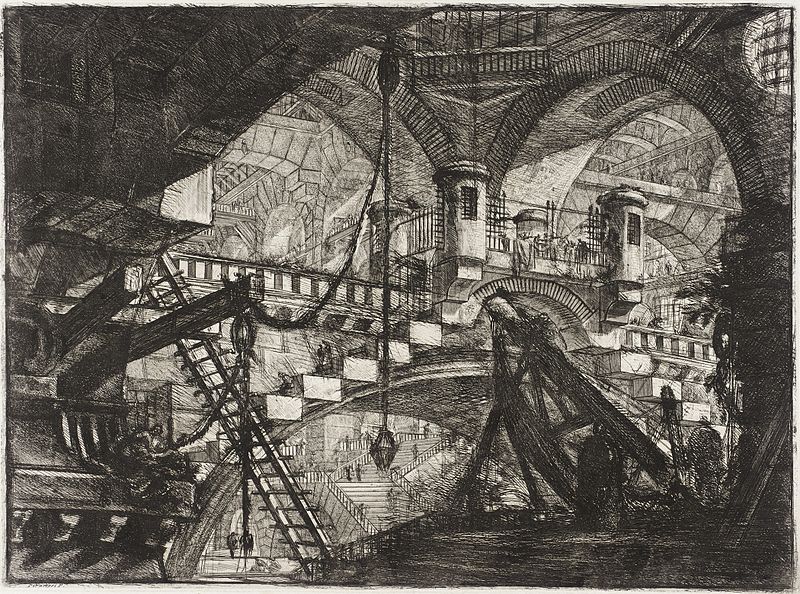
http://commons.wikimedia.org/wiki/File:The_Arch_with_a_Shell_Ornament_LACMA_46.27.11.jpg

Italian artist Giovanni Piranesi spent his days making etchings of Roman ruins, but in 1745 he turned out a series of much darker visions, which he called Le Carceri d’Invenzione. “Vaults of colossal proportions from which hang extinguished lanterns, openings closed by bars, spiral staircases and suspended passageways which lead nowhere, immense gallows and wheels, ropes strung on pulleys evoking strange tortures,” writes Roseline Bacou in her collection of the artist’s etchings and drawings, “all these are the visible elements of a closed and nocturnal world.” Thomas De Quincey wrote:

Many years ago, when I was looking over Piranesi’s Antiquities of Rome, Mr. Coleridge, who was standing by, described to me a set of plates by that artist … which record the scenery of his own visions during the delirium of a fever: some of them … representing vast Gothic halls, on the floor of which stood all sorts of engines and machinery, wheels, cables, pulleys, levers, catapults, etc., etc., expressive of enormous power put forth, and resistance overcome. Creeping along the sides of the walls, you perceived a staircase; and upon it, groping his way upwards, was Piranesi himself: follow the stairs a little further, and you perceive it come to a sudden abrupt termination, without any balustrade, and allowing no step onwards to him.

The full collection is here. Aldous Huxley read into the prints “things existing in the physical and metaphysical depths of human souls — to acedia and confusion, to nightmare angst, to incomprehension and to panic bewilderment.” In reworking the prints Piranesi came to relate them to early Rome: One column in the vaults bears the inscription AD TERROREM INCRESCENTIS AVDACIAE, a quotation from Livy’s History of Rome in which the early king Ancus Marcius responds to a loss of values among his people by establishing a prison in the center of the city, “to terrify the growing audacity.” But the initial series were pure fantasy, and their inspiration is unknown.

14 Oct 15:00

Uma agenda fora de foco

Serão necessários alguns meses para uma melhor análise da eleição parlamentar da semana passada. Mesmo assim, pode-se arriscar o palpite de que, enquanto discutem-se questões do século 21 naquele que seria um Brasil moderno como a Holanda, o eleitorado foi noutra direção, aparentemente conservadora, mas apenas latino-americana. Leia mais (10/12/2014 - 02h00)
13 Oct 02:12

Isle of tits

http://oglaf.com/isle-of-tits/

13 Oct 02:08

29-08-2014

by Laerte

12 Oct 15:43

tastefullyoffensive: [baconzombie]

12 Oct 03:36

Making safe for historians

The HTML 5 spec introduces the <time> element to mark up a date or time. Although I support the inclusion of these semantics in HTML, I believe that the current specification of the <time> element is vague because it avoids the question whether the element is safe for historians. Right now it hurts historical research more than it helps. In this entry I’ll explain why.

Although I will concentrate on the HTML5 syntax here, what I have to say also applies to the microformats datetime design pattern. The Microformats site adds one important detail to the discussion that the HTML5 spec overlooks: the point of having a <time> element (or a datetime design pattern) at all:

Use the datetime-design-pattern to make datetimes that are human readable also formally machine readable.

Who needs machine readable dates? As far as I can see there are two target audiences for this operation. The first is obviously social applications that have to work with dates, and where it can be useful to compare dates of two different events. An app must be able to see if two events fall on the same day and warn you if they do.

However, as a target audience social applications are immediately followed by historians (or historical, chronological applications). After all, historians are (dare I say it?) historically the most prolific users of dates, until they were upstaged by social applications.

This raises the question whether the <time> element should be tailored for historical use at all. When I started writing this entry I was convinced that it should.

In keeping with the definition of its purpose I the see the <time> element as a tool for an Internet-wide chronological search-and-compare system. Such a system will be a boon to historians, who would be allowed to quickly and easily look up events that happened around the same time as the event they’re writing about.

In history, just as in other academic disciplines, serendipitous discoveries are the meat of exciting new theories. A history-compliant use of the <time> element that allows automatic search and compare would broaden the horizons of historians.

However, now that I’ve reviewed some of the more common problems that have to be solved in order to decrease potential harm, I’m starting to doubt whether the <time> element can easily be made to fit history.

Right now, though, the specification is a vague compromise that doesn’t make the <time> element useful for historical research, but still allows it to be used historically.

I feel this ambiguity should be removed. I feel that the specification should clearly state whether the <time> element is meant for historical use or not. The current vague, implied “No” should be changed to a clear answer. I prefer Yes, but I can live with No.

If the <time> element should be made safe for historians, there’s quite a bit of work to be done; some of which is discussed in this article. If it should not be made history-safe, we have to add a cut-off date to the specification. Dates before this cut-off date would be ignored.

A cut-off date

The basic problem (that we’ll discuss in great detail below) is that the current specification requires the use of the so-called proleptic Gregorian calendar. Although that makes perfect sense in the modern age, it becomes progressively more pointless as we travel back in time, and somewhere in the late 16th century we reach the point that proleptic Gregorian dates become actively harmful to historical research.

The basic problem is that historians of the Middle Ages and earlier periods use Julian dates because that’s what the documents of that era use. If we’d map them to proleptic Gregorian dates, as the specification demands, they would be worse than useless in any kind of automatic search-and-compare system.

Hundreds of years’ worth of historical literature uses Julian dates if the people from the era it discusses did so, and therefore a system that uses proleptic Gregorian dates just doesn’t find any matches.

The current specification acknowledges this problem — somewhat. It says:

For dates before the introduction of the Gregorian calendar, authors are encouraged to not use the time element, or else to be very careful about converting dates and times from the period to the Gregorian calendar

A literal interpretation would have odd consequences. If I’d write about the secret negotiations between Louis XIV and Charles II to destroy the Dutch Republic in the early 1670s, I would be allowed to mark up the dates of Louis XIV’s letters, but not those of Charles II’s ones. France used the Gregorian calendar back then, but England stuck to the Julian. Such a rule is useless for historians. Besides, it’s just plain weird.

As to marking up Charles II’s letters with Gregorian dates, that’s possible, but it could lead to the same problems we discussed above: the generally accepted date for a letter might be Julian, in which case an automated search for the Gregorian date misfires dramatically.

So I believe this remark is incorrect and should be changed. The specification should clearly and unambiguously state whether or not the <time> element is fit for historical use instead of trying to find a vague formula that avoids this basic question. (I don’t even understand why this question should be avoided. It’s a simple one, though the consequences of a Yes are pretty complicated.)

If the answer is No the specification should define a cut-off date that is the earliest date the <time> element (or automatic search systems based on it) accepts as valid. Earlier dates are simply ignored by a compliant implementation. That neatly avoids the bulk of the problems mentioned in this article, and makes sure that any historical use that falls within the constraints of the specification is actually useful.

Therefore, if historical use of the <time> element is to be disallowed, we MUST (in the sense of RFC 2119) define a cut-off date.

Candidates

The most obvious candidate for a cut-off date is 1 January 1970, the start of Unix Epoch time. There’s one problem, though: if we’d cut off the <time> element there, many people alive today wouldn’t be able to mark up their birth dates.

Therefore I’d like to propose 1 January 1870 instead. Its relation to the start of the Unix Epoch is clear and it allows everybody alive today to mark up their dates of birth.

Besides, there’s some vaguish historical justification for this date. Around 1870 the final phase of European colonial imperialism started, which caused almost the entire world to be divided among the colonial powers. Not coincidentally, this also caused the Gregorian calendar to spread to even the most obscure corners of the world, and it became a true world standard.

The only problem with that cut-off date would be that Russia still used the Julian calendar in 1870 and continued to do so until 1918. Moving the cut-off date to 1918 is possible, but it would mean a few of the very oldest people in the world would not be able to mark up their birth dates.

You may stop reading now

If you’re convinced that the current specification of the <time> element should not be changed to accomodate historians, you can stop reading here. The historical overview that follows is not important to you.

You should just:

  1. make sure the specification clearly states that the <time> element is not meant for historical use.
  2. take a decision on the cut-off date.

Thank you for your attention.

What historians need

If you’re still with me, you’re obviously interested in chronological problems. You’ll get what you want — in spades.

If the HTML5 <time> element is to be made safe for historical use, the specification MUST (again in the sense of RFC 2119) allow

  1. BC dates (negative dates, in other words) to be specified
  2. incomplete dates to be specified
  3. calendars other than (proleptic) Gregorian to be specified
  4. arbitrary year-naming systems to be specified

Furthermore:

  1. The specification SHOULD allow the use of unambiguous dates that are not in the approved datetime format; most importantly Easter.
  2. The specification MUST NOT allow arithmetic operations on years before 300 BC.

Of these six rules, I believe that the first five are universal. Although I will defend them by studying European history exclusively, I think that most other chronologies will be served by them, too. The sixth rule is specific to European history; other civilisations will have other cut-off dates for arithmetic operations.

In order to understand all this we have to review the history of dates. There are two separate problems we have to discuss: the calendar (i.e. the days and months of the year), and the names of the years. The specification treats the first point vaguely, and ignores the second.

The Julian and Gregorian reforms

The solar year is about 365.2422 days long, which means it cannot be expressed in an integer number of days. As history progressed, calendars became better at dealing with this problem. For the purpose of our discussion, the Julian and Gregorian reforms are the most important.

  1. The ancient Roman year was a mess. It consisted of 12 months that spanned 355 days; about 10 days too few. The ancient Romans saw that their year was too short, and solved it by adding a so-called intercalary month, which was alternately 22 and 23 days long, to every second year. In theory this led to an average year of 366.25 days; about one day too long.
    Unfortunately the decision whether to insert an intercalary month, and how long it was, was up to the Pontifex Maximus, the high priest of the state religion. Some pontifices (among which Caesar himself) didn’t bother too much with this part of their duties.
  2. In 46 BC Julius Caesar, meanwhile having become dictator for life, introduced the Julian calendar. The months of the year got their modern number of days, and he also introduced the leap year every four years. Thus, the average length of the calendar year became 365.25 days.
  3. In 1582 Pope Gregory XIII updated the calendar because the Julian calendar’s average year was slightly too long. Therefore Gregory decreed that any year divisible by 100 would only become a leap year when it was also divisible by 400. This results in an average year of 365.2425 days.

Unfortunately, in 1582 the wars of religion raged in Europe, and the Protestants were not really eager to follow the directions of the Antichrist in Rome, especially if he happened to be right. The Orthodox also had pressing (and much older) reasons to demonstratively ignore the papacy.

Therefore all Catholic countries switched to the new calendar within years, but the Protestant and Orthodox countries refused to follow.

Most Protestant countries went over in 1700, when the wars of religion had become a vague memory and the actual difference between the two calendars acute. After all, 1700 was the first year that was a leap year in the Julian calendar but not in the Gregorian one.

Nonetheless, England and Russia continued to use the Julian calendar until 1752 and 1918, respectively. (In fact, one Scottish island stubbornly refused to implement the Gregorian calendar until ten years ago or so. The sheep might get confused.)

To this day, most Orthodox use the Julian calendar (even though the Orthodox states use the Gregorian one, and some Orthodox churches use the so-called Revised Julian calendar). That’s why the Orthodox celebrate Christmas (and sometimes Easter) on different days than the Catholics and Protestants.

Proleptic Gregorian calendar

Currently the specification decrees the use of so-called proleptic Gregorian dates; that is, the date a day would have had if the Gregorian calendar had already been in use back then.

Although this makes sense in the recent past, we’ll see that this decree becomes more harmful the more we go back into history. Although (proleptic) Gregorian makes perfect sense as a default, it MUST be possible to define another calendar.

The onus

Besides, there’s the matter of onus. Who, exactly, is responsible for mapping a Julian date to a proleptic Gregorian one? The HTML author or some kind of universal date-calculating system?

In other words, if I, as an historian, talk about 18th century Julian dates, do I have to map them to the Gregorian calendar myself (possibly by means of software I have to buy and install), or can I just trust an Internet-wide system to do so? Obviously I prefer the second solution because it’s less work for me and will probably introduce less errors.

The Russian Revolution

Let’s take a look at a practical example.

On 24 January 1918 Lenin signed a decree that moved the brand-new Soviet Union from the Julian to the Gregorian calendar. In order to bridge the 14-day gap between Julian and Gregorian, 1-13 February 1918 were omitted, so that 31 January was directly followed by 14 February.

Now how are we going to mark up this paragraph? Let’s try the proleptic Gregorian calendar:

<p>On <time datetime="1918-02-06">24 January 1918</time> Lenin
signed a decree that moved the brand-new Soviet Union from
the Julian to the Gregorian calendar. In order to bridge the
14-day gap between Julian and Gregorian,
1-13 February 1918 were omitted, so that
<time datetime="1918-02-13">31 January</time> was directly followed
by <time datetime="1918-02-14">14 February</time>.</p>

This remapping might be confusing for human and machine, but using Gregorian dates still makes sense, especially since the text is about Russia introducing the Gregorian calendar.

However, the 1-13 February 1918 bit is a problem. They’re dates, but they have never existed. I think it’s best not to mark them up at all.

Slightly more confusing is the following:

After the October revolution (25 October 1917) Russia became a communist state.

This date is Julian; we’ll have to map it to Gregorian, but the consequence is that the October revolution takes place in November. Fortunately we’re used to this fact; most history books mention this oddity.

Medieval dates

The use of Julian datetime values becomes mandatory as we enter the Middle Ages. So let’s jump eight hundred years more into the past.

Jerusalem was conquered by the crusaders on 15 July 1099, and a great slaughter was perpetrated among its inhabitants of all races and creeds.

According to the specification we’d either have to use proleptic Gregorian dates or not use a datetime attribute at all. Since I feel the second option invalidates the entire <time> element, I’m forced to choose the first one:

<p>Jerusalem was conquered by the crusaders on
<time datetime="1099-07-09">15 July 1099</time>,
and a great slaughter was perpetrated among its
inhabitants of all races and creeds.</p>

The problem is that the proleptic Gregorian 9 July is worthless. Every history book uses 15 July as the date of Jerusalem’s conquest, so an online search by a program that parses datetime values would misfire dramatically.

More in general, medieval historians use whichever date system the people from that age actually used, and therefore all dates in all books about medieval history are Julian, and not proleptic Gregorian.

Because medieval historians use Julian dates, mapping medieval dates to proleptic Gregorian is going to cause widespread confusion. The machine-readable dates will match those used in history books and source collections. Thus, the misuse of the proleptic Gregorian calendar will actively hamper historical research instead of aiding it.

In the case of medieval (and earlier) history we MUST use Julian datetime values. We do have to specify that fact, of course, which means we need an extra attribute, which I’ve dubbed calendar for the moment:

<p>Jerusalem was conquered by the crusaders on
<time datetime="1099-07-15" calendar="Julian">15 July 1099</time>,
and a great slaughter was perpetrated among its
inhabitants of all races and creeds.</p>

Easter

Easter is an important date; in fact during most of church history it was the most important holiday of the year. It’s not a fixed feast; it is celebrated on the first Sunday after the full moon after the first new moon that falls on or after the March equinox. (The actual calculation is somewhat more complicated, but this definition will do for now.)

Thus, the definition of Easter depends on the definition of the March equinox. In the Gregorian calendar it’s 21 March, and in the Julian calendar it’s also 21 March, but of course the two 21 Marches are several days apart, and if a new moon occurs in the gap between them, the Julian and Gregorian Easter dates will not match even after the Julian one is mapped to Gregorian. (This rule still holds for the Orthodox church.)

Because it was so hard to calculate this most important date of the year, considerable ingenuity was applied to the job throughout late antiquity and the middle ages. In fact, the very survival of chronological knowledge in the dark ages can be ascribed to the need to calculate Easter.

Every church had its paschal tables, which showed the dates for Easter (as well as chronologically related feasts such as Good Friday and Pentecost). When individual priests or monks started adding extra notes about important events to these tables, chronicles were born.

Concern over the slowly shifting date of Easter was what prompted Gregory XIII to institute his calendar reforms. He wanted to make sure the modern Church celebrated Easter on the dates prescribed by the Council of Nicaea in 325.

Easter is an exact date

Let’s jump four more centuries back and take a look at a practical example.

On Easter 675, a land dispute between Praejectus, bishop of Clermont, and Hector, count of Marseille, was heard before the royal court.

In order to properly mark up Easter 675 we have to first calculate Julian Easter 675 and then map this date to the proleptic Gregorian one. A new moon may have occurred between Julian and Gregorian 21 March 675, after all.

This calculation is not impossible, but the question is on whom the onus should rest. The author, or some kind of centralised date system? (I, in any case, have not attempted to calculate the precise date.)

I feel the onus should be removed from the historian who wants to write about poor Praejectus and his murder and is not interested in HTML5 chronology.

Besides, “Easter 675” is an exact date: both modern historians and people who actually lived in 675 will reach the same result when they calculate it.

The problem is that it’s so very hard calculate, especially when you insist on the proleptic Gregorian date. And once you’ve found the correct result, it turns out nobody is interested. So let’s save ourselves a tough job and just do this:

<p>On <time datetime="0675-Easter" calendar="Julian">Easter 675</time>,
a land dispute between Praejectus, bishop of Clermont, and Hector,
count of Marseille, was heard before the royal court.</p>

Incomplete dates

This is how early medieval chronological reconstructions work:

The murder of bishop Praejectus probably took place on 26 January 676. We know for a fact he was still alive on Easter 675, and his successor as bishop of Clermont is said to have ruled “for fifteen years and a bit,” and to have died in the reign of king Theodoric III.

Since Theodoric III died in April 691, Praejectus’ successor became bishop in early 676 at the latest. Besides, St. Praejectus’ feast is celebrated on 26 January; and it is not unreasonable to assume it took place on the anniversary of his murder.

Early medieval historians are quite happy when they can pin such an exact date on an event; and never mind that the date is Julian.

Now how are we going to mark up all this? There are several problems here:

  1. 26 January 676 for the murder is a conjectural date (and Julian besides).
  2. The exact date of death of king Theodoric III is unknown, but we know it took place in April 691.
  3. Praejectus’s feast was celebrated every year on 26 January Julian, but after the switch to the Gregorian calendar it was celebrated on 26 January Gregorian.

The first date should be marked up fully. After all it refers to an exact, specific date. The third date would probably have to be marked up by a <time> element without a datetime attribute.

As to the second date, we MUST use <time datetime="0691-04" calendar="Julian">, and never mind that that date is incomplete.

The fact that we know the month of Theodoric III’s death makes this date more precise than most dates from that era. Any machine-generated historical timeline tool MUST mention “April 691” as the date of Theodoric’s death, because the fact might be important to chronological research such as determining when Praejectus was martyred.

The Roman calendar

Let’s go another eight hundred years back and land just in time to see Hannibal victorious against the Romans at Cannae. This historical battle, sources assure us, took place on 2 August 216 BC. We don’t have a prayer of re-mapping this date to a proleptic Gregorian or a Julian one.

The ancient Roman year had 355 days, and in theory every second year ought to have a so-called intercalary month of 22 or 23 days. The problem was that these months were inserted irregularly, and no chronologist ancient or modern has ever taken the trouble to track down the exact use of the intercalary month. (Besides, the sources are just not there.)

This means that we will never know exactly on which proleptic Gregorian date the battle of Cannae took place. The best we can say is that it took place in high summer; probably in July or August.

However, if a source would say that a certain event happened on 5 August 216 BC, we can be certain that it took place three days after the battle of Cannae. The Romans saw the use of a reliable chronology and were generally accurate within the constraints of their weird calendar.

Thus, the date of the battle of Cannae should be marked up as:

<time datetime="-216-08-02"
	calendar="Ancient Roman">2 August 216 BC</time>

With this final example we’ve discussed the need for a calendar attribute sufficiently.

Apart from the calendar attribute, this code example contains something else an HTML5 validator would get extremely upset about: the negative year.

The restriction that BC years may not be used is of course totally absurd in a historical context.

The names of the years

That brings us to the second problem: the names of the years, and especially the use of different naming systems.

If you’re into ancient chronology, it’s best to see years as having names, not numbers. Essentially our modern numbering of years from the Incarnation provides a common naming system; not a numbering system.

In JavaScript terms, the name of the current year is the string "2009" and not the number 2009.

Regnal years

Until the waning of the middle ages, all monarchies used naming systems based on the regnal year of the king or emperor. Although we talk about 12 August 1274, a contemporary document would not use the name “1274,” but would instead say “the second year of king Edward” for the English, or “the fourth year of king Philip” for the French.

(Of course historians first have to figure out these documents refer to Edward I and Philip III, and not, for instance, Edward III and Philip VI. Medieval chronology is such fun.)

Christian years

In addition to this traditional naming system, that has been in use since the dawn of history, the Middle Ages used the naming system of years since the Incarnation that the devoutly Christian historians of the age considered the defining moment of human history.

The Book of Revelations clearly states that the Antichrist would be locked up for a thousand years before being allowed to briefly rule the Earth. The use of the Christian era naming system allowed everybody to get duly upset around the year 1000, and widespread confusion was sowed.

The Christian naming system was invented by Dionysius Exiguus, a monk living in Rome. Exactly why he thought that the year that he published his system was the 525th since Christ’s birth is not known, but his counting has been used ever since.

It is commonly said that Dionysius made a four-year mistake and that Christ was born in 4 BC. Matthew tells how Herod the Great tried to murder baby Jesus in the slaughter of the innocents, and Herod died in 4 BC. Thus, Christ must have been born in that year at the latest.

Matthew’s story is probably pious nonsense. He’s the least reliable evangelist historically speaking, writing 150 years after the events, and the others gospels do not mention the killing of the innocents. Therefore it’s very well possible that Dionysius was right after all.

Nonetheless, Christ is usually dated as having lived from 4 BC to 30 AD, for a total of thirty three years.

Consular years

Before Dionysius introduced his reform, people used the old Roman system, in which every year was named after its two consuls.

After the Romans had discarded their monarchy in 509 BC they were forced to stop using regnal years. They needed a new naming system, and they decided to allow their two chief magistrates, the consuls, to give their names to the year.

Thus, “in the consulate of Cn. Pompeius Magnus and M. Licinius Crassus Dives” is a historically valid alternative to “70 BC.” In fact, BC or AD years may be considered a convenient shorthand for the “semantically” more correct consular years.

Although the consuls lost all political power after Augustus founded the Empire in 27 BC, the title was still given out to aristocrats who’d deserved a plum, as wel as to the Emperor himself, until the office was abolished in 541 AD. The consuls continued to give their names to the year. (In return they were graciously allowed to squander their fortunes on organising circus games.)

Modern historians have mapped consular years to Christian ones, and have established lookup tables. The ancient historian Dionysius of Halicarnassus has carefully mapped Greek history to Roman consular years. (He may have made mistakes, but if he did we’re not in a position to find out. We must accept his chronology.)

Thus the Roman consular years give us a common naming system (a namespace, if you wish) for 1049 years of Greek, Roman, and early Medieval history. This naming system can be combined with the Christian one to give us a more-or-less reliable chronology going back about 2,500 years.

The last eight hundred or so of the Roman consular years are universally accepted as historically reliable. In the more uncertain first two hundred years, even the most radical reviser proposes a shift of eight years at most, so across the centuries this naming system remained pretty reliable.

300 BC: the first certain year

300 BC is the earliest year that we can map with complete accuracy; i.e. we can say with certainty that the consulate of M. Valerius Maximus Corvus for the fifth time and Q. Appuleius Pansa occurred exactly 2308 years before the present time.

For this reason among others, breaking off chronology at 1 AD, as HTML5 proposes, is pure nonsense. We’d miss out on another three hundred years of perfectly good, historically and arithmetically valid chronology.

The year 0 and the start of leap years

The year 0 does not exist. The consulate of Cossus Cornelius Lentulus and L. Calpurnius Piso, which we call “1 BC, ” was directly followed by the consulate of C. Caesar and L. Aemilius Paullus, which we call “1 AD.”

Emperor Augustus ruled from 27 BC to 14 AD, and that’s a reign of 40 years, not 41.

While we’re on the subject of Augustus, he was also responsible for finally setting down a regular pattern of one leap year per four years. The first leap year in the new system was the consulate of S. Aelius Catus and C. Sentius Saturninus, and because we happen to call that year “4 AD” we’ve grown used to thinking that a leap year must necessarily be divisible by four.

Varronian years

The Roman consular lists, the fasti consulares, have been preserved in several versions. The standard version is the one created during Augustus’ rule by the historian M. Terentius Varro and set up on the Forum Romanum to serve as a public calendar. It was dutifully updated every year.

Because these fasti were moved to the Capitol after being excavated in the 16th century, they’re known as the Capitoline Fasti.

Historians are pretty certain that some errors have crept into the Capitoline Fasti. The first problematic year is 301 BC, when the Capitoline Fasti say a dictator was appointed instead of consuls. Although this was allowed under the Roman constitution, dictatorships are quite rare, and this particular one is not mentioned in any other source. Therefore, modern historians have concluded, this dictatorship never actually took place.

Thus the consulate of M. Livius Denter and M. Aemilius Paullus, which we call “302 BC,” was directly followed by the consulate of M. Valerius Maximus Corvus for the fifth time and Q. Appuleius Pansa, which we call “300 BC.”

There are several such problematic years in the Capitoline Fasti before 300 BC. Unfortunately historians disagree on some of these cases, and therefore they’ve decided to follow Varro’s system anyway, warts and all. Years from 509 to 301 BC are called “Varronian years,” and about three to eight of them have never existed.

Therefore Christian years before 300 BC are names, and not numbers, and MUST NOT be used for arithmetic operations.

Varronian years are still being used in history books. If we say that “the Greeks defeated the Persian navy in 480 BC at Salamis, and the Persian army in 479 BC at Plataea” we’re using Varronian years.

Historians are pretty certain that these dates are in fact three to eight years off, and that we cannot say that the battle of Salamis took place exactly 2488 before the present year. It’s more in the order of somewhere between 2480 and 2485 — probably.

Nonetheless, it does not make sense to say the battle of Salamis occurred anywhere from 477 to 472 BC. All history books say “480 BC,” and people (as well as chronological search systems) would get confused if we did anything else. We MUST continue to use the Varronian year.

So the example has to be marked up as:

The Greeks defeated the Persian navy in
<time datetime="-480" yearNames="Varronian">480 BC</time>,
and the Persian army in
<time datetime="-479" yearNames="Varronian">479 BC</time>

Before 509 BC

More-or-less reliable chronology starts with the consulate of L. Iunius Brutus and L. Tarquinius Collatinus, Varronian year “509 BC.” All dates before 509 BC are educated guesswork at best. As we go further back in time the guesswork increases at the expense of the education.

Sure, you’ll often encounter earlier dates, but these have been painstakingly reconstructed by both ancient and modern historians, and there’s simply no way we can tell whether they’re right or wrong.

That’s the historians’ problem. Nonetheless, a history-compatible implementation of <time> MUST allow an arbitrary year-naming system to be specified. (The actual mapping of such a system to the consular/Christian system is a problem for historians; not for spec writers. If an historian would use his own system, he’d be responsible for creating lookup tables.)

An example will show why this is necessary.

The so-called “First Dark Ages”

It is my personal belief that the so-called “First Dark Ages,” traditionally dated from 1200 to 800 BC, have never existed; i.e. 1200 BC was the same year as 800 BC (roughly speaking, of course).

I also feel that earlier chronology is a mess wrongly based on the so-called Thirty Dynasties of Egypt scheme of the historian Manetho, whose work is almost completely lost, and who wrote in a time when Alexander the Great’s rapacious successors were trying to outdo each other in bragging about the venerable antiquity of the people they were exploiting. Egyptian and Mesopotamian chronology thus became a tool in a propaganda war, and it has never recovered.

As a result, I think that the Egyptian and Mesopotamian monarchies developed a few centuries later than is generally assumed.

I also think that Egyptian chronology has serious defects and should be re-thought from the ground up. (Especially the fact that the XXII dynasty was a priestly one concurrent with the last native dynasty, the Persians, and the Ptolemies ought to be recognised.)

Since all other ancient chronologies are based on the Egyptian one, this would have far-reaching consequences.

This opinion is not popular in historical circles; in fact most professional historians of the age will hotly defend the First Dark Ages and their painstakingly created chronologies. That’s fine; since I’m the challenger I have to prove my challenge by doing some research.

The point is that in order to mark up my research in HTML I’d have to create my own year-naming system, while also using the year-naming systems that are currently in use among historians. To make matters more complex, most Ancient Near East chronologies have a high, a middle, and a low variant (all of which are wrong, in my opinion).

In other words, I have to be very careful to specify which year-naming system a particular <time> element belongs to. I also have to be able to denote years belonging to my own chronological theory. Thus, I MUST be able to invent a value for the attribute I’ve called yearNames.

(Incidentally, this research would greatly benefit from a centralised chronological system I could plug in to to automatically convert dates from other systems to my proposed system. I’d have to create lookup tables (or maybe even arithmetic operations), but once I’d have done that, I’d be able to move the onus of recalculating centuries of history to an automatic system. Now THAT would be a benefit of a history-safe <time> element!)

Making <time> safe for historians

This short treatment of ancient chronology highlights only a few of the most important problems, and it doesn’t even try to cover non-European civilisations. More study is clearly necessary.

In conclusion, making <time> safe for historians is not an easy job, and, as I said at the start, the question is whether it should be attempted at all. I hope to have given you some useful information that will allow you to take a position on this question.

Bibliography

  • The Wikipedia entries on the Roman calendar, the Julian calendar, the Gregorian calendar, and Easter were especially helpful.
  • St. Praejectus is taken from Paul Fouracre and Richard Gerberding, Late Merovingian France; History and hagiography 640-720, Manchester University Press, 1996.
  • For consular names of the year I heavily rely on T. J. Cornell, The Beginnings of Rome, Routledge, 1995, especially the Appendix.

Comments are closed.
Bookmarked at brandizzi Delicious' sharing tag and expanded by Delicious sharing tag expander.
12 Oct 02:58

Antes tarde do que mais tarde, Netflix ganha suporte oficial ao Linux

by Paulo Higa

Usuários do Linux não precisam mais fazer nenhuma gambiarra para assistir aos filmes e séries da Netflix. Com a última atualização do Chrome, o serviço ganhou suporte oficial ao pinguim. O anúncio foi feito nesta sexta-feira (10) pela Canonical, confirmando que a novidade está disponível para todos os usuários com Ubuntu 12.04 LTS e 14.04 LTS ou superiores.

Até agora, usuários do Linux conseguiam usar a Netflix com alguns truques que consistiam em trocar o user-agent, rodar uma máquina virtual ou executar algum navegador pelo Wine. Isso porque a Netflix se baseia principalmente no Silverlight para transmitir seu conteúdo. Além de suportar a tecnologia de streaming adaptativo da Microsoft, o Silverlight era o responsável por proteger o conteúdo com DRM.

netflix

A última atualização do Chrome no Linux, no entanto, adiciona o suporte a algumas extensões de vídeo de HTML5 — como as Encrypted Media Extensions (EME), que transmitem conteúdo protegido por direitos autorais; as Media Source Extensions, capazes de direcionar o usuário para um servidor específico; e o Web Cryptography API, responsável por verificar se o usuário, de fato, possui uma assinatura válida.

Como todos os requisitos foram cumpridos, a Netflix agora permite que todos os usuários com a última versão do Chrome no Linux acessem o conteúdo usando um player em HTML5. As extensões citadas acima são padrões abertos da W3C, então não deve demorar muito até que outros navegadores adotem o recurso — a Mozilla, que era relutante à ideia, anunciou que vai suportar DRM no Firefox.

Se você usa as últimas versões do Ubuntu e está com o sistema atualizado, já conseguirá assistir aos vídeos pelo Chrome. Caso use outra distribuição ou esteja com uma versão antiga do browser, faça o download do Chrome 38.

Antes tarde do que mais tarde, Netflix ganha suporte oficial ao Linux


12 Oct 01:52

Saiba como e quando assistir ao debate entre Mantega e Arminio

by Míriam Leitão
Adam Victor Brandizzi

Droga, perdi. Tentarei amanhã.

Enviado por Míriam Leitão - |

na GloboNews

Saiba como e quando assistir ao debate entre Mantega e Arminio

Nesse fim de semana, a GloboNews vai reapresentar o debate entre o ministro Guido Mantega e o doutor Arminio Fraga. A primeira oportunidade é no sábado, às 14h05. No domingo, os horários são 05h05 e 09h05.

Pelo GloboNews Play, o assinante pode assistir ao programa quando quiser.    

12 Oct 01:15

Dogs vs Cats: The Great Debate, Ctd

by Andrew Sullivan

In a recent Guardian live chat, the frequently-entertaining pop philosopher Slavoj Zizek added his two cents:

What do you think we can learn from cats, if anything?

Nothing. I like to search for class struggle in strange domains. For example it is clear that in classical Hollywood, the couple of vampires and zombies designates class struggle. Vampires are rich, they live among us. Zombies are the poor, living dead, ugly, stupid, attacking from outside. And it’s the same with cats and dogs. Cats are lazy, evil, exploitative, dogs are faithful, they work hard, so if I were to be in government, I would tax having a cat, tax it really heavy.

Much, much more Dish discussion of dogs vs cats here.


11 Oct 21:38

Concerned about Ebola? You’re worrying about the wrong disease

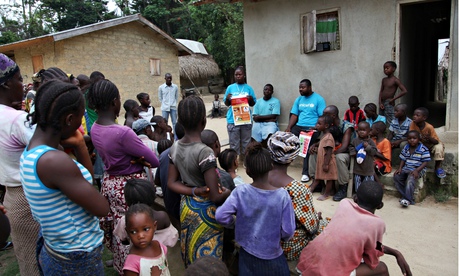
Villagers in Liberia are made aware of the dos and don'ts when faced with an Ebola outbreak Villagers in Liberia are made aware of the dos and don’ts when faced with an Ebola outbreak. Photograph: Eyepress/Sipa/Rex

A deadly disease is set to hit the shores of the US, UK and much of the rest of the northern hemisphere in the coming months. It will swamp our hospitals, lay millions low and by this time next year between 250,000 and 500,000 worldwide will be dead, thousands of them in the US and Britain.

Despite the best efforts of the medical profession, there’s no reliable cure, and no available vaccine offers effective protection for longer than a few months at a time.

If you’ve been paying attention to recent, terrifying headlines, you may assume the illness is the Ebola virus. Instead, the above description refers to seasonal flu – not swine or bird flu, but regular garden variety influenza.

Our fears about illness often bear little relation to our chances of falling victim to it, a phenomenon not helped by media coverage, which tends towards the novel and lurid rather than the particularly dangerous.

Ebola has become the stuff of hypochondriacs’ nightmares across the world. In the UK, the Daily Mirror had “Ebola terror as passenger dies at Gatwick” (the patient didn’t have Ebola), while New York’s news outlets (and prominent tweeters) experienced their own Ebola scare.

Even intellectual powerhouses such as Donald Trump have fallen into panic, with the mogul calling for the US to shut off all travel to west Africa and revoke citizens’ right to return to the country – who cares about fundamental rights during an outbreak? Not to be outdone, the endlessly asinine “explanatory journalism” site Vox informed us that “If the supercontinent Pangaea spontaneously reunited, the US would border the Ebola epidemic”.

Ebola is a horrific disease that kills more than half of people infected by it, though with specialist western treatment that death rate would likely fall a little. It’s unsurprising that the prospect of catching it is a scary one. The relief is that it’s not all that infectious: direct contact with bodily fluids of a visibly infected person is required, meaning that, compared with many illnesses, it’s easily contained.

Even in the midst of the current outbreak – the worst ever – the spread of the disease has not been rapid in west Africa: around 400 new cases were reported in June, and a further 500 or so in July. This is a linear spread, meaning each person at present is infecting on average around (actually just over) one additional person.

Far more worrying are diseases that spread exponentially: if one infected person spreads the disease to two or more on average, the illness spreads far quicker and is a much more worrying prospect, even if mortality is considerably lower.

The 800-plus deaths from Ebola in Africa so far this year are indisputably tragic, but it is important to keep a sense of proportion – other infectious diseases are far, far deadlier.

Since the Ebola outbreak began in February, around 300,000 people have died from malaria, while tuberculosis has likely claimed over 600,000 lives. Ebola might have our attention, but it’s not even close to being the biggest problem in Africa right now. Even Lassa fever, which shares many of the terrifying symptoms of Ebola (including bleeding from the eyelids), kills many more than Ebola – and frequently finds its way to the US.

The most real effect for millions of people reading about Ebola will be fear and stigma. During the Sars outbreak of 2003, Asian-Americans became the targets of just that, with public health hotlines inundated with calls from Americans worried about “buying Asian merchandise”, “living near Asians”, “going to school with Asians”, and more.

Similarly, during the H1N1 “swine flu” outbreak, which had almost identical spread and mortality to seasonal flu, patients reported extreme fear, prompted largely by the hysterical coverage.

In the coming months, almost none of us will catch the Ebola virus. Many of us, though, will get fevers, headaches, shivers and more.

As planes get grounded, communities are stigmatised, and mildly sick people fear for their lives, it’s worth reflecting what the biggest threat to our collective wellbeing is: rare tropical diseases, or our terrible coverage of them.

Bookmarked at brandizzi Delicious' sharing tag and expanded by Delicious sharing tag expander.
11 Oct 21:30

ISIS's Nightmare: Fierce Kurdish Women Fighters

On Monday the Turkish President Tayyip Erdogan said that the isolated Kurdish enclave of Kobani was  "about to fall" to a massive, sustained assault from ISIS.
Also on Monday, Rooz Bahjat, a Kurdish intelligence officer stationed in Kobani said the city would fall within  "the next 24 hours." By now ISIS was expecting to be slaughtering civilians by the score.

Instead, something totally unexpected happened -  ISIS has been forced to pull back.

A local Kobani official, Idris Nahsen, told AFP that fighters from the Kurdish People's Protection Units (YPG) had managed to push ISIS fighters outside several key areas after "helpful" airstrikes by the U.S.-led coalition

"The situation has changed since yesterday. YPG forces have pushed back ISIS forces," he said.

The Syrian Observatory for Human Rights, a Britain-based monitoring group, confirmed that ISIS fighters had withdrawn overnight from several areas and were no longer inside the western part of Kobani. They remained in eastern parts of the town and its southern edges, said Observatory director Rami Abdel Rahman, whose group relies on a network of sources inside Syria. The number of dead in the overnight fighting was not clear, but Mustafa Ebdi, a Kurdish journalist and activist from Kobani, wrote on his Facebook page that the streets of one southeastern neighborhood were "full of the bodies" of ISIS fighters.

Kobani has been under attack by  9,000 ISIS jihadists, armed with tanks and heavy artillery for nearly a month. This is the largest manned assualt by ISIS in its short existence.They are being opposed by just  2,000 Kurdish fighters with the YPG, the armed wing of the Kurdish Workers' Party (PKK), without access to any heavy weaponry and short on ammunition.
To put this into perspective,  800 ISIS fighters routed 2 divisions of the Iraqi Army, totaling 30,000 heavily armed soldiers, in June.
In other words, the Syrian Kurds of Kobani weren't supposed to stand a snowball's chance in Hell.

My father used to say, "It's not the size of the dog in the fight that matters. It's the size of the fight in the dog that does."

And now, here we are. Two days after Kobani was supposed to have become just the latest victims of ISIS terror. The difference is obviously the  motivation of who is fighting.

"We either die or win. No fighter is leaving," Esmat al-Sheikh, leader of the Kobani Defence Authority, told Reuters. "The world is watching, just watching and leaving these monsters to kill everyone, even children...but we will fight to the end with what weapons we have."

 Some people have more motivation than others. Those people include women. A very large percentage of the YPG fighters that have been so good at killing ISIS jihadists are  women.

I asked her about YPG’s women’s wing, the YPJ (Women's Protection Units), and the women fighters coming from Turkey. She said Kurdish women were as equally involved in defense affairs as in social services. “We have set up training camps for women in all three cantons. Women are active in all fronts,” she said. “Of the first 20 martyrs we had when IS attacked Kobani, 10 were women. Last year, of our 700 YPG martyrs, 200 were women...

I reminded Nimet of the legends we hear of IS militants fearing to encounter women fighters. She replied, “This is not a myth but reality. I personally met IS fighters face-to-face. Women fighters infringe on their psyche. They believe they won’t go to paradise if they are killed by women. That is why they flee when they see women. I saw that personally at the Celaga front. We monitor their radio calls. When they hear a woman's voice on the air, they become hysterical.”

Bookmarked at brandizzi Delicious' sharing tag and expanded by Delicious sharing tag expander.
10 Oct 23:16

Brazilians Stuff Suitcases in Last Free Perk for Fliers

Photographer: Paulo Fridman/Bloomberg

Brazil is the only country in the world where the law prohibits airlines from charging for a carry-on and two checked bags, the latter of which can weigh a total of 140 pounds. Close

Brazil is the only country in the world where the law prohibits airlines from charging... Read More

Close

Open
Photographer: Paulo Fridman/Bloomberg

Brazil is the only country in the world where the law prohibits airlines from charging for a carry-on and two checked bags, the latter of which can weigh a total of 140 pounds.

Cecilia Ribeiro Sainz Trapaga, her daughter and a grandson each lugged two 70-pound suitcases for travel to Sao Paulo last month from Orlando, Florida, on United Airlines. And they did so at no cost.

Had they been traveling to almost anywhere but Brazil, they would have had to pay for being at least 20 pounds overweight on each bag and as much as $100 for their second checked piece. But Brazil’s consumer-protection rules make it one of the most passenger-friendly places to fly, forcing airlines to handle extra luggage at no extra cost, put stranded travelers on competitors’ planes and face lawsuits for delays of as little as 30 minutes.

As a result, Gol Linhas Aereas Inteligentes SA (GOLL4), American Airlines Group Inc. (AAL) and other carriers can’t offset such expenses with additional revenue from fees that buoys profits in the U.S. and Europe. Airlines have been lobbying the government for years to tighten luggage weight limits because heavier planes burn more fuel.

“It’s a way of doing business that you have to be cognizant of,” said David Neeleman, founder and chief executive officer of Azul Linhas Aereas Brasileiras SA, in a Sept. 11 interview at Bloomberg’s New York headquarters. “It’s just a very consumer friendly place and people expect a lot and the government perpetuates that.”

Photographer: Paulo Fridman/Bloomberg

Brazil’s consumer protectionist rules make it one of the last passenger-friendly places to fly, forcing airlines to handle excess luggage at no extra charge, put stranded travelers on competitors’ planes and face lawsuits for delays of as little as 30 minutes. Close

Brazil’s consumer protectionist rules make it one of the last passenger-friendly places... Read More

Close

Open
Photographer: Paulo Fridman/Bloomberg

Brazil’s consumer protectionist rules make it one of the last passenger-friendly places to fly, forcing airlines to handle excess luggage at no extra charge, put stranded travelers on competitors’ planes and face lawsuits for delays of as little as 30 minutes.

Little Suitcases

In other parts of the world, airlines are getting even stricter about luggage, from carry-ons to suitcases bound for the cargo hold.

That means planes flying outside Brazil are lighter and more fuel-efficient, said Jay Sorensen, a former Midwest Airlines executive who now runs aviation consultancy IdeaWorksCompany.com in Shorewood, Wisconsin.

In Brazil, “they’re messing with the economics of airlines,” Sorensen said in a telephone interview. Brazil risks bankrupting its airlines by dictating what they can charge for, he said.

Air Canada and WestJet Airlines Ltd. said last month they would charge C$25 ($22) for the first checked bag on U.S. and domestic economy tickets. Fort Worth, Texas-based American Airlines allows passengers on flights to Europe one 50-pound checked bag for free, and charges $100 for a second bag of the same size. To some Mexican destinations, the first checked bag costs $25 and the second $40.

Europe’s low-cost carriers are famously restrictive with baggage allowances. On Ireland’s Ryanair Holdings Plc, travelers can’t bring onboard any bag weighing more than 10 kilograms (22 pounds). Beyond that, a first checked suitcase of 15 kilograms will set you back at least $20, according to Ryanair’s website.

Give Away

Brazil’s regulations mean that “when you force airlines to give something away for free, it’s just not economically efficient because somehow, somewhere, the customer is paying for this,” Sorensen said.

Usually that triggers higher ticket prices. A nonstop flight from Sao Paulo to Miami in mid-October runs about $1,600, according to a recent search on Expedia.com, while the cheapest nonstop flight of similar distance from New York to Rome is listed for $1,221. Barueri, Brazil-based Azul, which now just flies domestically, plans to add U.S. service in December.

“The whole world thinks one way, and in Brazil, we’re inventing things that just turn into costs and that increase ticket prices,” said Ronaldo Jenkins, director of security and operations at the Brazilian airline association, known as Abear. “The authorities are unchangeable, because they think it’s a win for the consumer.”

Free Snacks

Brazil’s aviation regulation agency, known as Anac, is in the process of reviewing the country’s luggage restrictions, it said in an e-mailed response to questions. The proposals, which include lower fares for travelers with less luggage, were open to public comment about 1 1/2 years ago and are now being analyzed by Anac.

Many travelers are accustomed now to having to pay extra for many things that were once taken for granted, including choosing a specific seat that might have more legroom and free snacks. Airlines are using fees from perks to boost the bottom line. Ancillary revenue rose to $16 per person last year from $6.99 in 2007, according to IdeaWorksCompany, which specializes in frequent flier programs and ancillary revenue. Baggage fees are the most significant source of ancillary income.

The Bloomberg U.S. Airlines Index beat the Standard & Poor’s 500 Index four times in the past five years. Gol has trailed Brazil’s benchmark Ibovespa during the same period.

Brazil Exception

Undoing the current rules is “going to be tough,” said Gol Chief Financial Officer Edmar Lopes, referring to efforts to get the government controls lifted. “A family with two adults and two kids, everyone, even in economy, has two bags and 32 kilos. So it’s 250 kilos for a family. Would you imagine that?” he said in a Sept. 7 interview in New York.

“As an international company, American Airlines abides by all laws and regulations of all the countries we serve,” the company said in an e-mailed request for comment about Brazil’s luggage policy. “From a market standpoint, our operations vary greatly around the globe.”

The disparity between Brazil and the rest of the world puts Brazilians in costly and awkward situations when they try to change planes in Europe and the U.S., said Abear’s Jenkins.

“You get to the States and you’re going to take a connecting flight and the guy’s going to charge you $500 in excess baggage,” Jenkins said in an interview in Sao Paulo.

Brazilians say it’s easy to go home with lots of stuff.

Families like Sainz Trapaga’s bring back mountains of goods -- from clothes and shoes to electronics and beauty products -- because they’re cheaper and of better quality abroad, she said.

‘Stupidly Expensive’

“We try to fill our suitcases as much as possible,” Sainz Trapaga said after disembarking from a United Continental Holdings Inc. (UAL) flight at Aeroporto Internacional de Sao Paulo/Guarulhos. “Here things are stupidly expensive.”

Louise Osis, traveling home to Santos, Brazil, with friends and relatives after visiting Orlando and New York, was bringing back a microwaveable egg cooker, Band-Aids and designer-brand attire.

“We bought things you can’t find in Brazil, like kitchen accessories,” Osis said while checking in at John F. Kennedy International Airport in New York. “And we saw a pair of basketball shoes that in Brazil cost 350 reais ($145) for $11.50, so of course we bought that.”

To contact the reporters on this story: Christiana Sciaudone in Sao Paulo at csciaudone@bloomberg.net; Julia Leite in New York at jleite3@bloomberg.net

To contact the editors responsible for this story: Ed Dufner at edufner@bloomberg.net Molly Schuetz, John Lear

Press spacebar to pause and continue. Press esc to stop.

Bookmarked at brandizzi Delicious' sharing tag and expanded by Delicious sharing tag expander.
10 Oct 23:15

honkshu: Alphonse Mucha - Study for The Death of Saint Adalbert...


honkshu:

Alphonse Mucha - Study for The Death of Saint Adalbert (1893)

10 Oct 23:15

Ebola is highly contagious … plus seven other myths about the virus

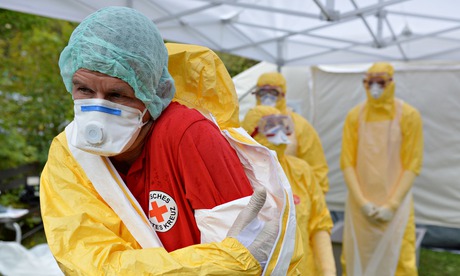
German Red Cross trains Ebola volunteers A volunteer doctor travelling to west Africa to help care for Ebola patients takes off an isolation suit during during training offered by the German Red Cross. Photograph: Timm Schamberger/Getty Images

The Ebola outbreak has been claiming lives in Africa for many months now, but following the first Ebola death from a case diagnosed outside the continent, coverage – and concern – in the west has stepped up yet another notch.

The outbreak is certainly a grave issue for west Africa, a public health priority, and has been exacerbated by a slow response from international bodies and rich nations. It has already claimed more than 3,800 lives, and could claim far more without an appropriate international response.

But it is also not the species-ending disaster some fear it could be. Below are eight Ebola myths, and an attempt to set out the real position.

1. Ebola is highly contagious

Compared with most common diseases, Ebola is not particularly infectious. The primary risk of catching Ebola comes from the bodily fluids of people who are visibly infected – primarily their blood, saliva, vomit and (possibly) sweat. These can transmit the disease if they make contact with the mucus membranes (lining of your nose, mouth, and similar areas).

Each patient in the current Ebola outbreak is infecting on average two healthy people (this figure, known as the R0 value, can be reduced with appropriate precautions). The Sars outbreak of 2002-03 had an R0 of five, mumps 10 and measles a huge 18. Ebola could be much more infectious than it is.

2. You can catch Ebola from someone who looks perfectly healthy

You almost certainly can’t. Ebola has an incubation period of up to 21 days between infection and showing symptoms (though it’s generally shorter). This is part of the fuel behind fears people could travel from west Africa then spread the disease.

However, in general, people who display no Ebola symptoms are not yet infectious – and in any case, casual social contact (being nearby, or even shaking hands) generally doesn’t spread the virus.

The exception actually lies with those who have had Ebola and recovered: studies suggest the virus can linger in semen for up to three months after recovery – so you may wish to think twice before having sex. Or at the very least, use a condom.

3. If you catch Ebola, you’ll almost certainly die

The most widely cited figure about Ebola is that its death rate is “up to 90%”. The history of Ebola, prior to this year, is a series of short-lived and very isolated outbreaks of different strains of the disease, and it is true that one of these outbreaks had a fatality rate of 90%.

Thankfully, this outbreak has a lower death rate. At present, about 8,000 people have been confirmed as diagnosed with Ebola, and of those 3,865 have, sadly, died. This is a fatality rate of 48% (though it could increase as some of those still ill die) – tragically high, but not nearly as bad as it could be.

Given the rudimentary and overloaded conditions in many of the hospitals in affected areas, it is likely this rate could be lower still for patients with access to top-tier medical care.

4. We should quarantine anyone with ‘Ebola-like symptoms’

This would lead to a lot of people being quarantined: if you want an accurate list of symptoms for early-stage Ebola, simply imagine the last time you (or someone you know) had flu – the two are almost indistinguishable at first.

This set of symptoms, shared among many common ailments, is behind the flurry of incidents at airports of “possible Ebola cases” causing so much coverage and disruption. It’s likely to keep happening, though there should be many more false alarms than real cases.

5. We should screen everyone for Ebola at our airports

Airports take in a lot of people, the overwhelming majority of whom have travelled nowhere near west Africa. Using measures like temperature sensors or similar en masse in western airports would trigger a vast number of false alarms.

The most effective measure, public health officials have repeatedly stated, is to make sure there is effective and comprehensive screening in place for people exiting countries with Ebola outbreaks – though some nations (notably the US) have implemented screening for airports with particularly high numbers of travellers from west Africa.

6. We are not ready for Ebola in the west

We’re about as ready as we can be. The Sars outbreak and pandemic flu scares mean hospitals and public health officials in most countries are required to have contingency plans for both local, small-scale outbreaks and major events.

Rich countries have much more ability to track and isolate those who have been in contact with anyone diagnosed with Ebola, and much better abilities to treat those who have been affected in hospital.

That’s not to say the risk is zero, but generally speaking public health officials are confident of their ability to limit the direct harm Ebola could do to countries like the US or UK.

7. Ebola has brought Africa to its knees

It is important to stress the three nations currently most affected by Ebola – Guinea, Liberia and Sierra Leone – face a public health emergency, social unrest, and economic issues caused by the protracted outbreak. Dealing with this is a humanitarian priority, and more help is needed.

But it is an oversimplification to suggest Ebola is a disaster for “Africa”, a continent of more than 50 countries and a land mass more than twice the size of Europe. The countries currently battling Ebola make up less than 1% of the continent’s economy – for much of Africa, like the rest of the world, it is largely business as usual.

It’s also worth noting that Ebola is far from Africa’s number one infectious killer: malaria, tuberculosis and HIV have each claimed hundreds of thousands of lives – many, many times more than Ebola – already this year, with none of the horrified coverage of the latter.

8. Ebola is the biggest public health disaster imaginable

Ebola is a real issue for the world’s governments, and one they’ve been slow to respond to. But there are many things epidemiologists (and others) think we should worry about far more.

Top of the list is a repeat of a deadly pandemic flu. Despite a few near misses, we’ve yet to see a repeat of the Spanish flu outbreak of 1918, which devastated nations already barely recovered from war, killing the youngest and healthiest.

There are extensive measures in place for such a situation, but officials agree they all leave much to be desired. If you must fear a pandemic, it’s a much better candidate than Ebola.

Ebola is a serious problem, which anyone with a degree of compassion should be concerned about. But if you’re in the west, it is astonishingly unlikely it will affect you, or anyone you know, personally.

Perhaps, though, it’s only that fear that’s making us pay the virus any attention at all.

Bookmarked at brandizzi Delicious' sharing tag and expanded by Delicious sharing tag expander.
10 Oct 23:15

Why an octopus's suckers don't stick its arms together

How does an octopus avoid tying itself in knots? Link to video: How does an octopus avoid tying itself in knots?

The question arose – the way questions can in science – when the team was faced with a freshly dismembered octopus arm that eagerly clung to everything it touched, with the notable exception of itself.

Octopuses are among the most extraordinary creatures in the ocean. They can blend into the background, morph into the shape of other beasts, and even regrow limbs lopped off by predators and scientists.

But for all their impressive feats, the octopus's walnut-sized brain cannot keep track of what its eight arms are doing. The problem is too hard. Since each arm is studded with suckers that act on contact, the mystery is this: how do octopuses not get tangled up in knots?

Researchers in Israel set out to answer the question in a series of experiments that grew steadily more gruesome and in time made full use of the common octopus's ability to grow back missing appendages.

Binyamin Hochner and his colleagues at the Hebrew University of Jerusalem had studied octopus arms for years. The limbs are intriguing for roboticists, because they are autonomous: none of the arms knows what the others are doing. Instead of being controlled from a central brain, decisions over much of their movement and behaviour are made within the arms themselves. Of the octopus's 500 million nerve cells, more than half are in their arms.

But octopus arms have more than a mind of their own. They can survive for around an hour after being amputated. Lone limbs have been seen to grab food and even pass morsels to where the arm thinks its owner's mouth must be.

It was a student of Hochner's who noticed, while working on other aspects of the octopus arm, that its suckers attached to everything except octopus skin. Something about the skin turned the suckers off. "We discovered this by accident. We're amazed nobody noticed it before," Hochner told the Guardian.

And so began the trials. On more than 30 occasions, Hochner noticed that amputated octopus arms never latched on to themselves or the arms of other octopuses. They would attach to petri dishes, but if half the petri dish was covered in gel soaked in octopus skin extract, the suckers avoided that half. The only time one amputated arm grabbed hold of another was when the latter had been peeled.

Tests on octopuses that had intact limbs were more equivocal. Presented with dismembered arms, some octopuses grabbed them as if they were lumps of food, and brought them to their mouths. They were less likely to do so if the amputated arm was one of their own.

Unsurprisingly, some octopuses seemed a little stumped. One octopus repeatedly rubbed its arms over an amputated appendage, touching it, but never activating its suckers. Others grabbed at amputated arms, but only where the flesh had been exposed where the limb was severed. Still more brought severed limbs to their mouths and held them with their beaks while the arms quickly let go. "The octopus cannot hold the arm properly with its suckers, so the only way it can hold it is with its beak," said Hochner. The scientists named the behaviour "spaghetti holding".

The experiments, described in the latest issue of the journal Current Biology, suggest that octopuses have a chemical in their skin that stops their suckers from sticking. But the mechanism is akin to a default setting, which the octopuses' brain can apparently override.

"It's a brilliant solution to what could be a really complex problem," Hochner said.

The scientists now want to learn which chemical, or combination of chemicals, is responsible for blocking the octopus's suckers, and how the animals can tell their own flesh from that of others.

Bookmarked at brandizzi Delicious' sharing tag and expanded by Delicious sharing tag expander.
10 Oct 23:15

asmilinggoddess: this is probably my favorite joke from...


asmilinggoddess:

this is probably my favorite joke from futurama tbh

10 Oct 23:14

Computer says “try this”

APPLES, mushrooms and pork sounds a promising recipe for a kebab, but the average barbecuer might balk at adding strawberries. According to John Gordon of IBM, however, the result is delicious. Dr Gordon is one of the leaders of that firm’s cognitive-computing team, responsible for a machine called Watson which is able to digest and analyse large amounts of English text and then draw inferences from it. When, in March, Watson was fed reams of recipes and texts about food, it reasoned that these four ingredients would complement each other, based on their sharing a number of flavoursome chemical compounds. And Dr Gordon, at least, thinks Watson’s suggestion is a winner.

Devising new recipes sounds a trivial use for a multimillion-dollar piece of kit. But Dr Gordon’s culinary experiment neatly demonstrates the idea of automated hypothesis generation—and the possible uses of that are certainly not trivial. More than 90 groups of scientists are now developing hypothesis-generation software. They hope to use it not on recipe books but on the vast corpus of scientific literature (by one tally at least 50m scientific papers) that has piled up in public databases.

The power of the technique was demonstrated by research published in August by Olivier Lichtarge of Baylor College of Medicine, in Houston, Texas, and his colleagues. In collaboration with Dr Gordon’s group, they employed it to hunt for proteins called kinases that activate another protein, p53, which curbs the growth of cancers. They used the software to read the abstracts of 186,879 papers and produced a list of the most promising kinases for experiments. The twist was that the papers in question were all published before 2003. That meant Dr Lichtarge could check to see if the Watson-based approach came to the same conclusions as those arrived at by human researchers over the subsequent ten years. And it did. Of the top nine kinases the software picked, seven have subsequently been shown to activate p53.

Anne Poupon of the French National Institute for Agricultural Research, in Tours, heads another group working on automated hypothesis generation. Her software, Méthode d’Inférence, crunches research on hormones and the 1,500 types of receptor molecules with which they interact. Sometimes, it recommends looking more closely at certain of these interactions because the literature on them contains contradictory results that need to be resolved. On other occasions it deems interactions ripe for closer examination because the hormone and receptor types involved are similar to those of known pairings that have already proved medically valuable. Even though Méthode d’Inférence is still a work in progress, it has already prevented the duplication of work within the institute and has produced a novel hypothesis about the mode of operation of follicle-stimulating hormone (a substance that helps, among other things, to govern the menstrual cycle).

A third example of automated hypothesis generation at work is brainSCANr, devised by Bradley Voytek of the University of California, San Diego, and his wife Jessica. BrainSCANr is designed to help neuroscientists choose research projects. It has, among other things, revealed a promising path for migraine research. By sifting through more than 3.5m papers, the software suggested that clues to the origin of migraines may be found in the levels of serotonin, a signalling molecule, that are released by neurons in a region of the brain called the striatum.

Hypothetical advantages

In Dr Lichtarge’s view, hypothesis-generation software works in part because science writing tends to be free of humour, sarcasm and “emotive or literary overlay” that could trip it up. That points to another source of text it can analyse in search of hypotheses to test. Web searches typically lack complex grammar and even verbs that could confuse software. By examining words typed into Microsoft’s Internet Explorer web browser and Bing search engine by people wondering why they feel ill, computers at Microsoft Research, in Redmond, Washington, are producing hypotheses on potentially harmful pairings of medications. Eric Horvitz, Microsoft Research’s head, says America’s Food and Drug Administration has formed a team to use these “early warning” hypotheses to produce better designs for laboratory experiments on potentially dangerous drug combinations thus revealed.

It all, then, looks rather promising, both for science and for IBM—which launched a commercial version of its automated-hypothesis-generation software in August. Dr Gordon hopes Discovery Advisor, as this service is known, will be a money-spinner for the firm. If that does happen, it will probably be because it has also proved an ideas-spinner for science.

Bookmarked at brandizzi Delicious' sharing tag and expanded by Delicious sharing tag expander.
10 Oct 00:42

Slavoj Žižek webchat – as it happened

Adam Victor Brandizzi

Eu recomendo muito abrir a página e ler toda a entrevista. É muito boa. (Esse nem é o trecho melhor, o melhor é sobre gatos)

I remember when Fukuyama published his book on The End of History, it was very fashionable to mock him. But in a certain sense, almost all of us were Fukuyamaists. Even the left, most of the left, was not raising fundamental questions, the big questions about the future of capitalism or state. They were just trying to make the existing system more just. And more efficient. And I think the big question today is: is this enough? It is clear, common sense tells us, that we humanity, all of us, are approaching a series of potential catastrophic problems, antagonisms. Ecology, the problem of finances and how to control them, intellectual property, who will control biogenetics, and especially new forms of apartheid in our societies. People say our society is becoming global: Berlin Wall fell down. Yes, but new walls are emerging everywhere, even literally. United States and Mexico, Israel and West Bank. And so on.

Here I want to refer to a rightwing philosopher who I appreciate, the German Peter Slotterdijk. He made a very intelligent observation about globalism. He said that globalism doesn't mean we are all in one big global society, he said that globe also means globe in the sense of cupola, grouping us and isolating us from the rest. Like he was probably referring to films like Elysium, where the privileged elite live under a protective cupola. And this is more and more our situation today. Go to LA: you have the symbolic cupola of Hollywood, Santa Monica, and then you have Inglewood, and literally if you are within the privileged part you are rationally aware there are slums but you don't really see them, they are not part of your world. You just become aware of them when violent riots, protests, explode.

So the Fukuyama problem is: can liberal democratic capitalism, in the long term, can it deal with these problems? I think not, unfortunately. And interestingly enough, even Fukuyama himself is no longer a Fukuyamaist, he admitted that The End of History is dated. So this is the problem today, how even to imagine an alternative. Even Hollywood knows that what is awaiting us, if things go on just the way we are now, is a new apartheid society. Hunger Games, Elysium and so on. But what to do? That remains a problem. I don't have easy solutions here.

Bookmarked at brandizzi Delicious' sharing tag and expanded by Delicious sharing tag expander.
10 Oct 00:41

toucanparty: see us next time for another episode of The...


toucanparty:

see us next time for another episode of The X-files

By Diigii [tumblr | twitter]

another eposide of The X-files = reblog

09 Oct 14:40

Devolution Is Superior to Secession

by Donald Devine

The 1996 Salzburg Seminar was a prestigious international gabfest organized to discuss “cross-cultural perspectives on conservatism.” Worldwide political parties and movements designated “conservative” at home or considered as such by Westerners were invited to explain their views on conservatism, to discuss what they held in common. With representatives from across Europe to Turkey, and even from China, obviously there was little commonality.

Playing by the rules, this U.S. representative suggested that localism and community could be a unifying ideal for the right, at which the French representative nearly swooned, furiously insisting that conservatism was precisely the opposite. It was love of the patria and of its representative the national state, whose point was seconded immediately by the Turkish representative. The Spanish, Italian, Belgian, and several Eastern European national representatives actually denounced local nationalistic movements as threats. But when I suggested sub-national movements were alive even in Britain, the idea was so preposterous the room immediately broke into laughter, with the Englishmen questioning my very sanity.

Two decades later Scotland massed 45 percent of its population willing to break 300 years of ties to become independent of England. Inspired, a million Catalans went to the street to demand independence, and its regional legislature voted to hold a (non-binding) referendum. Basques threatened the same. Flanders nationalists in Belgium promised that if Scotland received European Union representation, so would they. The Italian Northern League, organized around the ideal of separation, cheered Scotland on. Even Bavaria every so often threatens splitting from Germany. Norway and Sweden did separate in 1905, as did the Czech Republic and Slovakia in 1993.

All Europe was centralized under divine right kings and nationalisms at great cost in blood and treasure throughout the 16th and 17th centuries, forcing previously independent nations and peoples into the larger units we know today. Germany and Italy were not unified until the 1870s. Hundreds of independent states were dissolved over the period, but most of the successors retained local customs and institutions, many nursing old and developing new grievances against an often remote and unresponsive state. Even France still has restive Basques, Bretons, Savoyans, and others demanding local rights or independence.

Americans certainly have not been immune to the secession impulse, of course, including a great civil war costing millions of lives. While that war presumably settled the matter, even today a recent Reuters/Ipsos poll found that 23.9 percent of Americans would like to see their state pull away from the union, up from 18 percent in 2008. In the previous year under George W. Bush, 32 percent of liberals thought breaking away would be a good idea, compared to 17 percent of conservatives. Today under Barack Obama, 30 percent of Republicans and even 20 percent of Democrats would have their state secede.

Former congressman and presidential candidate Ron Paul even claimed a recent “growth of support for secession” inspired by Scotland and demonstrated by the one million Californians who supported dividing the state into six entities, saying this “should cheer all supporters of freedom.” He was congratulated for raising the issue by Daniel McCarthy of The American Conservative, but McCarthy responded that secession is not a principle of liberty. Not only does secession often trade one master for another—as Scotland would do under the European Union and NATO—but there is no guarantee the new state would foster internal liberty. McCarthy argues persuasively that for Scotland and America,

secession and union are questions of security and power, which undergird prosperity, self-government, and individual freedom. For much of the rest of the world, poisoned by ethnic and sectarian hatreds, secession means nationalism and civil strife. In both cases, breaking up existing states to create new ones is a revolutionary and dangerous act, one more apt to imperil liberty than advance it.

Indeed, Paul’s own original article on the matter viewed secession sentiments mostly as pressure on a national government to limit its power over local units as opposed to being valuable in itself. He specifically urged “devolution of power to smaller levels of government,” which can be a very different thing from secession. While secession is problematical as McCarthy argues, devolution of power within a national government is essential to liberty.

While unsuccessful as secession, Scotland’s threat forced even unionist party Prime Minister David Cameron to promise greater local autonomy not only for it but for Wales, Northern Ireland, and even England itself, although federalism will be challenging for Britain since England holds 85 percent of the population. While England basically invented local government with the parish (and transferred this ideal to America while it was being suffocated at home), it has long marginalized local government and restricted its powers. Margaret Thatcher, for all of her love of freedom, overrode local governments with abandon. Scotland’s message just might awaken England to its historical ties to local and regional government. Some useful ideas could be found by dusting off its 1957-1960 report of the Royal Commission on Local Government.

Centralization’s historic claim to greatness was ending Europe’s wars, especially those of religion through the 17th-century Treaty of Westphalia. Despite the claim by an overwhelming number of historians and commentators ever since, ending the 30 Years War did not end wars on the continent, much less elsewhere. A long series of dynastic wars followed, including the worldwide War of Spanish Succession, which Americans call the French and Indian War. More important, the 30 Years War was not a religious but a dynastic struggle. Catholic France actually fought on the supposed Protestant side. Major dynastic wars continued right up to World War I.

Westphalia actually created a number of powers sufficiently strong to challenge each other in alliances to decide which would rule, leading to the instability of the period. The world is more peaceful today because only one power emerged from World War II and the Cold War. While the U.S. has engaged more than was prudent, as McCarthy emphasizes, “a world consisting of more states more evenly matched, would almost certainly not be more peaceful.” Those who understand the fragility of freedom “should appreciate that all states are aggressive and seek to expand, if they can—the more of them, the more they fight, until big ones crush the smaller.”

American hegemony properly controlled thus assists world peace, and secession could threaten international and domestic liberty. Still, secession in its tamed form of federalism and decentralization presents the secret to domestic liberty, especially in larger states. The ability to devolve power to the lowest levels possible—first to the individual, then to the family, to free associations and businesses, to the community, to local and regional government, and only to the national state when no other institution can perform the function—allows freedom to adjust to community differences and make individuals more satisfied with their national state.

Where secession sentiments are high, it is a strong indicator that too much power is centralized. It is a lesson for Britain but, alas, increasingly one for the United States as well as a glance at recent federal court decisions immediately confirms.

Donald Devine is senior scholar at the Fund for American Studies, the author of America’s Way Back: Reclaiming Freedom, Tradition and Constitution, and was Ronald Reagan’s director of the U.S. Office of Personnel Management during his first term.

09 Oct 12:36

He Did The Crime, But She’s Doing Time

by Andrew Sullivan

Sometimes staying in an abusive relationship means enduring more than beatings. Alex Campbell reports on the horrifying case of Arlena Lindley, a domestic violence victim who was sentenced to 45 years in prison after her child, Titches, was killed by her abusive boyfriend, Alonzo Turner, for failing to prevent the child’s death:

Lindley’s case exposes what many battered women’s advocates say is a grotesque injustice. As is common in families terrorized by a violent man, there were two victims in the Lindley-Turner home: mother and child. Both Lindley and Titches had suffered beatings for months. But in all but a handful of states, laws allow for one of the victims — the battered mother — to be treated as a perpetrator, guilty not of committing abuse herself but of failing to protect her children from her violent partner. Said Stephanie Avalon, resource specialist for the federally funded Battered Women’s Justice Project, “It’s the ultimate blaming of the victim.”

Lindley’s not the only woman to suffer this injustice, either:

No one knows how many women have suffered a fate like Lindley’s, but looking back over the past decade, BuzzFeed News identified 28 mothers in 11 states sentenced to at least 10 years in prison for failing to prevent their partners from harming their children. In every one of these cases, there was evidence the mother herself had been battered by the man.

Almost half, 13 mothers, were given 20 years or more. In one case, the mother was given a life sentence for failing to protect her son, just like the man who murdered the infant boy. In another, the sentences were effectively the same: The killer got life, and the mother got 75 years, of which she must serve at least 63 years and nine months. In yet another, the mother got a longer sentence than the man who raped her son. In one more, a father fractured an infant girl’s toe, femur, and seven ribs and was sentenced to two years; for failing to intervene, the mother got 30.

Amanda Hess comments:

Campbell’s story demonstrates how the criminal justice system is scapegoating domestic violence victims in order to cover for its failures to properly investigate and prosecute instances of child and intimate partner abuse. Shortly before he began dating Lindley, Turner was charged on two separate occasions, first with burglary and later “unlawful restraint,” after he broke into an ex-girlfriend’s home, pushed her, and stole her belongings, then returned three weeks later, grabbed her by the neck, covered her mouth, and forced her outside. The woman escaped after a neighbor stabbed Turner in the leg; months later, Turner was out on probation from the burglary charge and was still awaiting trial on the restraint charge when he murdered the boy. On the day of Titches’ murder, another neighbor called police after she witnessed Turner kicking Titches on the floor, but when police arrived and couldn’t locate Turner or the toddler, they failed to pursue the report. It is outrageous that the justice system in this case only took a hard line against domestic violence after a child was killed.


09 Oct 11:49

O dia depois

1) Em dia de eleições, quer eu vote ou não, gosto de visitar os locais de votação. Quando tem polícia ou civilidade suficientes (e, portanto, ninguém tenta convencer ninguém, na última hora, à força de santinhos e bandeiras), o clima é festivo e calmo.

As famílias chegam juntas e, às vezes, endomingadas. Parece haver uma vontade de mostrar para as crianças o que é votar.

O clima é diferente do da missa de domingo ou de qualquer outra cerimônia religiosa –entre as cerimônias religiosas, incluo os comícios e todas as manifestações coletivas em que a massa venera, adora e louva um candidato, uma bandeira, um santo ou um santinho.

Votar talvez seja um rito e uma espécie de ato de fé. Mas o momento crucial desse rito não é coletivo –ao contrário, ele é estritamente reservado ao indivíduo. Rito de qual culto, então? E ato de fé em quê?

Pois é, ninguém (salvo ilusões e delírios) acredita que, depositando nosso voto na urna, a gente possa mudar o mundo. Mas, paradoxalmente, votamos exatamente por isso: para confirmar nossa fé no poder de os indivíduos modificarem o mundo.

Alguns dizem que votar é uma palhaçada ou, no mínimo, um fazer de conta desprezível. Outros acham que, ao contrário, é pelo voto que as vontades individuais acabam contando, porque elas se juntam e se transformam em vontades coletivas, as quais, por serem coletivas, pesariam mais e teriam o poder de mudar o mundo.

Invejo esse otimismo. Mas tendo a pensar que as vontades individuais nunca se somam e nunca produzem vontades coletivas. As vontades coletivas são entidades que nascem por conta própria e, em geral, pedem para os indivíduos desistirem do que eles desejam para serem "aceitos" numa coletividade.

Enfim, sem otimismo e sem pessimismo excessivo, prefiro pensar que votar (mesmo que não mude nada ou quase) seja uma espécie de condição sem a qual uma democracia é impraticável. Explico.

Para organizar nossa vida numa democracia, é preciso acreditar na possibilidade de o indivíduo expressar sua vontade e ser ouvido (que isso aconteça ou não, tanto faz). Votar é a expressão de uma fé necessária, um jeito de lembrar que, apesar de vivermos em sociedade, não renunciamos totalmente à nossa vontade individual.

2) Quase sempre, em dia de eleições, passo a noite esperando os resultados. Hoje, no Brasil, com as urnas eletrônicas, às 21h já se sabe quase tudo. É maravilhoso, mas sinto falta do suspense dos números parciais e de sua dolorosa interpretação noite adentro.

Hoje, quase sempre, durmo já sabendo quem ganhou ou, no caso, quem vai para o segundo turno.

3) Seja como for, que se trate do primeiro ou do segundo turno, o dia depois das eleições, para mim, sempre foi uma espécie de decepção –claro, maior no caso do segundo turno.

Acordo, tomo café e saio de casa para trabalhar –tudo normal. Não imagino que o mundo tenha mudado no meio da noite por causa do voto do dia anterior. Se houver mudanças, sei que elas levarão tempo: é necessário esperar o segundo turno e que os novos eleitos assumam. Isso, sem contar que as mudanças são lentas e progressivas, e pouco importa que os eleitos sejam proativos ou revolucionários.

Mesmo assim, no dia depois, saio de casa e olho ao redor de mim com uma certa surpresa. Tivemos eleições, mas tudo está igual a ontem, ou pior, igual a sexta passada, pois ontem era um pouco diferente, por ser domingo e, ainda por cima, domingo de eleições. As pessoas estão indo para o trabalho ou já estão aos seus postos. Tudo como sempre.

Mas o que eu estava esperando? O desespero de quem acha que perdeu? A festa descontrolada de quem acha que ganhou? Não, nada disso.

O quê, então?

Não sei, mas a sensação de que nada mudou, a sensação de que nasceu um dia igual a qualquer dia da semana passada, como num feitiço eleitoral do tempo, acaba me entristecendo.

Houve algumas eleições, ao longo da minha vida, em que, na manhã do dia depois, parecia que houvesse algo diferente no ar, como se o mundo não fosse nem pudesse mais ser o mesmo.

Lembro-me de duas: a eleição de Mitterand em 1981 e a eleição de Obama em 2008. Alguém me perguntará se não acho que foram apenas mais duas ilusões quaisquer. Responderei que não, que foram eleições que mudaram o gosto do ar que respirei naquelas manhãs (mudaram "l'air du temps", o ar do tempo, como dizem os franceses). Mas essa é outra história.

09 Oct 11:46

Vale a pena ler de novo: Arminio Fraga: Mitos do PT

8 de outubro de 2014 por mansueto

Folha de S. Paulo – 28/08/2014

Arminio Fraga: Mitos do PT

Não é de hoje que o PT adota uma retórica agressiva e populista para marcar suas posições. Em tempos de campanha, esta prática se radicaliza, adquirindo tons cada vez mais berrantes, e chegando frequentemente a se desentender com os fatos. Abaixo alguns exemplos.

O primeiro mito, mencionado em entrevista na televisão pela própria presidente Dilma, é que a culpa do baixo crescimento é da economia internacional. Não é verdade. Nos governos FHC e Lula, o Brasil cresceu a taxas médias muito próximas das da América Latina. Para os anos Dilma, o crescimento projetado está 2 pontos percentuais ao ano inferior ao da região, o que demonstra que não foi problema externo, foi interno mesmo.

O segundo diz que “basta estimular a demanda e o resto se resolve”. Não tem sido bem assim. Falta investimento, vítima de preconceitos ideológicos e má gestão. A produção e a importação de bens de capital afundaram nos últimos meses. A infraestrutura virou uma barreira ao crescimento. O investimento está flutuando em torno de 18% do PIB há anos, valor insuficiente para acelerar o ritmo de crescimento. É preciso elevar este porcentual a 24% até 2018, que é a nossa meta.

O terceiro é que os problemas da indústria serão resolvidos com medidas pontuais. Na verdade, a indústria nunca esteve tão mal. As taxas de juros estão para cima e o câmbio para baixo. O complexo sistema tributário é custoso e cumulativo, prejudicando as exportações e o investimento. A logística não está à altura das necessidades do país.

O quarto é o “querem fazer um arrocho”, em resposta à posição honesta de que (para voltar a crescer) o país necessita corrigir muitas de suas políticas. A verdade é que a economia está devagar quase parando, amarrada por uma enorme e crescente incerteza sobre seu futuro. As perspectivas para o ano que vem são sombrias, como indicam todos os indicadores de confiança disponíveis. O arrocho, com dispensas e suspensões de contrato de trabalho, já chegou, vamos cair na real.

O quinto é o estridente “vão fazer um tarifaço”. Aqui cabe, antes de mais nada, perguntar que situação é essa e como chegamos nela. Falo do irresponsável represamento dos preços de combustíveis e de energia, e da taxa de câmbio. No campo dos combustíveis, sofre a Petrobras asfixiada em seu fluxo de caixa, sofre o setor de etanol, onde as falências crescem, e sofre o meio ambiente, com o absurdo subsídio implícito a combustíveis fósseis. No setor elétrico, um movimento voluntarista de redução de tarifas saiu pela culatra, e vem gerando uma dívida bilionária com as distribuidoras de energia. Por último, a repressão da taxa de câmbio desestimula as exportações e pressiona ainda mais o deficit em conta corrente, hoje em 3,5% do PIB.

Em sexto lugar, há a acusação de que “o governo FHC sempre cortou o gasto social”. Acusação falsa, como demonstra Samuel Pessôa em artigo recente nesta Folha. Medido como a soma de INSS, Lei Orgânica da Assistência Social, abono salarial, seguro desemprego e bolsas, o gasto social cresceu cerca de 1,5 ponto do PIB em cada um dos governos Itamar/Collor, FHC, Lula e Dilma (esta em cerca de 1 ponto até agora). Na verdade, o governo FHC representou uma guinada no foco do gasto público na direção da educação e da saúde, ponto nunca reconhecido pelo PT.

Finalmente, o governo diz que “quebraram o país e nós pagamos o FMI”. Em 2002, o Brasil quase quebrou, sim, em função do medo do que faria o PT no poder (e que Lula resolveu, para seu eterno mérito). No segundo semestre de 2002 o governo FHC (com anuência da oposição) tomou um empréstimo com o FMI de US$ 30 bilhões. Cerca de 80% do empréstimo foram reservados para o próximo governo, sendo 20% desembolsados (e não gastos) em dezembro de 2002 e o restante já durante o governo Lula. Portanto os recursos ficaram, na prática, à disposição do governo Lula.

O populismo e a mentira são inimigos da democracia e da boa política. Temos que melhorar a qualidade do debate público, que deve ser baseado em fatos e dados.

ARMINIO FRAGA NETO, 57, economista, foi presidente do Banco Central (governo Fernando Henrique). É assessor do candidato à Presidência da República pelo PSDB, senador Aécio Neves (MG)

Curtir isso:

Curtir Carregando...

Relacionado

08 Oct 21:29

Suécia vai reconhecer Estado da Palestina | Internacional | DW.DE | 03.10.2014

A Suécia vai reconhecer o Estado da Palestina, anunciou nesta sexta-feira (03/10) o novo primeiro-ministro Stefan Lofven, sublinhando que a solução do conflito entre israelenses e palestinos passa pela criação de dois Estados.

"Uma solução de dois Estados supõe um reconhecimento mútuo e a vontade de uma coexistência pacífica. Por isso, a Suécia vai reconhecer o Estado da Palestina", declarou Lofven em seu discurso de tomada de posse no Parlamento.

Segundo ele, devem ser respeitadas "as exigências legítimas tanto dos palestinos, quanto dos israelenses quanto à sua autodeterminação e à sua segurança".

O novo governo sueco, formado por social-democratas e verdes, é mais favorável à causa palestina do que o anterior, que seguia a linha dos grandes países da Europa Ocidental na questão.

O reconhecimento do Estado palestino e o apoio ao trabalho de reconciliação estão entre as prioridades do Partido Social-Democrata, que quer igualmente que "os crimes de guerra de Israel sejam analisados e que o bloqueio a Gaza seja suspenso".

O primeiro-ministro sueco não explicou se o reconhecimento será sujeito ao voto do Parlamento, no qual o novo governo é minoritário, nem especificou quando ele acontecerá.

  • Palästinenser Regierung erste Kabinettssitzung 03.06.2014

    Os 50 dias de guerra em Gaza

    Governo de unidade palestino

    Em 2 de junho, en Ramallah, na Cisjordânia, Hamas e Fatah oficializam um governo de unidade. Europeus e americanos manifestam apoio, porém com cautela. O governo israelense reage e suspende as negociações de paz mediadas pelos Estados Unidos, por considerar o Hamas uma organização terrorista.

  • Trauerfeier für entführte Studenten in Israel

    Os 50 dias de guerra em Gaza

    Sequestro de três estudantes

    Em 12 de junho, três estudantes israelenses são sequestrados. O primeiro-ministro Benjamin Netanyahu culpa o Hamas pelo desaparecimento dos jovens. No final de junho, os corpos são encontrados. Em 23 de agosto, pouco antes do cessar-fogo duradouro, o Hamas assumiria envolvimento no assassinato dos três.

  • Israel - Ausschreitungen nach der Trauerfeier um Mohammed Abu Chedair

    Os 50 dias de guerra em Gaza

    Assassinato de jovem palestino

    Em 2 de julho, o corpo de um adolescente palestino, de 16 anos, é encontrado numa floresta perto de Jerusalém. A família acusa colonos israelenses do assassinato. Na parte árabe de Jerusalém, há confrontos com a polícia israelense. Após seguidos lançamentos de foguetes a partir da Faixa de Gaza, o Exército israelense move tropas adicionais à divisa com o território palestino.

  • Gazastreifen Bodenoffensive Israel 18.07.2014

    Os 50 dias de guerra em Gaza

    Começa a guerra

    Em 8 de julho, o conflito entre israelenses e palestinos torna-se novamente uma guerra. Em poucas horas, dezenas de foguetes são lançados da Faixa de Gaza contra Israel. Não há feridos, já que grande parte dos mísseis são destruídos no ar. Nos ataques aéreos israelenses, mais de 20 pessoas são mortas.

  • Israel Angriffe auf Gaza 16.07.2014

    Os 50 dias de guerra em Gaza

    Iniciam-se as negociações

    Após uma semana de conflito, em 14 de julho surge a primeira esperança de um cessar-fogo. O Egito intervém como mediador. Israel concorda com uma trégua prevista para o dia seguinte. O Hamas rejeita a proposta egípcia. "Um armistício sem um acordo com Israel está fora de questão", disse o porta-voz do grupo. A guerra, então, já tinha 180 mortos.

  • Galerie - Tunnel Gazastreifen

    Os 50 dias de guerra em Gaza

    A primeira trégua

    Em 17 de julho, pela primeira vez desde o início dos combates, Israel e Hamas concordam com um cessar-fogo de cinco horas. Após o período, Israel começa uma ofensiva terrestre. Netanyahu detalha os objetivos da operação: a infraestrutura do Hamas deve ser destruída, especialmente os chamados "túneis do terror".

  • Paris / Gaza-Krise / Nahost-Konflikt / Krawalle

    Os 50 dias de guerra em Gaza

    Protestos pelo mundo

    O secretário-geral da ONU, Ban Ki-moon, apela por uma suspensão dos ataques. Um dia depois, em 20 de julho, ele viaja com o secretário de Estado dos EUA, John Kerry, ao Cairo para discutir uma trégua. Em Gaza, milhares de pessoas fogem de suas casas e procuram abrigo. Em alguns países, há protestos contra a ofensiva de Israel. Em Paris, há manifestações e ataques contra instituições judaicas.

  • Angriff auf UN-Schule in Gaza

    Os 50 dias de guerra em Gaza

    Ataque a escola da ONU

    Em 24 de julho, 15 pessoas morrem e mais de 200 ficam feridas em um ataque israelense a uma escola das Nações Unidas. O Exército de Israel argumenta que havia avisado sobre a investida antes de ela ocorrer. A agência de refugiados da ONU informa que a evacuação da escola não era possível. Mais de 570 palestinos e 25 soldados israelenses são as vítimas da guerra até então.

  • Waffenruhe bringt Zerstörung im Gazastreifen zum Vorschein 26.07.2014

    Os 50 dias de guerra em Gaza

    Novo cessar-fogo

    Em 26 de julho, começa um cessar-fogo de 12 horas. Em Paris, ministros do Exterior se encontram para discutir uma trégua permanente. Muitos palestinos usam a suspensão dos ataques para comprar medicamentos e alimentos. Os serviços de emergência retiram mais de 130 corpos dos escombros. Israel anuncia o prolongamento do cessar-fogo por algumas horas, mas o Hamas dispara foguetes novamente.

  • Beschuss von UN-Schule im Gazastreifen 03.08.2014

    Os 50 dias de guerra em Gaza

    Tréguas violadas

    Uma nova trégua é violada, em 1º de agosto. Nos dias seguintes, o caso se repete. No início de agosto, Israel dispara novamente contra uma escola da ONU e, em seguida, retira as tropas terrestres da Faixa de Gaza. No Cairo, as partes envolvidas no conflito negociam um cessar-fogo duradouro.

  • Gaza Israel Krieg Waffenruhe 12.08.2014

    Os 50 dias de guerra em Gaza

    Chance à paz

    A mais longa trégua desde o início da guerra possibilita, a partir de 10 de agosto, negociações. O cessar-fogo que era para durar três dias se estende por nove. O mediador, Egito, evita a longa lista de exigências dos dois lados. Um pequeno texto seria promissor para um possível acordo. A abertura das fronteiras de Gaza e a expansão gradual da zona de pesca são discutidas.

  • Raketenangriff aus Gaza auf Israel 20.08.2014

    Os 50 dias de guerra em Gaza

    Mortes passam de 2 mil

    Um armistício permanente é quase alcançado em 19 de agosto. Mas foguetes são novamente lançados. Israel responde e mata, entre outros, a mulher e filho de um chefe militar do Hamas nos ataques. Dois mil palestinos foram mortos e mais de 10 mil ficaram feridos na guerra. O lado israelense contabiliza as mortes de 64 soldados e três civis. Uma criança israelense morre por um foguete lançado de Gaza.

  • Palästinenser feiern Waffenstillstand

    Os 50 dias de guerra em Gaza

    Cessar-fogo permanente

    Depois de 50 dias de guerra, em 26 de agosto o Egito consegue fazer as duas partes chegarem, enfim, a um cessar-fogo permanente. O acordo entre os palestinos e Israel garante que as fronteiras de Gaza serão reabertas. As negociações para tratar de mais detalhes do acordo continuam em quatro semanas.


    Autoria: Isadora Pamplona

Bookmarked at brandizzi Delicious' sharing tag and expanded by Delicious sharing tag expander.
08 Oct 21:28

iraffiruse: Frozach Submitted

08 Oct 21:27

Marina quer aceno tucano a MST e índios para apoiar Aécio - 08/10/2014 - Poder - Folha de S.Paulo

Adam Victor Brandizzi

Hahahah boa :)

Terceira colocada na disputa pela Presidência da República, com 21% dos votos válidos, Marina Silva (PSB) bateu o martelo sobre as condições que determinarão seu apoio a Aécio Neves (PSDB) no segundo turno das eleições: o tucano precisa fazer um aceno à esquerda, principalmente aos movimentos sociais.

Reunida com aliados há três dias no apartamento em que costuma se hospedar na zona sul de São Paulo, Marina definiu que a reforma agrária e o comprometimento com os índios e o Movimento dos Trabalhadores Rurais Sem Terra figuram entre as prioridades para que seu apoio a Aécio seja público.

A ex-senadora disse a interlocutores que precisa ser "convencida" de que a candidatura do PSDB firmará compromissos com segmentos da sociedade que votaram nela em 2010 e em 2014. Para isso, espera o contato do tucano.

"Marina não vai ao encontro de Aécio. Ele que precisa ir ao encontro dela", disse um dos principais assessores da pessebista.

A ex-candidata ao Palácio do Planalto espera que o tucano procure a ela ou a seus assessores para entender as exigências que coloca à mesa para finalmente firmar a aliança e que dê sinais públicos de que fará flexões à esquerda.

Nas áreas de economia e relações exteriores, por exemplo, o programa de governo de Marina é bastante liberal, como o de Aécio. Outros temas que foram destacados por ela como fundamentais para a aproximação –reforma política com o fim da reeleição, sustentabilidade e educação em tempo integral– já estão contemplados no plano da candidatura tucana.

Marina e Aécio não conversam desde segunda-feira (6), quando a ex-senadora telefonou ao tucano e à presidente Dilma Rousseff (PT) e os parabenizou pelos resultados na disputa. Não falaram sobre um eventual apoio.

Campanha Marina Silva

FORMATO

Fora do segundo turno, Marina tenta construir um discurso coerente com a postura de "nova política" que defendeu durante toda a campanha. Por isso, exigirá que o tucano se comprometa pessoalmente com temas como a demarcação de terras indígenas, mantendo o poder da Funai, e a reforma agrária, com assentamentos populares. O projeto do PSDB é historicamente pouco identificado com essas questões.

Dessa forma, Marina acredita que não será cobrada por eventuais promessas não cumpridas. Aliados da ex-senadora afirmam que Aécio não precisará conversar in loco com todos os segmentos. "Pode mandar representantes e endossar o compromisso em seu programa de TV", afirma um assessor da pessebista.

Nesta quarta-feira (8), Marina participa de uma reunião por teleconferência com a direção nacional da Rede, seu grupo político, composta por 120 integrantes, para discutir a posição tomada na reunião da Executiva, na terça (7).

Na ocasião, os 24 membros da instância decidiram pela "mudança qualificada" e a "não continuidade do governo atual", dando o aval a Marina para fechar com Aécio. Também nesta quarta, a Executiva do PSB se reúne em Brasília para definir a posição do partido no segundo turno. A tendência é pró-Aécio.

Na quinta-feira (9), Marina, PSB e os outros partidos da coligação –PPS, PHS, PPL, PRP e PSL– fazem uma reunião para fechar a decisão. Marina quer construir o consenso em torno do nome de Aécio para que seu pronunciamento público em favor do tucano não seja imprescindível após a reunião. Caso não haja acordo, já disse que tomara posição individual.

Bookmarked at brandizzi Delicious' sharing tag and expanded by Delicious sharing tag expander.
08 Oct 21:27

Think Norway’s new bank notes are cool? You should see the ones they rejected

The central bank of Norway has decided on the design of its next bank notes after a competition, based on the theme of “The Sea.” And—unsurprisingly, given Scandinavia’s reputation for beautiful design—they are pretty special.

One side of the new notes, to enter circulation in 2017, will show off designs by the Metric System and Terje Tønnessen, which Norges Bank described as “open, light and typically Nordic.”

(The Metric System and Terje Tønnessen)

On the reverse of the note will be a beautiful pixellated design by Snøhetta Design. The studio said: “When contrasts come together, as when soft meets hard or digital meets analog, a dynamic is created. Our cubical pattern first of all represents pixels; our times’ visual language.”

There were eight participants shortlisted by the jury for the competition. All the entries can be found here (pdf).

And the quality of the work showed why Scandinavian design is admired across the world. Any of the entrants could have won. In fact, one of the other designers did win—Enzo Finger’s entries were judged by the bank’s jury as the best of the competition, though that apparently was not enough to actually get on the notes:

(Enzo Finger)

Other entries included these from the designer Aslak Gurholt Rønsen, who included the drawings by children:

(Aslak Gurholt Rønsen) (Aslak Gurholt Rønsen) (Aslak Gurholt Rønsen)

These are by Blæst Design, based on the idea of expanded horizons:

(Blæst Design) (Blæst Design)

Christian Messel and Pati Passero, working with a theme of anonymous portraiture in contrast to stereotypical images of the Great Men who shaped history:

(Christian Messel and Pati Passero)
(Christian Messel and Pati Passero) (Christian Messel and Pati Passero)

Ellen Karin Mæhlum looked at the “microscopic, beautiful and unicellular plankton that form the basis for life in the sea:”

(Ellen Karin Mæhlum) (Ellen Karin Mæhlum) (Ellen Karin Mæhlum) (Ellen Karin Mæhlum)

And the visual artists May Elin Eikaas Bjerck wanted to highlight the coast:

(May Elin Eikaas Bjerck) (May Elin Eikaas Bjerck)
Bookmarked at brandizzi Delicious' sharing tag and expanded by Delicious sharing tag expander.
08 Oct 14:30

Marriage

People often say that same-sex marriage now is like interracial marriage in the 60s. But in terms of public opinion, same-sex marriage now is like interracial marriage in the 90s, when it had already been legal nationwide for 30 years.
08 Oct 14:28

Ideias fora do lugar

BRASÍLIA - Para cada problema complexo existe uma solução simples. Em geral, errada. Essa é a lógica por trás de uma ideia que tem sido muito propagada: acabar com a reeleição para cargos executivos (prefeitos, governadores e presidente da República).
No início da campanha, Aécio Neves (PSDB) e Eduardo Campos (PSB) defenderam a proposta. Em seguida, Marina Silva abraçou a ideia. O ex-presidente do Supremo Tribunal Federal Joaquim Barbosa fez defesa enfática da tese: "A reeleição funciona como a mãe de todas as corrupções".

Aécio e Marina acham que a reeleição deve ser eliminada e todos os mandatos então seriam aumentados de quatro para cinco anos. Todas as eleições passariam a ser coincidentes ""de vereador a presidente da República.

É curioso Marina "nova política" Silva estar de acordo com uma alteração que afastará os eleitores dos políticos. Isso mesmo. Hoje, os brasileiros votam a cada dois anos. Se vingar o que ela e Aécio sugerem, as eleições se darão apenas a cada cinco anos.

No mais, há um senso comum (equivocado) sobre a reeleição ser sinônimo de uso da máquina estatal, com recondução automática do governante. A vida real é bem diferente. Primeiro, basta observar o calor pelo qual passa Dilma Rousseff para tentar ficar outros quatro anos no Palácio do Planalto.

Há uma estatística contundente nos Estados. Desde 1998, quando a reeleição passou a ser possível, 77 governadores tentaram ficar no cargo para um segundo mandato (até 2010). Desses, só 50 tiveram sucesso. Ou seja, 35% dos que tentam a reeleição são rejeitados pela urnas.

Tudo considerado, o fim da reeleição não redimirá a política. Pior. Acabar com esse instituto vai privar bons políticos –do PT, do PSDB ou de qualquer partido– de ficar mais um mandato quando estiverem fazendo uma administração correta.

Bookmarked at brandizzi Delicious' sharing tag and expanded by Delicious sharing tag expander.
07 Oct 23:53

Make your smartwatch even less useful by installing Windows 95

The smartwatch product category is still just getting off the ground, and right now they aren't the most useful things on the planet. There is a ton of power packed into them, though, and the main problem is essentially limited software. In that regard, how about running a full desktop OS on your wrist?

Corbin Davenport has been torturing his Android Wear-powered Samsung Gear Live by making it run all manner of things it shouldn't ever be asked to run. Thanks to the Android DOS emulator aDosBox, he's even gotten Windows 95 to boot up, which you can see in the above video. Sadly, it's not running perfectly. Thanks to a lack of emulator configuration, Windows 95 keeps running out of memory and apps just crash. The Gear has a whopping 512MB of RAM, but the emulator just doesn't let Windows address it all.

It's not just Windows that Davenport has gotten running on the Gear Live. He also has video of the Android version of Doom (of course) and Minecraft PE. The 1.65 inch screen makes everything pretty unusable, but it's all in good fun. If you want to see more microscopic programs running on a smartwatch, don't forget our attempts with the original Galaxy Gear—we got Candy Crush and a full Android Launcher up and running on these little things.

Bookmarked at brandizzi Delicious' sharing tag and expanded by Delicious sharing tag expander.