Cowboy Who?
Shared posts
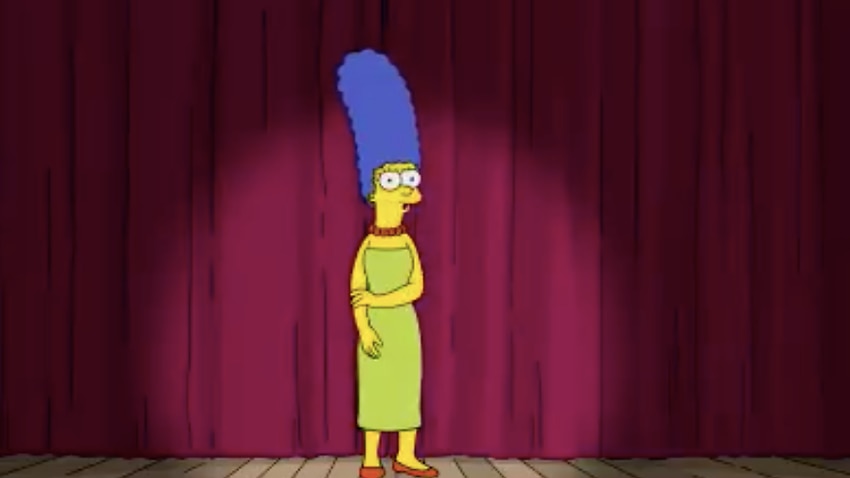
Marge Simpson hits out at Donald Trump's aide who made a Kamala Harris jibe
Dolly Parton: 'Of course black lives matter!'
In Aerial Combat Over Lake Michigan, Eagles: 1; Drones: 0

Last month, Hunter King was using a drone to map shoreline erosion for Michigan's environmental department when a bald eagle apparently attacked the vehicle, causing it to crash into the water.
(Image credit: RJ Sangosti/MediaNews Group/The /Denver Post via Getty Images)

How Should I Cover My Face? A Deeper Look Into Neck Gaiters And Face Shields

Experts look into a new study that claims wearing a neck gaiter may be worse than no mask at all. And they discuss other face coverings such as goggles and plastic face shields.
(Image credit: Gina Ferazzi/Los Angeles Times via Getty Images)

'Of Course Black Lives Matter,' Dolly Parton Tells Billboard

"Do we think our little white asses are the only ones that matter? No!" the singer, songwriter, philanthropist and businesswoman told the music magazine.
(Image credit: Terry Wyatt/Getty Images)

Mail-in ballots sent to Trump in Florida despite repeated criticism of practice

U.S. President Donald Trump has requested a mail-in ballot for Florida's Tuesday primary election, despite weeks of criticizing the practice.
Supreme Court Allows Rhode Island To Make Voting By Mail Easier Amid Pandemic

The state has agreed to suspend a requirement that mail-in ballots must be signed before two witnesses or a notary. The high court rejects a Republican effort to reinstate the rule this fall.
(Image credit: Steven Senne/AP)

Fortnite Uses Apple's Own '1984' Ad Against It In Dispute Over Payments

Apple pulled the popular shooting game from its App Store, after its developer tried to get around the fee Apple requires from in-app purchases.
(Image credit: Epic Games)

Heat continues, and a word on Hurricane Ike
Our forecast is going to be very hot, with heat advisories likely needed through the weekend. Before jumping into the details, such as they are, I wanted to say a word about Hurricane Ike.
We are, amazingly, coming up on the 12th anniversary of Hurricane Ike. If you don’t remember, the storm hit Houston fairly hard, but made landfall just far enough east of Galveston that the worst of its storm surge missed Galveston Bay. It represented an enormous wake-up call for the region in terms of vulnerability of coastal residents, as well as the Houston Ship Channel. Unfortunately, while we have studied the problem in depth, we have yet to commit to any major projects that would address the threat and mitigate surge. There are two main proposals: A Coastal Spine Project led by the U.S. Army Corps of Engineers and the General Land Office, and an astonishingly beautiful Galveston Bay Park that would protect the Houston Ship Channel from a 25-foot storm surge.
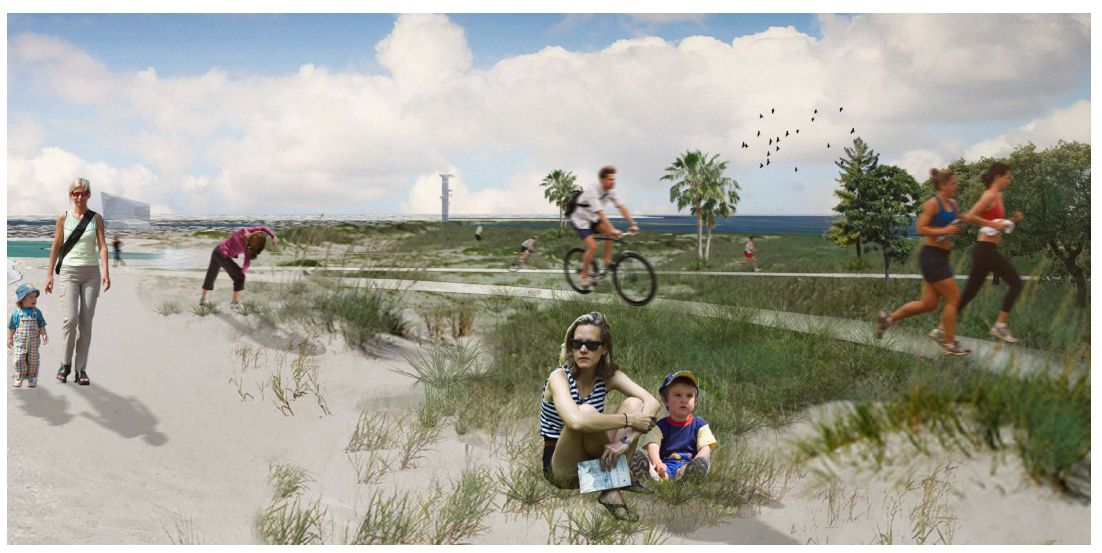
Visualization of park space that would exist on Galveston Bay Park. (SSPEED Center)
While we certainly realize that America and Texas have a lot of other problems to deal with at present, it is time to pick one, or both, of these projects to move forward with for the good of the greater Houston region. Otherwise, we may not get so lucky with the next large hurricane that makes landfall along the upper Texas coast.
Thursday
Houston’s high temperature hit 101 degrees on Wednesday at Bush Intercontinental Airport, and we can probably expect more of the same today with mostly sunny skies. The National Weather Service has issued a heat advisory for now through Friday evening, and in truth it probably will be extended through the weekend as high pressure continues to influence our weather. Southwest winds of 5 mph will provide very little cooling today. Nights will remain sticky and warm.
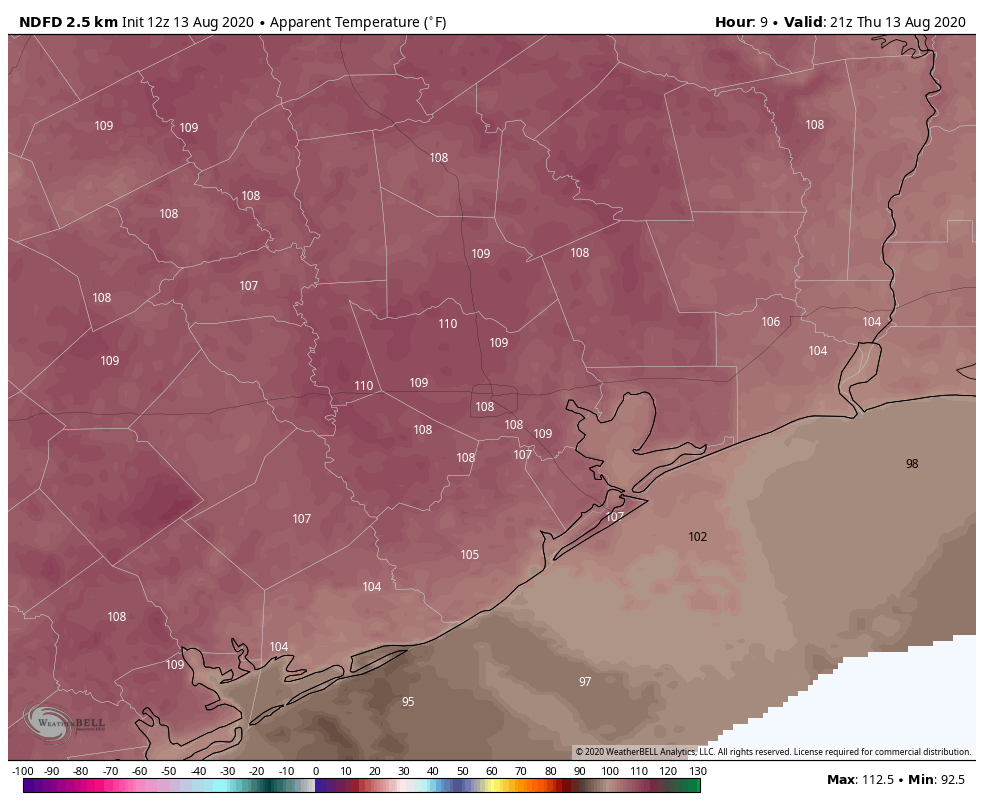
Heat Index temperatures will again be smoking hot on Thursday in the region. (Weather Bell)
Friday, Saturday, and Sunday
More. Of. The. Same. It’s probably worth mentioning that we could see a few isolated showers pop up during the afternoon, with daytime heating. I’d sure welcome one, but it seems a forlorn hope at this point.
Next week
The heat should back off somewhat by Tuesday, as some sort of weak cool front approaches the area. We still don’t have great confidence in how far this front will reach, but it should help to increase rain chances by Monday night or Tuesday, and then knock back daytime highs into the low- or mid-90s. We’d love to get some dry air to help with nighttime temperatures, but I’m not ready to bet on that yet.

The Twenty Most Iconic Local TV and Billboard Legends in Texas, Ranked
 They exist in every city: the local icons whose TV commercials ran late at night, or whose billboards adorned off-ramps, reminding residents who to call if they needed a personal injury lawyer, a used car, or new furniture. Just mentioning someone’s name will often spur locals—who grew up with some guy (it’s usually, but not always, a guy)—to sing a jingle, recite a slogan, or cite the beginning of a phone number. Of course, everybody in every city thinks that their local legend is the best one. But it is our job to assess the candidates and give them to you, the good people of Texas, in a ranked and highly subjective list. We compiled this list of twenty after searching through our archives, consulting…View Original Post
The post The Twenty Most Iconic Local TV and Billboard Legends in Texas, Ranked appeared first on Texas Monthly.
School Committee Meeting to Decide On Your Future In Teaching Bingo

Happy birthday, dad!
Happy birthday to the coolest dad!

Saturday Morning Breakfast Cereal - Soul
Click here to go see the bonus panel!
Hovertext:
There are only like 5 dogs with souls, and they all work in the movies.
Today's News:

TikTok Trump lip-syncer Sarah Cooper gets a Netflix special
For its latest big get, Netflix has snagged Sarah Cooper, the comedian who has perfected mocking President Donald Trump using his own words (via Variety). The company will start streaming Sarah Cooper: Everything's Fine this fall. Netflix says the special will feature an array of guests taking part in short interviews and sketches led by Cooper. It will touch on topics like race, gender, class "and other light subjects."
How to medical pic.twitter.com/0EDqJcy38p
— Sarah Cooper (@sarahcpr) April 24, 2020
Helping Cooper bring the special to life is a talented crew that includes Natasha Lyonne (Orange is the New Black, Russian Doll) and Maya Rudolph (Big Hero 6, Vader Immortal). Lyonne will direct, with Rudolph serving as one of the executive producers on the special.
By this point, you've probably seen Cooper's "How to medical," a TikTok video where she pokes fun at the White House briefing where President Trump suggested doctors could use disinfectants to treat COVID-19. The video has 22.4 million views and 174 thousand retweets on Twitter.
Cooper also has a connection to the world of tech. Before becoming a comedian, she worked as a design manager at Google, assisting the Docs, Sheets and Slides teams. Her time at the search giant inspired 100 Tricks to Appear Smart in Meetings, a satire about how to be successful at team meetings.
A supporter of the far-right QAnon conspiracy theory looks set to be elected to US Congress

The Morning After: Surface Duo ships September 10th for $1,399
Early Tuesday morning, a Microsoft blog post popped up revealing pricing and other details for its dual-screen Surface Duo Android device. The $1,400 handheld will go on sale September 10th, complete with its “revolutionary” 360-degree hinge that enables use of the 5.6-inch screens when it’s open or closed.

There’s not a lot of information posted yet — keep an eye on the site, we’re expecting more details shortly — but that price puts it solidly above large Android phones like the Galaxy Note 20 Ultra and below foldables we’ve seen so far. We’ll need some hands-on time to decide if good looks and a slick hinge are worth the price.
— Richard
Xiaomi made see-through OLED TV
Xiao you see me…

As part of its 10th anniversary celebration, alongside some high-spec phones, Xiaomi revealed a transparent TV, the Mi TV Lux OLED Transparent Edition. It will cost 49,999 yuan (about $7,200), but it’s also vaguely magical.
When it’s turned off, the 55-inch display looks like a piece of glass. When it’s turned on, images appear to float in thin air, or so Xiaomi says. It goes on sale in China on August 16th.
Continue reading.
Microsoft’s Xbox Series X will launch in November — without ‘Halo Infinite’
And xCloud is in beta for some players.

We don’t have a launch date for the Xbox Series X yet, but we do have a launch month. You probably could’ve guessed a new console would launch in November, but just in case, Microsoft has confirmed things. It also revealed that instead of being a launch title, Halo Infinite will ship at some point in 2021, presumably so the developers at 343 can address some of the issues that disappointed gamers in its gameplay reveal recently.
In terms of things you can play, Xbox Game Pass Ultimate members can try out xCloud game streaming right now. It doesn’t launch officially for another month, but Android users with the Game Pass app installed can play a few games streamed from the cloud.
Continue reading.

NVIDIA will show off its next-gen graphics cards on September 1st
Mark your calendar.
After catching our eye with a teaser, NVIDIA confirmed an event that will happen on the first day of September. At noon ET, CEO Jensen Huang will “highlight the company’s latest innovations in gaming and graphics.” As the 21st anniversary of GeForce, should we expect a new 2100 Series GPU or a jump directly to 3000? We’ll find out in a couple of weeks.
Continue reading.
Google turns Android phones into an earthquake detection network
Alerts will roll out in California first, with other states and countries to follow.

Using Android phones for notifications of a nearby earthquake isn’t new, and we’ve seen the MyShake app use phones’ sensors as seismometers. But now Google is building the feature directly into Android, creating the Android Earthquake Alerts System. According to Google, phones are “sensitive enough to detect the P-wave, which is the first wave that comes out of an earthquake and is typically much less damaging than the S-wave, which comes afterward.”
Continue reading.
The last Blockbuster is hosting an Airbnb sleepover in September
Be kind, unwind.

The last Blockbuster in the world, located in Bend, Oregon, will be available to rent on Airbnb for three one-night stays in September, complete with a re-creation of a 1990s living room and all the snacks and movies you can handle.
Reservations will go live on Monday, August 17th, and up to four people can attend each night of the sleepover. However, only local residents of Deschutes County have been invited to book. Guests will have the store completely to themselves, and everything will be thoroughly cleaned between visits, abiding by current CDC recommendations.
Continue reading.
But wait, there’s more...
Google's Bedtime wellness feature is no longer a Pixel exclusive
Lucid hints its first EV will have Tesla-beating range
Judge dismisses Genius lawsuit against Google over 'stolen' lyrics
Shroud returns to Twitch under a new, exclusive deal
Here's how cross-platform 'Rocket League' play will work
‘Red Dead Online’ is so broken it’s hilarious
Xiaomi's Mi 10 Ultra promises an absurd 120x hybrid zoom
Engadget Upscaled: Will QLC SSDs make hard drives extinct?
A 'GoldenEye 007' fan remake is dead after a cease and desist demand
SoftBank is in talks to sell ARM (at a time when ARM chips matter)
Kamala Harris Is Biden’s VP Pick — Here’s What It Means For The Election And Beyond
Former Vice President and presumptive Democratic nominee Joe Biden announced Sen. Kamala Harris as his running mate today. Here’s a look at what this choice means and … what it doesn’t.
It’s a historic choice, with the potential for even more history to be made.
Harris is the first Asian American and the first Black woman in American history to be a general election candidate for president or vice president for either of the two major political parties. (Harris’s mother was born in India, her father in Jamaica. They met as graduate students at the University of California at Berkeley, in the 1960s.) Harris is just the second Black person (after Barack Obama) and the fourth woman (after Democrats Geraldine Ferraro in 1984 and Hillary Clinton in 2016, and Republican Sarah Palin in 2008) to be on a presidential ticket for one of the two major parties. If she and Biden win the November election, she would be the first Asian American, the first woman of any race or ethnicity and the second Black person in U.S. history to be vice president or president.
Harris’s selection is the latest sign of the increasing diversity of the Democratic Party. Democrats last had an all-white, all-male ticket in 2004, with then Sens. John Kerry and John Edwards. This vice presidential process, with Biden committing to choosing a woman fairly early on and then choosing a Black woman, suggests the Democrats may rarely in the future have a ticket of two white men. They may also rarely in the future have a ticket of two white people (as in 2016 with Clinton and Tim Kaine) or two men (as in 2012, with Obama and Biden).
It’s another illustration of the power of Black Americans in the Democratic Party.
A clear plurality of Black voters favored Biden throughout 2019, helping keep the former vice president near the top of polls through most of the Democratic primary race. Black voters in South Carolina and then other states, particularly in the South, strongly supported Biden and played a key role in his winning the nomination despite lackluster showings in Iowa, New Hampshire and Nevada.
After it was clear Biden would be the party’s nominee, a lot of prominent Black Democrats — mostly notably Rep. James Clyburn, the highest-ranking Black Democrat in the House — pushed for Biden to pick a Black woman as his running mate. With Harris’s selection, their wish was granted.
It’s another defeat for the party’s left wing.
With Sens. Bernie Sanders and Elizabeth Warren losing the nomination contest, many liberal activists pushed Biden to pick Warren as his running mate. They were unsuccessful. Harris has a fairly liberal voting record in the Senate, but she’s not nearly as far to the left as Warren. Harris hasn’t called for the breakup of Facebook, for example, or supported a wealth tax.
The Democratic Party is moving left ideologically. But liberal activists may have a hard time getting their main policy goals adopted, even if Democrats control the House, Senate and the presidency next year. The most important figures in Washington in 2021 might be Biden, Harris, House Speaker Nancy Pelosi and Senate Democratic Leader Charles Schumer, all of whom have kept some distance from the party’s left wing.
Let’s pause there for a moment. I could have made the preceding three points — the history of the selection, the power of Black voters and the loss for the Left — and even used nearly the exact same words in some of those sections if Biden had selected one of the other Black women who was reportedly being considered for vice president. That list includes former Georgia House Minority Leader Stacey Abrams, Rep. Karen Bass, Atlanta Mayor Keisha Lance Bottoms, Rep. Val Demings and former National Security Adviser Susan Rice.
The implications of Harris’s selection, however, become more complicated when you look at Harris specifically, as opposed to the selection of a Black woman more generally. So here’s what’s not clear:
We don’t know if Harris will help or hurt Biden win the general election.
Research suggests that the electoral impact of vice presidential candidates is fairly limited. I would expect Harris to follow the same pattern. Harris is a sitting senator who was competent during the debates she participated in during the 2020 Democratic primary process, so she is unlikely to make huge gaffes that raise questions about why Biden selected her (in the way that Palin became a problem for John McCain in 2008). At the same time, a senator from California doesn’t provide an obvious electoral boost in a key swing state. Also, overall, Harris wasn’t a particularly effective candidate when she ran for president last year.
So the most likely outcome is that Harris’s selection doesn’t change much — either Biden keeps his current lead and wins the presidency or Trump comes back based on factors that don’t have a lot to do with Harris. But politics is dynamic, so I’m not sure that prediction will come true.
We don’t know if Harris will boost the ticket with Black voters.
I don’t want to downplay Harris’s Indian American roots. But Black voters are expected to account for about 13 percent of the expected 2020 electorate, a much bigger share than Asian Americans (5 percent). Black voters are also a particularly sizable and important bloc in key swing states such as Florida (13 percent), Michigan (13 percent), North Carolina (23 percent), Pennsylvania (11 percent) and Wisconsin (5 percent.) I am addressing Harris’s potential appeal to Black voters specifically not because I think Black voters are likely to be particularly energized by a Black woman like Harris, but rather because much of the conversation around the vice presidential selection has implied that picking a Black person will create extra enthusiasm for the ticket with Black voters.
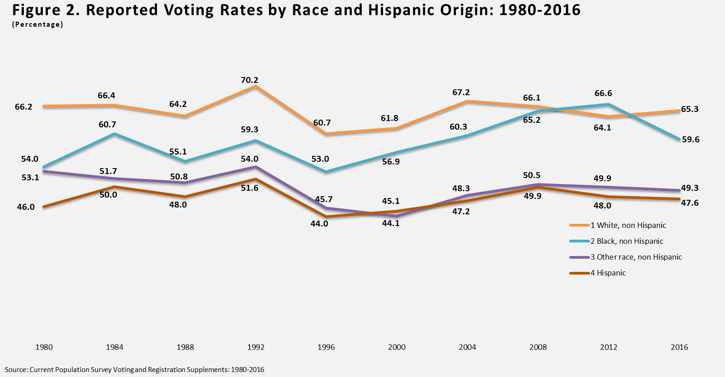
The percentage of Black voting-eligible people who cast ballots was significantly higher in 2008 (65 percent) and 2012 (66 percent), when there was a Black candidate on the ticket, compared to 2004 and 2016 (both around 60 percent) when there was not. Some political science research shows that Black people vote at higher rates when a Black candidate is on the ballot, although that finding is somewhat contested, and that research is about voting for a Black candidate at the top of the ticket, not a white candidate with a Black running mate.
So it’s not a crazy idea that Harris might boost the ticket with Black voters. It has some empirical basis. But I think the stronger case, at least based on what we know right now, is that she won’t have much of an effect in terms of Black voters.
Why not? First of all, while it happened in 2008 and 2012, it’s just really hard for Democrats to get that much more support from Black voters, who even in elections like 2004 or 2016 vote at fairly high rates (significantly higher than Asian American or Hispanic voters) and overwhelmingly support Democratic candidates.
Second, it’s not 2008 or 2012, when Black voters had the chance to elect and then reelect the first Black president. Third, Harris herself seems unlikely to particularly excite Black voters. This is not a random guess — Harris ran for president for much of last year and was not the preferred candidate of older Black voters in the Democratic primary (that was Biden) or younger Black voters (that was Sanders or Warren in earlier stages of the race). Obama, in contrast, had very strong Black support during his 2008 primary run, previewing what would happen in his two general election campaigns.
We don’t know how Harris’s selection affects the protest movement that has emerged since the police killing of George Floyd.
Another part of the discourse has been that the selection of a Black woman became more necessary in the wake of the national protests around racial inequality over the last several months. But it’s not clear the Black Lives Matter activists organizing these protests view a Black woman being picked as vice president as a major priority in terms of addressing racial inequality in America (as opposed to, for example, reducing spending on policing.) And some more liberal Black people are wary of Harris because they felt she was too punitive toward people who committed minor crimes like truancy when she was the district attorney in San Francisco and then the attorney general of California.
I would emphasize all of this is a bit unknown. Maybe Harris’s choice will be applauded by BLM activists; it’s just not a given.
We don’t know if Harris is now the most-likely Democratic nominee in 2024.
If Biden and Harris lose, Harris’s presidential ambitions are likely over. (Just ask Joe Lieberman, John Edwards, Sarah Palin, Paul Ryan and Tim Kaine.) But if they win, remember that Biden will enter office at age 78 and that in March he described himself as a “bridge” figure who will help usher in the Democratic Party’s next generation of leaders.
So is Harris being set up to be the Democratic front-runner and likely nominee in 2024? I don’t know. And honestly, Biden and Harris may not know either. But this matters, for two big reasons. First, in the 2020 election, expect Trump and his campaign, who have had a hard time casting Biden as an extremist or a radical, to make attacks on Harris with sexist and racist undertones, cast her as an ultra-liberal Californian out of touch with Middle American values and suggest that voting for Biden in November means that Harris will be running the country for 12 years.
Second, if Harris is vice president, she would need to make sure she is ready to run for president in 2024 — in case Biden either doesn’t want to run for a second term or isn’t up to it — while also ensuring she isn’t portrayed by the media as constantly planning her 2024 campaign, which would likely irritate Biden and other Democrats.
Biden made the predictable pick (in fact, we kind of predicted it in March). Harris is more liberal than Biden but not Sanders/Warren-left, and she is an Asian and Black woman in a party that always wants to show it cares about traditionally marginalized groups and probably feels the need to showcase its racial diversity even more in the wake of the Floyd protests. So Biden choosing someone with Harris’s political, biographical and demographic attributes makes a lot of sense.
The biggest unknowns are around Harris herself and her electoral skills. Harris is a good politician based on these facts alone: She was elected senator in the nation’s most populous state and in a country with a lot of race and gender discrimination, Harris is the second Black woman ever elected to the Senate, and arguably the first to be a serious presidential candidate. That said, it’s still not clear if she is a particularly strong politician on the national stage, and therefore if she will be that helpful for Democrats in the No. 2 slot in 2020 or as the main candidate in a future presidential election.
As if 2020 Weren’t Bad Enough, We Are Now Running Out of Dr Pepper
 One of the ways that the emotional roller coaster of 2020 has manifested itself has been in product shortages. Need toilet paper? Sorry, it took months for supply to get back to normal. Want to work out? Through the spring, kettlebells and weight benches were available only on the black market. Basics like flour and yeast took their turns being the hot, sold-out product of the moment, and during the Animal Crossing furor of the months of the pandemic, Nintendo Switches were being stockpiled like cigarettes in prison. Bikes and aboveground pools are still scarce, as summer begins its (extremely) slow transition into fall. Even jigsaw puzzles, the hot ticket home entertainment of the 1930s, disappeared from retailers’ shelves. The latest product to get swept…View Original Post
The post As if 2020 Weren’t Bad Enough, We Are Now Running Out of Dr Pepper appeared first on Texas Monthly.
MY FATHER WAS A CHICKEN PLUCKER!
Saturday Morning Breakfast Cereal - Eugenics

The Oil Spill At Mauritius Is A Disaster. And It Could Soon Get Worse

A Japanese-owned cargo ship ran aground in late July and began leaking oil a few days ago. Now a crack has expanded in its hull. The island nation is home to species that live nowhere else.
(Image credit: Jean Aurelio Prudence/L'Express Maurice/AFP via Getty )

Improbable, Prophetic Houston
Our cities sometimes appear inevitable. Once something is built, it’s difficult to remember what the landscape was like before—before a highway cut through a neighborhood, before an office tower hovered over a downtown, before a housing development carved up a wetland.
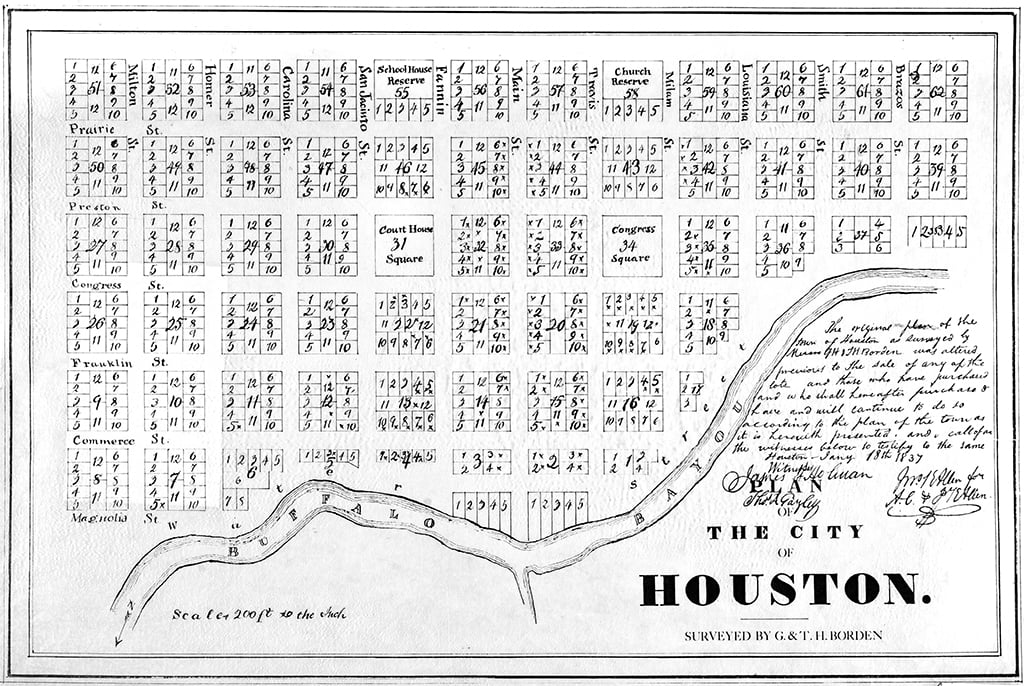
But in 1836, when Houston’s founders, Augustus Chapman Allen and John Kirby Allen, envisioned “a great interior commercial emporium of Texas,” the city was just an idea, a vision projected onto a swampy prairie at the confluence Buffalo and White Oak Bayous, once home to the Karankawa and Atakapa tribes. So how did Houston become Houston?
Two new books about the Bayou City—one about its people, one about its places—provide compelling answers to that question. Both Prophetic City: Houston on the Cusp of A Changing America and Improbable Metropolis: Houston’s Architectural and Urban History offer layered, nuanced histories of this ever-evolving city. If Houston’s dizzying growth over the past half century offers a glimpse at the future of the United States—multicultural, sprawling, unequally prosperous—then, these books suggest, by understanding how we got here, we can better understand where we’re going.
In the spring of 1982, a sociology professor at Rice University named Stephen Klineberg was teaching a class on research methods, instructing his students on how to design a systematic survey of their classmates. At the time, Houston was “a different place from the rest of America,” he writes. “It was an arrogant, spread out, automobile-dependent boomtown while most of the country was in recession.” When a professional research firm reached out and asked if he wanted to partner on a city-wide public opinion poll, he jumped at the opportunity to give his students the opportunity to study the whole of Houston, to get a sense of “the kind of city its inhabitants were hoping to build with all the oil-based affluence.”
In May of that year, two months after the class completed their survey project, the oil boom became a bust. The price of a barrel of oil fell from $35 to $28 overnight. By the end of the following year, more than 100,000 people had lost their jobs. It was clear, Klineberg writes in Prophetic City, the survey should continue.
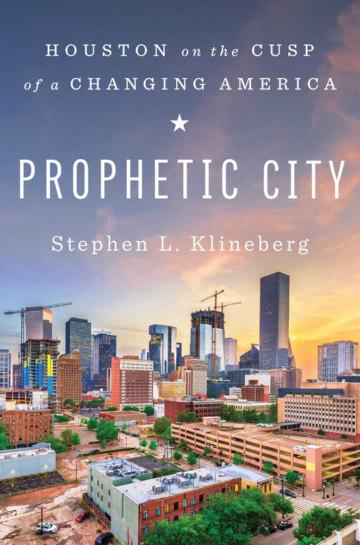
By Stephen Klineberg
Avid Reader Press
$28; 336 pages
Thirty-nine years later, 45,000 Houstonians have talked to his team of researchers—now housed at the Kinder Institute for Urban Research, which Klineberg directs—making the Houston Area Survey the longest-running study of any city in the United States. As Houston grew at a dizzying pace, as the city attracted immigrants and refugees from across the world and the economy cycled through booms and busts, researchers were there, calling people up for a 30-minute chat on the telephone.
Prophetic City tracks not just the changes that led Houston to become America’s fourth most-populous city, but also how residents felt about those changes as they were happening. Over time, Klineberg reports, Houstonians have become more socially progessive and accepting of LGBTQ people, immigrants, and refugees. A Houstonian today is more likely to support public education and environmental activism than they were in 1982. Residents are more likely to oppose the death penalty and support more stringent government regulation.
Klineberg notes that these increasingly progressive attitudes have been slow to make their way into public policy, but he offers frustratingly little analysis as to why. “The loudest voices… in the Texas Legislature are generally anti-gay, anti-immigrant, and pro-death penalty, even though most Americans (and most Houstonians), when interviewed in the privacy of their homes, take decidedly more progressive positions on these and other issues,” he writes. Perhaps it is because many people self-report themselves to be more tolerant than they actually are. Perhaps it is because, over the past four decades, politicians have made it increasingly hard for Texans to vote and express those progressive positions. Ever the sociologist, Klineberg doesn’t speculate.
Despite the decisive shifts in public opinion captured year after year, Klineberg’s body of research demonstrates, compellingly, how uneven change can be. In 2004 and then again in 2016 and 2017, researchers asked Houstonians about how they felt about living in racially diverse neighborhoods. “Despite clear evidence of their overall positive and improving assessments of ethnic relationships in Houston,” Klineberg writes, “Anglos were just as resistant in 2017 as they had been in 2004 about moving into an integrated neighborhood.” And they were very resistant: In 2017, 48 percent of white people surveyed wouldn’t buy a house in a neighborhood that was 60 percent Black. Fifty-eight percent wouldn’t buy a house in a neighborhood that was majority Hispanic.
Again, Klineberg simply reports the facts, leaving it to others to offer judgements. “Houston,” says John Guess, the CEO of the Houston Museum of African American Culture, “is a much more deeply racist town than the surveys reveal.”
If a city can be understood as a collection of human stories, then perhaps those stories are written upon our built environment—collected in the buildings that contain our lives, the places we work and learn and pray. Through a mix of archival images, maps, and text, Improbable Metropolis traces the development of Houston over two centuries as the town transformed from a flood-prone swamp to a sprawling, cosmopolitan city.
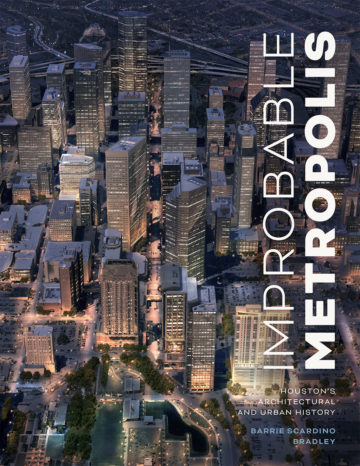
By Barrie Scardino Bradley
University of Texas Press
$45; 412 pages
Famous for its lack of zoning and “spirit of speculation,” Houston is decidedly less famous for its architecture. The former editor of Cite: The Architecture and Design Review of Houston, author Barrie Scardino Bradley attempts to correct the record, defending the city’s no zoning policies as fostering creativity and innovation in the built environment. Things are possible in Houston that simply aren’t possible elsewhere: “Houston’s architecture, an indicator of its culture and prosperity, has been inconsistent, often mundane and predictable, sometimes bizarre, and occasionally extraordinary,” she writes.
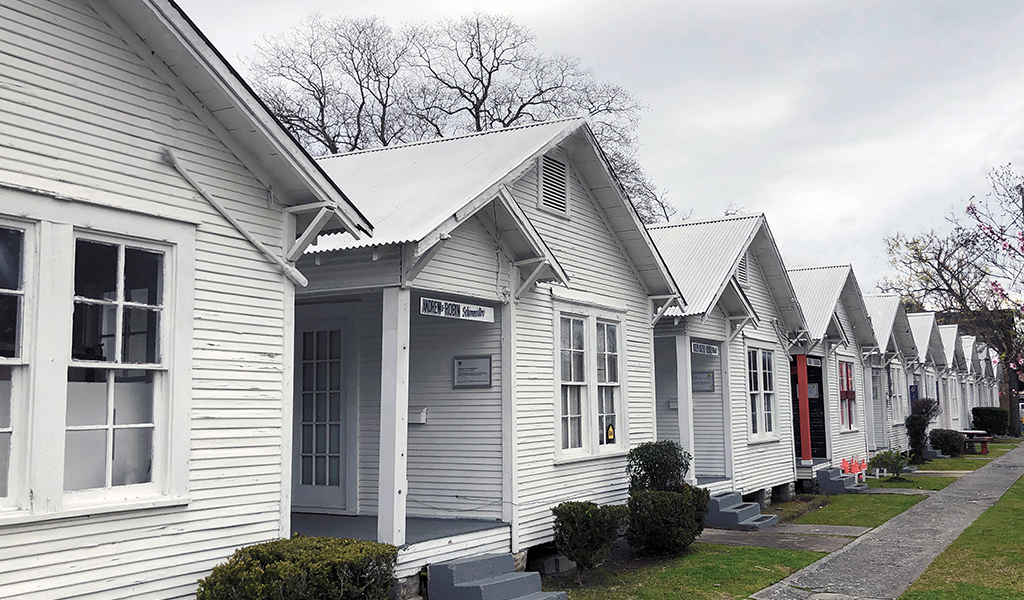
How did Houston’s urban personality emerge? There are the structures of the white and wealthy—hotels and banks and museums. There are the famous parks, the emergence of a world-class medical center. But in Improbable Metropolis, Bradley also captures the vernacular architecture that defines much of the city. For example, in the Third and Fourth Wards, “identical, small, wood gabled-roof houses were three rooms deep, one room behind another, usually with a small stoop in front and back.” These row houses, with their shared outdoor spaces, served as community centers for Black families in neighborhoods settled by freed slaves after the Civil War. Over the decades, many homes fell into disrepair, neglected by absentee landlords and the city itself. In 1993, a group of artists bought 22 of these historic homes, relying on volunteer help to rebuild the structures into studios and galleries.
But restoration has never been one of Houston’s strengths. Instead, the city tumbles forward, rebuilding what it no longer requires. In 1883, architect George E. Dicky unveiled the B.A. Shepherd Building to house the First National Bank of Houston, becoming the city’s “best example of a commercial house with High Victorian Gothic features,” Bradley writes. But change soon came for it, too: “The Shepherd Building ended ignominiously as the Pink Pussycat Lounge before it was demolished for a Harris County parking garage in 1989.”
Indeed, the demolition of the city’s historic buildings tells as vivid a story as does their construction. In 1913, when Black people were legally barred from visiting the new Houston Lyceum and Carnegie Library, prominent Black businessmen purchased property in the Fourth Ward and contracted William Sidney Pittman, the son-in-law of Booker T. Washington and one of the foremost architects in the South, to build the Carnegie Colored Library. “This building served the African American community until it was demolished for freeway construction in 1962,” Bradley reports.
As the Texas Department of Transportation considers expanding yet another freeway in Houston, in the process demolishing historic structures in its pathway—including dozens of homes in Independence Heights, the first city in Texas incorporated by Black people—and relocating a historic church, it’s an apt moment to consider the city that today’s residents never got to see.
Above all else, both Klineberg and Bradley capture Houston as a city of transformation, something always in the process of becoming something else. In urban Texas, so many of us are from someplace else, amnesiacs in the places we live. As we consider how to build better, more equitable cities, it’s worth examining what we’ve inherited and who we’ve become. In a place as dynamic as Houston, where each generation creates a new city from the foundation of the old, the only thing that is truly inevitable is change.
Read more from the Observer:
-
From Boom to Bloodbath: The Permian Basin’s shale revolution is over and renewable energy is surging. What does that mean for Texas’ future?
-
In Harris County, A Group is Working to Expand Voting Access in Jails: The lack of access for eligible voters in pretrial detention is part of a larger constellation of disenfranchisement for people whose lives intersect with the criminal legal system.
-
Houston’s Hot-Stepping Zydeco Dance Fuses Creole and Black Cowboy Cultures: For many of these dancers, musical gatherings are just one aspect of a lifestyle rooted in their Creole heritage: trail riding by day, zydeco dancing by night.
The post Improbable, Prophetic Houston appeared first on The Texas Observer.
Bindi Irwin takes to Instagram to reveal she is pregnant
The daughter of the late 'Crocodile Hunter' Steve Irwin has revealed she is in the first trimester of pregnancy, after marrying her long-time partner Chandler Powell in March.

Five Ways Trump And GOP Officials Are Undermining The Election Process
There has long been conflict in the United States over who gets to vote and how. In the years since Barack Obama’s election as president, those voting debates have become increasingly partisan, with Republican elected officials often pushing measures like requiring photo IDs that make it harder for people to vote, and Democratic officials advancing provisions like same-day registration that make it easier to vote.
That long-running conflict over voting has reached a new, more critical phase for two reasons. First, the outbreak of COVID-19 means that people might be risking their health if they opt to vote in person. Secondly, Donald Trump, unlike previous presidents, regularly breaks with democratic norms and values and is now openly suggesting that he might manipulate the electoral system to help him win a second term.
“Trump aides exploring executive actions to curb voting by mail,” was the headline of an article in Politico last weekend (that was a news article, not an opinion piece). Politico’s reporting found that the White House was considering using executive actions to insert itself into the election process, which is usually run by states, including finding ways to make it harder for people to vote by mail.
I think it’s totally appropriate for people to, well, freak out about the potential undermining of the electoral process by Trump and his allies. That said, there is now a flurry of lawsuits, judicial rulings, decisions by election officials at the local and state levels, and claims of voter fraud and voter suppression that can be a bit of minefield to wade through. It’s a lot and it can get confusing.
So to better understand what’s a really big deal versus something that might be problematic but perhaps not as important, we broke out the potential ways that Trump and the GOP could limit voting or undermine the electoral process into five general tactics. These tactics are roughly ordered from least to most alarming. This is not any kind of formal legal guide, although we consulted with some experts for this piece, and some of those experts have law degrees. This analysis also includes some details of the Democrats’ approach to voting rights issues. But we opted to focus on the Republicans because their approach is more controversial than the Democratic one (which is largely to make it easier to vote) and because perhaps the most important figure in the current voting wars is the Republican president.
Here are the tactics:
1. Opposing changes to make it easier to vote amid COVID-19
A lot of the litigation around voting this year pits groups allied with liberal-leaning parts of the electorate, like the NAACP Legal Defense and Educational Fund (LDF) and lawyers affiliated with the Democratic Party, against officials in charge of administering elections (secretaries of state, for example). In these cases, the litigants are trying to get judges to change or invalidate existing laws and force officials to make it easier for Americans to vote and have their vote counted.27
The litigants often invoke the pandemic in demanding these changes, but they are changes in the voting process that these litigants would likely prefer outside of the COVID-19 context, too. For example, the LDF and the Southern Poverty Law Center are trying to get struck down a requirement in Alabama that voters include a copy of their photo ID with their application for an absentee ballot. Getting a copy of your photo ID does potentially increase your chances of getting COVID-19, their brief argues. But the LDF opposed provisions requiring people to present photo IDs as part of the voting process well before the coronavirus pandemic.
Marc Elias, a leading Democratic election attorney, is filing lawsuits in more than two dozen states (including basically every key swing state), to enforce his “four pillars” for mail-in voting in the 2020 election:
- The government prepays the postage for mail-in ballots.
- Ballots postmarked before or on Election Day are counted (as opposed to counting only ballots received by Election Day).28
- Signature requirements for mail-in ballots are administered in a voter-friendly way. (Elias suggests requiring election officials across the country to contact voters before their ballots are ruled invalid because the signature on the ballot does not match the signature election officials have on file.)
- Individuals or groups are allowed to collect the ballots of people and turn them in (to ease voting for people who might not have easy access to mail services).
Liberal-leaning lawyers like Elias are losing some of these cases in court (or at least not getting all the accommodations that they want), with Republicans — including the Trump campaign — filing briefs opposing changes that might make it easier for Americans to vote and have their vote counted. It’s not ideal that Republicans are taking this tack, as the right to vote is so important. And the GOP often uses false or misleading rhetoric to oppose measures making voting easier, such as dubbing efforts by groups to collect and turn in mail-in ballots “ballot harvesting” and suggesting, without evidence, that the process will lead to widespread voter fraud.
That said, we cast this tactic as the least problematic one Republicans are employing because there are instances of Republicans opposing new steps to make voting easier, rather than creating new barriers to voting. Also, even most blue states don’t currently have all four of Elias’s pillars in place. Only seven states (California, Colorado, Hawaii, Nevada, Oregon, Utah and Washington) got “A” ratings for their vote-by-mail systems in a recent Brookings Institute report.
2. Seeking to invalidate laws that make it easier to vote amid COVID-19
During the pandemic, some states, particularly those run by Democrats, are taking affirmative steps to make it much easier to vote. For example, California and Nevada are planning to send mail-in ballots to all the registered voters in their states. Election officials in Pennsylvania have set up boxes for people to drop off their absentee ballots, as opposed to requiring all voters to send them through the mail.
The Trump campaign is filing lawsuits to stop the moves in Nevada, Pennsylvania and other states. The Republican National Committee (which is tightly aligned with the Trump campaign) is involved in litigation in 17 states, again including virtually every battleground state, to enforce its voting agenda, which includes:
- Requiring ballots to be received by Election Day.
- Keeping current photo ID and signature laws in place.
- Opposing people or groups being able to turn in mail-in ballots of other voters.
- Opposing newly enacted plans to allow basically all voters in a given state to vote by mail.
You can see why this is more problematic in terms of democratic values than the previous category: Local and state officials are taking affirmative steps to make it easier for Americans to vote and have their vote counted amid a pandemic and the sitting president’s campaign is trying to reverse those decisions.
For this category, the actions of the five justices on the U.S. Supreme Court appointed by Republican presidents are likely to be particularly important. In all four of the most recent Supreme Court decisions on voting rights issues, the court’s conservative majority rejected attempts by liberal litigants to get existing law changed to make it easier to vote amid COVID-19 (the first category we listed above). Those rulings have infuriated liberals, but I can’t say that I’m surprised by them — Chief Justice John Roberts regularly votes both to uphold existing legal precedents and to show deference to the judgements of local officials and other branches of government in ways that sometimes align with the more liberal justices and other times with the court’s conservatives. So it would be more surprising (and alarming) if Roberts and the high court struck down new laws, like those in California, making it easier to vote.
3. Advancing new practices and provisions that make it harder to vote
This tactic refers to moves like rolling back the number of early voting days in a state or making it harder for students to vote. These are all strategies that Republicans have employed pre-COVID-19. Republicans aren’t rolling out a lot of new provisions to make it harder to vote in 2020 because they already passed a lot of them from 2011 to 2018, and they couldn’t pass a lot of them in 2019 and 2020. (Democrats made a lot of gains at the state level in 2018, and it would have been controversial to adopt such measures after the virus outbreak.)
But Republicans are trying two new strategies, with liberals seeking to get each struck down by courts. First, in Florida specifically, Republicans are complicating the process for ex-felons who have served their sentences to regain their voting rights, despite a 2018 ballot initiative, supported by 65 percent of Florida voters, that was intended to do just that. And in states around the country, GOP officials are planning to send an unusually large number of people to individual voting locations as “poll watchers.” Poll watchers have been used by both parties. But the rhetoric about voter fraud from Fox News and Trump in particular creates the potential for GOP poll watchers to show up at voting places specifically to look for voters they might view as both illegitimate and liberal-leaning (people of color and people around age 18 in particular) and push for the officials running those polling locations to more closely scrutinize those voters.
I view this category as particularly problematic, in terms of democratic values, because it raises the specter of people facing increased difficulty voting in large part because they are perceived to likely to oppose Republican candidates. (The ex-felons who would be newly eligible to vote in Florida are disproportionately Black.)
4. Anti-democratic rhetoric
What I’m talking about here is largely rhetoric that has no direct impact, but has the potential to undermine confidence in the election system. Think about Trump’s comments about potentially changing the day of the election or the unfounded suggestions by the president, Attorney General William Barr and other conservatives that mail-in voting will lead to fraud.
How this tactic affects the election depends on two factors. First, do other members of the Republican Party, such as Senate Majority Leader Mitch McConnell, echo Trump’s rhetoric, thereby creating a situation where one of the country’s two major political parties is questioning the electoral system? And second, do GOP elected officials start acting on this rhetoric, such as trying to roll back existing vote-by-mail programs or not counting ballots received after Election Day in states where it is legal to count them?
In other words, this kind of rhetoric presents two potential risks, undermining the public’s confidence in the legitimacy of the election and — if the rhetoric leads to action — literally compromising the legitimacy of the election.
5. Fundamental changes to the electoral process
Speaking of actually compromising the election … The recent changes at the U.S. Postal Service that are slowing down mail delivery across the country are arguably the biggest threat to the American election system in 2020. If mail delivery continues to be slowed down, that creates two very important potential problems. First, in states where ballots must be received by officials before Election Day (33, according to the National Conference of State Legislatures), a slowed-down mail system could disenfranchise thousands and perhaps even millions of people. Secondly, a slower system creates the potential for a ton of ballots to arrive either just before, on or after Election Day, meaning that the counting of votes might stretch on for days or weeks and Americans wouldn’t know the winner of the presidential election for a long time. That’s not ideal in any circumstances, but particularly with a president like Trump who can’t be expected to wait for election results before trying to declare himself the winner.
Postmaster General Louis DeJoy, a longtime GOP donor who has given more than $2 million over the last few years to Trump’s campaign and other Republican causes, says the changes he has made since taking his post in June are intended to reduce the USPS’s spending and make it more cost-efficient. I don’t have any proof he is lying, but it’s also doubtful that DeJoy would be candid about it if his real goal was complicating vote-by-mail systems and helping Trump win. Either way, it’s a strange decision to overhaul the mailing system in a way that appears to be making it harder to send things through USPS quickly when the U.S. will be relying on the Postal Service more than ever before as part of the electoral process.
And if Trump followed through on changing the day of the election (which he cannot do on his own) or limiting vote by mail, those changes would go into this category as well.
It’s worth thinking about these categories both in terms of the horse race and in terms of broader questions of democratic norms and values. The first three are problematic in terms of democratic norms and values because Republicans seem to be intentionally making it harder for people to vote. And if this race gets tighter, those moves could prove decisive. If we reach the later stages of the campaign and polls still show Biden with a clear lead nationally and in most swing states, it’s less likely that these tactics would literally swing the election. (Then again, we haven’t really faced a situation like this before.)
On the other hand, the last two categories are huge, both in terms of democratic values and electoral repercussions. If people’s mail-in ballots aren’t received until way after Election Day, and Trump and his allies are falsely suggesting that mail-in ballots are somewhat fraudulent anyway, that undermines the election results and creates the potential for Trump to try to remain in office even if Biden is the rightful victor.
Active
The best thing about dancing is no one seeing me dancing.