A businessman trying to buy a municipal building at the base of the city's water tower got a lot more than he bargained for — several thousand gallons more.
(Image credit: Google Maps )

A businessman trying to buy a municipal building at the base of the city's water tower got a lot more than he bargained for — several thousand gallons more.
(Image credit: Google Maps )
This post, remember the manager who wouldn’t let her best employee attend her own graduation? , was originally published by Alison Green on Ask a Manager.
Remember the letter-writer whose best employee quit on the spot because she wouldn’t let her go to her college graduation? The employee — who had grown up in foster care and worked full-time while taking night classes to earn her degree — had worked late/come in early/worked overtime for years to cover for other coworkers, but the manager refused to give her two hours off to attend her graduation ceremony.
Here’s that manager’s opposite (click the image to read the full article):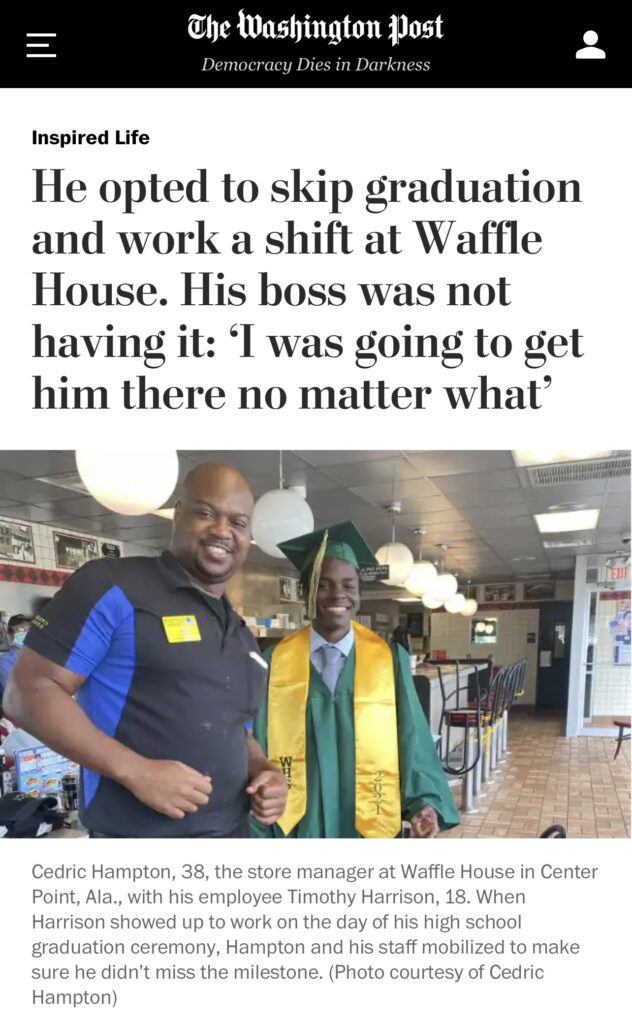
(Also, we’re not done with updates for today yet! Check back later for a much-anticipated update…)
READ THIS BEFORE THEY MAKE YOUR EYES ILLEGAL
Do you look outside at ruins of liberty and ask, what has become of my country? Gulfstream media says you cannot ask that. Amazon delivers your notice of cancellation. You think, am I canceled now? Is our beautiful HISTORY canceled? NO! (The question was not rhetorical.)
I remember the American dream when everything was PERFECT for everyone who mattered. Now dream is over because WOKE!? You know what this means, right? All electoral college debt will be CANCELED and there will be no more conventions in Wyoming forever. Only four beefs a year and a tax on your farts. The tax will go to China. “Where is the beef?” you will ask no one because your family died of masks. But you know where is the beef. (It is with Hunter and her emails.)
It will never be too late to stop the Steelers. Cross-stream media won’t tell you that right now ninjas are finding drive-through voting guides full of bamboo and Benghazi. Oh, but we are the pogromatic ones?
We must stand on our principled. Always at all times look to the past and the founding fathers who embraced like a rat king to spurt CONSTITUTION that said, “Take, eat, these are my guns to shoot when you are uncomfortable.” And the people made peaceful non-uppity protest and George Hamilton joined them on a horse he hugged with his superabundant thighs. He gave them whiskey and said, “This is a good rebellion.” How many horses do you think are in Biden’s bunker? Rescue horses maybe.
You know the libs, the independs, the Lincoln 1619 Project, and the rhinoceroses HATE America. They want to put tears in your eyes about slavery and insurrection but those are in the PAST and we must never ever look to the past because it is OVER. They want to rip cursive from your baby’s mouth and replace it with criminal race theory. But did you know… I have little girl? So women are people. But what happens when man goes inside lady room and lifts up my child’s gas prices? Every single day. Is this really what Dr. Seuss died for? I DON’T THINK.
You are smartest person in your zip code, but are you patriot? If you love America press MONEY.
This is a work of fiction,
and no artificial intelligence was subjected to this content.


The biotech firm said its Covid-19 vaccine showed 90 percent efficacy in clinical trials. Thank moths.
Another Covid-19 vaccine, this one from the biotech firm Novavax, has posted superb results in a phase 3 clinical trial, the company announced on Monday. But with more than half of US adults now vaccinated against Covid-19, the biggest impact of these results may be in other countries.
The Novavax vaccine stands out from other Covid-19 vaccines because it uses a technology that has not been deployed to date. It can also be stored at ordinary refrigerator temperatures, unlike some other vaccines that have strict freezer requirements that complicate distribution.
Novavax said its vaccine candidate was 90 percent effective overall against Covid-19 cases that produce symptoms, and 100 percent effective against moderate and severe disease. The results, from nearly 30,000 participants across the US and Mexico, could make it the fourth Covid-19 vaccine to begin distribution in the US, following vaccines developed by Pfizer/BioNTech, Moderna, and Johnson & Johnson.
But the first approvals of the vaccine will likely come in other countries, Stanley Erck, CEO of the Maryland-based company, told the New York Times. Novavax may not even seek emergency authorization for its vaccine in the US until September. At that point, it may not make much of a difference to the US vaccination effort.
As part of the US government’s Operation Warp Speed, last July Novavax was awarded $1.6 billion for vaccine development and production of 100 million doses. At the time, the 20-year-old company faced skepticism for never having brought a vaccine to market.
Novavax now aims to scale up production, with a goal of 150 million doses per month by the end of the year with factories in the US, South Korea, and India. Its two-dose vaccine comes at an expected cost of $16 per injection. That’s more expensive than the adenovirus-based vaccines developed by Johnson & Johnson and AstraZeneca, but around the same price or cheaper than the mRNA vaccines made by Pfizer/BioNTech and Moderna.
The Novavax vaccine did exhibit lower efficacy against variants of Covid-19, but the company is studying reformulated versions to target them. With Covid-19 continuing to spread in many parts of the world, having another option to counter the disease will bolster the effort to contain the pandemic.
Vaccines are like target practice for the immune system: They encourage our bodies to build up defenses against a particular threat, without making us sick. When the real pathogen arrives, immune cells are ready to act, preventing infection altogether or dampening the worse effects of the disease.
Traditional vaccines contain weakened or inactivated versions of viruses or bacteria, or fragments of them. But new approaches have been brought to bear on Covid-19. Moderna and Pfizer/BioNTech vaccines use a snippet of genetic material, mRNA, encased in a nanoparticle. Human cells can read those genetic instructions and manufacture a fragment of SARS-CoV-2, the virus that causes Covid-19, which spurs the immune system to prepare for the virus.
The Covid-19 vaccines developed by AstraZeneca and Johnson & Johnson also shuttle genetic instructions to human cells, encouraging them to make a fragment of SARS-CoV-2, but they use a different virus — an adenovirus — that carries a snippet of DNA.
Novavax’s approach blends old and new techniques. To make the vaccine, the company combines another kind of virus — a baculovirus — with the genetic information needed to make a spike protein, a key fragment of SARS-CoV-2. When moth cells are infected with this virus, they manufacture the spike protein. Scientists then harvest and fuse those proteins with a nanoparticle. These nanoparticles combined with spike proteins are what is injected in the Novavax vaccine.
/cdn.vox-cdn.com/uploads/chorus_asset/file/22657826/Screen_Shot_2021_06_14_at_11.43.06_AM.png) Novavax
Novavax
According to Novavax, this approach yields a strong immune response with minimal side effects. The main complaints from vaccine recipients were fatigue, headache, and muscle pain lasting less than two days.
While new infections, hospitalizations, and deaths are trending downward in the United States, the Covid-19 pandemic continues to rage in other countries. India, currently an epicenter of the pandemic, recently set a new world record of more than 6,000 daily Covid-19 deaths. Part of the toll stems from the Delta/B.1.617 variant of the virus, which appears to be more transmissible. Health officials warn that other countries with limited resources and low vaccination rates remain vulnerable to their own outbreaks. And as long as the virus continues to spread, it risks mutating in dangerous ways that can reverberate to places like the US.
Leaders at the G7 summit last week committed to sharing 1 billion doses of Covid-19 vaccines with other countries, with half coming from the US. For its part, Novavax is partnering with manufacturers in other countries like India and South Korea to scale up its production. The company had pledged at least 1.1. billion doses of its vaccine through Gavi, an international vaccination consortium.
I realize that Novovax vaccine results won't get the same attention as when we heard from Moderna, Pfizer, and J&J
— Ashish K. Jha, MD, MPH (@ashishkjha) June 14, 2021
But for vaccinating the world, this is huge
Very, very good news
Novovax essential to vaccinating the globe.
That fact that it has 90% efficacy is awesome https://t.co/qGFzSfoIqo
Novavax may still have a future role in the US. The company is investigating how its vaccine could work as a booster, bolstering protection from other vaccines as immunity wanes over time. A study last month showed that even mixing shots of different vaccine platforms led to robust immune protection. But it’s not clear yet how long the shielding provided by other Covid-19 vaccines will last.
At the same time, the virus itself is continuing to change. Novavax’s results on Monday showed that its vaccine had 86.3 percent efficacy at preventing disease caused by the Alpha/B.1.1.7 variant of the virus, which first appeared in the United Kingdom. It shows that protection was high, but not as high as immunity to earlier strains of the virus.
Early phase 2b results from South Africa, however, showed the vaccine yielded 48.6 percent efficacy against the Beta/B.1.351 variant in HIV-negative participants. The company is now investigating a retooled version of its vaccine aimed specifically at the Beta variant.
The ongoing evolution and spread of Covid-19 shows that the pandemic is not over, and it’s too early to become complacent. A new way to immunize against Covid-19 is a welcome development — particularly if it can reach the most vulnerable, and quickly.
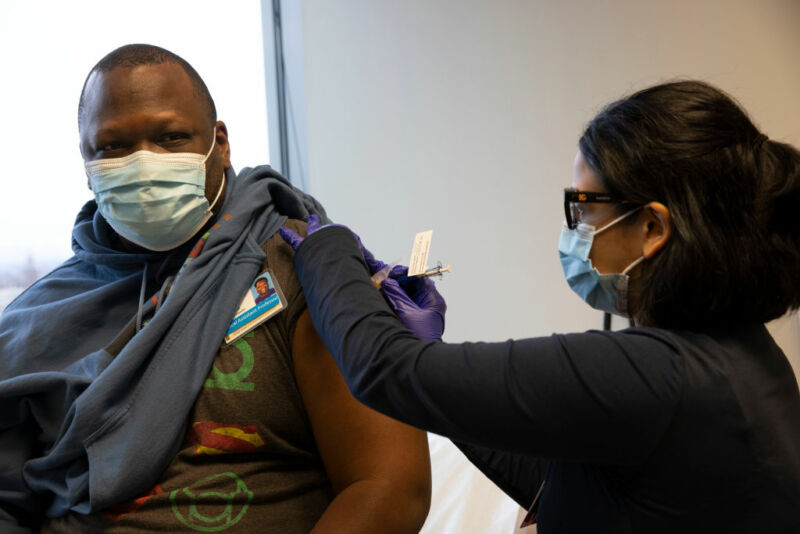
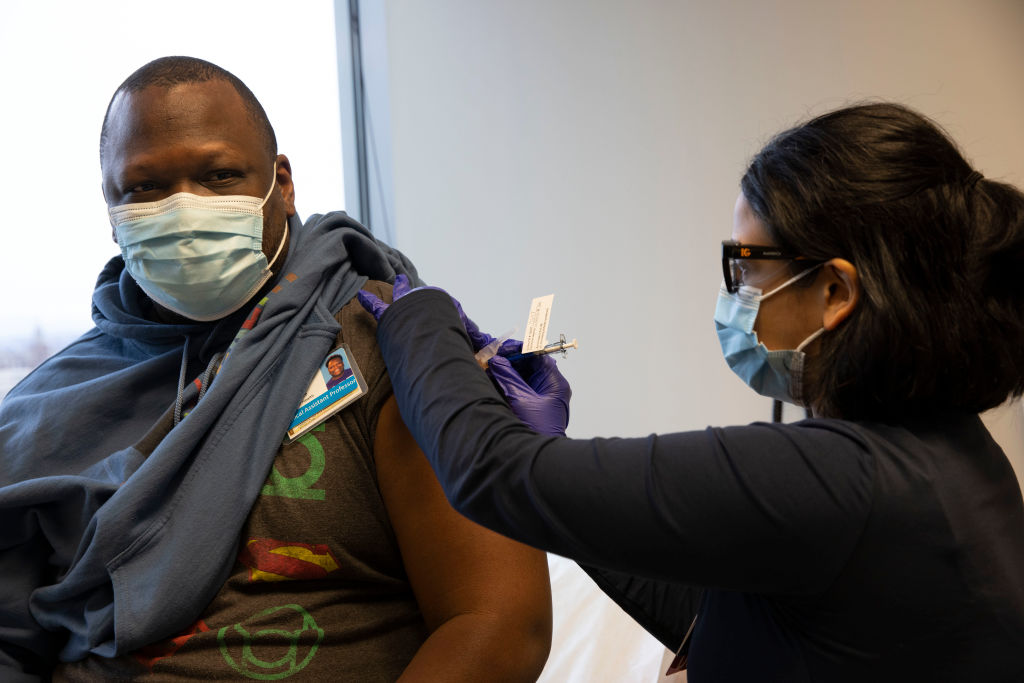
Enlarge / A participant gets his second dose of the Novavax vaccine during the clinical trial. (credit: Karen Ducey / Getty Images)
Today, a company called Novavax announced that it had completed a large efficacy trial of its COVID-19 vaccine, and the news was good. The vaccine is highly effective, it blocked severe disease entirely, and it appeared to work against some of the more recently evolved virus variants. The company says it can produce 150 million doses per month by the end of the year, and the vaccine is stable when stored with normal refrigeration, so it could play a big part in the effort to administer vaccines outside of industrialized nations.
So far, US citizens have had the choice of RNA-based vaccines, like the offerings from Moderna and Pfizer/BioNTech, or a vaccine based on a harmless virus engineered to carry the coronavirus spike protein, as used in the Johnson & Johnson vaccine. (The AstraZeneca and Sputnik vaccines are similar to J&J's.) Outside the US, many countries have used vaccines based on an inactivated coronavirus, although these have turned out not to be very effective.
The Novavax vaccine uses an entirely different technology. Vaccine production starts by identifying a key gene from the pathogen of interest—the SARS-CoV-2 spike protein, in this case—and inserting it into a virus that infects insect cells. Insect cells can easily be grown in culture, and they process any proteins they make in the same way that human cells do. (This processing can involve chemically linking sugars or cleaving off superfluous parts of the protein.) The activity ensures that the purified protein will be chemically identical to the spike protein found on the surface of the SARS-CoV-2 virus itself.
Read 11 remaining paragraphs | Comments
 WHO: Anyone planning a West Texas trip this summer. WHAT: Balmorhea State Park’s beloved spring-fed pool, which will reopen later this month for the first time since September 2019. WHY IT’S SO GREAT: The 85-year-old, 3.5-million-gallon pool offers respite from the heat and a chance to swim with endangered fish. My favorite memory from Balmorhea State Park, about 32 miles north of Fort Davis, is from a chilly October morning almost six years ago. When my husband and I arrived at the sprawling pool area around 10 a.m., the crystal-clear water caught the morning light, practically glowing in an alluring shade of turquoise that seemed better suited to the Caribbean than the West Texas desert. As always, I marveled at the sheer size of the…View Original Post
The post Swimmers, Rejoice: Balmorhea State Park Is Reopening appeared first on Texas Monthly.

“Absolute Equality,” a mural by Houston artist Reginald Adams. Photo credit: Montinique Monroe for The New York Times
June 19 is Juneteenth, the day that commemorates the 1865 proclamation on Galveston Island by Union Army General Gordon Granger ordering the freedom of more than 250,000 enslaved Black people in Texas. Galveston’s Juneteenth Legacy Project will dedicate the mural Absolute Equality at 11:30 AM this Saturday at the intersection of 22nd and Strand Streets in the heart of Galveston Island.
Painted on the east wall of the Old Galveston Square Building by Houston artist Reginald Adams, the 5,000 square-foot mural, commissioned by the Juneteenth Legacy Project, depicts four historical portals. Adams’ other murals include Houston’s Fruits of the Fifth Ward, I Can’t Breath on Travis Street in Houston, and Restorative Justice in Dallas, among many others across Texas.

The mural on the evening of June 13, 2021. Photo: C. Rees for Glasstire
From a vignette of enslaved Africans being led onto slave ships, to a painting of Esteban, “the first non-native enslaved person arriving by shipwreck on Galveston Island in 1528,” to images of Harriet Tubman, Abraham Lincoln, and General Granger, the mural’s message is punctuated with vivid images. The text at the base of the painting reads “Absolute Equality,” words taken from the proclamation of that historical day’s General Order No. 3.

Reginald Adams,I Can’t Breathe. Location: 3711 Travis, Houston, TX, 2020. “The mural pays homage to George Floyd and others who have lost their lives innocently at the hands of law enforcement.”
The new mural, on the Mitchell Historic Properties building (owned by the family of the late Cynthia and George Mitchell), supplements the historical marker plaque on the site where Granger issued the proclamation more than 150 years ago. During the Memorial Day Weekend holiday, Samuel Collins III, co-chairman of the Juneteenth Legacy Project, along with members of the organization, walked with Fort Worth activist Opal Lee on part of her journey to advocate for Juneteenth to be a national holiday.
A recent New York Times article about the mural reveals that Collins was the driving force of the mural project. After reading an article by Austin philanthropist Sheridan Mitchell Lorenz, Collins contacted her with the idea. “I got chills thinking about that,” the article quotes Ms. Lorenz, as she recalls receiving Mr. Collins’ email. “I thought, ‘How come we didn’t think of that sooner — what an opportunity!’”
For more information on the dedication ceremony this Saturday, please go here.
The post Juneteenth Legacy Project ‘Absolute Equality’ Mural to be Dedicated in Galveston This Saturday appeared first on Glasstire.

In a large-scale study, Novavax said its vaccine was completely effective against the original coronavirus strain and also effective against some variants. It works differently than other vaccines.
(Image credit: Alastair Grant/AP)

I’m still chasing the cause of a rare Q3 clock glitch on the Yellowstone board. I’ve collected some more data that may help point to the underlying cause. It’s quite a puzzle, but I like a good mystery.
I began with some armchair reasoning. A glitch happens when some signal changes state and accidentally causes another signal to change state too, usually due a defect in the board’s design. Glitches don’t appear when all the signals have a constant value. My earlier observations showed that the Q3 glitch always occurred during a read from Yellowstone’s SRAM chip, about 50 to 150 ns after the falling edge of Q3. So what other signals would be expected to change state 50 to 150 ns after the falling edge of Q3? Those would seem to be the only possibly culprits.
I reviewed the Yellowstone design, and the list of signals that could change state during that time window is pretty short. First among them is 7M: a 7 MHz clock that’s provided by the Apple II. I examined what 7M was doing at the time of the glitches, but there was no particular phase relationship I could find between 7M and the Q3 glitch, after reviewing many example glitches. So I think 7M can be crossed off the list. Next is Phi1, another Apple II clock. But reviewing the trace showed that Phi1 never changes during the time period of interest.
That only left a couple of asynchronous signals as possibilities, including RDDATA, the incoming bit stream from the disk. RDDATA could change state at essentially any time. When I captured a trace including the glitch and RDDATA, I found something very interesting:

I call this the multi-glitch. You can see there’s a glitch on RDDATA before the falling edge of Q3, with a simultaneous glitch on RAMCS, and the glitch on Q3 happening about 140 ns after that. This tells a different story than my earlier data, because it shows that the problem started before the falling edge of Q3. It means the Q3 glitch is just a manifestation of something that went wrong a moment earlier.
At first I thought there was a simple explanation for this: something bad on RDDATA causing cascading problems elsewhere. But although a glitch on RDDATA would cause disk data to get corrupted, it shouldn’t have any effect on RAMCS or Q3. Instead I think all three signals must be getting impacted by sudden fluctuations in the power supply. At least that’s the only explanation I can think of for three signals to glitch at the same time, when they’re logically unrelated and physically separated on the PCB.
The glitching on RDDATA and RAMCS looked unrelated to the actual data on RDDATA, but it always happened about 160 ns after the rising edge of Q3. Applying the same armchair reasoning as before, I wondered what other signals might be changing state when the glitch occurred, and this time I had a better answer. That’s about 20 ns to 80 ns after the board’s 74LVC245 bus driver is enabled, pushing Yellowstone’s output byte onto the Apple II data bus:
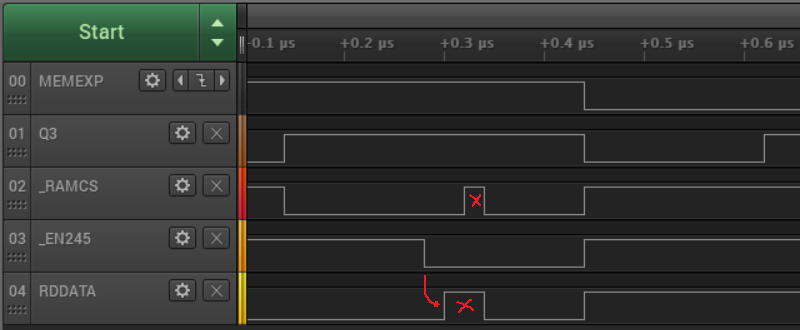
Now I think we may finally be getting close to an answer. It would make a lot of sense to see sudden fluctuations in the power supply shortly after the 74LVC245 is enabled. If there’s bus contention, that’s the moment when it’s going to appear. And even if there’s not bus contention, if the bus driver’s outputs simultaneously all change from 0 to 1 or vice-versa, it can create a big current spike. This is exactly why bypass capacitors are important, to smooth out power supply noise from this type of event.
Bus contention on this ‘245 was exactly what caused the downfall of my original Yellowstone effort back in 2017-2018. It was more than two years before I came back to it, identified the bus contention, and fixed it. Or did I? Maybe it’s not completely fixed? So I tried making some changes to advance or delay the timing of the ‘245 enable signal, but it didn’t seem to have any effect on the glitching. Hmm.
Maybe there’s no bus contention, but it’s still a problem when all the bus driver’s outputs change at once. I’m not sure why that problem would only happen when the SRAM chip is being read, but maybe the SRAM also places a sudden load on the supply rail, and the combination of the two effects is too much. Do I have insufficient bypass capacitance on my ‘245 bus driver chip? It’s a 0.1 uF ceramic capacitor, connected by short traces to the chip’s power and ground pins. I could try soldering in some additional capacitors, or capacitors of a different type.
Whether it’s bus contention or something else causing power supply fluctuations, I ought to be able to see the fluctuations on the 3.3V supply at the moment of the glitch. But when I looked, I didn’t see anything. That could be because I used the analog mode of my logic analyzer, which has a very limited bandwidth, rather than a true oscilloscope. I need to keep looking. I feel like I’m getting closer to solving this puzzle, but still not quite there.
There’s still one other possible explanation here: a damaged chip resulting from my earlier fiasco when D5 was accidentally shorted to the 3.3V supply. That could have damaged the ‘245, the SRAM, or the FPGA. They all seem to be working OK now, but maybe there’s some hidden damage, and under the right conditions the ‘245 will go crazy and draw way too much current.
 Of all the possible hybridizations of Mexican food, a blending with Middle Eastern cuisine is perhaps one of the most natural. The two cultures have a long history of intermingling food traditions: in the 1930s, Lebanese and Iraqi immigrants to Puebla, Mexico, and their neighbors adapted shawarma into tacos árabes, which later morphed into Mexico City’s classic tacos al pastor and Monterrey’s tacos de trompo—initially called tacos doneraki (a portmanteau of doner kebab and Iraqi) in the 1960s. Many food terms in Spanish come from the Arabic, including aceite (oil), azúcar (sugar), and lima (lime). Alambres (wires), a popular Mexican dish, developed from Middle Eastern kebabs. Mexican staples like fragrant cilantro, earthy cumin, and rejuvenating lime are ingredients adapted from the Moors by the Spanish…View Original Post
The post Houston’s Tres Artfully Blends Mexican and Middle Eastern Food appeared first on Texas Monthly.
On Tuesday at the state Capitol, Governor Greg Abbott signed into law two bills aimed at strengthening the electric grid and reforming the agencies that regulate it. It was the culmination of the Legislature’s response to a devastating winter storm that crippled the state’s energy system and killed as many as 700 Texans, according to a recent Buzzfeed investigation.
Before signing the bills, Abbott confidently declared that “everything that needed to be done was done to fix the power grid in Texas.”
But for all the self-congratulation among state leaders this week, grid reform was but a minor feature of the legislative session. Republicans spent most of their time passing through extreme legislation that all but bans abortions, permits most anyone to carry a handgun without a license, restricts how race and history can be taught in Texas classrooms, punishes budget cuts in urban police deparments, and on and on.
The laws Abbott signed will require power plants to weatherize their facilities against extreme weather conditions, increase coordination between regulatory agencies, overhaul the leadership of those agencies, and institute a statewide weather alert system, among other things. The reforms are substantial—but energy experts warn that they go nowhere near far enough to actually prevent another winter catastrophe. Legislators went easy (again) on the natural gas industry. Senate Bill 3, the most comprehensive of the reforms, requires power generators and transmission line operators to weatherize their facilities. Despite the fact that natural gas supply disruptions were the biggest contributor to February’s grid meltdown, the law requires only gas facilities deemed to be “critical” to weatherize, a determination that will be made by the industry-friendly Railroad Commission.
A provision that would have helped fund backup power generators for critical water, electric, and health care facilities—including nursing homes and dialysis centers—was removed from SB3. And although hundreds of Texans were hospitalized for carbon monoxide poisoning, legislators didn’t consider joining 38 other states in requiring homes to have carbon monoxide detectors.
The law will take effect in six months. However, lawmakers declined to set a deadline for when regulators must begin actually enforcing the law. House Democrats proposed an amendment to establish a six-month deadline for enforcement after the regulatory agencies create their weatherization rules. But the bill’s architect, Representative Chris Paddie, R-Marshall, opposed the idea, citing “financial and operational concerns,” and the proposal was voted down. Another amendment to make penalties mandatory also failed.
A bill to reform the Electric Reliability Council of Texas (ERCOT)—which politicians like Abbott blamed for the blackouts—will politicize board appointments by putting the governor, lieutenant governor, and House speaker in charge of the process. Another bill to strengthen the maligned Public Utility Commission, which oversees ERCOT, emerged from behind closed doors in much weaker form. The law currently requires all three commissioners to be “well informed and qualified in the field of public utilities and utility regulation.” That’s a reasonable expectation for regulators of the country’s second-largest electricity market, but legislators ultimately decided that applied to just two commissioners.
Overall, the Legislature failed to provide any relief to Texans who were devastated by the storm. A Senate amendment that would have provided direct relief aid to Texans was ultimately stripped out. Lawmakers did, however, manage to pass $6.5 billion in state bonds to stabilize natural gas and electric utilities that were hit by huge price spikes. The cost will be passed on to utility customers through a surcharge on their monthly bills, which means ordinary Texans will be paying a few extra bucks each month for at least the next couple decades.
For Abbott and other top Republicans, the 87th legislative session was all about political posturing ahead of a primary, where Abbott will be challenged by a former tea party senator, as well as the GOP party chair who spent the last weekend of session at a QAnon convention in Dallas. And Abbott’s camp believes it got what it needed. “It’s an excellent session,” Dave Carney, Abbott’s chief political strategist, told the Dallas Morning News. “We had a great number of items that are attractive to Republicans and independents. We’re in great shape.”
Still, there was much ballyhoo among Republicans after they failed to pass a number of conservative priorities, including their restrictive voting bill Senate Bill 7 (which was killed after House Democrats broke quorum). Republicans also ran out of time to wrap efforts to limit “taxpayer-funded” lobbying and pass so-called anti-censorship measures against big tech social media platforms. Abbott has already signaled that he’ll call a special session to bring up the “election integrity” legislation up again, along with what is sure to be a menagerie of other right-wing bugbears. —Justin Miller
Wrong on Crime
Texas is a collection of myths, one of which has recently framed the state as a national leader on “bipartisan criminal justice reform.” Like most good delusions, there’s a kernel of truth there. Decades ago, lawmakers faced having to spend billions on building new prisons because of dramatically rising rates of incarceration. Instead, the state’s GOP-dominated Legislature reduced the prison population and mothballed several old lockups—mostly by reforming probation departments and funding more alternatives to prison, like substance use treatment programs and drug courts.
While Texas conservatives have called the state “emblematic of the growing movement to be both tough and smart on crime,” lawmakers here have failed to do much else in recent years beyond avoiding billions in new prison spending. Even as traditionally tough-on-crime neighbors like Oklahoma relax drug laws, similar reforms fail in Texas session after session; despite a growing legalization movement across the country, the state still has some of the nation’s harshest marijuana laws on the books. Texas lawmakers named legislation after Sandra Bland in 2017 but have repeatedly failed to pass police reforms that would have prevented her violent roadside arrest in the first place. This session was no different: On the heels of the international movement sparked by the murder of George Floyd, a bipartisan coalition of Texas lawmakers vowed to push a series of reforms aimed at a “compassionate, common sense approach to justice.” Almost all of the reforms they proffered failed or were watered down.
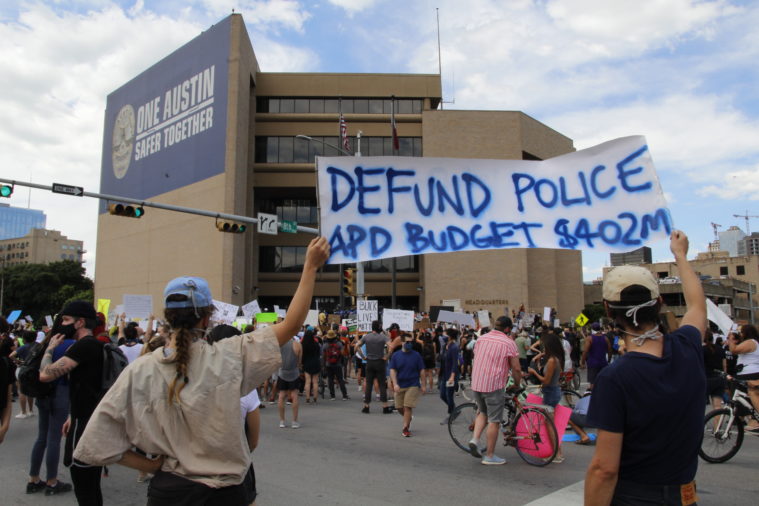
While the Texas House took these issues at least somewhat seriously this session, Lieutenant Governor Dan Patrick’s Senate remained a killing field for bills aimed at reforming the criminal legal system. Meanwhile, conservative lawmakers rammed through other regressive measures —such as Governor Greg Abbott’s priority to punish cities that reduce funding for law enforcement, ensuring Texas police budgets remain bloated in perpetuity. Scott Henson is a writer and advocate for criminal justice reform who has tried to bridge the right and left on prison and policing issues at the Texas Legislature since the 1990s; he recently published a particularly bleak outlook on the 87th session, calling it part of broader “lurch toward totalitarianism.” At the very least, this session should kill any notion of Texas as a national leader when it comes to reforming criminal punishment and mass incarceration. —Michael Barajas
Labored Away
Essential workers, despite a year of being praised as “heroes” on billboards around the country, did not receive a hero’s treatment during Texas’ 87th legislative session. For instance, most state employees were denied a wage increase, extending a yearslong trend. Among the snubbed were workers at state-supported living centers, where employees who care for Texans with disabilities often earn less than $25,000 annually. The living centers, like nursing homes, were slammed with deadly COVID-19 outbreaks last year. The Legislature also declined to pass significant reform to its unemployment system, which failed spectacularly to provide prompt benefits to out-of-work Texans during the pandemic. El Paso state Representative Mary González, a Democrat, proposed a bill to create a public-facing database of employers who’ve committed wage theft, but the measure died for the fifth straight session.
“Essential workers, who risked everything to keep Texas going through [an] unprecedented pandemic and winter storm fallout, were hailed as heroes,” says Texas AFL-CIO President Rick Levy. “But as we survey where the legislative session ended up, all that is a foggy memory.” —Gus Bova
Corporate Immunity
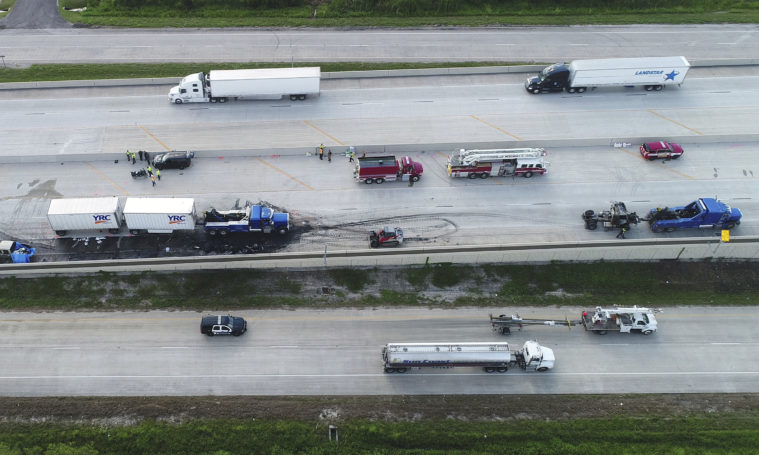
State lawmakers passed two bills this session that would protect companies from lawsuits when they cause the death or injury of a person. House Bill 19 would make it more difficult to sue trucking companies after their drivers hurt or kill someone in a wreck. Senate Bill 6 would strengthen lawsuit protections during pandemics for nursing homes, which came under fire for failing to protect residents from COVID-19. State Representative Jeff Leach, a Republican from Allen, is carrying both House Bill 19 and the House companion for Senate Bill 6. Both bills have passed through the Legislature and await the governor’s signature.
In 2020, Leach received approximately $1 million in campaign contributions from the Texans for Lawsuit Reform PAC. For decades, the group has sought to erode plaintiff’s rights to sue as part of a larger movement known as tort reform. Texans for Lawsuit Reform and its allies have successfully lowered lawsuit risk for doctors, auto manufacturers, apartment owners, and others. If Governor Greg Abbott signs these bills into law, the group will count two more victories. —Christopher Collins
Indigenous People’s Day
Since 1977, a national movement to replace Columbus Day with Indigenous People’s Day has been growing across the United States. So far, Austin, Dallas, El Paso County, San Marcos, San Antonio, and Houston all recognize the holiday. Texas, however, does not. This session, the Texas House and Senate wrestled over whether or not to replace the day, ultimately deciding to opt for a Indigenous Peoples’ Week that will occur on the second week of October for the next 10 years. The final version of the resolution was passed unanimously by both the House and Senate.
The resolution recognizes that Indigenous people “built empires, constructed sophisticated cities, and developed elaborate trade networks and complex social systems.” Indigenous Peoples’ Week is intended to raise awareness about the rich heritage and contributions that Indigenous nations have made to Texas and the country. The governor has until June 20 to sign the bill into law. —Pauly Denetclaw
The post 2021 Texas Lege in Review: Red Meat, Broken Promises, and More of the Same Old Shit appeared first on The Texas Observer.

Hovertext:
So far, humans are the only civilization to somehow preserve bastardry while scaling complexity.
In a large-scale study, Novavax said its vaccine was completely effective against the original coronavirus strain and also effective against some variants. It works differently than other vaccines.
(Image credit: Alastair Grant/AP)

Wasabi nabbed U.S. dogdom's most prestigious prize after winning the big American Kennel Club National Championship in 2019.
(Image credit: Kathy Willens/AP)


Remember kids: it's not a hookup unless they have an ethernet jack.

On the other hand, the fish in Tartarus must have done some really messed up fish crimes.

Feeling Extremely Tense
Good Sunday morning to you. As promised, we are here with an update on the tropics, as we watch the potential for development in the Gulf this week.
I just want to lead with a quick update on our near-term weather here in Houston. It hit 98° yesterday officially, and we’re running slightly hotter already today. We typically don’t see our first 98° day until July 9th, so we’re running close to a month ahead of schedule there. That doesn’t mean we’re necessarily headed for 100° this afternoon, but it’s going to be another scorcher. Please take it easy outdoors. In addition, it’s an ozone action day, so anyone with respiratory sensitivity will want to limit outdoor activity.
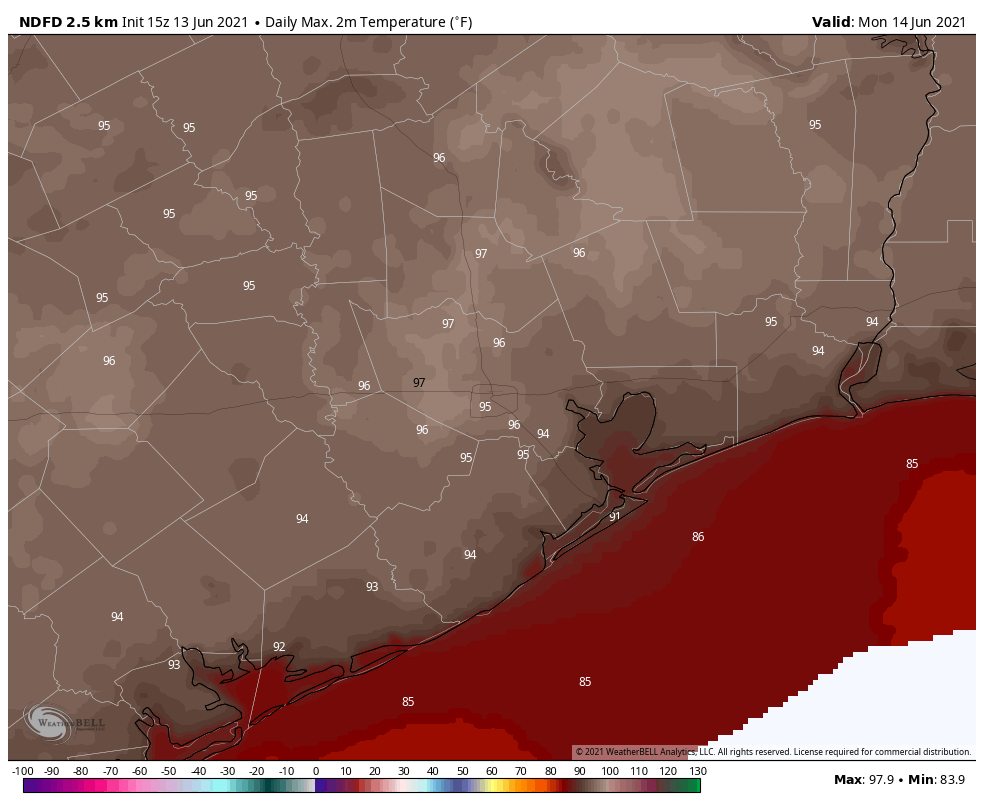
The big difference between today and prior days is with rain chances. Yesterday was close to zero. Today will be slightly above zero. So we feel at least a few locations, possibly parts of the city, will see a cooling downpour this afternoon. Outside of that, it’s just going to be red hot. Tomorrow and Tuesday will likely see a few more scattered showers and storms in the afternoon. Prior to those developing, look for sun, clouds, and temperatures into at least the mid-90s, with morning lows in the 70s to near 80° in spots.
Alright, the main point of today’s post is to discuss the tropics.
One sentence summary: A tropical system seems likely to form in the Bay of Campeche over the next 5 days, and while we will watch it closely, we are currently expecting a fairly disorganized system with a decent chance that the majority of impacts remain shunted off to our east.
In meteorological speak, when we have a specific disturbance we want to get more information on before it gets close to becoming a tropical depression, it is labeled an “Invest,” or area to investigate. In the Atlantic basin, invests are labeled 90L to 99L, and then the list recycles. In the southern Gulf, we now have Invest 92L.
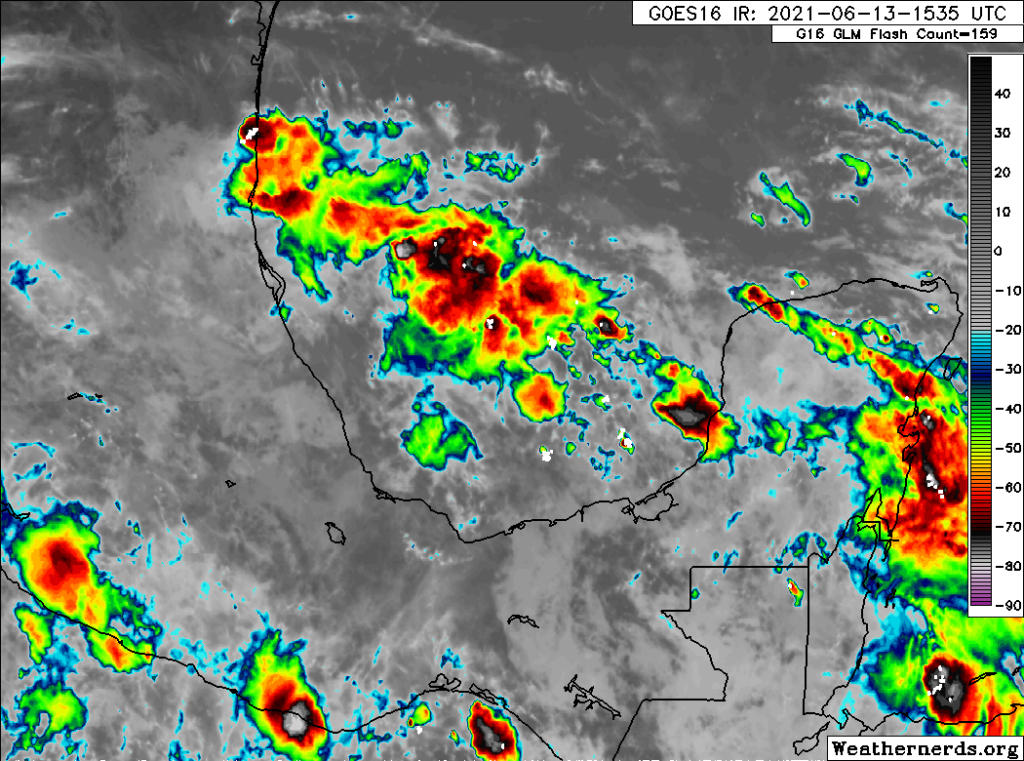
From the satellite image above, you can see a blotchy area of thunderstorms and little organization. This is mostly what we expected to see this weekend. Development from 92L is probably going to be slow. In fact, the National Hurricane Center says the chances of a depression forming seem to be most likely later this week, so we’ve got some time to watch. As of now, they are assigning 50 percent odds of development over the next 5 days.
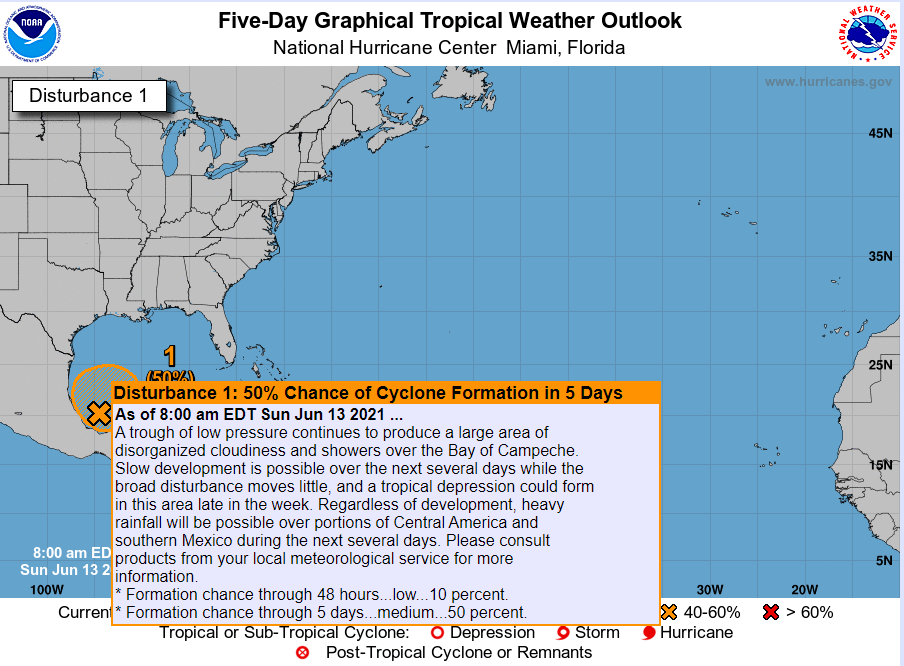
In addition, this system is likely to fester and sit over the southern Gulf the next few days without moving much. So that means any impacts here in Texas from 92L likely would not occur until very late this week or next weekend. You might ask why it’s going to struggle to develop if it’s sitting over the southern Gulf, which is about 2 to 3 degrees warmer than normal. Well, for one, it’s sitting over 25 kts. of wind shear, with an area of 40 kts. of wind shear to the north. That’s prohibitive to development.
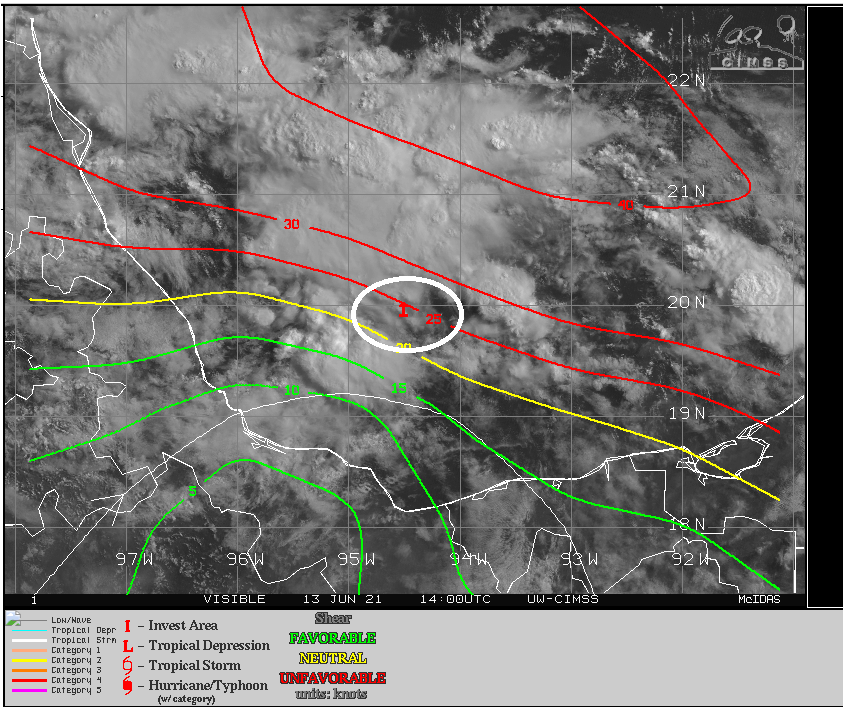
This shear is not expected to relax much over the next few days. In fact, this wind shear may linger in place through Wednesday or Thursday or beyond.
Given a lack of serious steering currents right now, the system is expected to stay in place over the Bay of Campeche. But, as the week progresses, a strengthening ridge in the Western US, a strengthening trough along the East Coast of the U.S., and a building ridge in the western Caribbean will act to gradually invite 92L to drift northward. The exact track of this system will depend on the actual strength of these features and exactly where the center of Invest 92L forms. In general, modeling is telling us to probably expect a northward drift later this week, with some acceleration to the Gulf Coast on Friday or Saturday. From there, it seems possible that the forward speed may slow. But details on that aspect of things are difficult to really pin down right now. Models seem to favor a track of the center toward areas just east of Houston, keeping most of the Houston area on the less impactful side of the system, but again, it’s too early to be too confident in any track specifics.
In terms of intensity, I think two things are going to seriously inhibit how strong Invest 92L can ultimately get. The first is shear, as noted above. I don’t see any evidence on models that this is going to relax much. That’s the first hurdle this system will have to overcome. It may also further help us in that wind shear could allow for much of the more significant system impacts from rainfall to pushed even farther to our east. For those of you reading us from places other than Houston, it’s important to realize that these early season systems are rarely ever symmetrically put together and impacts from heavy rain in particular can extend hundreds of miles to the east of the center.
The other thing that might lower 92L’s ceiling for intensity would be dry air coming off Texas.
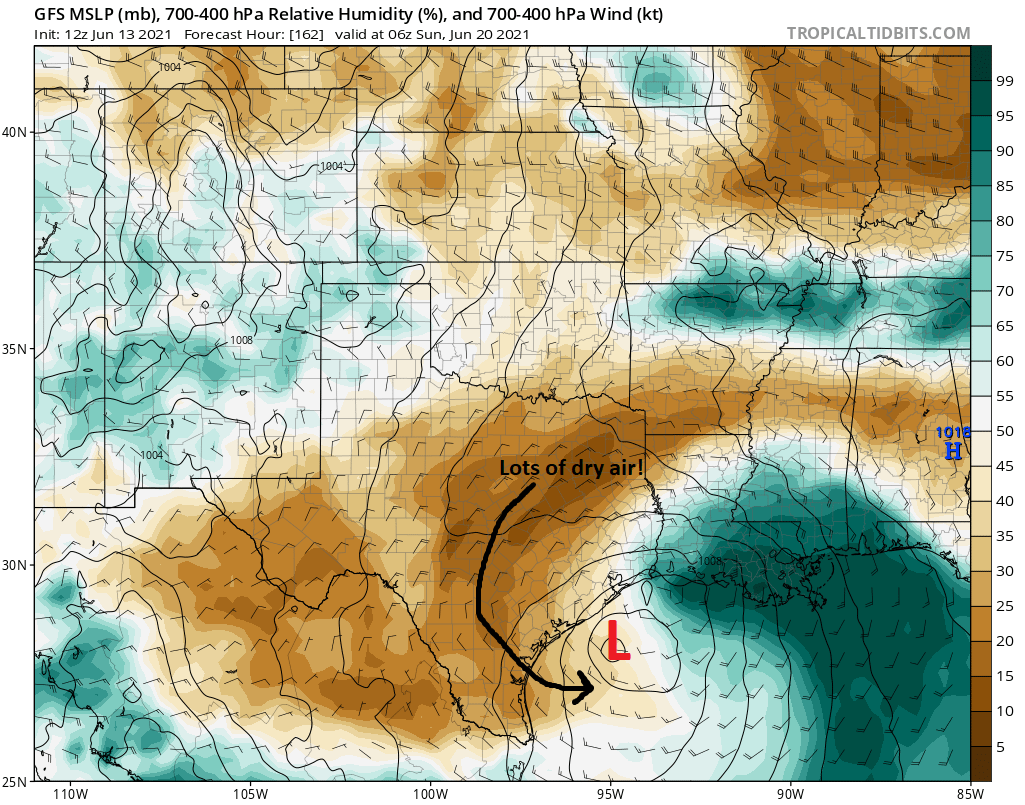
If you look above, you are seeing the GFS forecast of atmospheric relative humidity several thousand feet above us for next weekend. The brown over Texas indicates dry air. The red “L” is the approximate center of 92L as forecast by the GFS on Sunday morning. Don’t focus too closely on that. The green color indicates more ample atmospheric moisture. What is this telling us? Even if the track of 92L shifts 150 miles in either direction, it’s still going to be dealing with dry air possibly getting wrapped in from Texas. That should limit the ceiling of intensity as the storm comes north. Moisture from the storm may be displaced a good bit east of the center as well.
The bottom line, as is often the case with these early season storms: While we will continue to watch closely, at this point we don’t see this as a serious wind-making risk for the area. We are viewing this as a rainfall risk, as well as for some coastal impacts (minor to moderate tidal flooding, overwash, rough seas, etc.). Sitting here on Sunday, I don’t think we need to be especially worried about this either way, but I do feel we should watch things closely this week, just in case anything changes, particularly with respect to rainfall. It’s probably not a bad idea to check in on the forecast once per day and make sure we’re still status quo on things. But truthfully, I feel mostly at ease with where things stand today. Sure, that could change, but for now, we’ll take it!
Look for the latest in our usual Monday morning update tomorrow. Meanwhile, stay cool!


In a five-page ruling issued Saturday, a U.S. judge upheld Houston Methodist Hospital's vaccination policy, saying its requirement that employees receive a COVID-19 vaccine breaks no federal law.
(Image credit: Bloomberg/Bloomberg via Getty Images)


I’ve found a rare clock glitch in the Yellowstone hardware, but I’m not sure how to fix it. This seems to be the source of the “mysterious signal glitching” I mentioned in my previous post, that disappeared after some minor changes to the FPGA logic. From what I can tell it no longer affects the Apple IIe, but pops up rarely on the Apple IIgs, wreaking havoc. I’d suspected a glitch for a while, but I never directly observed it happening until increasing the logic analyzer’s sampling rate to 125 MHz and lowering the logic threshold from 3.3V levels to 1.8V levels. The evidence is shown above.
MEMEXP is an internal FPGA signal that should remain high. Q3 is a 2 MHz clock provided by the Apple IIgs. There’s an 8 ns wide glitch pulse shortly after the falling edge of Q3, and this causes MEMEXP to go low when it shouldn’t. In all my tests, the glitch pulse always occurs during the low period of Q3, between 50 to 150 ns after the falling edge.
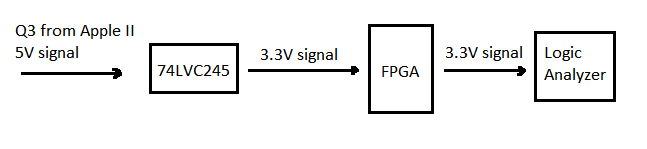
An important detail: The Q3 shown in this logic analyzer trace isn’t actually the FPGA’s Q3 input, because that’s on a PCB trace without any good place to attach a probe. The trace shows an FPGA output that’s been configured to simply propagate the Q3 input. That should be nearly the same thing, but not exactly identical. To complicate matters further, there’s also some level conversion happening. The Q3 supplied from the Apple IIgs is a 5V signal, and it passes through a 74LVC245 to create a 3.3V signal that’s connected to the FPGA. Behold my awesome diagram:
The previous Yellowstone prototype had a 390 ohm inline resistor between the Apple II’s Q3 signal and the 74LVC245. This is something I copied from the design of Apple’s Liron disk controller, although I don’t understand why it was there. None of the other disk controllers that I examined have a resistor on Q3, and I couldn’t find any documentation about a need for one, so I eliminated the resistor in this second generation prototype. Maybe that was a mistake, and is the reason why I’m seeing clock glitching now.
My hunch is there’s a different explanation. I suspect the glitching is caused by other problems on the board, rather than Q3 itself. Maybe there’s capacitive coupling between Q3 and another nearby signal trace. Or maybe my power and ground supplies are bouncing around whenever there’s a big spike in current, like when a bunch of chip outputs switch simultaneously from low to high, and that creates EM noise everywhere. Or maybe there’s some brief contention on the data bus that creates spikes and noise.
I tried playing around with the the FPGA input buffer settings for Q3, in an attempt to make the problem go away. I tried pull modes of KEEPER, DOWN, and NONE, and hysteresis settings of SMALL and LARGE. Nothing helped.
I’m not sure where to go next. I could try assembling a second board, to see if it’s just an assembly problem with this particular board rather than a general design issue. I could look for a way to get a logic analyzer probe directly on the actual Q3 input, which might require fancy soldering, and might also change the behavior. Or a probe on the 5V version of Q3, directly from the Apple II. I could try to patch a 390 ohm resistor onto the board, but it wouldn’t be clean and might create more clock problems than it solves. Or sprinkle some more capacitors around the board, or other analog magic.

Hovertext:
Or we could get more boring, fireless, pictures of Mars or whatever.

Confections bakery in Lufkin, Texas lost customers after posting a picture of its rainbow-iced Pride Month cookies. It's now being flooded with orders and donations, and paying them forward.
(Image credit: Jens Kalaene/dpa/picture alliance via Getty Images)

/https://static.texastribune.org/media/files/266dfa09829a37d1094d653491e7359a/Austin%20Power%20Plant%20EG%20TT%2019.jpg)