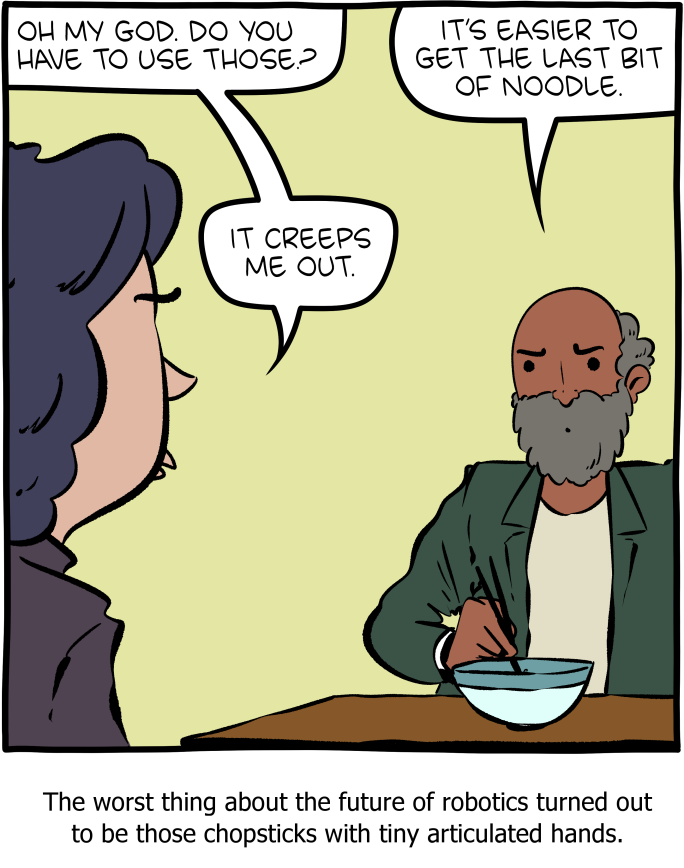
Click here to go see the bonus panel!
Hovertext:
Anything is Turing-complete if you're willing to be patient.
Today's News:
Hovertext:
Anything is Turing-complete if you're willing to be patient.
The conventional wisdom among political observers in Texas about this one and only gubernatorial debate was that Democratic challenger Beto O’Rourke needed to somehow, someway have a breakthrough against an incumbent governor who—despite taking a drastic rightward lurch and presiding over an increasingly long list of disasters—has proven resilient in the polls. Governor Greg Abbott, meanwhile, had to simply avoid a major blunder.
Now the debate is over and the dynamics of the race are the same as they were before. O’Rourke is consistently trailing in the polls by more than five points, most voters in Texas have made up their minds, and any of those still undecided likely won’t hinge their vote on what they saw (or more likely, didn’t see) this Friday night.
O’Rourke turned in a competent performance, repeatedly pressing the case that Abbott’s governing of Texas has been an unmitigated disaster for seven years—on gun violence, school safety, crime, border security, education, the electric grid, and on and on.
“Governor, the buck stops on your desk. You blame everyone else. You blame Joe Biden,” O’Rourke said of the incumbent.
Abbott largely managed to avoid stepping on any landmines, making headline-grabbing blunders, or answering any questions he didn’t want to, while using every chance he got to call O’Rourke a fearmonger, a liar, a flip-flopper, and a radical.
He sidestepped direct questions about whether he personally supported raising the age to 21 for purchasing assault-style rifles—as families in Uvalde have called for—saying that it was “purely my legal opinion.” Asked whether he, as governor for two terms, had any direct responsibility for the rise in violent crime, Abbott blamed Austin for “defunding” its police and Houston for its bail reform policies (without mentioning that, last year, he targeted Houston by passing his own statewide bail restriction law plus penalties for cities that reduce police funding).
“Governor, the buck stops on your desk. You blame everyone else.”
Asked what he would do to provide long-term relief amid soaring property taxes for homeowners, Abbott committed to using more than half of the state’s projected $27 billion budget surplus (much of which is one-time money created by playing fiscal musical chairs with federal pandemic relief funds) to “buy down” local property rates, an inherently short-term fix that Republicans have resorted to before.
O’Rourke went after Abbott for saying that the root cause of school shootings is mental health while the state ranks last in overall funding and he cut the state budget for such programs by over $200 million last Legislative session. Abbott retorted that the state is not, in fact, dead-last in mental health funding, claiming it is now middle of the pack thanks to his actions.
He also committed to making school safety an emergency item in the next session, “just like I’ve done in the past”—implicitly acknowledging that his past efforts in response to mass shootings were insufficient.
When asked to respond to the criticism that he has become much more of a right-wing ideologue while in office, peaking with his signing of the most extreme abortion ban in the country, Abbott took a practiced, soft, and somber tone talking about his Catholic faith and pro-life beliefs, which he said only grew stronger when he adopted his newborn daughter. He doubled down on his stance that women who are raped can access Plan B to prevent pregnancy since abortion is no longer an option. Beyond that, he said, the alternative was to simply go through with pregnancy with meager prenatal assistance and “baby supplies” provided by the state’s Alternatives to Abortion program.
For his part, O’Rourke said that, on immigration and border security, he’d focus on “solutions over stunts.” He criticized Abbott’s Operation Lone Star as a politicized boondoggle, but said he’d support more targeted deployments of Department of Public Safety troopers and volunteer National Guard soldiers on the border.
Asked about his infamous “Hell yes, we’re going to take your AR-15s” comment during his presidential campaign, O’Rourke said it’s still his personal belief that those weapons should not be legal, but that as governor, he’d focus on achievable policies with bipartisan support like raising the age to 21, expanded background checks, and red-flag laws.
On property taxes and education, he pledged to increase the state’s share of public school funding in order to ease the burden created by school districts’ property taxes.
Abbott said that after changes made to energy policy after Winter Storm Uri, the electric grid is “more resilient and reliable” than ever—as evidenced by the lack of blackouts during this past winter and during the record-breaking heat wave this summer. O’Rourke pointed out that there were still conservation notices issued during peak heat waves and that everyday Texans have been stuck with the tab from the grid failure by paying increasingly high utility bills.
Like most political debates, 60-second or 30-second limits for answers and 15 seconds for retorts proved woefully inadequate in delivering a real debate about complex and critical issues—or accountability of any kind for the governor.
Does this change the race at all? According to a focus group held by Amarillo’s KAMR TV news station, Abbott went into the debate ahead 40-27, with 33 percent of voters undecided. After the debate, O’Rourke was leading 50-43, with just seven percent still undecided. We’ll see if the rest of those who tuned in from the broader electorate were similarly moved.
Back to your regular programming.
The post Did the Abbott-O’Rourke Debate Change Anything? appeared first on The Texas Observer.
There are two things I want to talk about before jumping into the forecast for this week—a forecast I would classify as not great, but far from terrible. To start with, I want to thank everyone who came out to our first Fall Day celebration at the Houston Botanic Garden on a gorgeous Sunday. We should get a final tally today, but I think 400 or 500 people came by to say hello, and it was just wonderful to meet you all.
Matt and I also want to say a huge thank you to Reliant, who went above and beyond to organize and support this event on short notice. Megan, Pat, and the events team there did a spectacular job of ensuring there were activities for kids, coffee and snacks, and finding the great location. It’s due to our long-term partnership with Reliant, now more than five years running, that we’re able to hold events like this.

If you were at the Fall Day event, you may have heard me announce what has been clear for awhile now—the 2022 Texas hurricane season is over. This is something we could have written last week, but it felt inappropriate to do so as Florida was getting slammed by Hurricane Ian.
The Atlantic hurricane season runs from June 1 through November 30, but due to a variety of factors including a shifting jet stream at this time of year, it is rare for Texas to get struck by a hurricane after the end of September. This year, based on what we’re seeing in the tropics at present, should be no different. A freak storm is always possible, and we may see some tropical moisture at some point, but you should feel free to let your guard down. We made it!
I’m afraid this week won’t bring the same, absolutely splendid weather we saw at the end of September and early October. However, we’re not going back to full-on summer either. While the air will be more humid than last week, mornings and evenings will still be fairly pleasant.
High temperatures on Monday will reach the upper 80s under mostly sunny skies, with light winds out of the northeast at 5 mph or so. We may start to see some clouds higher in the atmosphere later today and tonight, and these will be related to Hurricane Orlene, a Category-2 storm in the Pacific making landfall in western Mexico today. Alas, we won’t see enough moisture from Orlene to bring much needed rainfall to our area. Lows tonight will drop into the mid-60s in Houston, with cooler conditions inland.
The story of the mid-week will be that of a slowly warming trend, with daytime highs rising from the upper 80s to 90 degrees, and overnight lows from the mid-60s to the upper-60s. However, in terms of humidity the dewpoints—a measurement of moisture in the atmosphere—are still going to remain in the 60s. What does this mean? Simply that while our air will feel more humid, it won’t be uncomfortably or oppressively so. Skies will be mostly sunny with, alas, very little chance of rain.
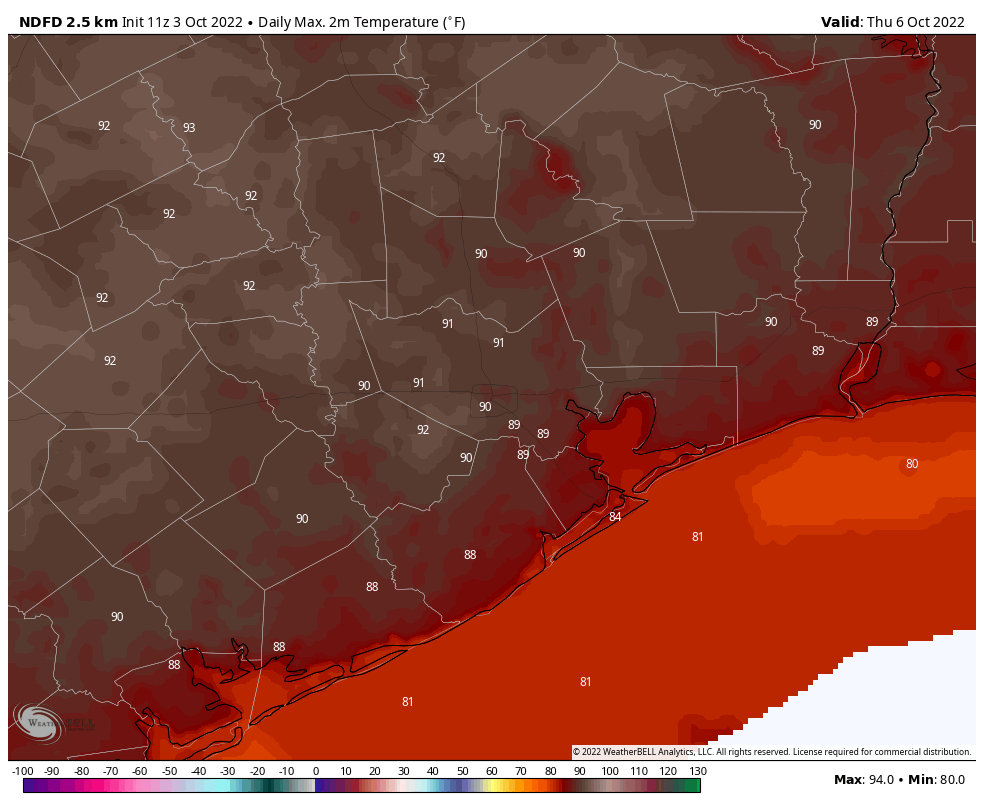
Highs will be around 90 degrees this Friday, but at some point later in the day, or overnight, a weak front should push into the area. Don’t expect miracles from this one. For starters, it seems unlikely to produce any rainfall. But it should knock the humidity back some, and trim a few degrees off our daytime and nighttime temperatures. Honestly, with mostly sunny skies and highs in the 80s, this weekend should again be pretty nice.
I know you’re all wondering about rainfall. The bad news is that it’s still a ways off. The somewhat hopeful news is that, with the next front, which I would pencil in around October 13 or 14, the models do seem a little more bullish about rain chances. I would caution that this is 10 days out, so it lies at or just beyond the edge of our ability to predict. But I’m an optimist, so I’m saying there’s a chance …



If you own an Alexa, you’ve willingly allowed a tiny corporate spy to live in your home and record your every word. When you’re around one, here are the things you should never say.
Time is a widespread conceit. As humans, it is easier to think of time as linear and progressive; the forward march of history to a better world. What if the timeline, however, is not so clear? What if past and future can be melded to form a better present? Christopher Blay / SpLaVCe Ship, on view at Barry Whistler Gallery, explores that relationship. In a body of work that aligns with Afrofuturism, a cultural and philosophical movement centering African diaspora communities in science of fiction, Blay invites viewers to contend with African American history while envisioning a new path forward.

Christopher Blay, “Power Lines #11,” 2022, twisted afro picks, on organic roofing felt, 11 x 8 ½ inches
Upon entering the gallery, Blay’s Power Lines series greets visitors, setting the stage for what they will experience. In these works, Blay celebrates the hair pick — a comb typically used to style thickly textured and coily Black hair — and utilizes it as a symbol of strength and resilience. Black Power fists serve as the handles of each pick, with metal tines surging out in unique angular formations. I strongly encourage visitors to take note of the titles of Blay’s works, which are carefully crafted to highlight the symbolism embedded in each piece.
A great example is the Power Lines series. The term “line” has multiple meanings. It can refer to lineage, or ancestry; when referring to African Americans, the notion of lineage is quite fraught. Black families have been intentionally disrupted and used as a tool of White supremacy during slavery, the centuries that followed, and into the present day. Yet, African Americans have found ways to reconstruct families and draw power from that support and community. The tines of the comb may be bent or severed, but they continue. There is not a loss of power, just a change of course.
There is also a reference to power or electric lines in this body of work, like a notion of energy — an allusion many present-day questions about the sustainability and reliability of our power sources. We also must question how we power ourselves as individuals, and convert our own energy into a collective power.
The year 2020 served as an important marker in the movement for social justice in the United States. It galvanized large numbers of people of diverse backgrounds, and made them pool their energy in the fight for inclusivity and equity. As I look at Blay’s works, I cannot help but wonder what’s next. How do we, those in the movement for equity and justice, continue to grow our collective power and plug that energy into the efforts that will bring about meaningful change? How can we look to the past and draw strength from it while forging a radically different future?
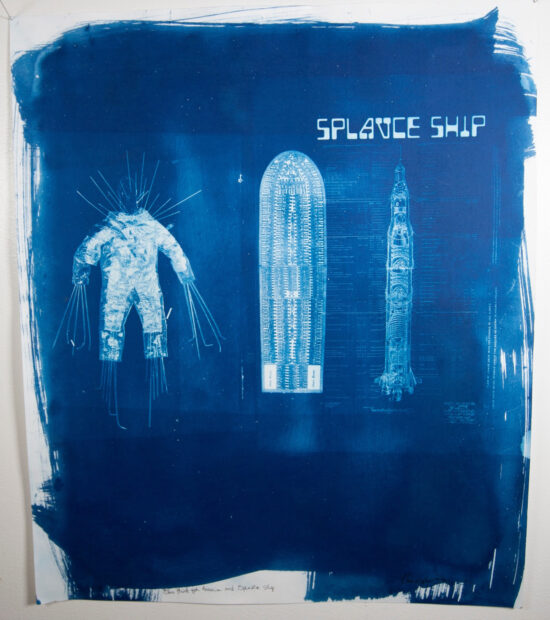
Christopher Blay, “Blueprint for America and SpLaVCe Ship,” 2022, cyanotype on hahnemuhle paper, 24 x 20 inches
Blay has long tackled social justice in his artistic practice. His newest series SpLaVCe Ship, featuring works on paper and sculptural works, blends his interest in science fiction with Black history. Blueprint for America and SpLaVCe Ship sets the stage for the project. On the left of this cyanotype is the Diaspronaut, the protagonist of Blay’s narrative. It is Blay’s fictional character of a future Diasporan being, with long tentacle-like extremities, that will travel through space to settle a new home. To create this figure, he layers the afro picks from Power Lines with the image of an early space suit. In the center of the work is the familiar image of the layout of an African slave ship, inhumanely transporting hundreds of human beings in rows and stacks across the Middle Passage. A blueprint of a rocket ship occupies the right side, showing the transition from past to future. While Black bodies were forcibly moved by slave ship to the Americas, going forward, Black people will assert their agency and make their next moves via space ship.
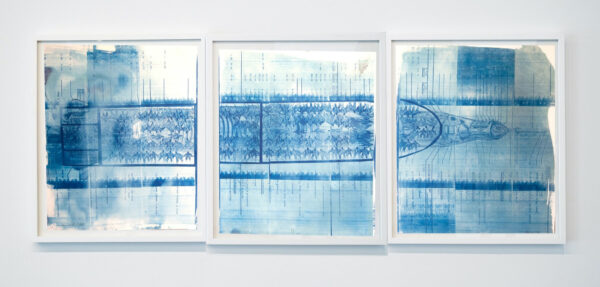
Christopher Blay, “SpLaVCeShip,” 2022, cyanotype on hahnemuhle paper, set of three, 24 x 20 inches, each
Blay’s vision comes to life in SpLaVCeShip, which is a combination of the three images into a singular artwork. In this cyanotype, Blay overlays the blueprint of the slave ship onto the blueprint of the rocket, but partially clad Black bodies no longer occupy the vessel. Instead, Blay substitutes his Diaspronauts into the ship, repeating his futurist figures atop the figures of the past.
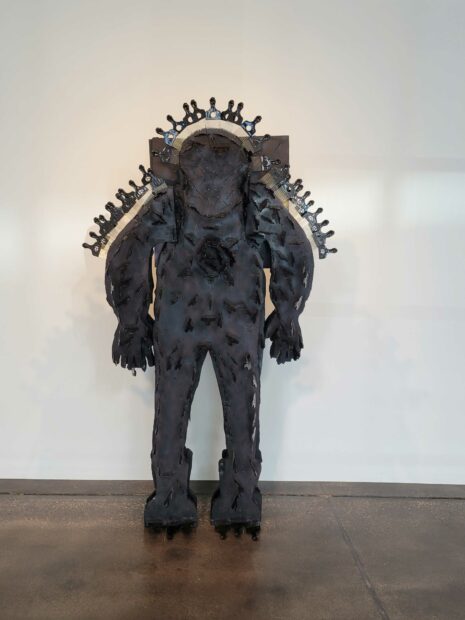
Christopher Blay, “Untitled (Diaspronaut),” 2022, black spray paint on insulation foam, metal rods, and afro picks, 84 x 48 x 24 inches
In the second gallery, Blay’s narrative takes monumental form, from large renderings of the SpLaVCe Kru on organic roofing felt to The SpLaVCe Ship, a three-dimensional model of the ship made of steel, wood, and painted canvas. The work in this section that lingered with me most was Untitled (Diaspronaut). This life-sized figure, apparently in a space suit, is striking in its solid blackness. The use of insulation foam provides a built-out form that enhances its presence. Afro picks jut out from this solid black form, which shares qualities with Kongo nkisi sculptures. Nkisi are power figures in the Kongo tradition, providing protection and power to the owner. I cannot help but wonder if this is Blay’s effort to give Black people from the diaspora a large-scale power figure that provides protection and medicine as new chapters are written in our history.
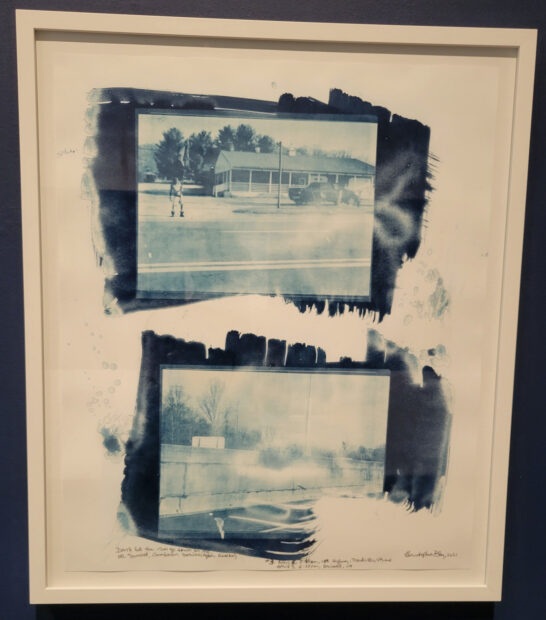
Christopher Blay, “Don’t Let the Sun Go Down on Me, or Sunset/Sundown Series (after Ed. Ruscha), #3 April 6, 5:46 PM, Lee Highway, Troutville, VA, and April 6, 6:38 PM, Bristol, VA,” 2021, cyanotype on hahnemuhle paper, 20 x 24 inches
The medium of cyanotypes returns in the back section of the gallery with Blay’s Don’t Let the Sun Go Down on Me, or Sunset/Sundown Series (after Ed. Ruscha). Created during a road trip taken by Blay in April 2021 from Houston to Washington, D.C., this series is as much a performative piece as a tangible work on paper. In many of the images, Blay strikes a nostalgic cord, reminding viewers of the many hours spent staring out of the car window during yet another long road trip.
One piece, #3 April 6, 5:46 PM, Lee Highway, Troutville, VA, and April 6, 6:38 PM, Bristol, VA is less serene and more confrontational. In the top image, one looks across a road to the parking lot of a farmhouse-style business and a dark pickup truck. While this is not an uncommon sight in most areas of the United States, in this image a figure appears to be standing in the drive of the parking lot, wearing combat-style boots and holding a flag. In this cyanotype, it is hard to make out what flag is being displayed, but considering the image was taken in Virginia (and the recent history of white supremacist rallies there), the mind automatically starts guessing.
In the work’s other image, Blay captures a view from the road with a bright Christian cross at its center. The United States has long been considered a Christian nation, and Virginia certainly falls into the Evangelical Bible belt. To be clear, while there is nothing necessarily jarring about a cross for this viewer, even I found the location, scale, and shade of the cross to be a confrontation.
First, it is a large cross directly in the center of the image, commanding the viewer’s attention, while a United States flag looks paltry in comparison just to the right. Why was such a large cross placed here? What is being asserted about the role of Christianity in this particular place? Considering the debates about religious freedom and the restrictions of particular rights in accordance with Christian values, I cannot help but view this as an attempt to re-impress Christianity upon those passing.
Then, there is the bright tone of the cross. Those who have made a sunprint before will know that objects laid over the light-sensitive paper block the light, making an area appear lighter than the surrounding, unshielded area. In this case, the cross appears quite bright. Again, considering the context of this image, which was captured in Virginia, the mind cannot help but wander to the idea of burning crosses meant to intimidate Black people.
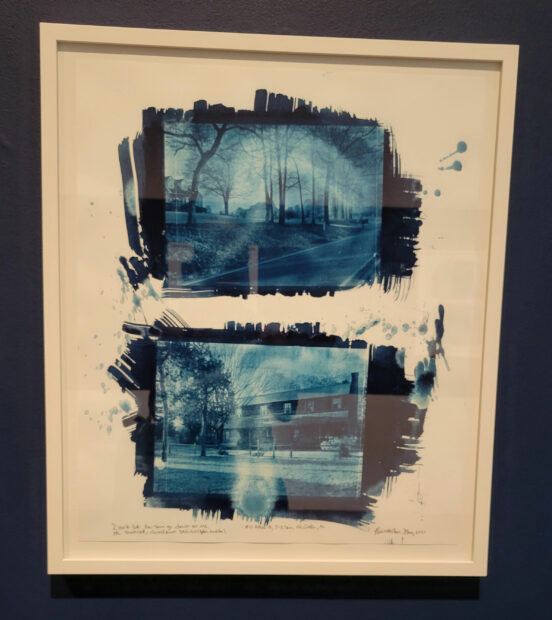
Christopher Blay, “Don’t Let the Sun Go Down on Me, or Sunset/Sundown Series (after Ed. Ruscha), #4 April 5, 7:37 AM, McCalla, AL,” 2021, cyanotype on hahnemuhle paper, 20 x 24 inches
#4 April 5, 7:37 AM, McCalla, AL captures the stately homes that dot the landscape Blay traveled. What is remarkable is the especially early time of morning that the photograph was taken. Were others aware of Blay’s presence, capturing images of homes and businesses? If so, what did they think? These questions get at the heart of the project and are part of his response to Ruscha. While Ruscha had the freedom to travel along Sunset Boulevard taking images, Black men like Blay cannot navigate communities as freely or safely. This also relates to his use of the term “Sundown” in the title of the series, referring to the many sundown towns that existed during the Jim Crow era, and arguably still exist today. In these places, Blacks experienced/still experience violence if found within city limits at night. Blay’s project is not only a creative documentation of his travels through the American landscape, but also a transgressive performance that explores his own mobility.
Christopher Blay / SpLaVCE Ship takes visitors on a remarkable journey through past, present, and future. Through exceptional works, both paper-based and sculptural, viewers are invited to engage with challenging concepts, but leave with a sense of hope. Blay has provided us with his creative idea of what a future could look like. He gives us a starting point to interrogate how we will take our past and continue to explore our ability to take new paths in the present to create a new narrative for African diasporan life in the future.
Christopher Blay / SpLaVCE Ship is on view at Barry Whistler Gallery in Dallas through October 15, 2022.
The post The Future is Past is Now: “Christopher Blay / SpLaVCE Ship” at Barry Whistler Gallery, Dallas appeared first on Glasstire.
(This is a guest post by Antoni Sawicki aka Tenox)

Project Monterey was an attempt to unify the fragmented Unix market of the 90s in to a single, cross vendor Unix OS that would run on the upcoming Intel Itanium (and others) CPU. The main collaborators were: IBM, who brought its AIX, SCO brought UnixWare, HP was supposed to bring parts of HP-UX and Sequent DYNIX/ptx. Ironically the project shared fate of the Itanium CPU—it totally failed. In the end Linux took spot of the “single Unix OS”. IBM donated AIX pieces to Linux instead and the main legacy of Project Monterey was the famous SCO vs IBM lawsuit.

IBM did however produce AIX version for the Itanium architecture! According to Wikipedia, some 30+ licenses were sold in 2001-2002. For years a dedicated group of individuals was trying to locate a copy of the legendary OS. It seemed that the OS was lost forever…
…until some 21 years later friends of NCommander checked in with a set of AIX5L IA64 CDROMS! The CDs have now been dumped and you can download them here. Unfortunately downloading will not get you much closer to actually running this. As of today no publictly available virtualization or emulation platform can run this. Yes we tried Simics, looked at QEMU IA64 and XEN/KVM for IA64, etc. The OS will not boot on modern Itanium 2 (McKinley) CPUs, only the early “pre-release” Itanium 1 aka Merced. Allegedly the only emulator ever capable of running it was the super elusive unobtanium called Intel SoftSDV.
It’s currently speculated that AIX5L IA64 will work on and only on so called “Intel Software Development Vehicle (SDV)” sometimes referred to as “Intel Engineering Sample”. It was an Intel made machine, later sold in several OEM branded version: IBM IntelliStation Z Pro 6894, HP i2000 Workstation, SGI 750, Dell Precision Workstation 730 and Fujitsu-Siemens Celsius 880.

…yes, they all look alike because all of them were in fact produced by Intel with custom case badges and paints.
Luckily I was able to score a working HP i2000. AIX booted up and installed on a first try:


Initially I was not able to get the onboard NIC working. Upon short investigation AIX5L IA64 supports only two network cards:
devices.pci.23100020.rte - IBM PCI 10/100 Ethernet Adapter Software
devices.pci.ae120100.rte - Gigabit Ethernet PCI Adapter Software
The AIX Itanium Early Adopters Release Notes mentions a few other cards but I do not see drivers for these in the OS. The doc mentions “Extended Hardware Drivers CD” which we don’t have.
Luckily again I was able to find a working NIC on eBay!

The system comes with X11 and CDE but so far I was not able to get any GPU working beyond basic text mode. I tried many different video cards from that era but there simply doesn’t appear to be any driver in the OS except for basic VGA / LFT mode. I think the key to getting video works is the previously mentioned extended hardware drivers cd.
Update: Thanks to efforts of TRN we now have a working GCC and ports of lots of apps!
Finally, if you want to read more I have found some interesting pieces on ibmfiles and various mirrors here and here.

The tax cut was part of a package of unfunded cuts unveiled only days ago that sent the pound to record lows and was widely seen as politically toxic.
(Image credit: Stefan Rousseau/AP)

This post, do you have to be paid if your office is closed because of a hurricane? , was originally published by Alison Green on Ask a Manager.
I’m getting a lot of questions because of Hurricane Ian about whether you have to be paid if your office closes because of the storm. Here’s a quick run-down.
If you’re a non-exempt employee (eligible for overtime): If your office closes because of the storm and thus you don’t work on those days, your employer is not required to pay you for those days. Some employers still will, but the law doesn’t require it; it just depends on what your employer’s policy is.
If you’re an exempt employee (salaried and not eligible for overtime): If you work any portion of the week, you have to be paid your full salary for the week … even if your office closes because of the storm. They can, however, require you to use a vacation day for that day. (But if you’re all out of vacation days, they can’t dock your pay to cover it.) Smart employers will not make you use vacation time for these days, but they’re not all smart.
What if your office is open but you can’t get to work because of the storm? If you’re non-exempt, nothing changes. If you’re exempt, however, it’s a little different: In this case, you’re not considered “ready, willing, and able to work” — even though that’s not within your control — and so your employer can dock your pay if you miss a full day. If you only miss the part of the day, they can’t dock any pay; that’s part of being exempt. But most employers will let you use vacation time for these days, and some won’t charge your accrued leave time at all.
So the answer, as it so often does, comes down to whether you’re exempt or non-exempt.
Of course, employers can choose to do more than they’re legally obligated to, and good employers think carefully about the morale problems associated with paying exempt workers for missed days while not paying non-exempt ones, particularly in a context where people are fearing for their safety and their homes.
Originally published in 2017 during Hurricane Irma.

LONDON—Griping over how long it took to carry 2,000 chairs up and down a spiral staircase, Buckingham Palace staff reportedly decided Monday not to pack up all of the royal funeral stuff just yet after seeing King Charles III up close. “Let’s just leave everything in the corner—it’s not going to be more than a few…

SPACE—Earth’s moon, the planet’s only natural satellite and the fifth-largest moon in the solar system, reportedly died Monday at the age of 29. Born Jefferson Gene Leach in 1993, the planetary-mass object was raised in poverty on the streets of Brownsville, Brooklyn, dropping out of school to work several part-time…
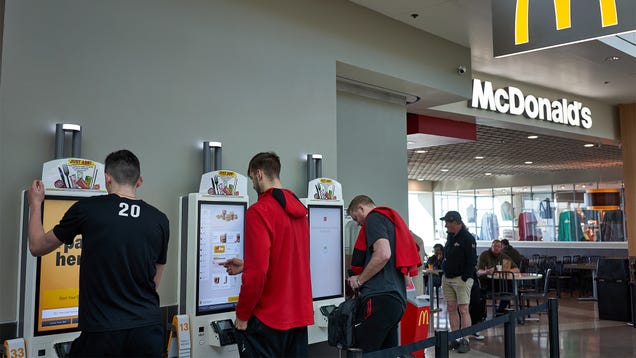
CHICAGO—In an effort to streamline the abuse process, fast food behemoth McDonald’s confirmed Monday that it had started testing a new self-ordering kiosk that would cry when customers yelled at it. “We hope these new self-service kiosks will allow twice as many McDonald’s customers to go on ruthless power trips in…
Please join us on October 18th 6:00- 8:00 pm as we take a peek behind the doors of the Physical Archive in Richmond, California
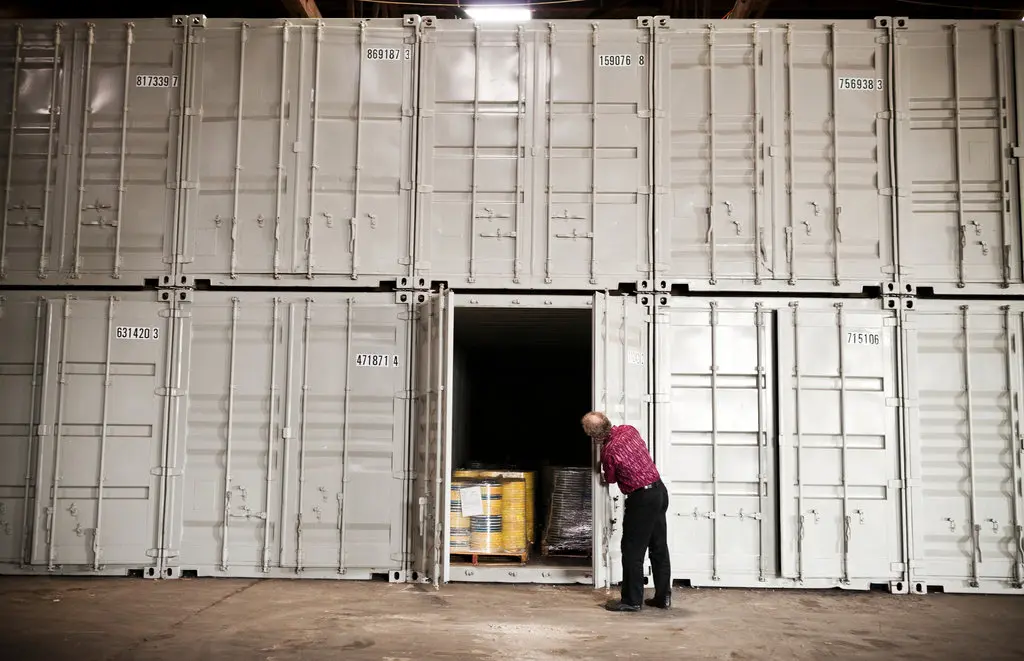
In anticipation of launching Democracy’s Library on October 19th we are excited to offer a behind-the-scenes tour of our physical collections of books, music, film, and video in Richmond, California.
With this special insider event we are opening the doors to an often unseen place. See the lifecycle of physical books acquired by the Internet Archive — donation, preservation, digitization, and access. We’ll also present samples from generous donations and acquisitions of books, records, microfiche, and film, and demonstrate the Archive’s high-end motion-picture film scanner.
We look forward to offering this glimpse into a very important part of the Internet Archive in its mission to bring Universal Access to All Knowledge.
Light refreshments will be provided
Cost: $10
DOORS OPEN: 6 PM – 8PM
ADDRESS: 2512 Florida Avenue Richmond, CA
THANK YOU FOR REGISTERING IN ADVANCE
The post “Doors Open” — Go Behind–the-Scenes at the Physical Archive of the Internet Archive appeared first on Internet Archive Blogs.


Read more of this story at Slashdot.
Glad Girls: Heteronormativity and Its Relation to Distaff Serotonin Levels
My Valuable Hunting Knife: Monetization / Valorization of Weaponry as Related to Prevalent Models of Self-Esteem Expression
Hardcore UFOs: Mosh Culture, Stagediving, and Attendant Prevalence of Traumatic Brain Injuries
I Am Produced: Artistic Integrity in the Era of Lo-Fi Crossover
Subspace Biographies: Role(s) of the Music Documentary in the Age of Streaming
I Am a Tree, I Am a Scientist: Arboriculture, Ontology, and Identity
Vote for Me, Dummy: Democracy in the Post-Knowledge Epoch
Not in My Airforce: The Inclusiveness Journey and the Modern Armed Forces
Shocker in Gloomtown: Overreliance on ECT in Mid-Size Municipal Mental Health Facilities
Echos Myron: The Continued Influence of the Athenian School on Contemporary Western Sculpture
Hank’s Little Fingers: A Case Study in Digital Diminution
Your Name Is Wild: Surprising and Unusual Nomenclature from the Post-Boomer Era
Strumpet Eye: Inversion of the Male Gaze in Early Victorian Literature
Fast Japanese Spin Cycle: Postwar Manufacturing Dynamics and the Battle for America’s Laundry Rooms
Hot Freaks: How Bikram Yoga Stormed the Suburbs
Everywhere with Helicopter: Reports of Omnipresence Amongst Propellor-Driven Aircraft
Acorns and Orioles: A Guide to Naming Your Brooklyn-based Restaurant
Postal Blowfish: Alternative Neurotoxin Delivery Systems in the Public Sector
The Goldheart Mountaintop Queen Directory: Sexual Identity and the Queering of Antebellum Appalachia
Discussing Wallace Chambers: Discussions on the Subject of Wallace Chambers
1. At first, they seem kind of magical.
2. It never occurred to me that they could do so much damage.
3. They are more visible at dusk.
4. They are invasive.
5. They are a nuisance and affect the quality of life of everyone they come in contact with.
6. They are biblical in scope.
7. They are stomped out while other, less beautiful ones, are allowed to flourish.
8. Someone broke up with me because I wouldn’t let them die.
9. My children are plucking off their wings.
10. There are billboards dedicated to encouraging their destruction.
11. People take a disturbing amount of pleasure in killing them.
12. I find myself co-opting dinner conversations to incessantly discuss them: where did they come from, where are they going, am I worrying about them too much?
13. If they stick around too long, they could damage the wine industry.
14. They were interesting at first, but now they seem hardly worth my time.
15. I thought they were beautiful butterflies. But they are not. They are not beautiful butterflies.
16. My parents don’t think they’re a big deal.
Spotted Lanternflies: 1-7, 9-16
Misguided Dreams: 1-16
Hovertext:
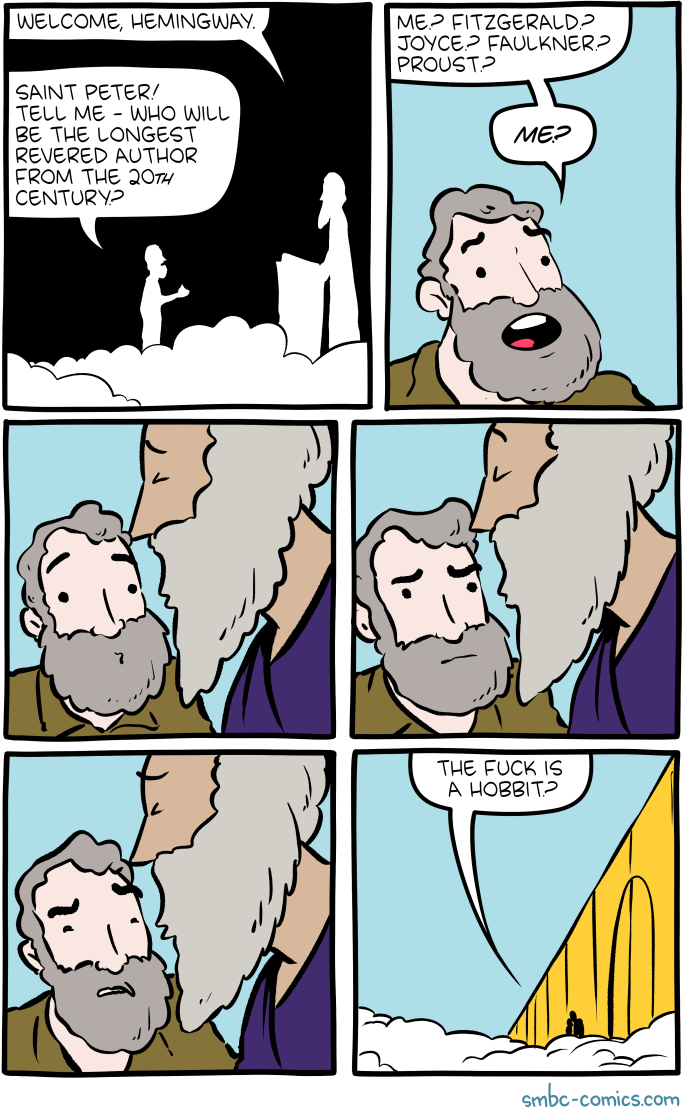
Tolkien ends up in Heaven but is secretly disappointed Valhalla wasn't available.
Hovertext:
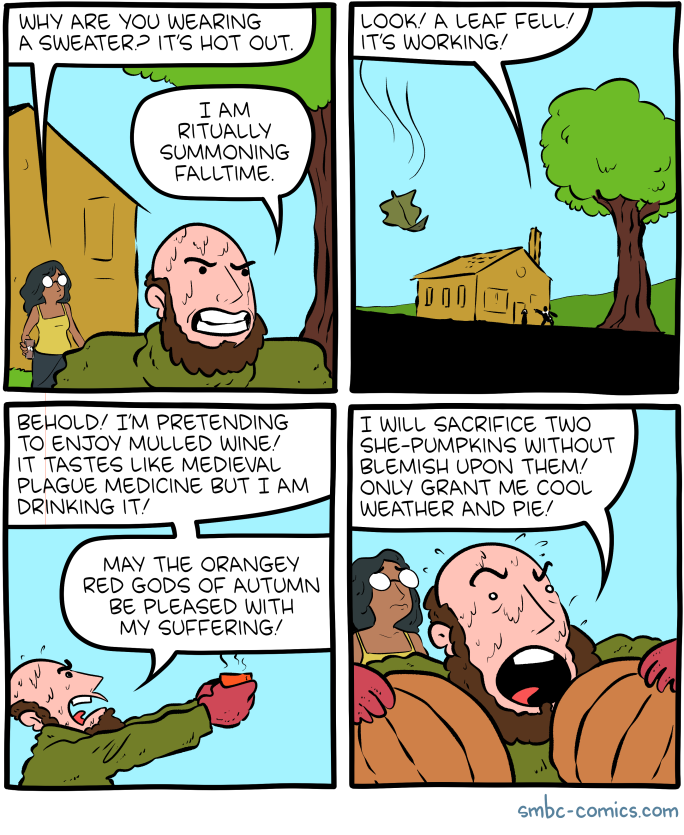
The danger is you go too far and it starts sleeting.
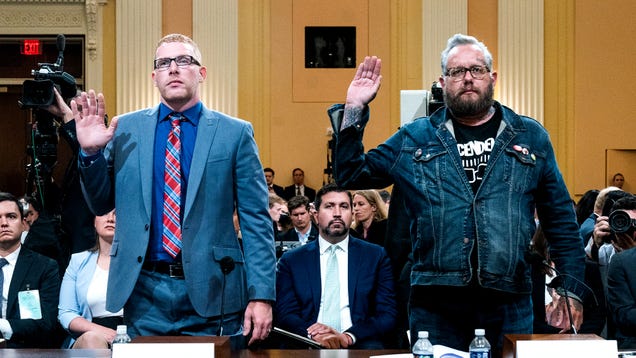
Five members of the Oath Keepers, including founder Stewart Rhodes, are being tried in federal court for their role in the riots of Jan. 6, 2021. The Onion tells you everything you need to know about the Oath Keepers and their trial.

NAPLES, FL—With state power outages topping 2.6 million in the aftermath of Hurricane Ian, sources reported Thursday that wealthy Florida residents without electricity were forced to rely on their emergency hand-crank margarita machines. “Thank goodness our estate manager had the foresight to pack an emergency…

CINCINNATI—Checking up on the injured player after he suffered a concussion in Thursday night’s game against the Cincinnati Bengals, NFL doctors reportedly tested the mental acuity of Miami Dolphins quarterback Tua Tagovailoa by seeing if he could sign an indemnification agreement. “Following the game, NFL medical…
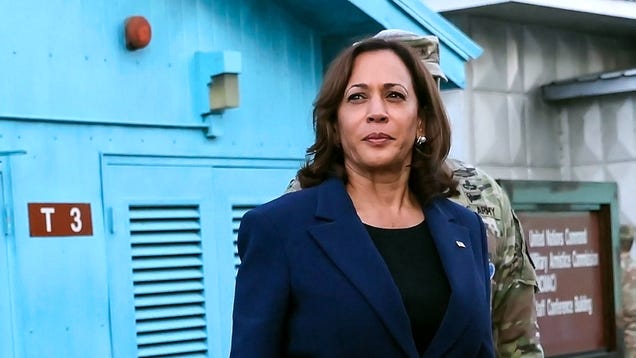
KOREAN DEMILITARIZED ZONE—Noting that it would be so easy to transform her life in an instant, Vice President Kamala Harris reportedly briefly pondered stepping across the DMZ Friday to whatever fate would await her. “Just one step: That’s all it would take and then everything would change,” said the vice president,…

Singer and trained flutist Lizzo played a 200-year-old crystal flute made for President James Madison at her show in Washington, D.C., the instrument on loan fro the Library of Congress, which has the largest flute collection in the world. What do you think?
One of the major problems that worked against Stadia from the jump was the fact that Google didn't secure blockbuster exclusives for the cloud gaming service, which it will shut down in January. Sure, people were able to play the likes of Red Dead Redemption 2,Cyberpunk 2077 and Destiny 2 on the platform, but those are all available elsewhere. As it turns out, Google may have spurned the chance to have an exclusive title from one of the biggest names in gaming.
According to 9to5 Google, at one point Hideo Kojima was working on a Stadia-only follow-up to Death Stranding, which debuted on PlayStation in 2019 and later arrived on PC. Death Stranding has some asynchronous multiplayer elements. Other players might be able to use ladders, roads and other items that you place in the world, for instance. However, the planned follow-up was said to be a fully single-player game, which might have been the reason why Google canceled the project.
According to the report, Google canned the game, which was described as an episodic horror title, after seeing the first mockups in 2020. Stadia vice-president and general manager Phil Harrison is said to have made the final decision to kill the project. For what it's worth, in a May 2020 interview, Kojima claimed one of his projects had recently been canceled.
Google reportedly abandoned the project in the belief that there wasn't a market for single-player games anymore. Of note, CD Projekt Red just announced that Cyberpunk 2077 (which, again, was released on Stadia) has now sold 20 million copies, less than two years after its eventfuldebut. By mid-2021, Death Stranding itself had sold more than 5 million copies.
The lack of big exclusives is far from the only issue that led to Stadia's downfall. A questionable business model and a seemingly rushed rollout didn't help, and nor did Google's reputation for ruthlessly killing off its own products. Even though Stadia has excellent game streaming tech and some passionate fans, it never took off as Google hoped. The company will shut down the platform on January 18th and issue refunds for all hardware and software purchases (except for Pro subscriptions). Ubisoft is working on a way to give people who bought its games on Stadia access to PC versions.
The news of Stadia's demise blindsided developers, from giants like Destiny 2 studio Bungie to indie studios whose titles were supposed to hit the now-closed Stadia store in the coming weeks. As Axios notes, it isn't clear whether Google has a broad plan to reimburse studios for costs they expected to recoup after launching their games on Stadia. There are concerns about what Stadia's closure means for game preservation too. While Google didn't secure AAA exclusives, Stadia has some indie games that aren't available elsewhere.
Meanwhile, some are calling on Google to unlock the Stadia Controller's Bluetooth functions. The argument is that, if people can more easily use the controller on other platforms, it's less likely that the gamepad will become e-waste. The controller connects directly to WiFi for Stadia games in order to minimize lag. You can also hook it up to devices with a USB-C cable.
As for Kojima, he has a Death Stranding sequel in the works, according to the game's star, Norman Reedus. It also emerged in June that Kojima has teamed up with Xbox Game Studios for his next title. That game will be powered by Microsoft's cloud technology.
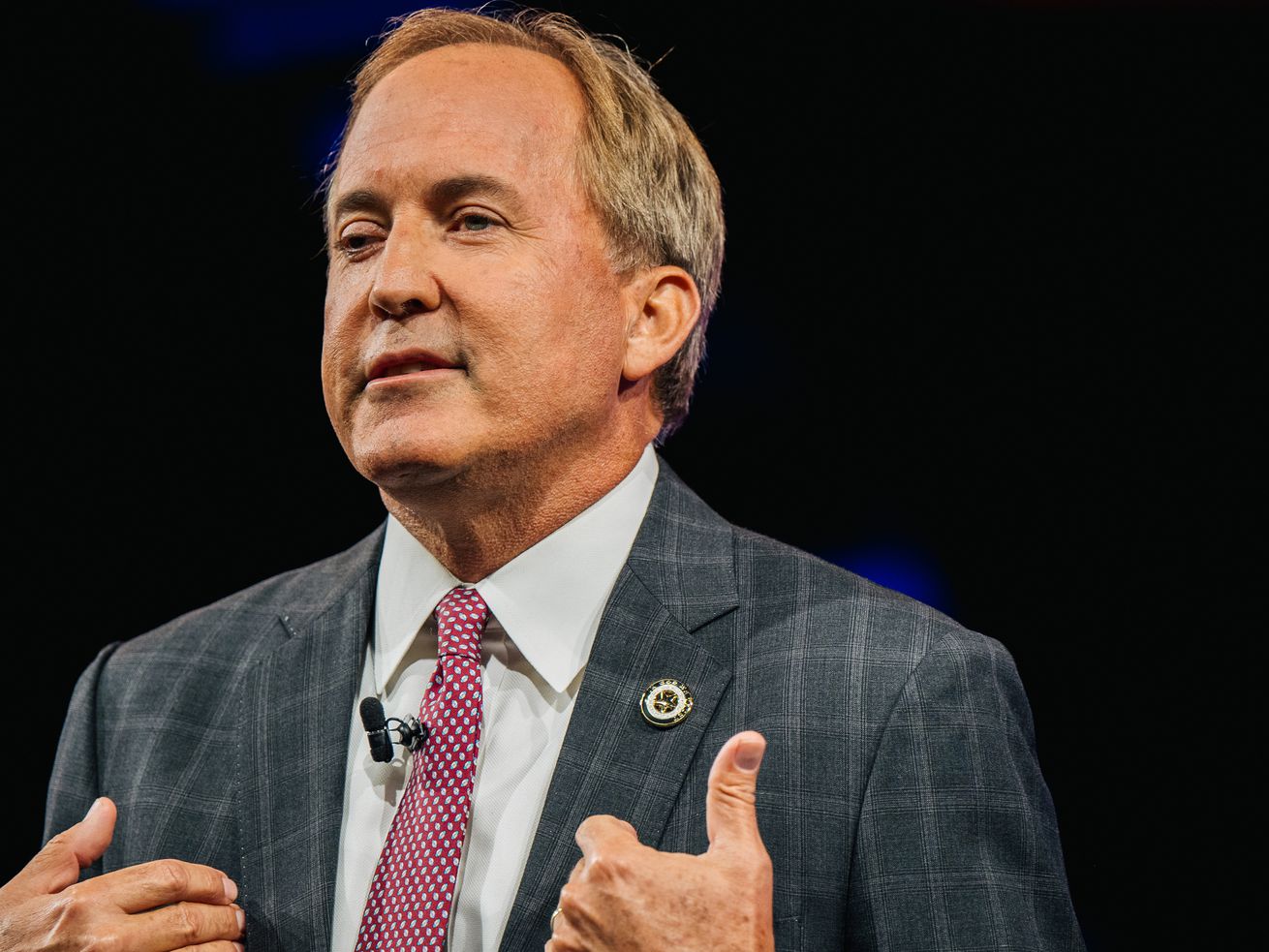
Texas voters will get to render a verdict before the courts do.
On Monday, the top legal authority in the state of Texas reportedly fled his own home rather than allow an official to serve him a subpoena.
According to an account from the man who served the subpoena, reported in the Texas Tribune, Texas Attorney General Ken Paxton appeared to try and wait out a process server with the subpoena for an hour in his home, then later ran away as the server approached him, and finally rode away in a truck driven by his wife as the server laid the documents on the ground.
Paxton’s lawyers have argued that he was simply intimidated and didn’t realize he was being served with a subpoena. And it certainly seems like the least of Paxton’s worries when it comes to legal entanglements. He’s also the subject of an FBI criminal probe into allegations of bribery, and in 2015, he was indicted and arrested on felony securities fraud charges, for which he has yet to go to trial.
No one should be above the law, especially not a state’s top prosecutor, but there’s no law barring him from continuing to serve in his position despite the allegations against him. Texas voters will get to render a verdict before the courts do, as Paxton is up for reelection in the November midterms.
After twice winning reelection, then surviving a primary fight this year despite his legal baggage, it seemed as though Paxton was made of Teflon. He has continued to be an influential figure in the Republican Party, in Texas and nationally, often leading splashy, multi-state lawsuits against policies of the Obama and Biden administrations.
He might be more vulnerable this year, advancing from the Republican primary with only 43 percent of the vote (a tepid showing for an incumbent) despite securing former President Donald Trump’s endorsement. And he’s holding a thin lead over his Democratic challenger Rochelle Garza: 5 percentage points and 2 percentage points, according to recent polls by WFAA/Texas Hispanic Policy Foundation and the Dallas Morning News and the University of Texas at Tyler, respectively. Both polls showed at least 8 percent of voters were undecided.
Should Paxton prevail, it would suggest that, in a red state like Texas, being a Democrat is still a greater transgression than the litany of charges against him.
Here, we recap Paxton’s recent run-ins with, and runs away from, the law.
In 2015, Paxton was accused by Byron Cook, a former Republican state legislator, and Florida businessman Joel Hochberg of encouraging them to invest $100,000 or more in a technology company called Servergy Inc., without notifying them that he would earn a commission if they did so. This is alleged to have happened in 2011, while Paxton was a member of the Texas House.
The indictment alleges that he “intentionally fail[ed] to disclose” that he had been given compensation in the form of 100,000 shares of Servergy stock, charging him with two counts of securities fraud. He was also charged with a failure to register with the state securities board.
Paxton has denied the allegations in the case, which is still making its way through the courts. It’s not clear why it’s taken so long, but disputes over where the case should be tried, compensation for special prosecutors, and pandemic-related delays have all contributed. Paxton’s lawyers have denied that the delays can be attributed to any kind of “improper influence” that he has sought to exert. If convicted, he could face five to 99 years in prison for each of the securities fraud charges and two to 10 years for failing to register, and he would likely lose his law license.
In a separate but related case, an associate of Paxton’s, Charles “Chip” Loper III, accused Cook and Hochberg of a scheme to profit off the investment funds of a mineral assets company Paxton represented before he was elected attorney general. Loper claimed that the scheme hurt him and his father financially.
Cook and Hochberg have argued that the Loper lawsuit was brought in retaliation to their allegations and that Paxton should instead be held accountable for the alleged harm. They successfully sought to have him added to the case as a “responsible third party,” and that means he will have to sit for a deposition scheduled just weeks after the November election in which he can also be asked questions relating to the Servergy case.
After seven years, there might soon be more movement in the securities fraud case — but not soon enough for voters to have answers ahead of the election.
In 2020, several of Paxton’s then-top aides requested that federal law enforcement authorities investigate Paxton, claiming he violated federal and state law by intervening to aid one of his top donors, real estate investor Nate Paul. The FBI later opened a criminal investigation examining those claims.
The aides asserted that Paxton tried to get state employees to release government records to Paul that should have been kept confidential, and that he issued a legal opinion that helped Paul avoid foreclosure sales on several of his properties during the pandemic. He also allegedly intervened in a lawsuit between Paul and an Austin-based charity, and hired an outside attorney to review claims from Paul that he had been mistreated during an FBI raid on his property in 2019, complaints Paxton’s staff had already reviewed and dismissed. In return for all this, the aides claim, Paxton got Paul’s help with a home remodel and with finding Paxton’s alleged mistress a job.
Paxton has said that he’s done nothing wrong and has accused the FBI of infiltrating his office. No criminal charges have been filed.
Three of the aides have resigned, and the remaining five were fired. They have since filed a whistleblower lawsuit claiming they were fired in retribution for reporting Paxton to federal authorities. Paxton has claimed that they were terminated for unrelated, legitimate reasons.
Last month, after Texas’s near-total abortion ban went into effect, a group of abortion funds filed a lawsuit asking a federal judge to bar Paxton and other Texas prosecutors from using that law or any other statutes to target them for helping Texans travel out of state to get abortions. They asked him to testify at a hearing in the case on Tuesday.
To ensure that he would show up, they tried to serve him with two subpoenas at his home, one requiring him to testify in his official capacity and another in his personal capacity. But Paxton and his wife fled nearly an hour after a process server showed up at their doorstep on Monday.
His attorneys have said that he didn’t know that he was being served and that the couple left out of concern for their personal safety, since they didn’t know the “strange man” who tried to serve him. But court records indicate that attorneys representing the abortion funds had notified Paxton’s office ahead of time that they would subpoena the attorney general and that the server was at his doorstep.
The judge in the case has since slapped down the subpoena, though the abortion funds have asked the court to reconsider. There is as yet no ruling in the case.
During the product endgame, the ship room accepts fewer and fewer bugs, until you reach a point where the product is basically finished, and only a catastrophic issue would be accepted for a bug fix.
But it’s not that teams have stopped doing work. Bugs are still being reported, and teams investigate and assess the problems and the potential fixes. Even if the fix doesn’t get accepted by ship room for the initial release, it can be brought to the servicing team for incorporation into a future update.
Recently, the term “break glass” has gained currency for the case of accepting a change to a product that everybody thought has reached its final build. As a result, the build lab has to spin up one more build, everybody has to update their documents where they had written what they thought was the final build number, and a new round of testing begins.
The metaphor is that the final build is sealed in a box, and the button to open the box has a glass cover that reads “In case of emergency, break glass.” Accepting the change means that somebody has to break the glass and open the box.
For some reason, the phrase “break glass” is not declinable. You don’t say “break the glass” or “broken glass”. The phrase is frozen, and you have to circumlocute around it:
You are probably already familiar with the terms show stopper and ship stopper to describe the situations that lead to the breaking of glass.
Bonus chatter: It appears that the services teams use “Break Glass” to describe an emergency process to address a major service outage, in which temporary secure access to server resources is granted through some secondary means. These emergency processes must naturally undergo their own security review. It also follows the metaphor of the glass cover over a button that says “In case of emergency, break glass.”
Bonus reading: Losing the game of Last Checkin Chicken two products in a row.
The post Microspeak: Break glass appeared first on The Old New Thing.