LGBTQ Texans say lawmakers and right-wing figures are misrepresenting what happens at all-ages performances to propagate hate and violence against queer people.
I’m on vacation. Here are some past letters that I’m making new again, rather than leaving them to wilt in the archives.
1. My coworker is really angry about a prank
Some of my colleagues decided to pull (what they thought was) a harmless prank on a coworker. The coworker, “Jane,” is particular about her car – she always parks far from the entrance because she is concerned about car door “dings” and does not want anyone to park near her. As a joke, several people pulled their cars around her one morning last week. No one touched her car or impeded her ability to get into the car or leave the parking lot.
When Jane saw what they had done, she went ballistic and started yelling at everyone in the office. Keep in mind, Jane is usually the first to pull a silly prank in the office (think printing out pictures and papering a coworker’s cube with them).
Fast forward to today, and the weekend didn’t calm her down – nearly a week later, she is still refusing to speak to anyone involved in the prank. She has started parking her car even further out to ensure it is the only one in the area. The office is typically a friendly place, but Jane feels hard done by and shows no signs of getting over this. The employees who engaged in the prank feel she is completely overreacting since no harm came to her or the vehicle. It is a public lot after all with no assigned spots. Thoughts on what to do?
Pranks tend to be highly controversial in the comment section here (I suspect they’re more controversial here than anywhere in real life, but who knows) but since Jane has a track record of pulling pranks herself, I can’t fault your coworkers for thinking she’d see the humor in this. (You of course shouldn’t do this to someone who’s known not to be able to take a joke or laugh at themselves, because then it’s mean-spirited rather than funny.)
That said, since she’s upset by it, the coworkers involved should apologize. It doesn’t need to be a groveling apology or anything that would be out of proportion to what happened. But they should say something like, “Hey, we’re sorry that upset you. We meant it as an affectionate joke and thought you’d find it funny. But we see that you didn’t, so we’re sorry it upset you.”
If Jane continues to refuse to speak to people after that, a manager needs to intervene and tell her to let it go.
2. Contacting my daughter’s employer about her affair
First, the behavior coming from my daughter is not her. It’s as though someone has taken her away.
My daughter started a new job end of November. She has always had a strong working ethic and went to college for human resources. We just recently found out she had been partying with girls from work and they have been encouraged her in having an affair. Well, her husband found out she is having an affair and all of us have been losing sleep and are emotionally stressed. He (husband) did talk to her and they had a plan to work it out.
The following day she had lunch with these girls and since has changed her mind and is staying with this guy and his roommate. Last night I found out the guy she is having the affair with is also on a dating site.
My daughter has been with her husband for seven years and he is devastated and wants to work on the marriage. I would like to contact the company and let them know what’s going on and also ask if they have a fraternization policy. What are your recommendations?
Oh my goodness, no. Do not under any circumstances contact her employer. This is not a work matter; this is between your daughter and her husband. Contacting her employer would be incredibly out of line.
I’m sure this is painful for you to watch, but you can’t interfere with your adult daughter’s employment in that way (or her personal life, for that matter).
3. An employee told me she found another job and gave me an “offer” letter with the option to terminate her
I just had an employee bring a letter to me saying that she had an opportunity to work elsewhere and that she will be taking that job but would still be available to work for our company one day a week. If we decided not to accept her offer for one day a week, then she would “terminate” her employment with us. At the bottom of the page, it had a place for me to sign whether I accepted her one day a week, or declined her one day a week and accepted that it would be termination. Because she used the word “terminate,” I did not feel comfortable signing her letter because WE are not terminating her employment, SHE has decided to stop working her full time hours with us. But at the same time, we do not need an employee that will only be here once a week. We had a conversation about this and verbally informed her that one day a week would not work for our company and told her to write a letter of resignation and turn it in as soon as possible.
This was then followed by another letter “from her to our company” stating her termination of employment with the company. It also mentioned that she had offered to work one day a week and that it had been declined by the company. Again, I did not feel comfortable signing her letter because I did not agree with her wording. I told her that the letter must state that she is the one resigning from the position offered to her.
I have never had an employee resign this way. What do I do? Have I done anything wrong so far? Should I just continue to not sign her letters?
Yeah, this is super sketchy. She’s trying to make it look like you are letting her go — either so that she can collect unemployment (which she probably can’t anyway, since she’s accepting another job) or for some other reason, which is probably just a misunderstanding of the law.
I’d say this: “We’re not terminating you. You’re telling us that you’ve accepted another job and resigned. We are accepting your resignation.” If she says not resigning because she’s offering you one day a week, say this: “Your position is full-time. There’s not a part-time role available. We consider this a resignation, and aren’t going to continue debating this.” If she keeps pushing, say this: “I’m confused about what your goal is here. Is there some reason why you want this to be considered a termination?”
Also, stop trying to get her to write a resignation letter; if she won’t, she won’t, and at this point it’s just prolonging the debate. Write a memo explaining what happened, being as detailed as possible, and file it away. Additionally, give her a letter documenting the fact that she’s resigned, you’ve accepted it, and her last day will be X. Decline to discuss further.
4. I accidentally described myself as “outgoing” when I’m not
When I interviewed for my upcoming job, I was asked to describe myself in three words or phrases. I said “professional, a self-starter, and outgoing.”
The first two are true, but I’m not outgoing. I’m usually introverted and quiet, although I am very good at networking. Also, my last job required a looooot of customer service interaction (700 or so people in an 8-hour shift), so I was primed to think of that while I was interviewing.
I swear that saying that wasn’t intended as a lie! It was just something that came to mind and I said it without thinking. But when I start this next job — which is NOT a customer-facing position — are they going to be expecting me to be super outgoing, or can I be more like myself?
Nah, I wouldn’t worry about it too much. They’re probably not going to mention the exact details of your answer to that question, and even if they did, they’re not likely to hold it against you.
The only thing I’d worry about here is whether you may have inadvertently gotten yourself hired into a job that isn’t the right match for you — if they really want/need someone who’s outgoing and you’re not. But (a) it’s unlikely that a single word in an interview would result in that, and (b) it sounds like you’ve adapted to environments that required a lot of interaction in the past.
Either way, your best bet here is to be yourself and see how it goes.
The device you’re watching this video on is best understood by thinking about positive and negative charges moving around a circuit of diodes and transistors. But the only elementary particle actually flowing in the circuit is the negatively charged electron. And yet those flowing positive charges are there, in the form of a particle you may never have heard of.
Hosted by Matt O'Dowd Written by Fernando Franco Félix & Matt O'Dowd Post Production by Leonardo Scholzer, Yago Ballarini, Pedro Osinski, Caique Oliveira, Adriano Leal & Stephanie Faria Directed by Andrew Kornhaber Associate Producer: Bahar Gholipour Executive Producers: Eric Brown & Andrew Kornhaber Executive in Charge for PBS: Maribel Lopez Director of Programming for PBS: Gabrielle Ewing Assistant Director of Programming for PBS: John Campbell
BIg Bang Supporters Devin Wiley Ryan Salsamendi Steffen Bendel Gautam Shine Bryce Fort Peter Barrett David Neumann Leo Koguan Alexander Tamas Morgan Hough Amy Hickman Juan Benet Vinnie Falco Fabrice Eap Mark Rosenthal David Nicklas
Quasar Supporters Glenn Sugden Vikram Vaka Alex Kern Ethan Cohen Stephen Wilcox Christina Oegren Mike Conroy Mark Heising Hank S
Hypernova Supporters Ankur Anand Ryan Moser David Giltinan Ivari Tölp Vyce Ailour Brandon Paddock Ken S Gregory Forfa Kirk Honour drollere Joe Moreira Bradley Voorhees Marc Armstrong Scott Gorlick Paul Stehr-Green Ben Delo Scott Gray Антон Кочков John R. Slavik Mathew David S. Cerutti Donal Botkin John Pollock Edmund Fokschaner Joseph Salomone chuck zegar Jordan Young John Hofmann Matthew Pabst Daniel Muzquiz
Gamma Ray Burst Supporters Justin Lloyd Chuck Lukaszewski Edward Hodapp Kevin Tillery Cole Marc Forand D. Delair Walter Montalvo Andrea Galvagni Larka Jerry Thomas Nikhil Sharma Alexander Gruber Jonathan Cordovano John Anderson Scott Hannum Paul Widden Bradley Ulis Craig Falls Vivaan Vaka Kane Holbrook Ross Story teng guo Sujasha Gupta Vaka Mason Dillon Harsh Khandhadia Thomas Tarler bsgbryan Sean McCaul Susan Albee Frank Walker Matt Q MHL SHS Terje Vold James Trimmier Anatoliy Nagornyy comboy Andre Stechert Paul Wood Kent Durham jim bartosh Nubble Ramon Nogueira The Mad Mechanic Ellis Hall John H. Austin, Jr. Diana S Faraz Khan Almog Cohen Alex Edwards Ádám Kettinger MD3 Endre Pech Daniel Jennings Cameron Sampson Geoffrey Clarion Russ Creech Jeremy Reed Eric Webster David Johnston Web Browser Michael Barton Mr T Andrew Mann Isaac Suttell Devon Rosenthal Oliver Flanagan Bleys Goodson Robert Walter Mirik Gogri Mark Delagasse Mark Daniel Cohen Nickolas Andrew Freeman Shane Calimlim Tybie Fitzhugh Robert Ilardi Eric Kiebler Craig Stonaha Graydon Goss Frederic Simon Tonyface John Robinson Jim Hudson A G David Neal justahat John Funai Tristan Bradley Jenkins Daniel Stříbrný Luaan Cody Thomas Dougherty King Zeckendorff Dan Warren Patrick Sutton John Griffith Daniel Lyons DFaulk
I didn’t expect to have an update on this, but here we are. Happy update season, everyone!
First, a huge thank you to both yourself and the commenters. I’m a daily reader of your blog, so I figured the advice would be that this is annoying, but ultimately not my problem.
My interview with Marcia was my first in-person interview, but I’d two prior phone interviews with someone in HR, and then a second interview with the HR director. Both went very well, and so I sent an email to the director with Marcia’s email attached. In short, I said that I had withdrawn my candidacy in no small part due to my interview with Marcia, and that the email she sent after the fact only confirmed that I had made the right decision. I also said that I was not looking for anything specific from them, but that Marcia’s comments toed the line of discriminating based on a disability and religion (thank you for that little tip!) and that I would not want any legal trouble to befall the company in the future. I again thanked them for the opportunity and wished them well in their search.
Less than an hour later I was on the phone with Bob, who said he oversaw HR and had been forwarded my email. He wanted to speak to me about what happened. I recounted the story, and he seemed genuinely appalled. Bob apologized profusely, asked if I’d like to throw my hat back in the ring for the position. I thanked him but declined, citing that this experience had soured my views on the company. He said he understood, thanked me for bringing everything to their attention, and wished me well. I presumed that would be the end of it and I wouldn’t have much of an update to send.
I was incorrect. That evening I got a phone call from an unknown number. I didn’t answer and truthfully forgot about it until later that evening when I saw the icon on my phone for a voicemail. It was from Marcia. I listened to it on speakerphone while I washed dishes. According to the voicemail my “baseless threats to sue [COMPANY]” had resulted in her termination. She “couldn’t believe she had wasted prayers on me” and “was only trying to help.” Marcia made sure to inform me that I was “totally unsuited” for the position I had applied for, and that a “heathen sinner like me” didn’t deserve gainful employment. I blocked her (but kept the voicemail) and emailed Bob one final time to notify him of the interaction (not that he could do much, but I had to tell someone). He thanked me for the additional info, and that was the last I heard from either of them.
A few other little bits –
The tart I was making was for Passover, so the irony in all of this was PALPABLE.
Some people asked – it was a blood orange custard tart, and it was delicious.
I actually decided to stay at my current job. I’d mentioned I was only casually searching because I wasn’t necessarily unhappy, but I wasn’t happy either. Well, I had my yearly review and had 1) some of the tasks I disliked removed from my desk, 2) picked up a substantial project to manage on my own, and 3) got a 10% raise, plus a very nice bonus. So yay!
I debated putting this part in, but in the spirit of the letter overall – there were a couple commenters who seemed to agree with Marcia, that I should cover these scars forever and ever because people might “think things.” Your opinion is of course your own, but I’d encourage you to think about the biases you have here. Scars are scars, they are part of life. People acquire them for all kinds of reasons, in all kinds of places. They aren’t really indicative of anything other than living life.
Thank you again to Alison and all the wonderful commenters!
It’s “where are you now?” month at Ask a Manager, and all December I’m running updates from people who had their letters here answered in the past. Here are four updates from past letter-writers.
As many of you guessed, I’m an RN and provide direct patient care in my unit. I’ve occasionally thought of moving on, but honestly, I love the doctors I work with and most of the staff as well. I’m one of the most senior staff and I feel like we improve patient lives and make a difference.
For those of you who were encouraging me to take a pic – don’t worry, that is the FIRST thing I did! I sent it to Alison with my original post, but I didn’t want to out myself or my colleagues, so I asked her not to post it.
I gave myself the weekend to calm down and when I went back to work the next week, the posting was down. I asked my charge about it and he said, “Oh yeah, I told [supervisor], ‘You should take that down. It’s really pissing people off’ and she said, ‘Really?’ and looked embarrassed and took it down right then.” So I decided that was good enough for me.
In the meantime, there have been other management issues that I haven’t loved and I’ve been brushing up my resume. If any readers want to hire an RN with 20+ years of experience in critical care and cardiology, hit me up!
From the comments: I really do like my supervisor – she was a great coworker until recently. And yes, she HAS picked up OT to help us. She’s not a villain, IMO, but she was never taught to manage people (most nurses aren’t) and is in a bad spot. I didn’t shame any coworkers because yes, some of them were eager or at least willing to work OT. There were enough of us that felt like me, though, which is why I stepped up. My issue wasn’t with the OT, but how it was being presented.
That said, I have a super snarky sense of humor and I loooooved all of you who suggested posting job openings and “The beatings will continue until morale improves” and health boundaries stuff: you are my people.
For the commenter who said that if healthcare workers can’t talk honestly about mental health, then where are the rest of us: I feel you and I’m sorry. I’m an overweight, depressed (but medicated!) nurse and I CAN advocate for myself, but I still hurt when I hear the biased comments and thoughtless criticism. If you are my patient, I care about you and I will defend you and I know that I’m not enough. I’ll keep working to change the system from the inside, I guess.
I took a bit of a middle ground approach with your advice. I emphasized to “Tim” that I was satisfied with the rest of the team’s work. After some time has passed, I have gradually raised expectations for the rest of the team (but privately and through individualized training that I didn’t go out of my way to let “Tim” know was happening.) Task by task they built up their knowledge and efficiency. And low and behold, the newer team members began taking on more. The relationship between them and “Tim” isn’t cozy, but they are at least civil and I don’t hear weekly complaints anymore.
I have also set “Tim” on an advancement path to another team where he will build on his existing knowledge, but his work will be more siloed and won’t require so much interaction with team-members. His role will be back-filled by a new hire that seems to mesh better with the team.
Lastly, “Tim” has also recently started seeing a therapist outside of work to deal with personal stresses, and since then, he has been more easy going and less irritable than before.
After reading your response to my email, I had a talk with our manager and what to do about his bad attitude and attendance. The problem child was off that day, shocker.
Didn’t need to do a whole lot though and everything kind of feel into place. The next day when he came back he told one of the people he was working with that he knew he didn’t have long in the shop so he might just smash up some material on purpose just to go out with a bang. Well that’s all she wrote, the person working with him relayed that message and we gave him the boot literally one day after you posted my email.
He was brought back in a few days later to meet with the owner to turn in keys and final paycheck. He cried, apologized and begged to give him another chance. Didn’t though and he is history! Last we heard he’s still unemployed.
I ended up reaching out to the coworkers that had been kind to me post-termination and let them know they were still welcome at the wedding, but I wouldn’t be sending out invitations to those I hadn’t heard from. I also let them know I understood if attending would make things difficult for them with my former boss, and that there were no hard feelings if they weren’t able to come. One asked if I would serve as a reference for them, and another offered to serve as a reference for me which was very kind. For several reasons, I now realize this was just not a great place to work, and I feel as though our inexperience was taken advantage of in a major way, since most of my coworkers had little to no prior work experience themselves.
I know some folks were confused why I invited coworkers at all—I wasn’t planning on it until my boss mentioned something to me about coming to the wedding, and it seemed like they expected an invitation. Another coworker was also planning a wedding around the same time and there was a lot of discussion about them inviting the entire team as well, so I saw it as an expectation of working for a small company. Since this happened, I’m working on holding firmer boundaries in my personal and professional life. I realize now that after my termination, I got stuck in an anxiety spiral and became fixated on this issue, which really wasn’t much of an issue at all in the long run.
I was lucky to have my fiancé’s support during my brief period of unemployment, so I was able to laser-focus on wedding planning, mental health healing and job hunting. After these past few months, I can confidently say that the wedding went off without a hitch and, in the meantime, I landed a fantastic new position in a new field that I absolutely love! Thank you so much for your response and to those that commented advice too!
My friend wasn’t thrilled with your and the readers’ responses. I had omitted/changed some minor details to protect his identity, which led to some incorrect assumptions. When the theft happened, the first thing that he did was contact the police and hotel security.
Ultimately his work didn’t press for further details. He got the sense that they really didn’t want to know more. These weren’t the actions of a criminal mastermind so the perpetrator was apprehended quickly and the laptop was returned with no issues.
Donald Trump’s real estate company has been found guilty on all 17 charges of tax fraud and other crimes related to a 15-year-long criminal scheme to defraud tax authorities. What do you think?
SAN FRANCISCO—Expressing concern that he might have totally ruined the holiday season, Elon Musk reportedly worried Thursday that he wouldn’t have enough Twitter employees left to fire on Christmas Eve. “Gosh, I just don’t know if I’ll be able to parcel them out long enough to enjoy destroying a few of their lives on…
Today, reporters and editors of The New York Times began a one-day strike, as negotiations between their union and management failed to reach an agreement. Here at America’s Finest News Source, we are committed to supporting our fellow journalists, and so The Onion has boldly and inadvertently locked ourselves out of…
Be Your Own Makeup Artist: Jerome Alexander’s Complete Makeup Workbook
Alexander
1983
Submitter: Not sure why this cover is giving me such Robert Palmer vibes… This was found languishing on the shelf and no wonder – time to replace this with some from this century.
I am the general manager of a large company. Recently I had a closed-door meeting in my office with our HR manager, Jenny, discussing the issues of the week, including disciplining a difficult employee and succession planning for Jenny’s unannounced new role in the company.
When we exited the office, we noticed that an employee, Patty, was quietly working late in the office next to us, and her manager Ashley (who I manage) was in there. I didn’t think anything of it at the time, but I found out later that Ashley had moved into Patty’s office specifically to eavesdrop. The next day, all of the sensitive details of our hour-long conversation had made their rounds through all of the employees in the office. Patty had told Ashley to come over to her office to listen! We just had a training session on reducing gossiping a week ago, because of an incident with another one of Ashley’s employees, and it’s done nothing to stop the gossip problem.
I am livid. I chose not to respond immediately so I could cool down and not respond emotionally. I know that I need to confront both Ashley and Patty, but have no idea what to say.
I answer this question over at Inc. today, where I’m revisiting letters that have been buried in the archives here from years ago (and sometimes updating/expanding my answers to them). You can read it here.
The size and scope of the oil spill caused by the Keystone pipeline Wednesday remains unknown, but analysts say Canadian crude could suffer a significant price impact if the pipeline is shut down for more than a few days.
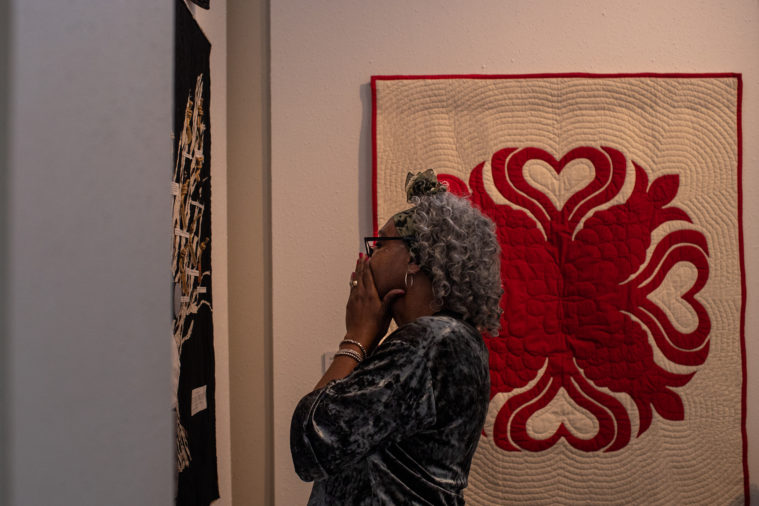
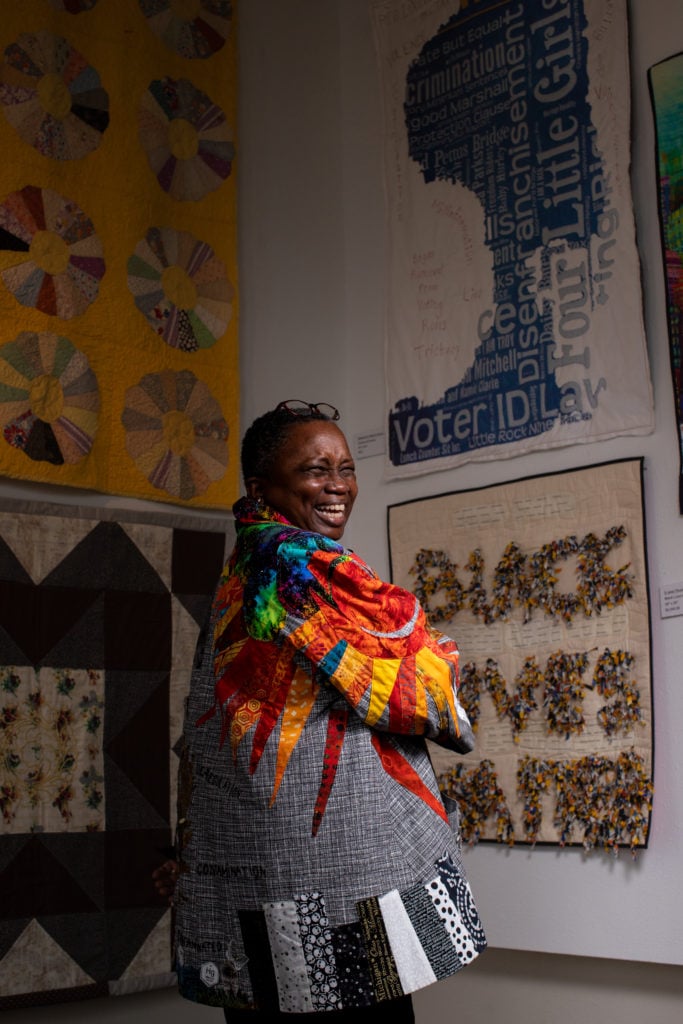
“There’s a determination not to tell the true history, because no one wants to admit to the evilness of the people we celebrate as heroes,” said Deborah Moore Harris, the president of the quilt circle. The group’s latest body of work is currently on view at the Carver Community Cultural Center Gallery through December 16.
Moore Harris is an artist, retired Army veteran and one of the quilt circle’s four founding members. She works part-time at a craft store. About 20 years ago, she decided to make her first quilt after watching an episode of The Carol Duvall Show, an arts and crafts program that ran on HGTV from 1994 through the early 2000s. The quilt was a gift for her mother and stitched together the genealogical details of her ancestral tree.
“It is definitely not straight, but it is colorful and tells the story of my family.”
Priscilla Mayfield, 59, admires her group’s exhibition “These Ain’t Yo Big Mama’s Quilts” at the Carver Center in San Antonio on Nov. 17. Kaylee Greenlee Beal for the Texas Observer
The quilt circle is celebrating its fifth season together. The group is made up of 30 members with varying skill levels who range in age from 19 to 90. They meet every second Saturday of the month at the Carver Public Library to exchange wisdom, techniques, and stories.
Nina Fennell is one of the Quilt Circle’s elders. When she passed away recently, her family donated the fibers she left behind to the group. They began sorting through the materials and quickly discovered quilt blocks that she started, but never completed.
Two of the quilts in the exhibition are quilts Fennell began that her quilt circle family finished in her honor. The group arranged fabric from her home into a traditional wagon wheel pattern, building on the foundation Fennel laid.
In quiltmaking, there is often no single person a quilt can be attributed to. Many hands sew single stitches to create a shared piece of art and history. The “Black Angel” quilt, also on view at the Carver, is another outcome of a collaborative endeavor. Almost all of the group’s members had a hand in the project and say each block was cut, sewn, embroidered and binded with intention and lots of love.”
When the quilt circle meets in the new year, they will pick up where they left off, working collectively to complete a single hand-sewn quilt.
Moore Harris says the group’s members are practicing the art of “taking a story and expanding on it.”
Dr. Lillian Jones joined the quilt circle four years ago and has two quilts in the exhibition.
“Lillian is the historian of our group,” Moore Harris told the Texas Observer.
Jones’ “Tex Mex Underground Railroad” quilt has taken on a life of its own since the exhibition began. “You definitely have much better quilters in the group than me,” Jones demured. “But I do love the history and the stories.”
African American Quilt Circle of San Antonio Texas President Deborah A Moore Harris, 67, stands in front of her quilt (top right) calling attention to voting rights at her group’s exhibition “These Ain’t Yo Big Mama’s Quilts” at the Carver Center in San Antonio. Kaylee Greenlee Beal for the Texas Observer
She used cotton fiber, dimensional paints, pipe cleaners, embroidery, appliqué, and traditional quilting techniques to sew a Black liberation history often omitted from textbooks. In 1821, Vicente Ramón Guerrero Saldaña became the second president of Mexico and abolished slavery in most of the country. Guerrero was a man of African, Indigenous, and European descent. Jones’s quilt illustrates the route traveled through Texas by an estimated 3,000-10,000 formerly enslaved people seeking liberation by crossing the Mexican border.
“These are not the things that are taught in school,” Moore Harris said. “You know how it is—people don’t give you the whole story.”
Since the exhibition began, the group has been contacted by multiple museums and historical organizations seeking to commission quilts that tell other stories conveniently omitted from the canon of history.
“I never would have dreamed that people would be so interested in this quilt,” Jones said with a laugh.
“Meanwhile, I’m just trying to get the thing done and not have too many threads showing.”
Two and a half years ago, Dr. Lillian Jones retired. She had spent 37 years working as an OB-GYN physician in San Antonio. At first, it didn’t feel like retirement. Between the start of the pandemic and the responsibility of serving as caregiver to her mother, the transition was not easy. Recently, she is finding more time to pour into her research and craft.
The 70-year-old fiber artist works out of her home in Converse where she lives with her sister, creates multimedia artwork, and tends to her garden. It is currently teeming with greens ready for harvest, just in time for the holidays.
“These are not the things that are taught in school. You know how it is—people don’t give you the whole story.”
Jones is a lifelong student. Through medical school, residency, and nearly four decades caring for babies and birthing patients, she has always carved out time for her creative practice.
“I would drag my friends to macrame classes, ceramics classes, you name it.”
She took her first sewing class in middle school, but picked the skill up at home from her mother Carolyn, an English teacher and expert seamstress who made her daughter’s wedding and bridesmaid dresses. “When I was in college, I’d send her a pattern with the fabric and she’d send it back done.”
Later in life, she learned to quilt through Northside Independent School District’s community education programming.
“Don’t be worried about the mistakes,” one classmate advised. “If the threads don’t match and the seams aren’t even, it’s still going to keep you warm.”
Those words of encouragement, coupled with Jones’ tenacious curiosity, led her to complete her first few quilts—the second one made entirely of corduroy.
When she brought her materials into class the day she began her corduroy quilt, her instructor looked back and said, “Oh my, corduroy.”
“What’s wrong with corduroy?” Jones wondered. “That will make it even warmer.”
The woman beside her lifted her gaze from the project before her and peered over at Lillian. “You don’t sew, do you honey?”
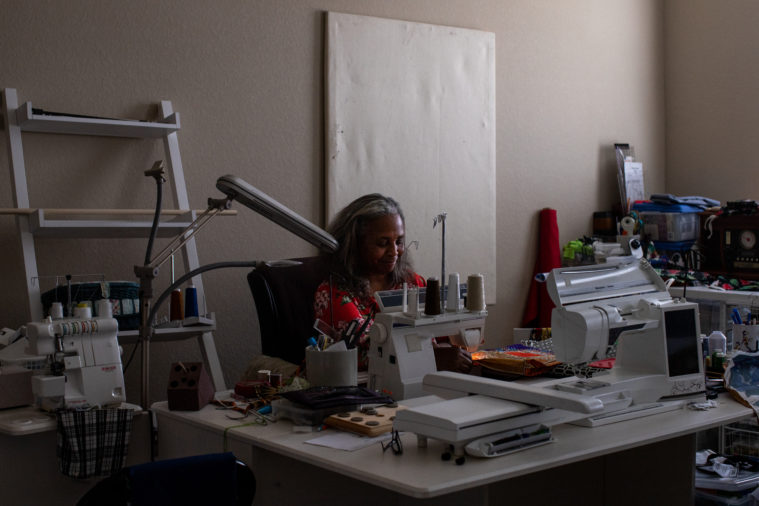
Lillian Jones, 70, stitches a travel shoe bag for a friend at her home workshop in Converse Kaylee Greenlee Beal for the Texas Observer
The fabric was impossibly thick and left a trail of fuzz that took days to vacuum out of the carpet. Nevertheless, she completed the quilt.
Jones has been sewing off and on for about 15 years. In that time, she has made 15 quilts.
“At the start of the year, I usually have an idea of what I’d like to do project-wise and gather up fabrics.” When the Observer spoke with Jones, she had just returned from a fabric hunting expedition at the International Quilt Convention in Houston.
She likes to get the idea for the design in her head before she thinks about the fabric. Usually, the idea comes from a picture.
“But every now and then, it’s from a story.”
Jones became curious about this particular story nearly 30 years ago.
She was on a cruise that stopped at multiple ports in Mexico. In one town, Jones wandered into a museum where an exhibit on Afro-Mexican culture took her by surprise. What struck her even more was a painting that included a familiar face. A museum label identified the young girl in the painting as Audrey Adams, half confirming what Jones suspected.
Lillian Jones, 70, stitches on her sewing machine, surrounded by fabric and fiber arts supplies, at her home in Converse. Kaylee Greenlee Beal for the Texas Observer
“I thought, ‘you’ve got to be kidding me!’”
Audrey Adams was a San Antonio public school teacher and no stranger to the Jones family when Lillian was a child. Adams taught Lillian’s mother and uncle and was still teaching by the time her older sister reached grade school.
“I was curious when I got back from the cruise and went to my mother.”
Lillian’s mother confirmed what she suspected—Adams was from Mexico.
“I knew she was a Spanish teacher but I never thought there were any Black people in Mexico.”
An assumption is often made that Black and Mexican are mutually exclusive identities that cannot coexist. This misconception is due in large part to revisionist histories that have been retold for generations.
Afro-Mexicans are descendants of formerly enslaved Africans brought to Turtle Island between the 16th and 18th centuries. The erasure of Afro-descendant peoples and their experiences has been institutionalized throughout Mexico’s history. After achieving independence from so-called New Spain in 1821, Mexico was a fragmented state. To cultivate a national sense of identity, government officials proclaimed that race and ethnicity did not exist.
A double exposure shows Lillian Jones, 70, looking out towards her garden from her home workshop in Converse overlaid with her quilt, “The Tex Mex Underground Railroad,” on display at the Carver Center in San Antonio. Kaylee Greenlee Beal for the Texas Observer
During the Mexican Cultural Revolution of the early 20th century, Afro-descendant peoples and other ethnic groups were omitted from historical and cultural narratives. Artists, intellectuals, and government officials constructed an idea of Mexican identity around mestizaje, an ahistorical belief that the country’s racial and ethnic makeup consisted exclusively of European and Indigenous ancestry. The only legally recognized ethnic groups were white Spaniards, Indigenous peoples, and mestizos, a term used to describe a person of both European and Indigenous descent.
While conducting research for her quilt, Jones considered the flip side of the coin. “I was so impressed to learn that Mexico stopped doing race classification,” after abolishing slavery in 1821. “At the time, to me, that was so progressive.”
It is easy to understand how a lack of recordkeeping would serve those seeking freedom from colonial violence in. The advantages become even more clear when you consider how, historically, U.S. Census data has been weaponized to abet white supremacy. Nevertheless, census data is used by federal governments to distribute funds for social services to states and municipalities. The exclusion of Afro-descendant people from Mexico’s constitution and census is a form of structural racism.
In 2020, this injustice was partially rectified when Afro-descendant peoples were counted in Mexico’s national census for the first time. The victory was the result of yearslong organizing by grassroots advocacy groups, including Guerrero-based México Negro. While inclusion in the census is a step in the right direction, it has not immediately remedied inequitable social, economic, and political conditions in these communities. Years of marginalization and attempted erasure cannot be undone overnight. Today, the largest Afro-descendant communities are concentrated in the states of Guerrero, Oaxaca, and Veracruz.
Jones told the Observer that she began thinking about “Tex Mex Underground Railroad” four years ago, when she joined the quilt circle, thanks to a suggestion by the circle’s president at the time. She was intrigued, but the unpredictability of life kept getting in the way. “I had been thinking about the quilt forever and then I saw this film.”
A community film screening at the Little Carver Theatre set the project in motion. Produced by the University of Texas Rio Grande Valley, “Just a Ferry Ride to Freedom” tells a pre-Civil War story of the Texas-Mexico border with an emphasis on the stretch between Laredo and Brownsville. The documentary highlights a network of interracial couples who sought refuge in Hidalgo County and offered ferry rides to “runaway” enslaved people seeking freedom across the Rio Grande.
Freedom is a relative term. After escaping to Mexico, some formerly enslaved people were lured into the trap of “lifelong servitude” by Spanish plantation owners. The violence inflicted in these settings often mirrored the horrors of chattel slavery. Every self-liberated person also faced the ongoing threat of recapture by bounty hunters.
The Texas Rangers, often mythologized, formed in 1836. As the state’s original police force, they carried out a campaign of “ethnic cleansing” that resulted in mass genocide and removal of Indigenous peoples from their ancestral lands in West Texas. Texas Rangers were also bounty hunters tasked with patrolling the state to hunt “runaway” enslaved people. But against the odds, attempts to form self-liberated maroon settlements south of the Rio Grande were successful in several cases.
Jones spent about a month reading articles and academic papers on the subject. She bought books related to the Underground Railroad, but did not find them to be of much use due to their exclusive focus on the Northern route.
She considered putting her embroidery machine to the task for the text on the quilt, but quickly realized there was too much information to capture. “At a certain point, all those stitches become hard to read.”
Instead, she opted for printed out pieces she could appliqué. Her primary sources are cited on the back of the quilt. She includes a historical timeline and other notes on the front.
Lillian Jones, 70, projects a map of Texas counties on a piece of fabric to mark the places where the largest concentration of enslaved people were found, at her home workshop in Converse. Kaylee Greenlee Beal for the Texas Observer
Once she felt satisfied by her research, she began piecing together fibers, facts, and figures, thinking strategically about colors, symbols, and political context.
“I got an old map of Texas online, then used a projector to enlarge it,” she said. She traced the map onto the fabric and appliquéd her cut-out pieces.
The patterned fabric that depicts Mexico was the first selection she made. She allowed this piece to guide the color story for the rest of the quilt, pulling out the orange for Oklahoma, blue for Arkansas, and green for Louisiana. Similar to a state bird or flower, each state in the so-called United States has an official quilt block pattern. She incorporated the Oklahoma twister, Arkansas pinwheel, and Louisiana crossroads.
Jones naturally gravitates toward black and white fabrics and, as a result, has a strong selection available within her library of craft materials at home. The triangle pattern used to illustrate a majority of the state of Texas is repeated to create the quilt’s border and was pulled from her personal collection. The Nueces Strip hugs the natural border of the Rio Grande River and holds great significance in this story. Jones used a different black and white fabric she found at Mesquite Bean Fabrics on Austin Highway to demarcate this area from the rest of the state.
“That region was so crucial,” Jones said.
Between an unforgiving climate and sparse vegetation, an inestimable number of freedom seekers died at this point in the journey. “There was almost no water, temperatures over 100 degrees, poisonous snakes and spiders and nowhere to hide from bounty hunters.”
In a world where written record has intentionally omitted and misrepresented history, artful storytelling can be an act of narrative reclamation.
“When people come to see our quilts, they are surprised to learn about history,” Moore Harris said. “But that’s the whole premise of the [quilt circle]—to tell the story.”
“These Ain’t Yo Big Mama’s Quilts” will be on exhibition at the Carver Community Cultural Center Gallery, Monday through Friday, 8 a.m. to 4 p.m. until December 16, 2022. Entry is free and open to the public.
The African American Quilt Circle of San Antonio Texas submitted dozens of quilts for their exhibition “These Ain’t Yo Big Mama’s Quilts” at the Carver Center in San Antonio. Kaylee Greenlee Beal for the Texas Observer
Griner was traded for convicted Russian arms dealer Viktor Bout. The swap did not include former Marine Paul Whelan who remains imprisoned in Russia on espionage charges the U.S. says are false.
(Image credit: Evgenia Novozhenina/Pool/AFP via Getty Images)
If a man is wearing Doc Martens, he’s conservative.
If the man in Doc Martens has a buzzcut, he is very conservative.
If someone’s wearing a golf polo anywhere but on a golf course, they are conservative.
If someone’s wearing a barn jacket anywhere but in a barn, they are liberal.
If they’re wearing a barn jacket in a barn, they are conservative. Unless the barn is filled with rescue dogs, then it’s anyone’s guess.
If someone’s wearing Stan Smiths, they are liberal.
If someone’s ever played tennis with Stan Smith, they are conservative.
If a man lists his pronouns on social media, he is liberal.
If he lists his pronouns on dating apps, he is conservative but wants you to think he’s liberal.
If someone has erotic dreams about Anderson Cooper, they are human and shouldn’t look into it too much.
If those erotic dreams also include Andy Cohen, Don Lemon, and the rest of CNN’s drunken New Year’s Eve crew, they are probably going through a lot and should maybe talk to a professional about it.
If someone is still bemoaning cancel culture, they are conservative. Unless they’re bemoaning the cancellation of Broad City, then they’re liberal.
If a guy wears baggy corduroy pants, he is liberal but his parents are conservative.
If he wears slim-fit corduroy pants, he is conservative but his parents are liberal.
If a woman is in the top 1 percent of Taylor Swift listeners on Spotify, she is liberal.
If she is in the top 10-15 percent of Taylor Swift listeners on Spotify, she is conservative.
If she got good seats to Taylor’s tour through Ticketmaster, she’s a bot.
If someone saw Bruce Springsteen on Broadway, they are conservative but like to think they’re liberal.
If they saw Bruce Springsteen play in New Jersey before he was “Bruce Springsteen,” they are liberal but like to think they’re conservative.
If a guy drinks white wine, he’s liberal.
If a girl drinks whiskey, she’s conservative.
If someone can taste the difference between a Merlot from ’78 and a Merlot from ’98, they are conservative but have a son who dropped out of college to join Antifa.
If someone can hear the difference between Beethoven and Debussy, they vote liberal but donate money to Republicans.
If a man wears dress shirts with monogrammed cuffs, he is conservative.
If a woman wears dress shirts with monogrammed cuffs, she is liberal.
If anyone wears those dress shirts that don’t have a collar, they are a cult leader.
If a man was the quarterback on his high school football team but didn’t get any SEC scholarship offers, he used to be conservative but is liberal now.
If a man was the lead role in his high school play but didn’t get into Juilliard, he used to be liberal but is conservative now.
If a man over fifty has a DON’T TREAD ON ME tattoo, he’s liberal.
If a man under fifty has one, he’s a suspect in the January 6 commission.
If a man is wearing an authentic horseman’s duster from J. Peterman, it’s actually three small boys trying to get into an R-rated movie.
If a woman is wearing an authentic horseman’s duster from J. Peterman, she’s liberal and she has a gun.
If your great aunt Tillie comes home for the holidays wearing flowing scarves and wailing on a harmonica, there’s a chance it’s Steven Tyler of Aerosmith impersonating your great aunt Tillie so he can crash your dinner. Either way, do not eat that butternut squash casserole they brought.
If anyone is wearing a MAGA hat, they’re just trying to get a rise out of you. Don’t fall for it.
Right-wing extremist and former Marjorie Taylor-Green intern Milo Yiannopoulos was reportedly fired from Kanye West’s 2024 presidential campaign following a string of disastrous media appearances by West and rumored campaign infighting. What do you think?
Tanya Habjouqa, “The problematic Candy: “Ras Al Abed”,” 2022, Photo vinyl on wall, dimensions variable. Image courtesy HMAAC.
Negative Women: Four Photographers Questioning Boundaries, an aptly titled exhibition curated by Christopher Blay at the Houston Museum of African American Culture, celebrates the politics of both joy and pessimism, with a discerning eye towards history. There’s clarity in the negative, which exposes the world and its — at times — sinister forces. All four artists — Ciara Elle Bryant, Tanya Habjouqa, Mari Hernandez, and Letitia Huckaby — represent an international and domestic focus on correcting, challenging, and expanding the historical record.
A viewer’s first engagement with the show is the small, cavernous room that houses Ciara Elle Bryant’s roiling multimedia installation Black Shines Like Gold (2022). Reminiscent of Arthur Jafa’s Love is the Message, the Message is Death (2016), Bryant’s piece teems with prismic life, drawing upon images that range from the critical, to the calming, to the familial. Bryant deftly collages found material with celebrity images, such as a sunglasses-clad and skeptical Whitney Houston, footage from the civil rights movement, newspaper clippings, advertisements for hair projects, and cartoons. As Christopher Blay put it in a recent conversation about Bryant’s Black Shines Like Gold, the installation “channel-surfs through Black culture, making visual connections through the past 35 years.” Bryant’s use of both outdated and contemporary technology — a video projector and slides — nods to the work’s sweeping, intergenerational reach. As Blay points out, projectors and slides were first used as information tools for entities like schools and businesses; Bryant co-opts these mass-media tools to represent Black culture, unfiltered from its source.
Ciara Elle Bryant, “Black Shines Like Gold,” 2022, (installation view), mixed media installation, digital archival slides, digital archival prints, and video projection. Image courtesy HMAAC.
Alongside this collaged material, the audience literally rides along with an unseen driver as they cruise through a neighborhood, stopping every so often to greet a passerby. On the opposite wall hang everyday objects, such as a wide-toothed comb, a bandana, bamboo earrings, and various close-up photographs of items like jewelry, all in various tones of black and white.
Ciara Elle Bryant, “Black Shines Like Gold,” 2022, (installation view), mixed media installation, digital archival slides, digital archival prints, and video projection. Image courtesy HMAAC.
The adjacent gallery space houses a portion of Letitia Huckaby’s photographic series Bitter Waters Sweet, in which she focuses her lens on Africatown, a community outside of Mobile, Alabama. The town was founded by West Africans who were trafficked to the United States after the Atlantic slave trade was made illegal, yet prior to the signing of the Emancipation Proclamation. Huckaby’s work responds to the smuggling of Clotilda, the ship that unlawfully brought slave labor, into Mobile Bay.
Clotilda was rediscovered in 2018. The shadow of this dark history literally haunts the cotton-printed frame of Huckaby’s otherwise traditional landscape portraits and close-ups of the earth, such as Black Mulberries (2022), a close-up of the fruit. In Early in the Morning, the sun pierces through a lattice of leaves that loom across the frame. Africatown’s descendants now find themselves amidst a struggle for environmental justice, and made headlines in 2018 when the town sued a nearby industrial plant leaking chemicals linked to cancer. Given the community’s fraught history, both past and present, Huckaby’s work asks the uncomfortable question, “what has changed in the time between Clotilda’s first docking and now?”
In the upstairs gallery, Mari Hernandez’s What Remains points to the malleability of historical narrative through a series of faux colonial-era self-portraits. Whether dressed in delicate white cotton and lace like in Ximena the Voice” (2018) or Lucrecia the Light (2018), or militia garb, as in Pitted Brother Against Brother (2018), the purposeful artifice of the costuming locates the viewer in an uneasy and menacing temporality. Mari Hernandez poses as the subject in each of these photographs. In the artist statement written by Hernandez and her collaborator Chad Dawkins, which accompanies the work, the pair write, “For Hernandez, the use of self-portraiture is significant as a means to make herself visible in the work and in the space of the work’s presentation. Referencing art historical precedent, and rooted in early feminist theory, Hernandez makes herself physically present in her work, therefore dictating the subjective content with her own body.”
Mari Hernandez, “What remains,” (Installation view), 2018, inkjet prints on crepe de Chine. Image courtesy HMAAC.
The scale, positioning, and quantity of the works remind one of casta paintings, a series of images used by the Spanish and Portuguese to identify racial mixing and social class. Prosthetics are visible on different parts of Hernandez’s face. There is a quietness to the portraits, which nods to both the cruelty and formality of 19th century colonialism. One of the images ending the series is a photograph of a pale-faced general in a three-pointed hat in a painting titled Cobarde (2019), or “coward.”
Tanya Habjouqa, video still from “Shaden Qous teaches Afro-Debke to young students at the African Community Society in the Old City of Jerusalem,” 2022, multi-channel video. Image courtesy HMAAC.
In a turn towards the archival, Tanya Habjouqa’s Afro-Palestinian, a section of her long-form project The Sacred Space Oddity, represents a collaboration with community elder Mahmoud Jiddah to increase the visibility of Afro-Palestinians in Jerusalem. Bending the anthropological format to her will, Habjouqa uses its tools to harvest a message of equity, justice, and representation. “This chapter focuses on Afro-Palestinian stories of resistance, political incarceration, cultural production, and community,” Habjouqa writes in the work’s companion text. “The exhibition blends imagery, collaborative portraiture, archival material, and ethnographic interviews.” Habjouqa activates the small, room-like space with photographs of the African Quarter in Jerusalem, community portraits, and a video of students learning Afro Dabke, a combination of Palestinian folkdance and Cameroonian African dance. In one particularly effecting series, Habjouqa renders a triptych of the “problematic candy” Ras Al Abed, which translates to “head of a slave,” showing that racial oppression is woven into everyday speech.
Negative Women wields the crisp lens of pessimism to hold history’s feet to the metaphorical fire. While Letitia Huckaby sheds light on uncomfortable parts of North America’s past, Mari Hernandez purposefully molds her own image into that of a number of colonial figures to point to the calculated violence of the 19th century, using prosthetics to highlight photography’s insidious background as an instrument of colonial oppression. Bryant’s all-around gaze on Black culture takes in tragedy along with triumph. Tanya Habjouqa shares her medium with community elder Mahmoud Jiddah to document, celebrate, and reflect upon the untold stories of Afro-Palestinian life. The result is an exhibition that leaves audiences hungry for change.
Hovertext: The good news is by increasing productivity in the Bullshit Essay sector, students can focus on liquor, memes, and unfortunate casual encounters as God intended.
Try out my quantum mechanics course (and many others on math and science) on https://brilliant.org/sabine. You can get started for free, and the first 200 will get 20% off the annual premium subscription.
Correction to what I say at 7 mins 9 seconds: The first study I mention is about cannabidiol oil.
Today we’ll talk about zink batteries, regulations for StarLink satellites, find out how birds feel about fireworks, learn about a new way to detect sugars, thirty thousand molecules that could make better batteries, and more efficient photosynthesis. I’ll also briefly have to comment on wormholes, again. And of course, the telephone will ring.
00:00 Intro 00:36 Zinc Battery Skepticism 01:48 More Wormhole Craze 03:48 Starlink Regulations 06:50 Cannabis vs Placebo 08:35 Fireworks Freak Out Birds 09:52 New Method to Tell Apart Sugars 10:25 30000 New Molecules for Batteries 12:00 More Efficient Photosynthesis 13:14 Build Scientific Knowledge on Brilliant
Not dramatically, not rip-the-bandaid-off or anything. I tried to fix it. I realized from reading the comments that a lot of the problem was self-imposed– my desire to keep the machine running at all costs meant I took on more than my fair share, but I truly loved my bosses and my company and even (most of) my coworkers, and wanted us all to succeed. But this mess was broken for real, the comments made that very clear. It was pretty painful to realize, actually. But I knew something had to give.
Buckle in….
So first things first, I told myself to knock it off. I was taking on too many of the company’s problems and not forcing them to find their own solutions. I had to draw harder lines, and resolved to do so.
Second, I started rephrasing the conversations to make it clear that this was their responsibility. I peppered all of my interactions with lots of “your work” and “my help” and tried to avoid any type of “happy to help” type positivity (e.g. if a coworker sent a request for something, I’d respond along the lines of “sure, I can meet your client for you”). Subtle, I know, but I knew this was going to be a long battle so I was laying the groundwork. At this point I thought I’d still be there.
Next, I talked to my boss. I would have liked to do this sooner but she only came in occasionally and it felt like an in-person type of meeting. I told her I wasn’t happy with my current job, and exactly why, and used a lot of the verbiage from the posting (thank you!). I had been forwarding her the truly absurd requests and questions I had been getting for months so this wasn’t new info to her, but I know she was hoping I would never push back this hard. She offered me a new position (I think it was “Operations Manager” or something) to recognize my increased contributions. No mention of a raise. And while it was very nice I don’t LIKE that work, so making it official was the exact opposite of what I wanted. When I declined, she said they would start looking for an admin to “take over your duties.” I reminded her they weren’t “my” duties, and never were. She agreed and apologized, but I didn’t hold my breath. I think the hardest thing for me, and the thing that the posting and the comments really cemented, was realizing my boss agreed with me but wouldn’t do anything to fix it. I know she appreciated me and didn’t want to lose me, but at that point (and all the previous points) it felt very much like lip-service and not much else. Of all the many, many fires to put out, my fire was not a priority and never would be.
After a few weeks I told my boss, by chat, I was going to start working one day a week from home. She asked that I make sure everyone knew which day it would be, which I agreed to without thinking, because this just reinforced to everyone I was SUPPOSED to be in the office handling their shit even though I wasn’t. I also didn’t anticipate (and should have) that people would just wait to ask me to do things till I was in the office again, so this step didn’t work out the way I hoped it would have.
BUT. Something I didn’t anticipate brought it all to a head. Someone asked me to mail something for them on a day I was home. I told them I wouldn’t be able to help, and his response … he said the documents were urgent and needed to go out that day, so I would have to go to the office and take care of it. Yeah. He said *I* would have to go to the office to handle his shit for him. I responded with something like (1) boss is cc’d on this email, and (2) while I’ve been willing to help you with your documents in the past, I am not in the office today, so you will need to handle your documents yourself as I am unable to help you. He didn’t respond. My boss messaged me that she liked my email, and we had a good laugh about it. But then I asked her how the admin search was going even though I knew they never even posted anything about an admin position. She admitted it hadn’t happened yet because it wasn’t a priority (it never was) but promised she would handle it. I think this was when she realized I was serious.
At our next weekly Zoom meeting boss announced the admin position and asked everyone to tell their friends, outlined exactly what the position would entail. I thought she would have phrased it as “taking over OP’s work” since that would have been the easiest way to describe it, but instead she framed it as other people’s assistant (e.g. “this way you won’t have to drive into the office to mail your things anymore.”) I was … impressed. The implication that people had OF COURSE been handling their own shit themselves shut down any sort of protest. On one hand it was absurd because boss 100% knew no one was handling their own admin work, but on the other hand I didn’t care. She basically gas-lit the entire team, and it sorta worked. Fair dos.
The admin job was posted very quickly after that but, shockingly, part-time minimum-wage work with no benefits while all alone in a building handling everyone else’s crap isn’t a dream job. Who knew? The talent pool was … non-existent. I think we had 2 applicants in total, the first of which was hired immediately but didn’t show up for her second day, the second one didn’t show up for the interview. If there were more applicants, I wasn’t aware of them. Coworkers continued to send me their requests on the down-low (eyeroll), but I was too tired to protest so I just did them.
So I can’t say they didn’t try, though it was pretty late in the game and they didn’t really try all that hard. But they tried.
I started browsing job-postings. I’m not sure why I waited so long though loyalty probably had a lot to do with it. But one day I was bored and browsed and applied for a job. And another, and another. And every job I applied for got me an interview. Or at least a request for an interview since I ghosted so many of them. The thought of leaving my company and my job and my boss, all of which I loved, was a LOT. Like, a lot a lot. But one of them was a “can’t miss” opportunity — sort of the Moby Dick of my industry — and I took it. Increased pay, decreased responsibility. Putting in my notice was hard, REALLY hard, but I’ve never regretted it.
So. Lessons learned. To managers: PLEASE pay attention to the division of responsibilities. To employees: (1) Do NOT make other people’s problems your problems. Learn how and when and where to draw the boundaries. And (2) sometimes the situation really is too far gone and the only way to fix it is with a hard re-set. Recognizing and accepting it is the hard part. As Kenny Rogers once said, “You got to know when to walk away, and know when to run.”
On Monday, the Supreme Court heard a case concerning a Christian website designer who wanted to deny service to LGBTQ+ customers, reigniting debate over whether private businesses should be able to refuse to offer their services on religious grounds. The Onion weighs the pros and cons of refusing service based on…
I’m on vacation. Here are some past letters that I’m making new again, rather than leaving them to wilt in the archives.
1. My good employee is angry about my bad employee
I have two employees who have both worked here for over 20 years. One works days, the other works evenings. The employee on evenings has had many, many, many years of disciplinary issues and is on action plans over and over and over again. He owns his own business during the day and only works our evening shift, so he makes it very clear this is not his primary concern. He is extremely reliable but is not good at his job and has many inconsistencies in his performance and responsibilities. HR is not willing/able to terminate his employment. I can’t exactly tell you why, but there is obviously some reason they won’t. We are asked to continue his action plans and keep great documentation.
I have only been with this organization for 1½ years and he has been on an ongoing action plan with me since January. The daytime employee is a model employee and works hard, is reliable, goes above and beyond, and has not had one bad mark on her file since she began working here. She is fed up with all that the evening employee gets away with. It is eating her up inside. I know she understands that I am doing everything I can to work with the evening employee, but she has seen this for 20 years and cannot get past it any more (can’t say I blame her). What can I do to help her through her anger over the situation? This has become increasingly worse for her and I just don’t know how to channel those feelings into something productive or worthwhile to her.
Her anger is a reasonable reaction! I understand that it would be better for the organization if you could find a way to make her okay with the situation, but would it be better for her? I’d argue that she should be pissed off and disillusioned with her employer — not with you, because this isn’t your fault, but certainly with the broader organization. There are consequences to employers who won’t address performance problems, and one of them is that good employees get frustrated and eventually leave.
The most important things you can do here are to push to be allowed to fire the bad employee, to insist on knowing why — with years of action plans and documentation — that hasn’t happened (you’re his manager; you have standing to know that), and to make sure that whoever is standing in the way of firing your night shift employee knows that you’re likely to lose your good employee over it if they won’t act.
Beyond that, the kindest thing you can do for your good employee is to be honest with her about what will and won’t change so that she has all the info she needs to make good decisions for herself: “I understand why you’re frustrated. I would be too. You’re right to think that there’s a disparity between your performance and his. I wish I could tell you that was going to change, but I haven’t seen any signs that it will. I support you in whatever you decide to do.” Don’t try to talk her into being okay with something that isn’t okay.
I took a day off work because I have tonsillitis. I returned to work with a sick certificate. My manager took me into the office and told me that since it wasn’t the first time I had tonsillitis, I must have them removed. I told her my doctor did not agree and I won’t be having surgery against my doctor’s advice. She has given me a week to go back to the doctor and demand that my tonsils are removed.
I don’t think her demands are reasonable and I felt uncomfortable discussing my health with her. I average 1.5 sick days per year and it’s been well over six months since I’ve had a day off.
I don’t know what I should say to my boss next week. I am certain she can not legally make these demands, but how can I politely tell her it’s none of her business? Since my boss isn’t willing to listen to me, is it time I get HR involved?
Yes. Or at least yes if your boss brings it up again.
Your boss is out of her gourd.
To be fair, I suppose it’s possible that she didn’t mean “you must do this,” but rather meant “it seems like it would be good to ask your doctor about this.” That would still be really overstepping, but it would be less insane then “I order you to have a medical procedure.”
If she raises this again, say this: “That’s not something my doctor agrees is necessary, and I don’t want to discuss my health with you further. Is there any issue with the amount of sick time I’ve used? My records show I average 1.5 sick days a year, which is quite low. Do you have a concern about my use of time off that you need me to address?”
If she continues hassling you, then yes, talk to HR immediately. This is ridiculous. (And if you’d like, you can go to HR right now; you don’t need to wait.)
I need help! I run a book club at the library and it is about 15 members strong (great for a small rural town). Unfortunately, I have someone coming who is SO off-putting to others in the group, so much so that they are considering not coming to future meetings. This woman is extremely opinionated, controlling of the conversation and domineering to the point of shutting other people down. If what she is trying to say is interrupted, she starts from the very beginning of what she was saying until she gets everything out that she wanted to say.
This woman is not from our town, but comes with a sister who is a resident. How do I curb her behavior (or preferably get rid of her) before I lose my fabulous group? I’m not great on confrontation…would a letter work?
Don’t send a letter. This isn’t letter stuff; it’s direct conversation stuff. One option is to do it during the meetings themselves (saying things like “I want to give others a chance to talk as well, so I’m going to ask you to wrap this up and cede the floor” and “You’ve had the floor a lot today, so let’s hear from others” and so forth). The other is to talk with her privately and say something like, “I need you to share air space with other group members and ensure that you’re not taking up significantly more time than others. When you do X or Y, it shuts other people down. With 15 members who all need time to speak, that means that in an 90-minute meeting you should expect to speak for about five or six minutes total — otherwise other people won’t get their share of time.”
If you’re a public library, you might have limitations on how much, if anything, you can do as far as kicking her out of the group — but if you do have that option, you can tell her that you won’t be able to invite her back if she continues monopolizing the conversation.
Also, while I don’t normally recommend issuing rules to the whole group to address the behavior of one person, this is a situation where it might help to go over ground rules at the start of your next meeting (like “give other people a chance to talk”), so that other group members see that you’re tackling this and not letting it go unchecked.
4. Should I ask for a gift since I can’t attend the office holiday party?
We relocated to an area and I sought out an insurance office that was next to our temporary housing and started working there — mostly remote but I occasionally would go into the office. Last year we relocated again and now we are five hours away. I have worked for my boss now almost four years, but was only able to attend his dinner one time in the past. I spoke with him yesterday and he mentioned that they are planning the dinner in January and within the week I should let him know if we will be in the area.
My dilemma is that when I cannot attend, I don’t receive anything in lieu of attending the dinner. I feel for my hard work and dedication, it would be nice if I get a little something — maybe a gift card for local restaurant? I mean, if we were to travel, we would spend time, gas, hotel, etc. — obviously that just doesn’t make sense.
Your thoughts whether it is rude/wrong of me to simply tell him I cannot attend and then somehow suggest a restaurant gift card instead?! If okay, not sure how to word it either?!
It’s fine to tell him that you can’t attend; he probably assumes that’s likely going to be the case since you’re five hours away. But you should not suggest that he give you a gift instead. This isn’t a situation where everyone else is getting a gift and you’re not. This is a situation where others are attending a workplace event that you’re not attending because you’re remote. A gift isn’t an equivalent substitute. It’s true that it would be a nice gesture for him to send you a gift in lieu of being able to wish you happy holidays in person, but it’s not in any way obligatory or even something you should expect — and asking him to do that would come as weirdly transactional.
There are huge upsides to being able to keep your job when you move away, but there can be downsides too. This is one of them, but it’s a pretty minor one.
Sarah Lamdan was working as an academic law librarian at the City University of New York in 2017 when something concerning caught her eye.
“I was really startled and confused because I didn’t understand how Lexis and Westlaw would be doing ICE surveillance,” said Lamdan, who wondered about the potential impact on the campus’ immigrant population and her role as a librarian in giving away data.
Lamdan and a colleague wrote a blog for the American Association of Law Libraries raising questions. However, within minutes, at the “advice of legal counsel,” the post was removed, Lamden said. She didn’t know why they were not allowed to raise the issue, and her quest for answers began.
“It made me really, really curious,” Lamdan said. “That started this five-year course of research to unpack what these companies really are, what they’re doing, how they can be the main legal information providers and also be building surveillance systems.”
She shares her findings in “Data Cartels: The Companies that Control and Monopolize Our Information” published in November by Stanford University Press. Lamdan talked about her book with SPARC Executive Director Heather Joseph at an online webinar November 30 sponsored by the Internet Archive and the Authors Alliance. [Recording available here]
Watch Session Recording
The U.S. Immigration and Customs Enforcement (ICE) was building an invasive data surveillance system and journalists reported that Thomson Reuters and LexisNexis were interested in participating. She quickly realized that those were the parent companies of the gold-standard legal databases, Westlaw and Lexis, that Lamdan regularly taught students to use.
The book chronicles the unregulated underworld of a few companies that operate as “data cartels,” highlighting how selling data and informational resources perpetuate social inequalities and threaten the democratic sharing of knowledge.
In her research, Lamdan, who has a law degree and master’s in library science, said she was surprised to discover the scope of the enterprises and ways they leveraged users’ personal data without consent.
“I saw Lexis and Westlaw as these little mom-and-pop legal information expert shops that gave us tote bags and helped sponsor our annual meeting,” Lamdan said. “I didn’t realize that they are actually parts of these multi-billion-dollar giant corporations that are basically like informational warehouses.”
The library community has been increasingly concerned about companies’ commoditization of research, said Joseph, and the book spells about the trend with a sense of urgency.
“We think of these companies as content providers, but they’re more than that,” Joseph said. “They have a multiplicity of companies that have different functions under the umbrella company name and what those divisions do is critically important. For example, having one company essentially, owning the legal corpus of the United States and then controlling the data of people who access that information and distributing it is unbelievable.”
Purchase from the publisher, Stanford University Press
Too often, people view legal or academic publishers as benign distributors of useful information, Joseph said, but it is big business driven by profit. Companies are increasingly seeing opportunities to expand their services and become data analytic brokers. With so much information in the hands of so few players, these companies have a stronghold over predictive platforms affecting people’s privacy, health and finances.
Information is a unique commodity, Lamdan said, because one information product cannot be replaced with another similar product. Libraries can’t merely unsubscribe to these services or journals because students and attorneys rely on the unique informational products they provide. This has created a classic monopoly problem where consumers have little choice about which products they use, which Lamdan said should be addressed.
“Together, these companies are pivoting from publishing, towards data analytics. They are changing the way our information systems work and the way their markets work,” Lamdan said in the online talk. “They are acting in a way that drives us from information access to these closed walled garden data analytics systems that exploit our personal data and limit access to certain types of information.”
Lamdan is clear that there is no one fix to address the concentration of power in these information companies. She does, however, suggest that federal antitrust laws be revisited and revised to better address digital and data problems. Regulators could intervene to say that companies should not be allowed to be in both the business of providing critically important information to the public, and the business of selling personal data products to the government simultaneously.
Joseph said the broader community can break its dependency on these companies by expanding open access and creating an infrastructure that does not rely on commercial enterprises for information. Approaching knowledge as a public good, rather than a private commodity, can also shift the framework for how information is disseminated.
To find out more about Lamdan’s book or to purchase a copy, click here.

/https://static.texastribune.org/media/files/722dfd382248178c0dd5c889a8244fcd/1119%20Trans%20Storytime%20ST%20TT%2026.jpg)



 Be Your Own Makeup Artist: Jerome Alexander’s Complete Makeup Workbook


/https://static.texastribune.org/media/files/e4b2ebe0524ad517cfbad1431a09d31d/Brittney%20Griner%20REUTERS%20TT%2004.jpg)