This is the second part of this series. To read the first part, click here.
This is the concluding portion of a two-part article on José Esquivel, who was one of the earliest and most important Chicano artists in Texas. For the first part, which treats Esquivel’s artistic training and influences, his membership in the Con Safo art group in San Antonio, and the work he produced while he was affiliated with it, see “José Esquivel (1935-2022), Pioneering Chicano Artist, Part 1: The Con Safo Group Years.”
Esquivel left the Con Safo group after a tumultuous conflict between other group members at a meeting held in November of 1973. He also had misgivings about his continued association with Chicano art, which he felt endangered his career as a commercial artist. Thereafter, Esquivel devoted himself to wildlife painting for about twenty years. Esquivel returned to making Chicano art in 1991 (according to an article cited in Part 1), which is after he had retired from City Public Service, San Antonio’s public utility company in 1987, where he had been the supervisor of the art department. His pension and benefits were fully vested, and he had provided a comfortable living for his family. His son Mario would complete his studies at the Pratt Institute in New York in 1992, which is where Esquivel had wanted to study. Esquivel’s website lists two exhibitions in 1993, at the Guadalupe Cultural Arts Center, and at the Centro Cultural Aztlán. These exhibitions represent his public reengagement with Chicano art.
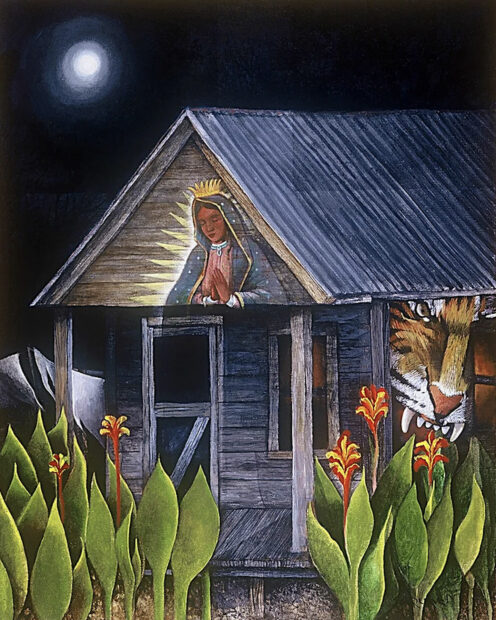
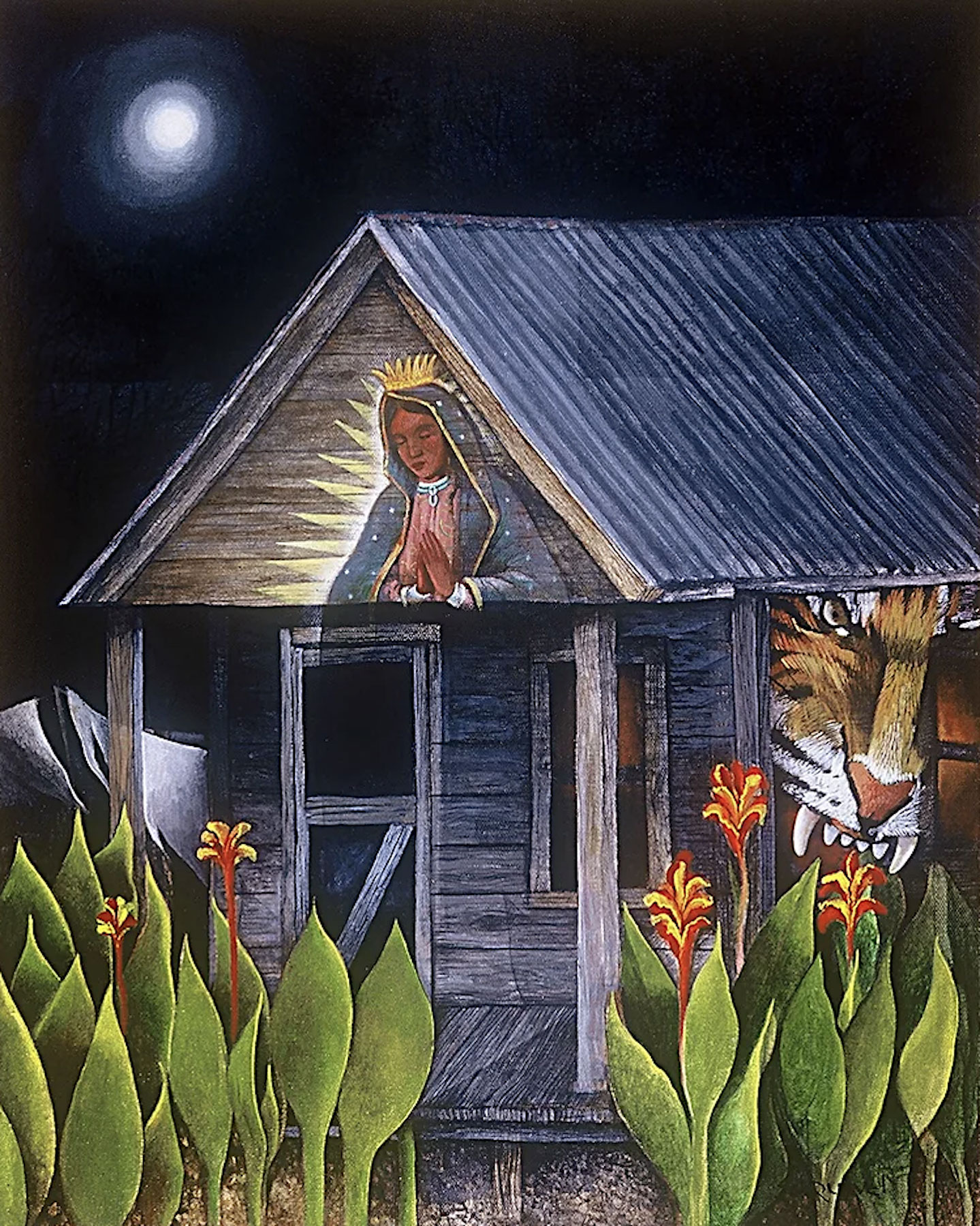
José Esquivel, “Nuestra Señora,” 1995, acrylic on canvas, 16 x 20 inches, collection of the artist’s estate.
Esquivel has rendered a simple wood frame house that is perhaps warped as much by memory as by time. The Virgin of Guadalupe makes a supernatural appearance on the pediment of this humble house on a moonlit night. A giant tiger’s head also manifests itself on the side of the house.
In the barrio, Guadalupe is revered as a friend and protectress. The tiger’s head, on the other hand, symbolizes the dangers that are lurking in the night, particularly drug addiction and drug-related violence. Tigers perform this symbolic function in a number of Esquivel’s other paintings, such as Victory at the Temple (2000) (discussed below); El Gusano (2002); Loose Tiger (2009); and Cemeterios de Niños’ — American Jungle (2015).
I suggested in a 2021 Glasstire article that a tiger in Mel Casas’ Humanscape #58 (San Antonio Circus ‘69) symbolized “the righteous anger of the excluded people of color.” Casas’ giant, emblematic tiger, which looks like it was projected onto a screen, may have inspired Esquivel’s similar tiger in Nuestra Señora, though, of course, these tigers symbolize very different things. (Also see my discussion of Casas’ probable cinematic influence on Esquivel in Part 1.) Esquivel’s tiger’s head even functions like a cinematic projection: it is not visible against the light-emanating window.
Henri “Le Douanier” Rousseau and Salvador Dalí, two other artists who influenced Esquivel, also utilized tigers in paintings he would have known in reproduction. Rousseau was a self-taught, “primitive” French painter who worked in the late 19th-early 20th centuries. He deeply impressed and influenced numerous modern artists, including Pablo Picasso, when the latter was creating increasingly simplified forms that would lead to Cubism. Rousseau was beloved by the Surrealists. Diego Rivera also drew on his work, and he was one of Frida Kahlo’s favorite painters. Rousseau was a source for several important modernist currents, and Kahlo was an inheritor of some of these traditions.
Rousseau is best known for his jungle scenes, including a painting with a tiger called Surprised! (1891). Other notable paintings by Rousseau include: The Flamingos (1907), The Snake Charmer (1907), and The Dream (1910).
Exotic plants, like those visible in Nuestra Señora, can be grown in San Antonio’s warm climate, though they are very unlikely to have been seen in abundance in the barrio. Esquivel renders them in a very naïve manner. They are disproportionately large and simple, in a very deliberate contrast to the plants he portrayed in his wildlife phase, when he would render single blades of grass in meticulous detail.
Esquivel’s treatment of these plants was inspired directly by both Rousseau and Kahlo. Ironically, Rousseau falsely claimed first-hand familiarity with jungles in Mexico. Rousseau created his jungle scenes by layering a small number of giant plants, and Kahlo and Esquivel followed his recipe.
Kahlo pays homage to Rousseau in several paintings. Kahlo, who had a wicked sense of humor, spoofs him hilariously in Self Portrait, Dedicated to Dr Eloesser (1940), in which she creates a background “jungle” simply by rendering a few gigantic leaves that are standing straight up.
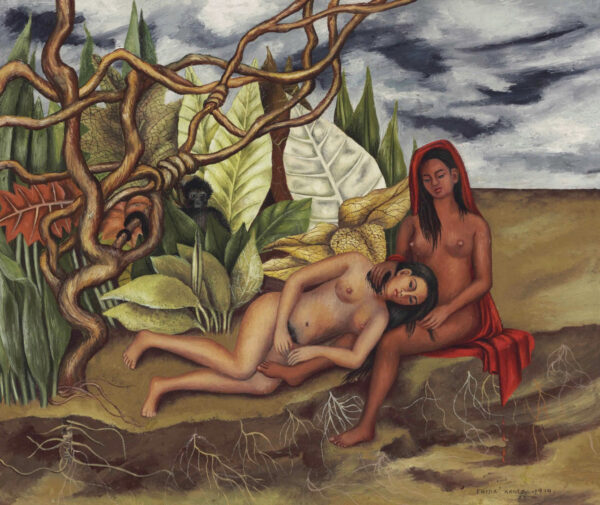
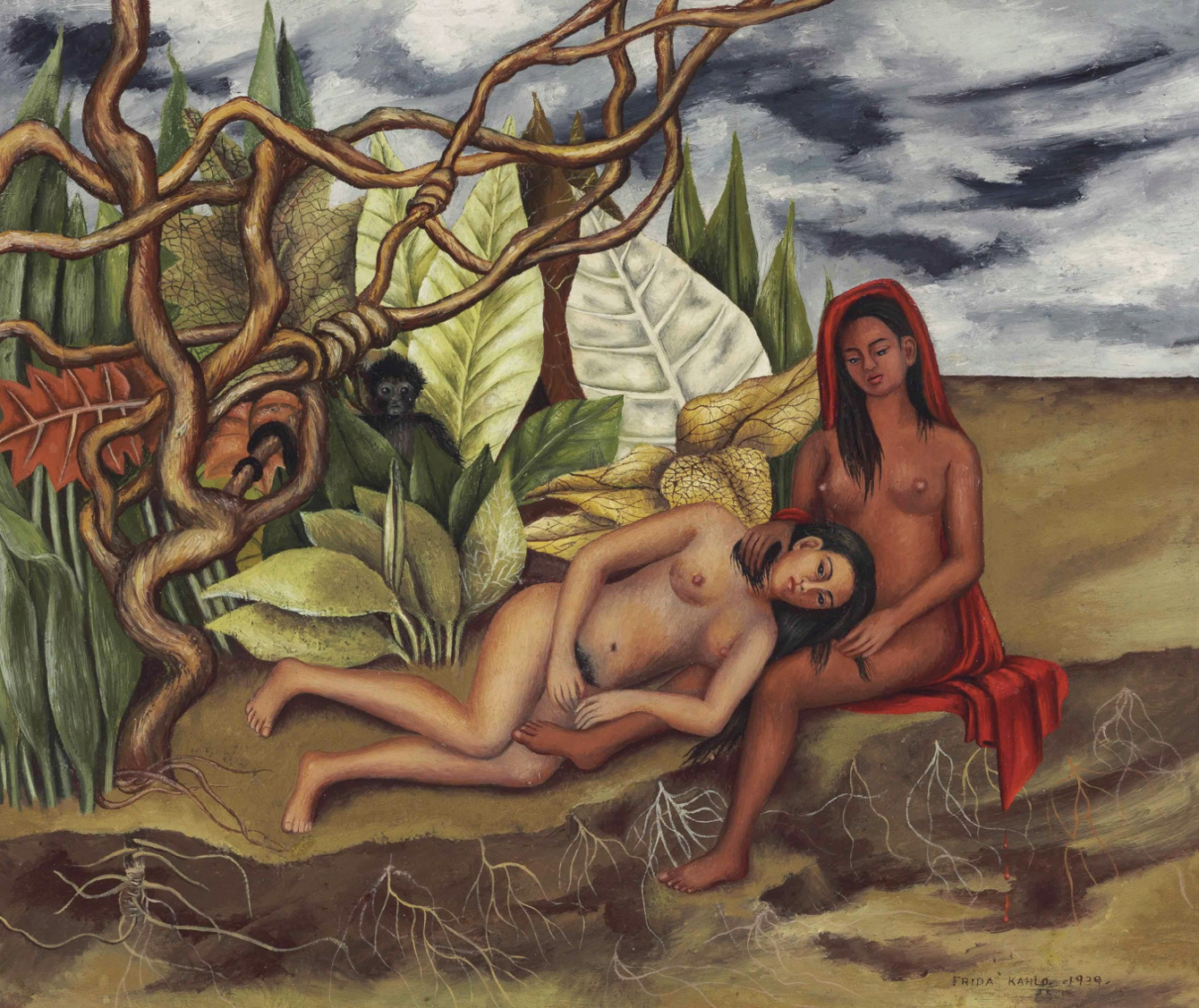
Frida Kahlo, “Two Nudes in a Forest, ” 1939, oil on metal, 9 7/8 x 11 7/8 inches, private collection. Photograph: Christie’s.
Similar jumbo leaves appear in the center of Two Nudes in a Forest (1939), where an enigmatic jungle sprouts forth in a desert with two nude women. (In its own way, this painting is as strange as Rousseau’s The Dream.) Note how closely the pod-like plants in the far left corner of Kahlo’s Two Nudes in a Forest and those in the center foreground resemble Esquivel’s plants in Nuestra Señora.
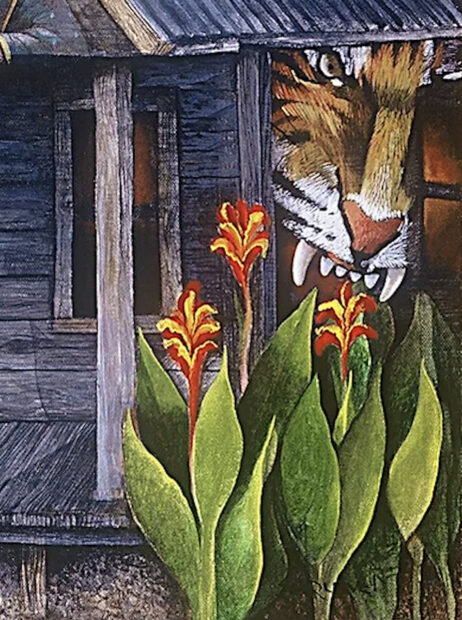
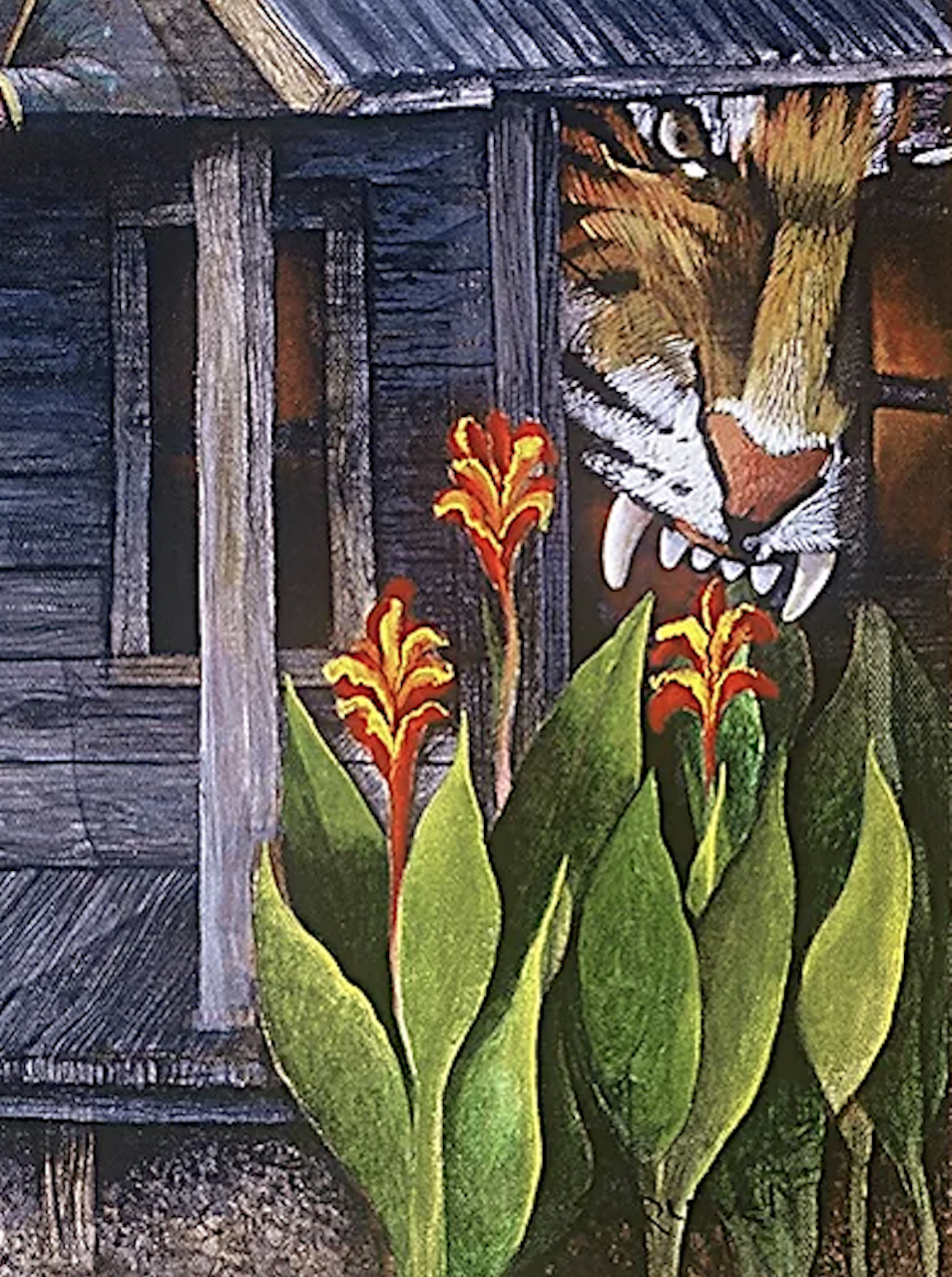
José Esquivel, “Nuestra Señora” (detail of right foreground), 1995, acrylic on canvas, 16 x 20 inches, collection of the artist’s estate.
In Nuestra Señora, Esquivel paints his plants even flatter than Kahlo, deliberately rendering them more “naïve,” more “primitive.” For two examples of Esquivel’s wildlife paintings with realistically depicted flora, see Part 1.
In some of his subsequent paintings, Esquivel increases the number of tropical plants in order to suggest more forcefully that the barrio is a dangerous urban jungle. This implication is rendered most explicitly — in image as well as title — in Cemeterios de Niños’ — American Jungle (2015).
Esquivel, who participated in many of the Centro Cultural Aztlán’s annual Celebración a la Virgen de Guadalupe Exhibits, included this painting in the twenty-first iteration in 2016.
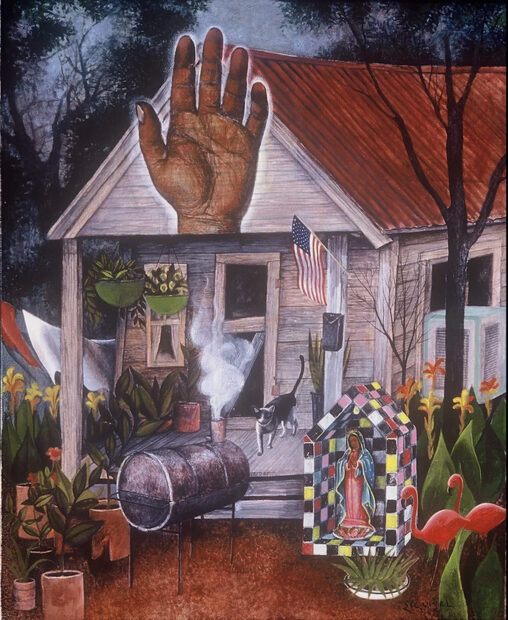
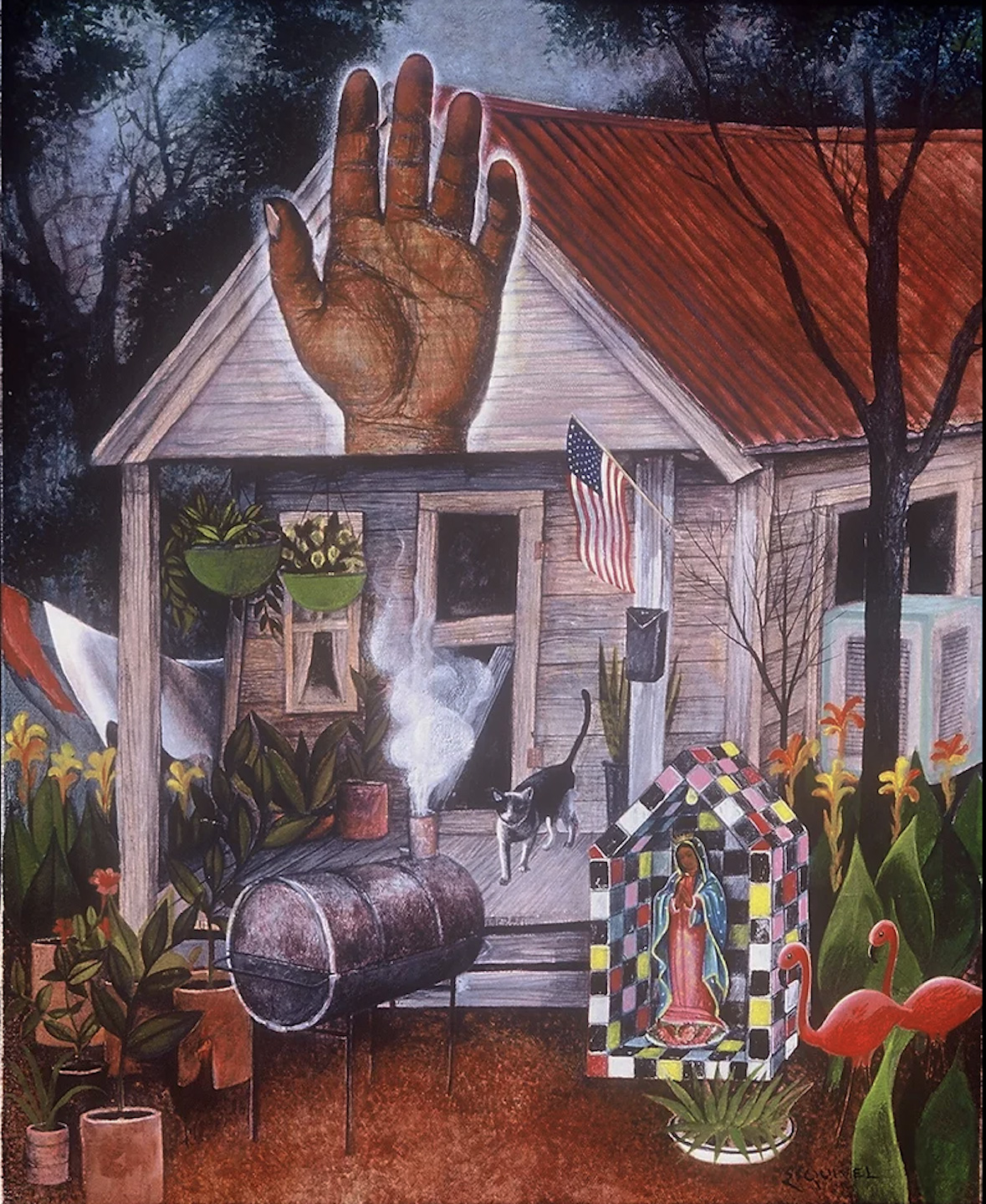
José Esquivel, “Labor Day Celebration,” 1997, acrylic on canvas, 16 x 20 inches, private collection.
In Labor Day Celebration, the barbeque grill is emanating smoke, which attracts the attention of a cat. A large brown hand hovers over the front of the house, displacing the Virgin of Guadalupe that miraculously inhabited this spot in Nuestra Señora. Esquivel’s Chicano paintings from this phase of his career are purposefully rustic, crude, and/or naïve in comparison to his earlier wildlife paintings. By contrast, this fully articulated hand is rendered with relative precision and detail. To further emphasize its miraculous nature in Labor Day Celebration, a white halo shimmers around it.
Otherwise, it is an ordinary day in this household. Clothes hang on the line, a giant air conditioning unit is situated at the window (a not-so-miraculous sign of San Antonio’s extreme heat), and a pair of plastic pink flamingos appears to attend to a brightly-tiled shrine devoted to the Virgin of Guadalupe.
The giant, disembodied hand is that of a Chicano laborer, such as José Sr., Esquivel’s father, who did mason and tile work. He crafted the Virgin of Guadalupe’s tile enclosure. Labor Day Celebration is an homage to physical labor. No workers need be depicted, because the hand stands in for them, as does the tile shrine and the laundry hanging in the background.
The disembodied hand also relates to the Mano Poderosa (The All-Powerful Hand), an image of Christ’s wounded hand that appears frequently in Mexican popular devotional images. See my discussion of the Mano Poderoso in connection with a painting by Vicente Telles that addresses labor and immigration (“Crossing Borders: the Work of Ricardo Islas, Brandon Maldonado, and Vicente Telles,” Glasstire, June 8, 2022.) Viewed in this context, Esquivel’s giant hand is simultaneously a depiction of the religious/miraculous and “the real.”
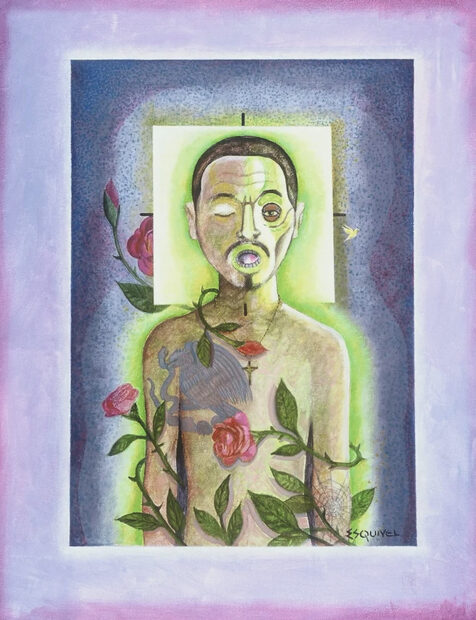
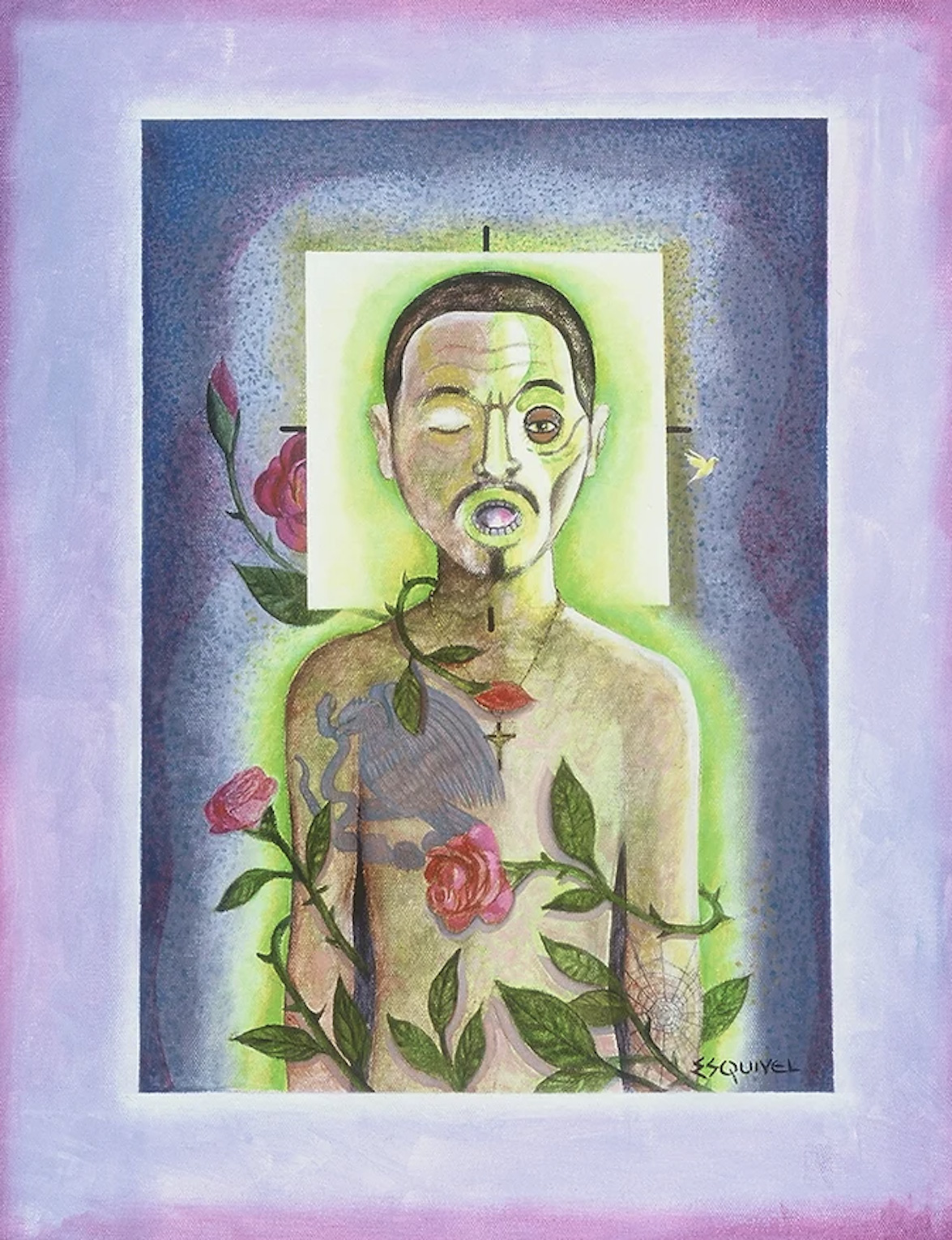
José Esquivel, “La Luz Verde,” 2000, acrylic on canvas, 16 x 20 inches, collection of the artist’s estate.
La Luz Verde depicts a gang member whose assassination has been “green-lighted,” hence the green glow around his body. His tattoo depicts an eagle with a rattlesnake in its mouth that perches on a cactus, which is Mexico’s national symbol. This signifies that the man is a member of the Mexican mafia.
Roses grow around the man’s body, as if it were a trellis. The leaves and vines cast strong shadows, as if to insist that they are indeed real and not mere symbols, though, in a paradox that suggests the contrary, the thorns do not pierce the man’s flesh. Ironically, the eagle even seems to be perched on the rose blossom in the center of the man’s torso. A rose vine is half-wrapped around the man’s neck, connecting it to the thorn necklace (which draws blood) in Kahlo’s Self Portrait, Dedicated to Dr Eloesser. Esquivel’s roses symbolize the fragility of youth and beauty at the precise point at which this man’s life is coming to an end. (See Part 1 for the origins of Esquivel’s use of rose symbolism.)
Esquivel’s utilization of rose vines was inspired by Kahlo’s Roots (1943), a painting in which vines grow out of a cavity in her body while she reclines on a bed of volcanic stone. Though Kahlo was frustrated by her ability to bear children (symbolized by the stone head of a child that lies at her feet), she nonetheless presents herself as an emblem of fecundity. The red veins in the leaves become roots that flow over Kahlo’s Tehuana dress and the rocky landscape on which she rests. On a more sinister note, the vines have been identified as a poisonous plant.
In La Luz Verde, the center of the man’s head has been sighted in the center of a square riflescope. In vernacular terms, the man has been “lit up.” Mysteriously, the man has one eye closed, as if he, too, were aiming a rifle. Perhaps this is a suggestion that his own similar actions are about to bring about his own death by gunshot. Strangely, this man’s open eye is behind a mask, or a flayed skin (including the head and the body), like that of the Aztec god Xipe Totec. The shape of the man’s open mouth, which is outlined with a greenish hue, also recalls such mouths in images of Xipe Totec, some of which were carved in green jade. Green was a sacred color for Mesoamericans, because they connected the color to fertility. Whereas sacrifices to Xipe Totec were made to ensure fertility, this man will be “sacrificed” for the purpose of profit. Because green is “the color of money” in the U.S., the man’s green halo is also fitting in the context of a drug cartel related slaying.
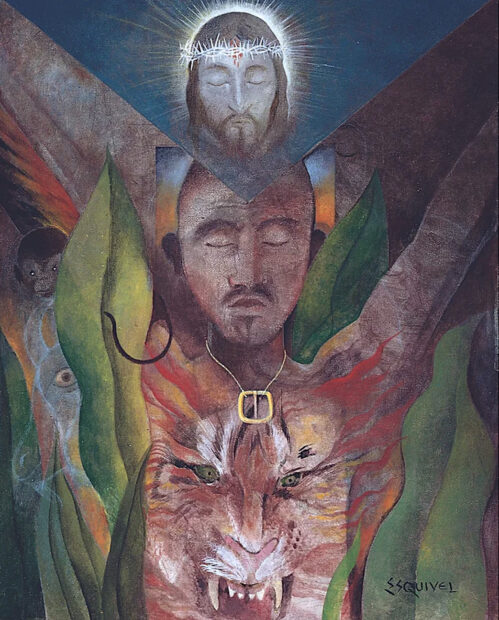
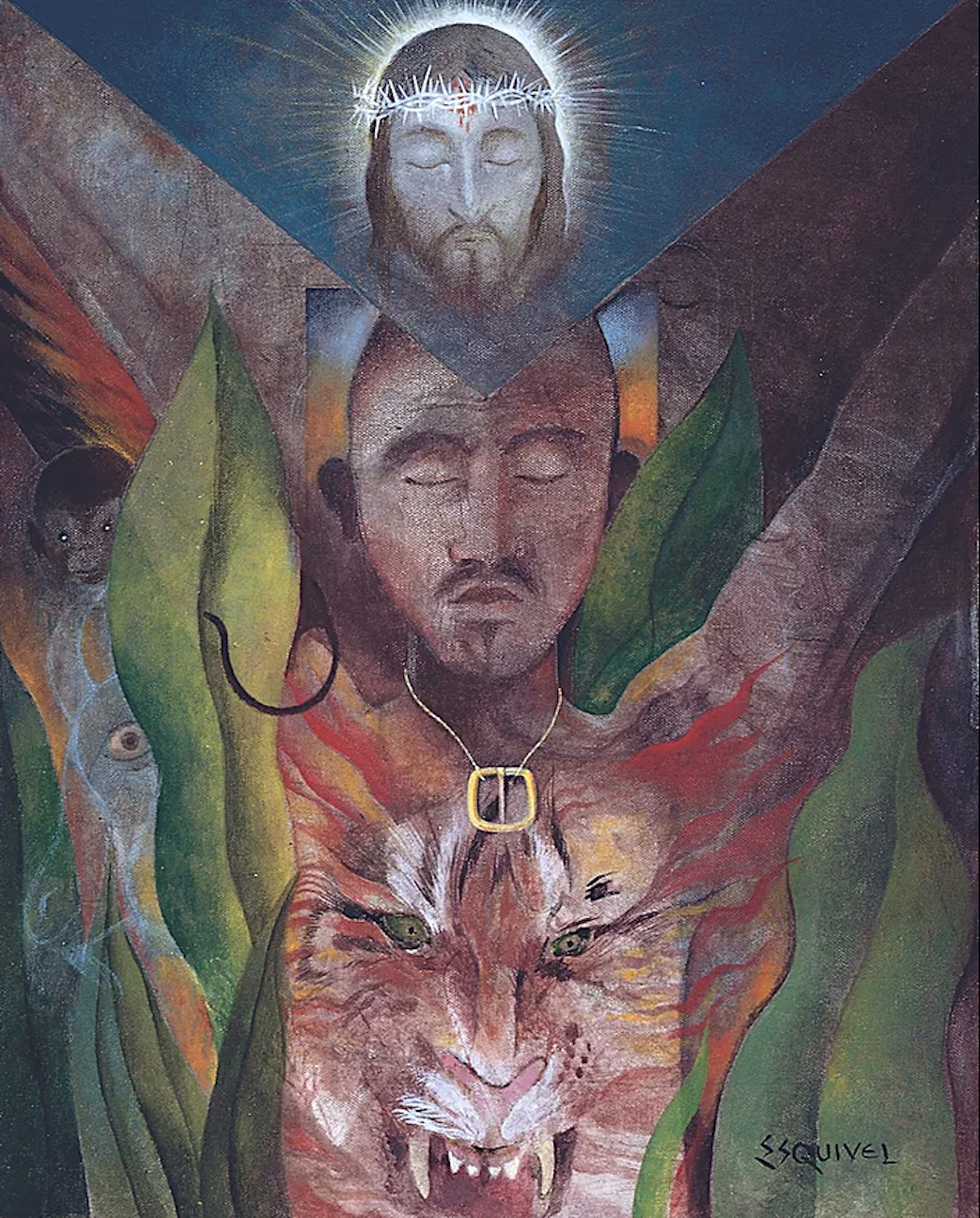
José Esquivel, “Victory at the Temple,” 2000, acrylic on canvas, 16 x 20 inches, Santos Martinez Chicano Art Collection.
The man depicted in Victory at the Temple resembles the man in La Luz Verde. But whereas the latter is an instant from death, the former has renounced the deadly career of crime in favor of life. The image of Christ above him implies that he has chosen the path to resurrection and everlasting life.
Victory at the Temple is a tribute to the Victory Outreach Ministry, which was founded by Freddie Garcia, a recovered drug addict. It represents the spiritual journey that enabled Garcia to escape from addiction. The man’s closed eyes and upraised arms symbolize release from the bondage of addiction. His arms form a “V,” which is echoed by visually rhyming shapes that likewise stand for victory (as in President Richard Nixon’s famous pose).
Addiction is represented by the menacing, growling tiger that is emblazoned on the man’s chest. The tiger even emits flames that emphasize the pain of withdrawal. In El Gusano (The Worm), which is linked above, a man with a burning head (a burn-out) is green because he is “green-lit” for a drug gang-related execution. In addition to the menacing tiger in the background of El Gusano, the man bears a tiger’s stripes on his body. Esquivel utilized tiger imagery in several ways to express the dangers of drug addiction.
The monkey and the other animals in the implied jungle depicted in Victory at the Temple represent animal impulses. Beneath the monkey (a favorite animal in paintings by Rousseau and Kahlo), two ghostly blue animals share a common eye and possibly a horn as well. On the left, one can see a goat, with a “billy” beard. In Christianity, the goat is linked to the devil. To the right of the goat, the bluish animal resembles a bull mask (perhaps African). The giant leaves grow stiffly upward, as in paintings by Rousseau and Kahlo. Three leaves (and portions of a few others) evoke a jungle setting with maximum efficiency.
The man’s transformation was achieved by his belief in Christ, whose head is represented within a triangle, which is a symbol of the Christian trinity. The triangle, in fact, seems to cleave the man’s skull like an axe blade, penetrating deep into his head. This expresses how deeply Christ’s message in inculcated into the repentant addict’s brain. With his inward vision, which is similar to that of Christ (as represented above him) the man is able to ignore the animals and the exotic plants that mark the barrio as an urban jungle, with all their attendant dangers.
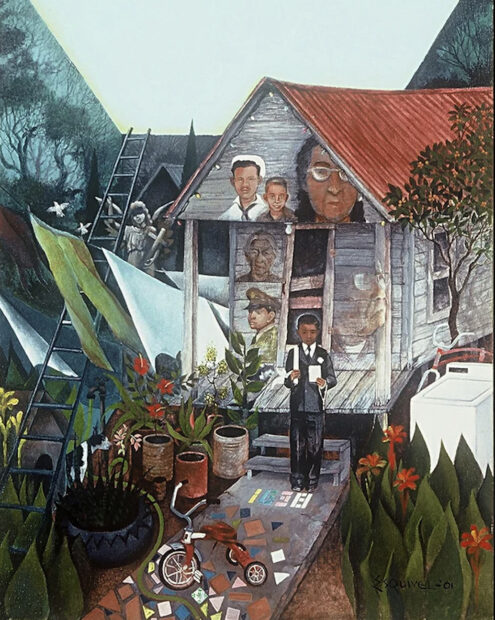
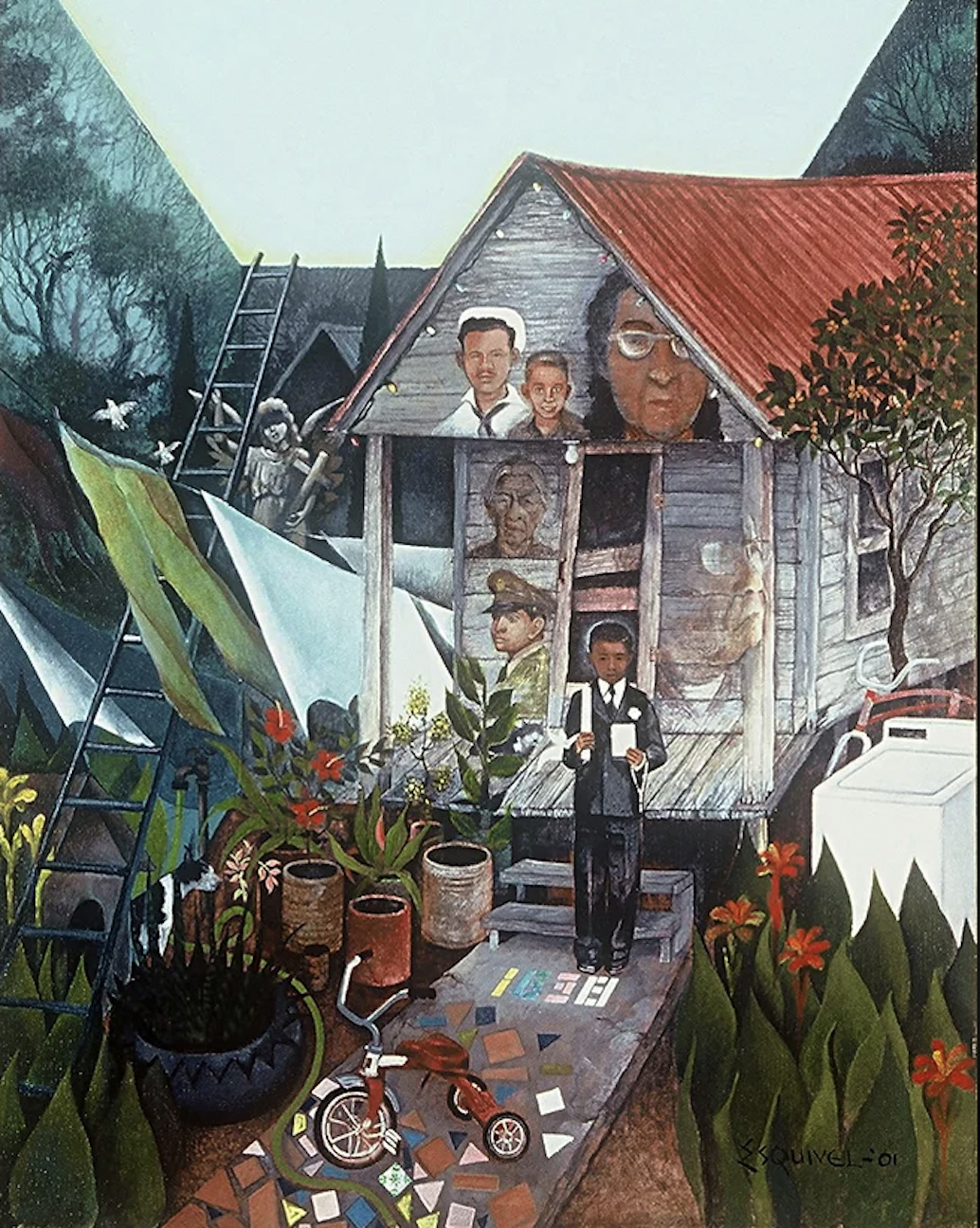
José Esquivel, “Boxed in at 1638,” 2001, acrylic on canvas, 16 x 20 inches, collection of Zoe Diaz.
The text I wrote for the catalog of the Joe Diaz collection when it was exhibited in Corpus Cristi in 2004 is copied below in italics:
Boxed in at 1638 (2001) depicts the house in which Esquivel was raised. According to the artist, “It shows a clutteredness, a chaos — it shows poverty. People on the West Side never threw anything away — they always hoped they would find some use for it.” The miscellaneous accretions include cans, a tire, a broken washing machine, and part of a bicycle. Such objects functioned as working capital: someone who drove by might need a washing machine part, for which they could swap a bicycle part.
When he was a child, Esquivel’s family did not possess a telephone, a television, or a car. But the absence of such basic devices that we take for granted was normal in the barrio. Neighbors shared what they did have, and they assisted others when they were in need.
Esquivel’s mother worked as a domestic in a wealthy neighborhood. The title of this painting derives from a maternal complaint: “Every time she would get despondent, my mother said: ‘We’re in this damn box — we’ll never get out of here.’ And, so, years later, all these things that are in your head become symbols.” This recollection caused the artist to enclose the house and the yard in a literal manner: they are boxed in; a long ladder serves as the sole means of escape. “My mother was always trying to get out, always trying to get us to escape our conditions. A lot of our people are trapped in poverty — there seems to be no exit.”
On a personal level, young Esquivel did not feel deprived, because he had no contact with the more fortunate. The artist presents himself in front of the house at the time of his First Communion. It was a high point of his childhood because he was provided with a new suit. The twisted, dilapidated familial home is disproportionately small in comparison to the doghouse in the foreground. These conditions are mitigated by the ghostly portraits, which evoke familial warmth. As Esquivel puts it, “they seem to come out of the house, almost like spirits.” The stylized plants in the foreground — products of conscious primitivism — stem from the artist’s admiration for the Douanier Rousseau and Frida Kahlo. Their simplified forms symbolize the young man’s naïve view of the world (¡Arte Caliente!: Selections from the Joe A. Diaz Collection, Corpus Christi: South Texas Institute for the Arts, 2004, p. 34-35).
Significantly, under the ladder on the left, one can make out a funerary statue of an angel bearing a cross. The implication is that the inhabitants of the house will die without ever escaping the barrio. Esquivel will extend this theme in subsequent paintings by turning the small plot of land into a cemetery.
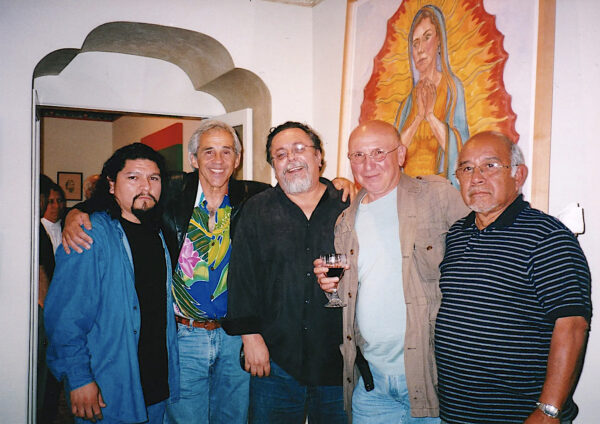
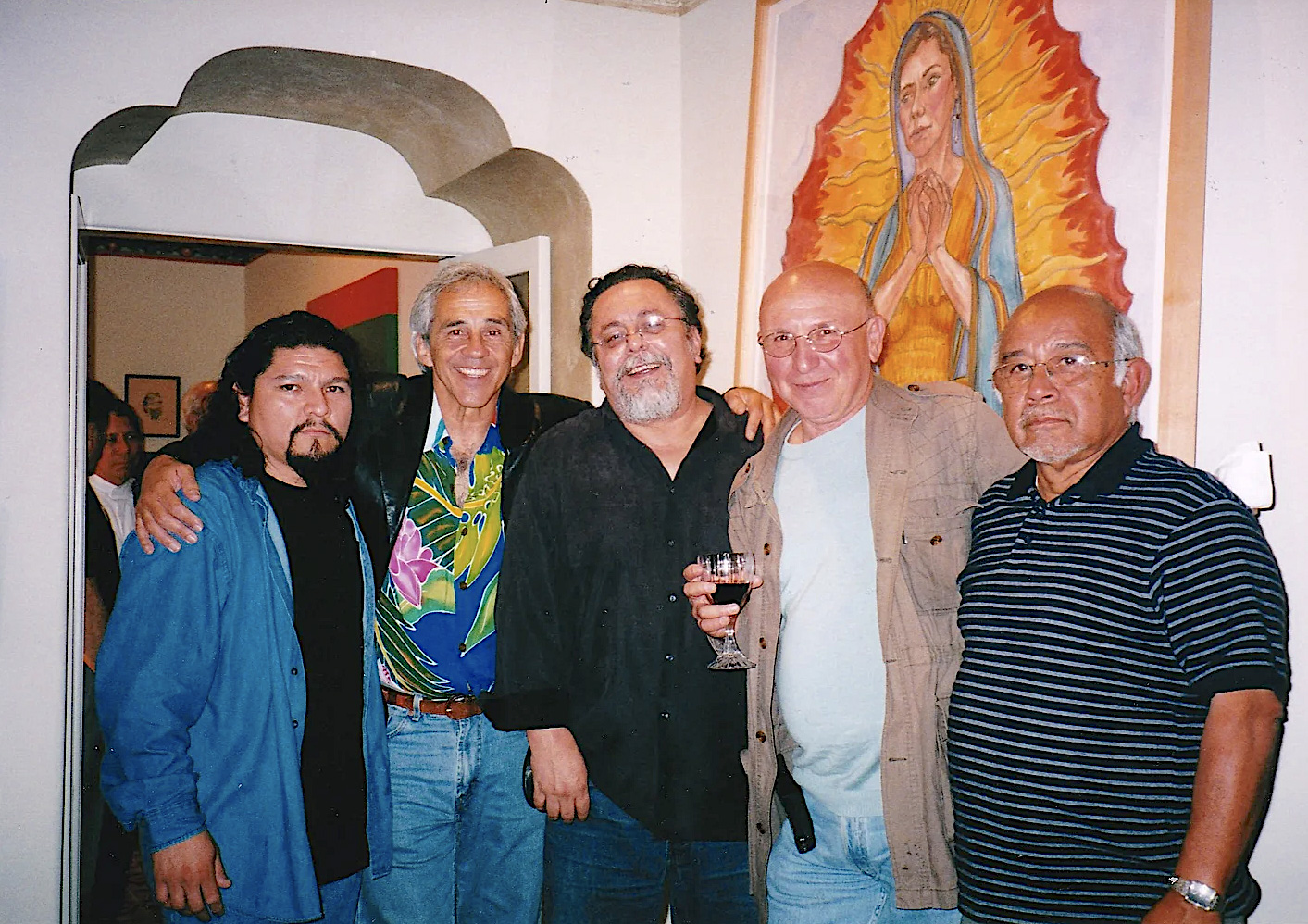
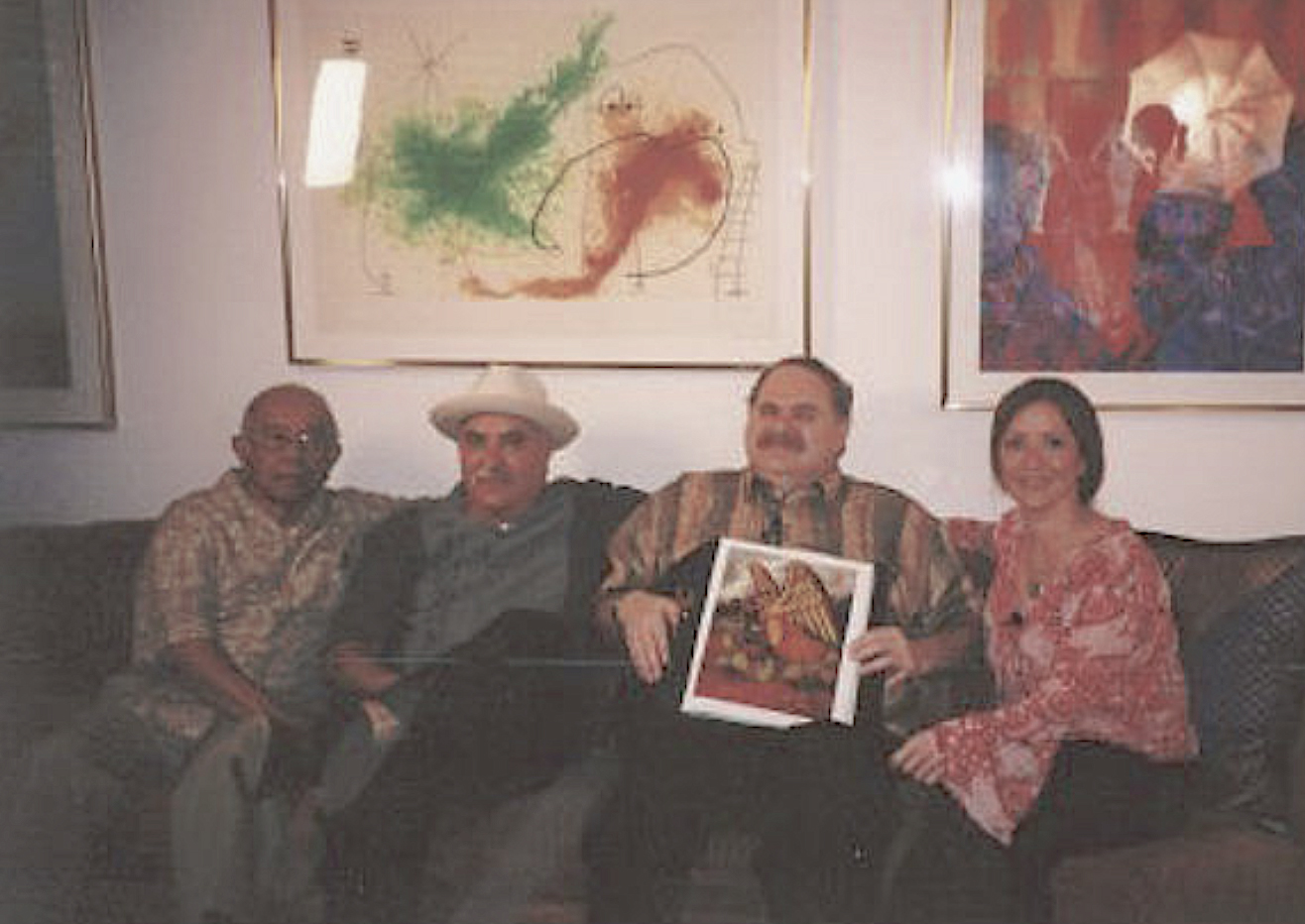
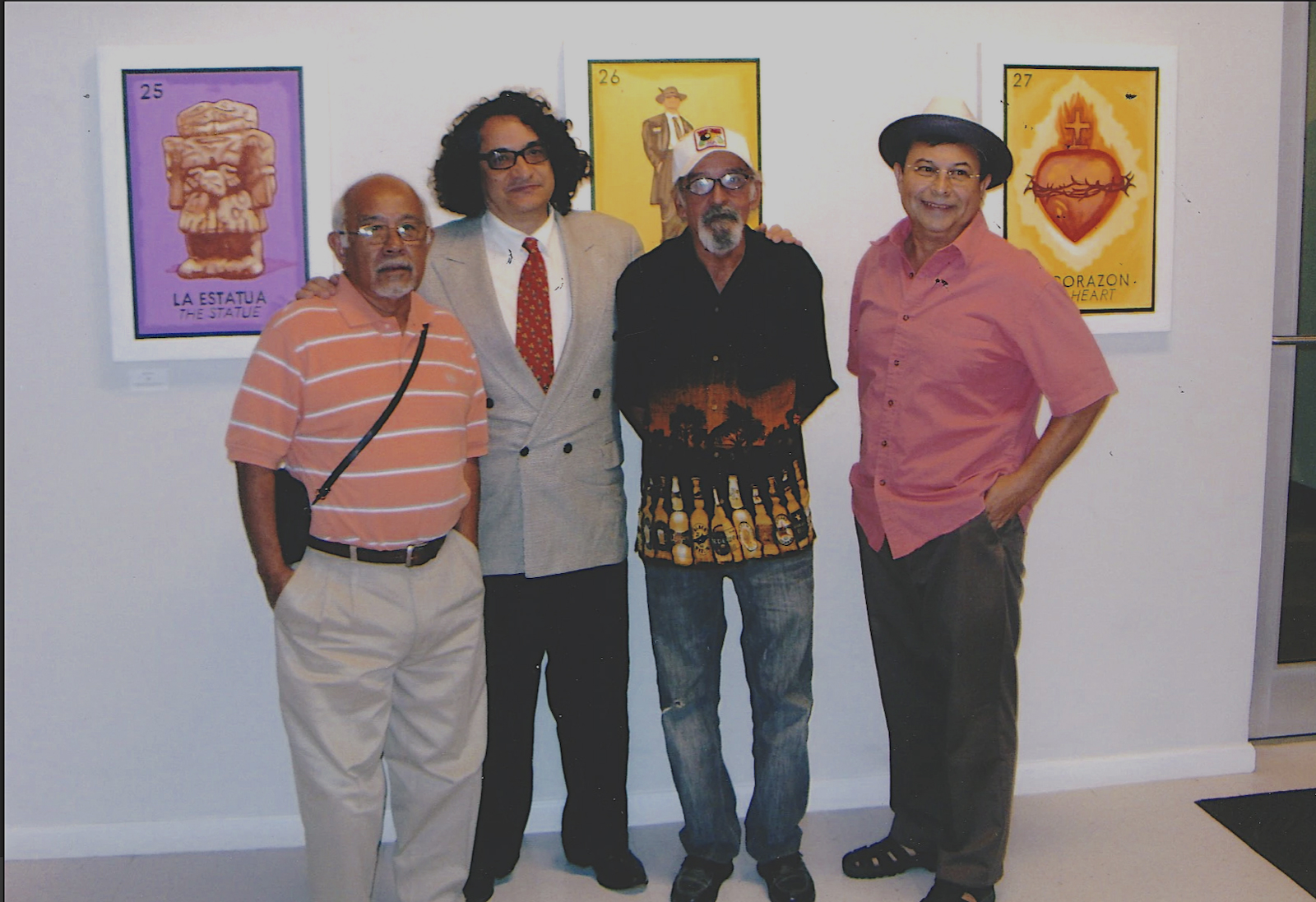
Rubio Rubio (formerly Alex Rubio), Pepe Serna, John Valadez, César Martínez, and José Esquivel. Group picture taken by Ruben C. Cordova at party for the exhibition ¡Arte Caliente!: Selections from the Joe A. Diaz Collection, Corpus Christi, 2004.
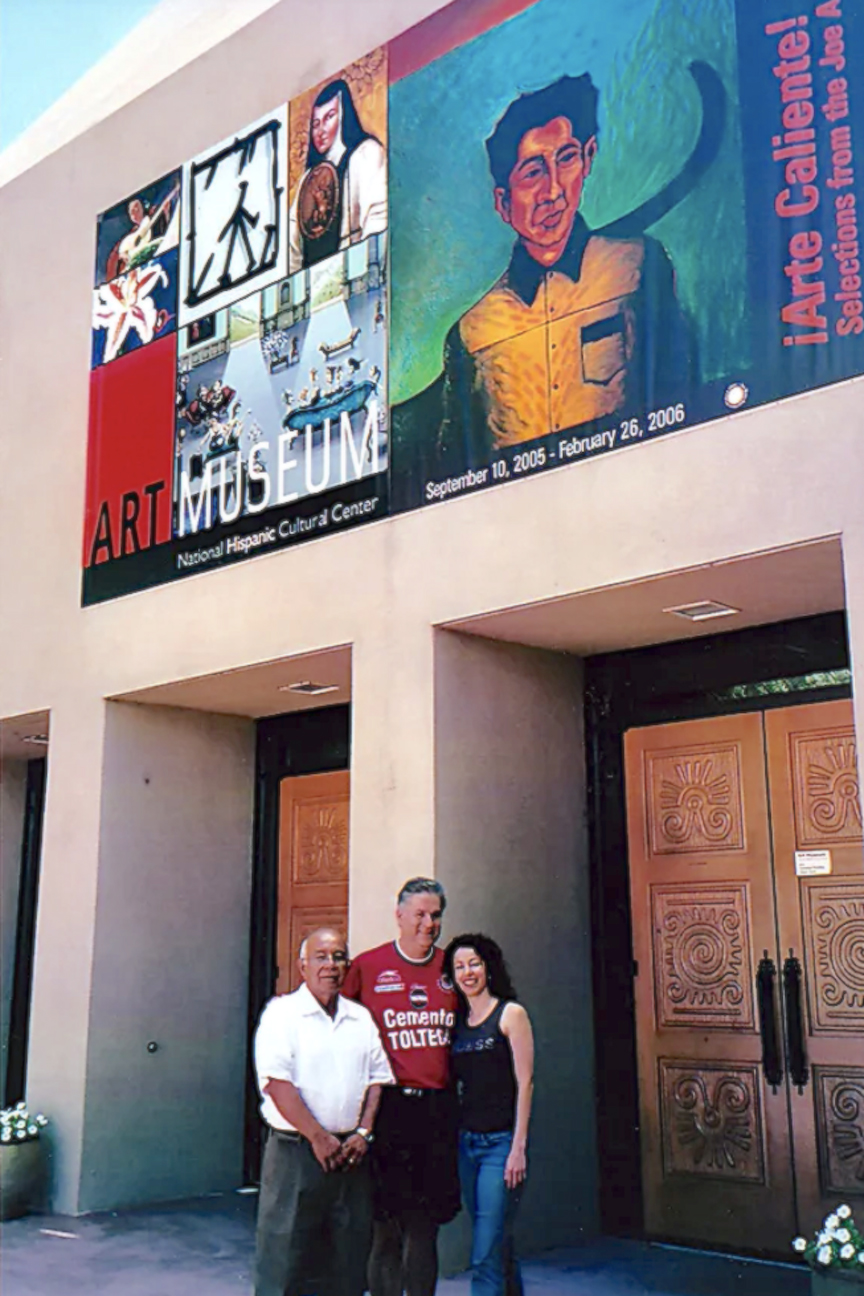
2003 and 2004 were watershed years in which Esquivel participated in several exhibitions. The Diaz collection was shown in Corpus Cristi in 2004, and it subsequently traveled to several other museums: the National Hispanic Cultural Center, Albuquerque (2005), the Fort Wayne Museum of Art, Fort Wayne, Indiana (2006), the San Jose Museum of Art (2006), the National Museum of Mexican Art (2008), and Middle Tennessee State University, Murfreesboro (2016).
2004 was also the year of my Arte Contemporaneo exhibition at the Centro Aztlán in San Antonio, and I also co-curated another show that featured Esquivel’s work in 2004: Latino Expressions at San Antonio’s Central Library.
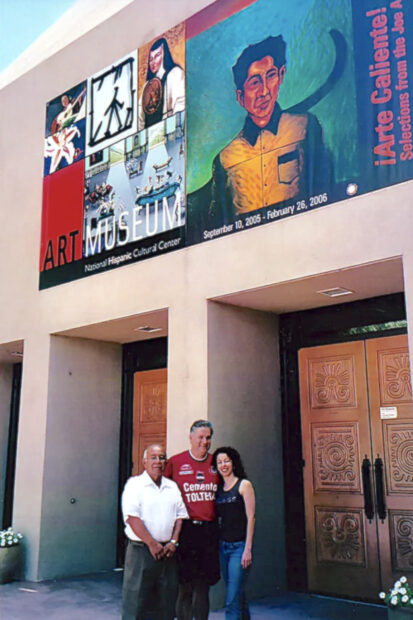
José Esquivel with Joe and Georgina Diaz with the banner for ¡Arte Caliente!, National Hispanic Cultural Center, Albuquerque, 2005.
After ¡Arte Caliente! introduced Esquivel’s work to the National Museum of Mexican Art in 2008, he was featured in one exhibition in that museum in 2011 and 2013, and in two shows in 2015.
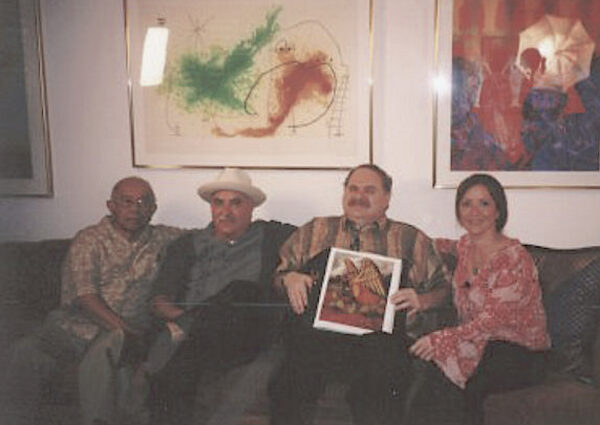
José Esquivel, Joe Lopez (an artist who ran Gallista Gallery in San Antonio), Gary Keller (symposium organizer), and artist Celina Hinojosa, Tempe, Arizona, 2005.
Esquivel participated in the Latino Symposium at Arizona State University in 2005, where I also gave a talk on the Con Safo group.
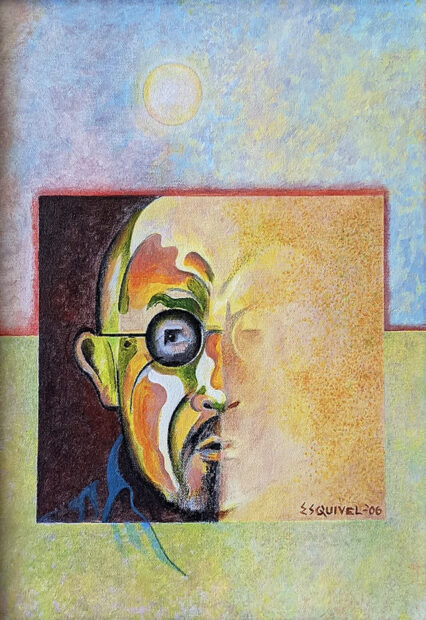
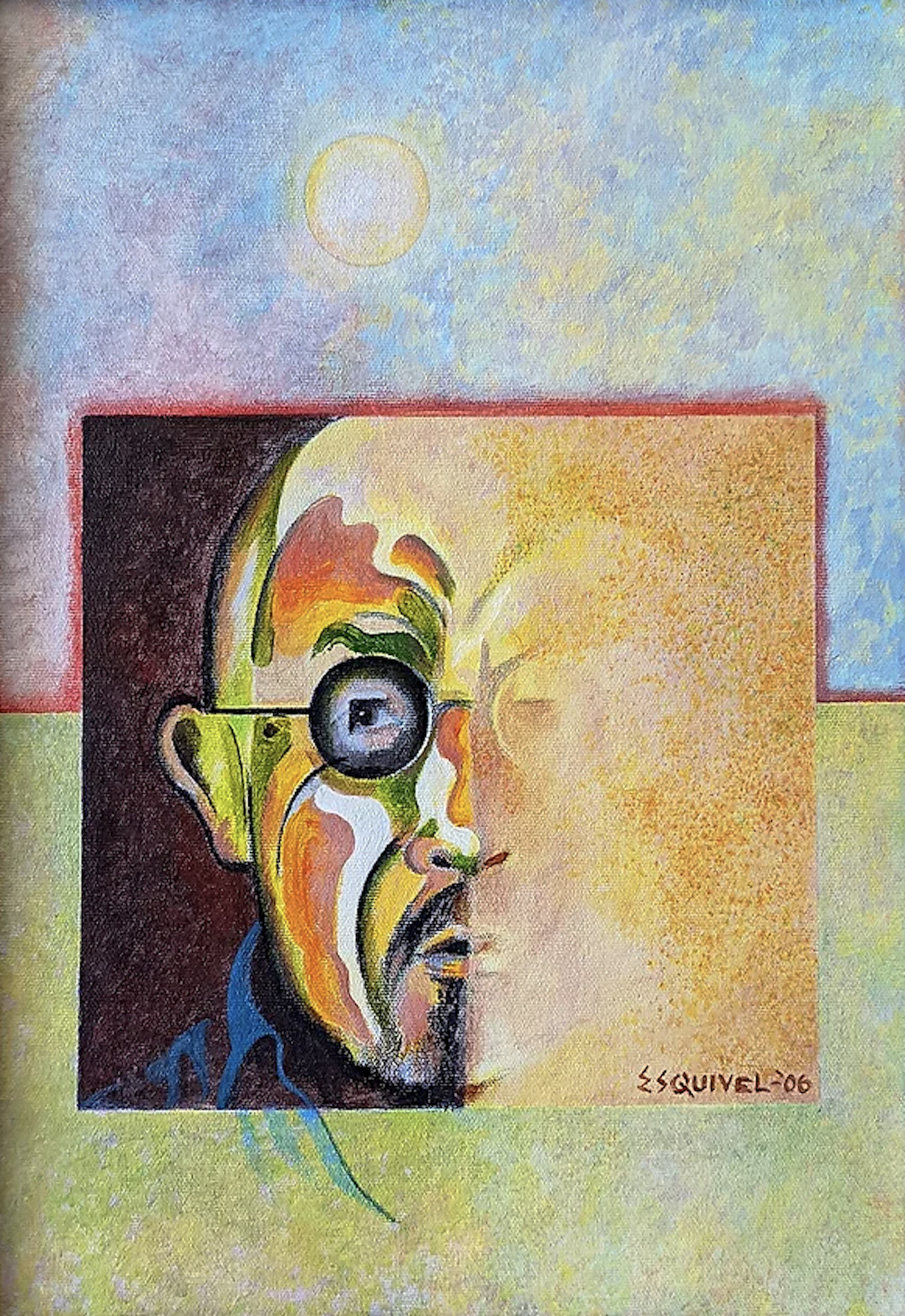
José Esquivel, “Self-Portrait,” 2006, acrylic on canvas, 16 x 20 inches, collection of the artist’s estate.
Esquivel’s self-portrait is a picture within a minimalist landscape. A trace of the artist’s blue shirt escapes this picture-within-the-picture. On the left, the line made by the arm of his glasses eerily continues the landscape’s horizon line. The self-portrait itself is bifurcated down the middle. This horizontal and vertical centering within a square recalls that of the man’s head in La Luz Verde.
In this self-portrait, the right half of the picture-within-a-picture is ghostly, increasingly dissolved into Impressionistic touches. It is as if it were painted on a metal sign that had long-term exposure to the elements, leaving it degraded and rusted, with traces of paint mixed with rust near the center, but only golden-orange rust on the far right.
The left side of the artist’s face, by contrast, is broken up into distinct, streaky areas of bright colors that are arbitrary in nature, rather than descriptive, as in Fauvist paintings by Henri Matisse. The green areas above his eye Surrealistically morph into plant-like shapes. The round eyeglass reads like a hole in the picture, with a marble-like eye resting within a strange, geometric shape. In multiple ways, Esquivel breaks with illusionistic representational practices, while still delivering a particularized, recognizable self-image.
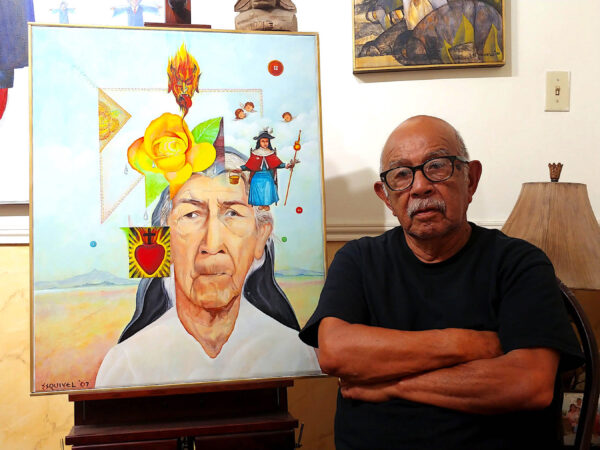
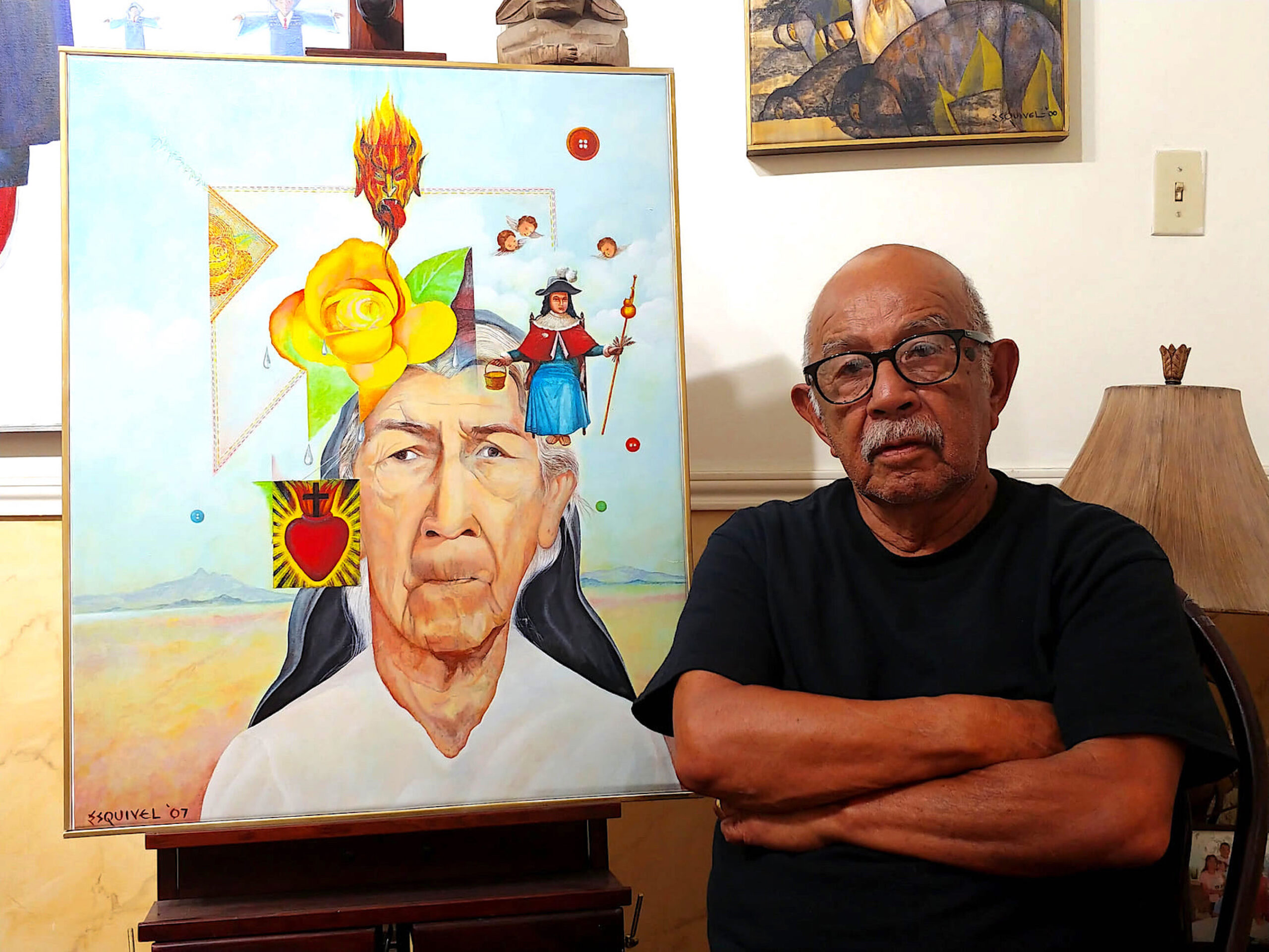
José Esquivel with “Elenita Cruz’s World” (El mundo de Elenita Cruz), 2007, 30 x 24 inches, National Museum of Mexican Art, Chicago.
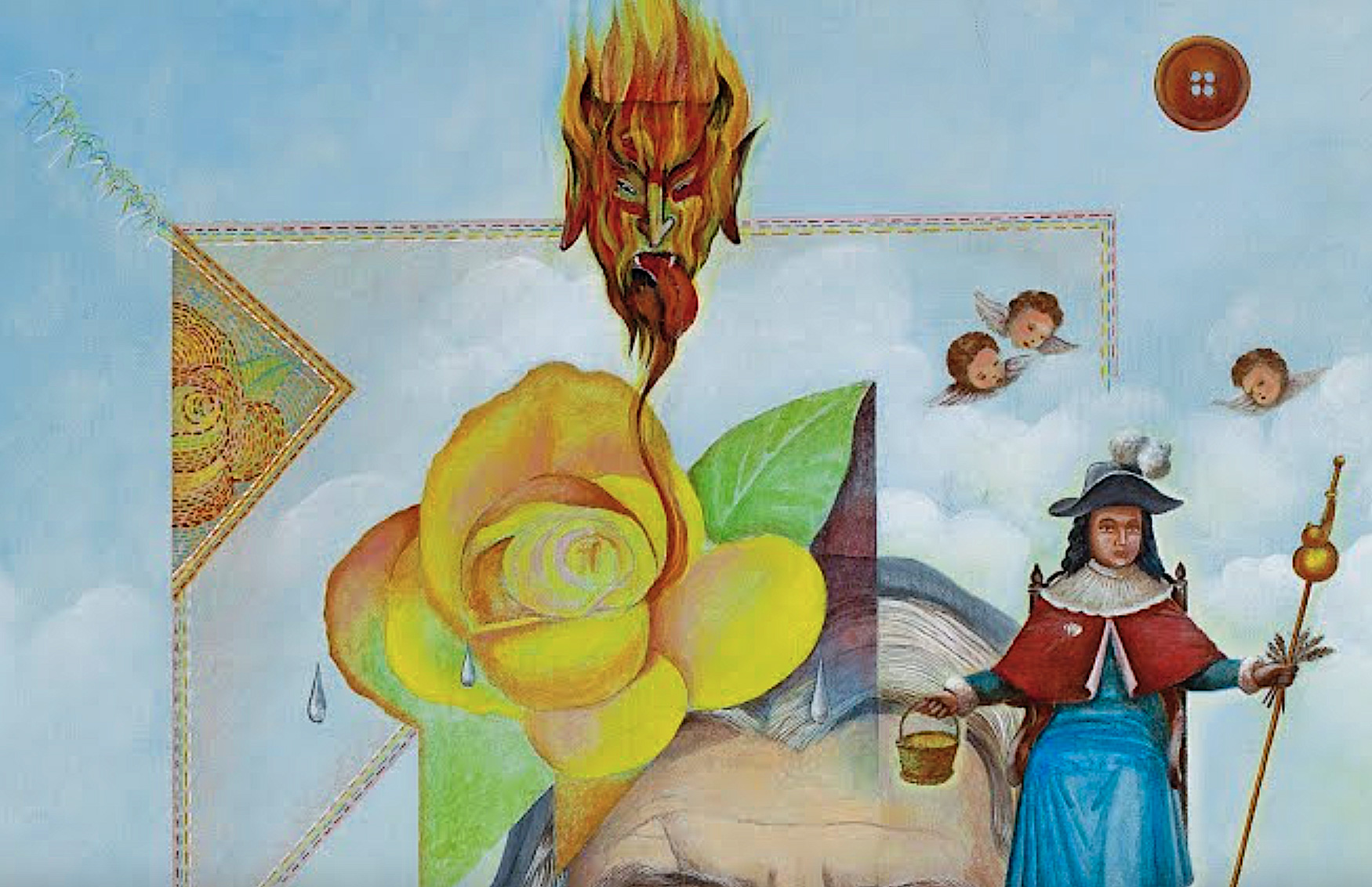
Esquivel poses with Elenita Cruz’s World, a tribute to his grandmother (technically, she was Esquivel’s father’s aunt, but she raised José Sr. from a young age). Cruz emigrated to the U.S. from Bustamante, Nuevo León, which is about 70 miles North of Monterrey. She brought Esquivel’s father with her when he was nine years old. The desert landscape with distant mountains in Elenita Cruz’s World represents her native Mexico in the environs of Monterrey.
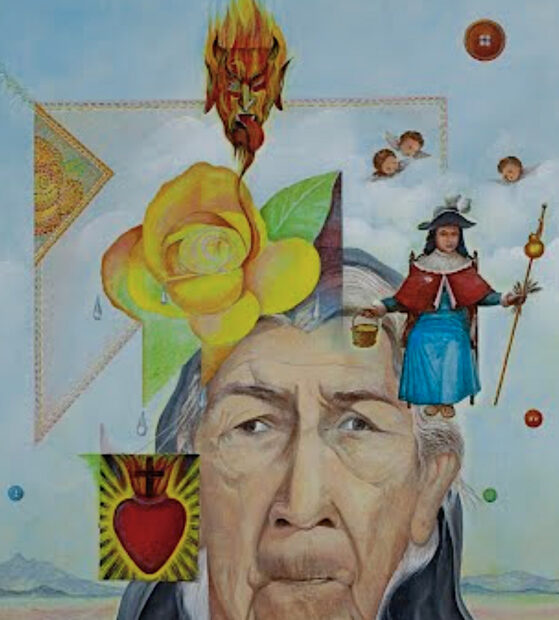
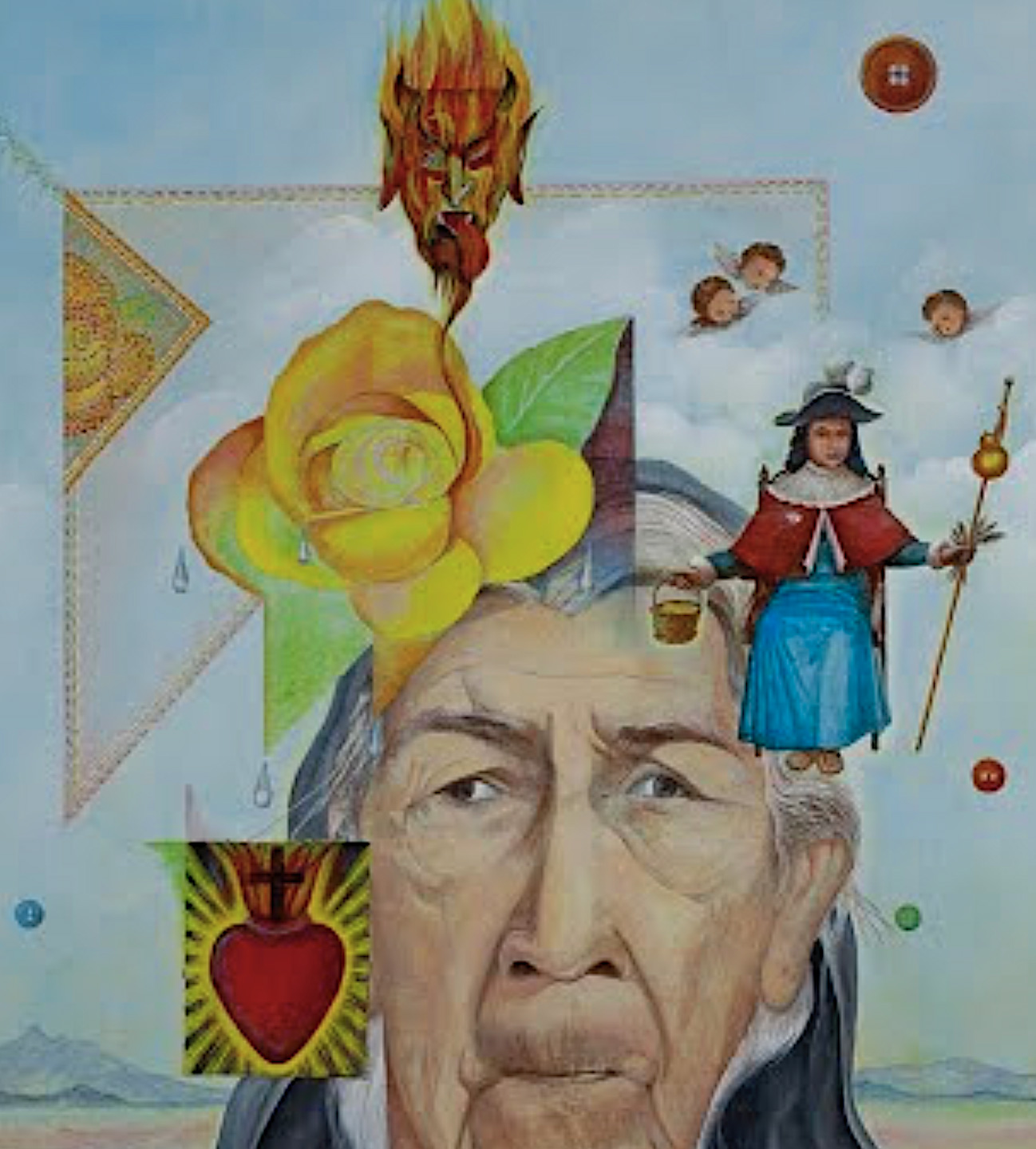
José Esquivel, “Elenita Cruz’s World” (El mundo de Elenita Cruz, detail), 2007, 30 x 24 inches, National Museum of Mexican Art, Chicago. Photograph: Google Arts & Culture.
Esquivel often referred to his grandmother as a “spiritual warrior.” She sprinkled holy water every morning throughout the house as an exorcism ritual, and she prayed obsessively, at all hours of the day. Esquivel, who always seemed somewhat bemused by her religiosity, did not strike me as a particularly religious person. Mario Esquivel recalls that the family “attended and was active in the Catholic Church” when he was growing up. Mario characterizes his mother as more spiritual than conventionally religious. Mario adds: “Later in life, José would read up on many different religious and spiritual philosophies.” In the 1990s, Esquivel attended church sporadically. During the period treated here in Part 2, Esquivel was less of a practicing Catholic than he was in his younger days, though, in his art, he is more of a cultural Catholic, since he deployed more Catholic iconography.
Grandmother Cruz’s faith is reflected in the religious emblems Esquivel utilized in this symbolic portrait. The child with a staff, water gourd, and basket is the Santo Niño de Atocha, an image of the Christ child based on a medieval Spanish legend. According to the legend, when much of present-day Spain was under Moorish occupation, only children who were related to Catholic prisoners were allowed to bring them food. This legend holds that the Christ child was able to miraculously pass by the Moorish guards and sustain the prisoners, which is why he has a basket. The staff, gourd, shell, and hat are emblems of pilgrimage. The Santo Niño became a patron saint of pilgrims, as well as of people in need in general. Many miracles are attributed to him in Spain, Mexico, and even in New Mexico. Cruz had a special devotion to the Santo Niño de Atocha.
The image Esquivel painted is taken directly from holy cards that are still utilized today, including the cherubs and the clouds. The clouds from the holy card are dispersed throughout the upper section of Esquivel’s painting. They serve as a bridge that interpenetrates the physical world of the secular (represented by the desert landscape) and the holy, miraculous world of the god-child.
The Santo Niño is balanced by a yellow rose on the other side of Cruz’s head. The yellow rose is an emblem of Texas, as in the song The Yellow Rose of Texas. Esquivel even made a painting called The Yellow Rose of Texas that features a yellow rose superimposed over a bull’s skull (it has parallel lines at the bottom, as in Puffying Away, treated in Part 1).
Importantly, the rose is also associated with the Virgin of Guadalupe, and the faithful believe that roses were intimately connected with the creation of the miracle-working image now housed in the Basilica of Guadalupe in Mexico City. According to this story, roses miraculously appeared out of season, and were gathered by a convert named Juan Diego in 1531. He transported them in his tilma (an indigenous robe). When he dropped them before a skeptical bishop, the miraculous image of the Virgin of Guadalupe appeared on his tilma, without the intervention of human hands. This story is commonly referred to as “The Miracle of the Roses.”
The drops that fall from the yellow rose in Elenita Cruz’s World relate to the drops in Esquivel’s farm worker-themed paintings from the 1970s that are discussed in Part 1. By the time he made this painting, Esquivel was aware of how Frida Kahlo utilized liquid drops in many contexts. When she was at her most Surreal, Kahlo’s drops symbolized dew, rain, milk, tears, pearls, and sperm (sometimes multiple substances in the same painting).
The yellow rose in Elenita Cruz’s World is tinged with red, which suggests blood. In Como Una Flor (Like a Flower), a tribute to Selena, the murdered Tejana singer, Esquivel made this connection explicit by depicting a drop of blood on a rose’s thorn (he later painted out the blood in an effort to make the work more saleable). Roses, for Esquivel, are emblems of beauty, fragility, and mortality.
Up above the rose, Esquivel rendered an image of a flaming devil’s head, complete with horns, fangs, and a protruding tongue. Its red, green, and yellow color scheme echoes that of the rose and its two leaves. The devil is essentially camouflaged by the colors of the rose. He is, in fact, connected to the rose by a reddish form that could read as a stem, vein, or umbilical cord. This emblem of connectedness references several of Kahlo’s paintings, including My Grandparents, My Parents, and I (Family Tree) (1936) and The Two Fridas (1939). The Two Fridas, as Dawn Ades has pointed out, depends upon Rivera’s print Communicating Vessels, a linoleum cut made to commemorate an André Breton lecture in Mexico in 1938. (The example linked above is one of several extant hand-colored examples.)
The fact that the devil springs from a rose is an inside joke on Esquivel’s part. In her religious paranoia, Elenita Cruz always feared that the devil was lurking everywhere — so Esquivel has the devil make its appearance from a particularly unexpected source. As noted above, the miraculous image of the Virgin of Guadalupe was said to have originated while roses were carried in a tilma. So it is particularly diabolical for the devil to be birthed from a rose (much in the way Kahlo depicts herself birthed from her mother in My Grandparents, My Parents, and I). Thus Esquivel’s devil shares the same miraculous paternity as the miraculous image of the Virgin of Guadalupe.
Below the rose in Elenita Cruz’s World, Esquivel rendered a sacred heart. It is the characteristic red color, surmounted by a cross that is engulfed in flames. Thus fire has the confounding quality of serving simultaneously as a sign of salvation (the purifying flame above the sacred heart) and damnation (the burning devil). But of course, one can’t have one without the other. The red, flaming heart is surrounded by a yellow nimbus. Astonishingly, the rays that emanate from it have a red, yellow, and green color scheme, which relate it to the flower and the flaming devil. I don’t recall ever seeing green utilized in this fashion in a sacred heart image.
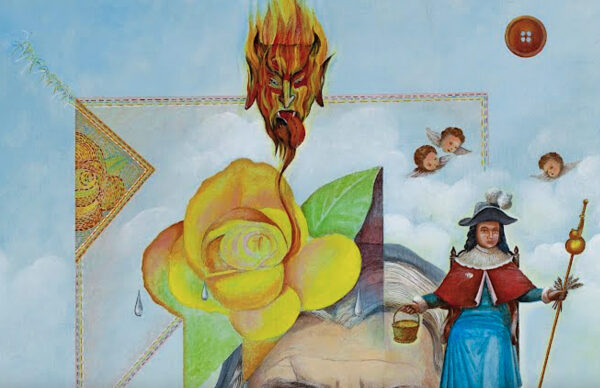
José Esquivel, “Elenita Cruz’s World” (El mundo de Elenita Cruz, detail), 2007, 30 x 24 inches, National Museum of Mexican Art, Chicago. Photograph: Google Arts & Culture.
Esquivel also utilizes this red, yellow, and green color scheme in parallel stitches in the sky that look like they were made by a sewing machine. (There is something uncanny in the ubiquity of this color scheme.) The stitches emanate above the Santo Niño’s head, then they make a ninety degree left turn, where they pass behind the flaming devil’s head. After some zigs and zags, they connect to the yellow rose. In the upper left corner, the stitching is unraveling.
Both Rivera and Kahlo utilized the effect of unraveling/connecting threads in conjunction with strangely behaving plants in Surrealist-inspired paintings. In Rivera’s Mandrágora (Mandrake, 1939) and Maja Guarino (1940), a young woman holds a Day of the Dead object while a filament from a spider’s web on the left side of the painting connects to her silky and translucent white wedding gown. In Maja Guarino, a thread continues to the bottom of the painting, where it transforms itself into Rivera’s signature. Recall that in Greek myth, Arachne challenged the goddess Athena to a weaving contest, and was turned into a spider as punishment for her hubris. The linking filaments/threads in the Rivera paintings suggest that weaving is weaving, whether by a two-legged weaver or an eight-legged one. After all, all weavers attempt to ensnare the beholder, and all things are related, however mysterious the connection.
On the right side of both of Rivera’s paintings, the root of a mandrake plant (a hallucinogenic associated with magic and witchcraft) makes a ghostly, enigmatic appearance. (For a short discussion of Mandrágora in connection with the International Surrealist Exhibition of 1940 in Mexico City, click here.)
Kahlo ups the Surrealist ante in Self-Portrait as a Tehuana (a.k.a. Diego in My Thoughts, 1943), a painting in which multiple threads extend from her Tehuana blouse/headpiece, while numerous tendrils reach out from the bouquet on her head. Textile elements woven into clothing are thus as seemingly alive and energetic as living plants that are thrusting vines in all directions.
The stitching in Esquivel’s painting, which bizarrely connects the Santo Niño, Satan, and the yellow rose, is becoming undone. We can only wonder if this unraveling of linkages between will reveal yet another reality or plane of existence that is presently unseen?
Finally, below the unraveled stitchery, we see what looks like an embroidered image of the yellow rose. Cruz herself was an embroiderer. Due to the state of impoverishment that pervaded her neighborhood, she often bartered her creations, and she even gave some away to her needy neighbors.
Could this triangular section be folded over from the other side? Do the stitches that we see outline the backside of an embroidery that is otherwise invisible to us? The folded-back section of embroidery also makes a specific art historical reference: it mimics the Pointillist painting technique (made with tiny touches of unblended colors).
The four small round forms that float in the sky are buttons. Given their prominence and that of the stitches, sewing is given great prominence in this painting. Cruz was a seamstress who operated a foot-powered sewing machine. She made practical objects, such as curtains, aprons, and potholders, as well as the embroidery work noted above. Cruz taught her son to sew, so the stitching and the buttons represent a professional skill passed on from mother to son.
Before he moved on to masonry and tile work, Esquivel’s father was a tailor who made men’s suits. Recall also that one of the highlights of Esquivel’s childhood is when he got a new suit for his First Communion.
If we return to the full painting, Cruz is depicted in Mexico, rather than in the flat-as-a-board environs of San Antonio or South Texas. But Cruz is near the end of her life, rather than the much younger person she was when she began her pilgrimage to the U.S. Esquivel has rendered a late portrait of his grandmother in a dreamscape of memory and imagination. We might even compare the landscape to Dali’s Persistence of Memory (1931). Both paintings have bleak, flat landscapes, except for distant cliffs or mountains in the distance.
The objects that hover around Cruz’s head are deeply personal, and, at the same time, highly conventional symbols of good, evil, and beauty. This use of symbolism is very different from the kind often found in European Surrealist paintings, such as Dalí’s Dream Caused by the Flight of a Bee around a Pomegranate a Second Before Awakening (1944). Dalí began with his own obsessions (the sexualized nude image of his wife Gala and a distorted rendering of Bernini’s sculpture of an elephant bearing an obelisk), to which he added wholly arbitrary elements (a ferocious female tiger emerging from a ferocious male tiger’s mouth, which in turn emerges from a fish’s mouth, which emerges from a burst pomegranate). The personal nature of Esquivel’s symbolism has much more in common with that of Kahlo.
The objects that float around Cruz’s head are anything but arbitrary. They are externalizations of her deepest beliefs. But, at the same time, they are hallucinatory images. They are not physically present, nor is she present in the landscape at this point in time.
Cruz is unidealized, with the full effects of aging on display. Jesse Treviño’s Señora Dolores Treviño (1983), an un-idealized portrait of the artist’s aged mother hanging the laundry, was an important precedent for Esquivel. Treviño’s painting had been purchased by the San Antonio Museum of Art in 1994, and it has long been one of the most famous and accessible Chicano paintings in San Antonio.
The position in which the flower is superimposed over Cruz’s head recall the flowers commonly depicted on young women as an emblem of beauty and its transitory nature. That is the function of the rose in La Cruz (discussed in Part 1) as well as in La Poblanita (1971).
The sacred heart could almost read as an earring, but it is instead an article of faith (as is the Santo Niño and the devil). Cruz looks at us directly. She is resolute, as she prepares for her final journey.
Esquivel donated Elenita Cruz’s World to the National Museum of Mexican art in his grandmother’s memory. A zoomable image of this painting is available on Google Arts & Culture.
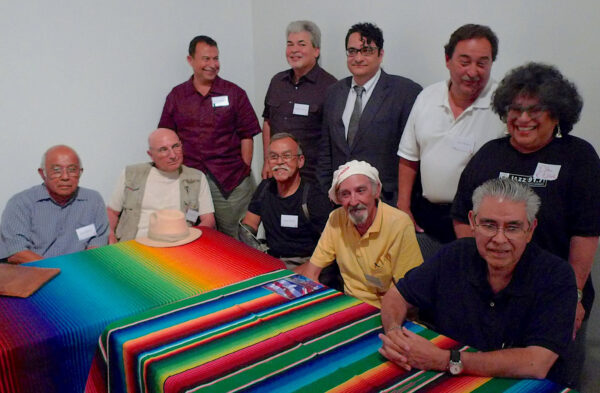
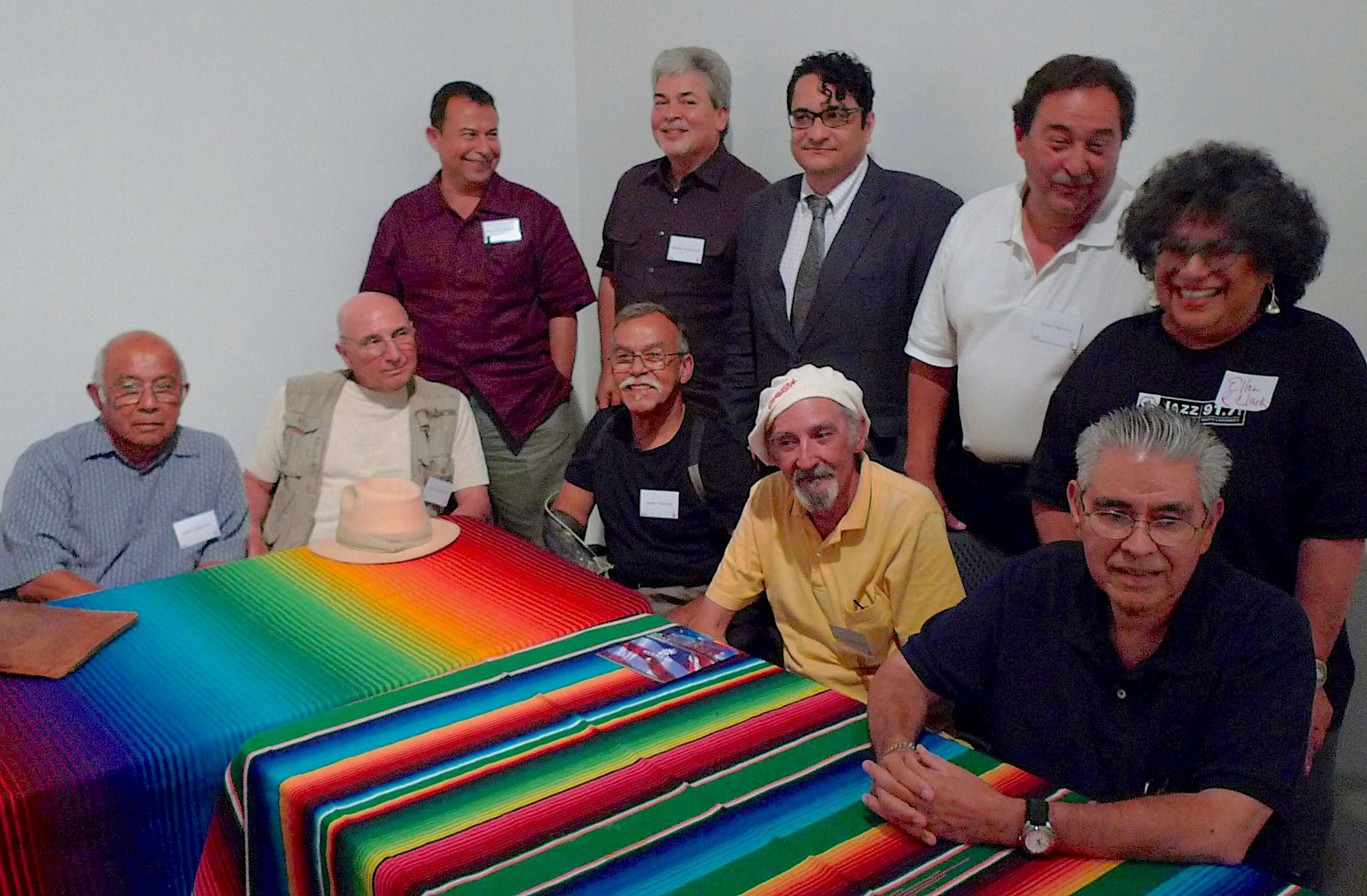
José Esquivel, César Martínez, Jesse Treviño, Jesse “Chista” Cantú, and Felipe Reyes (seated); Rolando Briseño, Roberto Gonzalez, Ruben C. Cordova, Rudy Treviño, and Ellen Clark (Clark was a non-artist, communications member of Con Safo), Museo Alameda, San Antonio, 2009. Photograph by panel attendee.
The above picture was taken at a Con Safo panel and book signing in conjunction with the retrospective exhibition Jesse Treviño: Mi Vida at the Museo Alameda, which I curated.
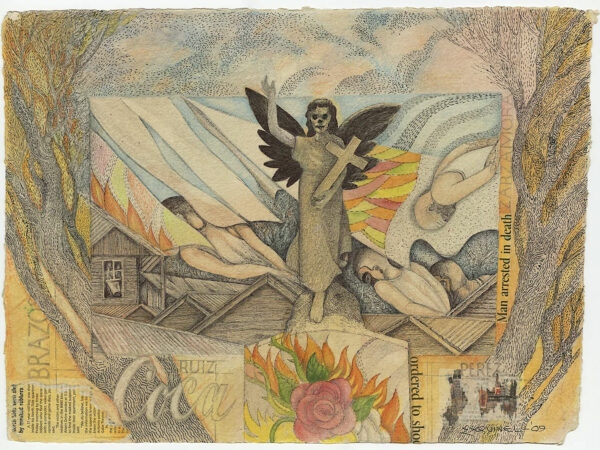
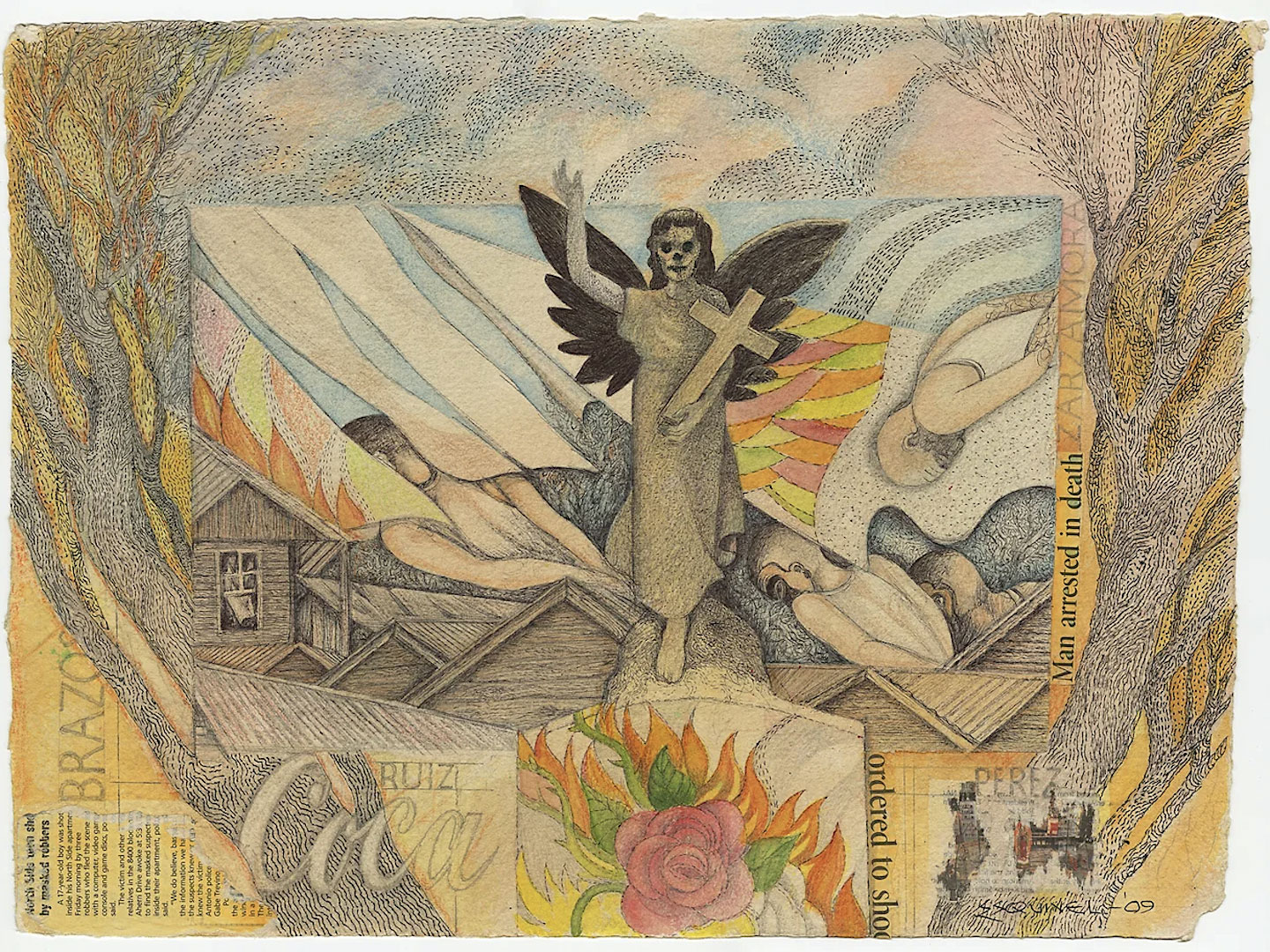
José Esquivel, “Angel de la Muerte,” 2009, mixed media on watercolor paper, 14 x 19 inches, collection of the artist’s estate.
This angel, with one arm upraised and other bearing a cross, recalls a funerary statue one might find in an affluent cemetery. But, ominously, she has black wings and a skull for a face. She is an angel of death, who presides over the barrio (note the roofs of the simple houses). Fragmentary images of men with their hands behind their backs allude to men arrested for violent crimes.
Angel de la Muerte is part collage and part collage-like drawing and watercolor. Headlines allude to death and arrests. Esquivel has inscribed the names of several barrio streets, including Perez, the street of his childhood home. In the bottom center, he has rendered a burning rose, his emblem of lost potential and senseless destruction.
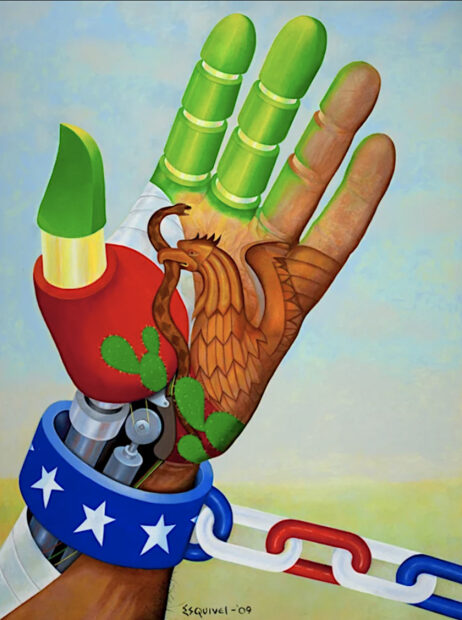
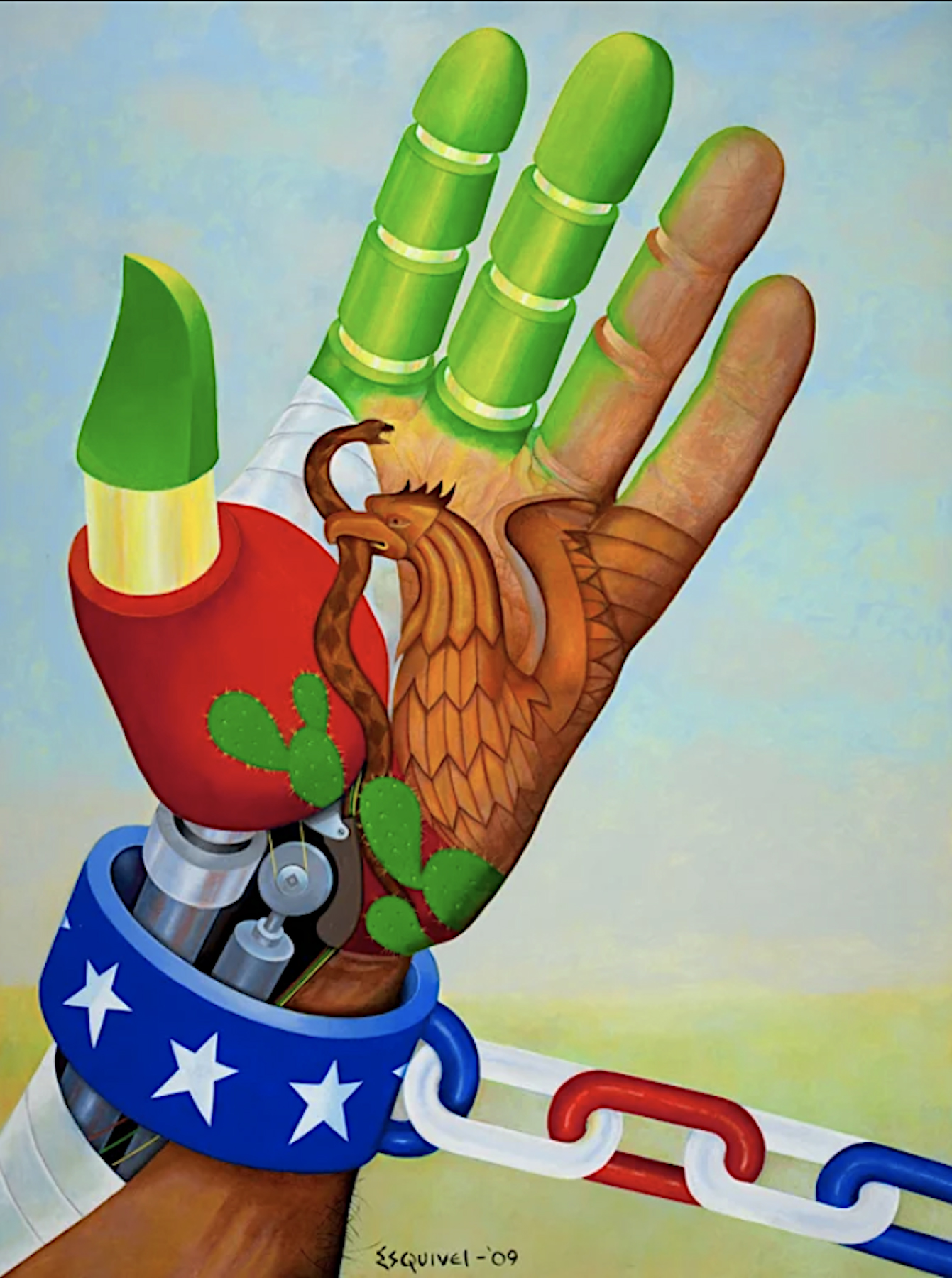
José Esquivel, “Alien Hand,” 2009, acrylic on canvas, 48 x 36 inches, collection of the artist’s estate.
Mexicans have been referred to as aliens for so long that Chicano artists began depicting them as brothers from another planet. Alien Hand, which is part human and part mechanical, partakes in that tradition of national — and perhaps even interplanetary — alienation.
This alien hand is a Mexican native, which is why the Mexican emblem (the eagle on a cactus with a snake in its beak) is embossed on it. The area between the thumb and the first two fingers is red, white, and green, reflecting the Mexican national colors. Fittingly, the thumb is green, since so many Mexican immigrants are accomplished agricultural workers.
Beneath the thumb, one can see mechanical components. Thus the green-thumbed alien is a cyborg: part human and part machine. This duality can refer to the repetitive, mechanical nature of much agricultural work — and thus it connects to some of the images of farm labor that are discussed in Part 1.
On the other hand, the mechanical elements summon the character played by Arnold Schwarzenegger in the Terminator film franchise, with implications of strength, power, and indomitable will. This is a veritable hand of power.
The red, white, and blue chain and the star-patterned handcuff stand for the U.S. flag. This shows how the hand is constrained by the coercive, carceral power of the United States.
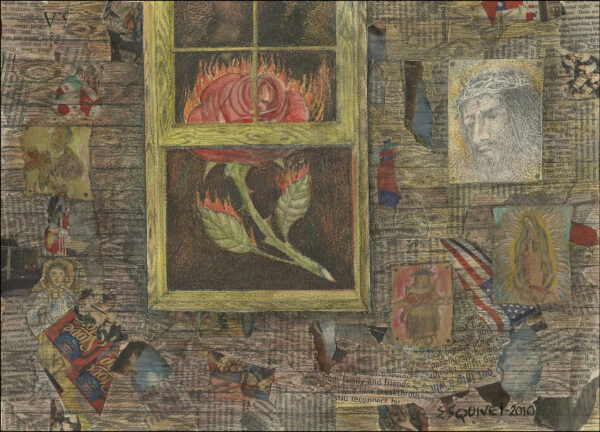
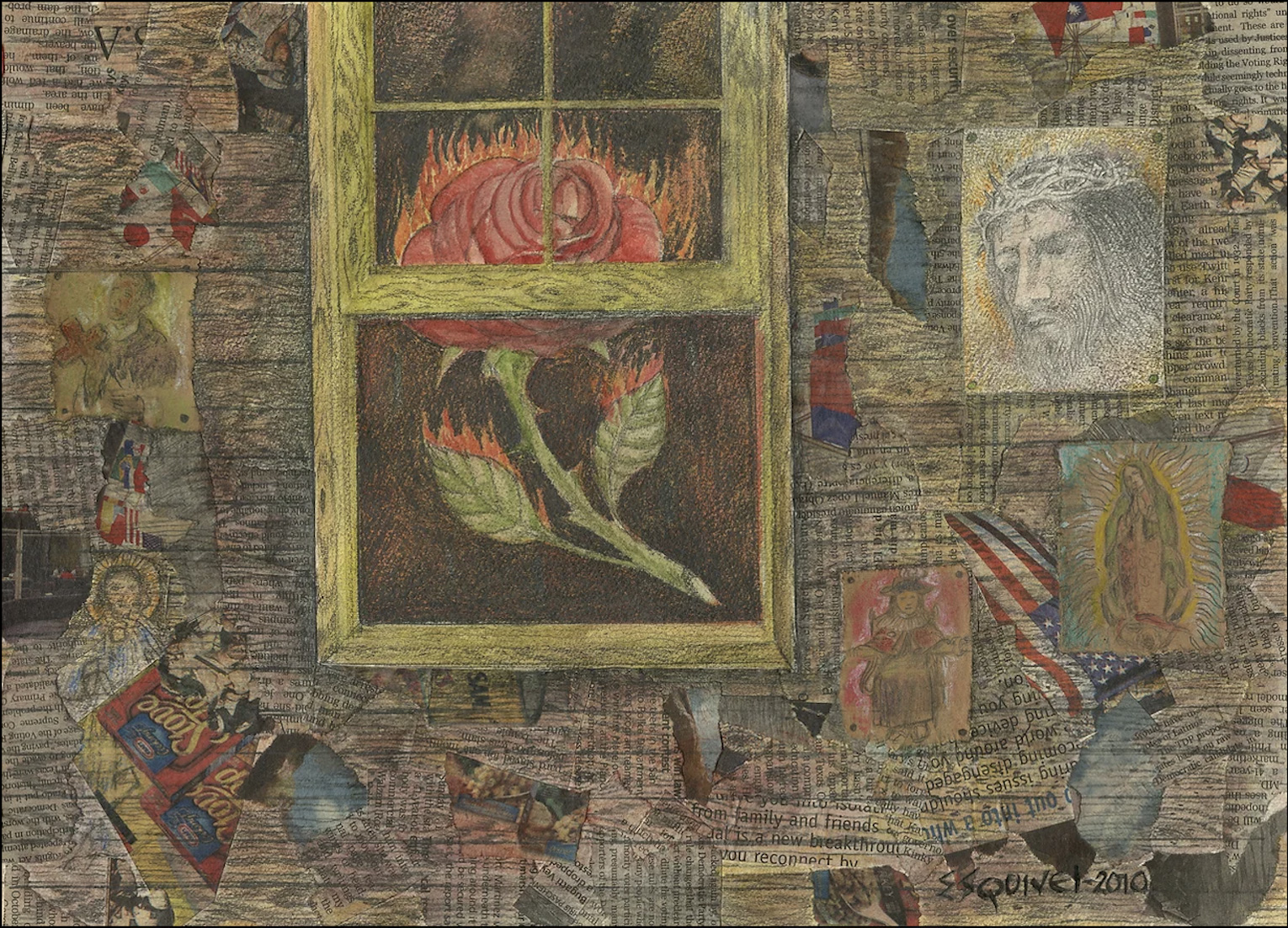
José Esquivel, “Burning Rose,” 2010, mixed media, 10.5 x 14 inches, collection of the artist’s estate.
In Burning Rose, we have a view of the inside of a barrio house, like the one on Perez Street. When Esquivel’s family moved there, sections of it did not have drywall or internal paneling. Only the wood on the exterior served to keep out punishing cold winds. Consequently, on the inside of the house, the family glued newspapers onto the external wooden slats as a form of makeshift insulation. According to Mario Esquivel, his father eventually put cement in the areas that did not have interior walls.
The interior of the house depicted in Burning Rose is not Esquivel’s childhood home from the 1940s, because this example has internal wood paneling. Moreover, we can see packaging from Stovetop Stuffing, which was not introduced until 1972. As the artist noted to Mario:
For practical reasons during the winter months or cold spells the inspiration came from the homes in the neighborhood that rarely had well-insulated walls. To remedy this, newsprint would be plastered to cover cracks in wood walls and drafty areas.
Most of the newspapers have been rendered semi-transparent by the glue, so we can see both the highly legible print and the grain of the wood beneath it. Mario Esquivel notes that the artist touched up the print with a very fine brush to ensure its legibility. The newspaper texts address voting rights, political issues, and miscellaneous local headlines. In addition to newsprint, various other scraps served as insulation, including fragments of images of U.S., Texas, and Mexico flags.
Religious images, including Christ with the crown of thorns, the Virgin of Guadalupe, the Santo Niño de Atocha, Christ Blessing, and St. Martin de Porres (a half-black saint) were then thumb-tacked on top of the newspaper. Unlike the newsprint, these religious images are opaque, though they are faded. In a few places, the paper has come off, and we have an unobstructed view of the house’s wooden siding.
The “interior” portion of Burning Rose is a trompe l’oeil collage, one that references the papier collé techniques employed by Cubist artists such as Picasso, Georges Braque, and Juan Gris. But this is a papier collé of necessity. We can also view this work as an ironic commentary on American realist still-life paintings that obsessively reproduce a wall or section of an artist’s studio.
Through the window, however, we glimpse an antithetical exterior vision, one that is symbolic rather than real. Once again, we have a large burning rose, hovering right behind the window. This image functions as an image of distress: it symbolizes the desperate poverty of the household. Mario Esquivel says this burning rose symbolizes the destruction of beauty outside of the walls of the home.
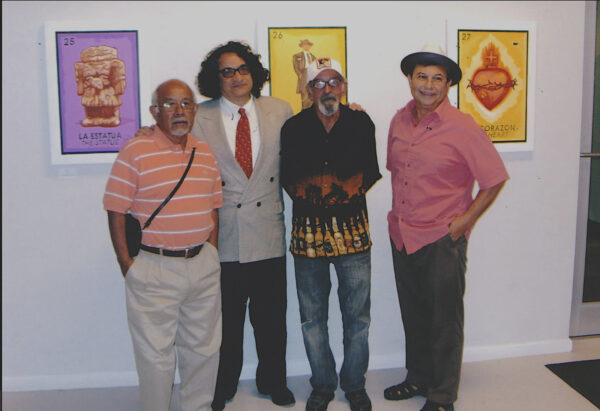
José Esquivel, Ruben C. Cordova, Jesse “Chista” Cantú, and Rolando Briseño after a Con Safo panel and book signing at the Centro Cultural Aztlán, San Antonio, 2011. Photograph by panel attendee.
The above panel and book signing took place on September 16, 2011 to commemorate Mexican Independence Day. See Scott Andrew’s article in the San Antonio Current. Paintings in the background are from an exhibition by David Blancas, who was not a Con Safo artist.
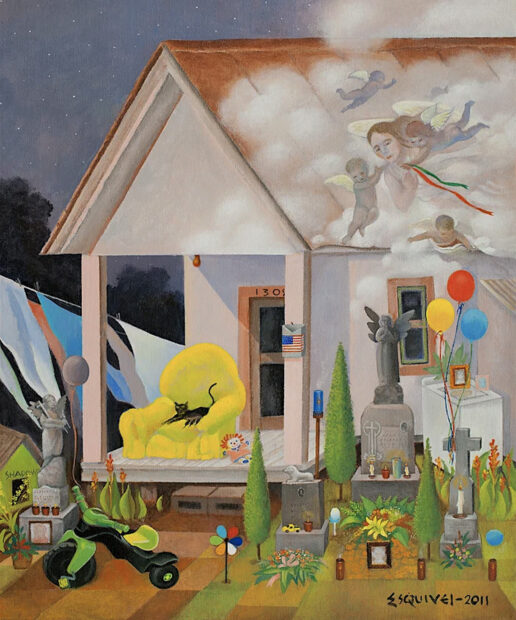
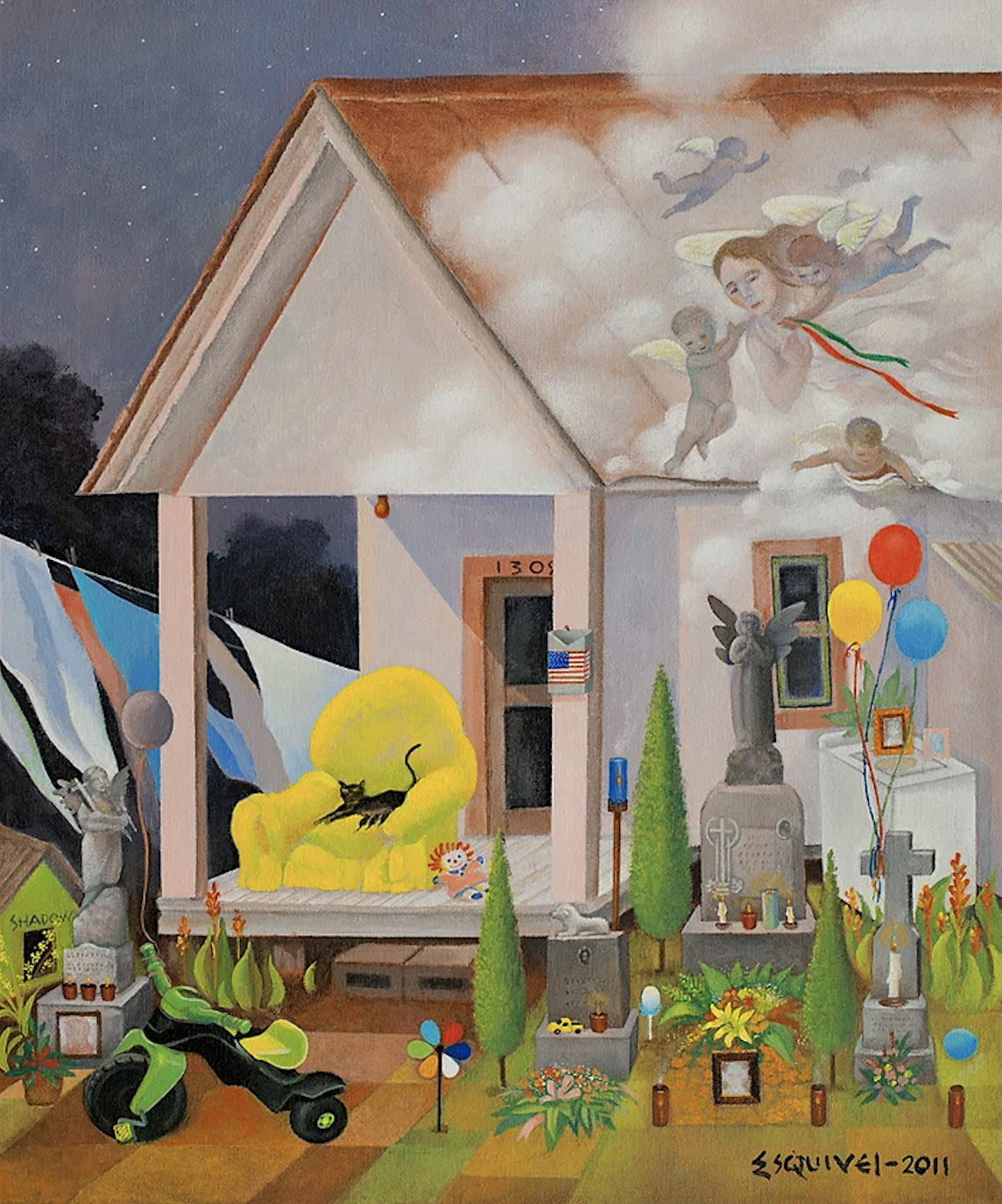
José Esquivel, “Los Angelitos,” 2011, acrylic on canvas, 16 x 20 inches, National Museum of Mexican Art, Chicago.
Angelitos is a Catholic term for baptized infants and young children who die before they are deemed capable of committing sins. Catholic doctrine holds that they are automatically guaranteed eternal salvation in heaven, which is why the winged infants frolic in the cottony clouds that hover above and pass through the roof of this humble abode. The doll and toys are unused because the children have all departed.
The front yard, in fact, has been transformed into a cemetery, with candles, obelisk-like trees, balloons, and four funerary monuments. The ground itself is a mosaic — not of tiles, but of tiny future burial plots for young, innocent souls. This is Esquivel’s ironic commentary on the children who are the unintended victims of drive-by shootings in the barrio.

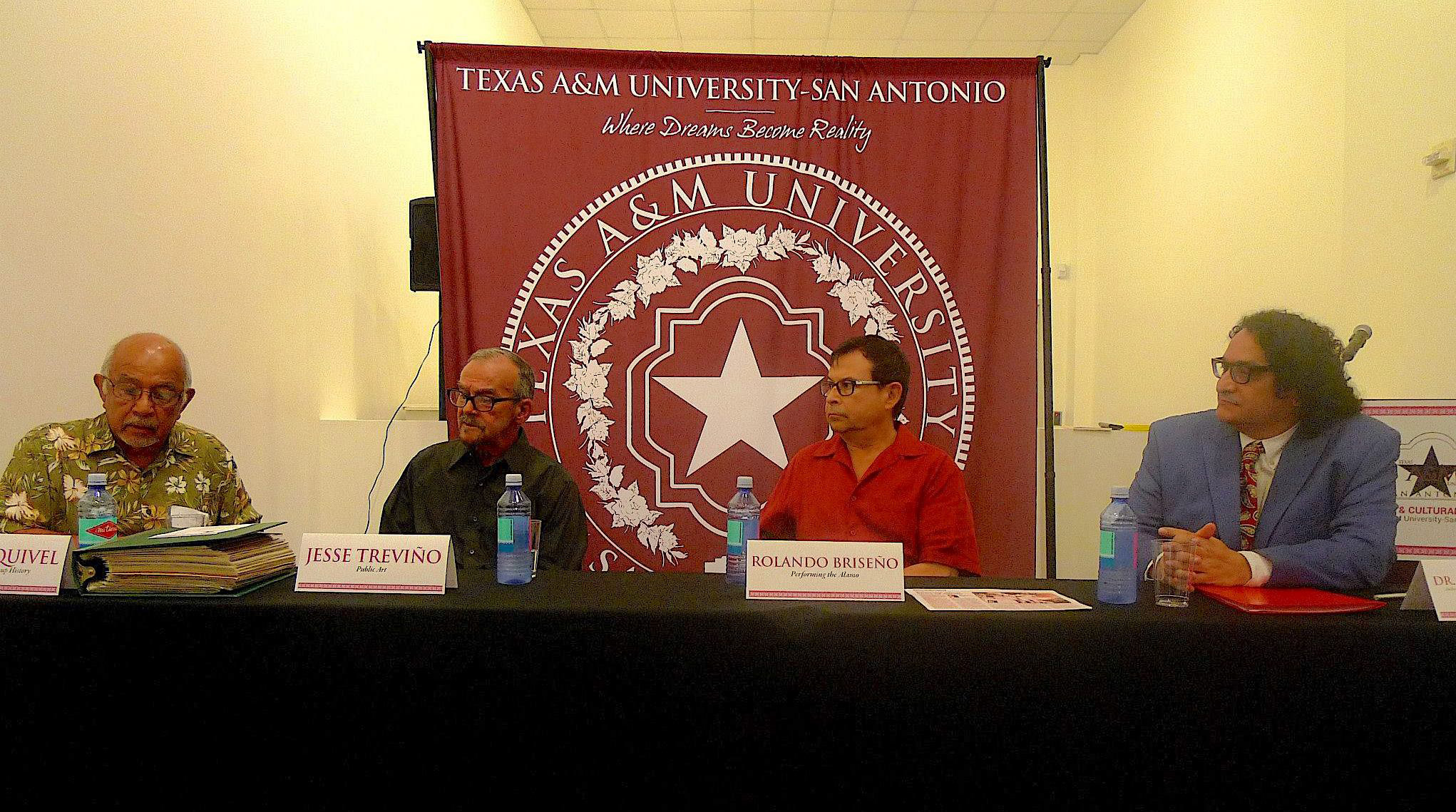
José Esquivel, Jesse Treviño, Rolando Briseño, and Ruben C. Cordova, at a Con Safo panel and book signing, Texas A&M University, San Antonio, 2011. Photograph by panel attendee.
This was the first educational event after Texas A&M took over the Museo Alameda, which it renamed Centro de Artes (the name remained unchanged when it was subsequently taken over by the city’s Department of Arts & Culture). Esquivel’s topic was “Documenting the Con Safo Art Group.” His collection of Con Safo documents is in the green binder in the foreground.
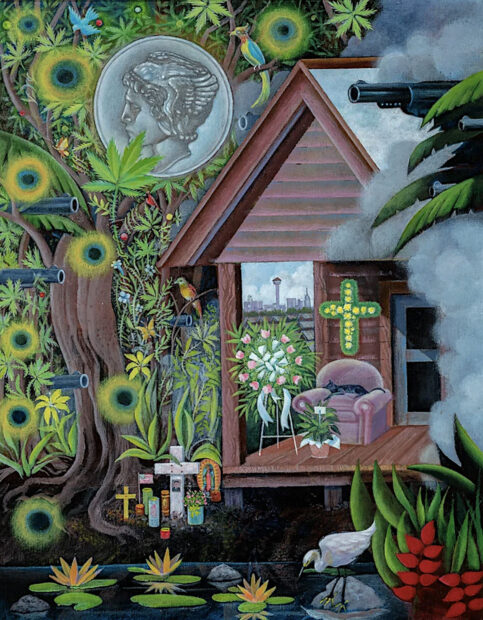
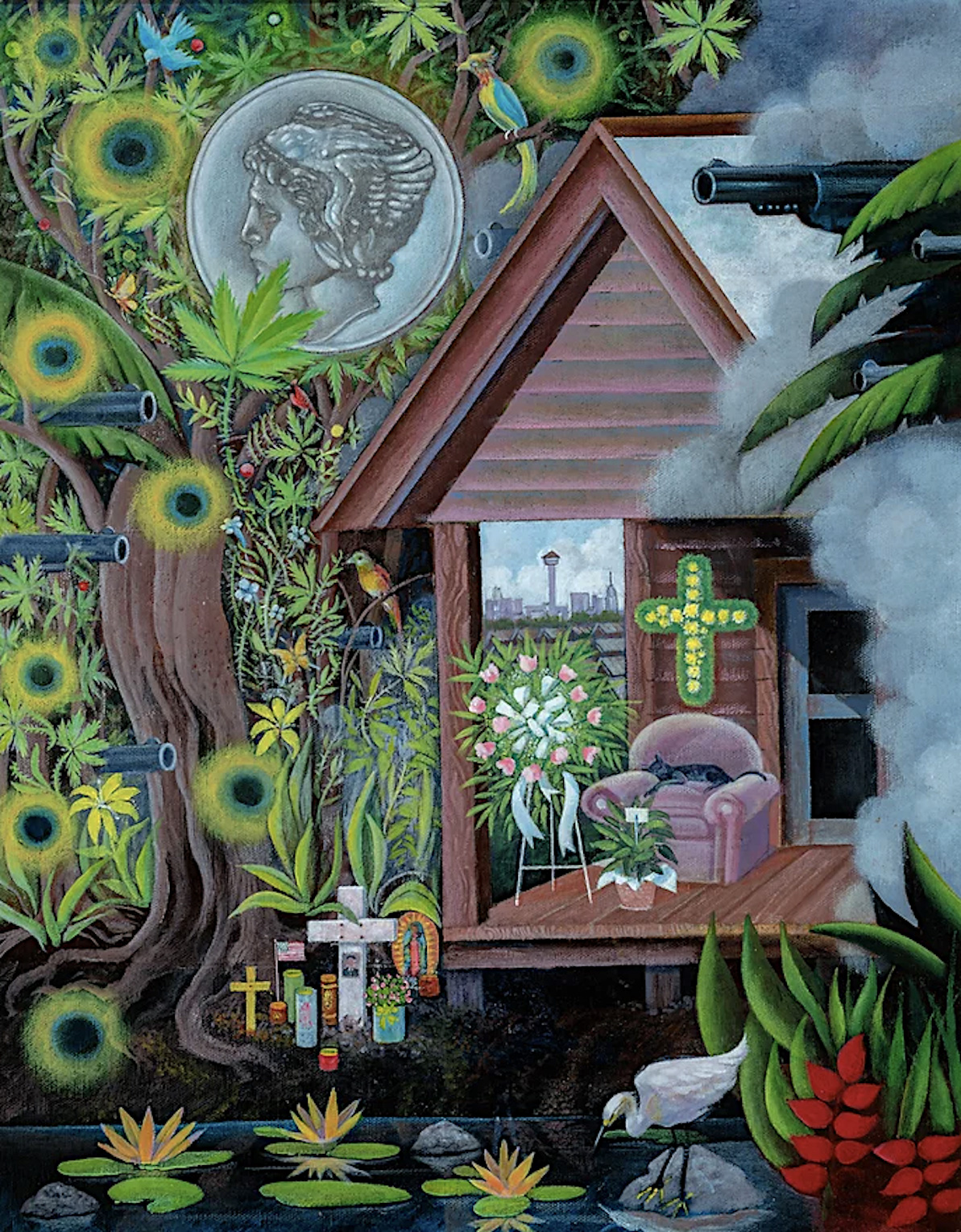
José Esquivel, “El Dimo,” 2015, acrylic on canvas, 16 x 20 inches, collection of the artist’s estate.
This simple home has a funereal wreath on the porch and a small cemetery between the tree and the house. Marijuana grows thickly around the tree. Large guns (the only active agents of human presence in the painting) protrude from the greenery and clouds. But they are not aimed at the exotic birds. They instead represent the violent means utilized by gangs to control their turf. The green concentric circles are “green lights,” deadly bull’s eyes that signify sanctioned gang hits.
The large, archaic “Mercury” dime in the upper portion of the painting refers to “El Dimo,” a pachuco slang term that refers to the ten percent payment that local narco-trafficker bosses demand for the right to sell drugs in territories under their control. The barrio had been depopulated, so the Mercury head on the dime is the only depiction of a person in the painting.
The red-leafed plants in the lower right evoke blood. They appeared several times in paintings by Rousseau. Palm tree leaves in the upper right, and a water lily pad at the bottom identify this scene as that of an urban jungle. In the distance, one can glimpse the downtown San Antonio skyline, visible over the roofs of numerous ramshackle houses. It’s a long way out of the barrio to a place of relative safety.
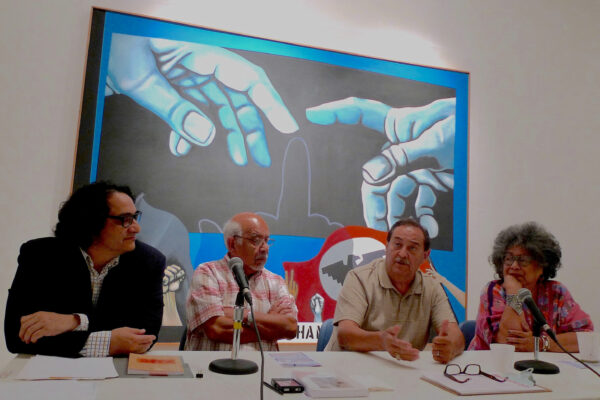
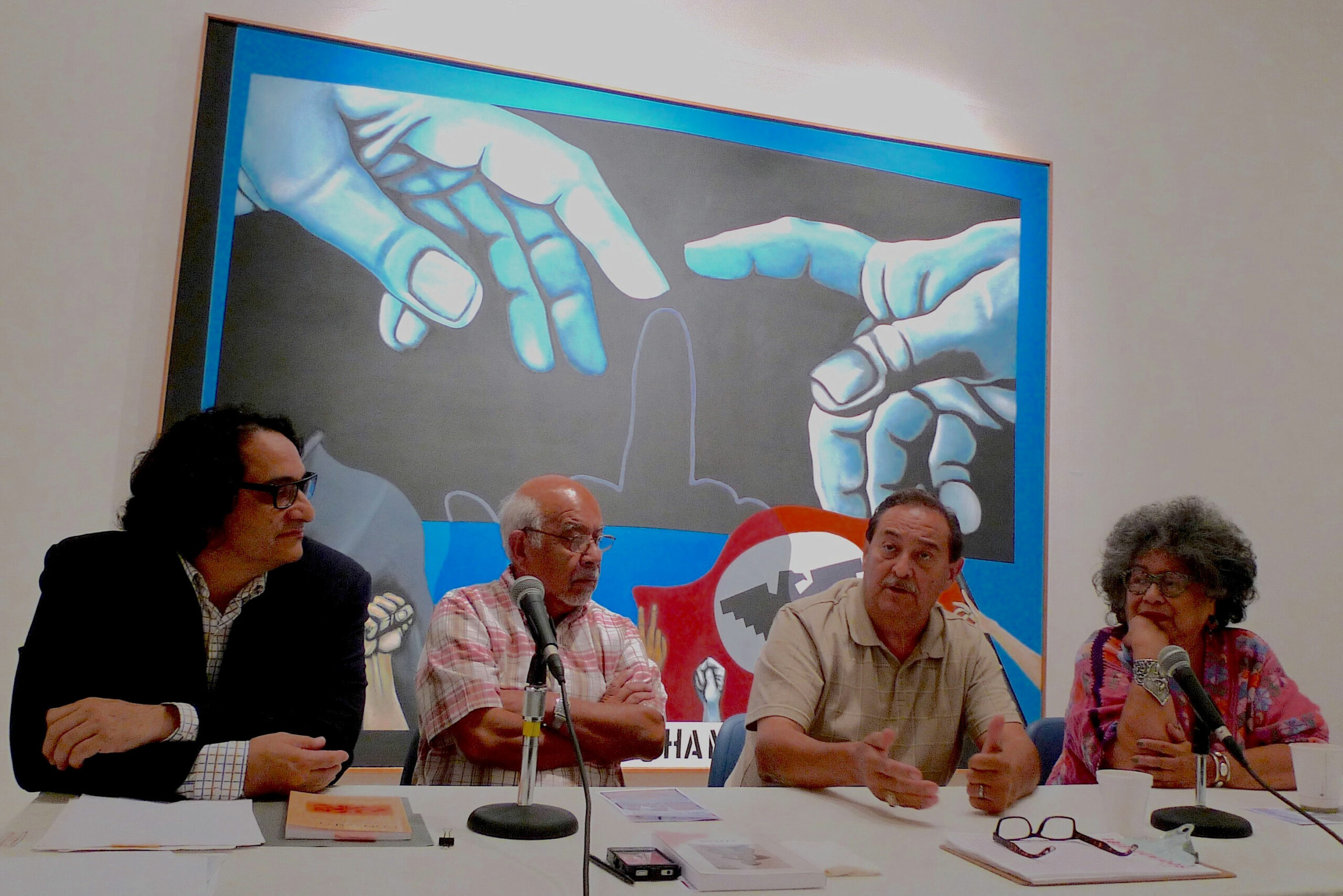
Ruben C. Cordova, José Esquivel, Rudy Treviño, and Ellen Clark at a Con Safo panel and book signing, Guadalupe Cultural Arts Center, San Antonio, 2015. Photograph by panel attendee.
This panel was in conjunction with the exhibition Getting the Big Picture: Political Themes in the Art of Mel Casas, 1968-1977, which I curated. Casas’s Humanscape #63 (Show of Hands), completed in December of 1970, is in the background. In this panel, Esquivel again addressed his role in documenting the group.
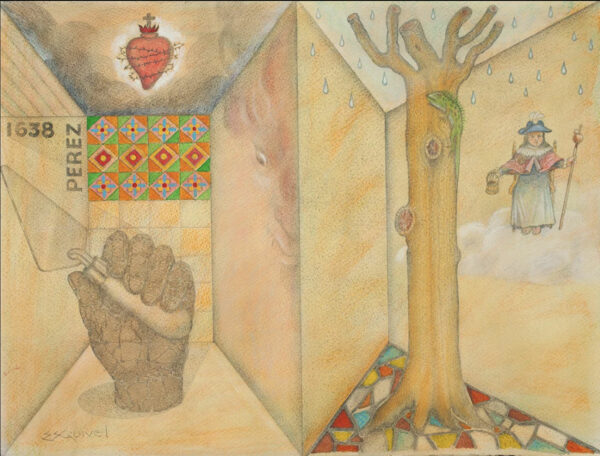
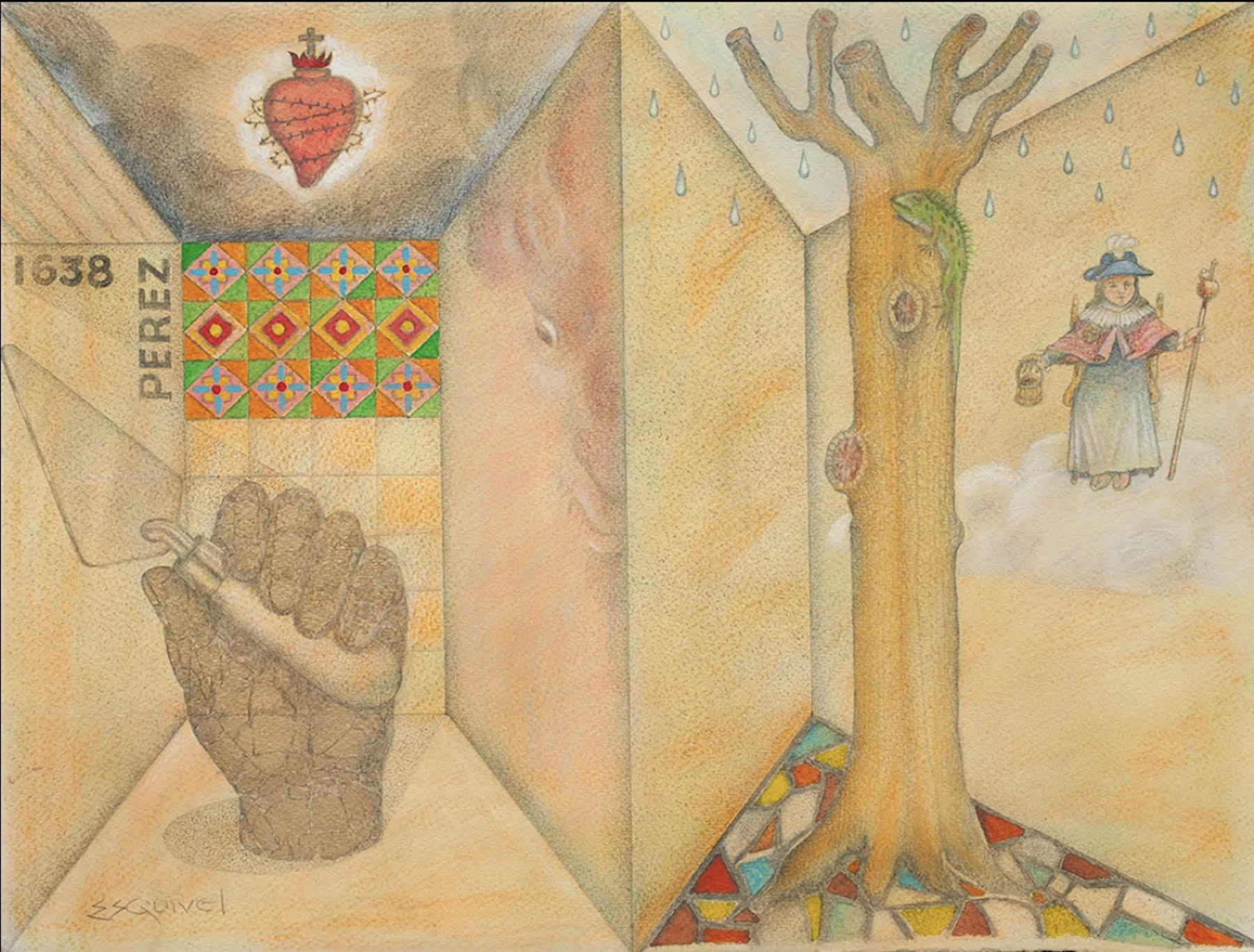
José Esquivel, “Golden Hand,” 2016, mixed media, 20 x 26 inches, collection of the City of San Antonio.
Golden Hand is a tribute to Esquivel’s father, José, Sr., who was skilled at doing tile and masonry work. He was employed by many wealthy clients in greater San Antonio, and he also did a considerable amount of work on the house at 1638 Perez Street, where the artist grew up.
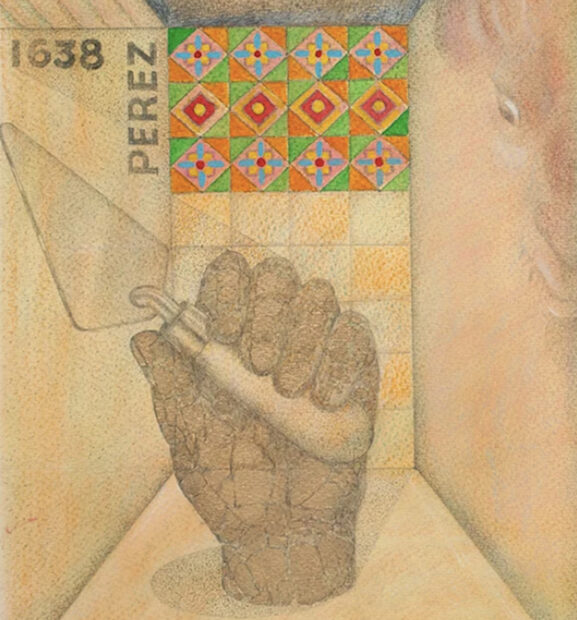
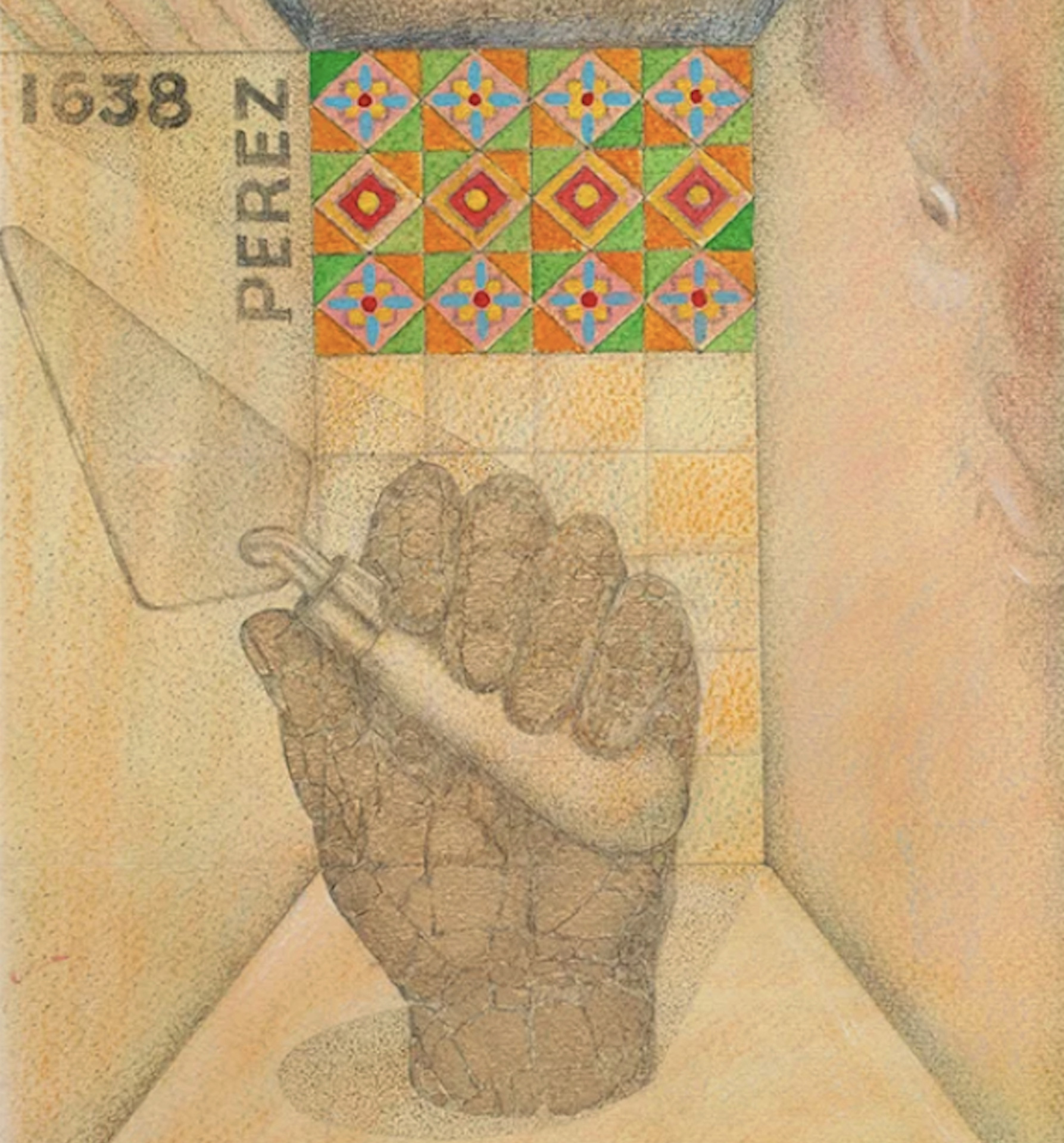
José Esquivel, “Golden Hand” (detail of left side), 2016, mixed media, 20 x 26 inches, collection of the City of San Antonio.
The giant brown hand with the trowel is his hand. It symbolizes the father’s ability to perform labor and make a living, as do the walls and the tile work (the tiles behind the hand, and those beneath the tree on the right side of the painting). This monumental sculpted hand is severely cracked. It was inspired by Frida Kahlo’s Ruin, a drawing from 1947 in which a large sculpture of her severely cracked head is held together by numerous supports. In Golden Hand, the cracking of the hand signifies mortality. People die. And even their mightiest works eventually crumble and fall.
The sacred heart ringed by thorns and the Child of Atocha refer to the strong religious beliefs inculcated by Esquivel’s grandmother Elenita, as noted above. The Sacred Heart and the Child of Atocha were her favorite religious emblems. The Christ child sits on a small chair that rests on a voluminous expanse of clouds (like those that are usually rendered in the sky above him). Oddly enough, rain falls only on the right side of Esquivel’s painting. The desiccated tree trunk on the right is shorn of branches. It is dead, but it still serves as a habitat for creatures, such as the lizard that climbs it. People also live in houses made from dead trees.
Two ghostly apparitions are visible in the sharply angled wall in the center of the picture. On the right side, one can make out a reddish demonic figure; the image on the right is more blurry and yellow. Mario Esquivel says the ghostly figures represent José Sr.’s “personal demons,” which stand for his struggle with alcoholism.
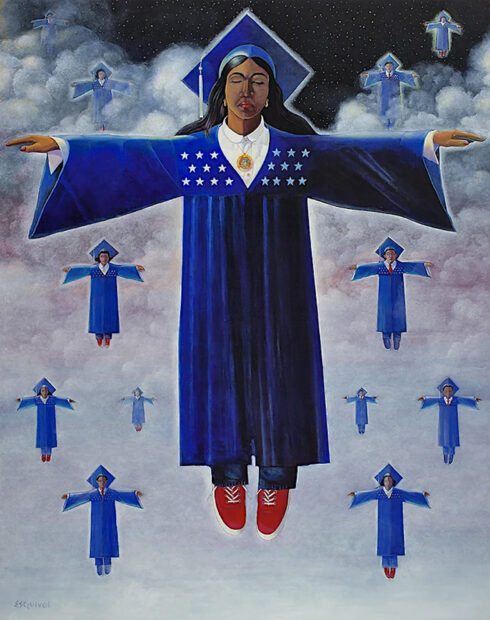
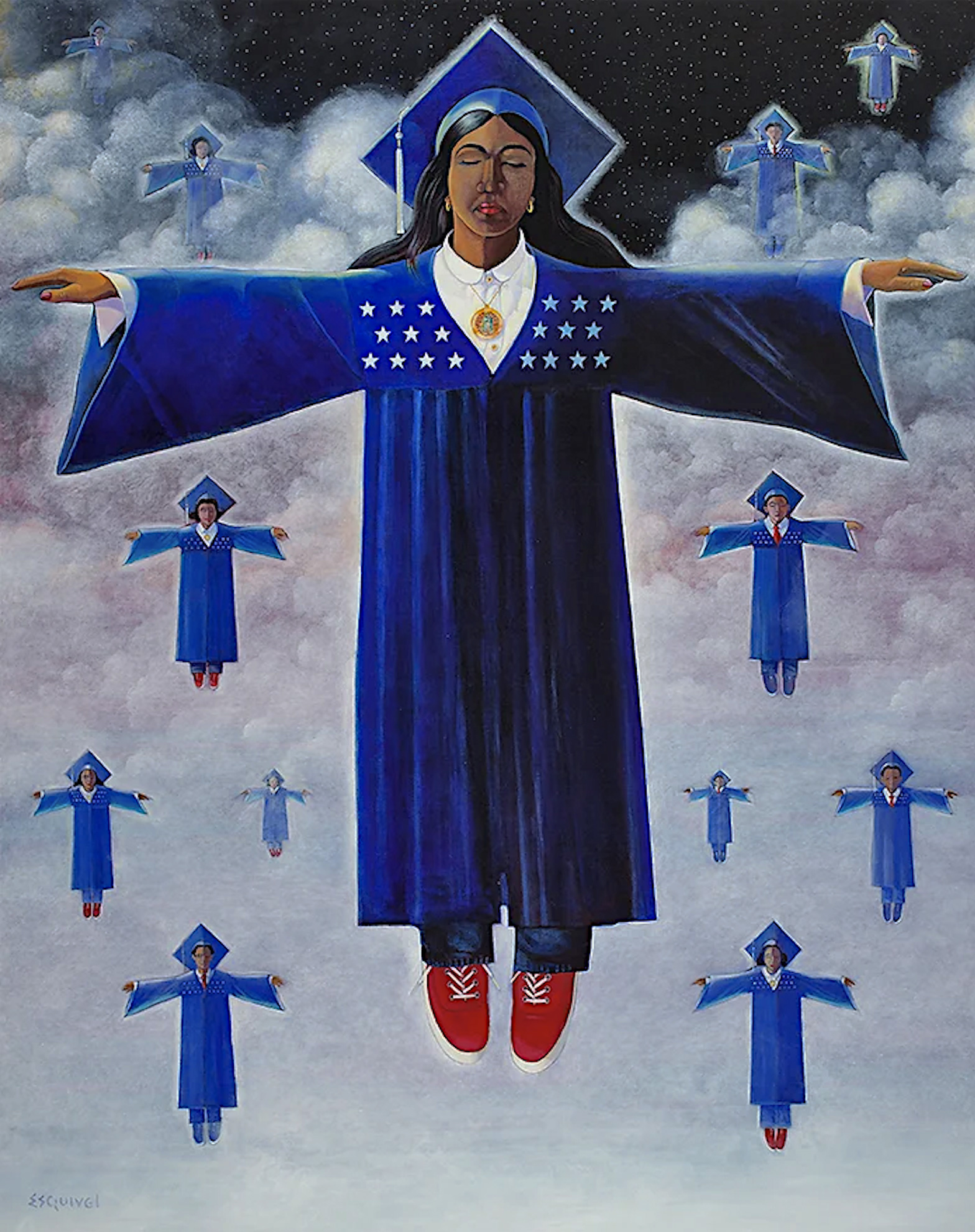
José Esquivel, “Dreamers in Space,” 2014 – 2018, acrylic on canvas, 60 x 48 inches, collection of the artist’s estate.
Dreamers in Space was included in my exhibition The Other Side of the Alamo: Art Against the Myth, which was organized in commemoration of San Antonio’s tricentennial in 2018. Most of the exhibition featured Alamo-specific works. Esquivel’s painting was situated in the last gallery, which was devoted to the after-effects of the Alamo myth and the ensuing U.S. conquest of Mexico. I reproduce the catalog text below:
Dreamers in Space refers to the Dreamers, a popular term for people whose U.S. immigration status is currently in limbo. Esquivel notes: “The political reality for the Dreamers is not knowing where they belong, so they are suspended in space.” His Dreamers are all wearing graduation caps and gowns. Jeans and tennis shoes protrude beneath the gowns, indications of their youth and working class origins. The Dreamers appear to be in a trance-like state, frozen, as if they are in suspended animation. They could be dreaming. If so, their dreams are deferred until such time as their legal status is clarified.
Dreamers are people who came to the United States as children and are currently students, or have a G.E.D. or a diploma, but who are not citizens of the U.S. The 2001 Dream Act, if enacted, would have provided them with a path to citizenship. A program initiated in 2012 by President Barak Obama, known as Deferred Action for Childhood Arrivals (DACA), blocked the deportation of these people, but did not include a pathway to U.S. citizenship. President Donald Trump ended the program, directly affecting 800,000 people, and potentially 1.8 million, most of whom were born in Mexico. Trump’s decision led to a temporary government shut down. Negotiations are underway to provide a replacement program for DACA, though Republicans are seeking concessions, one of which calls for approval of Trump’s proposed border wall with Mexico.*
The cruciform pose of each Dreamer is like that of a person floating on water. But this shape also recalls a crucifixion, which implies that they are martyrs to a larger political conflict. The concept of floating figures that Esquivel uses in Dreamers in Space was inspired by Golcome (1953), an oil painting by the Belgian Surrealist René Magritte in the Menil Collection in Houston, Texas. Magritte’s painting features numerous men in black coats and bowler hats who seem to be floating in air. (The title Golcome refers to a ruined city in India known for its wealth.) Initially, Esquivel’s painting had a solid background. Esquivel felt that the painting was in need of more painterly depth, so he added clouds to produce a more Surreal effect that suggests a dream state.
* See: Caitlin Dickerson, “What is DACA? Who are the Dreamers? Here Are Some Answers,” New York Times, Jan. 23, 2018, updated Jan. 25, 2018, and Sheryl Gay Stolberg and Michael D. Shear, “Senate Rejects Immigration Plans, Leaving Fate of Dreamers Uncertain,” New York Times, February 15, 2018. (The Other Side of the Alamo: Art Against the Myth, San Antonio: Guadalupe Cultural Arts Center, 2018, p. 180-81.)
I provide an update to the DACA issue in a recent Glasstire article that features a long discussion of immigration (“Diez y ocho illegales Pressure-Cook in a Boxcar: Border Politics and Two Migration Hellscapes by Adan Hernandez”) While the Supreme Court prevented Trump from ending DACA in 2020, several states subsequently sued (including, of course, Texas), and that case will likely eventually go to the Supreme Court again, as noted by Politico in July of 2022. Thus Esquivel’s image of suspended dreamers will remain literally relevant for quite some time.
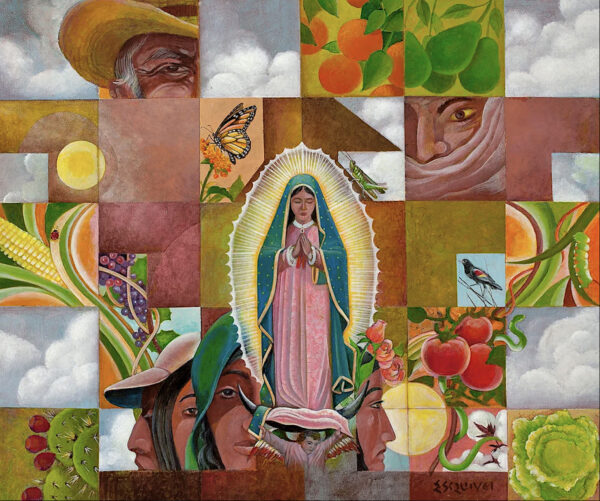
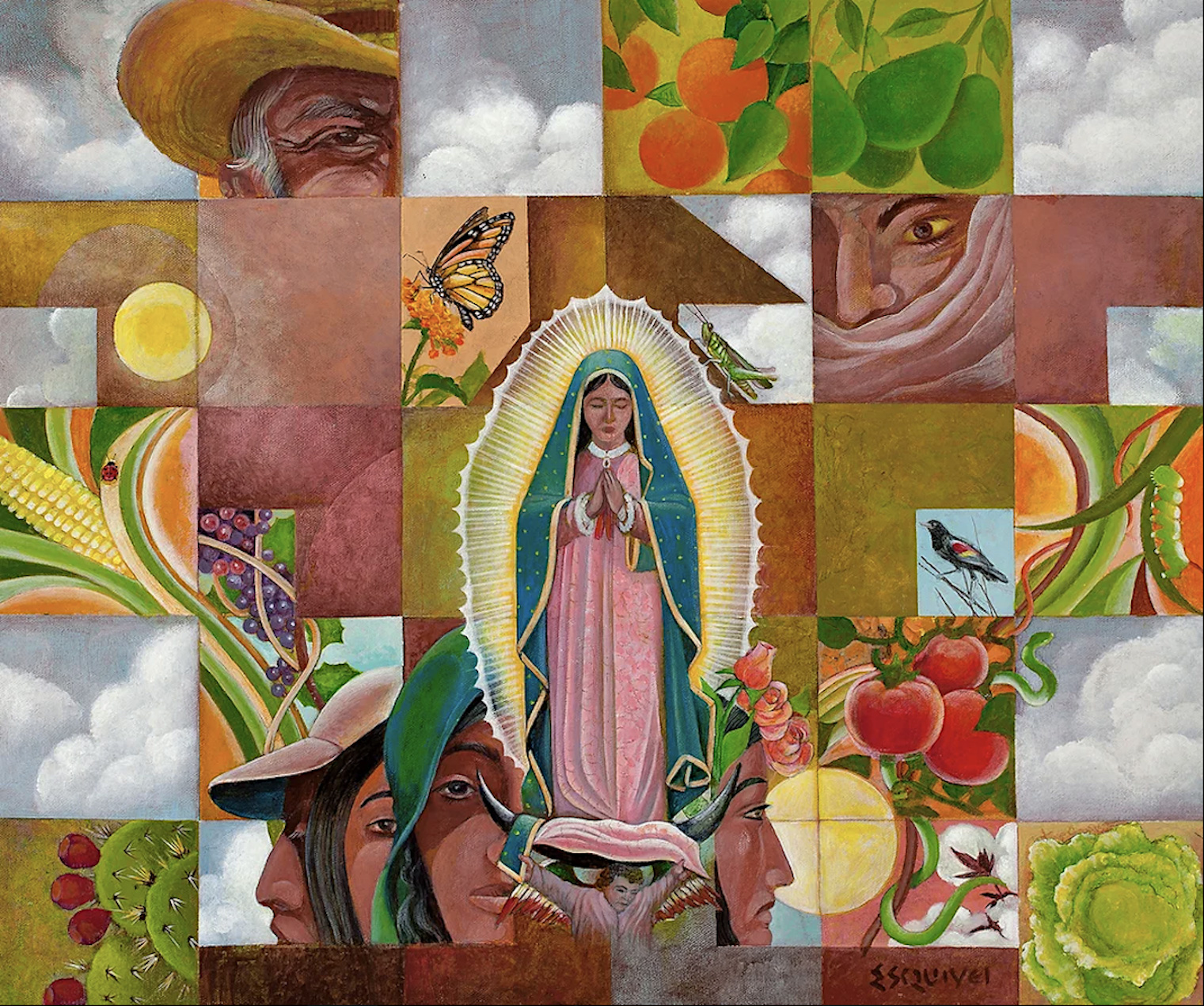
José Esquivel, “Las Nubes,” 2016, acrylic on canvas, 30 x 40 inches, collection of the artist’s estate.
One point of origin for this painting was the song Las Nubes (the clouds) by Little Joe y La Familia, in which a despondent man sings his sad song, causing the rain to cease.
The Virgin of Guadalupe appears in the lower foreground of Las Nubes. The heads of four farm workers are behind her, descendents of those in Farm Workers and Raza Growing Wings, discussed above. Of these four heads, two look directly outward towards the viewer; one looks to the right; one looks to the left. Due to the directional positioning of these heads, they serve as a variation on the mestizo head motif, which was widespread in Mexican and Chicano art. The mestizo head motif features three heads that are fused or related in some manner, following the example in the center of Francisco Eppens’ mosaic Life, Death, Mestizaje, and the Four Elements (1952). (Eppens’ mosaic is illustrated and discussed in Part 1 in connection with another Esquivel painting.) Eppens’ image of mestizaje was influenced by tricephalous (three-headed or three-faced) images of the Christian trinity. (For several images and a discussion of the latter, see: Gesa Elsbeth Thiessen, “Not So Unorthodox: A Reevaluation of Tricephalous Images of the Trinity,” Theological Studies, 2018, vol. 79 (2), p. 399-426.)
Amado Peña, Jr., who was a Con Safo group member (Nov. 1973 – Nov. 1974), made a version of Eppens’ tri-facial head that he called Mestizo in 1974. Other versions, less abstract than those by Eppens and Peña, were in wide circulation. I saw them made by everyone from velvet painters on the Mexican border to student friends. One common example featured a head with a visored conquistador’s helmet in left profile (like Esquivel’s man with a baseball cap), the head of an indigenous woman in right profile, and a Mexican or Chicano head (their mestizo progeny) looking directly outw...

/https://static.texastribune.org/media/files/6f99e532fd1a5006bc3497393edcd5b3/0329%20Capitol%20File%20LS%20TT%2004.jpg)








/https://static.texastribune.org/media/files/25e245fb34320e7fc04e4598a715b14a/0415%20Queer%20March%20Cap%20MM%20TT%2005.jpg)