Click here to go see the bonus panel!
Hovertext:
Did you know you can just BUY arcade tickets?
Today's News:
Hovertext:
Did you know you can just BUY arcade tickets?
This post was written by Alison Green and published on Ask a Manager.
A reader writes:
I’m 25 and have never worked a full-time job before, and very much do not want to change that. I’m not disabled, but with the amount of time I’d spend working and then coming home exhausted and unmotivated, I worry that I won’t be able to keep up with basic chores around the house and take proper care of my animals.
Currently I’m working part-time in retail, and when I got my health insurance I realized that I don’t qualify to be covered in a 911 kind of emergency unless I move to full-time. My husband (who does work full-time) looked into putting me on his plan, but it would cost us double what we’re currently paying. Plus, as a pair of newlyweds who are still figuring this “life” thing out, it would be extremely helpful to have some extra cash.
I know at this point I need to have a conversation with my manager about making the switch to a 40-hour week, but I dread doing it. I really hate the idea of spending so much of my time working — not just in retail, but in general. Is this normal? How do y’all manage a house and a life when you work eight or nine hours a day and only get two days off in a week?
P.S. Sorry if I sound spoiled. I live in a low cost-of-living area and that’s how we’ve been able to make this work for so long. I wish everyone who wanted to was able to work part-time and afford it.
Yeah, it’s pretty normal. Most people wouldn’t work full-time if they didn’t have to in order to support themselves and their families. It’s not like everyone else out there who’s working full-time loves it, or even doesn’t mind it. A lot of people resent it, live for the weekends, etc. And it’s not uncommon to have a slowly dawning sense of horror in your 20s when you realize you’re going to have to spend a huge portion of the next several decades at work.
Of course, not everyone feels that way! Some people are lucky enough to have jobs that they like and/or find fulfilling. (The latter is the reason I went into nonprofit work; I figured that if I had to spend 40+ hours a week at work, it would be a lot more bearable if that labor went toward helping to make the world a better place.) Even among people who like their jobs, though, most would rather work fewer hours or have more flexibility in their schedules. And a lot of us who like our work are still exhausted all the time. It’s legitimately exhausting to work full-time hours and have to manage your household and life on top of that.
It’s not irrelevant that this system was originally designed for men who were assumed to have a spouse who stayed at home and managed all the other aspects of life for him. (Although of course, even then plenty of families couldn’t support themselves on a single salary or only had a single working-age adult or so forth.) It’s also not irrelevant that now that most women work, we’re still carrying a disproportionate share of the household labor too. (This is almost certainly why a bunch of studies show women are more tired than men.)
So yes, it sucks for a lot of people and you are normal for not wanting to do it. That’s a different question than whether you have to do it, of course; it sounds like you do have to, like most people.
All that said … retail is notoriously terrible, and you might find that you dread a different type of work less. Retail is also notoriously low-paying; a better-paying job might make it more possible for you to work fewer hours. You also might find a different job leaves you with more energy at the end of the day; dealing with the public is a special kind of draining. So some of the existential dread you’re experiencing might be tied to your specific job — but if you’re thinking the whole system seems messed up, you’re not wrong.
This post was written by Alison Green and published on Ask a Manager.
It’s five answers to five questions. Here we go…
1. CEO said she “can’t stand” me in a public Slack message
Two years ago, I was recruited to a team I had long admired and knew well through a shared network. I was excited to join, and my initial six months were extremely positive and I was elevated to our leadership team.
During this time, I experienced some growing pains with my role and expressed my frustrations to a colleague. That colleague unfortunately betrayed my confidence, and word that I was unhappy got to our CEO. I found this out because my CEO accidentally put a message in a public Slack channel about how much she “can’t stand” me and that I was “an ungrateful brat.” A number of colleagues saw it, and it triggered a breakdown that has taken time to recover from.
My supervisor has been extremely supportive, but said there will probably never be a resolution to this. My CEO has never and likely will never apologize or bring it up. I do not work in an environment where I can be supported by HR in filing a complaint. Over a year later, it still weighs on me. My CEO and I don’t speak. I was dropped from our leadership team without explanation and have hit a ceiling in terms of my role here. To make matters worse, I work in a smaller office in another city from our main HQ. I feel increasingly isolated and it impacts my work. I’m a senior level person and in my 40s — the idea of finding another job is terrifying and unlikely. But I also feel trapped and retaliated against in my workplace. How can I resolve this? Do I need to simply find an exit plan?
First, your CEO sucks! People in a position of power have a responsibility to speak more judiciously, even if they think they’re speaking privately. And once the Slack incident happened, she had a responsibility to deal with it — to find a way to clear the air and to work through whatever issues led to her feeling that way, and to be straight with you if she didn’t think they were resolvable.
But yes, you need to get out of there. Fair or not, your CEO has publicly said she can’t stand you, and you’ve seen firsthand the impact on your career there: she won’t speak to you, you’ve been dropped from leadership, and you’ve been isolated. Your manager has told you nothing is going to change. It makes no sense to stay.
People find jobs in their 40s (and beyond) every day; it’s by no means “unlikely” that you will! That’s not to downplay age discrimination, which is a real thing, but it doesn’t mean you can’t get hired. (Consider all the forms of discrimination that are out there; discrimination is usually about having extra obstacles, not about never finding another job again.) You might have barriers you didn’t have when you were younger, but you’re still highly likely to find another job if you start looking.
2. We listed salary in the ad but still got people asking for much more
I was recently part of the hiring process to fill two positions within the team I’m on. The role is a project management job with some technical aspects for a specific tool under the umbrella of a larger nonprofit. The job being what it is, we get applicants with all sorts of backgrounds from pre-law/law, to social work, to education, to computer science, and some folks with more customer service or help desk backgrounds — all of which can be a reasonable fit in the right situation. Knowing how wide the applicant pool would be, in the ad we made sure to list the salary range explicitly and ask what pay folks are looking for in the application.
Despite that, maybe a fifth of the applicants listed a pay well above the advertised range. I’m talking like 1.4x or so higher on average. Some of these candidates seemed excellent, but in an effort to rein in our candidate pool (we ended up with upwards of 300 applicants), we ended up unilaterally cutting anyone who asked for more than about $10k over the high end of our range, knowing we had a little wiggle room to come up maybe $2-5k for a truly exceptional candidate and that our benefits are better than most comparable nonprofits. Was cutting the pool this way the right call?
On one hand, I know that I’d be frustrated if I asked for a specific amount, went through the interview process, and then at the end of the process was offered something around two-thirds of what I asked for. But on the other, the range was posted in the ad, so maybe they’re just hoping we have more wiggle room than we have or they’ve been given advice to ask high so that there’s room to come down and would have been fine with the high end of the advertised range. Is there something we could have or should have done to check?
It’s not unreasonable to cut your pool that way, but I don’t love it if it meant you were cutting people who looked really strong. With people who you otherwise would have been excited to talk to (meaning they were really strong relative to the rest of the pool, not just generally qualified), why not just ask about at your first stage of screening (which is hopefully something low-commitment like a short phone interview)? It’s perfectly reasonable to say in that first contact, “I’m not sure if you saw the range we listed was $X-Y and we don’t have wiggle room on that. You wrote that you’re seeking $Z, so I want to be up-front that we will not be able to go that high. Does it still make sense to proceed?”
But also, I’d strongly recommend that you stop asking people to list what pay they’re looking for on the application. It’s great that you’re listing your range — keep doing that! — but there’s no reason to ask candidates to give a number themselves. That just invites games around salary, where people will worry about undercutting themselves or overshooting … and it’s not necessary. You know what you’re willing to pay. You’ve told them what you’re willing to pay. If the concern is that they might be in a lower part of your range than they’re anticipating, you can clear that up in the first screen too — “for candidates with your level of experience in X, you’d be in the X-Y part of our salary range.” Then they know and can decide if they want to continue or not.
3. Can smoking keep you from getting hired?
My niece is a smoker and has interviewed for several jobs but hasn’t received any offers. She has a great work history but moved to a different state and usually does a Zoom interview, then gets called back for an in-person interview and that’s it. Many places are “health” places (hospitals, doctor’s offices, etc.) and I wonder if the smell of smoke on her is a deterrent? She gets pretty defensive, so I hesitate to bring this up. But if I were a hiring person it would definitely have a negative impact on me because I hate smoking.
Yes, it’s definitely possible. If she smells like smoke, that will be a strike against her with a lot of places, medical offices in particular. (Although some states do have laws that prohibit employers from discriminating against smokers.) It doesn’t sound like you have the standing to raise it with your niece, though.
Alternately, it might not be that at all. If she’s only had a handful of interviews, it’s not necessarily meaningful that she hasn’t had an offer yet.
4. My boss undervalues me and barely pays minimum wage for skilled work
I’m a graphic designer in an extremely small office and have a BFA and 20 years experience. In September 2021, I quit, only to be begged to come back in January 2022. I came back with the caveat that it was remote only and I had to have a flexible work schedule due to my daughter’s medical needs (the reason I quit in the first place). I went back and received a $1/hour pay raise. I have been there 11 years total and started at $13/hour in 2012. Now I make $14/hour in 2023. Next year in my state, $15 will be minimum wage. The market rate for my education and experience in my field/area is $28-$50.
I explained to my boss that I don’t feel valued as she keeps giving online people (think Fiverr) my duties and gets upset when I voice my opinion. I told her that I was available 15-20 hours a week. She told me she doesn’t charge customers for artwork and doesn’t feel that paying me per project is fair because I can produce art quickly and that my pay is fair because I work from home. I told her that experience deserves compensation. I started “working my wage” (basic designs, clipart, etc. as opposed to detailed pieces the customers were used to) and not being as available, as clearly she doesn’t value me. How else can I explain that if she wants good art then she has to pay? Can I negotiate a raise? After 11 years and 20 years experience, I feel like I’m worth so much more than nearly minimum wage.
Why are you staying there? Even if you can somehow wrangle a raise out of her, it’s likely to be only a few dollars more an hour — when the market is paying people with your skills more than triple your current rate. It doesn’t make sense to stay somewhere that so wildly undervalues and underpays you and where you have to fight for every additional dollar (or where you feel compelled to resort to clipart to make your point — something that won’t help your portfolio).
Stop trying to persuade your boss to see reason, and use the market to walk. This small and stingy company isn’t the only employer out there. (I suspect you might be staying because your boss let you go remote and have flexible hours, but those things are increasingly available elsewhere too.)
5. Are informational interviews the real way to get jobs?
I am a job-searching recent college graduate. A bit ago, I stumbled upon a newsletter claiming that “normal” job applying, resume and cover letter writing, etc. are all pretty much irrelevant and the real way you get jobs is by reaching out to professionals in your field for “informational interviews” where you ask them about the field and how to grow in it. Then, because people who are already known to employers are the ones who get hired, you’ll get a job out of it all.
Am I wrong in taking it with several grains of salt and continuing in my job searching the old-fashioned way? Is this advice specific to certain career fields? For what it’s worth, the newsletter writer is in marketing and I’m in an extremely different field. I told a late-career professional in a very different field about this and they scoffed and said, “Yeah, not at my workplace!”
Anyone who’s claiming that informational interviews are the primary way to get a job is full of crap. Informational interviews can be one part of your overall strategy, but they absolutely should not be your main focus, and that’s a really weird and misleading thing for that person to claim. In fact, most people get jobs without ever doing a single informational interview — which doesn’t mean they don’t have value (they can and do) but they’re hardly the linchpin to a successful job search.
A lot of people who sell their job search advice start making odd claims like this, and I think it’s because they’re looking for some distinctive piece of advice to make their own — something that sets them apart from the standard “write a great resume and cover letter that show your track record of achievement.” That doesn’t mean it’s good advice though; much of the time it isn’t.
This has been an unprecedented year, heat-wise, so it’s difficult to rely too much on past climate and weather norms. However, we have reached the point of the year after which it is extremely unlikely for a hurricane to strike the state of Texas. The historical odds of doing so after the date of September 24 are approximately 1-in-50.
Despite the fact that the Gulf of Mexico remains toasty warm, if there ever were a year to call the season in late September for Texas, this is the season. Wind shear has been exceptionally high over the last few weeks, and it is showing no signs of abating in the near future. And the overall pattern does not appear to support the movement of tropical systems into the Western Gulf of Mexico toward Texas. The bottom line is that history says we’re done, and the current setup says we’re done. Never say never, but we’re probably done.

That is not to say that we still cannot see a tropical storm or a disturbance that brings us rain. That can happen in October, and has in the past. But these are mostly moisture events rather than serious wind or surge events. This also says nothing about the hurricane odds for Louisiana and points east. It remains an active Atlantic season, which we’re tracking for you on The Eyewall. So my advice is this: Although the Atlantic hurricane season will continue for another couple of months, you can breathe a little easier this morning if you live in Texas.
Houston saw some solid, widespread showers and thunderstorms on Monday. If you got the rain you needed, that’s great. If you didn’t, well, that’s probably the end of the widespread showers for awhile. We’ll still have some spotty rain chances going forward, but nothing like Monday. For areas south of Interstate 10, chances today are probably about 30 percent, and for areas north they’re much closer to zero percent as the weak front that drove Monday’s storms has moved offshore.
Skies today will be mostly sunny, with a light northeast wind, and highs of around 90 degrees or slightly above. Our air is slightly drier, and this should help low temperatures drop into the low 70s for much of the city, with upper 60s possible for far inland areas.
Another day a lot like Tuesday, with coastal areas seeing a chance of rain, and highs generally in the low 90s.
The overall pattern more or less continues, with highs in the low 90s and sunny skies. Nights, generally, will drop into the mid-70s. Rain chances will continue to hover in the 10 to 20 percent range, so unlikely for most.

The upper atmosphere will support the flow of some modestly drier air starting this weekend, so that will allow daytime temperatures to rise a bit. But this will also support more rapid cooling in the evenings, and somewhat lower humidity. Look for highs in the low- to mid-90s this weekend, with sunny skies, and lows in the low 70s except near the coast.
The overall flow of somewhat drier air should continue next week, with highs generally in the low 90s, and nighttime temperatures in the more seasonable low 70s. It won’t be fall, but it’s something a bit nicer than summer. Truth be told, after the summer we experienced, it should feel pretty good outside. There are some hints of fall’s first real front about 10 days from now, but they’re not strong enough for me to have any confidence. We’ll see.

Dear Faculty:
Due to concerns expressed by the students, parents, and staff, you are invited to attend a mandatory emergency mental health fair in the amphitheater on Friday at 4:15 p.m.
Faculty will enjoy complimentary cotton candy, popcorn, and balloons while roving jugglers and mariachis provide entertainment. Renowned motivational speaker Chip Sunshine will guide faculty through a ninety-minute journey of self-discovery titled “Keeping It Together: Reaffirming Your Love for Teaching,” which will remind faculty that students are the lifeblood of this school, and no sacrifice is too great if just one student can find value in their college experience.
Dear Faculty:
Due to budgetary constraints, we have had to scale back the upcoming faculty mental health fair.
“Keeping It Together for Three More Weeks: How to Think of Your Suffering as Penance for All the Awful Things You’ve Probably Done” will now take place a week from Wednesday in the basement of the main gymnasium next to the room with the broken pool pump. Please note the change of title and location.
This session, now presented by Cherry O’Cherry, the town’s multilevel marketing maven, will help you realize that you aren’t going to die if you just suck it up and finish out the semester.
Dear Faculty:
For no particular reason and definitely not because of any scandal that has us scrambling to cover our asses, the date for the faculty mental health intervention has been moved to early January.
“Keeping It Together: How Not to Get So Burned Out That You Walk Out in the Middle of Class” will now be a slideshow presented in the haunted auditorium by Jim “Flip” Philips, head coach of the varsity TP team.
Even though we can’t admit how indispensable you are for legal reasons, we want you to know how important it is for us to appear to value you.
Dear Faculty:
Happy New Year. Today’s mental health slideshow has to be postponed.
The TP team got wiped out by West Mountain Culinary Academy, and Coach Philips is providing round-the-clock support to them and their families during this difficult time. Sorry for the late notice.
The presentation has a new title: “Please Stop Burning Out Before the School Year Ends: No Teachers Means No Students Means School Closes.” We were told sarcastically that the last title was insufficiently hostile, which we took as a challenge.
It will take place, rain or shine, on April 1 at 7:45 a.m. in the condemned dorm on Squatters Lane. Tea and nuts will be available for purchase. Those with mold sensitivities or a strong survival instinct may request to attend virtually.
The new presentation will make you see that enrollment is more important than your actual life.
Dear Faculty:
Today’s mandatory faculty mental health slideshow, “Going Through the Motions: How to Function Despite the Fact Your Supervisors Hate You and Your Job Is Destroying You Spiritually,” has been postponed again.
An important donor is distraught over the TP team’s recent loss, so the president sent Coach Philips to his palatial estate just outside of town to beg him for forgiveness.
It will now be presented by the guy who lives under the bridge on May 13 in the old abandoned darkroom in the attic of the arts building at 5:51 a.m. sharp. The waste storage “facility” in the chemistry building was already reserved by Delta Kappa Iota for one of their weird sunrise candle rituals.
Dear Faculty:
Today’s slideshow in a hazardous location about our indifference to your deteriorating self-worth has been indefinitely postponed. Have a good summer.

The Federal Trade Commission and 17 states accuse Amazon of suffocating rivals and raising costs for both sellers and shoppers. The lawsuit could be existential for the company.
(Image credit: Justin Sullivan/Getty Images)

This post was written by Alison Green and published on Ask a Manager.
It’s five answers to five questions. Here we go…
1. I’ve been told I’m socializing too much with other teams
I have been at my current job for a year and have been struggling with fitting in. I think there’s a big culture difference than what I’m used to, and I’ve also dealt with a lot of bullying from my team. I’ve been job searching, but no luck so far.
I’m finally starting to make friends with people at work outside of my team, which is great! I’ll occasionally (no more than once per day, if that) go down to their unit to spend 5-15 minutes chatting, and maybe once every two weeks I’ll eat lunch with them in their unit (we don’t really have a convenient break room, so everyone usually eats at their desks). Our jobs don’t overlap at all, so I’ve asked general questions about their job process out of curiosity, learning more about my organization, etc.
The third person in their unit reported to their supervisor that I’m there way too often and that I’ve been trying to get them to show me sensitive information (this is not true at all). Luckily, their supervisor didn’t really believe his full side of things, talked to my friends, and cleared that up quickly. It’s worth mentioning that I currently do not have a supervisor as he was moved to a different unit.
However, in the past, people have mentioned to my old supervisor that I tend to “linger” when I go to collaborate with other units, which is a big part of my job. I was not formally reprimanded, just nicely told that it was something to keep in mind.
I truly don’t believe that I’m this big of a distraction, but I’m having a hard time since this has now been brought up twice in some capacity. This seems like a place where you’re fine if your friends are already in your unit, because you don’t have to move anywhere to chat, but if you aren’t friends with your unit, you’re out of luck.
I don’t think I’ve changed my behavior at all, and in my previous job I was known for being personable and received excellent reviews my entire five years there. Is this just a culture fit problem, or am I the problem?
It’s hard to say, but I’m concerned that it’s been brought up twice now.
I’m curious about what the vibe was when the other unit’s supervisor spoke to you about it, especially in the conversation after they investigated a little more — because there’s a whole spectrum of possibilities there, from that manager thinking it was ridiculous that the complaint was made at all to something more like “the person who complained was off-base about the details but it would still be better to avoid this coming up again.”
Absent any other info, I’d say that yeah, you need to spend less time in that other unit — because even if the person who complained was totally off-base, from a work-priorities perspective it’s more important that the manager not have to keep refereeing this (and that you don’t look oblivious to the feedback) than that you get to eat lunch over there.
(The lunch thing in particular sticks out to me, because if “eating at their desks” means “working while they eat” — for any of them, even if not for all — it would definitely be annoying to have someone from another department show up with their sandwich to turn the time into a purely social one.)
I would also say, now that you’ve been talked to about it a couple of times, five minutes of chit-chat is okay but 15 minutes at a time is pretty long and you should stick to five … and even then you should be alert to the other person’s cues — are they actively engaged in and enthusiastic about the conversation / are their eyes getting pulled back toward their screen / etc.
But also, all of this is just about calibrating yourself to the norms of the organization you’re in. It doesn’t mean you’re an annoying person or you were overstaying your welcome with colleagues in past jobs. It’s just about paying attention to how things work in this environment and adjusting accordingly. Which especially sucks since your own team has been awful to you, but is probably the reality of it.
2. Explaining to new hires that we just had two employees arrested for embezzling
I’ve worked for a small company which handles a lot of money, including cash payments, for about eight years. Five years ago, a staff member, Sarah, was caught and arrested for embezzling a huge sum of money. Afterwards, we instituted new security procedures and we were all caught up in a heartbreaking criminal investigation and trial. Sarah spent four months in prison and now will have to repay about 6% of what she stole.
As the criminal proceedings were winding down, we hired Lily. Lily knew about our changes in security and I think, crucially, realized that Sarah’s actions were not met with equitable repercussions. Lily instituted a criminal scheme and has been caught and charged with embezzlement of a lower, but still significant, sum of money.
The crisis with Lily just came to light this past week and I have two new direct reports starting Monday. Presumably, we will also be filling Lily’s role. I feel like being too transparent about what happened with Sarah may have contributed to the Lily situation, but I also know that hearing about Lily from colleagues is unavoidable, and I know that I will at least have to come up with a reasonable way of explaining our security overhaul and why our boss is meeting with police and prosecutors.
What’s the proper way of handling this situation? Am I just way overthinking things? How much transparency is helpful vs. harmful?
Most people don’t see a light sentence and think, “Great, I can handle four months in prison — I’ll embezzle too.” It’s far more likely that your security procedures are still far too lax and don’t have enough checks and balances. It shouldn’t be possible for someone to embezzle without those checks and balances flagging it very early on. That’s where I’d focus — on figuring out tighter systems, including bringing in outside security experts if you haven’t already.
As for the new hires, be matter-of-fact about it and don’t beat around the bush — “this happened, there’s an ongoing investigation, and we’re in the middle of a security overhaul.” They’re going to hear about it from coworkers anyway, and it’s far better for you to matter-of-fact address what’s going on than for them to have to piece it together on their own. The issue isn’t that if you’re honest about Sarah and Lily, your new hires might decide to embezzle too; the issue is that your company, for some reason, has still left itself far too open to it being possible.
3. My coworker always asks me for guidance on work I don’t know anything about
My colleague, Petunia, and I both report to the same manager, Iris. We are the same rank on two different teams in the same department. We work on projects together regularly, but we do not assign each other tasks and we have independent tasks that are assigned to us by Iris. I find Iris to be very approachable and collaborative as a manager.
Petunia regularly asks me what her tasks are for projects that I am not involved in, instead of asking the person who assigned the tasks. I usually respond by saying she should check in with the senior person who assigned the task.
Most recently, there was a meeting with Iris, Petunia, and I to discuss a large project with input from the different teams. I completed my portion of the project, then Iris said she and Petunia would work on another portion of the project without me. Petunia agreed to this and did not ask any follow-up questions during the meeting. After the meeting, Petunia immediately asked me, “What do I need to prepare for the task with Iris?” I said I wasn’t sure, and she should ask Iris for guidance.
This has happened on several occasions, and initially I chalked it up to Petunia looking for reassurance from a peer. However, I’m beginning to find the questions grating as I’m not involved with assigning tasks and it seems obvious to me that Petunia would follow up with Iris or whoever assigned the task to understand their expectations. Am I being too harsh? And how do I address this constructively?
No, this is strange! And it’s one thing for Petunia to ask you once or twice, but it sounds like it’s happening a lot and that’s bizarre; if nothing else, she should be realizing from your responses that you’re the wrong person to help.
So, it’s time to name the pattern: “You ask me a lot about your tasks for projects I’m not involved in, so I wanted to make sure you realize: I’m never going to be able to answer those questions for you — you will always need to ask Iris or whoever assigned you the work. It doesn’t make sense to bring those to me.”
And then if she keeps doing it after that: “This is what I meant — this isn’t anything I can answer.”
If that doesn’t take care of it, you could mention it to Iris if you want, framed as, “I think Petunia might need guidance from you on what to do when she has questions about a project. She’s been asking me, but I’m not involved enough with her work to know, and while I’ve suggested she talk to you instead, she’s still coming to me.”
4. My team apologizes for repeated mistakes but it keeps happening
I run a successful print shop, but lately my team seems to not perform accurately. They need to enter the press orders correctly or read the orders correctly and when I mention they did not, which meant we then had to reprint the job, costing the company money, their only response is, “I’m sorry.”
These same mistakes keep happening and again I get “I’m sorry.” What is the best way to respond? Especially since it does not seem to help and they keep doing the same mistakes.
You need to talk about the pattern: “This has been happening repeatedly lately, so we need to figure out to do differently. I don’t need you to apologize — I want you to dig in with me on figuring out where our processes are going wrong. What’s your sense of why it keeps happening and what we can change to prevent it?”
And then listen. They might have insight into the situation that you don’t. But if they don’t, then it’s appropriate for you to try to figure out solutions (which could be anything from retraining to instituting a checklist that needs to be signed off on before any job is run or adjusting your staffing levels if you realize people are rushing at an unreasonable rate to get everything done, or who knows what). At some point you might conclude that the issue is the person, not the systems, but if you’re seeing it with multiple people, it’s more likely that it’s something about the system. Start there.
5. Can I ask if I’m going to be laid off in a merger?
My company recently announced a merger. They’re not handling it well (I could write many more letters about all of the issues). While some people have been quietly let go and we only know from office chatter, the messaging has been that there will be more people let go but they don’t want to talk about it until it’s done.
My dilemma is that my mortgage is up for renewal in the next two months. The interest rates have climbed, so the new payment will be quite a bit higher (I’m in Canada, where mortgage terms are typically three to five years, then renewed at the current rate). If I lose this job, I will likely get a severance payment, but jobs in my industry are scarce right now and all companies are laying people off. If I renew the mortgage and end up having to sell the house, I will be on the hook for tens of thousands of dollars of interest with the bank.
Is it okay to reach out to the new leaders and ask that they let me know if they plan on letting me go sooner rather than later? It would mean having to sell the house quickly and other stresses, but at least I wouldn’t be on the hook for so much money to the bank? Or am I just putting myself at risk of looking like I’ve placed an ultimatum in front of them and invite them to terminate me anyway?
You can ask, but you can’t really depend on their answer if they tell you that your job is safe. If decisions are ongoing, they might not even know for sure yet, and if they do know they might not be willing to tell you. (There’s a lot of business philosophy that goes into the timing of layoff announcements, and it’s probably not going to be trumped by your personal situation.) It’s also possible that the person you ask might not be privy to decisions being made above them.
Because of that, as a general rule I don’t recommend even bothering to ask; you’re unlikely to get an answer you can count on. That said, in your case there’s not really anything to lose by explaining your situation and asking (assuming you don’t present it as an ultimatum, which of course you shouldn’t). You won’t be able to put any real weight on a “no,” but it’s possible you could nudge them into giving you some information (or just making a decision about you) faster. There’s no guarantee of that but it’s also not likely to hurt you, so I lean toward thinking you might as well, just for the small chance that it does produce something useful in a situation where you really, really need it. But simultaneously, be thinking about what you want to do if you don’t get any useful info, which is very likely to be the outcome.
This post was written by Alison Green and published on Ask a Manager.
A reader writes:
There’s no easy way to say this so I’ll be blunt: My department director, Katherine, has created a horrible work environment because of her unmanageable PMDD (premenstrual dysphoric disorder).
As a woman, I do not want to reduce Katherine’s education, expertise in this field, and actually great work she’s done down to something that can be turned into a horrible sexist stereotype, but this situation has gone way too far.
We know that it’s PMDD/PMS because after two weeks of abuse, Katherine apologizes and blames her period. But for at least 10 days mid-month, Katherine goes from a supportive leader to a screaming, crying abuser who fires people and throws things at employees. HR is fully aware of the issue and has been trying to find a solution for a while now, but it feels like they’re not doing anything. And it’s gotten to the point where it takes is so long to recover from her outbursts that we’re always in panic mode.
We share office space with another department, and people not even supervised by Katherine have quit or demanded they be allowed to work from home. The company has put a block on internal transfers out of our department because we’re all trying to get away from Katherine. So many people have quit we’re all doing the work of three people if not more. Corporate has also blocked hiring new people because of the turnover and made it clear they won’t fill empty positions until the “environment improves.” This is a 25+ person department running on an 11-person skeleton crew. We’ve been to so many trainings and corporate sit-downs about positive workplace behavior when we as a team are 100% not the problem here.
Here’s just some of what Katherine does/has done:
• Hours-long screaming meetings where she pounds on the table and throws office supplies while calling us “lazy f*cking idiots.”
• She threw a very heavy stapler at someone in front of the whole team and then denied it.
• She’ll tell someone they’re on a PIP when they’re not.
• Calls random people into her office and fires them for non-issues like typos in internal documents or for a perceived personal slight. HR has given a LOT of unnecessary severances in the last two years.
• Called the cops on a vendor who parked in “her spot.” We don’t have assigned parking.
• Flipped a table during a weekly check-in meeting. She was ordered to take a two-month leave but came back a week later and nobody said anything.HR told me their hands are tied by the ADA, which sounds wrong to me. I don’t think the ADA covers verbal abuse and throwing things at your staff. They said they’re trying to get menstrual leave approved by corporate, but I don’t see the point if Katherine spends the whole time screaming at us via Zoom or Slack, which is what she does when she works from home. Their most recent solution was to assign us our own HR generalist who just sits there until Katherine goes off and they send her home to terrorize us remotely.
Afterwards, sometimes she apologizes but mostly she refuses to take ownership of abusive behavior other than to just say she’s looking for a birth control that will fix it and to hint that maybe we had some kind of hand in pushing her too far. To an extent, I have empathy, especially after having my own struggles with hormonal birth control and endometriosis. But I can’t work like this anymore. I’ve been interviewing to leave the company for over a year, but I need comprehensive healthcare for one of my kids so I can’t leave without something lined up.
My attendance is suffering because I’ve started calling out for the days I know will be the worst. Some days our entire department is empty except for Katherine, the HR generalist, and like three people Katherine will spend the day screaming and snapping at. If she can’t scream at us, she’ll call her kids, husband, her mom, or her youngest’s school and scream at them, which we can hear through the walls. The generalist will send her home when she does that, but she won’t go quietly.
I know this must be hard for Katherine because any kind of PMDD or PMS treatment and diagnosis is usually invasive and it’s infantilizing to have extreme symptoms reduced to “that time of the month,” but my hair is starting to fall out. At my last doctor’s appointment, I found out I lost a considerable amount of weight, yet my blood pressure is dangerously high. All my tests point to extreme stress and everything is fine at home. Is any of this normal? Is HR doing everything they can? One of my coworkers suggested we walk out as a department, but we don’t have a union so I doubt that’ll work.
No, none of this is normal. And no, your HR isn’t doing anything close to everything they can.
The Americans with Disabilities Act (ADA) does not require employers to let managers scream at and abuse their staff as a reasonable accommodation for a medical condition — and your HR team would know that if they bothered to look at the law or consult with a lawyer. They’re treating the ADA as if it means that once someone cites a medical condition, any and all behavior they say stems from that medical condition must be tolerated, and that is categorically not the case. The ADA doesn’t require employers to let someone struggling with, say, addiction (a medical condition) to snort coke at work, and it doesn’t require them to let someone with an impulse control disorder to grope employees, and it doesn’t require them to let Katherine abuse employees.
Your HR team is being severely negligent. If they’d done the bare minimum of speaking with an employment lawyer, they’d know it’s perfectly legally tell Katherine that she cannot scream at employees, throw things at them, angrily fire people in the heat of the moment, lie about PIPs, flip tables, or any of the rest of what you listed, and they can legally fire her if she does.
The ADA requires your employer to look for reasonable accommodations if providing them means the employee will be able to perform the essential functions of her job (which Katherine is not doing) and if the accommodations don’t cause undue hardship to the company (and Katherine’s behavior absolutely meets the bar for undue hardship).
None of this is intended to be unsympathetic to people who struggle with PMDD. But you can’t routinely abuse people 10 days every month. You can’t routinely abuse people for one day every month. If this happened once or twice, it would be reasonable for your employer to keep trying to work with Katherine, while making it clear the behavior couldn’t recur. But your company is permitting abuse be Katherine’s standard M.O. to the point that they’ve employed a “watcher” for her (and yet not given that person enough power to intervene in any real way).
I don’t have a good solution for you, although it might be interesting to get your own consultation with a lawyer to see if you might qualify for your own accommodations given the health effects you’re experiencing from Katherine’s abuse (and since we know your company tends to roll over quickly when the ADA is invoked, that might be fruitful). Also, your coworker who suggested you all walk out isn’t necessarily off-base; the National Labor Relations Act protects any group of coworkers who organize around working conditions, not just ones with a formal union. (A lawyer could help advise you there too.) But know that nothing about the way your company is choosing to handle this is normal, reasonable, or okay.

LOS ANGELES—Meagerly rattling a tin cup at pedestrians rushing past him on Sunset Boulevard, the penniless and barefoot Warner Bros. Discovery CEO David Zaslav was seen wandering the L.A. streets Monday after reaching a tentative deal with the striking members of the Writers Guild of America. “I’m ruined, please—I…

TOLEDO, OH—Finding themselves distracted and unable to enjoy their meal, local couple Monica and Kyle Hulud told reporters Wednesday they pitied the man at Rosie’s Italian Grille who was eating alone instead of in complete silence with a person he couldn’t stand anymore. “Poor guy has to have dinner all by himself…
This will be the first winter with Covid-19 that we’re not in a public health emergency. This leaves a lot of questions open for the front line, like hospitals, health departments, and nursing homes, including: Do we reinstate mandatory masking in hospitals this fall/winter?
The scientific evidence shows a solid case for reinstating masks in hospitals and long-term care facilities. So much so that I think it’s worth pushing through the inertia.
Here’s the data’s story.
Before the pandemic, hospitals ran on an average of ~65% occupancy. Wiggle room was built in, but in pre-pandemic times, it wasn’t unusual for hospitals to reach capacity during a bad flu season, especially in pediatric hospitals and ICUs.
The pandemic brought new realities:
We have a new virus in our repertoire of threats.
We have not increased our capacity.
Healthcare workers are burnt out and leaving in droves.
We have learned a ton about viruses, transmission, and available tools to help.
Masks are one tool that can help keep capacity down and workers and patients healthy.
In-hospital respiratory infections are a problem, particularly for kids. If you go to a hospital, you’re at risk of getting an infection you didn’t have when entering the door. This isn’t new; nosocomial infections, like surgical site infections, ventilator-associated pneumonia, and catheter-associated urinary tract infections, have been a problem for decades.
We also see hospital acquired respiratory illnesses:
One study (pre-pandemic) found in-hospital respiratory infections were 5 cases per 10,000 adult admissions; 44 cases per 10,000 pediatric admissions.
13% of people died from in-hospital respiratory infections.
2 of 3 in-hospital respiratory infections occurred during the fall and winter.
Another study (during the pandemic) of 288 hospitals found that 4.4% of hospitalizations were due to in-hospital Covid-19 infections.
Community transmission increases hospital transmission. Close quarters, close contact, vulnerable people.
One study found a 10% increase in community-onset SARS-CoV-2 infection rate was associated with a 178% increase in the hospital-onset infection rate.
Healthcare workers come to work sick. High workload burden, a sense of personal responsibility, a lack of paid sick time, and perceived expectations. This results in:
A significant proportion (15-70%) coming to work sick with flu, for example.
A Covid-19 study found 50% presenteeism while sick with symptoms.
Masks work . . . especially in hospitals.
Masks work on individuals. We have limited evidence on whether they work to reduce population-level transmission. But some of the most substantial evidence is in hospitals:
A large clinical trial (pre-pandemic) found bacterial and viral infections were significantly lower among healthcare workers who continuously wore an N95 compared to other study groups, like those who wore a surgical mask or no mask at all.
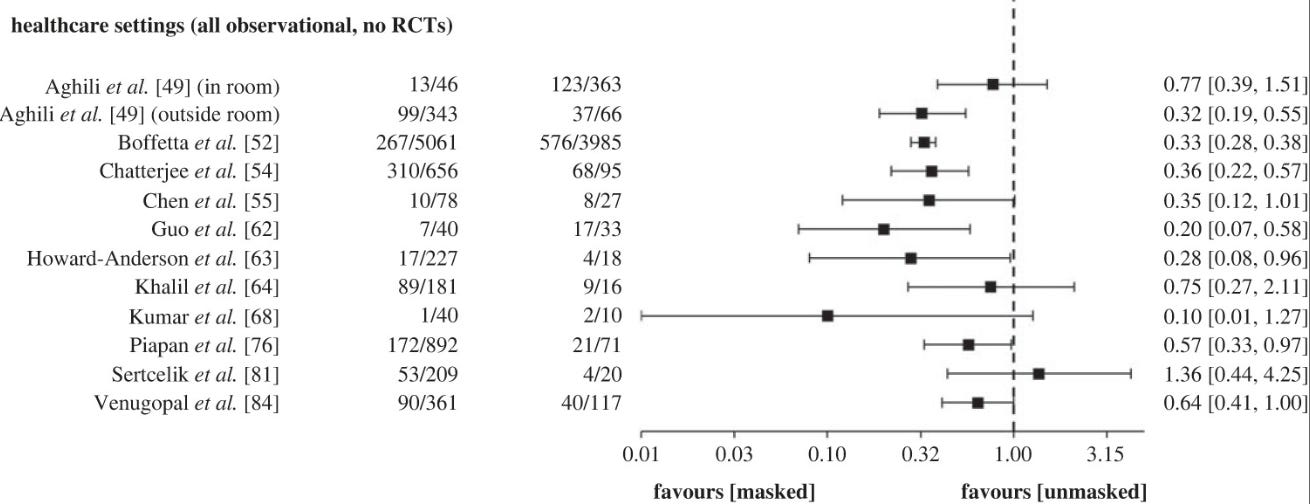
One review examined 40 studies on masks in healthcare settings (one randomized controlled trial and 39 observational studies). The majority of studies favored masking vs. not masking in healthcare.
There are a few reasons I’ve heard (beyond the normal “masks don’t work” argument):
We didn’t do it in pre-pandemic times.
For the public, this is true. Donning a mask as a personal measure to prevent hospital infections is a new step we’ve taken during the pandemic. This is a highly contagious virus. And we’ve learned leaps and bounds, like the role of asymptomatic disease and viral transmission routes.
For healthcare workers, masks have been a core tool for decades, especially when managing patients with potential respiratory infections. The questions are really when and where? Tossing the mask altogether has never been on the table in high-risk healthcare settings.
Negatively impacts healthcare workers. One study in Singapore found that one-third of nurses said wearing masks negatively affected their work, such as discomfort, frequent adjustment, and inability to concentrate.
Are these infections preventable? Hospital-onset Covid-19 infections occurred at similar rates as other health care–associated infections, like UTIs. A national goal is to reduce these, but this raises a good question about how preventable in-hospital respiratory infections are.
“I thought we were done with mandates!” There is a distinction between public mandates aimed at the population as a whole and a much narrower mandate for specific high-risk settings. If you don’t set foot in a hospital or long-term care facility, most (all?) mask orders won’t impact you.
If masks are reinstated, what are the on- and off-ramps, if any? There are a few options:
Keep mandatory masking throughout the year.
Universal masking during a window of time. For example, Marin County has decided to mask in hospitals from November through March after looking at respiratory trends in wastewater data.
Universal masking in high-risk units, like organ transplants and oncology. (Although there are high-risk patients throughout the hospital.)
Require masks based on hospital capacity. But what capacity? This would be confusing to patients going to different hospitals.
Like any policy, where you land on this ultimately comes down to values. (And we know nothing gets people’s blood boiling more than masks.)
Do not be surprised if hospitals and long-term care facilities return to mandatory masking soon. Some have already announced that they are coming down the pipeline.
Infectious diseases violate the assumption of independence— what we do directly impacts those around us. A low-cost, minimally invasive intervention, like masking, is a great way to start protecting our community’s highest-risk individuals this fall and winter season.
Love, YLE
“Your Local Epidemiologist (YLE)” is written by Dr. Katelyn Jetelina, M.P.H. Ph.D.—an epidemiologist, wife, and mom of two little girls. During the day, she is a senior scientific consultant to several organizations. At night, she writes this newsletter. Her main goal is to “translate” the ever-evolving public health world so that people will be well-equipped to make evidence-based decisions. This newsletter is free, thanks to the generous support of fellow YLE community members. To support this effort, subscribe below:

Doctor Who returns with three specials starring David Tennant as the Fourteenth Doctor, reunited with Donna Noble (Catherine Tate).
Doctor Who marks its 60th anniversary this year with three specials featuring David Tennant as the Fourteenth Doctor, with the first slated to air in November. The latest trailer shows the good Doctor reunited with his former companion Donna Noble (Catherine Tate) and facing off against two classic adversaries from the Whovian archives: an alien race called the Meeps and a celestial being known as The Toymaker, played by Neil Patrick Harris.
(Spoilers below for prior seasons of Doctor Who.)
When the BBC announced that Ncuti Gatwa would succeed Jodie Whittaker's Thirteenth Doctor as the new incarnation of Doctor Who, fans naturally expected Gatwa to make his first appearance in the traditional regeneration sequence. Instead, in the 2022 special "The Power of the Doctor," Whittaker's Doctor regenerated into an incarnation bearing a striking similarity to the Tenth Doctor—both played by Tennant. It was a savvy marketing move, given the enormous popularity of Tennant's Doctor. With showrunner Chris Chibnall stepping down and Russell T. Davies re-assuming the reins for the show's 60th anniversary, what better time to revisit that character, along with my personal favorite of the companions, Donna Noble?
This post was written by Alison Green and published on Ask a Manager.
A reader writes:
The organization I work for is based in a small rural community, so it’s not uncommon to turn up to something like an exercise class, community event, or supermarket and find yourself face to face with someone from work. Quite often, that also ends up being the person at work who makes everyone miserable, Cassandra.
For context, our CEO (Stephanie) likes to micromanage all things HR-related herself. The organization has an external HR consultant but most of us do not have permission to approach this consultant directly. As a result, any interpersonal conflict that can’t be dealt with by the individuals involved ends up on Stephanie’s desk.
Cassandra is incredibly good at being two-faced. She has the wool completely pulled over Stephanie’s eyes, to the point that when coworkers approach her about Cassandra’s behavior, Stephanie can’t possibly imagine that Cassandra would have intentionally caused upset and always comes down on Cassandra’s side. Some of these complaints have been quite serious, but she is always given the benefit of the doubt.
I was also fooled by Cassandra for a long time, so I understand exactly how good she is at manipulating those around her. But one day I stood my ground when she tried to steam-roll me, and then I became a target for her nastiness. I have had things thrown at my desk instead of handed to my outstretched hand, simply for going to buy a coffee with another coworker and not buying her one (we didn’t offer to buy anyone coffee, and it was our designated break, so it wasn’t like we deliberately excluded her) and yelled at for doing my work correctly instead of her way. She withholds information I need to do my job, and so on. I tried to take the more serious incidents to Stephanie, but once Cassandra tells her side of the story, it is always spun back on me so there’s no point.
Thankfully, Cassandra has been working from home more and more frequently, and the addition of new staff means she’s on good behavior to impress them, so it’s tolerable to work with her for now. But I still don’t wish to socialize with her outside of work. If I am in the supermarket, I can (and do) turn and walk away to avoid interaction, but there are some activities that I avoid so I don’t have to see her, and I don’t want to avoid them anymore. She will beeline to say hello to me in these situations because if I don’t engage, if makes her look like the victim to others present.
Is it reasonable to have a conversation where I basically say, “I have to put up with your bullshit at work, but I don’t have to tolerate you here, please pretend I do not exist outside of the office”? And how do I say it in a way that I can defend when it inevitably gets back to Stephanie?
No, not really, at least not if you don’t want any blowback.
The thing is, you’re expected to maintain generally civil relationships with colleagues — even when you encounter them outside of work. That doesn’t mean you need to socialize with Cassandra, but it does mean that if you say something openly hostile to her outside of work, your employer would have legitimate concerns about how you manage your work relationships (just like if you sexually harassed someone outside of work, or flipped off a client in the park, or so forth). The ways you treat colleagues outside of work can be your employer’s business, because they care about the sorts of relationships you maintain with the people they expect you to work with. That’s always true, but it goes double since Stephanie is likely to believe you’re the one stirring up drama.
However, there are professionally appropriate ways to indicate you don’t want to engage socially with someone. You can be chilly to Cassandra as long as you’re not rude, and you can excuse yourself from conversations with her right away. I recommend Miss Manners’ map of the varying degrees of chilliness to employ with someone you loathe — which goes from Slightly Cool (“your mouth turns up when you have to say hello to her, but your eyes do not participate in the smile”) to Cold (“all the formalities, but no smile — you do not have a personal grievance against him; you are merely treating him as the sort of person you do not want to know”) to Freeze (“you do not greet him, you do not acknowledge his presence, and if he approaches you, you turn away”). Freeze is too much for a coworker; I recommend Slightly Cool. (If you prefer Cold, I’d only caution you to factor in how it will look to those around you, which matters more than what Cassandra thinks.)
Frankly, there’s real power in being meticulously professional, and it’s more likely to throw her off whatever game she’s playing than getting down in the mud with her will do.
But if none of that convinces you, consider that Cassandra sounds obnoxious and vindictive enough that she’s not likely to respect a “please pretend I do not exist outside of the office” request anyway. If she’s intentionally initiating contact when others are present so that she’ll look like the victim if you don’t engage, delivering that message will just give her more motivation to do that; you’d be essentially announcing that you’re likely to give her the reaction she’s hoping for.
Hovertext:
Somehow this became inspired by nature week.
After a torrid weekend—Sunday’s high temperature of 97 degrees broke the all-time record for September 24 of 95 degrees, which had been set just the previous year—some relief is on the way. A weak front will slowly push southward into the city today. This will bring widespread showers and thunderstorms, with a slight chance of hail and damaging winds. In the front’s wake we’ll see slightly cooler days and nights, with drier air making for somewhat more pleasant mornings and evenings.

As of 6:30 am CT we’re seeing storms fire up near Cypress and Huntsville, and the focus of activity during the morning hours will generally be along and north of Interstate 10. This afternoon and evening the better chances for rain will shift further south and closer to the coast. Overall rain chances are probably about 70 percent, with amounts varying widely.
Some areas will see a tenth or two of an inch, whereas some locations beneath stronger thunderstorms may pick up 1 to 2 inches of rainfall. Stronger thunderstorms will also carry the potential for severe weather, like hail and damaging winds. However, the dynamics are not super supportive for severe weather, so while it’s a possibility, I don’t anticipate bedlam out there.
In terms of temperatures, they’re going to be dependent on cloud coverage and storms this afternoon. Most areas will probably reach the low 90s, however. Overnight lows will drop into the mid-70s for much of the area, with a chance of showers lingering south of Interstate 10.
The aforementioned front is essentially going to stall out along the coast. For areas south of Interstate 10, then, a decent chance of showers will persist on Tuesday. Further inland, however, rain chances will likely be only 10 or 20 percent. Expect daytime highs in the low 90s, with partly sunny skies, and light northeast winds. Lows on Tuesday night should drop into the mid-70s. The air will be slightly (but only very slightly) drier than it has been.
The latter half of the week should see high temperatures generally in the low-90s, with partly to mostly sunny skies. Rain chances will probably drop back to 20 percent, again, with this higher likelihood nearer to the coast. Nights will generally fall into the mid-70s.

The overall atmospheric setup favors a slightly drier flow of air this weekend, and with lower dewpoints we’ll see a couple of effects. First of all, rain chances will be basically zero, with sunny skies. Highs will likely reach the mid-90s, but with the drier air we’ll also cool off more quickly in the evenings, so it should feel a little bit nicer outside in those instances.
This pattern should more or less continue into next week, however the trend may be toward a bit cooler conditions by the middle of next week. It’s possible that we could see something of a stronger front in about 10 to 14 days. There are hints of it in the models and the overall pattern. But the signal is not particularly strong, so my confidence is low. For now, enjoy your extended summer, Houston.
This post was written by Alison Green and published on Ask a Manager.
A reader writes:
I’ve got an odd situation happening with a male staff member on my team. I’m his boss and a woman. We are similar in age (I’m a couple of years older), and he has more experience in specific areas of his work than I do, and I have more expertise in other areas of his job description. When he brings ideas or suggestions to me about areas of our work where he is clearly more knowledgeable, I always respond with “great idea” or “I never would have thought of that — so glad to have your expertise in this area,” etc. However, when I make suggestions about ways he could expand or grow in the areas of his responsibilities where I have more expertise and knowledge, he will frequently respond with something akin to “I have already thought of doing that exact thing in that exact way and just didn’t tell you yet.”
He doesn’t respond this way 100% of the time. For example, if it’s an area we’re both a bit in the dark on and working to figure out something new, I don’t get the “you’re not telling me anything I hadn’t already thought of” response to suggestions. It happens mostly when I’m suggesting ways to take a project further or make it more impactful. But it’s happening often enough that I’m noticing the pattern and feeling annoyed by it.
When I get the “I already thought of that” response, I can’t help but think he’s lying. While he does have good ideas, I’ve had to have two conversations with him in the past about his productivity levels and my need for him to take complete ownership of projects (he’s in a director-level position). He tends to check boxes and just achieve the task while not, in my observation, fully engaging with his work.
When I think about why he’s responding this way to my suggestions, I imagine it’s one of two things: he’s feeling called out for not thinking through a project more fully before bringing an idea or a request to me or he’s devaluing my expertise and experience. He’s not rejecting what I’m suggesting, just making sure I know he had gotten there on his own. Maybe there’s something else going on?
I know the only way to know is to ask him, but I’m struggling with how to address it or if I even need to. Part of me thinks at least he’s taking my suggestions and implementing them. Who cares if he needs to tell me it was his idea, not mine? I’m secure in my position, have the complete trust of my boss (a man), and any undervaluing my employee may do is contained. If it’s an issue with my gender, I have other, more important things to deal with than enlightening him. But if I’m doing something to make him feel that he has to make it clear he’s on the same wavelength or there will be consequences, I’d like to stop doing that. That part of me doesn’t want to feel that I am stressing him out and causing this behavior as a coping mechanism or way he feels he needs to manage me.
If I do need to address it, how? I’ll never get him to admit he’s not thought of these things before me or at the same time (he 100% hasn’t), and I don’t even care. I just want him to feel okay with taking a suggestion and saying, “Sure, I’ll do that.”
Oh, I worked with this guy! And yes, it’s really annoying.
After all, it doesn’t really matter if he’s thought of every suggestion you make if he hasn’t acted on it or raised it himself (or isn’t ready to explain why he decided not to). And yeah, you can usually tell when someone is just saying it to prop themselves up (although ironically, it has the opposite effect of what they intend and makes them look less capable than if they hadn’t tried to claim they already had the ideas).
I do think you’re right to grapple with whether it’s something you really need to address or not. I lean toward thinking you should, because (a) if he is reacting to something about the way you’re managing him, it’s worth knowing that (unless it’s just that you’re, you know, managing him while being a woman) and (b) if you’re right that he’s BS’ing you, it ties into the larger concerns you have about his work — that he’s not approaching a director-level job with enough rigor and engagement.
So one option is to just say directly the next time he does it: “I’ve noticed when I suggest ways to take a project further or increase its impact, you tell me you’ve already thought of those ideas. I don’t care much whose idea is whose or who thought it up first, but I want to make sure I’m not doing something that makes you feel pressured to assure me you’re already there?”
Alternately: “I’ve noticed when I suggest ways to take a project further or increase its impact, you tell me you’ve already thought of those ideas. If that’s the case, great — but I’d love to see you running with those ideas on your own then before I suggest them. What do we need in place to make that happen?”
Related to that, it might be interesting to say one of the next times it happens, “Oh, great! Was there a reason you hadn’t tried it — do you have concerns about doing it that way?” It’s a bit of a trap for him because, assuming he hadn’t really thought it through before this moment, he’s not likely to have a great answer. The point isn’t to trap him, though; it’s to help him realize that claiming he had your idea first isn’t a “freebie” since you’re going to then ask a probing follow-up about it, and so there’s a downside to that response that he might not have considered.
You also might try asking for his ideas first before you offer your own … which presumably will make it harder for him to then respond with “already thought of it” once you do offer yours.
But I think you’re right to be annoyed, and also that your level annoyance is calibrated correctly — it’s not the biggest deal in the world but it’s odd, and it’s probably a mark of Something Bigger.

STOCKHOLM—Honoring the deity’s transformational and enduring contributions to the scientific field, the 2023 Nobel Prize in Physics was awarded Monday to God, our Creator, who devised the Heavens and the Earth in all their brilliance. “This prize recognizes the Lord’s foundational work in developing the sun, the moon,…
How do you approach a work of art? Do you notice how it shifts and changes as you get closer to it? Are you aware of the space it is in and how that colors your experience? What about the artwork draws you in and what repels you? Do you consider how your body responds to the work?
Mona Hatoum does. I recently had the opportunity to talk with her at Ruby City in San Antonio and she explained, “We experience the world through our senses. We respond to everything visually first, and then through the body, and then we start rationalizing what it means… so I like to have [the viewer] be either attracted or repulsed or somehow have them experience the work through their body first… rather than it being just an intellectual stimulus. I want [my art] to be working on all those levels, the physical, the mental, the emotional, the spiritual as well. I want a rich experience… And the successful works are those who do that, who maybe go through a transformation when we look at them.”
Since I first encountered Hatoum’s work, in the early 2000s, I thought of it solely as installation or sculpture. But, for an artist whose practice is rooted in performance art, it isn’t surprising that beyond the objects she creates, Hatoum is always considering the viewer’s phenomenological experience. I’ve only recently begun to formally study phenomenology, and two decades ago when I came into contact with Hatoum’s work, while I didn’t have the vocabulary to speak about it, I did clock its inherent visceral effect. When I was younger, studying art, I saw very little of myself represented in the art curriculum and collections of museums, and though culturally Hatoum and I are quite different, in other ways I found a kinship with her art: partially as a woman working in a traditionally male-dominated art world, but also in her approach to materiality and her blending of “soft” materials, like sand, cotton, household objects, and “hard” materials, such as steel and wood.
The first piece I saw by Hatoum was her 1994 kinetic sculpture + and –, on view at the Rachofsky House in the early 2000s when I was an undergraduate student at the University of Texas at Dallas. A three-inch-tall nearly 1-foot-by-1-foot box, it is small, simple, and unassuming. The box contains a thin layer of sand that is constantly being simultaneously raked and flattened by a motorized metal arm that is stretched across the piece, spinning to create a circular pattern. Perhaps it is just my memory of the work, and the singular, out-of-body experience I had with it, but I recall it being silent as the metal arm toiled on, forever drawing lines in the sand and forever erasing them in the same motion. I was mesmerized by the sculpture — both by the surface-level simplicity of the materials being used, and its deeper poetic underpinnings.

Mona Hatoum, “+ and -” (edition 9 of 14), 1994, hardwood, steel blades, electric motor, and sand, 3 x 11 1/2 x 11 1/2 inches. The Rachofsky Collection.
As I’ve returned to + and – over the years, with new perspectives and experiences, the piece continuously changes. When I was a young adult and seeing the world through idealistic eyes, I thought it was about balance, equilibrium, and harmony. Through a more jaded, world-warn outlook, it reads as futility and the inescapability of work in our lives as time marches on, indifferent to the individual. Yet, even more recently, at the beginning of this year when I encountered the work at the Dallas Museum of Art as part of the Movement: The Legacy of Kineticism exhibition, when in conversation with Ricci Albenda’s video, Panning Annex (Albert), + and – brought about new considerations related to destabilization and restabilization. Regardless of the thoughts that the piece evokes, it has always come with a kind of calm and acceptance. I can stand in front of it and feel my heartbeat and breathing slow.
Of course, the work encompasses all of these things and more. Hatoum told me, “For me, it’s yin and yang, positive/negative, constructing/destroying, it’s cycles… cycles of any kind, cycles of nature, cycles of war and peace, cycles of life, all these things… but it came from getting exposed to readings of Eastern philosophy… [learning about] the forces of nature and how they always work with and against each other. You can’t have day without night, you can’t have light without darkness.”
It was also at the Rachofsky House that I first encountered Hatoum’s Projection, a handmade paper piece depicting the Gall-Peters projection of the world, a map which seeks to correct issues of distortion in the commonly used Mercator projection. Made of white cotton and a thin layer of abaca, the work presents the continents as translucent debossed forms surrounded by a white ocean. The piece was created with handmade paper during a residency Hatoum participated in at Rutgers University, specifically working with their printmaking department. Much like + and –, there is a quiet beauty to Projection, along with the potential for a more powerful reading just below the surface.

Mona Hatoum, “Projection,” 2006, cotton and abaca, 35 x 55 inches. The Rachofsky Collection
The piece at once speaks to the political nature of maps and representation and hints at the potential fate of the world due to climate change. The Mercator projection, which dates back to 1569, is the map that many of us in the U.S. and beyond are familiar with, but it has been criticized for its inaccurate proportions, which seem to prioritize the United States, Europe, and Asia, effectively minimizing Africa and South America.
The Gall-Peters projection, though also flawed, because any flat representation of a three-dimensional object can never be completely accurate, seeks to correct some of the issues in the Mercator projection. Hatoum’s use of this map is a reminder that the world is not always what it seems, that what we know about places and objects is always tinged by our own perspectives, and that borders and dividing lines are rarely representative of reality. And ever so subtly, with the receding of the continents into the depth of the white space around them, Hatoum reminds us of the impermanence of our situations: that the oceans may rise and things may shift even for those of us who feel secure in the place we call home.
And home is a major theme in Hatoum’s work. Earlier this month I attended an opening reception at Ruby City for the organization’s new exhibition, Water Ways. Alongside works from the institution’s permanent collection, the show features two new acquisitions, including Hatoum’s 2006 piece Mobile Home II. The work features an array of household items, such as chairs, tables, handkerchiefs, toys, and luggage, set along wires between two steel barriers.

Mona Hatoum, “Mobile Home II,” 2006, furniture, household objects, suitcases, galvanised steel barriers, three electric motors and pulley system,
46 3/4 x 86 1/2 x 236 1/4 inches. © Mona Hatoum. Courtesy Neuer Berliner Kunstverein, Berlin. Photo: Jens Ziehe.
From across the room, Mobile Home II is reminiscent of an oversized bed, with the steel barriers acting as a headboard and footboard and the wires between them creating an implied surface. I first narrowed in on the handkerchiefs hung on the wires with clothespins, and was immediately brought back to memories of my childhood — seeing my mother and grandmother hang clothes out to dry in the backyard on clotheslines stretched between two metal T-shaped posts. As I approached the work I realized that the furniture and objects on the ground were also connected to the barriers via wire and that all of the wires were in motion, moving the objects together and apart, like an ebbing ocean.
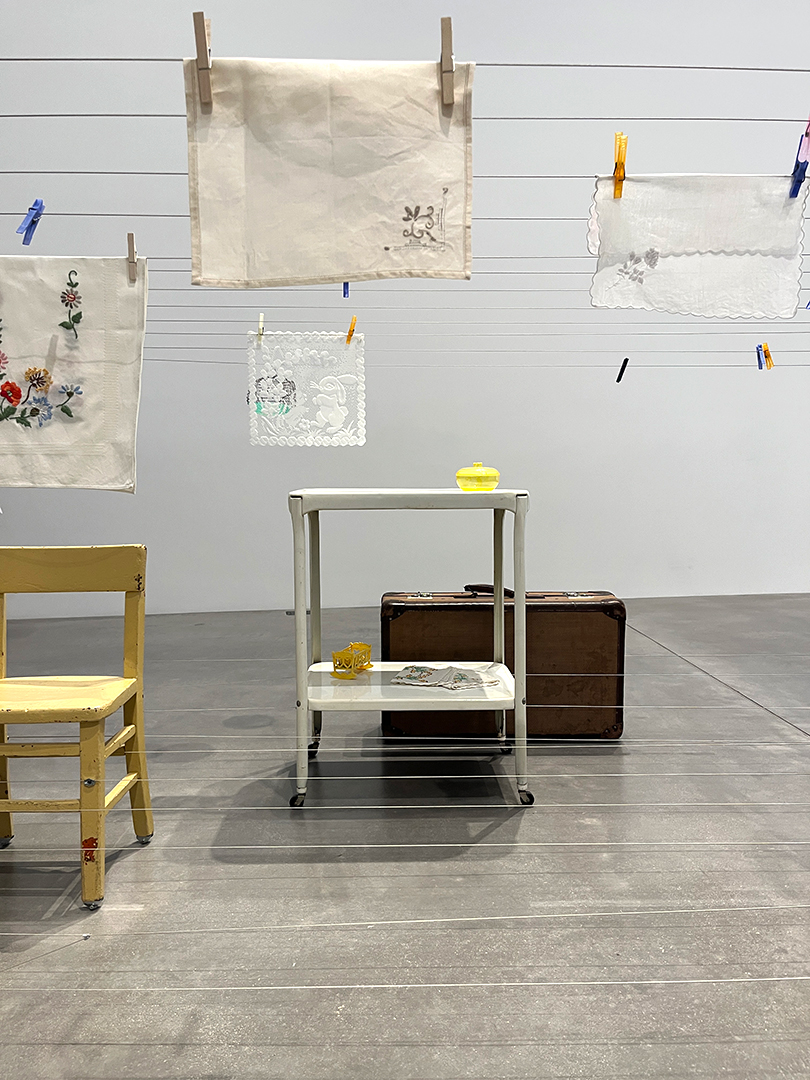
Mona Hatoum, “Mobile Home II” (detail), 2006, furniture, household objects, suitcases, galvanized steel barriers, three electric motors and pulley system, 46 7/8 x 86 5/8 x 236 1/4 inches. Linda Pace Foundation Collection, Ruby City, San Antonio, Texas, © Mona Hatoum.
As I investigate the various objects that make-up the work, my mind wanders — the pale yellow child’s chair is painted a similar color to one my daughter had a decade ago; the bunny toy hanging by its ear from a wire reminds me of feverishly washing my children’s toys and hoping they would dry before bedtime; the inflatable globe dancing precariously on the wires draws me back to Hatoum’s Projection; and on and on.
Somewhere in the midst of these personal reflections I’m pulled back to reality as I recognize the metal structures that contain the work are police barriers. These soft, sentimental moments swirling in my mind become tainted by the hint of state violence related to acts of migration. The barricades bring to mind detention centers, border walls, and other physical and legal barriers created to restrain and restrict people when they are at their most vulnerable. Being in San Antonio, a predominantly Latino city just two hours away from the U.S.-Mexico border, it’s hard not to consider the piece in the context of the ongoing violence against migrants and refugees seeking to cross into the U.S.
Hatoum and I speak about the title, Mobile Home, which is a play on words. The appearance of the piece does not directly reflect the object we know as a mobile home; instead, the title speaks to the idea of home as a place that is ever-changing. Hatoum explains, “For me it’s about a kind of flux of population… constantly in flux… moving across borders or between borders and this kind of feeling of precariousness or unsettled… whether [people] are being relocated because of war, conflict, or even natural disaster. It could be all of the above, and it’s interesting it could be placed in any place and it could be relevant. Like of course, I wasn’t thinking about the Mexican border here, but it’s very relevant as well. I like to keep [my work] very open to interpretation, so you bring your own reading to it depending on your own experience.”
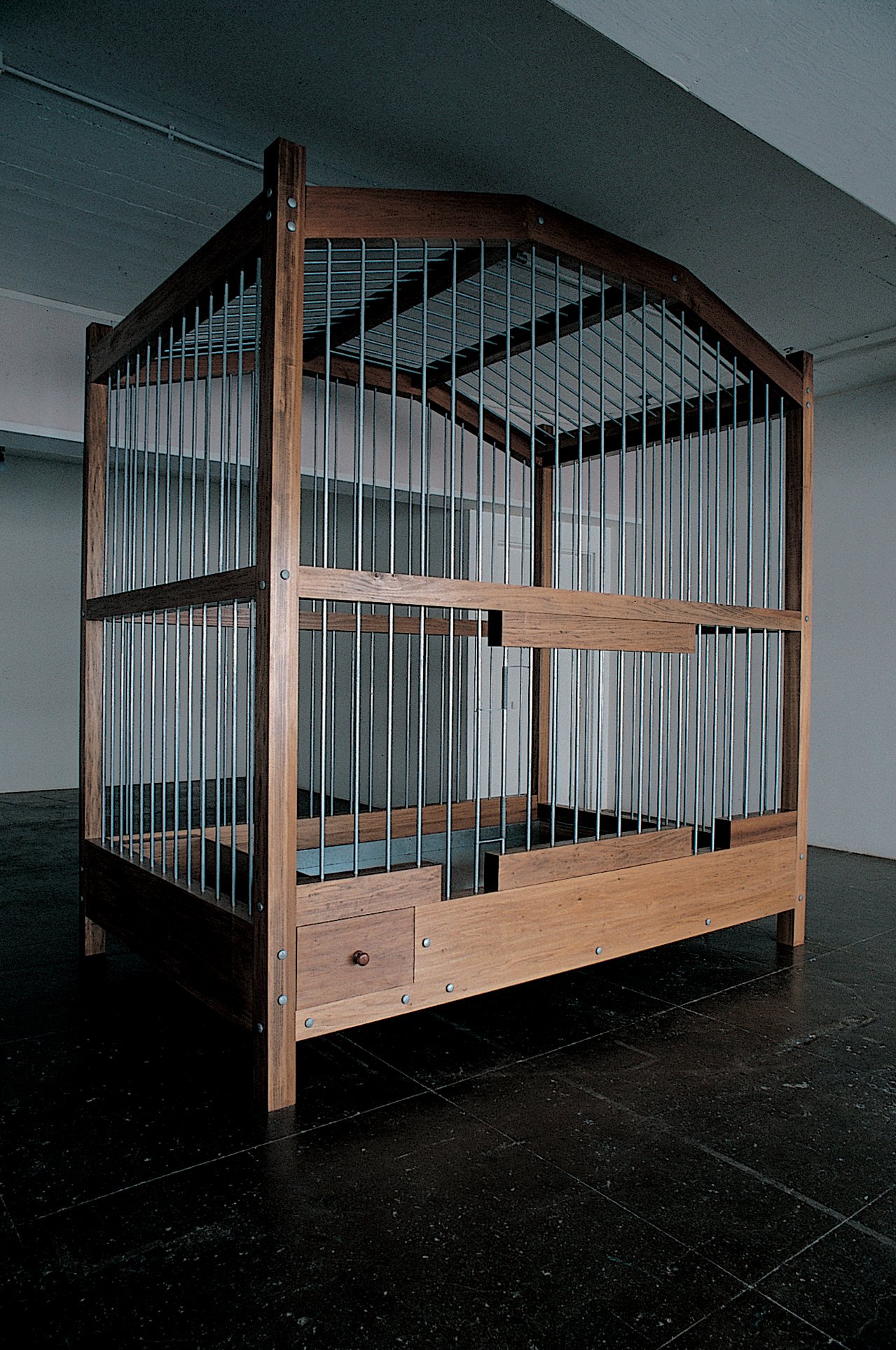
Mona Hatoum, “Untitled (Baalbeck Birdcage),” 1999, wood and galvanized steel, 122 x 117 x 77 1/8 inches. Photo: Ansen Seale.
This is neither Hatoum’s first time in San Antonio nor her first time working with a space connected to Linda Pace, the artist and art patron who founded Artpace and Ruby City. Hatoum spent the summer of 1999 as an artist-in-residence at Artpace, where she completed three works, Home, Isolette, and Untitled (Baalbeck Birdcage). Each of these pieces speaks to Mobile Home II, creating a connection between Hatoum’s time at Artpace and the newly acquired work by Ruby City.
The physical form of Untitled (Baalbeck Birdcage) is reverberated in Mobile Home II, via the steel bars and the rectangular shape of the latter work’s base. The three wire spheres that comprise Isolette, are echoed in one of the objects, a small bird carrier that Hatoum refers to as a “bird taxi,” which hangs on one of the wires of Mobile Home II.
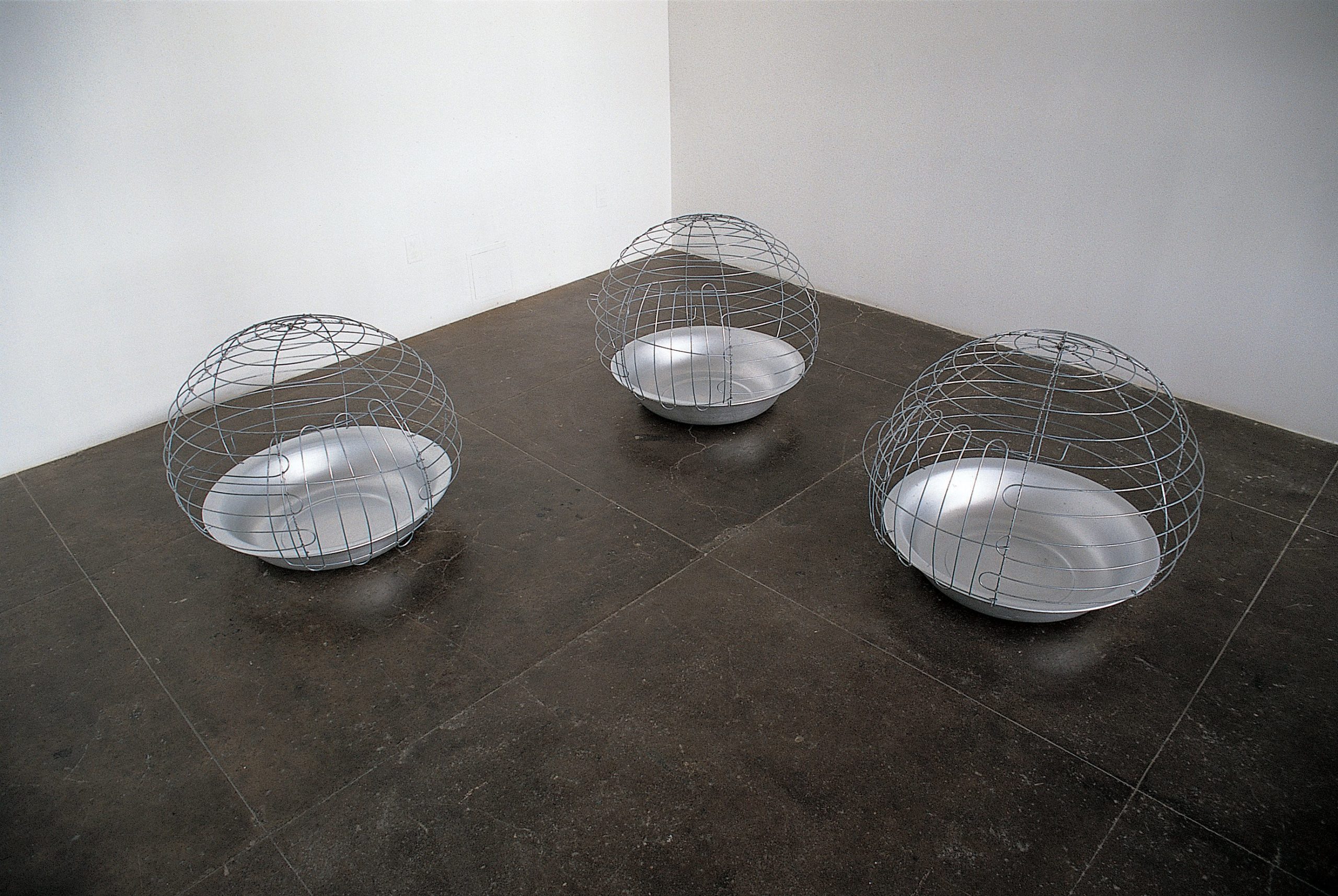
Mona Hatoum, “Isolette,” 1999, aluminum and galvanized wire, 25 x 31 inches diameter each. Photo: Ansen Seale.

Mona Hatoum, “Home,” 1999, wood, galvanized steel, stainless steel, electric wire, computerized dimmer controller, amplifier, and speakers. Photo: Ansen Seale.
And in Home, we see a fence of parallel wires, which in this case act as a protective barrier to the remainder of the installation, and are reminiscent of the wires moving the furniture and objects in Mobile Home II. Hatoum mentioned Home was the first in what could be seen as a three-part series related to the idea of domesticity. Here, household objects have been electrified, transforming the typically inviting, useful, and familiar into a dangerous assortment that cannot be approached.

Mona Hatoum, “Homebound,” 2000, mixed-media installation with kitchen utensils, furniture, electric wire, light bulbs, computerized dimmer unit, amplifier and speakers. Installation view at Duveen Galleries in Tate Britain, London, 2000. Photo: Edward Woodman. Courtesy of the artist and White Cube.
Home then led to the creation of Homebound, for an installation in the Duveen Galleries at Tate Britain. The work was an expansion of the ideas in Home and included a larger assortment of objects such as bed frames, chairs, hanging racks, and more, all electrified and placed behind a tall wire fence. In 2005, Hatoum created Mobile Home, which uses the same visual language as Home and Homebound. The wires are still present, but rather than creating a barrier around electrified furniture and objects, they connect the objects and set them in motion. The following year, Hatoum made Mobile Home II for the 15th Biennale of Sydney.
The two works are incredibly similar, but are almost entirely made up of different objects. There is one object that is nearly identical — a small toy bunny. Hatoum mentioned that she and a friend found the pair of rabbits at a market and each purchased one. She used the one she bought in the first Mobile Home installation, and when she decided to make Mobile Home II, she felt it was necessary to include the bunny again. So, she reached out to her friend, who gladly offered it for the work. It’s telling that Hatoum put such significance on having this item in both pieces, and I think it goes back to the phenomenology of the work. Among the various objects that make up Mobile Home II, the bunny plays an important role. It is a small, cuddly creature that immediately conjures thoughts of childhood and the vulnerability of young children during the process of migration.
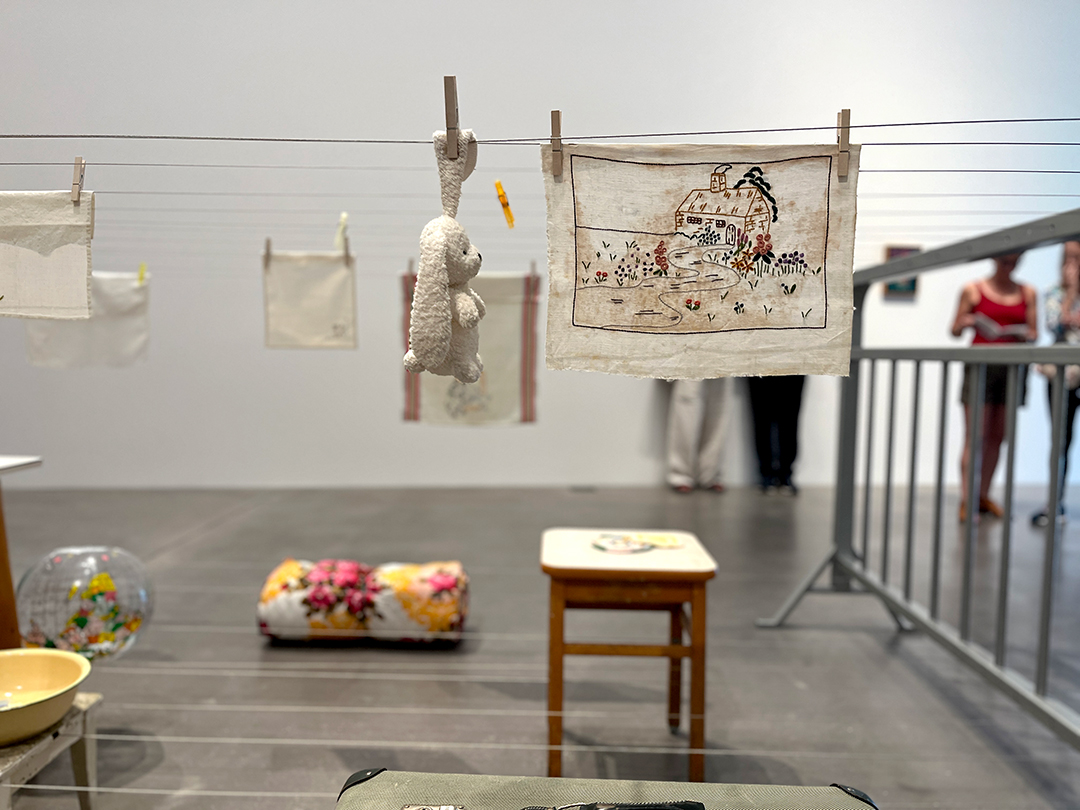
Mona Hatoum, “Mobile Home II” (detail), 2006, furniture, household objects, suitcases, galvanized steel barriers, three electric motors and pulley system, 46 7/8 x 86 5/8 x 236 1/4 inches. Linda Pace Foundation Collection, Ruby City, San Antonio, Texas, © Mona Hatoum.
It’s this attention to objects and their associations that permeates Hatoum’s work and makes it so incredibly powerful. Across her oeuvre, themes of movement, changing borders, comfort and disruption, and security and danger play out through a combination of mechanized and natural objects and soft and industrial items that dialogue with one another. Hatoum is able to tap into a wealth of emotions and memories by referencing familiar objects and placing them into surreal scenarios. This type of juxtaposition at once captivates and disorients viewers, turning what might otherwise be deemed sculpture into a performative act with the audience.
Mona Hatoum’s work is on view inWater Ways at Ruby City in San Antonio through July 28, 2024.
The post Experiencing Objects, Space, and Memory with Mona Hatoum appeared first on Glasstire.
This post was written by Alison Green and published on Ask a Manager.
It’s five answers to five questions. Here we go…
1. I’m worried my care manager will burn herself out
I am very lucky to live in a place where I get a lot of help from various places and people for my significant disabilities. For years, I managed it all myself, but about 18 months ago the agency that is supposed to coordinate my care hired A, who is quite possibly the first competent person to ever land in her job. (Among other things, I and others apparently have random funding that we were not using because we did not know that we had it!) My problem is that I really worry that A is going to burn out very fast, because she is simply too eager to help. For example, I am going through a crisis right now which she is very involved in, but I find it very unnerving to get texts from her after hours telling me to text her or call at any time. I do not want her to be checking her phone after hours! I also sometimes would send emails at random hours of the night, and she would respond to them right away, which indicates to me that she is working very long hours. (Now I am careful to only send emails to her during working hours.)
I really worry A is worrying too much about me, and if she is extending this worry and care to all of her clients, she’s going to burn out very very fast. I know that she cannot get paid that much for her work, and I would strongly prefer for her to be able to stay in her position and get promoted and not leave the field. I certainly do not want to tell her how to do her job or live her life, but with a crisis at 9 pm I’m going to call family or friends or my rabbi, not her.
I don’t want her to burn out, but unless she learns to leave work at work, she will. I have absolutely no idea what to do.
There’s probably very little you can do, unfortunately. A is going to have to figure out the right balance for herself on her own. She might burn out and leave the job earlier than you’d want or leave the field entirely.
Or she might not! While I’d never suggest anyone work those sorts of hours for their entire career, some people do legitimately thrive on being very work-focused during some seasons of their life, and then they change that as their lives/priorities/energy levels change. I personally did exactly that and have watched peers do it, too. For what it’s worth, I would have been a little annoyed by someone telling me I shouldn’t be doing it during the years when I was getting a lot of fulfillment from it.
But whatever happens, it’s A’s to figure out and your ability to influence it is pretty limited.
You can certainly tell her that she’s the best care manager you’ve had, you value her and her work highly, and you’re concerned about the hours you see her working because you want her schedule to be sustainable so she can stay in the field long-term. And you should be thoughtful about the hours when you contact her, as you’ve been doing. But beyond that, it’s something A is going to have to manage herself.
2. Coworkers are hassling me about using disposable lunch containers
I work in a non-teaching position at a university. Every employee is provided one cafeteria meal per shift worked. My department is busiest around lunchtime, so my colleagues and I usually grab to-go boxes and bring our food back and eat at our desks while we work (yay academia!).
This year the university has made a big push for reducing our carbon footprint. Part of this includes giving us all a reusable to-go container to use for food when we take meals from the cafeteria. My colleagues have all started using their reusable containers and washing them in our building’s kitchen area after each use.
I … can’t. I have OCD and dishes don’t feel clean to me unless they have gone through a dishwasher. I take medication for my OCD and have spoken with my psychiatrist about it, but this is a hurdle I just can’t seem to pass. There’s no logic behind it. Each day I continue to use a disposable tray because otherwise I’d feel so anxious that I wouldn’t be able to eat.
I didn’t think anyone would notice, but lately my colleagues have started to comment on my not using the reusable container I was provided. I pretended to forget it for a few days, but now they’re pressing me to get a replacement if I can’t find it, reminding me of the importance of not living a disposable lifestyle, and otherwise commenting on how I transport my food. Our desks are all right beside each other’s, so even if I didn’t walk over with them, they’d see my meal. They’re otherwise nice people, so I think their comments are well-intentioned … albeit unwelcome.
I understand the importance of responsibility in being a good steward to our environment, but I don’t think there’s any way I can use one of those reusable containers. I also don’t want to disclose my mental health issues with my colleagues. There are so many stereotypes and stigmas that surround OCD and I’d rather not be branded with them. Any ideas on a good script for getting them off my back?
First, any chance you could ask for a couple more of the reusable trays? That would let you take them home and run them through the dishwasher in between uses.
If that’s not possible or doesn’t solve it, you could say to colleagues who ask about it, “I have a medical issue that makes these the best option for me.” If anyone is rude enough to demand details, you should say, “I don’t want to get into medical stuff at work, thanks for understanding.”
3. Can I give constructive clothing advice to the person who took over my job?
I work in a field where meeting with elected officials is a core part of the job. I recently got an exciting new job, but still have many ties at and fond feelings for my last organization.
I recently saw photos from the most recent trip to D.C. posted by the organization. The person who eventually took over in my last position dresses much more casually than I would recommend when meeting with elected officials. Her look is more “college student on a date” than “professional representing a business organization.”
Is there a constructive way to tell her that elected officials will take her and the organization more seriously if she dresses more seriously? I think she is already at a disadvantage because she is on the younger side for this field, and I would like to see her succeed.
For context, she and I are on cordial terms; I have met with her once or twice to explain the history of certain projects and help with the position transition. I am in my mid-40’s, and she is in her late 20’s.
Not really. If you were in regular touch and had a mentor-type relationship, or if you were doing a lobby day together or something, then you could — but given the level of contact you described, it’s going to seem like a big overstep to say, essentially, “I saw photos of you and you should change how you dress.”
This is really something her employer should be flagging for her if it’s an issue; if they’re not doing that and it’s genuinely a problem, that’s on them — but there’s no way for you to do it based on seeing photos that won’t feel off.
4. Are our offices really getting cleaned?
I work for a company with a very flexible WFH schedule as we are often in the field meeting with members and can do much of our other work from home. However, we cannot print, shred, or mail from home.
We have several regional hubs that we can work from to complete these tasks and can reserve a desk or private office in advance or day of from an app. My problem lies in the cleanliness of the office.
There is reportedly a cleaning company that cleans the office each day. I say reportedly because there is an old desk calendar from March 2020 on the floor of one office and large cobwebs across the corner of another.
How do I bring this up to someone in the company without sounding lazy or like a complainer? Yes, of course I could pick up and throw out the calendar. However, I was hired this year and am not interested in disturbing years worth of dust and sneezing all day. We have an office manager, but she is the person who orders supplies and makes sure the printer works, not someone who cleans.
“Do you know if the cleaners are still coming regularly? It looks like some offices haven’t been cleaned for a while and I wasn’t sure if I should bring it to someone’s attention.”
You’re not going to sound lazy for asking if maintenance is being done when it appears that it’s not, and it’s not complaining to flag a potential work-related issue that might need attention. If the people who would normally be in charge of noticing and addressing it aren’t in the office much, it’s possible it’s just slipped off their radar and this will be a useful nudge. (That said, office cleaners don’t usually throw out things like old materials — nor should they! — so the old calendar doesn’t signify much. But the cobwebs are an issue!)
5. Should I apply for a senior job to get considered for lower-level ones?
I’m considering a career change out of sales into a more technical field. While I have college coursework and work experience that would support this change, I’m currently taking certification classes and building my portfolio to make myself as strong of a candidate as possible.
I was browsing job postings for the type of work I’m looking for (so I can tailor my studies to meet the typical job requirements) and saw that a large, well-know company is opening a warehouse locally to me, and are currently looking for a level III version of my (potential) new career path. The posting includes this level III employee as managing junior employees. I have the impression from the listing that the person they hire for this role will have a say in future hires.
While I would in no way qualify for this level III position, and I don’t feel qualified enough yet to apply to an entry-level role in this field, I received some advice that I should apply regardless in the hopes that I’d be considered as a future team member for a level I role. Is this a legitimate strategy, or would any hiring manager question my reading comprehension? Would a cover letter explaining that I’m interested in a future role help?
No, definitely don’t do that. If you don’t qualify yet for a level I role, applying now for a level III position will look really strange — some combination of naive/presumptuous/not understanding your own qualifications and what it takes to do the job well. If their system highlights past applications at the point when you apply for real, it’ll be a strike against you — not a huge one, but you’re better off without it.
When this kind of thing can work is when you’re currently qualified for a slightly lower level position (not two levels below) and they might be hiring for one of those soon — and then they can shuffle you on to that track instead, or tell you to keep an eye out for that posting. But when you’re not even ready to apply for the entry-level job, there’s not anything to be gained by doing it.

WASHINGTON—Spelling trouble ahead of the 2024 election, Democratic National Committee officials were reportedly concerned Monday after a new poll showed that only 15% of Americans have heard of the name Joe Biden. “A full 85% of American voters just looked at us with a blank expression on their faces when met with the…

American painter Bob Ross’s first ever painting that he did on the first episode of his television show The Joy Of Painting is now being sold for $9.8 million at a gallery in Minneapolis. What do you think?

KANSAS CITY, MO—Rolling their eyes as the tulip poplar they sat beneath began to rustle Monday, local witnesses reported that a wildly flailing tree was exaggerating its reaction to what was nothing more than a gentle breeze. “Ugh, can you believe the theatrics?” said sighing onlooker Darrell Denton, who stood up and…


