Feinstein suddenly became the mayor of San Francisco when two other officials were assassinated. Later she was elected to the U.S. Senate after male senators grilled Anita Hill in public hearings.
(Image credit: Anna Moneymaker/Getty Images)

Feinstein suddenly became the mayor of San Francisco when two other officials were assassinated. Later she was elected to the U.S. Senate after male senators grilled Anita Hill in public hearings.
(Image credit: Anna Moneymaker/Getty Images)

Leaders in the House and the Senate paused from the race to avert a government shutdown to remember Feinstein, the California Democrat who was longest-serving woman to ever sit in the U.S. Senate.
(Image credit: Saul Loeb/AFP via Getty Images)


WASHINGTON—Having been alive as far back as 1933, Sen. Dianne Feinstein of California, a trailblazer in being old, died Thursday night at age 90. “Sen. Feinstein, born Dianne Goldman, started off young but through hard work and dedication rose through the ranks to become very, very old,” said the late Democrat’s chief…

Donald Trump could be at risk of losing control of his New York business properties, including Trump Tower, after a judge found that the former president and his company liable for fraud. What do you think?
In case you missed it yesterday, we had our first real non-tropical post in which we discussed the ongoing salt water intrusion issues in Louisiana related to low-flow of the Mississippi River. While today’s post functions as an outlook, we will also discuss the developing flooding situation for New York City.
Philippe and Rina will dance, with Philippe eventually taking over as the dominant system, lifting into the Atlantic, while today we also check in on flooding in New York City.
Philippe & Rina
These two. Tropical Storms Philippe and Rina are now unable to be dissociated from one another, as we are seeing the Fujiwhara effect play out in real time. The two storms will interact and probably repel one another, with Rina likely taking a backseat to Philippe.

Basically, Philippe will stall, Rina will sling shot over the north side of Philippe, turn north and dissipate, and then Philippe will begin moving out to sea again. There has been a good deal of model uncertainty, particularly with respect to Philippe’s future intensity. And that is normal for a Fujiwhara interaction. When two storms engage like this and are this close together, inherent uncertainty increases, and that leads to a bit of forecast uncertainty. It’s becoming more likely however that Philippe becomes a stronger storm that pulls north, and I wouldn’t be to see the National Hurricane Center bump up their forecast intensity as it moves north into the open Atlantic.

As we’ve noted through the week however, even in the unlikely event that one of these systems ends up in the islands, it will be on the lower end of intensity and unlikely to create too much trouble. But confidence seems to be building in a no-impacts scenario. Both of these systems should be on their way out by later next week.
What else is out there?
Throughout the week we’ve also told you a bit about potential upper low or weak tropical development off the Southeast coast next week. Support for that has faded as a pretty decisive autumn cold front sweeps across the Southern and Eastern U.S. later next week. Finally! The hope would be that this leads to quieter tropics for a time. The season is by no means over (though for the northwest Gulf and Cabo Verde region it probably is), not with record warm water temperatures out there, but the pace should finally slow a bit. We’ll have more on this next week.
A few flash flood warnings have already been posted for the New York City area this morning as heavy rains stream into the area. Most of the City outside of the Bronx has seen some flooding with 1 to 3 inches of rain so far and the potential for a good deal more to come.
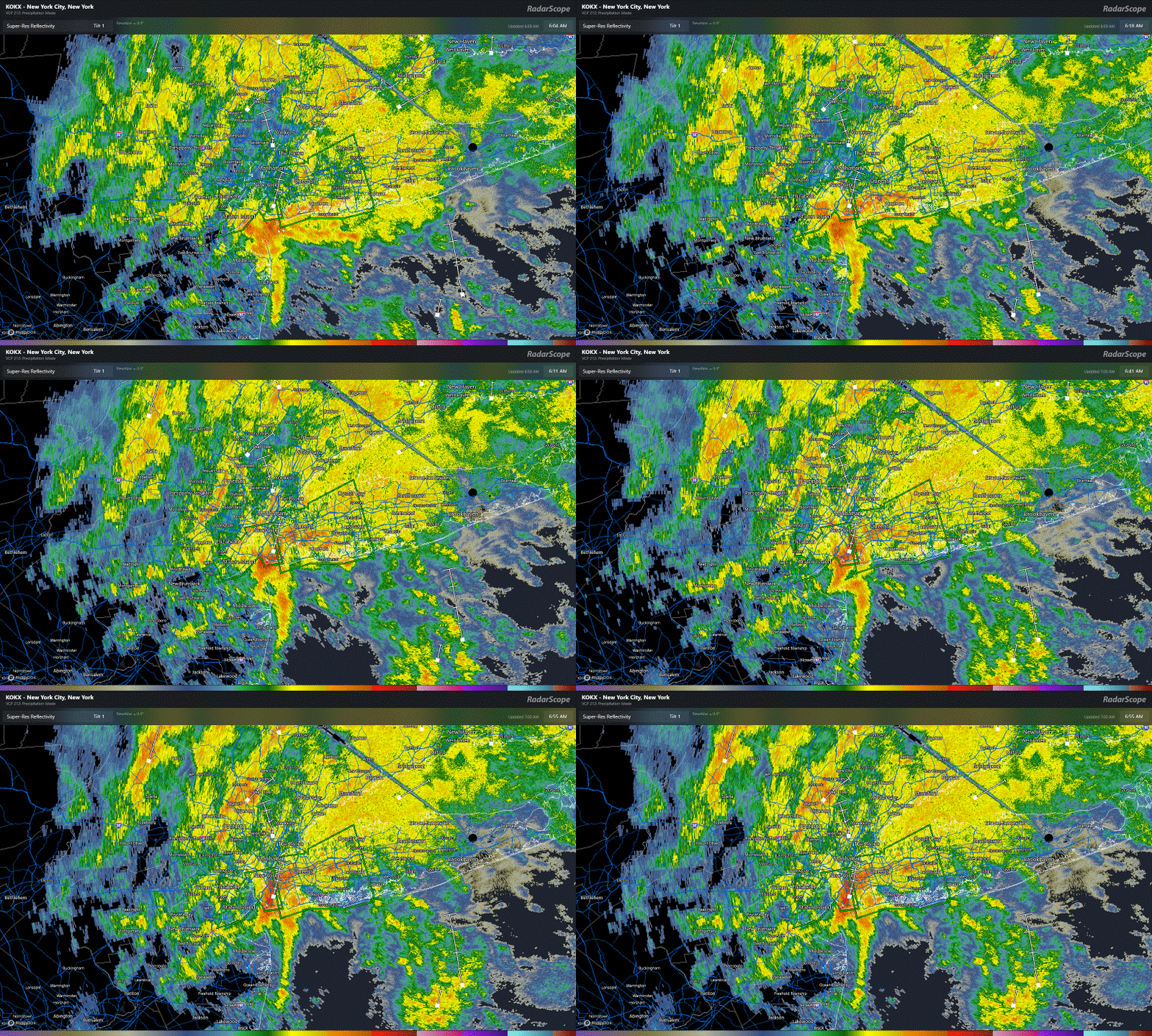
This should continue the flash flooding threat across northeastern New Jersey, New York City, Long Island, and southwest Connecticut. It’s likely that the heaviest rain will fall somewhere between Islip on Long Island and Newark, NJ. The worst conditions will be this morning into early afternoon with gradual improvement this evening.
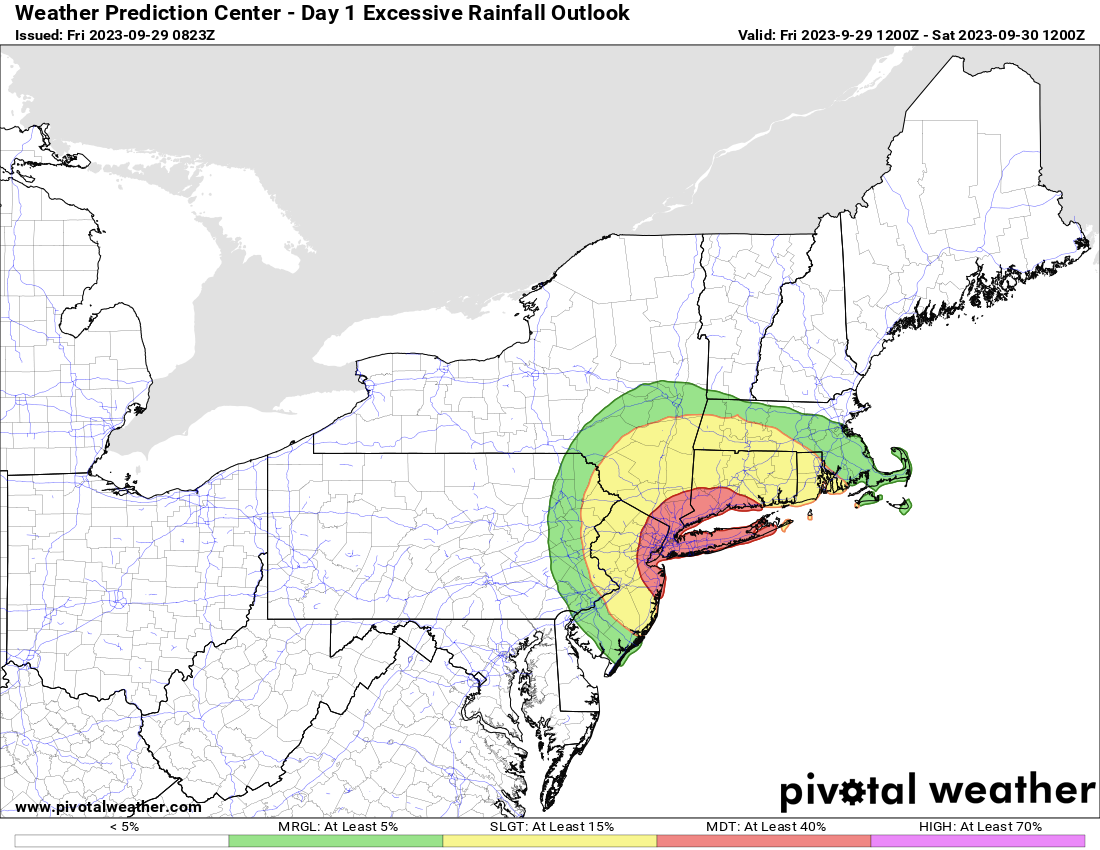
Some places could see in excess of 3 or 4 inches more rainfall which will likely lead to considerable street and some local creek or river flooding. Be safe in the New York City area today, and if you’re traveling that direction, be prepared for some delays and hassle.
REGINA – As part of his larger effort to teach all children (but especially trans children) that his government does not consider them human, Saskatchewan Premier Scott Moe has promised to use the notwithstanding clause of Canada’s constitution to ensure that children under 16 in his province no longer have the right to determine their […]
The post Scott Moe: If Saskatchewan children wanted rights, they should’ve voted for someone else appeared first on The Beaverton.

MONROVIA, CA—Announcing that renovations had been made to all 560 locations, grocery chain Trader Joe’s confirmed this week that they had added fitting rooms so customers could see how their food would look in their mouths. “Too often, a customer will arrive back home with their fresh Trader Joe’s finds only to…

Sometimes, dreams do come true. Not this time, though. Buy this mediocre home and then imagine you live somewhere much, much better. Back deck with light wood rot an ideal place to fantasize about a superior domicile.

SAN FRANCISCO—Claiming the plan would ensure benefits went toward those who truly needed them, a new proposal by San Francisco Mayor London Breed would require Supplemental Nutrition Assistance Program recipients to demonstrate starvation-induced organ failure. “Starting today, all those applying for food stamp…

WASHINGTON—Warning about the grave fallout should Republicans and Democrats fail to find common ground in negotiations, a report released Thursday by the Congressional Budget Office found that a government shutdown could imperil hundreds of Americans currently at the top of federally funded Ferris wheels. “Even a…

If you dabble with old computers, then you know the power supplies can fail just as often as the computers themselves. In the case of classic Macintosh computers, Apple didn’t use any kind of standard PSU, so buying new replacements isn’t possible. When a classic Mac PSU fails, the options are to recap and rebuild it, or make an adapter for another type of power supply. PC-style ATX supplies are cheap and readily available, and they offer the same +12V, +5V, -12V, and standby power outputs as Mac supplies. Wouldn’t an ATX-to-Mac PSU adapter be nice?
George Rudolf designed this simple ATX adapter and shared it on GitHub. It coverts a standard ATX 20-pin connector to the 10-pin connector found in the Macintosh IIcx, IIci, IIsi, IIvx, IIvi, Performa 600, Centris/Quadra 650, Quadra 800, and PowerMac 7100.


Aside from the different connectors, there’s also one small bit of active electronics on the adapter: an inverter for the ON signal. Classic Macs and PCs both support soft power, where the computer can be turned on from the keyboard or via software instead of with a hard on/off switch. This requires a power supply enable signal from a circuit using standby power, but the polarity of the ATX enable signal is the opposite of the Mac. Inverter to the rescue.
I was able to get 20 adapters assembled and shipped from JLCPCB for the princely sum of just $1.39 each. The connectors had to be sourced separately, but they’re readily available. Soldering the connectors only takes a few minutes, and they’re easy through-hole components.
I put together one of the 20 kits and installed it in my Macintosh IIci, and it worked great. I think it’s more useful for bench testing purposes than as a full PSU replacement, unless you want to go the extra mile of fashioning custom brackets to secure the ATX PSU inside the case.
For people who are attending Mactoberfest Meetup on October 14, I’ll have nineteen more of these ATX-to-Mac kits as free give-away items. You can assemble the kit right there at the meetup’s repair/work center. One of the Mactoberfest computer demos will also be a Mac IIci powered by an external ATX PSU, so you can see this adapter in action. I hope you enjoy these!

Hovertext:
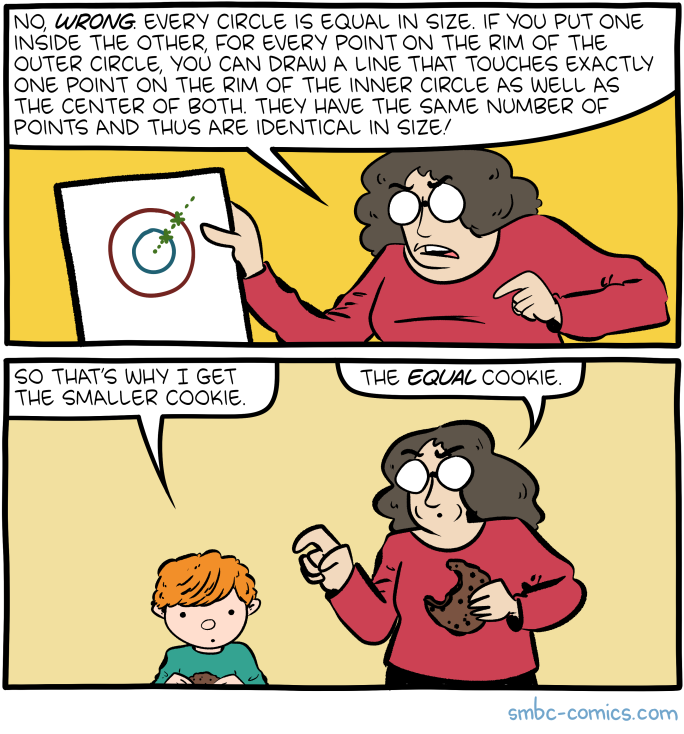
This joke conceived while reading Tarski's biography, a fact which will cause four of you to laugh politely.
Hey guys, ask us anything because WE TOOK OVER THE BARNES & NOBLE INSTAGRAM ACCOUNT
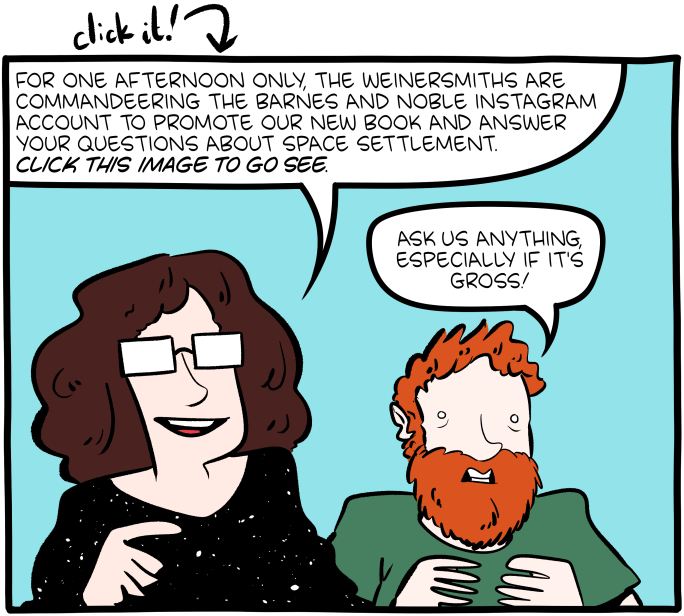
Hovertext:
Thanks all! There's also a regular update, so just click back for that.

Socialists have been hotly anticipating the end of capitalism since at least 1848, when Marx and Engels published The Communist Manifesto – but the Manifesto also reminds us that capitalism is only too happy to reinvent itself during its crises, coming back in new forms, over and over again:
https://www.nytimes.com/2022/10/31/books/review/a-spectre-haunting-china-mieville.html
Now, in Technofeudalism: What Killed Capitalism, Yanis Varoufakis – the "libertarian Marxist" former finance minister of Greece – makes an excellent case that capitalism died a decade ago, turning into a new form of feudalism: technofeudalism:
https://www.penguin.co.uk/books/451795/technofeudalism-by-varoufakis-yanis/9781847927279
To understand where Varoufakis is coming from, you need to go beyond the colloquial meanings of "capitalism" and "feudalism." Capitalism isn't just "a system where we buy and sell things." It's a system where capital rules the roost: the richest, most powerful people are those who coerce workers into using their capital (factories, tools, vehicles, etc) to create income in the form of profits.
By contrast, a feudal society is one organized around people who own things, charging others to use them to produce goods and services. In a feudal society, the most important form of income isn't profit, it's rent. To quote Varoufakis: "rent flows from privileged access to things in fixed supply" (land, fossil fuels, etc). Profit comes from "entrepreneurial people who have invested in things that wouldn't have otherwise existed."
This distinction is subtle, but important: "Profit is vulnerable to market competition, rent is not." If you have a coffee shop, then every other coffee shop that opens on your block is a competitive threat that could erode your margins. But if you own the building the coffee shop owner rents, then every other coffee shop that opens on the block raises the property values and the amount of rent you can charge.
The capitalist revolution – extolled and condemned in the Manifesto – was led by people who valorized profits as the heroic returns for making something new in this world, and who condemned rents as a parasitic drain on the true producers whose entrepreneurial spirits would enrich us all. The "free markets" extolled by Adam Smith weren't free from regulation – they were free from rents:
https://locusmag.com/2021/03/cory-doctorow-free-markets/
But rents, Varoufakis writes, "survived only parasitically on, and in the shadows of, profit." That is, rentiers (people whose wealth comes from rents) were a small rump of the economy, slightly suspect and on the periphery of any consideration of how to organize our society. But all that changed in 2008, when the world's central banks addressed the Great Financial Crisis by bailing out not just the banks, but the bankers, funneling trillions to the people whose reckless behavior brought the world to the brink of economic ruin.
Suddenly, these wealthy people, and their banks, experienced enormous wealth-gains without profits. Their businesses lost billions in profits (the cost of offering the business's products and services vastly exceeded the money people spent on those products and services). But the business still had billions more at the end of the year than they'd had at the start: billions in public money, funneled to them by central banks.
This kicked off the "everything rally" in which every kind of asset – real estate, art, stocks, bonds, even monkey JPEGs – ballooned in value. That's exactly what you'd expect from an economy where rents dominate over profits. Feudal rentiers don't need to invest to keep making money – remember, their wealth comes from owning things that other people invest in to make money.
Rents are not vulnerable to competition, so rentiers don't need to plow their rents into new technology to keep the money coming in. The capitalist that leases the oil field needs to invest in new pumps and refining to stay competitive with other oil companies. But the rentier of the oil field doesn't have to do anything: either the capitalist tenant will invest in more capital and make the field more valuable, or they will lose out to another capitalist who'll replace them. Either way, the rentier gets more rent.
So when capitalists get richer, they spend some of that money on new capital, but when rentiers get richer, them spend money on more assets they can rent to capitalists. The "everything rally" made all kinds of capital more valuable, and companies that were transitioning to a feudal footing turned around and handed that money to their investors in stock buybacks and dividends, rather than spending the money on R&D, or new plants, or new technology.
The tech companies, though, were the exception. They invested in "cloud capital" – the servers, lines, and services that everyone else would have to pay rent on in order to practice capitalism.
Think of Amazon: Varoufakis likens shopping on Amazon to visiting a bustling city center filled with shops run by independent capitalists. However, all of those capitalists are subservient to a feudal lord: Jeff Bezos, who takes 51 cents out of every dollar they bring in, and furthermore gets to decide which products they can sell and how those products must be displayed:
https://pluralistic.net/2022/11/28/enshittification/#relentless-payola
The postcapitalist, technofeudal world isn't a world without capitalism, then. It's a world where capitalists are subservient to feudalists ("cloudalists" in Varoufakis's thesis), as are the rest of us the cloud peons, from the social media users and performers who fill the technofuedalists' siloes with "content" to the regular users whose media diet is dictated by the cloudalists' recommendation systems:
https://pluralistic.net/2023/01/21/potemkin-ai/#hey-guys
A defining feature of cloudalism is the ability of the rentier lord to destroy any capitalist vassal's business with the click of a mouse. If Google kicks your business out of the search index, or if Facebook blocks your publication, or if Twitter shadowbans mentions of your product, or if Apple pulls your app from the store, you're toast.
Capitalists "still have the power to command labor from the majority who are reliant on wages," but they are still mere vassals to the cloudalists. Even the most energetic capitalist can't escape paying rent, thanks in large part to "IP," which I claim is best understood as "laws that let a company reach beyond its walls to dictate the conduct of competitors, critics and customers":
https://locusmag.com/2020/09/cory-doctorow-ip/
Varoufakis points to ways that the cloudalists can cement their gains: for example, "green" energy doesn't rely on land-leases (like fossil fuels), but it does rely on networked grids and data-protocols that can be loaded up with IP, either or both of which can be turned into chokepoints for feudal rent-extraction.
To make things worse, Varoufakis argues that cloudalists won't be able to muster the degree of coordination and patience needed to actually resolve the climate emergency – they'll not only extract rent from every source of renewables, but they'll also silo them in ways that make them incapable of doing the things we need them to do.
Energy is just one of the technofeudal implications that Varoufakis explores in this book: there are also lengthy and fascinating sections on geopolitics, monetary policy, and the New Cold War. Technofeudalism – and the struggle to produce a dominant fiefdom – is a very useful lens for understanding US/Chinese tech wars.
Though Varoufakis is laying out a technical and even esoteric argument here, he takes great pains to make it accessible. The book is structured as a long open letter to his father, a chemical engineer and leftist who was a political prisoner during the fascist takeover of Greece. The framing device works very well, especially if you've read Talking To My Daughter About the Economy, Varoufakis's 2018 radical economics primer in the form of a letter to his young daughter:
https://us.macmillan.com/books/9780374538491/talkingtomydaughterabouttheeconomy
At the very end of the book, Varoufakis calls for "a cloud rebellion to overthrow technofeudalism." This section is very short – and short on details. That's not a knock against the book: there are plenty of very good books that consist primarily or entirely of analysis of the problems with a system, without having to lay out a detailed program for solving those problems.
But for what it's worth, I think there is a way to plan and execute a "cloud rebellion" – a way to use laws, technology, reverse-engineering and human rights frameworks to shatter the platforms and seize the means of computation. I lay out that program in The Internet Con: How the Seize the Means of Computation, a book I published with Verso Books a couple weeks ago:
https://www.versobooks.com/products/3035-the-internet-con

Consumer Surveillance and Financial Fraud https://www.nber.org/papers/w31692 (h/t Naked Capitalism)
FTC and 17 states sue Amazon in long-awaited lawsuit targeting monopoly power https://arstechnica.com/tech-policy/2023/09/ftc-files-the-big-one-a-lawsuit-alleging-amazon-illegally-maintains-monopoly/
#10yrsago FBI: We know you’re innocent, but you’re not getting off the No-Fly list unless you rat out your friends https://www.aclu.org/news/national-security/no-fly-list-where-fbi-goes-fishing-informants
#10yrsago EFF racks up another courtroom victory over the NSA: damning docs to follow https://www.eff.org/deeplinks/2013/09/after-nsa-court-hearing-government-must-unseal-documents-december-20
#10yrsago How Miss Teen USA’s sextortionist got caught https://arstechnica.com/tech-policy/2013/09/miss-teen-usas-webcam-spy-called-himself-cutefuzzypuppy/
#10yrsago Judge requires patent troll to explain its “Mr Sham” business https://www.techdirt.com/2013/09/26/judge-takes-patent-troll-with-sham-employee-forces-troll-to-defend-practice-before-jury/
#5yrsago Modern Monetary Theory: why government spending isn’t like household checkbooks https://www.npr.org/sections/money/2018/09/26/651948323/episode-866-modern-monetary-theory
#5yrsago Defcon Voting Village report shows that hacking voting machines takes less time than voting https://defcon.org/images/defcon-26/DEF CON 26 voting village report.pdf
#1yrago Maintaining monopolies with the cloud: Microsoft, Oracle and other cloud giants use their terms of service to prevent competition https://pluralistic.net/2022/09/28/other-peoples-computers/#clouded-over
Today's top sources:
Currently writing:
Picks and Shovels, a Martin Hench noir thriller about the heroic era of the PC. FORTHCOMING TOR BOOKS JAN 2025
The Bezzle, a Martin Hench noir thriller novel about the prison-tech industry. FORTHCOMING TOR BOOKS FEB 2024
Vigilant, Little Brother short story about remote invigilation. FORTHCOMING ON TOR.COM
Moral Hazard, a short story for MIT Tech Review's 12 Tomorrows. FIRST DRAFT COMPLETE, ACCEPTED FOR PUBLICATION
Spill, a Little Brother short story about pipeline protests. FORTHCOMING ON TOR.COM
Latest podcast: How To Think About Scraping https://craphound.com/news/2023/09/24/how-to-think-about-scraping/
Upcoming appearances:
Wired Nextfest (Milano), Oct 7-8
https://eventi.wired.it/nextfest23-milano
The Internet Con at Moon Palace Books (Minneapolis), Oct 15
https://moonpalacebooks.com/events/30127
26th ACM Conference On Computer-Supported Cooperative Work and Social Computing keynote (Minneapolis), Oct 16
https://cscw.acm.org/2023/index.php/keynotes/
41st annual McCreight Lecture in the Humanities (Charleston, WV), Oct 19
https://festivallcharleston.com/venue/university-of-charleston/
Seizing the Means of Computation (Edinburgh Futures Institute), Oct 25
https://efi.ed.ac.uk/event/seizing-the-means-of-computation-with-cory-doctorow/
Recent appearances:
How to Seize the Means of Computation (rHatchery)
https://www.podpage.com/rhatcherylive/how-to-seize-the-means-of-computation/
Give Them An Argument
https://www.youtube.com/watch?v=yhTphllBUEM
Latest books:
"Red Team Blues": "A grabby, compulsive thriller that will leave you knowing more about how the world works than you did before." Tor Books http://redteamblues.com. Signed copies at Dark Delicacies (US): and Forbidden Planet (UK): https://forbiddenplanet.com/385004-red-team-blues-signed-edition-hardcover/.
"Chokepoint Capitalism: How to Beat Big Tech, Tame Big Content, and Get Artists Paid, with Rebecca Giblin", on how to unrig the markets for creative labor, Beacon Press/Scribe 2022 https://chokepointcapitalism.com
"Attack Surface": The third Little Brother novel, a standalone technothriller for adults. The Washington Post called it "a political cyberthriller, vigorous, bold and savvy about the limits of revolution and resistance." Order signed, personalized copies from Dark Delicacies https://www.darkdel.com/store/p1840/Available_Now%3A_Attack_Surface.html
"How to Destroy Surveillance Capitalism": an anti-monopoly pamphlet analyzing the true harms of surveillance capitalism and proposing a solution. https://onezero.medium.com/how-to-destroy-surveillance-capitalism-8135e6744d59 (print edition: https://bookshop.org/books/how-to-destroy-surveillance-capitalism/9781736205907) (signed copies: https://www.darkdel.com/store/p2024/Available_Now%3A__How_to_Destroy_Surveillance_Capitalism.html)
"Little Brother/Homeland": A reissue omnibus edition with a new introduction by Edward Snowden: https://us.macmillan.com/books/9781250774583; personalized/signed copies here: https://www.darkdel.com/store/p1750/July%3A__Little_Brother_%26_Homeland.html
"Poesy the Monster Slayer" a picture book about monsters, bedtime, gender, and kicking ass. Order here: https://us.macmillan.com/books/9781626723627. Get a personalized, signed copy here: https://www.darkdel.com/store/p2682/Corey_Doctorow%3A_Poesy_the_Monster_Slayer_HB.html#/.
Upcoming books:
The Bezzle: a sequel to "Red Team Blues," about prison-tech and other grifts, Tor Books, February 2024
Picks and Shovels: a sequel to "Red Team Blues," about the heroic era of the PC, Tor Books, February 2025
Unauthorized Bread: a graphic novel adapted from my novella about refugees, toasters and DRM, FirstSecond, 2025

This work – excluding any serialized fiction – is licensed under a Creative Commons Attribution 4.0 license. That means you can use it any way you like, including commercially, provided that you attribute it to me, Cory Doctorow, and include a link to pluralistic.net.
https://creativecommons.org/licenses/by/4.0/
Quotations and images are not included in this license; they are included either under a limitation or exception to copyright, or on the basis of a separate license. Please exercise caution.
Blog (no ads, tracking, or data-collection):
Newsletter (no ads, tracking, or data-collection):
https://pluralistic.net/plura-list
Mastodon (no ads, tracking, or data-collection):
Medium (no ads, paywalled):
(Latest Medium column: "How To Think About Scraping: In privacy and labor fights, copyright is a clumsy tool at best https://doctorow.medium.com/how-to-think-about-scraping-2db6f69a7e3d)
Twitter (mass-scale, unrestricted, third-party surveillance and advertising):
Tumblr (mass-scale, unrestricted, third-party surveillance and advertising):
https://mostlysignssomeportents.tumblr.com/tagged/pluralistic
"When life gives you SARS, you make sarsaparilla" -Joey "Accordion Guy" DeVilla
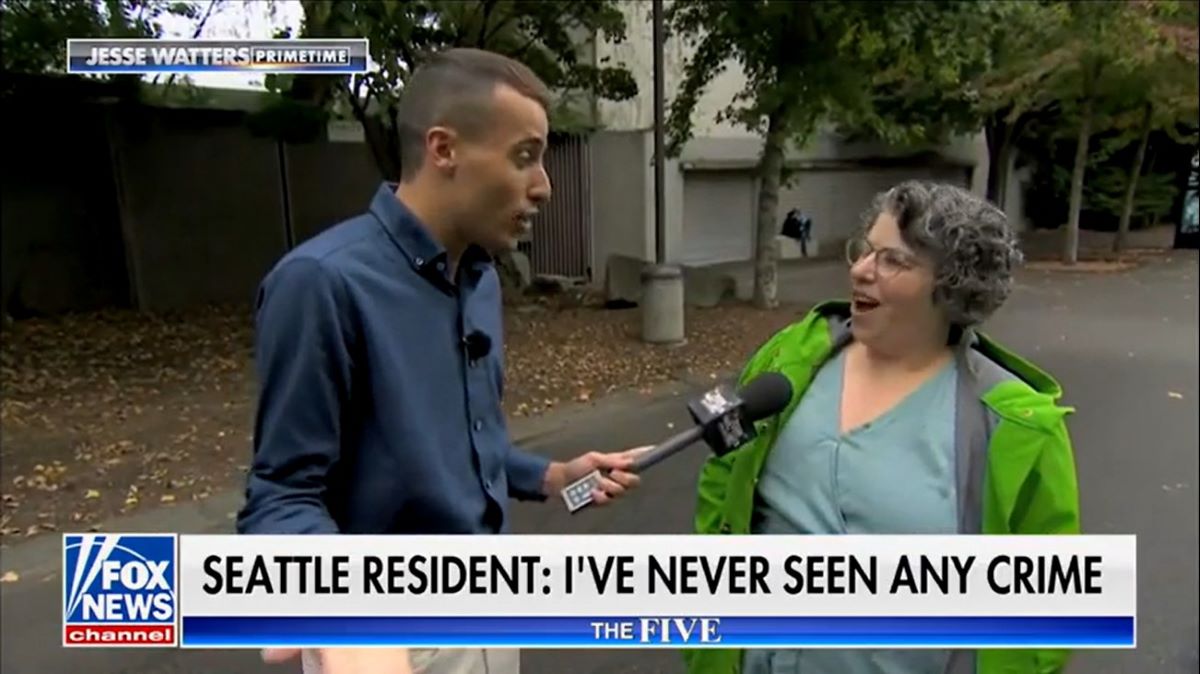
If you had never spent time in a large U.S. city and everything you knew came from Fox News segments, you might have an extremely dystopian vision of urban life: one where people are mugged and carjacked on poorly lit Batman movie sets, gas stations and storefronts are torched and looted by “woke mobs,” and drug kingpins in drag are hanging out on street corners, offering fentanyl-laced candies to passing kindergartners.
Having fully bought into their own narrative about the crime wave afflicting blue cities, and supposedly only blue cities, Fox News sent reporter Johnny Belisario out to talk to some real Seattle residents about what it’s like to dodge bullets and fight off carjackers on a daily basis. In a segment that began with the confusingly worded chyron “Crime and Drugs Are Now Expectations in Dem Cities,” Belisario bravely walked the streets of the “progressive hellscape,” as host Jeanine Pirro called it. He did not find what he expected, though, as everyone he met countered and ridiculed his absurd preconceptions.
The post No One Forced Fox News to Own Themselves This Hard appeared first on The Mary Sue.

CLEVELAND—Debuting what the company described as a completely-new way to enjoy the brand’s signature boxed dinners, packaged food product mainstay Hamburger Helper unveiled a line of erotic casseroles Thursday that is intended to be eaten off naked bodies. “No date night would be complete without Hamburger Helper’s…
This post was written by Alison Green and published on Ask a Manager.
A reader writes:
I am a division director at a large organization. I have three direct reports who collectively oversee about 30 staff, at levels ranging from entry-level, hourly office admins to seasoned managers earning six-figure salaries.
Every year, I meet once one-on-one with everyone who is not on my leadership team just to check in. I send out the questions in advance — they are designed to get feedback about the experience of the individual staff member and perceptions about what is working well and what isn’t in the division overall. There are a few questions I always ask and then I might throw in a couple of more topical questions.
I don’t consider these meetings to be optional, but it was never something I needed to enforce. My expectation is that when I request a meeting with someone on my team, they will meet with me. (I would personally never dream of refusing to meet with my boss!) Maybe not at the specific time I suggest, but they won’t just decline to meet. But that is what has happened and I don’t know what to do!
I sent a skip level meeting request to a manager (he has two young, new staff members who report to him.) He declined the meeting with no comment. When I followed up about finding a more convenient time to meet, he responded, “Thanks, but I’ll pass. I don’t need to meet.”
My irritation flared when I got this message, “Who does he think he is to just refuse to meet with me?!!” But once I got over that gut reaction and considered it further, I was conflicted. On the one hand, these meetings are important for me to get insights from across the division about what’s working and what’s not. In the past, themes have emerged that I’m then able to address to make the workplace better for all. Further, I don’t want this staff member setting an example for his direct reports that they can just opt out of meetings they aren’t interested in. On the other hand, these meetings are meant to give staff the chance to share their experience with me and something I’ve learned not to do thanks to reading AAM over the years is to force people to take part in “elective” activities (for example, when we have a holiday gathering, we schedule it during the normal work day but let people know that they are not obligated to attend and if they would rather just duck out early and take couple of hours of personal time, they can do that).
This meeting seems to straddle the fence on whether it’s primarily for me or for the employee. The staff member in question isn’t new to to the workforce or new to our organization. When I interact with him, he’s technically polite but generally sullen. That said, my understanding is that he’s fine at his job and his staff like him, but I have had to ask his supervisor to talk to him about participating appropriately as a manager. (For example, last year, he and his direct reports just … didn’t show up … at our division annual retreat. It was in our city, but away from our organization’s office, during normal work hours. He said he thought it was optional and he and his staff just went to work like normal that day.)
So, is this a hill to die on, where I I insist that he meet with me and share his feelings about his job? Or do I put this in the category of elective activity and give him a pass?
This is a work activity, and not an elective one.
You are doing due diligence on the management of your department, collecting information and creating opportunities for you to spot problems and areas for improvement. It’s a work duty, for you and for him.
Yes, it’s a chance for him to share things with you if he’d like to — and sure, he can opt of doing that piece of it if he wants to (although it would be pretty impolitic of him to make it clear he’s doing that; generally the wiser way to do that would be with bland answers rather than outright refusal). But he can’t opt out of you using the time to ask about things you’d like to know. It’s your meeting that you want; you get to call it and you get to expect him to show up for it.
And it’s not about dying on a hill; it’s about expecting him to comply with normal professional practices. Of course he needs to show up for a meeting that his boss requests. Not because you’re lording your authority over him, but because it’s reasonable to expect employees to comply with things that help you run your team effectively (within reason, of course … and this is within reason). It’s different from a holiday gathering; it’s a work meeting.
Years ago, I took over a team that had barely been managed previously, and I set up recurring regular meetings with each of the people who would now be reporting to me. One person told me she didn’t think it would help in her work and so I should skip her. I had to explain that the point wasn’t just to help her in her work — although I hoped that would happen too — but to help me in my work. To do my job well, I needed to know what was going on in each person’s realm and have the opportunity to give input, ask questions, make adjustments, and so forth. She had a fundamental misunderstanding of what the whole point of the meeting was — and, as it turned out, something of a fundamental misunderstanding of our relative roles as well. I suspect the latter is true of your employee, too.
Which I say because: something is going on with this guy. Sure, in the most generous reading it’s possible that he misunderstood what you were asking for. But I doubt it, especially combined with the rest of the info you provided about him. It’s worth digging in more deeply with his manager about exactly what’s going on there, because something is off.
This post was written by Alison Green and published on Ask a Manager.
It’s five answers to five questions. Here we go…
1. My boss’s speeches are way too long
The head of our office is frequently invited to give opening remarks at events, and our new boss is very passionate about speaking … to the point where he is just talking way too much.
To give two recent examples, he was asked to provide three to five minutes of remarks, and spoke for 45 minutes. At another event, he was given 20 minutes to do a more in-depth speech, and he spoke for an hour and a half. These were both dinners, and the food was cold by the time it came out! At other events, he’s caused the scheduling to run massively overtime, and on several occasions the main content of the event has had to be cut from the schedule.
His role is quite high-ranking (think politician/CEO), so no one is in a position to stop him once he gets going. Generally a staff member will write the speeches so we can monitor length/content, but this boss insists on either writing his own from scratch, or greatly expanding on whatever notes were provided to him. A couple of staff have quietly suggested he keep speeches short when passing on a request we’ve received for remarks, and he reacted quite angrily.
Do you have any suggestions on how we lowly staff can gently approach him to give feedback? I’m afraid we’ll stop being invited to attend events, which would be hugely detrimental to our office.
If he didn’t have a history of reacting angrily when people bring it up, sure. In that case you could say, “We’ve been hearing from event organizers that your remarks are going too long and throwing off the rest of the program, and they really need you to stick to X minutes and no longer.”
But since he does have a history of reacting angrily, you need someone high-up and influential to address it with him — a board member, a major donor, possibly a second-in-command or another senior leader who he respects, the head of an event he really cares about appearing at — someone whose feedback he’ll feel obligated to take seriously.
It that’s not an option or it doesn’t work, all you can really do is try stressing the schedule to him right before he speaks … and maybe discreetly mentioning to event organizers that he tends to run long and they’ll need to be assertive about managing his speaking time if they want to stick to their schedule; they may have tools to do that if they’re prepared ahead of time. But otherwise … this is who your boss is and if he lashes out at feedback, you can’t fix that for him.
2. Etiquette when someone is coughing right next to you
Last week I was sitting at a conference presentation and the person behind me started coughing. They were unmasked, as was I. I am low-risk for Covid complications, and have accepted the risk I’m taking going unmasked in public settings, but I still don’t want to expose myself when someone around me clearly seems ill.
I didn’t know this person, so I don’t know if they were sick/just allergies and didn’t feel comfortable asking. I didn’t want to offend them (or get into an argument) by masking up when they started coughing, and for the same reason I didn’t move my seat (we were in the back and they would definitely have seen me move, plus I didn’t want to disrupt the presenter). For the same reason, leaving the presentation entirely wasn’t an option. I chose to do nothing, sat there trying to not visibly wince every time they coughed, and took a ton of vitamin C as soon as I got home! If (when) I find myself in this situation again, what’s the best way to handle it in a way that keeps me as germ-free as possible, while not insulting anyone or risking a scene?
The best thing you can do is to carry your own mask and put it on if you feel uneasy. You can’t control what someone else is doing, but you can take steps to control your own level of exposure. It sounds like you felt that would be a rude and obvious reaction to their coughing, but it’s not rude to take measures to protect yourself (and they don’t know what your situation is; maybe you meant to be masked the whole time and forgot until the sound of a cough reminded you) … but if they do take offense, that’s their own issue. If they comment on it (unlikely from someone sitting behind you mid-presentation, but not impossible), you could just cheerfully say, “Yeah, I can’t risk getting sick right now, should have had this on the whole time!” If they have Feelings about that, that’s on them. You’re protecting yourself, not asking them to do anything differently.
That said, I also think it would have been fine to get up and move. If they saw you, oh well! If someone is coughing in public, some people might choose to keep a distance. That’s just how it goes. An alternative is to get up for a different reason — grab some coffee or go to the bathroom — and then choose a different seat when you return.
Obviously there’s also a whole thing here about how people can spread infections without coughing or having other visible symptoms, but you’re aware of that and it’s not unreasonable to calibrate your level of risk tolerance to “if you visibly have a higher chance of being ill, I want to take extra protection.”
3. Employee turns in paperwork with gross things on it
Is there a good way to address what I think are occasional dried boogers on paperwork? I can’t believe I have to ask this. I’m a manager and starting a couple months ago (with an employee I’ve had for 10 years) it has become a not-too-uncommon event to find dried boogers on paperwork they turn in. I don’t want to keep dealing with it, but I’m afraid of what happens after I say something. We all have embarrassing habits and I don’t think I could return to the office if anyone ever had to have a conversation like that with me.
Gross, what the hell! You could address it without speculating on what the, uh, foreign matter is: “Could you please ensure your paperwork is clean before you turn it in? Lately there have been things smeared on it.” If they seem confused, hand one of the papers back and say, “Like this — I’m not sure if it’s food or something else, but I’d like you to be more careful to keep paperwork clean.”
But also: is something else going on with this employee? This seems awfully similar to people who purposely do gross things to bathroom walls as an act of hostility. Eeeww, I’m going to stop thinking about it now, but sadly you have to.
4. Can I call out a hiring manager for excessive back-channeling?
A few weeks ago, I turned down an offer for a position with a company I’d been referred to by a friend. This friend’s organization is a client of the agency that made me the offer.
During the hiring process, the co-founder had reached out to my friend for a back-channel reference check, which I thought was a bit odd. I would’ve been happy to have that conversation with him and answer firsthand, but my friend did splendidly. I brought it up during a subsequent chat but didn’t make a fuss. However, that prompted me to listen much more carefully, and several red flags were raised, which is why I ultimately turned the offer down. The CEO and his right-hand dude both received my email response to their offer.
Cut to now, almost a month later. I receive a text from my friend showing the message she received from the CEO on LinkedIn. He states that he offered me a much higher salary than I expected but that “something that was said during the offer must’ve turned (me) off”, and he was hoping he could get some “back channel feedback” from her.
I’ve already drafted an email to the CEO, because I feel very icky about the whole thing — that he’d reveal something like this to my friend, a third party to this entire process, feels like my privacy was violated. It’s also dragging her into this unnecessarily, which I find inconsiderate of them. Especially when they could’ve written to me directly at any point, but chose not to. I know it’s template “tech dude heard a tip about back-channeling at a conference and figured he’d do this all the time,” but I feel like someone should at least try to shake it out of him. Am I off-base, or is this just deeply out of touch with professional norms?
It’s not off-base that he contacted your friend for a reference — she’s their client and she referred you for the job; it would be surprising if if he didn’t ask for her thoughts on you. When someone refers a candidate for a job, it’s understood that they might be asked for their impressions about the person. That part isn’t weird or inappropriate.
The message after you turned down the offer is odder — not necessarily because he asked if she had any insight into what went wrong (they have a relationship, she referred you) but the way he asked it is a bit off (sharing the salary thing, calling it “back channel feedback,” implying they must have turned you off in some way rather than you just not thinking it was the right fit). Also, there’s not always a sharable story when you turn down an offer, especially not one you’d want someone else to share on your behalf. So I’d say that was a bit off, but not shockingly so, and not something worth calling him out for.
5. Screening candidates when your candidates aren’t great at applying and interviewing
As a candidate I’ve read so many of your Q&As and tips on writing resumes, cover letters, interviewing skills, etc. and it’s made such a massive difference to the interview process each time I’ve been on the candidate side, so firstly — thank you! Secondly, from an employer/manager side, I’d love to get your thoughts on what to screen for, or what to do, when you aren’t getting applicants who have done these things.
We are hiring in a relatively competitive market for a mid-level job (non-management) at a mid pay range (on the high end of industry and role salary bands, but not over and above) and what I’ve noticed is that the majority of candidates are not writing cover letters, or when they do both the letters and their resumes aren’t personalized to the job at all. Oftentimes its clear even at the interview stage that they haven’t put any effort in to researching the company or industry, and these are the best of the candidates applying.
I guess my question is in this type of situation, do I take it as a mark against them (I am happy and able to keep the position open and keep searching) or do I accept that this is the standard of applications and focus more on their skills? Part of this is I see it as a bit of a double standard — I would never send an application/interview like this but I am aware I am a very career-oriented person — but maybe this is okay in some situations?
Yes, it’s okay.
When you’re the one looking for a job, it’s in your interests to present the most compelling case for yourself as a candidate that you can. That’s what all the advice about strengthening your resume and cover letter and prepping for interviews is about.
But when you’re hiring, your job is to identify the candidates most likely to excel in the job. That doesn’t necessarily mean the person who wrote the best cover letter or prepared the best! Those things help candidates show you who they are and why they’d (hopefully) excel at the job — but they are means to an end, and you only need to be focused on the end (which is finding the strongest person for the job). You’re not looking for the person who’s the best at job-hunting; you’re looking for the person who will be the best at the role you’re hiring for. Candidates who take the sort of job-search advice here make it easier for you to see when that’s them, but them doing it/not doing it isn’t on its own a reason to hire/not hire them.

Sen. Bob Menendez (D-NJ) has pleaded “not guilty” to sweeping federal charges that accuse him of accepting hundreds of thousands of dollars in gifts in exchange for political favors. The Onion examined every bribe the Democratic senator has accepted while in office, and this is what was found.

Canadian officials are apologizing to Jewish communities after honoring a Ukrainian-Canadian veteran who belonged to a Nazi division in WWII with a standing ovation during Ukrainian president Volodymyr Zelensky’s visit. What do you think?
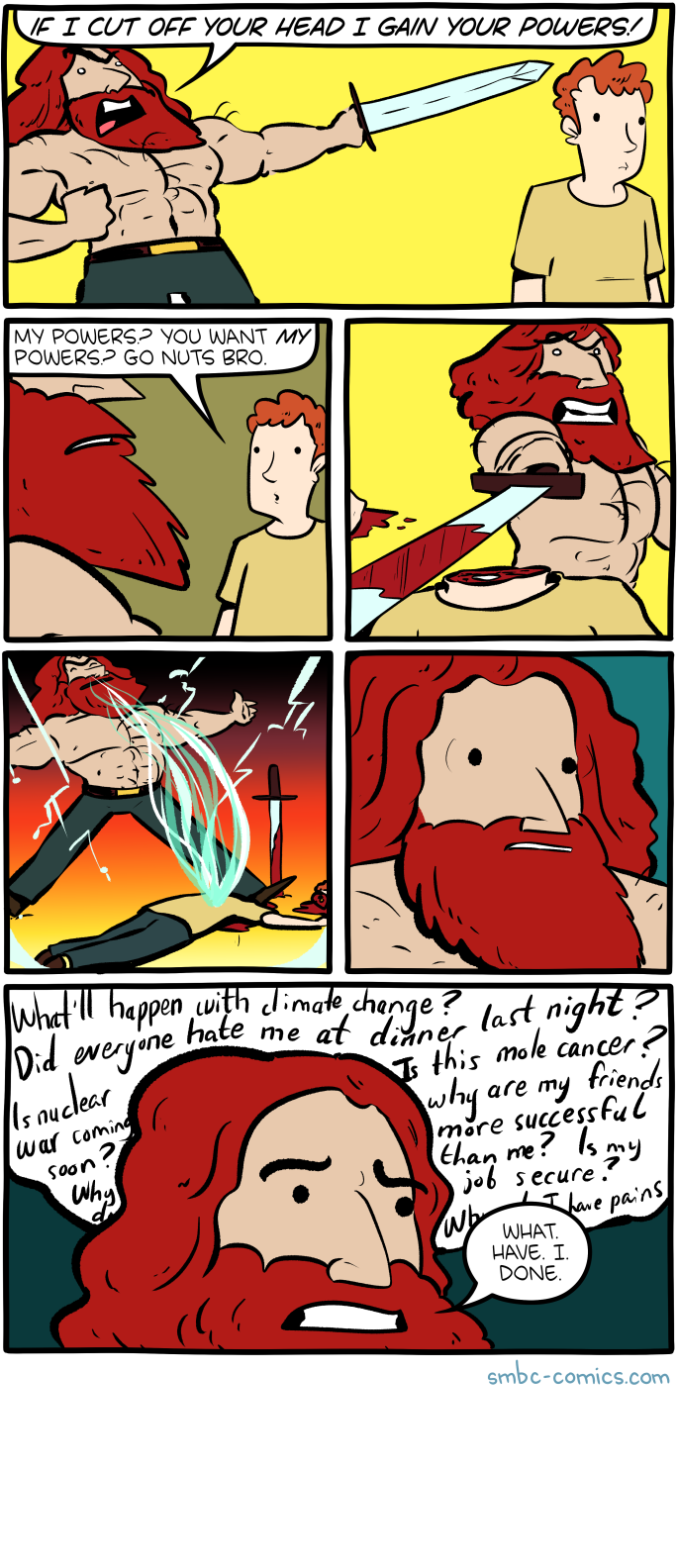
Hovertext:
After about 3 slayings they just sit in a chair, look out the window, and shake their heads from time to time.
Overall things don’t look too concerning for late September, as Tropical Storm Philippe continues to be a fading force, and Invest 91L appears most likely to track north of the Caribbean Sea and its islands.
Let’s begin with Tropical Storm Philippe. Frankly, it does not look like much of a tropical system this morning, as the storm is battling against both the influx of some drier air as well as wind shear. This is kryptonite for a tropical storm, and the most likely outcome is that Philippe will dissipate over the next day or two. By this weekend a remnant low should approach Puerto Rico, bringing some elevated rain chances. But I am not seeing anything in this forecast that particularly concerns me.
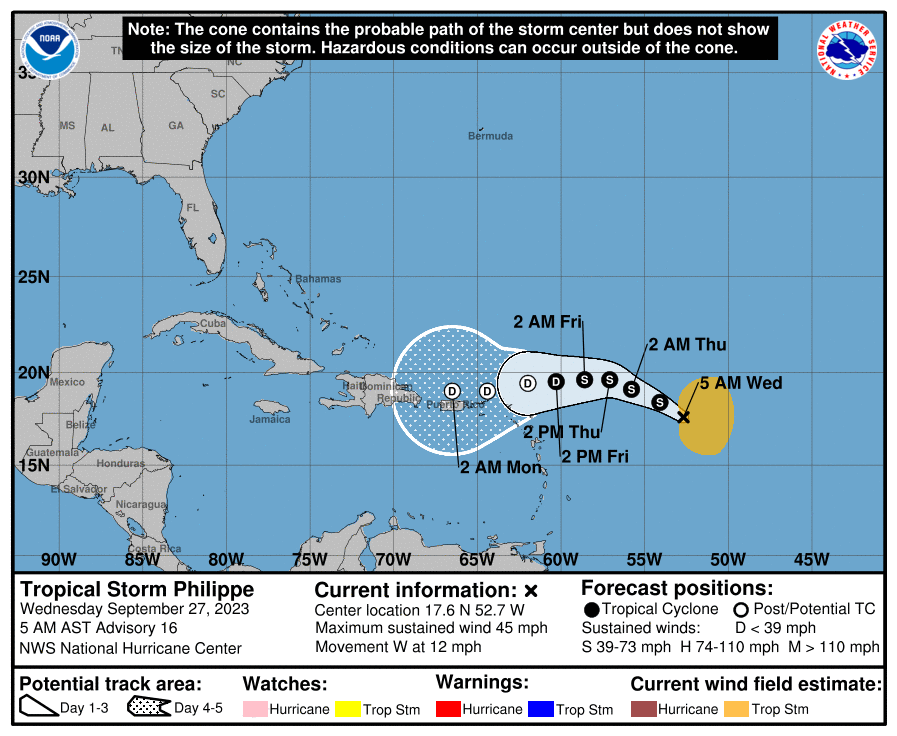
Just behind Philippe in the Atlantic lies Invest 91L, which should become the better organized system over the next couple of days. It probably will become Tropical Storm Rina fairly soon as it tracks across the Atlantic Ocean toward the Caribbean Sea. Fortunately, the preponderance of our modeling suggests that this tropical system will mostly likely turn north before reaching the northern Leeward Islands. The continued evolution of 91L will be worth watching, but again it is not something which provides us too much concern at this time.
We’re getting to the point of the forecast that is more speculative. However, after the remnants of Philippe move into Puerto Rico and Hispaniola, there may be an opportunity for some sort of low pressure system to congeal in or near the Bahamas about one week from today.

There is a definite signal in some of the global models ensembles for this scenario, and the ocean waters are plenty warm in this area. But the signal is not particularly strong, so I would not put too much stock in it. As we get to the end of September, this is the kind of thing we sometimes see in the tropics, with systems spinning up closer to land. If such a system were to develop it probably would get drawn north, perhaps toward Florida or the Eastern United States. But that is super speculative at this point.
When we look even further into the future, well into the first week of October, there’s just not a whole lot out there. We’ll continue to watch the area near the Bahamas mentioned above, as well as the southeastern Gulf of Mexico for potential development. But again this is all pretty vague, and we can’t point to any specific threat. In my book, that’s a good thing.
This post was written by Alison Green and published on Ask a Manager.
A reader writes:
I own a fitness studio, and one of my instructors is a senior in college, Emma. For several weeks, she only had one client for an early morning class that she teaches, a guy I’ll call Ryan. I know this client; he’s a nice guy in his early 20’s and a bit socially awkward. After one such class where it was just the two of them, Ryan asked Emma for her phone number. Emma says she felt caught off-guard and was aware of the fact that it was just the two of them in the space. She gave him her number although she didn’t want to.
Ryan proceeded to text her a few times and added her on social media; he would also linger a bit after classes to talk to her. Emma replied only to texts that were related to the fitness studio and did not add him back on social media. After a few weeks of this, Emma brought me her concerns. Her assessment was that Ryan had never been disrespectful or threatening, but his interest was nevertheless unwanted. Emma said she was unwilling to teach the early morning class if there was a likelihood that Ryan would be her only client and they would be one-on-one.
My solution (which Emma readily agreed to) was to remove her as the instructor for the early morning class. While it’s possible she could have Ryan as a client in a class at a different time of day, it’s highly unlikely that it would be one-on-one, which was her concern. During our discussion, Emma reiterated that Ryan had never been disrespectful or threatening, and she sort of acknowledged that she should not have given him her phone number when he asked. I made no comment whatsoever on that particular point.
For my part, I clearly stated that while she is expected to be kind and courteous to customers, she is under no obligation to cross any personal boundaries, including giving out her phone number. I emphasized that, in that moment when he asked for her number, if she had said anything to Ryan that sounded like “no” and he had still persisted, I would have banned him as a customer.
So that’s where this episode ends (for now?) but I have many thoughts and questions. My view is that responsibility lies on all sides here. Ryan should not ask someone who is working for their number while at their workplace. Emma should have a) said “no” in the moment or b) found another time to tell Ryan directly that she wasn’t interested in him. It feels to me like she is trying to avoid an awkward interaction, but that avoidance means that I as her employer have been inserted into what should have been handled between two young adults as an interpersonal issue. She essentially gave Ryan signals he reasonably understood as “yes” when she really meant “no” … but now won’t clarify it for him. I am unsure if it is within my bounds to point out that disconnect to Emma.
Moving on from here, what is my responsibility if/when Ryan continues to attend Emma’s classes (at a different time of day, with many more people around) and continues to try to talk to her after class, potentially working up the nerve to actually ask her for a date? Do I tell Ryan discreetly that Emma has a boyfriend? (A true but immaterial fact.) Do I tell Emma that she has a responsibility to let Ryan know unequivocally that she’s not interested? (This could be easily arranged with myself or others present.)
My sense is Ryan is not the kind of guy who would catch subtle signals, but would respond courteously to a “no.” Ironically, I wonder if he would have stopped attending the early morning class on his own if he had received that message from Emma! Furthermore, do I have a responsibility to make sure Ryan doesn’t ask out any other instructors while they are at work? If so, why is it my jurisdiction to preemptively squash a young man’s — or young woman’s — potential interest?
The incredibly key thing you’re overlooking here is that a lot of women hesitate to give men a clear and direct no in a situation like this because they have experienced other men having a frighteningly bad reaction to a clear rejection. You only need to look at the news to see horrific examples of this.
That’s not to say Ryan would react poorly to a clear rejection. He might not. But Emma has no way of knowing that, and so chose to prioritize her own safety in the moment. She’s entitled to do that.
Obviously I’m just assuming that’s where Emma is coming from … but it’s a pretty safe assumption to make. Even if she wouldn’t articulate it that way, when women talk about being uncomfortable giving a man a clear and unequivocal rejection, this is nearly always part of the calculus on some level: Will he become a problem? Will his reaction scare me? Will I have to worry that he’ll wait for me in the parking lot one night and make me feel unsafe? Will something worse than that happen? These are exhausting calculations to go through life having to make, and especially so at one’s workplace, where there’s a built-in power differential and she can’t escape being around him. (Yes, you would ban him if he overstepped. She didn’t necessarily know that at the time, and she’s also probably aware that there are a lot of ways he could make her uncomfortable that wouldn’t necessarily get him banned.)
All of which is to say: Sure, Emma could have given him a clear no. But it’s understandable that she didn’t, and the last thing you should do as her boss is to tell her she needs to. She navigated the situation in the way that felt safest to her.
As for your responsibility from here … you do indeed have a responsibility, both legally and ethically, to maintain a work environment where your employees don’t feel harassed. You’d be doing all your employees a favor if you let them tell clients you have a policy preventing them from socializing with clients. You can ask Emma if she’d like you to intervene with Ryan directly, but it should be her call to make, as the person most equipped to judge what will make her feel safest. You definitely shouldn’t tell her that she has a responsibility to give him an unequivocal no, for the reasons above.
So there’s this DLL in Windows called kernel32.dll. From its name, you might expect it to be the code that controls 32-bit kernel mode. But in reality, it runs in user mode. Why is the “kernel” running in user mode?
Set the time machine to 1985.
Windows 1.0 consisted of three primary components:
The 8086 processor did not have privilege levels, so there was no privilege separation between programs and the operating system. Any separation between them was accomplished by convention and mutual respect.
When protected mode was introduced in the 80286 processor, it became possible to separate privileged from unprivileged code. The processor has four privilege levels, called rings, numbered from zero (most privileged) to three (least privileged). It also has a memory management unit that can be used to present separate address spaces to each application. However, for backward compatibility, 16-bit Windows didn’t use the address space separation feature because existing programs had gotten into the habit of accessing each other’s memory by just passing pointers directly back and forth.
Windows also held back on using privilege separation between applications and the Windows kernel, and this ended up coming in handy, because the first 80386 version of Windows used ring 0 for the 32-bit virtual machine manager. The 32-bit virtual machine manager allowed the creation of multiple MS-DOS sessions, each running in a separate virtual machine, and all running alongside a virtual machine in which all of your Windows programs ran.
But even though all of the Windows programs ran at the same privilege level as the Windows kernel, there was a virtual machine manager kernel that the Windows kernel in turn relied upon.
| Ring 3 | 16-bit Windows
app1
app2
KERNEL
|
MS-DOS session | MS-DOS session |
| Ring 0 | Virtual machine manager | ||
It is the virtual machine manager that runs in ring zero. Initially, the virtual machine manager handled pre-emptive multi-tasking and virtual memory, but it left the file system in 16-bit code. In Windows 3.11 and Windows 95, even the file system itself moved into ring zero.
The job of what you think of as a modern operating system kernel has moved into ring zero, but applications still called functions in KERNEL for memory allocation and file I/O. Those functions in turned relied on ring zero services, but the interface to them is in ring three.
You can think of the names KERNEL, GDI and USER as shorthand for KERNELSERVICES, GRAPHICSSERVICES, and USERINTERFACESERVICES, abbreviated to fit inside the 8-character filename limitation of MS-DOS: The KERNEL module is not the ring zero kernel. Rather, it is the thing that gives you access to services which are associated with a modern operating system kernel.
The names KERNEL, GDI, and USER, carried forward to 32-bit Windows, leading to the somewhat confusing situation that KERNEL32 runs in user mode. It isn’t the part of the system that runs in kernel mode. Instead, it’s the part of the operating system that provides kernel-ish services such as allocating memory, accessing files, and interacting with the scheduler.
Bonus chatter: The 80386 processor does not use the terms “kernel mode” and “user mode”. It calls the different privilege levels “rings”, and it so happens that Windows uses only rings zero and three.¹
Windows NT consolidated the four rings into just two privilege levels because most non-Intel processors supported only two privilege levels anyway. Since Windows NT positioned itself as a portable operating system, it could not be architecturally dependent on a feature that was not present in most potential target processors.
¹ The OS/2 operating system used three of the four available rings. The privileged operating system code ran at ring zero, and most applications ran in ring three. However, an application could mark certain code segments to be run in ring two, which granted them access to I/O ports.
Ring one was intended to be used for device drivers, so they can be given access to more system services than regular applications, but without giving them full access to the entire system. I don’t know whether any operating system ever used ring one for that purpose.
The post Why is kernel32.dll running in user mode and not kernel mode, like its name implies? appeared first on The Old New Thing.

The Onion asked Florida students how the state’s “Don’t Say Gay” bill finally cured them of their sick, perverted urges to be lesbian, gay, bisexual, trans, or queer, and this is what they said.
A NASA space capsule carrying the largest soil sample ever collected from the surface of an asteroid has landed in the Utah desert seven years after the mission’s launch. What do you think?