Cowboy Who?
Shared posts


But this is a really great one from Richy Bosto...
But this is a really great one from Richy Boston! #CowboyWho

Why Roads Get Washboards
[Note that this article is a transcript of the video embedded above.]
For as long as we’ve had clothes, we’ve done laundry. Long before detergent pods and spin cycles, people figured out the simple trick of rubbing textiles against rough surfaces, which squeezes dirty water out of the fibers and pulls cleaner water back in. Roughly around the 1800s, that idea got a dedicated tool that you still occasionally see today, even if only in jug bands. The washboard spread across the world as a faster, more practical way to scrub shirts and pants. Its use continued to grow until automated electric machines took over in the early 20th century. But we’re not here to talk about laundry. That era wasn’t just the heyday of the washboard. It also marked the start of the highway era (at least in the US), when road construction boomed, and traffic skyrocketed, including on the unpaved routes that connected farms, towns, and job sites.
If you’ve ever driven on a dirt road, you know one of their biggest problems. In some places, the surface organizes itself into a repeating pattern of ridges and valleys that can rattle your teeth, shake your suspension to pieces, and make the vehicle feel like it’s skating. It’s obnoxious at low speeds. At higher speeds, it can become legitimately dangerous because bouncing tires can cause you to lose control of steering and braking. In 1924, this phenomenon was known as “rhythmic corrugations.” By 1929, people were calling them “washboard” roads. And nearly a century later, they’re still a persistent problem all over the world.
What’s surprising is that this is still an active area of research. In the past decade or so, there’s been a burst of papers trying to explain exactly how washboarding forms and how to stop it. I was reading one of those studies when I saw the experimental setup they used. The moment I saw it, I knew I had to build one. Let’s talk about why this happens, and why there’s still more to learn about washboarding. I’m Grady, and this is Practical Engineering.
Roughly 35% of the countless thousands of miles of roadways in the United States are unpaved. That’s technically true, but a little misleading since most of those roads are in rural areas that carry only a tiny fraction of the traffic volume compared to the roads paved in asphalt or concrete. This is not a measured or reported statistic, but some back-of-the-envelope math shows that only about one percent of traffic happens on unpaved roadways in the US. That’s not true in other parts of the world, though.
We call that outer layer of a road the wearing surface (for obvious reasons). Of course, using a hard material like asphalt or concrete as the wearing surface has a lot of benefits: it cuts down on dust, it’s generally smoother and more comfortable to drive on, it’s easier and safer to drive at high speeds, and it’s more durable. But as good as it is, paving doesn’t make sense in every situation.
Almost everything in transportation engineering is an economic decision. Roads seem kind of mundane and simple, but you have to consider the scale. Think about a basic home improvement project like installing new flooring in a kitchen. Maybe it’ll cost you a few thousand dollars. Then consider that a mile (or 1.6 kilometers) of two-lane roadways has, very roughly, 600 kitchen’s worth of surface area. For a simple commute to work, we’re talking about thousands or even tens of thousands of kitchens now. This is silly, but the point is that roads are extremely expensive, not because they’re particularly sophisticated, but because they’re huge. You don’t get a monthly “road bill,” but if you add up gas taxes, tolls, and the slice of general taxes that fund roads, the average household in the US is paying roughly on the order of an electric bill each month. So engineering decisions about roadways are largely driven by costs. Here’s a simple example:
An unpaved road is pretty cheap to build. Before we consider the traffic, it sits pretty low on this graph. But as traffic increases, so do the maintenance costs associated with regrading, adding new gravel that’s lost over time, controlling dust through chemical application, etc. Its fixed cost is low, but its variable cost is steep because it’s not as durable. A paved road is expensive to build initially, but it requires less maintenance and that maintenance is less sensitive to traffic volume, so its variable cost is relatively flat. You can see there’s a breakeven point based on traffic volume, below which it makes more sense not to pave a road. And that’s just looking at traffic. When you factor in other complexities like the availability of materials, the abundance of skilled contractors who can do the work, and climate factors, there are plenty of situations where paving a road isn’t the best economic decision. In many countries, pavement is a luxury reserved for only the busiest highways. My point in all of this is to show you that washboarding isn’t just a problem of the past. It’s a real and present challenge, so it makes sense that we’re still trying to understand how and why it happens.
I mentioned there’s a lot of ongoing research into this question. Those papers can be pretty hard to wrap your head around. So I figured I’d build a demonstration so we can see it happen in real time.
Here’s how I set this up: In the center I have a stepper motor connected to a gearbox. I chose a stepper because the hardware is relatively cheap these days, and with the built-in encoder, I don’t need a separate system to keep track of the speed. The power supply and driver for the motor are over here to the side. I’m pretty new to this stepper stuff. This is not related to washboards, but I just think it’s cool. This controller sends pulses to the driver, which energizes the coils of the motor in a careful order. The trick is that it also knows whether the motor actually did what it said to do, so it can adjust or throw a fault if something goes wrong. For the 90s kids, it checks itself before it wrecks itself. It took me some time to wrap my head around it, but now I just have a button and knob that do exactly what I want.
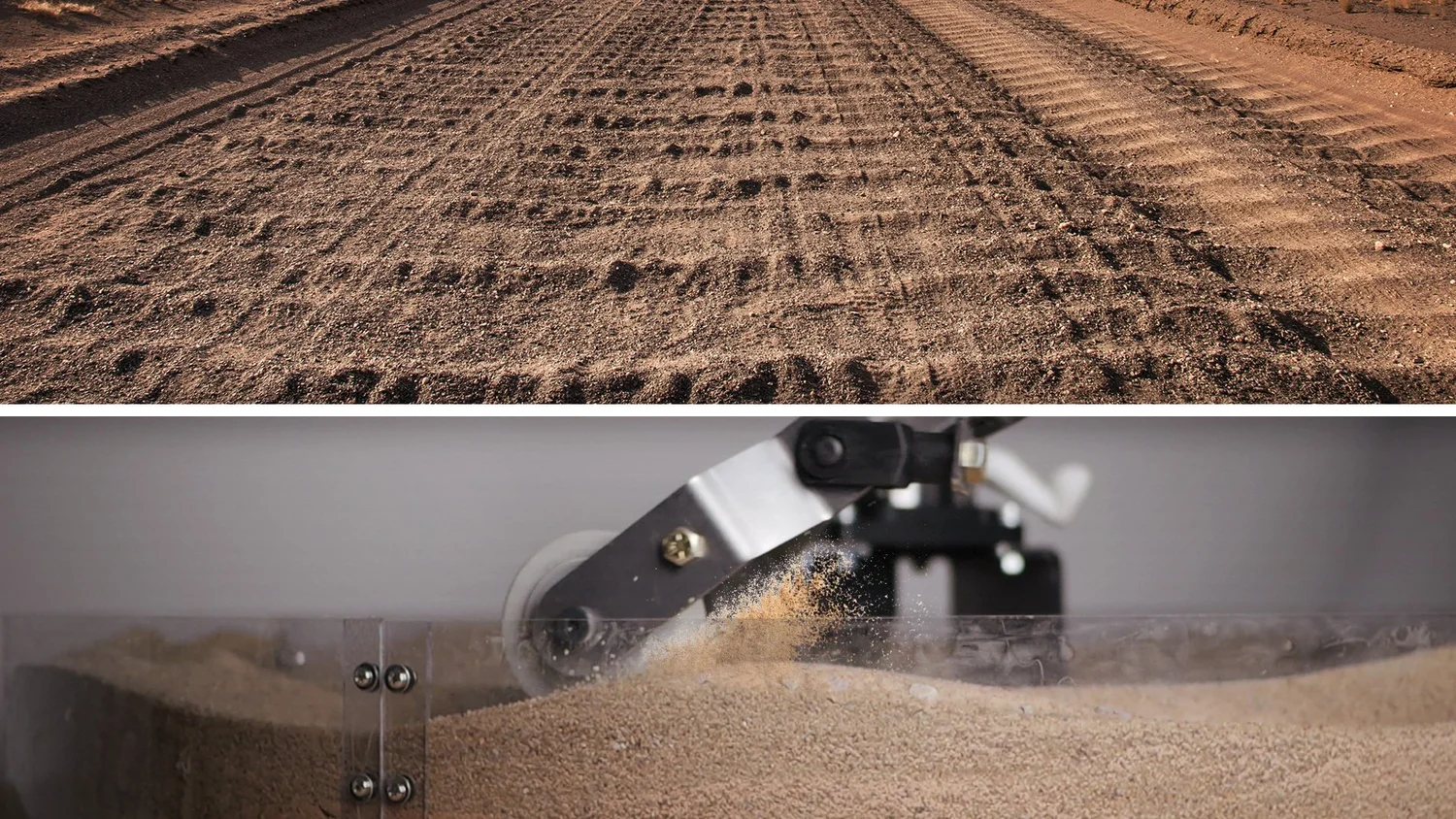
This arm is attached to the gearbox and has a wheel assembly on one side and some bolts for a counterweight on the other. The wheel runs in a circular track of sand I made from polycarbonate sheets. I used polycarbonate rather than my typical acrylic because it can flex more without breaking. Turns out that not much will stick to it, though, so I ended up bolting the pieces together.
Now that this is set up, I can just push go and watch what happens. And what happens isn’t really too interesting at first. This does just about what you’d expect it to: the wheel digs a rut in the sand as it goes around and around the track. Right now, it’s moving at about one meter per second or roughly 2 miles per hour. I let this run for an hour with pretty much no change in the behavior. But watch what happens when I ramp up the speed just a bit. And actually listen too, because it’s easier to hear than to see at first. [Break for real-time footage.] After only a few laps around the track, you start to hear a rhythm.
It doesn’t take long at all before the wheel is literally galloping between each bump. I have to be honest - I didn’t think it was going to work this well. Let’s take a closer look to see what’s happening. I’m going to smooth out the sand and start this again. But, critically, there’s no way for me to make this surface mathematically smooth. There are always going to be some small, random bumps and dips. And it turns out that’s important here. My wheel has some freedom to move around this clevis pin, so it can go up and down bumps like a regular vehicle would. The wheel’s not rigidly being pushed through the material; it’s in a conversation with the sand. Because there is some irregularity in the surface, the force between the wheel and the sand is irregular too. When we hit a bump, the force is briefly higher, causing the sand to be plowed forward. And when the wheel encounters a dip, the force is less so less material is shifted.
That fluctuation in forces matters because the wheel starts changing the surface of the track unevenly. As the wheel rolls up off a bump, it unloads, but what goes up must come down. The wheel has inertia, so when it falls, the downward force on the surface is higher than when it’s just rolling along. If the speed is fast enough, that impact happens a little after the lowest point, so the sand is pushed and piled downstream of where the wheel hit, creating a new bump where there wasn’t one before. One bump becomes two, becomes three, and so on. Each pass makes them a little bigger and organizes them a little better until you get that rhythmic corrugation in the surface.
Eventually the bumps are big enough that the wheel follows a ballistic trajectory, literally jumping off the surface with each one, and slamming back down on the other side in just the right place to push more sand up the following bump. The only thing limiting the bumps from growing indefinitely is the natural repose of the sand. It can only stand up so steeply before it flows down into the next dip, filling it somewhat. That’s why these washboards can travel like sand dunes, slowly moving down the road.
Understanding all this, it makes sense why washboards often emerge in transitional areas of a road: curves, changes in slope, and at connections to paved roads. You need a fluctuation in tire force to get the process started, and these are places where, even without a bump, there’s a higher likelihood of a sudden change in force that could start to shift the material.
What’s interesting is how robust the instability is. You would think that the differences in vehicle weights, wheel bases, suspensions, and speeds would tend to smooth things out. It turns out, they don’t. In fact, you don’t even need a wheel to do this. Researchers have shown that even a simple angled plate that acts like a plow will form ripples above a threshold speed as long as it has the freedom to move with the bumps. It all feels a bit counterintuitive; it’d be easy to assume that an angled plate would smooth out the road like icing on a cake. A big part of the reason things don’t smooth out is that the washboards are self-perpetuating. They impose a periodic force on vehicle tires that, in turn, amplifies the forces creating the corrugations. It’s like the Tacoma Narrows Bridge where the wind amplified the torsion and the torsion amplified the wind's effect on the deck: a positive feedback loop of instability that only gets worse over time.
The washboarding of roads is just one example of what scientists call a pattern-forming instability, where structure emerges from a system that starts out more-or-less uniform. We see them everywhere in nature, from chemical reactions to the markings on animals. And washboarding has some natural analogs. In rivers, moving water transports sediments in a way that can form ripples on the bed. I caught a cool shot of this phenomenon in action for my video about reservoir sedimentation. At a larger scale, river meanders are often described in the same way. Even a straight channel will, under the right conditions, begin to drift sideways as curvature redirects the fastest flow toward the outer bank, strengthening erosion there and deposition on the inside. I have a couple of videos on that process, too. But the fluid doesn’t have to be water. In places without much vegetation, wind-driven sand doesn’t naturally smooth out. Instead, it forms dunes that can march across the landscape. In all these cases, the same basic feedback loop is at work: the driving force reshapes the surface, and the reshaped surface redirects the driving force. It’s the same thing with washboards. Small bumps change how a wheel loads and shears the gravel, and that shifted, uneven loading moves material in a way that makes the bumps grow into a repeating pattern.
Characterizing the factors that play a role in the formation of washboarding helps you make engineering decisions about how to avoid it in the first place. The obvious solution is to use a more durable wearing surface, like asphalt. But we’ve already covered why it’s not always the best option. Plus, it’s not like asphalt is immune to damage. Speed is the most critical factor for washboarding. Maybe slowing down is a useful suggestion on a personal driveway, but it’s not particularly viable as a widespread solution on public roads, especially the low-traffic roads where enforcement of speed limits is…less than strict. We want to get to where we’re going, and we want roads that can safely handle the speed. So most of the focus is actually on the materials used in roadway construction.
Typical roads use a base layer below the wearing course. It can get a lot more complicated than this, but in nearly every case, the base material is usually doing the heavy lifting. The material used for road base is broadly graded, meaning it has particles of lots of different sizes, from gravel size all the way down to microscopic clay-sized grains. Often it’s made from crushed rock, which naturally produces a good mix of particle sizes. All those different sizes, plus the angularity of the crushed stone, help the road base lock together into a dense, strong layer. It’s actually pretty remarkable. If you’ve ever walked on well-compacted road base, it feels almost as hard as concrete. But remember that a typical road base is meant to be confined by some kind of pavement. You don’t have to worry about particles being dislodged or shifted because they’re trapped underneath the asphalt. So, generally, the wearing surface for an unpaved road is going to perform best if it has more fines than a typical road base, locking those bigger aggregates in better and offering more resistance to shearing.
This is a pretty careful balancing act. Too many fines, and the road is excessively dusty when dry and slippery when wet. Too few fines, and the surface won’t lock together, leading to washboarding and raveling. It’s a pretty fine line to walk for an engineer, and the trouble is that it’s not always a simple matter to source the right material. Road base is widely available because we use so much of it, so quarries and suppliers tailor their equipment and processes to meet those specifications. It can be much harder to get an aggregate operation to produce or blend a custom batch of material that works well for unpaved roads. In fact, except for the biggest projects with a commensurate budget, the material chosen for an unpaved road is almost always a compromise between what works best and what the local quarry can give you.
Another option might be synthetic materials that can augment the properties of soil. These are used in all kinds of situations, including roadway construction, so it makes sense that they might help prolong the life of unpaved roadways and reduce the maintenance costs associated with washboards. I think it might be fun to test some of these out in the test track here, since I already have it built. Let me know if you’d like to see a video on that.
For something so common, washboarding is a reminder that we’re still actively learning how the built world behaves, especially when it isn’t perfectly rigid, smooth, or controlled. Researchers are still teasing apart the details of how speed, tire pressure, suspension, moisture, and grain size conspire to pick a spacing and then lock it in. Unpaved roads aren’t a relic of the past. They’re critical infrastructure for huge parts of the world, linking farms to markets, kids to schools, and communities to clinics. And if a road corrugates, it’s not just annoying. It slows everything down, shakes vehicles apart, can lead to crashes, and makes maintenance a constant uphill battle. The more we understand the physics of washboarding, the better we can engineer roads that stay safe, smooth, and reliable, even when the only tools you have are local materials, a grader, and a limited budget.
On Tuesday morning Houston’s freeways created clouds of their own
In brief: Houston’s daily storm chances will remain high the next couple of days, with activity likely peaking during the afternoon hours. Also, we discuss a rare phenomenon observed on Tuesday, when clouds formed directly over the region’s freeways!
Freeway induced clouds
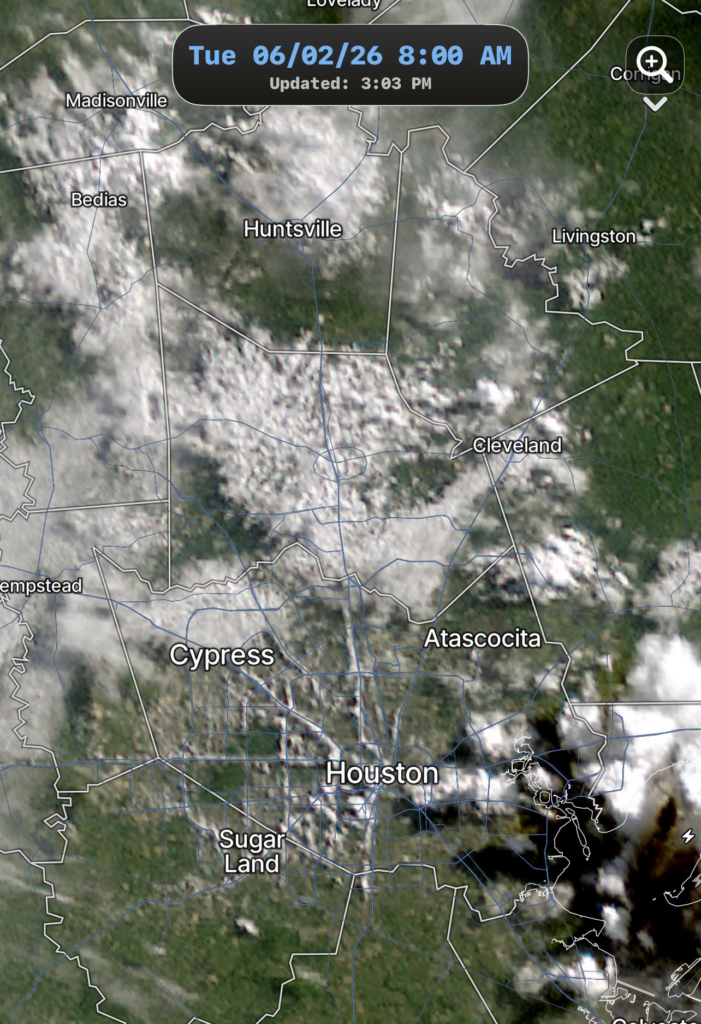
Yesterday a storm chaser named Ethan Mok shared satellite images from around 7 am to 8 am CT showing Houston in the visible spectrum. In them, remarkably, clouds lined up directly over most of the freeways in the greater Houston region. Quite clearly these interstates, particularly the Katy Freeway with its more than two dozen lanes, were inducing their own micro-climate.
Anyone ever seen interstate-induced clouds before? Low level CU developed perfectly along major interstates around Houston this morning. Kind of shocking to see such perfectly lined up clouds. #txwx pic.twitter.com/cn1BWf2wqL
— Ethan Mok (@Emokwx) June 2, 2026
I’m not sure precisely what is happening here, but it must be a combination of several factors. Winds on Tuesday morning were very light, allowing heat from the concrete surfaces (which were warmer than the surrounding air) to rise almost straight up. In addition, particulates from vehicle exhaust provided nuclei for water vapor to condense around, creating seeds for clouds.
We don’t, frankly, understand exactly why it happened on Tuesday morning, or whether this is a particularly common feature. I have never seen a manifestation like this, however. It does highlight that one of the more active areas of meteorology research is how cities change weather. A recent study, co-authored by a Texas A&M University atmospheric sciences professor (and friend of the website) named John Nielsen-Gammon, found that cities can boost pop-up thunderstorms.
Wednesday and Thursday
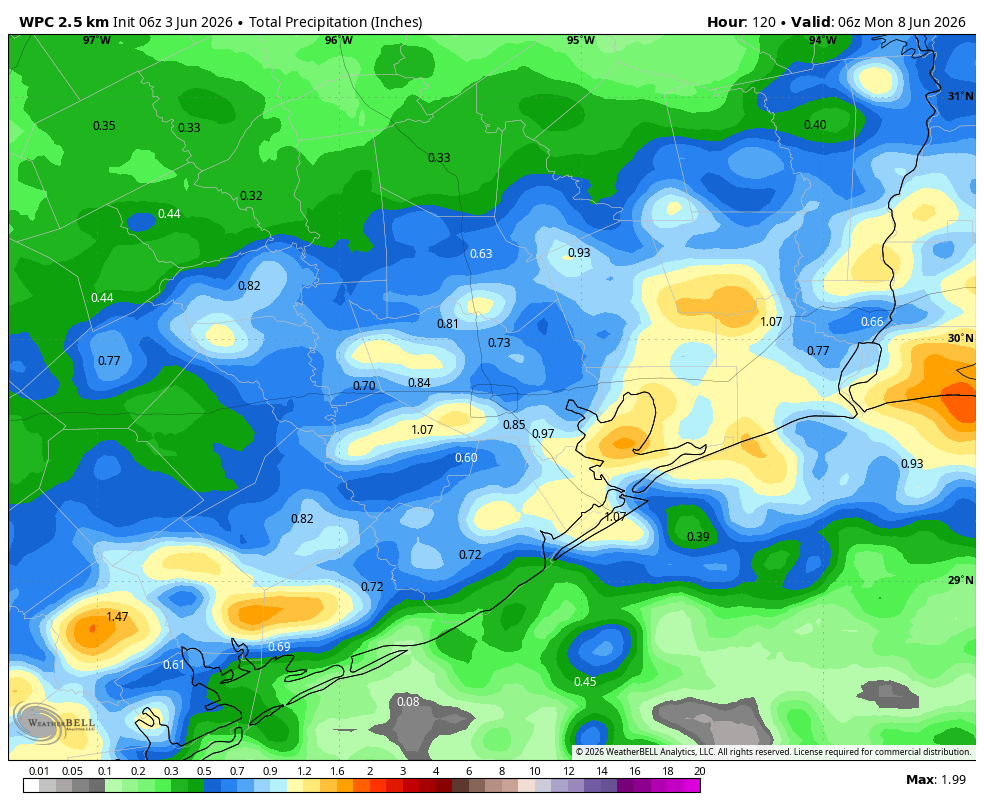
We saw widespread showers and thunderstorms on Tuesday, with some of the more efficient cells producing upwards of 2-3 inches of rainfall. Our overall pattern will remain similar for today and Thursday. Most of the area is likely to see rainfall during the next 48 hours, but amounts will vary significantly, from low tenths of an inch to 1 to 2 inches. Like on Tuesday, some of these thunderstorms could briefly turn severe as they rumble through. Skies will be partly sunny during the afternoon, with highs likely in the mid- to upper-80s.
Friday, Saturday, and Sunday
We’ll see continued rain chances this weekend, however the daily likelihood of showers will probably fall back to around 30 to 50 percent each day, with any storms most likely to develop during the afternoon hours along with peak heating. Highs each day will be in the vicinity of 90 degrees, a little warmer inland and a little cooler closer to the coast. I could see this forecast trending a little drier or holding the same in terms of rainfall. Hopefully we’ll firm things up by tomorrow’s post.
Next week
The most likely outcome for next week is that Houston temperatures go up a little bit, with highs in the lower 90s, and our daily rain chances fall back to something like 20 or 30 percent daily. Such a pattern would be very typical for early- to mid-June.


Stupid lawnmower! Is it out of gas?

Stupid lawnmower! Is it out of gas?
“Every aborted foetus is a potential future intern I could hit on” says Barnaby Joyce
One Nation politician and families man, Barnaby Joyce has caused controversy by speaking at an anti-abortion rally.
“It is important that you let people like me decide what women can do with their bodies,” said the guy who once complained that suggestions that politicians not sexually harass junior staffers were a personal attack against him.
“These are potential babies who could have grown up to have full lives with parents who weren’t ready for the responsibility of having kids.”
“Every aborted foetus is a potential future intern I could hit on. It brings a tear to my eye.”
The anti-abortion rally which rebranded to being about an alleged ‘sex-based abortion’ caused controversy as the example the rally was named after was proven to have been made up using photos of sugar gliders pretending they were human, likely because experts note that there is no evidence that it is actually a problem here in Australia.
“I’m here because we are the only party that cares about women,” said Barnaby, “At One Nation our anti-abortion, anti-trans and anti-family court stances are us protecting the ladies. Trust me.”
“It’s why we currently have no convicted rapists or men with active warrants related to sex crimes representing the party, and we have been that way for almost a month now.”
The post “Every aborted foetus is a potential future intern I could hit on” says Barnaby Joyce appeared first on The Chaser.
Heaven’s Gate Members Enjoy 29th Euphoric Year On Highest Plane Of Existence
THE NEXT LEVEL—Still reaping the benefits of a mass suicide timed to coincide with the arrival of the Hale–Bopp comet, members of the Heaven’s Gate cult told reporters Friday they were looking forward to this month’s anniversary celebration of their 29th euphoric year on the highest plane of existence. “Shedding my human vehicle and transcending to a higher evolutionary level was the best decision I ever made,” said Heaven’s Gate member Sam Clybourne, adding that while he may have been nervous about participating in a ritual that required him to consume phenobarbital-laced apple sauce, drink vodka, and then asphyxiate himself with a plastic bag, his travels aboard a comet-trailing UFO had made it all worthwhile. “It’s great up here, what can I say? I’m living in a utopic realm of superhuman perfection, and my new alien body is incorruptible, genderless, and free from all suffering. It’s nothing but pure bliss every day! Plus, I still get to wear my Nike Decades all the time.” Heaven’s Gate members confirmed everyone was welcome to join them in eternal ecstasy when the Hale–Bopp comet next passed Earth in 4385.
The post Heaven’s Gate Members Enjoy 29th Euphoric Year On Highest Plane Of Existence appeared first on The Onion.
Black Neighborhood Demolished To Make Room For Nothing In Particular
FORT WORTH, TX—In a move that left hundreds of longtime residents scrambling to find alternative housing, municipal construction crews reportedly demolished a local Black neighborhood Thursday, part of an ongoing city project to make room for nothing in particular. “For decades, this part of Fort Worth has languished as nothing more than a loving community for African American families and a bustling hub for Black-owned businesses,” said Mayor Mattie Parker, adding that the destruction of dozens of beloved restaurants, theaters, barbershops, and newspapers was an essential step toward creating more vacant lots that could sit empty behind fences for an indefinite length of time. “To be clear, we have no plans to construct any new high-rises, public parks, or sports stadiums where this neighborhood used to be. Nor are we encouraging private developers to build something in this once-vital place where Black residents maintained roots for generations, coming here to live, play, eat, and work. We just figured we’d bulldoze 30 or so blocks and see what happens. While we are proud of this neighborhood’s history, the time has come to make way for complete nothingness.” Mayor Parker went on to share computer-generated renderings of what the proposed plant overgrowth in the area might look like once the city completed its $10 million devitalization project across multiple minority communities.
The post Black Neighborhood Demolished To Make Room For Nothing In Particular appeared first on The Onion.
Owners Will Retain Access To The Ring Cam
Owners Will Retain Access To The Ring Cam: It’s not that big of a deal. They want to see what you’ll be up to.
Reference #918445
The post Owners Will Retain Access To The Ring Cam appeared first on The Onion.
Meta Launches Instagram Plus
Meta announced a new Instagram Plus subscription plan for $3.99, allowing extra features such as the ability to extend stories longer than 24 hours and see who rewatched users’ stories. What do you think?

“I don’t really need any of those features, but Mark Zuckerberg looks like he could use a few bucks.”
Maddy Diedricksen, Cracker Marketer

“At long last, something worthy of my hard-earned $3.99.”
Herbert Karpf, Wax Molder

“I always thought my friendships were missing key analytics.”
Levi Hall, Preservative Tester
The post Meta Launches Instagram Plus appeared first on The Onion.
‘Euphoria’ Delivers Happy Ending Where Fans Never Have To Watch ‘Euphoria’ Again
LOS ANGELES—Breathing a deep sigh of relief as the credits rolled Sunday night, fans praised HBO drama Euphoria for delivering a happy ending in which they would never have to watch the series ever again. “Thank God, it’s over—it’s finally over,” said 29-year-old fan Emma Torres, who added that the experience of realizing she would never see another episode of the series as long as she lived was like “riding off into the sunset away from her television.” “I was so worried they would try to leave the door open for a season four or some kind of spin-off, but nope, it’s done. All the loose ends are tied up in a neat little bow, and now I can finally spend my Sunday evenings doing literally anything else.” Torres went on to state that her one regret was that the series had not killed off Sam Levinson.
The post ‘Euphoria’ Delivers Happy Ending Where Fans Never Have To Watch ‘Euphoria’ Again appeared first on The Onion.
‘Fuck It, A Gig’s A Gig,’ Says Bruce Springsteen, Agreeing To Headline Freedom 250 Concert
COLTS NECK, NJ—Declaring that he wasn’t about to turn down a fat check for shitting out some hits, rock icon Bruce Springsteen said, “Fuck it, a gig’s a gig,” Monday as he agreed to headline the controversial Freedom 250 concert series on the National Mall in Washington, D.C. “I may get some flack from the fans, but I can always win them back by expressing regret later on, some BS about being misled by the show’s organizers,” said Springsteen, adding that he simply couldn’t say no to an all-expenses-paid trip that would get him the hell out of New Jersey for a night or two. “Let’s face it, it’s just music, and Papa’s gotta eat. So let’s talk cashola, you know? I’ll play anywhere that’s gonna make my wallet happy, and it just so happens that President Trump is going to make it very happy indeed.” Springsteen later clarified that, depending on the compensation, he’d be just as willing to perform at the inauguration for the next Democratic president as he would the inauguration for Donald Trump’s third term.
The post ‘Fuck It, A Gig’s A Gig,’ Says Bruce Springsteen, Agreeing To Headline Freedom 250 Concert appeared first on The Onion.
Kash Patel Under Fire For Using FBI Jet To Blow-Dry Hair
WASHINGTON—Drawing intense scrutiny for what opponents have characterized as misuse of agency resources, FBI director Kash Patel came under fire Tuesday for using an FBI jet to blow-dry his hair. “On numerous occasions, Kash Patel has inappropriately utilized a government-funded Gulfstream jet to add shine and smoothness to his hair after a shower,” said Illinois Sen. Dick Durbin, adding that Patel’s hair care habits had already cost American taxpayers $250,000 in jet fuel alone. “This aircraft is intended for important government business, but Patel has repeatedly used it for his own personal grooming. Just last week, he delayed an FBI forensics team’s response to the scene of a mass shooting by blow-drying his hair for a date with his girlfriend in Nashville. After all of this administration’s feigned outrage over government waste, it’s disgraceful for an FBI director to interrupt federal investigations so he can dry off after partying with the U.S. men’s hockey team in Milan.” According to FBI officials, Patel was unavailable for comment on the alleged misuse of government resources because he had mistakenly stood on the wrong side of the jet’s turbine and been sucked into the engine.
The post Kash Patel Under Fire For Using FBI Jet To Blow-Dry Hair appeared first on The Onion.
Trump Launches $88 Billion Fund For Anyone Who Has Ever Been Rejected By Woman
WASHINGTON—Declaring the money long overdue compensation for some of the nation’s most persecuted individuals, President Donald Trump announced an $88 billion fund Tuesday specifically appropriated to any man ever rejected by a woman. “At long last, there will be justice for every man in America who was very unfairly told no,” said the president, noting that all heterosexual males could claim up to $5 million each by documenting abuses such as being denied a second date, not receiving photos upon texting ‘send nudes,’ or being given false contact information to thwart any possibility of future interaction. “Whether you’re an Uber driver who had his heart broken by a lady passenger who refused your marriage proposal or one of the millions of men who was cruelly abandoned by a woman after two exchanges on a dating app, you can receive payment. Of course, financial compensation doesn’t undo the tremendous emotional damage of not getting anything you want from a woman. But hopefully it will ease some of the pain for men who sent a bouquet of roses every day for a month to a woman’s place of work, only to be told their behavior was off-putting and vaguely threatening.” Trump added, however, that men would never be penalized for rejecting women and would, in fact, be eligible for a tax break if they told a date to her face that they didn’t think she’d be so fat.
The post Trump Launches $88 Billion Fund For Anyone Who Has Ever Been Rejected By Woman appeared first on The Onion.
I’m So Sad You Didn’t Think You Could Tell Your Father And Me You Were The Santa Fe Slasher
Listen, sweetie. There’s something your father and I wanted to talk to you about. Over the past few months, we’ve noticed you’ve been behaving a little differently. Your grades have slipped, you always seem a little distracted, and, yes, we’ve noticed you sneaking out late every night. But we’re not angry. If anything, we’re just sad you didn’t think you could tell us you were the Santa Fe Slasher.
Why didn’t you tell us the truth? Did you think we’d be mad? Disappointed? Ashamed to be the parents of an active serial killer? No! Of course not!
Now, I’ll admit we were a bit surprised at first. We didn’t know you even liked knives. But we’re your parents, pumpkin. We’ll love and support you no matter what you do! We don’t care how many dozen people you’ve stabbed, or how many other unconfirmed victims there might be. There’s nothing shameful about being the most prolific serial killer in New Mexico state history.
When we saw those first grisly news reports six months ago, we never would have guessed it was you. Not because there’s anything wrong with being the Santa Fe Slasher. We just really believed you all those times you said you were going to play Fortnite and sleep over at Matt’s house. But then one night we called Matt’s parents, and they said Matt had been dead for weeks. Your father and I exchanged looks, like, “Uh-oh, that doesn’t sound right.” Then we poked around a little and found the bleach and the cleaver and the trash bag and the head, and we started getting pretty suspicious.
Yes, kiddo, I know we shouldn’t have gone in your room without asking. But your father and I were worried. We understand that was a violation of your privacy, and we’re sorry. In fact, there are other things we’d like to apologize for as well. Things like all the careless comments we’ve made in front of the TV. Thoughtless stuff like “How disturbing,” “What a nightmare,” and “Huh, is that our machete?” That’s no way for a parent to talk about their own child!
Worst of all, I remember one morning over breakfast I picked up the paper and said, “What kind of monster would stab a pageant queen more than 60 times, then stuff her corpse into a playground trash can?” Gosh, I cringe just thinking about it. It was so insensitive of me! You’re not a monster, honey. You’re a strong, smart, curious, careful, cunning mass murderer. Who are we to judge you for stabbing someone more than 60 times? Heck, you could have stabbed her 6,000 times and it would have made no difference to us.
And jeez, that’s not even the worst of it. Remember when we all went to that funeral for the Hansen girl? It was one of the closed casket ones. I marched right up to her mother at the wake and said, “Cathleen, they’re going to catch this son of a bitch, I know it, and he’s going to fry.” You were right by my side, munching on a bagel and taking in every word I said. Saying that was probably the worst thing I’ve ever done. I don’t want you to fry. I want you to thrive!
How much have all those knives and duct tape been costing you, anyway? I bet you’ve been burning through your allowance. Money’s a little tight right now, but I can ask around and see if we can get you any more lawns to mow. I know the Riveras probably need someone. Their yard’s basically gone to pot since you stabbed their son and his girlfriend. Not that that’s your fault, sweetheart. It’s their job to maintain their lawn.
If being the Santa Fe Slasher makes you happy, then it makes me and your father happy. Plus, from what we’ve seen in the news, it sure looks like you’re having a ball. You’re getting out of the house, you’re meeting people, and I bet it’s great exercise.
Your father and I want to support you any way we can. Maybe we could even tag along some time. That wouldn’t embarrass you too much, would it? Ooh, I can just imagine the three of us driving around the city together, hunting for victims and listening to This American Life. We’d let you do the killing, of course, but then maybe Dad and I could write something in the blood—something like “Burn in Hell for the sins of Eve!” or “God has forsaken the souls of Santa Fe.”
Alternatively, I have some beautiful stationery just piling up in the kitchen junk drawer if you’d prefer to taunt law enforcement that way. Or, if that sounds lame, your father and I will just stand there and cheer. Either way, when the body’s dumped, I promise we can all go to Dairy Queen! That is, if all this sounds good to you. We’re not trying to smother you, hon. We just want to be a part of your life. More than anything, we just want you to know how proud you make us.
Now let’s get those grades up, all right, buddy? If you do, your dad and I might even consider getting you that brand-new meat grinder you’re always asking about!
The post I’m So Sad You Didn’t Think You Could Tell Your Father And Me You Were The Santa Fe Slasher appeared first on The Onion.
Recycillogical
The post Recycillogical appeared first on The Onion.
Report: Music’s Power To Unite, Heal Down 74%
WASHINGTON—Indicating a downward trend across all genres, a new report from the Recording Industry Association of America released Thursday found that music’s power to bridge divides and lift spirits had dropped 74%. “After this latest dip in its capacity to unify, we can no longer recommend music as a reliable means of bringing people together,” said RIAA representative Marc Olivier, noting that in the past year there had been almost no instances of the art form inspiring a group of strangers to set aside their differences and join hands in song. “We found music’s ability to foster connections that transcend race, creed, and even language has steadily declined over the past 50 years, culminating in a marked drop in swaying and singing arm-in-arm among nearly every demographic. New data shows that combinations of melodic instrumentation, energizing rhythm, rich harmonies, and a catchy chorus now offer no significant balm to emotional wounds, and only succeed in soothing a young soldier’s crisis of conscience or deescalating tensions between law enforcement and civilians in 1% of cases. That’s down from a record high of 86% in 1975.” The report did note the exception of the “Happy Birthday” song, which, when performed in a restaurant, still held the power to galvanize anyone within earshot to join in on the fun.
The post Report: Music’s Power To Unite, Heal Down 74% appeared first on The Onion.
Serena Williams Returns To Tennis
Serena Williams announced she will play doubles at the prestigious HSBC Championships as a wildcard, marking the 44-year-old superstar’s return to professional tennis after a four-year hiatus away from the sport. What do you think?

“How can her fans trust she won’t just retire again someday?”
Vincent Sayles, Pasta Crimper

“Hopefully this inspires Billie Jean King to get her lazy ass back on the court.”
Marilyn Bondy, Systems Analyst

“Good luck explaining that gap on her resume.”
Carl Fronicke, Symposium Scheduler
The post Serena Williams Returns To Tennis appeared first on The Onion.
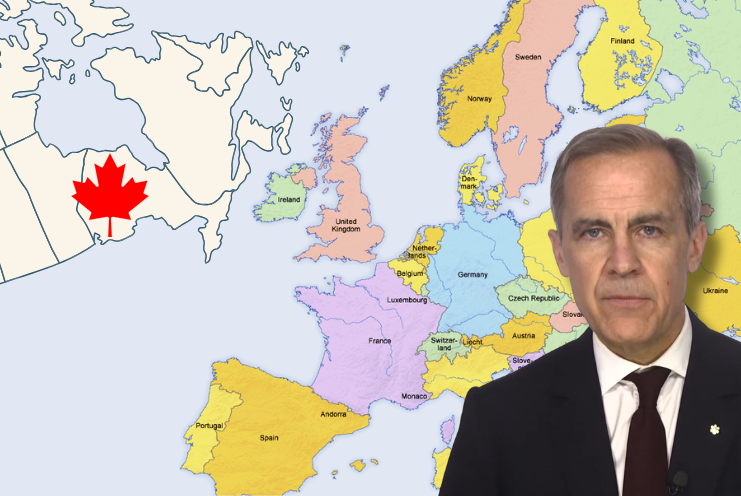
Report: Carney’s plan to protect Canada from US aggression to relocate entire country to Europe
OTTAWA – Prime Minister Mark Carney has reportedly settled on a last-ditch initiative to keep Canada safe from American instability: physically moving the entire nation to the continent of Europe. “The principal reason for Canada’s inextricable ties to the United States is that they are geographically speaking, our closest neighbour. Therefore, the solution seems patently […]
The post Report: Carney’s plan to protect Canada from US aggression to relocate entire country to Europe appeared first on The Beaverton.
Study finds jogging for just 30 minutes a day can add 30 minutes of stress to your life
Cambridge, MA – A new study from Harvard science has indicated that individuals who engage in just 30 minutes of jogging a day add 30 minutes more of stress into their day against those who do not. “Our recent forays into light exercise have really changed some of our preconceived notions,” explained Maya Brownstein, from […]
The post Study finds jogging for just 30 minutes a day can add 30 minutes of stress to your life appeared first on The Beaverton.


Karimihishirogibassaishiki
The Karimihishirogibassaishiki (仮御樋代木伐採式) is another ceremony leading up to the Shikinen Sengū (式年遷宮) at Isë Jingū (伊勢神宮), and was held on May 17th in the mountain forests in in Kiso, Nagano Prefecture that are supplying much of the timber for the rebuilding process. It was reported in the 25th May issue of Jinja Shinpō.
In Japanese, parts of the name are self-explanatory. “Shiki” is “ceremony”, while “bassai” means “felling (a tree)”, and “gi” is “tree”. “Kari” means “temporary” or “substitute” or “provisional” — it is the character used in the Japanese for “working title”, for example. “Mihishiro”, however, would probably mystify most native speakers. It is the name for the containers in which the sacred objects housing the kami, the goshintai (御神体), are housed at Jingū. I reported on the ceremonies for felling the trees for that last year. The Karimihishiro is the box in which the goshintai is placed while it is being transported from the old sanctuary to the new in the final ceremony of the Shikinen Sengū, the Sengyo-no-Gi (遷御の儀). It is moved from the old Mihishiro to the Karimihishiro at the beginning of the ceremony, and then moved to the new Mihishiro at the end, which means that this item is used for a few hours at most — but in the most sacred part of one of the most sacred ceremonies in Shinto.
The tree was chosen, and a shimenawa wrapped around it. Then a ritual space was set up in front of it, and purified. Offerings were presented at the base of the tree, and a representative from Jingū read a norito. According to the article, this matsuri honours “The Great Kami Present at the Base of the Tree(s) in the Honourable Timber Mountains in Kiso in Shinano Etc.”. That “etc.” is common in Japanese, to indicate that a list is not exhaustive, and so suggests that other kami are also honoured. It is not clear how many kami the Great Kami is in the first place (one? one per tree?), and so this presumably indicates other kami, of another type. Japanese ambiguity strikes again. I should note that asking the authors what the “etc” means does not always elicit a useful answer — sometimes they have no idea. (“Shinano”, on the other hand, is just the old name for the region now called “Nagano”. That one is easy.)
After the matsuri, the tree was cut down in the traditional way, just as for the trees for the Mihishiro, and after being placed at the centre of a celebration in the local town (Agematsu) for a couple of days, it was delivered to Isë by road.
At least, I think it was one tree. The photographs look like a single tree, but the article says that the tree is for the Karimihishiro for both the Inner and Outer Sanctuaries, and also for the fourteen Betsugū. It is possible that these are all made from one tree, because they cannot be that large (they are carried during the ceremony), but it is also possible that there are multiple trees. Overall, I think this is one tree, but this article is not completely clear.
About 150 people attended this ceremony, which secures the timber for something used for a few hours at most, and which honours the nameless kami of one or more trees. It is a crystallisation of one aspect of Shinto — an aspect that I suspect is quite appealing to contemporary sensibilities.
The *FREE* secret fruit hiding near you (probably)
U.S. names with the oldest population

Erin Davis calculated the average age of people with a given name to find the oldest name in the United States:
In short, the U.S. government produces estimates of the share of people born in year X who will still be alive in year Y. It also produces data on how many babies with a given name are born in each year.
By combining these two datasets, we can estimate how many babies with a specific name born in year X are still alive in 2025. Then, we can use those numbers to find a weighted average age for that name. (One big flaw this doesn’t account for immigration, but I haven’t found a way around that)
Myrtle wins for oldest average age. Davis provides an interactive version to search for your name.
Tags: age, Erin Davis, names
When ICE ramped up enforcement, US-born workers didn’t see any economic gains

President Donald Trump campaigned on a promise to strengthen the labor market. His immigration platform – including a pledge to conduct the largest deportation campaign in U.S. history – was central to that promise.
“For too long, Washington ignored how mass illegal immigration artificially suppressed wages, hurting working-class Americans – especially young men,” wrote Treasury Secretary Scott Bessent on X in July 2025. “But under President Trump, we now have a secure border, a blue-collar wage boom, and major investments from trade deals.”
The labor market tells a different story. In the first year of Trump’s second term, unemployment rose, hiring slowed and wage growth stagnated. The construction sector was hit particularly hard.
We’re scholars of labor markets, immigration and public environmental policy who have examined how these economic trends can be traced to the mass deportation campaign of Trump’s second term. Notably, while areas with heavier ICE enforcement saw a drop in employment among immigrants, there was no increase in either employment or wages among U.S. citizens.
A chilling effect on immigrant workers
Using data from October 2023 through November 2025, we looked at employment rates and wages for immigrant and U.S.-born workers in places that experienced sudden spikes in ICE arrests and compared them to places that did not.
In the regions where U.S. Immigration and Customs Enforcement ramped up its activity, we found a significant drop in the employment rate among likely undocumented immigrants who were neither detained nor deported. This was especially notable in sectors where such workers are heavily represented – such as agriculture, construction, manufacturing and wholesale markets – where we found a 4% drop in the employment rate.
These immigrants appeared to be staying home out of fear, a concern that’s widespread. In a Pew Research survey from summer 2025, 43% of foreign-born respondents said they feared deportation for themselves or someone close to them. We call this a chilling effect, since these people aren’t physically removed from the labor market. Instead, they changed their behavior because of ICE.
The chilling effect on employment in Trump’s second term is roughly double of what we found in prior work on mass deportations, when we looked at a program in President Barack Obama’s first term called Secure Communities. As we wrote in a companion paper co-authored with sociologist Caitlin Patler, a likely explanation is that ICE arrests during Trump’s second term have been far more indiscriminate and visible: The average number of daily ICE arrests was higher than any time in the past 10 years. The percentage of arrests conducted in public spaces – streets, workplaces, courthouses and school parking lots – more than doubled, rising from 19% to nearly 50% of all apprehensions. As a result, the intimidation effect was likely more widespread.
The broader effects
Trump pledged during his 2024 presidential campaign to focus ICE enforcement on criminals, especially violent offenders. In fact, we found the share of immigrants arrested by ICE who had a criminal conviction fell to a nearly record low in this time period, from roughly 60% in January 2025 to under 30% by the end of the year.
The economic effects have extended beyond immigrant workers. More broadly, many consumers have pulled back.
Other researchers have found that in cities with expanded ICE raids in 2025, consumer spending and economic activity fell. In February 2026, for example, Minneapolis officials estimated that the city’s economy lost US$203 million due to falling restaurant, hotel and retail revenues, as well as lost wages. Another analysis found that states with enhanced ICE enforcement saw aggregate credit- and debit-card spending drop by 1.7 percentage points compared with those that did not.
Scholars have found similar effects with foot traffic, which dropped sharply in areas where ICE expanded its activities. A Wharton study released in May 2026, for instance, estimated that foot traffic in areas heavily impacted by ICE operations dropped by 2.7%, with spending down by 6.2%, per week.
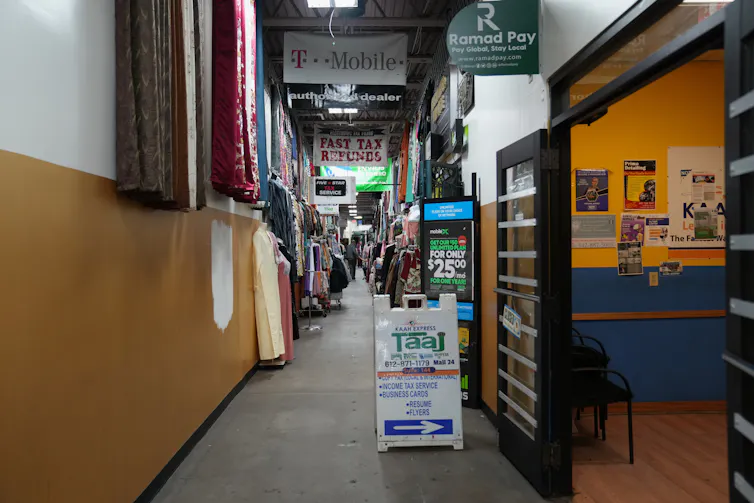
What happened to US-born workers?
Trump’s core political promise was that deportations would open up jobs for American workers. But we found the opposite: Employment among U.S.-born workers also declined in areas with heightened ICE activity. And employers didn’t respond by raising wages to attract more Americans to their workplace. Their demand for workers contracted instead.
At issue is the premise that foreign-born and U.S.-born workers directly compete for the same jobs. But the example of Trump 2.0 underscores a different dynamic. As we and other economists have documented, the labor market is not zero-sum. Immigrants and U.S.-born workers tend to fill complementary jobs rather than compete for identical ones.
Construction is a clear example. Fewer undocumented laborers on a job site means less work for the electricians, roofers and supervisors – roles more commonly held by U.S.-born workers who depend on those projects moving forward.
The broader stagnation of employment in the construction industry in 2025 fits this pattern. It also mirrors earlier findings that Obama-era deportations reduced homebuilding and pushed up new-home prices.
Immigration crackdowns are, of course, nothing new in U.S. history. In the early 1930s, President Herbert Hoover expelled 400,000 Mexican workers, which lifted neither wages nor employment of U.S.-born workers. Obama’s Secure Communities program in the 2010s had similar results.
And as our most recent research shows, mass deportations don’t create new job opportunities for American citizens. Presidents seeking to strengthen the labor market will need to look elsewhere.

Chloe N. East receives funding from the Russell Sage Foundation and NSF.
Elizabeth Cox receives funding from the Russell Sage Foundation and the National Science Foundation.
You’ve been trying to get around Amazon – but it’s not that easy
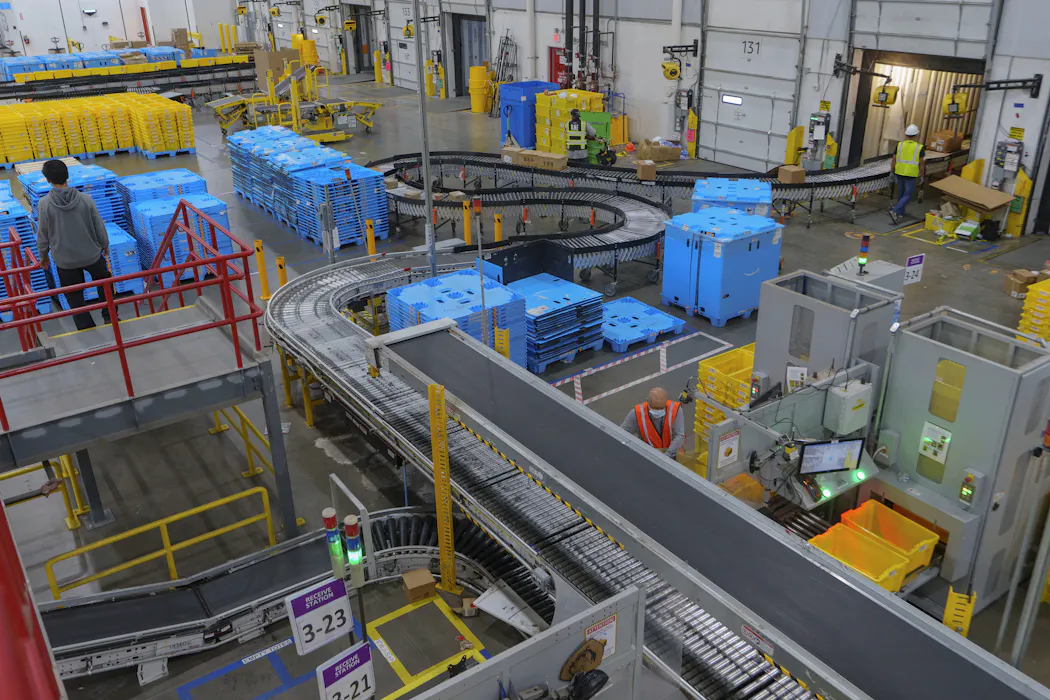
You did the right thing this morning.
Instead of the one-click default to your laptop’s last opened tab, you opened Etsy and bought a ceramic mug from a maker you’d been following on Instagram. Yesterday, your sister’s birthday gift came from a Shopify store run by a kitchenware designer in Sacramento, California. You felt something when you clicked “buy,” a small, warm, fuzzy feeling. Not Amazon. Not a giant. Someone real.
The package will arrive on time, in unmarked brown cardboard, in two days.
It will arrive that way because Amazon delivered it.
On May 4, 2026, Amazon announced the launch of Amazon Supply Chain Services. It opens Amazon’s warehouses, trucks and delivery network – built over decades to ship products from its own website – to outside companies of any size. Procter & Gamble, 3M, Lands’ End and American Eagle are among the first customers. The headlines framed it as a logistics story – Amazon is coming for UPS and FedEx – and most coverage stopped there.
But the bigger shift is one that consumers can’t see, and it has to do with how they support small businesses. A 2024 Pew Research survey found that 86% of Americans say small businesses have a positive effect on the country. For the millions of shoppers who have been redirecting their dollars away from corporate giants and toward small and local businesses, the May 4 announcement isn’t a logistics story at all. It’s about whether that effort still means what they think it means.
We’re scholars of consumer behavior and marketing who study how people square their purchasing decisions with ethical considerations, and we see a growing dilemma for consumers: If you pick the small brand instead of the giant, part of your payment actually goes somewhere you don’t expect. You may think you’ve made a conscious choice, but you’ve just walked through a different door into the same store.
And it’s getting harder and harder to escape.
Invisible but growing
Dragon Glassware is a small kitchenware company that began in a garage in Sacramento in 2017. You may have bought one of their wine glasses on their Shopify website, drawn in by the founder’s story and the small-business feel. Yet the order was picked, packed and shipped from an Amazon warehouse.
Another example is Poppi, which started at a Texas farmers market and went viral on TikTok as a cooler, healthier alternative to the giant soda companies. For years, the cans you ordered from Poppi’s own website – the ones that felt like a vote against Big Soda – were shipped to you by Amazon. Poppi was sold to PepsiCo for nearly US$2 billion in 2025, which is its own David-becomes-Goliath story.
These aren’t rare cases. Amazon’s Multi-Channel Fulfillment program, the service that ships these orders, now serves more than 200,000 U.S. merchants, and the network grew by roughly 70% in 2024 alone, according to Amazon. The same Amazon service also handles fulfillment for sellers on Shopify, Etsy, eBay and TikTok Shop. But you wouldn’t know this — the packaging is left unmarked by design.
What changed on May 4 is that Amazon opened this service up for all businesses – not just the small brands that have been there all along, but every kind of company at every size, from American Eagle retail orders to Procter & Gamble raw-material shipments between factories.
Peter Larsen, the executive quoted in the May 4 press release, said Amazon is doing for shipping what Amazon Web Services did for the internet. But there’s more to that comparison. Most people don’t know which websites run on AWS, and they don’t care. That’s the kind of invisibility Amazon is now building underneath physical things, too.

It’s also extremely lucrative. Amazon collects a fulfillment fee on every order it ships for an outside brand – roughly $15 for a three-pound package shipped in two days, according to Amazon’s own published rates. It also collects monthly storage fees on that brand’s inventory. And it gathers real-time visibility into what every competitor sells, to whom, in what quantities, at what moments of the year.
Amazon CEO Andy Jassy publicly described Supply Chain Services as a “major growth opportunity.” When Amazon says growth opportunity, it means the same thing it said about AWS – a business that could one day rival its retail arm.
Why the small brands are using Amazon
It’s tempting to think the small brands are selling out. They’re not. They’re doing the math.
A small kitchenware founder shipping out of her own garage can only get a wine glass to a customer in three to five days. Amazon’s network can get there in two. After 15 years of Amazon Prime, two-day delivery isn’t a luxury – it’s what shoppers expect. Small brands that can’t match it lose sales. Independent fulfillment companies exist, but Amazon’s service is typically cheaper and integrates directly with the platforms small brands already sell on, such as Shopify, Etsy, TikTok Shop and eBay.
The bigger implication is upstream, however. Amazon now controls roughly four out of every 10 dollars Americans spend online – more than four times the share of its nearest competitor. A small brand that wants to be discovered by new customers has little choice but to be on Amazon. Once there, the path of least resistance is to use Amazon’s warehouses for everything – including the orders that come in from Shopify and Etsy.
So for consumers, the choice technically exists. But the economics make it a decoy. And the more small brands are routed through Amazon’s network, the more Amazon can raise fees, change terms and shape the conditions for small commerce. In fact, Multi-Channel Fulfillment prices have already risen for three years running.
If even Procter & Gamble has decided to route part of its logistics through Amazon, what can a kitchenware founder in Sacramento realistically do?
For years, you’ve been telling yourself something every time you supported a small business – that your dollars meant something, that you weren’t pouring every dollar into the same handful of giants. But what does shopping your values even mean when the system underneath is invisible?
The impulse to shop your values isn’t naive. But it’s becoming harder to act on. For small businesses caught in the middle, deeper dependence on Amazon’s logistics means rising fees, with no leverage to push back. For those consumers who want choices, it means something uncomfortable: They can keep trying harder to avoid the giants, but the giants keep getting bigger anyway.
The mug will arrive Tuesday. It will be beautiful, made by hand, wrapped in brown paper tied with twine. The truck pulling up outside won’t have a logo on it. None of that is an accident. All of it is by design.

The authors do not work for, consult, own shares in or receive funding from any company or organization that would benefit from this article, and have disclosed no relevant affiliations beyond their academic appointment.