Last month, Japan's central bank raised interest rates for the first time in 17 years. That is a really big deal, because it means that one of the spookiest stories in modern economics might finally have an ending.
Back in the 1980s, Japan performed something of an economic miracle. It transformed itself into the number two economy in the world. From Walkmans to Toyotas, the U.S. was awash in Japanese imports. And Japanese companies went on a spending spree. Sony bought up Columbia Pictures. Mitsubishi became the new majority owners of Rockefeller Center.
But in the early 1990s, it all came to a sudden halt. Japan went from being one of the fastest growing countries in the world to one of the slowest. And this economic stagnation went on and on and on. For decades.
On this episode, the unnerving story of Japan's Lost Decades: How did one of the most advanced economies in the world just fall down one day — and not be able to get up? Japan's predicament changed our understanding of what can go wrong in a modern economy. And gave us some new tools to try and deal with it.
This episode was hosted by Jeff Guo. It was produced by Emma Peaslee and engineered by Cena Loffredo. It was edited by Molly Messick. Alex Goldmark is Planet Money's executive producer.
The U.S. labor market continues its hot streak, adding 303,000 jobs last month — more than expected. Many of these jobs will require a four-year degree despite a push among some employers to eliminate these requirements. On today's show, we look at the state of the job market for people without a four-year college degree.
We take stacks and heaps for granted nowadays, but back in the very old days of computing, computers operated without a stack or a heap.
Tell a recent college graduate this, and you may as well tell them that there was a time when you didn’t have instant access to millions of cat videos.
It’s not too hard to imagine computing without dynamic memory allocation. You just have to use fixed-size memory buffers for everything. If you have to operate on variable-sized data, you reserved a fixed-size buffer of some capacity that is large enough to accommodate any data you would reasonably be expected to process, and if somebody asked for more, you just exited the program with a fatal error. If you were really nice, you would provide a compile-time configuration so your clients could adjust the maximum capacity to suit their datasets. And if you were really fancy, you wrote a custom allocator that operated on that fixed-size buffer so people could “allocate” and “free” memory from the buffer.
But operating without a stack? How did you call a function if you didn’t have a stack for the return address or local variables?
Here’s how it worked.
First, the compiler defined a secret global variable for each inbound function parameter, plus another secret global variable for each function to hold the return address. It also defined a secret global variable for each of the function’s local variables.
To generate a function call, the compiler assigned the parameter values to the corresponding secret global variables, assigned the return address to the function’s secret “return address variable”, and then jumped to the start of the function.
The function read its parameters from its secret global variables, and used the pre-defined secret global variables that corresponded to its logically local variables. When the function was finished, it jumped to the address held in the function’s secret “return address variable.”
For example, suppose you had code like this, written in a C-like language:
int add_two_values(int a, int b)
{
    int c = a + b;
    return c;
}

void sample()
{
    int x = add_two_values(31415, 2718);
}
This would be transformed by the compiler into something like this:
int a2v_a;
int a2v_b;
int a2v_c;
void* a2v_retaddr;

int add_two_values()
{
    a2v_c = a2v_a + a2v_b;

    return_value_register = a2v_c;
    goto a2v_retaddr;
}

int sample_x;
void sample()
{
    a2v_a = 31415;
    a2v_b = 2718;
    a2v_retaddr = &resume;
    goto add_two_values;
resume:
    sample_x = return_value_register;
}
Check it out: We did a function call and return without a stack!
Now, you can optimize the ABI by, say, passing some of these values in registers rather than globals. For example, most processors had a special “link” register and a special instruction “branch with link” that automatically set the link register equal to the address of the instruction after the “branch with link” instruction, And maybe you optimize the calling convention to pass the first two parameters in registers, resulting in this:
int a2v_a;
int a2v_b;
int a2v_c;
void* a2v_retaddr;

int add_two_values()
{
    a2v_a = argument_register_1;
    a2v_b = argument_register_2;
    a2v_retaddr = link_register;

    a2v_c = a2v_a + a2v_b;

    return_value_register = a2v_c;
    goto a2v_retaddr;
}

int sample_x;
void sample()
{
    argument_register_1 = 31415;
    argument_register_2 = 2718;
    branch_with_link add_two_values;
    sample_x = return_value_register;
}
There was just one catch: You can’t do recursion.
Recursion doesn’t work because a recursive call would overwrite the return-address variable with the return address of the recursive call, and when the outer call completed, it would jump to the wrong place.
The programming languages of the day solved this problem by simply declaring it illegal: They didn’t support recursion.¹
Bonus chatter: Some compilers were even sneakier and used self-modifying code: The special return-address variable was really the address field of the jump instruction at the end of the function!
After the practical value of subroutines was recognized, quite a few processors added a subroutine call instruction that worked by storing the return address at the first word of the subroutine, and beginning execution at the second word of the subroutine. To return from a subroutine, you execute an indirect jump through the subroutine start label. (As I recall, some processors stored the return address at the word before the first instruction of the subroutine.) Here’s what it looked like using a made-up assembly language:
add_two_values:
    nop                     ; return address goes here
    add   r1 = r1, r2       ; actual subroutine begins here
    jmp   @add_two_values   ; indirect jump to return address

sample:
    mov   r1 = 31415        ; first parameter
    mov   r2 = 2718         ; second parameter
    bsr   add_two_values    ; call subroutine
    st    sample_x = r1     ; save return value
When the CPU executed the bsr branch-to-subroutine instruction, it stored the return address into the first word of add_two_values (overwriting the sacrificial nop) and began execution at the following instruction, the add r1 = r1, r2.
¹ FORTRAN initially didn’t even support subroutines! Those were added in 1958. And support in FORTRAN for recursion didn’t become standard until 1991, and even then, you had to explicitly declare your subroutine as RECURSIVE.
Microsoft Employees Are Hooked on the Company’s Training Videos (WSJ paywall). But really, what I want to call attention to is the video that plays even if you don’t have a subscription: I can tell that the scene was filmed on the fourth floor of Building 41.
Each of the six floors of Building 41 is themed after a stage in the development of computing.
A security vulnerability report came in that went roughly like this:
I have found a permanent denial of service vulnerability in Windows. If you modify this administrative setting (directly via regedit, not via the user interface) to have a specific corrupted value, then when the system boots up, it will use this corrupted value and corrupt the operating system itself, rendering the system unusable. Modifying the setting back to its original value does not repair the problem. The system is permanently corrupted and must be reinstalled. I am requesting a bounty for this report.
This is a fairly cut-and-dried case of “It rather involved being on the other side of this airtight hatchway”: Modifying the setting in question requires administrator privilege, and it’s hardly a surprise that an administrator can render a system inoperable.
Breaking the system by corrupting an administrative setting is just style points. If you are an administrator and want to render a system inoperable, just delete everything in sight, starting with all the files in C:\Windows\System32. Delete anything that isn’t nailed down, and then go get your crowbar (also known as “Take Ownership” privilege) and pry up even the things that are nailed down.¹ No need to get all clever with crafting a corrupted setting.
Now, if the corruption of the setting could be triggered by means that don’t require administrator privileges, then you would have found something. But as it stands, it requires administrator permissions to perform this attack, so you’re starting on the other side of the airtight hatchway.
The finder argued that it is a security flaw that the system doesn’t prevent administrators from corrupting the setting. For example, there are some registry keys in the system that are protected from accidental corruption by making them read-only even to administrators. But these are merely safety measures, not security boundaries. It’s like putting a cover over the emergency shutoff switch in the control room: The cover doesn’t prevent anyone in the control room from pulling the switch. It merely prevents them from pulling the switch accidentally. If somebody with access to the control room really wants to pull the switch or corrupt the registry key, they can do it: They can lift the cover or take ownership of the key and grant themselves full access.
The finder also argued that the system should protect itself from installers that corrupt the setting. But if an installer can corrupt the setting, that means that the installer is running with administrator privileges, so it already can do anything it wants. And that includes removing the corruption protection and rendering the system unusable.
Mind you, preventing administrators or installers from inadvertently corrupting the setting sounds like a reasonable safety measure, and the system already does part of that by showing only non-corrupted options in the administrator user interface. And having the system recognize a corrupted value and stop itself before causing any permanent damage is a reasonable reliability measure, so thanks for pointing out the issue. But it’s not a security issue. You can’t protect against an administrator who intentionally decides to mess up their system.
¹ Another idea is to turn on BitLocker and throw away the BitLocker key. Or go into Advanced Recovery and reformat the system volume!
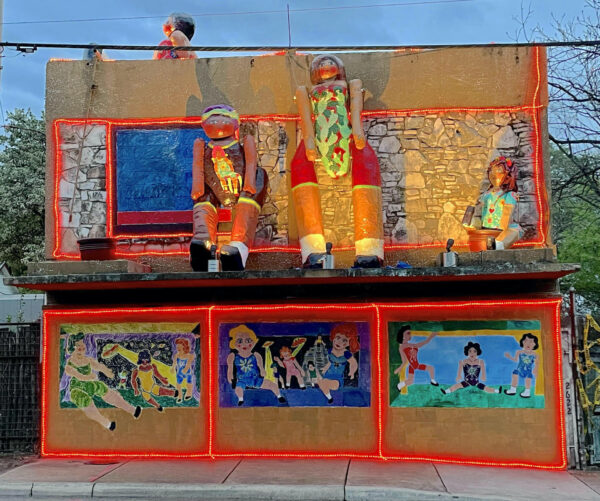
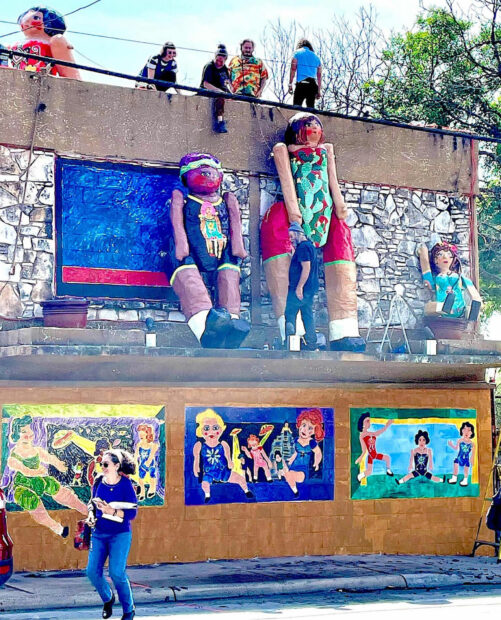
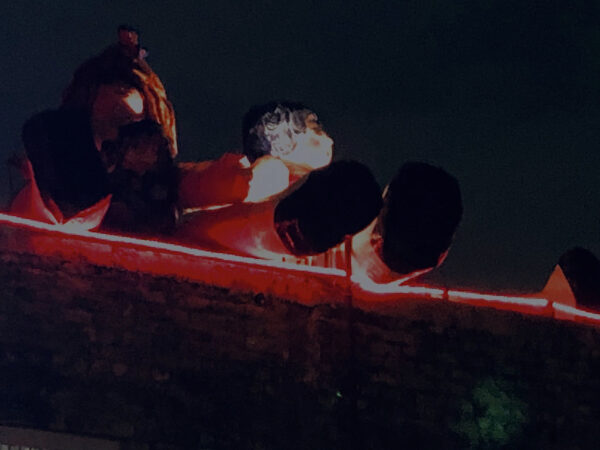
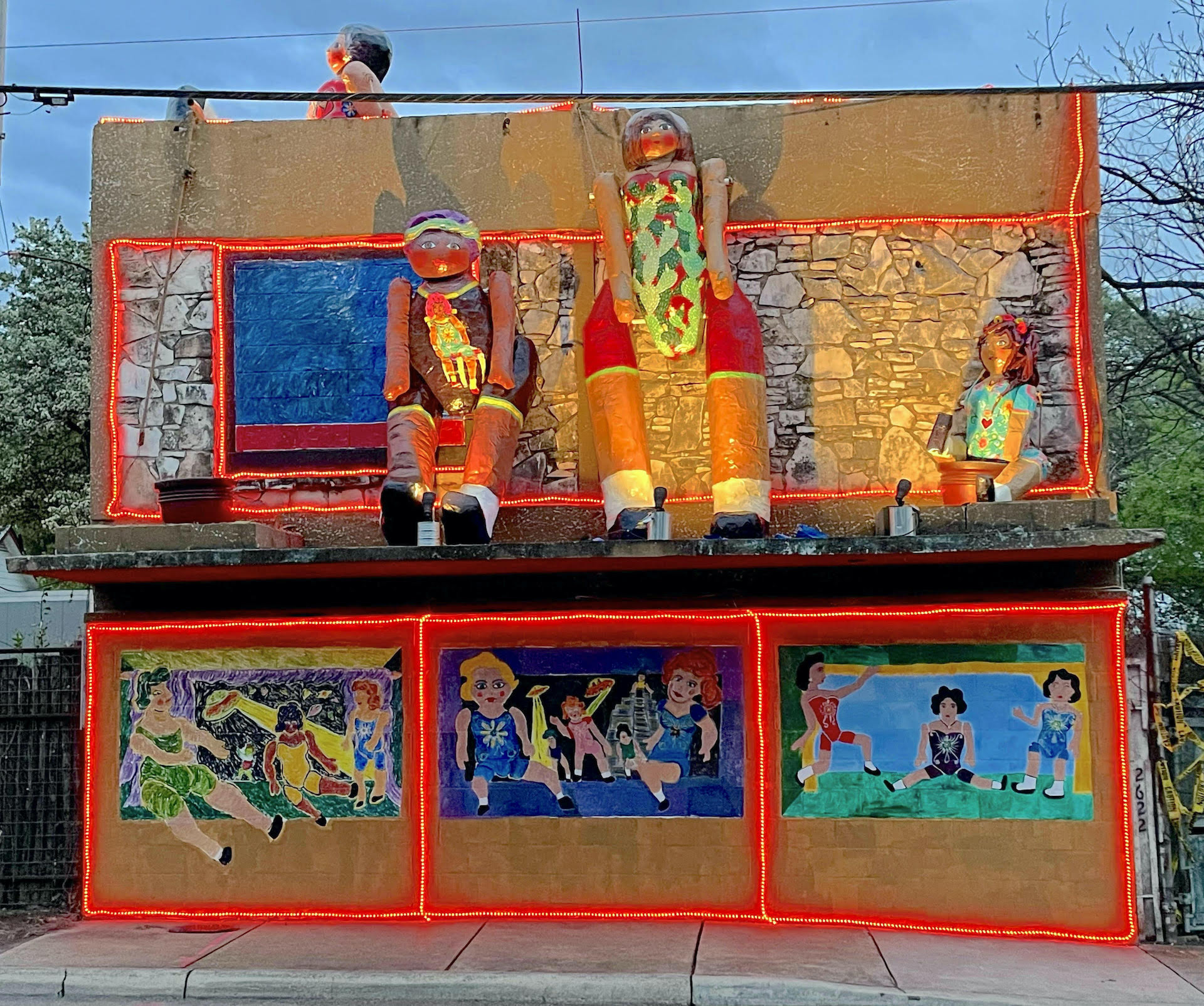
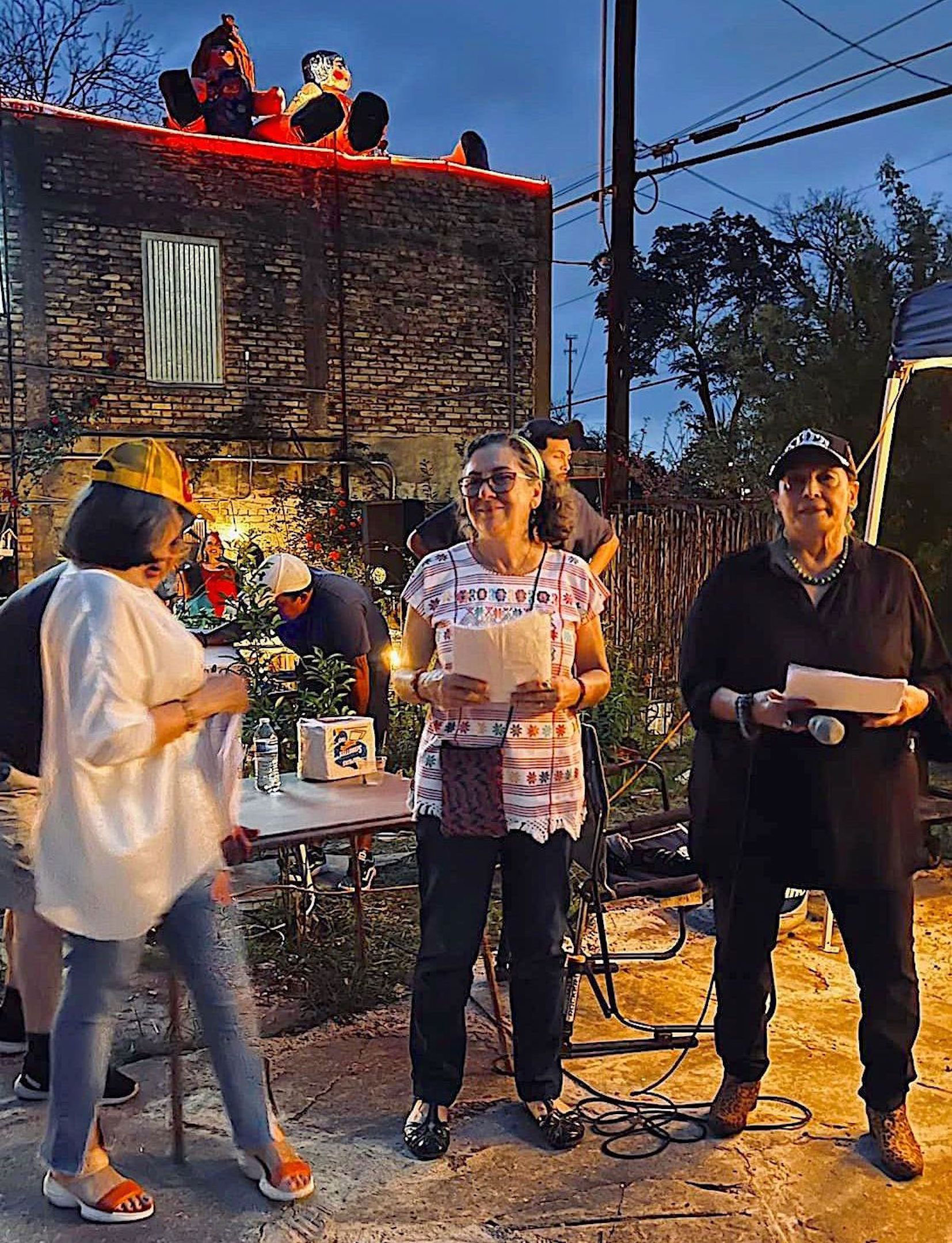
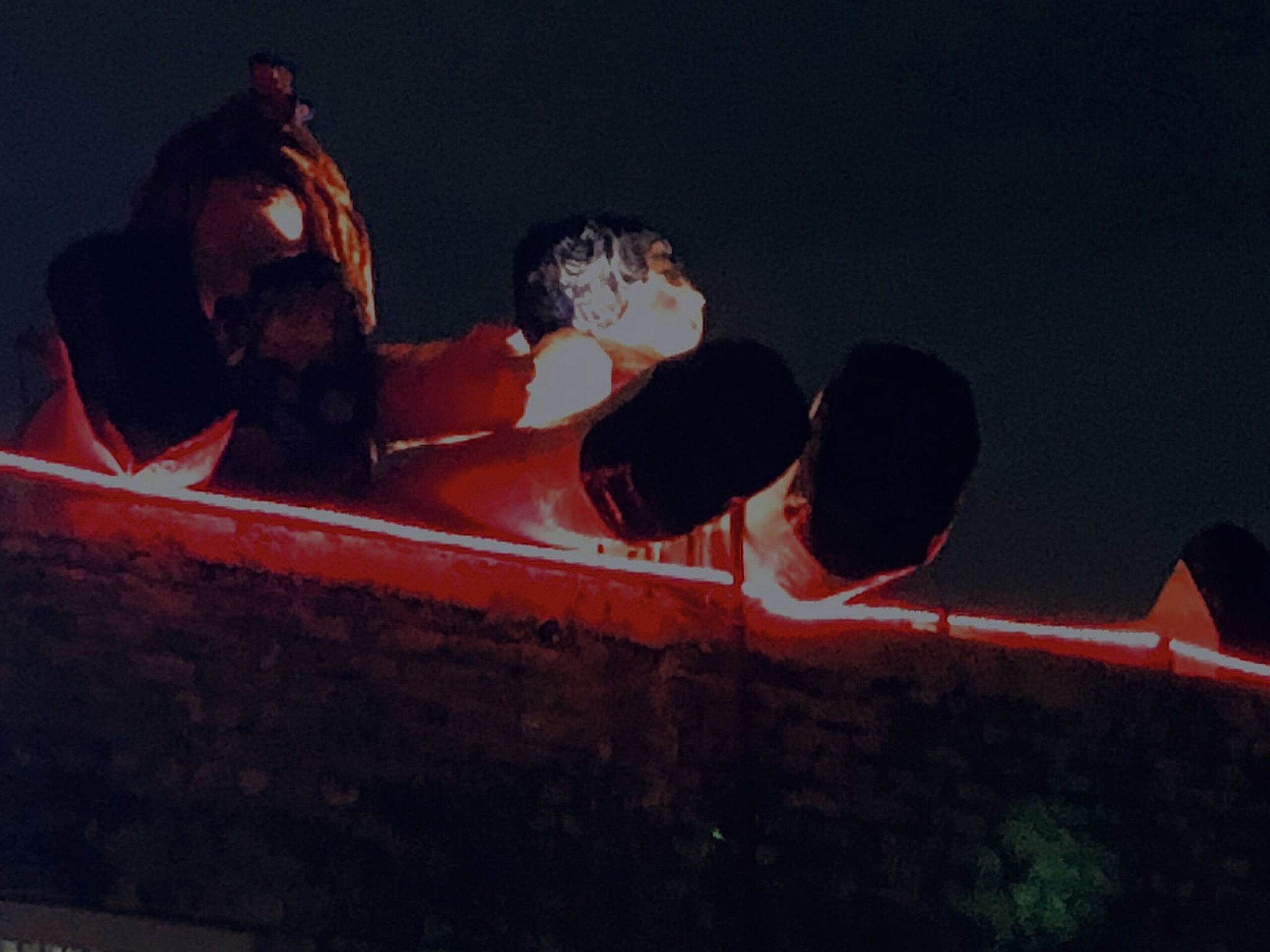
Exterior of Elizabeth Rodriguez’s home facing Guadalupe Street, with red lights, faux storefront windows, and giant Lupita dolls. Photo: Ruben C. Cordova.
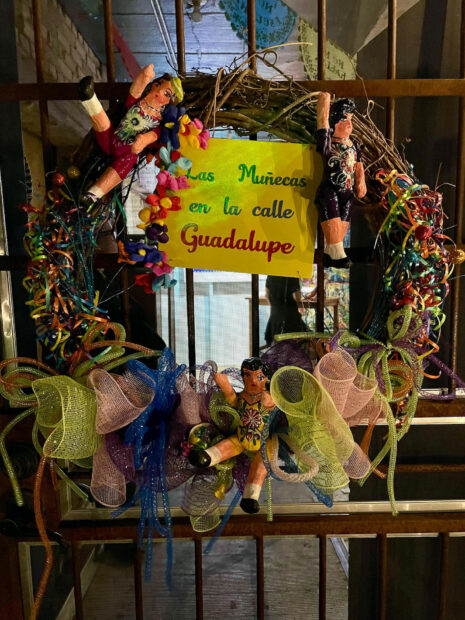
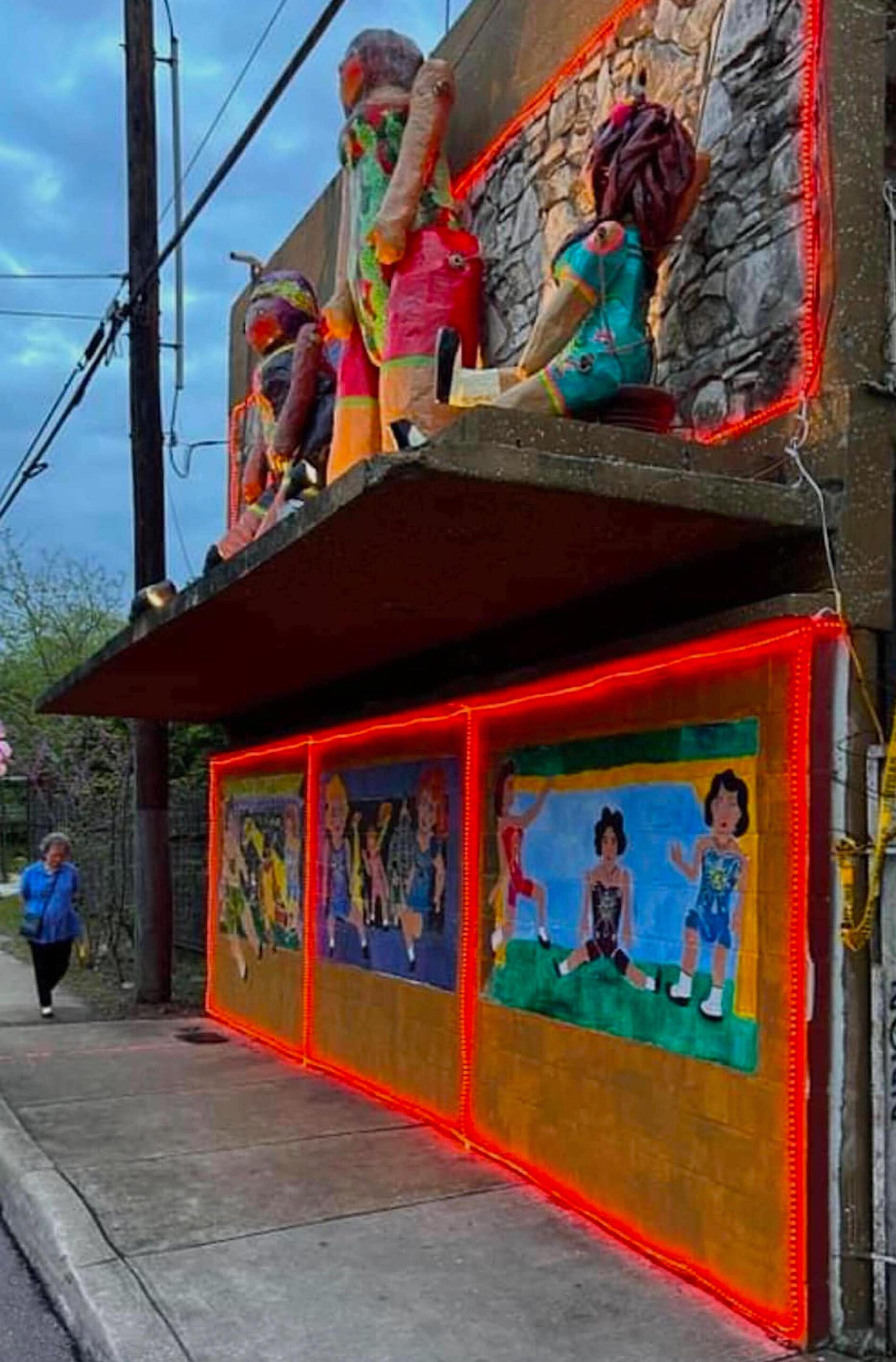
Artist Elizabeth Rodriguez lives in a strange old building on Guadalupe Street built in 1957 to house Arms Plumbing. According to local lore, confirmed by city records after the event was planned, the building served as a brothel in the 1970s and 80s, when prostitution flourished on this street in the Westside of San Antonio. This tradition was addressed in a multi-media installation/event called Muñecas en La Calle Guadalupe on the evening of March 16, when the building was illuminated with red lights to emphasize its former function.
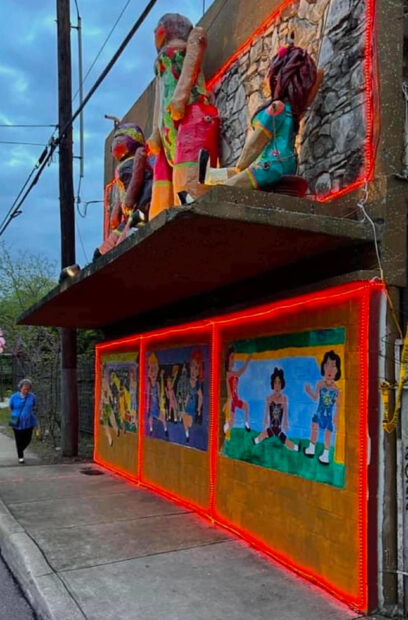
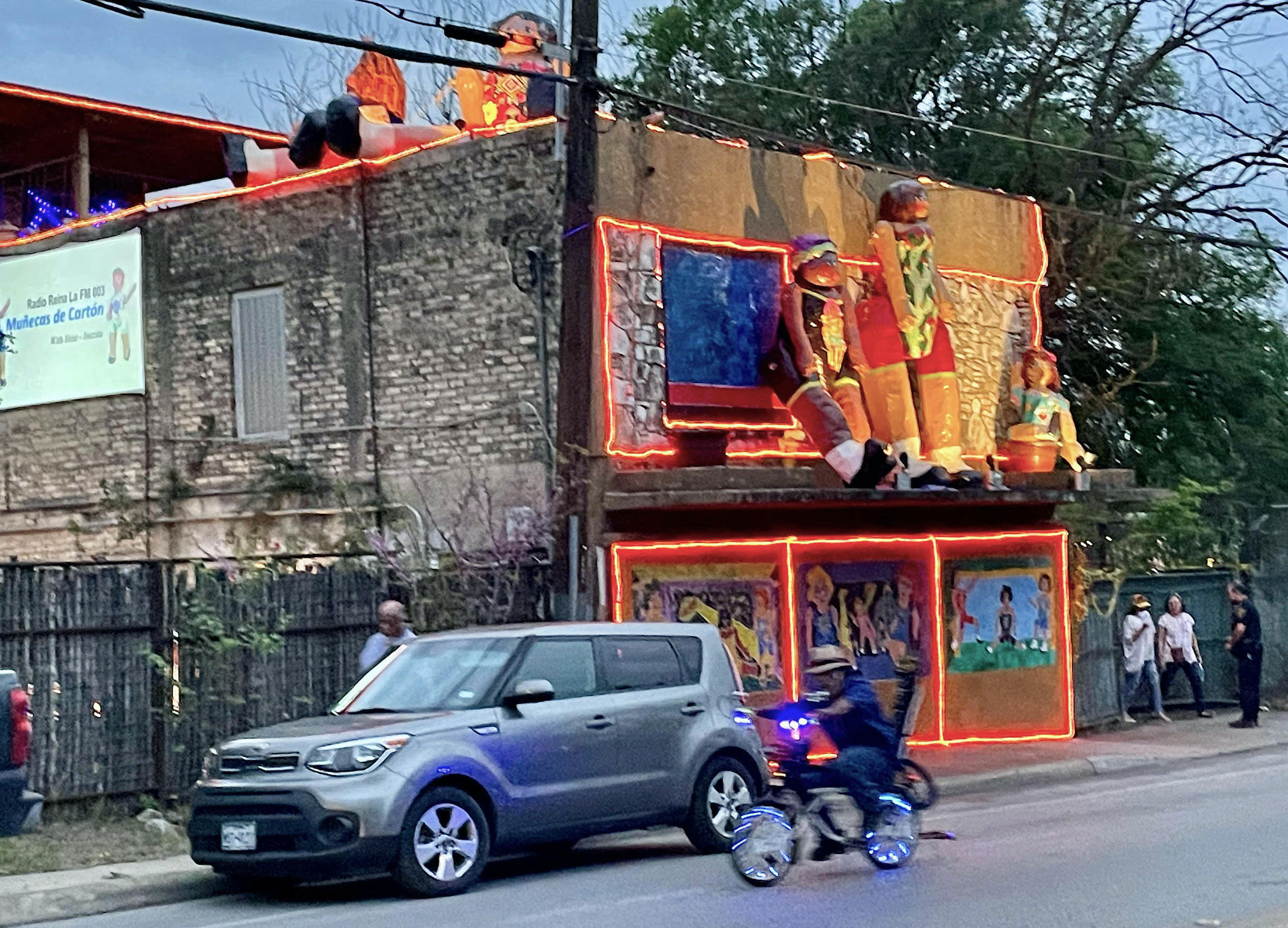
Exterior of Elizabeth Rodriguez’s home facing Guadalupe Street, with red lights, faux storefront windows, and giant Lupita dolls. Photo: E. A. Davis.
In the post-World War II period, prostitution became deeply entrenched on Guadalupe Street, which had a high concentration of bars. When Rodriguez was in middle school in the late 1970s, students would issue this taunt: “Hey, I saw your mother on Guadalupe street,” implying that the mother in question was there turning tricks. Historically, San Antonio’s red-light districts (a.k.a “Sporting Districts”), including Guadalupe Street, never actually utilized red lights. So, in this work, Rodriguez gave material form to a trope or metaphor. Her prolonged stay in Amsterdam in 1999 had given Rodriguez familiarity with the usage of red lights to signify zones set aside for sex work.
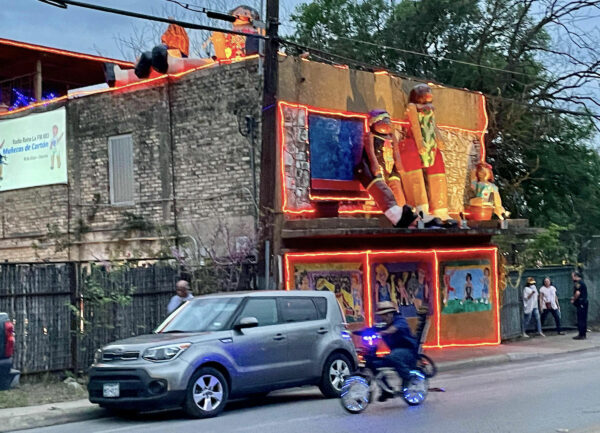
Exterior of Elizabeth Rodriguez’s home facing Guadalupe Street, with red lights, faux storefront windows, and giant Lupita dolls. Photo: Ruben C. Cordova.
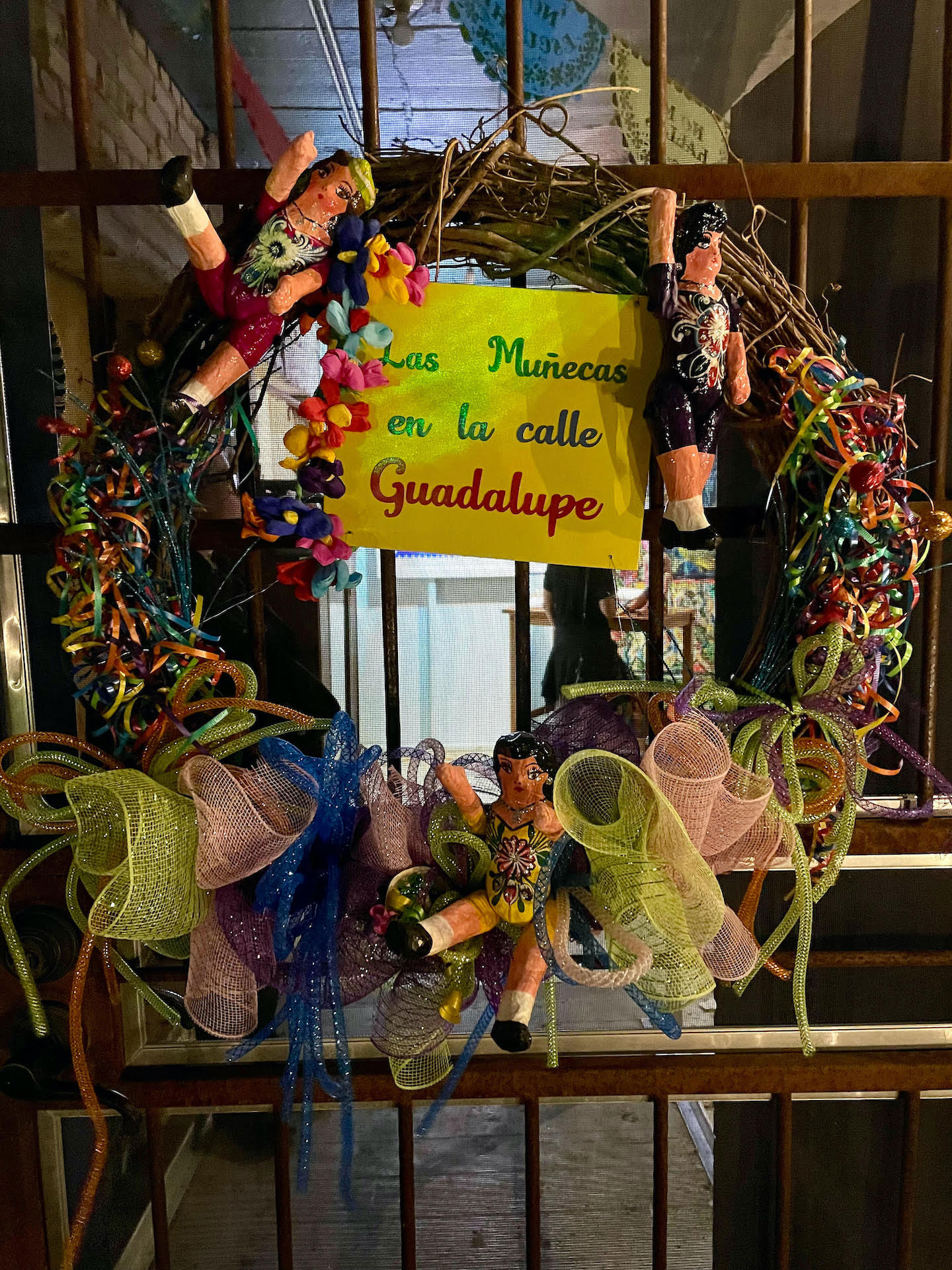
Traditional Mexican papier-mâché muñecas (dolls), known as Lupitas, formed the common thread of the installation. According to some local and Mexican traditions, these folkloric objects, when placed in windows in “red-light” districts, served to advertise the profession of prostitution. In this context, they are referred to as “puta” (whore) dolls.
Rodriguez notes, however, that there is no compelling proof that these dolls ever advertised prostitution on Guadalupe Street. Another tradition holds that a woman might buy a Lupita doll, inscribed with the name of her husband’s mistress, in order to inform him that she knew about his affair. Some artists in the exhibition addressed the theme of prostitution in connection with these dolls. Other artists, who grew up playing with these dolls, did not want to associate them with that particular profession.
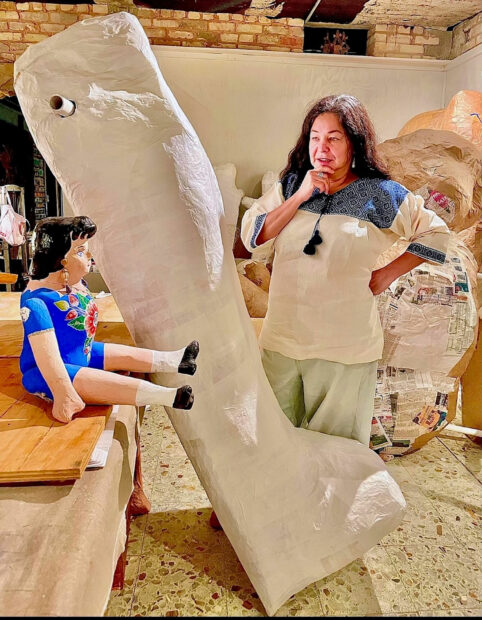
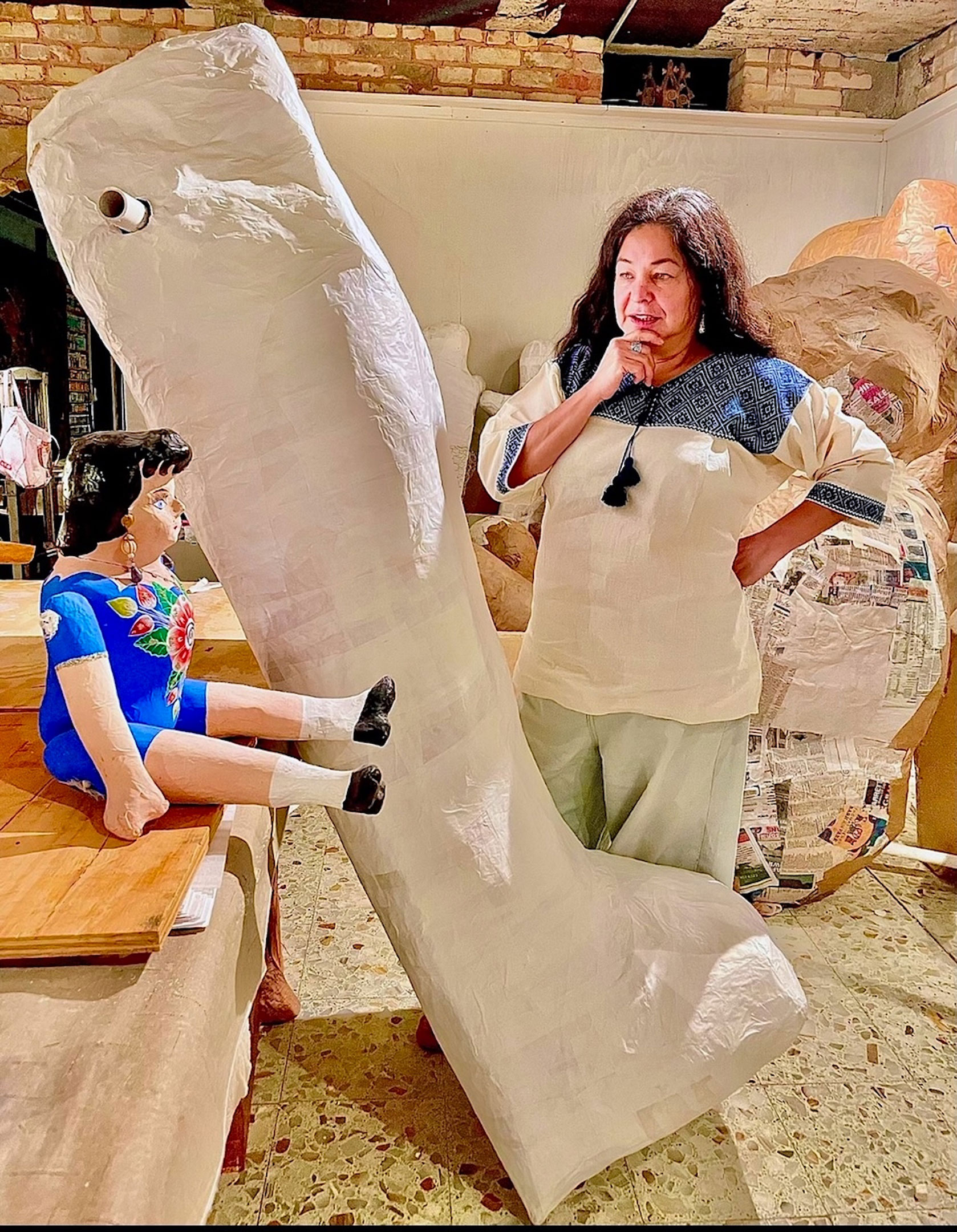
Elizabeth Rodriguez studying the leg of a giant Lupita doll in progress. Photo courtesy of the artist.
Rodriguez and her assistants (which included friends, family, and students) crafted several monumental muñecas over the course of three months. Rodriguez had spent the better part of two years gathering the necessary materials (newspapers, cardboard, chicken wire, plastic bags and other lightweight materials for packing, etc.).
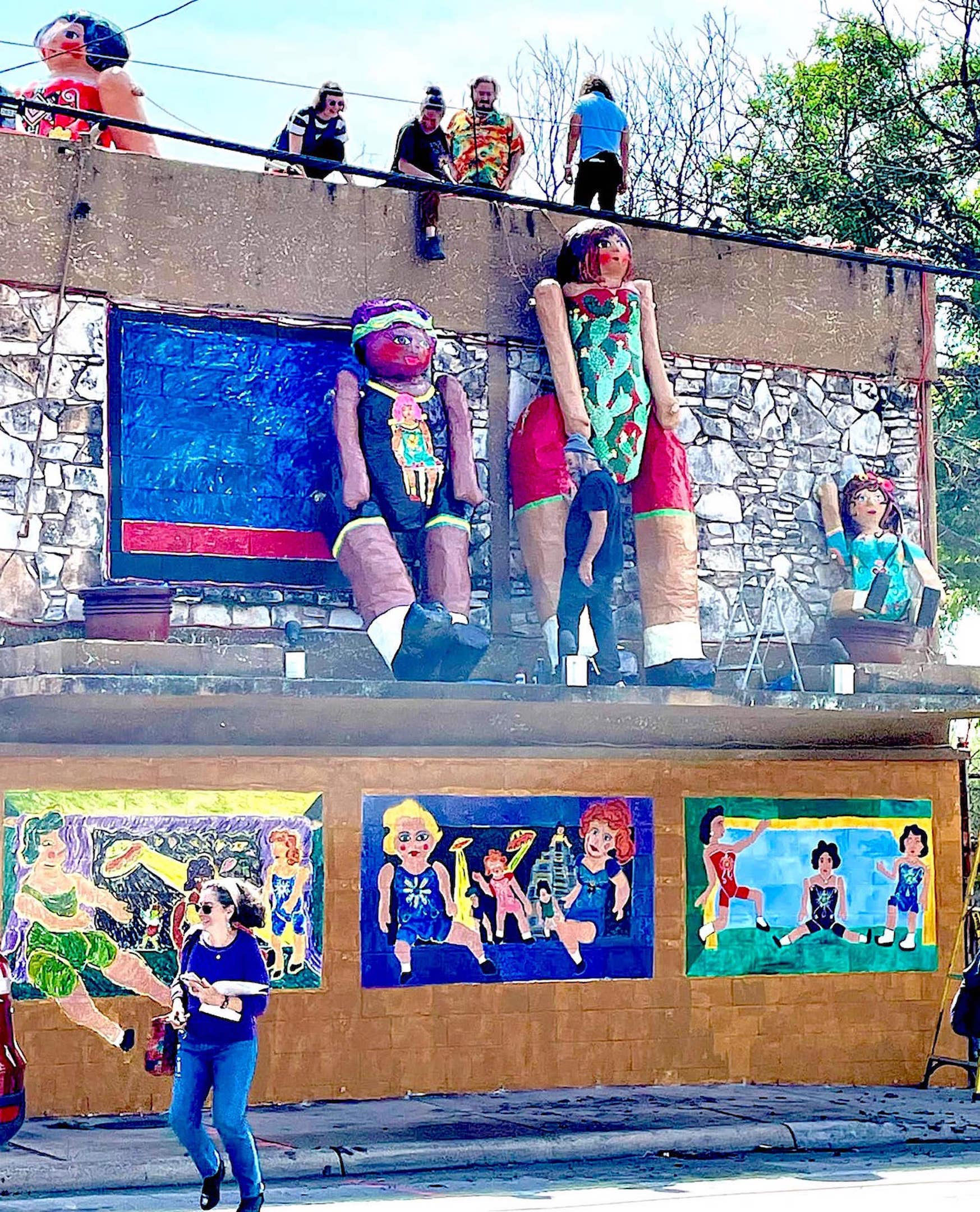
Andy Villareal (center), Elizabeth Rodriguez’s husband, is securing the central muñeca. He also painted the faux windows to create a virtual storefront. The building never had a real opening onto Guadalupe Street, because it served as a garage. The building was accessed from the West, facing Apache Creek. Photo: Barbara Felix.
Several muñecas were placed on the exterior of Rodriguez’s home, in surrealistically inflated homage to their reputed former role on Guadalupe Street.
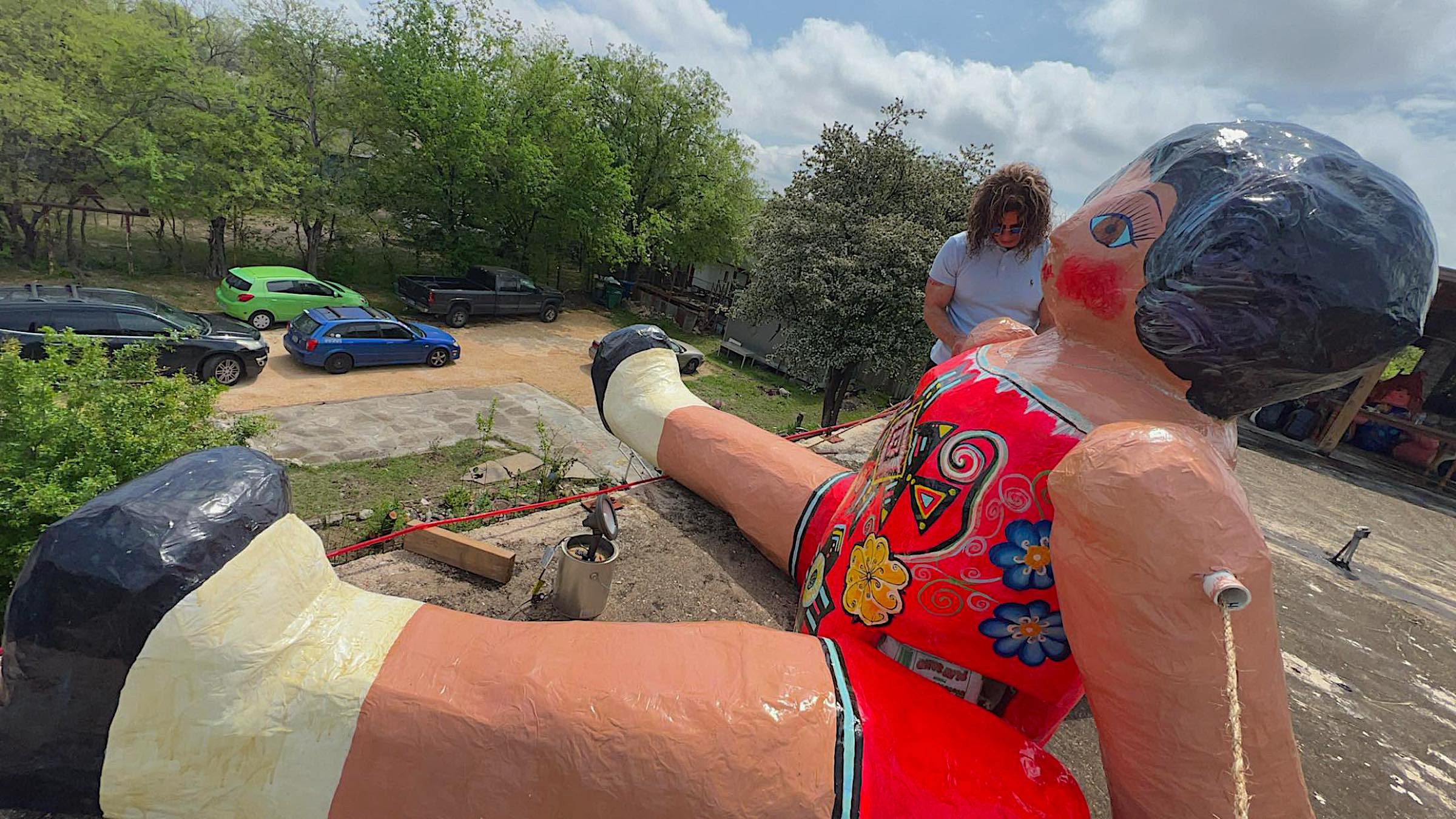
View from the roof with monumental muñeca. Photo: Monica Rodriguez.
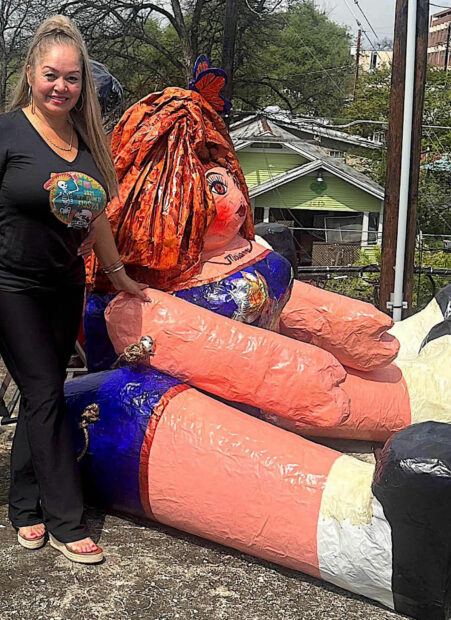
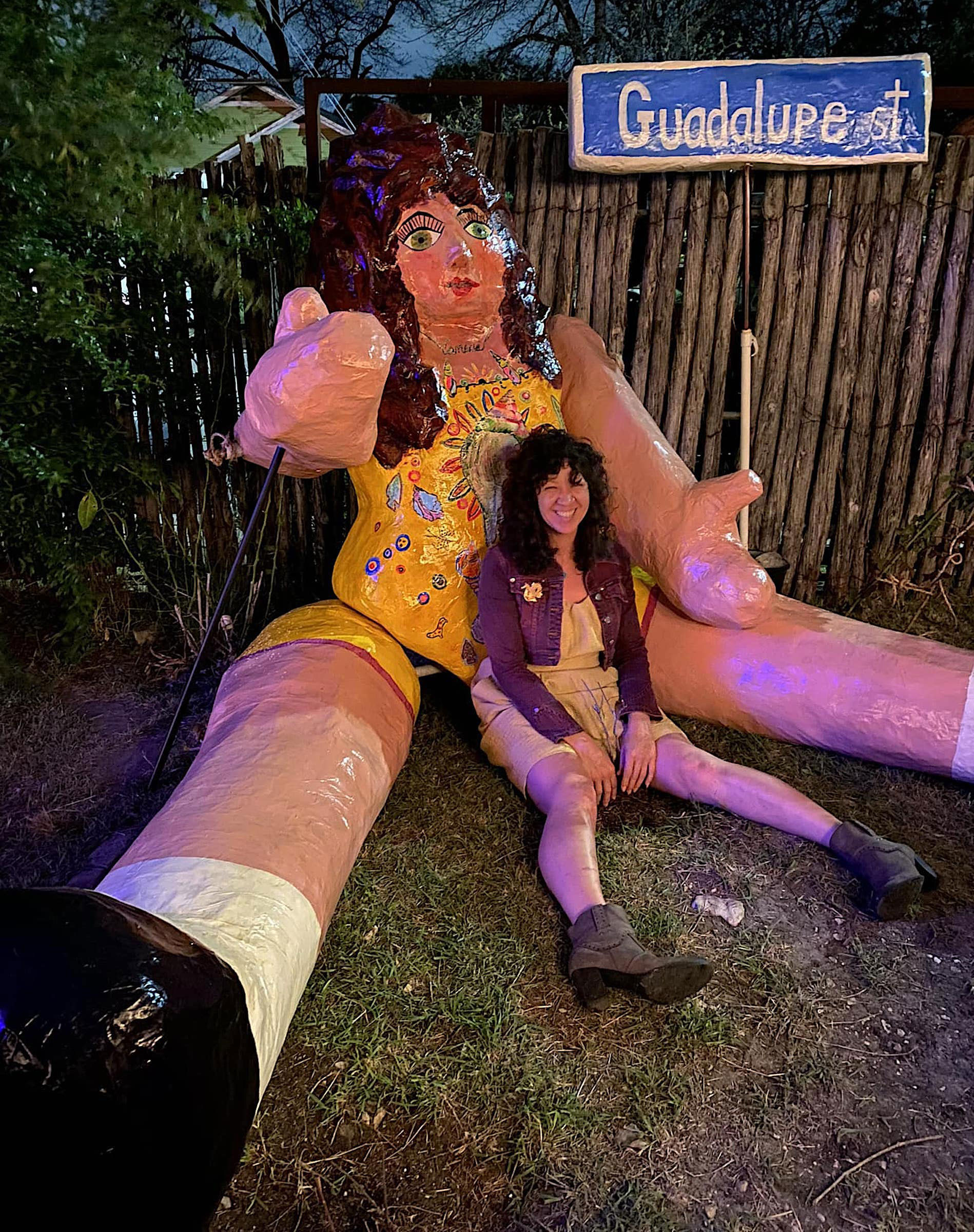
“Muñeca Vanessa” with its human model, Vanessa Herrera Colón. Photo: Sabra Booth
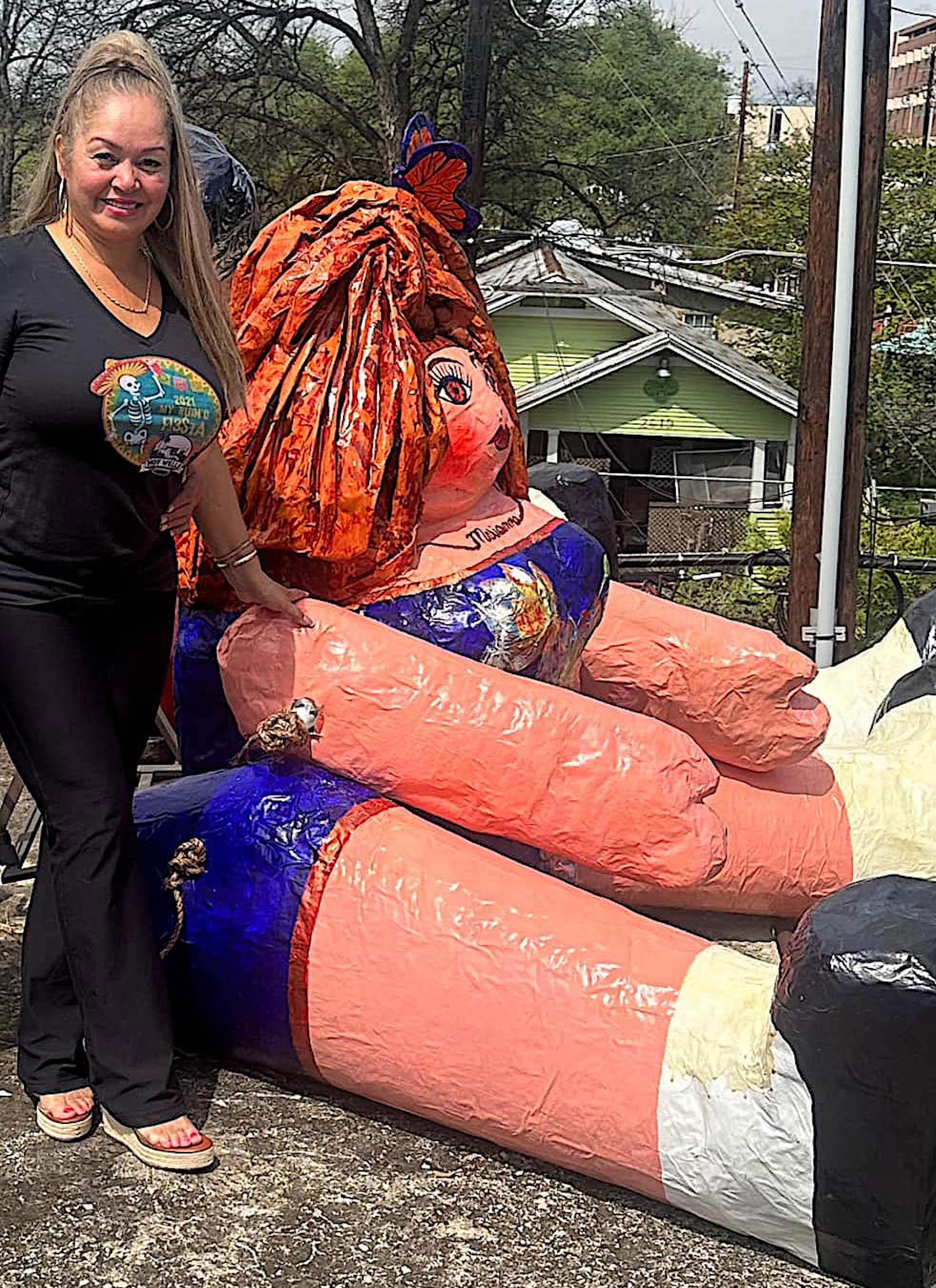
“Muñeca Marianna,” with its human model, Marianna Lujan. Photo: Marianna Lujan’s Facebook.
The largest of these dolls would have been twenty-five feet high had it been able to stand. Rodriguez modeled her dolls on friends, as in the examples pictured above.
Invitation (Marta Sanchez also joined the exhibition after the invitation was printed.) Photo courtesy of the artist.
The Lupita doll served as a common iconography theme utilized by the thirteen women artists that Rodriguez invited to participate in the exhibition, whose work addressed such issues as the (contested) purpose of the traditional dolls, the history of Guadalupe Street as a red-light district, and the general folklore and symbolism of the neighborhood.
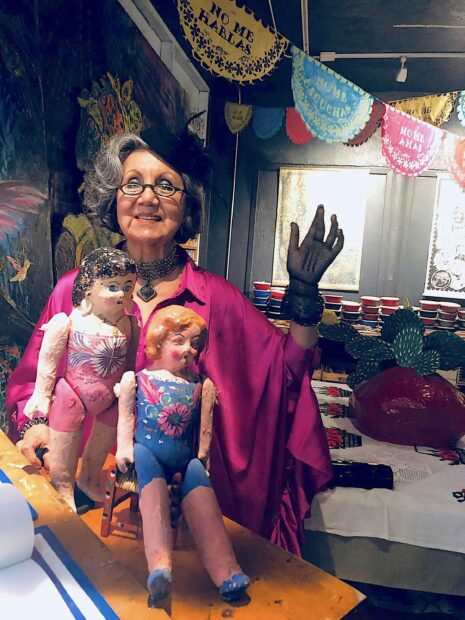
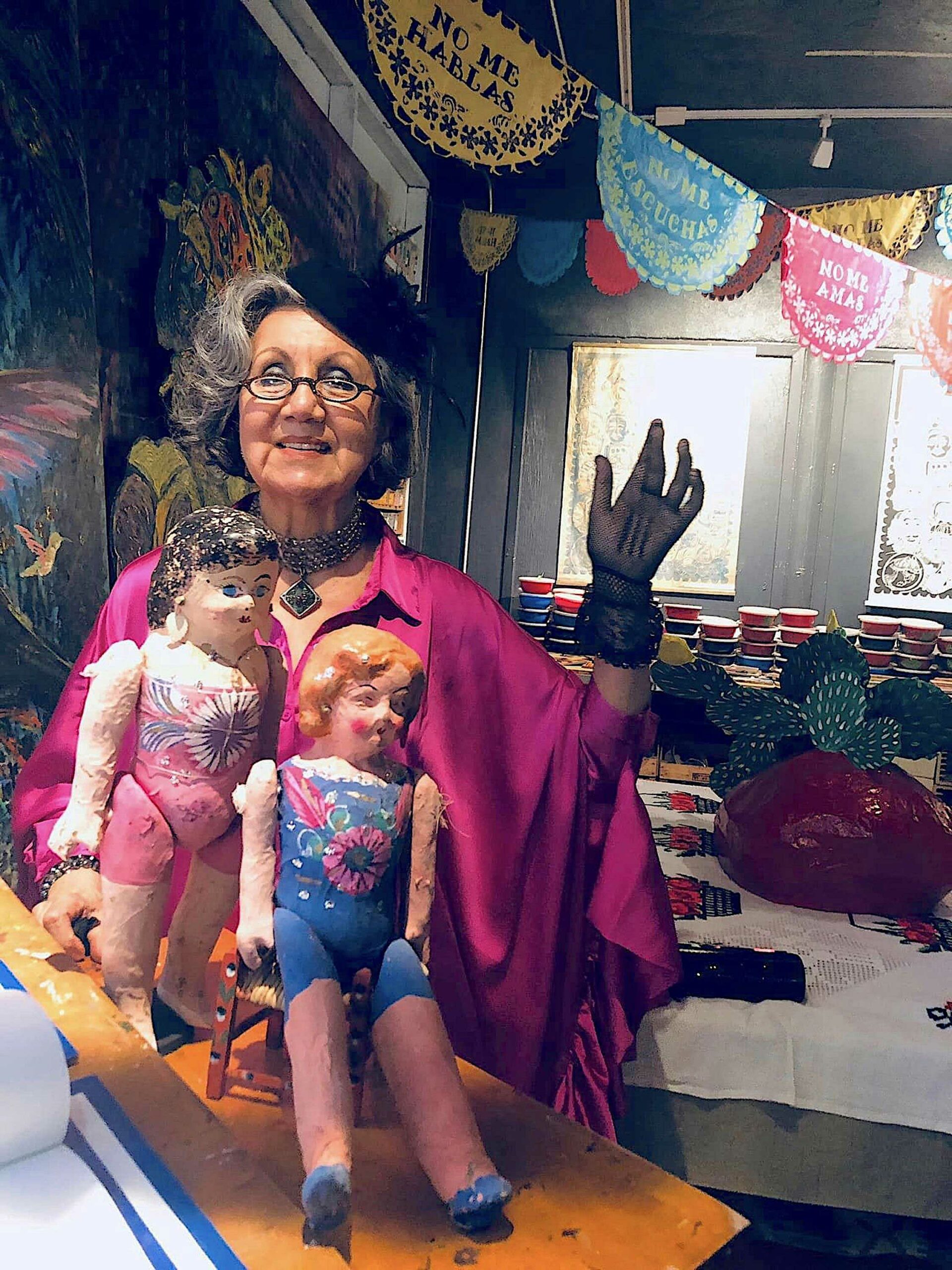
Gloria Sánchez Hart in period dress with two of her Lupita dolls. Her installation is in the background. Photo: Sabra Booth.
Due to the ongoing gentrification of the neighborhood, Rodriguez refers to the exhibition as “an exercise in nostalgia, and a way to say goodbye to the neighborhood,” which is rapidly losing its traditional character. Several artists dressed in period clothing in order to evoke the neighborhood’s earlier days.
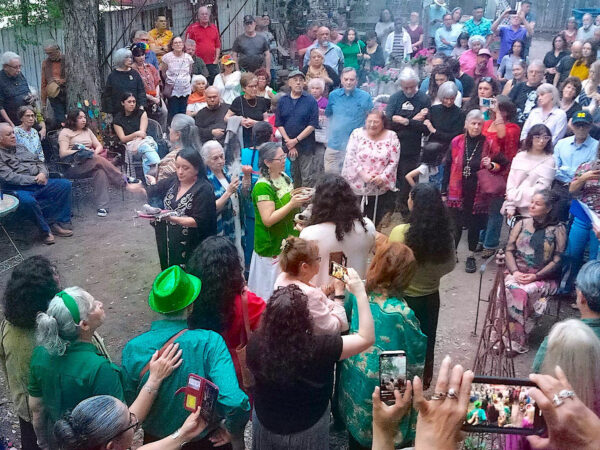
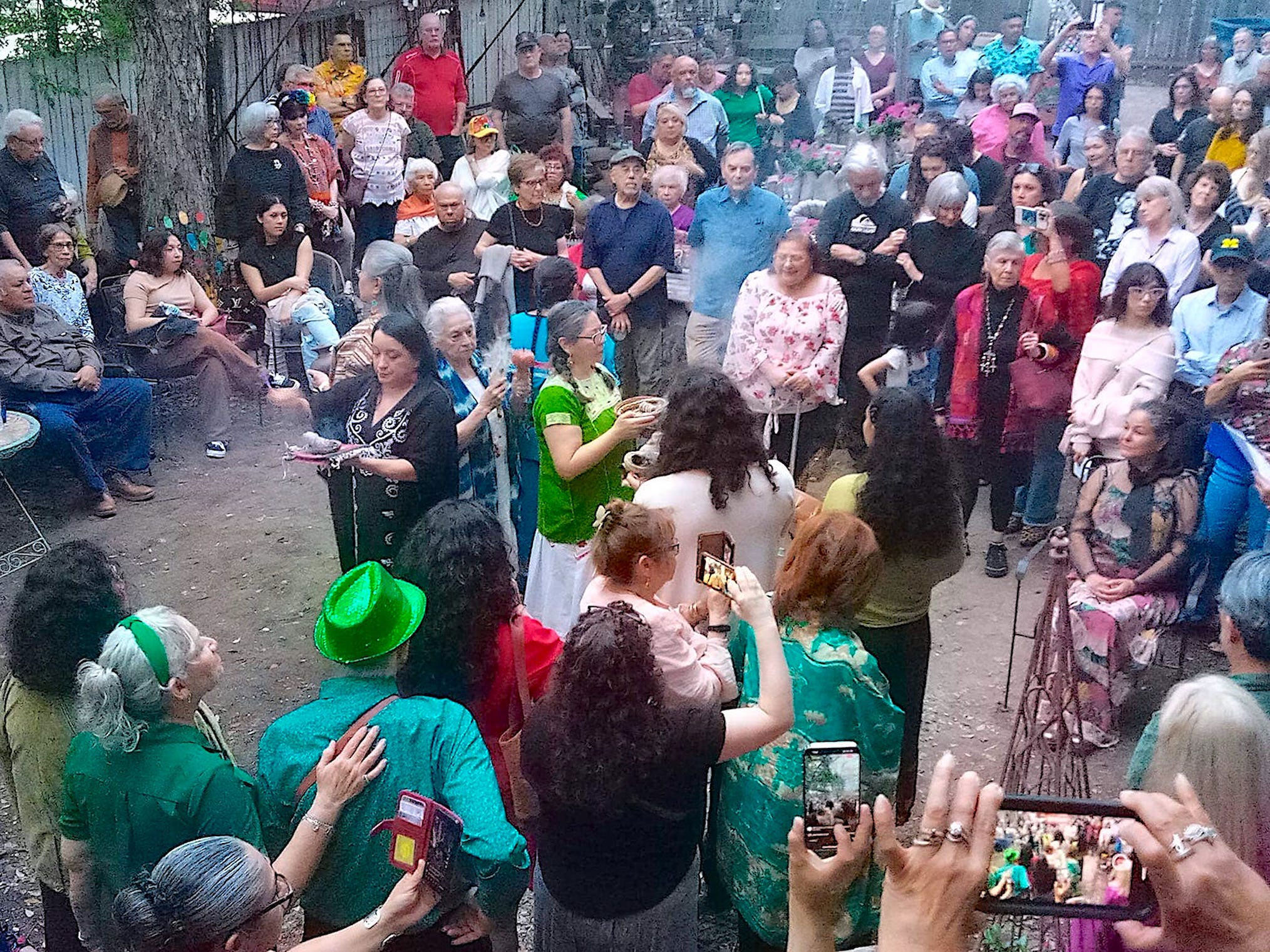
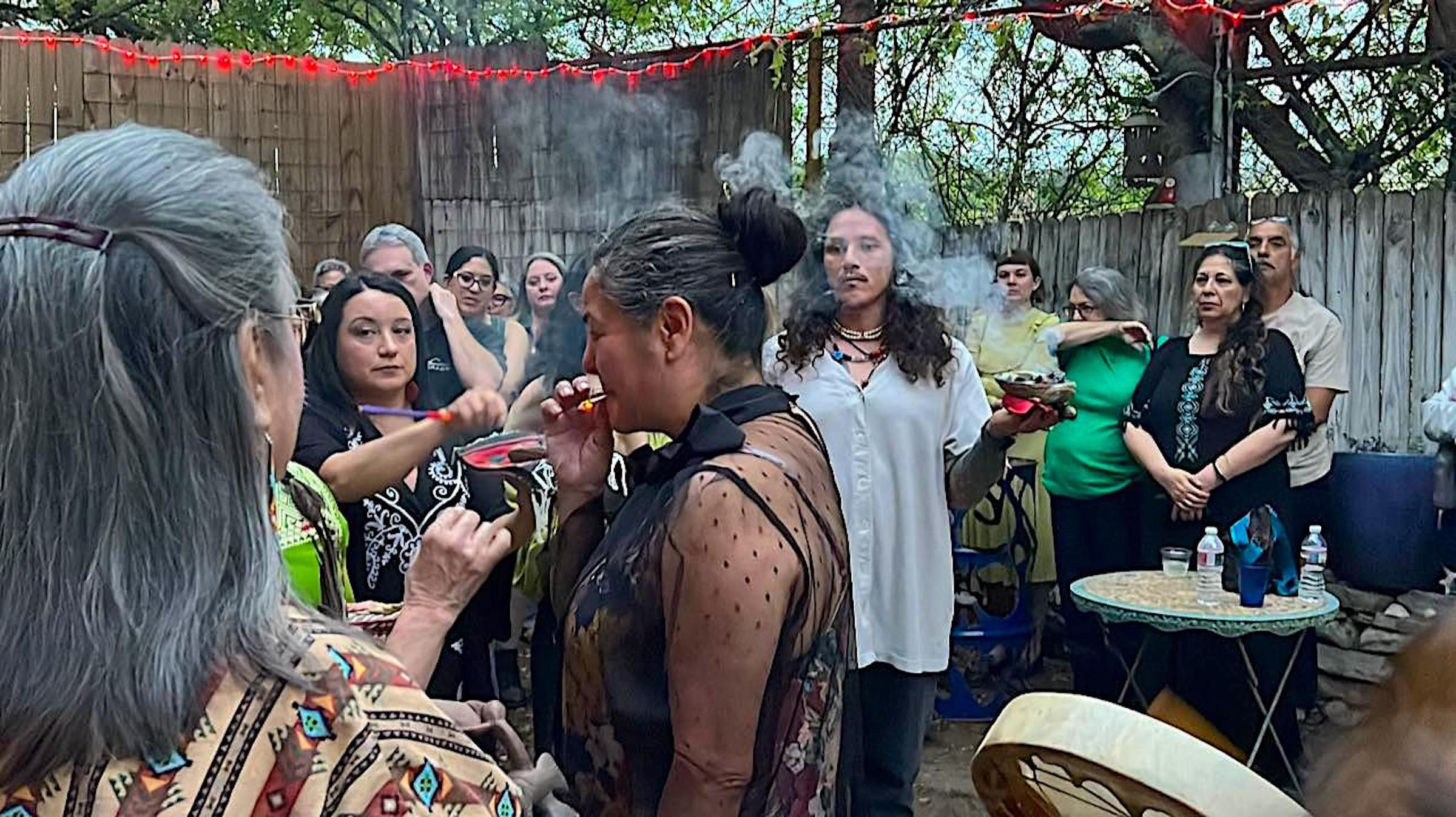
Opening Ceremony. Photo: Andy Villareal.
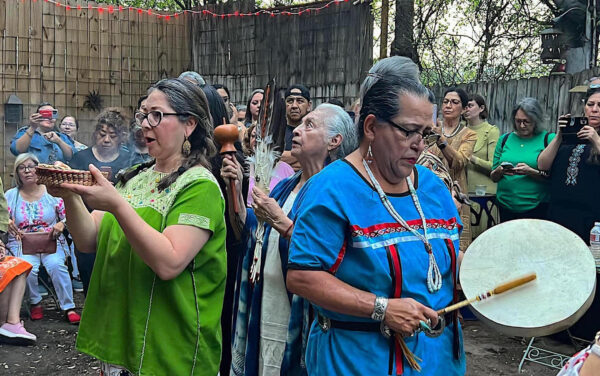
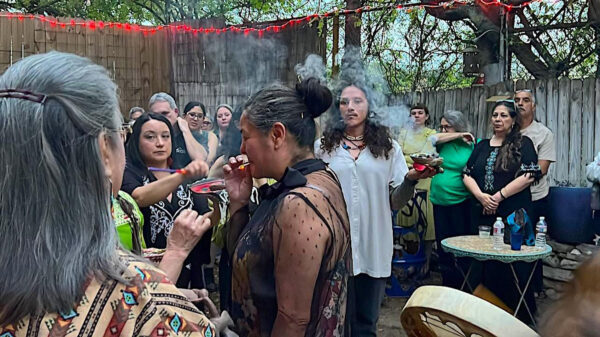
The festivities began with Gloria Camarillo Sánchez and the AH Manam Spiritual Circle performing an opening ceremony and indigenous blessing.
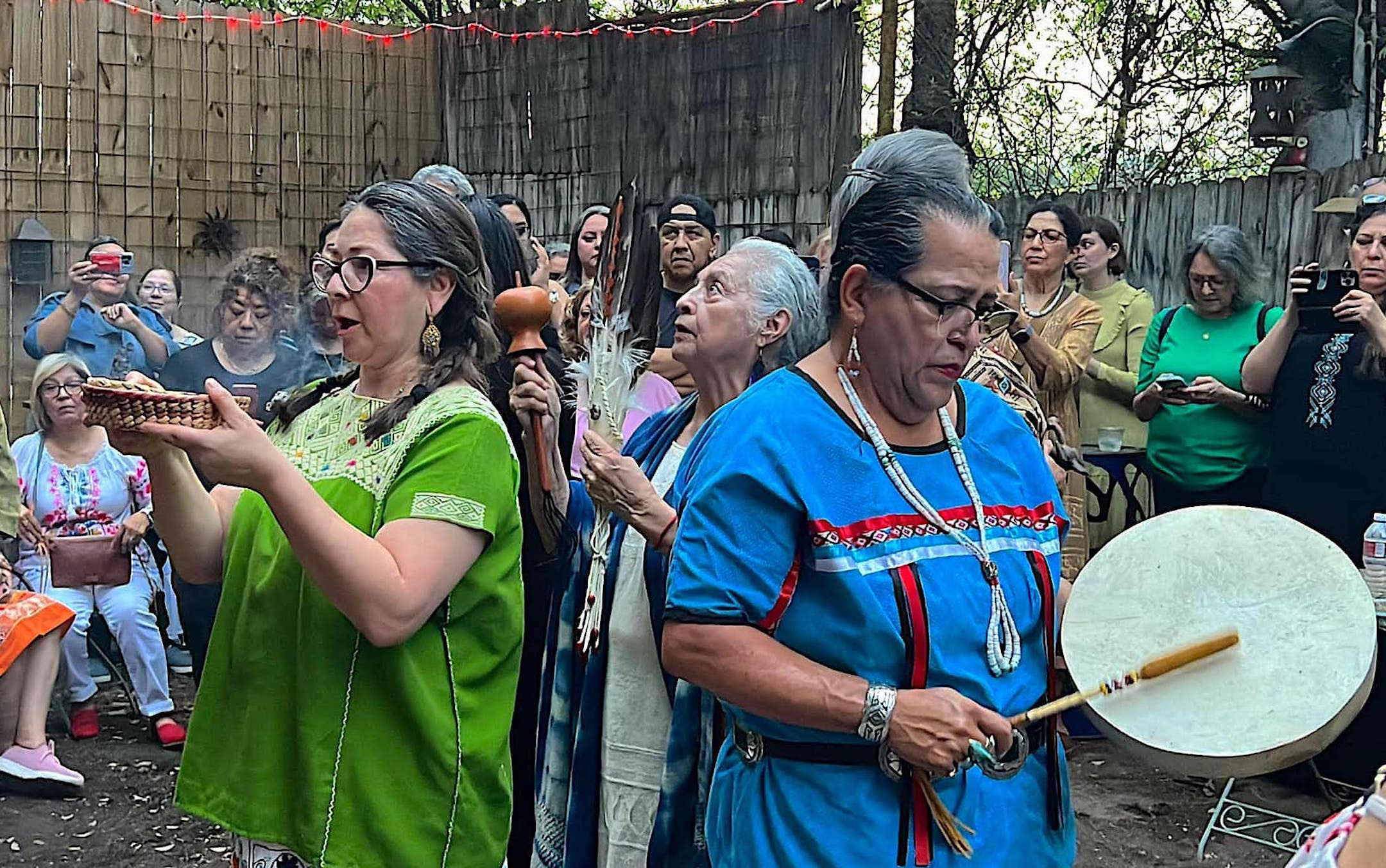
Performing the Sacred Four Directions Prayer. Photo: Barbara Felix.
They acknowledged the Coahuiltecan people’s claim to the land and they performed the Sacred Four Directions prayer.
Blessing Elizabeth Rodriguez (center). Photo: Barbara Felix.
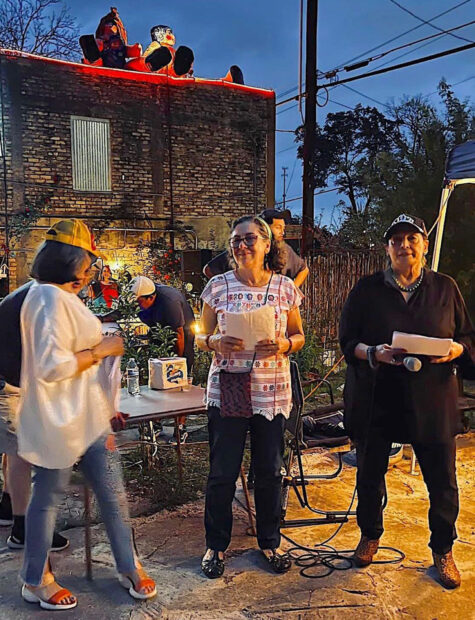
The blessing was followed (on the other side of the building) by a fictive radio program reading. It was written by Iñez Saenz, who called it “Reina Radio FM003 – Muñecas de Cartón.”
Performance of “Reina Radio FM003 – Muñecas de Cartón,” with Guadalupe Marmolejo, Gladys Cosio-Burger, and Inez Saenz. Photo: Barbara Felix.
Addressing the pre-WWII history of the Lupita dolls, it was performed by Saenz, Gladys Cosio-Burger, and Guadalupe Marmolejo. According to this program, the doll originated as a toy, was transformed into an advertisement for prostitution, and later turned into an accusatory object bought by women who had been cheated on by their spouses.
Entrance door. Photo: Ruben C. Cordova.
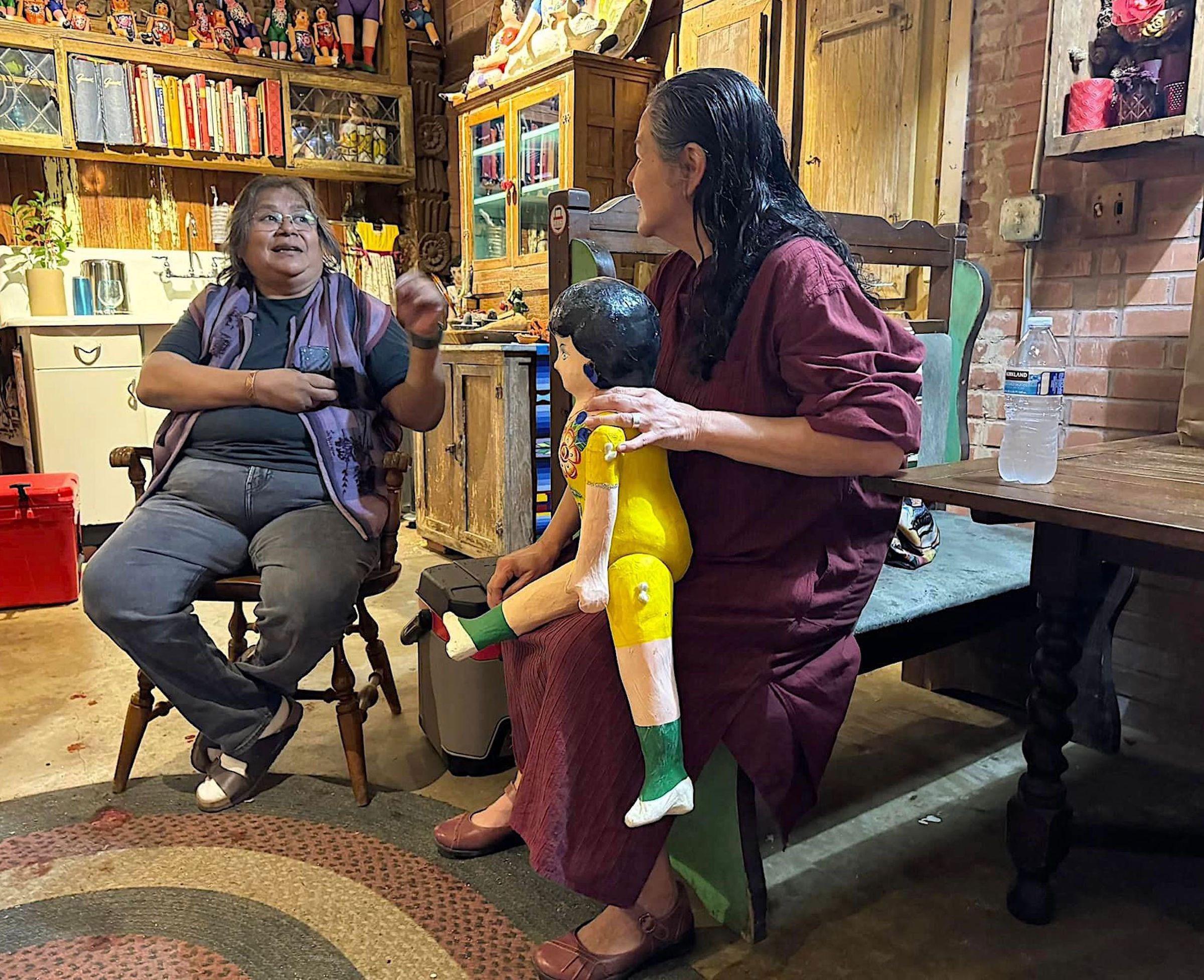
Veronica Castillo Salas speaking with Elizabeth Rodriguez. Photo: Celeste DeLuna.
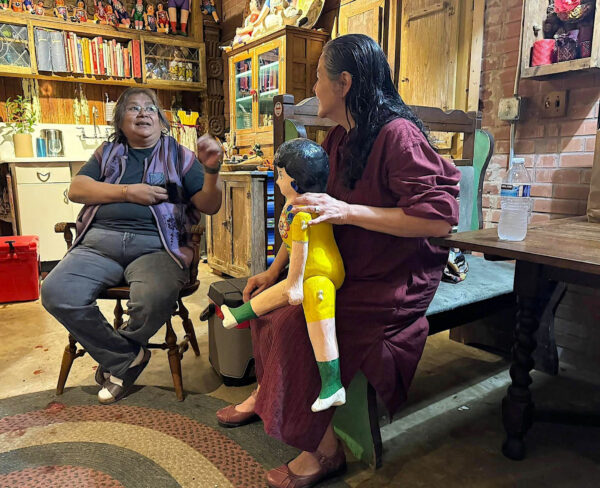
The exhibition was preceded by many conversations, such as the one above between Veronica Castillo Salas and Elizabeth Rodriguez. Castillo Salas, who is from Pubela, Mexico, maintains that the dolls were never intended as children’s toys. Castillo Salas, who comes from a long line of Mexican artisans, spoke to families in Mexico who created these dolls over generations that confirmed this belief.
Veronica Castillo Salas, “Myths and Legends of Lupita.” Photo: Ruben C. Cordova.
In the above painting, Castillo Salas depicts the Lupita dolls as knowing adults, within the context of the Tree of Life.
Edna Lugo and Gloria Sánchez-Hart, on the other hand, according to Rodriguez, view the dolls as toys, not as markers or signs of prostitution or infidelity.
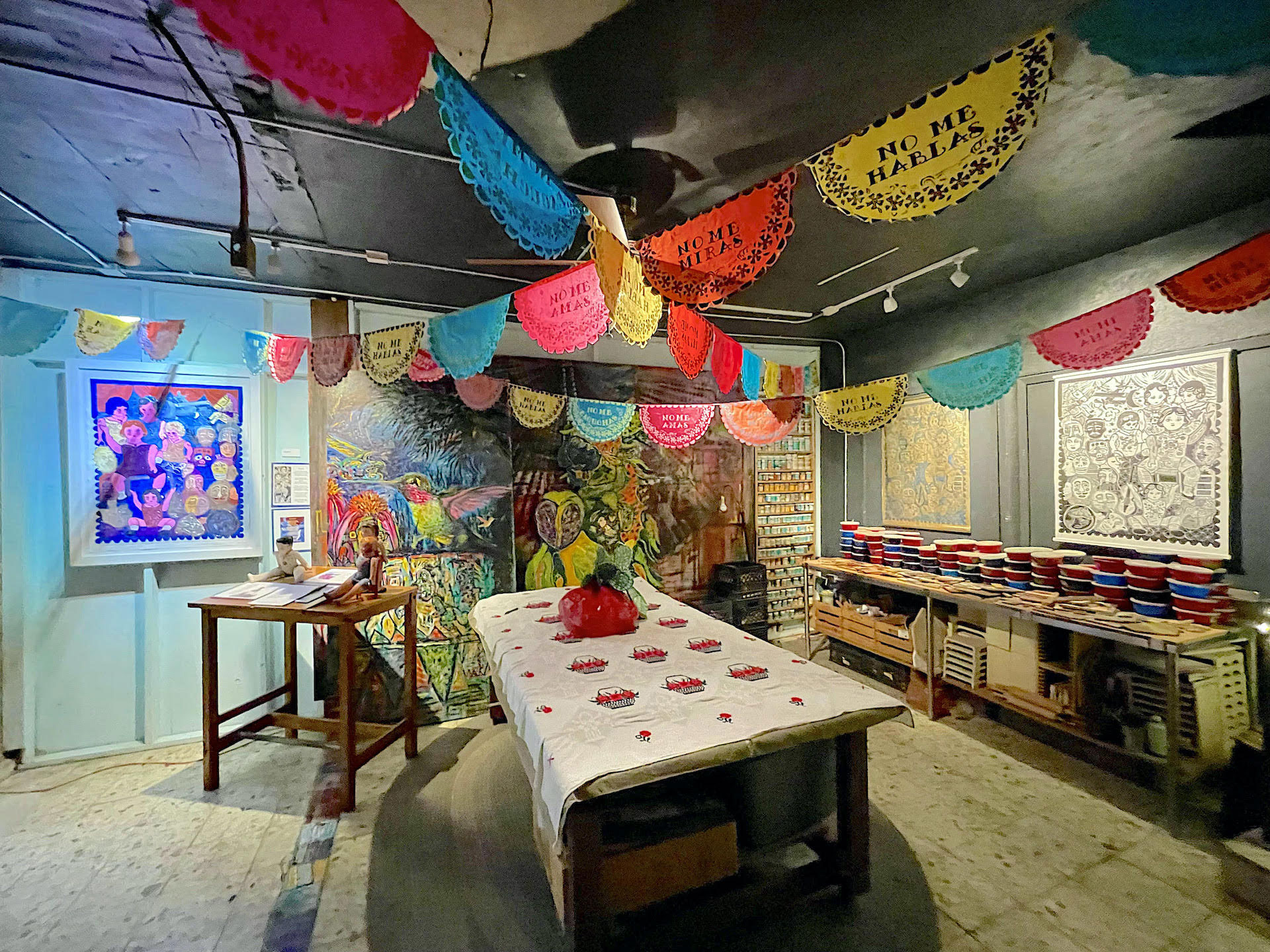
Gloria Sánchez Hart, “Installation: Muñecas en La Calle Guadalupe.” Photo: Ruben C. Cordova.
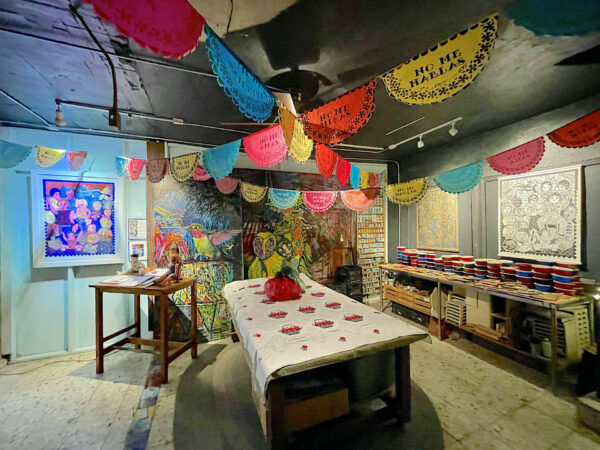
Sánchez-Hart’s installation treats the dolls as toys that she ignored for decades. The papel picado that hangs from the ceiling makes accusatory remarks, as if spoken by the dolls to the artist (translated here from Spanish to English): “you don’t look at me, you don’t listen to me, you don’t talk to me, you don’t love me.”
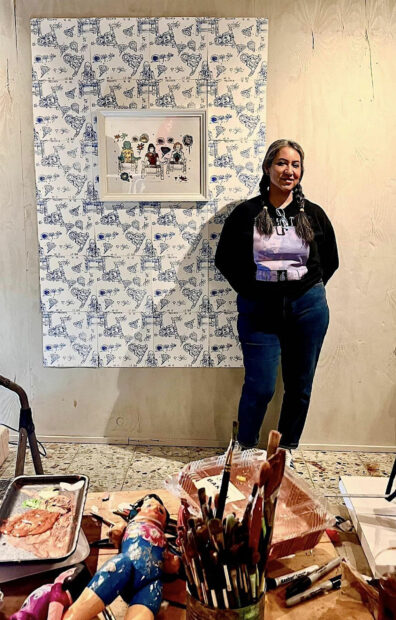
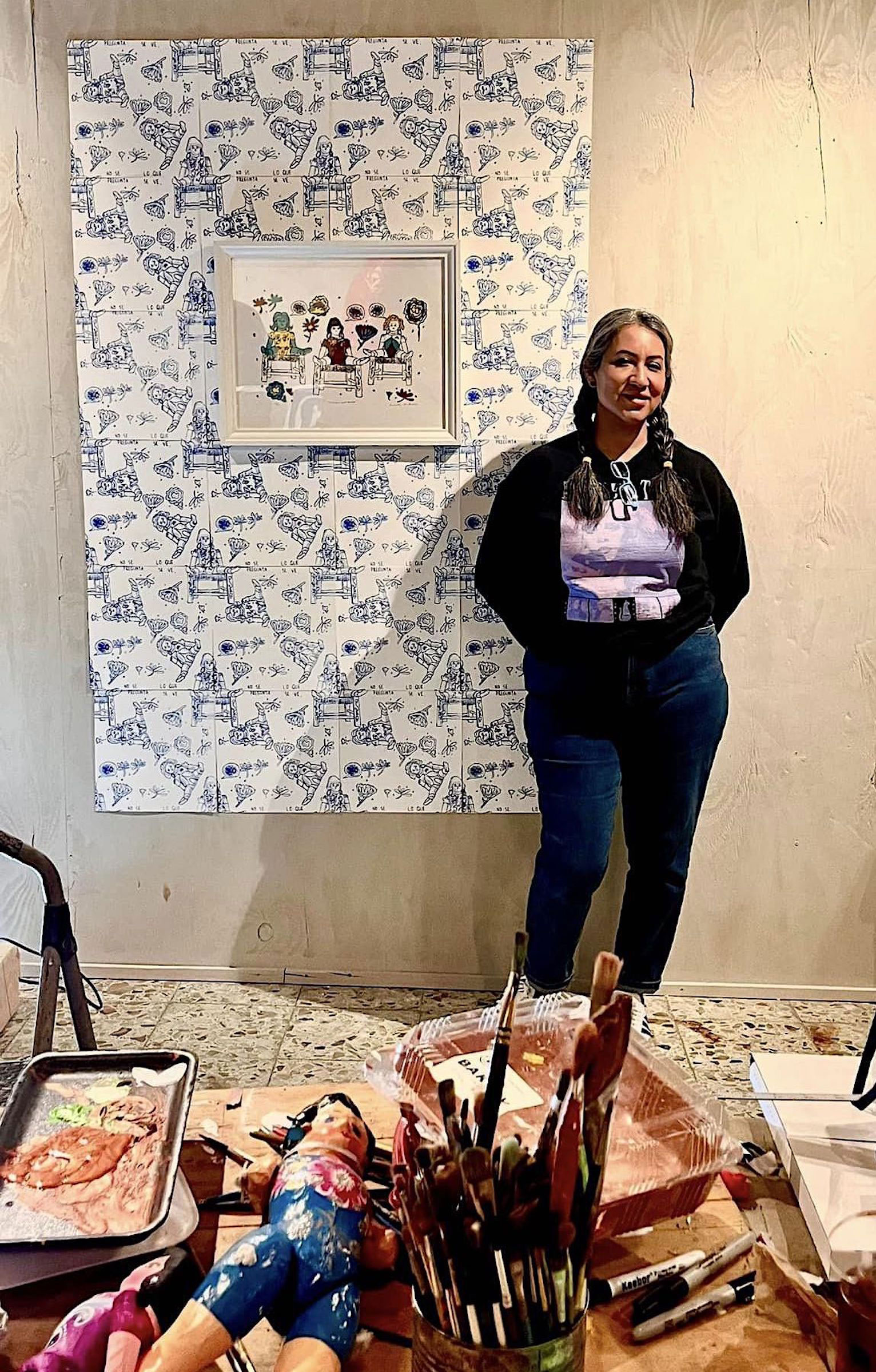
Celeste DeLuna with her “Voices and Seats” installation, framed color reduction print in center (16 x 20 inches), surrounded by fourteen screenprinted panels (12 x 12 inches) on paper in the European toile style. Photo courtesy of the artist.
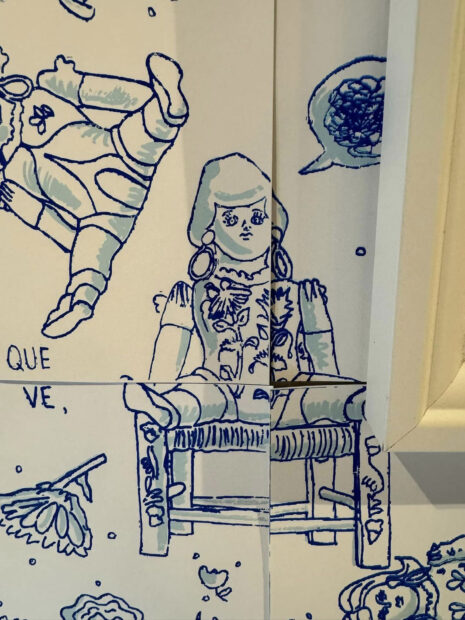
The central image in the above work derives from a photograph Celeste DeLuna took of a group of Lupita dolls at a Mexican restaurant in Houston. The dolls “struck me as both sexualized and infantilized, much like real life women are treated in regard to their bodies,” she recalls. “As a girl who always loved dolls and stuffed animals, I felt bad for them,” DeLuna added. She describes them as “struck dumb, posed with their legs open… placed on wooden Mexican toy chairs and displayed on a wall at a restaurant.” Importantly, DeLuna points out, “the Lupitas did not have a seat at a table, neither voice nor choice.”
In DeLuna’s view, the dolls are obviously sexualized. She recalls conversations Rodriguez had with women in Mexico, who denied the sexual nature of the Lupita dolls. DeLuna characterized this attitude with the phrase: “lo que se ve, no se habla” (what is seen is not spoken), which is why she uses it as an inscription in this installation.
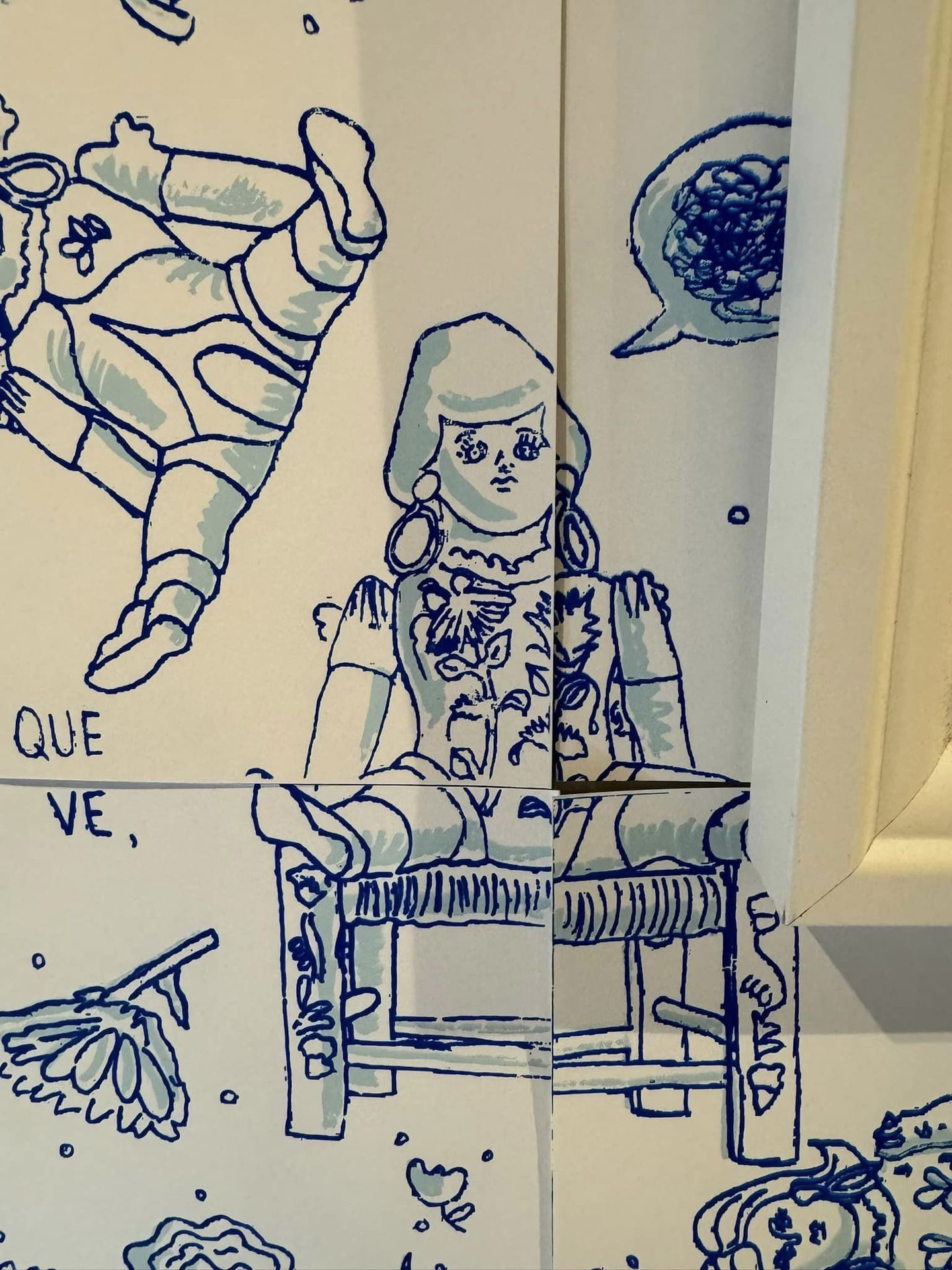
Celeste DeLuna, “Voices and Seats” (installation detail). Photo courtesy of the artist.
Since the dolls are working-class folk objects, DeLuna wanted to situate them “in a ‘fancy French doll’ context.” By creating a toile-style wallpaper from the patterns of the dolls in her original print, DeLuna sought to have the dolls “subvert” what she calls “a rarefied atmosphere.” The dolls symbolize working class women, and this is how she pictures “working class women walking in other worlds.”
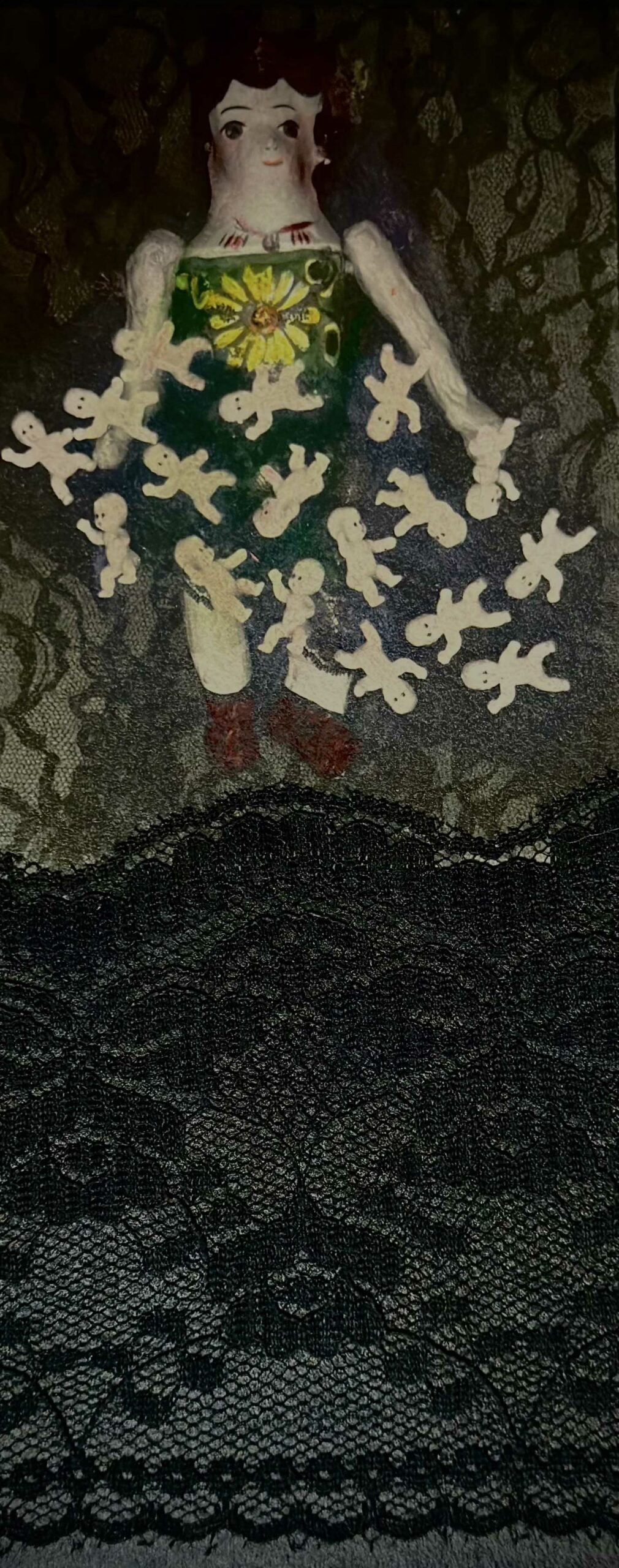
Kathy Vargas, hand-colored photograph. Photo courtesy of the artist.
When Rodriguez invited Kathy Vargas to participate in the exhibition, she brought her a small doll to be photographed. Vargas contributed four hand-colored photographs to the exhibition.
She told me that the dolls in these photographs “are my commentary on how some politicians see women today: sweet, frilly, silent, acquiescent baby factories.”
The photograph illustrated above represents the doll as a “baby factory,” with seventeen offspring. The green color of her outfit and the flower are also symbolic of fertility. In another picture (not illustrated here), the doll is virtually buried under flowers.
Kathy Vargas, hand-colored photograph. Photo courtesy of the artist.
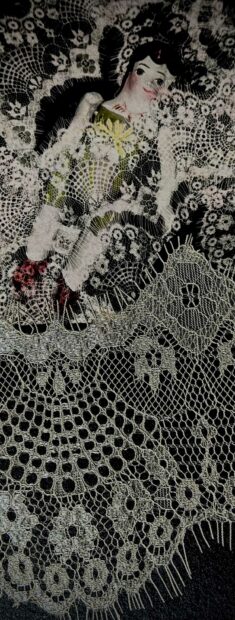
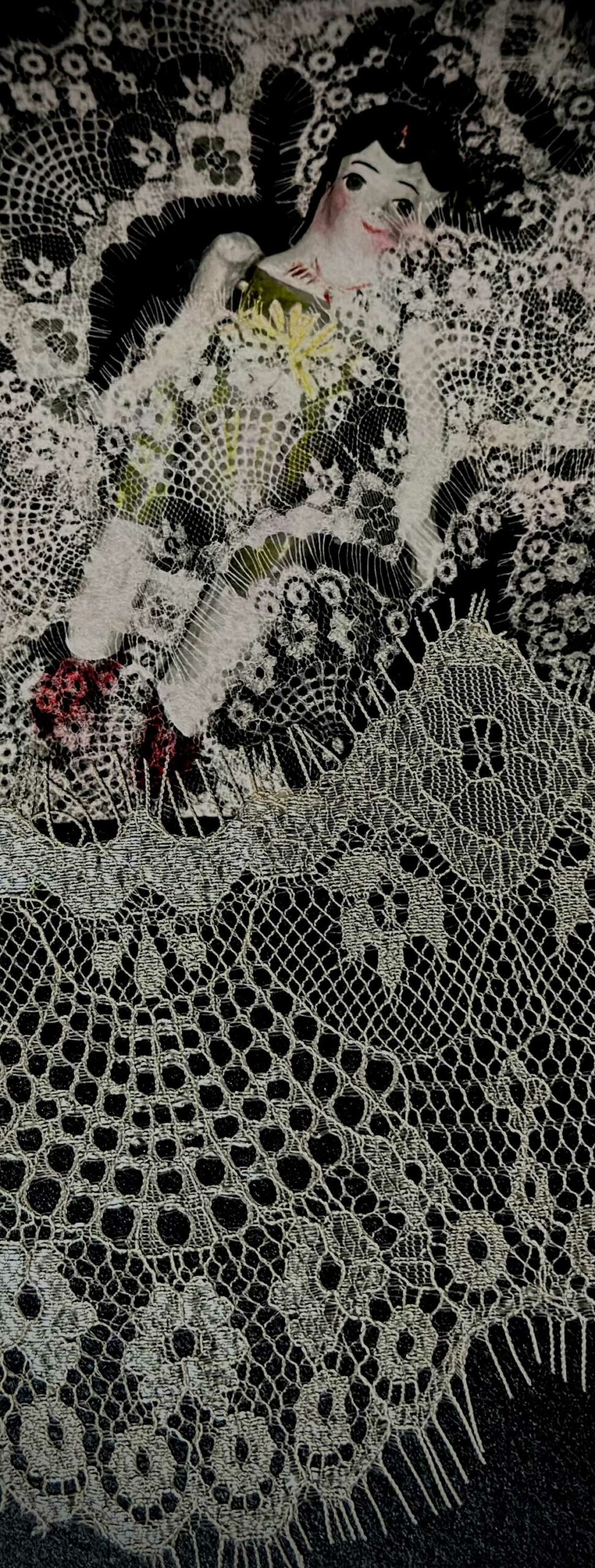
In the above photograph, the Lupita doll is incorporated into a frilly doily to such a degree that her corporeal identity is compromised. Through this dematerializing dissolution, the doll takes on the qualities of the doily, implying states of frilliness and passivity.
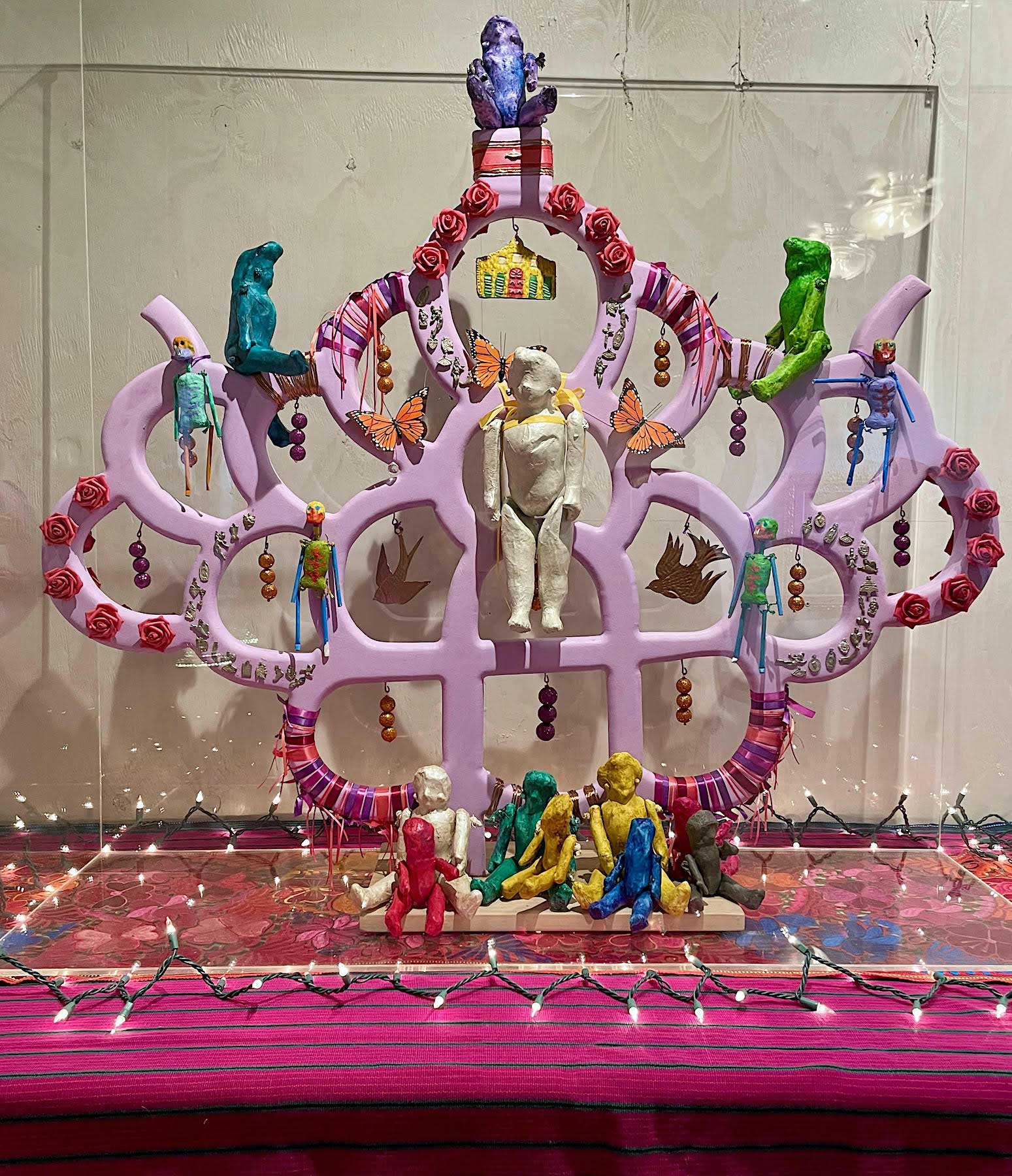
Kathy Sosa, Altarpiece from “Ofrenda for the Women We’ve Lost.” Photo: Ruben C. Cordova.
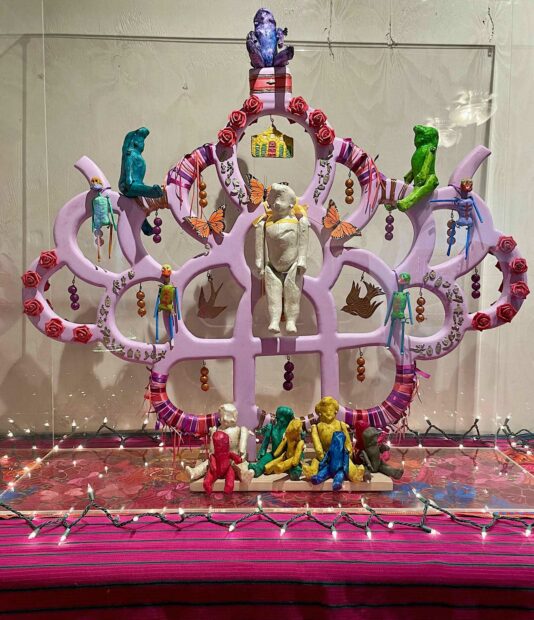
In Kathy Sosa’s semi-abstract Tree of Life altarpiece, diminutive Lupita dolls have been painted a single, solid color, which drains their vivacity. These dolls represent the many women who lost their lives due to domestic violence.
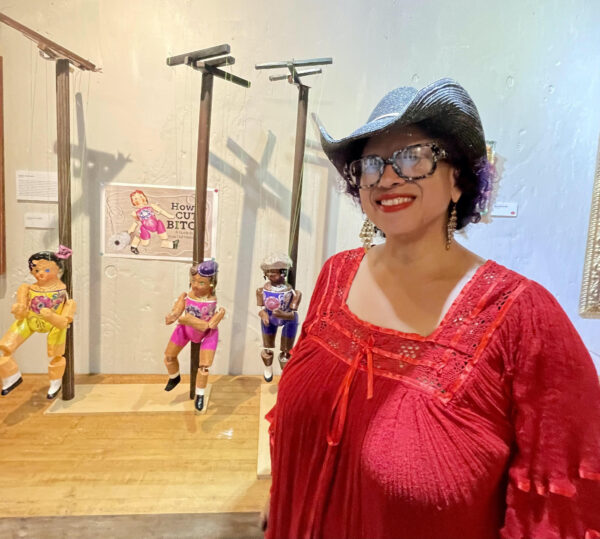
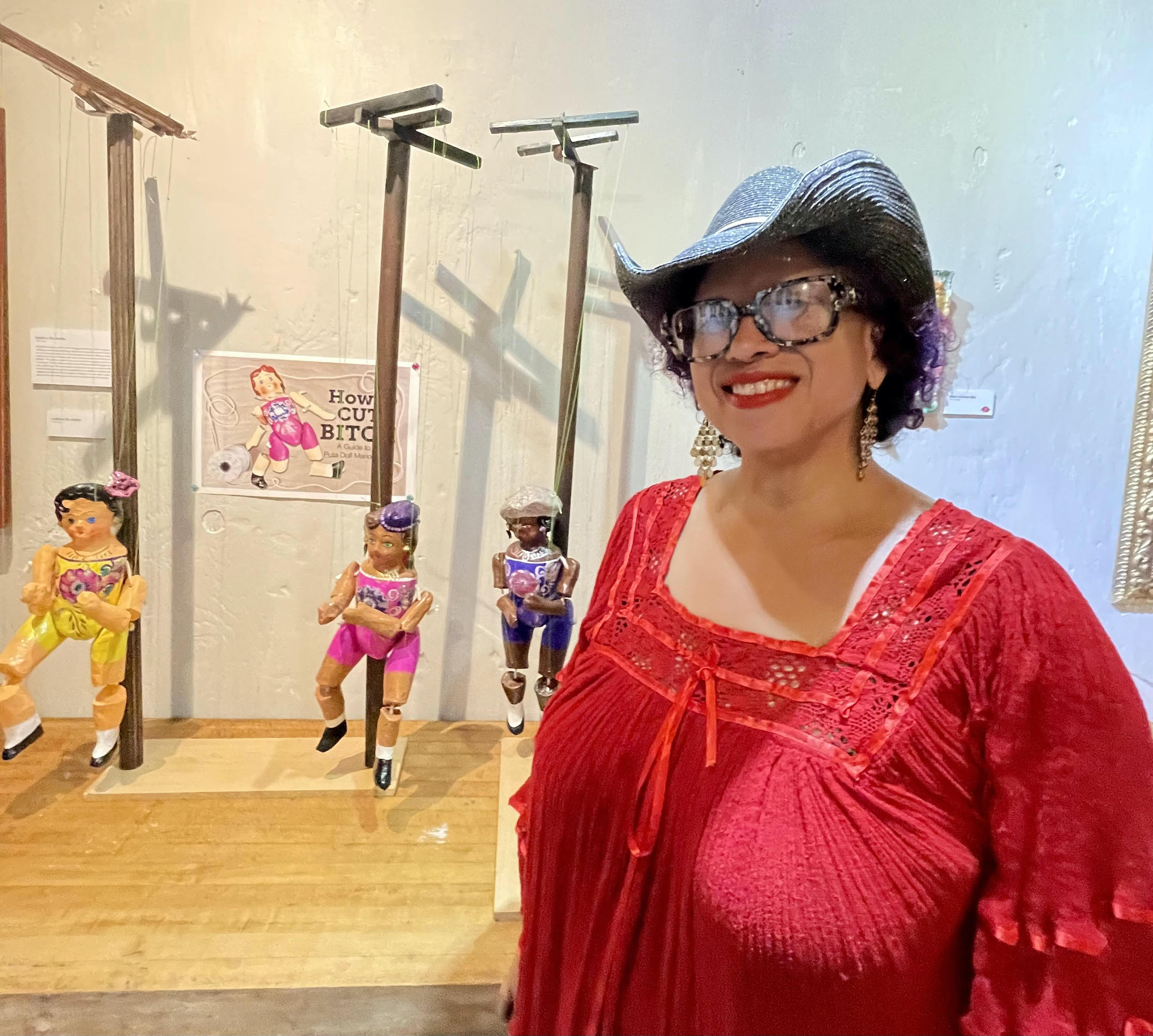
Barbara Felix with Lupita puppets. Photo: Ruben C. Cordova.
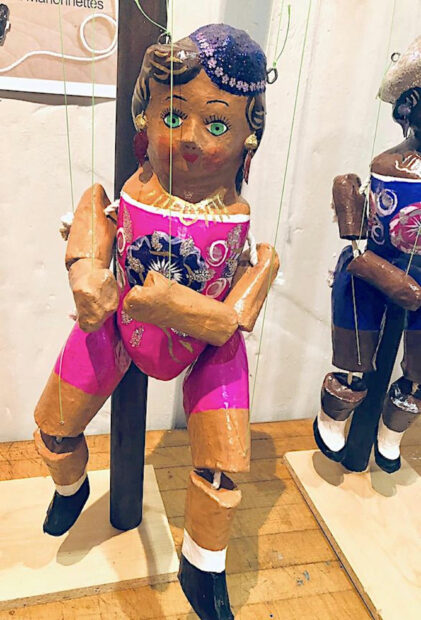
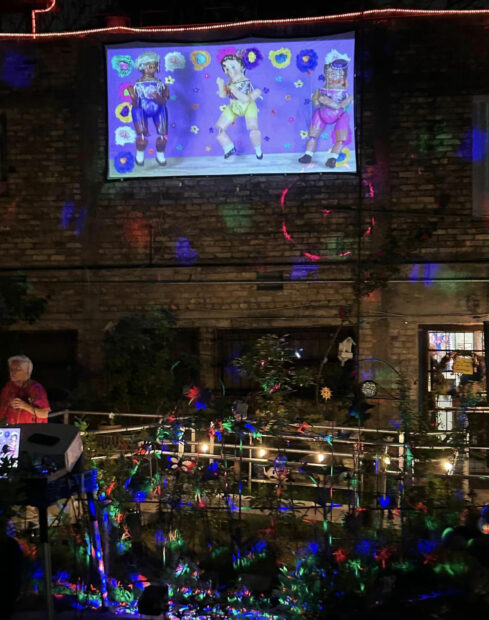
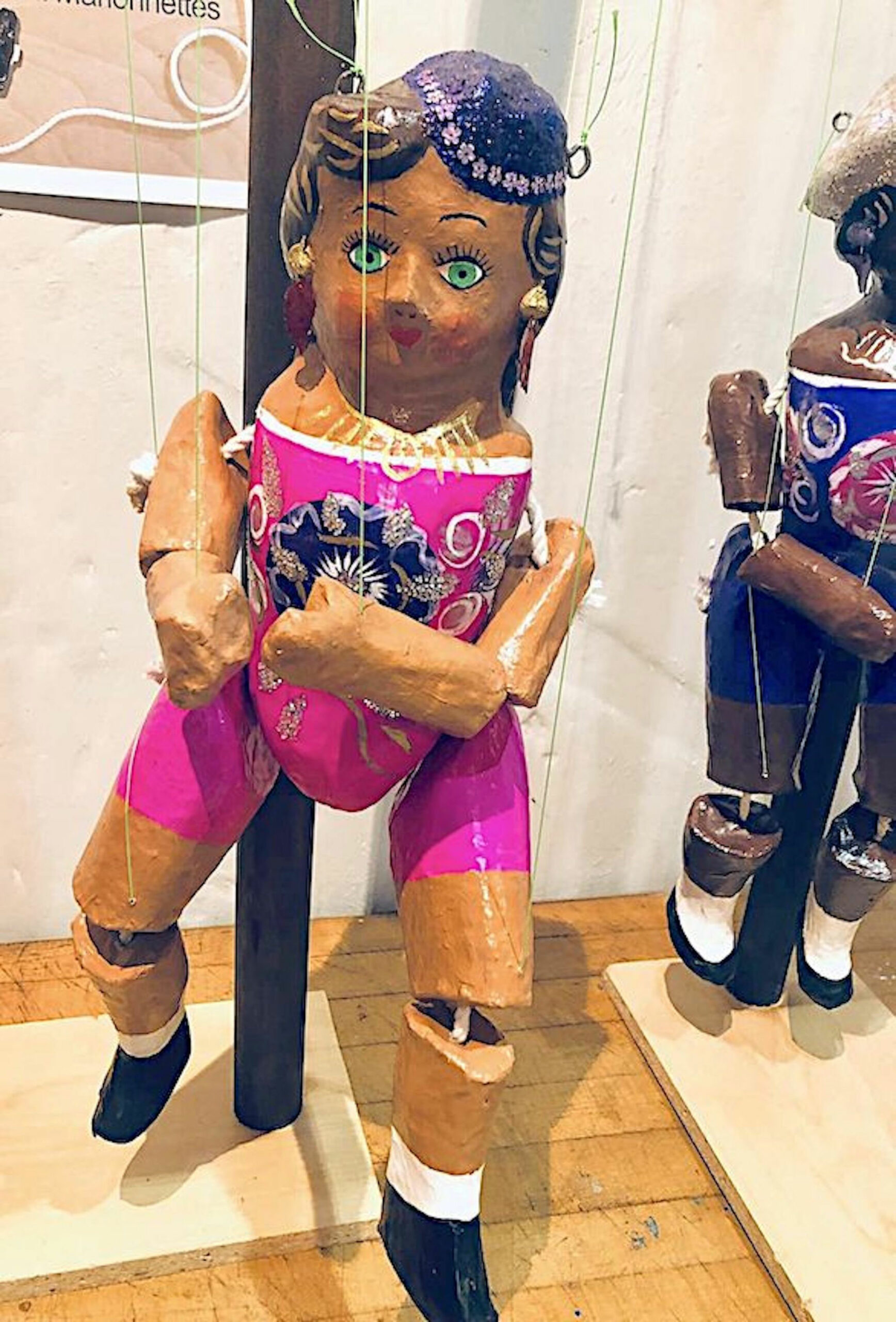
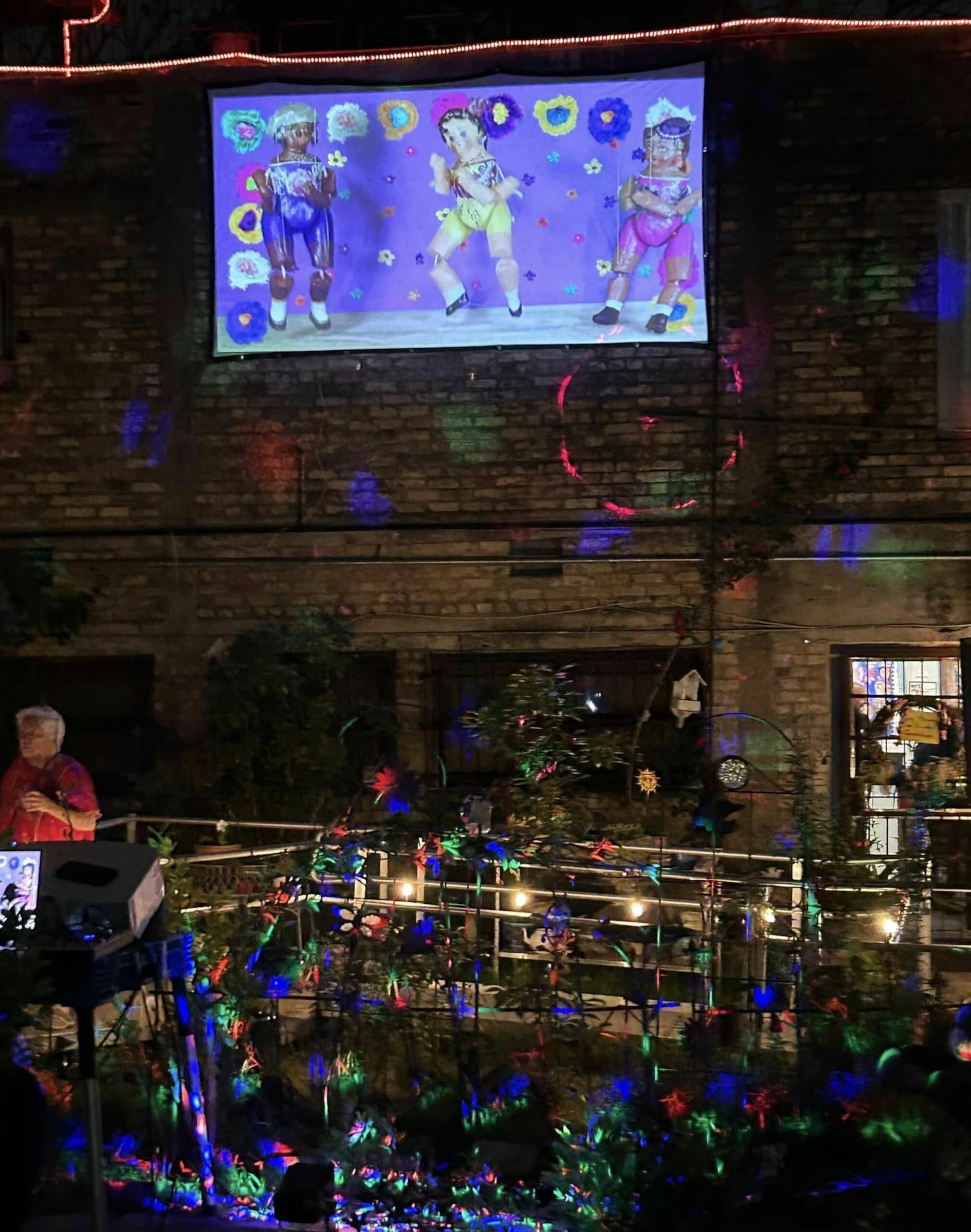
Barbara Felix utilized dolls to create puppets, which she cut up and carved into puppets that she used for an animation that was projected on the outside of the house.
Lupita puppets (detail). Photo: Sabra Booth.
Barbara Felix’s puppet animation. Photo: Sandy Villareal.
Felix’s animation was projected on the east exterior wall of the house.
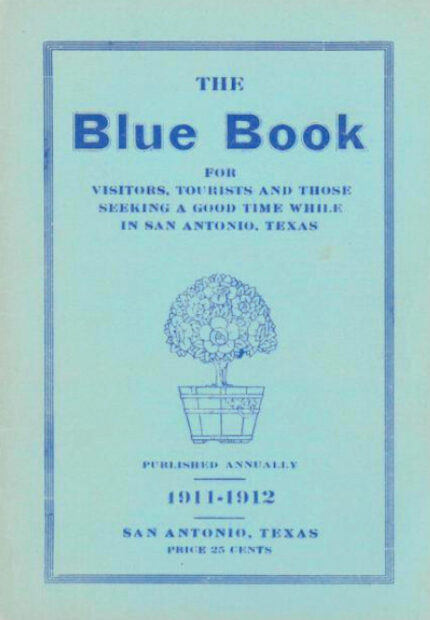
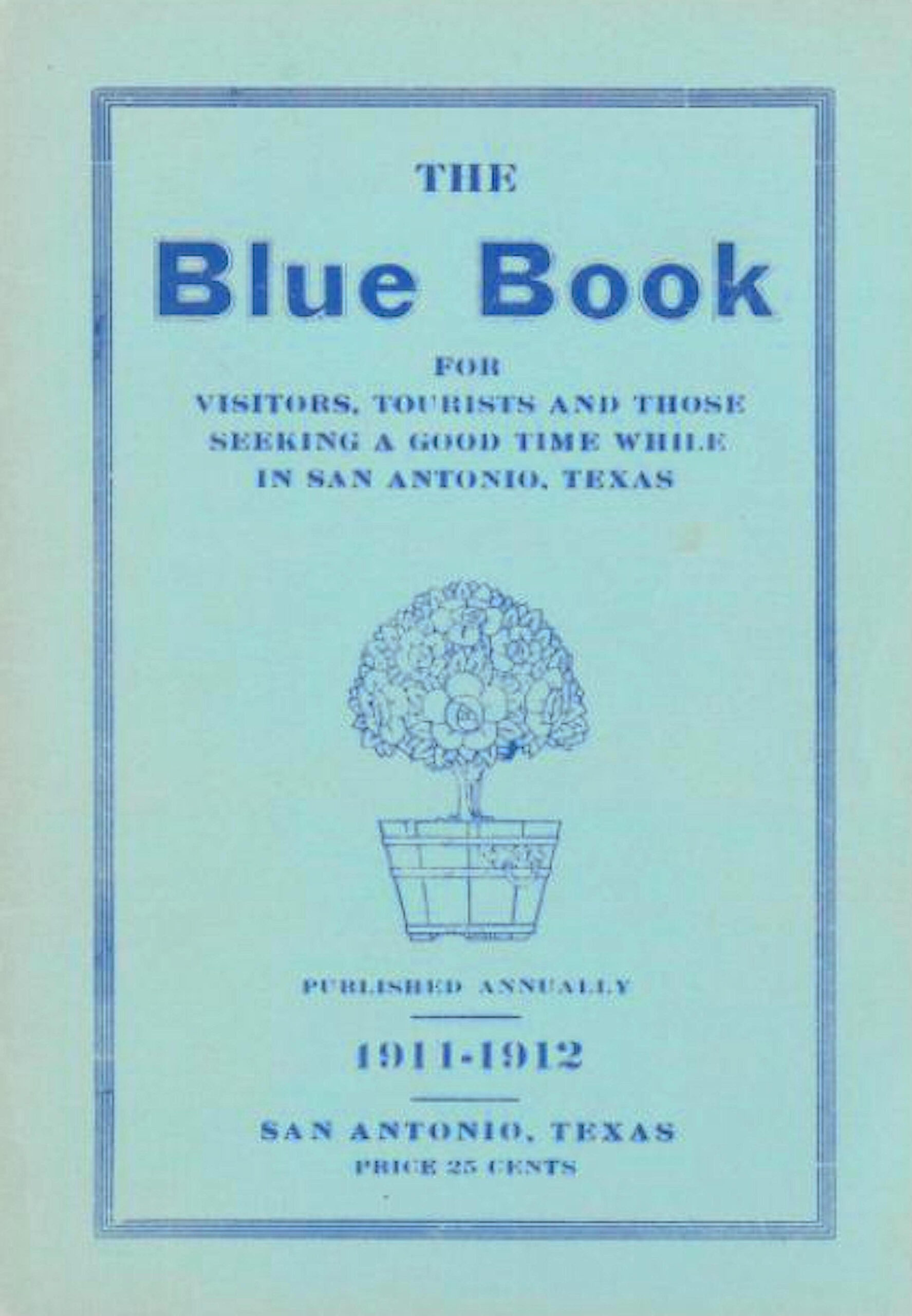
William Keilman, “San Antonio Blue Book,” 1911-12. Photo: Journal of the Life and Culture of San Antonio.
In 1911, William “Billie” Keilman, a former San Antonio policeman who was then a brothel owner, published the San Antonio Blue Book, which he sold for 25 cents. It listed “the names, locations and phone numbers of prostitutes in San Antonio’s red-light district, and it ran advertisements for saloons, restaurants and brothels” (Jennifer Cain, “Bawdy Houses ‘For Those Seeking a Good Time while in San Antonio, Texas’ – The Restrictions and Permissions of Bawdy Houses from 1889-1941,” Journal of the Life and Culture of San Antonio, University of the Incarnate Word).
According to Cain, the “Sporting District” prostitutes were given one of three designations: “A”, “B” or “C.” Whereas most “A” class prostitutes were Anglos in higher-priced brothels, the “C” class prostitutes were mostly Mexican or Black women who worked in establishments that are referred to in the Blue Book as “cribs.” Though white men could patronize all races of prostitutes, Black men were forbidden from consorting with Anglo prostitutes.
Keilman gave the impression that prostitutes were restricted to the “Sporting District” (today’s UTSA downtown campus, near Market Square), which confused early researchers on this topic, who could find no ordinances that placed geographical restrictions on prostitution. It appears that Keilman merely wanted to funnel visitors in the direction of his brothel, which he described in this manner: “In this district you will find the Beauty Saloon conducted by Billie Keilman, a safe and sane thirst parlor” (quoted in Bri Kirkham, “No boundaries? How San Antonio’s red-light district grew,” Texas Public Radio, April 1, 2022).
The U.S. military (which objected to its soldiers contracting venereal diseases) tried to shut down San Antonio’s primary red-light district during World War I. These efforts continued for decades. They were no doubt defeated by the sizable bribes that the operators of these establishments could pay to politicians and the police. Finally, the bawdy houses in the Market Square area were shuttered during World War II. This provided the opportunity for Guadalupe Street to become a prostitution hot spot in subsequent decades.
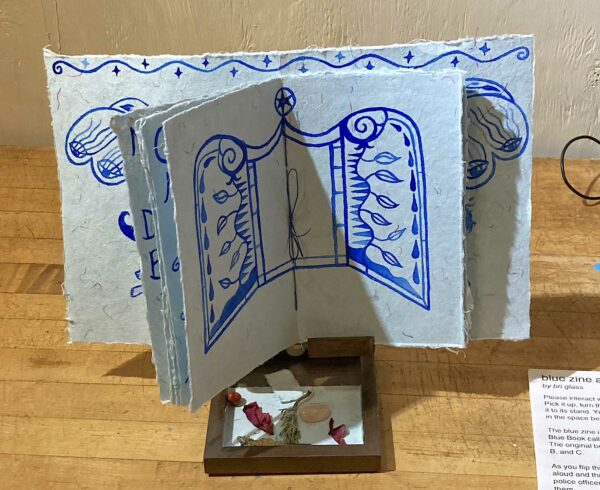
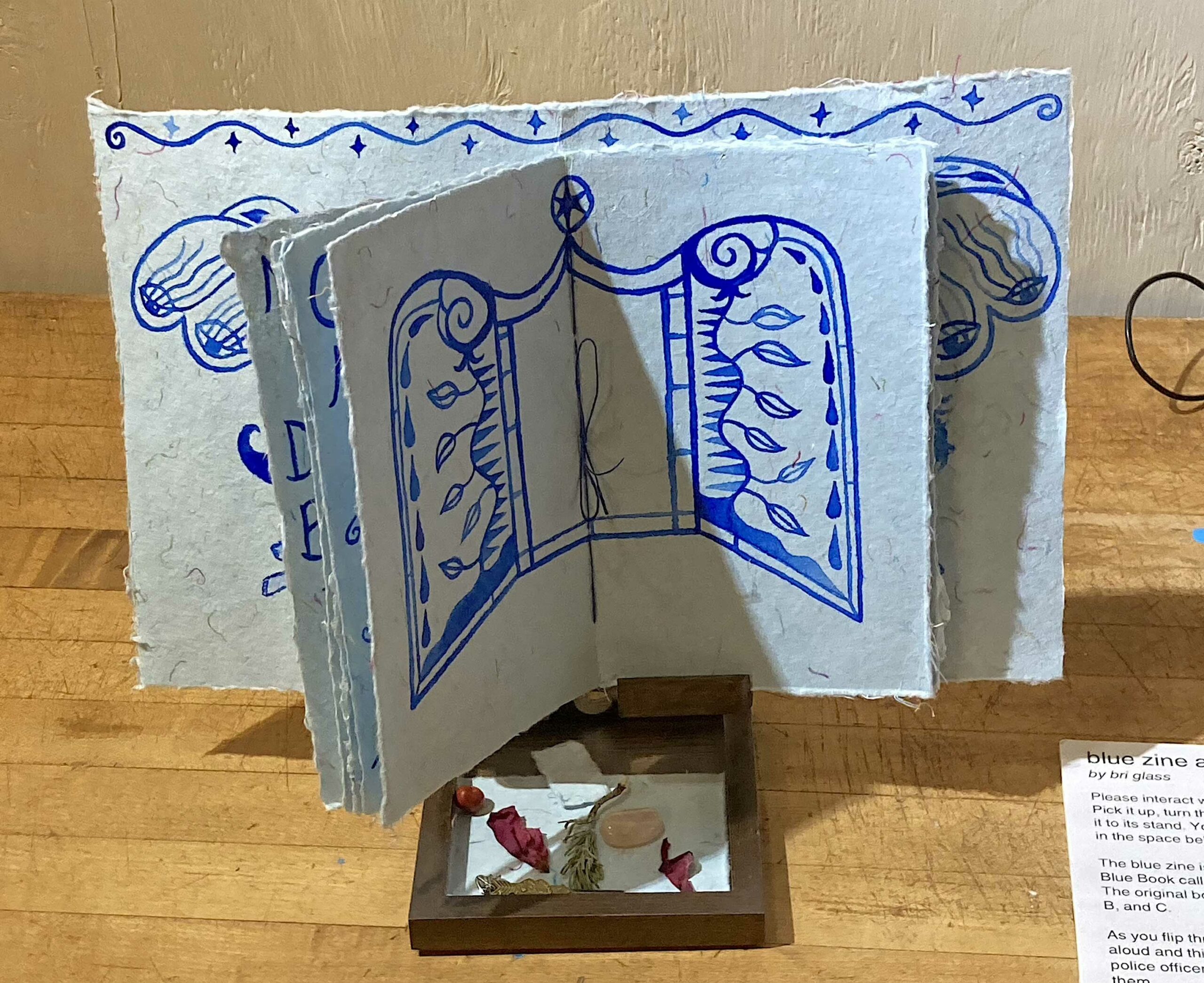
Bri Glass, “Blue Zine.” Photo courtesy of the artist.
Bri Glass’ contribution to the exhibition is Blue Zine, which incorporates names and imagery from Keilman’s Blue Book, which Glass scanned at the Texana/Genealogy department of San Antonio’s Central Library.
The Blue Zine is an interactive zine on handmade paper with several illustrations of angels and altarpieces. It serves as “a paper altar to the women in the Blue Book,” some of whom have their names inscribed in it.
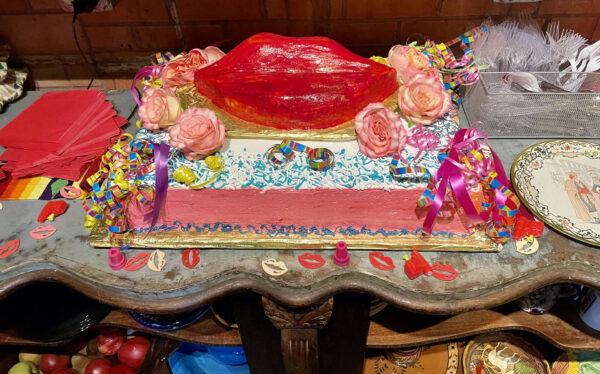
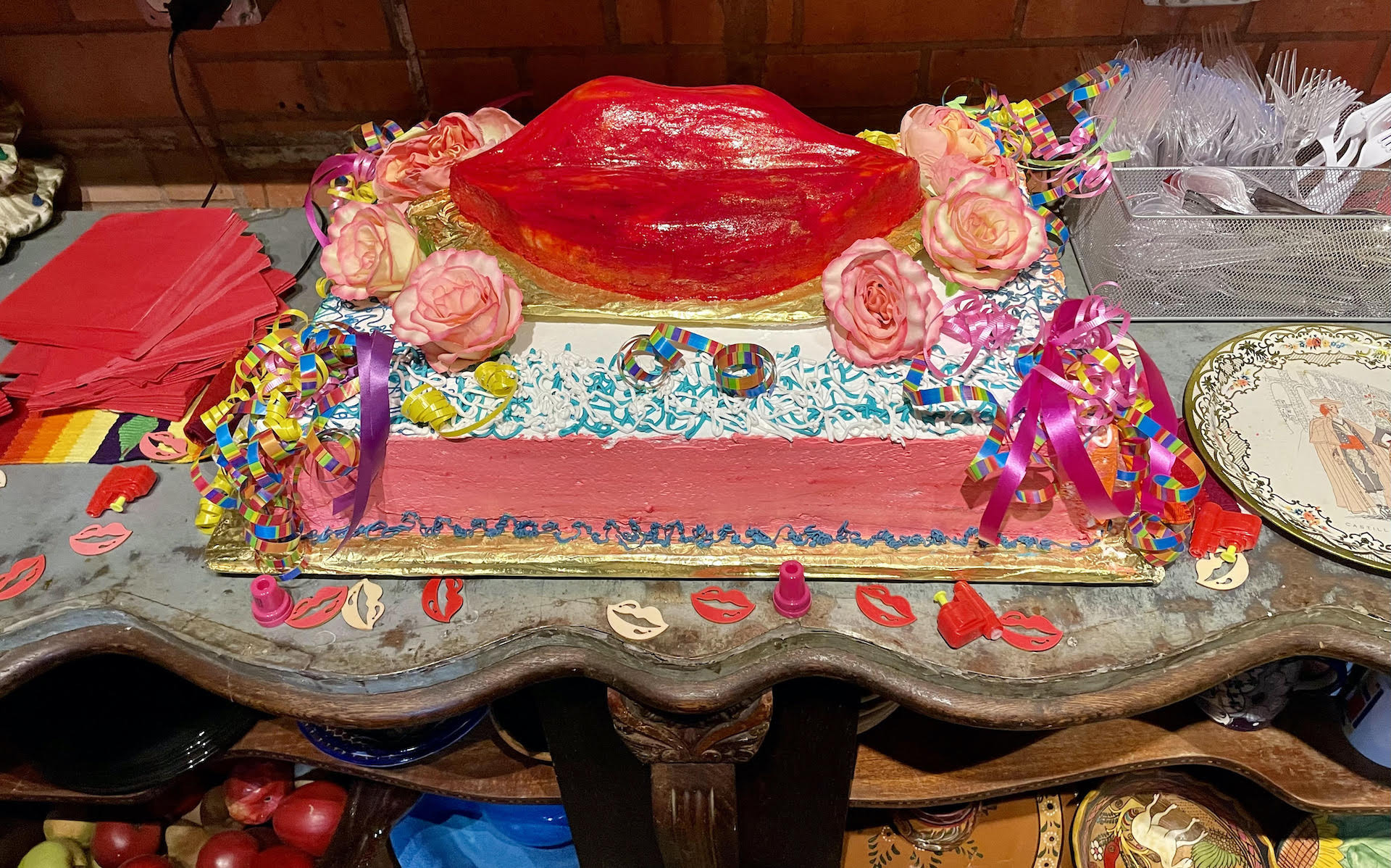
A cake at the opening. Photo: Ruben C. Cordova.
This cake, crowned by a large pair of red lips, was a gift to Rodriguez from Raquel Centeno, one of her students.
Exterior of Elizabeth Rodriguez’s home (detail). Photo: Sabra Booth.
Night at last drew back its black curtain, and everything vanished, save for the red lights, which, for one evening, illuminated a dark corner of San Antonio’s Westside past.
Muñecas en La Calle Guadalupe, curated by Elizabeth Rodriguez, was on view at 2622 Guadalupe St. on March 16.
***
Ruben C. Cordova is an art historian who has curated more than 30 exhibitions. His next exhibition, Dining with Rolando Briseño: A Fifty Year Retrospective, opens August 13 at Centro de Artes in San Antonio.
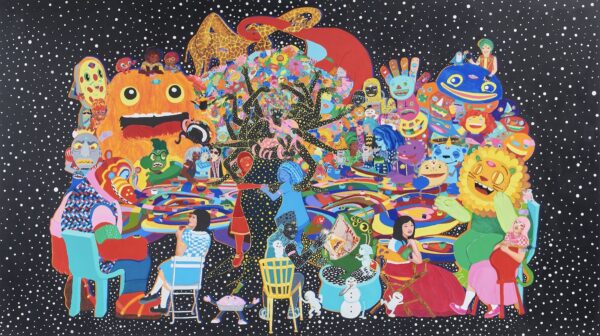
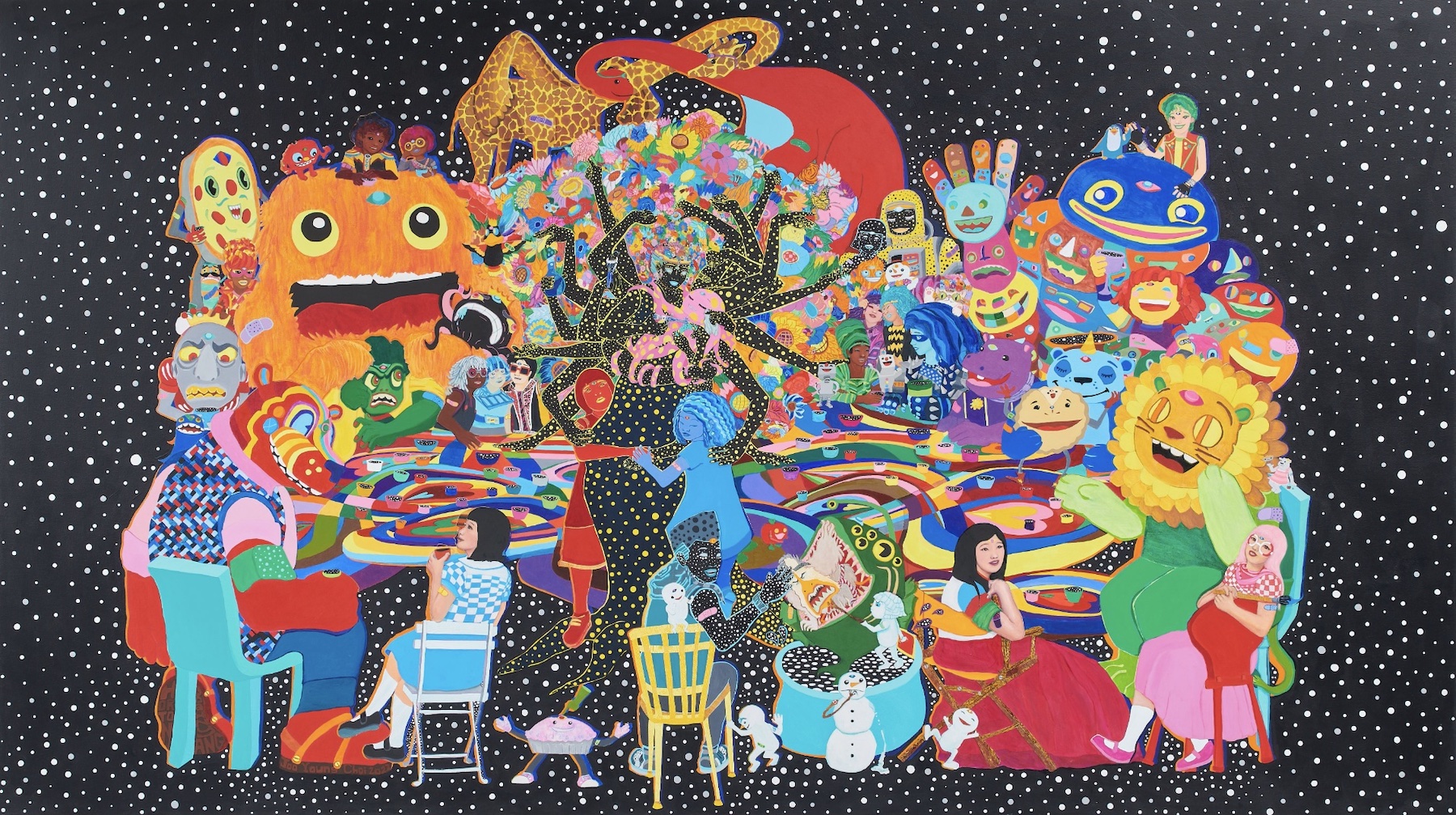
The Dallas Art Fair (DAF) and the Dallas Museum of Art (DMA) have announced the museum’s acquisition of three works of art created by women artists, including a piece from Inman Gallery by Houston-based JooYoung Choi.
JooYoung Choi, “The Table of Love,” 2022, acrylic, gouache, vinyl paint, carbon transfer, Gelli print, airbrush, Duralar, cut paper on canvas, 69.25 x 123 inches. Acquired from Inman Gallery
Each year, since its establishment in 2016, the Dallas Art Fair Foundation Acquisition Program has supported the acquisition of contemporary works from the fair for the museum’s permanent collection. Over the last eight years, the program has funded $875,000 worth of acquisitions to the DMA, including this year’s grant of $100,000. Although the grant amount was the same last year, the fund supported the purchase of 12 artworks. This year the museum took a different approach, acquiring works that are much larger in scale than previous years.
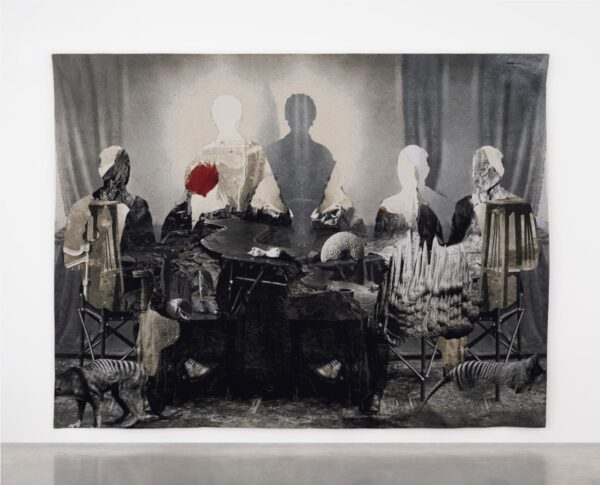
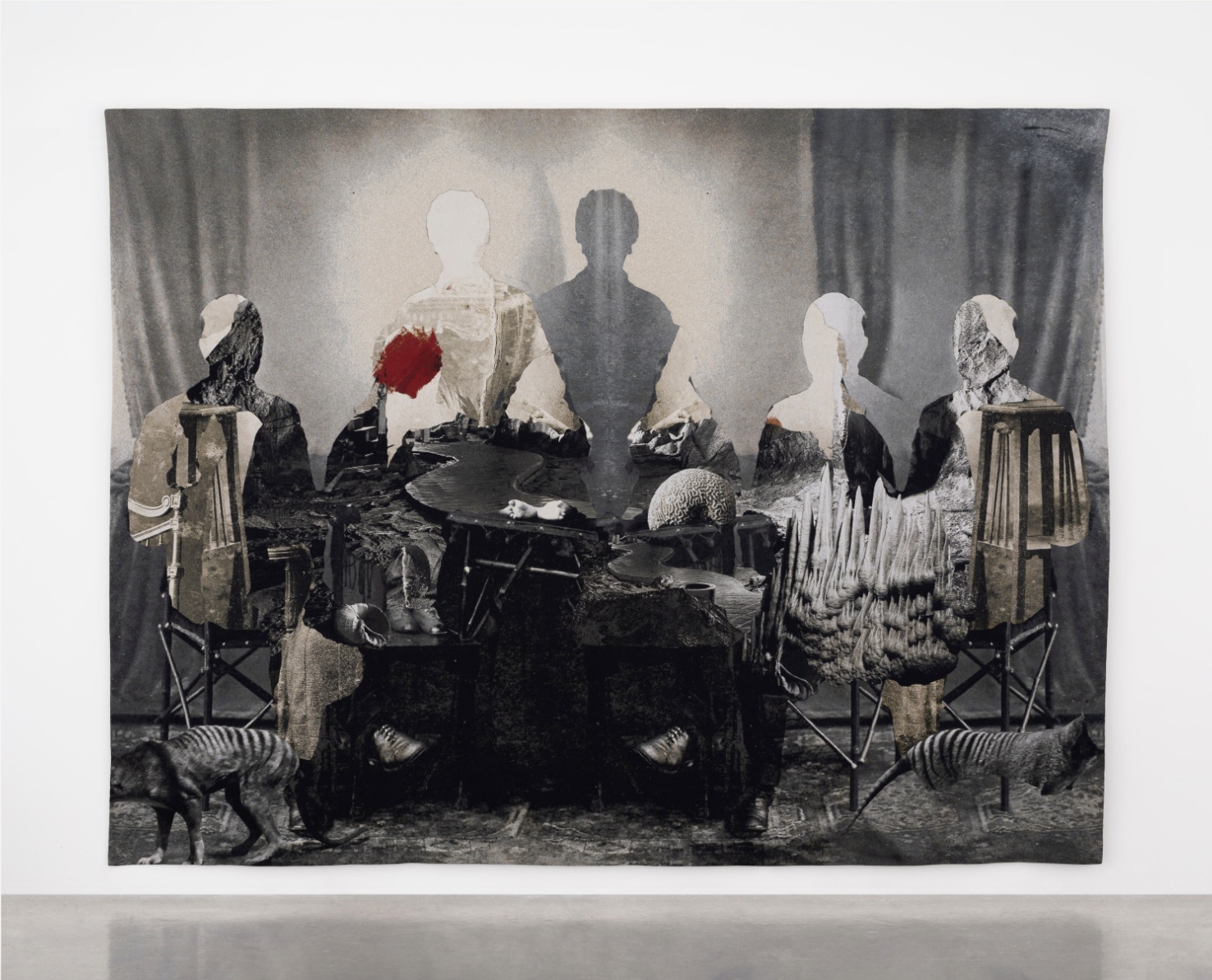
Ailbhe Ní Bhriain, “Interval I”, 2023, jacquard tapestry, cotton, wool, silk, Lurex, 116.1 x 155.9 inches. Courtesy the artist and Kerlin Gallery.
During a press preview at DAF, Dr. Anna Katherine Brodbeck, the DMA’s Hoffman Family Senior Curator of Contemporary Art, said, “This year’s acquisitions are some of the most ambitious acquired through the fund to date. Collectively, they speak to the role the artists play as world builders, and will allow the DMA to speak to our audiences about the contemporary moment with all the beauty and complexity of their intricate work.”
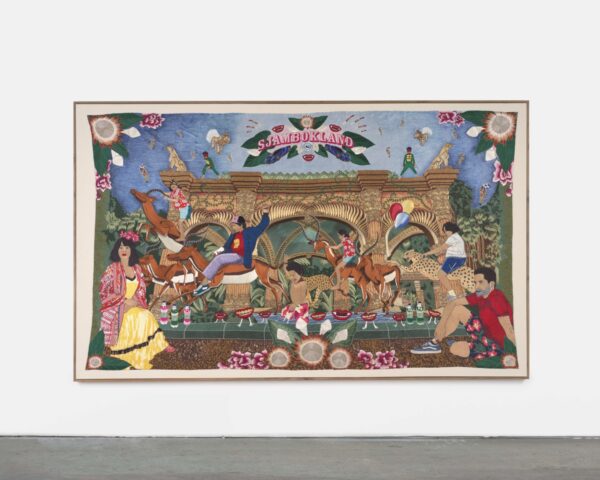
Thania Petersen, “SJAMBOKLAND,” 2022, embroidery thread on cotton poplin, Japanese glass cut beads, 61.50 x 105 inches. Acquired from Nicodim Gallery
The other artists that were selected are Ailbhe Ní Bhriain, an Irish artist working in film, computer generated imagery, collage, tapestry, print, and installation, (acquired from Kerlin Gallery) and Thania Petersen, a South African artist whose multidisciplinary approach includes photography, performance, and installation (acquired from Nicodim Gallery). The works were selected earlier in the week by the members of the DMA’s curatorial team, including Ms. Brodbeck; Dr. Vivian Li, the Lupe Murchison Curator of Contemporary Art; Ade Omotosho, the Nancy and Tim and Hanley Assistant Curator of Contemporary Art; and Agustín Arteaga, the DMA’s Eugene McDermott Director; along with a group of fund donors.
The 2024 fund donors are Jim Blake, Aleka Calsoyas, Sheryl and Geoff Green, Kristi Kirkpatrick, Marlo and Jeffrey Melucci, Cliff Risman, Linda and David Rogers, Gowri and Alex Sharma, Marlene and John Sughrue, and Teresa Tsai.
Drinking a cup of coffee is how billions of people wake up every morning. But climate change is threatening this popular beverage. Over 60% of the world’s coffee species are at risk of extinction. Scientists are searching for solutions, including hunting for wild, forgotten coffee species that are more resilient to our shifting climate. Find out how the chemistry of coffee can help us brew coffee alternatives, and how coffee grounds can be part of building a sustainable future.
Guests:
Christopher Hendon - Assistant Professor of Computational Materials Chemistry, University of Oregon
Shannon Kilmartin-Lynch - Associate Professor of Civil Engineering, Monash University, Australia
Aaron Davis - Senior Research Leader of Crops and Global Change, Royal Botanical Gardens, Kew
GLENCOE, IL—Noting that she must be some kind of genius to get such amazing results, students told reporters Friday that their pregnant sex ed teacher must really know her stuff. “I’m not saying our other sex ed teachers weren’t good, but Mrs. Collins is clearly in a league of her own to be six months pregnant,” said…
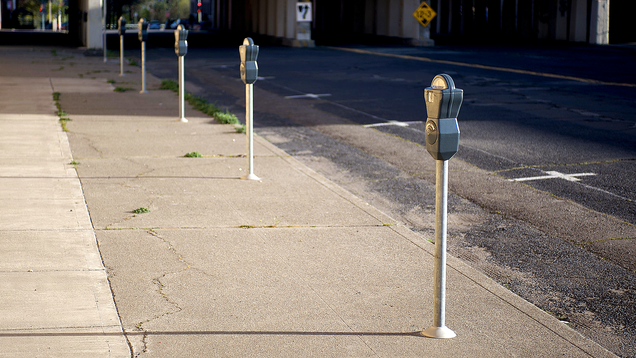
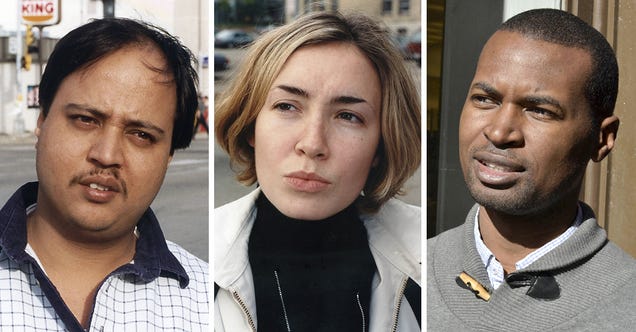
WASHINGTON—Shedding new light on the nation’s astonishing athletic abilities, the Pew Research Center released a new study Friday finding that the majority of Americans could jump the parking meter if their bum knees weren’t acting up. “According to our research, an astonishing 76% of Americans could clear that meter…
The MTA has demanded $750,000 a year from the organization that runs the New York City Marathon to make up for lost toll revenue from the Verrazzano-Narrows Bridge, which is closed for runners on the day of the race. What do you think?
On the night of Easter Sunday, burglars entered the vault of a facility in San Fernando Valley where cash for businesses across the region is stored, bypassing the alarms and making off with an estimated $30 million in cash. What do you think?
It’s the Democrats. The 2044 election is fast approaching, and we need your support now more than ever. It is the most important election of our lifetimes.
We know it feels like we’re always saying that this presidential election is the most important election of our lifetimes. But we wouldn’t be saying that if it wasn’t true each and every time. Especially this time.
As you’ll recall, the 2024 election was the most important election of our lifetimes, just as the 2020 election had been the most important election of our lifetimes. It was only through tireless grassroots organizing that Joe Biden prevailed. The grave threat posed to our democracy by Donald Trump was (narrowly) defeated, and America was wrested from the jaws of authoritarianism.
At least, for four more years.
Nowadays, it seems quaint to wonder whether an octogenarian is fit for office like we did back then. At ninety-eight years old, Donald Trump is as spry as ever. His speeches are completely unintelligible now, but he can still yell at the top of his lungs. And for Republicans, that’s the only barometer of fitness for office. This is why he’s continued to be the Republican nominee for president in every election since 2016, even during his ten-year-long prison sentence in the ’30s.
That’s why the 2044 election is the most important election of our lifetimes. Because, for the seventh time, Democrats must defeat Donald Trump in order to save our nation.
Each of the seven times Trump has run for president, it’s been close. Who could forget the 2028 election coming down to three hundred votes in Wisconsin? Or the e-ballot controversy during the Brazilpox pandemic of 2032? Or the days leading up to the 2036 election, where it seemed all but certain Trump would prevail until Taylor Kelce dropped that surprise album, Democracy (Taylor’s Version)?
Democrats have managed to hold on to the presidency for a record twenty-four years, and it wouldn’t have been possible without the efforts of dedicated volunteers such as yourself. Only through your unwavering determination have Democrats managed to keep the country okay, but not great, but also not catastrophically bad either.
With Biden’s reelection, Democrats staved off totalitarian rule and kept the country on the path of being tacitly democratic, unequal, but only somewhat discriminatory. Which, you have to admit, is better than living in the totalitarian, extremely unequal, and rampantly discriminatory nation that Republicans want.
President Harris carried on Biden’s remarkable legacy of making modest social progress in some areas while losing ground in others. This was an impressive achievement compared to the complete erosion of the social safety net and civil rights that would have happened had Trump been elected.
And, in the 2030s, President Newsom did an admirable job of keeping the country only slightly worse off than it was before. No president in the modern era has been more effective at ensuring America’s decline remained gradual rather than completely and utterly apocalyptic.
Now, after a nail-biter in 2040, President Buttigieg faces a tough reelection bid.
Yes, there are glimmers of hope. The nation’s demographics are shifting. Conservative Sun Belt states are losing population now that the West and Deep South regularly see high temps in the 120s. A decisive separatist victory at the Battle of Miami saw an end to the Florida War of Independence, and the peace treaty signed between President Buttigieg and Emperor DeSantis means one less red state to worry about. Plus, Texas voted 48.3 percent Democrat in the last election, so 2044 could be when the state finally flips. That said, it will take every dollar, every phone call, and every vote to ensure President Buttigieg defeats Donald Trump. Otherwise, it’s lights out, America.
We know it’s exhausting for people like you to have to save the country over and over and over again every four years. We know you’re mentally wiped out from the constant looming threat of state-sponsored violence and dissolution of personal freedoms that would come with a second Trump presidency. We know you’d rather be watching season 56 of The Bachelor.
But we need you to give it your all and help us win this election, just like we needed you in 2040, and 2036, and 2032, and 2028, and 2024. We’re pretty sure this is the last time Trump will run, so this election looks to be the final “most important election of our lifetimes.” Once we beat him, we promise we’ll all be able to relax a bit and finally get off those SSRIs we’ve been taking since November 9, 2016.
Unless, of course, a younger, more charismatic strongman comes along. Then all bets are off.
Hey man, welcome to our brewery. I’m gonna be your draft list today. The first thing you should know about me is this: I’m approachable. I believe beer is for everyone. If that means I’m a draft list without a single beer that tastes like beer, then hell yeah, brother—that’s what it’s all about.
You seem like the type of guy who’s lookin’ to sip on a couple of easy-drinking light brews with the fellas. I bet you even wanna be able to stand up and walk in a straight line when you head out of here. Counter pitch: maybe you don’t?
Listen, I pride myself on my impressive and diverse range of beers, but every single one has an ABV of 7.5 percent or higher. No matter what beer you choose, you better buckle up, my man, because you’re about to black out before the sun sets.
First thing you’re gonna wanna do is check out my super crushable IPAs. I’m talkin’ Double, Triple, Quadruple, Quintuple. West Coast, East Coast, Midwest, Milkshake. Juicy, Hazy, Hazier, Hozier. You name it, I’ve got it. And not just one. I’ve got like three kinds of each of those. This might have you thinking, “Cool, I like a hoppy beer. I understand what these IPAs have to offer.” Here’s the thing: no, you don’t.
Sure, we made a “normal” IPA once. But then we were like, why make a beer that’s enjoyable to drink when we could make a beer that’s not? So now we’re brewin’ with the craziest shit, dude, for real. I’m talkin’ ice cream sandwiches, In-N-Out cheeseburgers, grandma’s rigatoni. If it sounds like a mistake, we’re brewin’ it and we’re callin’ it something like, “I Bet You’ve Never Seen a Penguin Drive a Sportscar.”
If that’s not your vibe, that’s totally cool, because I bet you’ll love our sours. Check it out—we have seventeen different sours, and all of them taste like we milked a Trolli gummy worm. That’s right, we brewed them with lactose. If that’s not enough to get you goin’, I’ve got one word for you: thick. We’re gonna pour you this beer, and you’re gonna think it’s a smoothie. You’re gonna drink it, and you’re still gonna think it’s a smoothie. But it’s not. It’s a beer, technically. It’s 17 percent.
No worries if you’re feelin’ a little less adventurous today, man. I’ve also got twelve different flavored seltzers, three pale ales that all taste like IPAs, and a stout so strong that we’re legally obligated to watch you drink it.
Lastly, I’ve got one lager. It’s super good, suuuper drinkable. It’s the type of lager you crack open on the first warm day of the year, you know what I mean? Imagine this: You’re drinkin’ it out on the patio. The sun is softly shining on your face. It tastes so simple and so awesome, you’re like, “Dude, why don’t people make more beers like this?” but you don’t look into it because you’re busy drinkin’ a beer on the patio, and it’s frickin’ sweet. Unfortunately, I am outta that one right now.
What’s that? A pilsner? Ha ha. Good one. I think what you’re looking for is something we here like to call a “drinkable liquid.” The closest thing we have to that is gonna be a cup of room-temperature water from the tap over there, okay? Awesome. Cheers, brother.
When we think of what our communities need, we usually think of affordable homes, good schools, and grocery stores. Not wide towering highways. Yet, in the past 70-some years, highways have dictated community development in urban centers. They’ve torn through low-income communities of color, displacing families, homes, and businesses. As a result, people move farther away; we languish in traffic, get home from work later, and spend less time with our family. We’ve accepted growing air pollution as the inevitable cost of the lives we’ve built around our cars and the neighborhoods we’ve built around highways. For many of us, we’ve never seen or imagined an alternative.
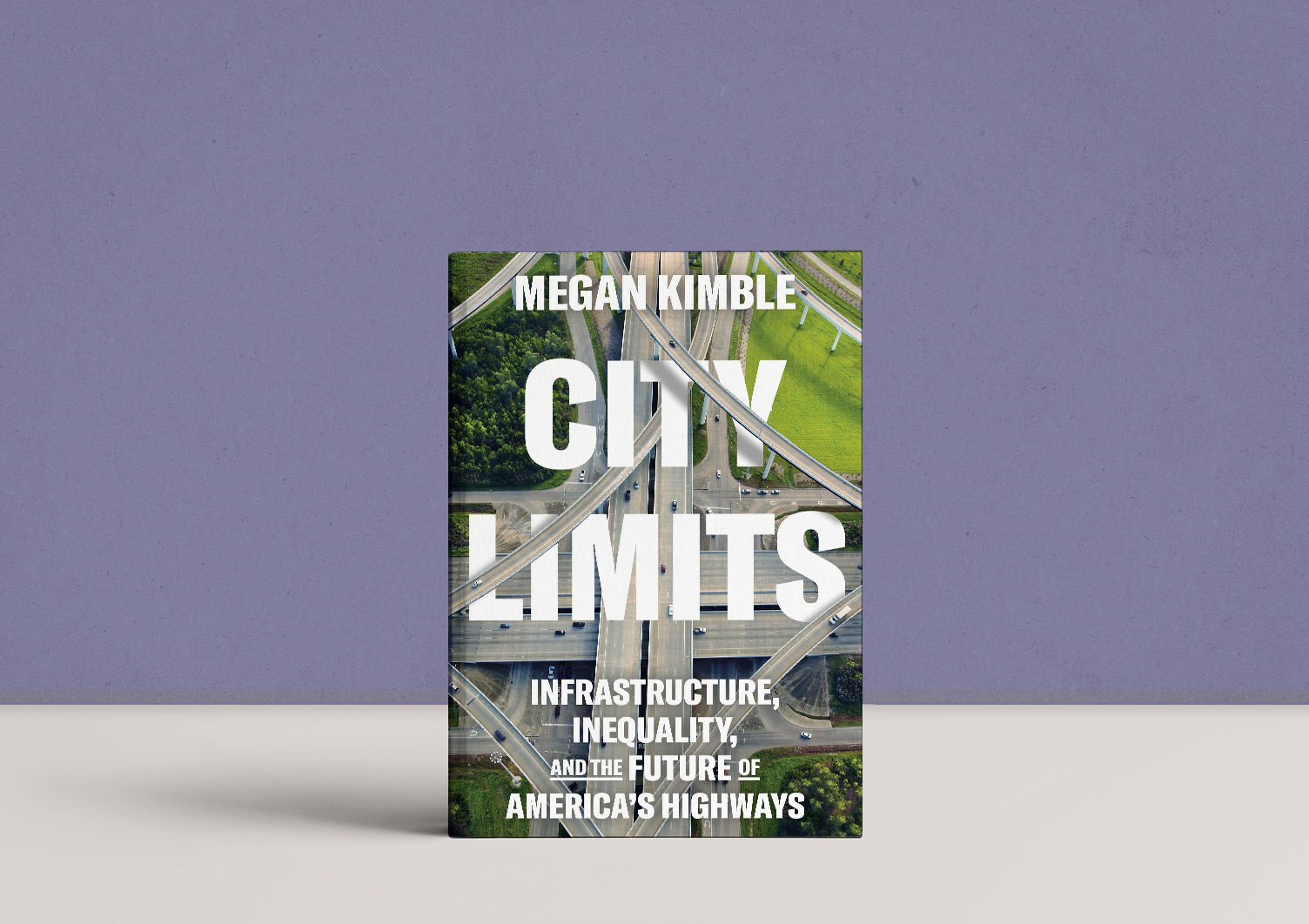
But in her new book City Limits: Infrastructure, Inequality, and the Future of America’s Highways, Megan Kimble, a journalist covering transportation and housing (and former Texas Observer editor), tells Texans: It wasn’t always this way, nor does it have to be. By interweaving the history of the interstate highway system with stories from past and present community members of Houston’s Fifth Ward, East Austin, and Dallas’ Deep Ellum, Kimble shows that these urban neighborhoods were not always designed around never-ending highway expansion. And by spotlighting the current struggles of activists resisting the Texas Department of Transportation’s (TxDOT) efforts to widen highways there, the author reimagines our cities’ futures.
City Limits reveals the human consequences of our built environment. One character, O’Nari Burleson, was born and raised in Houston’s historically Black Fifth Ward before I-10 tore her community apart in the mid-1960s. Burleson describes a place where everyone knew everyone, where she walked only a few minutes to school and found everything she needed at thriving local businesses.
Racism underlay highway development. After the Federal Highway Act authorized a 40,000-mile national system of interstate highways in 1944, Alfred Johnson, executive director of the lobby group American Association of State Highway Officials, said, “Some city officials expressed the view in the mid-1950s that the urban Interstates would give them a good opportunity to get rid of the local ‘n—rtown.’” The highways facilitated white flight from urban centers to suburban neighborhoods with racially restrictive covenants, while Black and Hispanic neighborhoods were redlined to deny families federally backed loans.
By the time I-10 was opened in 1966, 1,220 structures were erased from the Fifth Ward, including 11 churches, five schools, and two hospitals. O’Nari started relying on car transport to get to school. Seven-hundred families left the neighborhood at this time. “When I grew up, it was just people everywhere. This used to be full of people, full to the brim,” Burleson says. But the “neighborhood grew quieter, streets emptier.”
As in the Fifth Ward, the interstate highway came for Black communities in East Austin and Dallas’ Deep Ellum, neighborhoods that Freedmen had created to escape racism. These communities were cultural and commercial centers for Black people in Texas, but the state and federal transportation agencies only saw “blight” there. In 1950, the Interregional Highway, or I-35, was built, segregating Austin along racial lines. Over the next two decades, more than half a million homes along its east-side corridor would be displaced. In 1955, the Central Expressway tore through Deep Ellum, razing 54 city blocks.
“We do not believe that the Interstate System is the vehicle for solving rush-hour traffic problems, or for local bottlenecks. … Rapid transit and mass transit systems are the solution.”
The history of the interstate highway system that Kimble unspools is a history of accumulated racist policies, flawed planning, and missed opportunities to make amends.
In 1956, President Eisenhower signed the Interstate Highway Act, committing $25 billion to build 41,000 miles of interstate highways across the country over 13 years. The act created the Highway Trust Fund, diverting all taxes on gas and motor vehicles to interstate construction. What was left up for debate was whether the money should be used to connect cities—thus routing interstate traffic around urban areas—or to alleviate congestion within urban areas, routing the interstate through cities.
General John S. Bragdon, tasked by Eisenhower with investigating the alternatives, wrote, “We do not believe that the Interstate System is the vehicle for solving rush-hour traffic problems, or for local bottlenecks. … Rapid transit and mass transit systems are the solution.”
Bragdon added that communities should not be solely developed around transportation needs: “The highway plan should not be the central pattern around which a community develops. … The basic plan for all community development should be an economic growth and land use plan.” Even though Eisenhower agreed, Bragdon’s report never saw the light of day. Seeking reelection, Eisenhower buried the report to prevent blowback from local leaders eager to build more highways in their cities.
Early on, Bragdon and transportation engineers noted the phenomenon of induced demand—meaning that when bigger roads are built, traffic increases to fill those roads, in turn reducing space for public transit. Yet successive federal and state transportation policies have only fueled this vicious cycle, committing money to highways over public transit at the behest of oil and auto industry lobbyists.
In 2022, Texas Governor Greg Abbott approved the Unified Transportation Plan, an $85 billion, 10-year plan with 96 percent of its funding allocated to highway construction. State law requires TxDOT to use at least 97 percent of its funding for roads. As a result, Texas cities rely more on the federal government than the state for public transit funding, even though the federal Highway Trust Fund gives only 20 percent to public transportation. In 2021, President Joe Biden’s $2.3 billion infrastructure act committed only a fraction of transportation funds to public transit while highways received a 90 percent increase in funding.
Instead of righting past wrongs, Kimble reveals that TxDOT is now doubling down on racist highway policies, demanding more homes, schools, and businesses be destroyed in the same affected communities to add more lanes to the highways. Without considering alternative plans or modes of transportation, TxDOT recites its slogan that traffic will be unsustainable otherwise.
Many residents aren’t buying what the state agency is selling. Kimble follows community activists at door-knocking activities, protests, and numerous TxDOT hearings as they struggle to save their neighborhoods. In Houston, activists with Stop TxDOT I-45 won an agreement to address concerns around the loss of affordable housing and increase in air pollution. In Austin, members of Rethink35 are organizing to stop the expansion of I-35, and in Dallas, activists want to tear down I-345 and revitalize 245 acres of wasted land around the highway. These communities are linking up with a national movement of urban communities that want to demolish unwanted highways and use the land to build affordable housing, parks, schools, and local businesses—to serve people, not cars.
Kimble concludes City Limits by highlighting the hopeful spirit of so many fighting to rebuild their communities. It’s an uphill battle challenging TxDOT, but they have no choice: “It’s our home,” a STOP TxDOT I-45 activist says. Kimble writes, “Like a suture over a scar … harm cannot be undone, it can only be repaired.”
After all, there’s only so far people can move, only so much land we can allow TxDOT to take, and only so many hours in a day we can sit in traffic.
Fifth Ward resident Kendra London, 43, helped form the neighborhood organization Our Afrikan Family to serve and educate her community about a major threat: an expansion of Interstate 45 that will wipe out hundreds of Houston homes and businesses and has already forced evictions. For the past five years, she and other advocates have been door-knocking and holding meetings to educate residents about TxDOT’s plans. A little over a year ago, she thought they had made progress when the Federal Highway Administration signed a Voluntary Resolution Agreement with TxDOT ending a two-year civil rights investigation into the discriminatory environmental and economic impact the North Houston Highway Improvement Plan would have on several Black and brown neighborhoods.
The agreement allowed the project, a $9.7 billion plan to widen Interstate 45 and overhaul the downtown freeway system, to proceed. TxDOT expects construction to continue until 2042. In return, TxDOT agreed to mitigate the impacts on communities of color by considering ways to reduce the project’s footprint, monitoring air quality, providing more transparency, and helping residents, businesses, and organizations relocate within the community.
But TxDOT appears to be breaking its promises, according to documents and interviews with London and other community organizations.
Josephine Lee
TxDOT continues to demolish more public housing units than it was approved to displace, records show. Experts say its promise for pollution monitoring, which so far has included a report from a single monitor, is inadequate. And even TxDOT’s own reports show that promises to help businesses have fallen short. By September, TxDOT had to complete a survey of an estimated 300 affected non-residential businesses and organizations and document progress in providing relocation services. But TxDOT surveyed only 21 so-called “non-residential units” and claimed none needed relocation services.
Many residents told the Texas Observer they don’t know what will happen to them even though construction will begin as soon as August 1. TxDOT will “just pick people up and just move them out, while people are still in the dark and don’t know what’s happening,” London said. “TxDOT’s still bulldozing over our communities.”
TxDOT restated provisions from the agreement in response to an email the Observer sent outlining complaints from the community.
A civil rights complaint filed in December 2021 by five advocacy organizations calculated that 160 single-family homes, 433 multi-family units, 486 public housing and low-income units, 344 businesses, five places of worship, and at least 2 schools would be displaced. The resolution agreement fell short of community demands to reduce the numbers of those displaced, though it requires TxDOT to provide relocation services for affected businesses and residents to ensure they are “not cut out from the community” and to publicly post information to facilitate relocation.
“It’s obvious decisions have already been made. They never follow up on our questions.”
Julia Orduña, regional director at the low-income housing advocacy organization Texas Housers, like London, expressed concern that more public housing residents are being displaced than necessary and many have received inadequate assistance.
While all right-of-way acquisitions and demolition for the project were supposed to cease during the federal government’s two-year investigation, the Houston Housing Authority proceeded to evict all residents still living in 184 units of the public housing complex Clayton Homes, which was then demolished. London said the agency hired only a few “navigators” to advise residents on “enhanced relocation services” and many residents never received help.
TxDOT originally stated it plans to acquire only two of the six buildings of the public housing complex Kelly Village, but in its September progress report and December public presentations the agency revealed a new map showing the footprint encompasses all six buildings housing 270 units. When questioned about this, TxDOT public information officer Danny Perez wrote: “TxDOT is working with the Houston Housing Authority to acquire 50 of the 270 Kelly Village public housing units.” Furthermore, it’s unclear whether the hundreds of displaced public housing residents will be able to relocate to affordable units within the community. TxDOT has promised displaced public housing residents first rights to affordable housing in two new mixed-income residential units planned within two miles of Clayton Homes. But residents have not been told how many affordable units will be available, what income level will be used by developers to determine eligibility, and how long these units will remain affordable,” Orduña said.
“There is no real accountability with private entities managing these low-income units. So is there actual security for households to even be able to move there, and then when they do, [to] not fear displacement again?” Orduña said.
The resolution agreement also required TxDOT to inform property owners of an “occupancy agreement” option to remain at the property until the start of construction. But, as of September last year, TxDOT reported they had entered into only nine occupancy agreements and only three were active.
Community organizers, like Stop TxDOT I-45 organizer Alexandra Smither, also question the amount of outreach TxDOT has done with property owners and say that private right-of-way acquisition companies have long been pressuring homeowners to sell below market value before the project even received final approval.
Low-income renters, living in the 400-some multi-family units in the project’s footprint, are even more out of luck than homeowners, businesses, or public housing residents because they are at the whims of their landlord’s decision to sell their property. However, under the resolution agreement, renters were deemed eligible for the $30 million set aside for affordable housing initiatives and relocation compensation. Within three months of signing its agreement with the feds, TxDOT was required to gather public input and publicize a plan for how they would use this pot of money.
According to the resolution agreement, TxDOT agreed to hold public meetings twice a year in “an open forum for the community to provide feedback, raise issues, and ask questions about TxDOT’s compliance with the agreement.” Meetings were required to be accessible to residents who are disabled and who have limited English proficiency.
But attendees at the first public meeting TxDOT held last December reported that agency representatives didn’t leave enough time for community feedback, foreign language translation to English didn’t last the entire meeting, and the room was too small and crowded to accommodate disabled residents. Many residents got frustrated and left.
“TxDOT is not listening. It’s obvious decisions have already been made. They never follow up on our questions,” London said.
In a city ranked the sixth-worst for fine particle air pollution, civil rights complainants had noted that TxDOT’s overhaul of the downtown freeway interchanges would shift more traffic and vehicular air pollution toward the low-income communities of color who already face higher rates of asthma and cancer—in Near Northside, Fifth Ward, and Second Ward, away from the whiter, wealthier communities of Memorial Park, Fourth Ward, and Midtown.
The resolution agreement failed to force TxDOT to mitigate past environmental harms when the agency built Houston’s main highways through redlined Black and brown communities. It only required TxDOT to install one air monitor in each of the three segments of the project totaling 24 miles. In order to establish a baseline reading of pollutant levels, TxDOT must monitor the air for one year before starting construction in that segment. In response, TxDOT deployed one air monitor at the southernmost tip of Segment 3, a 12.3 mile area including the downtown interchanges.
So far, the agency has shared only one report from a month-long reading of the Segment 3 air monitor with the public.
“It’s not enough,” said Anthony D’Souza, research and policy coordinator for Air Alliance Houston. “Any expert can tell you that one monitor [per segment] is not enough to determine pollution levels, especially for a project that expansive.”
D’Souza said that average readings over a day or three days water down the data and are insufficient to understand what pollution levels are like during peak traffic hours.
Yet even that limited data shows that before construction, nitrous oxide levels exceed EPA standards, he said. Other common vehicular pollutants, like ozone, are not being measured at all. After a few hours, these chemicals cause throat irritation, coughing and wheezing and over longer periods can lead to asthma, heart disease, lung disease, cognitive impairment, and cancer.
“You end up underestimating the levels of pollution caused by the traffic on the freeway, and it leads you to believe that the project won’t have a substantial impact on pollution levels,” D’Souza said.
The proposed expansion project will add four more lanes, two each way to I-45 and another four lanes to a segment of I-10. For years, community members have called on the agency to reduce the number of lanes it plans to build.
The resolution agreement calls for TxDOT to “evaluate reasonable opportunities to reduce the project footprint” but doesn’t specify how. To date, community members and organizations have not received any information about how TxDOT plans to reduce the footprint of the plan.
“At the December federally required meetings, TxDOT employees were hesitant to talk about reducing the footprint, and it certainly was not suggested. The federal government needs to ensure it truly happens,” said Smither.
Community members are organizing to call on the feds to step in and enforce the agreement. The Federal Highway Authority has a lot of power. If it finds TxDOT in violation of its agreement, it can ask the state agency to remedy its actions, pursue sanctions, withhold federal highway funds, and ask the Department of Justice to enforce the agreement.
“We are begging the federal government to step in and live up to their big promises of protecting people from further damage wrought by highway expansion. They have the power. They need to use it. What’s happening here is wrong,” Smither said.
In the mid-1960s, as construction of Houston’s Interstate 10 razed swaths of the predominantly Black Fifth Ward community, London’s grandmother came home one day to find another house had been dropped into her backyard.
“There was no communication or community involvement then. And there’s no communication or community involvement now,” London said.
YOU’RE OVERDUE FOR A CLEANING! Jennifer at reception started having an affair with one of the dentists, and her husband will be storming into the office to confront them about it during your appointment.
YOU’RE OVERDUE FOR A CLEANING! Our new latex gloves are churro-flavored.
YOU’RE OVERDUE FOR A CLEANING! We are going to start publicly posting on our website when all of our patients’ last appointments were, so you can’t lie when your mom asks. HIPAA be damned.
YOU’RE OVERDUE FOR A CLEANING! The TV in our waiting room is playing Erin Brockovich.
YOU’RE OVERDUE FOR A CLEANING! I really shouldn’t be telling you this, but did you know that Jonathan Groff is one of our patients, too? Who knows, maybe you might bump into him here.
YOU’RE OVERDUE FOR A CLEANING! Your teeth look disgusting when you wear a white shirt. Everybody thinks so.
YOU’RE OVERDUE FOR A CLEANING! We promise we won’t annoy you about getting your wisdom teeth removed this time. And won’t even ask you how often you floss. That’s none of our business.
YOU’RE OVERDUE FOR A CLEANING! We’ll let you take a silly one on the X-ray.
YOU’RE OVERDUE FOR A CLEANING! One time, somebody put off their cleaning for an extra month, and all of their teeth fell out, and they died. I’m sure that won’t happen to you though… but you never know.
YOU’RE OVERDUE FOR A CLEANING! There’s a bounce house in the parking lot now.
YOU’RE OVERDUE FOR A CLEANING! Honestly, forget about posting it to our website. How about we call your mom directly and tell her when you last came in? We have her phone number since she’s your emergency contact. Guess that means you’re probably single, huh? Maybe you wouldn’t be if you had a better smile… just saying.
YOU’RE OVERDUE FOR A CLEANING! We taught the fish in the lobby’s aquarium how to do a loop-the-loop—you gotta come check this out.
YOU’RE OVERDUE FOR A CLEANING! Help! We’re trapped under something heavy and need you to come free us. We’re only able to reach our keyboard to send this one email, and the battery is about to die, so you’re our only hope.
YOU’RE OVERDUE FOR A CLEANING! In the mood to have a boob graze your ear? Come on down!
Remember the first time you used Google search? It was like magic. After years of progressively worsening search quality from Altavista and Yahoo, Google was literally stunning, a gateway to the very best things on the internet.
Today, Google has a 90% search market-share. They got it the hard way: they cheated. Google spends tens of billions of dollars on payola in order to ensure that they are the default search engine behind every search box you encounter on every device, every service and every website:
Not coincidentally, Google's search is getting progressively, monotonically worse. It is a cesspool of botshit, spam, scams, and nonsense. Important resources that I never bothered to bookmark because I could find them with a quick Google search no longer show up in the first ten screens of results:
Even after all that payola, Google is still absurdly profitable. They have so much money, they were able to do a $80 billion stock buyback. Just a few months later, Google fired 12,000 skilled technical workers. Essentially, Google is saying that they don't need to spend money on quality, because we're all locked into using Google search. It's cheaper to buy the default search box everywhere in the world than it is to make a product that is so good that even if we tried another search engine, we'd still prefer Google.
This is enshittification. Google is shifting value away from end users (searchers) and business customers (advertisers, publishers and merchants) to itself:
And here's the thing: there are search engines out there that are so good that if you just try them, you'll get that same feeling you got the first time you tried Google.
When I was in Tucson last month on my book-tour for my new novel The Bezzle, I crashed with my pals Patrick and Teresa Nielsen Hayden. I've know them since I was a teenager (Patrick is my editor).
We were sitting in his living room on our laptops – just like old times! – and Patrick asked me if I'd tried Kagi, a new search-engine.
Teresa chimed in, extolling the advanced search features, the "lenses" that surfaced specific kinds of resources on the web.
I hadn't even heard of Kagi, but the Nielsen Haydens are among the most effective researchers I know – both in their professional editorial lives and in their many obsessive hobbies. If it was good enough for them…
I tried it. It was magic.
No, seriously. All those things Google couldn't find anymore? Top of the search pile. Queries that generated pages of spam in Google results? Fucking pristine on Kagi – the right answers, over and over again.
That was before I started playing with Kagi's lenses and other bells and whistles, which elevated the search experience from "magic" to sorcerous.
The catch is that Kagi costs money – after 100 queries, they want you to cough up $10/month ($14 for a couple or $20 for a family with up to six accounts, and some kid-specific features):
I immediately bought a family plan. I've been using it for a month. I've basically stopped using Google search altogether.
Kagi just let me get a lot more done, and I assumed that they were some kind of wildly capitalized startup that was running their own crawl and and their own data-centers. But this morning, I read Jason Koebler's 404 Media report on his own experiences using it:
Koebler's piece contained a key detail that I'd somehow missed:
When you search on Kagi, the service makes a series of “anonymized API calls to traditional search indexes like Google, Yandex, Mojeek, and Brave,” as well as a handful of other specialized search engines, Wikimedia Commons, Flickr, etc. Kagi then combines this with its own web index and news index (for news searches) to build the results pages that you see. So, essentially, you are getting some mix of Google search results combined with results from other indexes.
In other words: Kagi is a heavily customized, anonymized front-end to Google.
The implications of this are stunning. It means that Google's enshittified search-results are a choice. Those ad-strewn, sub-Altavista, spam-drowned search pages are a feature, not a bug. Google prefers those results to Kagi, because Google makes more money out of shit than they would out of delivering a good product:
No wonder Google spends a whole-ass Twitter every year to make sure you never try a rival search engine. Bottom line: they ran the numbers and figured out their most profitable course of action is to enshittify their flagship product and bribe their "competitors" like Apple and Samsung so that you never try another search engine and have another one of those magic moments that sent all those Jeeves-askin' Yahooers to Google a quarter-century ago.
One of my favorite TV comedy bits is Lily Tomlin as Ernestine the AT&T operator; Tomlin would do these pitches for the Bell System and end every ad with "We don't care. We don't have to. We're the phone company":
The coverage of Khan's appearance has focused on Stewart's revelation that when he was doing a show on Apple TV, the company prohibited him from interviewing her (presumably because of her hostility to tech monopolies):
But for me, the big moment came when Khan described tech monopolists as "too big to care."
What a phrase!
Since the subprime crisis, we're all familiar with businesses being "too big to fail" and "too big to jail." But "too big to care?" Oof, that got me right in the feels.
Because that's what it feels like to use enshittified Google. That's what it feels like to discover that Kagi – the good search engine – is mostly Google with the weights adjusted to serve users, not shareholders.
Google used to care. They cared because they were worried about competitors and regulators. They cared because their workers made them care:
"Chokepoint Capitalism: How to Beat Big Tech, Tame Big Content, and Get Artists Paid, with Rebecca Giblin", on how to unrig the markets for creative labor, Beacon Press/Scribe 2022 https://chokepointcapitalism.com
"Attack Surface": The third Little Brother novel, a standalone technothriller for adults. The Washington Post called it "a political cyberthriller, vigorous, bold and savvy about the limits of revolution and resistance." Order signed, personalized copies from Dark Delicacies https://www.darkdel.com/store/p1840/Available_Now%3A_Attack_Surface.html
This work – excluding any serialized fiction – is licensed under a Creative Commons Attribution 4.0 license. That means you can use it any way you like, including commercially, provided that you attribute it to me, Cory Doctorow, and include a link to pluralistic.net.
Quotations and images are not included in this license; they are included either under a limitation or exception to copyright, or on the basis of a separate license. Please exercise caution.
NEW YORK—Shaking violently under the barrage of an afternoon downpour, a $5 umbrella purchased at 49th Deli Grocery confirmed Thursday that it was doing the best it could, all right? “Look, I’m sorry—I wish I were made out of more durable material, too, but I’m trying here, okay?” said the visibly rattled umbrella,…
Eight passengers on a Norwegian cruise, including a pregnant woman, a paraplegic traveler, and an 80-year-old who had been receiving emergency medical treatment at port, were not permitted back aboard the still-docked ship because they were late, leaving them to travel through six countries over land trying to meet…
BETHANY BEACH, DE—As movers unloaded a truck in front of the house next door, local dad Stan Morby, 43, expressed hoped Wednesday that his new neighbor liked verbal altercations. “Man, I really hope whoever bought that place enjoys getting into shouting matches in the front yard,” said Morby, noting how difficult it…
GLOUCESTER, MA—Struggling to articulate through streams of tears, sobbing conservationists from the National Marine Fisheries Service announced Wednesday that endangered Atlantic halibut were on their own now after the two species had a huge falling out. “We’re really done this time—those demersal assholes are on…
CHICAGO—Contemplating what he presumed was one of the most sought-after meals in all the city, local man Ron Steward told reporters Wednesday that a pizza slice at John’s Pizza & More had to be really delicious to be served from behind bulletproof glass.“Whoa, that’s got to be one incredibly tasty pizza slice if they…
Former President Donald Trump famously said that he would be “a dictator” on day one if he’s reelected this November. Here is everything that Trump plans to do on his first day in office.
A study found that cognitive tests issued via a phone app were able to accurately detect early-onset dementia in high-risk individuals, even when they were not yet displaying outward symptoms, providing a possible alternative to help identify the underdiagnosed illness. What do you think?