A jury will decide if a group of Trump supporters violated state and federal law when they allegedly harassed a Biden campaign bus on a Texas highway in 2020, frightening those on board.
The footage from I-35, which lasts about 10 seconds, shows Secret Service Agent Clint Hill — who famously jumped onto the back of the limousine as the shots rang out — hovering in a standing position over the president and Jacqueline Kennedy, whose pink suit can be seen.
This post was written by Alison Green and published on Ask a Manager.
It’s four answers to four questions. Here we go…
1. My neighbor, her nephew, my kid, and her dogs
My question has to do with kid work. I recently found myself in an uncomfortable situation with my middle-schooler, Falcon, and I’m wondering if I handled it badly. My neighbor, Jane, asked Falcon to check on her dogs and take them for a walk while she attended an event. She offered $15/hour, and since Falcon loves dogs, he agreed. The request was for him to spend two to three hours walking and playing with the dogs, starting between 5 and 6 pm.
On the afternoon of the event, Jane texted, asking if Falcon could instead stay at her house until she returned around 11 pm. She also mentioned that her adult nephew, Hank, would be at the house with Falcon. This change was … unexpected. We only saw the text after returning home from Falcon’s soccer game, by which time Jane had already left for the event. Neither of us had ever met Hank before, and all we knew about him was that he had learning disabilities.
Falcon was uncomfortable with the idea of spending several hours in a house with an adult stranger. But, since Jane had already left, we felt obligated to fulfill her request. I accompanied Falcon to the house at 6 pm. We walked the dogs, played with them in the yard, and greeted Hank, who was sitting in the dark and ignored us. Falcon was afraid of him. We played outside with the dogs for a couple of hours until it became too dark and mosquito-y to reasonably remain outdoors. We then brought the dogs inside and waited together in the front room with them until Jane returned, as neither of us was comfortable leaving Falcon alone with Hank.
When Jane got home, she noticed dog poop in the kitchen, which we hadn’t seen because Falcon was too scared to go in there (it was attached to the room where Hank was hanging out in the dark). It appeared that Hank and/or the dogs had stepped in the poop and gotten it all over the place. Our best guess is that the pooping happened before we arrived, as we were with the dogs fairly consistently from 6 pm until Jane’s return. Jane handed Falcon $75 as payment, but I texted her the next morning, offering to return the money since we hadn’t prevented the dogs from soiling the house. Jane asked us to return $50, which we did.
I feel terrible about the whole situation. I don’t think Jane should have put my son in the position of being alone for hours with a man he didn’t know. Falcon feels guilty for not doing a better job with the dogs. I’m wondering how could I have handled this better. Beyond letting the dogs out earlier, of course. I feel like I’ve both traumatized my child and let down my neighbor.
This is 100% on Jane. Falcon agreed to a specific job: playing with the dogs for a couple of hours, on his own, ending no later than 9 pm. Jane unilaterally changed that to “stay at my house for six hours with an adult man you don’t know.” Even if Hank had been friendlier/less intimidating, this wasn’t an okay thing to ask of a middle-schooler, particularly without checking to see if he’d be comfortable with it and possibly talking with you as well. (Frankly, even if Falcon were comfortable, I don’t think it would have been an appropriate ask. If Hank isn’t capable of taking care of the dog himself, and is someone who might smear dog poop all over the house without cleaning it up, an unprepared middle-schooler isn’t the right person to be alone with him.)
If we could go back in time, ideally you would have coached Falcon to tell Jane that he couldn’t stay later than the time he agreed to (or even told her that yourself). You say you felt obligated to fulfill Jane’s request, but you weren’t obligated; the request wasn’t the one Falcon had agreed to. I don’t think you needed to offer to return the money although I can understand the impulse, given the poop situation. But Jane should have refused that offer and should have apologized for how things unfolded.
2. I submitted a time off request 3 months ago … and am still waiting
I work at a small company, about 50 employees. Last year, the owner turned over day-to-day operations to a VP who has been with the company for the past 10 years. I report to the VP and am one of four people with the company in a managerial position.
Over three months ago, I submitted a leave request for the week of Christmas. I have been in this industry for over 20 years and that week is historically the slowest week of the year. I usually do not take off that week so that my staff is able to travel to see family (my family is small and local). Last year, my brother-in-law died on Christmas and my husband does not want to be home due to the bad memories from last year. Because it is Christmas, I submitted my request early to make sure it was timely and before any other requests were submitted.
The VP has not made a decision on my leave request and advised me he is still “thinking about it.” I’m very frustrated. I feel disrespected and unappreciated. I only earn two weeks of leave per year, which isn’t much and often causes issues as my husband has considerably more leave and we are unable to travel due to my lack of leave. It is also use or lose, so if I do not use my time by the end of the year, I will lose it. I feel like my vacation time is being held hostage. Never mind that I have to pay for the AirBNB and flight and my husband has to request leave as well for that week. Everything is in limbo over this and the costs are rising each day. The difference in the cost of the flights between early June and September is nearly $1000. I’m so angry and disappointed.
I’m willing to quit over this. My issue is that I don’t think the owner is aware of the issues with the VP, and I’m not sure how to bring it up as he has stated multiple times that he has complete faith in the VP and trusts him 100%. I do not think it is appropriate to withhold PTO approval (or denial) for over three months, all while the cost of my vacation plans are now increasing and I will not be able to use the leave before the end of the year if this vacation request is not approved. Any guidance would be greatly appreciated in how to address with both the owner and VP.
Talk to the VP first! Say what you’ve said here — the costs are rising with each day that you wait, the time off is use-or-or-lose it, and you need to be able to plan. Ask what he needs to give you a definite answer by next week.
If he doesn’t do that (or if he denies the request), talk to the owner. “Having complete faith in” the VP and “trusting him 100%” doesn’t generally mean “I believe he will never miss anything / could never benefit from help changing his perspective.” And you’re a high-level employee who’s been there for a decade; the owner probably would want to know that you’re on the verge of quitting over something so easily solvable.
All that said … two weeks of vacation time is very stingy for a management level position, and even more so after 10 years. I’d also find it grating to be in a high-level management role but still be required to get approval for a meager amount of time off during a slow period. No one should need to wait this long to have PTO approved, but typically PTO approval for managers at your level is much closer to a rubber-stamp; making you wait months for no discernible reason is ridiculous. Is this the only thing where your company is stingy and overly rigid? I’d be inclined to reassess how well this place treats you (in money, in benefits, and in respect) and compare it to other options that might be out there.
3. What do I do when my company firewall blocks a website?
On occasion I will open a safe-for-work link but it will be blocked for various reasons. Sometimes it’s because it’s a “advocacy website” (which, my job is in advocacy, so I don’t totally get) but sometimes it’s for pornography. This is absolutely mortifying! (And I must stress, there’s no reason to believe these links are actually NSFW!) What should I do when this happens? I usually do nothing, but I am very embarrassed at the idea of our IT team getting an alert that I tried to access porn at work. Do I need to email them about it and clear the air?
Nah. They’re probably well aware that the software misfires, and you’re undoubtedly not the only person it’s happening to. However, it would be fine to message them, “FYI, OatmealAlliance.com is being blocked as ‘pornography,’ which it obviously isn’t.” That way you’re informing them about a problem (their blocking tool needs refinement) and if it happens to bring you peace of mind in the process, so much the better.
If these are sites you need to do your job, you should add, “Can you please unblock it? I need it for a project I’m working on” (or similar).
4. Greeting people you’re not sure you’ve met before or not
Low stakes question, but do you have a favorite way to acknowledge people who you’re introduced to and aren’t sure if you’ve met before? Or you know you have, but they don’t remember and you don’t want to put them on the spot?
I’m usually in the latter category, but may be moving into the former. The default seems to be “nice to see you,” to cover all bases, but honestly I hate it. Curious if you have anything better?
“Nice to see you” is a classic among politicians and others who do lots of glad-handing for a reason: it covers you in case you’re forgetting that you’ve met the person previously. You could go with “hello, how are you?” but there aren’t many other options for this specific context.
Pre-orders are open until September 30th! Shipping is anticipated to start early 2025! Be sure to save your confirmation email, if you didn't receive one and were charged please email support@spri.ng
Nabiu is a practicing M.A.G.E. (Mathematical Algorithm Graduate Engineer) under the apprenticeship of the great Wizzro PhD!
Join Nabiu and other colorful characters as they go on errands for the eccentric professor, along the way they'll assist the citizens of the Broccoli Kingdom, come face to face with terrorizing monsters, and uncover the mystery of the Ley Lines.
The Fruitless Quests of Nabiu is an original animated series by TerminalMontage LLC, created by Jeremey Chinshue.
Inspired by games like Final Fantasy, Paper Mario, Pokemon, Kingdom Hearts, Super Mario RPG, Dungeons and Dragons, and more!
Those who grew up in the 80s, 90s and 2000s may recognize influences from Courage the Cowardly Dog, Yu-Gi-Oh, Pokemon, Monster Rancher, and other nostalgic Nickelodeon and Cartoon Network shows!
Dear Whoever Is Trying to Hack into My Instagram Account,
Hey, man. Just got that little automatic email you generated trying to hack into my Instagram account. Dude, no. You do not want to go in there. Seriously. This is for your own good.
I may not know you, but I’m confident you do not have the mental or emotional stamina to survive the torment and torture that is my Instagram account. Stop trying to guess my password and SAVE YOURSELF.
Still don’t believe me? Okay. Let me ask you this, then. Have you ever come to, somehow missing five hours you’ll never get back, staring at a blurry field of numbers that you soon realize is your bank account? But the bank account is much, much lower than you remember it being last you checked. And amidst the swarm of new charges—a fifty-dollar artisanal sunscreen here, a nonrefundable year-long subscription to something called a “Booger Box” there… Yes, it’s insect boogers you rub on your face promoted by a freakishly convincing beauty influencer. I bought endless boxes of boogers, man. You realize, oh god. It was me. I’m not okay. If you can’t weather dark moments like that, then you are not ready for access to the harrowing landscape that is my Instagram account.
It’s taken me years to build up the level of tolerance necessary to safely scroll through the minefield of targeted ads vying for my sweet, sweet credit card digits. And even guarded with my emotional shield, with that protection, I’m still vulnerable. How many body-shaping body suits can one buy before one loses the funds to feed said body and withers away to oblivion? Unfortunately, that’s a rock bottom I thought I had reached. And then I bought more. My waist looks amazing. I am dead inside. Live!
At this point, my dog has basically become a canine cocktail of every anti-itch, anti-pest, anti-anything-bad-that-could-ever-past-present-or-future-happen-to-him gel, ointment, and/or spray amalgamation. If a millennial witch tempted me with it via sponsored post, I’ve rubbed it on my dog’s butt. So many moist cures. For the love of god, don’t become this.
And the TIME. All that lost time. Scrolling and scrolling and scrolling and scrolling the doomiest doom that ever did gloom. Escape the doom and gloom, man. I have diagnosed myself with so many illnesses. If I don’t know what the fuck is going on with the stars at any given moment, hives break out all over my body, and the itching won’t subside until I read not one but five different astrologers’ takes at the very least. If I don’t, I’ll miss something. What? The fuck do I know! All I know is god forbid I miss that important prediction careening toward my fate, destined to blow up my life. My skin can’t TAKE IT. I’m a Taurus sun with a Capricorn stellium goddamnit. This isn’t a state of being anyone should willingly subject themselves to. You shouldn’t be in there. None of us should be in there.
So stay the hell away. For your own good. Your physical, mental, emotional, financial, and astrological well-being will all greatly appreciate it. I’m jealous that you’re on the outside. Take pictures. Post about your freedom. I will find you. I will follow. I will like. I will comment. I will share. I can’t stop myself. Not anymore. But you can. Just stay far the fuck away.
Yours from the deepest depths of the infinite scroll, Rebecca
A customer wanted to to transfer pixels between a ID2D1Bitmap1 and a GDI HBITMAP. The original D2D bitmap looked like this:
This usually got converted to a GDI bitmap correctly, but once in a while, they’d run into a system where the result looked like this:
Just from the screen shot, I knew what the problem was. Do you see what happened?
Here are some clues.
Notice that the result is not total garbage. There is a striped pattern to the result.
Notice also that the result has roughly the same color distribution of pixels as the intended result. The pixels are just being put in the wrong place.
And if you kind of squint, you can see the correct image. It just got stretched really thin and twisted.
Let’s unstretch and untwist it:
This twisting and stretching is what happens when you mismatch the bitmap stride.
Imagine two metronomes ticking at slightly different rates.
X   X   X   X   X   X   X   X   X   X   X
Y    Y    Y    Y    Y    Y    Y    Y    Y
Let’s insert a line break in the timeline each time the fast X metronome ticks, so this lets us see what the Y metronome looks like from X’s point of view:
X
↓
Y   |
|Y  |
| Y |
|  Y|
|   |
Y   |
|Y  |
| Y |
|  Y|
|   |
The ticks of the slower metronome get gradually more and more late until they get so late that they “wrap around” and are back in sync (but a full cycle behind). And then they get more and more late, and wrap around again, and the whole thing just repeats.
A bitmap’s stride (sometimes known as pitch) is the value to add (in bytes) to get from the start of one row of pixels to the start of the next row of pixels. If the bitmap was produced at one stride but consumed at a different stride, then you get the mismatched metronome effect, where the producer is starting each row every X bytes, but the consumer expects each row to begin every Y bytes. If the producer’s stride is larger, then from the consumer’s standpoint, the bytes of each row arrive later and later. (And if the producer’s stride is smaller, then the consumer sees each row starting more and more prematurely.) The result is that each row of pixels is offset slightly, and as more and more rows are processed, the offset accumulates, leading to the slanting effect.
The choice of stride can be hardware-dependent. Some video drivers prefer that each row of pixels begin on an exact multiple of, say, 64 bytes. If your bitmap uses a pixel format that is 4 bytes per pixel, then a bitmap of width n will have 4n bytes of pixel data for each row, and if that’s not a multiple of 64 (if n is not a multiple of 16), then there will be padding bytes at the end of each row.
This explains why the problem occurred only on some systems: You need a graphics card which imposes stronger alignment than that required by GDI.
Next time, we’ll look at the code for doing the conversion and see where the stride needs to be taken into account.
This post was written by Alison Green and published on Ask a Manager.
A reader writes:
I work in a field that has been heavily affected by layoffs in the past year. I have been lucky and managed to maintain work, but many talented people I know have not been so lucky.
My question is about whether posting depressing, sad posts on social media, especially LinkedIn, affects your hiring potential.
I have seen many of my former coworkers posting status updates that include how they been out of work for many months, they are burning through their savings, they applied to hundreds of positions only to be rejected by AI recruitment tools or ghosted by human hiring teams, and, in some cases, that they are are about to be homeless.
While I will not argue that the current job market is incredibly difficult, I worry that they are hurting themselves with potential employers who might unfairly see them as “difficult.”
I would like to know your take on this and what you would recommend on posting status updates like this on LinkedIn.
Yes, they are likely to be hurting their chances with prospective employers.
Employers tend to want to feel they’re hiring someone who’s in-demand — or at least someone who 100 other companies haven’t looked at and said, “We’ll pass.”
To be clear, this is not aligned with the realities of job-seeking and hiring. It’s not uncommon for talented people to struggle to find jobs, especially in a tight market, and being unemployed or having a long job search isn’t a sign that someone shouldn’t be hired.
But it’s not helpful to raise those questions in a hiring manager’s mind.
Moreover, hiring managers — being humans — tend to respond better to optimism than to cynicism, pessimism, or bitterness. That doesn’t mean that cynicism, pessimism, or bitterness are never warranted — but when you want people to hire you, making that your branding on a professional networking site is a bad move.
LOVES PARK, IL—Firm in his refusal to move on to the next tee until his standards had been met, area dad Greg Nevins announced Thursday that he was not leaving this mini golf hole until his son Logan showed him some good form. “Come on, enough playing around—now square your shoulders and keep your damn head down,” the increasingly agitated Nevins told his son, a growing line of impatient families waiting behind them as he demanded the boy retrieve his green golf ball from the heart-shaped water hazard and putt like he gave half a damn. “Don’t be a quitter! I understand you want to pack it up and move on to the go-karts, but we’re not leaving until I see one solid stroke from you. A 2-year-old could make this hole, for fuck’s sake. All you need to do is time your swing to the blades of the windmill. Oh Jesus Christ, don’t start crying!” At press time, bystanders reported that Nevins had vacated the mini golf course and redirected his anger toward his other son, Brian, who was allegedly exhibiting “piss-poor” form at the nearby batting cages.
WINDER, GA—In the hours following a violent rampage in Georgia in which a lone attacker killed at least four individuals and injured nine others, citizens living in the only country where this kind of mass killing routinely occurs reportedly concluded Wednesday that there was no way to prevent the massacre from taking place. “This was a terrible tragedy, but sometimes these things just happen and there’s nothing anyone can do to stop them,” said New Mexico resident Edward Turner, echoing sentiments expressed by tens of millions of individuals who reside in a nation where over half of the world’s deadliest mass shootings have occurred in the past 50 years and whose citizens are 20 times more likely to die of gun violence than those of other developed nations. “It’s a shame, but what can we do? There really wasn’t anything that was going to keep this individual from snapping and killing a lot of people if that’s what they really wanted.” At press time, residents of the only economically advanced nation in the world where roughly two mass shootings have occurred every month for the past eight years were referring to themselves and their situation as “helpless.”
Supporters of MDMA therapy say the treatment eases the symptoms of post-traumatic stress disorder, producing lifesaving results for groups such as veterans. Here is what you need to know about the experimental new treatment.
Q: Why did the FDA recently reject MDMA-assisted therapy? A: They believe it could be a gateway to harder therapies.
Q: What are the risks of MDMA therapy? A: Potential side effects include prolonged and severe optimism about the future.
Q: What dosage is administered during treatment? A: One blue dolphin followed by half a yellow daisy.
Q: Who is MDMA therapy recommended for? A: Anyone who’s too much of a pussy to just sit down and tell a lady in a scarf that you’re really sad.
Q: What if it’s not covered under my insurance? A: Venmo or CashApp are fine.
Q: Do the clinical trials ever go on forever? A: No, you’ll be okay. Just breathe.
Q: How does this differ from normal therapy? A: Regular therapy is not yet decriminalized in multiple states.
Q: Will it fix the feeling of wanting to have sex with your mom? A: It will make the feeling of wanting to have sex with your mom even better.
Q: How can I try MDMA therapy? A: This guy’s a fucking cop!
The REM is going to be a transformative system for Montreal, because it will extend metro-level public transit service deep in Montreal’s suburbs with fast automated trains (as well as features even the metro doesn’t have, like Wi-fi, screen doors, and air conditioning) , but what excites me even more than the initial network buildout (which, to be clear, is hugely exciting) is how the network will develop.
REM train at Brossard station.
If you enjoy my content, consider subscribing to my blog:
Your support will help me bring you more content faster!
Two of the biggest automated (or semi-automated) urban transit systems in the world are the Vancouver SkyTrain and London’s DLR or Docklands Light Railway. Both of these systems share a lot in common with the REM: being automated, largely-elevated (but sometimes located on old railways) networks with roughly 80 metre-long trains. And what’s interesting about both networks is how they’ve been able to incrementally grow both their infrastructure and service in the decades since they opened in the late 20th century.
Vancouver’s SkyTrain Millennium Line.
That these systems were able to be upgraded and expanded piece by piece is no accident. By using light, flexible trains and having most of your tracks above ground, it’s easy to add on new branches and extensions to your network to create additional capacity and serve new development areas. You can see this particularly well in London, where the DLR has several branches extending along the river Thames and through the Docklands entirely surrounded by new housing and development projects — and built on the cheap by going above ground on economical but attractive elevated structures.
London’s Docklands Light Railway.
Automation is also an underrated enabler of incremental expansion — it allows service patterns and operations to change substantially without retraining tens if not hundreds of staff, and it can allow a level of scheduling precision that can let you go with less infrastructure than would otherwise be the case. Two examples of this that come to mind are the sections of the DLR and SkyTrain that operate reliable frequent service with single-track sections (something that would be less likely outside of, say, Switzerland to be so reliable at such high frequencies), but also to completely change operating patterns based on minimizing infrastructure wear (SkyTrain used to do a weird wrong side operation of trains going to the “Evergreen Extension”, where trains would operate the wrong way for one station to simplify merge conflicts — something that was abandoned after the impacts were determined to be too significant, but that would probably have never been tried had humans been driving the trains).
Now, ironic as it is, the first big expansions that I think make sense to set the groundwork for the REM are actually expansions of the Montreal Metro. The Metro network is connected to the REM on its three main lines, but the connections all being near Mount Royal means that trips are forced into radial patterns. Additional connection points away from the mountain could be created at low cost, expanding connectivity, allowing passengers to avoid the congested city centre, and maximizing REM capacity by allowing trains to unload and refill with passengers at more points along their journeys.
Current Montreal REM & Metro plan.
The obvious first extension is taking the Orange Line to Bois Franc, which in many ways will be a Berri-UQAM-level interchange — with metro to downtown and to the MUHC, and REM connections out to all four branches. If there is a place in Montreal that justifies a big and dense transit oriented development it’s this site, and with fast connections to the airport and downtown it could be any attractive place for offices and conference space as well, creating a valuable mixed-use node.
Orange Line to Bois Franc.
The extension of the Orange Line to Bois Franc is less than 2 kilometres (thanks to the extended tunnels built at the same time as the new Cote-Vertu metro garage) and could be built for less than many metro extensions, with the terminus station tightly integrated with the REM above ground (in a sealed building, keeping the metro trains dry), platform screen doors from day one (which the Metro can already support), and perhaps, if we are ambitious (which I think we should be), cross-platform transfers (Bois Franc REM has side platforms!) with tail tracks for turning trains. This is something I have thought a lot about, and I think it would take this interchange from nice to amazing. This connection and design would create an immensely convenient link for people on the Orange Line heading to the airport, the West Island, or Deux-Montagnes, and it would similarly give passengers from these destinations a super easy connection onto the Orange Line — say, for going to an appointment at the MUHC or to Lucien L’Allier for a game at the Bell Centre. This kind of cross platform transfer would be just as useful as the one at Lionel Groulx, but intermodal and arguably even more valuable since it would link all 3 northern REM branches seamlessly into the metro.
The other extension I would suggest is one of the Green Line’s western leg from just south of Charlevoix, branching to the south to connect to the REM and serve redevelopments south of the VIA rail maintenance yard (as well as redevelopments on the yard land itself if VIA relocates those facilities). This branch would allow a train every 5 – 10 minutes on the Green line to run down to the riverside and connect with an infill REM station near Rue Marc Cantin, where the track should enable the addition of a station. The raison d’être for this connection would be to enable some passengers headed for destination along the east of the Green line to change here, securing a seat for their journey or for passengers headed to Guy or Atwater to have a slightly more reasonable trip. Probably most importantly though, it would allow an easy connection to the western end of the Orange line, without needing to make the rather annoying connection at Bonaventure.
Green Line branch to VIA yard.
The connection is also attractive because it’s logistically easy. The junction box could be built cut-and-cover alongside the A-15, and the tunnels could also be built cut-and-cover under Gaétan Laberge. The waterfront site could also play host to a large modern metro garage for the Green line that would enable very high service frequency on the line with housing developed on top of it. And yes, you could do another cross platform transfer, albeit you’d want the tracks to crash over so that the inbound REM passengers could change easily to a Green line train heading down the line
Both of these connections mean some REM passengers will get off of trains before reaching the three central interchanges, and that will allow more capacity for urban redevelopment (at the Peel Basin, or in TMR) and transit connections to occur near to the city centre (not that I think the capacity will really be needed anytime soon). Of course, those passengers would be getting on the metro, but thankfully the western legs of both the Orange and Green lines should have no problems absorbing the passengers and they still have much room for increased capacity with higher frequencies in the future and which have already started to be enabled by the Cote Vertu garage.
Linking the metro more heavily with the REM helps to create a stronger overall network for Montreal, and helps to relieve local congestion across the network in a way that lets us think about further cost-effective REM expansion, without short term concern about the core of the line being able to handle all of the passengers. How the REM network might grow from here will be the subject of future posts in this series.
Enlarge / Spotify released the Car Thing to the general public in February 2022. It's bricking them in December. (credit: Spotify)
For some of us, few things are more infuriating than a gadget that stops working due to a software change. As we've frequently covered here at Ars, startups and Big Tech companies are guilty of rendering hardware obsolete and/or stripping it of core functions. Consumer groups are urging the Federal Trade Commission to get involved.
In a letter sent today to Samuel Levine, director of the FTC's Bureau of Consumer Protection, and Serena Viswanathan, associate director of the FTC's Division of Advertising Practices, representatives from 17 groups, including Consumer Reports, the US PIRG, and iFixit, urged the FTC for "clear guidance" around software tethering. Software tethering, per the letter, is "making functions of a device reliant on embedded software that ties the device back to a manufacturer’s servers.” As it stands, the practice is hurting customers with "unfair and deceptive practices," such as suddenly locking features behind a subscription—like the Snoo smart bassinet recently did—or bricking already-purchased devices, which Spotify did with its Car Thing.
The letter to the FTC argues that such practices hinder owners' ability to own their hardware.
Judges for the Second Circuit Court of Appeals on Wednesday rejected the Internet Archive (IA) argument that its controlled digital lending—which allows only one person to borrow each scanned e-book at a time—was a transformative fair use that worked like a traditional library and did not violate copyright law.
As Judge Beth Robinson wrote in the decision, because the IA's digital copies of books did not "provide criticism, commentary, or information about the originals" or alter the original books to add "something new," the court concluded that the IA's use of publishers' books was not transformative, hobbling the organization's fair use defense.
Can the fear of students using generative AI and the rise of questionable AI “checker” tools create a culture devoid of creativity? It’s a topic that is curiously one worth delving into a bit more deeply, in part because of something that happened this weekend.
Earlier this year, we had a post by Alan Kyle about California bill SB 942. That bill would require AI companies to offer a free AI detection tool, despite the fact that such tools are notoriously unreliable and prone to nonsense. As Kyle wrote, the bill takes a “nerd harder” approach to regulating technology its backers don’t understand.
SB 942 has continued to move forward just passed in the California Assembly. It’s now on Governor Newsom’s desk to potentially sign.
I was thinking about that this weekend after a situation at home. One of my kids* has an English homework assignment. They had to read Kurt Vonnegut’s famous short story, Harrison Bergeron, and write a short essay about it. Since I do a fair bit of writing, my kid asked me to review the essay and see if I had any pointers. I gave a few general suggestions on how to think about improving the flow of the piece, as it read very much like a standard first draft: a bit stilted. My kid went off to work on a rewrite.
If you’re unfamiliar with the story of Harrison Bergeron, it’s about a society that seeks to enforce “equality” by placing “handicaps” on anyone who excels at anything to bring them down to the least common denominator (e.g., ugly masks for pretty people, having to carry around extra weights for strong people). One of the morals to that story is on the perils of seeking to force equality in a manner that limits excellence and creativity.
Later in the day, the kid came by with their school-issued Chromebook, which has Grammarly Pro pre-installed. The students are encouraged to use it to improve their writing. One thing that the tool has is an “AI Checker” in which it tries to determine if the submitted text was written by AI.
This is similar to “plagiarism checkers” that have been around for a few decades. In fact, Grammarly’s “check” covers both AI and plagiarism (or so it says). Those systems have always had problems, especially around false positives. And it seems that the AI checkers are (unsurprisingly) worse**.
AI detectors are an emerging—and inexact—technology. When an AI detector definitively states whether the analyzed content contains AI, it’s not acting responsibly. No AI detector can conclusively determine whether AI was used to produce text. The accuracy of these tools can vary based on the algorithms used and the text analyzed.
Anyway, the kid wanted to show me that when the word “devoid” was used, the AI-checker suggested that the essay was “18% AI written.” It’s a bit unclear even what that 18% means. Is it a “probability this essay was written by AI” or “percentage of the essay we think may have been written by AI”? But, magically, when the word “devoid” was changed to “without” the AI score dropped to 0%.
In Grammarly’s announcement, it claims that because these tools are so flaky, it “does things differently” than other AI checker tools. Namely, it says that its own tool is more transparent:
Grammarly’s AI detection shows users what part of their text, if any, appears to have been AI-generated, and we provide guidance on interpreting the results. This percentage may not answer “why” text has been flagged. However, it allows the writer to appropriately attribute sources, rewrite content, and mitigate the risk of being incorrectly accused of AI plagiarism. This approach is similar to our plagiarism detection capabilities, which help writers identify and revise potential plagiarism, ensuring the originality and authenticity of their work.
I can tell you that this is not true. After the kid continued to work on the essay and reached a point where they thought it was in good shape, the AI checker said it was 17% AI, but gave no indication of what might be AI-generated or why.
Now, to be clear, the essay can still be turned in. There is no indication that the teacher is relying on, or even using, the AI checker. When I mentioned all this on Bluesky, other teachers told me they know to basically ignore any score under 60% as a likely false positive. But my kid is reasonably flustered that if the AI checker is suggesting the essay sounds like AI wrote it, that it might mean there’s a problem with the essay.
At that point, the hunt began to figure out what could possibly be causing the 17% score. The immediate target was more advanced vocabulary (the issue that had already been identified with “devoid.”)
The essay did use the word “delve,” which has now become something of a punchline as showing up in every AI-generated work. There’s even a study showing the massive spike in the use of the word in PubMed publications:
Even crazier is the use of both “delve” and “underscore.” However, my kid’s essay did not use “underscore.”
The main theory I’ve seen is that the reason “delve” is so popular in AI works is that some of the training and data commonly used in AI systems was done in Nigeria and Kenya, where the word “delve” is more common. This has resulted in some arguments online, such as when online pontificator Paul Graham tweeted out how receiving an email with “delve” in it indicated it was written by ChatGPT, leading a bunch of Nigerians to call him out by mocking him, and highlighting that other cultures use language differently than he might.
Either way, the “delve” in my kid’s essay was not written by AI. But, just to be safe, the word was replaced. As were some other words. It made no difference. The AI checker still said 17%.
At one point, we looked at a slightly oddly worded sentence and tested removing it. The score went up to 20%. At that point, the kid just started removing each sentence, one at a time, to see what changed the score. Nothing actually seemed to do it, and despite Grammarly’s promise of transparency and clarity, no further information was provided.
All of this struck me as quite a series of lessons. First, it points out the absolute stupidity of bills like SB 942 which will only increase, rather than decrease, this kind of AI dousing rod woo woo divination.
But, the bigger lesson has to do with AI and schools. I know that many educators are terrified of generative AI tools these days. Plenty of educators talk about how they know kids today are turning in essays generated by ChatGPT. Sometimes it’s obvious, and sometimes less so. And many are not sure what to do about it.
I’ve seen a few creative ideas (and forgive me for not remembering where I saw these) such as having the students create a prompt to get ChatGPT to write an essay related to a class topic. Then, the real homework is having the student edit and correct the ChatGPT output. The students are then told to hand in the prompt, the original ChatGPT essay, and also their corrections.
A similar idea was to have the students write their own essay and then also have ChatGPT write an essay on the same prompt. Then, the students had to hand in both essays, along with a short explanation of why they thought their own essay was better.
In other words, there are some ways of approaching this, and as time goes on, I expect we’ll hear of more.
But, simply inserting a sketchy “AI checker” in the process seems likely to do more harm than good. Even if the teacher isn’t guaranteed to be using the tool, just the fact that it’s there creates a challenge for my kid who doesn’t want to risk it. And it’s teaching them to diminish their own writing skills in order to convince the AI-checker that the writing was done by a human.
And that seems, ironically, quite like the lesson of what “Harrison Bergeron” was supposed to teach us to avoid. Vonnegut was showing us why trying to stifle creativity is bad. Now my kid feels the need to stifle their own creativity just to avoid being accused of being a machine.
I’m not against AI as a tool. I’ve talked about how I use it here as a tool to help edit my (human) writing, to challenge me, and to push me to be a better (human) writer, even as those tools tend to be awful writers themselves. But I fear that with there being such a fear about “AI writing,” the end result might actually make people write less with the creativity of humans, and more to simply avoid being called out as a machine.
* In case you’re wondering, I checked first to make sure they were okay with me writing about this before telling this story and have kept details to a minimum to protect their privacy.
** After reading through a draft of this piece, kid suggested we should run this through an AI checker as well, and it tells me (falsely) that 3.7% of this article appears to be written by AI (it specifically calls out my description of Harrison Bergeron as well as my description of plagiarism checkers as likely written by AI).
Texas has seen extremely heavy rain with more to come, including in Louisiana through Friday.
A Caribbean tropical wave still merits watching, though any real serious risks are quite low, though it will bring heavy rain to Mexico.
The rest of the Atlantic looks quiet for the foreseeable future with a background of suppressed air likely keeping a lid on any disturbances.
I just want to take a quick moment to thank our sponsors this season for partnering with us on the site! Give them a look. Also, I want to just remind people of our social media sites:
Unnamed storm system pounding Texas with heavy rain
While the Atlantic is net quiet overall, there remains the one area to monitor in the Caribbean and eventually Gulf. In fact, the whole western Gulf is a mess still with a stalled front and surface low pressure continuing to produce widespread showers and pockets of heavier rain. Some locations just north of Corpus Christi saw upwards of 8 to 9 inches of rain this morning, and heavy rain continues in some spots there.
48 hour rainfall totals have been as high as 8 to 9 inches near Aransas Pass and 3 to 7 inches over a wide area of the Texas coast. Couple this with the significant rain seen last week on the upper Texas coast and you have a major rainfall event that’s unfolded. (NOAA MRMS)
The problem is that with steering currents basically collapsed here, everything has moved slowly. As I write this, there’s a band of heavy rain aimed at Aransas and Calhoun Counties that has produced roughly 2 inches of rain in an hour. These bands get stuck and hit one location like this for 2 to 4 hours, leading to 4 to 8 inches of rain and flash flooding.
On top of this, we have had a persistent pattern with a stalled front in interior Texas that has led to massive rain totals of 2 to 8 inches or more across Hill Country, a place that will happily take most of this rain as prolonged drought has hammered this beautiful part of Texas. The stagnant pattern is going to begin unclogging over the next 36 hours, but not before another round of heavy rain likely impacts Louisiana and the upper Texas coast.
While interior Texas rains taper off, one more round of heavy rain is likely between Matagorda Bay and Louisiana, where 4 to 8 inches of new rainfall and flash flooding will be possible. (Pivotal Weather)
After another 4 to 8 inches is likely along the upper Texas coast and into Louisiana, this “no-named” system will probably leave some places with just shy of 15 to 20 inches of rain since last week when all is said and done.
Caribbean tropical wave remains a stubborn low risk
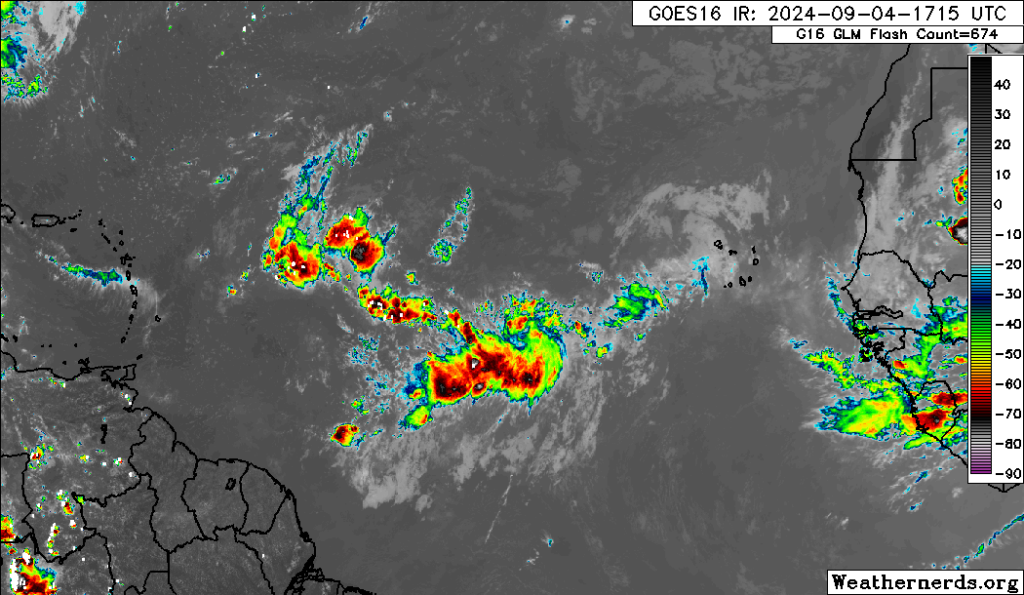
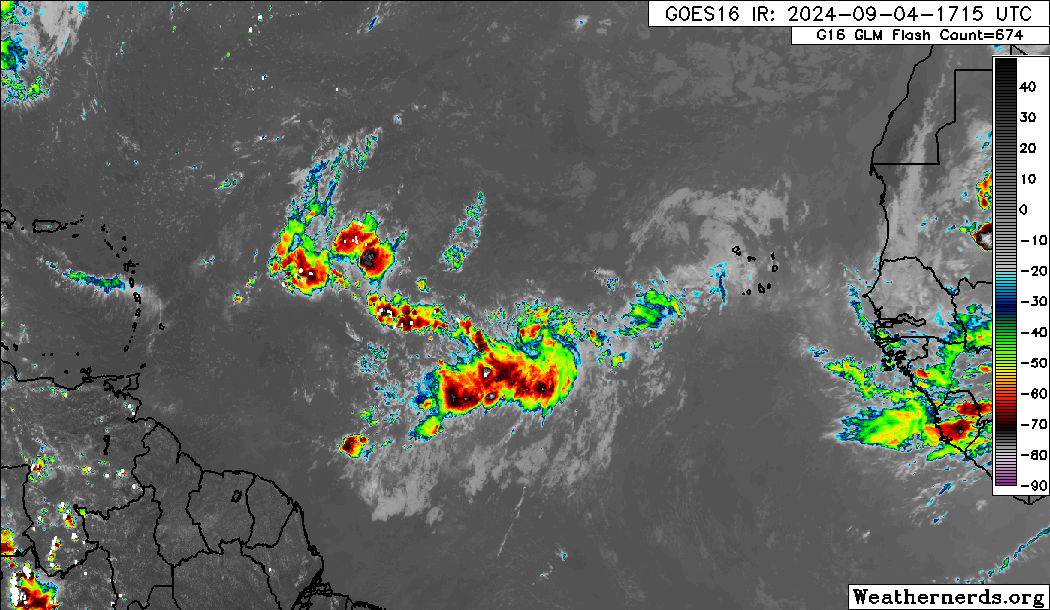
A cold front will sweep all this away from Texas and Louisiana over the weekend. By then, the Caribbean tropical wave we’ve been watching since last week should be over the Yucatan or Central America. Development odds remain about 30 percent this morning, and looking at satellite, it remains a poorly organized mass of disjointed thunderstorms south and southwest of Hispaniola today.
Showers and thunderstorms south of Jamaica and Hispaniola remain associated with a very disorganized tropical wave in the Caribbean. (Weathernerds.org)
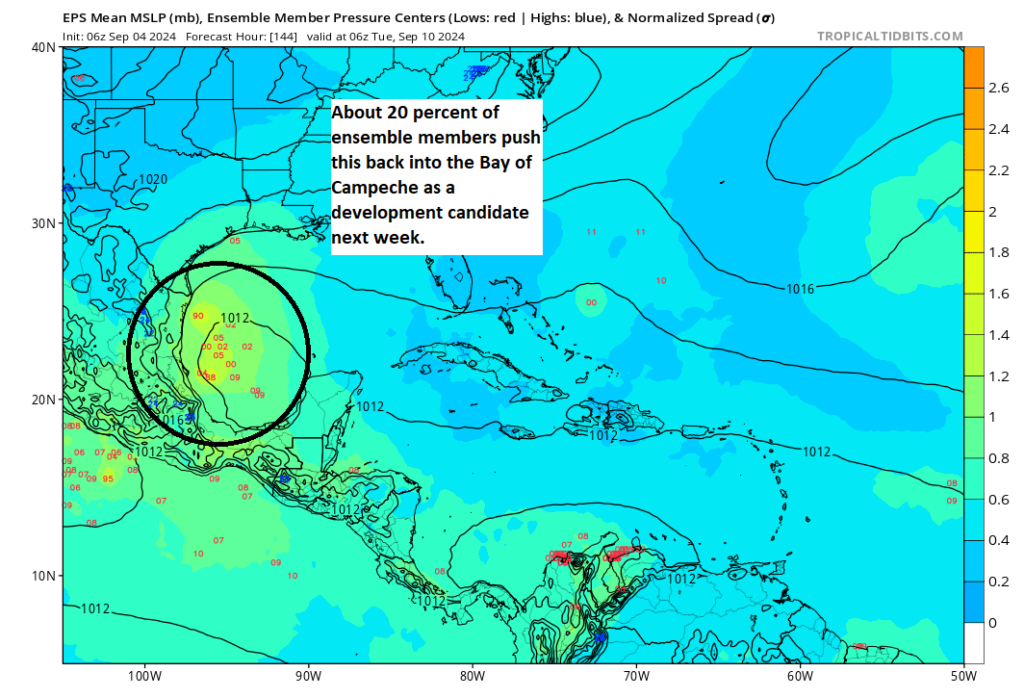
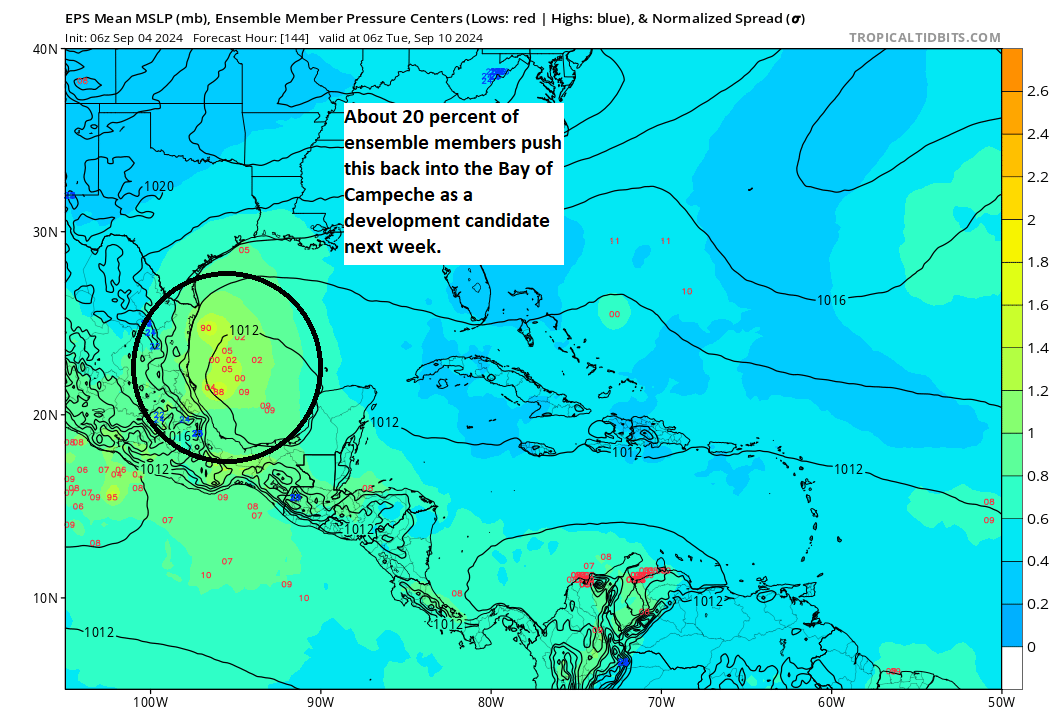
As this wave moves westward, any development will be sluggish before it comes ashore in Belize or the Yucatan. From here, it remains uncertain how things will play out, but any sort of re-emergence into the Bay of Campeche would bear some watching. That said, is that the likeliest outcome? Not necessarily. Of the 51 European ensemble members, about 20 percent push this into the Bay with some development. Of the 51 members, about 5-10% maybe bring it north into the Gulf. Never tell me the odds, but I like those odds right now.
The European ensemble model is not exactly eager to bring this tropical wave back into the Bay of Campeche, but it still merits watching. (Tropical Tidbits)
So, yes, we should continue to monitor the progress of things here of course! But as of right now, other than the ICON model, which is quite aggressive in developing this, and the European AI model, which brings it north and northeast into the central Gulf as what appears to be a subtropical storm, there is no significant model support from our traditionally best performing models for this to become a huge deal.
That said, we are looking at anywhere from about 5 to 15 inches (over 300 mm) of rainfall for portions of Mexico from this, so flooding could become an issue there.
Rest of the Atlantic is unimpressive
We continue to look for signs of life in the deep Atlantic, and while there remain two waves of note, neither appears to be a meaningful concern to anyone really.
A couple tropical waves in the deep Atlantic merit light watching, but there are no concerns for land masses at this point from either of these. (Weathernerds.org)
The two tropical waves in the open Atlantic have about a 10 and 20 percent chance west to east respectively of developing. The lead wave may bring some showers and storms to the islands, while the trailing wave is likely destined to go out to sea. There’s nothing emerging off Africa right now, and then next wave is a few days away. That wave may have a decent chance to develop I guess, but it too looks to remain out at sea right now.
Again, there’s just nothing inspiring in the Atlantic. And I’m not sure we’re going to see much either. If we look at what’s happening in the background of the Atlantic, we have broad sinking air dominating the western two-thirds of the basin, much as it has since early August. Any rising air has shifted from the Indian Ocean more toward Oceania and Indonesia. Sinking air tends to suppress storm development, while rising air tends to help storm development along. So, this doesn’t support robust disturbances in the western Atlantic. This strongly argues that we’re going to see muted activity continue through mid-month. Again, this is one of those intraseasonal signals we cannot predict in April or May that can have an outsized impact if they setup correctly. And in this case, they have certainly done so.
A complex Hovmoller plot which shows generally sinking air (red/orange) dominating in the area corresponding to the western 2/3 of the Atlantic basin. (StormVista)
Even a couple weeks ago, this signal seemed to indicate it would become less hostile to tropical development by early to mid-September. That’s now getting kicked down the road. Unless you chase hurricanes for a living, it’s hard not to be thrilled by this situation sitting here on September 4th. We’ll keep an eye on things.
“This and That” is an occasional series of paired observations. See past “This and That” posts here. – Ed.
Today: Impressionist paintings on round, found objects
Paul Gauguin, “Flowers and Bird,” c.1884-1886, drum with oil on vellum. Image courtesy Dallas Museum of Art
Joel Murray, “After Camille, Before Wyoming,” 2024, oil on plastic gas door; Image courtesy of The Fuel Commission’s Instagram account
With 2024 marking the 150th anniversary of the first Impressionist exhibition, it only makes sense that exhibitions celebrating the movement are currently on view or are planned to take place throughout the world this year. Dallas is no exception, including today’s unlikely pairing.
On view at the Dallas Museum of Art,The Impressionist Revolution from Monet to Matisse includes Paul Gauguin’s Flowers and Bird. The painting depicting pink peonies is on the surface of a small drum – one of only two known paintings by Gauguin to be created on a drum.
Joel Murray’s painting ’After Camille, Before Wyoming,’ offers a more contemporary look at Impressionism. His landscape presents a cropped and altered take on Camille Pissarro’s Jallais Hill, Pontoise. This painting might be a little harder to track down so keep an eye out. It is part of The Fuel Commission – a recent project by Lucia Simek and Gavin Morrison.
The Fuel Commission, started earlier this year, is a gallery on wheels. When Simek and Morrison purchased a 2017 Volvo XC60 online, the car was delivered without a fuel door. To remedy the problem, the couple now commissions an artist to paint a new door and they install it on the vehicle. The piece, for sale at a cost of ten times the Volvo’s tank of gas, makes its rounds. Once it is sold, the artist receives all the money minus the cost of a tank of gas and a new fuel door.
*************
No matter how original, innovative or crazy your idea, someone else is also working on that idea. Furthermore, they are using notation very similar to yours. – Bruce J. MacLennan
Thank you so much for responding to my question. I couldn’t really respond to any of the comments on your post, but I read them and really had a good think about everything you said and what the commenters were saying as well. I’m here to offer an update in case you or any of your readers may be interested. Spoiler alert: it’s explosive!
The clarification: HR was kind of a joke in my former company, they didn’t do anything but perpetuate gossip. No such thing as anonymous complaints. Peter and Kate were different departments, think sales and accounting.
The good news: A few days after I submitted the letter to you, I ended up submitting my resignation. I start my new job next month. So far, my coworkers seem nice (we’ve had one casual hang/mixer organized by the new workplace — everyone bought food. My brownies were a hit!) My new company had been trying to poach me for a while, and I just decided to take the plunge. I truly can’t tell you how happy I am to be away from that mess. I’ve just been relaxing at home now. My former coworkers keep me updated about everything that’s happening and safe to say, I left at the right time. Bullets dodged.
Peter was blindsided by my resignation, and asked me why I was leaving and if there was anything they could do to keep me but I refused. I was willing to serve my notice period, but Peter said it wasn’t necessary and I could leave immediately since I clearly thought I was better than them. It was in that moment it became clear to me that I’d been telling myself Peter is a good boss, but he clearly isn’t. Even your advice touched on this briefly. So I cleared my stuff out by the end of the day, went home, and cuddled with my dogs.
Since then, Peter’s boss contacted me, asking me to at least serve my notice period. I only responded by sharing Peter’s last email to me, where he threatened to have me escorted off company property if I wasn’t gone by the end of the day. The grandboss proceeded to call me to convince me to come back. In a rare moment of wanting to be confrontational, I told him I wouldn’t feel comfortable coming back because of many reasons, not just Peter’s rudeness. I told him all about Peter and Kate. I told him my former company simply didn’t have adequate safeguards, so even if I wanted to report this nonsense I couldn’t without being afraid of retaliation. My former grandboss clearly wasn’t ready for my verbal diarrhea. Said he would call me back, but it has been blessed silence since.
On to the actual update: aka what is going on with Peter, Joe, and Kate.
The day after I left, Peter and Kate left for another business trip. However, when Kate returned home she realised their house was empty. Completely bare.
It would seem Joe had been aware of the affair for a while, and instead of confronting Kate or Peter he’d been lining his ducks in row so he could just up and disappear. He resigned by email, no mention of a notice period. No one knows where he is, or what he is doing. Kate apparently tried to file a missing persons, but Joe had already informed the police he wasn’t a missing person. At the same time as Kate came home and realized Joe was gone, his entire family also blocked all forms of communication with her. She tried to show up at Joe’s parents house, only for his parents to claim they don’t know her, they never knew her, and if she didn’t get off their property they’d call the police.
I know all this from my coworkers, who know all this from Kate because she can’t stop talking about it at work. She “doesn’t know why” Joe would have done this.
Few days after that: she also dumped Peter in a rather public, unhinged way, saying that he hypnotized her (???) and her life was falling apart because of him. But apparently it didn’t stick for long because the next day they were having loud and violent sex in Peter’s office during lunch hours.
There are rumors circulating that both Peter and Kate are about to be fired. Not sure why they haven’t been fired already. Some of my former coworkers have asked me if I could keep an eye out for jobs for them in my new company.
Thanks for your advice and compassion! Love and blessings to you.
While pushing for an ordinance to prohibit protests in front of his home, Houston Mayor John Whitmire accused pro-Palestinian protesters of “being paid by Iran.” Houston Public Media submitted a public records request, and the city said it has no documentation related to the claim.
This post was written by Alison Green and published on Ask a Manager.
A reader writes:
I work as a director at a medium-sized nonprofit, reporting directly to the chief development officer (CDO). I have a coordinator (Jane) who reports to me and takes care of most of the administrative work. In June we received a large campaign pledge from a very powerful national foundation. It was a complex process that required collaboration between myself and other directors. One of my colleagues did a lot of heavy lifting in preparing our CEO and CDO for the solicitation meeting, and I took the majority of the follow-up.
We had a day-long directors meeting to do some planning for the next fiscal year. One of my colleagues mentioned that Jane complained in a group text that she worked “really hard” on this pledge/donation and “didn’t get any credit.” The CDO and I were pretty floored. Jane had virtually nothing to do with this process. I may have asked her to look at the foundation’s trustees at some point to see if there were any connections, but otherwise my other colleague and I did 95% of the work. I managed to shut it down in the room, but if Jane is talking to one of my colleagues, on my team, at the director level, I wonder what she is saying to others.
This is not the first time I have felt as though Jane has not been completely truthful, and I have noticed that she can be something of a gossip. She will say to me “off the record” and share some sort of rumor that doesn’t have much to do with her job. I have also felt in the past like she’s exaggerated, but this is the first time that I have actually caught her in a lie.
Truth be told, I don’t think that Jane is particularly spectacular at her job and I am not overly fond of her. I don’t want to get her in trouble, but I am disquieted by the exaggeration and gossip. I would say that she is just young, but I am pretty sure that she’s in her 30s. I suppose she is just really naïve, which was not what I expected when I hired her.
Would you take any action about this? I had already submitted my annual performance review before this took place but I am considering addressing it during the review (outside of the rating process).
Yes, you should talk to her.
There are a few different fronts you should address it on.
With her complaint that she didn’t get any credit for a project she barely worked on: I’m a big fan of taking things like this very, very seriously. First, because maybe there’s something you don’t know about what happened — maybe she helped the other director more than you realized, or maybe there’s some other miscommunication or surprising perceptions that it would help to ask her about and talk through. Who knows, it’s possible there’s more to it than what you realized. But assuming there’s not and she meant it as a throwaway remark that wouldn’t get back to you, by taking it very seriously you’ll convey that no, actually there are consequences to misrepresenting things like that (at a minimum, she’ll find herself in an uncomfortable conversation with you, being asked to account for her words). So sit down with her and ask about what you heard.
In other situations where you get the feeling that she’s exaggerating or not being entirely truthful, use a similar strategy. Make it a thing! Probe into it. Ask questions. Don’t just let it go. If you make it a thing every time, either she will learn she needs to stop doing it or you’ll get more clarity about exactly how deep the problems go and whether this is even salvageable. (Or both.)
With her tendency to gossip, address it head-on. When she brings you problematic gossip, tell her that kind of gossip is inappropriate and you want her to stop. And address the pattern too: “I’ve noticed you often pass along rumors like X or Y and that has the potential to cause harm because…” And then if it happens again: “This is the kind of thing I was talking about.” (Caveat: this assumes we’re talking about recreational rumor-spreading. If she’s asking about something she heard because it could legitimately affect her job, that’s different.)
Right now you have vague discomfort with Jane on a lot of fronts — and you also don’t think she’s great at her job. That’s a situation that cries out for more involvement from you, not less. Get more hands-on about managing the things that are making you uneasy, and delve into each incident that worries you rather than letting them go. She’s likely to find this strategy really annoying, but that’s okay; it’s your job.
One of two things will happen: either you’ll actually coach Jane into better behavior (if so, great) or it will become a lot clearer that she’s not operating in a way that’s aligned with the needs of her role.
CAMBRIDGE, MA—Largely conforming with the preexisting research on the subject, a cautious study published Wednesday by researchers at Harvard University found whatever everyone else found. “After exhaustive trials and data analysis, our team can confirm that we have made discoveries totally in line with the stuff that other scientists discovered,” said the study’s lead author, Mark Tupperman, who told reporters they didn’t even really need to look at his team’s report because it was so similar to what other research teams had already observed. “Do you know what MIT and Boston College had for their hypothesis? Because that’s what our hypothesis was too! And we confirmed it or disproved it just like they did. We’re really happy with how our study turned out, but if one of those other teams wants to publish their results first, we guess we’d let them do that.” Tupperman went on to state that his team had reached several crucial conclusions and then began mumbling so softly that he was completely incoherent.
DAVENPORT, IA—Lauded for his courage and good cheer even in the face of adversity, local high school quarterback Brett Modine, who was paralyzed during a practice scrimmage earlier in the year, was praised as a hero this week for not suing. “Real bravery is taking it on the chin like Brett did and still finding it within yourself to refrain from filing a lawsuit against the school district,” said coach Frank Gabrola, echoing the sentiments of dozens of faculty members and local residents who considered Modine’s lack of legal action to be emblematic of the sort of all-American champion he was at heart. “A guy like Brett is always going to do what’s best for the team, for the school, for the community. For him, it’s not about getting revenge, or keeping score, or receiving financial remuneration for his life-altering injury. He just does what he knows is right, and that’s what makes him a hero.” Gabrola added that he knew Modine would continue to comport himself with a quiet dignity and never complain about the school’s lack of wheelchair ramps or ADA-compliant restrooms.
Despite the best efforts of automakers and companies like Apple, states continue to push forward with popular “right to repair” reforms that make it easier and more affordable for consumers to repair tech they own.
While they vary in potency, New York, Oregon, California, Massachusetts, Colorado, Maine, and Minnesota have all now passed some flavor of right to repair laws. Colorado just got done passing its third such bill. The first two ensured that consumers had access to the parts, tools, and documentation they needed to repair agricultural equipment and powered wheelchairs.
The push has even started to expand into the military, and some appliance and tractor manufacturers aren’t happy about it. The fine folks at 404 Media obtained documents showcasing how both industries are lobbying hard against new legislation that could make it easier for the U.S. military to fix the equipment they buy.
As usual, baseless fearmongering is the name of the game, with both industries claiming that more affordable and easier repair would somehow hurt small companies, and might even pose security risks:
The letter argues that the legislation “would undermine the principle underpinning existing technical data rights statutes, which are designed to balance the government’s technical data needs against contractors’ need to protect sensitive proprietary and trade secret information.”
The claim that easier and more affordable repair poses some kind of unacceptable privacy and security risk is always the first one made by companies looking to lock down their lucrative repair monopolies. Apple for years falsely claimed such reforms would create a dangerous surge in nefarious hackers. Automakers claim such reforms will be a boon to sexual predators.
A 2021 bipartisan FTC report showcased how these claims are routinely false. In reality, right to repair reforms not only help make repair more affordable (a boon to military-funding taxpayers) but drive greater availability of manuals, parts, and tools, making tech safer.
In this case the lobbying and policy organizations trying to scuttle military right to repair reforms range from the “Institute of Makers of Explosives” and Aerospace Industries Association to the Irrigation Association, all of which are clearly getting nervous about the potential for even broader federal reforms.

/https://static.texastribune.org/media/files/1c4b7ab1f9e20bb3013f83008290893e/Rick%20Perry%20REUTERS%20TT%2001.jpg)