Cowboy Who?
Shared posts
RFK Jr sworn in as US Health and Human Services chief
Winter roars back into Houston after a sizzling start to February, and even colder weather is on the way
In brief: The last two weeks have felt very un-winterlike in Houston, but that has changed with the arrival of the first of three strong fronts. Among the things we’re watching for is the potential for a few storms on Saturday, and very cold temperatures during the second half of next week.
The twelve days of February
We started the month of February on an incredible hot streak, including four consecutive days of setting or tying record high temperatures. So far this month, the average monthly temperatures has been 15 degrees above normal, and it’s felt like we’ve been in the middle of spring rather than winter. However, we are now about to flip the script.

The remainder of the month should bring near-normal and below-normal temperatures, with the potential for freezing temperatures here or there. We are not going to cancel out the extremely warm start to the month, but Houston will feel like winter again—which it should, because we are still in the middle of February.
Thursday
It’s cold this morning, and it won’t warm up much. Temperatures range from the upper 30s north of Houston to the upper 40s right along the coast. Although we should see some pockets of sunshine today, a stiff northerly wind (at times gusting up to 30 mph) will make the high temperature of about 50 degrees still feel rather cold. Conditions will remain breezy tonight, as winds shift to come from the east. Expect lows to fall into the mid-40s in Houston.
Friday
Expect a mostly cloudy day, with temperatures a bit warmer, in the lower 60s. As the flow turns more southerly, we’ll see an increase in atmospheric moisture that could bring some spotty, light showers back into the region. However, overall rain chances appear to be fairly low. Temperatures will not cool off much on Friday night, in fact they’ll start rising after midnight as we continue to see a warmer, southerly flow.

Saturday
This will be a warmer, potentially unsettled day with high temperatures in the upper 70s. There will be a chance of light showers during the daytime, potentially with a line of showers and thunderstorms passing through during the afternoon or early evening hours. Overall accumulations don’t look super high (likely less than half an inch), and while there is the potential for some damaging winds the dynamics are not particularly favorable for severe storms. We’ll keep an eye on it. Lows on Saturday night will drop into the lower 40s.
Sunday and Monday
This will be a cold day, albeit one with mostly sunny skies. Expect breezy conditions and highs perhaps in the low 50s. Expect a cold night on Sunday, with temperatures in Houston dropping into the 30s, and a light freeze possible for some inland areas. On Monday, President’s Day, we can expect more sunshine, and somewhat warmer temperatures in the upper 50s to 60 degrees. It should be a nice day for kids to be off from school.
Next week
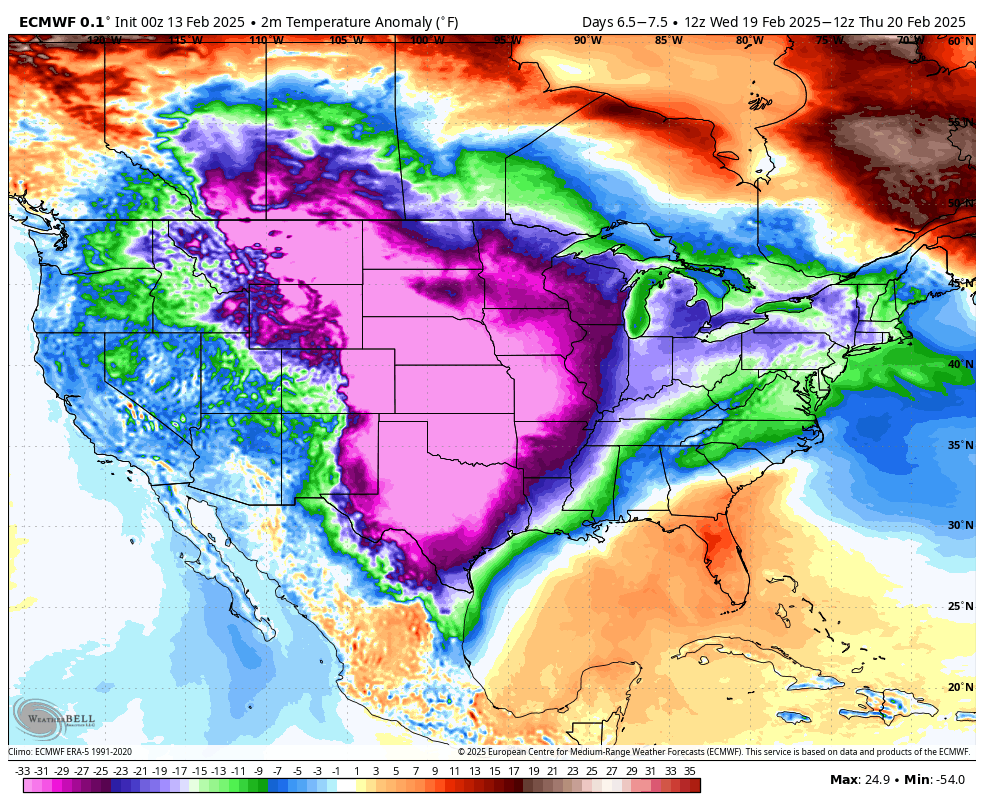
After chilly conditions on Monday, Houston will warm back up on Tuesday and Wednesday. And then? Well, a very serious outbreak of Arctic air is going to move into the central United States. The question is how far the bulk of this air mass drops into Texas, and whether it reaches the Gulf coast. As a result, there is a wide variance in low temperatures during the second half of next week, and I would say anything from mid-20s to lower-40s is possible in Houston. Certainly it is something we’ll be watching for you.

Finding Comic Relief at Art Week Mexico City

Collaborators of the project ITZA attending Fátima de Juan’s installation at La Bibi Gallery’s Zona Maco booth. Photo: Bryan Rindfuss
You don’t have to be a doom-scroller to realize there is plenty to spiral over in 2025. Unsettling headlines routinely induce panic about everything from geopolitical instability and extreme weather events to AI-powered cyberattacks and deepfakes spewing misinformation. Lest we forget the Orange One’s plans for mass deportations and a potentially crippling trade war with our closest neighbors.
Those and other troubling topics were on the minds of locals and visitors alike during Art Week Mexico City — an annual affair anchored by the internationally flavored fairs Zona Maco, Feria Material, and Salón Acme.
Outside the main fairs in a stately building in Colonia Juárez, a small painting by Mexican artist and educator Sandra Valenzuela encapsulated the moment with a sharp sense of humor. A thorny highlight of the contemporary landscape exhibition Misrepresented, Valenzuela’s meme-inspired painting employed prickly-pear cacti as a backdrop for the slogan, “These cacti are nopales. We eat them for salad. Do you think a trade war scares us?”
When asked about the painting, which is part of Valenzuela’s series SA-ME-ME, Misrepresented curator David Miranda explained that it references a key question posed in the British sketch show Noel Fielding’s Luxury Comedy: Is it a joke or a concept?
With that infinitely debatable conundrum in mind, we set out to find the most humorous work among the mazes of Zona Maco, Feria Material, and Salón Acme. Although the goal was to provide a much-needed dose of comic relief during an increasingly stressful era, we were pleasantly surprised to find some enlightening messages and fascinating stories beneath whimsical facades.
Zona Maco

Michael McGregor, “Still life in Studio End of Summer,” 2023. Courtesy of Hashimoto Contemporary
Michael McGregor
Los Angeles-based artist Michael McGregor has described his approach to still-life painting as “al dente,” a term typically reserved for toothsome pasta. That designation may refer to the childlike freedom of his works — spontaneous-looking affairs that are anything but overworked. Abundantly colorful, McGregor’s paintings curiously combine still-life hallmarks — fruit, wine bottles, flower vases, and candles — with such contemporary additions as McDonald’s french fries, boom boxes, cans of spray paint, and a sole Gucci horsebit loafer. “The Gucci loafer appears in a lot of my work,” McGregor told Glasstire. “As an object, it’s loaded with histories [and] a sort of opulence, but it’s also a design object that’s remained consistent — like Coca-Cola and McDonald’s fries — in an ever-changing world.” Showcased at Zona Maco by New York/San Francisco-based gallery Hashimoto Contemporary, McGregor’s whimsical, travel-inspired paintings were complemented by what the artist deems “point-and-shoot drawings” — sketchy renditions of a Cartier watch, a Birkin bag, and a bottle of Valentina hot sauce scrawled on stationery from luxury hotels including the Ritz-Carlton, Chateau Marmont and the Waldorf Astoria. “Through this escapist and vibrant lens, McGregor reinvigorates his audience,” Hashimoto Contemporary’s Jennifer Rizzo added. “[He’s] showing us that we can view the world with a sense of optimism and humor — a very real reminder of something that feels more important than ever.”

Ai Weiwei, “Untitled (Saint George Slaying the Dragon).” Courtesy of Galleria Continua
Ai Weiwei
Humor may not be the first quality that comes to mind when considering the work of Ai Weiwei — an outspoken human rights activist who was once arrested and beaten for critiquing the Chinese government. But the Chinese art star flexed his imaginative wit for 2023’s Untitled (Saint George Slaying the Dragon), which landed at Zona Maco courtesy of globetrotting Italian outfit Galleria Continua. Commissioned as a replacement for Vittore Carpaccio’s 16th-century masterpiece Saint George Killing the Dragon while it traveled from its permanent home — the Basilica of San Giorgio Maggiore in Venice, Italy — Ai Weiwei’s contemporary reinterpretation is constructed entirely from tiny LEGO bricks. Although it appears as pixelated as a low-resolution JPEG, the piece has a clear message that transcends its playful medium. Illustrating the triumph of good over evil, the LEGO construction nods to a biblical quote inscribed on the frieze of the Venetian chapel: “Ego vici mvndvm (I have conquered the world).”

Ali Elmaci, “Just Imagine But Maybe Its a Blessing.” Courtesy of Pilevneli
Ali Elmaci
Represented by the Turkish gallery Pilevneli, Istanbul-based artist Ali Elmaci is known for works that play with dark humor and irony. Tellingly, one of his artistic goals is to place viewers “on the fine line between laughter and sorrow.” That fine line is expertly drawn in Elmaci’s cartoony oil paintings of bedsheet-variety ghosts captured in day-to-day activities — picking wildflowers at sunset, marveling at winged insects, bursting into tears. Commanding attention in Pilevneli’s Zona Maco booth, Elmaci’s 2024 painting Just Imagine But Maybe It’s a Blessing depicts one of his signature spirits in wide-eyed wonderment during an encounter with a spritely fairy. In the background, the scenario takes a decidedly dark turn as a menagerie of wild animals hunt and attack their prey while a quartet of cherubs tries to distract the beasts by dropping apples from a tree – to no avail.

Fátima de Juan’s installation at La Bibi Gallery’s Zona Maco booth. Photo: Bryan Rindfuss

Fátima de Juan’s installation at La Bibi Gallery’s Zona Maco booth. Photo: Bryan Rindfuss
Fátima de Juan
In terms of whimsical wow factor, Mallorcan artist Fátima de Juan’s immersive Zona Maco installation was hard to top. Hosted by the Spanish gallery La Bibi, the presentation beckoned with a living room-like display decked out in fake-fur carpeting and wall coverings in an arresting shade of mustard. Painting since childhood, de Juan found her pathway into fine art through the realm of graffiti (tag name: Xena), and the soft edges afforded by aerosol paint still distinguish her large-scale canvases. Created in reaction to the male-dominated culture she grew up in, de Juan’s paintings celebrate the female form — albeit in an outsized format she likens to contemporary Amazonian proportions. In her exuberant work — some of which La Bibi bills as “sweetly aggressive self-portraits” — de Juan surrounds her powerful women with vegetation, fruit, and “power animals,” including cats and alligators. “It’s a call back to our origins, to pureness, and to a connection with the world and nature,” de Juan explained in a video shot in her studio in Mallorca. “As a woman, I’ve always felt the need to fill big spaces that were never predestined for a woman. I feel comfortable in this kind of format that makes one feel small in front of the artwork. In the end, through my work, I’m searching for a window to escape. Creating a new world where I’d like to live.”
Feria Material

Magdalena Petroni “Threesome.” Photo: Bryan Rindfuss
Magdalena Petroni
As luck would have it, absurdist humor was front and center at the ground-floor entrance to Feria Material — thanks to Mexico City-based gallery General Expenses and featured artist Magdalena Petroni. Born in Buenos Aires and now living and working in Mexico City, Petroni has a knack for quirky provocation that’s exemplified in her 2025 sculpture Threesome. Priced at $4,200, the work involves three taxidermied rats — two of which are dressed in skimpy Barbie clothes — clinging to a metal Playboy logo painted in acid-green automotive paint. Beyond the playful nod to polyamory in the animal kingdom, Petroni’s Threesome was amusingly hung next to New York-based artist Philip Hinge’s painting of a menacing tabby ready to pounce at a second’s notice.

David Ramírez Cotón, “Se Abrió Paca (The Bale Has Opened).” Photo: Bryan Rindfuss
David Ramírez Cotón
Perhaps Feria Material’s most outwardly humorous installation, Guatemalan artist David Ramírez Cotón’s exhibition “Se Abrió Paca (The Bale Has Opened)” transformed Guatemala City-based La Galería Rebelede’s booth into a trompe-l’oeil vintage store — complete with racks of second-hand garments and accessories. The kicker? Each article of clothing was actually a painting on un-stretched canvas with an accurate price tag affixed to the backside. Inspired by the vast quantity of used garments the United States exports each year to Guatemalan resellers — including Cotón’s uncle — “Se Abrió Paca” employed a whimsical format to explore the environmental implications of fast fashion and textile waste. It also celebrated the era-spanning surprises one might discover upon cracking open a 100-pound bale of pre-loved duds. Aptly, Cotón’s racks mixed everyday staples like blouses, joggers, and skirts with name-brand finds, including Diesel jeans ($1,199) and Nike running shorts ($699). But arguably Cotón’s wittiest works weren’t on the racks but on the walls — where a Virgen de Guadalupe blanket, a tiger poncho, and a Bugs Bunny towel were interspersed with hand-painted versions of retail signage and tiny canvases mimicking light switches and electrical outlets.

Fátima Rodrigo “Ejercicios de Resistencia (Resistance Exercises).” Photo: Bryan Rindfuss
Fátima Rodrigo
Similarly, Peruvian artist Fátima Rodrigo employs aspects of vintage pop culture — including repurposed apparel — as a means to address serious issues, including modernism, capitalism, and climate change. While her work comprises bedazzled disco balls and abstract tapestries sewn with metallic thread, Rodrigo’s presentation at Lima-based gallery Livia Benavides’ Feria Material booth highlighted her series Ejercicios de Resistencia (Resistance Exercises). Using leather work gloves as unexpected canvases, Rodrigo covers them in plastic gems and crystals and hand embroiders them with symbols associated with Peruvian culture — such as eyes inspired by celebratory Andean masks. By taking these everyday tools comically over the top, Rodrigo blurs boundaries between high and low culture while commenting on the unseen labor that fuels capitalism.
Salón Acme

Diego González Gómez, “El Agua Desapareció de Pilas Públicas y Fuentes Privadas (The Water Disappeared from Public Basins and Private Fountains).” Photo: Bryan Rindfuss
Diego González Gómez
What could possibly be funny about a fountain based on an old fountain based on an even older fountain? Just ask Guadalajara-based artist Diego González Gómez, who presented one of the quirkiest installations at this year’s Salón Acme. While participating in the archive-based exhibition “No Llegaron Aquí las Flores (The Flowers Didn’t Arrive Here)” at Guadalajara’s Museo Raúl Anguiano in 2024, Gómez found his archival inspiration in the museum’s fountain — itself a replica of what is now known as La Pila Seca. Dubbed La Pila de los Compadres in the 19th century, the fountain originally functioned as a water source for summer homes in the Guadalajara suburb of Tlaquepaque. As the story goes, the landmark entered its current waterless era when two men died on the site after a drunken knife fight. Inspired in part by the water-spouting fish that adorn both fountains, Gómez created El Agua Desapareció de Pilas Públicas y Fuentes Privadas (The Water Disappeared from Public Basins and Private Fountains). With an inflatable kiddie pool as its whimsical base, the piece features a quartet of plush fish spitting water from a stone pillar. When he debuted the project last year, Gómez explained on social media, “I believe that history is not made of stone and quarry, but of water that runs through something soft, like the drops falling from the mouth of a stuffed fish.”

Gibrán Turón, “Sentimiento Precoz (Precautious Feeling).” Photo: Bryan Rindfuss
Gibrán Turón
Atop the crumbly walls of Salón Acme’s storied host venue Proyecto Público Prim, Mexican artist Gibrán Turón’s playful paintings evoked cotton candy on a hot summer day. Presented by Marchante Arte Contemporáneo, Turón’s solo show “Sentimiento Precoz (Precautious Feeling)” highlighted both his artistic process and his kitschy sense of humor. Fantastical qualities aside, Turón’s work is largely based on fleeting moments — street scenes, signage, landscapes — he captures with his camera and then recontextualizes through painting. Among these slices of city life were a quintet of Mexican seafood cocktails, a candy-apple-red pedicure in progress, and a mustachioed man walking barefoot through a field in a wedding dress. Emerging as a fan favorite on social media during Art Week, Turón’s painting of two lovers caught in the act behind the door of a refrigerated meat truck reproduces the cautionary signage: “Reportar si permanezco más de 20 minutos estacionado (Report me if I remain parked for more than 20 minutes).” A poppy thread throughout, bubblegum pink factors heavily into Turón’s color scheme — a signature palette he developed in tribute to the dramatic sunsets in his hometown of Tepic, Nayarit.

Sebastián Córdova, “Rebeca.” Photo: Bryan Rindfuss

Sebastián Córdova, “Rebeca.” Photo: Bryan Rindfuss
Sebastián Córdova
Supersized clothing will arguably always be associated with the giant suit Talking Heads frontman David Byrne wears in Jonathan Demme’s 1984 concert film Stop Making Sense. Inspired by the exaggerated proportions of Japanese theater costumes, Byrne’s enormous suit is so embedded in pop culture that it routinely inspires Halloween costumes. If Byrne were seeking the cozy comfort of Mister Rogers’ Neighborhood, he might snap up one of Mexican architect Sebastián Córdova’s enormous cardigans. Among the most amusing highlights of the Salón Acme exhibition Yendo de la Cama al Living (From Bed to Living Room), Córdova’s Rebeca cardigans took shape after a long walk through Mexico City’s sprawling park Bosque de Chapultepec. Based on the distance of his walk, Córdova designed a hand-woven sweater crafted from exactly 3,014 meters of yarn. The resulting pieces — one in scarlet and one in pea-soup green and tan— measure roughly six feet tall and ring in at $6,200 each. As for the name? “That’s what they call cardigans in Spain based on the success of the 1940 Alfred Hitchcock film Rebecca,” exhibition curator Enrique Giner de los Rios told Glasstire. “We thought it would be interesting to name it that way, winking to the sweater’s presence in a house.”
Zona Maco is on view February 5-9, Feria Material and Salón Acme are on view February 6-9 in Mexico City.
The post Finding Comic Relief at Art Week Mexico City appeared first on Glasstire.
Telemundo Houston uses special effects to show weather changes
Open Future launches CommonsDB
Open Future is leading the newly launched CommonsDB initiative, funded by the European Commission, to create a prototype registry of public domain and openly licensed works. We are collaborating with Liccium, the Europeana Foundation, Wikimedia Sverige and the Institute for Information Law to bring this vision to life.
The CommonsDB registry will enable users to verify the rights status of content from multiple sources. It will be built using existing technologies and standards, consolidating ISCC codes, rights metadata, and verifiable credentials to make registry information available through public APIs.
The concept for CommonsDB originated from Open Future’s 2021 white paper by Paul Keller and Felix Reda, which proposed creating a public repository of public domain and open-licensed works. This work inspired the European Parliament to request and fund a pilot project for such a repository. It also builds upon the work of both Europeana and the Wikimedia community, who have developed two of the largest existing repositories of such works.
CommonsDB demonstrates Open Future’s commitment to supporting the Digital Commons and marks our first initiative to build public digital infrastructure for this purpose. It establishes a new area of focus at Open Future: Copyright Infrastructure. This line of work builds on the need for copyright infrastructure in the Digital Age, which was included as one of the Digital Commons Policy Proposals published in early 2024 to address challenges identified in the research around the Paradox of Open. A critical challenge is the lack of technical standards for copyright information and opt-outs—a gap affecting both digital copyright functionality and EU AI regulation.
CommonsDB aligns with the European Commission’s efforts to strengthen the Digital Commons and promote openness, interoperability, and accessibility. The project focuses on developing copyright infrastructure that provides better public information about rights status and permissions. This is essential for AI training and creator control, particularly for Public Domain works and Digital Commons resources, while providing guidance on machine-readable opt-outs and developing AI training compliance standards.
Over the next 18 months, Open Future will work closely with CommonsDB partners and external open collections experts to design and implement the prototype registry. To support this, we will conduct a two-part study examining the operational and technical feasibility. This study will identify and address copyright, public domain, and data governance issues to minimize legal uncertainty, and will explore the future governance and sustainability of the registry.
interview felt like an exam, HR is sending everyone Valentine’s Day candy “from” other coworkers, and more
This post was written by Alison Green and published on Ask a Manager.
It’s five answers to five questions. Here we go…
1. Interview felt like an exam
I had my first job interview in over 20 years yesterday, and it felt like an exam. Five people peppered me with a long list of questions, mostly hypotheticals. None of the questions were about my experience or my training. Only a couple were about what I had to offer the employer. The rest were, “What would you do if [thing that has never happened to me in all my many years working in this field] happened?”
The thing was, I found myself answering all the questions not with what I would do, but with what Ms. Perfect would do, if she had a textbook to refer to while the crisis was unfolding.
In the long ago past, I’ve had interviews that were more like “This is what we need someone to do. Have you done it before? Do you know how?”
It left a bad taste in my mouth and left me wondering if I wanted to work with these people, although they seemed nice on the whole. Am I off-base here? Have interviews become more like this since I was last in the hot seat? Should I be studying lists of hypothetical questions?
I’m not a fan of hypothetical questions in most interviews since they’re often easy for candidates to bluff their way through. Interviewers generally learn a lot more by probing into what people have actually done in situations they have actually experienced — which is why “tell me about a time when…” questions are used so much.
That said, I’m even less a fan of “have you done X before?” or “do you know how to do X?” because anyone can respond to that with “yes” and it tells you nothing about their real-life abilities. Maybe they’ve done X but badly! Maybe they saw someone else do X and are confident they can too, when it takes more practice to do well.
It sounds like these people just aren’t great at interviewing … but that’s pretty common. I’d pay more attention to what you’ve learned about the job, the manager, the culture, and the experiences of people working there. And if you don’t feel like you have a good sense of those things yet, ask plenty of your own questions before you accept an offer.
2. HR is sending everyone Valentine’s Day candy grams … from other coworkers
I work in a niche section of the healthcare industry at a medium-sized company. For a variety of reasons, I am currently looking for a different job. One of the things upsetting me is that our HR department (which is all of two people, one of whom is the daughter of the VP in charge of HR, which is a whole other issue) is trying and failing to improve company morale with more and more “events” instead of substantive changes like paper towels in the bathrooms or pay increases. Last week, there was a rock-paper-scissors tournament during the workday, and in a late afternoon email the day before we were told it was an “opt out” event — if you didn’t opt out, you were pulled away from your job up to three or four times in a couple hours to play rock-paper-scissors against someone else in the company, even if you were remote, in a bracketed tournament until someone finally won a previously-undisclosed prize of a basket of cleaning supplies. This week is the annual chili cook-off, which may or may not have a prize (it has one out of three times, and it has not been announced if there is one this year).
We just received an email stating that the company is sending candy grams to everyone for Valentine’s Day, and to “support” that, everyone has been randomly assigned a coworker to write a Valentine’s message for and it will be signed from us, not the company. I don’t even exchange valentines with my partner of a decade, much less with a coworker I have never met in person! I know this is trying to be nice, and I feel like pushing back is being a party pooper, but I feel really weird about it. I remember in school when some kids would get candy grams and get a bunch of nice personal messages, and others would get none or only one from the teacher, and that was always sad and awkward. I don’t want to make my coworker feel sad or awkward with a generic message, but I don’t know them outside of auditing their work!
I don’t know how to approach this at all, either to participate or to try and argue against doing it. In the past, my boss has been very resistant to passing on feedback to other departments, especially HR, and she strongly encourages our department to participate in all company events, up to and including guilting us about missing them or opting out. I don’t care if the company wants to give everyone candy — just sign it from the company, not me!
Yes, this is weird. But there’s no reason your message with the card can’t just be “Happy Valentine’s Day!” This is different from the school dynamic where it’s seen as a popularity contest, and I don’t think anyone will be sad not to get a more personal message from a random colleague … and I suspect a lot of people, maybe all, will be writing something similarly bland.
That said, if it’s possible to opt out (it’s not clear if it is) and you want to do that, you should feel free to! You can do that with feedback attached (“I’m uncomfortable sending Valentine’s greetings to coworkers so please don’t include me in sending or receiving”) or without it. If you think your boss will care, you could simply say to her, “I try to participate in company events, but I prefer to opt out of this one.”
3. Assistant always prioritizes my peer’s projects over mine
I work in a small office where support staff are in teams, and I have a dedicated secretary and a dedicated assistant (“Abby”). The issue I’m dealing with is Abby supports me and two others. Abby openly favors “Lucas,” who is my equivalent but much less experienced (think 25 years versus three years in the field). Abby will focus on and complete tasks and projects for Lucas first, and my projects will go on the back burner. When I press for updates or ask our supervisor for assistance, I’m told that Abby is very busy and to see if the other assistants can help. Because I’m not always privy to exact details, and I don’t want to create an adversarial office environment, I’ve started to just give Abby hard deadlines, whereas before I was more flexible to give her autonomy to avoid micromanaging her workflow. (I just started doing that, so I don’t know yet if it will work. But she has not responded to my new emails with the hard deadlines which might be a sign of resistance.)
Our supervisor favors Abby and has openly defended her and made excuses for her, so he is not going to step in. What should I be doing? I’m frustrated and demoralized.
I wish it was a couple of weeks from now so that we’d know if giving the deadlines was going to solve this, because it’s possible that it will. But meanwhile, one tweak I’d make to that plan: can you talk to Abby in person when giving her work so that you can say, “I need this back by (deadline). Is that doable?” so that you’re getting an answer from her on the spot?
If that doesn’t work, can you ask to be assigned a different assistant? If it’s true that Abby is very busy, as your manager says, and can’t compete your work on time, it’s entirely reasonable to ask for an assistant who can. And if you can’t get a different assistant, then it’s reasonable to meet with Abby and Lucas together and ask to figure out some protocols for prioritizing work so that you’re not the one who always gets short shrift.
4. Nose-picking boss
Over the years, I’ve had two different managers who openly pick their noses. It’s disgusting and I’m wondering if there’s an appropriate way to let them know how noticeable and off-putting the behavior is? I’m not talking about a discreet “scratch.” This is full-on digging, examining, flicking, and repeating going on. Years ago I experienced it in person and at one point offered my boss a box of Kleenex from my desk, which he declined and continued picking. Currently it’s happening on Zoom meetings (different company and manager). Both managers have very public-facing roles and general awareness of social decorum … they just both seem to be unaware of this behavior.
WTF?
When you’re in person, offering someone a tissue is a polite way of handling it and should alert them to the issue. If that doesn’t work, you could just hand them a tissue while saying, “Here, let me give you this.”
But over Zoom and when it’s your boss, there’s not much you can do. Video conferencing software really needs to start offering non-hosts a “remove this person from view” option for other participants on the call.
5. Can an employer make you use FMLA for weekly medical appointments?
Our HR team at work is typically stellar, but I’m confused about a recent announcement they made. They said if someone has a weekly medical appointment (i.e., physical or mental health therapy), they will deduct an hour from the person’s sick leave balance and an hour from the person’s FMLA balance. Is it correct that you can have time deducted from two places for one appointment?
Yes. FMLA isn’t a form of paid leave; it’s job protection. It allows you to have up to 12 weeks off per year (for qualifying reasons) without putting your job at risk, but it’s not a separate bank of leave and employers can require it to be used concurrently with your PTO.
Trump Is Just Threatening to Do Something Stupid as a Terrible Negotiation Tactic
“The president also repeated suggestions that the U.S. could come to control Gaza, but he said that it wouldn’t require committing funds and would come to fruition. He also said that would be possible ‘under the U.S. authority,’ without elaborating what that actually was… ‘We’re not going to buy anything. We’re going to have it,’ Mr. Trump said of U.S. control in Gaza.” – CBS News
Come on, how many times does he need to do this before you liberal birdbrains get it? Trump only threatens to do the stupidest, most globe-destabilizing stuff you’ve ever heard as a terrible negotiation tactic.
You realize he’d never actually do it, right? Whether he’s threatening to invade Greenland, invade Panama, bomb Mexico, take over the Gaza Strip, or annex Canada, it’s all just noise to force world leaders to go, “Wow, OK,” and then do whatever it is they were going to do anyway. Anyone can see that the only reason Trump is floating these catastrophically dumb ideas is to ensure the United States finally gets what it deserves—a sort of confused, pitying look and whatever geopolitical trinket will make us shut up.
Sure, right now it may seem “smart” to criticize Trump’s proposal to displace two million people throughout the Middle East so he can build a beach resort. But you guys will look like fools when Trump comes back with absolutely nothing to show for it but increased hatred and resentment for the US across the Arab world.
Opening negotiations with the first heap of idiotic garbage that pops into your head is just how the masters like Trump gain jackshit for leverage. All of us conservatives who actually know a thing or two about being complete dog shit at business understand that. If you want the rest of the world to respect you, you must be tough. You have to be smart. And I can’t think of anything tougher or smarter than unwittingly calling for Palestinian genocide on social media, or threatening to tank your own economy only to back down the second Canada asks you to.
It’s like all of you blue-pilled dimwits are still playing checkers while Trump is playing a new type of four-dimensional chess where in order to win, you have to lose in the most humiliating way possible.
Think about it: Ever since the Iraq War and the global financial crisis, America’s influence has been waning. To restore our once great reputation, we need a guy like Trump out there threatening to do things ten times worse than the Iraq War and the global financial crisis at least once a week.
It’s like, duh, idiots.
All of you lefty schmucks calling for the president to “be realistic” and “say things that make sense” are missing the point. America is getting royally screwed in all these deals. Trump understands that sometimes, you need to come out with something huge to shake up the status quo, even if the “something huge” is a comic-book-ass plan to take over North America, and the new status quo is that everything is the same, just worse.
Look, even if Trump did follow through on any of his wild ideas, cooler heads in the administration would sand off the Trumpian edges until it looks like a lousier version of what our policy already is. And before you say, “That sounds stupid,” let me remind you that the upside is nothing whatsoever.
Trust me, it’s all part of his grand scheme. Trump clearly exists on a different plane than the rest of us, which is a huge advantage when in high-stakes talks with nuclear-armed countries.
So go ahead, clutch your pearls about Trump’s deeply stupid and needlessly risky negotiation methods. You’ll be praising them once you see what it’s like to be a pawn in a doomed trade war or a pawn in a doomed actual war.
From 900 miles away, the US government recorded audio of the Titan sub implosion
Thanks to being an incompressible medium, water transmits vibrations both farther and faster than the air. (Here's a good video explainer on the subject.) This fact helps to explain how a US government-owned "moored passive acoustic recorder" was able to hear and record the 2023 implosion of the doomed Titan submersible—even though the recorder was 900 miles away from the dive site.
That implosion, during an attempted dive to the wreckage of the Titanic, killed five people, including Stockton Rush, the CEO of the company that built and operated the Titan.
The implosion audio was just released publicly by the US Coast Guard's Titan Marine Board of Investigation, which has been investigating the disaster in enormous detail. As part of that investigation, the Coast Guard obtained the audio from the National Oceanic and Atmospheric Administration (NOAA), part of the US Department of Commerce.

Canadian hockey fans prepare to call the 4 Nations Face-Off a brilliant idea or some made-up bullshit depending on whether we win
MONTREAL – As Team Canada gets set to play its first game in the inaugural 4 Nations Face-Off, fans across the country are ready to either celebrate a generation-defining victory or dismiss a totally meaningless defeat in a Mickey Mouse marketing stunt we’ll have all forgotten by next week. “It’s been nearly a decade since […]
The post Canadian hockey fans prepare to call the 4 Nations Face-Off a brilliant idea or some made-up bullshit depending on whether we win appeared first on The Beaverton.

Saturday Morning Breakfast Cereal - Touch
We’re Being Maximally Transparent. For Instance, We [REDACTED]
“…all of our actions are maximally transparent. I don’t know of a case where an organization has been more transparent than the Doge organization.” — Elon Musk, in a statement from the Oval Office
“In reality, Mr. Musk’s team is operating in deep secrecy… his financial disclosure filing will not be made public.” — New York Times
Here at the Department of Government Efficiency, we’ve been accused of operating in the dark—surprising agencies, creating turmoil, gaining access to classified information, and providing very little detail about all of it. This couldn’t be further from the truth. We’re all about transparency. For instance, we [REDACTED], which is why we stopped funding cancer research. See? Everything is out in the open. Here’s a few more for you:
Late last night, we broke into [REDACTED], and now all your Social Security money is invested in [REDACTED]. You’re welcome.
Today, our team agreed that [REDACTED], which led to our decision to end Medicare and Medicaid. Makes perfect sense now, right?
The [REDACTED] branch has been folded into the [REDACTED] branch, so now the country is run entirely by the [REDACTED] branch. It’s simpler that way.
We met with [REDACTED] who told us [REDACTED] and that’s why we’re going to invade [REDACTED]. Good luck, you’re all [REDACTED].
Even with this amount of transparency, many have asked to see our financial disclosures. Understandable. Here’s the deal: We make [REDACTED] every time we close a government agency, and I personally take home [REDACTED], which is only such a large number because I don’t pay [REDACTED], which you can get away with if you know the right loopholes. However, the real way this all benefits me is I can ensure certain large government contracts to [REDACTED] don’t stop, even as I gut the rest. Clear enough?
You want to know details about my staff? You want to know what makes unelected twenty-somethings qualified to take over your government? They’re open books. They all technically work for [REDACTED] and are paid by [REDACTED]. Many of them believe that [REDACTED], which is even a little extreme for me, but I’m learning a lot from them.
Look: I’m not going to pretend like we won’t make mistakes. We all make mistakes, right, [REDACTED]? But the one mistake we won’t make is keeping secrets from you, like how we [REDACTED] your [REDACTED], so you’ll need to [REDACTED] if you don’t want polio. And that’s a promise.
This is a brave new world, folks. You might feel overwhelmed at first by how open and transparent this administration is going to be. That’s all right. Rest assured, we will continue to [REDACTED] and replace all of your [REDACTED] with [REDACTED]. That way, you’ll never have to ask us another question ever again.
Sincerely,
[REDACTED]
Musk Signals Willingness To Bid More Than $97 Billion To Acquire Respect
WASHINGTON—Stressing that he was open to going far higher to close the deal, Tesla CEO Elon Musk announced Wednesday that he had made an unsolicited $97.4 billion offer to acquire respect. “This is a very important opportunity for me, and as such I’m willing to put forward considerable capital towards procuring just a modicum of respect,” said the billionaire in a social media post, which went on to explain that he saw acquiring respect as just “one small step” toward the broader goal of being seen as a serious person. “As you’re aware, I was actually in a position of high esteem just a few years ago. That’s why I’m a perfect candidate to acquire respect now. Of course, this is just my opening offer. No price is too high to make this happen.” Musk added that he expected he might have to significantly raise his bid based on the realities of how detestable most people found him.
The post Musk Signals Willingness To Bid More Than $97 Billion To Acquire Respect appeared first on The Onion.
Dunkin’ Pastries Included In Massive Recall
The U.S. Food and Drug Administration recalled about 2 million baked goods sold nationwide, including some doughnuts and coffee rolls purchased at Dunkin’, due to concerns the products might be contaminated with listeria. What do you think?

“Doesn’t matter, they’re for my coworkers.”
Gabrielle Hess, Bassoon Tuner

“I prefer to get my listeria from local bakeries.”
Brandon Tucholski, Wrench Sizer

“How do I tell if I’m listeria sick or just normal Dunkin’ sick?”
Stefano Motas, Trend Watchdog
The post Dunkin’ Pastries Included In Massive Recall appeared first on The Onion.
Charges dropped against Houston woman arrested at IAH for cyclist’s death
Trump Orders Treasury To Stop Minting Pennies
President Donald Trump directed the Treasury Department to stop minting new pennies, citing the rising cost of producing the one-cent coin. What do you think?

“But nickels just don’t taste the same!”
Hasan Rahaman, Party Consultant

“Now what am I supposed to throw at birds?”
Lee Quirk, Laughter Analyst

“What happens if I need change for a nickel?”
Joan Carr, Speech Rewriter
The post Trump Orders Treasury To Stop Minting Pennies appeared first on The Onion.
Pluralistic: Trump's Tiktok two-step is a lesson for future presidents (12 Feb 2025)

Today's links
- Trump's Tiktok two-step is a lesson for future presidents: Deference to corrupt institutions didn't get Democrats re-elected.
- Hey look at this: Delights to delectate.
- Object permanence: 2005, 2010, 2015
- Upcoming appearances: Where to find me.
- Recent appearances: Where I've been.
- Latest books: You keep readin' em, I'll keep writin' 'em.
- Upcoming books: Like I said, I'll keep writin' 'em.
- Colophon: All the rest.

Trump's Tiktok two-step is a lesson for future presidents (permalink)
Remember the Tiktok ban? I know, it was ten million years ago (in Musk years, anyway), so it may have slipped your mind, but let me remind you: Congress passed a law saying Tiktok was banned. Trump said he wouldn't enforce the law. The end.
No, really. I mean, sure, there's a bunch of bullshit about whether Trump will pick up the ban again after Tiktok's grace period ends, depending on whether they sell themselves to his creepy wax museum pal Larry Ellison. Maybe he will. Maybe Tiktok'll buy so many trumpcoins that he forgets about. Whatevs.
The important thing here is: Congress passed a (stupid) law and Trump said, "I've decided not to enforce that law" and then that was it:
https://prospect.org/justice/2025-01-31-trump-administration-test-supreme-court-tiktok/
Sure, there's some big rule of law/checks and balances/separation of powers problems here, and there are plenty of laws I'm mad about Trump not enforcing (like the law that says corporations can't bribe foreign governments, say). But this one? Sure, it's fine. The problem with Tiktok is that it invades our privacy in creepy ways, not that it is owned by a Chinese company. I don't want Zuck or Musk or (especially) Trump invading my privacy.
Congress hasn't passed a consumer privacy law since 1988, when they banned video store clerks from telling newspapers about your VHS viewing habits. That's why Tiktok is a problem. Pass that law, and if any president decides not to enforce it, I'll be mad as hell and I'll be right there in the streets next to you, in head-to-toe CV dazzle, with all my distraction rectangles in Faraday pouches, shlepping a placard bearing the Social Security Numbers of every Cabinet member in giant writing.
But the point is, the president defied Congress, which is a thing that Very Serious Grownups told us radicals Joe Biden mustn't do under any circumstances, lest the resulting constitutional crisis tear the country apart, or, at the very least, alienate so many voters that Donald Trump would become the next president.
We let Very Serious Grownups call the shots, and Donald Trump is president. Maybe we should stop listening to Very Serious Grownups?
Look, presidents ignore Congress's laws all the time. The Comstock Act (which effectively bans transporting pornography and contraception) is almost entirely ignored, and has been for generations (though Trump's creepy Heritage Foundation puppetmasters have promised to bring it back). The Robinson-Patman Act hasn't been enforced since the Reagan years, which is a damned shame, because Robinson-Patman would put Walmart, Amazon, Dollartree and Dollar General out of business (Biden started to enforce Robinson-Patman again during his last year in office):
https://pluralistic.net/2024/08/14/the-price-is-wright/#enforcement-priorities
I'm not trying to say that enforcing (or ignoring) the Comstock Act is the same as ignoring (or enforcing) the Robinson-Patman Act. The Comstock Act is bad, and the Robinson-Patman Act is good. I am capable of making that moral judgment, and I would like to have a president who does the same.
The fear about Trump ignoring the laws and procedures is justified, but not because of the damage he's doing to laws and procedures – it's because of the damage he's doing to the people of this country and the world.
Take the records that Trump has destroyed – vital data about public health and other subjects (thankfully, most of this was saved from destruction by the Internet Archive). The most important fact about that act of destruction is the harm that will result from it, not the failure to follow procedure.
There are plenty of times in which I am OK with people ignoring the law and destroying records. In 1943, Dutch guerrillas bombed the civil registry building in Amsterdam, to keep the records of where Jews and other disfavored minorities lived out of the hands of occupying Nazis. The firefighters on the scene kept their hoses running until any paper that hadn't been burned was reduced to slurry:
https://en.wikipedia.org/wiki/1943_Amsterdam_civil_registry_office_bombing
I'm fine with destroying records that wicked, vicious authoritarians would use to harm my neighbors.
Remember when Biden tried to cancel student debt? He could have started off by destroying the records of who owed what, so when the courts overturned his administrative action, it would have been hard or impossible to collect on the debts that were still held on federal books, or whose records the feds had (no, I'm not suggesting that Nazi death camp deportations are equivalent to unjust student debt collections, but if you agree that sometimes it's OK to illegally destroy records, then all we're left with is haggling over the specifics).
Sure, this would have been a constitutional crisis, but, as Ryan Grim says, "It is apparently unconstitutional for the president to instruct the Department of Education to restructure and forgive some student loan debt but it is ok for DOGE chair Elon Musk to just get rid of the whole department. Anywho."
https://twitter.com/ryangrim/status/1888973174819164663?t=Cd8fl4FWjY5zsOlQWZGv4g
Canceling debt isn't forgiving debt. Student borrowers have been preyed upon by colleges and lenders. People who borrowed $79,000 and paid back $190,000 can somehow still owe $236,000 do not need to be forgiven, because (unlike Trump) they haven't sinned. Rather, their debts need to be canceled (like Trump):
https://pluralistic.net/2020/12/04/kawaski-trawick/#strike-debt
Trump's shown us what a president should do when the courts get in their way: fight back. Worst case scenario is the court prevails, and a bunch of Fedsoc judges (up to and including the Supreme Court) set binding precedent that reduces the power of the president, which would be, you know, great. Best case scenario: Americans are freed from these crippling, fraudulent debts and, you know, vote for Democrats and against Trump, instead of staying home because they don't feel like the Democrats have their back.
Defying unjust court decisions isn't Trumpian – it's Rooseveltian. Roosevelt (following in Lincoln's footsteps) spent years discrediting and weakening the Supreme Court's power, using his bully pulpit to rob them of authority and build the political will to pack the court, which he was on the brink of doing when the Supreme Court surrendered:
https://pluralistic.net/2020/09/20/judicial-equilibria/#pack-the-court
Democrats developed an online organizing playbook, and it worked, so Republicans took it, improved on it, and won elections. Republicans have developed a devastatingly effective constitutional hardball playbook. Democrats should steal that playbook and run with it:
https://pluralistic.net/2024/10/18/states-rights/#cold-civil-war
I rang doorbells, made phone calls, and shelled out money for Democrats in the last cycle because I wanted them to do stuff that helps Americans, not because I wanted them to follow procedures. The fact that Trump is building offshore concentration camps and has deported our neighbors to them (to name just one of many cheap dystopian fanfics that Trump is LARPing) should be the kind of five-alarm fire that sent South Korean lawmakers scaling the barricades last month.
This is the kind of crisis where I'd expect Democrats on the Hill, at a minimum, to be refusing to give Trump and the GOP anything. Call quorum on every vote. Debate every amendment. Raise every objection. Vote against everyting. Do not confirm a single appointee. And any elected Dem that refuses to play along? Kick 'em out of the caucus. Oh, we can't afford to do that because we can't afford to lose a single lawmaker? How did that work out with Kirsten Synema and Joe Manchin? Shoulda kicked them out after the first vote, shoulda raised money for any real Dem willing to primary them. Should have shunned them in the hallways and refused to invite them to the Christmas parties. We should do that to Fetterman. Party unity got us nothing under Biden. Party unity got us Trump. Doing the same thing over and over again and expecting a different outcome isn't actually the formal definition of insanity, but it is nevertheless very, very stupid.
For the past four years, Very Serious Grownups in the Democratic machine kept telling us that we couldn't expect the president to do anything, or Congress to do anything, or the Senate to do anything, because the Republicans would stop them. Or the courts would stop them. Why fight when you know you're gonna lose? Because sometimes, you'll win. And even if you lose, you'll go down fighting.
Better yet, if you lose in just the right way, you'll force Trump's judges to take away powers from the President and the administrative agencies – take away the powers Trump is now wielding like a sledgehammer.
Hey look at this (permalink)

- EFF Sues OPM, DOGE and Musk for Endangering the Privacy of Millions https://www.eff.org/press/releases/eff-sues-opm-doge-and-musk-endangering-privacy-millions
-
Stellantis Introduces Pop-Up Ads in Vehicles, Sparking Outrage Among Owners https://techstory.in/stellantis-introduces-pop-up-ads-in-vehicles-sparking-outrage-among-owners/ (h/t Slashdot)
-
What We're Fighting For https://www.wheresyoured.at/what-were-fighting-for/

Object permanence (permalink)
#20yrsago MUNI cops and SFPD enforce non-existent, unconstitutional photography ban https://web.archive.org/web/20050215010617/http://www.shooter.net/index.php/weblog/Item/attack-of-the-sf-muni-fare-inspectors/
#15yrsago Poverty in Mississippi Delta worsened by poor broadband https://web.archive.org/web/20110131050913/http://www.centerforsocialinclusion.org/publications/?url=broadband-in-the-mississippi-delta-a-21st-century-racial-justice-issue&ch_url=executive-summary-4
#15yrsago Canadian politician gives rival the finger, offers to “go outside” with the entire legislature if they don’t like it https://www.cbc.ca/news/canada/new-brunswick/n-b-mla-expelled-for-rude-gesture-1.925628
#10yrsago EMI claims it owns copyright to videos of cats purring https://torrentfreak.com/youtube-flags-cat-purring-as-copyright-infringing-music-150211/
#10yrsago Nuanced view of corruption: money doesn’t buy elections, it buys influence https://web.archive.org/web/20150210152118/http://blogs.reuters.com/great-debate/2015/02/09/soros-there-is-no-idyllic-pre-citizens-united-era-to-return-to/
Upcoming appearances (permalink)

- Boskone (Boston), Feb 14
https://schedule.boskone.org/62/ -
Picks and Shovels with Ken Liu (Boston), Feb 14
https://brooklinebooksmith.com/event/2025-02-14/cory-doctorow-ken-liu-picks-and-shovels -
Picks and Shovels with Yanis Varoufakis (Jacobin/virtual), Feb 15
https://www.youtube.com/watch?v=xkIDep7Z4LM -
Picks and Shovels with Charlie Jane Anders (Menlo Park), Feb 17
https://www.keplers.org/upcoming-events-internal/cory-doctorow -
Picks and Shovels with Wil Wheaton (Los Angeles), Feb 18
https://www.dieselbookstore.com/event/Cory-Doctorow-Wil-Wheaton-Author-signing -
Picks and Shovels with Dan Savage (Seattle), Feb 19
https://www.eventbrite.com/e/cory-doctorow-with-dan-savage-picks-and-shovels-a-martin-hench-novel-tickets-1106741957989 -
Picks and Shovels at Another Story (Toronto), Feb 23
https://www.eventbrite.ca/e/picks-shovels-cory-doctorow-tickets-1219803217259 -
Ursula Franklin Lecture (Toronto), Feb 24
https://www.eventbrite.ca/e/2025-ursula-franklin-lecture-cory-doctorow-tickets-1218373831929 -
Picks and Shovels with John Hodgman (NYC), Feb 26
https://www.eventbrite.com/e/cory-doctorow-john-hodgman-picks-and-shovels-tickets-1131132841779 -
Picks and Shovels (Penn State), Feb 27
https://www.bellisario.psu.edu/assets/uploads/CoryDoctorow-Poster.pdf -
Picks and Shovels at the Doylestown Bookshop (Doylestown, PA), Mar 1
https://www.eventbrite.com/e/cory-doctorow-picks-and-shovels-a-martin-hench-novel-tickets-1146230880419 -
Picks and Shovels with Maximillian Alvarez (Baltimore), Mar 2
https://redemmas.org/events/cory-doctorow-presents-picks-and-shovels/ -
Picks and Shovels with Matt Stoller (DC), Mar 4
https://www.loyaltybookstores.com/picksnshovels -
Picks and Shovels with Lee Vinsel (Richmond, VA), Mar 5
https://fountainbookstore.com/events/1795820250305 -
With Great Power Came No Responsibility: How Enshittification Conquered the 21st Century and How We Can Overthrow It (Indiana University/virtual), Mar 7
https://events.iu.edu/mediaiub/event/1783095-with-great-power-came-no-responsibility-how-enshitti -
Picks and Shovels at First Light Books (Austin), Mar 10
https://thethirdplace.is/event/cory-doctorow-picks-shovels-1 -
Picks and Shovels with Wil Wheaton (Burbank), Mar 13
https://www.darkdel.com/store/p3257/Thu%2C_Mar_13th_6_pm%3A_Pick_%26_Shovel%3A_A_Martin_Hench_Novel_HB.html#/ -
Cloudfest (Europa Park), Mar 17-20
https://cloudfest.link/ -
Picks and Shovels at Imagine! Belfast (Remote), Mar 24
https://www.eventbrite.co.uk/e/cory-doctorow-in-conversation-with-alan-meban-tickets-1106421399189 -
Picks and Shovels with Peter Sagal (Chicago), Apr 2
https://exileinbookville.com/events/44853 -
ABA Techshow (Chicago), Apr 3
https://www.techshow.com/ -
Picks and Shovels at Morgenstern (Bloomington), Apr 4
https://morgensternbooks.com/event/2025-04-04/author-event-cory-doctorow -
Teardown 2025 (PDX), Jun 20-22
https://www.crowdsupply.com/teardown/portland-2025 -
DeepSouthCon63 (New Orleans), Oct 10-12, 2025
http://www.contraflowscifi.org/

Recent appearances (permalink)
- The Writer's Voice
https://www.writersvoice.net/2025/02/black-history-month-aaron-robertson-the-black-utopians-also-cory-doctorow-picks-and-shovels/ -
The threat of big tech oligarchy and why the internet sucks (David Moscrop)
https://www.youtube.com/watch?v=s0Jfhn5wJ-o -
Elon Musk's Digital Coup and the Future of the Internet (System Crash)
https://www.youtube.com/watch?v=zEZPa-YzaUs

Latest books (permalink)
-
- Picks and Shovels: a sequel to "Red Team Blues," about the heroic era of the PC, Tor Books (US), Head of Zeus (UK), February 2025 (https://us.macmillan.com/books/9781250865908/picksandshovels).
- The Bezzle: a sequel to "Red Team Blues," about prison-tech and other grifts, Tor Books (US), Head of Zeus (UK), February 2024 (the-bezzle.org). Signed, personalized copies at Dark Delicacies (https://www.darkdel.com/store/p3062/Available_Feb_20th%3A_The_Bezzle_HB.html#/).
-
"The Lost Cause:" a solarpunk novel of hope in the climate emergency, Tor Books (US), Head of Zeus (UK), November 2023 (http://lost-cause.org). Signed, personalized copies at Dark Delicacies (https://www.darkdel.com/store/p3007/Pre-Order_Signed_Copies%3A_The_Lost_Cause_HB.html#/)
-
"The Internet Con": A nonfiction book about interoperability and Big Tech (Verso) September 2023 (http://seizethemeansofcomputation.org). Signed copies at Book Soup (https://www.booksoup.com/book/9781804291245).
-
"Red Team Blues": "A grabby, compulsive thriller that will leave you knowing more about how the world works than you did before." Tor Books http://redteamblues.com. Signed copies at Dark Delicacies (US): and Forbidden Planet (UK): https://forbiddenplanet.com/385004-red-team-blues-signed-edition-hardcover/.
-
"Chokepoint Capitalism: How to Beat Big Tech, Tame Big Content, and Get Artists Paid, with Rebecca Giblin", on how to unrig the markets for creative labor, Beacon Press/Scribe 2022 https://chokepointcapitalism.com
-
"Attack Surface": The third Little Brother novel, a standalone technothriller for adults. The Washington Post called it "a political cyberthriller, vigorous, bold and savvy about the limits of revolution and resistance." Order signed, personalized copies from Dark Delicacies https://www.darkdel.com/store/p1840/Available_Now%3A_Attack_Surface.html
-
"How to Destroy Surveillance Capitalism": an anti-monopoly pamphlet analyzing the true harms of surveillance capitalism and proposing a solution. https://onezero.medium.com/how-to-destroy-surveillance-capitalism-8135e6744d59?sk=f6cd10e54e20a07d4c6d0f3ac011af6b) (signed copies: https://www.darkdel.com/store/p2024/Available_Now%3A__How_to_Destroy_Surveillance_Capitalism.html)
-
"Little Brother/Homeland": A reissue omnibus edition with a new introduction by Edward Snowden: https://us.macmillan.com/books/9781250774583; personalized/signed copies here: https://www.darkdel.com/store/p1750/July%3A__Little_Brother_%26_Homeland.html
-
"Poesy the Monster Slayer" a picture book about monsters, bedtime, gender, and kicking ass. Order here: https://us.macmillan.com/books/9781626723627. Get a personalized, signed copy here: https://www.darkdel.com/store/p2682/Corey_Doctorow%3A_Poesy_the_Monster_Slayer_HB.html#/.

Upcoming books (permalink)
- Enshittification: Why Everything Suddenly Got Worse and What to Do About It, Farrar, Straus, Giroux, October 2025
https://us.macmillan.com/books/9780374619329/enshittification/ -
Unauthorized Bread: a middle-grades graphic novel adapted from my novella about refugees, toasters and DRM, FirstSecond, 2026
-
Enshittification, Why Everything Suddenly Got Worse and What to Do About It (the graphic novel), Firstsecond, 2026
-
The Memex Method, Farrar, Straus, Giroux, 2026

Colophon (permalink)
Today's top sources:
Currently writing:
- Enshittification: a nonfiction book about platform decay for Farrar, Straus, Giroux. Status: second pass edit underway (readaloud)
-
A Little Brother short story about DIY insulin PLANNING
-
Picks and Shovels, a Martin Hench noir thriller about the heroic era of the PC. FORTHCOMING TOR BOOKS FEB 2025
Latest podcast: MLMs are the mirror-world version of community organizing https://craphound.com/overclocked/2025/02/09/mlms-are-the-mirror-world-version-of-community-organizing/

This work – excluding any serialized fiction – is licensed under a Creative Commons Attribution 4.0 license. That means you can use it any way you like, including commercially, provided that you attribute it to me, Cory Doctorow, and include a link to pluralistic.net.
https://creativecommons.org/licenses/by/4.0/
Quotations and images are not included in this license; they are included either under a limitation or exception to copyright, or on the basis of a separate license. Please exercise caution.
How to get Pluralistic:
Blog (no ads, tracking, or data-collection):
Newsletter (no ads, tracking, or data-collection):
https://pluralistic.net/plura-list
Mastodon (no ads, tracking, or data-collection):
Medium (no ads, paywalled):
Twitter (mass-scale, unrestricted, third-party surveillance and advertising):
Tumblr (mass-scale, unrestricted, third-party surveillance and advertising):
https://mostlysignssomeportents.tumblr.com/tagged/pluralistic
"When life gives you SARS, you make sarsaparilla" -Joey "Accordion Guy" DeVilla
Retail News: Two new Trader Joe’s headed to Houston’s North side
Molly Ivins on School Vouchers (1997)
Editor’s Note: The Observer published this column in its April 11, 1997, edition under the headline: “Texas: Laboratory for Lunacy.” That year’s private school voucher proposal narrowly died at the Lege.
Three strikes and you’re out? Watch Texas spend more on prisons than it does on schools. Thinking of making your tax structure more regressive? Come to the Lone Star State and see how it’s done.
The latest brainstorm to afflict our friendly pols in Austin is school vouchers. Consider the beauty of this nifty scheme as it might eventually be worked out under the guidance of the Texas Lege. To improve the public schools (I swear, that’s how the advocates are advertising this lunacy):
■We give vouchers to all the students who are already in private or religious schools around the state. Right there, before anybody else even gets a voucher, we will have taken, say, $1 billion out of the budget for our public schools. Shrewd move, eh?
■We also give all the kids now in public school a voucher, thus theoretically enabling these children to attend the schools of their parents’ choice: Unfortunately, private schools might find themselves under no obligation to accept any of our kids; they could be rejected because of their religious affiliation, their disabilities, on the grounds that they’re not bright enough, because the school administrators don’t like their looks—any reason not specifically excluded by law.
The Texas Freedom Network, a normally sensible group of good guys, is running around like Paul Revere, trying to alert the citizenry to this dread downside of the school voucher idea. “Proposed voucher legislation would allow private schools to recruit the best athletes and students at taxpayer expense.” Folks, we’re talking football now! I knew you’d be concerned. Quel horrifying thought: The whole high school football tradition is in dire peril. Stop the madness now!
On a more sober note, the good private schools we’d all like to send our kids to already have waiting lists a mile long. No public school kid is going to St. John’s in Houston or St. Mark’s in Dallas with a voucher clutched in his or her little hand; those schools cost $10,000 a year, and our little school voucher won’t cover half the cost.
Now maybe, just maybe, some upper-middle-class folks might be able to afford a fancy private school with a voucher to help, but working-class and middle-class kids are going to be stuck just where they always were. Why should we spend public money to help just that one thin slice of the population when it won’t improve the public schools?
The rural kids are really going to get burned by this idea. As you may have noticed, almost all private schools are in cities. Hundreds of rural school districts don’t have a single private school, but because of the way state education financing works, they’d still lose thousands of dollars from their budgets for the public schools without a single kid going to private school.
I realize this means nothing to our Legislature, but it should be mentioned that the whole idea is rankly unconstitutional.
All in all, this concept is so bad that it has an excellent chance of passing the Legislature. Much as we would like to help the rest of the nation by demonstrating once more just how stupid ideas work out in practice, couldn’t we give this one a miss?
In case you’re wondering who is pushing this dingbat notion, it’s the religious right, the same charmers who helped elect the right-wingers who now grace the state Board of Education. If you haven’t checked in on the state board lately, you really should. It’s a lot of fun—fruitcakes unlimited, flat-Earthers, creationists, all manner of remarkable specimens. In fact, it’s gotten so bad that there’s even a bill in the Lege to replace it with an appointed board again.
You may recall that we’ve had this fight before. In keeping with my Theory of Perpetual Reform, I now favor an appointed board. Last time, I favored an elected board. What I really favor is the idea that no matter what we try, in about ten years, it’s always a mess again and we need to try something else.
Speaking of matters educational, let me take on a sacred cow that is long past its prime: local control. Have you noticed that the people who consider local control of the schools a sanctified arrangement are the same people who are always complaining about how terrible the schools are? If local control is such a great idea, then how come the schools are so bad? Have we considered the possibility that maybe local control is the problem?
A truism of the everlasting education debates is that someone somewhere has already solved whatever the problem is. Someone somewhere is always doing a brilliant job of teaching physics to inner-city kids, or teaching music to a bunch of rural kids in the 4-H who have heretofore considered Loretta Lynn classical music, or getting bored suburban brats excited about Herman Melville.
The problem is that we can’t seem to replicate the successes in the schools across the board because there is no across the board. Instead, there’s local control. Sometimes it’s superb, granted. But often, it’s hopelessly knot-headed. Ask the folks in Dallas—they’ve had some lulus lately. It seems to me just possible that maybe what we need to do is take education out of the hands of insurance salesmen, Minute Women and other odd ephemera of the electoral process and put it in the hands of… well, educators.
The post Molly Ivins on School Vouchers (1997) appeared first on The Texas Observer.
Trump’s mass deportation plans have echoes of a 1950s federal crackdown that swept through Texas

more questions from people whose jobs are under attack by the new administration
This post was written by Alison Green and published on Ask a Manager.
Here’s part 2 of questions from federal workers who are currently under attack by the administration, as well as others affected by the fall-out. Part 1 (and an explanation of what’s going on) was here.
1. For those of us staying, how do we deal with this?
For those of us choosing to stay and continue defending the constitution, any advice? What are ways to deal with uncertainties, short notice changes, conflicting information, being short handed, and low morale? I hope many of us still feel that service and putting others before ourselves is good and the right thing to do.
I wish there was a good answer for this. Much of what’s happening is designed to get you to leave on your own. It’s going to be a rough ride for a while, and it will help to expect that. You’ll still be blindsided by things — you can’t be prepared for all of it — but you can brace yourself to know that it’s going to be rocky for a while. While things are so chaotic and volatile, the more unflappable you can be — the more you can simply roll with things like conflicting and constantly changing info, or being short-staffed, or how uncertain everything is — the less seasick you’ll be through all of it.
It’s not a great answer, I know.
But for people who are staying, know how many of us are very grateful to you. Thank you for doing what you can to hold the line.
2. Encouraging staff to leave before they’re laid off
I’m in one of the nonprofit sectors being heavily impacted by the executive orders. Even though they haven’t taken away our funding yet, upper management is sufficiently terrified to start saying we’re not renewing contracts in that work (in case funding gets clawed back). We are looking at significant decreases or the elimination of our department over the next 4-6 months.
I am the manager of a double-digit-sized team, who are all very passionate about the population we work with and our department. A few of them have loudly said they will go down with the metaphorical ship. Alison, I don’t want that! They’re all very talented and competent, and I would rather they find somewhere to land safely while I play Nearer My God to Thee. Any time I see a job I think they would be well suited for I will send it their way, but it feels awkward to do so. How do I walk the line between “you are an integral part of this team and sorely missed” and “get out while you still can”?
Be up-front with people! “I appreciate your dedication, but there are many ways to do good work in the world that don’t require you to go down with the ship. I want you to take care of yourself and your family, and I cannot in good faith discourage you from looking for a safe landing spot.”
You don’t need to nudge them every day to job search, but you should be clear that you support them in looking and believe they should look, and that there’s no special valor in refusing to.
3. Applying for a federal job in the middle of this
I’m a long-time federal employee. A month before January 20, I began an interview process for an internal transfer. I completed the final interview shortly before the hiring freeze.
I sent out thank-you notes, received a couple of polite acknowledgements, and it’s been radio silence ever since. Ordinarily, I would assume that I wasn’t picked and move on, but this is such an odd situation. I’ve heard that internal transfers will eventually be allowed. I suppose there’s a chance that the position will be eliminated or I will be fired, although I’m aware that I’m very fortunate not to be in my probationary period.
I’ve not followed up at all since my thank-you notes. There’s been so much chaos and confusion that I felt like it would be inappropriate and insensitive. But … should I? If so, when? and what on earth do I say?
Don’t follow up right now. There’s a federal hiring freeze (with the exception of a small number of exempted positions), and following up will make you look strangely oblivious to that. At most you could send a note saying, “I understand things are most likely on hold right now, but if you do return to filling the position, I’d love to talk further.” But it’s not really needed; it would be more about your own desire to close the loop in some way than anything likely to have a practical impact on next steps. I’d just sit tight for now and see how things develop.
4. Resume when I just got promoted but am already job-searching
Like many federal employees, I am expecting Reduction in Force in the upcoming weeks and am trying to prepare by updating my resume (thanks for the great resume advice, by the way!). The problem is that I was just promoted to a new position two months ago. I’m not sure how I should address this, if at all. I saw your advice to not include a short-term position unless it was intended as such from the beginning (e.g., a campaign), and I appreciate that advice. But I haven’t technically been laid off yet, and the promotion was a pretty substantial upgrade in terms of title (and expected responsibilities), and I’m reluctant to not highlight that on what are effectively marketing materials for myself. But I certainly haven’t been in the position long enough to have any “accomplishments.” Do I leave it off my resume and address it in my cover letter? I have to imagine that there have been other people in my position, federal employees or not, but can’t seem to find any good advice online.
Leave the promotion on your resume, and you don’t need to address the short nature of it in your cover letter. It will be clear to anyone in touch with hiring right now why you’re leaving.
More broadly, the advice about not including short-term positions that weren’t intended to be short-term is really about when you held a single short-lived position at a single company. It never applied to promotions at an existing company, even short-term ones!
5. Free job-hunting help for federal employees
I would love to pay for copies of your How To Get A Job ebook for a few of the federal employees who are undergoing such horrendous job conditions right now, many of whom I suspect may not have much job searching experience and possibly also not outside government jobs. It’s an outstanding resource. Any suggestions on a way to do this? Maybe there are other readers with the same impulse?
That is a lovely offer, and it makes me want to send it for free to any federal worker who wants it.
Federal workers: Email me with whatever evidence of federal employment you’re comfortable providing and I’ll send you a copy.
my employee loves his job — but is bad at it
This post was written by Alison Green and published on Ask a Manager.
A reader asks:
I manage a team and have run into a problem with “Bob,” one of my employees. Bob loves this job. Tells me almost every day how much he loves being at this company. But as much as he loves his job, he’s not very good at it. He’s gotten us incorrect information and turns in incomplete notes. He tries to tackle more and more projects, but it’s leading to him misinterpreting information, making erroneous conclusions, and generally dropping the ball. His colleagues are frustrated because they cannot rely on his research — it often results in more work for them as they fact-check his information.
He also peppers me with suggestions to improve the team — I’ve gotten up to 10 emails in a day: we should use Slack, we should get t-shirts and hats made, we should send autographed cards to people who write to us. Not bad ideas, per se — just not ideas that are particularly effective or actionable. He also wastes my time by giving me the blow-by-blow of his projects, and asking for my approval before taking next steps on them. I’ve let him know before if I don’t have time for lengthy conversations on these updates, but he just comes back later with more.
Bob has started asking if he can attend production meetings, which is absolutely not a part of his job, and I fear his overly-helpful nature will lead to him disrupting the meetings.
I guess what I’m asking is: how do I crush this man’s spirit in a productive way? He wants so badly to help and do more — but he’s messing up on basics of his job as it is. I need him to slow down, take more time with his actual work, and rein in all the extras, but I don’t want him to lose the drive that makes him a dedicated worker. And he is a dedicated worker — punctual, energetic, willing to help out in a pinch, always thinking about how to make things better. Do I break it gently and couch it in praise for his good attributes? Or do I take the no-nonsense approach and give him just the cold hard facts?
I answer this question over at Inc. today, where I’m revisiting letters that have been buried in the archives here from years ago (and sometimes updating/expanding my answers to them). You can read it here.
A majority of Texans say abortions should be allowed in cases of rape and incest in new poll
Showers and thunderstorms possible today as a cold front moves through
In brief: The first of several cold fronts will arrive in Houston today, bringing with it a decent chance of rain and possibly a few storms. We’ll warm back up on Saturday before another, stronger front knocks most of Houston into the 30s by Monday of next week.
Wednesday
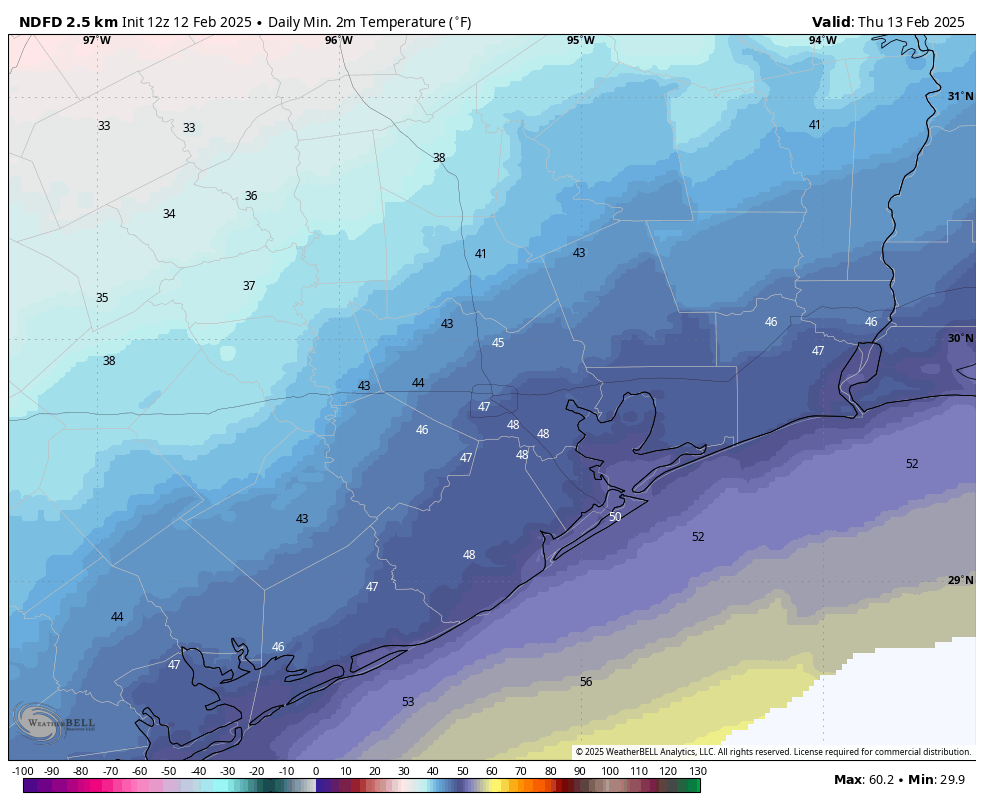
After an abnormally warm start to the month, Houston will see the first substantial frontal passage of February later today. We can expect a (probably broken) line of showers and thunderstorms to move through the area this morning before noon, from west to east, before drier air moves in from the northwest this afternoon. I don’t expect anything too wild and crazy from the rain showers, but it’s Houston so be prepared for the possibility of some thunderstorms and briefly heavy rainfall. Highs today will crest at about 70 degrees this morning before dropping into the 60s this afternoon, and the 50s this evening.
Thursday
Lows on Thursday morning will be in the low 40s, and with a chilly northerly flow expect high temperatures to only climb into the mid-50s. We will see mostly sunny skies, however. Lows on Thursday night will drop into the 40s as winds turn more easterly.
Friday
Skies will be partly sunny on Friday, with highs likely climbing into the mid-60s. As atmospheric moisture levels rise we could see a few scattered showers develop later in the day. Friday night looks to be mild, with lows only dropping into the upper 50s or lower 60s.
Saturday
Humidity levels will spike on Saturday, with high temperatures likely pushing toward 80 degrees as we see a surge of warmer air ahead of the next cool front. Although the timing is still a bit uncertain, this front likely moves through on Saturday afternoon or evening, and it should bring a chance of showers and thunderstorms with it. We’ll see about the dynamics for storms, but right now they don’t appear to be overly favorable in the Houston metro area. Lows on Saturday night are likely to plunge in the wake of the front, dropping to about 40 degrees.
Sunday
Expect clear, sunny, and cold conditions with high temperatures of around 50 degrees. Lows on Sunday night will drop into the 30s for much of Houston, and we cannot rule out a light freeze for some inland areas.

Next week
We’ll be chilly on Monday and Monday night before a warmup next week, followed by what appears to be another fairly strong cold front on Tuesday or Wednesday. This will, once again, bring the chance of a light freeze to Houston by Thursday morning or so. Winter is not over yet.
Jerry Jones Signs 15-Year, $500 Million Life Extension
ARLINGTON, TX—In a milestone deal in which the Dallas Cowboys owner renewed his commitment to this mortal coil for the foreseeable future, Jerry Jones announced Wednesday that he had signed a 15-year, $500 million life extension. “I’m over the moon to have reached a compromise that will let me to stay amongst the living through 2040,” the 82-year-old said of the blockbuster half-billion-dollar contract, which extends his life almost to the century mark. “I’ve always been an enormous fan of existence. Reality is a tremendous place: sentience, breathing, experiencing things. They’re all uniquely part of life. Ever since I started here, decades ago, I’ve understood there’s nowhere like this, especially when you compare it with what they’re doing over in the cosmic void of nothingness, stretching on forever in eternal silence and endless dark. No, thank you. I want to keep leaving my mark here for as long as I can.” Jones added that based on how this deal progressed, he was also open to an additional deal extending his place in the world indefinitely.
The post Jerry Jones Signs 15-Year, $500 Million Life Extension appeared first on The Onion.
Anti-Aging Millionaire Announces He Has Put In Purple Contact Lenses
LOS ANGELES—Boasting that he had made the most dramatic change to his appearance yet, anti-aging millionaire Bryan Johnson revealed Wednesday that he had put in purple contact lenses. “Today, I stand before you a new, younger man who also has violet eyes,” said the 47-year-old business magnate, who added that on top of his intensive daily regimen of light therapy, blood transfusions, and 91 custom supplements, he and his team of longevity specialists had now covered his eyes with colored lenses he purchased online. “Although my natural blue eyes didn’t necessarily age me, my new, purple eyes give me an air of otherworldly mystery. And this is only the beginning. Soon, I’ll have some cat-eye contacts for both myself and my son to wear when he gives me his blood.” At press time, a shirtless Johnson could be heard screaming in pain as his bloodshot eyes rejected the contacts and immediately aged him 20 years.
The post Anti-Aging Millionaire Announces He Has Put In Purple Contact Lenses appeared first on The Onion.
Man So Hungry He Could Eat An Orange
HARTFORD, CT—Telling his skeptical friends that he was in no way being hyperbolic as he described his ravenous state, local man Will Childress reportedly swore Wednesday that he was so hungry he could eat an orange. “Man, my stomach has been growling for so long that I seriously think I could crush a whole orange in one go,” said Childress, who claimed he was so starved that he would happily tear into the skin and peel an entire orange with his bare hands if he had the chance. “I’m not just talking about those little mandarins, either. I bet I could down a full navel orange without even thinking about it. You guys act like I’m joking, but I’m not. I’d just sink my teeth into it and take out a whole slice with one bite. Hell, I’m so hungry I could eat a damn pomelo right now.” At press time, friends confirmed Childress had begun eating an orange but tapped out halfway through when the acidic fruit began to upset his stomach.
The post Man So Hungry He Could Eat An Orange appeared first on The Onion.
I Know This Is a Bad Time, but I Would Like a Refund for My Ticket to Our American Cousin
Hey there, it’s me again. Just following up on my letter from earlier this week. I know this is a bad time, but I’d like a refund for the April 14 performance of Our American Cousin.
I’m aware the Ford’s Theatre team has been rather busy the past few days. I understand you have so many more things to worry about, but I’d really appreciate a refund. I had a seventy-five-cent balcony ticket.
Not to be a stickler, but I read the theater’s posted policy on refunds. Well, I read part of it before federal agents rushed in and escorted the whole audience out of the building. From what I gathered, though, I’m entitled to a refund. Cash would be preferable. I don’t want a voucher or anything.
In the grand scheme of things, it’s no big deal. The nation is in mourning. The killer is on the loose. I get that. Technically, though, I paid for a full show and only saw part of it. When I spend my hard-earned money on a three-act play, I expect to see every scene, interruptions be damned.
So sorry to bother you about this, but I’m not going to stop pestering you until I get my seventy-five cents. It’s not like I had a cheap upper-level ticket. I splurged for decent seats. The whole theater is blocked off indefinitely by law enforcement, but I bet you can pop in and snag my ticket money from the register.
This is a rough PR situation for the theater, I’m sure. It’s hard to bounce back from this kind of press. But I’m also sure that refusing refunds to paying customers won’t do your reputation any favors. Word travels fast.
Imagine if something similar happened to you. You go out to a nice dinner, maybe you have a cute date, and right as you’re enjoying the third course, a crazy guy comes in and assassinates the president of the United States. Bam. Your whole dinner is ruined. The waiter doesn’t even offer a doggy bag. No money back, no apologies for the inconvenience, just get your coat and leave.
That was me the night of April 14. Imagine my shock. Imagine my pain.
When you think about it, more than one injustice occurred that fateful evening. But in my case, justice can be restored. All I’m asking for is a fair shake. Enclose seventy-five cents into this envelope, and you’ll make this gloomy chapter of American history a little bit brighter.
If not, can I speak to your manager?

Vanishing Culture: Punch Card Knitting
The following guest post from digital humanities scholar Nichole Misako Nomura is part of our Vanishing Culture series, highlighting the power and importance of preservation in our digital age. Read more essays online or download the full report now.
Punch cards are a fascinating binary data storage format that aren’t just history—they’re still used by knitting machines today! Thanks to the Internet Archive and other collections, we still have access to historic punch cards, but there are some technical challenges to using them in the format they’re stored in. Meet a few folx working on those challenges.

Punch card computation—the good old days, or the bad old days, depending on who you talk to—lives firmly in the land of “the old days” for most—a piece of history, with pedagogical and nostalgic benefit—but it’s alive and well in the textile world.
Histories of computing frequently point to the Jacquard loom as the example of the “first” code, used to create fabric in a variety of patterns—like this 1839 commemorative portrait of the Jacquard loom’s inventor, J.M. Jacquard: https://www.loc.gov/pictures/item/2002737214/. These looms use punch cards to lift warp threads above or below the weft, allowing for the mechanized creation of non-repeating patterns across the loom. (https://americanhistory.si.edu/collections/nmah_645517)
While the Jacquard loom gets all the attention for being the first code, the punch card knitting machine transitioned from being a Jacquard attachment on lace and knitting machines in industrial textile production to the kind of local, DIY code that a lot of people in textiles interacted with—many of whom were women. By the 1970s, they were used by people knitting for themselves and their families, for take-home piece-work, and in textile factory settings. The punch card machine was eventually replaced in commercial and, if you can afford it, home contexts by machines that could control individual needles, instead of depending on a punch card’s repeat—but the machines are still in use in a number of hobbyist workshops (like my own!) and are even still in production (albeit much-reduced).
The knitting machines I own share their punch card dimensions (24 stitches wide) with one of the first punch cards (the Hollerith card, used for the 1890 census, was a 24-column punch card). They’re an important piece of computing history—and crucially, one of the few that isn’t only history because a broad community of people, on- and off-line, are still sharing knowledge on how to hack, restore, and use them.
All punch cards are fundamentally digital, even if we don’t generally think of “digital” as a property physical objects can have. It is only recently that our associations of computing with “the cloud” and other ephemeral metaphors have superseded the fundamentally physical processes that support computation. Working with knitting machine punch cards reminds me that the cloud is a metaphor, and lets me own and manipulate my code in a way I find both challenging and creatively liberating.
The coolest thing about knitting punch cards is that they really are just sequences of “yes” and “no”—and that information is actionable in a wide variety of machines, all of which perform different functions based on that information. Some machines can knit two different colors at once—one color is “yes,” and the other is “no.” Others can skip the stitches marked as “no.” Some machines can make tuck or slip stitches, and others still do something called “weaving,” a variation on the aforementioned two-color knitting. The information encoded by these punch cards, regardless of the actual dimensions of the cards, is interoperable across most machines—and when it is not, it is because the number of holes in the punch card doesn’t permit the same numeric repeat (30 and 24 are divisible by a similar, but not identical, set of numbers).
There are a lot of punch card knitting patterns stored on the internet, found in multi-purpose archives like the Internet Archive and in countless community-hosted Google Drives. Unlike a pattern written for hand-knitting, these punch cards are not, strictly-speaking, usable in the format they are stored in. While I could knit a sweater from a set of directions that look like knit 1, purl 40 from an image, working with images of punch card knitting patterns requires a different workflow—one that, counterintuitively, is challenging because of the digital nature of the punch card itself.
Digitizing the already-digital
Knitting machine punchcards are relatively easy to digitize in a way that preserves the information, but relatively difficult to digitize in a way that makes the transition back from stored-on-the-computer to stored-in-physical-material feasible. It is entirely possible to recreate a punch card using an image—by hand, laboriously, with a physical hole punch. (Image: https://archive.org/details/handypunch/HandyPunchDirections/mode/2up) Usually I work row-by-row, with a ruler across the image, to make sure I’m putting holes in the right spots and chanting things like “3 yes, 1 no, 3 yes, 4 no” in repeating patterns. It is error-prone, but consistent with how generations pre-internet worked with these patterns—translating an image in a book or magazine into binary data of “punch this, not that.”
However, those with more patience for debugging than patience for tedious card-punching have been experimenting with a variety of methods that allow for computer-controlled punching—or, more often, cutting that imitates punching. The Cricut is the standout piece of hardware here, although any machine that can precision cut paper using code will do. These machines, called CNC machines (CNC stands for “computer numerical control”), can have laser or blade attachments, and they work the same way as the massive plasma cutters used for cutting steel. A layer of software, which can be open-source or proprietary, translates an image stored as a SVG (scalable vector graphic) into strings of numbers that control the cutting head.
SVGs aren’t that hard to generate off of images; the challenge here is generating an SVG off an image that actually fits in a punch card knitting machine. There is exactly one spot a hole can go that will work with the dimensions of a knitting machine, and unfortunately, low-quality scans (even pretty-good quality scans) are often too noisy to make it possible to blow up the image and then cut out all the dark spots. I tried, and was rewarded with a punch card that jammed, ripped, and complained loudly for several rows before I gave up. With higher-quality scans, this one-to-one kind of reproduction might work—but only for the machine the punch card was originally designed for. So there’s an incentive to extract the information in those punch cards in a way that is not tied to the specific dimensions of one knitting machine or another. Knitting magazines frequently turned to standardized grid formats for this, preserving the information (“yes, no, yes, yes, no”) but not the specific dimensions of any given punch card.
I work with punch cards in my home workshop for fun, but I’m also fortunate enough to work with them at Stanford’s Textile Makerspace, where Quinn Dombrowski has been teaching data visualization using textiles on an assortment of knitting machines, looms, and sewing machines. Quinn’s colleague Simon Wiles, a Digital Scholarship Research Developer at Stanford’s Center for Interdisciplinary Digital Research, has worked on a computer-vision approach for converting images of punch cards into data that could be used to generate new physical punch cards. He previously worked on an incredible digitization effort on behalf of the Stanford Libraries to digitize their player piano rolls, which posed related technical challenges, so knitting-machine punch cards seemed like a challenge right up his alley.
When I asked Simon to describe his ideal digitization and preservation workflow for knitting machine punch cards, he said something that surprised me—that the encoded information preserved in magazines and books might be a better starting place than the punch cards themselves, depending on the goals of the project. It’s really hard to scan a punch card well. He pointed out that all sorts of things happen to physical punch cards that make them harder to digitize—they get bent or torn (and in the case of the player piano rolls he’s worked on, people repair and modify them in a variety of ways)—all of which are interesting material information about use, but which pose challenges for computer vision. The question of what to do with a hole that has been taped over is not only a creative decision, but also a technical one: will the scan be able to capture that? Do we introduce a new character to represent the tape in the encoding? Not that magazines are foolproof, he stresses—there are plenty of challenges in digitizing shiny paper, especially if one is trying to do it quickly or automatically.
Regardless of source material, Simon stresses the importance of high-quality scans: “From the point of view of posterity: the scan quality is really important—preserve it the best you can: things that are difficult to parse now will only get easier to parse in the future.”
Punch Card Encoding
Storing the parse—and circulating that information without having to repeat the process of either manual or computer-vision-assisted encoding—relies, at the moment, on community-supported infrastructure.
The format accepted by Brenda A. Bell’s generator, which generates SVGs for a given punch card style based on a user’s plain text file, has become one of the de facto encodings for this information as a .txt file encoded in ASCII—a way to archive and share punch cards that skips over the limitations of image-based archiving, even as it requires more upfront investment in labor. See image below for an example of what this looks like.

Text files are a lot smaller than images, and can be stored easily on both personal hard drives and cloud storage. There are many community-run Google Drives that act as repositories for these punch cards. As far as storing and circulating go, the ASCII format accepted by Bell’s generator offers a lot in terms of flexibility—allowing us to quickly remix, edit, and modify punch card patterns using lightweight, open-source software, even if the current format decontextualizes the information from its original conditions of use. Simon pointed out that a standardized metadata structure could do a lot there—maybe a standardized plain-text header—and I imagine what I could do with a corpus of punch card encoding linked to metadata about its provenance and digitization and to source images stored somewhere like the Internet Archive. What would we learn about knitting and textile history? What creative remixes would be possible?
Punch cards preserve the past and future
Knitting punch cards are an important part of any feminist computing history, and surprisingly resilient. They’re interoperable across machines with the same repeat, can be stored as physical (but still fundamentally digital) copies without worrying about hard drives going bad or requiring ongoing power consumption, and are also, in the age of seemingly-endless proprietary software and terms and conditions, refreshingly punk, in a minimal computing, open-source sort of way. How many people actually read the source code of the open-source software they use? Punch cards are the source, in something so fundamentally binary that fluency is not hard to come by. (Fluency in binary for almost all other tasks is nearly impossible.) I can repeat a row as many times as I wish. I can change whether my machine ignores the 1s, knits the 1s, purls the 1s, etc. I can perform subsequent operations on the punch card’s outputs with manual manipulation. And I own it. I own my knitting machine, can take it apart and repair it without violating some terms of service, and can hack and modify it and my punch cards to my heart’s content.
In a dream world, we’d have naming conventions or databases that let us link the .txt files to their corresponding stored images, in a system that balances the practicalities of storage and future use with the incredibly rich history available to us in the images. Punch card archiving supports an active, developing space where folx continue to develop computational and coding expertise in a variety of formats and ways—from working with mathematical modeling software to generate new punch cards to working out new designs with a hole punch and the memory cartridges at their machine. Our digitization and archiving practices can help us better understand the history of computing at the same time as they support an ongoing community working in creative computation. The Internet Archive and other community archives—which Simon says “are our best hope against enclosure”—don’t only preserve history, they enable communities to continue using and developing our technological resources.
About the author
Nichole Misako Nomura has a PhD from Stanford in English and an MA in Education, and studies digital humanities pedagogy. She’s currently an Associate Director at the Stanford Literary Lab, a digital-humanities research collective, and a lecturer in the Stanford Department of English.
I Vow to Fight Autocracy with Unprecedented Levels of Finger Wagging
“Chuck Schumer, the Democratic leader in the Senate, has reportedly been criticized by some of the party’s state governors for not resisting Donald Trump’s agenda and cabinet nominees strongly enough.” – The Guardian
FROM THE DESK OF CHUCK SCHUMER
Desperate times call for incremental measures.
As radical conservatives gut our institutions left and right, America needs an opposition leader with strength and resilience. Until we find that person, I will lead the charge. And I vow to fight for democracy every weekday of my life.
To the millions of enraged citizens who need a voice—I will be your soft whisper.
To the civil servants fighting back against unlawful purges—I’ll be with you every other step of the way.
To the conservatives who might underestimate me—you have no idea what I’m capable of fitting into a slideshow about the value of norms.
I will shrug the opposition into dust. When I’m through, they won’t know what hit ’em—or that they even got hit at all.
To paraphrase Roddy Piper, I came here to chew bubble gum and express mild indignation… and I’m all out of bubble gum.
Our party must act swiftly. There’s no time for hesitation. Or delay. Or dawdling. Or dragging our feet. Or indecision. Or dilly-dallying. Or stalling. Or hemming and hawing. Or equivocation. Or grandstanding. Or mincing words. Or slow-walking. Or procrastinating.
It’s time to gently place caution to the wind. It’s time to sit up and fight. It’s time for Democrats to stop playing our usual softball—and start playing the kind of softball that uses the smaller, slightly firmer ball. We need to throw the old Democratic playbook out the window, see what page it lands on, then enact the boldest plan on that page.
Republicans aren’t prepared for the amount of raw passion our newsletters are gonna have.
And if they think we’ll just roll over, then the joke’s on them. Because we’ve already rolled over, so the next time we roll over, we’ll actually be rolling back into a proper defensive position. They poked the bear. Well, this bear has claws—and those claws can organize telethons.
Things may seem dire, but fear not, America. I, Chuck Schumer, am here to roll up my sleeves and save democracy.
Though I may roll them back down if my forearms get chilly.