Shared posts

18 Apr 19:22

Tamal or tamale?

by Mando Rayo

It’s the ongoing tamale debate – although for some, there may be no debate at all.

Mando Rayo shares his take on the Texas (tamal?) debate with Angela Kocherga of the Texas Standard.

The audio interview featured in this bonus episode of Tacos of Texas originally aired live on the Texas Standard in December, 2025.

The full transcript of this episode of Tacos of Texas is available on the KUT & KUTX Studio website. The transcript is also available as subtitles or captions on some podcast apps.

The post Tamal or tamale? appeared first on KUT & KUTX Studios -- Podcasts.

15 Apr 14:31

#Kento #RoninWarriors

15 Apr 13:40

A Legacy of Fun & Focus: “Mini Art Museum” at the Contemporary at Blue Star, San Antonio

by Isabel Servantez

The Mini Art Museum, contrary to its title, made and continues to make an enormous impact on its visitors and those connected to it. Established by Mary Cantú and Gabriela Santiago in 2013, the small-scale institution has a special history as a first museum visit for many with a fun and curious presentation; all the artworks are the size of business cards. Its collection of artworks, now held by the Contemporary at Blue Star, and an entertaining presentation, currently on view at the Contemporary, stand as part of a legacy for Cantú, who passed away in 2025.

What may have begun as an act of camp or irony (asking many of San Antonio’s most respected artists to submit an artwork of such minimal size), quickly became a profoundly serious and joyful effort to collect and present the artwork of some of the most accomplished local artists to schools across the city and communities around the world. 

The levity and aims of the project were explained to me by Chris Castillo, a former intern and colleague of Cantú. He stated that although the two of them often shared raucous laughter, Cantú pushed them to pursue grand goals. He described Cantú as a “force” that would dare them to realize the wildest ideas they could conceive.

An photograph of an installation of a collection of tiny artworks, presented on tabletops set up like "islands" with small galleries of art.
An installation view of “Mini Art Museum” at the Contemporary at Blue Star

Joy is key in the way that Mini Art Museum is presented in the project space of the Contemporary. Given the scale of the artworks in the exhibition, filling the space may initially seem like quite an obstacle, but Contemporary at Blue Star curator Jacqueline Saragoza McGilvray and her team produced an ingenious and enjoyable solution. They have organically spread out the miniature artworks across the gallery by creating a miniature neighborhood with multiple exhibition spaces, some of which are only accessible if you duck under an over-head road; similar to driving around and under overpasses in San Antonio. 

The large bases that hold the display spaces create a requirement for viewers to walk around the gallery with intention and curiosity to avoid missing any of the artworks. The height at which the pieces are set adds to the playful nature of the exhibition, as you may be required to bend over to see the details of artworks and their titles (I stand at a proud 5 feet 6 inches tall and still found myself quite active in viewing the exhibition). Playfulness in the show, and recall of Mini Art Museum’s history as a teaching museum in schools, continues with the availability of magnifying glasses and single steps around the gallery, offering access for viewers of all ages to get up close to the artwork.

There is a downside to a full follow-through of this type of presentation, which is that it is difficult to get a head-on or unencumbered view of much of the art. While the Contemporary offers a gallery guide, it is limited in scope. A brochure, either physical or digital, with a complete presentation of the art would be more helpful in addressing this. Another benefit of a full gallery guide is increased accessibility for those with vision difficulties; as fun as it is to use magnifying glasses to inspect art, for some it is likely a difficult way to experience the show.

A photograph of a small  portrait ink drawing on paper.
Vincent Valdez, “Untitled,” 2015, ink on paper, 4 3/4 x 5 1/2 inches

The roster of artists in the exhibition is formidable. Looking through the nearly 100 works on view, you will see a who’s who of San Antonio artists that were prominent during the life of the Mini Art Museum’s collecting phase. The exhibition showcases works by 61 artists, including David M. Alcantar, Cynthia Emma Alderete, Sabrina Alfaro, Fernando Andrade, Kim Bishop, Anika Blanco, Dezi Boone, Valerie Bowers, Ana Hernandez Burwell, Elizabeth Camilletti, Chris Castillo, Sarah Castillo, Lisette Chavez, Danielle Cunningham, Jenni Cutter, Jennifer Ling Datchuk, Joe De La Cruz, Celeste De Luna, Alejandro Diaz, Mickey Lee Everett, Sandra Felker, Elizabeth Fieler, Janet Flohr, Joan Frederick, Michael Anthony Garcia, Laurel Gibson, Suzy González, Ghislene Harris, James Huizar, Amy Jones, Lauri Garcia Jones, Karen Keese, Daniel Knuckley, Lucia LaVilla-Havelin, Monica A. Martinez, Roy Martinez, Paloma Mayorga, Michael Menchaca, Miranda Meyer, Amada Claire Miller, Martha Ochoa, Tim Olsen, Kristy Perez, Ben Powell, Christina Puente, Felix F. Quintana, Daniel Rios Rodriguez, Carlos Rosales-Silva, Anthony Rundblade, Michael Stoltz, Hiromi Stringer, Christopher Elliott Suniga, Connie White Swann, Gary Sweeney, Jessica Swenson, Perla Tenorio, Christina Torres, Luis Valderas, Vincent Valdez, Rikianne Van Kirk, and Claudia Zapata.

A photograph of a small etching of a cat.
Hiromi Stringer, “A Box for a Cat,” 2016, etching, 4 1/2 x 2 1/2 inches

The physical asks of the exhibition reward engaged viewers. During my visit, I noticed a food truck near a handwritten A-frame sign that references a few San Antonio delicacies. I also spotted several cardboard cutouts of people, which serve two purposes — to create an imagined scale for the art and to give reference to the neighboring exhibition Roman Franc: Groups Collective, with the inclusion of San Antonio art world luminary and recently announced 2026-2027 Contemporary at Blue Star Berlin Residency Artist Gary Sweeney. The inclusion of his image nicely ties the three smaller spaces of the Contemporary together as a fun shared reference for those who notice.

A close-up photograph of a small cardboard museum and neighborhood with small artworks.
An installation view of “Mini Art Museum” with Gary Sweeney cutout

The last exciting detail I recognized is that the exhibition is divided into 11 different miniature galleries each with their own focus. Each island of presentation has one or two galleries with their own titled names, giving clues to specific themes and subjects.

A close-up photograph of small artworks positioned inside a small cardboard gallery.
Clockwise from left: Celeste De Luna, “Unknown title,” 2013, marker on paper, 2 x 3 inches; Suzy González, “Untitled,” 2016, ink on cardboard, 4 x 3 inches; Luis Valderas, “Space Vessel,” 2017, relief print, 4 1/2 x 2 1/2 inches; Joan Frederick, “What Global Warming?,” 2019, mixed media sculpture, 3 x 3 x 3 inches

I never had the privilege of meeting Mary Cantú, but based on the stories of the people that worked with her and those she affected through her work, it is clear that her legacy in creating and promoting innovative, engaging, entertaining, and useful initiatives — like the Mini Art Museum — that champion San Antonio culture and encourage access to the arts stands as a lasting guide for many. 

Jacqueline Saragoza McGilvray and the team at the Contemporary at Blue Star have tapped into Cantú’s spirit of wonder for this exhibition and have created a space that is joyous in its presentation, details, and accessibility, while remaining serious in its art historical rigor, commitment to local arts culture, and reverence to capturing the spirit and memory of an important figure in San Antonio.

Mini Art Museum is on view through June 7, 2026, at the Contemporary at Blue Star in San Antonio.

The post A Legacy of Fun & Focus: “Mini Art Museum” at the Contemporary at Blue Star, San Antonio appeared first on Glasstire.

15 Apr 13:34

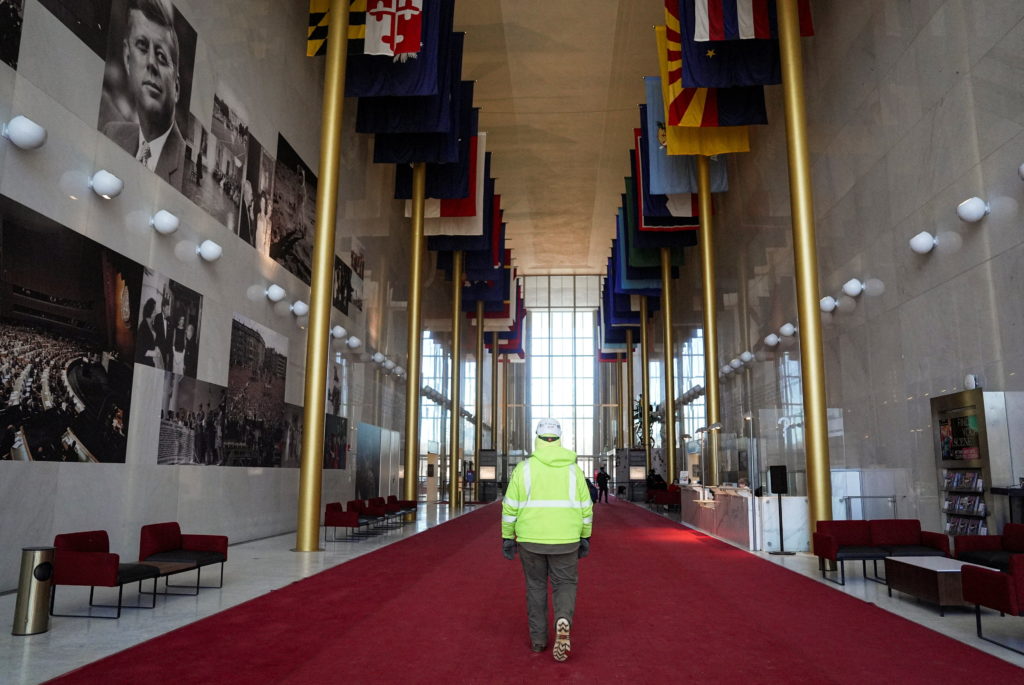
New head of the Kennedy Center tries to show that the building really needs a renovation

by Steven Sloan, Associated Press
Trump's move to shutter the building for two years starting in July, which was approved by the board last month, has spurred lawsuits and an outcry that the closure is merely a response to plunging sales as artists canceled Kennedy Center performances in droves.
15 Apr 13:27

manager is freezing me out, written up for being one minute late, and more

by Ask a Manager

It’s five answers to five questions. Here we go…

1. My manager has been freezing me out since I talked to HR about her

Last May, I finished my masters and in September landed a job in my field and specialty. The first few months were great with my boss, Claire. She was super nice, let me know everything that was going on in the department, I got along with my other coworker in my department, and I finally felt like I had found my job and people. I even told Claire I had a disability that I put on my application. She was very understanding and supportive.

Then in January, things changed. Claire accused me of trying to do her job anytime I suggested something and said I needed to stick to the things I was hired to do and to stop acting like the smartest person in the room. I was pulled into HR about this time and was told Claire made an off-hand comment about my disability and I needed to fill out official paperwork so I would be legally protected. The final straw when Claire yelled at me for making a judgment call when another department needed something from us and I was the only one in our department there, and then asked what my problem was while giving a textbook description of my disability. I went to our department head, John, and told him everything. He told me he’d talk to her and that I should go to HR.

I went to HR and everything led to a hostile work environment investigation. I did not want that. The conclusion was there was no hostile work environment and my boss and I have different communication skills. However, during it, it was discovered I had made my coworker, Maddie, feel uncomfortable. No one was written up and nothing was done. Claire, John, and I were each given a different HR class to take. I had to take one about bullying in the workplace. My boss had to take one about the Americans with Disabilities Act.

Since this happened, Claire has given me the silent treatment. 95% of our communication is through email. I am no longer privy to all the happenings of our department. I find out things by accident, when I walk in on her and Maddie talking. Claire goes out of her way to be passive-aggressive and petty to me in the emails. My cubicle is right across from her office and she used to always keep her door open, but now she keeps it closed most of the time. She didn’t wish me happy birthday on my birthday, when several people in other departments brought me gifts and cards. However, Maddie’s birthday was a week later and she came in with a card for her. John gives me good feedback, as do the other departments I work with.

Is there anything I can do? I’m not exactly ready to run back to HR since this is how we got here. I didn’t expect Claire’s and my relationship to be the same. I just didn’t expect this. Jobs in my field are rare.

HR probably did have a legal responsibility to investigate after you reported Claire’s comments; once they’re aware of something like that, they’re legally obligated to take action, even if that’s not what you wanted.

But Claire is retaliating against you for talking to HR and for the subsequent investigation, and that’s illegal. Federal law makes it very clear that it’s illegal to retaliate against an employee for making a good-faith complaint of discrimination, even if the complaint were eventually found to be baseless.

I know you don’t want to go back to HR, but if you want the situation to change, that’s really the next step. You’d go back to them and explain that Claire’s behavior toward you has noticeably changed since the investigation, that you’re concerned she’s retaliating against you for making a good-faith report, and that you’re formally requesting the company’s assistance in shutting down the retaliation. If you don’t trust HR to handle this competently and think it will make things worse, this may not make sense to do; in that case, you could consider a similar conversation with John, or one with a lawyer.

(I am curious about what happened between you and Maddie that led them to send you to an anti-bullying training and whether you think there was any merit to that. The answer wouldn’t change the steps that are available now, but if there were legitimate concerns about your behavior toward Maddie, that probably puts you in a less sympathetic position, although HR would have the same obligations regardless. It would make it messier, though. And also, if HR thinks Claire didn’t create a hostile work environment and this is just different communication styles, then what’s up with them making her take a class on the ADA? It doesn’t smell right.)

2. We’re written up for being one minute late

I have worked for manufacturing companies for over 20 years, all in the office and a few of those years as mid-level management. I have a college degree, further education, and am salary. My current employer just implemented writing office staff up for being late. This is not a situation of being 10, 15, or 30 minutes late, nor of chronically being late. This is, “You were one minute late today.” Performance doesn’t matter, staying late or otherwise being early or on time doesn’t matter. Bad weather is not an excuse. Really, no excuse is allowed. And you can be terminated for a few instances in a year. None of these roles see clients in-person or are call center type jobs.

Of all the companies I have worked for, this is the second one to implement this. I left the first in part because of it and will be leaving this one. It seems bananapants to me. Is this typical for what others see in this type of company? I get that is exists for the product floor but for salaried office staff?

No, this is not typical and yes, it is bananapants. There are jobs where you really do need to be at your desk and ready to work by a specific starting time because you need to answer client calls, etc., and that can be true regardless of whether you have a degree, are salaried, and so forth. But that is not most jobs, and “writing people up” (a fairly ridiculous concept in itself) for being a minute later, regardless of context, is absurd and infantilizing.

Related:
ridiculously rigid attendance policy

3. My company can’t move past my conduct five years ago

I have been with my construction company for 14 years, during which time I have significantly expanded my skill set and reached a senior level with a strong salary. However, my history here is complicated. Five years ago, while struggling with severe alcoholism, I had a significant professional lapse that resulted in my employer giving me an ultimatum: I had to complete rehabilitation and maintain sobriety to remain employed.

I have now been sober for five years and have consistently performed as an exemplary employee. While my manager has forgiven me, it is clear that the family who owns the business has not. Despite my contributions, I am consistently passed over for public recognition and achievements, and the environment feels increasingly hostile.

I am weighing whether it is better to stay and maintain my current status and salary or if it is time to cut my losses and move to a company where I can have a fresh start. I can sense that they can barely stand the sight of me; I feel like the ultimate pariah and it is very uncomfortable. I would appreciate any guidance you could offer on whether I should stay or begin looking for new opportunities.

Yes, start looking! Without question. For whatever reason, they can’t get past what happened, and you’re better off going somewhere else where you can start fresh.

Sometimes that happens! When people get used to seeing you a certain way, sometimes it can be really hard for them to see you differently, no matter how much you demonstrate that you’re no longer that same person. Sometimes that’s a failing on their side. Sometimes it’s because the earlier breach of trust can just never really be repaired, even when everyone hopes to. Either way, you’re better making a clean start with a company that doesn’t have that history with you.

4. Employer wants us to report all outside work, not just conflicts of interest

My company likes to say they are not trying to be “Big Brother” but seem to enact policies that probe much beyond what other companies in the same industry ever do. I am very used to anti-moonlighting policies and those make sense: don’t do what we pay you to do for other people. Well, my company has a policy we’ve somewhat gotten around but they have recently been changes that makes it a bit harder. They want to know all outside work, including your hat-knitting business, working for a family business, unpaid time you may volunteer for anything that may constitute a business, how many hours per week, etc. Everyone must submit a form with “nothing to report” or report anything else and attest that they’ve covered all scenarios.

My work is in technical compliance, and I would never moonlight without explicit transparency for a number of reasons. I have a part-time side hustle in a creative realm completely unrelated to this work. There is zero overlap, and I do the side work under an alias. You could never google my name and find my side project. My boss knows the general nature of the side work, and has been fine with me not reporting it.

Many of us feel this policy is reaching too far into our personal lives and demanding information that doesn’t impact our jobs or our time at work. How should we handle this? Our company is shifting more and more toward Big Brother tracking and monitoring and it may be a mass exodus around here…

Most likely, they’re requesting it because they’re concerned that if they leave it up to each individual employee to decide what’s relevant, someone may make the wrong call and not report something that’s actually a potential conflict of interest. They’ve decided it’s safer to ask you to report it all so that they can decide if it’s a conflict or not. Depending on the type of work you do for your company, that’s not necessarily outrageous; there are jobs where that would make sense.

If you think it doesn’t make sense for your line of work, you and a group of coworkers can certainly try pushing back, explaining why you think it’s unnecessary — but all it takes to cause this kind of policy change is them having one person who decided something wasn’t relevant to report when it actually was. They may be overreaching in other areas, but this one probably isn’t worth the capital to try to fight.

Related:
interview with a conflict of interest professional

5. Companies promoting their businesses in comments on my LinkedIn posts

I post regularly on LinkedIn and have a good following in my industry. This past week, a company liked my post and added a comment, which was a promotion for their business. I’m considering deleting it because I don’t want my posts/profile used to promote other businesses. On the other hand, it reflects on them and maybe it seems quite dramatic to delete it. What are your views?

Delete it without hesitation. It’s spam! There’s nothing dramatic about deleting spam.

The post manager is freezing me out, written up for being one minute late, and more appeared first on Ask a Manager.

15 Apr 13:26

See? We just gotta work together. Kid power!

See? We just gotta work together. Kid power!

15 Apr 13:26

Oh, and falsify some lab reports while you’re at it. Chop chop!

Oh, and falsify some lab reports while you’re at it. Chop chop!

15 Apr 13:26

Hey, my publisher asked me to remind you that my stuff is available on their store! Also there’s a…

Hey, my publisher asked me to remind you that my stuff is available on their store! Also there’s a wall scroll.

Books and plushies

Wall scroll

15 Apr 13:24

Pull the flipping emergency brake

by John Allison

The captain’s hat. I suspect they may have got this not from the ferry’s captain but from the Captain from Captain and Tennille. The moral of the story being that love… love will keep us together.

These lads needed more keyboards. Plainly five was not enough. Please refer any teenagers who might be interested in this video to today’s comic because this, too, is one for the teenagers.

15 Apr 13:22

Vatican City is Overrun with Crime Thanks to Its Woke Pope

by Carlos Greaves

“President Trump lashed out at Pope Leo XIV in a lengthy social media post Sunday night, calling the pontiff ’WEAK on Crime, and terrible for Foreign Policy.” — CBS News

- - -

As Republicans, we were excited when the Catholic Church elected an American pope. America is the greatest country in the history of the world, and it was absurd that it took 250 years for one of our own to finally be put in charge of the Holy See. Unfortunately, it turns out that Pope Leo XIV is the wrong kind of American—a woke liberal who denounces things like “violence” and “wiping out entire civilizations.” There’s no better evidence of Pope Leo’s liberal failings than Vatican City. Like all Blue cities, it’s overrun with crime.

The Vatican is in desperate need of criminal justice reform. As of today, any criminal can walk into the Vatican, confess to any crime, immediately be forgiven, and walk out with zero consequences. Any punitive measures are extremely lenient and amount to verbal commitments to pray a few “Hail Marys” or “Our Fathers,” or, at best, the Rosary. In what can only be described as leftist wish fulfillment, there appear to be no prisons in the Vatican, and the only law enforcement agency is the Swiss Guard, who look more like court jesters than a police force.

President Trump, on the other hand, understands that criminals should have to pay for their crimes. That is why he has established a process that forces criminals to pay upwards of $1 million to receive a presidential pardon.

It should come as no surprise that the Vatican’s soft-on-crime policies have resulted in a massive immigration problem. Thanks to its porous border with Italy, millions of migrants from around the world flock to the Vatican every year. In fact, even the year-round population of the Vatican seems to be entirely made up of immigrants, as its birth rate is virtually zero. With the entire city-state being run by immigrants, it’s no wonder the Vatican is a sanctuary city home to St. Peter’s Basilica—one of the largest sanctuaries on Earth.

Meanwhile, President Trump is committed to his zero-tolerance policy on immigration, even for fans attending this summer’s FIFA World Cup. An Iran vs. Egypt match in an empty stadium is a small price to pay for upholding America First principles, and any comparisons to “Hitler’s Olympics” are just pathetic attempts by the left to distract from President Trump’s many accomplishments as a FIFA Peace Prize recipient.

With virtually zero manufacturing, financial services, or high-tech industries to provide steady jobs, the residents of the Vatican have largely turned to organized crime. The most notorious of the Vatican’s street gangs wear red and call themselves “Cardinals.” Their primary source of revenue is an elaborate protection racket that collects contributions from a vast network of lower-level syndicates spanning the globe. It is this group of red-cassocked rabble-rousers that, through a secretive meeting known as a “Conclave,” was responsible for the progressive pontiff’s rise to power.

Unlike the Vatican, President Trump is transparent about elections and the many ways in which Democrats have rigged elections across multiple states, even when they were not in control at the federal level.

Given his disastrous track record running Vatican City, Pope Leo XIV has no business criticizing the president’s war in Iran. Shame on the pontiff for having such a holier-than-thou attitude about peace in the Middle East just because his official title is “His Holiness” and he’s “infallible in matters of faith and morals.”

If anything, Trump is the more Christ-like of the two, even though he would never imply that himself. Plenty of doctors wear floor-length robes and shawls and touch their patients on the forehead while ethereal light emanates from their fingertips.

Despite it all, one thing we will say for the Vatican is that we, as Republicans, support any institution that shields powerful men from accountability for sexual abuse. We hope that never changes.

15 Apr 13:22

Poor Sleep Linked To Gong

by The Onion Staff

CHICAGO—Concluding that the costs of keeping such a device in the bedroom far exceeded the benefits, a study released Monday by the University of Chicago’s sleep lab found a strong link between poor sleep and the presence of a gong. “Our research consistently revealed that one of the best predictors of a sleepless night was having a gong sound near one’s bed,” said lead author Dr. Sylvia Mott, who added that study participants reported falling asleep later and waking up earlier when exposed to the deafening clang of a gong being struck with a mallet. “Incidences of insomnia increased by 97% when the gong was repeatedly used throughout the night, whether it was a small handheld xiaoluo or a deeply pitched four-foot-wide ageng. For this reason, we recommend avoiding gongs for at least 30 minutes before bed. It might be tempting to hear one last thunderous crash as you’re winding down, but the data shows it’s just not worth it.” The study also found that the detrimental effects of gongs could be compounded when combined with two large cymbals smashed together on an unsuspecting sleeper’s head. 

The post Poor Sleep Linked To Gong appeared first on The Onion.

15 Apr 13:20

Party that exists only to obtain power not sure what to do now

by Staff

OTTAWA – Following two by-election wins that have allowed the Liberal Party of Canada to finally cement an electoral majority, Prime Minister Mark Carney has admitted that the party has absolutely no further plans for governing. “Every single part of our party infrastructure has been singularly trained on the relentless pursuit of power,” explained Carney, […]

The post Party that exists only to obtain power not sure what to do now appeared first on The Beaverton.

15 Apr 13:20

Pope Leo says “L + ratio” to Trump on X is what Jesus would have done

by Geoff Cork

Vatican City – During his online arguments with US president Trump, Pope Leo XIV was able to ratio the president on X, getting more likes than the President’s original post and handing Trump, “an L.” “Jesus would have wanted this to happen, fam,” explained the current head of the catholic church. “Unc was fast to […]

The post Pope Leo says “L + ratio” to Trump on X is what Jesus would have done appeared first on The Beaverton.

14 Apr 17:11

The Onion’s Exclusive Interview With Pope Leo XIV

by The Onion Staff

As the first supreme pontiff from the United States, Pope Leo XIV has balanced anti-war and climate advocacy with tending to the diverse spiritual needs of the Catholic Church’s 1.4 billion followers. The Onion sat down with the bishop of Rome so he could lay out his vision for the church in the 21st century.

The Onion : Thank you for taking the time to speak today. What has been your most memorable experience since ascending to the papacy?
Pope Leo XIV: The time they wouldn’t let me into St. Peter’s Basilica because I was wearing a wifebeater.

Has being American affected your time as pope at all?
Yes. When people in America say “Hail Mary,” they’re usually talking about football. But here, “Hail Mary” means “happy birthday.”

What was the first action you took as pope?
I released 300 altar boys back into the wild.

It must be boring having to go to church so much.
Yes.

Given the season, what lessons do you think believers and nonbelievers should take from the story of Easter?
Always make sure you know what someone’s planning when they ask you to bring a cross somewhere.

What’s your go-to place for hiding Easter eggs?
I gotta go with under stuff. Not many people think to look under stuff.

How was your relationship with your predecessor Pope Francis?
He always made me the back of our two-person God costume at parties. Wasn’t sorry to see him go.

Who is your dream starting five with popes?
Hoo. Let’s see. I’d go Innocent II as my point guard. John III for my shooting guard. Boniface V as my small forward. Gotta go with Benedict XI at power forward. And it’s a little basic, but I’d put Pius VI in the five spot.

Is there ever a scenario in which abortion is justified?
Jesus fucking Christ, I thought you’d be asking about my favorite deep-dish place or something.

How do you turn regular water into holy water?
Boil eight hot dogs in it, then let it cool.

The post The Onion’s Exclusive Interview With Pope Leo XIV appeared first on The Onion.

14 Apr 17:07

Saturday Morning Breakfast Cereal - Easier

by Zach Weinersmith


Click here to go see the bonus panel!

Hovertext:
Brought to you by Zach hasn't studied physics in years and is trying to read through the famous Mike and Ike quantum computing textbook.


Today's News:
14 Apr 16:37

The Masked Mouse

by Reza
14 Apr 13:37

Soon, you'll be reading a copy of wide world of...

Soon, you'll be reading a copy of wide world of news! #CowboyWho

14 Apr 13:36

U.S. Fertility Rate Plummets To Pre-Nick Cannon Levels

by The Onion Staff
14 Apr 13:35

Houston on a warming trend until a cold front arrives this weekend

by Eric Berger

In brief: In today’s post we look at our warm-ish start to April, and how we’re going to turbo-charge that this week before a nice front arrives this weekend. We should be back to seasonal temperatures then, but we’re still trying to read the tea leaves as to whether it will rain with the front.

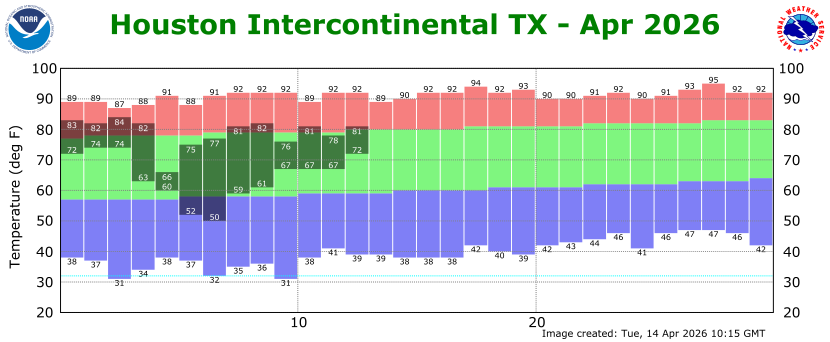
All but two nights this month have been above normal.

Warm April nights

So far April is off to a pretty warm start, with an average temperature of 71.4 degrees, a little more than three degrees above normal. But where we have really felt this is with our nights, which are typically in the upper 50s through the first half of April. However, we’ve been mostly in the 60s and 70s. We’re not close to setting any monthly records (through the first two weeks, our average and average minimum temperatures are not in the top 10 warmest of all time). But we are going to take the warmer-than-usual temperatures we’ve seen during the first half of April and super-charge them this week before a front returns us to seasonal conditions this weekend.

Tuesday and Wednesday

These days will both be similar, with a strong southerly flow (winds gusting up to 25 mph during the afternoon) bringing warm air and temperatures into the region. Expect highs in the mid-80s with partly sunny skies and plenty of humidity. Overnight lows will drop to around 70 degrees in Houston, with slightly cooler conditions for outlying areas. Although there is plenty of moisture in the atmosphere, a capping inversion will likely suppress any shower activity.

Thursday and Friday

I expect both of these days to see a little more sunshine, and accordingly I suspect our daily temperatures will push into the upper 80s (although probably not all the way to 90 degrees). Overnight lows remain warm and muggy, and those gusty southerly winds will continue. Rain chances, still, remain near zero with the possible exception of areas along and north of Highway 105.

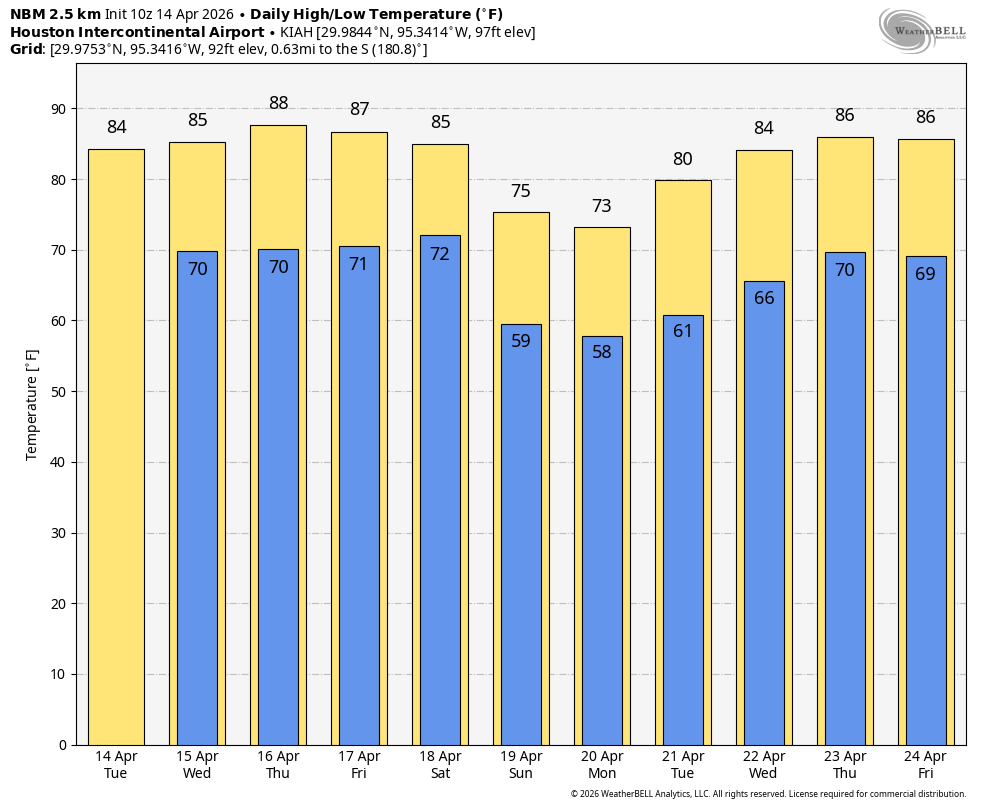
I think our daily low temperatures early next week could go a little lower than this. (Weather Bell)

Saturday and Sunday

The weekend will bring some cooler and drier air in the form of a front. But when? Right now I’m thinking Saturday evening is the most likely time. Assuming that’s the case—and to be clear, we are not locked in yet—Saturday should be another warm and fairly humid day with highs in the 80s. I do expect more clouds and a slight chance of light rain during the morning and early afternoon. At some point during the afternoon or evening a line of showers and possibly thunderstorms should drop down from the northwest along with the front. At this point I’m not seeing any signal for severe storms or heavy rainfall (a dry frontal passage is also still possible). This front should push Sunday morning’s lows down to around 60 degrees. Highs on Sunday look to be in the 70s, with lower humidity and partly (to mostly?) cloudy skies.

Next week

I think we’ll see overnight lows, possibly in the 50s, persist through Tuesday morning before we warm up again some, probably back to around highs in the lower to mid-80s by mid-week. Rain chances appear low before next weekend.

14 Apr 10:42

Rep. Tony Gonzales resigns from Congress amid backlash over sexual misconduct allegations

by Gabby Birenbaum
House members were set to vote this week on expelling both the San Antonio Republican and Democratic Rep. Eric Swalwell. Gonzales’ announcement came shortly after Swalwell said he would step down.
14 Apr 10:42

McAllen area residents push back against any ICE detention facility in their community

by Berenice Garcia
Monday’s remarks from residents comes after a list of potential ICE facilities included a McAllen warehouse.
14 Apr 10:42

Tesla’s Gigafactory water use surges in Austin as new chip plant looms

by By Sam Stark, Austin Current
Tesla’s Giga Texas water use jumped more than 200 million gallons — by about 60% — in two years, as massive chip plant proposal raises concerns about Austin’s strained supply.
14 Apr 10:41

group work is driving me mad, giving feedback when I haven’t seen the problem myself, and more

by Ask a Manager

It’s five answers to five questions. Here we go…

1. My coworkers’ approach to group work is driving me mad

At my workplace, we’re regularly required to give short presentations on how our work is coming along. As we work in teams, the teams need to present together. It seems like every time I come up against the same dynamic, and it’s driving me up a tree:

For example, Fergus and I need to do a 5-10 minute presentation on sales in a certain district. We have to make a PowerPoint and a summarizing document to be shared with everyone. We split up the work so that we’re each handling one half of both the PowerPoint and the document, and set up a check-in meeting a few days before the meeting to run through the presentation. Fergus completes his work just a couple of hours before the check-in, so I’m looking at the document throughout the week, seeing nothing happen, and getting freaked out that I’m going to have to pick up his work. After the first check-in, more work needs to be done on the presentation, so we schedule another check-in. Again, nothing seems to be happening ahead of the second check-in, so I break and just go in and do his work. Fergus expresses remorse at not having done his part and, to make amends, goes in and makes unnecessary changes that make the presentation worse (think randomly italicizing words or making all the text different colors), necessitating me going in again and reverting the changes because it was fine before. Altogether, doing the presentation together has taken twice the amount of time it would have taken me to do it alone, and it’s eaten into other important work I need to do. By this point, I am livid and Fergus can tell, so doing the presentation becomes clunky and joyless, even though I actually really enjoy giving presentations.

This is just one example, but it’s not specific to Fergus. Fergus is also not a bad guy, and I don’t think he’s deliberately trying to get a free ride. What I’ve shared above is a pretty specific example — not every person is formatting materials like this! However, the dynamic of me picking up other people’s work when it’s not done on time or correctly has happened with so many different people that I’m beginning to think it’s a me problem. It’s probably unreasonable to ask people to get their work done ahead of time so that I’m not stressed about it. And I know that there are certain aspects that I can just let go. It’s just that when a person seems to be on their way to giving me the runaround, I automatically get in that headspace of, “Here we go again! I might as well do the whole thing myself since that’s what’s going to happen anyway!” And then it becomes a self-fulfilling prophecy.

Can you offer some reframing so that I don’t lose my ever-loving mind? Are there some scripts I can use to make sure my coworkers and I are on the same page in terms of expectations?

First, how much does it matter if these presentations are perfect? Are you correcting them to a standard used by other people presenting or to a higher one? If the latter, it’s worth revisiting if it would actually be fine to put less energy into perfecting these.

Or, can you divide the work differently — like instead of each being responsible for half the PowerPoint and half the document, can you each take the entirety of one? (Probably not if you’re presenting jointly, but it’s worth asking.)

And if you’re nervous when you don’t see work being done earlier because you know from past history that it means changes will be needed at the last minute, why not suggest checking in earlier in the process?

But also, you need to stop looking at your partners’ work until the actual check-in, because that’s just making you antsy and adding to the problem — and the deadline needs to be the real deadline (without a secret deadline earlier in the week). And you definitely need to stop going in and doing your coworkers’ work for them just because it’s not done early; that’s not fair to them (they may have time carved out to do it later and it’s not okay for you to just decide to do it yourself) and it’s compounding the problem.

If you find that trying all of this leaves you with substandard work, then it’s time to talk to your boss about what’s going wrong — but first do the above and see where that gets you.

2. Giving feedback to a staff member when I haven’t seen the problem myself

I work in a structure with four managers and four officers, where the direct reporting lines don’t really correspond to working areas. So as a manager, I have regular and comprehensive catch-ups with my reporting officer (Lily), but I don’t actually get to see what she’s like to work with, only what she tells me. And I see enough to have given her some development pointers over the last year, but we don’t have any formal 360 review type mechanisms in place.

One of my fellow managers has told me that she and the officer she manages have both found Lily isn’t great at collaborating — she can guard projects a little too closely. I’d love to work with her on developing this skill, but I don’t want it to sound like people are coming to me unprompted complaining about her. I don’t think this is a failing, just an area of working where someone relatively junior and inexperienced can stand to improve. Can you suggest any scripts for how to bring this up?

Be transparent: “I periodically talk to other managers and offices about how things are going and where we can develop, and one things I’ve heard is that they’d like better collaboration on things like X and Y. When you’re the owner of a project, sometimes it can be easy to guard it so closely that other people feel shut out from opportunities to engage on it — but we want them to have chances to hear about progress, give input, and spot problems that they’re especially well positioned to spot (and which we may not be). Can we talk about how you’re handling input from others — and where we should welcome it, and what to do when you’re not sure a particular piece of feedback makes sense for the work?”

Before you do this, though, go back to the other manager and get more information about exactly how this is playing out (if you don’t already have those specifics ). You want to know exactly where Lily is struggling with this since your guidance will differ depending on what that looks like. For example, your focus would be different if she’s getting defensive when people offer input versus never giving them chances to offer it in the first place, and so forth).

Alternately, in some cases you could just ask, “What are you doing to ensure we get input from the X and Y teams?” or “What kind of input has Jane offered on this?” (and then, “What was your thinking on that?”) and dig into it that way, or even sit in on a couple of relevant meetings where you could observe it firsthand and then give her feedback afterwards. But this isn’t something you should need to dance around.

3. Can you use a follow-up email to “fix” responses you messed up in the interview?

Can post-interview thank-you email be used for other purposes — namely, is it an opportunity to shore up responses where I know I didn’t nail it in the interview?

I tend to either nail or whiff my interview questions entirely based on whether I anticipated and prepped for the questions in advance, so inevitably I have at least one or two questions where I fail to answer them well. Can I use the thank you email to share some of what I wish I’d said on reflection?

I’m imagining something like this: first, thanking them as normal. Then, if the question I whiffed was about X, I’d say, “As someone who does X in my work — such as with Example A, B, and C — I continue to be excited about the opportunity to leverage these skills in service of….”

And if you whiffed more than one question, can you address multiple things? I think trying to recover from more than two issues would make the email way too long, but wondering if “thank you, highlight area X, highlight area Y” is also crossing that line.

Yes, you can use your follow-up email to correct or expand on things that came up in the interview, including things you don’t think you answered well. But your proposed example is too subtle! You should be more direct about it. For example: “I realized that when you asked about X, I should have shared ____.” Keep this relatively short — a paragraph or two at most.

And I’d limit it to just one or two things. The second can be framed as, “I also wanted to mention…”

More than that will come across a little weirdly, but it’s fine to do this with one or two topics.

Related:
thank-you notes: they’re not about thanking anyone

4. Explaining minor injuries at work

I’ve recently developed a minor skin condition on my hands. It’s easily treatable and not something I think about or worry about too much. However, the medicated lotion makes the skin on my hands incredibly thin, so they’re covered with scars and scrapes constantly. This in and of itself isn’t even that bad, but even a minor scratch or bump causes me to start bleeding. This morning I was running to a meeting, sat down, and realized I had blood running down my hand where I must have bumped it getting out of the car.

How do I address it so my coworkers aren’t worried? I don’t really need help or anything. I keep bandages everywhere and I usually just excuse myself for a moment, clean off the blood and come back. I’ve even started bleeding in a meeting after I hit my hand on the table! But to reiterate, these aren’t things that really hurt at all and I don’t want people to be concerned, but I appreciate that they are.

Keep doing what you’re doing — excuse yourself to handle it and then come back. You don’t need to say anything beyond that. But if someone expresses concern, just say, “Oh, it’s just a minor skin condition that means I bleed easily right now, but nothing to worry about.” People will take their cues from you, so if you’re breezy about it, that’ll likely be that.

5. When I’m a witness for someone else’s complaint, can I share my own experience?

My coworker, Vila, has raised an official grievance against his manager, Servalan, for bullying and discrimination. I’ve been asked to be a witness in the investigation, and I’m not sure what to expect in the meeting or what my responsibilities are.

I haven’t directly seen Servalan’s behavior in this case because Vila is in a different office but, based on how she treated me for the four months I reported to her, I absolutely believe it. The only reason I didn’t raise a grievance myself is because I spoke to my skip-level boss and had my reporting line changed. Can I talk about Servalan’s treatment of me in the meeting, or am I expected to keep solely to how she treated Vila?

Yes, you can share your own experience with Servalan. Be up-front about that: “I haven’t directly seen Servalan’s behavior with Vila because I’m in a different office, but I have my own firsthand experience with her that aligns with what Vila is reporting. Would you like me to share what I experienced myself?”

The post group work is driving me mad, giving feedback when I haven’t seen the problem myself, and more appeared first on Ask a Manager.

14 Apr 10:39

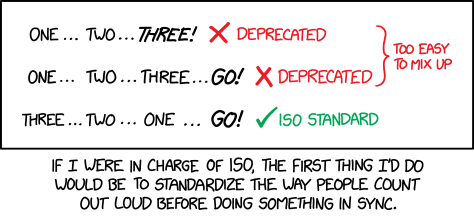
Countdown Standard

Anyone who is caught counting 'three ... two ... one ... zero ... GO!' will be punished with a lifetime of eating only ISO standard food samples.
14 Apr 10:38

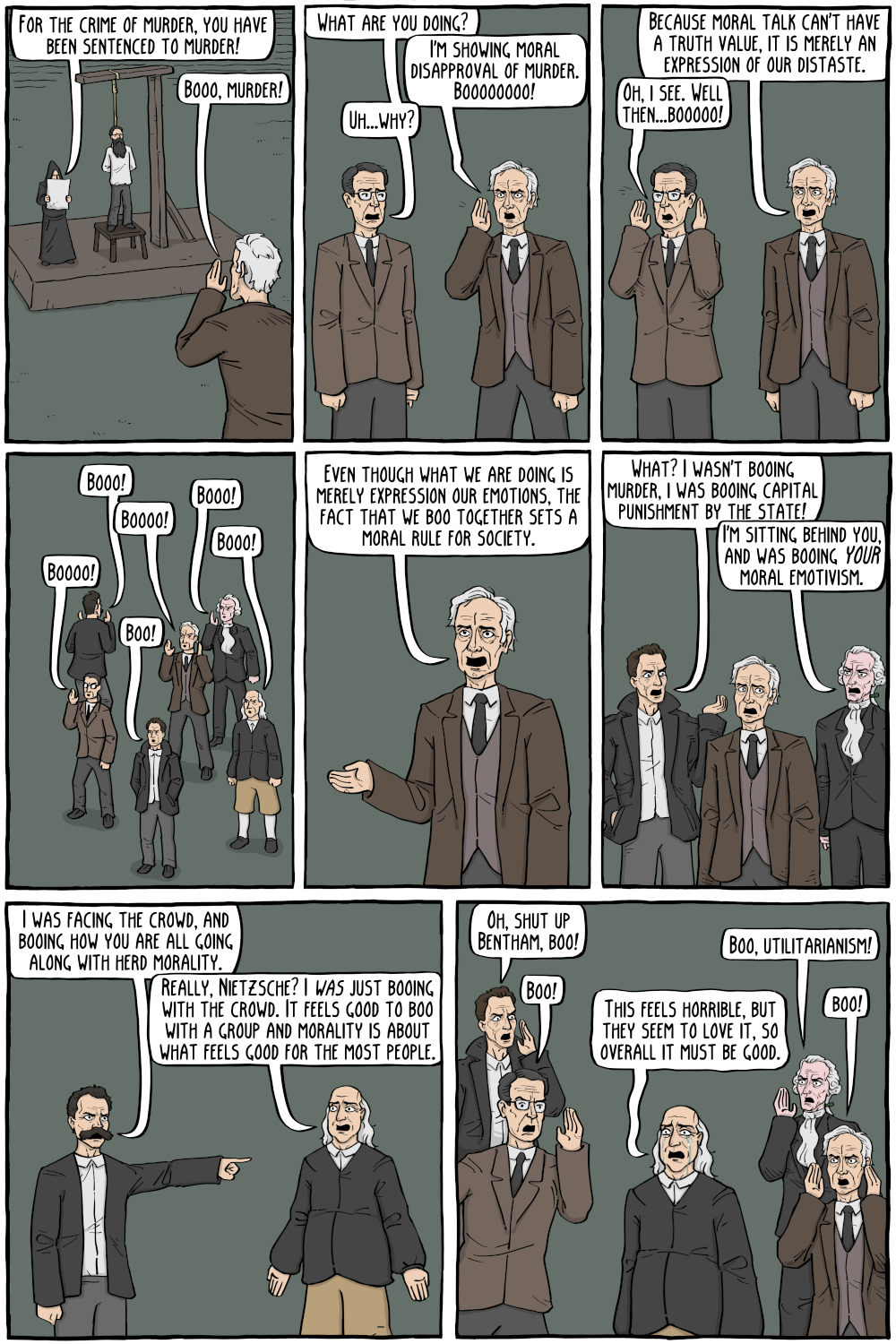
Boo Murder!

by Corey Mohler
PERSON: "For the crime of murder, you have been sentenced to murder! "

PERSON: "Booo, murder!"

PERSON: "Because moral talk can't have a truth value, it is merely an expression of our distaste."

PERSON: "Oh, i see. Well then...booooo!"

PERSON: "What are you doing?"

PERSON: "I'm showing moral disapproval of murder. Boooooooo!"

PERSON: "Uh...why?"

PERSON: "Booo!"

PERSON: "Booo!"

PERSON: "Boooo!"

PERSON: "Booo!"

PERSON: "Boooo!"

PERSON: "Boo!"

PERSON: "What? I wasn't booing murder, i was booing capital punishment by the state!"

PERSON: "Even though what we are doing is merely expression our emotions, the fact that we boo together sets a moral rule for society."

PERSON: "I was facing the crowd, and booing how you are all going along with herd morality."

PERSON: "Oh, shut up Bentham, boo!"

PERSON: "Boo, utilitarianism!"

PERSON: "Boo!"

PERSON: "boo!"

PERSON: "This feels horrible, but they seem to love it, so overall it must be good."
14 Apr 10:37

Kami Who Have Sex

by David Chart

Content warning: See the title…

A book I have read recently is Maguwau Kamigami (まぐわう神々), by Kanzaki Noritakë (神崎宣武). The title can be translated as “Kami Who Have Sex”, and it is about explicitly sexual elements in Shinto practice.

The first thing to note is that Kanzaki is a Shinto priest and ethnologist, and has a regular column in Jinja Shinpō. His new books invariably get a positive review in the newspaper. But not this one. This one was passed over in silence.

The executive summary is that explicitly sexual associations with kami can be traced back centuries, but they always seem to have been somewhat marginal. After the explicit mentions in the earliest myths, clearly sexual elements seem to disappear from all the evidence we have concerning central and prestigious jinja and matsuri. (This is an argument from silence — Kanzaki does not mention any.)

One of the major forms in which such elements are found are dōsojin (道祖神), which are images of kami that were set up at road junctions or at the roadside at the borders of villages, and served to protect travellers and the boundary. In certain areas of Japan — around Tokyo — these often took the form of a stone with an image of a man and woman on, and sometimes they are embracing, or kissing, or even having sex. The surviving examples are all 400 years old or less, but that may well be just a result of increasing prosperity making it possible for ordinary people to afford carved stones. Older wooden images would not have survived.

There are also a fair number of connections between harvest ceremonies and clearly sexual elements, such as sacred dance costumes that include large wooden penises, or jinja where the goshintai is visible, and is a large carving of a penis — or a vulva, or sometimes both, but penises seem to be much more common. Kanzaki argues that the two common prayers of premodern peasants were good harvests and healthy children, and that it is not surprising that the two got merged in a lot of cases.

At some of the sites with penis kami, there is evidence for people coming to pray for relief from STDs, particularly syphilis. Japan has never had a particularly strict attitude to sexual activity, and it was even less so in the Edo period, so when syphilis arrived in the sixteenth century (I blame the Portuguese), it spread widely. There was no effective treatment at the time, so people just prayed. This was particularly true for women working in the pleasure quarters, where having sex with customers was part of the job (but, importantly, only part). There are several surviving sites that seem to have been particularly associated with those areas.

When Westerners were allowed into the country around 1860, they thought all of this was primitive and disgusting, so the Meiji government passed laws to suppress it, and actually enforced them quite strictly in areas foreigners were likely to visit. Mountain villages in western Japan were not such a concern. However, this does seem to have led to a lot of the customs being discontinued. Some do survive, and now are major tourist attractions — because it is a religious festival in which people solemnly parade a two-metre penis through the village.

My impression on reading the book is that Kanzaki finds the evidence unsatisfactory. There is enough to make it clear that this sort of thing happened, in a lot of places, but not enough to attempt any sort of general classification, or even to say whether the survivors are typical examples that were lucky, or survived because they were always remarkable. At any rate, Jinja Honchō does not draw attention to these elements of Shinto’s past. Or even present.

I have a Patreon, where people join as paid members to receive an in-depth essay on some aspect of Shinto every month, or as free members to receive notifications of updates to this blog. If that sounds interesting to you, please take a look.
14 Apr 10:31

Jinja at the Centre

by David Chart

Issue 277 of Shintō Shūkyō includes a research report entitled “Hiroike Chikurō’s “Shrine-Centrism” at the End of the Meiji Period”, by Hashimoto Tomitaro (I think that should probably be “Tomitarō”, but it is written without the macron in the English contents page of the journal).

“Shrine-Centrism” was the idea, pushed in the late Meiji and early Taishō eras (roughly 1900-1920), that jinja should be at the centre of regional communities, leading the improvement of local society. The priests should be good examples, and guide the local people into being better Japanese citizens. Unfortunately, there were not enough priests, and those there were were not always up to the job. Hiroikë was the professor in charge of Shinto and Shinto History at Jingū Kōgakkan, one of the main centres for educating priests, and so he was expected to take a leadership role in addressing this. He did.

His thoughts on this subject were known from a book published in 1915, entitled Jinja Veneration and Religion, and in the preface Hiroikë says that it is a version of lectures he gave in 1911, which had previously circulated in informal copies. The occasion for this research report was the discovery of one of those copies. As far as I can tell from the article, this discovery basically confirmed the claim in the preface — the book is expanded, with additional chapters, but the core appears to be the same as the lectures.

The point of interest is the content. The lectures start with an explanation of why it is necessary to improve the moral character of the people of Japan (oddly, people at the time do not seem to have shared the view of contemporary conservatives that everything was great in 1911), and then argue that ancestor veneration is central to Shinto. Next, they explain about local kami, and then argue that people should form their characters by looking up to the kami, particularly Amaterasu Ōmikami.

Thus far, this is conventional for the Shinto community, but the next bit is more unusual. Hiroikë seems to have argued that there were limits to how far non-religious Jinja Shinto could go in shaping people into the citizens that they should be, and that Sect Shinto should play that role. “Sect Shinto” is the standard English translation for “Kyōha Shintō (教派神道)”, which refers to the thirteen Shinto traditions that were recognised as religions by the Meiji/Taishō government. The report does not say exactly what Hiroikë suggested, but it does point out that he seems to have been the first academic to take Sect Shinto seriously.

This is interesting for two reasons. The first is that the thirteen traditions in Sect Shinto were (and are) quite different from one another. I find it hard to believe that they could have produced a consistent character. If this is what Hiroikë had in mind — securing diversity in Japan through a diversity of religious traditions — then it is very interesting, but without further detail I cannot say.

The other reason bears on the question of whether State Shinto was a national religion. This is further evidence that people in authority at the time genuinely thought that it was not, and thought that other religions were needed to supplement it precisely because it was not a religion.

The opening section of the report notes that previous research has shown that “Shrine-Centrism” failed to have much effect in society. That is an important reminder not to take programmatic statements, even from influential individuals, to reflect the actual situation in society.

I have a Patreon, where people join as paid members to receive an in-depth essay on some aspect of Shinto every month, or as free members to receive notifications of updates to this blog. If that sounds interesting to you, please take a look.
14 Apr 10:28

Liberal bouncers tell MPs to wait in line to join party

by Ian MacIntyre

OTTAWA – With Mark Carney’s Liberals finally achieving a majority, bouncers outside the Liberal party have instructed numerous MPs who are now rushing to cross the floor to “wait in line”. Following wins in two key by-elections, University-Rosedale and Scarborough Southwest, bringing the Liberal seat count up to 173, MPs from across the political spectrum […]

The post Liberal bouncers tell MPs to wait in line to join party appeared first on The Beaverton.

13 Apr 22:58

Hiker Airlifted After Being Stung By Bees Over 100 Times

by The Onion Staff

A hiker was forced to be airlifted after he was stung by bees over 100 times, with officials claiming the stings left him “unable to continue his descent.” What do you think?

“Bees can sense when you’re trying to improve yourself.”

Brandi Clark, Chair Appraiser

“If they’d offered him a ride up the mountain to begin with maybe he could’ve avoided the bees altogether.”

Juan Maldonado, Rice Bagger

“The park rangers clearly warn you not to pet the bees.”

Dylan Forbes, Pet Namer

The post Hiker Airlifted After Being Stung By Bees Over 100 Times appeared first on The Onion.

13 Apr 22:26

Very clever, Holly Hobbie…

Very clever, Holly Hobbie…