Shared posts

08 Jul 20:26

The sizzle reel that says things that nobody understands

by Raymond Chen

At the end of project milestones, some organizations have a tradition of asking each team within the organization to produce a a “sizzle reel” highlighting the work that they have accomplished. These short videos are then gathered together and shown at the organizational group meeting so everybody can show off their work and receive appropriate kudos from other teams in the organization.

Another source of these “sizzle reels” is a group showing off its work as a form of advertisement. For example, a team may have developed a new tool or technology and want to get the word out. Or they may have made improvements to their existing technology, and they want to announce the next revision to their existing customers.

One thing I would like to remind people who are creating these short videos: Understand your audience.

It is not uncommon for these little videos to brag about accomplishments in terms that are not comprehensible to people who aren’t on the team.

We are always working on improving performance, and during this milestone, we tried out a new way to turboencabulate the dependency net, which produced a metonomic phase cycle period of 15 milliseconds.

Like, I’m happy for you though, or sorry that happened.

Go ahead and include those details if it makes your team feel good. (Particularly the developers who worked hard on the new turboencabulator.) But please also give a brief explanation that makes sense to the outsiders who are watching your video.

On large data sets, we found that this lowered run times by as much as 30%, though improvements of 10% are more typical.

The post The sizzle reel that says things that nobody understands appeared first on The Old New Thing.

08 Jul 20:24

Dubious security vulnerability: If I perform this complex series of manual steps, I can crash a program I am running

by Raymond Chen

A security vulnerability report arrived that went roughly like this.

In Program X, click on the triangle icon and hold the mouse down. Drag the triangle icon to the green box in the corner, and while still holding the mouse down, press Alt+F4 to close the window. The program will crash on a null pointer.

It sure looks like you found a bug. But is it a security bug?

Who is the attacker? Who is the victim? What has the attacker gained?

The attacker is presumably the person using the mouse and keyboard to trigger the bug.

The victim is, um, I guess it’s the person whose program crashed. But wait, that’s the same as the attacker!

What the attacker gained is the ability to prevent the victim from getting work done.

It’s unclear how this became “elevation of privilege”. A crash on null pointer is typically at most a denial of service. And in this case, the attacker is denying service to himself.

If you want to deny service to yourself, you can just click the × button in the top right corner of the window. There, now you can’t use the program!

The report finishes with a claim that if malware could trigger the crash, then the malware could use a crafted input to escalate privileges.

First of all, there’s no escalation here. The crash is on a null pointer, not a use-after-free or something else that could be leveraged to gain remote code execution. Furthermore, if malware has the ability to inject input, then they don’t need this bug to escalate privileges. They could inject input to run an elevated command prompt and type commands into it!

The post Dubious security vulnerability: If I perform this complex series of manual steps, I can crash a program I am running appeared first on The Old New Thing.

08 Jul 20:23

A walkthrough of the original Microsoft Building 3

by Raymond Chen

I don’t know why, but there is a Matterport walkthrough of the original Microsoft Building 3, which now no longer exists.

This walkthrough appears to have been made not too long before the building was demolished to make room for the new Microsoft campus. I can tell by the office furnishings (such as height-adjustable beige desks) and the overall gray color theme of the building. Originally, the decor leaned heavily on oak for doors as well as desks, shelves, and cabinets.

Building 3 was one of the so-called “X-wing” buildings.¹ From above, you can see the X shape, so chosen to maximize the number of window offices. The challenge in the X-wing offices is not getting lost, since all the corridors look the same. There was a period of time when the Real Estate department tried to address this by painting the walls of each branch of the X a different color, but this didn’t help much because the colors were not recorded in the address book, so when you went looking for room 2352, you didn’t know what color wing it was in. You still had to wander the building looking for it.

Anyway, enjoy the walkthrough. The map is more complete on the second floor, so use that one to see how well you can navigate through the building.

Bonus reading: The Hallowe’en-themed lobby. Via the Matterport walkthrough, you can now stand in the lobby. But you’ll have to imagine the Hallowe’en decorations hanging from various pieces of fishing line. The fishing line was then connected to the four front doors, as well as slipped in the gap between the top of the glass wall and the ceiling, ultimately connected to nearby doors deeper inside the building.

¹ We also had “double X-wing buildings” which consisted of two X-wings glued together, so it looked from above like ++. As easy as it was to get lost in an X-wing building, it was doubly so in the double X-wing buildings.

The post A walkthrough of the original Microsoft Building 3 appeared first on The Old New Thing.

08 Jul 18:31

In the absence of high pressure, widespread showers likely today and Wednesday

by Eric Berger

In brief: Houston’s pattern will continue to bring a chance of daily showers. For the next two days, in particular, much of the region should see rain and a bit cooler temperatures. We should get back into the mid-90s later this week, and into the weekend. So basically, it will feel like July in July.

A year since Beryl

Conditions are quite a bit nicer this morning than they were one year ago today, when Hurricane Beryl made landfall down the coast from Houston. At this time we were seeing maximum winds across the region, with gusts above hurricane force strength affecting much of the area. This caused significant tree damage and knocked power out to millions in the region. So it is not a particularly happy memory for most of us.

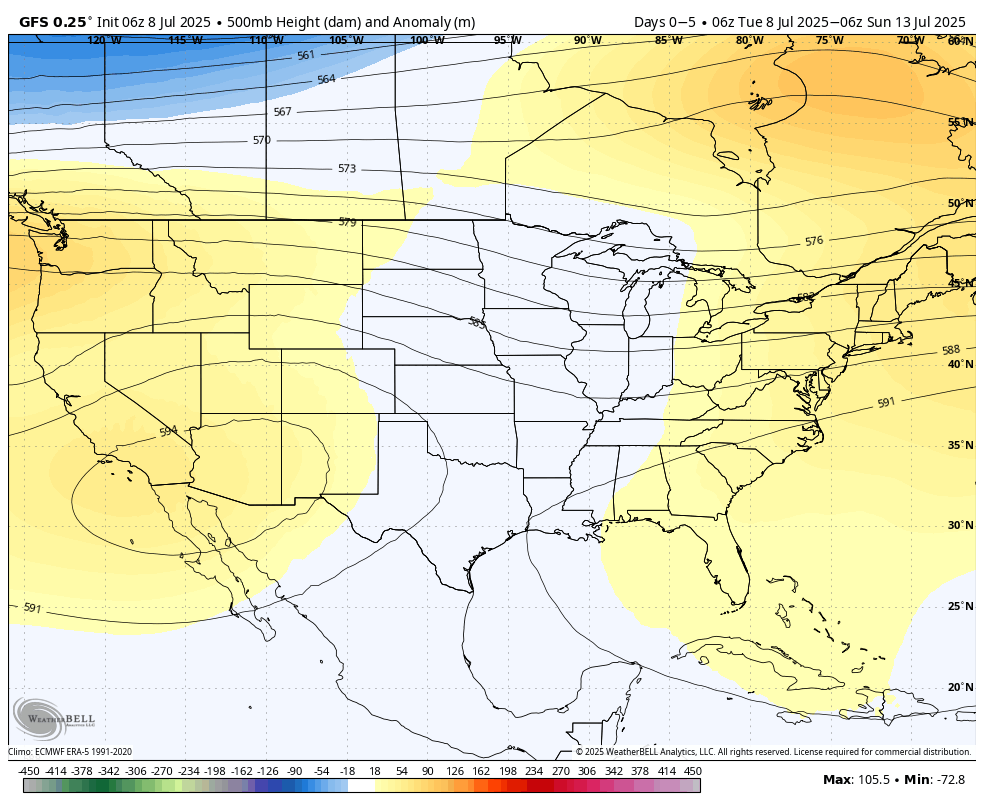
High pressure will be anchored to our west this week, opening the region to continued rain chances. (Weather Bell)

Tuesday

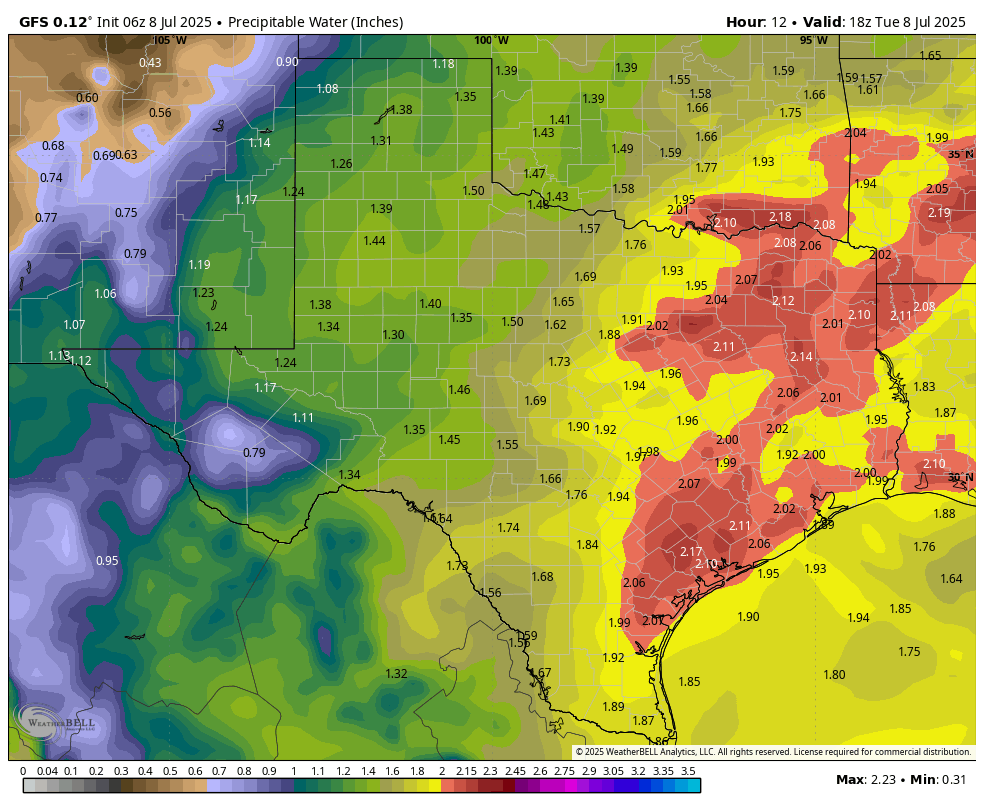
A couple of factors will support ongoing, healthy rain chances across the Houston region this week. These conditions, the combination of lower pressure and lots of moisture in the atmosphere, should be especially pronounced today and Wednesday. As a result we should see the development of fairly widespread showers and thunderstorms.

As usual, these showers will be hit or miss. They will start out closer to the coast later this morning, and then spread inland throughout the afternoon and early evening before waning after sunset. Some locations may pick up 1 inch of rain under stronger storms, whereas as other locations will only see light rain or dark skies. You’ve seen this story before in Houston. Most locations, on average, should pick up a few tenths of an inch of rain by the end of Wednesday.

Values of precipitable water, the amount of moisture in the atmosphere, of 2 inches and above are a good indication of rain. (Weather Bell)

Partly to mostly cloudy skies this afternoon, in addition to rain-cooled air, should help to limit high temperatures to the lower 90s. Winds, generally, will be light at 5 to 10 mph except within stronger thunderstorms. Lows tonight will drop into the mid-70s for most locations.

Wednesday

This will be a similar day to Tuesday, with rain chances above 50 percent. Again we can expect a few thunderstorms, but mostly I think these will be light to moderate showers. Highs, again, will be in the lower 90s.

Thursday and Friday

The second half of the week should bring somewhat lower rain chances, but they still should be somewhere in the 30 to 50 percent range. Accumulations will be less for most locations. Accordingly, daytime highs will be a little bit warmer, in the mid-90s for most locations. This is plenty hot, but also pretty much par for the course in mid-July.

Saturday and Sunday

Unfortunately I still do not have a great handle on the outlook for this weekend. It depends on the extent to which high pressure can build up over the area, and there is no agreement in the various models I am looking at. My sense is that we’ll see highs in the mid-90s, with a decent (i.e. maybe 30 percent) chance of light to moderate showers each day. Hopefully in another day, or so, the forecast will come into better focus.

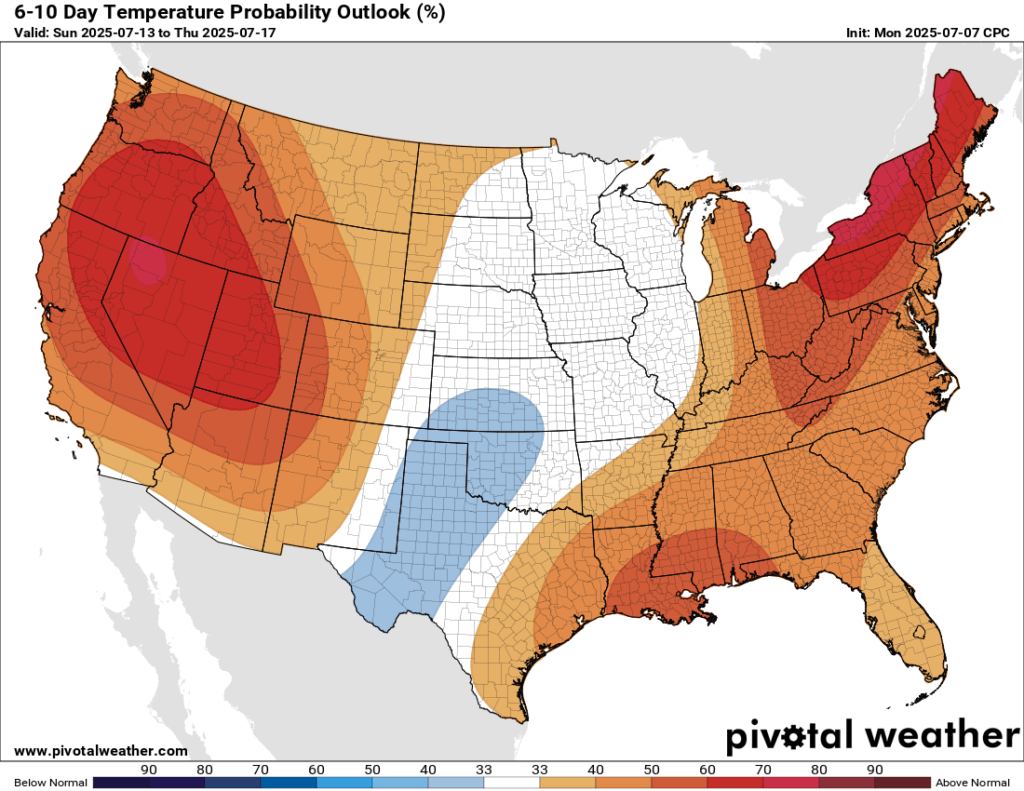
Temperatures next week look somewhat warmer than normal for the Houston region. (Pivotal Weather)

Next week

Overall next week looks a little bit warmer, with high temperatures in the mid-90s, and possibly some areas sneaking into the upper 90s. I think rain chances may step back a little bit, compared to this week at least, but I’m not sure the spigot will be entirely shut off. Basically, July will continue to do July things, probably.

08 Jul 18:30

Tile Store Offended By Sponsored Little League Team Celebrating Win At Pizza Place Instead

by The Onion Staff

ITHACA, NY—Scoffing at the idea that the players would be able to properly honor their victory anywhere else, the owner of local tile store All Stone and Tile was reportedly offended Tuesday that the Little League baseball team he sponsored had celebrated its win at a pizza place instead. “So I guess we spent several hours setting aside all these tiles we know the kids would love for nothing, huh?” said owner Griffin Cronin, who launched into a diatribe against Sal’s Pizzeria, mocking the restaurant for using mortar instead of thinset between the checkered slabs decorating its dining area. “Apparently all we’re good for is paying for the jerseys, equipment, and field maintenance. The true loyalties of these 11-year-olds lie elsewhere, despite everything we’ve done for the brats. What do they want from us? To sell pizzas instead? Then we would be abandoning our core principles as a tile store, for crying out loud!” At press time, Cronin was wondering aloud if he might be the problem after learning the team sponsored by Alternatives Federal Credit Union happily had convened in the financial institution’s lobby to revel in its recent playoff victory.

The post Tile Store Offended By Sponsored Little League Team Celebrating Win At Pizza Place Instead appeared first on The Onion.

08 Jul 18:30

Trump Orders His Face Added To The Pep Boys Logo

by The Onion Staff

WASHINGTON—Insisting that he deserved a place alongside the iconic visages of the auto supply company’s founders, President Donald Trump issued an executive order Tuesday adding his face to the Pep Boys logo. “After all my tremendous work on behalf of American car owners, many have said that I should have my image up there with Manny, Moe, and Jack,” Trump told reporters during a press briefing at the White House, adding that any symbol of America’s best deals on towing, tires, and car batteries was incomplete without him. “No one has done more to offer Americans brake repair and tire alignment services at affordable prices than I have. In fact, they should probably put me in the middle of the logo. There’s room. They can get rid of the one with the glasses if they have to. It’s time to update the Pep Boys logo for the modern day and recognize my achievements as the greatest automotive aftermarket service provider this country has ever seen.” At press time, a group of automotive service historians issued a statement condemning the change and casting Trump’s actions as the dangerous whims of an American Bibendum.

The post Trump Orders His Face Added To The Pep Boys Logo appeared first on The Onion.

08 Jul 18:30

Poll Finds What Makes Someone ‘Cool’ Similar Across Cultures

by The Onion Staff

Researchers who polled 6,000 people from the U.S., Australia, Chile, China, Germany, India, Mexico, Nigeria, Spain, South Africa, South Korea, and Turkey found a cross-cultural consensus about the personality traits that make someone “cool,” in which cool people were universally viewed as more extroverted, hedonistic, powerful, adventurous, open, and autonomous than their peers. What do you think?

“Yeah, Jet Ski revving is a universal language.”

Nina Latham, Bench Inspector

“As if anyone could know how to be cool without paying for a $599 seminar.”

Simon Iverson, Fiddle Historian

“Isn’t there anyone in the world who’d appreciate my mastery of the zither?”

Devin Terrazas, Seat Filler

The post Poll Finds What Makes Someone ‘Cool’ Similar Across Cultures appeared first on The Onion.

08 Jul 18:23

Carney confident government can meet spending cut goals as long as they make life a little worse for every Canadian

by Luke Gordon Field

OTTAWA – Mark Carney has unveiled an “ambitious” plan to cut government spending by 7.5% next year, and 15% by 2029, figures he truly believes his government can manage as long as he ensures daily life getting between 5 and 30% worse for Canadians during that time. “Finding a way to take billions of dollars […]

The post Carney confident government can meet spending cut goals as long as they make life a little worse for every Canadian appeared first on The Beaverton.

08 Jul 18:23

Climate Change Helped Fuel Heavy Rains that Led to Devastating Hill Country Flood

by Arcelia Martin

Editor’s Note: This article originally appeared at Inside Climate News, a nonprofit, independent news organization that covers climate, energy, and the environment. It is republished with permission. Sign up for their newsletter here.

Heavy rains over the weekend that pushed the Guadalupe River in Texas’ Hill Country to its second-highest height on record had by Tuesday resulted in more than 100 reported deaths, including 28 children from the all-girl Camp Mystic. But as search and rescue teams and volunteers sweep the banks of the river for missing people, the number of confirmed deaths is expected to grow. 

Climate scientists said the torrential downpours on July 4 exemplify the devastating outcomes of weather intensified by a warming atmosphere. These disasters, they said, will become more frequent as people around the world continue to burn fossil fuels and heat the planet. 

“This is not a one-off anymore,” said Claudia Benitez-Nelson, a climate scientist at the University of South Carolina. Extreme rainfall events are increasing across the U.S. as temperatures rise, she said. 

Warmer temperatures allow for the atmosphere to hold more water vapor, producing heavier rainfalls, she and other climate scientists said. This coupled with old infrastructure and ineffective warning systems can be disastrous. 

“It is an established fact that human-induced greenhouse gas emissions have led to an increased frequency and/or intensity of some weather and climate extremes since pre-industrial time, in particular for temperature extremes,” the United Nations’ Intergovernmental Panel on Climate Change reported in 2021. “At the global scale, the intensification of heavy precipitation will follow the rate of increase in the maximum amount of moisture that the atmosphere can hold as it warms about 7% per 1°C of global warming.”

The U.S. government’s fifth National Climate Assessment, released in November 2023, says that “the number of days with extreme precipitation will continue to increase as the climate warms” and that “these changes in precipitation patterns can lead to increased flood hazards, impacting infrastructure, ecosystems, and communities.”  

Central Texas is infamous for its flash flooding and arid soil, hard-packed ground into which water does not easily infiltrate. So when rain hits the ground, it runs off the region’s hilly terrain and canyons and accumulates into creeks and rivers rapidly, overwhelming them, causing them to rise quickly. 

The flash flooding wasn’t a result of a full-strength storm, Benitez-Nelson said, but a remnant of a tropical storm. “That, to me, is really sad and deeply alarming,” Benitez-Nelson said. “Climate change is turning ordinary weather into these disasters.” 

Damp remnants of Tropical Storm Barry moved up from eastern Mexico as humid air also moved north from Mexico’s southwestern coast, stalling over Texas’ Hill Country. The warm air in both the low and high levels of the atmosphere is a recipe for intense rainfall, said John Nielsen-Gammon, the state’s appointed climatologist for more than 20 years. 

He and his colleagues compiled a list of all the rainfall events in Texas that produced more than 20 inches of rain a few years ago. One common feature the climatologists found was when wind blew from south to north, or when moisture was brought northward from the tropics, he said. “That sets up the possibility of very heavy rainfall,” Nielsen-Gammon said. He concluded in a report last year that extreme rain in Texas could increase 10 percent by 2036. 

Increased moisture from the tropics is driven by warming oceans. 

The oceans absorb over 90 percent of excess heat in the atmosphere produced by greenhouse gas emissions, warming ocean temperatures down to depths of 2,000 meters. Tropical storms gain strength from heat and evaporate more quickly at higher temperatures, adding more water vapor to the atmosphere, Nielsen-Gammon said. 

A study released Monday by ClimaMeter, a project funded by the European Union and the French National Center for Scientific Research, found that meteorological conditions leading up to Friday morning’s floods were warmer and 7 percent wetter than similar events of the past. Natural variability alone can’t explain the changes in rain associated with the exceptional weather, the report said, and points to human-caused climate change as one of the main drivers of the event. 

ClimaMeter’s analysis shows the difference in surface temperature, precipitation and wind speed between the present climate from 1987 and earlier decades, from 1950 to 1986. 

“Climate change loads the dice toward more frequent and more intense floods,” said Davide Faranda, one of the report’s authors who is research director of climate physics in the Laboratoire de Science du Climat et de l’Environnement, part of the French National Center for Scientific Research. “The flash flood that tore through Camp Mystic at night, when people were most vulnerable, shows the deadly cost of underestimating this shift.” 

He added: “A 7 percent increase of rain is a lot, but doesn’t really make the tragedy. If you have a good alert system, if the population knows the risk related to climate change for this weather phenomena and can take them into account, not minimize them, then you can save lives, because it’s not double the amount of precipitation, it’s not three times. It’s something that we can handle if we are prepared.”

Other factors in the flooding death toll such as land use change, urban sprawl and warning system failures weren’t analyzed and may have further amplified the disaster, the report said. 

“We are in a more extreme climate,” Faranda said. “And every year, year after year, we make it more extreme by burning more fossil fuels. … These extremes now start to touch the limits of what is normal life on this planet, in terms of humans, in terms of infrastructure that we built with the old climate, in terms of resilience of the ecosystem.”

Initial estimates for the damage and economic loss of this disaster will reach beyond $18 billion, according to AccuWeather. 


Inside Climate News Staff Writer Bob Berwyn contributed to this report. 

The post Climate Change Helped Fuel Heavy Rains that Led to Devastating Hill Country Flood appeared first on The Texas Observer.

08 Jul 18:21

Review: “Tenfold” at McLennon Pen Co., Austin

by Alyssa Taylor Wendt

Roll out the welcome mat, McLennon Pen Co. is here to stay.

Jill McLennon has injected a big dose of life force into the Austin arts scene with the opening of her new gallery space on West Fifth Street. Her affirming presence and refreshingly critical eye radiate with bold color, energy, and elevation. For the tight community we have here, we needed a new commercial gallery with fresh ideas that not only takes risks, but courts collectors, brings New York professionalism, and has an official roster of represented artists. She is checking all the boxes. The exhibition’s title proves prophetic — this is indeed a tenfold expansion of artistic vision, bringing together a diverse group that demonstrates McLennon’s commitment to both local talent and global contemporary dialogues.

Owner and gallerist McLennon hails from New York, bringing 13 years of commercial art world savvy to Austin. After two temporary locations, she has taken over and renovated a 2,300-square-foot space (formerly a Skivvies sexywear store) with her own design acumen, functional style, and support of local artisans, who she commissioned for the finishing details. Gianni Yarto of Mean Boy designed the reception desk, modelled to reflect the midcentury architecture of the building, and Evan Voyles from The Neon Jungle constructed another of his stunning exterior neon signs, based on McLennon’s grandfather’s namesake shop in Chicago. The level of consideration is part of the gallerist’s signature modus operandi that brings an intuitive vision and an eye for identifying unique voices while elevating the programming and artists to turn Austin up a notch (or three). 

The vernissage crowd demonstrated how hungry we are for this new iteration. Packed to the dropped ceiling with artists, collectors, socialites, Clarksville locals, and even gallerists from out of town, the summer night buzzed with promise. Three rooms comprise the main space with a curious mixture of luminous picture window daylight and overhead fluorescence. 

There is no denying the strength of all ten carefully curated artists represented in the show: Rosie Clements, Andy Coolquitt, Lindsey Lascaux, Peter McRury, Patrick Quinn, Audrey Rodriguez, Ben Siekierski, Slater Reid Sousley, Ashley Swarts, and Alexandra Valenti. While many of them have been showcased in McLennon’s previous spaces, much of this work is new and arranged with integrity, risk, and (dare I say it) love. Her engagement with the art community goes beyond the glossy surface — her choice of artists seems driven by a genuine belief in the work rather than trend-chasing.

A photograph of an automaton sculpture of a perched owl.

Ben Siekierski, “Panopticon”

We are greeted by Ben Siekierski’s Panopticon across from the reception desk and its bouquets. This clever avian automaton doubles as a surveillance camera, alluding to his previous exhibition with McLennon about security and access. Siekierski’s optically skewed and impressively precise oil paintings deeper in the gallery showcase the extraordinary range of this emerging artist, whose works draw on domestic tranquility with a tactile humor and social commentary that linger long after you’ve left.

A photograph of a found object installation with fabric pieces spelling out the word "Coot."

Andy Coolquitt, “COOOT”

Andy Coolquitt commands his own niche of the gallery with four works using found objects and his trademark playful provocations. Known for his uncanny ability to transform overlooked detritus into sculptural narratives, Coolquitt’s works demonstrate the kind of resourceful chaos that has made him a cornerstone of Austin’s art scene since the 1990s, offering viewers a meditation on materiality that is hilarious, clever, and universally resonant.

An installation image depicting three large-scale paintings by Patrick Quinn.

Works by Patrick Quinn

Youthful energy pervades every inch of this lively show with inspiration clearly drawn from the digital world, surveillance culture, experimentation, sex, the female gaze, materialism, and questions of access. Patrick Quinn’s large-scale acrylic paintings navigate the crossroads of high and low culture with both a complex ease of the medium itself and a fondness for pushing boundaries. Lindsey Lascaux’s backlit lightbox prints warp and push notions of advertising language, while her Explosion Study acrylic painting reads like the climax for the best apocalypse afterparty. Rosie Clements’ inventive use of bubble wrap to blur and obscure flesh and tone gives her sensual imagery an updated twist that would even give Gerhard Richter pause. 

An installation image of three works by Rosie Clements that are overlaid with bubble wrap to obscure the images.

Works by Rosie Clements

A photograph of an artwork by Peter McRury featuring a woman holding a rosary and leaning toward a skull.

Peter McRury, “Woman with Skull”

I am especially taken by the refraction of works in the second room of the gallery. Here, McLennon created a triangulation of both the female gaze as well as skulls within the curated arrangement. Images of feminine fortitude are present throughout the show in works by Clements and Swarts, but there is also an interconnected throughline within the placement of Quinn’s Afraid of Mariah Drew Carey?, Peter McRury’s Heads painting and Alexandra Valenti’s Untitled, for now. In the same realm, I noticed a second triad, this time of skulls within the same Quinn painting, Ben Siekierski’s Ambassador, and McRury’s Woman with Skull. While the female gaze created a foundation of empowerment, the death imagery left me with a feeling of inevitability. Destined strength and the reversal of objectification feel like an optimistic takeaway for these times, a position for resilience and staying the course with vigor. 

An installation image of paintings by various artists hung in a white-walled gallery.

An installation view of “Tenfold” at McLennon Pen Co.

The eminent stillness of the space is symbiotically balanced by the movement of the outside world, which we see in our periphery through the large picture windows. This is the perfect metaphor for McLennon’s open relationship to the community, as opposed to the austere boxed exclusivity of a standard gallery design. She has additionally created a private office space for storage and to meet with collectors, which seems like a personal sanctuary in progress, containing the works of seven artists, including three that are not currently on view in the main gallery. 

Each artist contributes a unique voice and while the exhibition is paint-heavy, it maintains a successfully diverse cohesion — brilliantly tied together by McLennon’s instinct for talent. Her curatorial influence feels true, with each work seemingly handpicked to narrate not just the story of a gallery, but of a city in flux. McLennon Pen Co. operates as a contemporary commercial gallery, providing essential commercial representation for Austin artists — a vital component to the city’s art ecosystem. This inaugural exhibition sets a high bar for future programming and positions the gallery as a serious player in Austin’s evolving cultural landscape. 

Go see Tenfold. Bring questions, linger in front of the works, and get to know the artists spotlighted. The exhibition reveals a roster that’s both culturally attuned and courageously varied. McLennon has orchestrated something genuinely special. Tenfold reads as more than just a debut — it’s a declaration of intent for a gallery that’s ready to shape the city’s contemporary art scene for years to come with both sophistication and engaging perseverance. 


Tenfold is on view at McLennon Pen Co. in Austin through July 19, 2025.

The post Review: “Tenfold” at McLennon Pen Co., Austin appeared first on Glasstire.

08 Jul 18:20

Art Kid Dreams: A Conversation with Tomashi Jackson

by Emily Peacock

Tomashi Jackson and I met back in 2015 when she came to Houston to work with Project Row Houses. Patrick Renner and I collaborated with Jackson on her video piece Vibrating Boundaries (Law of the Land) (Self-Portrait as Tatyana, Dajerreia & Sandra). 

Jackson and I spoke over Zoom a week after the opening reception for Across the Universe, her solo exhibition at the Contemporary Arts Museum Houston. The conversation below has been edited for brevity and clarity.

A screenshot of a video call between artists Emily Peacock and Tomashi Jackson.

A screenshot of the video call between artists Emily Peacock and Tomashi Jackson

Emily Peacock (EP): Tomashi! It’s good to see you and thank you for speaking with me. I would like to approach this interview from the perspective of an artist. Two artists talking it out.

Tomashi Jackson (TJ): Well, first, I want to say, Emily, it’s great to be reunited with you. Thank you, Emily, for your hospitality, your kindness, and your openness when we first met in 2015, and thank you for the work that you contribute to the Houston art community, the community of humans, and also the work that you contribute to Glasstire as a really important local publication. It’s an honor all the way around.

EP: Thank you! It feels so long ago since we met; now I have an 8-year-old. It felt like a whole other world when I saw my image on the video; it was like, “Oh, my God! Who is that?”

TJ: Yeah, that was you opening your arms to a visitor, being willing to experiment. So, thank you for that, and thank you for this.

EP: Let’s get started. You attended Cooper Union, the Massachusetts Institute of Technology, Yale University, and the Skowhegan Residency, and you’ve had work in the Whitney Biennial. You currently have a traveling museum exhibition. From an artist’s perspective, you’re living the dream. Was it a clear path from the start? Were you driven from an early age?

TJ: I’ve been driven for as long as I can remember. So, I’m thinking, like, 3. That’s when I started drawing and asking to have it seen. My mother was undeniably the visual artist in my grandmother’s family of nine children, and she gave birth to me in Houston in 1980. Most of her siblings are deceased now. From what I’ve learned over the years, almost all of them were gifted in some way. I grew up thinking that my mother was the only one who was committed to visual art. However, I’ve learned over the years that I have an uncle who drew and loved creating paintings. He also enjoyed taking things apart and putting them back together, disassembling machinery, televisions, and appliances.

EP: Do you take things apart, or did you take things apart as a child?

TJ: Not in a cool way like that. I broke things that I wasn’t supposed to break. In 2018, my aunt and I were walking through the Los Angeles Museum of Contemporary Art galleries together, looking at Mark Rothko’s works along with my work on view. She told me that she had been identified as talented in visual art when she was in elementary school by a teacher she had, but already then she assumed there would be no way for her to grow up and support herself as an artist. So that was news to me. 

EP: Were you raised by your mother? 

TJ: I wasn’t raised by her. I was raised by a village, but mostly by her sister who was trained as an operating engineer, electrician, and plumber. She was also a prolific photographer and loved film; at one point, she studied filmmaking at our local community college. But that’s all to say that I witnessed people being obsessive about image-making, language, and communication. The people around me were watching because they knew that my biological mother was a painter; it was assumed that my interest in art was a carryover from her … the natural gifts that she gave me.

EP: And they encouraged you and nurtured that?

TJ: Yeah, yeah.

EP: I didn’t discover art until I was around 19. So, I feel like I was a late bloomer. 

TJ: I would have loved to have been one of your art teachers. I feel like that makes all the difference.

EP: Did you have some good art teachers? You started doing murals at a young age, right?

TJ: That was at 19, I had gone to San Francisco to study at the San Francisco Art Institute, and I was there on a painting and drawing scholarship, but I felt guilty. I felt like I didn’t know what to paint or draw, and the spirit of the city was so exciting at the time, being among working-class multigenerational artists of all disciplines. I found myself incredibly inspired by the muralist tradition that was very much alive there. I also felt a sense of guilt. My mother was sending me $200 a month to help me pay for a small room and get food. I felt guilty taking her money when I didn’t know what I was doing. 

I had already absorbed some rigid beliefs that were really fear-driven. The value of that time had to be affirmed by certainty … like, “This is what I’m doing, and where this is going to go.” Out of that guilt, I decided that if my mother was sending me money and this scholarship was only a partial scholarship, I should learn something about which I knew nothing. So, I focused on 8mm and 16mm films and experimental videos. That’s why I was there, so I could learn something that I didn’t already know. But before that the important art teachers happened in elementary and highschool. 

EP: I love learning new processes, it excites me. 

TJ: You know, you said earlier that I’m living the dream of an artist. I would modify that and say, for an art school kid I’m living the dream, because I had desires to do meaningful work that would exist in the world in some way, and that might contribute to art history one day. It’s so important to be in the presence of other people who take visual arts seriously, our peers and mentors, for better or for worse, because no one’s perfect and everyone is partially feral. 

EP: I have the word feral tattooed on my chest.

TJ: Oh, my God, exactly! And here we are together. But, [it is necessary to be] in a community with people who take visual art very, very seriously, who can identify the signs, and know why we need life drawing courses —that drawing matters so much — even if the work that you end up producing is abstract or experimental or performative. 

I really needed to be in focused communities where visual arts were taken seriously so I could start getting the dreams in my head out. That’s why I’m here, because of the working artists who taught at the public schools I attended, and who let me know that there were facilitated spaces for us. They opened doors to possibilities that existed within this national and international network of other communities of people who have taken the visual arts seriously for hundreds of years. 

I asked myself at around age 7 or 8, “Why am I doing this?” That’s when I started making people pay for my work. Because that’s when my gifts revealed themselves, speaking as an adult. Now, in child terms, when I drew for people, it made them stop being mean to me. Am I drawing because I want people to stop being mean to me? Or am I drawing because this is what I’m meant to do, and then I would have to wait for a solution to come that would help me get beyond that question? So, the solution, when I was little, was charging my friends for drawings, so I stopped giving work away for free.

EP: I love that from an early age you were like, “This is worth some money folks!”

TJ: I really didn’t know what that meant, except I had to not give myself away. Really, it was in the hope that the work that would come out of me in the future would be more meaningful. But, I also wondered, “Is it just that I am doing this to assuage or to soothe a deep internal pain only? Or am I doing this because I might have something to contribute to art history one day?” I was introduced to art history by teachers who exposed us to the subject when I was 7, and I loved it. 

EP: I love art history. Your work is research-based; at what point do you say, “Okay, that’s enough research, time to start making things visually,” or are you making things as you’re researching, or is it both? 

TJ: I would say both. It depends on the circumstances and the timing. It depends on the deadlines. And that’s definitely an art school kid thing.

EP: Deadlines are so important. They’ll make you get shit done.

TJ: I really appreciate deadlines, and I appreciate what I’ve gotten from surviving these academic experiences. And you know, because I was out of school for 7 years, I learned how to meet deadlines. I was an apprentice for working artists, who were making huge pieces for the San Francisco International Airport Expansion. We might have funding to complete a mural by said date, and after that date, nobody can get paid and we can’t pay for the scaffolding anymore, so we had to work through the night to get the mural done. And then, no matter how tired everyone was, someone had to take down that scaffolding and have it ready to be picked up.

EP: It’s all about dealing with the practicalities that aren’t necessarily what you want to focus on. It’s not just about creating the art; it’s also about who will rent the truck and paint the gallery walls.

TJ: And that’s how the work gets made, because we can’t get two stories up without the scaffolding. There’s also this learned gratitude for all partners who make these wonders of visual language possible. Getting back to making the work, sometimes an effort begins with a question about a place. Sometimes, an effort begins with an invitation, as was the case with the works about Georgia in my show at the CAMH. 

I was invited to Georgia to create a body of work and to have my first solo museum show, but to my knowledge, I didn’t have any connections in Georgia, and I had never been there before. I’d never been to Atlanta, so I had to go there and keep my eyes and heart open for influence. By going there and visiting and meeting people, I learned what the show was supposed to be.

An installation image of colorful layered works by Tomashi Jackson.

An installation view of ”Tomashi Jackson: Across the Universe” at the Contemporary Arts Museum Houston

EP: One of the things I realized while reading through your work is that there are histories in every community where you can find accounts of people being suppressed. 

TJ: YES! Let me show you our dining room table.

EP: Yeah, please.

TJ: In 2013, when she was working on advocacy for saving public school transportation in Boston, this whole table would be covered in paperwork, printouts, and binders from my best friend Nia Evan’s time studying education policy with a focus on politics, leadership, and education law. She kept all the printouts from graduate school. This is why, whenever I’m visiting colleges or teaching, I urge everyone to print out their PDFs and not presume that everything will be accessible digitally forever.

EP: I like physical copies too. The titles of your pieces seem to be very important. They feel like they are a little bit of a nudge to the viewer about the histories and the research behind the piece.

TJ: You’re right. It doesn’t matter whether or not people have a preexisting understanding of the whole of all these stories. I’m not always rigid about the titles; a system will arise when I’m doing the work. For example, the cases that I was looking at, I use them parenthetically in the titles. 

I had a rare and beautiful opportunity to walk through the show when it was here in Boston with some civil rights attorneys who happened to just be there as a part of the last tour. They just change everything. One of these civil rights attorneys was from McKinney, Texas and when we got to the piece Vibrating Boundaries (Law of the Land) (Self-Portrait as Tatyana, Dajerreia & Sandra), she started talking about growing up there. Those clues, as you were saying, that are in their simplest form are acknowledging what I was looking at and what I was thinking about. I have found that it advances the discourse in ways that are beyond my wildest dreams and beyond my control. 

EP: Yeah.

TJ: There are titles from chapters from a book that I was reading to help me understand the history — Building the Great Society: Inside Lyndon Johnson’s White House by Joshua Zeitz. I don’t always use chapters from books as titles, but sometimes I do.

EP: I imagine it depends on the research and the resources.

TJ: Right. In Georgia, when that work was first shown at the Zuckerman Museum of Art, the people from Atlanta talked me through that piece. They saw redlining. They saw city plans. That is not what I was trying to do. I was just trying to respond to the atypical geometry that the piece presented after I put these things on the wall. And then I was like, “Okay, I guess I’m going to make a line formation that acknowledges and deals with this shape. It’s not a rectangle, and it’s not a square. It’s something else. I guess the visual language here will simply be acknowledging what this thing is.” Then people who are from that place are looking at it, seeing the red clay in it, seeing the voting ephemera, the election ephemera, and they started telling me what it was about.

EP: That sounds very rewarding. Let’s talk about your alter ego, Tommy Tonight, who is based on 90s black boy band idols.

TJ: Oh, Lord!

EP: I didn’t get a chance to sit in the video room at the opening, so I went back and watched all the videos later. I just loved them. It’s wild. They are such a significant departure from your precise, research-based work. It feels more playful and vulnerable. It started in Skowhegan in 2019, right?

TJ: Yes, I formed the group D’TALENTZ with Aryel René Jackson, Nikita Gale, and Ashley Teamer at Skowhegan, and if I had been the curator of this show, that room would not exist. 

EP: Wow!

TJ: I didn’t think that work should be included. It was ultimately negotiated. This is the beauty of great curators who are true to their disciplines. Miranda Lash [the Ellen Bruss Senior Curator at the Museum of Contemporary Art Denver], who played a key role in shaping Across the Universe, is incredibly brilliant. And then there’s another curator and art historian, Rebecca K. Uchill, who works at the University of Maryland, Baltimore County, who also has incredible disciplinary integrity. She was the first to force me to talk about Tommy Tonight in a way that helped me see what this was about. I really didn’t know; I was just doing it.

A photograph of artist Tomashi Jackson dressed as her alter ego Tommy Tonight in a music video.

D’TALENTZ (Big Keto, A-Dogg, King, & Tommy Tonight), 2020, single-channel video with sound, 8:55 minutes. Courtesy of the artist and Tilton Gallery

EP: How did it start in Skowhegan?

TJ: It was my seventh time applying to Skowhegan. I finally got in. Coincidentally, it’s the year that I was in the Whitney Biennial, which is crazy. That’s never happened before in the history of that organization and probably won’t happen again. But I was in one of the happiest places on Earth, where people like us, who are obsessed with visual art, can be. I had been wanting and trying to get to Skowhegan since I was at Cooper Union in 2006. In 2019, I finally got there and, after receiving news from home about my mother being displaced to Bakersfield, CA, I became so sad. 

One night, I resolved to isolate myself and listen to recorded Skowhegan lectures in bed, and I went to the bathroom, and the bathroom was filled with all of these fellow artists dressed in drag. I had totally forgotten we had a drag party at the Common House that night. They were drawing a beard onto the face of an artist who used to be based in Atlanta, Nikita Gale, then Ariel offered to paint a beard on my face. That night, Tommy Tonight was born. 

As we were walking through the woods to the Common House, I started speaking in another voice at another octave and this story just emerged. “I may not be there in the morning but I’ll be your Tommy tonight.” He said he wanted to hang out with the fellas and go to a good party, have a good time, get some numbers from some cute girls, and have no problems. At the party no one else seemed to know who I was, so I really got to be someone else for a night, and then we eventually prepared a performance for the talent show that happened a couple of weeks later. Then, we started to make the videos as the boy band D’TALENTZ — a nod to Octavia Butler’s book Parable of the Talents

Tommy has since reappeared in various locations, including Athens, Greece; Los Angeles, California; Boston, Massachusetts; and the Baltimore Museum of Art, as well as, most recently, the Great Sand Dunes of Colorado. He lip-syncs songs that explore love, liberation, and the complexities of living in a participatory democracy. I now understand that Tommy emerged out of grief for my mother’s illness and eventual passing. So, Tommy has just kind of become a stand-in. The songs that he sings are the same songs that I sang with my mother, to my mother, and that she sang to me.

EP: When I met you 10 years ago, my mom had just died a couple of months prior. I made a film and did stand-up comedy about a month after her death because death makes you reevaluate what you’re doing and why. But my friend really encouraged me to make a film. I would tell myself to keep my head down and work on the film. It kind of allowed me to process my mom’s death in more of a productive way. 

TJ: Wow! You totally understand.

EP: Maybe that’s why Tommy Tonight really resonated with me.

TJ: That’s amazing.

EP: Thank you, Tomashi! Houston loves you. We’re happy to have you. 


Tomashi Jackson: Across the Universe is on view at Contemporary Arts Museum Houston through March 29, 2026.

The post Art Kid Dreams: A Conversation with Tomashi Jackson appeared first on Glasstire.
08 Jul 18:19

Houston City Council member Letitia Plummer announces run for Harris County Judge

by Sarah Grunau
Plummer joins a field for the 2026 Democratic primary that also includes former Houston Mayor Annise Parker. Incumbent Harris County Judge Lina Hidalgo has not revealed whether she plans to seek a third term.
08 Jul 17:45

how do I step back from a friendship with an intensely negative and argumentative coworker?

by Ask a Manager

A reader writes:

I’ve been working at a university library for a little over a year now and have had a hard time making friends. Shortly after I started, I befriended a coworker, “Morgan,” who is also relatively new, and it has been nice getting to know them and commiserating about how hard it is to make friends in a new city and workplace.

Over the course of our friendship, Morgan has opened up more and more about the interpersonal problems they’ve had with our colleagues. They describe scenarios where collaborative projects get stalled because other stakeholders stop communicating with them, coworkers they were getting lunch with on a weekly basis suddenly stop responding to chats, and other frustrations with navigating bureaucracy that interferes with their work. It’s hard to tell if Morgan is becoming increasingly disgruntled or if they are now very comfortable with telling me their unfiltered feelings.

I’ve also had to navigate some fairly horrendous problems as a new employee, so it’s been nice to have a coworker who understands and sympathizes with our (somewhat) dysfunctional workplace culture. Morgan has made it very clear to me that they are only here for the time being and have already decided that this is not the city they would like to stay in long-term. Personally, I want to retire here and have worked very hard to improve my situation. It feels very different for me today than it did a year ago, which is why it’s become increasingly difficult to navigate Morgan’s constant negativity.

Morgan can be a lot of fun to talk to, but they’re in an increasingly bad mental space at work. They frequently come to my office to gripe for an hour or two in spite of how busy I am; I’m always actively working and trying to concentrate when they pop into my office. To my fault, they ask if it’s a good time to chat and I always say yes because they’ve been so hurt by our coworkers pulling away and I’m afraid of upsetting them. On top of this, they’ve become increasingly argumentative with me when they’re looking to talk. Again, I would say this is my fault because they are looking to vent and I’m always trying to provide solutions, so I think it’s taken as invalidating Morgan’s feelings.

Morgan is in such a bad mental space at work that seemingly any type of feedback or dialogue that they disagree with comes off as an attack. One of the issues they’ve had with multiple colleagues is that they invalidate Morgan’s feelings. Morgan has described situations where they complained about something to a colleague and rather than agreeing with and consoling Morgan, they essentially said to look on the bright side. For example, Morgan was upset about a change made to their office and the coworker responded with, “At least you have your own office.” Morgan has many examples of conversations like this and cites it as a workplace culture issue. In addition, Morgan holds on to comments like this (that took place months and months ago) and often refers back to them as examples of how bad things are. At this point, I am very afraid of upsetting Morgan because I like them, and their hyper-sensitivity is a bit triggering in light of all the reparative work I’ve done for my position and unit.

One more detail about Morgan that I think plays a factor is their odor. Morgan has a strong mildewy smell wherever they go. The odor fills a room and I can often tell if they’ve recently been in a space because of the smell. I believe Morgan maintains good hygiene practices, but that they are unaware of the fact that a lot of their clothing has developed a pungent mildew odor. Depending on how strongly they smell, it can be very difficult to spend extended periods of time with them. I’ve avoided spending time with them outside of work, like inviting them to my home, because the smell is so off-putting and am wondering if it has contributed to their interactions with coworkers.

How do I take a step back with Morgan without further inciting them?

I don’t think “without further inciting Morgan” is the right goal! The right goal is to treat everyone reasonably and respectfully while not letting them trample your boundaries or your time and energy.

It seems like you’re navigating your friendship with Morgan from a position of fear more than anything else — fear of inciting them, upsetting them, or making them feel challenged (to the point that you’re spending one to two hours at a time letting them vent when you’re supposed to be focused on your work).

Obviously it’s good to avoid upsetting people when you can, but when someone is going to be upset by your completely reasonable behavior, that’s on them, not on you. You like Morgan, but the relationship relies on you tiptoeing around to avoid setting them off by … doing your job? Being honest about where you see things differently?

Interestingly, at the same time that you’re prioritizing Morgan’s feelings above your own needs, you’re actually not treating them very respectfully! You’re misleading them about what you think and secretly resenting the time you’re spending with them, without setting the boundaries that could allow you to actually enjoy your time talking with them. Imagine if the roles were reversed; you’d probably be a bit mortified if you found out that someone you thought was a friend was secretly frustrated with you but continued to let you go on obliviously doing the things that were annoying them. I want to stress that I’m not saying that to blame you — you’re already blaming yourself far more than you should be — but to point out that your current framework for the relationship isn’t serving either of you well.

It’s probably worth digging into how you’ve gotten here (in particular, whether you have a pattern of people-pleasing tendencies that subvert your own needs), but let’s talk practical steps.

First and foremost, stop telling Morgan you’re available to talk when you’re actually busy. Morgan is asking if it’s a good time to talk! Take advantage of that and respond honestly: “Actually, no, I’m on deadline right now” … “I’m swamped today, hopefully later this week!” … “Sorry, can’t, need to focus on what I’m working on” … etc. These are all very normal things to say in an office. If you’ve literally never set those boundaries with Morgan before, you might feel a little awkward about it at first, but — again — these are normal things to say while you’re working. If it helps steel your resolve, remind yourself that at some point your boss or other colleagues are likely to notice you spending one to two hours at a time socializing instead of working and it’s not going to look good.

If Morgan is upset that you’re not as available anymore, that’s okay. You’re at work to work. If it helps, you can say something to explain it — like “I’ve realized I’m spending way too much time socializing and I’m worried my boss is noticing,” “I’m slammed lately, can’t spend as much time talking as I used to,” “I’m finding it rough to spend so much time on the negative parts of working here; for my own mental health, I can’t spend so much time complaining,” or whatever you’re comfortable saying.

If Morgan has feelings about you setting boundaries on your time, that’s something they’ll need to work out on their own. You don’t need to apologize or feel bad for needing to focus on your job or putting limits on your own emotional energy.

It sounds like you’re worried that if you set these boundaries, Morgan will lump you in with everyone else who has “invalidated their feelings” (by having a different perspective than they do) or who has pulled away from them. And they might! You can’t control that. But you’re not doing them any favors by handling them with kid gloves. Behave reasonably, expect other people to respond reasonably, and if they don’t, accept that that’s theirs to work through. It’s not your responsibility to insulate Morgan or anyone else from reasonable actions.

Last, the odor! Mildew is actually one of the easiest odors to address because it’s less personal than trying to address body odor. For whatever reason, “Oh, I think that coat might smell mildewy” tends to feel less like a personal critique. Any chance you’re up for mentioning it? It’s not your job to do that with someone who has already demonstrated they’re prone to feeling attacked — but it would be a kindness if you’re willing to.

The post how do I step back from a friendship with an intensely negative and argumentative coworker? appeared first on Ask a Manager.

08 Jul 17:40

do I have to answer questions from my company after I leave?

by Ask a Manager

A reader writes:

I am retiring after 35 years with my company. I was fed up after seeing others get promoted or hired in above my pay without the same experience.

I gave them 10 weeks’ notice because no one else can really do my job. I do have a coworker who does similar work part of the time, but only for about a third of their work. Plus, while that person has been working with me for the past four years, they have never really taken it seriously and learned everything they should have.

Now that it’s close to my last day, my colleagues – mostly coworkers, but also my manager – are asking if they can contact me after my last day to ask questions about the projects that I’ve been the one responsible for up until now. I don’t want them to. I want to leave and make a clean break.

A complicating factor is that I’m friendly with some of these coworkers, both in real life and on social media, which makes me think I’ll have a hard time not answering them. Really, I’d like to block everyone’s numbers after I leave, but that seems so rude.

Any advice on how to handle this? A former coworker who retired three years ago still gets questions and I don’t want that!

You can read my answer to this letter at New York Magazine today. Head over there to read it.

The post do I have to answer questions from my company after I leave? appeared first on Ask a Manager.

08 Jul 17:30

Lamborghini Espada 400 GT, 1968. Designed by Marcello Gandini at Bertone and first presented at the…

carsthatnevermadeitetc:

Lamborghini Espada 400 GT, 1968. Designed by Marcello Gandini at Bertone and first presented at the Geneva Motor Show, the Espada became one of Lamborghini’s best selling models. Ferruccio Lamborghini wanted a grand tourer for drivers “passionate about beautiful, powerful cars, but bound by the need for space and comfort”.  It remained in production through three series until 1978 with 1,227 being made

more about the Espada

08 Jul 17:30

08 Jul 17:30

08 Jul 14:28

Measles cases reach 33-year high as RFK Jr. pursues anti-vaccine agenda

by Beth Mole

Over the weekend, the tally of measles cases reached 1,281, setting a new case record since the highly contagious viral disease was declared eliminated from the country in 2000. The previous record was set in 2019, when there were 1,274 cases and officials warned that the US had narrowly avoided losing the elimination status.

Overall, the current case tally is a 33-year high for the preventable infection, and the outlook for the country is bleak. Vaccination rates have only fallen since the pandemic, and the top health official in the country—Robert F. Kennedy Jr.—is an unswerving anti-vaccine activist who has spent his short time in the position so far spreading dangerous misinformation about the measles vaccine—as well as peddling unproven treatments and downplaying the infection.

Experts expect that the US will lose its elimination status, which will occur if the virus spreads uninterrupted for 12 months. To block transmission, experts say populations must maintain vaccination rates of 95 percent or higher. But, nationally, the vaccination rate among kindergartners has fallen to 92.7 percent in the latest data, with some communities having vaccination rates far lower, leaving them vulnerable to widespread outbreaks.

Read full article

Comments

08 Jul 13:41

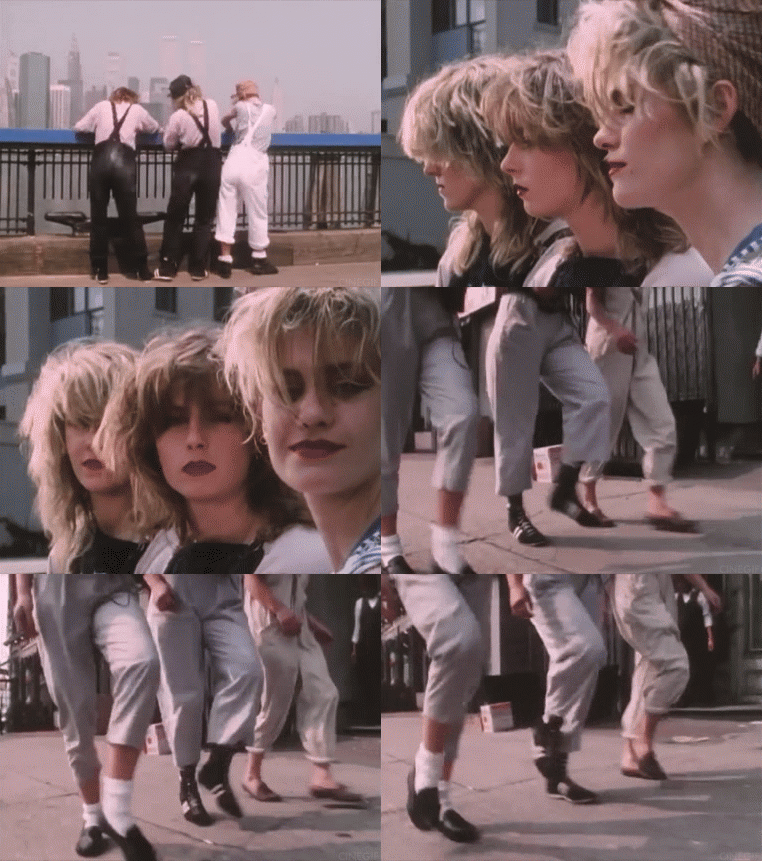
cinegif: Bananarama - Cruel Summer | 1983


cinegif:

Bananarama - Cruel Summer | 1983

08 Jul 13:30

Hills, rivers and rocky terrain: Why the Hill Country keeps flooding

by By Alejandra Martinez, Graphics by Edison Wu
When storms roll in, water rushes downhill fast, gaining speed and force as it moves — often with deadly results.
08 Jul 13:25

receptionist makes loud sound effects all the time, coworker is sticking me with all the weekend work, and more

by Ask a Manager

It’s five answers to five questions. Here we go…

1. My coworker makes loud sound effects all the time

At what point is something a legitimate distraction rather than a pet peeve? At my job we have an open concept office and only managers have offices while everyone else sits in the open space with little privacy, meaning everyone can hear everyone.

Our receptionist makes loud … sound effects all the time. For example, every yawn is a FULL BODY experience complete with a cartoonish exaggerated yawn/yell. When she gets frustrated that her computer is running slowly, she lets out a groan/whine. (I cannot think of a better way to describe this other than the sound little kid makes when they don’t get their way.) This is not constant by any means, but the yawn thing is several times a day and every time it sends my blood pressure rising.

Is this something that I can reasonably say something to her about? Often after a particularly loud yawn/yell, I will ask her if she is okay. Normally she will just say yes, she is okay, just tired. Is it too much to ask that bodily sounds be kept to a minimum? This seems not to bother others as much as it does me and miraculously doesn’t happen as much when the big bosses are around.

You could try: “I’m sorry to ask, but is there any way you can keep those noises down? I jump every time you do that.”

There was also this resolution from someone with a similar problem.

And a general PSA for everyone: if coworkers are asking if you’re okay whenever you make a particular noise and this happens repeatedly, there’s a good chance they’re hinting that they’d like you to stop.

2. My coworker decided to stick me with all our weekend event work

My coworker and I make up a two-person team that manages community programs for our county. Overall the job has a great work-life balance but over a 3-4 month season we have 5-6 weekend events with long hours. It’s pretty tiring but our boss gives us time off before or after these events to rest.

A few months ago, my coworker shared that she felt like the event work wasn’t being evenly split. I privately felt this was unfair, but I worked with her to make things more balanced. She also admitted that she was getting a lot of burn-out from an optional but job-related class. She had actually wanted us to take the class together but I said that it would be too much with the events.

A few days before our last event of the season, she told me she “didn’t want to do it” and that she wasn’t going to do long event hours anymore. Our supervisor, without involving me, told her that not working overtime at events was fine. At this event we had a miscommunication and she thought we would only be at the event on Saturday. The schedule ended up being a four-hour Saturday shift for her and I worked long days Friday/Saturday/Sunday.

As far as I know, she doesn’t have a disability or familial reason. She is capable but drained. We both have anxiety/mental health things so I want to be respectful, but I am also exhausted and becoming resentful. The job otherwise has great work-life balance, and I feel that the event schedule is a stressful but manageable part of the job.

I feel like she managed her time poorly with her optional class and didn’t prioritize the mandatory parts of the job. Plus, her expectation that we would only be at one day of a two-day event is, to me, a sub-standard job. I sense she feels she is setting up a boundary and I’m not respecting it and creating a bad work environment. But I feel abandoned and like she isn’t committed to the job, and that it’s disrespectful to think a few long event days is unreasonable in an otherwise good workplace.

How do I tell to my supervisor that it is unrealistic for my coworker to not work overtime for events? How do I tell my coworker that this isn’t an unreasonable schedule and I can’t do this by myself?

You shouldn’t be in a position of needing to convince or cajole your coworker to split the work evenly. Instead, you should talk with your boss and say you’re not able to take on more than your half of the weekend event hours, that the last event where your coworker worked four hours and you worked long hours three days in a row was exhausting and unsustainable, and it’s not something you can do going forward.

If you’re nervous about drawing that boundary, realize that it was apparently very easy for your coworker to make a much bigger demand and have it accepted!

It sounds like this might be less of an issue next season, if your coworker’s class is over — but either way it’s reasonable for you to raise it now and say this division of labor won’t work for you.

3. What is it appropriate for HR to tell emergency contacts?

Your column about the person whose coworker had a heart attack at work reminded me of an event at my workplace many, many years ago.

A coworker experienced a grand mal seizure at her desk, which was located in a row of desks in an open-plan space. The seizure lasted several minutes (someone had the foresight to time it) and she was unconscious for several minutes after. Of course, we called 911 and notified HR. HR notified her parents, who lived locally and were listed as her emergency contacts.

The coworker regained consciousness before the EMTs arrived, but she was disoriented and didn’t comprehend when the HR rep told her about the seizure and that her parents would meet her at the hospital.

Flash forward to later: she was livid that the company had contacted her parents. I think her rationale was that emergency contacts are supposed to be informed something is wrong and that they need to help, but it’s inappropriate to give the contacts medical information (in this case, the seizure).

She left the company shortly after. I don’t know why or what transpired with HR (rightfully so).

Was she correct that emergency contacts shouldn’t be advised of the nature of a medical incident? It seems unreasonable, but what does the law say? (We’re in the U.S., if that’s matters.)

U.S. law doesn’t prevent employers from sharing medical info with an emergency contact (unless the employer happens to be a health care provider, in which case HIPAA would likely be in effect — but HIPAA doesn’t apply to most non-health-care employers).

In many cases there’s no way to contact an emergency contact without explaining a bit about what’s going on. And really, just saying “she’s being taken to the hospital and you should meet her there” would be far more alarming in a lot of situations than just explaining the basics.

In general, people should assume that if they have an emergency at work and their emergency contact is contacted, info about what happened may be provided. If someone doesn’t want that, they need to say it explicitly at the time when they provide the contact info (“please do not release details about any medical situation to X; contact them only for ABC”).

4. Should I use one of my few personal days to travel for an interview when I might not get the job?

I have been interviewing for a position that is mostly remote but would require some travel to a central office a few times each year. My interviewers told me that they would like to bring finalists out to this location to meet the staff in person. I have very few personal days in my current position and don’t love the idea of using one (or maybe even two) of them to travel for an interview if I’m among a few finalists and there’s still a good chance I won’t actually get the position. I would only have 1-2 days left after that until next summer, which would make things difficult this coming year if I had to stay at my job.

At the same time, I don’t want to make it seem like I’m not as committed as other candidates, and I worry that even if the organization accommodated my position, they might still end up going with someone else just because of the merits of these in-person interactions. I will find out if I made it to this round in a couple of weeks and am feeling nervous about what to do if I am invited to continue. What do you think?

If you’re seriously interested in the position, you probably need to take the day(s) off to travel there. It’s still pretty common for employers to want to meet candidates, particularly finalists, in person before hiring them, and declining to do it is likely to put you at a disadvantage unless you’re already head-and-shoulders above the other finalists. That said, you could definitely ask for a date where you’d only need to take one day off rather than two (like by doing it on a Monday or a Friday so your travel day is on the weekend).

5. We’re supposed to complete our self-evaluations on our own time

Just got this notice from HR: “Annual reviews season is upon us! This is a friendly reminder to please complete your self-evaluation form in the Intranet on your own time by August 1.”

I’ve never been asked to do my self-eval off the clock in any other position. This is my first review season with this organization. The request to do this on my time gives me major ick.

If you’re non-exempt, this is illegal; they have to pay you for the time.

If you’re exempt and aren’t paid for overtime, there’s less of a distinction in terms of pay, but you could still ask your boss why you’re being told to do a work task on non-work time.

The post receptionist makes loud sound effects all the time, coworker is sticking me with all the weekend work, and more appeared first on Ask a Manager.

08 Jul 13:13

See aerial photos of the flooding aftermath in Kerr County

by Gabby Munoz
Search and rescue efforts are ongoing in the region.
08 Jul 13:12

How can the next disaster in flash flood alley be prevented?

by Raul Alonzo
The very qualities that draw people to the beautiful Texas Hill Country — rolling terrain, limestone formations and lazy rivers — also make the area deadly during heavy rainstorms.
08 Jul 13:11

Texas lawmakers failed to pass a bill to improve local disaster warning systems this year

by Raul Alonzo
A GOP state lawmaker who represents Kerr County says he likely would vote differently now on House Bill 13, which would have established a grant program for counties to build new emergency communication infrastructure.
08 Jul 13:11

Family credits luck, knowledge of area for safe escape from Texas Hill Country floods

by Laura Rice
David Beebe says his family’s home ended up being high enough to escape full damage from floodwaters – but says if they hadn’t known the area so well, they may have driven into danger.
08 Jul 13:11

‘Our hearts are broken’: Camp Mystic mourns loss of 27 campers and counselors

by Gabby Munoz
On its website on Monday morning, the camp also thanked the community, first responders and officials for support during "this unimaginable tragedy."
08 Jul 13:05

springbreak1984:

08 Jul 13:05

fuzzyghost:

08 Jul 13:05

Steve R. Dodd

kingsanda:

Steve R. Dodd

08 Jul 04:31

Texas lawmakers failed to pass a bill to improve local disaster warning systems this year

by Terri Langford, The Texas Tribune, Carlos Nogueras Ramos, The Texas Tribune
A GOP state lawmaker who represents Kerr County says he likely would vote differently now on House Bill 13, which would have established a grant program for counties to build new emergency communication infrastructure.