Library Director Roosevelt Weeks says there is no evidence that patrons’ personal data has been breached as part of the cyberattack, which the county became aware of in late February. During a special session on March 6, Fort Bend County commissioners approved more than $2.6 million in IT contracts under an agenda item titled "library update."
MAR-A-LAGO, FL – While steadfastly refusing to answer questions surrounding his ties to notorious sex criminal Jeffrey Epstein, U.S. President Donald Trump has reportedly considered releasing the DOJ’s Epstein Files anyway simply to satisfy his lifelong thirst to see his own name discussed in print media at any cost. “Sure, releasing these Epstein Files could […]
The city council updated the so-called “civility ordinance,” which prohibits sitting, lying down or placing personal possessions on sidewalks in 12 parts of the city from 7 a.m.-11 p.m. In downtown Houston and East Downtown, the rules will now apply 24/7.
Zine Fest Houston (ZFH) has announced an open call for its 2025 compilation zine, to be published in concert with its annual one-day festival on Saturday, November 15, 2025 from 12-6 p.m. at The Orange Show Center for Visionary Art.
Houston-area zine creators are invited to submit one 8.5-inch tall by 5.5-inch wide page or an 8.5-inch tall by 11-inch wide two-page spread for the black-and-white printed publication, on the theme “Cowboy/Western.” Zine makers who’ve tabled at any past Zine Fest Houston are also eligible to apply. Submissions are free, with a maximum of two pages.
To help develop zine-making skills, ZFH will offer three summer workshops at The Orange Show: Advanced Collage Techniques with Monae Jacobs on Saturday, July 12; Intro to Papermaking with Kira Lear on Saturday, July 26; and Intro to Screen Printing with J. Michael Stovall on Saturday, August 16. For more information and to register for the workshops, visit the education page on The Orange Show website.
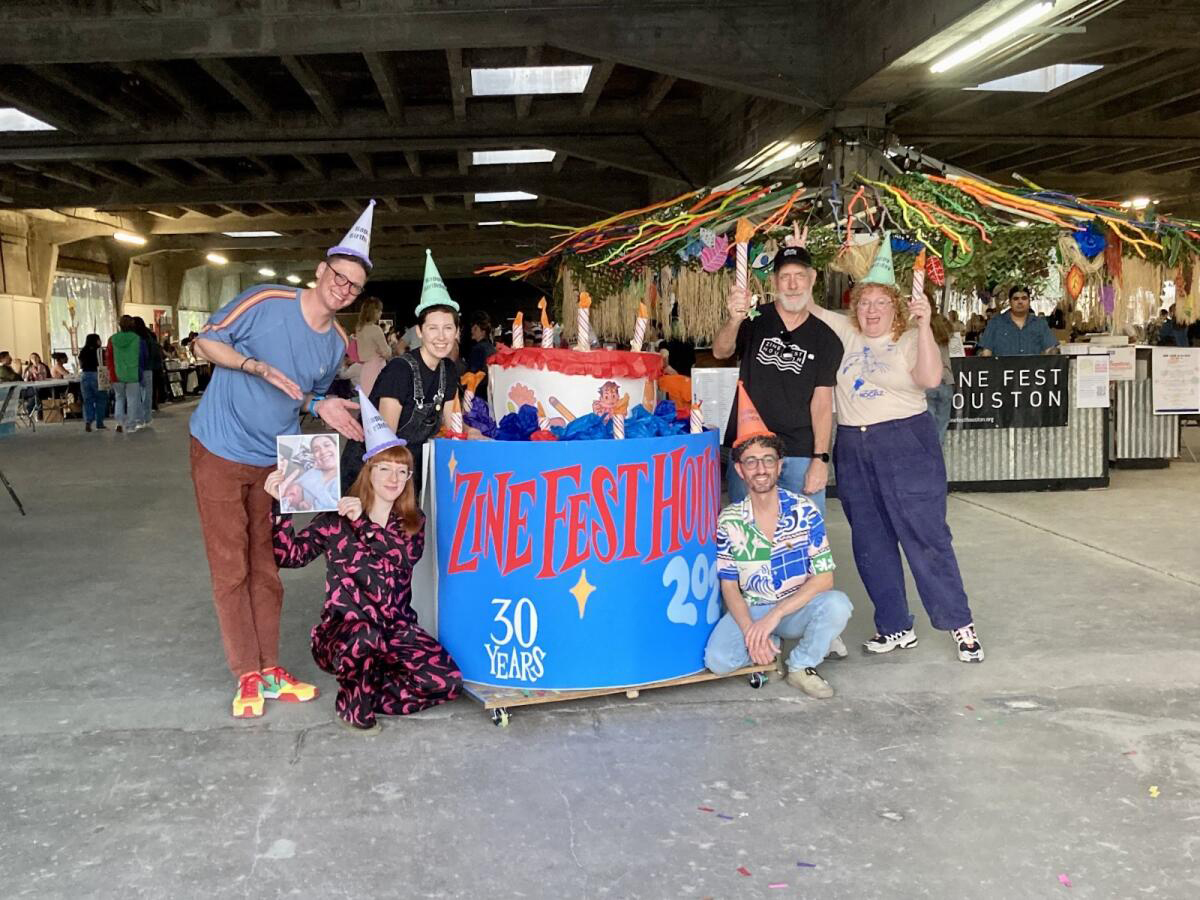
A photo from Zine Fest Houston’s 30th event, which happened in November 2023
ZFH annually provides low-cost table space to regional and national DIY publishers, which in past festivals have included Art Hoes, Daddy Issues Zine, Diary Of A Sista Grrrl, Houston Tenants Union, Peach Fuzz Magazine, Riso Riso, Xicana Vegan, Zines4Queers, and former Glasstire editor Bill Davenport.
In the spirit of the theme for 2025, ZFH organizers promise “the rootinest and tootinest self-publishing roundup this side of the Chisos Mountains,” and note in the open call announcement that information on an in-person event for the compilation zine release is forthcoming.
The deadline for submissions is Saturday, August 2. For more information on the compilation zine open call, visit the ZFH submissions page. For updates as further details on the festival are released, visit the ZFH website or follow the ZFH Instagram page.
I am a sensory seeker. I crave bold color, immersive environments, and visuals whose impressions leave riotous phosphenes dancing across my eyelids. So, of course, when I visited Feeling Color: Aubrey Williams and Frank Bowling at the Modern Art Museum of Fort Worth, I anticipated a treat.
It took a little searching to find the entrance to the exhibition, nestled toward the back of the permanent collection galleries on the first floor of the museum. A dreamy canvas by Frank Bowling, with chunky, gauzy, and poured paint textures in golden, rusty, and pastel hues, sets the tone for the show, which places Bowling’s and Aubrey Williams’ work in conversation with one another. Two artists are deeply connected — both from Guyana, both working in London in the late 20th century, and both investigating materials, abstraction, and sociopolitical realities through their own lenses.
Installation view of “Fred’stouch” by Frank Bowling in “Feeling Color” at the Modern Art Museum of Fort Worth
Ghostly renderings lure me toward two of Frank Bowling’s paintings. I see the continent of South America, the country of Guyana, and colonial structures, floating amid solid bars of red, yellow, black, and green mimicking the Guyanese and Pan-African flags. Bowling’s experimentation with symbolism, material, and application creates a sense of conflicted movement between space and culture.
It’s a smallish show, dense and vibrant. I find myself looping around and around, revisiting the paintings like a pollinator, looking for connections and divergences. The exhibition layout groups Bowling’s and Williams’ work in alternating galleries, maintaining aesthetic and conceptual separations between the artists and their paintings. While a stated goal of the show was to place the artists in conversation with one another, I would characterize their interactions as a series of alternating monologues.
Installation view of “Feeling Color” at the Modern Art Museum of Fort Worth
Aubrey Williams’ geometric and figurative explorations of Indigenous South American and Pre-Columbian cultures fill the largest space, incorporating elements of nature and spirituality through color and abstraction. I disappear into the radiant worlds.
Installation view of “Feeling Color” at the Modern Art Museum of Fort Worth
My eyes cross trying to keep the compositions from whirling off the canvases as circles turn to suns turn to feathers turn to eyes turn to flowers turn to gears and mysterious mechanisms. I drool over thick applications of paint over gossamer veils of color, creating a delicate batik-like dyed surface that pushes far, far away. Williams creates the push and pull of space, time, and culture as he manipulates the paint. These paintings are alive.
Aubrey Williams, “Moon Sign V (Olmec-Maya and Now” (detail), 1984, oil on canvas
Aubrey Williams, “Moon Sign V (Olmec-Maya and Now” (detail), 1984, oil on canvas
A few of Bowling’s large color field abstractions beg to be touched. For Zephyr radiates against its blue wall, where bands of soft, sheer color leave me transfixed. I, weirdly, salivate. I want to slice this painting up and eat it as a sweet, sour treat. Bowling’s careful application creates mini ecosystems through pouring, brushing, scraping, layering, and lifting. The paint speaks of change, controlled and accidental.
Frank Bowling, “For Zephyr,” on view at the Modern Art Museum of Fort Worth
Paintings from Aubrey Williams’ Shostakovich series visualize the power of music. Having grown up in a musical household, with a classical violinist mom, I’d been looking forward to seeing these paintings. I’d hoped for installed speakers to play selections of music, so that the sound and visuals could come together more seamlessly. However, I was at least pleased that the wall label for Symphony No. 11, opus 103 (Shostakovich) featured a QR code to listen to a performance of the titular composition.. Wishing for a bench, I stood listening on my phone and allowing my eyes to traverse the corresponding painting, following the otherworldly strings, the pounding of the timpani, the triumphant brass, the sublime mystery of the rests. In the painting as in the music, there is curiosity, conflict, victory, and the unknown.
Aubrey Williams, “Symphony No. 11, opus 103 (Shostakovich),” on view at the Modern Art Museum of Fort Worth
As a final surprise, I encounter an interactive space. In an unusual move for the Modern, I find a table with books and catalogues, a documentary film, and… a prompt for visitor engagement! As a museum educator who values play, interactivity, and opportunities for collective reflection, I was excited to read through layer upon layer of messages from previous visitors and contribute my own. The walls are filled with slips of paper featuring words and drawings addressing (or pointedly avoiding) the prompt:
Pick a color.
Any color.
Feel a Color.
Let it exist beyond sight.
Imagine its weight, its texture, its movement.
Draw how that color feels, what it does, not what it looks like.
Use your words or draw the feeling.
Installation view of an interactive space within “Feeling Color” at the Modern Art Museum of Fort Worth
Installation view of an interactive space within “Feeling Color” at the Modern Art Museum of Fort Worth
As I leave, sensorially sated, I ponder. What part does color truly play in my world, beyond the museum, beyond the studio? What stories, memories, or new ideas do I find embedded in the pigments, sounds, and environments of my life? Of many conclusions, one sticks with me: that color in my life is punctuation. Its presence, absence, hue, and saturation impact the tenor of my day-to-day movements and tint my reminiscences. A juicy pink is a sliced watermelon, the candy scent of Bullfrog sunscreen, and my Granny’s crackling cackle. A gaudy orange and teal dress is confidence and power. Memories of a long since dead loved one are a misty white grey, growing in opacity year over year. Exclamation points. Question marks. Ellipses.
Feeling Color: Aubrey Williams and Frank Bowling is on view at the Modern Art Museum of Fort Worth through July 27, 2025.
I’m 12 years into my career. Since I finished grad school about eight years ago, I really hit my stride and I’ve excelled in my career. I’m a high-performer, get promoted regularly, get positive feedback from both in and outside my companies, have a great network, regularly am contacted for new job opportunities, etc. My career aligns well with my strengths, and I’ve had comfortable, supportive environments to learn and work on what I perceive as my weaknesses.
In contrast, though, before finishing grad school, I had a few short-term jobs and internships where my performance and approach to work was very different. I never did a bad job or acted out of line — I was just solidly mediocre and needed a lot of feedback and direction. I always took the feedback seriously and ended all of these roles with positive remarks about how much I improved. Looking back, I can identify the reasons for my poor performance — these roles were ambiguous and somewhat unstructured, I lacked confidence and decisiveness, and I was afraid to ask for clarification, all with a side of undiagnosed/unmanaged ADHD.
I’m proud to have overcome these challenges, but I still cringe looking back. I’m in a different offshoot of our field now, but occasionally could cross paths with former colleagues from these jobs. For any other contact in my professional network, I feel confident about reaching out for collaboration, networking, freelance opportunities, or open positions, but for these contacts, I feel ashamed and want to avoid them at all costs.
This has been top of mind recently because one of these former colleagues just started a job at a company I’ve been eyeing for awhile. I’d love to reach out and see how she’s doing, learn more about the company from an insider, and throw my name out in case a job within my current specialty ever came up. But I worry she’d just remember my poor performance as an intern nine years ago, and not see all the growth I’ve had since then, and I’d have a worse shot at a job than if I just applied cold. If I do reach out, what’s the best way to acknowledge my past poor performance and current career success? In general, do people tend to remember intern performance and hold it against them later in their career?
Well, first, a lot of interns need a lot of feedback and direction! That’s the point of internships. It’s actually pretty rare to find an intern who doesn’t need that. The fact that you took feedback seriously, incorporated it into your work, and ended up with positive comments on how much you’d improved actually says you might have been a pretty good intern. Keep in mind that interns are judged against other interns, not against people with the amount of experience you got later. You might have done a fine, even good, job as an intern, within the context of what they were expecting!
Now, maybe there’s more to it than that. If you were regularly dropping balls, forgetting important things, not taking direction, etc. — then sure, maybe this really was poor performance. But I’d encourage you to look at interns you’ve worked with in more recent history (as your more experienced self) and reflect on whether people really were likely to have seen your work as disappointing.
For the sake of argument, though, let’s say you reflect on that and you’re confident that nope, you were pretty bad. A lot of the people from that job might not even remember that at all. Unless you were spectacularly bad (or spectacularly good), most people won’t remember the specifics about an intern’s performance a decade earlier. Some people might remember you being kind of … middling, but because the majority won’t, it’s still worth taking the shot.
Also, when you reach out, give them a brief rundown of your more recent career. When you’re contacting someone after so long, it always makes sense to catch them up on what you’ve been doing recently to put your request in a more current context … and in this case doing that has the bonus of illustrating that you have in fact turned into a responsible, productive member of the field.
If you find yourself walking down the street in the 1980s and you
see someone coming who prefers the VIC-20 to the Apple II, cross
to the other side of the street. (That said, the VIC-20 really was
revolutionary. It was by far the most affordable home computer
anyone had ever seen at that point. It was laughably underpowered
… but: it was only $300! They sold a million of ’em.)
I don’t want to get on the bad side of @gruber and @jsnell, but
when they say the Commodore 64 cost $600, that’s misleading. Yes,
it cost $600 when it was released, but its price dropped quickly.
By the time I bought one in late ’83 or early ’84, it was selling
for $200 at Kmart. To recognize that it was a great computer for
the price, you have to know what that price really was.
When I wrote the other day that the C64 cost $600, it didn’t jibe with my memory. But my thinking is too set in the ways of Apple, where a computer debuts at a price and then stays at that price. A price around $200 is more what I remember for the C64, at a time when a bare-bones IIe cost $1,400. Inflation-adjusted, $200 in 1984 is about $620 today, and $1,400 is about $4,300. That’s why so many more kids of my era got their parents to spring for a Commodore 64 but not an Apple II. They were rivals in some sense, but really, the Apple II was a different class of computer, and cost nearly an order of magnitude more. Inflation-adjusted, it’s very similar to the difference in both price and capabilities of the Meta Quest versus Vision Pro.
(Me, I didn’t own a computer until I went to college. My parents wouldn’t buy me one because they feared if they did, I’d never leave the house. I resented it at the time, but in hindsight, they might have been right. I didn’t fight too hard because we had an Atari 2600 and a generous budget for game cartridges. Plus, my grade school had a few Apple IIe’s (alongside a bunch of cheap TI-99/4A’s), and my middle/high school had an entire lab of Apple IIe’s and IIc’s.)
Hungary’s 1,000‑year‑old Pannonhalma Archabbey is scrambling to disinfect and preserve tens of thousands of historic books from a destructive beetle infestation that could wipe out centuries of history. What do you think?
“What books did they eat? I’m looking for recommendations.”
Elliott Wege, Remote Programmer
“I have a bunch of old Nora Roberts books I’m trying to unload, if the beetles are interested.”
In brief: In today’s post we take a quick temperature check on TikTok, which seems hot and bothered about the possibility of a hurricane hitting Houston. In the real world, we discuss the forecast for the week ahead, which includes an elevated chance of rain on Friday from a tropical disturbance that is almost certainly going to move into Louisiana.
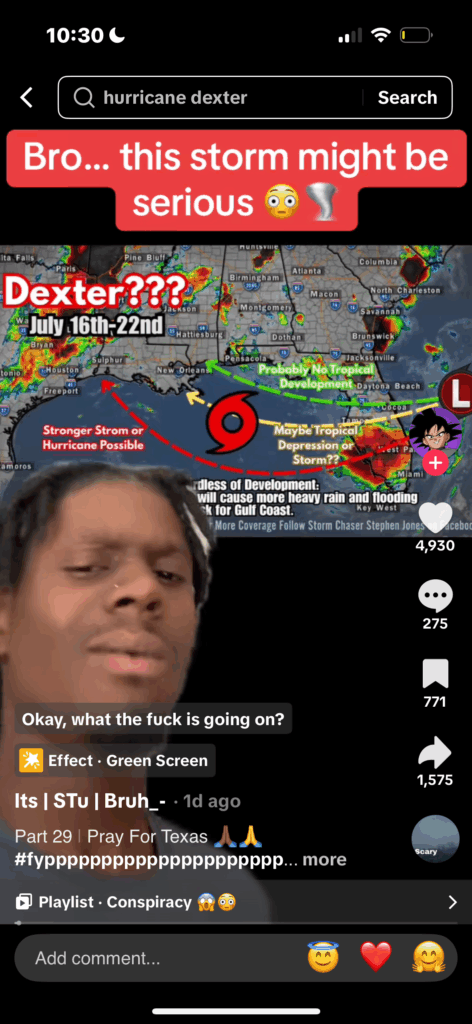
The TikTok hurricane
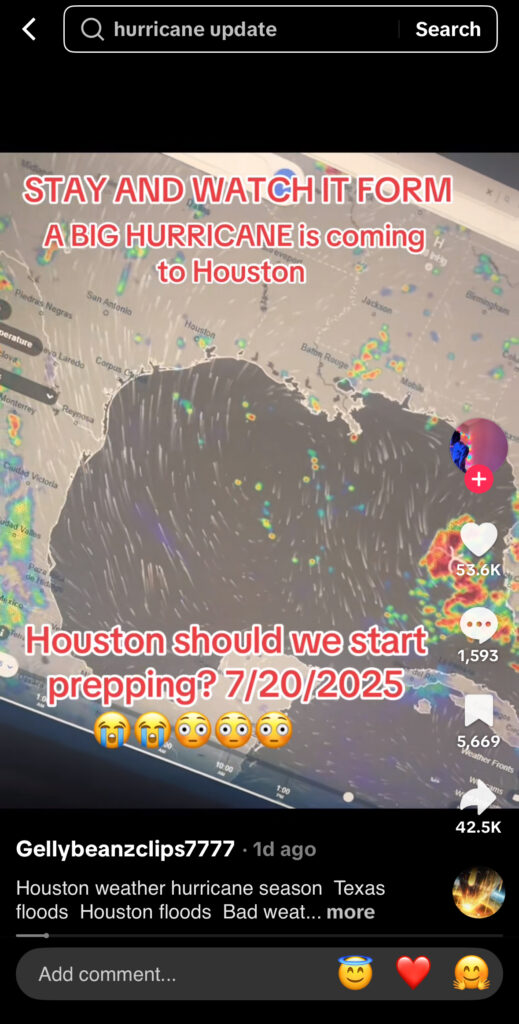
On Tuesday evening one of my daughters said “everyone” on TikTok is talking about a hurricane coming to Houston this weekend. At first, I thought it must be a few pot-stirrers, because nothing could be further from the truth. Why? Because:
a) There is no hurricane
b) A tropical system that probably won’t develop much is probably not coming to Texas
c) There is no credible basis on which to make such a forecast right now, like none
So we sat down and she showed me some of the videos. (Full disclosure, I just turned 52 years old, and I have only dabbled on TikTok. It’s just not my thing. If it’s yours, that is totally fine. I am not shaming anyone who likes TikTok or creates content there). I was blown away. The amount of misinformation is staggering, and these videos are being watched 100,000s of thousands of times, with this huge influential reach. It was to the point where my daughter was seriously concerned about the possibility of a hurricane coming to Houston, and asked me what we should do about it.
TikTok on Tuesday evening.
I have no desire to try and take on the Chinese government or ByteDance and its algorithm. I realize that misinformation is rampant across social media, not just TikTok, and that people are knowingly and unknowingly spreading it for various reasons. But it frustrates me because this kind of content spreads anxiety, which for some people is crippling; and the inevitable false alarms will only sow doubt and uncertainty when the time comes to take real forecasts seriously.
So with this post I just wanted to reiterate that Space City Weather will never play these games. We are not chasing clout. We aspire, above all things, to be boring and have boring weather to write about. We also acknowledge that we are far from perfect. We will make mistakes in our effort to predict the future, but they are honest mistakes and believe me, Matt and I agonize over them. In short, we are always going to try and bring you the truth about the weather as we see it. In 2025, that mission seems to be more vital than ever. So we fight on. We will do our utmost. I fear it will not be enough.
Wednesday
As pressures rise and atmospheric moisture levels fall, today should be mostly sunny in Houston with virtually no chance of rain. Instead it’s going to be a classic mid-July day with plenty of humidity, and high temperatures in the mid-90s. Winds will be light, from the south at 5 to 10 mph with slightly gusty conditions during the afternoon hours. Lows tonight will drop into the upper 70s.
Thursday
A day similar to Wednesday, although there is a slight chance of afternoon showers and thunderstorms along the sea breeze. Chances are 10 to 20 percent.
Friday
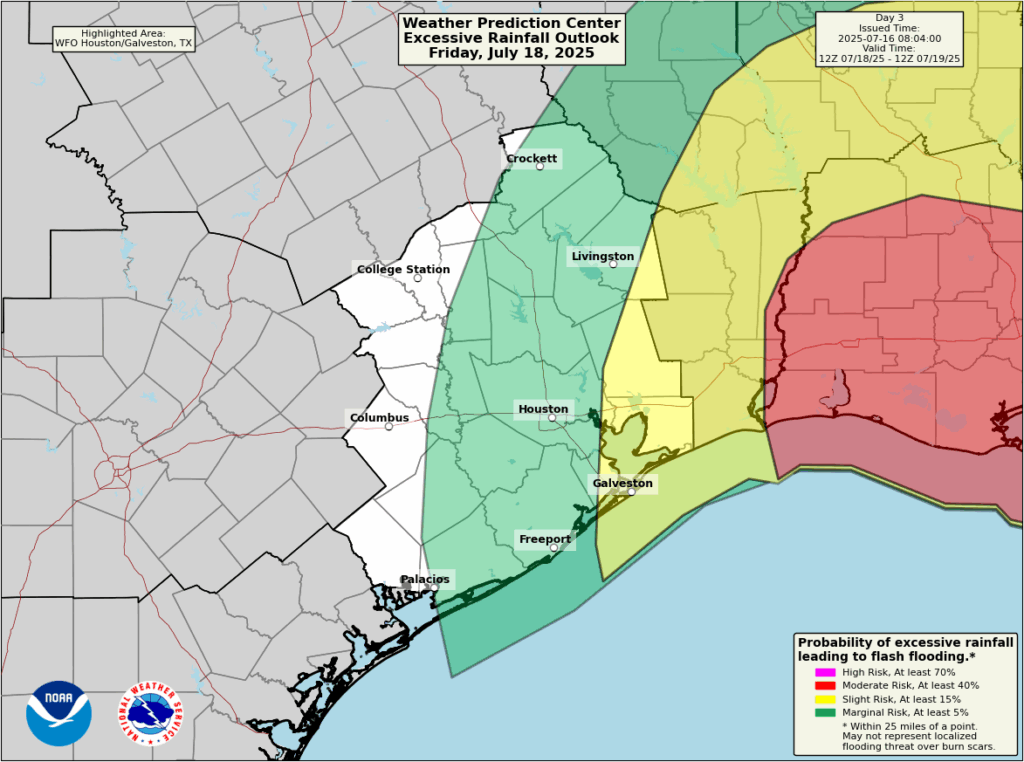
An increase in atmospheric moisture, related to the tropical disturbance in the Gulf, will bring a better chance of rain on Friday. These rains should be concentrated most heavily over Louisiana, and there is likely to be sharp gradient to the west approaching Houston. That is to say, there will be a line west of which rain is unlikely. Where will that line be? Interstate 45 is a decent guess, but the line could also be closer to Beaumont. The map below shows the best guess from NOAA’s Weather Prediction Center. My sense is that areas along and east of Interstate 45 have a decent chance to pick up 0.5 to 1 inch of rain on Friday, with lesser amounts to the west. But this forecast is very much written in pencil right now. Any winds and surge from the tropical system should not be impactful in the greater Houston region. Expect highs of around 90 degrees with mostly cloudy skies.
Prediction for where excessive rainfall is most likely on Friday. (NOAA)
Saturday and Sunday
A decent chance of showers will linger into Saturday, perhaps about 40 percent, but this day should bring partly sunny skies back into the forecast with highs in the lower 90s. By Sunday high pressure should be taking hold, so rain chances should reach closer to zero, with mostly sunny skies and high temperatures in the mid-90s.
Next week
Most of next week looks hot and sunny, with highs in the mid- to upper-90s. Rain chances will be quite low for much of the week, although the upper air pattern could change toward the end of the week to bring precipitation back into the forecast. We shall see.
Invest 93L
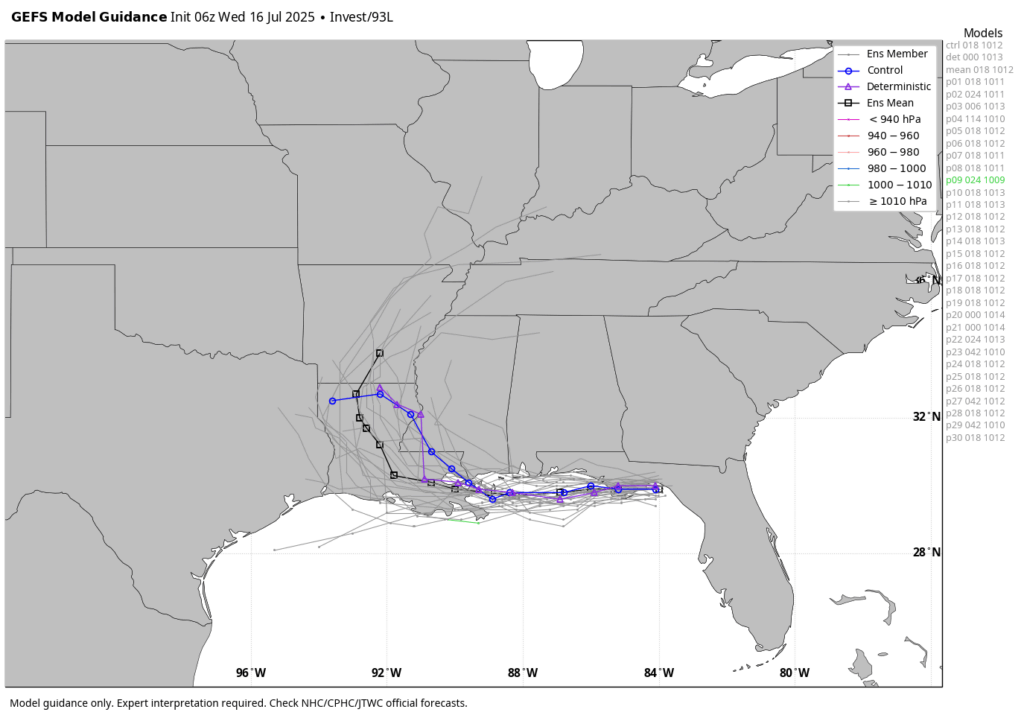
So what really is happening with the tropical system? Not a whole lot. The ‘center’ has crossed the Florida peninsula, but it remains close to the Florida Panhandle this morning. This proximity to land will not help with any efforts to develop. Over the next day or so the center should remain very close to the northern Gulf coast, limiting development. There is a non-zero chance that some sort of center organizes further south today, and this would allow for more strengthening. However that appears fairly unlikely. Probably, the low pressure system will continue to track more or less west before moving into Louisiana on Thursday night or Friday, bringing an high chance of rain. The National Hurricane Center continues to indicate there is a 40 percent chance of a tropical depression or weak tropical storm forming before landfall.
Some of the models that were advertising extreme rainfall totals in southern Louisiana have backed off some. However, this is still a favorable setup for heavy rainfall so flooding along and south of Interstate 10 in Louisiana is a distinct possibility.
There is good agreement among the GFS model ensembles about what Invest 93L will do. (Weather Bell)
As ever with tropical systems there is inherent unpredictability, especially with systems that have yet to develop a well-defined center of circulation. But time is running out for Invest 93L to surprise us.
It’s the first time Operation Border Health has canceled in 26 years. More than 6,600 people received check-ups, dental services, diabetes screenings and more last year.
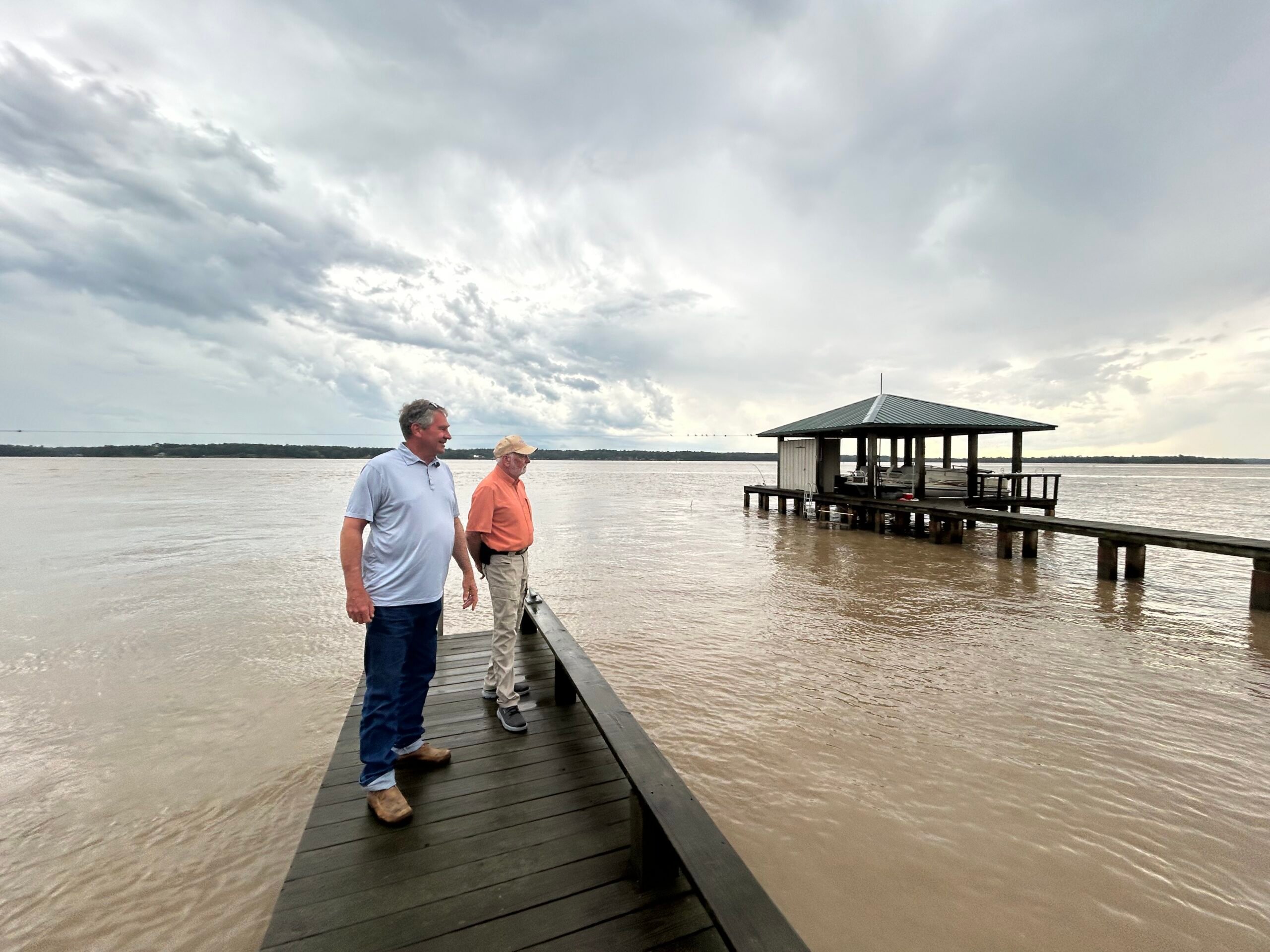
Houstonian Mike Peppercorn bought property along Lake Livingston in 2008, choosing timberland where his family would have privacy and pasture where they could raise cattle for Future Farmers of America projects. He and his neighbors with acreage along Barrett’s Landing Road all figured that surely this lake—which serves as a reservoir for the City of Houston 80 miles south—was an invaluable public resource that would forever be protected.
That seemed like a safe bet. Lake Livingston, an enormous impoundment of the Trinity River created in 1971, is surrounded by retirement homes, ranchettes, and sprawling RV parks. Part of its shoreline is a popular 635-acre state park, and its waters, stocked with bass, crappie, and catfish, are favored by Texas anglers for fishing tournaments. The reservoir, the largest located entirely in Texas, is owned by the Trinity River Authority and is a major source of Houstonians’ drinking water.
So it shocked Peppercorn and his neighbors Karl Van Brocklin, a retired engineer, and Randy and Ginny Lammers when energy giant Entergy Texas Inc. proposed building a high-powered electrical transmission line, up to 160 miles long, that would run right through their properties and the lake itself.
One of Entergy’s favored pathways for the project, dubbed the SETEX Area Reliability Route, would cut across about a mile of the reservoir. And yet Entergy, records show, didn’t ever bother to inform the City of Houston—which gets about 70 percent of the water produced by the reservoir—about its proposed lake routes.
Lammers, Peppercorn, and Van Brocklin, all former Houstonians who regularly gather to share research in a barn-like workshop on Lammers’ property, worry about much more than the impact of unsightly poles and power lines on birds and on the people who live, boat, and fish here. They fear that its construction could unleash toxic threats buried in the lake’s sediment that could poison the fish and impair water quality for Houston residents—and for everyone downstream.
“All of these routes are 100 miles long. Going across the lake is one mile. For the safety of everybody’s drinking water, why go across the water?” Peppercorn said in an interview with the Texas Observer.
Until this small group reached out to Randy Macchi, director of Houston Public Works, city officials knew nothing about it. Entergy’s plans call for erecting a variety of steel structures that, if one of the lake routes is chosen, would be anchored to pilings and stand at least 75 and as much as 195 feet tall above the water and could create a mile-long path of obstacles between 125 and 250 feet wide.
After being informed by the Barrett’s Landing bunch, Macchi dispatched a letter of opposition expressing concerns that any route across the lake could adversely impact the city’s water supply. “The construction of powerlines across Lake Livingston could create many undesirable scenarios; none of which are in the best interest of HPW’s customers or the customers of other entities,” he wrote.
But the city’s letter of opposition arrived too late to be considered. Macchi, who did not respond to the Observer’s request for comment, told KPRC he’s outraged that the utility’s failure to inform city officials shut them out. “There’s a regulatory process, and Entergy notified a lot of entities. … The City of Houston was not one of them. And that’s troubling—because this isn’t just a lake; it’s our most critical water source.”
Neighbors Mike Peppercorn (left) and Randy Lammers fear that a proposed electrical line project that may cross Lake Livingston—and their neighborhood—could stir up contaminated sediment. (Photo by Lise Olsen)
The contested project, part of Entergy’s plans to improve the grid that connects Entergy’s power plant in Willis with several counties in East Texas, is now under review by an administrative law judge at the State Office of Administrative Hearings. By August, the judge is expected to make a recommendation on the project to the Texas Public Utility Commission. But a look at the growing number of opponents to Entergy’s proposed Lake Livingston routes shows that Entergy thus far has done little to determine how the lake’s ecosystem might be affected by the construction or by the power line itself.
In the Texas Parks and Wildlife Department’s comment, the agency’s wildlife division director Alan Cain remarked that the company had done insufficient work to determine the impact on “important rare or protected species and their associated habitats”—including alligator snapping turtles and other creatures that live in or near the reservoir—along the more than 100-mile route proposal. The letter doesn’t specifically mention the Livingston reservoir.
Lake Livingston may look pristine. Indeed, park officials boast that its shoreline is home to multiple nesting pairs of Bald Eagles. Trinity Water Authority officials like to brag that big strides have been made to improve the quality of the river’s sometimes turbid water since the passage of the Clean Water Act in 1972.
But this huge reservoir’s waters are still troubled. Since 2017, it has been listed by the Texas Commission on Environmental Quality (TCEQ) as an impaired body of water—contaminated by cancer-causing dioxins and PCBs. In other words, it’s one of the lakes and rivers that the state has designated as needing more protection and clean-up to fully comply with the lofty aims of the Clean Water Act. In 2017, the TCEQ did a limited amount of testing of sediment in the lakebed, probing four sites for toxics, but those samples are miles away from the proposed route, according to a report posted online.
For even longer, an underfunded Texas fish-testing program has documented that some of this lake’s gar and even its prized catfish and bass are essentially too dangerous to be regularly eaten by anyone because of those same carcinogenic contaminants.
Though Lake Livingston and other East Texas lakes along the Trinity River continue to be popular for anglers, the state health department has issued periodic advisories warning children and women of child-bearing age not to eat the gar, bass, or catfish—and for all others to limit consumption. Surprisingly, Cain, the Texas Parks and Wildlife official who reviewed the proposed pipeline routes, doesn’t mention Lake Livingston or the fish studies that the park service has conducted there over the years.
The source of the poisons found in those fish is believed to be contaminated sediment in the bed of the lake—sediment that’s already frequently disturbed by floods and hurricanes but would be stirred up by the process of excavation and construction of those enormous metal towers and high-powered lines.
Entergy has also failed to consider that Lake Livingston is used for “recreational purposes”—despite the ubiquitous presence of fishermen, boaters, and campers, according to documents filed by the Trinity River Authority (TRA). Attorneys representing the TRA, which opposes the route through the lake and favors alternatives, have objected that there was “no discussion of recreational uses of Lake Livingston itself and no discussion of boating or potential public safety hazards that would be created.” (The TRA did not immediately respond to the Observer’s request for comment).
For its part, Entergy insisted in a statement released to KPRC that “we are committed to transparency and continue to fully participate in the regulatory review process, which includes opportunities for public input and review of all routes under consideration.”
The utility company’s statement adds it’s “also committed to complying with all federal and state environmental regulations, including any permitting requirements under the Clean Water Act. While route evaluation is ongoing and no final decision has been made, each proposed route—including lake and land crossings—is being thoroughly assessed based on a number of factors, including environmental impact, community input, engineering feasibility, and long-term reliability for our customers.”
Peppercorn argues that Texans who fish, live, and ultimately drink this water deserve more answers before the PUC approves construction through this large reservoir and popular recreation area. He and his neighbors argue that any other route would be better.
“We want a study on the water,” he told the Observer. “There’s a lot of people who pull water on the Trinity River and on Lake Livingston—and not all of them have the sophistication of the City of Houston. …Why not do the right things?”
ST. PAUL, MN—In a comprehensive new survey of how the wealthy view their socioeconomic status, a study published this week in the Journal Of Economic Perspectives found that the majority of billionaires consider themselves to be middle class.
The study—which collected responses from 865 of the richest Americans, including Jeff Bezos, Mark Zuckerberg, Elon Musk, Alice Walton, and Michael Bloomberg—reports that 70% of individuals with $1 billion or more in assets said they belong to moderate-income households. Of those, around a third acknowledged that as a result of their hard work, they may now be doing well enough to qualify as upper middle class.
“The billionaires we surveyed spoke a great deal of the challenges they face just keeping up with all their bills,” said study co-author Simon Mendoza, who observed that while economic data suggests the wealthiest 0.0001% are doing better now than at any point in U.S. history, most do not feel this is reflected in their personal experience. “Many described themselves as simple small business owners who, for example, are often forced to lay off hundreds or even thousands of employees just to keep the lights on in all their vacation homes.”
He added, “Others cited structural disadvantages, such as supply constraints that continue to squeeze some billionaires out of private island ownership.”
Among the typical middle-class concerns shared by those who participated in the study was the increasing cost of putting kids through college. Many billionaires complained that a donation of a few million dollars was no longer sufficient to guarantee acceptance to elite universities, which now expect parents to subsidize a new research facility, performing arts center, or library before agreeing to admit their academically unqualified children.
Billionaires who perceived themselves as middle class also expressed anger over healthcare expenses, lamenting in particular the skyrocketing price of on-call concierge physicians, routine full-body MRIs, anti-aging stem-cell therapies, jawline surgery, and continuous infusions of blood from a healthy young person.
“A million dollars doesn’t go as far as it used to, that’s for sure,” said survey respondent and candy magnate John Mars, 89, who told researchers that, despite working his entire life to inherit a fortune now worth more than $40 billion, he worried about what he would leave behind for his own children. “The cost of lobbying members of Congress so I can avoid paying taxes has gone through the roof. And elections are getting more expensive all the time. I spent the best years of my life trying to repeal the estate tax, and I still have nothing to show for it.”
“Like most Americans, I’d prefer to leave this world knowing I provided each of my kids with an 11-figure inheritance,” Mars continued. “Unfortunately, that dream may be out of reach for me.”
Inflation, one of the biggest worries facing the middle class, was mentioned frequently by the study’s billionaire participants.
“Have you gone to a chain supermarket lately and seen how expensive it is to buy a controlling stake in the place?” said Jeff Bezos, who purchased Whole Foods when he was CEO of Amazon and, in his survey response, described his struggles living dividend check to dividend check. “With the economy like this, you have to ask yourself if you should be opening up your own Michelin-starred restaurant downtown or eating more meals at home cooked by private chefs.”
“Lucky for me, I’m just an ordinary guy with pretty basic tastes,” Bezos added. “Hell, I still drive the same old limited-edition Lambor-ghini Veneno Roadster I bought for $5 million back in 2014!”
Like every parent, I want my kids to be safe. I know that for my young daughter and son to grow and thrive, they need to feel secure in their surroundings. But with the way people coddle their children these days, I fear we’re raising a generation that won’t be able to handle life’s basic challenges. So when my kids face tough situations, like getting shot at, I try not to shelter them too much. I realize if I take a bullet for them, they may never learn to take bullets themselves.
When my second-grader’s shoe comes untied, or my kindergartner’s coat needs zipping, I don’t immediately kneel down and do it for them. They’re old enough to manage these things on their own, and though they may get frustrated at times, it’s a necessary lesson in personal responsibility. Same deal when shots are fired. I could throw myself in front of them the moment someone starts shooting in their direction, but then I’m not exactly preparing them for life, am I?
Obviously, I wouldn’t be doing my kids any favors if I sent them out into the world not knowing how to sustain a gunshot wound to the chest.
Sometimes it’s your job as a parent to stand back and say, “You got this, buddy!” Whether your child is learning to ride a bike, heading off to camp for the first time, or bleeding out because multiple shots have perforated their torso, it can be hard to watch them struggle. After all, there may be a few tears! But before you know it, they’re figuring out how to balance on two wheels, make new friends, or tear their shirt into strips to stanch the flow of blood until paramedics arrive.
Unfortunately, today’s helicopter parents have other ideas, hovering overhead and swooping in the moment their child faces adversity. You know the type— they intervene any time their kid has an argument with a friend, gets a bad grade, or doesn’t make a sports team. Well, they do the same thing in an active-shooter situation. Believe it or not, some parents will literally throw themselves on top of an armed assailant to ensure their child doesn’t take a single stray bullet.
I can understand their impulse, but kids need to develop self- reliance. Sometimes that means being stern and making them find their own cover when a shooter opens fire in a public space.
Back when I was growing up, parents still believed in a crazy little thing called tough love. I might scream and holler and cry for help, but that didn’t mean my mom and dad charged to the rescue every time I procrastinated on a science project or forgot to bring my coat to school. It can be a challenge, taking shots from a powerful rifle, but it’s also an experience that builds character in young people, assuming they are able to recover from the blood loss.
Surely nothing is more impor-tant for children to learn than how to get back up after life knocks them down in a hail of gunfire.
Someday my kids will be adults. They’ll go off to college and get shot, they’ll join the workforce and get shot. I won’t be there to hold their hand through the many rounds of ammunition the world fires their way. If I crouch with them under a table every time a deranged gunman storms into Baskin-Robbins, I will have failed as a father. They’ll grow up expecting someone to step in and actually do something to stop them from being torn to pieces by an AR-15.
This house is ideal, apart from one bedroom having a full-size Skee-Ball machine in it. We don’t know how they got it in there. Did they assemble it inside? Was the house built around it? We can’t figure it out.
Marlene Audney, 83, finally found an opportunity to slip away quietly Monday when her daughter briefly left her hospice room to fetch a snack from the vending machine.
1. My manager disclosed medical information about my child to my coworker
I’m in the healthcare field, and my role necessitates adhering to confidentiality with clients. In a moment of vulnerability, and as a way to explain an increase in requests for time off, I told my supervisor about a diagnosis my son had just received (I work in pediatrics and my son was diagnosed with a condition we treat at my facility). I explicitly said that I did not intend to tell my immediate colleagues and her response was, “Yes, don’t tell them.”
Days later, she — to my shock — disclosed to me that a colleague was miscarrying. She prefaced this with, “I don’t want you to think that because I am telling you this, that I’m about to spread your business.” I, of course, immediately started to worry that she would.
Fast forward about six months, and I have been feeling more and more queasy about her disclosure of my colleague’s miscarriage. I asked a third colleague whether our supervisor had ever shared personal information about me, and she confirmed that, less than a week after telling me she wouldn’t “spread my business,” our supervisor told my third colleague about my son’s diagnosis.
I’m feeling very frustrated and betrayed, and I’m not sure how to evaluate what next steps to take. Do I report to HR, and risk her being fired (I work with the person who would be promoted into her role, and she is equally toxic)? Do I talk to her directly (though I’m not sure what I would ask for? An apology? A new supervisor?), and risk her retaliating against the coworker who answered me when I asked whether this information was shared? I’m looking for new jobs, but I love my work and the broader team. I’d love to stay, but I’d prefer a competent manager, who doesn’t gossip!
At a minimum you could talk to your manager and ask why she shared your child’s personal medical information after explicitly assuring you that she wouldn’t. You don’t need to be asking for any particular outcome to do that; you’d simply be putting her on notice that when she violates people’s confidentiality, they may find out about it and be unhappy — a useful lesson for her to learn. It won’t necessarily change her behavior (although it should!) but you’re entitled to have that conversation.
It’s also something that would be very reasonable to report to HR, particularly given that confidentiality around medical info is a very big deal in your field! It’s very unlikely that reporting this to HR will result in your boss being fired, unless there have been previous complaints and she was already on thin ice. Typically in a situation like this the person gets warned (and ideally re-trained on confidentiality), not fired.
But if your goal is to get a competent manager, it doesn’t sound like that’s likely to happen at the moment.
2. How to tell coworkers I don’t work for free
I’m a teacher in the adult education sector (not in America). Paid admin hours are calculated based on teaching hours and range from 0-6. As with most teaching jobs, there’s way more admin than you can do in your paid admin time.
My position is: I’m not a volunteer. My employer is not a charity. I don’t work for free. I’m working 5-10 teaching hours a week, so I get 0-1 hour of paid admin. I get my admin done in class time while the students are occupied and I walk out the door on time.
I’m surrounded by martyrs who stay later or take work home, etc. (It’s 99% women and quite a few see teaching as a “vocation” and not a job). I have tried to explain that they’re doing themselves (and their coworkers) no favors by not pushing back. All they’re doing is teaching the powers-that-be that all the work somehow magically gets done, so why not pile on more? Why hire any more staff? It’s like talking to the wall. (Mind you, it doesn’t stop them constantly whinging about the workload!)
So I can’t persuade them, but I am being strict about leaving on time and not working at home myself. But, come the end of the term, I get, “Oh, can you just do this or that?” I’ll say, “No because I don’t have any admin hours.” They say, “Oh, but we’re all working extra hours.” Can you suggest a polite way of saying, “Well, you shouldn’t be, but if you won’t stand up for yourselves, that’s not my fault. See ya”?
“I feel strongly that sticking to our paid hours is in the best interests of the students, since otherwise the administration can’t allocate resources correctly.”
The potential weakness of that response is that it frames it as about the best interests of the students rather than about teachers deserving to be paid for their work (which is ultimately the point I think you want to make), but that’s arguably a strength too, since it makes it harder for people to argue. Either way, it’s a reasonable explanation.
3. Should I always answer emails to confirm appointments?
I am almost done with grad school and in the process of looking for internships and considering jobs. I don’t have any experience of working in an office, so I have question concerning emails: do you always answer an email to confirm meetings, appointments, and short suggestions?
For example, I was invited to an interview and asked for my availability. I responded with multiple options and have now received a confirmation for one of those options. Do I reply back to acknowledge that I have seen the email and that the appointment time still works for me? And do I include the people that were cc’d? The whole exchange happened within two days so nothing has changed about my availability. I don’t want to unnecessarily flood people’s inboxes and I have a hard time writing a one-sentence confirmation email that still looks polished, but if people generally expect a reply in these situations it may look like I haven’t seen the invitation.
Are there different norms for this when you’re applying for jobs and when you already work somewhere (and perhaps have build up the reputation that you don’t miss emails)? Have I been ignoring my professors by not emailing them a quick “thank you” after every short question I’ve sent? Maybe I’m just not yet used to email being a medium through which entire conversations are held!
Yes, you should answer emails confirming appointments to close the loop on your end. You offer a range of times, they pick one, and then you confirm on your end with something like, “Great, I’ll plan to talk with you at 2 pm ET on the 30th. Looking forward to it.” If you don’t do that, some people won’t notice but others will and will wonder whether the call is confirmed or not, so closing the loop that way is more polished and professional. You don’t need to include the people who were cc’d, but generally you should. If they don’t want their inboxes flooded with that kind of thing, they’ll ask the person who initially cc’d them to stop including them; you don’t need to worry about it on your end.
The rules aren’t as concrete for non-appointment-setting emails. You don’t need to send a quick “thank you” for absolutely every response you receive, but when you’re in doubt you should. It gets less necessary when you’re emailing with someone multiple times a week; it’s more necessary when you don’t talk to them that much. Think of it as letting them know their info made it to you and was appreciated and that now the interaction is complete. (You do not need to do this with many group emails, though.)
4. Should I drop out of this interview process because of how they’re handling travel?
You actually answered my question about 11ish years ago about applying for a job and not initially being picked as a finalist but then being asked to interview since someone had dropped out. I wasn’t sure if it would be worth it to go and you said: “Of course it is! This happens all the time!” So I went to that interview, was hired, and have been in that job since (and absolutely love it, btw).
I am always looking for opportunities to grow in my career even though I am very comfortable where I am. So, I applied for a director level position at an organization located several states away. I have interviewed a few times in the last few years and have always worked with a recruiting company who had me book my travel arrangements and they reimbursed me. This org apparently has a travel agent on staff who is doing all the travel arrangements. When they initially contacted me a few weeks ago to ask if I wanted to interview, they connected me with the admin who would be getting me my travel information.
We are now less than two weeks from the interview and, while they confirmed my name and birth date and other info for the plane tickets and flight times, I have not received any confirmation of my flight or any details on how to get my tickets/boarding pass (the confirmation they sent was a screenshot of them booking the flight). They also have not sent any hotel confirmation and, when I asked, she said the hotel was booked and gave me the name of it but said she was still waiting on a confirmation. They also said they weren’t sure I would get a rental car, which seems odd since the org has several different facilities that I would typically want to visit. They also only have me in that city for about 24 hours, which is not enough time for me to really get a feel for the area or know if I want to move there.
I’m at the point where I don’t even think it’s worth my time to interview. I’ve found the process disconcerting and have become very unsure if this is a place I even want to work, but I’m concerned they’ve already booked my flight and dropping out now would look bad on my part. Do you think I should just suck it up and go through with the interview even though I most likely will say no or do you think I should save everybody’s time and just email them now that all this disorganization and back and forth about travel has made me change my mind about interviewing? Am I way off-base that not having my travel information confirmed less than two weeks before my interview is kind of wild?
Yes, you are off-base! You are reading way too much into pretty normal stuff. You’re still nearly two weeks away from the interview; there’s plenty of time for them to get you final details (particularly since they’ve already booked the flight and confirmed the times). When you’re one week out, contact the person again and ask if she can forward you the remaining info so that you’re ready to go.
As for the rental car, unless it’s standard in your field for candidates to visit all the facilities in the area, I wouldn’t assume they know you’d like to do that (or even that they are planning to coordinate that). You can ask about it, but it might not be something they do, or do at this early stage.
If you’d like to spend more than 24 hours in the area to get a better sense of whether it’s somewhere you’d consider moving, you can ask for that. A lot of candidates want to get home as quickly as possible, especially after a first interview (as opposed to a meeting later in the process), but you can speak up and say, “Since this would be a relocation, would it be possible to extend the stay by an extra night so I can check out the area?” It’s probably not realistic to ask them to cover the hotel for longer than that for a first interview (when they haven’t decided you’re a finalist yet), but there’s nothing wrong with asking for an extra night.
Do not cancel an interview over any of this! (It’s interesting how similar this is to your question 11 years ago, when you were also ready to drop out but ended up being glad you didn’t!)
5. Motion sickness and work travel via bus
I’m pretty new to my company (about six months) and am invited to a training session at our secondary site, about three hours away. There is a shuttle bus that goes between the sites. Here’s the thing — I get extremely motion sick, especially on buses. I even wear sea sickness bands on airplanes. I’ve tried motion sickness pills, which can help, but they make me tired; we are traveling the morning of, so I don’t want to be tired for the training. Additionally, I live about an hour from where I work, and not on the way to the secondary site.
Can I ask to drive myself, and how do I ask my boss? The company preference when driving is to get a rental car.
Yes! Say this to your boss: “I get extremely motion sick, and it’s worst on buses. Could I plan to drive myself?” You don’t need to get into the motion sickness pills making you tired, etc. Just state the situation and what you need. (If you’d be up for taking others with you, you could offer that too, but you don’t need to.) If they want you to get a rental car to do it, they can let you know that.
Stratford, England – Shakespeare Birthplace Trust archivists today announced their discovery of a lost Shakespeare folio for a play entitled “Dracula vs. Frankenstein.” Natasha Cartwright, a Cambridge University scholar of Shakespeare’s later works, was shocked by the discovery. “We all know that Shakespeare is credited with the invention of hundreds of words, but to think […]
Three worrying foes there at the top, feel free to pick your favourite. We’ve seen Swamp King before, of course. Perhaps we will learn more about the others in time.






/https://static.texastribune.org/media/files/0e718f655a8cb5d4f5f54fe470992947/McAllen%20File%20JG%20TT%2004.jpg)