It’s the first time Operation Border Health has canceled in 26 years. More than 6,600 people received check-ups, dental services, diabetes screenings and more last year.
1. My manager disclosed medical information about my child to my coworker
I’m in the healthcare field, and my role necessitates adhering to confidentiality with clients. In a moment of vulnerability, and as a way to explain an increase in requests for time off, I told my supervisor about a diagnosis my son had just received (I work in pediatrics and my son was diagnosed with a condition we treat at my facility). I explicitly said that I did not intend to tell my immediate colleagues and her response was, “Yes, don’t tell them.”
Days later, she — to my shock — disclosed to me that a colleague was miscarrying. She prefaced this with, “I don’t want you to think that because I am telling you this, that I’m about to spread your business.” I, of course, immediately started to worry that she would.
Fast forward about six months, and I have been feeling more and more queasy about her disclosure of my colleague’s miscarriage. I asked a third colleague whether our supervisor had ever shared personal information about me, and she confirmed that, less than a week after telling me she wouldn’t “spread my business,” our supervisor told my third colleague about my son’s diagnosis.
I’m feeling very frustrated and betrayed, and I’m not sure how to evaluate what next steps to take. Do I report to HR, and risk her being fired (I work with the person who would be promoted into her role, and she is equally toxic)? Do I talk to her directly (though I’m not sure what I would ask for? An apology? A new supervisor?), and risk her retaliating against the coworker who answered me when I asked whether this information was shared? I’m looking for new jobs, but I love my work and the broader team. I’d love to stay, but I’d prefer a competent manager, who doesn’t gossip!
At a minimum you could talk to your manager and ask why she shared your child’s personal medical information after explicitly assuring you that she wouldn’t. You don’t need to be asking for any particular outcome to do that; you’d simply be putting her on notice that when she violates people’s confidentiality, they may find out about it and be unhappy — a useful lesson for her to learn. It won’t necessarily change her behavior (although it should!) but you’re entitled to have that conversation.
It’s also something that would be very reasonable to report to HR, particularly given that confidentiality around medical info is a very big deal in your field! It’s very unlikely that reporting this to HR will result in your boss being fired, unless there have been previous complaints and she was already on thin ice. Typically in a situation like this the person gets warned (and ideally re-trained on confidentiality), not fired.
But if your goal is to get a competent manager, it doesn’t sound like that’s likely to happen at the moment.
2. How to tell coworkers I don’t work for free
I’m a teacher in the adult education sector (not in America). Paid admin hours are calculated based on teaching hours and range from 0-6. As with most teaching jobs, there’s way more admin than you can do in your paid admin time.
My position is: I’m not a volunteer. My employer is not a charity. I don’t work for free. I’m working 5-10 teaching hours a week, so I get 0-1 hour of paid admin. I get my admin done in class time while the students are occupied and I walk out the door on time.
I’m surrounded by martyrs who stay later or take work home, etc. (It’s 99% women and quite a few see teaching as a “vocation” and not a job). I have tried to explain that they’re doing themselves (and their coworkers) no favors by not pushing back. All they’re doing is teaching the powers-that-be that all the work somehow magically gets done, so why not pile on more? Why hire any more staff? It’s like talking to the wall. (Mind you, it doesn’t stop them constantly whinging about the workload!)
So I can’t persuade them, but I am being strict about leaving on time and not working at home myself. But, come the end of the term, I get, “Oh, can you just do this or that?” I’ll say, “No because I don’t have any admin hours.” They say, “Oh, but we’re all working extra hours.” Can you suggest a polite way of saying, “Well, you shouldn’t be, but if you won’t stand up for yourselves, that’s not my fault. See ya”?
“I feel strongly that sticking to our paid hours is in the best interests of the students, since otherwise the administration can’t allocate resources correctly.”
The potential weakness of that response is that it frames it as about the best interests of the students rather than about teachers deserving to be paid for their work (which is ultimately the point I think you want to make), but that’s arguably a strength too, since it makes it harder for people to argue. Either way, it’s a reasonable explanation.
3. Should I always answer emails to confirm appointments?
I am almost done with grad school and in the process of looking for internships and considering jobs. I don’t have any experience of working in an office, so I have question concerning emails: do you always answer an email to confirm meetings, appointments, and short suggestions?
For example, I was invited to an interview and asked for my availability. I responded with multiple options and have now received a confirmation for one of those options. Do I reply back to acknowledge that I have seen the email and that the appointment time still works for me? And do I include the people that were cc’d? The whole exchange happened within two days so nothing has changed about my availability. I don’t want to unnecessarily flood people’s inboxes and I have a hard time writing a one-sentence confirmation email that still looks polished, but if people generally expect a reply in these situations it may look like I haven’t seen the invitation.
Are there different norms for this when you’re applying for jobs and when you already work somewhere (and perhaps have build up the reputation that you don’t miss emails)? Have I been ignoring my professors by not emailing them a quick “thank you” after every short question I’ve sent? Maybe I’m just not yet used to email being a medium through which entire conversations are held!
Yes, you should answer emails confirming appointments to close the loop on your end. You offer a range of times, they pick one, and then you confirm on your end with something like, “Great, I’ll plan to talk with you at 2 pm ET on the 30th. Looking forward to it.” If you don’t do that, some people won’t notice but others will and will wonder whether the call is confirmed or not, so closing the loop that way is more polished and professional. You don’t need to include the people who were cc’d, but generally you should. If they don’t want their inboxes flooded with that kind of thing, they’ll ask the person who initially cc’d them to stop including them; you don’t need to worry about it on your end.
The rules aren’t as concrete for non-appointment-setting emails. You don’t need to send a quick “thank you” for absolutely every response you receive, but when you’re in doubt you should. It gets less necessary when you’re emailing with someone multiple times a week; it’s more necessary when you don’t talk to them that much. Think of it as letting them know their info made it to you and was appreciated and that now the interaction is complete. (You do not need to do this with many group emails, though.)
4. Should I drop out of this interview process because of how they’re handling travel?
You actually answered my question about 11ish years ago about applying for a job and not initially being picked as a finalist but then being asked to interview since someone had dropped out. I wasn’t sure if it would be worth it to go and you said: “Of course it is! This happens all the time!” So I went to that interview, was hired, and have been in that job since (and absolutely love it, btw).
I am always looking for opportunities to grow in my career even though I am very comfortable where I am. So, I applied for a director level position at an organization located several states away. I have interviewed a few times in the last few years and have always worked with a recruiting company who had me book my travel arrangements and they reimbursed me. This org apparently has a travel agent on staff who is doing all the travel arrangements. When they initially contacted me a few weeks ago to ask if I wanted to interview, they connected me with the admin who would be getting me my travel information.
We are now less than two weeks from the interview and, while they confirmed my name and birth date and other info for the plane tickets and flight times, I have not received any confirmation of my flight or any details on how to get my tickets/boarding pass (the confirmation they sent was a screenshot of them booking the flight). They also have not sent any hotel confirmation and, when I asked, she said the hotel was booked and gave me the name of it but said she was still waiting on a confirmation. They also said they weren’t sure I would get a rental car, which seems odd since the org has several different facilities that I would typically want to visit. They also only have me in that city for about 24 hours, which is not enough time for me to really get a feel for the area or know if I want to move there.
I’m at the point where I don’t even think it’s worth my time to interview. I’ve found the process disconcerting and have become very unsure if this is a place I even want to work, but I’m concerned they’ve already booked my flight and dropping out now would look bad on my part. Do you think I should just suck it up and go through with the interview even though I most likely will say no or do you think I should save everybody’s time and just email them now that all this disorganization and back and forth about travel has made me change my mind about interviewing? Am I way off-base that not having my travel information confirmed less than two weeks before my interview is kind of wild?
Yes, you are off-base! You are reading way too much into pretty normal stuff. You’re still nearly two weeks away from the interview; there’s plenty of time for them to get you final details (particularly since they’ve already booked the flight and confirmed the times). When you’re one week out, contact the person again and ask if she can forward you the remaining info so that you’re ready to go.
As for the rental car, unless it’s standard in your field for candidates to visit all the facilities in the area, I wouldn’t assume they know you’d like to do that (or even that they are planning to coordinate that). You can ask about it, but it might not be something they do, or do at this early stage.
If you’d like to spend more than 24 hours in the area to get a better sense of whether it’s somewhere you’d consider moving, you can ask for that. A lot of candidates want to get home as quickly as possible, especially after a first interview (as opposed to a meeting later in the process), but you can speak up and say, “Since this would be a relocation, would it be possible to extend the stay by an extra night so I can check out the area?” It’s probably not realistic to ask them to cover the hotel for longer than that for a first interview (when they haven’t decided you’re a finalist yet), but there’s nothing wrong with asking for an extra night.
Do not cancel an interview over any of this! (It’s interesting how similar this is to your question 11 years ago, when you were also ready to drop out but ended up being glad you didn’t!)
5. Motion sickness and work travel via bus
I’m pretty new to my company (about six months) and am invited to a training session at our secondary site, about three hours away. There is a shuttle bus that goes between the sites. Here’s the thing — I get extremely motion sick, especially on buses. I even wear sea sickness bands on airplanes. I’ve tried motion sickness pills, which can help, but they make me tired; we are traveling the morning of, so I don’t want to be tired for the training. Additionally, I live about an hour from where I work, and not on the way to the secondary site.
Can I ask to drive myself, and how do I ask my boss? The company preference when driving is to get a rental car.
Yes! Say this to your boss: “I get extremely motion sick, and it’s worst on buses. Could I plan to drive myself?” You don’t need to get into the motion sickness pills making you tired, etc. Just state the situation and what you need. (If you’d be up for taking others with you, you could offer that too, but you don’t need to.) If they want you to get a rental car to do it, they can let you know that.
I've been assigned to this program to make sure the councles standards are strictly adhered to. Eh ... well that includes such gramatical mistakes as I have just made, that is, ending a sentance with a preposition. I was only testing you and I will be more alert in the future!
In brief: More flooding, this time in New Jersey in particular, as well as Florida. The next serious flooding event may unfold thanks to Invest 93L later this week in Louisiana.
Note: Most of the data in these posts originates from NOAA and NWS. Many of the taxpayer-funded forecasting tools described below come from NOAA-led research from research institutes that will have their funding eliminated in the current proposed 2026 budget. Access to these tools to inform and protect lives and property would not be possible without NOAA’s work and continuous research efforts.
Another round of flooding
First of all, if you think this year has been busy in terms of flooding, it has. Let’s just look at the Southeast as an example, since we’re going to focus a lot there today. So far, over 650 flash flood warnings have been issued in 2025 for the Southeastern U.S. If the year ended today, it would not be near last place for most flash flood warnings in a year.
Accumulated flash flood warnings by year (for the entire year) for the Southeast. (Iowa State Mesonet)
In the South-Central part of the country, it’s not a whole lot different. We’re well over 1,000 warnings on the year for flooding.
South-Central U.S. flash flood warnings by year. (Iowa State Mesonet)
We saw more of it yesterday, this time in the New York City metro area and down in Florida.
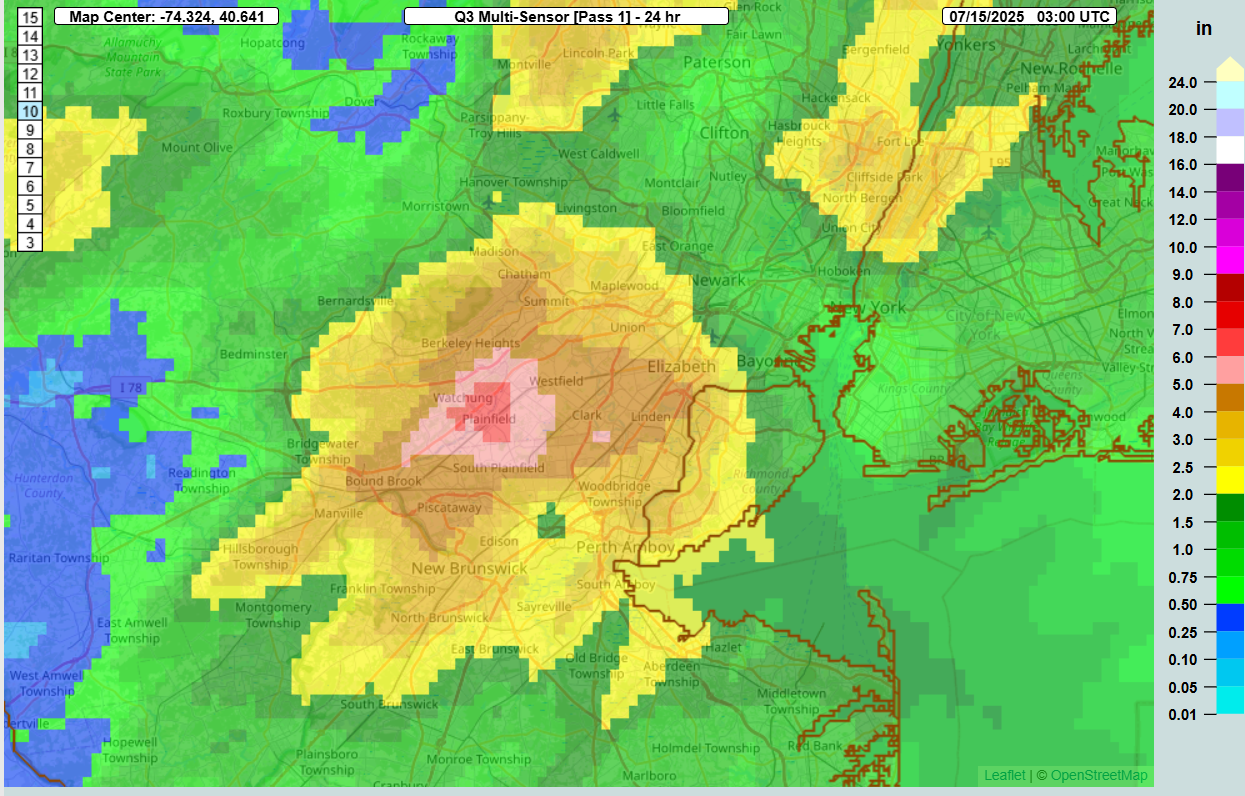
In northern New Jersey, rainfall totals probably came close to 7 inches in spots right near the Watchung Ridge up in western Union and northeast Somerset Counties.
Radar estimated rainfall bullseye of 6 to 7 inches right over Plainfield, NJ yesterday. (NOAA NSSL)
This type of rain has about a 2 to 3 percent chance of occurring in any given year in this location. Numerous reports of flooding were received in parts of New Jersey, as well as in New York City, as rainfall rates of around 2 inches or more per hour overwhelmed drainage systems. Heavy rain also fell west in Pennsylvania, west of Scranton-Wilkes Barre, with about 1 to 2 percent probabilities of those totals occurring in any given year. A secondary area occurred near Lancaster, PA as well.
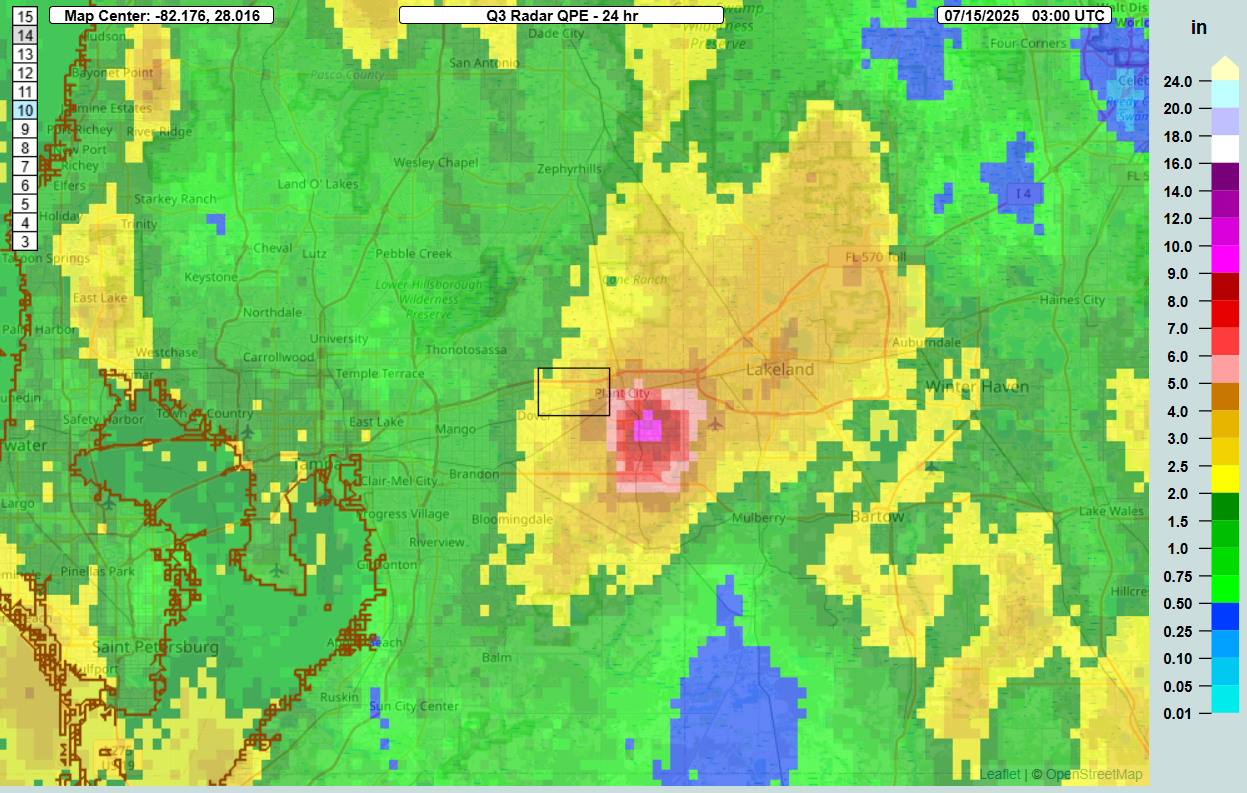
South into Florida, much of the state saw rain yesterday, but the Plant City and Lakeland areas were especially hard hit. Rain totals of as much as 6 to 10 inches occurred just southwest of Lakeland, with flooding reported there as well.
Rain in Florida was widespread, but very isolated pockets saw extremely high totals, such as in Plant City. (NOAA NSSL)
Just another day in this seemingly frenetic summer.
Tropical Disturbance: Invest 93L
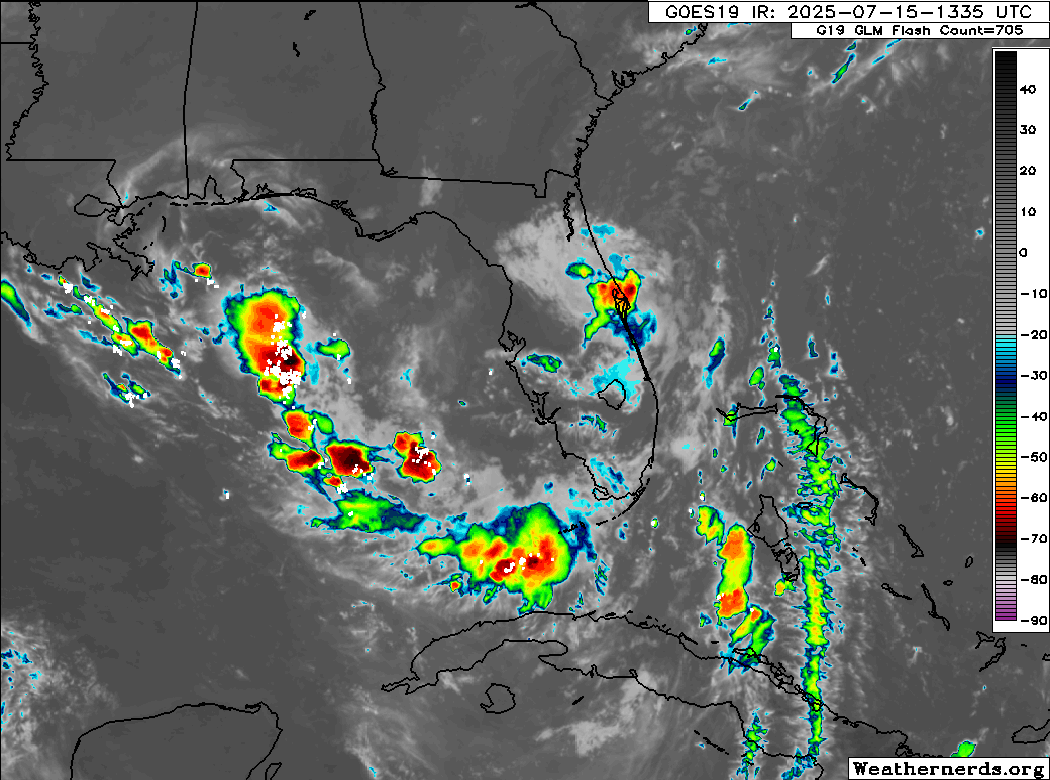
There’s so much to talk about today in terms of all sorts of things, but we will focus first on the potential for a tropical system in the Gulf. Currently, Invest 93L is moving onto the Florida Peninsula. If we’re really being honest, it ain’t much to look at today.
Invest 93L is moving onto the Florida Peninsula this morning. (Weathernerds.org)
Once into the Gulf it will encounter both very warm sea-surface temperatures and slightly less wind shear. This will allow it to begin to get its bearings and make an effort to organize. Currently, the NHC is giving it about a 40 percent chance of development the next couple days as it moves west across the northern Gulf. Obviously, you see something in the northern Gulf, and it’s instinctive to get a little worked up. This will probably have limited time over water, and the proximity to land is likely going to work against it some. There’s also likely to be some drier air in play here. All this to say that it would seem that the ceiling on this system is fairly low in terms of intensity.
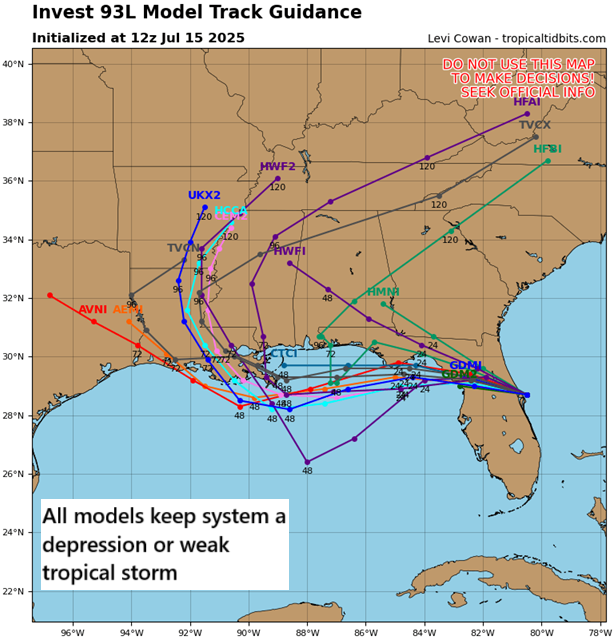
Tropical models are generally focused on Louisiana for the track of Invest 93L. (Tropical Tidbits)
In terms of the track, it is likely to work west across the Gulf generally toward Louisiana. A weaker, more disorganized system would probably work inland west of New Orleans. A stronger system, for whatever reason, may come ashore farther east. The next name on the storm list is Dexter.
But given the low ceiling, I think it’s important to focus on the rainfall risk here.
Rainfall risk on Gulf Coast
Gulf systems this time of year typically have characteristics that make them very sloppy, very lopsided, and very wet. In other words, they’re often a flooding threat. And this appears to be the case here as well.
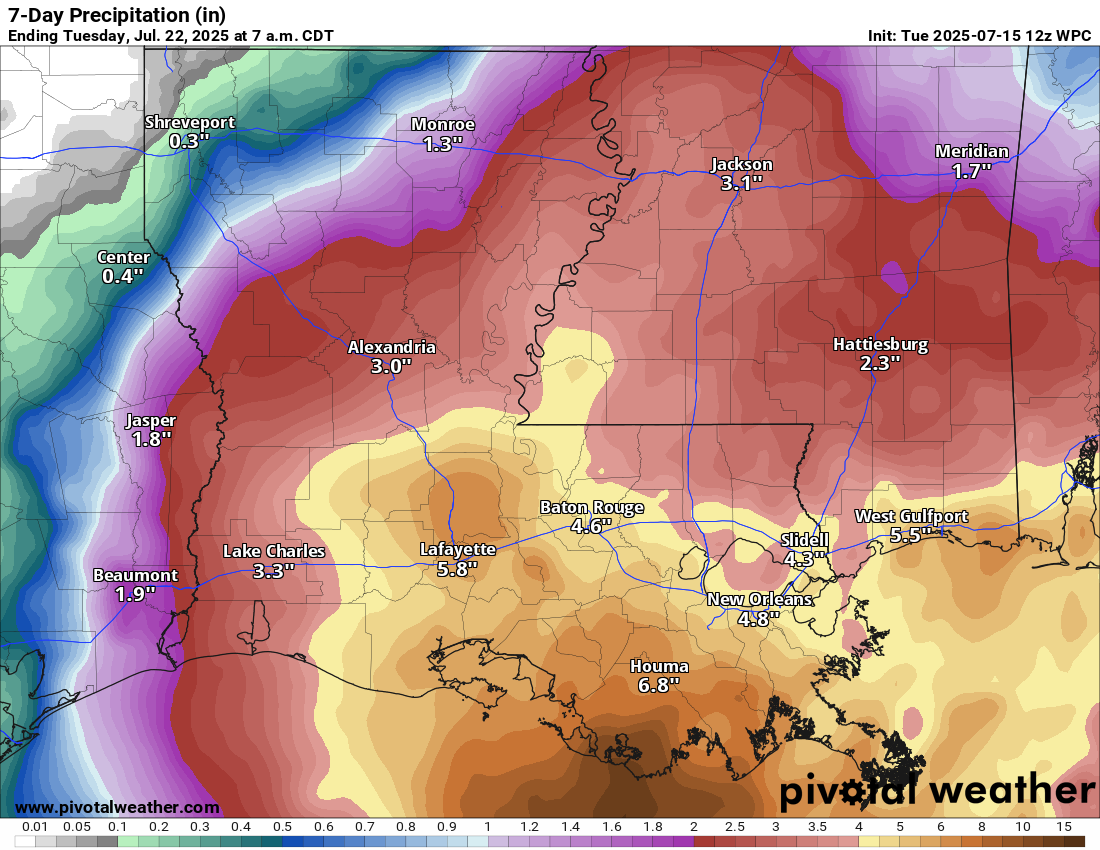
The 7-day rainfall forecast for Louisiana and the Gulf Coast of Mississippi shows upwards of 4 to 8 inches of rain or more possible. (Pivotal Weather)
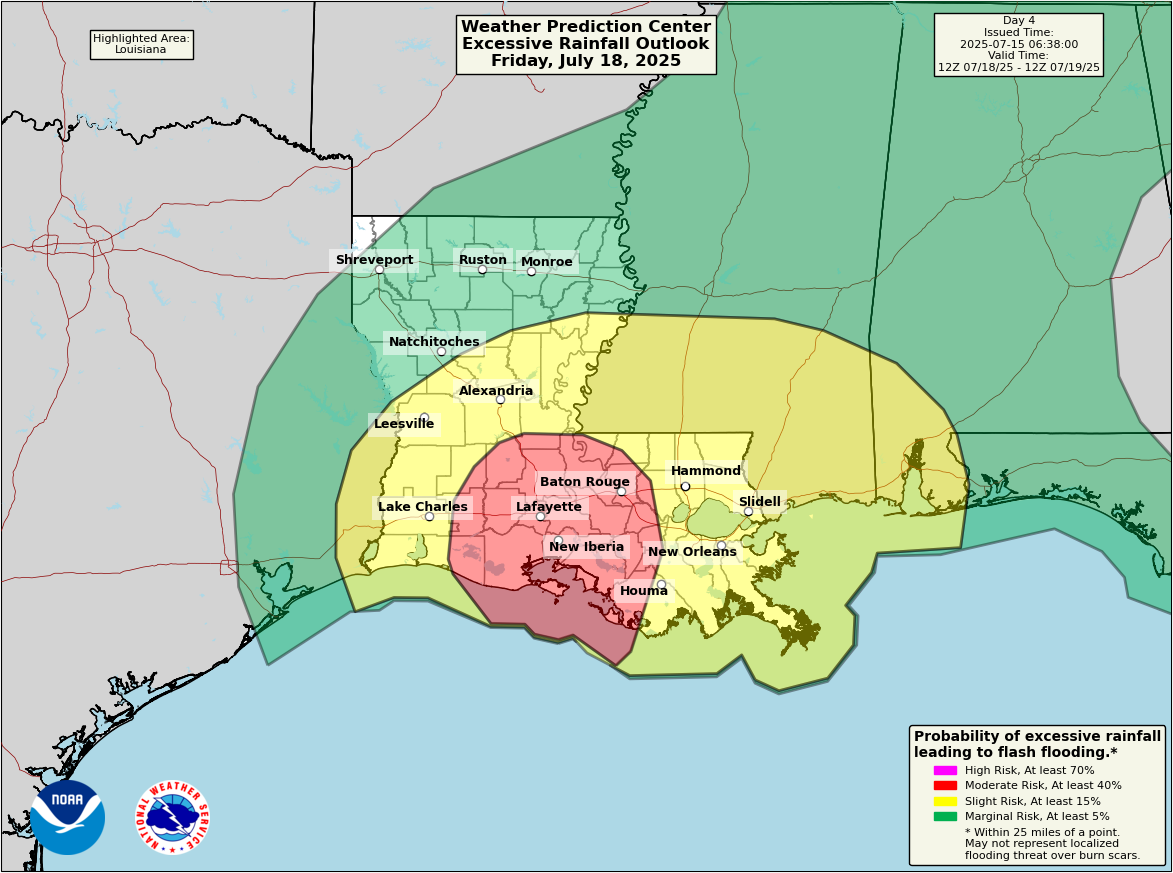
The current rain forecasts show upward of 4 to 8 inches of rain across much of Louisiana and coastal Mississippi. Heavy rain will also extend east into coastal Alabama and the Panhandle of Florida as well. In fact, there is already a moderate risk of flash flooding (3/4) for day 4 in Louisiana (Friday).
A moderate risk of flash flooding exists for Acadiana on Friday (NOAA WPC)
The focus of the flooding risk will be on Acadiana and the Atchafalaya Basin. This includes both Baton Rouge and Lafayette. It’s still a bit early to focus on high-end risks of how much rain could fall, but I would keep a very close eye on the forecast between Beaumont and Baton Rouge from the flooding and heavy rain risk point of view.
On the east side of 93L, a very warm and humid air mass will lead to hot and uncomfortable weather later this week up the East Coast. Numerous record warm low temperatures are at risk of being broken.
Numerous record warm lows are at risk on Thursday morning. (NOAA WPC)
We’ll have more tomorrow morning or later today if anything significant changes.
I work in HR and oversee my organization’s performance review process. For context, it is a family owned, 500-employee very niche business, with some really wild internal politics and two really dysfunctional leadership groups. When I started, there was a very informal “if you do it, great” type of review process that was done with pen on paper and then stored in employee files. We totally revamped the process and moved it to electronic and with a formal timeline; it’s gone very well and has been well received by the employees, but our six executive vice presidents (EVPs) have never participated. (The EVPs manage our VPs, who are the ones who run things day to day.)
This year, my boss, the EVP of HR, wants to initiate peer reviews only at the VP level — have all 10 VPs review each other, and then provide each of them with an anonymous report that contains all of the feedback from the other VPs. This would be done manually (pen and paper vs. in our system — it doesn’t have peer or 360 review capability). The VPs would complete nine peer reviews with the same set of questions for each VP; these would be sent to HR, and we would compile reports for each VP with the various reviews from their peers (anonymous/removing identifiers). Then the EVP group (six people) will receive copies of each VP’s peer review report, have a meeting with each VP to go through the report, and do a “review.”
It’s worth mentioning that our EVP group rarely manages their people/VPs and avoids conflict and constructive criticism like no other, so it could be a big waste of time if there are no action items or follow through once the “reviews” are complete.
On one hand, I know peer reviews and 360s are done all the time at various organizations. It seems like a very practical exercise to go through, and I do think it will be eye-opening, bringing to light a lot of the issues between the VP group, as well as providing a platform to have the EVP group engage in feedback for the VPs. However, this feels like it is destined for disaster. Given the history of an EVP team that doesn’t manage their people, a VP group that from the outside appears to be out to get each other/highly competitive, and many big egos, I don’t see how this will go well and I feel like there could be bigger fallout than anticipated.
I am curious to hear any advice about implementing this process. While I’m not able to veto this idea, and will execute it if this is the path that our leadership wants to take, I’d like to present my boss with any potential issues that I haven’t thought through. Pros? Cons? Are peer reviews a waste of time? Any peer review success stories out there?
Yeah, this sounds like a recipe for disaster.
To be clear, 360 feedback can be really valuable — when it’s done well. When it’s done badly, it can cause morale problems and destroy trust, all while using up huge amounts of time and energy.
When it’s done well, the idea is that you get multiple perspectives on an employee’s work, including viewpoints that the manager may not otherwise know about. That can help offset managerial bias, help the manager spot patterns (or inconsistencies), and bring to light issues or strengths that otherwise could go unnoticed.
But they take an enormous amount of time to do well, and they’re not something that you want poor or disengaged managers doing, because it takes skill to synthesize and present 360 feedback in a constructive way. It’s also not a substitute for the manager’s own (hopefully well-informed) judgment about how an employee is doing.
If you haven’t done the work of establishing a culture where feedback is given frequently and where people generally trust their colleagues to be acting with good will toward them, 360 reviews have the potential to backfire horribly.
It also doesn’t typically make sense to have everyone provide feedback on everyone. Usually it works better if the manager and employee decide on a list of feedback providers together, based on who the employee works with regularly and is likely to have a useful perspective. “Might have an opinion about Jane” isn’t enough.
You also need a clear process for managers to synthesize and present that feedback, which includes being engaged enough with the employee’s work to know what input is relevant and valuable and what isn’t, and how to shield people’s identities when feedback is sensitive. They shouldn’t cut and paste feedback into the review; they need to filter it through their own judgment (including going back to talk to people if something seems off or doesn’t make sense).
Most importantly, you need people to trust the organization, its leaders, and the process enough that they’ll participate candidly and with good will — which doesn’t sound at all like the case in your company.
Popular Muppet character Elmo’s verified X account was hijacked, resulting in the posting of antisemitic and racist content before it was secured. What do you think?
“How am I supposed to explain to my child that Elmo doesn’t use two-factor authorization?”
Colton Horn, Rottweiler Advocate
“I still haven’t forgiven him for the hateful comments he made about the letter ‘G.’”
Paolo Ferreira, Margarita Innovator
“I still remember when Bananas In Pajamas denied the Armenian Genocide.”
TORONTO – Seeking to give riders a productive activity during its numerous and lengthy delays, the Toronto Transit Commission has launched a new summer contest called Catch That Rat! Rather than attempt to solve the frequent issues inconveniencing its 700,000 daily riders, the TTC has spotlit its with a new rodent-focused competition. “A lot of […]
Stratford, England – Shakespeare Birthplace Trust archivists today announced their discovery of a lost Shakespeare folio for a play entitled “Dracula vs. Frankenstein.” Natasha Cartwright, a Cambridge University scholar of Shakespeare’s later works, was shocked by the discovery. “We all know that Shakespeare is credited with the invention of hundreds of words, but to think […]
Three worrying foes there at the top, feel free to pick your favourite. We’ve seen Swamp King before, of course. Perhaps we will learn more about the others in time.
When Joe Biden wanted the Department of Education to forgive student loans, the Supreme Court shut him down hard. The Court spent pages in Biden v. Nebraska explaining why the Department lacked authority under the HEROES Act, demanding “clear congressional authorization” for such a significant policy change.
But when Donald Trump wants to dismantle the entire Department of Education without any congressional authorization? That gets a rubber stamp with no explanation at all.
The hypocrisy is staggering, and it reveals everything you need to know about how the Roberts Court actually operates.
Two weeks ago, I wrote about how the Supreme Court blessed human trafficking with literally zero explanation. The Court stayed a lower court order that required basic due process protections for people being shipped to random countries around the world—including war zones where migrants face torture, slavery, or death. No analysis. No reasoning. Just: “go ahead and traffic people to South Sudan” (which has now happened).
This wasn’t an aberration. Yesterday, they did it again. This time, they’re letting Trump dismantle the Department of Education.
In Linda McMahon v. New York, the Supreme Court issued an order that allows the Trump regime to move forward with gutting the Department of Education.
Without explaining the reasoning.
After Trump’s Secretary of Education Linda McMahon put in place plans to fire nearly 50% of the department’s workforce overnight—what she called “the first step on the road to a total shutdown of the Department”—two lower courts stepped in to block this obvious violation of the separation of powers.
The Supreme Court’s response? Lift the injunction. Let Trump proceed with dismantling a Cabinet-level agency that only Congress has the power to abolish. And offer absolutely no explanation for why this is legal or constitutional.
Since April 4, #SCOTUS has issued 15 rulings on 17 emergency applications filed by Trump (three birthright citizenship apps were consolidated).
It has granted relief to Trump … in all 15 rulings.
It has written majority opinions in only 3.
Today’s order is the 7th with no explanation at all.
Fifteen for fifteen. That’s not jurisprudence—that’s a rubber stamp. By way of comparison, in the 16 years of the George W. Bush and Barack Obama presidencies, the two presidents combined only asked (let alone got) emergency docket relief eight times.
The emergency docket is supposed to be for… emergencies. It’s supposed to preserve the status quo while more fully briefed cases make their way through the courts. Instead, the Court is using it to let Trump implement his most legally dubious policies while avoiding the scrutiny that comes with actually having to explain their reasoning.
And the hypocrisy here is staggering.
Just two years ago, having the Department of Education forgive student loans was supposedly beyond the pale and required extended analysis. But letting Trump fire half the department’s workforce overnight and effectively shut down the agency that Congress created? That gets a rubber stamp with no explanation at all.
Sotomayor’s Righteous Fury
Justice Sotomayor’s 19-page dissent (joined by Justices Kagan and Jackson) is a masterpiece of righteous indignation. She methodically dismantles the majority’s abandonment of constitutional principles:
This case arises out of the President’s unilateral efforts to eliminate a Cabinet-level agency established by Congress nearly half a century ago: the Department of Education. As Congress mandated, the Department plays a vital role in this Nation’s education system, safeguarding equal access to learning and channeling billions of dollars to schools and students across the country each year.
Only Congress has the power to abolish the Department.
She then delivers the key point:
When the Executive publicly announces its intent to break the law, and then executes on that promise, it is the Judiciary’s duty to check that lawlessness, not expedite it.
But the conservative majority couldn’t be bothered to address any of this. They just waved through Trump’s power grab without explanation.
Writing for the Historical Record
Justice Sotomayor’s dissent here follows the path that Justice Ketanji Brown Jackson has blazed recently: writing not just for her colleagues, but for the public and for history. As Jay Willis noted at Balls & Strikes, Justice Jackson has been remarkably willing to call out the Court’s partisan hackery. In case after case, she’s been pointing out that the Court has “demonstrated enthusiasm for green lighting this president’s legally dubious actions in an emergency posture.”
Sotomayor appears to be joining this approach. Rather than maintaining polite judicial fiction, she’s directly calling out the majority’s “willful blindness” and warning about the “grave” threat to our Constitution’s separation of powers. Jackson’s dissents have become a running commentary on the Court’s transformation from a judicial body into a partisan enabler of authoritarian rule. Now Sotomayor is adding her voice to this historical record. As Wills notes, they’re writing for the public, assuring millions of Americans that they’re not wrong to question the good faith of a Republican-controlled Court that keeps siding with a Republican president.
For as long as she remains stuck in the minority, it might also be the most important part of her job: If she cannot persuade her colleagues that the Constitution does not imbue Donald Trump with an inviolate right to ignore it, she can at least use her platform to show the public that the institution is captured, broken, and not to be taken seriously.
This approach has reportedly frustrated some of their colleagues, who seem to think there’s still value in maintaining decorum among justices. But Jackson and (hopefully, now) Sotomayor understand something important: when the Court stops explaining itself, it stops being a court and becomes just another political institution.
Why Explanations Matter
As Vladeck wrote about the human trafficking case, the Court’s refusal to explain itself creates chaos:
The more important point is that this dispute has happened only because the six (or five) justices who voted to stay some of Judge Murphy’s earlier rulings didn’t explain themselves. In that respect, the contretemps in D.V.D. can be directly traced to one of my biggest criticisms of the shadow docket—the justices’ regular refusal, even when granting emergency relief, to explain why they’ve done so. Alas, I’ve been beating this drum for years. But it’s hard to think of a more pointed or compelling example of what can happen when the Court doesn’t write.
Well, now he’s got a second example.
Without explanations, parties and lower courts are left to speculate about what the justices actually meant. That’s particularly problematic when the disputes involve governmental policies affecting millions of people.
More fundamentally, principled explanations are what separate judicial power from raw political power. When the Court stops explaining itself, it stops being a court worthy of respect.
The Broader Assault On The Rule Of Law
This isn’t just about immigration or education policy. It’s about the fundamental principle that government officials must follow court orders until they’re properly overturned. By repeatedly rewarding Trump’s defiance of lower court rulings, the Supreme Court is teaching every future administration that court orders are optional if you have the right political connections.
Well, at least he’s teaching Republican administrations that, as the Biden v. Nebraska case appears to make it clear, this doesn’t apply to Democratic administrations.
The McMahon case is particularly egregious because, as Sotomayor details, the Trump administration openly admitted it was trying to shut down an agency that only Congress can abolish. They fired thousands of employees without any analysis of how this would affect the department’s statutorily mandated functions. When asked during a congressional hearing whether they had conducted such an analysis, McMahon simply said “No.”
This is executive lawlessness, plain and simple. And the Supreme Court is actively enabling it.
What We’re Losing
The Department of Education administers over $120 billion in federal student aid to over 13 million students. It enforces civil rights laws in schools. It provides funding for special education services for more than 7 million students with disabilities. It channels over $100 billion annually to public schools.
It is fundamental infrastructure to the American education system.
All of this is now at risk because six justices couldn’t be bothered to write a few paragraphs explaining why the President can unilaterally dismantle Cabinet-level agencies.
Students with disabilities will lose services. Schools will lose funding. Civil rights protections will disappear. All so Trump can fulfill a campaign promise to “close up the Department of Education” without the inconvenience of actually getting Congress to agree.
The Roberts Court’s True Legacy
Each lawless decision like this makes it clearer that the Roberts Court’s legacy will be the complete destruction of public faith in the judiciary. John Roberts spent years wringing his hands about declining trust in the Court, but he’s presiding over its transformation into a partisan institution that serves power rather than law.
This isn’t just about “declining trust”—that’s already happened. The question now is what comes next when courts stop being courts and become just another political institution competing for legitimacy.
The Court is teaching Americans that the rule of law only applies to those without political connections to the right people. Why should anyone respect judicial decisions when the justices themselves have abandoned any pretense of impartiality?
Justice Sotomayor’s dissent ends with a warning that applies far beyond this case:
The majority is either willfully blind to the implications of its ruling or naive, but either way the threat to our Constitution’s separation of powers is grave.
The conservative majority isn’t naive. They know exactly what they’re doing. They’re systematically dismantling the constraints on executive power, one unexplained shadow docket ruling at a time.
And they’re doing it without even having the decency to explain why.
[Note that this article is a transcript of the video embedded above.]
In the early 1900s, Seattle was a growing city hemmed in by geography. To the west was Puget Sound, a vital link to the Pacific Ocean. To the east, Lake Washington stood between the city and the farmland and logging towns of the Cascades. As the population grew, pressure mounted for a reliable east–west transportation route. But Lake Washington wasn’t easy to cross.
Carved by glaciers, the lake is deceptively deep, over 200 feet or 60 meters in some places. And under that deep water sits an even deeper problem: a hundred-foot layer of soft clay and mud. Building bridge piers all the way to solid ground would have required staggeringly sized supports. The cost and complexity made it infeasible to even consider.
But in 1921, an engineer named Homer Hadley proposed something radical: a bridge that didn’t rest on the bottom at all. Instead, it would float on massive hollow concrete pontoons, riding on the surface like a ship. It took nearly two decades for his idea to gain traction, but with the New Deal and Public Works Administration, new possibilities for transportation routes across the country began to open up. Federal funds flowed, and construction finally began on what would become the Lacey V. Murrow Bridge.
When it opened in 1940, it was the first floating concrete highway of its kind, a marvel of engineering and a symbol of ingenuity under constraint. But floating bridges, by their nature, carry some unique vulnerabilities. And fifty years later, this span would be swallowed by the very lake it crossed.
Between that time and since, the Seattle area has kind of become the floating concrete highway capital of the world. That’s not an official designation, at least not yet, but there aren’t that many of these structures around the globe. And four of the five longest ones on Earth are clustered in one small area of Washington state. You have Hood Canal, Evergreen Point, Lacey V Murrow, and its neighbor, the Homer M. Hadley Memorial Bridge, named for the engineer who floated the idea in the first place.
Washington has had some high-profile failures, but also some remarkable successes, including a test for light rail transit over a floating bridge just last month in June 2025. It's a niche branch of engineering, full of creative solutions and unexpected stories. So I want to take you on a little tour of the hidden engineering behind them. I’m Grady, and this is Practical Engineering.
Floating bridges are basically as old as recorded history. It’s not a complicated idea: place pontoons across a body of water, then span them with a deck. For thousands of years, this straightforward solution has provided a fast and efficient way to cross rivers and lakes, particularly in cases where permanent bridges were impractical or when the need for a crossing was urgent. In fact, floating bridges have been most widely used in military applications, going all the way back to Xerxes crossing the Dardanelles in 480 BCE. They can be made portable, quick to erect, flexible to a wide variety of situations, and they generally don’t require a lot of heavy equipment. There are countless designs that have been used worldwide in various military engagements.
But most floating bridges, both ancient and modern, weren’t meant to last. They’re quick to put up, but also quick to take out, either on purpose or by Mother Nature. They provide the means to get in, get across, and get out. So they aren’t usually designed for extreme conditions. Transitioning from temporary military crossings to permanent infrastructure was a massive leap, and it brought with it a host of engineering challenges.
An obvious one is navigation. A bridge that floats on the surface of the water is, by default, a barrier to boats. So, permanent floating bridges need to make room for maritime traffic. Designers have solved this in several ways, and Washington State offers a few good case studies.
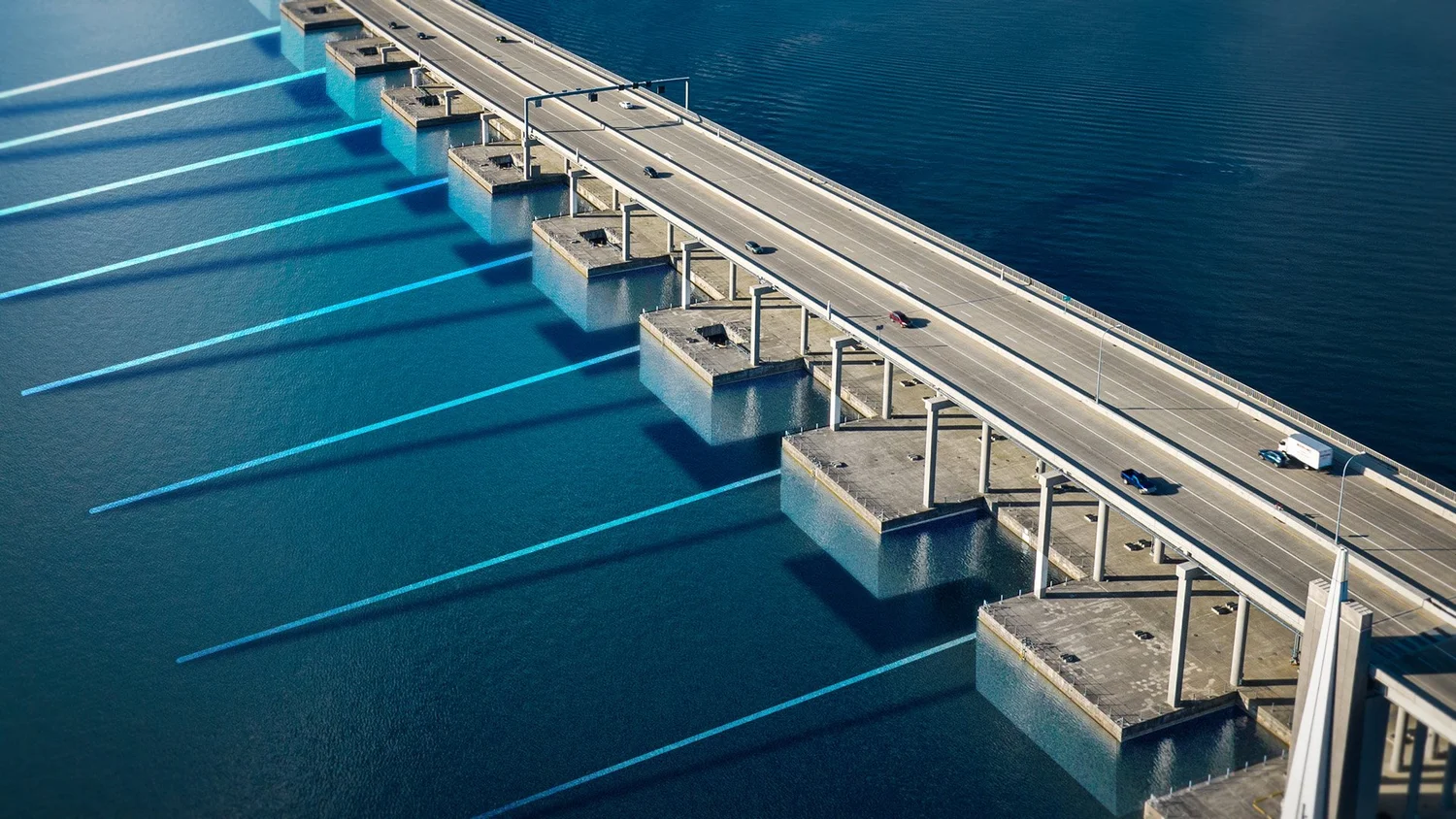
The Evergreen Point Floating Bridge includes elevated approach spans on either end, allowing ships to pass beneath before the road descends to water level. The original Lacey V. Murrow Bridge took a different approach. Near its center, a retractable span could be pulled into a pocket formed by adjacent pontoons, opening a navigable channel. But, not only did the movable span create interruptions to vehicle traffic on this busy highway, it also created awkward roadway curves that caused frequent accidents. The mechanism was eventually removed after the East Channel Bridge was replaced to increase its vertical clearance, providing boats with an alternative route between the two sides of Lake Washington.
Further west, the Hood Canal Bridge incorporates truss spans for smaller craft. And it has hydraulic lift sections for larger ships. The US Naval Base Kitsap is not far away, so sometimes the bridge even has to open for Navy submarines. These movable spans can raise vertically above the pontoons, while adjacent bridge segments slide back underneath. The system is flexible: one side can be opened for tall but narrow vessels, or both for wider ships.
But floating bridges don’t just have to make room for boats. In a sense, they are boats. Many historical spans literally floated on boats lashed together. And that comes with its own complications. Unlike fixed structures, floating bridges are constantly interacting with water: waves, currents, and sometimes even tides and ice. They’re easiest to implement on calm lakes or rivers with minimal flooding, but water is water, and it’s a totally different type of engineering when you’re not counting on firm ground to keep things in place.
We don’t just stretch floating bridges across the banks and hope for the best. They’re actually moored in place, usually by long cables and anchors, to keep materials from overstressing and to prevent movements that would make the roadway uncomfortable or dangerous. Some anchors use massive concrete slabs placed on the lakebed. Others are tied to piles driven deep into the ground. In particularly deep water or soft soil, anchors are lowered to the bottom with water hoses that jet soil away, allowing the anchor to sink deep into the mud.
These anchoring systems do double duty, providing both structural integrity and day-to-day safety for drivers, but even with them, floating bridges have some unique challenges. They naturally sit low to the water, which means that in high winds, waves can crash directly onto the roadway, obscuring the visibility and creating serious risks to road users. Motion from waves and wind can also cause the bridge to flex and shift beneath vehicles, especially unnerving for drivers unused to the sensation. In Washington State, all the major floating bridges have been closed at various times due to weather. The DOT enforces wind thresholds for each bridge; if the wind exceeds the threshold, the bridge is closed to traffic. Even if the bridge is structurally sound, these closures reflect the reality that in extreme weather, the bridge itself becomes part of the storm.
But we still haven’t addressed the floating elephant in the pool here: the concrete pontoons themselves. Floating bridges have traditionally been made of wood or inflatable rubber, which makes sense if you’re trying to stay light and portable. But permanent infrastructure demands something more durable. It might seem counterintuitive to build a buoyant structure out of concrete, but it’s not as crazy as it sounds. In fact, civil engineering students compete every year in concrete canoe races hosted by the American Society of Civil Engineers.
Actually, I was doing a little recreational math to find a way to make this intuitive, and I stumbled upon a fun little fact. If you want to build a neutrally buoyant, hollow concrete cube, there’s a neat rule of thumb you can use. Just take the wall thickness in inches, and that’s your outer dimension in feet. Want 12-inch-thick concrete walls? You’ll need a roughly 12-foot cube. This is only fun because of the imperial system, obviously. It’s less exciting to say that the two dimensions have a roughly linear relationship with a factor of 12. And I guess it’s not really that useful except that it helps to visualize just how feasible it is to make concrete float.
Of course, real pontoons have to do more than just barely float themselves. They have to carry the weight of a deck and whatever crosses it with an acceptable margin of safety. That means they’re built much larger than a neutrally buoyant box. But mass isn’t the only issue. Concrete is a reliable material and if you’ve watched the channel for a while, you know that there are a few things you can count on concrete to do, and one of them is to crack. Usually not a big deal for a lot of structures, but that’s a pretty big problem if you’re trying to keep water out of a pontoon.
Designers put enormous effort into preventing leaks. Modern pontoons are subdivided into sealed chambers. Watertight doors are installed between the chambers so they can still be accessed and inspected. Leak detection systems provide early warnings if anything goes wrong. And piping is pre-installed with pumps on standby, so if a leak develops, the chambers can be pumped dry before disaster strikes. The concrete recipe itself gets extra attention. Specialized mixes reduce shrinkage, improve water resistance, and resist abrasion. Even temperature control during curing matters. For the replacement of the Evergreen Point Bridge, contractors embedded heating pipes in the base slabs of the pontoons, allowing them to match the temperature of the walls as they were cast. This enabled the entire structure to cool down at a uniform rate, reducing thermal stresses that could lead to cracking.
There were also errors during construction, though. A flaw in the post-tensioning system led to millions of dollars in change orders halfway through construction and delayed the project significantly while they worked out a repair. But there’s a good reason why they were so careful to get the designs right on that project. Of the four floating bridges in Washington state, two of them have sunk.
In February 1979, a severe storm caused the western half of the Hood Canal Bridge to lose its buoyancy. Investigations revealed that open hatches allowed rain and waves to blow in, slowly filling the pontoons and ultimately leading to the western half of the bridge sinking. The DOT had to establish a temporary ferry service across the canal for nearly four years while the western span was rebuilt.
Then, in 1990, it happened again. This time, the failure occurred during rehabilitation work on the Lacey V. Murrow Bridge while it was closed. Contractors were using hydrodemolition, high-pressure water jets, to remove old concrete from the road deck. Because the water was considered contaminated, it had to be stored rather than released into Lake Washington. Engineers calculated that the pontoon chambers could hold the runoff safely. To accommodate that, they removed the watertight doors that normally separated the internal compartments. But, when a storm hit over Thanksgiving weekend, water flooded into the open chambers. The bridge partially sank, severing cables on the adjacent Hadley Bridge and delaying the project by more than a year - a potent reminder that even small design or operational oversights can have major consequences on this type of structure.
And we still have a lot to learn. Recently, Sound Transit began testing light rail trains on the Homer Hadley Bridge, introducing a whole new set of engineering puzzles.
One is electricity. With power running through the rails, there was concern about stray currents damaging the bridge. To prevent this, the track is mounted on insulated blocks, with drip caps to prevent water from creating a conductive path.
And then there’s the bridge movement. Unlike typical bridges, a floating bridge can roll, pitch, and yaw with weather, lake level, and traffic loads. The joints between the fixed shoreline and the bridge have to be able to accommodate movement. It’s usually not an issue for cars, trucks, bikes, or pedestrians, but trains require very precise track alignment. Engineers had to develop an innovative “track bridge” system. It uses specialized bearings to distribute every kind of movement over a longer distance, keeping tracks aligned even as the floating structure shifts beneath it. Testing in June went well, but there’s more to be done before you can ride the Link light rail across a floating highway.
If floating bridges are the present, floating tunnels might be the future. I talked about immersed tube tunnels in a previous video. They’re used around the world, made by lowering precast sections to the seafloor and connecting them underwater. But what if, instead of resting on the bottom, those tunnels floated in the water column? It should be possible to suspend a tunnel with negative buoyancy using surface pontoons or even tether one with positive buoyancy to the bottom using anchors. In deep water, this could dramatically shorten tunnel lengths, reduce excavation costs, and minimize environmental impacts.
Norway has actually proposed such a tunnel across a fjord on its western coast, a project that, if realized, would be the first of its kind. Like floating bridges before it, this tunnel will face a long list of unknowns. But that’s the essence of engineering: meeting each challenge with solutions tailored to a specific place and need.
There aren’t many locations where floating infrastructure makes sense. The conditions have to be just right - calm waters, minimal ice, manageable tides. But where the conditions do allow, floating bridges and their hopefully future descendants open up new possibilities for connection, mobility, and engineering.

/https://static.texastribune.org/media/files/0e718f655a8cb5d4f5f54fe470992947/McAllen%20File%20JG%20TT%2004.jpg)