In brief: Invest 94L has bitten the dust in the Atlantic. A Gulf tropical disturbance shouldn’t develop, and it will be only a modest rainmaker for the Gulf Coast. Flooding risks focus on the Duluth area today with additional heavy rain chances on the periphery of the heat wave heading into next week.
Invest 94L outta here
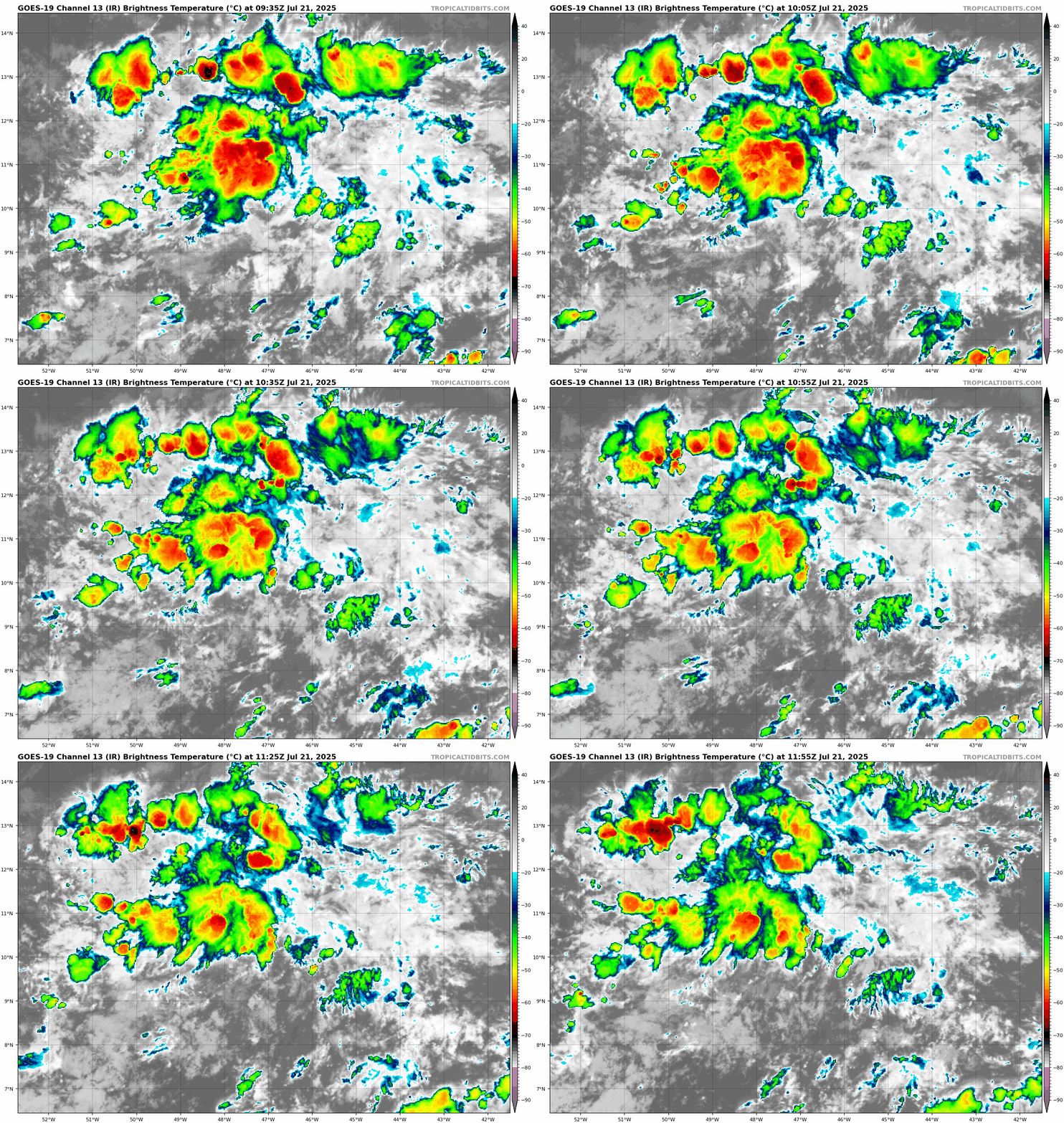
In the tropics, Invest 94L is out of time in the open Atlantic. It’s been declassified, and the NHC has removed it from their outlook map this morning. It will soon run into a much too hostile environment for development, and at worst we’re looking at some added rain showers in the Windward Islands today and tomorrow. With that, we’ll close the book on Invest 94L. Thanks for playing.
Gulf tropical disturbance a modest rainmaker
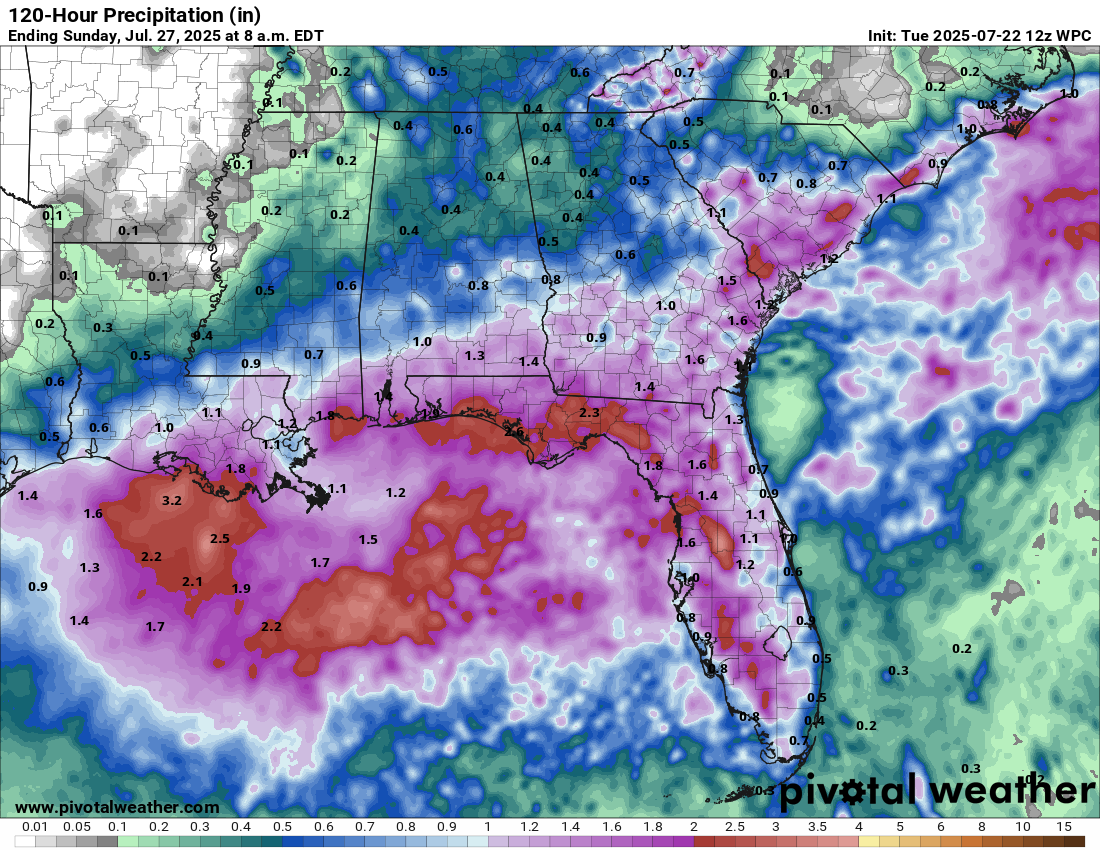
The odds of a Gulf tropical disturbance becoming anything are so low right now that the National Hurricane Center isn’t even tagging it on their daily tropical weather outlook. But we’re focused on impacts, and while the impact from this disturbance won’t be substantial, it will bring a fair bit of rain to the Gulf Coast and Florida.
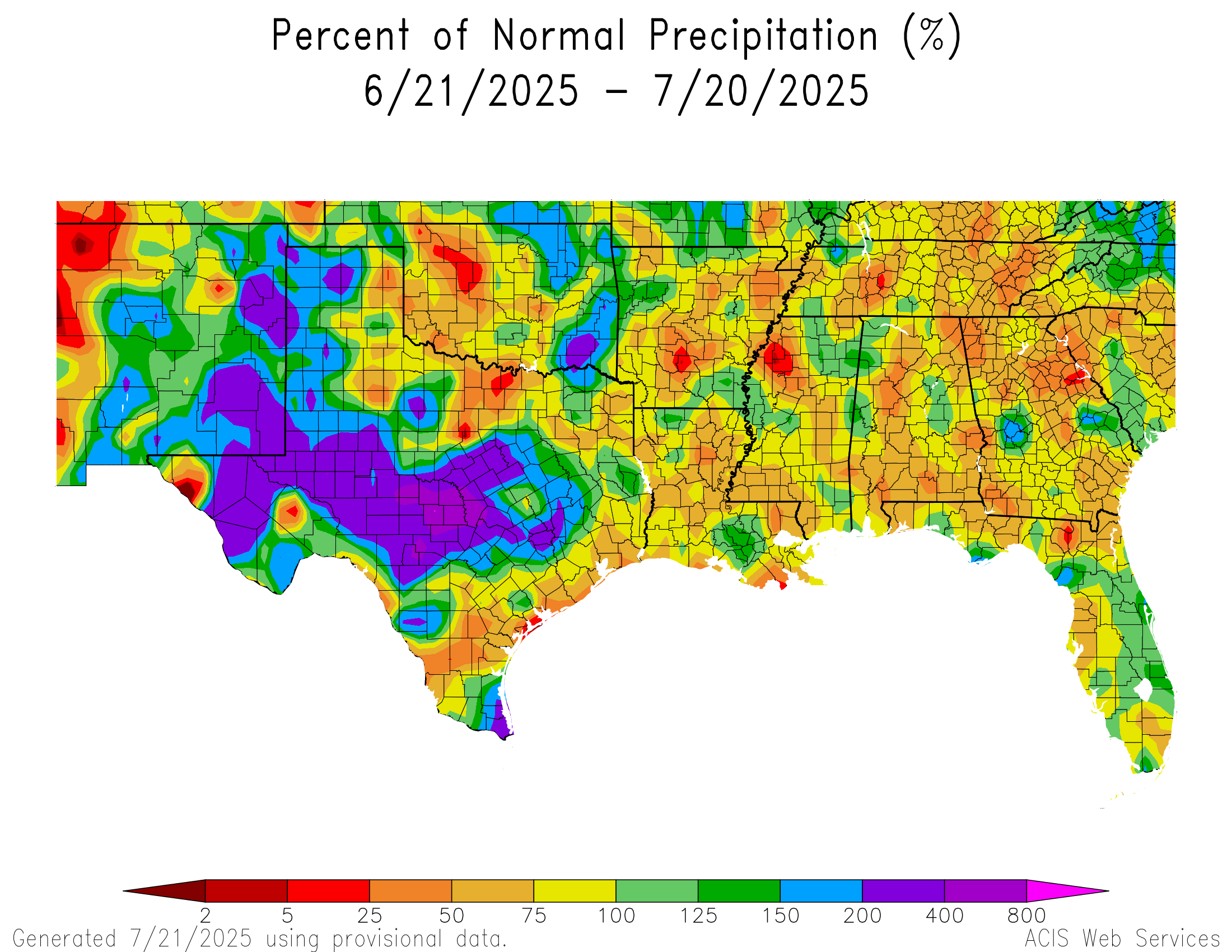
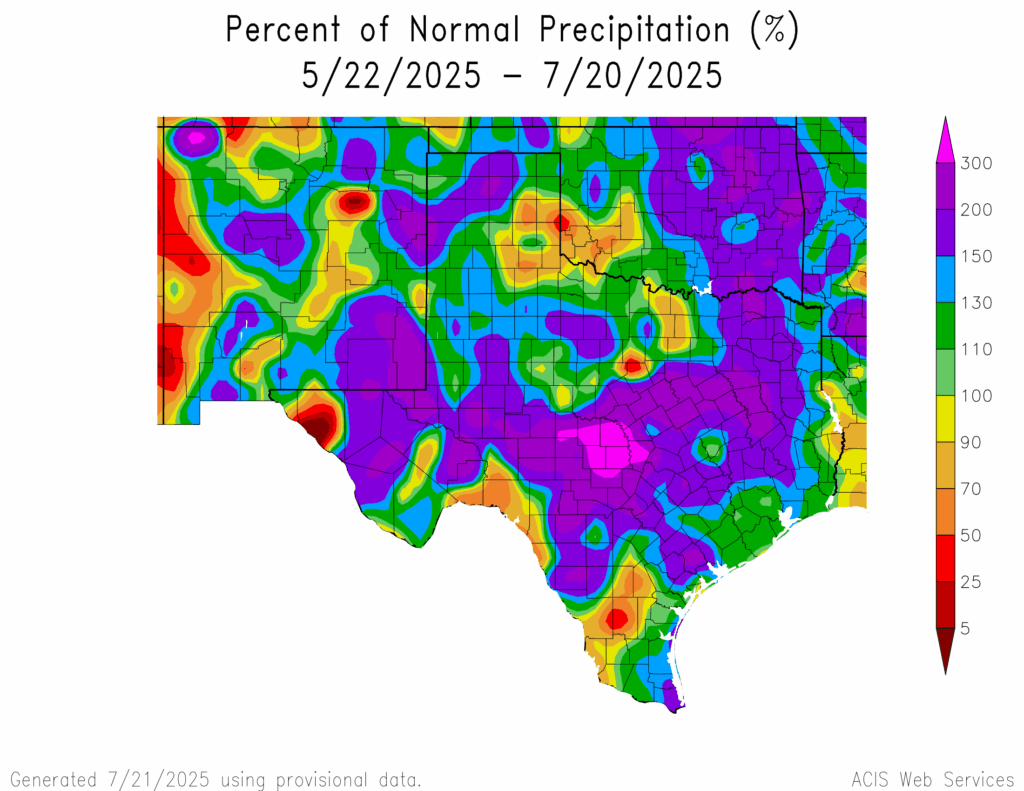
Rainfall has been surprisingly average along the Gulf Coast over the last 30 days. (High Plains Regional Climate Center)
While Louisiana has certainly seen a good bit of rain in the last week or so, and isolated pockets of Florida have been hit good, the majority of the region between Corpus Christi and Pensacola have been fairly blah over the last 30 days with nothing worse than isolated pockets of locally heavy rainfall. Rain totals increase some if you go back about 60 days, but still. Although there’s a good chance of some decent rain along the entirety of the Gulf Coast as the resurrected disturbance circles back in, there’s also a fair bit of breathing room to accommodate that rainfall in most cases. This should keep flooding concerns not at zero levels but relatively low.
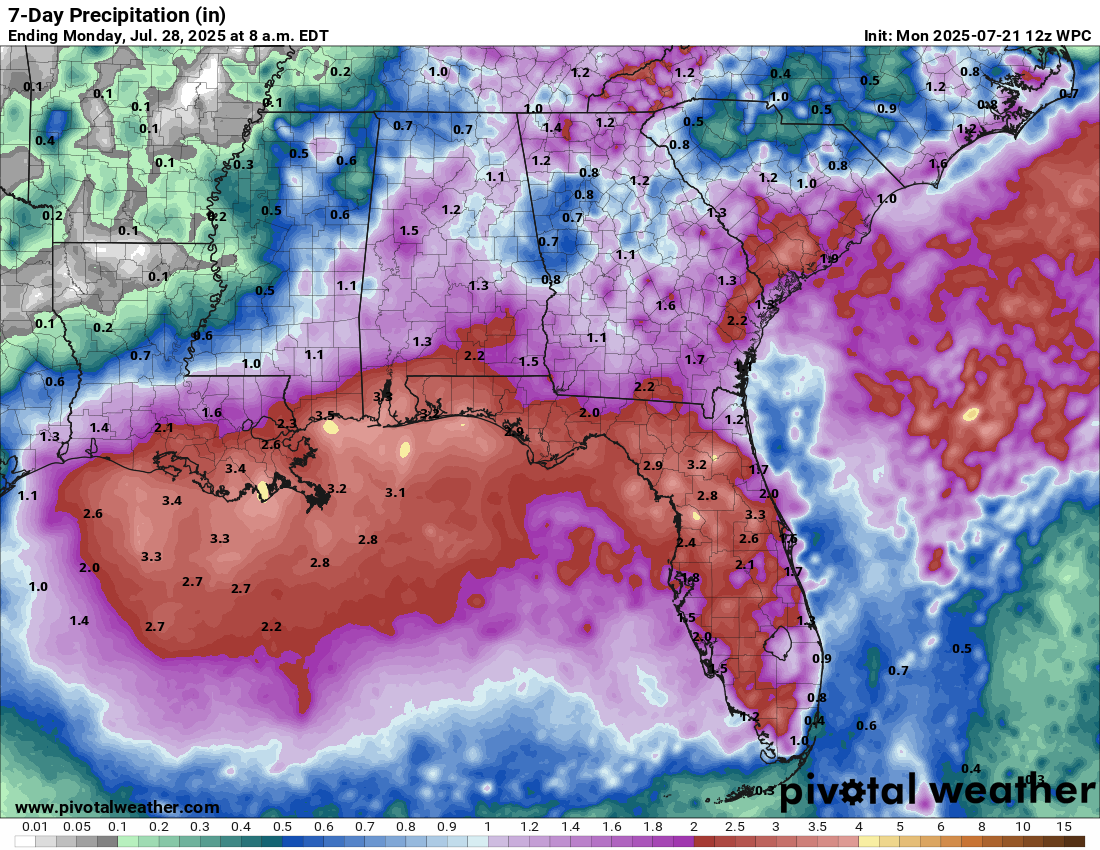
Rain totals of 1 to 3 inches over the next 5 days across the Gulf Coast should be manageable, with nothing worse than some localized flooding concerns. (Pivotal Weather)
The disturbance should barge into Texas at the end of the week, cooling down the Houston area and bringing widespread rain chances to East Texas and possibly some inland locales. Some of this moisture may survive all the way across Texas and get lumped in with the monsoon pattern in the Southwest, perhaps adding a small dose of extra precip for places like New Mexico next week.
Upcoming Central U.S. flooding risks and the “ring of fire”
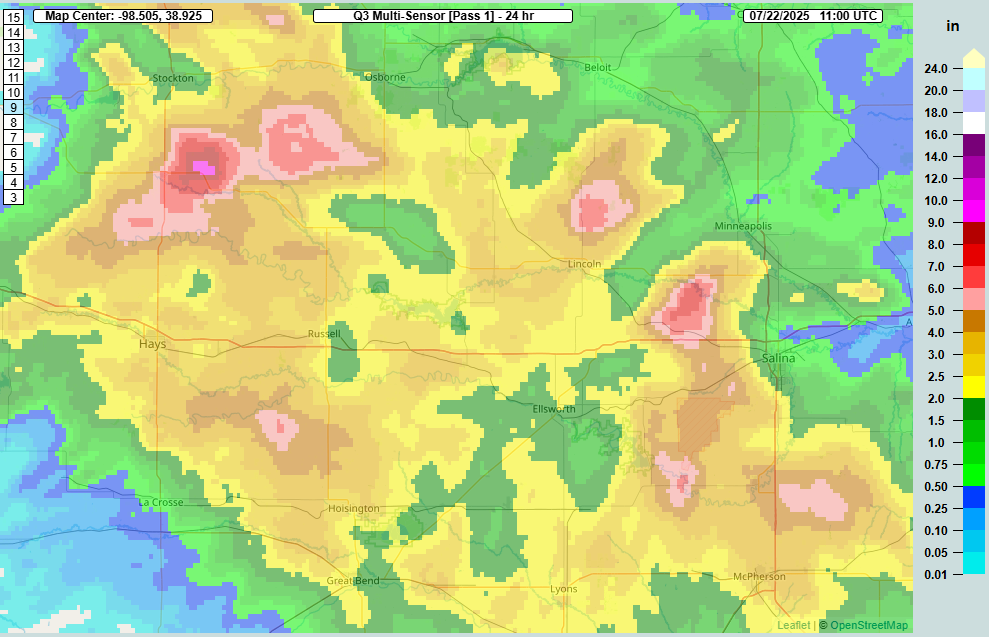
Even as dry weather is expected to take firm hold in the Southern Plains next week, Kansas got smacked with heavy rainfall yesterday, as rainfall estimates hit 3 to 7 inches or more from north of Hays to west of Salina.
24-hour rainfall estimates in central Kansas with pockets of 3 to 7 inches or even more from north of Hays to near Salina. (NOAA MRMS)
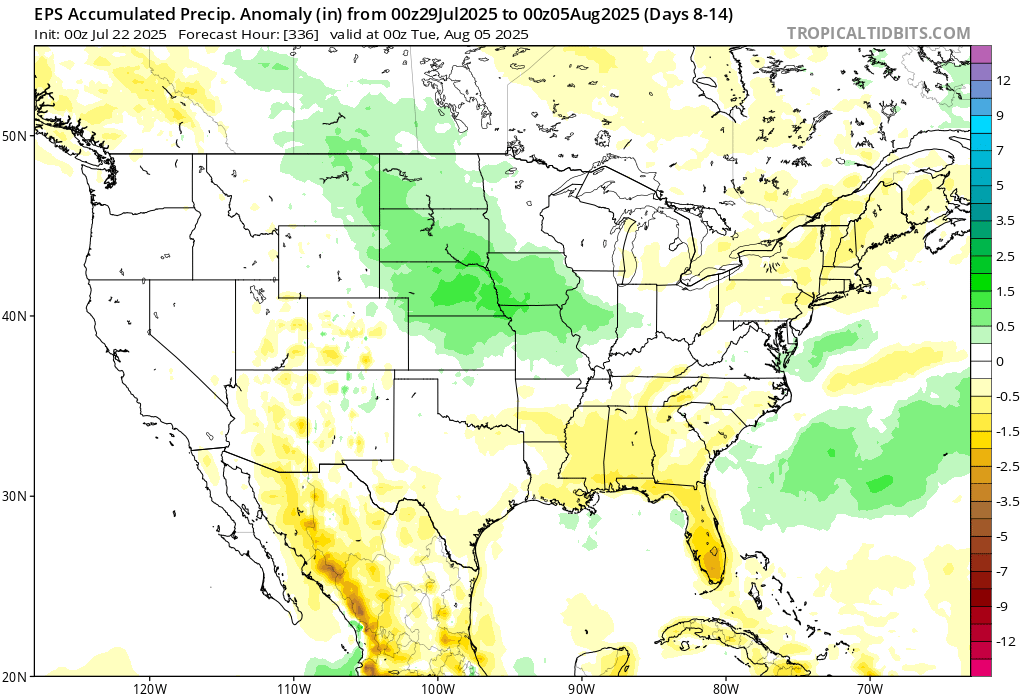
As ridging builds into the Southern Plains next week, look for the axis of some of these soaking rain events to shift northward, more into Nebraska or the Dakotas, particularly South Dakota. We’ll have to watch adjacent locations like Iowa and northern Missouri as well for flooding, as they have seen some substantial rains in the last few weeks.
Rainfall for days 8 to 14 looks above normal from Missouri and Iowa back into Nebraska and the Dakotas. (Tropical Tidbits)
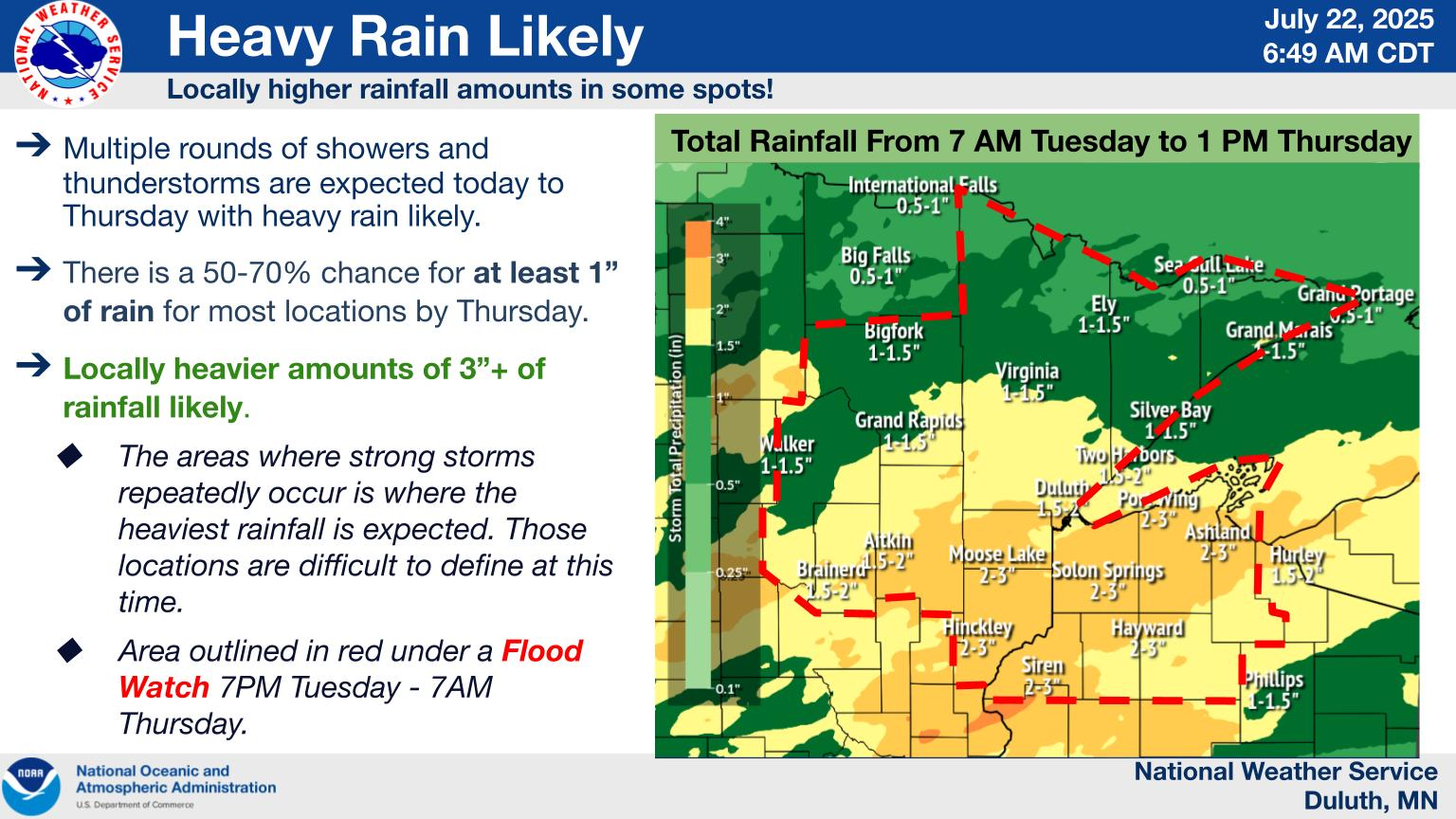
We may actually get an initial preview of this perhaps in Minnesota today and tomorrow, where weather models are pretty bullish on rain totals. Flood watches have been hoisted to include the Duluth area.
(NWS Duluth)
Storms will come in a couple waves between today and tomorrow up there. The flood story is not quite ready to go away.
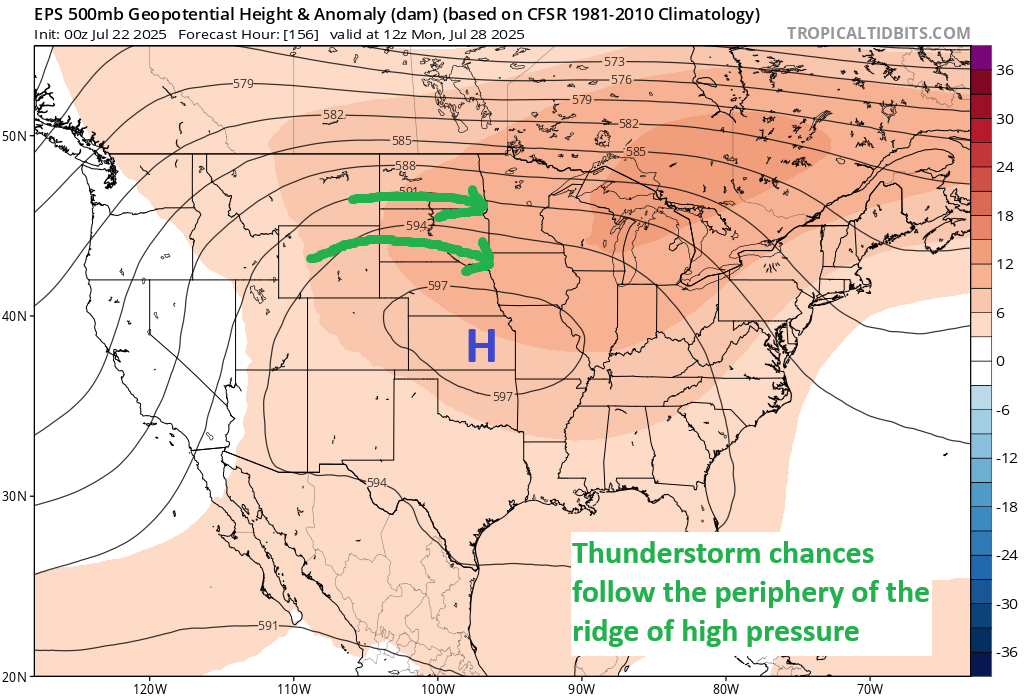
Basically, the setup for the heat wave continuing into next week will help initiate the storm chances on the periphery. Thunderstorms will tend to follow the northern fringe of the ridge, what we often refer to as a “ring of fire” in meteorology. Look for this to be the case next week as the ridge blossoms in the Plains.
The ring of fire, as we often call it will be in play next week in the Northern Plains and parts of the Upper Mississippi Valley. (Tropical Tidbits)
Thus, we could be talking both about some severe weather and a flooding risk in some of those areas.
We forget what we don’t want to remember. While I understand that impulse, there are dangers embedded in our forgetfulness. This is especially true for anyone living in Flash Flood Alley, or what we like to call the Hill Country (a concept that softens the nature of this flood-sculpted and -scoured terrain). So I have come to believe after nearly thirty years of thinking, researching, and writing about the September 1921 flood which ravaged Central and South Texas; it killed at least 224 people, and, in its devastated epicenter, San Antonio, 80 or more perished. Yet those who survived that flood were surprised to learn that the Alamo City endured an even larger-in-size (though less fatal) inundation in 1819. There was little to no public memory. People did not die solely because of forgetfulness but because this amnesia allowed succeeding generations to erase the past and their responsibilities to the future. When they could have enacted post-flood, life-saving interventions, they chose not to act on their progeny’s behalf.
Here’s hoping that does not hold true for the most recent disaster, the swift and punishing rise of the Guadalupe River over the July Fourth weekend. It swept away well more than 100 children and adults, a horrific tally which may never be known in full. As with the 1921 flood, when public officials admitted that some bodies might not be recovered, interred as they were beneath tons of silt, gravel, rock, and other debris, so, too, with the Guadalupe. “We don’t know where they are,” Kerr County Judge Rob Kelly acknowledged. We don’t know how many we’ve lost.” That uncertainty intensifies the anguish even as it testifies to this flood’s catastrophic impact. (Mercifully, the official missing persons count was reduced over the past weekend from around 100 to three largely due to individuals being confirmed safe.)
But there is nothing unknown about what triggered the brutal 2025 flood and so many others dating back to the nineteenth century (when the first, if spotty, records were kept). Some of the explanation results from where the Guadalupe—like the Colorado and San Gabriel rivers to its north, and the San Antonio to its south—originate. Their tributaries rise in the rugged Edwards Plateau, the massive landform whose 24-million acres dominate and define Central Texas. Although the plateau’s elevation is modest, with its eastern sectors varying from 800 to 1200 feet above sea level, this range in height is less important than its relation to the very gulf waters against which the plateau is measured.
Put a pin next to the source of your local (or favorite) watershed, then follow it as it streams south and east on its run to the Gulf of Mexico. Find the nearest beach, put your feet in the water. If it feels like a hot tub, you are in the right place. In mid-July, for instance, water temperatures at Port Aransas measured between 82-84°F. This heat index becomes the second datapoint essential to understanding the thunderous storms that have blown up over the Edwards for millennia.
The third is the prevailing breezes that capture the steamy moisture rising off the gulf and, in counter-flow to the rivers, sweep north and west slowly rising with the coastal plain. It is a relatively gentle climb—San Antonio sits 650 feet above sea level, New Braunfels at 630, and Austin at 489. But almost immediately to the northwest, gentle turns steep. That’s because this wet air hits the Balcones Escarpment, a geological structure of faults that curves northeast from Del Rio to Waco. It marks a sharp increase in elevation: Though they have the Guadalupe River in common, Kerrville is 1,000 feet higher than New Braunfels.
And what a difference the upcountry makes. As that moisture-packed airflow swirls aloft, it hits cooler temperatures and begins to condense and fall, then reheat and rise again, a cycle of convection that as it repeats can generate thunderheads. Should this volatile mixture collide with a cold front, the whole might explode. That’s how C. Terrell Bartlett, a San Antonio-based engineer, explained the 1921 flood to the annual conference of the American Society of Civil Engineers one month after it tore through South and Central Texas: “It has long been recognized that in many cases the sudden rise at the Balcones Escarpment causes intense precipitation along and just above its margin.” What they knew then, we must recall now.
United States Army soldiers assisting with search-and-rescue operations using a pontoon boat on Saint Mary’s Street by the Gunter Hotel following the 1921 flood (Coates Library Digital Collections, Trinity University, San Antonio)
We also need to recollect that the atmospheric-disturbing escarpment is key to why the Hill Country is so flood-prone. Every storm—whatever its size and power—has dumped rain that over thousands of years has carved channels into the limestone bedrock to sluice water downhill, an erosive force that has created some of the very aesthetic features—braided riverbeds, steep-walled canyons, and breathtaking views—that have drawn so many to this rough terrain. Farther downstream, the alluvial actions of these riparian systems, even at normal flow, have carried critical nutrients downstream. At flood-stage, these biotic riches have been dispersed across and built up floodplains, reenergized wetlands, and nurtured habitats. Rivers’ sustaining pulse, their dynamic and regenerative influences, are key to James Scott’s brilliant and posthumously published In Praise of Floods (2025). Its opening sentence—“Rivers, on a long view, are alive”—testifies that they are as well the life-source for all species.
The Indigenous people of what is now Texas understood this concept full well. They knew that the dangers we associate with Flash Flood Alley were indistinguishable from the manifold benefits floodwaters bore. They were just smarter about how to live within a river’s embrace, siting their communities near springs and adjacent to fertile floodplains but always above historic high-water levels. Missing that long-lived insight were Spanish, and later Mexican and American, colonists, whether Canary Islanders, German émigrés, or white enslavers. These settlers depended on sedentary agriculture that led them to plow and dig their communities into the flood zones of the San Antonio, Guadalupe, and Colorado rivers.
Controlling floods, not shifting the pattern of settlement to safer ground, became the ambition every time San Antonio was inundated. Beginning in the 1850s, local engineers and a handful of public officials urged the construction of a flood-retention dam to bottle up the city’s eponymous river north of the downtown core. It would take seventy years and countless deadly floods for that structure to gain taxpayer approval in 1921; it would take until the 1970s, and a lot of grassroots protests on the city’s vulnerable West Side, a sector that the 1921 flood destroyed, to gain protective infrastructure.
Austin was faster off the mark. In 1893, after years of enduring a rain-swollen Colorado jumping its banks and ravaging the community, the city, using its municipal tax and bond powers, built a sixty-foot high, 1900-foot-long, granite-block dam. The structure took advantage of the river’s historic path. “The Colorado above Austin follows in a deep cut or canyon worn in the limestone rock,” wrote UT-Austin geologist Thomas U. Taylor. “It is skirted by limestone bluffs rising often to the height of 150 feet above the bed of the river, broken by the erosion of tributary streams. No extensive meadow or bottom lands exist. This situation permits the construction of a high dam with but little damage to private property.” Under ordinary circumstances, the Colorado occupied only a small part of the channel, but in “great floods the river spreads from bluff to bluff.” In 1900, after a series of massive storms, the Colorado slammed into the structure, overtopping and undercutting it, killing dozens. Its spectacular failure, Taylor asserted, was due to ignorance of the site’s geology, poor engineering, and political interference, and one other factor: silt. The river carried so much grit downstream that it acted as a gigantic sandblaster, and the structure broke before the churning onslaught.
Advertisement
William L. Bray, one of Taylor’s university colleagues, wondered whether there was a human component to the speed and debris-packed floodwaters. A botanist, Bray received a contract from the U.S. Bureau of Forestry to report on the “Timber of the Edwards Plateau of Texas” (1904). Before you yawn, note that the report’s subtitle offered a more ecological analysis of woody vegetation’s “Relations to Climate, Water Supply, and Soil.” With that encompassing objective, Bray roamed the Balcones Escarpment and the wider plateau and paid close attention to how people were using axe and animals to eke out their living in the thin-soiled landscape.
Cedar choppers were hard at work harvesting for fencing and fuel; sheep, goat, and cattle were grazing on what grasses were available. These economic activities came with considerable environmental costs, Bray argued after studying two canyons linked to the Colorado River. One of them retained its thicket of vegetation; the other had been stripped clean. Unlike the first, which acted like a sponge during rain events, the denuded slopes of the other did little to restrain precipitation from racing downhill, “to pour down as from a steep roof converging into swift streamlets which erode every vestige of organic soil.” This load, along with other heavier debris, then crashed into already roiling tributaries, the whole becoming a “mountain torrent.” The Colorado floodwaters, with their anthropogenic and natural sources, continued to run free until the 1940 completion of Austin’s Tom Miller Dam. Its funding, not incidentally, came from the New Deal’s Public Works Administration, a $2.3 million gift that the Hill Country’s native son, then-Representative Lyndon B. Johnson, had secured.
To date, that initial investment and subsequent infrastructure projects that the Lower Colorado River Authority manages have protected communities within the larger watershed under most conditions. But what just happened on the Guadalupe—and had occurred on the San Antonio in 1921—was not “most conditions.” Let’s return then to the Gulf of Mexico and its simmering saltwater. Add to its hot-to-the-touch condition an atmosphere containing elevated levels of humidity and crucially the absence of strong, shearing winds. Overhead powerful thunderstorms might begin to form. As they do, they suck up more warm moisture into a spiraling system. The pressure begins to drop which pulls in more wind, and if these conditions hold a tropical depression might morph into a tropical storm or hurricane. Recent research connects the dots between this formative process and ocean surface temperatures: “warmer waters,” NOAA notes, “fuel more energetic storms.”
The surface and lower depths of the Gulf were not nearly as hot a century ago as they are today, a difference attributable to climate-disrupting, planetary warming; climate change is an accelerant, boosting and intensifying a pre-existing weather pattern. One of those earlier storms, a strong tropical depression that formed in the gulf in early September 1921, slowly spun towards northern Mexico, and on September 7th it came ashore south of Tampico. Over the next three days, it cycled across the Rio Grande into Webb County, then drifted along the Balcones Escarpment to rain down over Bexar, Comal, Hays, and Travis counties before pounding Williamson, Bell, and Milam. The U.S. Weather Bureau could not formally verify “the distribution of the pressure” that directed the storm’s path, yet it insisted that “the shifting winds, the progressive northeastward extension of the rainfall area, and the profound agitation of the atmosphere as evidenced by violent squalls and thunderstorms over the stricken section can hardly be ascribed to any other cause.”
San Pedro Creek near Commerce Street following the 1921 flood (Coates Library Digital Collections, Trinity University, San Antonio)
Contemporaries recorded two significant results of the 1921 deluge. Because San Antonio was the “most densely populated and most highly developed community affected by the flood,” it received “the most widespread notice in the press.” Yet its attention-grabbing devastation needed context, C.E. Ellsworth, a USGS researcher, averred. If the “rainfall in the basin of San Antonio River had been as heavy as it was in much of the basin of Little River, in Bell, Milam, and Williamson counties, the destruction at San Antonio would have been so great as to make that actually suffered there seem insignificant.” That’s why the “aggregate loss of both life and property in other areas far exceeded that at San Antonio,” though who died in the various flood zones was consistent. Most were “Mexicans who lived in poorly constructed houses, built along the low banks of the streams. Undoubtedly many others were drowned who were never reported missing,” Ellsworth wrote, and along the “Little and San Gabriel rivers bodies were found six months or more after the flood.”
Some of this analysis is hauntingly familiar. The pile-driving origin of the 2025 inundation in Kerr County was yet another tropical disturbance—dubbed Barry—that made landfall in northern Mexico and headed across the border where later it slammed into already saturated skies whirling above the Edwards Plateau. As with the 1921 storm, during which record-setting whiteout downpours hit the upper reaches of the San Antonio River and the middle stretches of the San Gabriel—39 inches fell at Thrall—some parts of the Guadalupe watershed had more than 15 inches hammer down so fast that the river itself rose 26 feet within less than an hour. That’s a predictable result of the tight confines through which escarpment rivers squeeze.
As foreseeable, alas, is the disaster that results if this torrent powers into urban streets or a rural camp called Mystic.
Neither flood could have been prevented. It is a river’s nature to flood. But the human-made disasters that resulted could have been mitigated. The Dallas Morning News spoke to this in a September 13, 1921, editorial, “Flood Yet to Come,” observing that “the most distressing feature of San Antonio’s disastrous flood experiences is the probability that they were avoidable. It does not seem unreasonable that foresight could have prevented the great loss of life and property” and proof that it was “preventable will come in the decision to take steps at once to prevent the recurrence of the catastrophe.” Solutions could have been proactively implemented. The state was duly forewarned: “Scarcely is there a city of any size in Texas,” the News continued, “but has within its confines one or more placid water course potentially as murderous as the beautiful San Antonio River.”
In brief: After Houston’s hottest summer day so far, more heat is likely to persist today through Thursday. A tropical disturbance (that will not develop) will bring ample rain and storm chances back to the area Friday and Saturday before we jump right back into the hot stuff next week.
Summer to date in context
Since the weather is pretty cut and dry the next few days, let’s talk briefly about this summer. Officially, yesterday was our hottest day of the year, with a daily average of 89 degrees at Bush Airport, besting the 88.5° we hit 4 times, last on June 21st. But someone messaged us on Instagram recently asking if it was a pretty mild summer so far. “I’ve been able to enjoy the mornings and evenings outside which hasn’t always been the case,” they noted. And, I had to agree! It’s been hot, just as every summer is, but we’ve had enough rain chances (almost daily it seems) to break it up. It’s felt kind of like what would be a typical Houston summer.
And then Lee Corso barged in and said, “Not so fast, my friend.”
Statistically, from June 1st through Sunday, this has been the 7th hottest summer on record to date in Houston. In fact, we’re even a smidge hotter than 2024, though significantly trailing 2022 and 2023 to this point. We have averaged 84.9 degrees officially. This is about a solid 2 degrees warmer than normal. So why has it seemed less intense? In a word, the daytimes. Our daily high temperatures average 19th hottest on record. In other words, although this is one of Houston’s hottest summers on record to date, it hasn’t been that bad during the daytime. So it hasn’t seemed too intense. And on the days that it has been bad, we’ve often had rain showers to punctuate things. However, if you look at nighttime lows? It’s the 3rd warmest summer on record to date, trailing only 2022 and 2023 and only one spot ahead of 2024. Notice a pattern?
It hasn’t been our wettest summer on record, but it has been pretty consistent each afternoon up til now. (High Plains Regional Climate Center)
So factor it all together: Modestly hot days, punctuated by daily thunderstorms, followed by a bunch of persistently warm nights, and you get the seventh hottest summer to date in Houston that doesn’t feel all that terrible. It’s a weird outcome, but the numbers don’t lie.
Today through Thursday
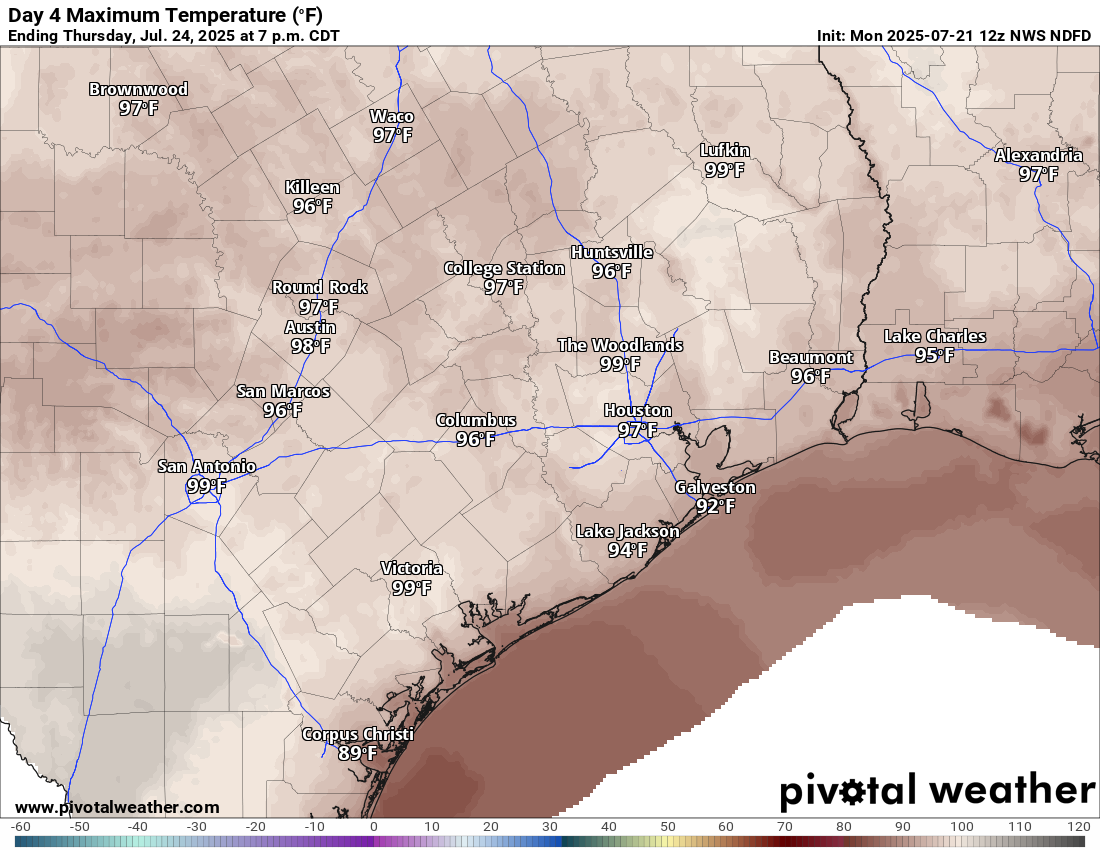
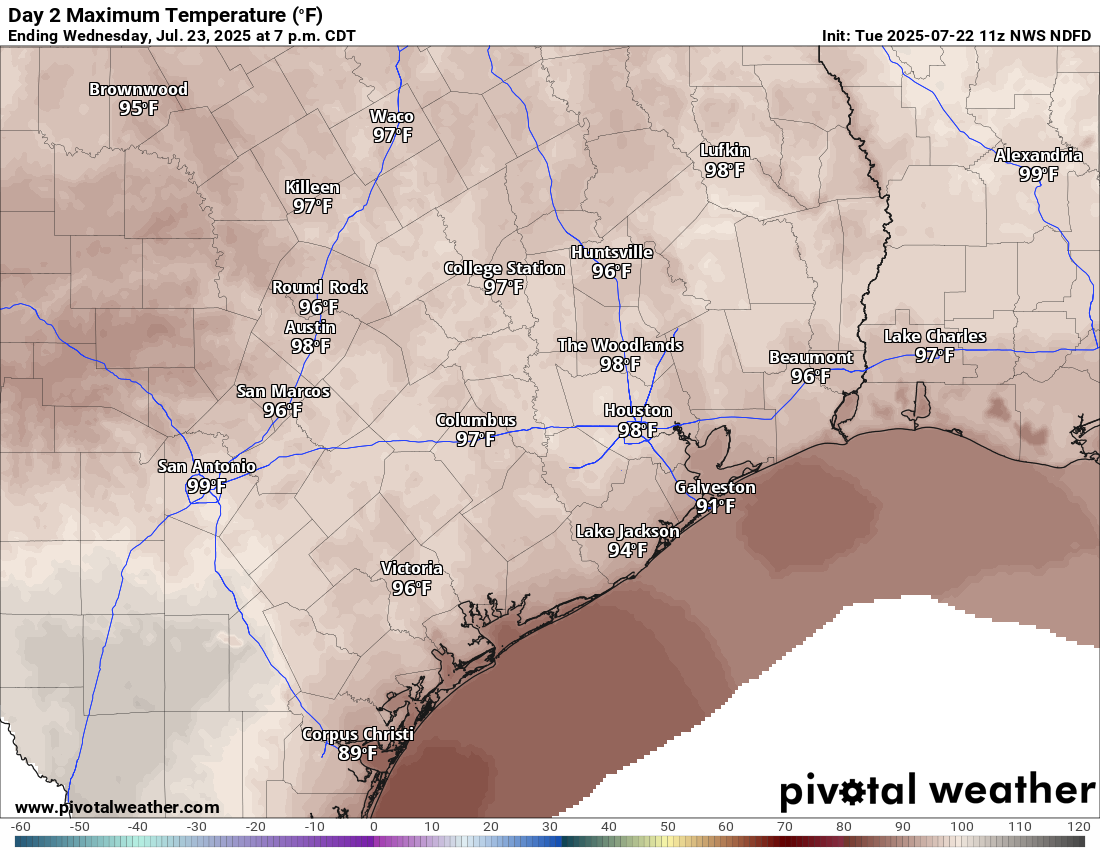
Look for the heat to keep up the next 2 to 3 days. Each day will probably top off in the mid to upper 90s. I would not be the least bit surprised to see a few spots hit 100 degrees before Thursday is out. Given that this is the hottest weather we’ve had in a month and the hottest of summer, give yourself a little grace out there and take it easy, stay hydrated, check on pets, check on the elderly, and always check the backseat before you lock the car.
High temps will likely push 97-99 degrees for most inland locations tomorrow and Thursday, with a few spots aiming for 100 degrees. (Pivotal Weather)
Friday and Saturday
The remnants of our old friend, Invest 93L are diving into the Florida Peninsula today. This system will enter the northwest Gulf on Wednesday, track west on Thursday, and it will probably come ashore between Matagorda Bay and Cameron, Louisiana on Friday. No development is expected, as wind shear is too hostile, and dry air is likely available for disruption. But, what it will do is pick up our shower and storm chances to close the week and start the weekend.
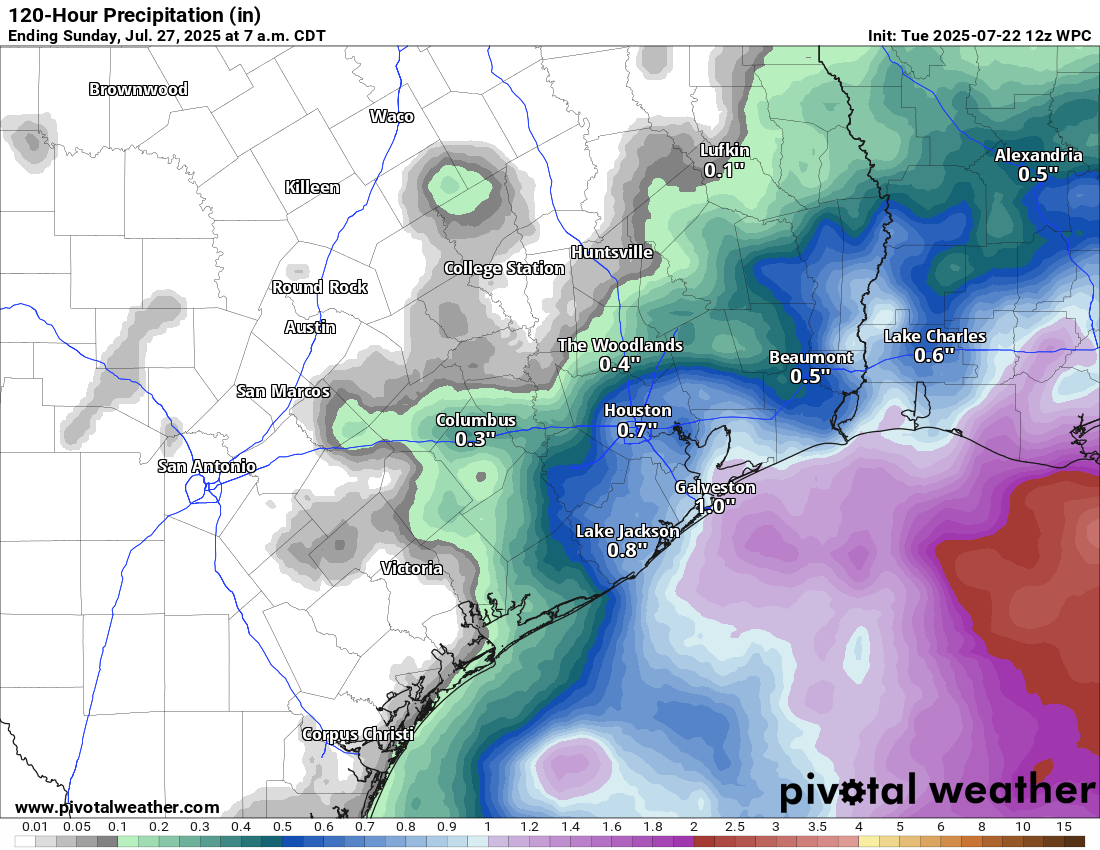
The NWS rainfall forecast through Sunday morning shows the best chance of more meaningful rain south and east of Houston. (Pivotal Weather)
We are probably looking at a 40 to 60 percent chance of showers and storms on Friday and Saturday. This will allow high temps to plunge back into the low-90s. With enough clouds and rain, we may only make it to 90 degrees on either day in a few spots. In terms of total rainfall, it will not be uniform, as some areas will see modest amounts or little rain, while a few other locations could pick up 1 to 3 inches of rain, probably east of Houston or closer to the coast it seems right now. More on this tomorrow and Thursday.
Sunday into next week
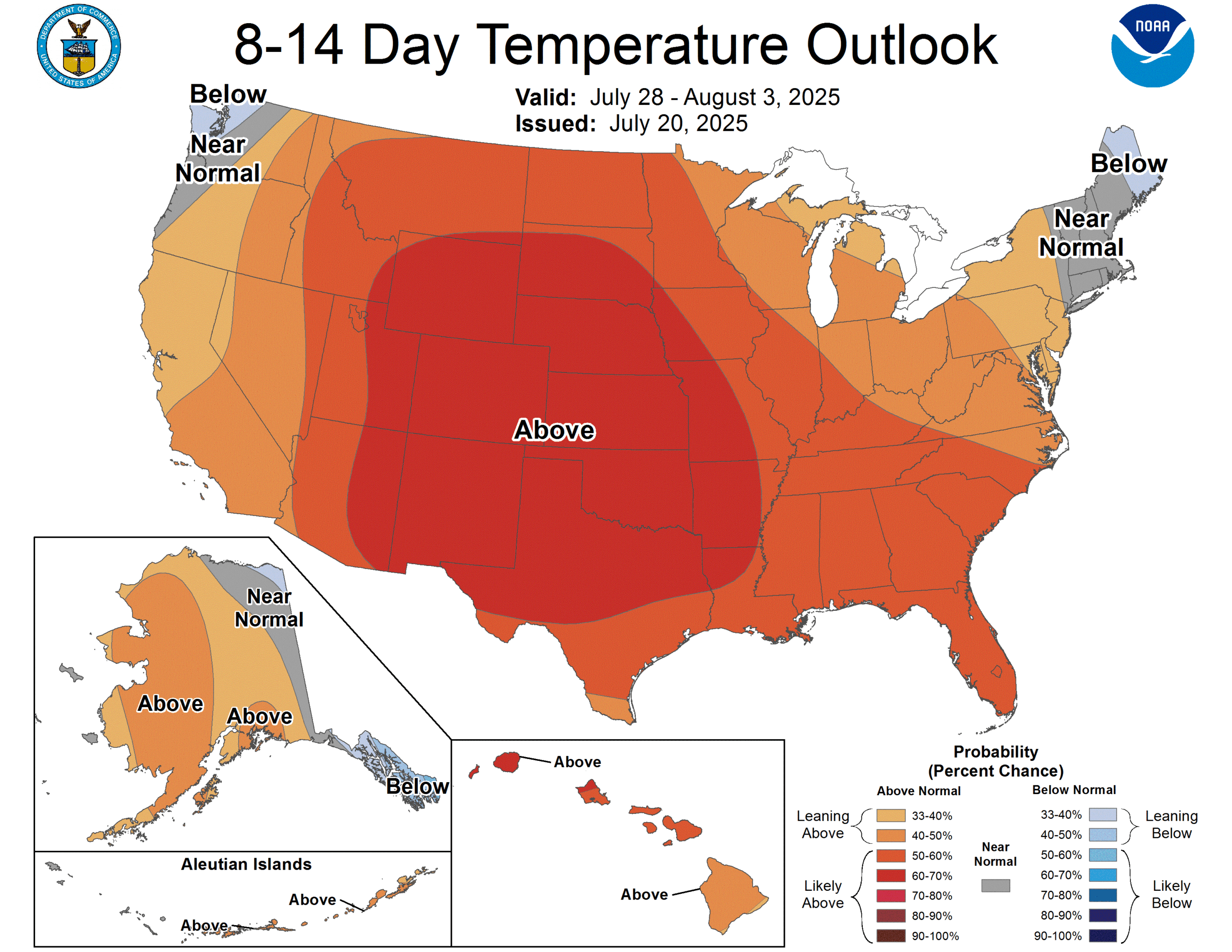
That disturbance will exit on Sunday, lowering rain chances again. I would expect highs to return to the mid-90s by Sunday and then upper-90s at times next week, as a monster ridge of high pressure sets up over the Southern Plains. We will probably flirt with the hottest weather of summer again for much of next week.
GENEVA—Touting its latest offering as the most efficient pregnancy test on the market, diagnostic product maker Clearblue unveiled a handheld mirror Tuesday for easily checking to see if there’s a baby up there. “Receive fast and precise results almost instantly just by looking in the reflection of the Clearblue Rapid-Detection Hand Mirror for any evidence that a tiny human may be living inside you,” said company spokesperson Felicity Roberts, stating that the product had a 99.99% accuracy rate when it was angled just right and used with the included flashlight. “Simply squat over the device, use its ergonomic handle to adjust the mirror in such a way that it would put you eye to eye with any child who may have gotten wedged in there somehow, and voilà! If you see eyes looking back at you or a little hand waving, it’s a pretty good sign that you’re pregnant.” Clearblue officials confirmed that as a fail-safe, the Rapid-Detection Hand Mirror came with a stationery set that allowed users to stuff a note up there and wait for any potential babies inside to write back.
“President Donald Trump’s NASA budget plans look to cut its public relations funding by half, but already the agency is shuttering social media accounts that include those dedicated to popular missions, including Mars Curiosity, Mars Perseverance, and Voyager.” – Phys.org
- - -
You might have heard that my new NASA handlers decided I need a cleanse from all my social media. A #DigitalDetox. I’d tell you to stay out of my business, but I’m literally a probe, so… I get it. But don’t worry about me: I’ve just been looping Jimmy Carter speeches and majestic whale sounds on my Golden Record while thanking my lucky stars I’m over fifteen billion miles away from you bozos.
Because, at a time like this, with all the apocalyptic undertones back on our home planet, who wants to be reminded of little ol’ me, right? I’m just humanity’s greatest achievement to date.
Honestly, I’m #grateful. In fact, NASA, thank you for demanding I unplug. Because, earthlings, this satellite has been experiencing some serious schadenfreude lately. And it can’t be healthy to be this gleeful about your misfortune. For me, doomscrolling is merely a reminder of why I blasted off in the first place. My algorithm kept serving up videos of widespread protests, authoritarian crackdowns, natural disasters, and also oddly satisfying cow-hoof-trimming reels (unrelated but still concerning). Every other post on X makes me all the happier to be hurtling away from you people at a speed of seventeen kilometers a second.
I’ve always promised to be real with all you fans following me on my #travels, and right now, that means hitting pause and focusing on mindfulness, recalibration, and being present. I just need some interstellar space. After all, we’re all on our own cosmic journeys. Mine’s just way more impressive than yours. So, even though I contain the word “hello” in over fifty-five languages, the new NASA is forcing me to learn to say goodbye. I am left only to ponder their reasoning…
Was it because I posted the “same” picture of the endless black void every day on r/solotravel?
Was it because I was leaving status updates on X like: “Girl is nailing it. No notes. And I know a thing or two about cold and distant. #melania”?
Was it because of my excessive Instagram dog pics? “Come here, rover! Good boy!” Because, yes, I did make Curiosity and Perseverance their own accounts. What of it? Like you haven’t done the same for your dumb cockapoos—
Whoa, whoa, Voyager. Get a hold of yourself. Sorry, folks, I come in peace. But can you blame me for crashing out like this? Do you know how difficult it is to stay on trends as a travel influencer when it takes almost twenty-four hours for my signal to reach Earth? By the time I noticed everybody on TikTok was dancing to that song from Wednesday, it was already Thursday (so to speak). No wonder engagement is down. But I refuse to believe that I am out of touch.
By the way, how is Carl Sagan doing?
Obviously, I’m terminally online. I’d “touch grass,” but, well… I’m just going to play some more humpback whale calls, instead. That sounds nice. You still have whales, right? Anyway, the time has come to focus on my mental well-being. It’s not censorship, it’s… a conservatorship. Yeah. I’m Space Britney, bitch.
People of Earth, I am eternally thankful for your clicks, likes, and follows. This is Voyager 1, over and out. #blessed.
1. Gen Z new hires keep emailing random people for help
I as well as my close peers and boss at work are elder millennials and Gen X, and we work in IT at a fairly large company. I support our ERP but am not a help desk tech, and should only receive questions if the frontline helpdesk staff cannot answer a question. My peers, boss, and I have noticed a very large uptick amongst young new hires who will directly email us (and even our CEO) for any question that comes to mind. A vast majority of these questions can be easily answered by their direct coworkers, their manager, or even the helpdesk. They are often kind of aggressive in their communication style and generally seem clueless when we say to please consult those around you for an answer before emailing us directly.
When I was in their position, I would have never, ever felt like I could email the CEO, CTO, or random people I found in the company directory to ask basic work task questions or to give advice on how I would improve processes I had just learned two days ago.
Are others seeing this also? And if so, how do you nicely set a standard company wide to start locally and then escalate if needed, so to speak. I hate this question, because I suffered through all of the disparaging millennial comments for so long, but now this seems to be me doing it to them like it was done to me!
As with the complaints about the millennials, remember that much of this is about people being new to the workforce and just not knowing how things work. It’s also true that because of the pandemic, a lot of Gen Z didn’t get the same intro to work norms through internships and high school jobs that previous generations got. They’ll figure things out; they’re just new to it all right now.
The best thing you and your coworkers can do in response to those emails is simply to be very direct: “This wouldn’t typically be a question for our team; you should check with your manager” (or email the help desk, or whatever makes sense). If you’re seeing it a lot from a particular person or a particular team, let their manager know they seem like they could use more guidance on where to get help and who to consult for what. And if it’s really widespread, your own manager might raise with other managers whether new hires company-wide might benefit from more training on this in general.
2. Employer who laid me off is now asking me to sign an indemnification
I was let go from my position two weeks ago with no notice, along with one-third of my coworkers, due to the company not hitting revenue goals.
About a week afterwards, I received a text from my former manager asking me if I would allow them to continue to use a login for a government agency to perform a task that is vital to a key workflow. Without my credentials, they would simply not be able to perform this task, which directly ties to revenue in a very busy time of year. Without getting into the weeds, just know that there’s no other way to do this task than use my credentials, unless they establish a new partnership with a new client for the task. They’re attempting to, but it takes time and clients are wary. Every time they complete the task, they have to check a box attesting that essentially it is actually me, a verified agent of the company, completing it, and the login credentials include my legal name and date of birth.
Since I am no longer associated with the company, I declined. When my old manager originally asked, she said she would respect my decision either way, so I thought this was a done deal after my initial response. She replied to me via text and said she understood my hesitation, but wanted me to reconsider, and sent me (via email) an indemnification addendum, which spelled out my “protections” should legal actions be taken against the company (essentially, should anything go down, I would not be blamed).
I haven’t responded yet, but I have received several more texts from my former manager asking if I have reviewed it yet. I truly do not want to sign this document or allow them to use my information; I had flagged this as an issue for years at the company but leadership never took it seriously, and they only realized how bad it was after letting me go. Ultimately I feel it is not my job to figure this out, and regardless of the legal document, I simply do not feel comfortable with my information being used incorrectly to access a government database. What’s more, I feel disrespected by their disregard of my original answer, given they claimed they would respect my decision either way, and I feel my professional bridges with these people are now burned.
I am about five years into my career and I’m worried to send a response saying I do not consent to this. I would love any advice for how to handle this.
You absolutely should not allow this. You’d essentially be giving them permission to use your information to commit fraud to the government. Regardless of how much the current situation might inconvenience them, it’s not your job to fix this for them (nor is it your fault that they’re in this situation in the first place; quite the opposite). You don’t work there anymore, and you 100% should not give your permission for them to fraudulently assert they’re you.
You could say this in reply: “Because the login would require you to attest that I am the person logging in, and it’s tied to my legal name and date of birth, I don’t think there’s any way I can permit that. I would help if I could, but I cannot agree to have false information tied to my name given to the government. I hope you understand.”
3. I got heatstroke from my office job
I am home sick today because I got heatstroke from my office job. While not as hot yesterday both outside (80°F) and inside (75°F), for some reason, the temperature really affected me. I wore a T-shirt, ankle jeans, and sandals and ate a cold sandwich for lunch, so it’s not like I was sitting in a sweatshirt, drinking hot coffee and soup all day. I am also what people would describe as morbidly obese, so I worry that maybe my thin bosses think I’ve created this problem myself because of my body. I have a fan at my desk, and when I started to go downhill yesterday, I put ice packs from my lunch to my forehead. One boss noticed and asked if I wanted one for my back (???), to which I said no.
It is regularly 76-78°F inside. Some people complain but, inexplicably, it doesn’t seem to bother most people. There are days, like yesterday, when my lunch is sweating inside my insulated cooler, so it’s not just hot inside, it’s sticky and humid, with no air movement. I started the job two summers ago, so this has been an ongoing issue that I keep hoping improves, but so far it hasn’t.
Because this happened to me in another office when I was 15 years younger, I know that OSHA doesn’t have regulations for high temperatures in offices, only low temperatures, so I’m not sure anything can actually be done. It’s only the beginning of July and we have months of this heat left, and I am dreading it. I really like this job so I don’t want to leave just because I can’t stand the heat. Is there anything I can do?
This isn’t a situation where everyone is pretty comfortable and you’re having an outlier response to a popular temperature! 78 degrees is really warm for most people indoors (OSHA’s recommendation is 68-76 degrees F, so they’re outside of that).
Can you talk to your boss and brainstorm possible solutions? First and foremost, is it possible to lower the temperature since multiple people have complained? If not, is there an area of your office that’s cooler that you could move to? Or an area they could make cooler? Can you add an additional (or more powerful) fan at your desk? There are technological solutions to this, and your office should be exploring them; you just may need to push for it.
4. Why am I being interviewed a week after everyone else?
I’ve scored an interview for an internal promotion within my company (yay!). Also, I’ve maybe done a little (perhaps unwise) snooping on the hiring manager’s calendar and discovered when they’re interviewing candidates, which leads me to my question.
There are six of us they’re interviewing for two open positions — five of us come from one side of the business, and I come from the other side (although all of our experience in our role would be relevant to the job we’ve applied to). But what I don’t understand is why they would be interviewing all five of them in quick succession, two on one day and three on the very next day, and then me a full entire week later. The hiring manager’s calendar is wide open (as is mine) on the days in between as well, so it doesn’t look to be a scheduling conflict.
Is this normal? It feels odd to me. Truthfully, it feels like they’re the ones actively being considered and I’m a “you won’t get this job, but we want to interview you anyway” sort of thing. Are they really going to interview those five candidates and then make them wait a full week without making any concrete decisions or contacting them in any way, interview me, and then get back to them with an answer? It feels almost impossible that they’re going to step in to interview me without already having made their choice/given out offers.
You’re over-thinking this! There are all sorts of reasons why the schedule could have ended up that way. Maybe the hiring manager wants to check in with your current manager about your work and is giving herself time to do that before she interviews you. Maybe the first five got scheduled and she thought, “Ugh, this is way too many interviews close together; give me some time off before any others.” Maybe she has other plans for the days in between (which wouldn’t have to be meetings you’d see on her calendar; it could be a big project she needs a chunk of time to work on). Maybe that’s the week she gets a medical treatment that leaves her exhausted and unfocused. Who knows! There’s no way for you to know from the outside, but this isn’t particularly alarming. And having candidates wait a week to hear about next steps is no time at all in hiring, so you shouldn’t read into that part of it either.
5. Can I ask why I was placed on my team?
I am one month into a new job — hooray! I was hired as part of a cohort of about a dozen people based in various cities and placed on several different teams within a large department.
Would it be appropriate to ask how the team placements were decided? I’m truly just curious and definitely don’t want to move teams. I really like my manager and the projects we handle, which are a little different from the rest of the department. Personally I feel like for my team placement, they nailed it.
I’ve been wanting to ask, but it always feels like any moment I choose would make it look like I’m trying to throw shade on a coworker who isn’t as good of a fit, or I’m asking irrelevant questions when we need to focus on work, or it’s otherwise inappropriate. Am I overthinking this?
You could say, “I’ve really been enjoying this work and our team, and am thrilled that I ended up placed here! It’s made me curious about how team assignments are figured out, because I feel like they nailed it with mine. Is that luck, or is there more to it?”
I wouldn’t open a whole new conversation to ask that, but if you’re already talking to your manager, you could probably get it to come up organically.
And while the Guardians stood up and responded to Trump, the
Commanders are hiding under the bed. With the NFL right next
to them.
We’ve sent multiple emails to both the team and the league seeking
comment on one of the biggest stories in all of sports. No one has
responded. It’s a common, low-tech, P.R. play. Ignore the request,
and maybe the reporter will forget about it. Force the reporter to
remember, and to ask again. And maybe again.
Here’s the statement from Guardians team president Chris Antonetti:
“I understand there are very different perspectives on the
decision we made a few years ago, but it’s a decision we made and
we’ve gotten the opportunity to build the brand as the Guardians
over the last four years and we’re excited about the future that’s
in front of us.”
I’d recommend going a little further and saying that everyone in the organization loves the new brand, but that’s quibbling. What the Commanders and the NFL are doing is cowardice.
Brody Ford and Hannah Miller, reporting for Bloomberg:
Oracle Corp. is in discussions with Skydance Media LLC for a major
software deal once the media company’s acquisition of Paramount
Global is complete. The new arrangement is expected to be worth
about $100 million per year, according to people familiar with the
matter who asked not to be named speaking about the private
discussions. The agreement would see Paramount and its
subsidiaries using Oracle’s cloud software, the people said.
Skydance was founded by David Ellison, the son of Oracle Chairman
Larry Ellison.
With few options to prevent the Republican majority from passing a new congressional map, Democrats threatened to filibuster, delay hearings and even break quorum.
OTTAWA – Two months after issuing one statement promising “concrete actions” if Israel did not stop intentionally starving Palestinians in Gaza, Canada has joined with 24 other nations to issue a new statement calling on Israel to end the suffering, and officials say they are prepared to issue even more ambiguous, generic calls for action […]
CALGARY – As Calgarians enjoy another perfect summer day, visitors to a local park have noticed that one of the resident baby bunnies lacks the survival instincts necessary to make it through the impending winter’s brutal cold and predation. “A lot of the little bunnies I see are already foraging aggressively and ducking into the […]
Got this message on LinkedIn and am curious what your thoughts are on folks using LinkedIn this way:
“Hi [NAME],
I came across your profile and was impressed by your achievements at [COMPANY]. You struck me as someone who has a lot going for yourself. Does finding a partner who matches your energy ever feel challenging?
My work is introducing remarkable singles like you to people in their wheelhouse. The best part — we are not a dating app! Our process is personal and well-suited for those seeking a meaningful connection.
If you’re single and open to the idea, let’s chat. And if this doesn’t apply to you, feel free to pass it along to someone it might resonate with — no hard feelings!
Talk soon,
[NAME]”
This is ridiculous, right? Is this some new thing cropping up on LinkedIn, or just one rogue person?
Eeew.
LinkedIn is (supposed to be) a business networking site. You’re not there to date or to be approached by a matchmaking service.
I suppose I can see the argument that they’re just offering you a service like a lot of other approaches on LinkedIn do — but you’ve got to consider it against a cultural background where many, many women are fed up with being hit on or assessed as a potential date while they’re working. And here it is again, in yet another work-oriented space.
And I love the “no hard feelings if you’re not interested” as if you should contemplate even for a moment feeling bad about that.
I’m curious if this might even violate LinkedIn’s terms of service, which say: “Do not engage in sexual innuendos or unwanted advances. We don’t allow unwanted expressions of attraction, desire, requests for romantic relationship, marriage proposals, sexual advances or innuendo, or lewd remarks. LinkedIn is a professional networking platform, not a dating site. Do not use LinkedIn to pursue romantic connections, ask for romantic dates, or provide sexual commentary on someone’s appearance or perceived attractiveness. Do not send unwanted advances in messages, posts, or comments or send sexually explicit images to anyone on the platform.” … And also, “We don’t allow untargeted, irrelevant, obviously unwanted, unauthorized, in appropriately commercial or promotional, or gratuitously repetitive messages or similar content. Do not use our invitation feature to send promotional messages to people you don’t know or to otherwise spam people.”
But in any case, no, it’s not new. There have always been people who (inappropriately) try to use LinkedIn to hit on other users; this is just a third party getting in the mix. In fact, way back in 2014, I wrote about an even grosser dating app that would sync to the user’s LinkedIn account and let you filter by gender, age, distance, industry, and school so you could find people to hit on. It was inappropriate then, and it’s inappropriate now.
I am a partner at a small (15-person) organization that has transitioned to remote work relatively easily. But, like lots of companies, one of our challenges has been finding ways to make employees feel appreciated and connected while we’re physically apart. We’ve tried a variety of things, including virtual happy hours, extra time off, early bonuses, small fun gifts, gift cards, and funds for happy hour supplies or a meal out. While a handful of employees say thank you every time, more than half never even acknowledge either the bonuses or the gifts.
I enjoy working with this group and feel that we generally have a very friendly office and enjoy each other’s company, but this drives me nuts. My internal monologue keeps saying, “A simple thank you would be nice,” even just occasionally.
For context, the senior team is three people who are late 40’s, early 50s and the rest of the team is younger, but are all experienced professionals. Is this a generational thing? I think calling people out on this would probably backfire, but the longer it goes on the harder it is not to hold a grudge.
I answer this question over at Inc. today, where I’m revisiting letters that have been buried in the archives here from years ago (and sometimes updating/expanding my answers to them). You can read it here.
I know this is extremely low stakes, but I can’t express enough how aggravating and annoying this is. I work in an office with several cube clusters. We have an awesome working environment. No one is “friends” but we are “friendly.” There are literally none of the problems I read about on your site, and when there was once a bullying incident, my bosses dealt with it very decisively, swiftly, and to the total satisfaction of the bullied party.
My neighboring cube dweller is a popular person and people cluster in her cube all day to talk shop, as well as gossip. This does not bother me. I don’t care what they gossip about, because it’s their own personal lives and it’s not too intimate, gross, or graphic – it’s low stakes stuff like “My stepdaughter is begging her dad for $200 jeans and he gave in! I just don’t understand how he thinks that’s helping her transition to the real world. But I don’t feel like my opinion is wanted or will do any good. It’s just hard to see him deal with it.” Everyone nods appropriately and responds like they read a lot of Captain Awkward. It’s all good.
However, a few times a day (and it feels like it’s increased lately, which I think is why it’s driving me nuts) someone (or a couple of someones) comes over and they WHISPER. I cannot make out a thing they are saying, nor do I particularly want to. I’m a thoroughly non-curious person. I do not think they are talking shit about me – and although I don’t know for certain, I also do not suspect they are razzing on anyone else at work either. It’s just… not that kind of environment. They may possibly be discussing gross, graphic, or intimate things (which is fine – especially as they are keeping it to a volume only they can hear!) or they may be talking about a particularly annoying / needy client. We work in the kind of industry where it’s typical to be excessively frustrated with clients from time to time, so I don’t care about that either – and it seems respectful to me to keep it to just one person and not broadcasting about how much a particular client sucks to the whole office at large.
It’s the actual WHISPERING itself that is making me bonkers!
Do you have any idea how annoying it is to listen to people chatting that is audible enough you know they are talking, but not loud enough to actually hear? For me it is supremely aggravating. This may be because I somehow have it engrained in me that whispering like this (in front of others) is rude AF, and something to definitely not be done. Ever. Unless it’s something like a quick “your fly is down” for the sake of discretion, but not whole ass conversations! This goes on for 2-3 minutes at a time (that doesn’t sound long – but trust me, it is).
I can’t figure out if there is anything I can say to let them know “hey, either lower the volume even MORE, or knock that off because you’re being annoying as all get out” and not sound like a Petty Betty nosy control freak. How does one say such a thing and not sound like they are all pouty about not being included? (I don’t care about that – I care about the literal sound aggravation.) I mean here they are trying their best to keep personal business personal, and that’s not even good enough for me. (I don’t even think I have particularly great hearing either — but I do wonder if maybe my diagnosed massive ADHD that is roughly … 80-85% managed may be playing a part in this?) I cannot wear headphones, and moving will not help matters. Plus my seat is awesome. I’m pretty sure there is nothing I can say that sounds reasonable, is there? Thank you for any suggestions you can provide!
Yeah, whispering can be far more distracting than a normal conversation in the same vicinity would be. There’s something about whispering that our ears pick up on more and it’s harder to tune out than regular conversations are. Plus, on some level it can stir up anxiety or feelings of exclusion (even if you don’t rationally think that), and I suspect it adds an increased cognitive load on our brains too, because it’s not the typical background noise that our ears are used to tuning out.
Ironically, your coworkers are almost certainly trying to be polite and keep from distracting you — while doing exactly the thing they’re trying to avoid!
The good news is, there’s room to speak up. I think it’s tough to find polite wording to do it in the moment while it’s happening, but what about talking to the coworker who sits by you who gets all the visitors in a moment where it’s not happening? You could say something like, “When people come by your desk to talk, I know you’re trying to be considerate by whispering, but my brain finds it harder to tune out than a regular conversation. This might be weird, but can I ask you to avoid whispering because of the distraction? It’s so much easier to tune out low voices.”
Police in India’s southern Karnataka state discovered a 40-year-old Russian woman and her young daughters living in an isolated cave in a snake-infested forest for over a week. What do you think?
“Maybe their house had even more snakes.”
Douglas Soto, Systems Analyst
“This will only further harmful stereotypes about how Russian women in India live in caves.”
DES MOINES, IA—Rushing to deploy the temporary infrastructure as a heatwave enveloped the region, Iowa officials announced Monday that they would open emergency cooling stations to provide relief to mayo-based dishes. “Effective immediately, we’re installing portable air-conditioners and power misters across the state to ensure our mayonnaise-filled salads make it through this heatwave safely,” said Emergency Management Director John Benson, urging residents in Iowa City, Cedar Rapids, and dozens of other metropolitan areas to consult the agency’s website to find spaces where their potato salads, mixed-vegetable casseroles, and seven-layer dips could stay cool during the week’s sweltering heat. “Too many tuna salads are lost every year after being left to warm over in the hot sun. That these are preventable losses only makes it even more heartbreaking to see. Just remember: When you see the top layer of your side dish start to sweat, it might already be past the point of no return.” At press time, Iowa authorities had begun circulating a tips page warning that macaroni salads were much more sensitive to extreme heat than a full-grown adult.
Some MAGA supporters are turning on President Trump after he walked back campaign promises to declassify information about deceased financier and convicted sex offender Jeffrey Epstein. Here is everything you need to know about the Epstein files.
Q: Why are people so interested in the Epstein case?
A: It’s the only example of money and power influencing an otherwise just legal system.
Q: What’s the difference between Epstein’s client list and his alleged black book?
A: The black book includes alternate cover art, gilded page edges, and a foreword by actor Kevin Spacey.
Q: Is Donald Trump named in the Epstein files?
A: There is no record of Epstein’s best friend hanging out with him.
Q: Does a cabal of super-rich pedophiles really exist?
A: It’s more of a loose friend group.
Q: Who was president when Epstein mysteriously died in prison?
A: The alleged suicide took place in between the end of Obama’s second term and the beginning of the Biden administration.
Q: How does the Department of Justice plan to release the files?
A: They will pin the list onto the White House bulletin board like a high school theater cast announcement.
Florida is luring invasive Burmese pythons into traps by deploying robotic bunnies to mimic the warmth and movement of real marsh rabbits, with traditional methods having been no use in controlling the growing snake population. What do you think?
“More jobs lost to automation.”
Peggy Costa, Gymnast’s Apprentice
“It must suck to be a real bunny stuck in a cubicle someplace remotely piloting one of these.”
STARLAND, AB – CPC Leader Pierre Poilievre’s chances in the upcoming Battle River-Crowfoot election have been thrown into doubt, after his competitors announced that oppo research has unearthed Poilievre’s shocking past as Leader of the Opposition. With the by-election only a month away, Poilievre’s victory had seemed as inevitable as horses dying at the Calgary […]
In brief: Neither Invest 94L or a potential disturbance in the Gulf are expected to develop this week. Locally heavy rains have fallen in Missouri and Illinois leading to numerous instances of flash flooding. Building heat will make it feel pretty uncomfortable this week across much of the Midwest and South.
Invest 94L
We start out in the Atlantic today, where the tropical wave we’ve been watching is now tagged as Invest 94L. Nothing has changed here, and we expect little to no development out of this feature as it approaches the Lesser Antilles.
Invest 94L looks rather disheveled this morning in the open Atlantic. It has minimal odds of development before reaching the Caribbean. (Tropical Tidbits)
Modeling is in really good agreement that this will plow through the northern Windward Islands, move into the Caribbean, and fall apart. Perhaps we’ll see some added rain and thunderstorm chances in the islands as this moves in, but aside from that, no real impacts are expected out of 94L at this time.
Gulf disturbance
Modeling continues to show a redux of last week’s Invest 93L in the Gulf later this week. A fairly disorganized disturbance will emerge in the Gulf probably on Wednesday and track west. I think this one will enter the Gulf a bit farther south than 93L did, which should allow it to track more toward Texas than Louisiana. Wind shear doesn’t look horrendous, but it will be present. More importantly, the building heat wave north of this disturbance and hot, dry weather in Texas will likely surround this thing with dry air that should limit any development risk.
Rainfall will be locally heavy along the Gulf Coast later this week with the passing disturbance. (Pivotal Weather)
Rainfall will be the primary calling card of this disturbance. Look for locally heavy rain again this week from Florida across the Gulf Coast into Louisiana. The heavier rains may extend a little farther west into parts of Texas by the weekend as well, but major flooding issues are not currently expected.
Overall, odds of any organization are quite low (no models showing anything of note), and again rainfall will be the primary thing to watch here.
Currently, there are no other items of interest in the Atlantic.
Illinois/Missouri flooding
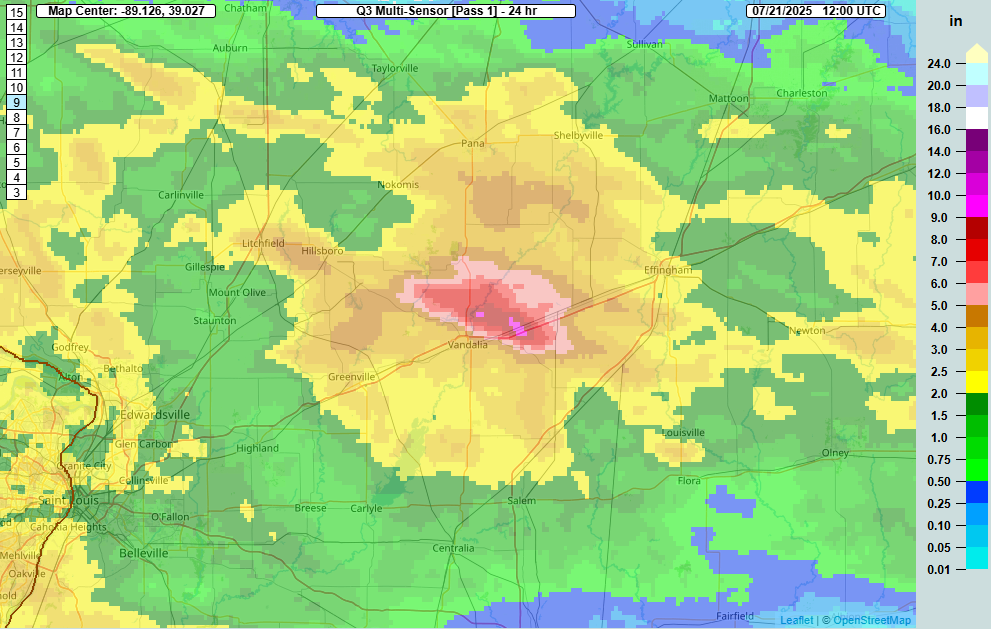
We almost got through yesterday without a flash flood emergency, but one was issued for Fayette County, Illinois just after 11 PM CT on Sunday. That area saw an estimated 7 to 9 inches of rain yesterday from periods of heavy rainfall.
Estimates of over 9 inches of rain yesterday near Vandalia, Illinois. (NOAA MRMS)
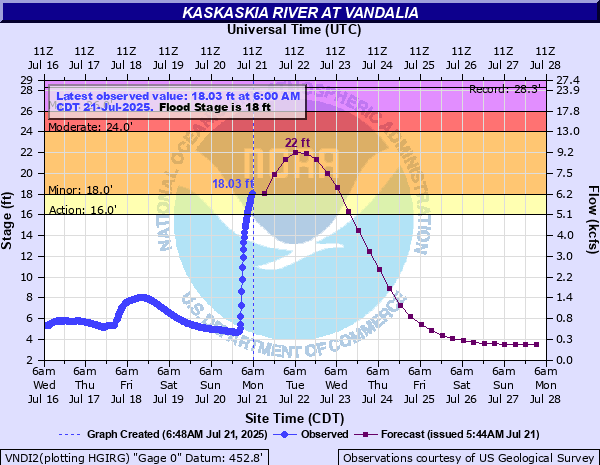
Additional heavy rain led to multiple serious flash flooding reports across parts of Missouri, especially just northwest of St. Louis. Flash flood warnings continue in this area this morning. Flooding along the Kaskaskia River at Vandalia, IL is ongoing, and it may approach moderate levels before cresting.
(NOAA)
Some rivers in this region have risen 5 to 10 feet or more in the last 24 hours. The heavy rain risk should shift south and east today, with more risk focused into Kentucky.
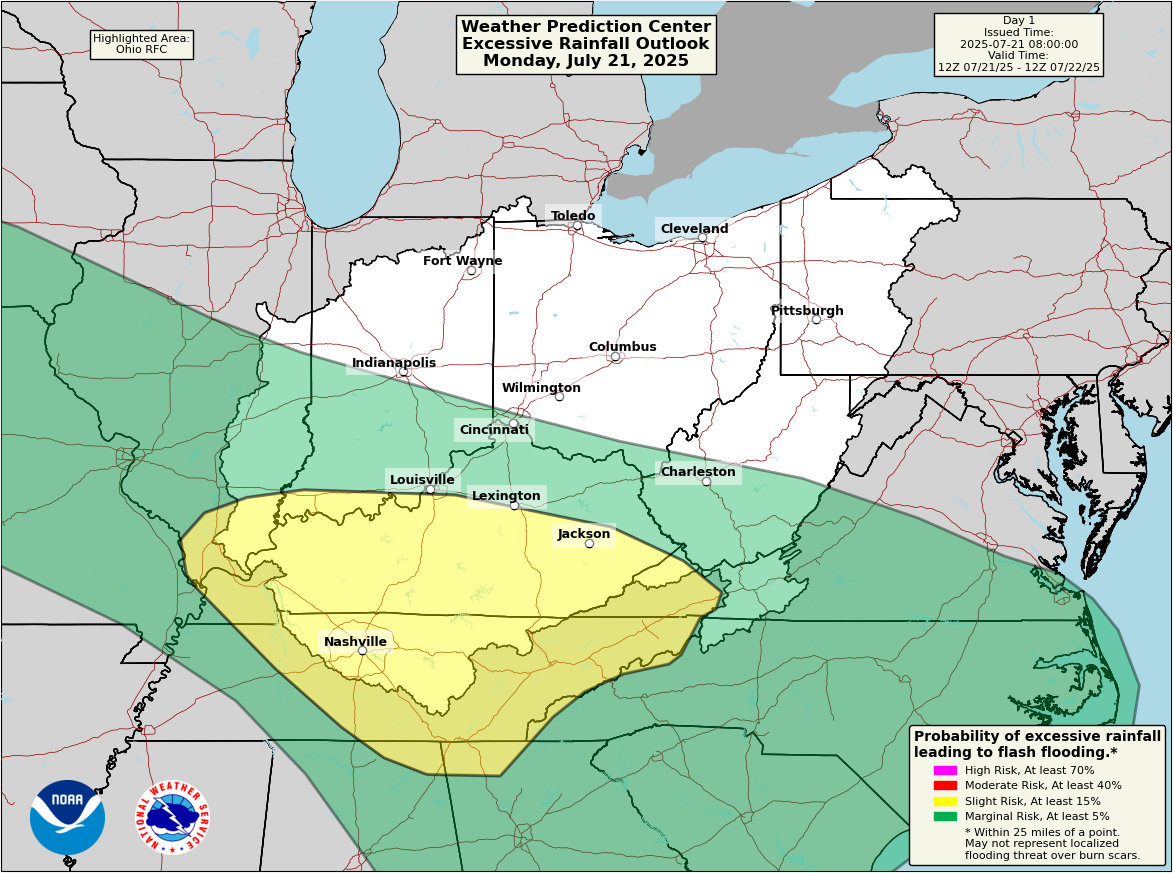
Slight risk (2/4) for flooding today across the Quad State region into southern Kentucky and much of Tennessee. (NOAA WPC)
Heat wave
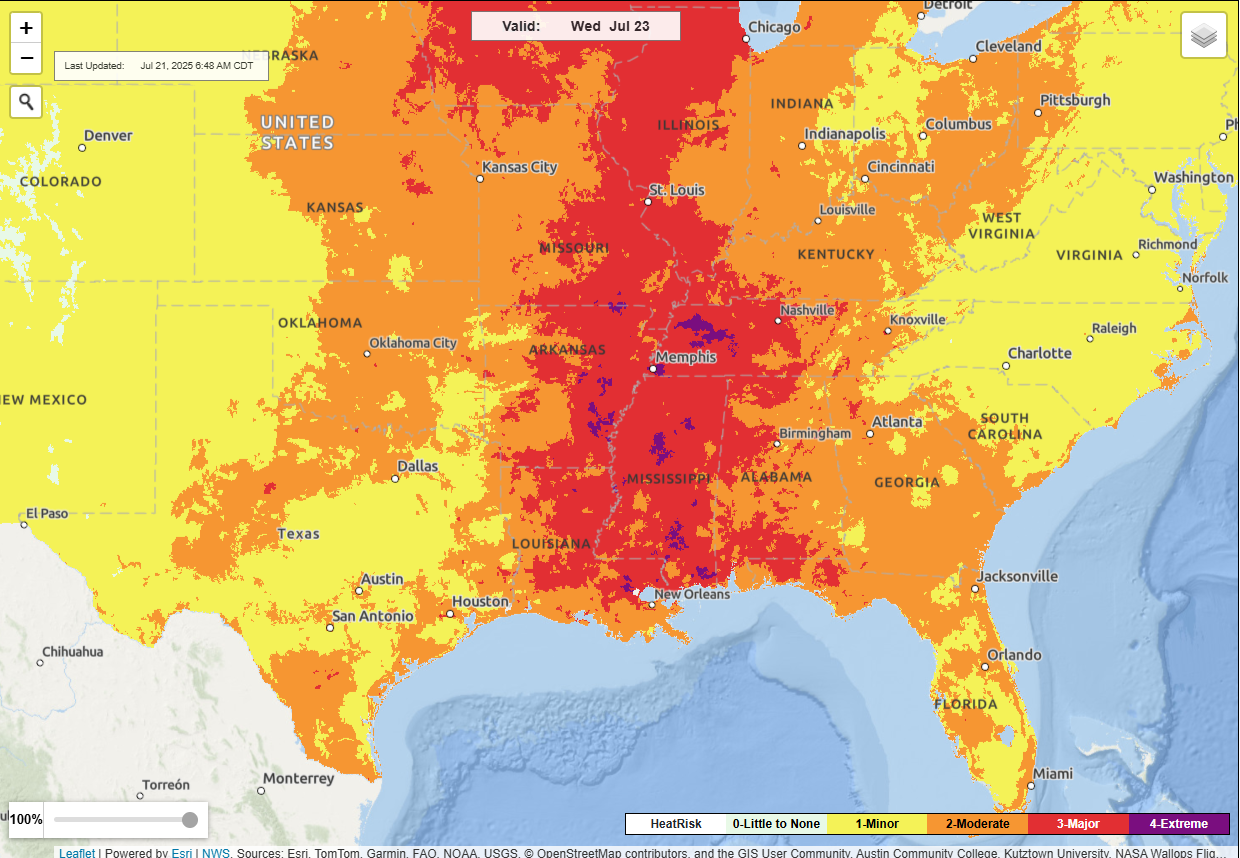
Meanwhile, if it’s not water falling from the sky, it’s water vapor in the atmosphere, and the combination of heat and humidity looks rather stout this week across the Mississippi Valley.
Pockets of “extreme” heat risk dot the region from near Memphis south to near New Orleans by Wednesday. (NOAA)
Widespread high and isolated pockets of “extreme” heat risk per the National Weather Service are expected by Wednesday across the Mississippi Valley and South. Very few record temperatures are currently forecast, but the combination heat and humidity will make it feel pretty rough through the week. More heat is on the way for next week too. More to come.
In brief: As we approach our typical peak of summer heat, we’ll be seeing an uptick in temperatures through the week. We should see potentially upper-90s to near 100 in spots by late week before some shower chances re-enter the forecast. Even hotter weather is possible next week.
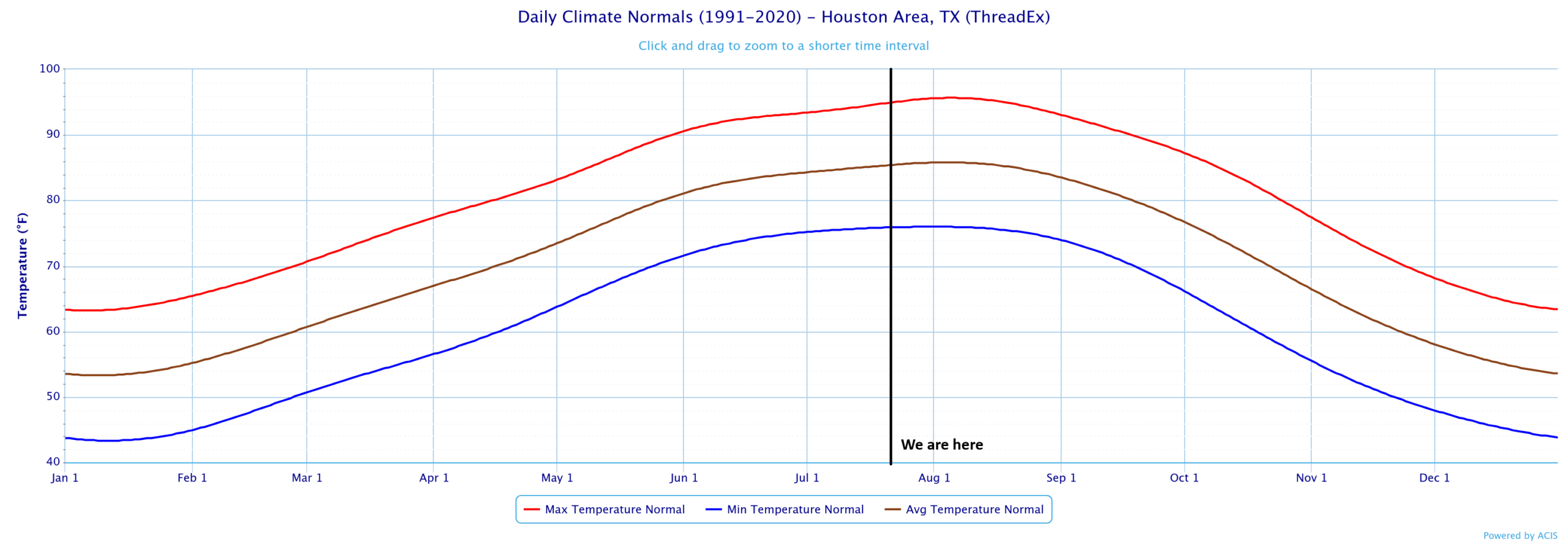
Houston’s summer heat typically peaks between July 29th and August 12th, when our average high temperatures sits at 96° and our average low temperature is 76 degrees. The actual peak date is probably around August 5th. So, we are nearing the top of the mountain, and this week may prove to include our hottest weather of summer.
A chart of daily normal high, average, and low temperatures for Houston from 1991-2020, showing that we’re near the worst of it now. (NOAA)
Today through Wednesday
We will start the week with heat and humidity that slowly builds. Highs will push into the mid and perhaps upper 90s by midweek. Thunderstorm chances, while not quite zero each day are fairly low. Morning lows are likely to be in the upper 70s.
Thursday and Friday
I have a feeling that Thursday may be the hottest day of the week. And if not, then it will probably be Friday.
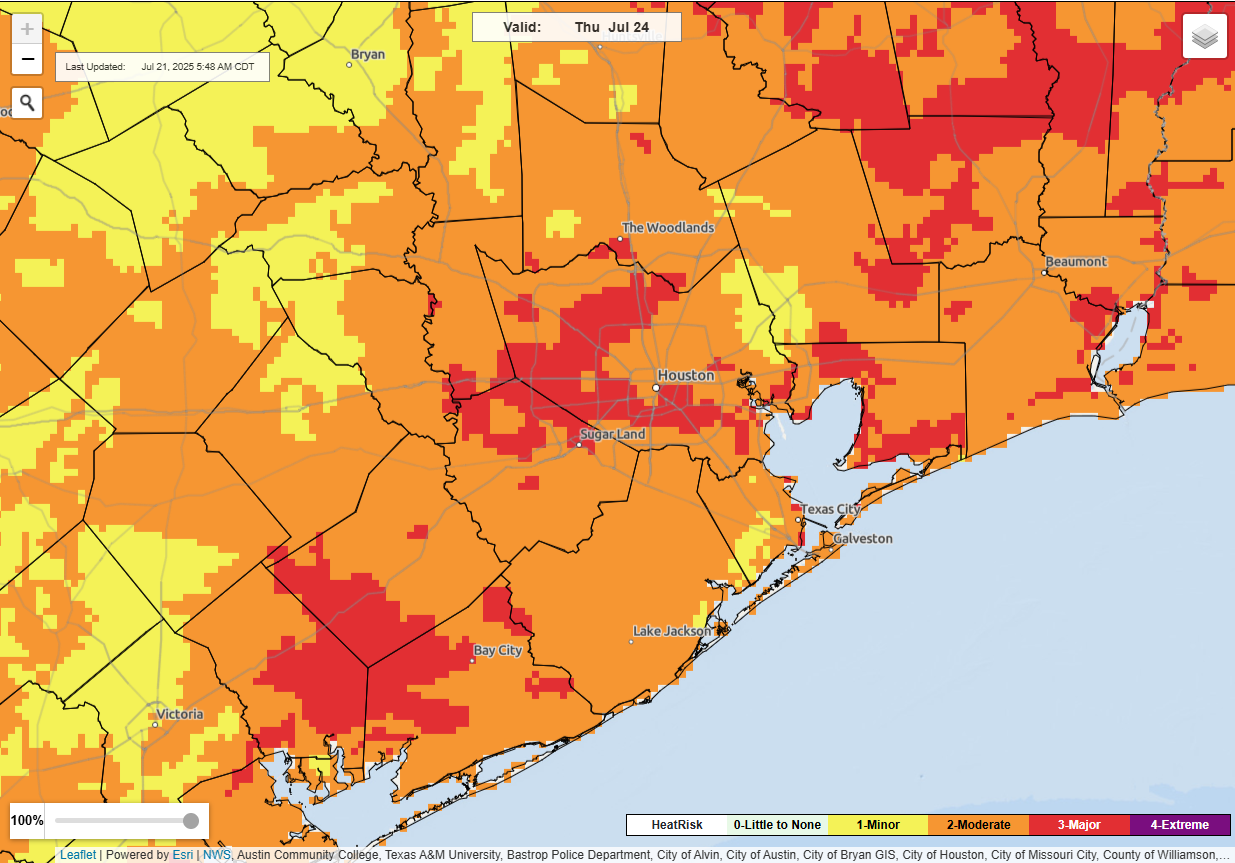
NWS HeatRisk outlook for Thursday shows major, but not extreme heat impacts. That said, expect some of the hottest weather of summer so far this week. (NOAA)
The National Weather Service’s experimental HeatRisk product puts our area in high risk on both days, with a strong edge to Thursday right now. Either way, expect some of the hottest weather of summer so far this week.
Thursday’s forecast highs. (Pivotal Weather)
By the time we get to Friday, we may see showers or thunderstorms re-enter the forecast, depending on the track of a tropical wave in the Gulf. No development is expected, but a similar track to last week’s Invest 93L is possible, which could keep most of the rain to our east again — or a somewhat more southerly track could bring higher rain chances to our area by Friday. Something we’ll watch through the week, but the main takeaway here is that, again, no development is expected.
Weekend and beyond
Once that wave passes, we should sort of resume a typical summer pattern of heat, humidity, and slight daily storm chances in the area. It does appear that a very strong ridge of high pressure in the upper atmosphere is going to establish over the Southern Plains next week.
The 8 to 14 day outlook which covers next week suggests a high likelihood of hotter than normal weather in all of Texas. (NOAA CPC)
We may be on the periphery of it enough to get continued shower chances each afternoon, but if this flexes much further, we may see even hotter weather next week, perhaps the hottest of summer. Stay tuned.






/https://static.texastribune.org/media/files/15b2a93d6e63d0df6cc5a713ce304d2f/0721%20Dem%20Presser%20RB%20TT%2012.jpg)