Shared posts

30 Jul 12:10

can I drop out of a leadership program I hate, is prohibiting beards discrimination, and more

by Ask a Manager

It’s five answers to five questions. Here we go…

1. Can I drop out of a leadership program that’s the opposite of what I want?

I was nominated to join a leadership program at my company by my department’s management team. When I was told about the nomination by my manager, he emphasized how great this opportunity was for me.

At face value, I had some reservations: I cannot stress how little ambition I have. I have zero interest in any sort of management role (people or project), and I think I’d choose the acid bath over a networking event. But my manager was excited and since I had previously expressed my lack of interest in management (and also I thought expressed my general unsociable nature), I thought this thing couldn’t be all that bad.

The introduction meeting happened the other day and I am reeling. The whole program is based around proactive networking. It seemed like most of the others in this program are the bubbly, assertive types. Very eager to chit chat, very happy to play host for events, very bend over backwards to express how excited they are. That is just not and could never be me. I have a very small social battery I like to preserve for outside of work. I just want to do my job, make enough money for a roof over my and my cats’ heads, and pay for my silly little vices.

I don’t know what to do. I feel like my manager should know that this is a total clash with my personality, but he signed me up for this. I’m afraid of disappointing him, but I’m also thinking to protect my peace I need to tell him something. Can I outright request to not participate in this program? And … how do I do that?

You can probably drop out, but there’s likely to be some cost to doing it after you’ve already started. There could be some exceptions to this; I’ve had bosses where I could have said, “Thanks for thinking of me for this but after attending the first class it’s clear it’s very much not for me” and it would have been fine. But unless you know for sure that you have that type of relationship with your boss, dropping out does have some political risk.

Can you go back to your boss and ask what made him want to nominate you for the program? You could say that so far it seems out of sync with the interests you’ve talked about with him and so you’re curious to hear his thinking, and then hear him out with an open mind. I do worry that it’ll turn out that it’s because he knows you don’t like this stuff that he thought it would be “good for you” … but who knows, maybe there’s more to it than that.

As for what to do after that, weigh how much of a pain it’s really going to be. If it’s just sitting through a few annoying classes, it’s probably worth sucking it up and getting through it. But if it’s going to demand significantly more from you(like if you’re going to have to organize events, go to networking stuff, etc.), there’s more of an argument for considering spending some capital on opting out.

2. Is it OK that I don’t work while I’m on a pumping break?

I had my first baby and came back to work about three months ago. I’m breastfeeding, so I take 20-30 minutes two or three times per day to pump. I try to schedule my sessions around meetings and other job duties. If there’s a meeting I can’t miss I’ll call in or I’ll bring my laptop into the pumping room to work on a project, but most of the time I read or play games on my phone. I’m wondering if it’s okay to use my pumping sessions as also a sort of break. I’m willing to do what needs to get done, but we’re also in a slow season and I don’t like working while pumping! Pumping is work, and not nearly as nice as actually feeding my baby at home. (I am also slightly resentful that my company revoked our two WFH days right before I went on parental leave, so now I have to drive in and pump five days/week.) Can you please give me and all other pumping parents permission to chill out guilt-free for a bit while we work to feed our kiddos?

(The only reason I wouldn’t be pumping while working at home is that my partner works four 10-hour shifts, including one weekend day, so he is home with the baby those two days I’m now required to be in the office.)

You can indeed continue what you’re doing, guilt-free. The law gives you breaks to pump and they are truly breaks, not just time when you’re supposed to keep working while hooked up to a machine. Plus, a lot of people who pump find they can’t pump successfully if they’re trying to work at the same time; some women need to look at a photo of their baby or otherwise relax in order to express milk. It’s fine to make it a real break from work.

3. Is prohibiting beards discrimination?

I’m curious about the Army and Marines removing the exemption to a standard for men’s grooming which had allowed men who couldn’t shave daily for medical reasons a waiver in which they could grow a short, neat beard. Obviously, they’d have to shave more regularly for operational duties, like if they were wearing gas masks, scuba masks, or any other equipment requiring a tight seal on the face. Since this rule disproportionately affects Black men, 45% of whom currently have this waiver compared to 3% of white men, I would think this would be an easy, and blatant, example of workplace discrimination. Am I right?

In theory, yes. The EEOC has found repeatedly that to comply with the Americans with Disabilities Act, employers must make exceptions to shaving policies for people who suffer from pseudofolliculitis barbae (which is common among black men and causes razor bumps that are at high risk for infection). The only exception is if there are clear safety reasons not to and even then they need to explore other accommodations if possible, such as changes in duties.

The protections for employees in Title VII don’t extend to uniformed members of the armed forces, so legally they can probably do this … but the choice is pretty revealing.

4. How important is volunteer work on a resume?

I used to volunteer with a local organization, but after the organization made some changes, that volunteer role was no longer needed. Since then, I lead a small local hobby group, but I don’t have any current volunteer positions with larger, more established organizations, and I’m not on any boards. Outside of that hobby group, I fill my spare time with solo hobbies like cooking, reading, and exercising, casual get-togethers with friends and family, and I’m also in a couple of book clubs. I feel fulfilled!

But will employers be looking for stronger evidence of leadership in my spare time when they look at my resume? I’m in a relatively senior role, so I’m wondering if that makes it more important.

For the vast majority of jobs, including senior ones, it’s absolutely fine not to include volunteer work on your resume. It can be a plus if you have it — especially if the work relates in some way to the job you’re applying for or showcases an ability that your paid job history is light on, but it’s not going to be a problem if you don’t have it. (Frankly, most people don’t do volunteer work; that’s more the norm than not.) There are a small number of jobs where demonstrating community involvement is more important, particularly C-level roles, but you’d almost certainly know if you were in one of them.

5. Layoff limbo: should I job search now if it means not getting severance?

I feel semi-stuck in a layoff limbo. My employer has been acquired by another company, but the transaction won’t happen for another 6-12 months. While management has been trying to be as transparent as possible, they obviously aren’t telling us yet if layoffs will happen, when, and what percentage of the workforce will be laid off in the acquisition process. I enjoy my job, I have a decent manager who lets me be autonomous, and I work fully remote. The best job in the world? No, but my workload is manageable, and I have no grievances to air.

However, with the uncertain future looming, I’ve been browsing LinkedIn job openings and do see a half dozen positions that I’d be eligible for that would also include a nice pay raise (20-50%). However, I don’t necessarily want to leave my current position if 1) it’s not getting eliminated, or 2) if it does end up getting eliminated and I’m eligible for severance pay. Obviously, severance packages haven’t even been discussed yet, so who knows if it’d be a flat amount, one week for every year of employment, or one month for every year of employment (I’d be shocked if it was as generous as that, but hey, I can dream). Multiple employers frequently hire for my position, so I really don’t have any fear of not finding a new job quickly. A fully remote job with a huge pay bump and interesting work? Maybe not. But I am fortunate and confident enough that I could find a quick lateral move nonetheless.

I feel stuck in limbo, though, because I may have up to 12 months for this process to take place. Do I just keep my head down and wait to see if I’m retained or laid off? Do I job hunt leisurely now and try to get a more lucrative and enticing job but risk not getting a severence package? Or do I wait until I know I’m getting laid off and then potentially having to accept the first okay job that falls into my lap? I feel like it’s probably the leisurely job search option, but I don’t want “job-hunter’s remorse” if I could have stayed in my position or gotten severence pay before jumping off the acquired ship. What advice do you have? Have any readers regretted leaving a job before being potentially laid off?

Start a leisurely search now. It’s extremely unlikely that severance would be as high as a month for every year of employment; one week, or maybe two weeks, per year is more typical, and it could be less than that. If the choice is between (a) a great new job with a good manager, remote work, and other benefits you want, but no severance or (b) severance but a more middling job with a problematic managers and inferior benefits … the first option is better, and is likely to improve your day-to-day quality of life for a longer period of time.

A leisurely search means you don’t need to take anything unless it really seems worth forgoing severance — but it’s smart to get a head start on looking around so that you can be picky about what you take.

The post can I drop out of a leadership program I hate, is prohibiting beards discrimination, and more appeared first on Ask a Manager.

30 Jul 12:05

Waco construction worker was detained by ICE. His employer says he has legal status to work.

by Sam Shaw

Noe Guerrero, a Waco construction worker and father of three, was seized by ICE on Thursday for allegedly failing to carry immigration documents.

The post Waco construction worker was detained by ICE. His employer says he has legal status to work. appeared first on The Waco Bridge.

30 Jul 02:45

Foxes in Love

Added by @bye in Arts & Design › Web comics.

30 Jul 01:39

A “reputation”

by John Allison

The last panel is my favourite panel I have drawn this year.

The post A “reputation” appeared first on Bad Machinery.

30 Jul 01:37

#Ryo #RoninWarriors

29 Jul 20:44

‘Quishing’ QR Code Scams Dupe Millions

by The Onion Staff

QR‑code phishing or “quishing” scams are on the rise, with malicious codes intended to trick users into divulging personal data or downloading malware. What do you think?

“I miss the simple days of someone stabbing me for my wallet.”

Chuck Milhorne, Beard Stylist

“Nice, I hate typing in scam URLs.”

Pam Kopp, Hourglass Filler

“The humble barcode would never betray us like this.”

Jason Shaper, Systems Analyst

The post ‘Quishing’ QR Code Scams Dupe Millions appeared first on The Onion.

29 Jul 20:44

I’m Starting to Think Grundle the Swamp Monster May Never Drain the Swamp

by Carlos Greaves

It’s been six months since The Elder was exiled and control of the village was put back into capable and trustworthy hands. And yet the haunted swamp at the outskirts of the village remains as dark and impenetrable as ever. As a concerned villager, I can’t help but wonder if Grundle the Swamp Monster may never drain the swamp like he promised us he would.

When Grundle first approached the village with his plan to drain the swamp in exchange for complete and total rule over the villagers, I couldn’t have been more excited. Sure, I was a little surprised, given that Grundle frequently cavorted with all of the foulest creatures in the swamp, including the notorious Bog-Fiend. If anything, when I thought “swamp,” I thought “Grundle.”

But Grundle insisted that he wasn’t like those other swamp creatures—he was a monster of the people—and when he promised to build a wall around the village, and lock up The Crone (whose husband everyone was pretty sure was secretly friends with the Bog-Fiend), I immediately got on board.

“Who better to protect the village from swamp monsters than a swamp monster?” I reasoned. After all, it was Grundle who warned us that children were being kidnapped and taken to the swamp through a secret tunnel in the basement of the village bakery. Even though that turned out not to be correct, his concern for our kids was proof enough that we could trust him. Though, in hindsight, we should have checked to make sure the tunnel was actually there before we impaled the baker with a pitchfork and left his corpse to rot in the middle of the town square.

Now, Grundle is back in charge (his exile was a total sham) but the swamp still hasn’t been drained. Even worse, he and his trusted advisor, the Marsh Witch, won’t even drain Bog-Fiend Bayou, where the most malevolent of the late Bog-Fiend’s associates are thought to be holed up.

I hate to say it, but part of me thinks that Grundle might be hiding something behind those kind, bright yellow, vertical-pupiled eyes that he’s so fond of licking.

I’ll admit that, during Grundle’s first reign, there were things he could have done better. After all, no slime-covered, fourteen-foot swamp-thing is perfect. He never built the wall, or locked up the crone. And when he led the Bog Upsiring that nearly caused the entire village to burn to the ground, I felt he’d maybe gone a step too far.

But I was sure that, as soon as he came back into power, he would expose the cabal of cryptids and bring peace to the village. Now I’m beginning to suspect that Grundle has no interest in converting that marshland into farmland, which has me thinking the unthinkable: What if Grundle only wants to rule over the village so that we’ll continue supplicating him by tossing baby goats directly into his gaping maw? What if all of his gleeful howls have been nothing more than empty promises?

Grundle’s deafening silence on the Bog-Fiend’s mysterious death (The Bog-Fiend drowning? In his own swamp? Give me a break) is making me question everything. And for the first time in my life, I’m not convinced The Crone and The Elder are exclusively to blame.

When the blacksmith was found slashed to pieces, and we had to start buying our horseshoes from the next village over, I blamed The Crone and The Elder for not keeping him safe from what, by the looks of the claw marks, was a roughly fourteen-foot tall swamp thing.

When the village’s cistern was destroyed by some large, slimy creature smashing it apart, I blamed The Crone and The Elder for proposing needlessly expensive resiliency measures designed to prevent it from happening again.

And when the baker’s wife refused to sell us bread until everyone apologized for impaling her husband with a pitchfork and leaving his corpse to rot in the middle of the town square, I blamed The Crone and The Elder for teaching a woman it was okay to speak her mind.

But now I’m not so sure it’s all their fault. Maybe they’re right that draining the swamp won’t magically solve all our problems. Maybe they’re right when they say that, while the swamp is smelly and awful, it’s also a vital ecosystem. And that, if we all work together, we can drive out the monsters and have a swamp that works for everyone.

Then again, The Elder could’ve easily drained Bog-Fiend Bayou himself. Clearly there’s something shady going on.

29 Jul 20:43

A chicken for The New York Times, a star for Bloomberg: A new “Media Capitulation Index” ranks large media and tech companies

by Sophie Culpepper

What’s the best scale for measuring independence — or lack thereof — in 2025?

The media advocacy group Free Press (not to be confused with the Bari Weiss publication by the same name) decided the answer was “chickens.”

The organization’s pointed new “Media Capitulation Index,” out Tuesday, ranks the 35 largest commercial media and tech companies on a scale from one to five chickens, from “vulnerable” (Comcast; Microsoft) to “propaganda” (X/SpaceX; Trump Media). That scale, per Free Press, captures “the degree…to which each media company has compromised its commitment to independent news and information in exchange for political favors and higher profits, or simply to get the Trump administration off its back.”

Just two of the 35 ranked organizations — Bloomberg and Netflix — earned an elusive star for independence. (Two others, TikTok and Audacy, have “TBD” ratings.)

The report calls out the concentration of ownership in a few ultrawealthy hands — billionaires, private equity firms, conglomerates — and the threat that poses to democracy. “In many cases, the question is not ‘who owns the media?’ but ‘who owns the media owners?,’” Free Press writes. “This tracker provides readers with an often disturbing answer.”

The index includes companies across the four categories that shape how information flows today: online platforms & streaming; broadcasting & entertainment; cable & telecom; and newspapers & publishing. Each ranking includes a description of noteworthy capitulations, and many also get further context about their holdings, lobbying spending, and “DEI Doublespeak.”

Here’s the full list for the newspaper and publishing category:

The New York Times would be more positively rated here were it not for one consistent failing at the massively influential newspaper: those damn headlines,” the index states. “In an apparent and ill-advised attempt at both-sides objectivity, the paper’s headline writers routinely normalize the most extreme elements of Trumpism.” One example it points to: a headline stating that the $400 million Qatari jet Trump accepted “claimed the blatant bribe merely ‘strains the bounds of propriety.’” (Free Press also excoriates the Times’ Style section for “superficial profiles and features that fawn over the sartorial choices of this authoritarian regime and its adherents,” adding, “it’s as though the Times is telling readers that the end of democracy isn’t important, as long as you look good in Givenchy.”)

Gannett receives two chickens for, per the index, its brutal cuts to its newsrooms, its decision not to endorse a presidential candidate in the 2024 election, and DEI capitulation. Alden receives three; co-founder Randall Smith and his wife donated to the Trump Victory Fund, and the company follows Trump administration linguistic doctrine (Gulf of Mexico; Gulf of California). The Los Angeles Times receives four for reasons you’ve probably heard about.

In a sea (brood?) of chickens, Bloomberg and Netflix are the only companies to earn a Free Press star across all four categories. Free Press credits Michael Bloomberg for standing up to Trump right after the 2024 election (and pledging to fund a UN climate body after Trump’s withdrawal from the Paris climate accords). Netflix, similarly, gets credit because CEO Reed Hastings has publicly criticized Trump, funded his opposition, and (perhaps most notably) “built a business that for now seems resilient to political pressure from the White House, while other tech giants are capitulating.”

Meanwhile, here’s the full broadcasting and entertainment list:

In this category, Cox Media Group, which owns 38 radio stations in eight markets and licenses to 12 broadcast TV stations in nine markets, gets one chicken because it’s considering the sale of its TV stations, which would require sign-off from Trump’s FCC under Brendan Carr. Warner Bros. Discovery gets three chickens, particularly for pressure on CNN’s critical coverage of Trump.

In online platforms and streaming, Google parent company Alphabet gets two chickens for actions including donating $1 million to Donald Trump’s inaugural committee and scrapping diversity initiatives. “Google is deeply reliant on several government contracts and is participating in a $9 billion joint Pentagon contract alongside Amazon, Microsoft and Oracle,” the index notes. Meta gets four for “[embracing] all things Trump,” from settling Trump’s federal lawsuit to installing Trump loyalists to its board.

The five companies in the cable and telecom category receive either one chicken (Comcast and Charter Communications) or three (AT&T; Verizon; T-Mobile U.S.). T-Mobile, for instance, is looking for approval of its UScellular acquisition and “‘dissolved’ its partnership with several civil-rights organizations that had helped the company develop inclusive corporate-governance practices.”

The bleak index is accompanied by a supplementary report, “A More Perfect Media: Saving America’s Fourth Estate from Billionaires, Broligarchy and Trump,” that grapples with a better way forward. Margaret Sullivan interviewed that report’s author, Tim Karr (she notes, “there are enough chickens in these ratings to start a good-sized poultry farm.”)

“These corporations exist because of public policy,” Karr told Sullivan; he believes our flawed system can, eventually, be reformed. “There is a genuine popular movement to create a more democratic media system. People should get engaged in this debate.”

Browse through the full index here.

29 Jul 20:43

Trump Still Polling Well With Working-Class American Pedophiles 

by The Onion Staff

WASHINGTON—Despite the president’s sagging approval rating overall, a Gallup Poll released Tuesday confirmed that Donald Trump’s support remained overwhelmingly strong among working-class American pedophiles. “Even though his polling numbers among Americans who are not sexually attracted to children have hit a second-term low, the president’s approval rating is still an impressive 80% among child rapists with household incomes between $30,000 and $80,000,” said polling analyst Lily Willis, explaining that Gallup’s results indicated that Trump’s agenda still spoke to the large number of Americans primarily concerned with kitchen table issues like whether or not they’ll be able to afford 13-year-old prostitutes. “For sexual predators who molest kids paycheck to paycheck, Trump’s promise to jump-start the economy with tariffs remains extremely popular. Furthermore, the recent trend of lower gas prices has significantly eased the financial burden on pedophiles whose sex crimes often rely on trafficking children across state lines. Interestingly, while the poll demonstrated that Trump’s support has softened among rapists more broadly, his approval rating remains safely above water among the demographic of ephebophiles—those who, like Trump himself, are sexually attracted to teenagers.” At press time, Democratic strategists were reportedly looking for new ways to appeal to the essential pedophile voting bloc to avoid a disastrous midterm election.

The post Trump Still Polling Well With Working-Class American Pedophiles  appeared first on The Onion.

29 Jul 20:39

updates: the soiled chair, the demon, and more

by Ask a Manager

Here are four updates from past letter-writers.

1. I accidentally peed on a fabric chair at work

Thank you so much for publishing my question and to all the commenters who shared their own embarrassing work incidents. It was very reassuring to know that I had not completely destroyed my professional reputation. I ended up telling my manager what happened. I was honest and told her I’d had a bladder control incident, and she was very kind about it and told me not to worry. She even told me about the time she wet herself at work, so I guess it’s more common than I thought! She did tease me a little about it being a sign of my getting older (I was about to turn 40, and she’s 10 years older than me), which made me laugh and feel a little better.

My manager called the building’s cleaning services as we both figured an enzyme cleaner would take care of the stain. This is the part where it gets embarrassing. The cleaning person came and loudly asked where the chair was, which made a few people curious. She then announced (still loudly) that since it was fabric they’d have to throw it out because it was a biohazard. Yikes! At that point my coworkers were wondering what was going on. I ended up telling my curious coworkers that I spilled something on the chair and stained it (without specifying what “it” was) and everyone just assumed it was my tea with milk that I always drink. I didn’t correct them.

2. Can I tell my coworker to stop scrolling on her phone in meetings?

Thanks for your advice – I did my best to let my frustration go, and didn’t end up sharing my feedback with the Texting Coworker directly. Though I still find her openly texting in meetings pretty rude, I’ve come to appreciate that she is often doing it to stay connected to her kids, which as a non-parent in the workplace I can’t imagine how I’d actually navigate in her place!

As an aside, the unwillingness/inability of our team manager to give her feedback has revealed itself to be the tip of a very large iceberg of poor management. While this particular texting incident may be small, it’s prompted some general reflections on frustrations with my current workplace and my desire for better management/supervisor training for the team.

3. Should I tell this employer why I’m withdrawing from their hiring process? (#5 at the link)

I did not get that job, so never ended up being in a position to offer feedback one way or another, but I did get another job at the same place in a different department and from what I’ve gathered in my short time here, I dodged a bullet.

My job now also had two interviews, but they allowed me to use Zoom for both rounds since we hadn’t moved yet, and they were flexible with my start date. I can work from home once a week and we found a house less than 10 minutes from my office (which is in the building next to the other job, but I have yet to run into my interviewer). Their flexibility during the interview process has also extended to the job and everyone has been very understanding of life with young kids (we’ve already had a couple rounds of illness since school started). I am very happy not to have heard back from the other job!

4. Should I tell my boss I dreamed he tried to summon a demon? (#5 at the link)

I’m the one who dreamed my boss summoned a demon and so many people had questions.

Some people joked that I was sleeping on the job, or asked why in the world I would submit that question. I can answer both of those at once. No, I was not sleeping on the job. I woke up one morning, having just dreamed that, and in my just-woken-up haze, somehow thought it was a good idea to send that question in. Once I was fully awake and had had my coffee, I realized how ridiculous it was and assumed Alison would never actually print it. Imagine my surprise and amusement when she did. But I am glad to have brought joy to so many people.

And no, I did not tell my boss that he summoned a demon in my dream. But maybe it’s a sign of inner troubles. At the time of the dream, my company were going through multiple worrying issues, including a restructuring of my division that led to numerous reorganizations, nonsense from our regulator related to the new administration that made a lot of people very unhappy, a hostile takeover of the Board of Directors, a possible major change in our operating model, and recent layoffs in my division which were allegedly due to the restructuring and not any of the other stuff although I don’t actually believe that because there were layoffs in other divisions too. So maybe it was a sign that I subconsciously felt the company had been taken over by demons or something. My boss has actually been very good throughout all this though, and as transparent as he can be about what is going on, bearing in mind he finds out a lot of it the same time we do. So I’m not afraid he will sic a demon on me or anything like that.

The post updates: the soiled chair, the demon, and more appeared first on Ask a Manager.

29 Jul 20:25

Microsoft Introduces ‘Copilot Mode’ in Edge

by John Gruber

Sean Lyndersay, general manager of Edge at Microsoft:

For decades, the way we’ve used browsers has remained linear: open a tab (or 20), search for something, read a page, repeat. It’s a model that’s worked well, but it hasn’t fundamentally changed. Until now. As AI begins to reshape nearly every facet of digital life, we’re witnessing a turning point in how we interact with the web. Now, it’s worth asking: is your browser working for you as much as it should?

Color me skeptical about the idea that my web browser should be “working for me”, rather than serving as a tool for me to work with. The AI hype cycle is pointing to a future where automated agentic web browsers surf automated AI-generated websites. Robots consuming robot-generated content — an infinite loop of AI onanism.

This is why today we’re excited to launch Copilot Mode, a new experimental mode in Microsoft Edge, and our next step towards building a more powerful way to pilot the web.

With Copilot Mode on, you enable innovative AI features in Edge that enhance your browser. It doesn’t just wait idly for you to click but anticipates what you might want to do next. It doesn’t just give you endless tabs to sift through but works with you as a collaborator that makes sense of it all. It keeps you browsing, cuts through clutter and removes friction to unlock your flow — all built to the highest Microsoft standards of security, privacy and performance trusted by billions of people and businesses worldwide — with you as the user always in control.

Microsoft is famously known for presenting interfaces that “cut through clutter” and “remove friction”. I’m sure this will be great.

I am reminded of the decade-ago Netflix strategy espoused by Ted Sarandos: “The goal is to become HBO faster than HBO can become us.” I think something similar is behind Microsoft trying to make Copilot front-and-center in Edge, and Google’s concurrent move to junk up Chrome with AI-generated suggestions. Their goal is to make their web browsers chatbots faster than OpenAI can make ChatGPT a web browser.

HBO is still around. It even just got its name back. But Netflix won that race.

29 Jul 20:24

Texas husband-and-wife archaeologists unearth long-lost tomb of ancient Mayan ruler

by Raul Alonzo
University of Houston professors Arlen and Diane Chase have been excavating the same site in Belize for nearly 40 years. Their latest find may just be their biggest.
29 Jul 20:24

The Trump administration releases billions of dollars in federal education funding to states

by Gabby Munoz
The funding usually goes to states on July 1 but was in limbo for the last few weeks.
29 Jul 20:23

‘Awareness isn’t enough’: Student organization tackles stigma around eating disorders

by Raul Alonzo
Diya Mankotia’s Project EDSA seeks to help struggling students and educate the educators.
29 Jul 20:22

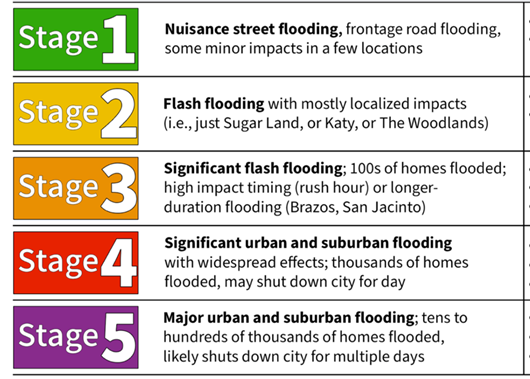
We’re updating our flood scale. Here’s why

by Eric Berger

Editor’s note: On July 29, 2025, we published a new version of the Space City Weather Flood Scale. The new version incorporates research done by two psychologists at the University of Houston, Steven Paul Woods, Psy.D. and Natalie C. Ridgely, Ph.D. We intend the new version to be more user friendly and helpful in the time of a storm. In this post, Drs. Woods and Ridgely explain the research they did to inform this update. And here’s a link to the official news release from the University of Houston.

How can we help Houstonians better prepare for major weather events?

An impassioned tweet from Matt about the challenges of weather communication during the 2022 hurricane season led us to wonder: Can we use psychological science to help Houstonians better understand and prepare for major weather events? We posed this question to Matt, who was enthusiastic about the potential of a meteorology-meets-psychology research collaboration. Matt and Eric were specifically curious if we could boost the usefulness of the beloved Space City Weather (SCW) Flood Scale (Lanza & Berger, 2023).

The original goal of the SCW Flood Scale was to help Houstonians better understand and prepare for a wide range of flooding events. The SCW Flood Scale uses a color-coded numerical rating system (1 green = nuisance street flooding to 5 red = severe life-threatening flooding) and provides a historical flooding event for context (e.g., Hurricane Harvey). But does it nudge people to actually prepare for flooding? This is important because even when people know the flooding risk of an approaching storm, they may not turn that knowledge into useful ways to protect themselves (i.e., weather-protective behaviors). There are meaningful gaps between what we know, what we intend to do, and what we actually do (e.g., Fishbein, 1979). Providing people with direct informational cues can help bridge these gaps (Grounds & Joslyn, 2018; Woods et al., 2022). So, we designed a simple experiment to see whether including examples of appropriate weather-protective behaviors at each level of the SCW Flood Scale helps people do a better job of planning for storms.

How did we do this study?

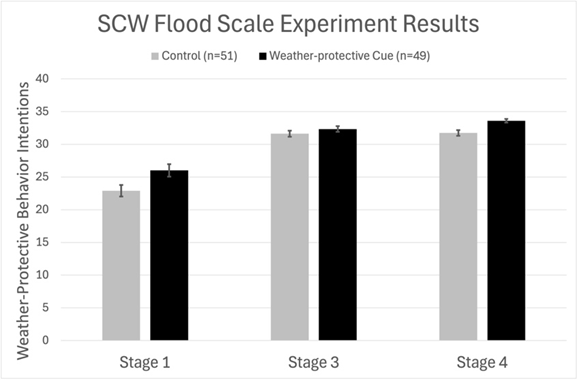
The Storm Forecasts: With Matt and Eric’s help, we created three realistic storm forecasts that varied in severity on the SCW Flood Scale (i.e., Stages 1, 3, and 4). We presented these storm forecasts to people in a randomized order.

The Weather-Protective Behaviors: After hearing the three storm forecasts, participants were asked to rate their intentions to do 12 different weather-protective behaviors on a scale of 1 (unlikely) to 5 (very likely). Higher scores mean stronger plans to practice useful weather-protective behaviors. We included actions that would be helpful in a flood, like reducing the amount of time spent on the roads, gathering necessary supplies, charging electronic devices, and listening for emergency alerts. We also included actions that sounded reasonable, but may not be helpful during a flooding event, like wrapping exposed pipes, securing the foundation of their home, or sheltering in a basement.

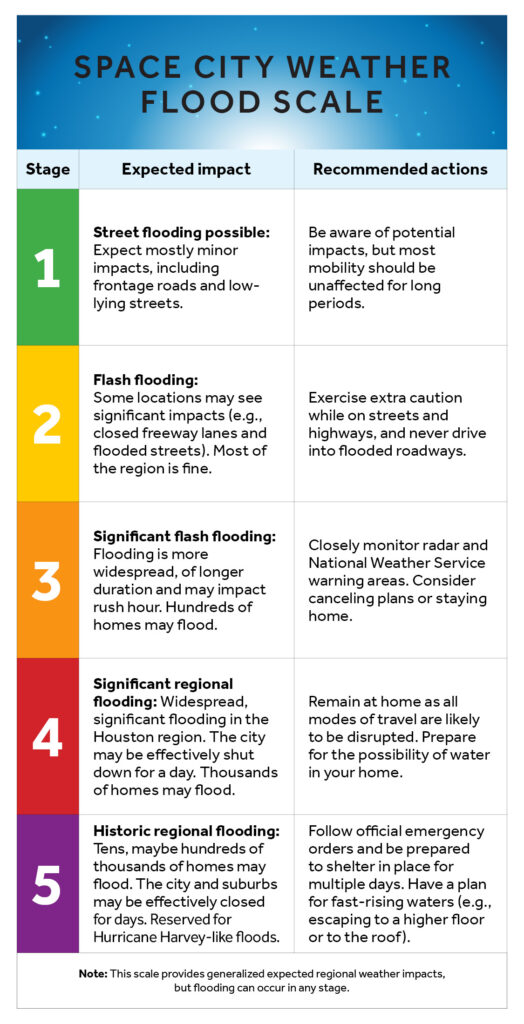
The Experimental Groups: The study participants were randomized into one of two groups: 1) A control group who saw the standard version of the SCW Flood Scale; or 2) A weather-protective cue group who saw a new version of SCW Flood Scale that included examples of weather-protective behaviors at each level of flood risk (e.g., Stage 1 = Consider reducing time on the roads; Stage 3 = fuel vehicles; Stage 5 = identify safe evacuation routes).

The Study Participants: We recruited 100 healthy adults from 5 Gulf Coast states to participate in this study. Importantly, the control group and the weather-protective cue group did not differ in demographic factors (e.g., age, education), cognitive ability, weather literacy, and experience with storms.

Did the experiment work?

In brief, yes! People in the weather-protective cue group did a better job of planning for the storms. Figure 1 shows the flood-protective behaviors on the vertical axis, where higher scores mean better plans to practice useful flood-protective behaviors. The individual storm forecasts are on the horizontal axis. You can see that the benefits of the protective cues varied by storm severity. The flood-protective cues had strong benefits for the most (Stage 4) and least (Stage 1) severe storms, but only weak benefits for the Stage 3 storm, which was a fast-moving wind event for which flood protective recommendations may be somewhat less clear. Encouragingly, we also found the largest benefits of the flood-protective cues among people who had the lowest levels of baseline weather preparedness. That means we were able to improve flood-protective plans for the people who were at greatest risk of being unprepared. Finally, we found that the flood-protective cues had no effects on non-beneficial actions (e.g., wrapping household pipes). In other words, the flood-protective cues only nudged people towards doing things that are known to be helpful for their health and property during a flooding event.

What’s next?

The results of this simple experiment suggest that adding flood-protective action cues to the SCW Flood Scale increases the likelihood that people will plan to safeguard their home and health in response to flood forecasts. We are excited that Matt and Eric will be working with Reliant to add the flood-protective cues to the SCW Flood Scale moving forward. And we hope that this new version of the SCW Flood Scale will provide additional support and comfort to Houstonians as they prepare for future storms. We are currently looking at whether the benefits of the flood-protective cues vary across people who may be particularly vulnerable to weather impacts, including older people and those with serious medical conditions. We are also curious to learn more about what leads people to choose non-beneficial weather-protective actions in these situations. Finally, we would like to know whether we can help Houstonians better understand and use heat warnings. So, stay tuned for more meteorology-meets-psychological science!

Steven Paul Woods, Psy.D. and Natalie C. Ridgely, Ph.D.
Department of Psychology, University of Houston

References

Fishbein, M. (1979). A theory of reasoned action: some applications and implications. Nebraska Symposium on Motivation, 27, 65–116.

Grounds, M. A., & Joslyn, S. L. (2018). Communicating weather forecast uncertainty: Do individual differences matter? Journal of Experimental Psychology: Applied, 24, 18–33. https://doi.org/10.1037/xap0000165

Lanza, M.R. & Berger, E. (2023). The Space City Weather Flood Scale: An imperfect attempt to help a flood-weary region put rain forecasts in context [abstract]. Paper presented at the 103rd Annual AMS Meeting, Denver, Colorado, USA.

Woods, S. P., Morgan, E. E., Loft, S., Matchanova, A., Verduzco, M., & Cushman, C. (2021). Enhancing cue salience improves aspects of naturalistic time-based prospective memory in older adults with HIV disease. Neuropsychology, 35, 111–122. https://doi.org/10.1037/neu0000644

29 Jul 20:11

You’re Trash

by Reza
29 Jul 20:10

my company donated my award money to charity without my consent

by Ask a Manager

A reader writes:

Last year, my company introduced “impact awards.” Employees could nominate themselves or other employees to receive one of five $1,000 awards for outstanding work. This was framed as a bonus and we were specifically told we would get cash. My company is global and has several thousand employees, so the award was very competitive.

Unbeknownst to me, my manager nominated me and I actually won one of the awards! This was announced to everyone in the company at our virtual town hall.

I was really excited, because as a mid-20s single woman with student loans living alone in a big city on a low level corporate salary, that money would go a long way for me. So imagine my disappointment and anger when the money never came and the company later sent out an email applauding themselves for deciding to donate the award to victims of a natural disaster on the winners’ behalf. They never asked us if we were okay with this. Of course we weren’t (at least I wasn’t — I didn’t know the other winners and didn’t discuss it with them, but they were all older and higher up than I was, so maybe the money wasn’t as important to them), because we were excited about the award and the company regularly does charity fundraising efforts that we participate in and donate to anyway. But I felt like I couldn’t say anything at the time because it would look bad to complain about giving money to charity, even though I also needed the money.

I’m still resentful about it because our raises and annual bonuses were extremely low this year, even for people who were given the highest performance rating, like myself, and $1,000 is significant to me. It’s actually almost as much as my annual salary increase was. The company just announced that they’re accepting nominations for this year’s impact awards, and while I don’t expect to win two years in a row, I’m curious what you think about the whole situation. Is it right or even legal for a company to pull a promised bonus from under my feet to give to charity? Could I have told them I wasn’t okay with it and asked them for my money? We didn’t even get to choose what to donate it to, and there were other causes I would’ve much preferred to give the money to if it had to be donated.

This sucks!

You were told you were getting money in recognition of your excellent work … and then you didn’t get any money. (But hey, your company got a tax write-off for donating on your behalf.)

And they did it in a way where a lot of people would feel awkward about speaking up. If they had said, “Surprise! We decided to spend your award on repaving the parking lot,” you probably would have felt comfortable saying, “That doesn’t seem right to me.” But when they announce they’ve redirected your money to charity, you understandably didn’t want to seem like you begrudge helping people who are truly in need.

But you know, if the company wants to help victims of a natural disaster, they can do it with their own funds. What they did to you and the other award recipients was crappy.

Whether or not it was legal would depend on exactly how they worded communications around the awards. There’s a decent chance it wasn’t, though.

And hindsight is 20/20, but yes, you could have pushed back when it happened! Sample wording: “I am glad the company is supporting victims of X, but I was counting on this award money after it was announced and would hope the company would keep its commitment to those of us the awards were promised to while also supporting disaster victims if it wants to.”

The post my company donated my award money to charity without my consent appeared first on Ask a Manager.

29 Jul 20:08

End of days? Shoppers pharmacy answers phone

by Alix Markman

WINNIPEG – A local Shoppers Drug Mart has spurred rumours of the apocalypse after its pharmacy opted to pick up the phone. The Shoppers pharmacy has become so notorious for its lack of communication with patients that customers were known to joke that the location would only answer the phone “when hell freezes over.” As […]

The post End of days? Shoppers pharmacy answers phone appeared first on The Beaverton.

29 Jul 16:19

You're not fooling anyone young man! I've dealt...

You're not fooling anyone young man! I've dealt with your kind before young man and I know EXACTLY what's going on between those two little ears of yours! #CowboyWho

29 Jul 16:19

If Jack turned the air conditioner off, that Caddy could catch him.

If Jack turned the air conditioner off, that Caddy could catch him.

29 Jul 16:18

Feds move to eliminate petrochemical watchdog, putting Texans and others at risk

by By Elena Bruess, Capital & Main
Amid increasingly intense weather, the Chemical Safety Board is the lone independent agency watching over the Gulf Coast’s petrochemical corridor.
29 Jul 14:46

Parts of Houston will approach triple digits today. Also, we have an exciting announcement to share

by Eric Berger

In brief: In today’s post we reveal the new design and content for our flood scale. We have made changes based on research conducted by the University of Houston. Although rain chances will increase later this week, we also anticipate no need to use the new flood scale any time soon.

Updated flood scale

This morning we are pleased to announce an update of our flood scale, which is intended to help guide expectations for people in the greater Houston region when it comes to the potential for flooding. We first introduced our flood scale in 2019, after Hurricane Harvey, and have used it dozens of times since then. But we really did not understand how people were using it.

Now, with the help of some researchers from the University of Houston, we do. A professor of
Psychology, Steven Paul Woods, reached out to Matt a couple of years ago, and together they and one of his doctoral students, Natalie C. Ridgely, worked to perform a study of the scale and whether it was effective at communicating risk. Later this morning we will publish a summary of the study, and its results, written by Woods and Ridgely. (Here it is).

As a result of this study, we have made some changes in the structure of the scale to simplify it, and added recommended actions. Reliant provided a cleaner design. What thrills me the most is that this scale was created here in Houston, and improved by local researchers who care about this community just as much as we do. It is by Houston, for Houston.

Our new scale appears below:

Tuesday

Well, we won’t need the flood scale today. With high pressure firmly in place, Houston is going to have one of its hottest days of the year. With sunny skies, look for high temperatures to push into the upper 90s across most of the region away from the immediate coast. Some inland areas may reach 100 degrees. Winds will be very light, from the west mostly. Lows tonight will only drop into the upper 70s.

Wednesday

This will be another hot and mostly sunny day, with highs in the upper 90s. However there will be a couple of subtle differences. One is that dewpoints may drop into the mid-60s across the region. This is not “dry” in any great sense, but these dewpoints are lower than normal for this time of year. So humidity will be lower than we have been often experiencing this summer, especially for inland areas. There also will be a very slight chance of showers later on Wednesday afternoon or evening.

Thursday and Friday

Low pressure stretching across the Gulf will bring increased rain chances into the area for several days. On Thursday and Friday the likelihood of rain will be somewhere between 30 and 50 percent, with low-end accumulations for most. Depending on the timing of rain (if any) highs will vary between the low- and upper-90s, with partly to mostly sunny skies.

Saturday and Sunday

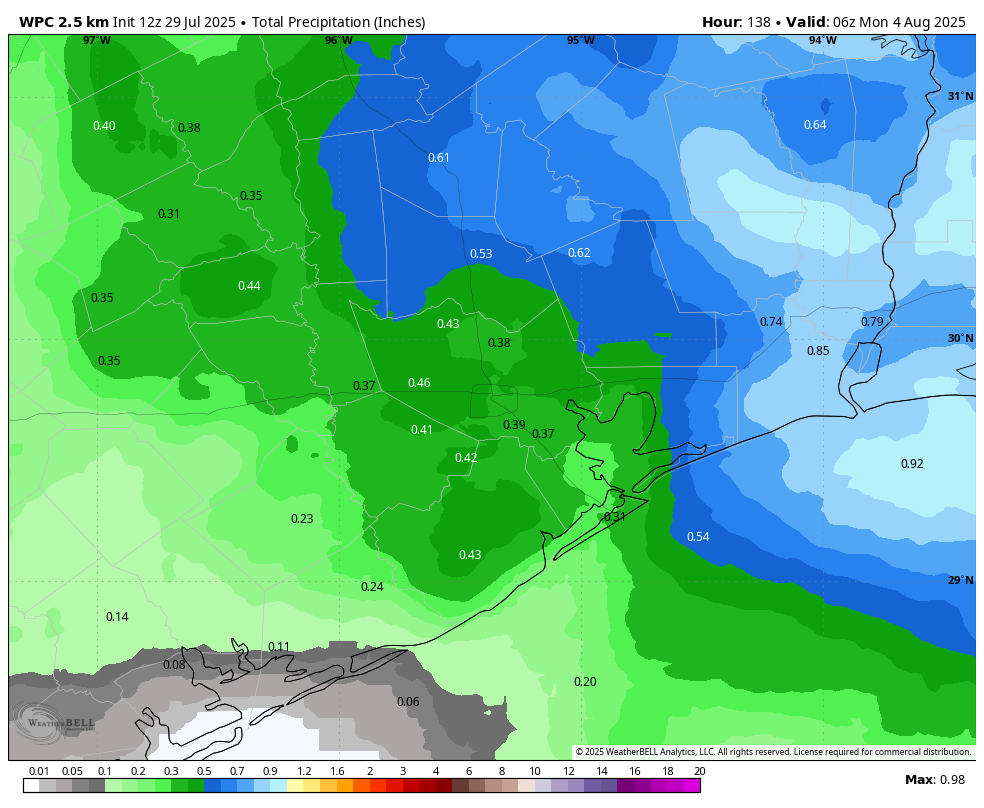
Better rain chances will arrive this weekend, with both days bringing about a 50 percent likelihood of showers. For now we don’t see too much of a risk for really heavy rainfall, and my expectation is that most locations will pick up between 0.25 and 0.5 inch of rain. Since this is summer and tropical rainfall is possible, we’ll be on the lookout for higher totals, but for now this looks more like a splash of rain rather than a deluge. Highs will generally be in the low- to mid-90s with partly sunny skies.

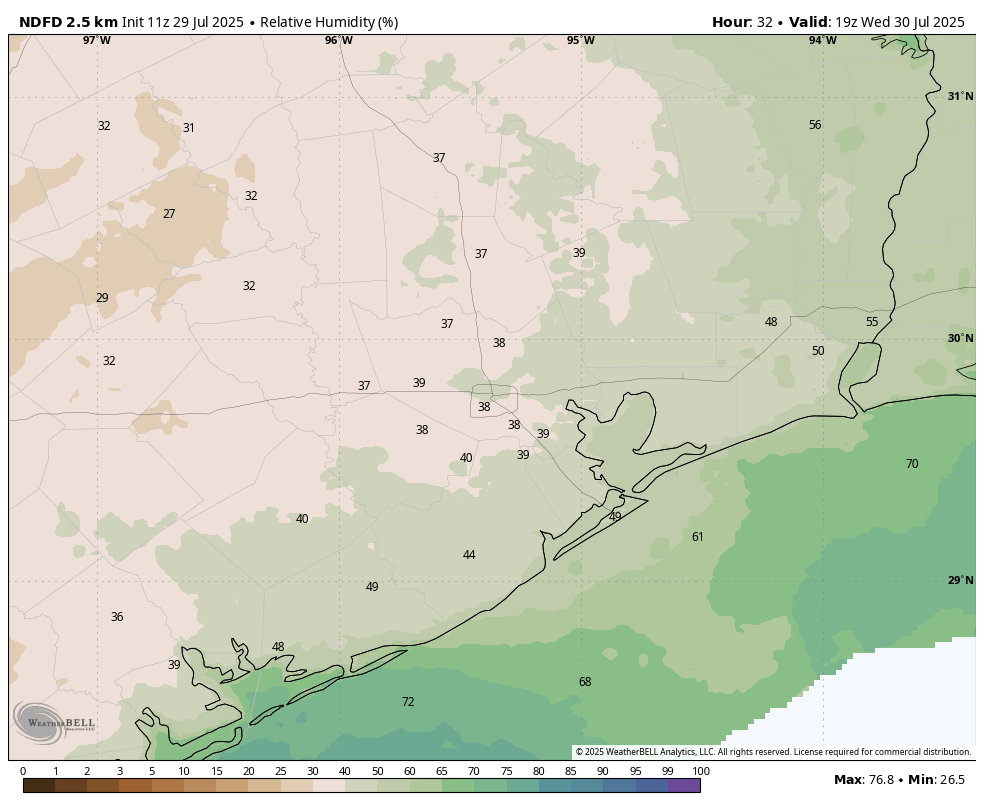
NOAA rain accumulation forecast for now through Sunday. (Weather Bell)

Next week

The first full week of August does not look to be excessively hot. Temperatures probably will be in the mid-90s for the most part, with a smattering of daily showers driven by the sea breeze. Beyond that, we shall have to see.

29 Jul 14:15

New York gunman was targeting NFL but went to wrong office, mayor says

Four people were killed when a gunman stormed a skyscraper on Monday evening and opened fire.
29 Jul 13:59

Trump Body Double Struggling To Get Leg Edema Just Right

by The Onion Staff

WASHINGTON—Expressing frustration with his inability to duplicate the president’s bulbousness caused by trapped fluid, body double John Schade was reportedly struggling Tuesday to get the appearance of Donald Trump’s leg edema just right. “One glance at my ankles and they’ll know something’s off,” said the presidential political decoy who bemoaned that there was only so much a person could do to increase their daily sodium intake, noting that he was already up to 6,000 milligrams a day with little visible effect on his limbs. “Secret Service told me it was only ‘mild swelling.’ Mild swelling, my ass. I’m wearing five pairs of wet socks, and it still looks weird. There’s only so much a baggy pair of pants can hide.” At press time, Schade had begun a strict regimen of sitting in front of a computer for 14 hours a day.

The post Trump Body Double Struggling To Get Leg Edema Just Right appeared first on The Onion.

29 Jul 13:59

Moment Of Silence Followed By Hot Dog Race

by The Onion Staff
29 Jul 13:38

What I Presume “Quiet Luxury” Means

by Mary Flannery

I play hide-and-seek in my penthouse apartment with my four-year-old twins, Whisper and Gem, all three of us clad in bespoke knit loungewear.

I wear my new Alaïa bandage dress to the opening of the latest Marina Abramović performance art piece at MoMA (The Artist Is Silent). The dress is a nod to the performance, in which Abramović stands in the middle of the room wearing a gag while members of the public tiptoe around her.

I own a silk Dior bathrobe exclusively for wafting silently from room to room when I’m home alone.

I celebrate the life of my best friend’s recently departed Pekingese, who was run over by a Rolls-Royce. I am dressed in black Chanel from head to toe out of respect for Monsieur Le Floof.

I arrive at my silent retreat at a Cistercian monastery in the Hamptons carrying my Louis Vuitton yoga mat. I prepared for the occasion by getting Botox shots in my armpits to ensure that the sound of dripping sweat will not disturb me during scorpion pose.

My butler is contractually obligated to say everything sotto voce.

I take a therapist-mandated time-out, during which I must remove my Manolo Blahnik stiletto heels, sit in the corner of my therapist’s office (facing the wall), and remain silent for fifty-five minutes. Dr. Kvěch is one of the leading proponents of Laconism, a school of psychiatry based on the belief that the best way to treat mental illness is not to speak about it.

I wear my Versace leather jumpsuit at an invitation-only silent rave in a converted warehouse formerly used by a ring of Pekingese smugglers.

I have a Bottega Veneta toiletry kit full of calming hangover remedies. When indulging in a hair of the dog, I muffle the pop of the Cristal cork with my Prada virgin wool earmuffs.

I hold in a fart in the ground-floor bathroom of the St. Regis New York.

I bring a suitcase stuffed with Armani cashmere scarves to my lover’s apartment in the Meatpacking District. I do this so I can scatter them on the floor and sneak out without waking him the next morning. That’s how much I care about his work as a DJ.

Now that I’ve created a foundation dedicated to rehabilitating smuggled Pekingese dogs, I always take care to wear my Valentino wrap coat for the charity headquarters’ annual active-shooter drill.

I read the September issue of Vogue in a private room at the Morgan Library.

When my DJ lover dumps me at my charity headquarters, I don’t make a scene. Like the traumatized Pekingese dogs I’m so eager to help, I save my screaming and sobbing for the soundproofed space our charity likes to call the “Feelings Room.”

During my voluntary stay at the Park Avenue Psychiatric Hospital for the Posh, I am confined to a leather-padded cell, wearing a vintage, studded straitjacket designed by Karl Lagerfeld.

I never talk about money. Only poor people do that.

29 Jul 13:22

East Texans condemn Dallas millionaire’s plan to pump 16 billion gallons of their groundwater to other parts of the state — every year

by By Jess Huff
Texas law largely allows landowners to do what they want with the groundwater beneath them, potentially protecting the latest plan to ship water out of East Texas.
29 Jul 13:09

Nearly 4,000 NASA employees opt to leave agency through deferred resignation program

by Chandelis Duster, NPR
The employees who have chosen to leave the agency amount to about 20% of NASA's workforce.
29 Jul 13:08

How is a Constitutional Amendment Ratified?

by Macie Kelly
29 Jul 11:58

recruiter told me team is “very neurodivergent,” can company force me to use my personal phone, and more

by Ask a Manager

It’s five answers to five questions. Here we go…

1. Recruiter told me the team is “very neurodivergent”

I’m interviewing for a managerial role, and have been a manager in tech for a while. During an interview yesterday, the recruiter was describing what the hiring manager was looking for. In it she stated unprompted that “this is a very neurodivergent team so we’re looking for a manager who is incredibly empathetic.”

I was surprised to hear this from the recruiter! Did the manager tell her? Did the engineers? On the positive side, it’s potentially very inclusive and accepting of a team, and I have lots of experience managing neurodivergent engineers so it is great to hear they’re aware. On the negative side, it could lead to a manager joining and immediately asking who is the “neurodivergent” person out the gate or treating them with a bias.

The recruiter had other language (“empathetic,” “soft touch,” “accepting behaviors”) that concerned me, especially as a woman. In the past, these hints meant the company had a clear expectation of how I would manage emotions and communications of my direct reports for them in a more motherly or secretarial way for the sake of a prized engineer. Examples include, “Boss, you asked me to do X by Y date. Could you put a reminder on my calendar to do that for me so I don’t forget?” and “Your direct didn’t feel psychologically safe when you said they shouldn’t use the corporate travel site for personal flights” (yeah, I know).

Is it illegal for the recruiter to tell me this about their team? Should I be concerned, or am I letting my past color this new, potentially inclusive company?

It’s not illegal. They’re not giving you specific medical information about an individual employee; they’re telling you something about the makeup of the team that affects the kind of approach they’re looking for. It’s okay for them to be transparent that there’s lots of neurodiversity on the team and they’re looking for someone with a management approach that will work well for their specific context. Not talking about that risks causing problems.

But I’d be very cautious about the emphasis on “soft touch” and “accepting behaviors” — that could mean all sorts of things, and you’d really, really want to get specifics about what it means to them before deciding if it’s a job you’d want. If you continue talking with them, ask about that — “You mentioned you’re looking for a manager with a soft touch and emphasized the importance of accepting behaviors. Can you tell me more about specifically what you’re looking for in that regard, and what has and hasn’t meshed well with the team in the past?”

2. I told my manager that I’d rather die than come to work

I’m a software engineer at a large corporation. The company is generally pretty good to employees — we have good benefits, I like my coworkers, my workload isn’t excessive, and I have good work-life balance. I do not enjoy my work, but thats a separate problem for me to sort out.

The issue is that I have some mental health illnesses that are peaking lately. This past week, I had a remote 1:1 with my manager where I broke down in tears over a recent mistake (one of many), told my manager I feel like I don’t contribute anything of value to our organization or our team, and then told her that sometimes I’d rather die than go to work! (To her credit, my manager turned this meeting around after 20 minutes of me losing it, and we actually discussed work tasks at the end.)

Obviously I am not okay. I spent a LOT of time with my care team this week and got to spend additional “quality time” with them this weekend … an additional 72 hours, in fact. Clearly I need more time off etc, and I am working on that … but in the interim, how do I talk to my manager? What do you say after “I’d rather die than work for you”?! I didn’t mean it! She’s actually a wonderful, supportive person who gave me my start in this industry.

In her shoes, I’d be really worried about you and it would help to hear something like, “I want to apologize for what I said in our meeting last week. It was a moment of stress for me, but that’s not an accurate reflection of how I feel about my job. You’ve been a great, supportive manager, and that’s not something I should have put on you. I have some things going on outside of work that got to me that day, but I’m actively working on them and am hopeful about moving forward.”

3. Can my company force me to use my personal phone number for work-related database access?

My company subscribes to a database that requires a multi-factor authentication to access the site. They allow text messages or the option to receive a code via email. The option to receive a code via email is only available once a month. The database has limited relevant data for my work, so I infrequently use it; however, I do sometimes need access to it.

Previously, I had a corporate-issued cell phone, which allowed me to access the database with no issues. However, to cut costs, my company recently got rid of our cell phones and switched to WebEx, which does not allow text messages. As a result of this change, I am only able to access the database once per month, as that is their arbitrary rule for email MFA. I brought up the issue to my boss, whose solution was that I provide them with my personal phone number and get the text messages, which I am not comfortable doing.

I asked the database company for an exemption to get multiple emails per month (I use the database maybe once or twice a month, and regularly go months without using it), and they say there is no workaround and they need to have a phone number.

I told my boss and grandboss that I am not comfortable providing my personal phone number to this company, so we are seemingly at an impasse. I used the excuse that I don’t want to field any sales calls. (They have called me in the past, asking why I don’t use their service more often.)

My grandboss is going to try and talk to our service rep to see if I can get an SSO option, but if not, they seemingly are going to require me to use my personal phone number to access the database and try to get me on a do not call list. I don’t really have a good reason for not providing my number, other than it makes me incredibly uncomfortable for them to have my personal data, but at the same time, I feel a little silly in saying this. Am I being unreasonable here? Could there be any repercussions for me refusing to provide my personal phone number to access a database I infrequently use?

In theory, your employer can require you to use your personal phone number to access the database and, in theory, could fire you if you refuse. In practice, they’re very unlikely to fire you over this (unless you have a pattern of putting up obstacles and they’re at the end of their rope). It’s more likely that they’ll just be exasperated, particularly if they get you on a do-not-call list (thereby addressing the explicit objection you offered) and you still refuse.

Any chance they can just get you a physical token or hardware key to give you access?

4. My manager won’t tell me when the person I’m covering for will be back

My manager has two direct reports with similar roles. When one person is out, the other person has to cover. My coworker, one of the aforementioned direct reports, had a medical issue arise and she’s going to be out for a prolonged period of time. Is my manager under any obligation to keep me informed as to when my coworker will return to work, especially since I am covering her duties? Covering for someone else is much easier mentally when you know how long the period of time will be. My manager is very reluctant to share any information.

Your manager might not know, or might feel that it’s not straightforward enough (like a simple “four weeks”) that she can talk about it without compromising your coworker’s privacy. To be clear, there should be something she can say without violating your colleague’s privacy, but she might be being overly cautious. From a legal perspective, there’s no reason she can’t say something like, “It’s somewhat up in the air but at least four weeks and potentially several months, and we won’t know anything more solid for a while.”

You can certainly ask, and explain why! It’s reasonable to say, “I’m not asking you to violate Jane’s privacy, but it would help me manage the increase in work if I had an idea of what the timeframe is likely to be, even if it could potentially change.”

5. Should I get paid for wrap-up tasks when a job ends?

I’m about to lose my job after being furloughed for two months; the funding for the next stage of our project just didn’t come through (thank you, dysfunctional federal government). As a remote worker in a different city from HQ, should I be paid for all the time I will spend doing any final paperwork and shipping my laptop and accessories back to the home office? There’s also a standing desk I don’t know what we’ll do with. I’m hoping they’ll tell me to keep it so I don’t have to disassemble the big thing on my own. I drove it home in my car after my on-site orientation, and I doubt they’ll want to pay for me to drive it back.

It just adds insult to injury that failing to complete our project is a huge waste of taxpayer money, but completing it would have allowed that agency to function more efficiently with fewer employees.

Legally, they have to pay you for any time you spend doing work-related tasks, including shipping back equipment. In practice, a lot of people don’t end up pursuing that. In your shoes, I’d make sure you complete it by the last date you’re getting paid to avoid a fight over it.

Ask your manager about the standing desk right now. They’ll probably tell you to keep it. But if they want it returned, they need to coordinate that themselves (both the disassembly and any pick-up for shipping). You can say, “It needs to be disassembled, which I’m not able to do on my own, but if can send someone here to disassemble it and haul it away, I can of course coordinate with you on that.”

The post recruiter told me team is “very neurodivergent,” can company force me to use my personal phone, and more appeared first on Ask a Manager.