Cowboy Who?
Shared posts
Trump-Modi ties hit rock bottom with new tariffs on India over Russian oil
Texas House Democrats evacuated from Illinois hotel after bomb threat, police say
Federal appeals court sides with Texas on ID requirements for voting by mail
Former Harris County deputy arrested, charged with manslaughter in man’s death
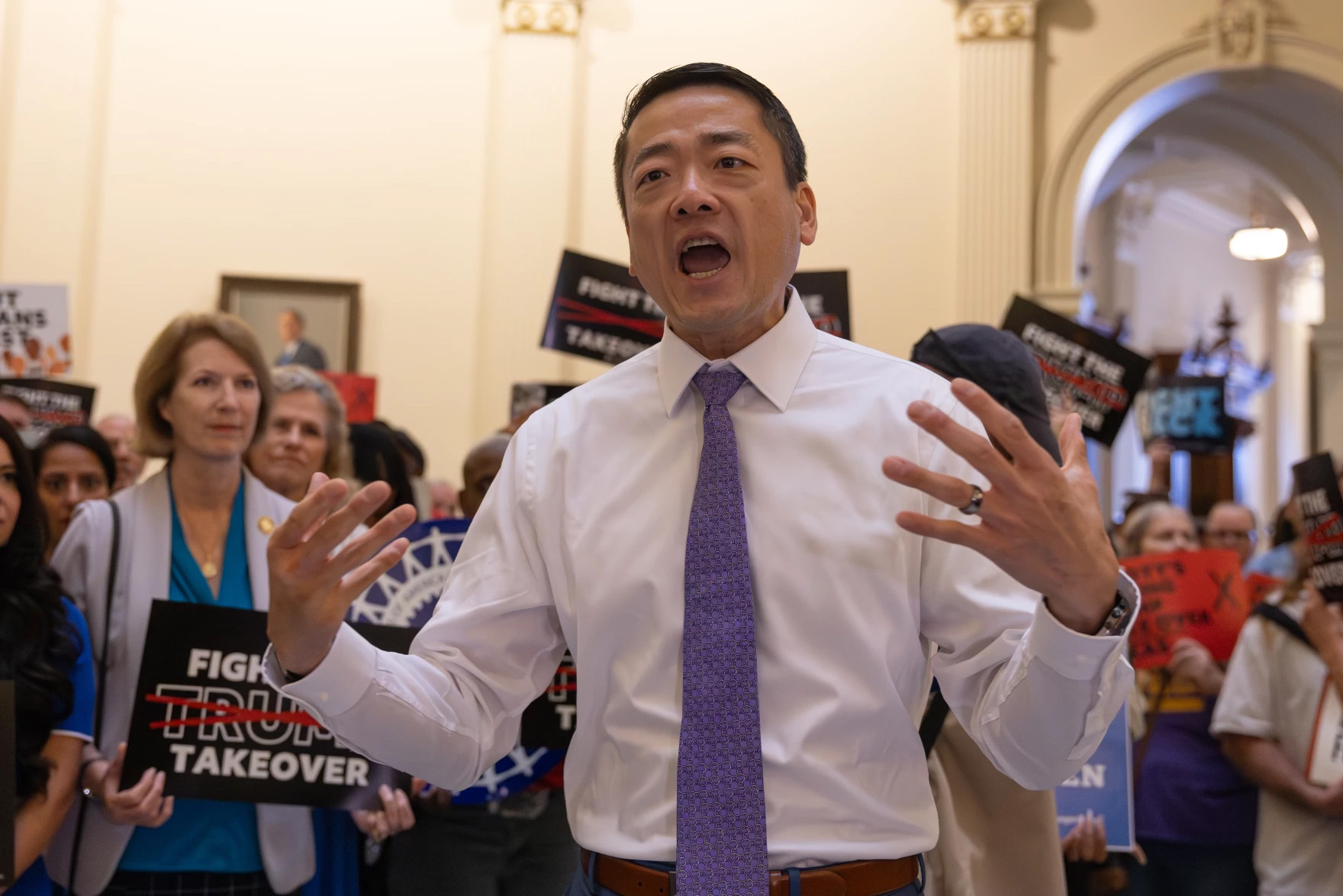
Gov. Abbott seeks removal of House Democratic Leader Rep. Gene Wu over quorum walkout
Feds discard expansion plan for Panhandle wildlife refuge in rare move

Texas House Democrats evacuated from Illinois hotel after bomb threat
Battleship Texas finds permanent home at Galveston’s Pier 15
Tropical Storm Dexter Graphics

5-Day Uncertainty Track last updated Wed, 06 Aug 2025 14:45:35 GMT

Wind Speed Probabilities last updated Wed, 06 Aug 2025 15:22:03 GMT
Hundreds of old EV batteries have new jobs in Texas: Stabilizing the power grid

/https://static.texastribune.org/media/files/ccc86dadc5281075f267a5056f4a62cc/Car%20Battery%20Farm%20ICN%20TT%2001.jpg)
House Democrats helped Dustin Burrows win the gavel. Their departure from the state marks a pivotal moment for him.

/https://static.texastribune.org/media/files/371f63f1bd75dfc4ba5948bcb1a17f85/0804%20Quorum%20Break%20BD%2010.jpg)
Local Texas election officials concerned about software vendors’ financial scare

/https://static.texastribune.org/media/files/482f66e2b6e7a687021fcf37a0b1f896/Asian%20Voters%20MYL%20TT%2014.jpg)
'Vote him out!' - Republican lawmaker Mike Flood heckled by constituents
Lots of Atlantic noise but virtually all of it over the open ocean
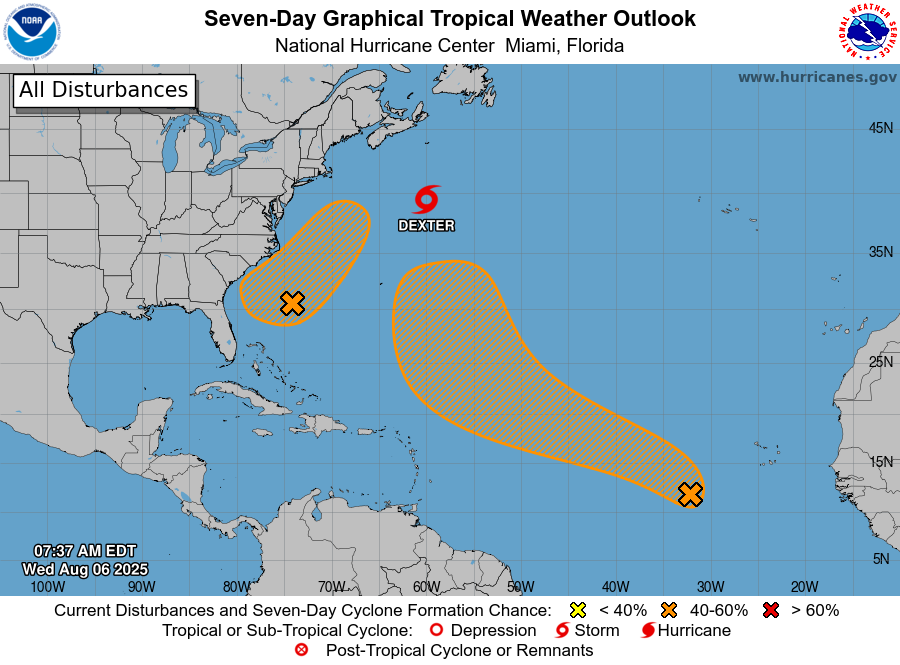
In brief: A disturbance off the Carolina coast has a 40 percent chance to develop heading into the weekend, but it looks to remain offshore. Tropical Storm Dexter may intensify over the open Atlantic as it transitions from tropical to non-tropical late this week, no threat to land. The area in the deep Atlantic with 60 percent development odds remains worth watching but not likely to stir up too much trouble.
Tropical Atlantic
We’ll continue our daily check up on the areas worth watching in the tropical Atlantic — and speculate on what could come next.
Carolina coast
Starting closest to land today, some good news. The disturbance that’s expected to attempt to develop off the coast of the Carolinas appears that it will be less stuck than it appeared earlier in the week. Again this morning, there just isn’t a whole lot there yet.

Initially, the thought was that we’d see development gradually through the week, followed by a very slow-moving or stationary type system off the coast. The first half of that statement is still true. Development will be very sluggish here. We won’t wake up to a tropical storm out of nowhere tomorrow. It may not be until Friday or Saturday that we see anything make a real effort to form. And from there, it now looks as though it will slowly but steadily move north and northeast, heading out to sea. Development odds have been pushed back to 40 percent this morning, indicating that this is not exactly expected to really get going once it does start to attempt development.
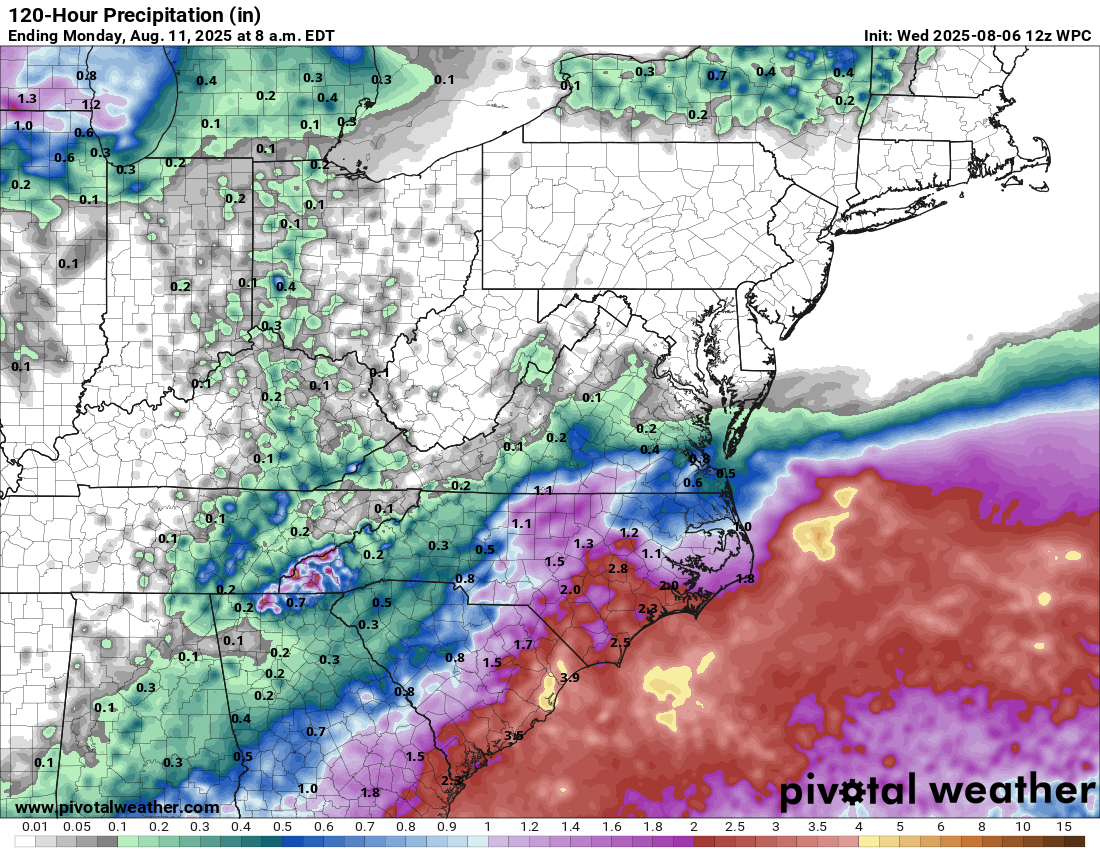
In terms of impacts: Rainfall and rip currents are at the top of the list. You can see the 5-day forecast average rain totals above. Locally higher amounts are possible, especially today in interior North Carolina and Georgia, where flood watches are in effect.
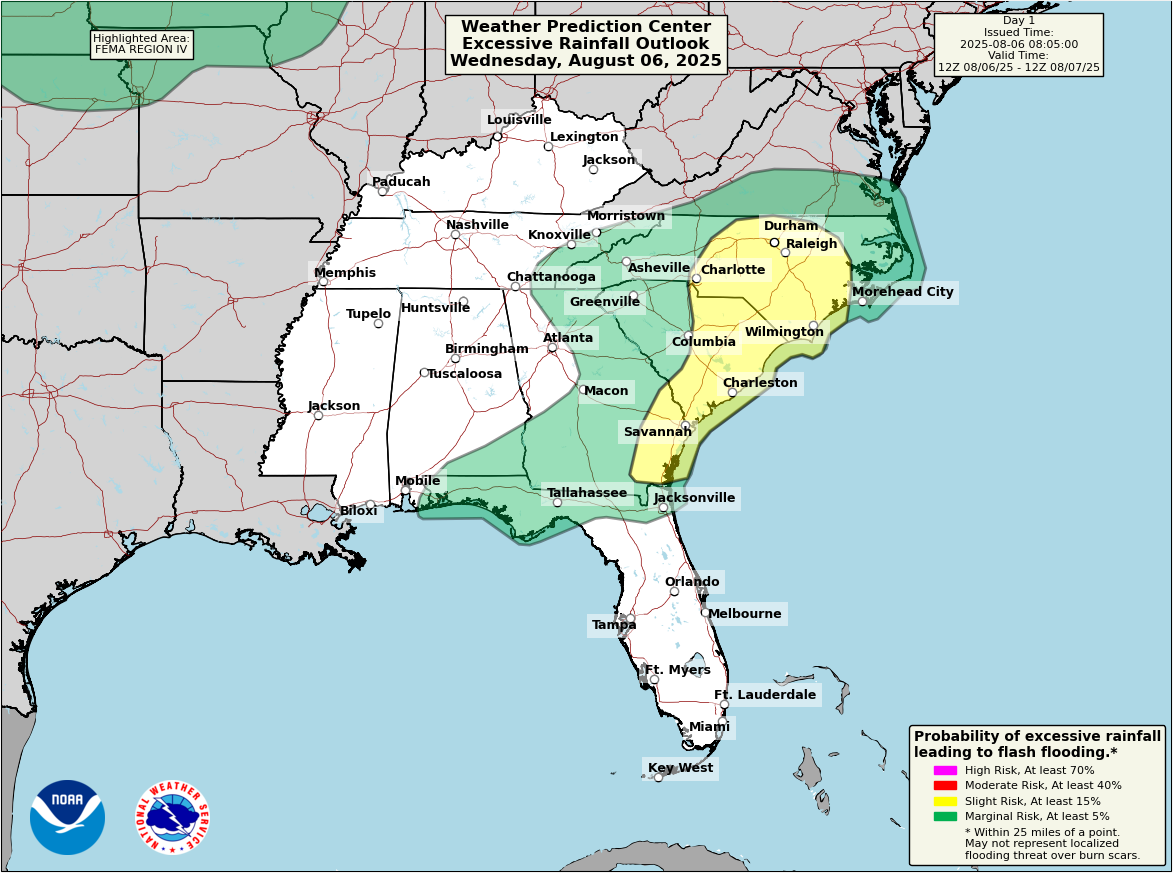
A lot of the rain is actually front-loaded and not directly related to the system itself, but the whole pattern is connected. Rip current risk is moderate to high on the North Carolina coast, and if any development does actually occur offshore, that risk will hold into the weekend. Just something to be aware of if you’re beaching it this weekend in the Mid-Atlantic or Southeast.
Tropical Storm Dexter
Dexter continues to cling to life as it moves out to sea.
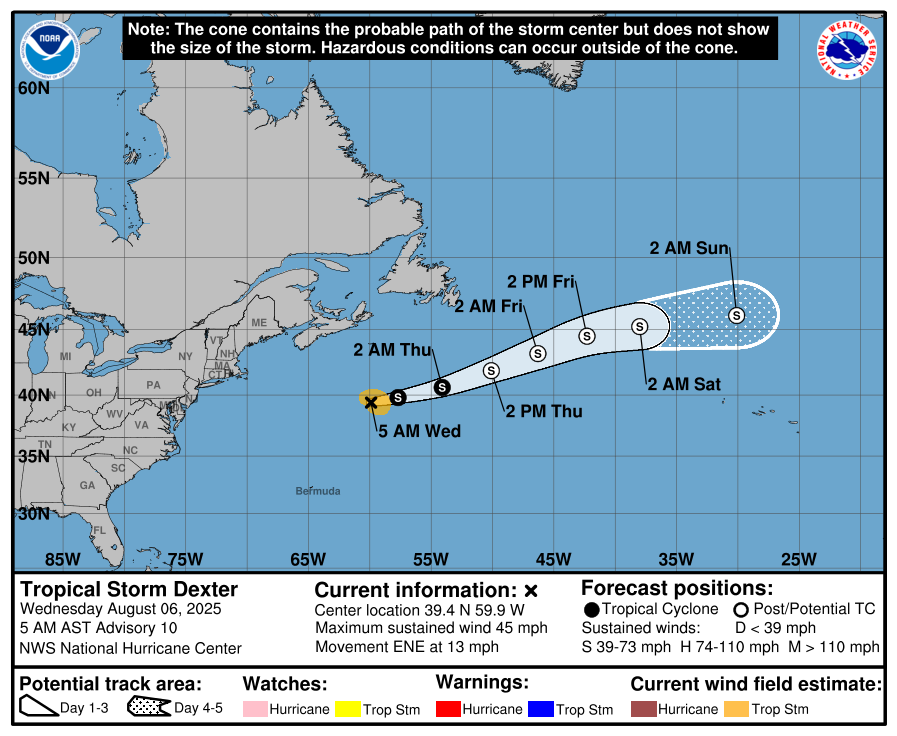
Dexter is expected to become post-tropical tomorrow and end up north of the Azores by Sunday as a non-tropical low pressure. From there, Dexter’s remnants end up getting tied into a storm system near or north of the British Isles by Tuesday or Wednesday of next week. No big impacts are expected right now.
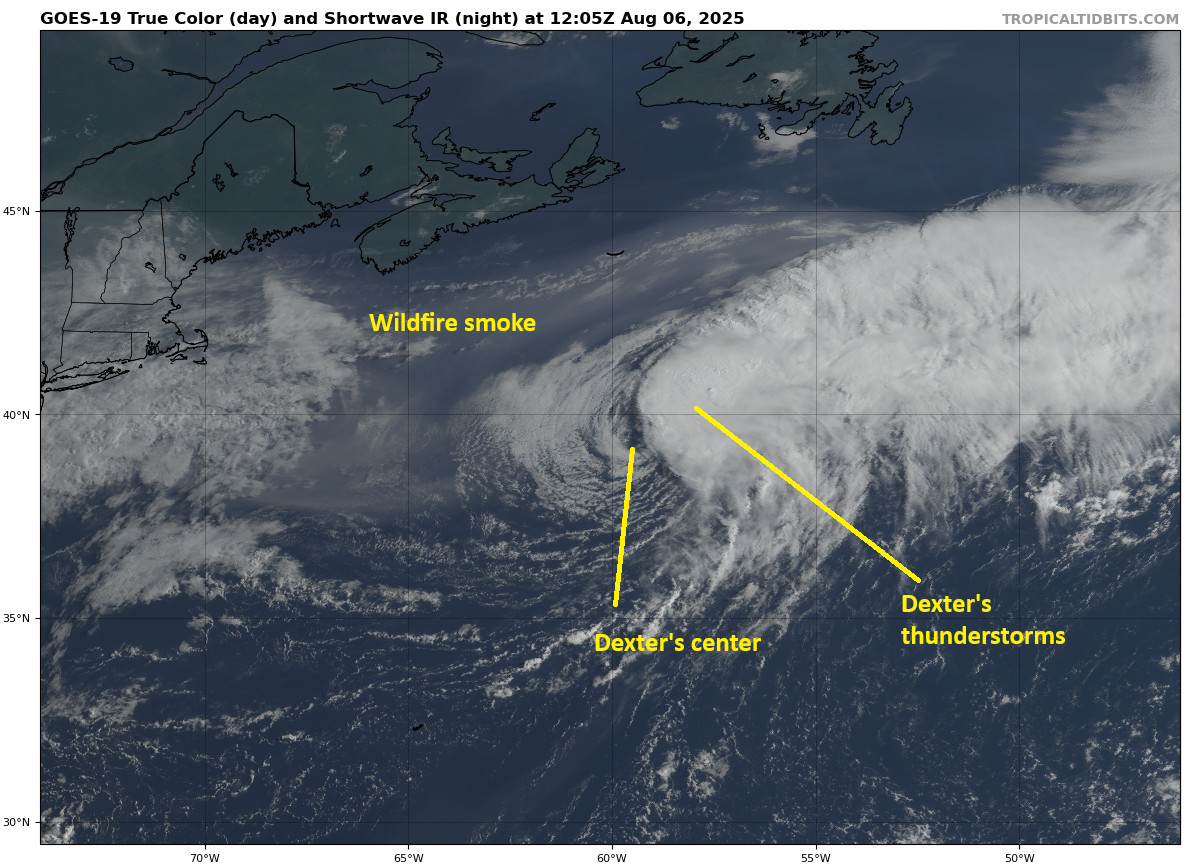
Dexter’s thunderstorms have outpaced the system itself, with the center again almost exposed entirely this morning. That’s a sign of an unhealthy storm. It’s just not in the greatest environment right now, packed with wind shear. That said, tropical systems have a funny way of doing things when they transition to extratropical systems. In Dexter’s case, while it may continue to look very sloppy, it’s likely to increase in intensity, with winds possibly approaching hurricane-force at some point in the next couple days. Thankfully that will remain over the water, though some rough seas could be generated in Atlantic Canada.
Deep Atlantic
We are watching two areas in the Atlantic. There is the one being highlighted by the NHC with a 60 percent chance of development. There is also what will probably be the next highlighted area by the NHC in a day or two.
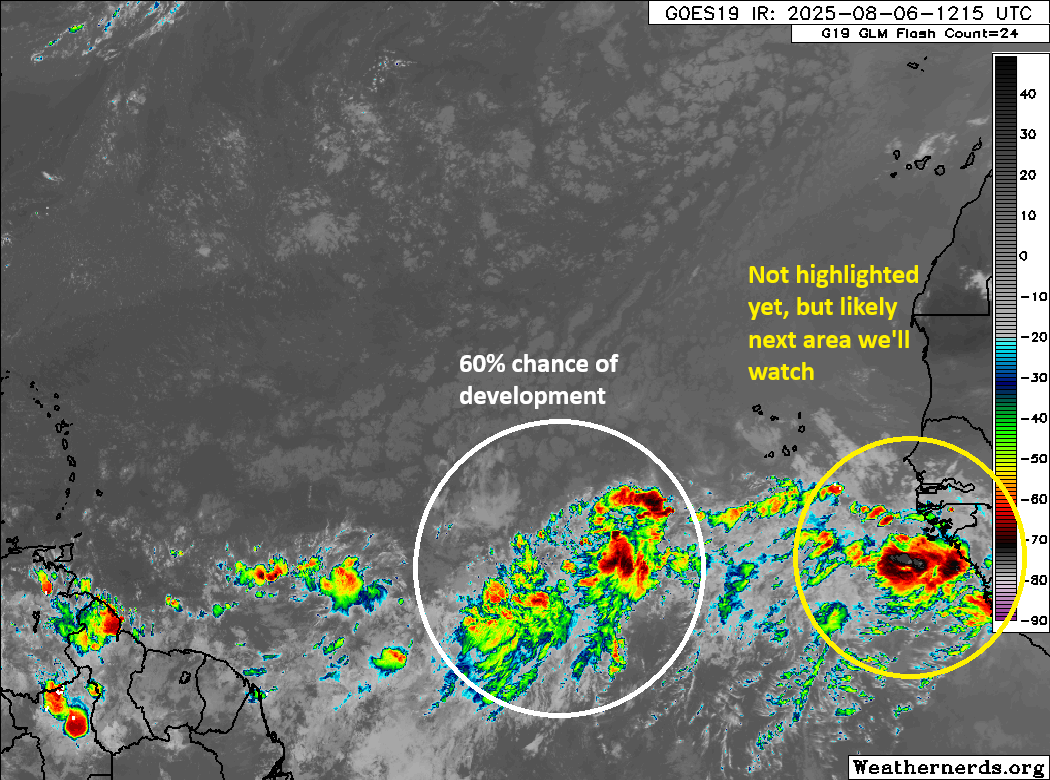
The 60% area looks a good deal better this morning than it has the last couple of days. We will probably see some gradual organization attempt to occur from this one between now and Friday. I wouldn’t be shocked if the 60 percent becomes a 70 or so by later today. In terms of this one’s future, it will probably have a relatively low ceiling for intensity. But a depression or tropical storm seems like a decent possibility at this time.
As the system moves, it will be steered west northwest or even northwest at times around the periphery of high pressure in the eastern Atlantic. By the time it gets to the weekend, high pressure may strengthen somewhat and force to turn back more to the west for a short time. Eventually, it will likely hit the escape hatch and get drawn back northwest and north through a weakness in the high pressure across the basin.
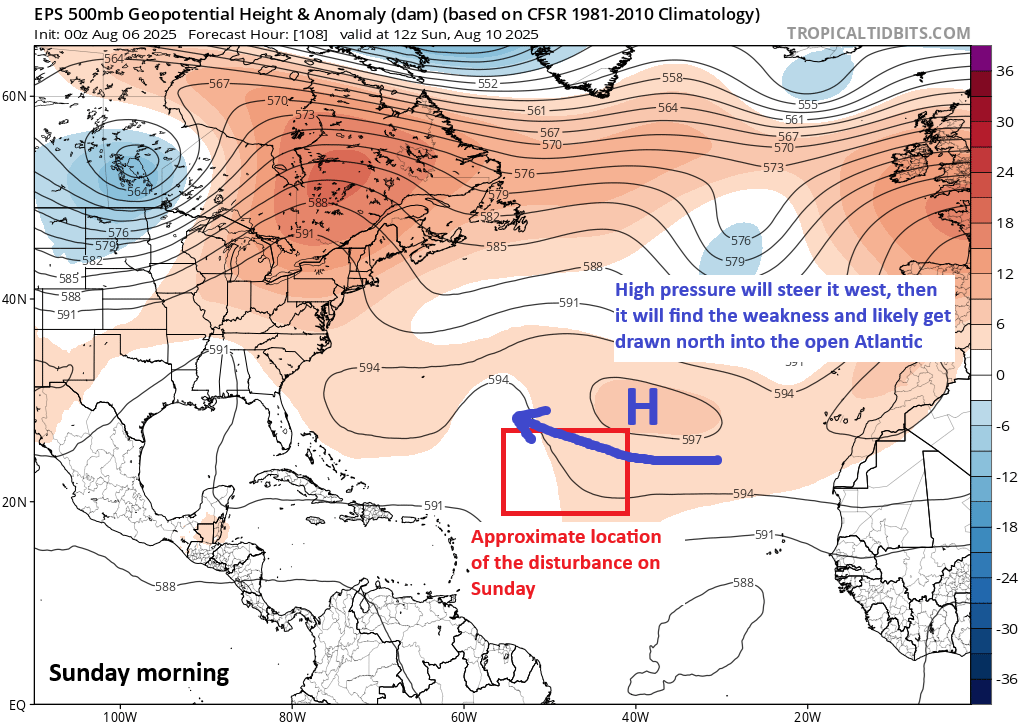
This should allow the system to ultimately turn out to sea. I would say it’s probably worth continuing to monitor for the Caribbean or Southeast or Bermuda, but it’s unlikely to stir up too much trouble.
On the image atop this section, I did highlight the area behind this disturbance as one to watch as well. Model guidance keeps this one a little more southward in the Basin, which could in theory allow it to get closer to more land in 10 to 12 days. There is very little consensus on this one yet though, so for now it’s just probably the next area we’ll watch but nothing more than that.
For August in Houston, our ‘mild’ weather continues
In brief: This post discusses our relatively mild start to the month of August, which is a nice change from some of our recent summers. And really the forecast does not offer much variability, with highs likely in the low- to mid-90s for awhile with a splash of daily rain chances.
It could be worse
The average high temperature during the sizzling first week of August, 2023, was 102 degrees Fahrenheit. (I felt a shudder as I wrote that). Last year it was 97.5 degrees. This year, so far, we’re running at 93.8 degrees. This is not exceptionally cool, but it is a little bit below the normal high for this time of year (96 degrees). As Matt has noted the moderate daytime temperatures we’ve been seeing this summer have been offset by extremely warm nights, but nevertheless it sure feels nice to go through what is typically the hottest time of the year and have days that aren’t at or near record high temperatures.
And I don’t want to jinx anything, but it looks like we should remain solidly in the low- to mid-90s through at least the middle of the month as high pressure appears unlikely to build directly over the region anytime soon.
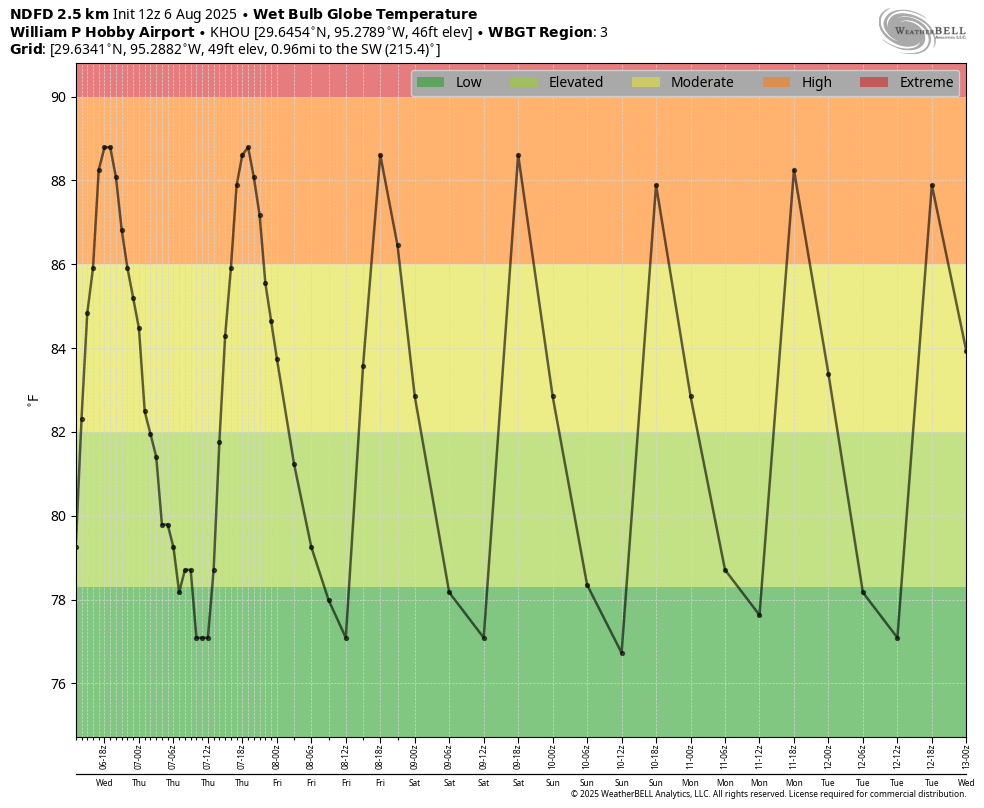
Wednesday
We remain on the edge of a very potent high pressure system anchored over the Southwestern United States, and that will continue to bring warm, mostly sunny days with a low-end chance of showers and thunderstorms. With this pattern we should continue to see high temperatures in the mid-90s for areas along and north of Interstate 10, and lower 90s for areas closer to the coast. Rain chances will be on the order of about 30 percent daily, with totals probably at the higher end toward the coast, and lower further inland. Humidity remains high, with light southeasterly winds. Nighttime temperatures will struggle to fall much below 80 degrees.
Thursday and Friday
These days will see a similar pattern, although daytime highs should be 1 or 2 degrees warmer, with some inland areas potentially reaching the upper 90s. A chance of showers is possible during the afternoon along the sea breeze.
Saturday and Sunday
The song remains the same heading into the weekend, although daily rain chances may nudge up to 40 or even 50 percent closer to the coast. These showers are unlikely to last too long, and for most locations will only bring a tenth of an inch of rain or two. For the most part skies should be sunny, with high temperatures in the low- to mid-90s.
Next week
Honestly, at this point not much change appears to be in the forecast for next week. If we’re getting through August with temperatures in the low- to mid-90s and the occasional shower to keep things green, then we’re doing August in Houston about as good as one can.
Tropics
Dexter remains a weak tropical storm that is moving away from land, so no concerns there. Two other systems have a chance to develop, and one of them may bring increased rain chances to the southeastern United States over the next week. The Gulf looks clear for now, but we’re just about to begin a pattern of tropical systems forming in the “main development region” of the tropical Atlantic, and these will have a better chance of moving westward toward the Gulf, and potentially entering the body of water on our doorstep. Nothing is imminent, however. We’re just getting close to that time of year.

What Does a Mile Look Like? Matthew Gray’s Sculptures Bring a New Perspective

Matthew Gray’s “Mile Dark.” Photo: Sarah M. Vasquez
Standing in front of a 25-foot-tall sculpture on his property 56 miles west of Marfa, Matthew Gray listens as the work’s aluminum beams creak while it sways with the passing wind. “What we’re doing right now is the test,” Gray said. “Can it stand the wind?”
This piece, named Mile Dark, is one of three large-scale sculptures he’s created on his property five miles south of US 90. Each is made with lightweight aluminum beams that are 21 feet in length, which, taken together, would equal a mile when laid out end to end. “We all know what a mile is, but at the same time, we don’t,” said Gray. “What does a mile look like?”
As Asleep at the Wheel famously sang, there are miles and miles of Texas. It’s hard to determine distance in this expansive West Texas landscape, so perspective is relative.
As you approach Gray’s sculptures from FM 2017, they seem so small from the horizon; but standing in front of them is a completely different experience.

Matthew Gray stands by “Mile Dark,” with “Broken Mile” behind him. Photo: Sarah M. Vasquez
Gray moved to West Texas after living in New Mexico for over 30 years. He was previously a mountain climber and a photographer for Patagonia, which plays a role in this work, but growing up, he also built skateboarding ramps and fortresses with found plywood. He moved to the Big Bend region because he wanted to build sculptures in the wild. After two years of searching, the stars aligned for him when he found property between Valentine and Van Horn. He went straight to work once he secured the place, cleaned up junk left behind by the previous owner, and started building the first sculpture in the series, Broken Mile, which was completed in October 2023.

Matthew Gray’s “Broken Mile.” Photo: Sarah M. Vasquez
Broken Mile stands at 35 feet tall and is less dense than Mile Dark, which was completed last year. It was so far the hardest for Gray, because he had to figure out how to produce it, dialing in the materials he used and the process, which he describes as less of an exercise in concept and more of an improvisation — think a jazz player that makes up the music as he plays. There is some foresight into what he wants to create, but for the most part, he builds as he goes, adding pieces to the areas he feels need the support, either structurally or aesthetically.
“There’s only so much you can think through,” said Gray. “You’ve got to go and build. That will kind of reveal what [the sculpture] wants to do.”

Matthew Gray’s “Broken Mile.” Photo: Sarah M. Vasquez
There is no shelter to protect him from the beaming sun, so he starts his work days before sunrise, pointing his car headlights towards his work space. He’ll typically end around 10 a.m., before the summer day becomes too hot. The idea is to keep the creation process simple and low impact, so adding a shade structure would be more trouble than it’s worth.
The first thing that goes into the ground for each sculpture is the foundational concrete Gray digs and pours himself. With the lack of electricity on the property, everything he does is by hand. He uses a battery-operated drill to connect the aluminum pieces. The sculpture becomes scaffolding that he stands on while he adds pieces. He chooses not to weld the beams together because the work would become too rigid. Instead, he’s inspired by the surrounding ocotillos and trees, and connects the aluminum in a way that allows the piece to gently sway with the wind. Once the sculpture is complete, he leaves his signature footprint in its concrete base with his Dr. Martens boots.

Matthew Gray’s signature footprint at the base of his sculpture. Photo: Sarah M. Vasquez
These sculptures are about survival. Anyone who spends time in the West Texas desert knows it’s not for the faint of heart. The weather can be pretty unpredictable and fervent, with strong wind gusts that can reach 50 mph and a monsoon season that can bring flash flooding to the area. There are also hard freezes, dust storms, and the occasional snowfall.
“Everything you see here growing has figured out how to survive the wind, the conditions, the cycles, the predators, so that’s interesting. We are part of nature, so we have to follow suit,” said Gray.
The aluminum interacts with the environment. During the peak afternoon sunlight, the material brightly shimmers against the earthly landscape. There’s a stark contrast between the glowing work and the pastel skies during the golden hour. “You can really tell that it may have rain or moisture out here. Sometimes it’s glistening,” said Gray. “Sometimes it’s covered in a powdered sugar dust.”
Gray is currently working on the third piece, titled Mile Quartered, which he says will be much lower, strewn, and fragmented, mimicking a shipwreck after it struck rocks. While it took him less time to complete Mile Dark as he dialed in his skills and process, the delay for the Mile Quartered comes as he’s working on other projects in Marfa, and also taking a deserved break.

Matthew Gray’s “Rules of Order” sculptures. Photo: Sarah M. Vasquez
Works in his other series, called Rules of Order, were constructed with the same aluminum beams that were divided into pieces, making them much smaller in scale. “I like these guys,” said Gray, referring to the completed sculptures. “They’re kind of like sketching a little more, [they let me] move fast.”
When he moved into a new place in Marfa, he created a sculpture inside the main room to explore whether this style of work could exist in a domestic, indoor setting. So far, he thinks it can. He’s also expanding to stainless steel, which is much heavier and harder to cut.

One of the sculptures Matthew Gray built inside his residence. Photo: Sarah M. Vasquez
“Stainless is the superior metal,” said Gray. “It’s a different animal. This is the freaking Black Sabbath. This is the business, and I like it. There’s a little more intimidation. You can’t move as fast. That’s all right.”
His Rules of Order pieces are on private residences, so they’re not accessible (though one is viewable from Hill Street near the Chinati Foundation), but the three large pieces on Gray’s property at 51 Chispa Road are open for public viewing. There is no signage to direct you to the location or lights to view the pieces at night, but that’s how Gray likes it. He says this experience is far from a gallery or art studio, and he feels adding anything to explain the work would detract or change its intention.
“It’s for the people to experience,” said Gray. “That’s it. That’s all there is to it.”

One of Matthew Gray’s new sculptures, created with stainless steel. Photo: Sarah M. Vasquez
The post What Does a Mile Look Like? Matthew Gray’s Sculptures Bring a New Perspective appeared first on Glasstire.
Nasher Sculpture Center Names 2025 Artist Grant Winners
Dallas’ Nasher Sculpture Center has announced the winners of the 2025 Nasher Sculpture Center Artist Grants in Honor of Jeremy Strick.
The awardees are Hakeem Adewumi (Dallas); Sheridan Hines (Allen); Claudia Maysen (Keller); Kris Pierce (Fort Worth); and PRP (Permanent Research Project), a Dallas artist space run by Jake Elliot Hargrove, Michael Mazurek, and River Shell. Each will receive $2,000 to realize their projects.
In a press release, Nasher Curator and artist grant juror Dr. Leigh Arnold said, “This year’s winners demonstrate the sustained engagement artists have with the communities around them, and the Nasher is proud to celebrate and support their contributions to building connections through art.”

Hakeem Adewumi, The Next Kingship Belongs to Us, 2022, digital photograph. Photo courtesy of the artist
Adewumi’s project will expand his photographic practice into the realm of sculpture through immersive training in CNC machine operation. The resulting work will be incorporated into his Juneteenth House, an experimental worldbuilding project that interrogates the meaning of Juneteenth, acknowledging the haunting crisis of the holiday’s history with joy, abundance, and liberation.
Hines will further a body of work that merges salvaged furniture with sculpted human elements to create life-sized sculptures that tell stories of domestic intimacy and bodily vulnerability, with the aim to dismantle discomfort around illness, death, and trauma.

Claudia Maysen, US DOLLS series, Life-Sized Installation–Study, 2025, mixed media on paper, foamboard, steel, wood. Photo: courtesy of the artist
Maysen plans to use the funds in support of an installation featuring 18 life-size figures in the style of paper dolls set within two dioramas for her 2026 solo exhibition at the Oak Cliff Cultural Center in Dallas. The mixed media and foam board cutout paper dolls are a metaphor for the way immigrants are often flattened into stereotypes.
Pierce will rekindle his 2012 sculpture series, The Red Telephone, which consisted of three custom payphones sited in busy areas of Fort Worth, each phone inviting public confessionals that were captured for an online catalogue. The new iteration will feature four payphones installed in Dallas, and will use updated technology.
Funding for Permanent Research Project will support critical repairs and improvements to their Dallas exhibition space, as well as support for the material needs and creative labor of participating artists. The collaborative artist-run space provides a supportive environment for production and exhibition of artworks, fostering investigation, experimentation, and discourse. Approaching its tenth year of operation, PRP has been an ongoing resource for artists who lack other means to show their work, and a catalyst for fresh ideas and community building.
The winners were chosen by a jury that included Dr. Leigh Arnold, Anna Smith, the museum’s Curator of Education, and North Texas artists Jesse Morgan Barnett, Ciara Elle Bryant, Benito Huerta, and Dan Jian.
The grants are named for former Nasher Sculpture Center Director Jeremy Strick, who retired in 2024 after 15 years at the helm.
The post Nasher Sculpture Center Names 2025 Artist Grant Winners appeared first on Glasstire.
playing LinkedIn games at work, picky eater doing international travel, and more
It’s five answers to five questions. Here we go…
1. Playing LinkedIn games at work
I’m curious what your thoughts are on playing the games on LinkedIn. I use them for a quick brain break between tasks (usually under a minute or three, and that includes a brief glance at my feed or inbox). Honestly, there are days when it’s the thing I look forward to most in my work day.
Here’s the catch — after you play each game it displays all of your connections who also played that game that day. On one hand I like seeing former colleagues’ faces pop up, but on the other hand, I’m not sure I want my current boss seeing that I’m playing games each day. (But then he would be, too, I suppose.)
It’s clearly a marketing strategy to drive traffic, but is it okay to play a few each day? (If not, I’m going to need a fake LinkedIn profile because they’re seriously fun.)
I wouldn’t play games at work that are going to report to your boss that you were playing games at work. Even if he’s playing himself, it’s not a good look. (And it’s not that there’s anything wrong with taking short breaks like that! People do it all the time to read the news, chat, etc. It’s just the optics of it being games is bad, and optics are not always strictly logical.)
LinkedIn does offer an option to keep the activity private, though.
2. Should I tell a former manager what I think about some missteps?
I’m struggling with whether to address something with a former manager, Amy, who I think has made some major missteps lately.
I left my old job a year ago for a role that was a big step up for me, with lots of encouragement from Amy. I am still connected with both Amy and other staff in my old organization, and I still see some of them semi-regularly for lunch or coffee, so I’m fairly plugged in to what’s going on there behind the scenes. There have been some really major changes in my old org because of budget crunches, staffing turnover, etc.
I have heard through friends who still work there about how Amy has been backing a really terrible manager, Clara, who treats staff very poorly in a morale-killing and turnover-churning way, and who also isn’t very good at her job. Amy has also delivered some major job-altering news (layoffs, reorgs) to staff casually sandwiched into other meetings on other topics, sometimes with other staff present, without any kind of heads-up.
I feel like I should be saying something the next time I have coffee with Amy, but I have no idea how to approach it. Amy and I have always had a good rapport, and she treated me well and encouraged me to stretch myself when I worked for her, but the things I’ve heard about what’s happening lately are really disappointing. It also feels a little hypocritical for me to keep hanging out with Amy without saying something when I’m aware of and really unhappy about the way she’s treating former colleagues.
You shouldn’t get involved. You don’t work there anymore, you don’t know what’s happening first-hand, there could be context or nuance you’re missing … and ultimately this just isn’t your business anymore.
This is the joy of leaving a job! You no longer need to care what happens there or try to solve their problems.
If you’re not comfortable hanging out with Amy anymore based on what you’re hearing, you can certainly pull back from doing that, but any issues happening in your old company need to be addressed by the people who are still working there.
3. I’m a picky eater doing international travel
I recently took a new director-level job with an organization that I am very happy to work for. It is a remote position and I am settling in very well. With my new role, I will have global staff both on-shore and off-shore. I plan to meet everyone in person, which means I’ll be traveling to India on a regular basis (once or twice per year).
Here’s my problem. I am a fairly picky eater. I’m not the one who wants to explore different cuisines. I sometimes have a sensitive stomach and would hate to end up spending more time that normal in the restroom! I can always find something on the menu that I will eat but I don’t like to try different foods. I don’t want to offend any of my host colleagues or subordinates. Can you offer some suggestions on how to deal with this?
Can you do some research ahead of time and find some common Indian foods that you know are safe for you, so you can lean heavily on those while you’re there?
If the concern is more about resisting people’s entreaties to try things that you’d rather not eat, it’s probably easiest to just explain you have dietary restrictions that limit what you can eat, but you’re excited to try the ___ (whatever you’re ordering). Just frame it vaguely but matter-of-factly as “medical restrictions” and leave it at that.
4. I’m in a field that expects autobiographical work … and I have an extreme trauma history
I am a reasonably successful “early career” professional artist in an art field where the cultural expectation is that art is at least partially autobiographical and/or inspired by lived experience. It’s very common for artists to make work that directly details their personal trauma, and there’s pressure to put your own personal trauma in your work. I live in a small country where most artistic activity is based around one city and the nature of our field means we are often physically in the same room together. It’s a small close community, so we all know each other.
I’ve had an extremely traumatic life and while I have shared some smaller personal traumas, I’ve needed to keep most of my life very private. When I was a teenager, I was kidnapped and held prisoner for several years (basically a Natasha Kampusch situation). As a result I never went to school, never experienced any kind of normal teenage things, didn’t go to uni, never been on a date or had a partner, didn’t have the typical post-uni early career stage. I did receive an education later but in a non-typical way.
I can’t answer questions about my education or my early career or really any questions about my teens or 20s because everything was affected by the captivity. Already awkward questions are starting since my backstory “doesn’t add up” (in my country it’s illegal to not go to school). And the cultural expectation is that you will put everything about your identity and past up for public dissemination, because the debate about authenticity and lived expectation means the boundary between art and person is wafer thin. For example there’s a big debate in my industry about the fact most people who become successful artists are privately educated, you cannot apply for any job without disclosing whether you were privately educated or not. You are expected to have your schooling on your Wikipedia page. I obviously can’t do that.
I have no idea how to handle questions about my younger years or my education. Do I just lie? Invent a “normal” backstory and risk being found out? Discreetly tell a few people? I know there are lots of members of your community who are artists so I’d love to ask your community how they handle being artists at a time when artists are expected to sell their identity as well as their work.
Would you be comfortable saying your early life was difficult and your education was atypical and you’d rather leave it at that? Even in a field that expects your work to be autobiographical, you can choose which elements of your own experience you put into your work (or which you talk about publicly); making your work personal doesn’t have to mean full disclosure of things you’d rather keep private. And if someone asks directly why your schooling doesn’t look like what they’re used to seeing or why you don’t talk about certain periods of your life, it’s fine to say, “It’s a long story that I don’t talk about a lot.” And if they push: “It’s a painful topic.”
I’m sorry you’re dealing with this.
5. My resignation has been greeted with silence.
I work in local government. In the 10 years I’ve been here, I’ve risen to management and I’ve generally enjoyed my time. But I was offered a position doing similar work for the state government, and it was a good offer. When my boss went to the grandboss and asked for a bump in pay to keep me, he got nothing but a shrug.
It’s been a week since I sent my formal resignation to our HR, as is required in my union contract, and I’ve heard … nothing. No acknowledgment, no reply, not a peep. What version of the various pissy emails I’ve composed in my head do I send?
None of them. When you send an important, time-sensitive email and don’t hear back, it doesn’t make sense to email a second time. Instead, pick up the phone and call the person and say, “I want to make sure you received my email on (date) with my resignation since I haven’t heard anything back.”
The post playing LinkedIn games at work, picky eater doing international travel, and more appeared first on Ask a Manager.
Vanishing Culture: Why Preserve Flash?
The following guest post from free-range archivist and software curator Jason Scott is part of our Vanishing Culture series, highlighting the power and importance of preservation in our digital age. Read more essays online or download the full report now.

At the Internet Archive we have a technical marvel: emulators running in the browser, allowing computer programs—after a fashion and with some limits—to play with a single click. Go here, and you’re battling aliens. Go there, and you’re experiencing what a spreadsheet program was like in 1981. It’s fast, fun, and free.
We also encourage patrons to upload the software that affected their early lives, and to then encourage others to play these programs with a single click. And so, they do—many, many people working through an admittedly odd set of instructions to make these programs live again.
But of the dozens of machines and environments our system supports, one very specific one dwarfs the others in terms of user contributions: thousands and thousands of additions compared to the relative handful of others. And what is that environment?
Flash.
Created in the 1990s through acquisition and focusing its playability within then-nascent browsers, Flash (once Macromedia Flash, later Adobe Flash) was a plug-in and creation environment designed to bring interactivity to websites and provide a quick on-ramp to making some basic applications across various machines. Within a few years, it was something else entirely.
Originally, it was something as simple as a website where rolling your mouse over a button made it light up or play a sound. Soon it became little animations playing in a splash screen. Some machines had their resources taxed by this alternate website technology—but soon many major sites couldn’t live without it.
Flash flew across the mid-2000s internet sky in a blaze of glory and unbridled creativity. It was the backbone of menus and programs and even critical applications for working with sites. But by 2009, bugs and compatibility issues, the introduction of HTML5 with many of the same features, and a declaration that Flash would no longer be welcome on Apple’s iOS devices, sent Flash into a spiral that it never recovered from.
But thanks to the Archive’s emulation, Flash lives again, at least as self-contained creations you can play in your browser.
Explore the Flash software library preserved and emulated at the Internet Archive.
What emerges, as thousand of these Flash animations and games arrive, is what part it played in the lives of people now in their twenties and thirties and beyond. “Almost like being given a moment to breathe, or to walk into a museum space and see distant memories hung up on walls as classic art,” our patrons wrote in.
For a rather sizable amount of people using computers from the late 1990s to mid 2000s, before Facebook and Youtube pulled away the need for distractions of a simpler sort, Flash was many people’s game consoles. There were countless people, at work and at home, using Flash sites to play to pass the day and night. Games, animation, and toys to flip through and enjoy. And what there had been to enjoy!
A reasonable tinkerer of Flash’s construction and programming environment could create something functional or straightforward in a day or two of playing around. Someone more driven could, across a week of work and lifting ideas and tutorials from elsewhere, emerge from their screens with an arcade-quality game or a parody movie that got an immediate, heartfelt reaction from a grateful audience. Even when the audience wasn’t quite so grateful, it was easy enough to whip up another experimental work and throw it into the public square to see how it landed.
Without some extensive surveying and research (maybe a future Doctorate of Flash History is out there) we may never know exactly what combinations of ease, nostalgia, and variety have left so many people with such a fondness for Flash. But one thing is clear: its preservation is vital.
Recent events have strengthened the need to keep Flash preserved—for example, shutdowns of the Cartoon Network’s website wiped out hundreds of Flash games and animations that only existed on the site, and will never show up on a DVD or streaming service.
It is everywhere, and nowhere—an easy enough thing to explain, but an impossible thing to transfer over as to the depth and variety of what the garden of creation was. Flash, while under the purview of a single company, became, in contrast to the hundreds of other languages and programs for video and sound, the home for everyone. And now it has a home with the Internet Archive.
About the author
Jason Scott is the Free-Range Archivist and Software Curator of the Internet Archive. His favorite arcade game is Crazy Climber.
Top Reasons For Leaving Summer Camp Early
The post Top Reasons For Leaving Summer Camp Early appeared first on The Onion.
Our Plan for Peace Was Simple: Kill Everyone
We didn’t always have a straightforward strategy for peacekeeping. Our top brass spent day and night working it out. We ordered lunch for the office and called to say we’d be home late or not at all. We assumed the remedy we were searching for would be full of complexities—minutiae that’d make even the most obsessive bean counter’s head spin. We ran simulation after simulation, but all our spurious theories came out in the wash.
In the end, we decluttered the old ways of thinking. Scratched out the chalkboard full of ideas. The answer had been in front of our eyes the whole time. It was straightforward. Elegant. Like a perfect mathematical proof. Our plan for peace was simple: Kill everyone.
The problem, we reasoned, was that when it came to any conflict (and especially our conflict), people were the constant. People, our experts argued, are what all violence has ever had in common. Remove them from the equation, and what remains? A light breeze. A bird call. The sound of rushing water.
There were, of course, a few slight snags. For instance, when it came to a peace plan that involved killing everyone, there was expected and widespread disagreement over who, specifically, constituted “everyone.” Even the term “people” was up for debate. Who were these people? How could we make it clear they weren’t people in the way that we were people?
Another hiccup bubbled to the surface: Peace would need to be enjoyed by someone—otherwise, was it really peace at all? This was our core philosophical hurdle, one we discovered only after we’d set our plan in motion. It was a true riddle. An enigma. If a tree falls, that kind of thing. The ouroboros of our peacemaking theory was that, to achieve it completely, we had to destroy completely. And then who would be around to soak up all that juicy, lasting peace?
We’ll be the first to admit that our initial rollout was anything but smooth. How could it have been? Peace isn’t something prepackaged that you can order online and unbox. It’s something you have to take from someone else. Besides, we needed to make decisions—fast. We concluded that the most appropriate answer to the question of who should reap the fruits of peace was (it now seems embarrassingly obvious to say) the peacemakers. The peacemakers! Those who crafted and concocted peace were meant to enjoy their creation. Who could argue with that? No one, soon. Not once we’re the only ones left.
For if we’d found one thing to be true, it was this: To guarantee the enjoyment of our eventual, collective peace, we had to make sure the others didn’t outlast us. This was crucial. In fact, it remains a top priority as we head into another year of making peace.
tourist
tourist
...
![[img]:hhgmli](https://analognowhere.com/_/hhgmli/hhgmli.png)
a tourist passes through panels
https://analognowhere.com/_/hhgmli
 ALT
ALTThe case that saved the press — and why Trump wants it gone
President Donald Trump is again attacking the American press — this time not with fiery rally speeches or by calling the media “the enemy of the people,” but through the courts.
Since the heat of the November 2024 election, and continuing into July, Trump has filed defamation lawsuits against 60 Minutes broadcaster CBS News and The Wall Street Journal. He has also sued the Des Moines Register for publishing a poll just before the 2024 election that Trump alleges exaggerated support for Democratic candidate Kamala Harris and thus constituted election interference and fraud.
These are in addition to other lawsuits Trump filed against the news media during his first term and during his years out of office between 2021 and 2025.
At the heart of Trump’s complaints is a familiar refrain: The media is not only biased, but dishonest, corrupt, and dangerous.
The president isn’t just upset about reporting on him that he thinks is unfair. He wants to redefine what counts as libel and make it easier for public officials to sue for damages. A libel suit is a civil tort claim seeking damages when a person believes something false has been printed or broadcast about them and so harmed their reputation.
Redefining libel in this way would require overturning the Supreme Court’s 1964 ruling in New York Times Co. v. Sullivan, one of the most important First Amendment legal rulings in American constitutional history.
Trump made overturning Sullivan a talking point during his first campaign for president; his lawsuits now put that threat into action.
What Sullivan was about
As chair of a public policy institute devoted to strengthening deliberative democracy, I have written two books about the media and the presidency, and another about media ethics. My research traces how news institutions shape civic life and why healthy democracies rely on free expression.
In 1960, The New York Times published a full-page advertisement titled “Heed Their Rising Voices”. The ad, which included an appeal for readers to send money in support of Martin Luther King Jr. and the movement against Jim Crow, described brutal and unjust treatment of Black students and protesters in Montgomery, Alabama. It also emphasized episodes of police violence against peaceful demonstrations.
The ad was not entirely accurate in its description of the behavior of either protesters or the police.
It claimed, for instance, that activists had sung “My Country, ’Tis of Thee” on the steps of the state capitol during a rally, when they actually had sung the national anthem. It said that “truckloads of police armed with shotguns and tear-gas” had “ringed” a college campus, when the police had only been deployed nearby. And it asserted that King had been arrested seven times in Alabama, when the real number was four.
Though the ad did not identify any individual public officials by name, it disparaged the behavior of Montgomery police.
That’s where L.B. Sullivan came in.
As Montgomery’s police commissioner, he oversaw the police department. Sullivan claimed that because the ad maligned the conduct of law enforcement, it had implicitly defamed him. In 1960 in Alabama, a primary defense against libel was truth. But since there were mistakes in the ad, a truth defense could not be raised. Sullivan sued for damages, and an Alabama jury awarded him $500,000, equivalent to $5,450,000 in 2025.
The message to the press was clear: criticize Southern officials and risk being sued out of existence.
In fact, the Sullivan lawsuit was not an isolated incident, but part of a broader strategy. In addition to Sullivan, four other Montgomery officials filed suits against the Times.
In Birmingham, public officials filed seven libel lawsuits over Times reporter Harrison Salisbury’s trenchant reporting about racism in that city. The lawsuits helped push the Times to the edge of bankruptcy. Salisbury was even indicted for seditious libel and faced up to 21 years in prison.
Alabama officials also sued CBS, The Associated Press, the Saturday Evening Post, and Ladies’ Home Journal — all for reporting on civil rights and the South’s brutal response.
The Supreme Court decision
The jury’s verdict in favor of Sullivan was unanimously overturned by the Supreme Court in 1964.
Writing for the court, Justice William Brennan held that public officials cannot prevail in defamation lawsuits merely by showing that statements are false. Instead, they must prove such statements are made with “actual malice”. Actual malice means a reporter or press outlet knew their story was false or else acted with reckless disregard for the truth.
The decision set a high bar.
Before the ruling, the First Amendment’s protections for speech and the press didn’t offer much help to the press in libel cases.
After it, public officials who wanted to sue the press would have to prove “actual malice” — real, purposeful untruths that caused harm. Honest mistakes weren’t enough to prevail in such lawsuits. The court held that errors are inevitable in public debate and that protecting those mistakes is essential to keeping debate open and free.
Nonviolent protest and the press
In essence, the court ruling blocked government officials from suing for libel with ulterior motives.
King and other civil rights leaders relied on a strategy of nonviolent protest to expose injustice through public, visible actions.
When protesters were arrested, beaten or hosed in the streets, their goal was not chaos — it was clarity. They wanted the nation to see what Southern oppression looked like. For that, they needed press coverage.
If Sullivan’s lawsuit had succeeded, it could have bullied the press away from covering civil rights altogether. The Supreme Court recognized this danger.
Public officials treated differently
Another key element of the court’s reasoning was its distinction between public officials and private citizens.
Elected leaders, the court said, can use mass media to defend themselves in ways ordinary people cannot.
“The public official certainly has equal if not greater access than most private citizens to media of communication,” Justice Brennan wrote in the Sullivan ruling.
Trump is a perfect example of this dynamic. He masterfully uses social media, rallies, televised interviews and impromptu remarks to push back. He doesn’t need the courts.
Giving public officials the power to sue over news stories they dislike could well create a chilling effect on the media that undermines government accountability and distorts public discourse.
“The theory of our Constitution is that every citizen may speak his mind and every newspaper express its view on matters of public concern and may not be barred from speaking or publishing because those in control of government think that what is said or written is unwise,” Brennan wrote.
“In a democratic society, one who assumes to act for the citizens in an executive, legislative, or judicial capacity must expect that his official acts will be commented upon and criticized.”
Why Sullivan still matters
The Sullivan ruling is more than a legal doctrine. It is a shared agreement about the kind of democracy Americans aspire to. It affirms a press duty to hold power to account, and a public right to hear facts and information that those in power want to suppress.
The ruling protects the right to criticize those in power and affirms that the press is not a nuisance, but an essential part of a functioning democracy. It ensures that political leaders cannot insulate themselves from scrutiny by silencing their critics through intimidation or litigation.
Trump’s lawsuits seek to undo these press protections. He presents himself as the victim of a dishonest press and hopes to use the legal system to punish those he perceives to be his detractors.
The decision in the Sullivan case reminds Americans that democracy doesn’t depend on leaders who feel comfortable. It depends on a public that is free to speak.
Stephanie A. (Sam) Martin is the Frank and Bethine Church Endowed Chair of Public Affairs at Boise State University. This article is republished from The Conversation under a Creative Commons license.
Update: Guerrero sent to detention center after ICE charges dismissed

Federal authorities this week transferred a Waco man to an immigration detention facility near Houston after dropping the charges on which he was arrested last month. Noe Guerrero, 34, was transferred Monday to the facility in Conroe, where an immigration judge will decide whether to reinstate a previous immigration bond that would allow him to […]
The post Update: Guerrero sent to detention center after ICE charges dismissed appeared first on The Waco Bridge.
Lawsuit Alleges That Meta Pirated and Seeded Massive Amounts of Porno for Years to Train AI
Ashley Belanger, writing for Ars Technica:
Porn sites may have blown up Meta’s key defense in a copyright fight with book authors who earlier this year said that Meta torrented “at least 81.7 terabytes of data across multiple shadow libraries” to train its AI models. [...]
After authors revealed Meta’s torrenting, Strike 3 Holdings checked its proprietary BitTorrent-tracking tools designed to detect infringement of its videos and alleged that the company found evidence that Meta has been torrenting and seeding its copyrighted content for years — since at least 2018. Some of the IP addresses were clearly registered to Meta, while others appeared to be “hidden,” and at least one was linked to a Meta employee, the filing said.
According to Strike 3 Holdings, Meta “willfully and intentionally” infringed “at least 2,396 movies” as part of a strategy to download terabytes of data as fast as possible by seeding popular high-quality porn. Supposedly, Meta continued seeding the content “sometimes for days, weeks, or even months” after downloading them, and these movies may also have been secretly used to train Meta’s AI models, Strike 3 Holdings alleged.
The porn site operator explained to the court that BitTorrent’s protocol establishes a “tit-for-tat” mechanism that “rewards users who distribute the most desired content.” It alleged that Meta took advantage of this system by “often” pirating adult videos that are “often within the most infringed files on BitTorrent websites” on “the very same day the motion pictures are released.”
Meta is an empty husk of a company with no values, no beliefs, other than growth and dominance for the sake of growth and dominance.
Enchanting strum

Much like the previews of new features of iOS in ads, certain timescales may have been compressed in the process of wood steaming.
The post Enchanting strum appeared first on Bad Machinery.
Why are Windows semiannual updates named H1 and H2?
Windows issues monthly updates, but the bigger updates happen twice a year. The one that happens in the first half of the year is called the H1 release, and the one in the second half is the H2 release. The letter H refers to “half”, which is the same pattern used by finance people to refer to the first and second halves of fiscal years. (Quarters are abbreviated Q, so Q2 means “second quarter”, for example.)
You may remember that the semiannual updates used to be called the Spring and Fall releases. For example, we had the 2017 Fall Creators Update and the 2018 Spring Update. Why the name change?
It was during an all-hands meeting that a senior executive asked if the organization had any unconscious biases. One of my colleagues raised his hand. He grew up in the Southern Hemisphere, where the seasons are opposite from those in the Northern Hemisphere. He pointed out that naming the updates Spring and Fall shows a Northern Hemisphere bias and is not inclusive of our customers in the Southern Hemisphere.
The names of the semiannual releases were changed the next day to be hemisphere-neutral.
The post Why are Windows semiannual updates named H1 and H2? appeared first on The Old New Thing.
TribCast: How long can Texas Democrats hold out?

/https://static.texastribune.org/media/files/36e03a93ec0f753c8e541e64519be0ba/TribCast%20Aug%205.jpg)
That wasn’t even caused by the avalanche. They’re just completely incompetent!

That wasn’t even caused by the avalanche. They’re just completely incompetent!