METRO began tearing up the intersection of Westheimer and Taft early Monday morning. Montrose residents, looking on, criticized the removal as a waste of time and money.
University of Houston political science professor and host of “Party Politics,” Brandon Rottinghaus explains the amendment process and why they’re important to Texas.
Houston-based artists, curators, creatives, and collectives are invited to apply for the Fresh Arts Space Taking Artist Residency (STAR) program, now entering its 6th year.
Selected STAR residents receive nine weeks of mentor-guided professional development, followed by eight weeks of access to a 2,500-square-foot gallery space at Winter Street Studios, in the city’s Sixth Ward.
As described by Fresh Arts, the STAR program empowers traditionally underrepresented multidisciplinary artists to take over a space in innovative ways.
Fresh Arts Space Taking Artist Residency gallery and studio space
Applicants propose a project theme or concept, and those selected as residents are expected to activate the gallery space through exhibitions, performances, community-based programs, or other programming. Residents receive a $3,600 honorarium to offset production costs, along with additional stipends available for promotion.
Past STAR residents include Koomah, a multidisciplinary artist, performer, and filmmaker; A.C. Evans, a curator; Dr. Lindsay Gary, a dance artist; Keda Sharber, a storyteller; and former Houston poet laureate Outspoken Bean.
Two individual artists or artist teams will be selected for two available residency periods from April to May or July to August, 2026. Applicants may indicate their preferred residency period in their application.
The deadline to apply is Friday, December 5, at 11:59 p.m. Learn more about the STAR program via the Fresh Arts website.
Georgia O’Keeffe, the prolific American modernist, once wrote of the American Southwest as “wonderful… big, lonely, and windy,” a landscape where mirages, sunsets, and scale unsettled as much as they inspired. In 1916, she admitted that the desert made her feel “like I’m in a shoe that doesn’t fit.” More than a century later, British Canadian interdisciplinary artist Lorena Lohr is looking at the same landscape with fresh eyes. Her exhibition Desert Nudes at Galleri Urbane in Dallas taps into this enduring fascination with the American Southwest, exploring its vastness, fragility, and mythology through a language all her own. Lohr has exhibited internationally and continues to expand her body of work centering on themes of memory, impermanence, and the uncanny.
Lorena Lohr, “Nude and Motel Room Doors,” 2024, oil on board, 12.20 x 8.66 inches. Image courtesy of the artist and Galleri Urbane
Since 2010, Lohr has explored the American Southwest by train and bus, creating a visual love letter to her experiences through paintings and photographs. “The first trip was three days straight through from the East Coast to West. When I woke up in Arizona at 5 a.m. and saw that pink-to-blue sunrise, it changed everything,” Lohr told me. “That moment of seeing the desert for the first time gave me the idea to paint.” Her small-format oil paintings merge art historical references with contemporary painting practices, producing kitschy imagery that explores escapist fantasies.
An installation view of “Desert Nudes,” 2025. Image courtesy of Galleri Urbane
She transforms the mundane into dreamlike landscapes, where figures are intimately intertwined with their surroundings. The contrast between the desert’s stark openness and the closeness of the human form echoes the relationship between subject and scale in her work. Lohr distills the vastness of the Southwest into intimate portraits of imagined figures, condensing immensity into the miniature. These small-scale paintings recall the 16th–19th century tradition of portrait miniatures, once exchanged as tokens of love, loyalty, and friendship, while reimagining that lineage through her lived experience and fantasy.
Lorena Lohr, “Texas Desert Nude,” oil on board, 2025, 3.37 inches. Image courtesy of the artist and Galleri Urbane
Lohr’s choice of scale is also rooted in the beginning of her self-taught artistic practice. “I used to study reproductions in library books rather than museum paintings,” Lohr explained. “Those small images felt jewel-like, otherworldly, like portals into another realm where everything was sacred.” That same sense of concentrated reverence pervades her current work. In these small spaces, Lohr condenses the immensity of the Southwest into compositions that feel both devotional and domestic.
Joachim Patinir, “Landscape with the Rest on the Flight into Egypt,” ca. 1518 – 1524, oil on panel, 12.40 x 22.64 inches. Image courtesy of Museo Nacional Thyssen-Bornemisza, Madrid
Another tradition Lohr engages with is 16th-century northern European landscape painting, when artists such as Joachim Patinir began prioritizing the land over the figures, as in Landscape with the Rest on the Flight into Egypt. Lohr treats her landscapes with the same admiration, yet diverges by allowing her female figures to merge with their surroundings and share the viewer’s attention. Their bodies echo the contours of the terrain, curves rhyming with hills and horizons, to create a harmonious and inseparable space between figure and ground.
Lorena Lohr, “Girl in Yuma II,” 2025, oil on board, 9.84 x 10.43 inches. Lorena Lohr, “Desert Nude on Rocks,” 2024, oil on board, 16.93 x 13.39 inches. Images courtesy of the artist and Galleri Urbane
At first glance, Lohr’s women appear inviting, even aligned with stereotypical standards of beauty. But on closer look, their bodies resist anatomical correctness. By distorting the figures and having them address the viewer, Lohr subverts the male gaze — a term coined by British feminist film theorist Laura Mulvey in 1975 to illuminate how mainstream cinema represents women as passive objects for male pleasure, a concept rooted in patriarchal power structures. Lohr instead evokes a confident sensuality.
Lorena Lohr, “Bar Room Blonde,” 2022-2023, oil on board, 11.42 x 8.46 inches. Image courtesy of the artist and Galleri Urbane
Drawing from Renaissance paintings, where women were often depicted as passive objects of male consumption, she reimagines her figures as active participants. “I realized there weren’t really paintings with the sensibility of the Northern Renaissance based in the American desert,” Lohr said. “And there wasn’t an image of a female nude that existed outside of allegory or religion, just a figure at ease in the landscape.”
In Desert Nudes, she corrects that absence, placing women at the center of ethereal scenes that feel simultaneously historical and entirely new. Lohr’s women confront the viewer directly, eliminating any possibility of voyeurism. They are not passive recipients of objectification. When discussing the power of gaze with Lohr she stated, “I want the figures to feel present in real time, not wistful or damsel-like.” “Part of that comes from imagining what it would be like to feel completely at ease in situations where I usually have to be on guard, walking alone, staying in a motel, being in a barroom.” There is no question of power between viewer and subject: it belongs to the women themselves. Aware of our gaze, they meet it directly, holding agency in their self-directed poses, finding serenity within moments of vulnerability.
Her practice also engages a lineage of Italian Renaissance and Baroque women painters who used their bodies as models, from Sofonisba Anguissola to Artemisia Gentileschi. For these predecessors, self-portraiture was often a matter of necessity or self-promotion; for Lohr, it is both a practical choice and an act of self-reflection. “If I get stuck, I’ll look at myself,” she admitted. “Most old master painters who were men didn’t have a female body at hand.” The result is a series of figures that hover between lived experience and imagined embodiment, part autobiography, part archetype.
An installation view of “Desert Nudes,” 2025. Image courtesy of the artist and Galleri Urbane
Though Lohr’s compositions often feel surreal, she resists direct labels. “When you mentioned surrealism at my opening, it was the first time I’d really thought about the connection,” she told me. “Surrealists like Leonor Fini and Félix Labisse have inspired me, but I’ve never tried to emulate them. I try to keep my forms in line with Flemish painting, but also natural to my own style, even with its naive elements.”
That balance, between art history and immediacy, defines Desert Nudes. Lohr’s process, as she describes it, begins with a single line: “I sit down, draw one line, then the next follows. Keeping it free is key.” Her approach mirrors the sense of discovery present in her photographs, where ordinary details, a doorway, a motel curtain, the shadow of a cactus, become portals into something uncanny. Both mediums, she says, are “semi-diaristic,” shaped by chance encounters and the quiet act of looking.
By merging figure and landscape, memory and fantasy, Lohr transforms the vast Southwest into personal explorations of autonomy and mutualism. In her hands, it becomes a stage for reimagining how women are seen, not as allegory or ornament, but as subjects whose presence reshapes the world around them.
Desert Nudes was on view at Galleri Urbane in Dallas from September 6 through October 18, 2025.
For three and a half decades, Eva Lundsager has essayed nature-oriented abstraction in a variety of two-dimensional mediums. Using familiar means of abstract expressionism — fluid gestural strokes, drips, spatters, loopy squiggles, washy scumbling — the artist, currently based in Boston, has long deployed her materials in a way that thematizes the physical and organic processes of the natural world. Hers is an art of simile, metaphor, and suggestion. Despite the fact that they delineate no recognizable place in particular, her works demand to be read as landscapes, a demand articulated by an almost invariable insistence of a horizon line somewhere on the support.
An installation view of Eva Lundsager’s “Time Is Very Quick” at Talley Dunn Gallery, 2025. Photo: Kevin Todora, courtesy of the artist and Talley Dunn Gallery
The nine paintings in her terrific new exhibition in Dallas mark a continuation and an evolution of this longtime practice. Four large 2024 canvases, each a little over six feet wide and titled Here we witness, anchor the exhibition. In each, a sinuous line that resembles a cresting wave divides the image neatly in half, with fiery heavens above and largely blue expanses below, like sunsets over ocean swells. Red and pink catenaries in Here we witness 1 drip down as if the skies bled, while gray florets on the surface recall fluffy clouds or puffs of smoke. An area of green and brown lies beachlike between sky and sea. Sections of the water feature overlaid patterns of small circles and rectangles, subdividing the wave into decorative and energetic pockets à la Gustav Klimt.
Eva Lundsager, “Here we witness 1,” 2024, oil on canvas, 58 x 76 inches
Eva Lundsager, “Here we witness 2,” 2024, oil on canvas, 58 x 76 inches
This patterning, with the addition of scribbled cursive lines — waves become graphic language — grows more emphatic in Here we witness 2, and an area of busy brushwork on the center right edge, just at the horizon, evokes some sort of commotion or a flowery profusion. Number three is the most sedate of the group. Deep blue at the bottom with lighter shades atop make for a more watery, oceanic wave, notwithstanding an incongruous patch of lilac and green at the center. Here we witness 4 is the most explosive. Red rain falls in sheets, pierced by rays of light. The deep roils. A pointed form in the lower right conjures a whale or a surfacing leviathan. In the middle ground, a frenzy of activity feels simultaneously fecund and festive, the flurry of brushwork intimating, alternately, an overgrown garden and a celebration complete with confetti and party streamers, all as it slowly slides down to the right.
Eva Lundsager, “Here we witness 4,” 2024, oil on canvas, 58 x 76 inches
Eva Lundsager, “If it,” 2024, oil on canvas, 56 x 52 inches
As this may suggest, the limitations of Lundsager’s self-imposed parameters nonetheless allow her a wide range of expression and mood. Her paintings always speak in subordinating conjunctions: “as if,” “or.” Watery pigment drips as if it were rain or blood; chalky staccato marks swarm as if they represented things blooming out of control or fighting. The more or less aqueous character of paint engenders objective correlatives — to psychological states or emotional environments, as well as to the phenomena of nature. Yet her natural correspondences are unstable, polysemic, never just one thing or another. Likewise, her view of landscape resists easy categorization. Lundsager rehearses the bucolic mode, to be sure, but an undercurrent of foreboding seems ever present. Et in Arcadia ego. Still, the preeminent sensation imparted by the present exhibition is one of painterly joy.
In two smaller works dominated by sunshiny yellows, drips flow upwards, insinuating vegetal growth. The sliver of a black hole sun at the top edge of If it (2024) glowers above a partly doubled horizon — an island appears to levitate over a wooded shore, itself reflected in a lake’s pale calm. Red line for Elsa (2024) shows a group of lemon-colored forms — spectral figures or a Charles Burchfield forest — haloed by a purple-tinged gray in the upper left and nested in swooping arcs of golden green. A little party of cursive lines and pointillist dots rests in another fold. Below, a register of navy blue holds a series of irregular shapes filled with concentric doodles, and, below that, a lighter band in which the red line of the title seems to demarcate the outline of a hill seen from a distance against a cloud-streaked sky. Rejecting the implied spatial logic of other works in favor of something more hallucinatory and dreamlike, these paintings feel cinematic in a way, full of episodic movement, cut and sutured points of view, and moments that suggest that the images flip from positive to negative and back again, even though they have almost nothing to do with photographic representation. They read as quasi-psychedelic, both trippy and ecstatic.
Eva Lundsager, “and horribly beautiful site,” 2024, oil on canvas, 54 x 66 inches
The three other canvases in the exhibition include large swaths of black or midnight blue, their dark atmospheres marking somewhat of a departure for the artist. A large oval just off center in the painting titled and horribly beautiful site (2024) seems to define a place separate from that of the rest of the image, as if we viewed the eddying forms within through a lens trained elsewhere or a wormhole in the space-time continuum. The surface of Howsoever (2025), the most recent and largest in the show at more than seven feet wide, is formed from several horizontal registers, without any of the dividing lines really constituting a distinct horizon. A central band comprises a parti-colored background beneath a web of small repetitive units, reminiscent of the obsessive marks of Yayoi Kusama’s Infinity Nets. Just above this, a craggy zone of off-pastels in a plethora of applications — spiral blobs, frilly loops, repeating dabs, loosely brushed mini-fields — recalls the patchwork of farmland seen from an airplane. At the top, tresses of olive drab and grayed purple bookend a region of velvety black on the right, while a globular cluster of deeper violets on the left resembles an alien head staring into the abyss, which is cloven by a lightning strike of stark white shading to brown — a Clyfford Still effect echoed by the bit of goldenrod that punctuates the cerulean daubs at the bottom edge of the canvas.
Eva Lundsager, “Howsoever,” 2024, oil on canvas, 72 x 90 inches
Similar rhymes in other areas of the canvas help keep Howsoever from spinning off into just a collection of disparate parts. Lundsager holds the painting (the landscape) together with a precarious equilibrium, providing, for me at least, a quietly thrilling spectacle. Moreover, while we can perceive the composition as a landscape, a view, we also apprehend it at the same time as multiple viewpoints from widely varying perspectives — a “normal” straight-on frontal prospect one moment, an aerial view the next — which induces a kind of pictorial vertigo, akin to that found in certain works of Picasso’s analytic cubism or some of David Hockney’s 1980s scenes of California. These explorations of perceptual ambiguity within an entirely abstract pictorial universe feels both new and anticipatory, and a result made possible only by Lundsager’s sustained engagement with a “naturalistic” — if we can call it such a thing — observation of both the environment and paint.
Eva Lundsager: Time Is Very Quick is on view at Talley Dunn Gallery in Dallas through December 13, 2025.
If you had told me while I was doing my undergrad degree that a key skill in research was poster making, I would have assumed you were making a rather strange arts and crafts-related joke.
If you had told me while I was doing my PhD that I would continue to need this poster skill well into my later career, I would have assumed you were a tiredness-induced hallucination (happens a lot during PhD).
But here we are, double-digit years later, and I find myself, this morning, opening a file on my computer called “poster_first_draft“. I have now lost count of the number of posters I have made in my research career and the number of posters I’ve reviewed, judged, and cartooned. Every year, I have the absolute pleasure of live cartooning #RSCPoster, resulting in me reading about 100 posters, an annual 24-hour sprint of science communication.
So, despite my younger self, I want to share my top tips for preparing a good research poster and avoiding all the mistakes you often see in a typical research poster.
Remember, it’s a poster, not a thesis!
It’s very tempting when planning your poster to treat it like a report, thesis or academic paper. This can lead you to cram too many ideas into what is fundamentally a small space.
A poster is something that is meant to highlight a specific point or results in a way that is quickly understandable and presentable. Not a thoroughly detailed breakdown of an entire project or experiment. It’s the one time you can show your results and not show ALL of your work. Show the bits and key to understanding the point you want to present only.
Before you even think about what you are going to write, make sure you understand what the key thing is that you want to share in your poster and what you need to show to explain that. If you find yourself detailing the model number of equipment or explaining the experiment before the experiment in which you made a precursor for the things in this experiment, you’ve gone badly wrong.
First off is the size of the text. You might think it’s the content, but that can only come once you’ve got some idea of the amount of text space you’ve got. If you start content first, you’ll either need to take a hatchet to your carefully crafted words or do what is all to comment and reduce the text size to unreadable.
A rule of thumb is that you want the text to be readable a few meters away from a poster (or, in the case of #RSCPoster, readable on a 15″ screen). A good rule of thumb is that when editing your poster, you should be able to comfortably read the smallest text when the entire poster is visible on the screen. If you have to zoom in to read it or read the text with your nose pressed against your screen, you’ve gone too small.
Now the diagram complexity.
Next are your diagrams and graphs. When preparing these, you need to remember that, ideally, everyone would read your poster and understand the context of your figure. In reality, most people are going to immediately look at your figure and not read anything because we’re all lazy skim readers at heart.
So don’t try to cram a million things into a graph, don’t make a flow diagram that makes MC Escher look confused, and don’t have diagrams which are only understandable by reading a 2000-word key. Think carefully about the key message you want to convey in your poster and present that as your biggest, clearest figure. Better yet, draw a cartoon
This article was also presented in poster format, but sadly, we were given a poster board furthest from the conference buffet, so you probably didn’t get to see it.
In brief: Houston’s weather has been largely unchanging in recent weeks, but that pattern is about to break. We expect widespread rain showers this weekend, and this will be our best chance of denting Houston’s emerging drought in a long time. We also are looking at the likelihood of fall-like weather later next week.
A forecaster’s lament
I have a love-hate relationship with boring weather in Houston. On one hand, it’s extremely easy to forecast conditions when you have high pressure sitting on top of your head in October. Basically, every day features sunny and warm-to-hot conditions, with warm nights. So yeah, it’s easy to be right. And who doesn’t like to be right?
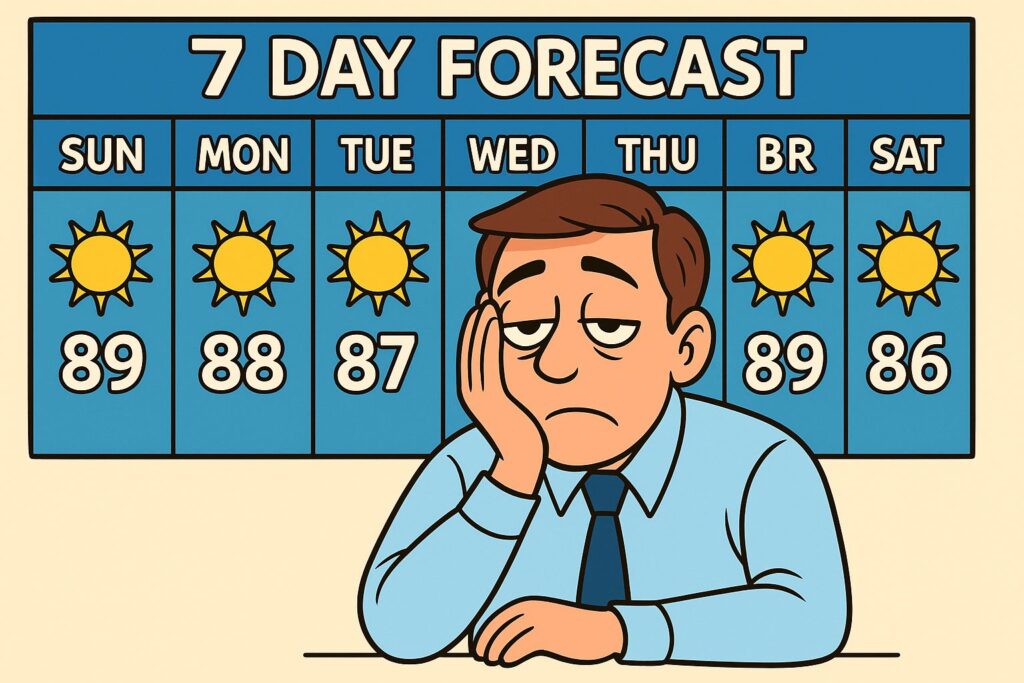
Image by ChatGPT. I have no idea why Friday is abbreviated BR, but AI is gonna AI.
However, it becomes pretty boring to write about that kind of a pattern every day (sometimes we must take drastic measures to relieve the tedium, like a GIF-based forecast). Moreover, as someone who lives in Houston, it is boring to experience the same weather every day, especially when we are supposed to be transitioning from summer to fall. Variety is the spice of life, and all that. Well, I’m here to tell you that this transition is happening finally, so buckle up.
Tuesday
We’re going to see another partly to mostly sunny day today, with high temperatures likely reaching 90 degrees for most of the region. (There’s a non-zero chance this is our final 90-degree day of 2025, but I don’t want to jinx anything so pretend I did not write that). A weak front will arrive later today, and it will bring a slight chance of showers and isolated thunderstorms with it. The best chances will be east and southeast of Houston, particularly in areas near Galveston Bay, this afternoon and early evening. The front will usher in some drier air, and lows tonight will drop into the upper 60s in Houston, with cooler conditions for outlying areas.
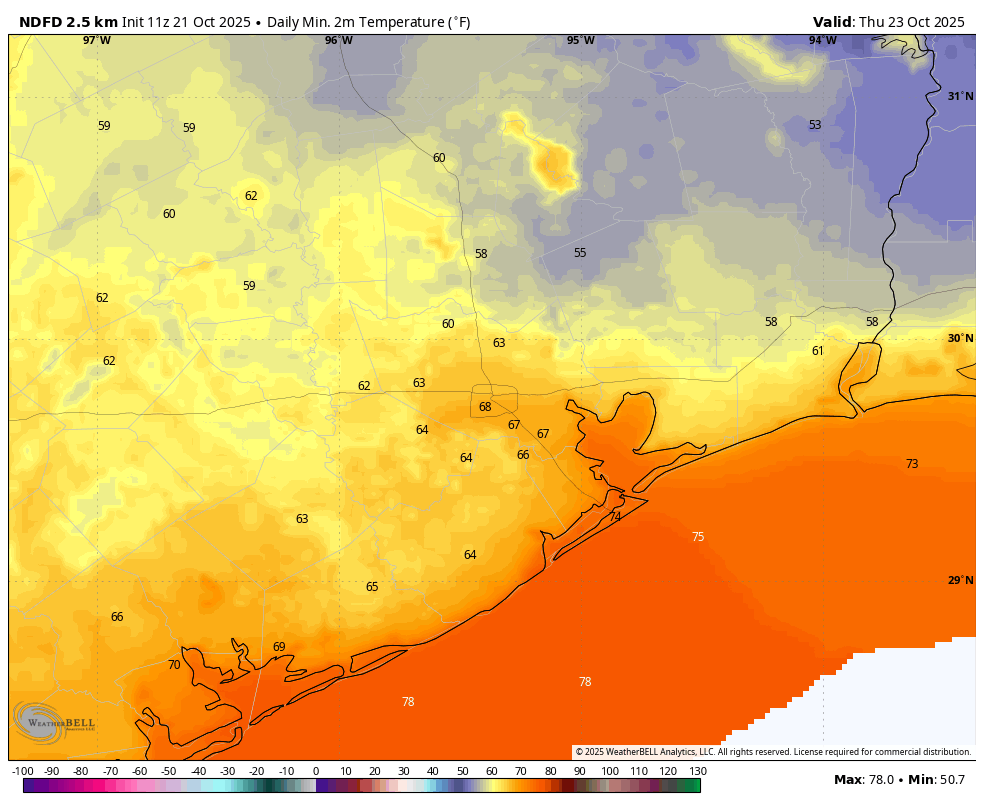
There is some uncertainty in the low temperature forecast for Thursday morning. (Weather Bell)
Wednesday
This will be a sunny and pleasant day, with mostly dry air and highs of around 80 degrees. It’s not precisely clear how long the drier air will hold over Houston, and this means we have some uncertainty about how chilly Wednesday night will be. I’m going to be optimistic and say much of Houston drops to around 60 degrees by Thursday morning, but if our dewpoints rise more quickly, it’s going to be a more humid and warmer night.
Thursday
This should be another mostly sunny day, but highs will be a little warmer, likely in the mid-80s for most locations as the onshore flow resumes. Lows on Thursday night will drop into the lower 70s.
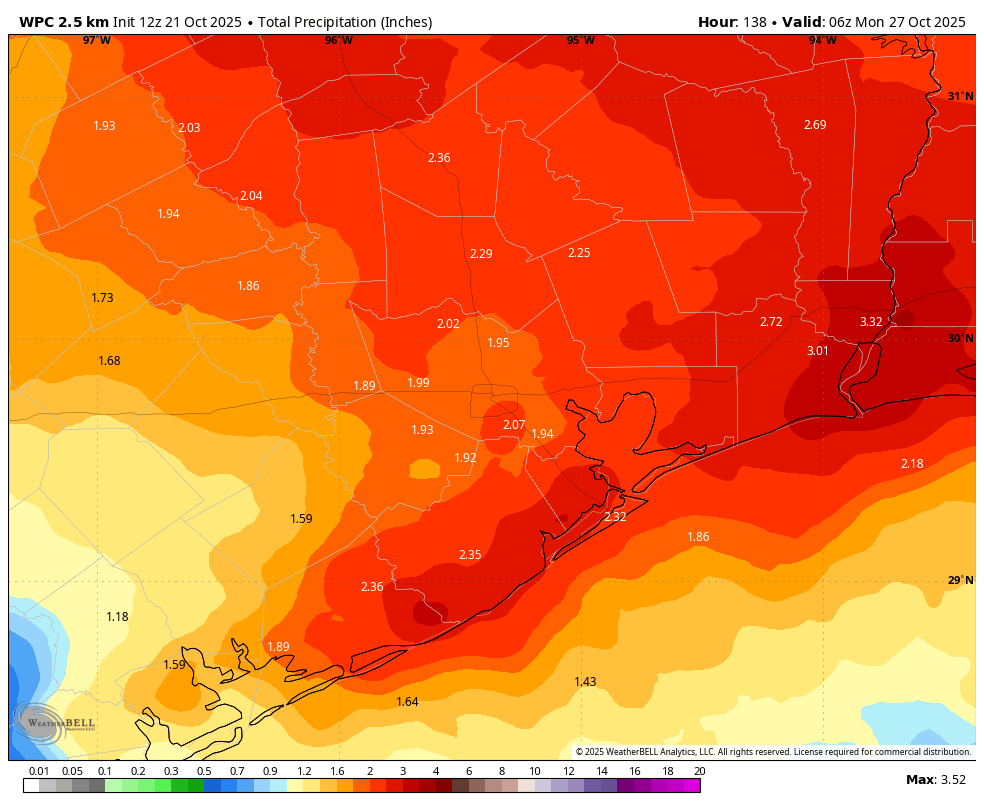
NOAA rain accumulation forecast for now through Sunday. (Weather Bell)
Friday, Saturday, and Sunday
An upper-level low pressure system will approach, and move through the region this weekend, and with abundant atmospheric moisture to tap it is going to bring our best chance of rain in many weeks. Friday should start out mostly sunny, but we’ll see building clouds during the afternoon. Late Friday night through Saturday night is when I expect to see the best chance of rain, with the potential for some thunderstorms. The entire region should see precipitation, and the models have become more bullish overnight. I’m projecting about 2 inches of rain for most people, but totals will vary widely and there is the potential for higher accumulations. Rain chances will fall on Sunday, perhaps to around 40 percent, before things clear out. The weekend will see highs in the vicinity of 80 degrees with mild nights near 70 degrees.
Next week
Most of our model guidance is still pointing toward the arrival of a fairly strong cold front by around next Wednesday or so. Would I etch this forecast in stone, since it is eight days out? No I would not. But I’m rather hopeful that truly fall-like weather is coming during the second half of next week. Details to come as our confidence increases.
1. My coworkers aren’t following our return-to-office mandate
My company’s return-to-office mandate is eight days a month for at least five hours each day. The tracking system, however, only records “days in office,” not hours.
As a result, many coworkers come in for an hour or two, grab coffee (we have very good coffee), and leave. They don’t get flagged because the system shows compliance, even though they’re not following the written rules. My manager hasn’t addressed it, though he must know it’s happening.
I’ve been following the letter of the rules, and resentment is starting to build. Upper management keeps stressing the mandate, but on the ground there’s no real enforcement. I’ve only been here for a year but I have good relationships with my coworkers and manager. I value the flexibility we have and don’t want to be the office tattletale. How should I handle my frustration in this situation?
It’s really up to your manager to decide (a) whether he cares that it’s happening and (b) whether to address it. He may not care! That’s his prerogative, if so — at least to the extent that management above him permits him to look the other way. For all we know, the managers above him might not care either.
You can either keep doing what you’re doing or, if you want to, start to use some of the flexibility your manager is apparently granting to others. If your concern is that your coworkers are going to ruin work-from-home for everyone else by abusing the current system … well, they might. But it’s not something you have control over; it’s your manager’s to decide how to manage that, and at the moment he’s choosing to let it go.
That said, you could ask him directly about that: “Should we be worried that we’re at risk of work-from-home being revoked completely if people don’t work their full five hours in the office when they come in? I admit it worries me and I wondered what your take is on that.”
2. My employee has a suspicious spot on their hand
I manage a team remotely so I rarely see my team from the shoulders down. We had an on-site event recently and I noticed that one of my direct reports has a very suspicious looking spot on their hand that looks like that could be cancerous. I only recognized it because I have a similar spot on my foot and my doctor was concerned it might be cancer (it wasn’t). Is there any way I could bring this up as something they might want to get checked out? None of us are medical professionals and I don’t know if I would be severely overstepping as their manager by saying anything.
You can bring it up once; just leave it in their court after that, regardless of what they do with the info. Don’t check back with them, and make it clear you’re just giving them information that they can act on or ignore as they want.
I’d say it this way: “I don’t want to overstep and I try not to comment on health things, but I noticed you have a spot on your hand that looks exactly like one I had that my doctor wanted me to get checked out in case it was cancerous. You might have already looked into this, but in case you haven’t, I wanted to mention it.” Then, leave it to them.
3. I was rejected for culture fit — should I encourage them to reconsider?
I was recently invited to interview for an admin position at a very small business. They emphasized heavily that the role involves a lot of time pressure, and in particular that the boss (who puts a lot of focus on getting each project perfect for each client) can be quite demanding, but that she recognizes when she oversteps and apologizes / offers perks to make up for it. The interviewer mentioned having worked for her for over 20 years, so I believe her that this wouldn’t be like walking into a nightmare like the horror stories you so often hear.
I felt like the interview went really well, that it was a role that would really suit me, and that I’d done a great job of conveying my skills to the interviewer. Unfortunately, that same afternoon I received a rejection letter: “After lengthy discussions among my team, I need to advise you that unfortunately your application has not been successful. We felt that you interviewed well and we are sure you would be able to manage the work, but your gentle and quiet demeanor made us unsure as to whether you would be happy working in our sometimes very hectic office. If you wish to discuss anything, please reach out to me next week. We otherwise wish you the very best in your search for a new job.”
I understand it takes me a little bit of time to warm up to people and that I tend to listen more than speak until I do, but I really feel that this won’t be the sort of long-term obstacle to my success and happiness that they’re worried it would become. I understand that part of the reason why employers are reluctant to offer specific feedback is because it invites the applicant to disagree, and I respect that they understand the role a lot better than I do, but… I understand myself a lot better than they do, and it feels rough being rejected based on something I would have removed myself from the pool over if I had serious reservations about it.
I’m not sure what to make of their offer to call them back if I have anything to discuss. My main thought is to call them, thank them for the consideration and feedback, explain what I’ve just told you, and wish them luck with their other candidates but invite them to reconsider me if it turns out they don’t like any of their other options? I’m not really sure whether that would come across as overstepping. Should I do it, or just move on?
Move on and consider that this might be a bullet dodged. A very small business emphasizing heavily that the role involves a demanding boss who tends to oversteps and needs to apologize and offer perks to make up for it does sound like it has high potential to be a nightmare. The fact that your interviewer had worked there for 20 years makes me more concerned, not less, because people tend to get used to dysfunction over time and start to accept things someone newer to the business would be horrified by. If you’d talked to multiple people who had been there only a few years and seemed happy, I’d find that more reassuring — but a small business with a 20-year employee reporting this? Big caution sign.
Moreover, in a small business, personality fit can be really important, and you don’t want to try to persuade them the fit is right if they’re not already convinced. And in this context, “your gentle and quiet demeanor made us unsure as to whether you would be happy here” sounds highly likely to mean “you need a much thicker skin because you’ll be working in what most people would consider a difficult environment.” When you combine it with the paragraph above, I’d figure the rejection is a blessing in disguise — or at the very least, not one to try to get overturned.
I work in academia in a support team. I’ve worked in this position for several years. I have an academic work ID and was able to get a department badge before they discontinued creating them. Last week, I received an email from upper management saying that they’d like my team to have recognizable photos on the website for our department and in our directory because we deal with a lot of customers. The message did include a line saying that if for some reason we don’t want a photo, we should contact a specific person.
This messages also went to the other three women techs and the rest who do not have a headshot image on the website. The exception being one of my coworkers who is friends with one of the upper management and who was not included in the email. He had his image removed about a year or so ago because he didn’t like how he looked.
At one of my previous jobs, I was harassed by the clientele. Some of them tried to get more specific details about me like my last name. I feel like that could have led to creepy behavior and/or something worse.
Any suggestions I can use to say no respectfully? Especially in academia, I strongly prefer to minimize my online presence for my own safety. Again, I have my ID and badge. I have no problem showing those when requested.
It seems like they pretty explicitly opened the door for you to say no, by acknowledging that someone might have a preference not to do this. But even if they hadn’t, it would be fine to reply back and say, “I prefer not to post a photo for safety reasons, although of course I’m always happy to show my ID and badge if asked.”
5. My coworker keeps insisting I must speak Spanish
I have a coworker who keeps asking me if I speak Spanish. I have told her multiple times that I am not fluent in Spanish and cannot translate, but she keeps asking. My name is Jose and I have a darker complexion compared to her.
In my mind, this has surpassed the reasonable expectation that someone would forget about my skill set and has ventured into profiling based on my heritage. Is this a valid issue to bring to HR if this type of behavior continues even after I’ve consulted with the department heads of both parties?
Yes, and it’s a problem that your coworker’s boss has been informed and hasn’t put a stop to it yet. I wish I knew what both managers’ responses had been when you addressed it with them — but regardless, if it’s still happening, talk to HR.
Sure, it was a huge bummer that they cut funding for fixing the streets in our town. We enjoyed going places. But, overall, it’s worth it for the tax cuts we expect any day now. I mean, at least we owned the libs. Libs love streets. Did you see that video of Trump dumping shit on libs marching in the streets? Got ’em!
- - -
Ah, dang. Groceries have never been more expensive. We really thought this was something Trump might be able to help us with. But the high cost of food is worth it so a transgender teen in Idaho can’t use the school locker room. Libs aren’t cheap to own, but the price is more than fair.
- - -
Wait, when they said they were going to dismantle the Department of Education, they were talking about, like, America’s Department of Education? The one that funds our schools? Shoot. Our kids will have to learn how to read from the back of cereal boxes. But at least the cereal doesn’t have Red Dye No. 2 in it. And as we all know, the libs are OBSESSED with Red Dye No. 2. Owned!
- - -
Owning the libs all the way into a measles outbreak? That’s called “keeping the narrative spicy,” and it’s NOT a bad thing.
- - -
Yes, we liked that restaurant. Yes, it would have been better if they hadn’t shut down, but half their staff got deported, so what are you going to do? At least all those dumb woke libs in LA and New York can’t eat at this Mexican restaurant in Columbus, Ohio, either.
- - -
Our cousin lost his soybean farm. We really thought the tariffs would help American farmers, but it turns out other countries just stopped buying our stuff. Stupid woke CCP. But you know what you can’t repossess? An ideological victory. I mean, except every four years, when the presidency changes hands. Whatever. The libs have been owned so hard they don’t even know what hit ’em.
- - -
So when they said they were axing “federal government jobs,” we just assumed they meant jobs in MARXIST blue cities. This is an unwelcome surprise. But you know what? This annoying liberal girl I knew in college cried in her IG story on election night. And we’ll ride that all the way to the bank (where they’ll hopefully give us a loan).
- - -
The water’s been brown for three weeks. It’s a drag, but I bet there’s an Ivy-educated lib walking around Bushwick in a really bad mood right now. So it’s totally worth it.
- - -
Huge bummer: Our health insurance got cut. We kept hearing Republicans say that lazy good-for-nothings and illegals would stop receiving Medicaid checks every month. And we thought, “Yeah, we’re on Medicaid, but they never send us checks.” So we didn’t think it would affect us. Anyway, in the meantime, we’ll take comfort in the knowledge that the libs probably can’t see doctors either. I mean, all the hospitals in rural areas are shutting down, and coastal elites are famously concentrated in… look, whatever, they’ve been owned, okay?
- - -
All right, well… we can’t pretend this has turned out the way we imagined. But you know what? We heard that a gender studies department in Vermont had its funding reduced by 12 percent. And the video of our great president wearing a crown I posted to my knitting group’s Facebook page really pissed off all the libs on there. And that, in the end, is what matters most.
PARIS – Following a brazen daylight heist of the French crown jewels from the Louvre, French authorities have declared no charges will be laid, citing the country’s “Trop Cool Pour Être Un Crime” (“Too Cool to be Crime”) law. On Sunday, four thieves carried out a highly professional and wicked daylight raid on the famed […]
If you tried logging into Canvas Monday morning and were greeted with little robots tinkering on a broken spaceship, you weren’t alone. HCC’s systems don’t seem to be the culprit—but rather Amazon Web Services (AWS), the giant cloud that quietly powers much of the modern internet.
The massive AWS outage rippled across the U.S. early Monday, taking down major sites and services, including Canvas, the digital home base for most college students. The problem originated in AWS’s U.S.–East-1 region (Virginia), where a network failure caused widespread slowdowns and login errors.
According to Amazon, the trouble began inside its Elastic Compute Cloud network—the system companies use to rent virtual servers and computing power instead of maintaining expensive hardware of their own. In simpler terms, EC2 is what keeps many of your favorite websites running behind the scenes.
Amazon said the internal system that tracks how much traffic and strain customers put on its servers malfunctioned, throwing the whole network out of balance. To prevent things from getting worse, AWS temporarily limited how many new server companies could spin up while engineers worked to get everything back online.
As of now, Canvas remains offline. HCC’s IT team confirmed in an alert that the platform is experiencing technical issues “due to Amazon cloud being offline,” and that the vendor is actively working to fix the problem. Students can expect an update once Canvas is back to normal.
So, while the outage may be inconvenient (and a little panic-inducing for anyone with deadlines looming), it’s also a reminder that the cloud isn’t invincible. Even a minor failure in a far-off data center can leave students unable to access assignments or submit work on time, underscoring the need for backup plans and flexibility.
I often bake for my office. I just bring in the baked goods and leave them in the kitchen. I don’t solicit compliments and I don’t directly offer them to people, either. The only compliment I need is seeing an empty tray at the end of the day. I don’t even know who tried the baked goods and I don’t seek to find out.
The baked goods generally go over well and I get thank-you’s and compliments, but I also get a handful of people coming over to thank me for bringing in baked goods but explaining that they can’t eat them for whatever reason — allergies, diet, whatever.
This bothers me a lot and I don’t know if I’m justified. A generous reading is that they are trying to thank an act of generosity even if they couldn’t partake in it, but it rubs me the wrong way. One reason is, I don’t want to hear about my coworkers’ food issues. I have my own. The other is it seems to be negating what I did and making it about themselves. The other is that it interrupts my work for no reason. I always want to say, “I don’t care if you don’t eat the pastries!” I’d rather receive silence than an empty compliment! Is there anything I can do other than nod and say “thanks”? But what am I even thanking them for?
Yeah, people should just pass up the baked goods without comment; they don’t need to report to you whether they ate them or not, or why they couldn’t.
If this were food being provided by your office, that would be different. In that case, they’d have standing to talk to whoever coordinated the food and ask that a more inclusive variety of treats be offered so they weren’t regularly being left out.
But you’re just a coworker who likes to bake. They don’t have standing to ask you to change what you’re making or to stop bringing it in (if either of those is the subtext of the comments, which is possible).
That said, I’m curious about how often you’re bringing in treats. If it’s multiple times a week, I could see people feeling like … well, not that you’re obligated to provide them with treats tailored to their needs, because you’re not, but still feeling like, man, that’s a lot of times to walk into the kitchen and find out that once again there’s a plate of brownies they can’t eat.
As for what to say when it happens: you said you feel like you’re supposed to say “thanks” but that doesn’t really make sense as a response. You could say, “Sorry you couldn’t eat them!” or “Yeah, I love to bake but I know it won’t be for everyone” or “Just needed to get them out of my kitchen” or “Hey, while you’re in there can I ask you about WorkTopic?”
But I don’t think there’s a magic way to stop the interruptions from happening in the first place. And I bet you’re also getting interrupted by people who want to say the food was delicious or to thank you for making it. If the interruptions really bother you, you’re probably better off just not bringing in food as often — because it’s the kind of thing that will lead to conversations/interruptions about it.
As Immigration and Customs Enforcement seeks to increase its presence across the country, the agency is actively recruiting new agents to carry out the Trump administration’s mass deportation campaign. The Onion breaks down how to join ICE.
STEP 1
Be born with something just…missing
STEP 2
Try deporting a few neighbors without the constitutional authority to do so, to see if it’s for you
STEP 3
Unlearn any secondary languages you may know
STEP 4
If filling out the application form presents a challenge, candidates may instead demonstrate how hard they can punch a dog
STEP 5
Undergo background check confirming at least one prior arrest for a violent crime
A major Amazon Web Services (AWS) outage took down multiple online
services for around four hours this morning, including Amazon,
Alexa, Snapchat, Fortnite, ChatGPT, Epic Games Store,
Epic Online Services, and more.
As of 6:35AM ET, the AWS status checker is reporting that
“most AWS Service operations are succeeding normally now,” and
some of the impacted platforms, including Fortnite,
Epic Games Store, and Perplexity have announced
that they are fully recovered and back online.
However, as of 9:50AM ET, Amazon says that multiple services in
the US-EAST-1 Region are still “impacted” by operational issues,
and that it is working towards a full resolution. The AWS
dashboard first reported issues affecting the US-EAST-1 Region at
3:11AM ET, with global services in other regions also taken
offline. The cause of the outage hasn’t been confirmed, and it’s
unclear when regular service will be fully restored.
I bet it was this AWS outage that explains why I couldn’t sign in to my NYT account to play Wordle this morning. (Got it in 4 today.)
Update:Amazon claims the issues were resolved at the end of the day. I still couldn’t order food for delivery from a few local restaurants, including any that depended on Doordash or Toast, at 7pm ET though.
The Weingarten Art Group in Houston has issued an open call for a public sculpture to be installed in the city’s East End District.
The open call invites U.S.-based artists with experience creating large-scale public works to submit qualifications for the design and production of a sculpture at the Navigation Boulevard Roundabout in the culturally diverse area along Buffalo Bayou. According to a press release, the Weingarten Art Group is seeking “a landmark gateway sculpture that celebrates one of Houston’s most historic neighborhoods,” with a total budget of $1 million.
Navigation Boulevard roundabout. Rendering courtesy of the Weingarten Art Group
East End District landscape designers and engineers will coordinate closely with the selected artist to design a foundation for the artwork, along with landscaping and lighting.
A Request for Qualifications (RFQ) is the first phase of a two-phase selection process. Following submissions for the RFQ, three finalists will be invited to submit detailed proposals in the Request for Proposals (RFP) phase. Each finalist will receive a $4,500 honorarium for the development of a detailed design proposal, with a site visit required in March 2026. Travel expenses for the artist and up to one member of their studio will be reimbursed.
In its open call, the Weingarten Art Group provides a brief history of the neighborhood in which the public sculpture will be housed: “The East End grew from a 19th-century hub of trade along Buffalo Bayou into one of the city’s most culturally diverse districts. Waves of immigrants — Asian, Hispanic, African American, and European — shaped its neighborhoods, industry, and identity, fostering a tradition of resilience, activism, and community pride. Known for its industrial base, thriving small businesses, and role in peaceful civil rights efforts, the East End also became a center for education, faith, culinary delights, and the arts. Today, it blends historic character with revitalization, offering vibrant public art, eclectic dining, walkable neighborhoods, and strong civic engagement, while honoring its rich multicultural heritage.”
A roundabout site in Houston’s East End.
In addition to design and production of the public sculpture, the selected artist will also serve as a mentor in the Weingarten Art Group’s inaugural East End Artist Launchpad, a new mentorship initiative supporting local emerging artists as they develop and install their own temporary public artwork in the East End.
The RFQ deadline is Monday, December 8. Finalists will be notified February 16, 2026, and installation of the selected sculpture is scheduled for late 2027.
For further details on the application process and evaluation criteria, visit the Weingarten Art Group Submittable page.
Catch the Dome at golden hour and the place almost forgets its own size. The ring road slows to a hush, sodium lamps warm up along the edges, and a slant of light slips under a corrugated seam like a rumor. No crowd pressure, no PA system clearing throats — just wind combing the parking stripes and a gull writing wide ovals in the sky as if testing the roof’s radius. Your eye drifts toward small things it never found during game days: a faded “Gate C” arrow that still points confidently at nothing; a patch of stubborn grass where concrete cracked; a handrail with a palm-polished gleam that readies itself out of habit. The building doesn’t perform anymore; it lets you.
That mood already circulates online. The liminal spaces feed hums with cousins of this scene — office parks at dusk, hotel corridors that never end, night lobbies with one plant and too much carpet — images that teach a slower way of looking rather than shouting for attention. The Astrodome slides into that cadence with natural ease. Phone cameras love it because they can’t swallow it; they imply it. A slow pan across an empty concourse does more than document absence; it lays out a method: read surfaces, listen for what isn’t speaking, let scale arrive in pieces.
An aerial photograph of the Astrodome. Image courtesy of Rice University’s Kinder Institute for Urban Research
Art history keeps a few wayfinders for this kind of seeing, and we can tuck them in without breaking the spell. Alois Riegl, the Viennese art historian who asked why societies keep old things around, sorted our attachments into categories: what still works for us now, what tells us about then, and what age itself grants — that shy glow objects earn by surviving. The Dome’s current charisma leans on that last value, which the internet multiplies: scuffs as patina, dust as atmosphere, vacancy as meaning.
Robert Smithson, poet of entropy and inventor of the phrase “ruins in reverse,” taught viewers to watch construction and decay run in parallel like two lanes of the same freeway. Even stabilized and landmarked, the Dome practices that duet — steel softening by degrees, concrete taking on a matte calm, a bowl that frames air more often than spectacle. And Rosalind Krauss, who mapped sculpture’s “expanded field” when art escaped the pedestal, offers a neat diagram for the Dome’s drift: less straightforward building now, more a hybrid zone that behaves like architecture, landscape, and sculpture at once. None of this demands theory to feel true. It just gives names to intuitions the body registers on contact.
Post-internet culture turns those intuitions into circulation. When images learned to outrun the things they depict, attention shifted from objects to their travel routes. Hito Steyerl called the migrating, compressed file the “poor image” — a format that wins by moving farther, not by looking perfect — which explains why dim, handheld walkthroughs of the Dome can shape public feeling more convincingly than any glossy rendering of a “future activation.” The copy outpaces the plan; the share becomes the event.
And the temperature of those shares? Cultural theorist Mark Fisher’s conception of the word “eerie” fits like an interior climate. The eerie registers when something that should be present feels absent (the crowd, the clear authority) or when a force acts without a face (debt, policy, time). The Dome triggers both conditions. You arrive expecting bodies and noise; you meet hush and committee minutes. Agency persists, but behind the scrim. No melodrama, just a persuasive quiet that keeps asking you to notice the missing.
This, by the way, is why the drive-by “ruin porn” complaint lands short. The appetite here rarely celebrates collapse; it builds a kind of literacy. Liminal images teach you to read where optimism hardened into protocols, where protocols slid into postponement, and how postponement developed a look. The Dome offers a civic-scale seminar in that progression without wagging a finger. It simply shows its work.
Stand by the fence and the seminar begins. Air moves differently inside manufactured voids — thinner, slightly refrigerated, like air that used to labor for comfort and now coasts on muscle memory. The roof’s ribs pull your eye in long, even strokes; the mind submits gladly to the metronome. A maintenance golf cart, the only vehicle with credentials, clicks past and vanishes under the bowl as if it entered a different weather system. Even the typography performs: blocky letters that once choreographed a crowd now read like a municipal poem about guidance and desire.
If this feels strangely art-like, that’s not a mistake; it’s a category update. Contemporary art long ago pivoted from objects alone to the systems that carry them — cables, logistics, platforms, policy. By that measure the Astrodome behaves like a collaborator. It curates attention by refusing to overexplain, performs scale without spectacle, converts a budget line into a feeling, and gives cameras honest work: translate volume into rhythm. Artists who tune infrastructures would hear the invitation immediately — Yuri Pattison with ambient computation, Jon Rafman with platform sightlines, Tabita Rezaire with networks and care. The point wouldn’t be to decorate. It would be to keep the room legible at the volume where you hear Fisher’s register and trace the policies as they breathe.
What to do, then, with a structure already functioning as a public lesson? Resist the binary of total reboot versus clean erasure. Stabilize the shell; keep it openable instead of perpetually closed. Cut a few precise overlooks — places where the bowl reads as landscape, where a single sightline carries the story better than a thousand placards. Commission light-touch works that score the architecture rather than drown it: a sound piece that catches the building’s long reverb, a typography guide that treats the signage like an urban palimpsest, a night program that choreographs existing lights without turning the thing into a theme park. Let the building keep its quiet and make that quiet accessible.
The “eighth blunder” line, used with a smile, doesn’t roast Houston’s past; it nicks our habit of answering every complicated object with a retail-scale solution. The Dome suggests a more contemporary reflex: sometimes a city earns more by learning to look than by rushing to make. That learning travels. You start seeing your grocery store at closing, your office lobby after the badge readers breathe out, your feed at 2 a.m. with the volume down. You notice how illumination scripts emotion, how wayfinding nudges a gait, how small neglects compose accidental stage sets for daily life. The building becomes a teacher for everything that isn’t the building.
Back outside the fence, evening does what evening does best: edits. The roofline goes charcoal, the ring road finds its quiet, and the gull gives up on geometry. A breeze catches a plastic bag, sets it drifting along a painted line, then lifts it suddenly as if reminding the bag who decides. The Astrodome doesn’t plead for a second chance or a final verdict. It offers a rhythm. Keep the shell. Mark the overlooks. Let the feed carry the lesson. And when the city needs to think in public, bring people here and let the room do the talking.
Spatial awareness. The desert as a reclaimed entity. Expansion of temporal limitations. Dismantling of everything that doesn’t serve your own expansion. Delicate resilience. Creating form for form’s sake. Delighting in gesture. Trust as an act of making. How still is still enough? Disrupting a pattern to make a new pattern. Making something out of the abundance in nothing.
These are the first thoughts that enter my mind after leaving an experience with Hannah Spector’s thoughtful show at Women & Their Work, if you stare at a cowboy’s face for long enough, it turns into a sunset. Like watching a film that steals your sense of reality, I felt a bit changed leaving the gallery and returning to the world as I left it. Details have become more vivid, even the most mundane. And everything I considered important before entering the exhibition seems faint and far in the distance. A success by any standards of transportation. Is this not the job of art?
I often have this debate with other creators — are we required to make political work in dire times? There are those that deem anything else worthless, insisting we always voice dissent. What about divine inspiration? Making work to stay sane? Building the world you want to live in? Transporting ourselves to interior worlds?
The personal is political and in that, Spector brings us into a private sphere of rhapsodic jubilation, one that doesn’t require a previous knowledge of the language, it’s a language of inquiry, of poetics, of existential wandering with an indeterminate number of flaneurs under desert skies. The sense of searching is loud. From the montages of nocturnal footage lit with numerous flashlights within the video to the experimentation with materiality in their sculpture, this show resurrects our search for meaning. Here they find it inside of comradery, environment, found objects and scorched earth, a love letter to moments and tender revelation.
Hannah Spector’s “if you stare at a cowboy’s face for long enough, it turns into a sunset” on view at Women & Their Work. Photo: Essentials Creative
Behind a floor-to-ceiling wall of blackout curtains, I encounter the namesake video centerpiece of the exhibition. The installation surrounds a cozy invitation to lie and indulge on piled futons, positioned amid seven video projections on a variety of simple, raw screens in various sizes and angles. On these, I begin to witness montages and mirrored footage of abstracted pairings and multiplicitous portraits: moon-like orbs, cacti, puddles, dust, bones, mountains, night seeing, others.
Hannah Spector’s “if you stare at a cowboy’s face for long enough, it turns into a sunset” on view at Women & Their Work. Photo: Essentials Creative
If you choose to recline in the intended bed, the piece can only be partially seen. I immediately think of the Ryoan-ji Temple’s rock garden in Kyoto, Japan, which contains 15 large rocks positioned so only 14 can be viewed at any given time; one is always hidden. This celebration of imperfection on the path toward resolution is fitting for Spector’s experimental collage of video, which has a refreshing impulsivity and playfulness. The audience bears witness to a convergence of their artistic languages through the narrative voiceover, hypnotic visuals, performances by Spector and their friends, and the subtle soundtrack with recitative mantras.
Here is an artist truly at play and at home with themself, in their element with the unmistakable backdrop of West Texas. The video begins with a panoply of disparate images, creating a chaos of muted calico observations. As the piece progresses, the imagery homogenizes into mirrors, inversions, and meditations that I read as the gift of calm singularity that desert time provides.
Hannah Spector’s “if you stare at a cowboy’s face for long enough, it turns into a sunset” on view at Women & Their Work. Photo: Essentials Creative
A found chair is held aloft, perhaps in defiance of comfort. The musings trigger a memory of reading Carlos Castaneda as a teen, that sense of inevitable existential probes that come with refusing an allegiance to normative standards. Indeed, Spector uses inversion to reimagine the American West here, with motifs of totemic animal figures, boots, tumbleweeds, absurdity, mesquite brush, tracks, doubling, movement, and vastness. The exchange between bodies expands into choreography, with an out-of-body consciousness one equates with transcendence.
Hannah Spector’s “if you stare at a cowboy’s face for long enough, it turns into a sunset” on view at Women & Their Work. Photo: Essentials Creative
As the sublime morphs back into play, the collages give way to an exchange of multitasking for both the performers and the viewer: Overlapping arms on stucco, codeswitching with garments, and watching themselves drawing boundaries in the dirt all happen as we, the viewers, traverse between screens. There is a celebration of the discarded and the overlooked, which evokes Barbara Hammer’s A Month of Single Frames in my side brain. After a third watch, I stand up in silence and read the vinyl wall text piece in the shadows: mesquite bean opening in midnight doesn’t make a sound. I emerge back into the light.
An installation image of Hannah Spector’s “if you stare at a cowboy’s face for long enough, it turns into a sunset” on view at Women & Their Work. Photo: Essentials Creative
Rebirth into blinding sunlight. Here I am in this language, the dialect of the gallery world. The vinyl, ceramic sculpture and copper-plate etching prints in the front room represent this language with a cohesive materiality and sense of form. The subject matter dances around traditional signifiers of masculinity with a twist of… yes, play! Slip-cast boots and railroad ties, pit-fired hybrids of desert fauna and tools, and barrel-fired ceramic sculptures are presented in grand salon style, but I secretly wished for privacy and controlled lighting to spend time with all the thought put into this work.
The epicenter of this arrangement, sleepwalking (with clocks), displays a treated piece of mahogany with tabs of etchings around the exterior edge like numbers on a timepiece. The image is one of strong power, with a repeated motif of a human form holding two orbs, like a deity of moons or a bodybuilding effigy. Mahogany becomes a character in this narrative, used in several of the pieces, which comes as no surprise, as it is a traditional symbol of strength and resilience, like the emotional armor needed for the desert, for proposing new languages, and for handling the materials used in the work of this sculptural antechamber. Here, Spector’s work in the front room does play second fiddle to the video installation to a degree, due to the limitations of the gallery layout, making the sculptural and print work feel like an introduction or even a separate show. The preset position of a curtained track separates the seven-channel video from the other works, giving it a vast majority of the real estate, and effectively predetermining its emphasis.
Works by Hannah Spector on view in “if you stare at a cowboy’s face for long enough, it turns into a sunset” at Women & Their Work. Photo: Essentials Creative
Hannah Spector defines themself as a poet, interdisciplinary artist, educator, and composer, which is evident in both their approach to video as well as their community presence, curating memorable events around Austin, most notably at Shed Shows and MASS Gallery. Theirs is a language of interchange, of giving back, of continual threads unraveling in suspended belief, of possibility. Even the copper-plate prints, ceramics, mahogany frames, and objects in the front space of the gallery have an unfinished essence, leaving the viewer agency to complete the entities and reclaim them mentally in response. A small plinth offering chapbooks, stickers, and audio cassettes for sale, encourages the visitor to bring a piece of Spector’s spirit home with you to continue the conversation. This generosity and desire for connection is a recurring throughline in not only this exhibition but in the way that Spector moves through the world. Confident Vulnerability is what I felt when I left the dark womb of the show, which I posit as an excellent state in which to navigate our current world in turmoil.
Hannah Spector’s if you stare at a cowboy’s face for long enough, it turns into a sunset is on view through November 16, 2025, at Women & Their Work in Austin.
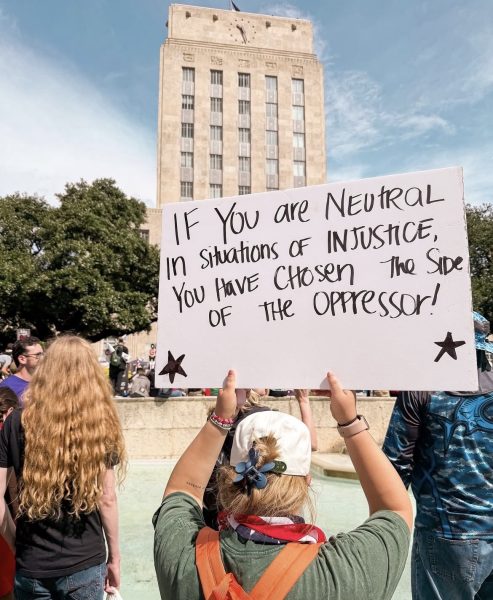
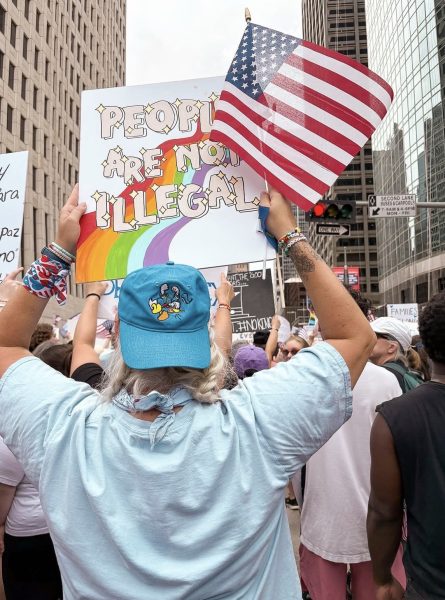
On October 18, local protestors joined a national wave of No Kings demonstrations against what organizers describe as President Donald Trump’s growing authoritarian inclinations. Various rallies occurred in Houston, including at Discovery Green downtown and The Woodlands.
Lindsey Gaughan via Instagram.
A coalition of more than 200 progressive organizations, like the 50501 Movement and Indivisible, is organizing the “No Kings” movement. As part of a national effort, more than 2,500 protests are taking place across all 50 U.S. states on October 18. Movement leaders stated that around 1,700 people had registered online to take part in the downtown Houston protest. According to the Houston Chronicle, police did not confirm this number of participants.
At Discovery Green, protesters held their demonstration at noon around the same time as other concurrent events, such as the Families with Pride festival. People crowded the park and overflowed to other streets, shouting slogans and carrying signs denouncing the presence of “kings” in the White House. Outside central Houston, satellite protests continued in communities such as Pasadena, Pearland, Clear Lake, Conroe, and The Woodlands.
In Texas’s state capitol, Governor Greg Abbott deployed the National Guard, Texas Rangers, and state troopers where planned protests were to be held, citing fears of violence and unrest. In Houston, the local policing presence was visible, yet the protests had minimal displays of aggression and violence.
Lindsey Gaughan via Instagram.
The coalition preached nonviolence, issued safety tips, and urged people to dress up in the color yellow, which was one of the symbols of unity. They cited such issues as increased executive authority, a threat to democratic norms, healthcare cuts, and deportation policies in their statements.
This is the second mass mobilization of this kind since the June protest in Houston, when an estimated 15,000 people gathered in downtown Houston. That earlier protest set the tone for more civic engagement across Texas. Organizers of the event say that turnout for the October protest shows that the movement is not losing its momentum.
As the protests concluded, many hoped this wouldn’t be a one-off event but rather an act of civic action that would continue. Movement leaders encouraged attendees to register to vote, stay informed about politics and upcoming elections, and continue protesting. For many participants, this protest represented a broader call to civic engagement across Texas.
The company I work for is a small father-and-son-owned business with 20 employees. This summer, our administrative assistant, Amy (age 50), broke her hand and required surgery. The injury occurred a week before a previously scheduled vacation. During her absence (one week and three days), the father (Bill) met a 21-year-old woman, Rose, at a car wash and offered her an administrative position, even though no position was open at the time.
Upon returning from leave, Amy found Rose seated at her desk and was instructed to train her to perform her job duties. Amy’s own role was changed to scanning and organizing the backlog of company files, which she was told would later transition to other organizational “projects.” The company is already paperless, so this reassignment is limited in scope.
Over the following months, it became apparent that Rose’s hiring was personally motivated. Bill frequently cooks breakfast for her, speaks to her using “baby talk,” takes her on irrelevant errands during work hours, and pays her to come in on Saturdays to “clean the office” with him alone. There are also indications that company funds have been used for Rose’s personal benefit, such as paying for her vehicle maintenance, paying for gas for her car weekly, and purchasing her gifts.
Recently, Bill verbally confronted Amy during a meeting, believing she had insulted Rose. In addition, he yelled at her for scanning – the very task that she was assigned, with no response as to what tasks should be her focus. Bill is verbally abusive to everyone and has the emotional regulation of a toddler. Amy, caught off guard after months of frustration, raised her voice in response. Although no direct comment about Rose was made, Rose left the meeting upset and was granted two paid days off. Amy apologized to both owners and to Rose afterward. When she met with the son (Jason) to explain, Jason said he did not care about the perks Rose receives because she “does extra work,” and that while he would let this incident go, Amy must tolerate his father’s behavior and accept what happens in the company in order to remain employed. He also said he intends to start documenting her behavior and would look to terminate her if she continues to be a problem.
The workplace has long been known for verbal hostility from Bill, but this is the first time that an angered response received any attention.
Amy is concerned about potential retaliation and whether her reassignment and treatment could constitute age discrimination. I have encouraged her to speak with an employment attorney to clarify her legal position and to get guidance on how to document events appropriately, as well as begin to look for a new position as it is clear that, whether or not it is right, they will find a way to justify firing her. Is there anything else I can do with this situation? I know this is all wildly inappropriate, but it must be illegal too?
So Bill hired a 21-year-old woman for a position that didn’t exist and bumped a 50-year-old employee out of her job to justify it, speaks to her in baby talk, pays her to come in on weekends when it’s just the two of them, and is verbally abusive to everyone else, and his son/co-owner responds by … telling everyone else to accept it or they’ll be fired?
Eeesh.
Yes, Amy should talk to an employment lawyer. It’s likely that there’s enough here to put together an age discrimination case — maybe not one she could prove at trial (although maybe so!) but definitely one that should give her enough leverage to get a decent settlement from the business. A lawyer could have a good time with this.
However, one thing that lawyer will need to look at is whether the business meets the threshold to be covered by the federal age discrimination law. You said the business has 20 employees, and the Age Discrimination in Employment Act kicks in right at 20 employees — but owners generally aren’t considered employees, so if Bill and Jason are included in that count, the law would consider the business to have 18 employees … which would put it below the threshold for coverage. (Federal anti-discrimination laws only apply to business with a minimum number of employees — generally 15-20 — because of what’s otherwise seen as too much regulatory burden on very small businesses.) That said, your state might have its own age discrimination law that kicks in at a lower number of employees; many do, and the lawyer Amy talks to will know.
As for what you can do beyond encouraging Amy to talk to a lawyer and offering to be a corroborating witness … well, there’s power in numbers. Would a group of your coworkers be willing to put their collective foot down about Bill’s abuse? If you act as a group, would you have the leverage to insist on changes? People often feel they’re at the mercy of an abusive boss — but if enough of you band together, you’d have more power as a group than you have on your own. (This is the whole idea of unions — but you don’t need a formal union to act collectively. And the National Labor Relations Act, which protects employees who band together to speak up about working conditions, applies to any business with one or more employees.)
Really, though, a better long-term plan would be to get out. Any business, large or small, can be dysfunctional (we’ve seen plenty of proof of that here) — but when you get this kind of dysfunction at a small business, it tends to infuse absolutely everything, and generally the best move is to just get yourself out of there.
MONTECITO, CA—Signaling a new chapter in her career, pop star Katy Perry released a new single Monday about the superiority of Canadian manufacturing. “When I learned about the strength of Canadian automotive and aerospace manufacturing, I knew I had to put it in a song,” Perry said in an Instagram post accompanying a preview of the new track, which features lyrics such as “Five-fifty billy in exports annually, uh-huh / They makin’ tires in the Annapolis Valley, uh-huh” over a hip-hop-influenced beat and a Max Martin–produced chorus that emphasized the country’s advantages in skilled labor. “I like to write about what’s going on in my life, and right now, I’m definitely in my single, flirty, manufacturing-powerhouse era. British Columbia’s hydrogen fuel cell industry is a whole mood. I hope my KatyCats have as much fun listening to ‘Made In Canada’ as I had recording it.” At press time, Perry announced she would be releasing a new album on Boxing Day.
Amazon Web Services experienced DNS resolution issues on Monday morning, taking down wide swaths of the web—and highlighting a long-standing weakness in the internet's infrastructure.